Scottish Travels & Book Haul: Wigtown, Arran, Islay and Glasgow
When I was a kid, one-week vacations were rare and precious – Orlando or Raleigh for my dad’s church conferences, summer camp in Amish-country Pennsylvania, spring break with my sister in California – and I mourned them when they were over. As an adult, I find that after a week I’m ready to be home … and yet just days after we got back from Scotland, I’m already wondering why I thought everyday life was so great. Oh well. I like to write up my holidays because otherwise it’s all too easy to forget them. This one had fixed start and end points – several days of beetle recording in Galloway for my husband; meeting up with my sister and nephew in Glasgow one evening the next week – and we filled in the intervening time with excursions to two new-to-us Scottish islands; we’re slowly collecting them all.
First Stop, Wigtown
Hard to believe it had been over five years since our first trip to Wigtown. The sleepy little town had barely changed; a couple of bookshops had closed, but there were a few new ones I didn’t remember from last time. The weather was improbably good, sunny and warm enough that I bought a pair of cutoffs at the Community Shop. Each morning my husband set off for bog or beach or wood for his fieldwork and I divided the time until he got back between bits of paid reviewing, reading and book shopping. Our (rather spartan) Airbnb apartment was literally a minute’s walk into town and so was a perfect base.


I paced myself and parcelled out the eight bookshops and several other stores that happen to sell books across the three and a bit days that I had. It felt almost like living there – except I would have to ration my Reading Lasses visits, as a thrice-weekly coffee-and-cake habit would soon get expensive as well as unhealthy. (I spent more on books than on drinks and cakes over the week, though only ~25% more: £44 vs. £32.)


I also had the novelty of seeing my husband interact with his students when we were invited to a barbecue at one’s family home on the Mull of Galloway – and realizing that we’re almost certainly closer in age to the mum than to the student. Getting there required two rural bus journeys to the middle of nowhere, an experience all in itself.
‘Pro’ tips: New Chapter Books was best for bargains, with sections for 50p and £1 paperbacks and free National Geographics. Well-Read Books was good for harder-to-find fiction: among my haul were two Jane Urquhart novels, and the owner was knowledgeable and pleasant. Byre Books carries niche subjects and has scant opening hours, but I procured two poetry collections and a volume of Dorothy Wordsworth’s journals. The Old Bank Bookshop and The Bookshop are the two biggest shops; wander for an hour or more if you can. The Open Book tends to get castoffs from other shops and withdrawn library stock, but I still made two purchases and ended up being the first customer for the week’s hosts: Debbie and Jenny, children’s book authors and long-distance friends from opposite coasts of the USA. Overall, I was pleased with my novella, short story and childhood memoir acquisitions. A better haul than last time.

‘Celebrity’ sightings: On our walk down to the bird hide on the first evening, we passed Jessica Fox, an American expat who’s been influential in setting up the literary festival and The Open Book. She gave us a cheery “hello.” I also spotted Ben of The Bookshop Band twice, once in Reading Lasses and another time on his way to the afternoon school run. Both times he had the baby in tow and I decided not to bother him, not even to introduce myself as one of their Patreon supporters.
On our last morning in town, we lucked out and found Shaun Bythell behind the counter at The Bookshop. He’d just taken delivery of a book-print kilt his staff surprised him by ordering with his credit card, and Nicky (not as eccentric as she’s portrayed in Diary of a Bookseller; she’s downright genteel, in fact) had him model it. He posted a video to Facebook that includes The Open Book hosts on the 23rd, if you wish to see it, and his new cover photo shows him and his staff members wearing the jackets that match the kilt. I bought a few works of paperback fiction and then got him to sign my own copies of two of his books.


As last time, he was chatty and polite, taking an interest in our travels and exhorting us to come back sooner than five years next time. I congratulated him on his success and asked if we could expect more books. He said that depends on his publisher, who worry the market is saturated at the moment, though he has another SIX YEARS of diaries in draft form and the Remainders of the Day epilogue would be quite different if he wrote it now. Tantalizing!
Note to self: Next time, plan to be in town through a Friday evening – we left at noon, so I was sad to miss out on a Beth Porter (the other half of The Bookshop Band) children’s songs concert at Foggie Toddle Books at 3:00, followed by a low-key cocktail party at The Open Book at 5:30 – but not until a Monday, as pretty much everything shuts that day. How I hope someone buys Reading Lasses (the owner is retiring) and maintains the café’s high standard!
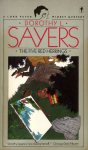 Appropriate reading: I read the first third of Dorothy L. Sayers’s The Five Red Herrings because it’s set in the area (first line: “If one lives in Galloway, one either fishes or paints”), and found it entertaining, though not enough to care whodunnit. In general, I’m terrible for trying mystery series and DNFing or giving up after the first book. Lord Peter Wimsey seemed like he’d be an amusing detective in the Sherlock Holmes vein, but the rendering of Scottish accents was OTT and the case relied too much on details of train schedules and bicycles.
Arran
Our short jaunt to Arran started off poorly with a cancelled ferry sailing, leaving us stranded in Ardrossan (which Bythell had almost prophetically dubbed a “sh*thole” that morning!) for several hours until the next one, and we struggled with a leaky rear tyre and showery weather for much of the time, but we were still enamoured with this island that calls itself “Scotland in miniature.” That was particularly delightful for me because I come from the state nicknamed “America in miniature,” Maryland. This Airbnb was plush by comparison, we obtained excellent food from the Blackwater Bakehouse and a posh French takeaway, and we enjoyed walks at the Machrie stone circles and Brodick Castle as well as at the various bays (one with a fossilized dinosaur footprint) that we stopped off at on our driving tour.


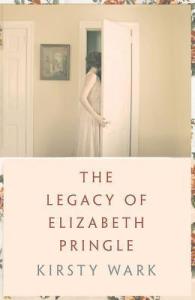 Appropriate reading: The Legacy of Elizabeth Pringle by Kirsty Wark, the only Arran-set novel on my library’s catalogue, is an enjoyable dual-timeline story linked by the Lamlash home of the title character. When she died in her nineties in 2006, she bequeathed her home to a kind woman who used to walk past on summer holidays with her daughter in a pram. Martha Morrison was that baby, and with her mother, Anna, suffering from dementia, it’s up to her to take possession and root out Elizabeth’s secrets. Every other chapter is a first-person fragment from Elizabeth’s memoir, cataloguing her losses of parents and lovers and leading ever closer to the present, when she befriended Saul, an American Buddhist monk based at Holy Island across the water, and Niall, a horticulturist at Brodick Castle. It’s a little too neat how the people in her life pair off (sub-Maggie O’Farrell; more Joanna Trollope, perhaps), but it was fun to be able to visualize the settings and to learn about Arran’s farming traditions and wartime history.
Islay
Islay is a tourist mecca largely because of its nine distilleries – what a pity we don’t care for whiskey! – but we sought it out for its wildlife and scenery, which were reminiscent of what we saw in the Outer Hebrides last year. Our B&B was a bit fusty (there was a rotary phone in the hall!), but we had an unbeatable view from our window and enjoyed visiting two RSPB reserves. The highlight for me was the walk to the Mull of Oa peninsula and the cow-guarded American Monument, which pays tribute to the troops who died in two 1918 naval disasters – a torpedoed boat and a shipwreck – and the heroism of locals who rescued survivors.


We spent a very rainy Tuesday mooching from one distillery shop to another. There are two gin-makers whose products we were eager to taste, but we also relished our mission to buy presents for two landmark birthdays, one of an American friend who’s a whiskey aficionado. Even having to get the tyre replaced didn’t ruin the day. There’s drink aplenty on Islay, but quality food was harder to acquire, so if we went back we’d plump for self-catering.


Incidental additional hauls: I found this 50th anniversary Virago tote bag under a bench at Bowmore harbour after our meal at Peatzeria. I waited a while to see if anyone would come back for it, but it was so sodden and sandy that it must have been there overnight. I cleaned it up and brought home additional purchases in it: two secondhand finds at a thrift store in Tarbert, the first town back on the mainland, and a Knausgaard book I got free with my card points from a Waterstones in Glasgow.


Glasgow
 My 15-year-old nephew is currently on a school trip to Scotland and my sister went along as an unofficial chaperone. I couldn’t let them come to the UK without meeting up, so for months we’d pencilled in an evening in Glasgow. When we booked our Airbnb room in a suburb, it was because it was on a super-convenient train line … which happened to be closed for engineering works while we were there. Plan B: rail replacement buses, which were fine. We greatly enjoyed the company of Santos the Airbnb cat, who mugged us for scraps of our breakfasts.
With our one day in Glasgow, we decided to prioritize the Burrell Collection, due to the enthusiastic recommendations from Susan, our Arran hosts, and Bill Bryson in Notes on a Small Island (“Among the city’s many treasures, none shines brighter, in my view”). It’s a museum with a difference, housed in a custom-built edifice that showcases the wooded surroundings as much as the stunning objects. We were especially partial to the stained glass.


Our whistle-stop city tour also included a walk past the cathedral, a ramble through the Necropolis (where, pleasingly, I saw a grave for one Elizabeth Pringle), and the Tenement Museum, a very different sort of National Trust house that showed how one woman, a spinster and hoarder, lived in the first half of the 20th century. Then on to an exceptional seafood-heavy meal at Kelp, also recommended by Susan, and an all-too-brief couple of hours with my family at their hotel and a lively pub.


We keep returning to Scotland. Where next in a few years? Possibly the southern islands of the Outer Hebrides, which we didn’t have time for last year, or the more obscure of the Inner Hebrides, before planning return visits to some favourites. All the short ferry rides were smooth this time around, so I can cope with the thought of more.

We got home to find our mullein plants attempting to take over the world.
Other 2019 Superlatives and Some Statistics
My best discoveries of the year: The poetry of Tishani Doshi; Penelope Lively and Elizabeth Strout (whom I’d read before but not fully appreciated until this year); also, the classic nature writing of Edwin Way Teale.


The authors I read the most by this year: Margaret Atwood and Janet Frame (each: 2 whole books plus parts of 2 more), followed by Doris Lessing (2 whole books plus part of 1 more), followed by Miriam Darlington, Paul Gallico, Penelope Lively, Rachel Mann and Ben Smith (each: 2 books).
Debut authors whose next work I’m most looking forward to: John Englehardt, Elizabeth Macneal, Stephen Rutt, Gail Simmons and Lara Williams.
My proudest reading achievement: A 613-page novel in verse (Mary Ann Sate, Imbecile by Alice Jolly) + 2 more books of over 600 pages (East of Eden by John Steinbeck and Cutting for Stone by Abraham Verghese).


Best book club selection: Red Dust Road by Jackie Kay was our first nonfiction book and received our highest score ever.
Some best first lines encountered this year:
 “What can you say about a twenty-five-year old girl who died?” (Love Story by Erich Segal)
- “The women of this family leaned towards extremes” (Away by Jane Urquhart)
- “The day I returned to Templeton steeped in disgrace, the fifty-foot corpse of a monster surfaced in Lake Glimmerglass.” (from The Monsters of Templeton by Lauren Groff)
The downright strangest book I read this year: Lanny by Max Porter
The 2019 books everybody else loved (or so it seems), but I didn’t: Fleishman Is in Trouble by Taffy Brodesser-Akner, The Topeka School by Ben Lerner, Underland by Robert Macfarlane, The Boy, The Mole, The Fox and The Horse by Charlie Mackesy, Three Women by Lisa Taddeo and The Nickel Boys by Colson Whitehead
 The year’s major disappointments: Cape May by Chip Cheek, We Are the Weather: Saving the Planet Begins at Breakfast by Jonathan Safran Foer, Letters to the Earth: Writing to a Planet in Crisis, ed. Anna Hope et al., Bowlaway by Elizabeth McCracken, Rough Magic: Riding the World’s Loneliest Horse Race by Lara Prior-Palmer, The Lager Queen of Minnesota by J. Ryan Stradal, The Knife’s Edge by Stephen Westaby and Frankissstein by Jeanette Winterson
The worst book I read this year: Jonathan Livingston Seagull by Richard Bach
Some statistics on my 2019 reading:
Fiction: 45.4%
Nonfiction: 43.4%
Poetry: 11.2%
(As usual, fiction and nonfiction are neck and neck. I read a bit more poetry this year than last.)
Male author: 39.4%
Female author: 58.9%
Nonbinary author (the first time this category has been applicable for me): 0.85%
Multiple genders (anthologies): 0.85%
(I’ve said this the past three years: I find it interesting that female authors significantly outweigh male authors in my reading; I have never consciously set out to read more books by women.)
E-books: 10.3%
Print books: 89.7%
(My e-book reading has been declining year on year, partially because I’ve cut back on the reviewing gigs that involve only reading e-books and partially because I’ve done less traveling; also, increasingly, I find that I just prefer to sit down with a big stack of print books.)
Work in translation: 7.2%
(Lower than I’d like, but better than last year’s 4.8%.)
Where my books came from for the whole year:
- Free print or e-copy from publisher: 36.8%
- Public library: 21.3%
- Secondhand purchase: 13.8%
- Free (giveaways, The Book Thing of Baltimore, the free mall bookshop, etc.): 9.2%
- Downloaded from NetGalley, Edelweiss or Project Gutenberg: 7.8%
- Gifts: 4.3%
- University library: 2.9%
- New purchase (usually at a bargain price): 2.9%
- Church theological library: 0.8%
- Borrowed: 0.2%
(Review copies accounted for over a third of my reading; I’m going to scale way back on this next year. My library reading was similar to last year’s; my e-book reading decreased in general; I read more books that I either bought new or got for free.)
Number of unread print books in the house: 440
(Last thing I knew the figure was more like 300, so this is rather alarming. I blame the free mall bookshop, where I volunteer every Friday. Most weeks I end up bringing home at least a few books, but it’s often a whole stack. Surely you understand. Free books! No strings attached!)
20 Books of Summer, #14–15: Mary Lawson and Stephen Moss
Approaching the home straight with these two: another novel that happens to have an animal in the title, and a pleasant work of modern nature writing set in an English village. My rating for both: 
Crow Lake by Mary Lawson (2002)
I’ve meant to read more by Lawson ever since I reviewed her latest book, Road Ends, for Nudge in May 2015. All three of her novels draw on the same fictional setting: Struan, Ontario. Lawson grew up in a similar Canadian farming community before moving to England in the late 1960s. After an invitation arrives for her nephew’s birthday party, narrator Kate Morrison looks 20 years into the past to remember the climactic events of the year that she was seven. When she and her siblings were suddenly orphaned, her teenage brothers, Luke and Matt, had to cobble together local employment that allowed them to look after their little sisters at home. With the help of relatives and neighbors, they kept their family of four together. All along, though, their lives were becoming increasingly entwined with those of the Pyes, a troubled local farming family.
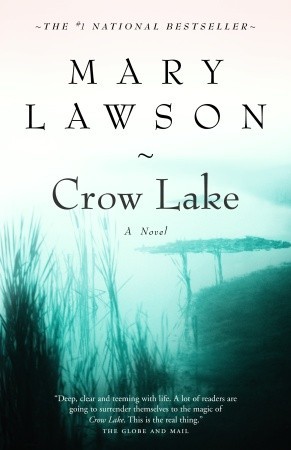 Matt inspired Kate’s love of pond life – she’s now an assistant professor of invertebrate ecology – but never got to go to college himself. Theirs was a family that prized schooling above all else (legend has it that Great-Grandmother installed a book rest on her spinning wheel so she could read while her hands were busy*) and eschewed emotion. “It was the Eleventh Commandment,” Kate recalls: “Thou Shalt Not Emote.”
This is a slow burner for sure, but it’s a winning picture of a family that stuck together despite the odds, as well as an appeal to recognize that emotional intelligence is just as important as book learning. The novel reminded me a lot of Surfacing by Margaret Atwood and The Girls by Lori Lansens, and I’d also recommend it to readers of Elizabeth Hay and Jane Urquhart.
*Delightfully, this detail was autobiographical for Lawson.
Wild Hares and Hummingbirds: The Natural History of an English Village by Stephen Moss (2011)
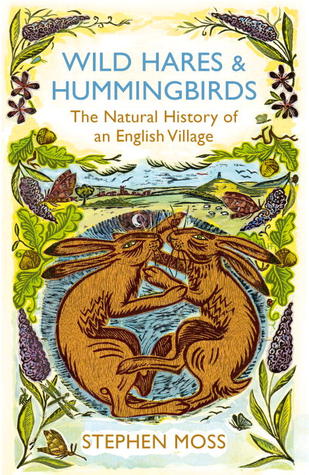 England doesn’t have any hummingbirds, but it does have hummingbird hawkmoths, which explains the title. In the tradition of Gilbert White, Moss writes a month-by-month tribute to what he regularly sees on his home turf of Mark, Somerset. As I did with Mark Cocker’s Claxton, I picked up the book partway – at the month in which I started reading it – and when I reached the end, returned to the beginning and read up to my starting point. Controversial, I know, but that July to June timeline worked fine: it gave me familiar glimpses of what’s going on with English nature now, followed by an accelerated preview of what I have to look forward to in the coming months.
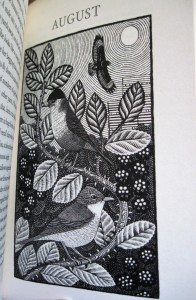 Moss is primarily a birder, so he focuses on bird life, but also notes what’s happening with weather, trees, fungi, and so on. In the central and probably best chapter, on June, he maximizes wildlife-watching opportunities: going eel fishing, running a moth trap, listening for bats, and looking out for unfamiliar plants. My minor annoyances with the book were the too-frequent references to “the parish,” which makes the book’s concerns seem parochial rather than microcosmic, and the common use of semicolons where commas and dashes would be preferable. But if you’re fond of modern nature writing, and have some familiarity with (or at least interest in) the English countryside, I highly recommend this as a peaceful, observant read. Plus, Harry Brockway’s black-and-white engravings heading each chapter are exquisite.
Favorite lines:
“Being in one place is also the best way to understand the passing of the seasons: not the great shifts between winter and spring, summer and autumn, which we all notice; but the tiny, subtle changes that occur almost imperceptibly, from week to week, and day to day, throughout the year.”
“For me, one of the greatest pleasures of living in the English countryside is the way we ourselves become part of the natural cycle of the seasons.”
Book Serendipity Incidents of 2019 (So Far)
I’ve continued to post my occasional reading coincidences on Twitter and/or Instagram. This is when two or more books that I’m reading at the same time or in quick succession have something pretty bizarre in common. Because I have so many books on the go at once – usually between 10 and 20 – I guess I’m more prone to such serendipitous incidents. (The following are in rough chronological order.)
What’s the weirdest coincidence you’ve had lately?
- Two titles that sound dubious about miracles: There Will Be No Miracles Here by Casey Gerald and The Unwinding of the Miracle: A Memoir of Life, Death, and Everything that Comes After by Julie Yip-Williams

- Two titles featuring light: A Light Song of Light by Kei Miller and The Age of Light by Whitney Scharer
- Grey Poupon mustard (and its snooty associations, as captured in the TV commercials) mentioned in There Will Be No Miracles Here by Casey Gerald and Drinking: A Love Story by Caroline Knapp
 “I Wanna Dance with Somebody” (the Whitney Houston song) referenced in There Will Be No Miracles Here by Casey Gerald and Don’t Call Us Dead by Danez Smith
- Two books have an on/off boyfriend named Julian: Drinking: A Love Story by Caroline Knapp and Extinctions by Josephine Wilson
- There’s an Aunt Marjorie in When I Had a Little Sister by Catherine Simpson and Extinctions by Josephine Wilson


- Set (at least partially) in a Swiss chalet: This Sunrise of Wonder by Michael Mayne and Crazy for God by Frank Schaeffer
- A character named Kiki in The Sacred and Profane Love Machine by Iris Murdoch, The Age of Light by Whitney Scharer, AND Improvement by Joan Silber
 Two books set (at least partially) in mental hospitals: Mind on Fire by Arnold Thomas Fanning and Faces in the Water by Janet Frame
- Two books in which a character thinks the saying is “It’s a doggy dog world” (rather than “dog-eat-dog”): The Friend by Sigrid Nunez and The Octopus Museum by Brenda Shaughnessy
- Reading a novel about Lee Miller (The Age of Light by Whitney Scharer), I find a metaphor involving her in My Year of Rest and Relaxation by Ottessa Moshfegh: (the narrator describes her mother) “I think she got away with so much because she was beautiful. She looked like Lee Miller if Lee Miller had been a bedroom drunk.” THEN I come across a poem in Clive James’s Injury Time entitled “Lee Miller in Hitler’s Bathtub”

- On the same night that I started Siri Hustvedt’s new novel, Memories of the Future, I also started a novel that had a Siri Hustvedt quote (from The Blindfold) as the epigraph: Besotted by Melissa Duclos
- In two books “elicit” was printed where the author meant “illicit” – I’m not going to name and shame, but one of these instances was in a finished copy! (the other in a proof, which is understandable)
- Three books in which the bibliography is in alphabetical order BY BOOK TITLE! Tell me this is not a thing; it will not do! (Vagina: A Re-education by Lynn Enright; Let’s Talk about Death (over Dinner) by Michael Hebb; Telling the Story: How to Write and Sell Narrative Nonfiction by Peter Rubie)
 References to Gerard Manley Hopkins in Another King, Another Country by Richard Holloway, This Sunrise of Wonder by Michael Mayne and The Point of Poetry by Joe Nutt (these last two also discuss his concept of the “inscape”)
- Creative placement of words on the page (different fonts; different type sizes, capitals, bold, etc.; looping around the page or at least not in traditional paragraphs) in When Death Takes Something from You Give It Back by Naja Marie Aidt [not pictured below], How Proust Can Change Your Life by Alain de Botton, Stubborn Archivist by Yara Rodrigues Fowler, Alice Iris Red Horse: Selected Poems of Yoshimasu Gozo and Lanny by Max Porter

- Twin brothers fall out over a girl in Cutting for Stone by Abraham Verghese and one story from the upcoming book Meteorites by Julie Paul
- Characters are described as being “away with the fairies” in Lanny by Max Porter and Away by Jane Urquhart
 Schindler’s Ark/List is mentioned in In the Beginning: A New Reading of the Book of Genesis by Karen Armstrong and Telling the Story: How to Write and Sell Narrative Nonfiction by Peter Rubie … makes me think that I should finally pick up my copy!
Reading Ireland Month 2019: Jess Kidd and Jane Urquhart
Last month I picked out this exchange from East of Eden by John Steinbeck:
“But the Irish are said to be a happy people, full of jokes.”
“They’re not. They’re a dark people with a gift for suffering way past their deserving. It’s said that without whisky to soak and soften the world, they’d kill themselves. But they tell jokes because it’s expected of them.”
There’s something about that mixture of darkness and humor, isn’t there? I also find that Irish art (music as well as literature) has a lot of heart. I only read two Ireland-related historical novels this month, but they both have that soulful blend of light and somber. Both:
Things in Jars by Jess Kidd (2019)
In the autumn of 1863 Bridie Devine, female detective extraordinaire, is tasked with finding the six-year-old daughter of a baronet. Problem is, this missing girl is no ordinary child, and collectors of medical curiosities and circus masters alike are interested in acquiring her.
In its early chapters this delightful Victorian pastiche reminded me of a cross between Sarah Waters’s Fingersmith and Neil Gaiman’s The Graveyard Book, and that comparison played out pretty well in the remainder. Kidd paints a convincingly gritty picture of Dickensian London, focusing on an underworld of criminals and circus freaks: when Bridie first arrived in London from Dublin, she worked as an assistant to a resurrectionist; her maid is a 7-foot-tall bearded lady; and her would-be love interest, if only death didn’t separate them, is the ghost of a heavily tattooed boxer.
Medicine (surgery – before and after anesthesia) and mythology (mermaids and selkies) are intriguing subplots woven through, such that this is likely to appeal to fans of The Way of All Flesh and The Mermaid and Mrs Hancock. Kidd’s prose is spry and amusing, particularly in her compact descriptions of people (but also in her more expansive musings on the dirty, bustling city): “a joyless string of a woman, thin and pristine with a halibut pout,” “In Dr Prudhoe’s countenance, refinement meets rogue,” and “People are no more than punctuation from above.”
I’ll definitely go back and read Kidd’s two previous novels, Himself and The Hoarder. I didn’t even realize she was Irish, so I’m grateful to Cathy for making me aware of that in her preview of upcoming Irish fiction. [Trigger warnings: violence against women and animals.] (Out from Canongate on April 4th.)
Away by Jane Urquhart (1993)
I was enraptured from the first line: “The women of this family leaned towards extremes” – starting with Mary, who falls in love with a sailor who washes up on the Irish coast in the 1840s amid the cabbages, silver teapots and whiskey barrels of a shipwreck and dies in her arms. Due to her continued communion with the dead man, people speak of her being “away with the fairies,” even after she marries the local schoolteacher, Brian O’Malley.
 With their young son, Liam, they join the first wave of emigration to Canada during the Potato Famine, funded by their landlords, the Sedgewick brothers of Puffin Court (amateur naturalist Osbert and poet Granville). No sooner have the O’Malleys settled and had their second child, Eileen, than Mary disappears. As she grows, Eileen takes after her mother, mystically attuned to portents and prone to flightiness, while Liam is a happily rooted Great Lakes farmer. Like Mary, Eileen has her own forbidden romance, with a political revolutionary who dances like a dream.
I’ve been underwhelmed by other Urquhart novels, Sanctuary Line and The Whirlpool, but here she gets it just right, wrapping her unfailingly gorgeous language around an absorbing plot – which is what I felt was lacking in the others. The Ireland and Canada settings are equally strong, and the spirit of Ireland – the people, the stories, the folk music – is kept alive abroad. I recommend this to readers of historical fiction by Margaret Atwood, A.S. Byatt and Hannah Kent.
Some favorite lines:
Osbert says of Mary: “There’s this light in her, you see, and it must not be put out.”
“When summer was finished the family was visited by a series of overstated seasons. In September, they awakened after night frosts to a woods awash with floating gold leaves and a sky frantic with migrating birds – sometimes so great in number that they covered completely with their shadows the acre of light and air that Brian had managed to create.”
“There are five hundred and forty different kinds of weather out there, and I respect every one of them. White squalls, green fogs, black ice, and the dreaded yellow cyclone, just to mention a few.”
It’s my second time participating in Reading Ireland Month, run each March by Cathy of 746 Books and Niall of Raging Fluff.
Did you manage to read any Irish literature this month?
20 Books of Summer #4 + Substitutes & Plane Reading
You’ll have to excuse me posting twice in one day. I’ve just finished packing the last few things for my three weeks in America, and want to get my latest #20BooksofSummer review out there before I fly early tomorrow. What with a layover in Toronto, it will be a very long day of travel, so I think the volume of reading material I’m taking is justified! (See the last photo of the post.)
Four Wings and a Prayer: Caught in the Mystery of the Monarch Butterfly by Sue Halpern (2001)
 I admire nonfiction books that successfully combine lots of genres into a dynamic narrative. This one incorporates travel, science, memoir, history, and even politics. Halpern spent a year tracking monarch butterflies on their biannual continent-wide migrations, which were still not well understood at that point. She rides through Texas into Mexico with Bill Calvert, field researcher extraordinaire; goes gliding with David Gibo, a university biologist, in fields near Toronto; and hears from scientists and laymen alike about the monarchs’ habits and outlook. It happened to be a worryingly poor year for the butterflies, yet citizen science initiatives provided valuable information that could be used to predict their future.
The book is especially insightful about clashes between environmentalist initiatives and local livelihoods in Mexico (tree huggers versus subsistence loggers) and the joy of doing practical science with simple tools you make yourself. It’s also about how focused attention becomes passion. “Science, like belief, starts with wonder, and wonder starts with a question,” Halpern writes.
The style is engaging, though at nearly 20 years old the book feels a bit dated, and I might have liked more personal reflections than interviews with (middle-aged, white, male) scientists. I only realized on the very last page, through the acknowledgments, that the author is married to Bill McKibben, a respected environment writer. [She frequently mentions Fred Urquhart, a Toronto zoology professor; I wondered if he could be related to Jane Urquhart, a Canadian novelist whose novel Sanctuary Line features monarchs. (Turns out: no relation. Oh well!)]
Readalikes: Farther Away by Jonathan Franzen & Ruins by Peter Kuper
My rating:
I’ve already done some substituting on my 20 Books of Summer. I decided against reading Vendela Vida’s Girls on the Verge after perusing the table of contents and the first few pages and gauging reader opinions on Goodreads. I have a couple of review books, Twister by Genanne Walsh and The Life and Loves of Lena Gaunt by Tracy Farr, that I’m enjoying but will have to leave behind while I’m in the States, so I may need that little extra push to finish them once I get back. I’ve also been rereading a favorite, Paulette Bates Alden’s memoir Crossing the Moon, which has proved an excellent follow-up to Sheila Heti’s Motherhood.
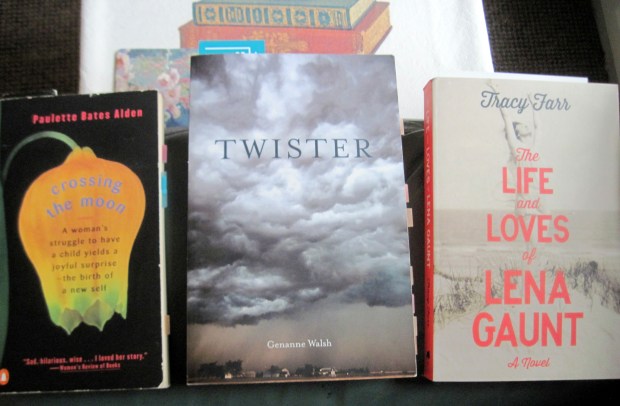
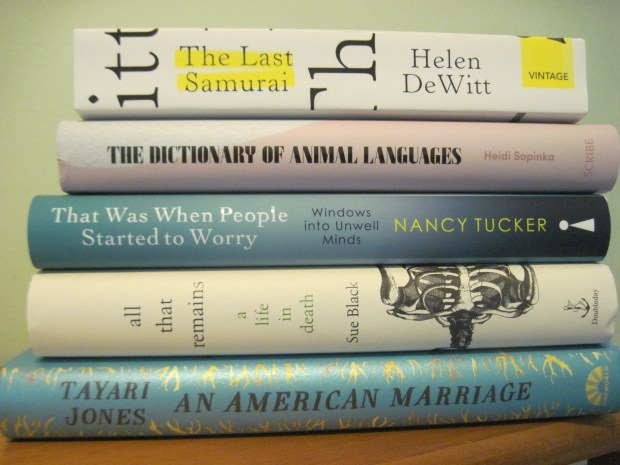
(What I haven’t determined yet is which books these will be standing in for.) Waiting in the wings in case further substitutions are needed is this stack of review books:
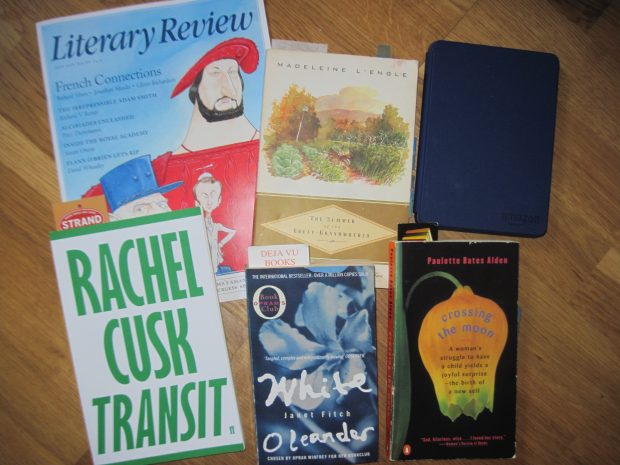
Also from the #20Books list and coming with me on the flight are Madeleine L’Engle’s The Summer of the Great-Grandmother and Janet Fitch’s White Oleander, which are both terrific thus far. The final print book joining me for the journey is Transit by Rachel Cusk. I have attempted to read her twice before and failed to get through a whole book, so we’ll see if it’s third time lucky. It seems like the perfect book to read in transit to Canada, after all.
Finally, in progress on the Kindle are Summer by Karl Ove Knausgaard, the last in his set of four seasonal essay collections, and The Late Bloomers’ Club by Louise Miller, another cozy novel set in fictional Guthrie, Vermont, which she introduced in her previous book, The City Baker’s Guide to Country Living.
It’ll be a busy few weeks helping my parents pack up their house and moving my mom into her new place, plus doing a reduced freelance work load for the final two weeks. It’s also going to be a strange time because I have to say goodbye to a house that’s been a part of my life for 13 years, and sort through box after box of mementoes before putting everything into medium-term storage.
I won’t be online all that much, and can’t promise to keep up with everyone else’s blogs, but I’ll try to pop in with a few reviews.
Happy July reading!
Two Mother–Daughter Author Pairs for Mother’s Day
This coming Sunday is Mother’s Day in the USA. (Mothering Sunday generally falls in March here in the UK, so every year I have to buy a card early to send to my mother back in the States, but I still associate Mother’s Day with May.) Earlier in the year I got over halfway through a Goodreads giveaway book, Beyond the Pale by Emily Urquhart, before I realized its author was the daughter of a Canadian novelist I’d read before, Jane Urquhart. That got me thinking about other mother–daughter pairs that might be on my shelves. I found one in the form of Sue Monk Kidd’s The Secret Life of Bees plus an advance e-copy of her daughter Ann Kidd Taylor’s upcoming debut novel, The Shark Club. (I’ve previously reviewed their joint memoir, Traveling with Pomegranates.) And, as a bonus, I have a mini-review of Graham Swift’s novella Mothering Sunday: A Romance.
The Whirlpool, Jane Urquhart
 From 1986, this was Urquhart’s first novel. Overall it reminded me of A. S. Byatt (especially The Virgin in the Garden) and John Fowles’s The French Lieutenant’s Woman. Set in 1889 on the Canadian side of Niagara Falls, it features characters who, each in their separate ways, are stuck in the past and obsessed with death and its symbolic stand-in, the whirlpool. Maud Grady, the local undertaker’s widow, takes possession of the corpses of those who’ve tried to swim the Falls. Her creepy young son starts off mute and becomes an expert mimic. Major David McDougal is fixated on the War of 1812, while his wife Fleda camps out in a tent reading Victorian poetry, especially Robert Browning, and awaiting a house that may never be built. Local poet Patrick sees Fleda from afar and develops romanticized ideas about her.
Each of these narratives is entertaining, but I was less convinced by their intersections – except for the brilliant scenes when Patrick and Maud’s son engage in wordplay. In particular, I was unsure what the prologue and epilogue (in which Robert Browning, dying in Venice, is visited by images of Shelley’s death by drowning) were meant to add. This is the second Urquhart novel I’ve read, after Sanctuary Line. I admire her writing but her plots don’t always come together. However, I’m sure to try more of her work: I have a copy of Away on the shelf, and Changing Heaven (1990) sounds unmissable – it features the ghost of Emily Brontë! [Bought from a Lambeth charity shop for 20p.]
My rating: 
Beyond the Pale: Folklore, Family and the Mystery of Our Hidden Genes, Emily Urquhart
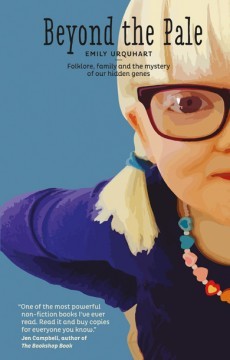 In December 2010, the author’s first child, Sadie, was born with white hair. It took weeks to confirm that Sadie had albinism, a genetic condition associated with extreme light sensitivity and poor eyesight. A Canadian folklorist, Urquhart is well placed to trace the legends that have arisen about albinos through time and across the world, ranging from the Dead Sea Scroll story of Noah being born with blinding white skin and hair to the enduring superstition that accounts for African albinos being maimed or killed to use their body parts in folk medicine.
She attends a NOAH (America’s National Organization for Albinism and Hypopigmentation) conference, discovers potential evidence of a family history of albinism, and even makes a pilgrimage to Tanzania to meet some victims. It’s all written up in as engaging present-tense narrative of coming to terms with disability: to start with Urquhart is annoyed at people reassuring her “it could be worse,” but by the end she’s ever so slightly disappointed to learn that her second child, a boy, will not be an albino like his sister. [Goodreads giveaway copy]
My rating: 
The Secret Life of Bees, Sue Monk Kidd
 It’s hard to believe it was 15 years ago that this debut novel was an It book, and harder to believe that I’d never managed to get around to it until now. However, in some ways it felt familiar because I’d read a fair bit of background via Kidd’s chapter in Why We Write about Ourselves and Traveling with Pomegranates, in which she and her daughter explored the Black Madonna tradition in Europe.
It joins unusual elements you wouldn’t expect to find in fiction – beekeeping and the divine feminine – with more well-trodden territory: the Civil Rights movement in the South in the 1960s, unhappy family relationships, secrets, and a teenage girl’s coming of age. Fourteen-year-old Lily is an appealing narrator who runs away from her memories of her mother’s death and her angry father, peach farmer T. Ray. You can’t help but fall in love with the rest of her new African-American, matriarchal clan, including their housekeeper, Rosaleen, who scandalizes the town by registering to vote, and the bee-keeping Boatwright sisters, August, June, and May, who give Lily and Rosaleen refuge when they skip town.
Although this crams in a lot of happenings and emotional ups and downs, it’s a charming story that draws you into the brutal heat of a South Carolina summer and keeps you hoping Lily will forgive herself and slip into the rhythms of a purposeful life of sisterhood. [Secondhand purchase in America]
A favorite line: “The way people lived their lives, settling for grits and cow shit, made me sick.”
My rating:
The Shark Club, Ann Kidd Taylor
 Dr. Maeve Donnelly loves sharks even though she was bitten by one as a child. She’s now a leading researcher with a Florida conservancy and travels around the world to gather data. Her professional life goes from strength to strength, but her personal life is another matter. Aged 30, she’s smarting from a broken engagement to her childhood sweetheart, Daniel, and isn’t ready to open her heart to Nicholas, a British colleague going through a divorce.
Things get complicated when Daniel returns to their southwest Florida island to work as the chef at her grandmother’s hotel – with his six-year-old daughter in tow. Maeve is soon taken with precocious Hazel, who founds the title club (pledge: “With this fin, I do swear. To love sharks even when they bite. When they lose their teeth, I will find them. When I catch one, I will let it go”), but isn’t sure she can pick up where she left off with Daniel. Meanwhile, evidence has surfaced of a local shark finning operation, and she’s determined to get to the bottom of it.
This is a little bit romance and a little bit mystery, and Taylor brings the Florida Keys setting to vibrant life. It took a while to suspend disbelief about Maeve’s background – an orphan and a twin and a shark bite survivor and a kid brought up in a hotel? – but I enjoyed the sweet yet unpredictable story line. Nothing earth-shattering, but great light reading for a summer day at the beach. Releases June 6th from Viking. [Edelweiss download]
My rating:
Mothering Sunday: A Romance, Graham Swift
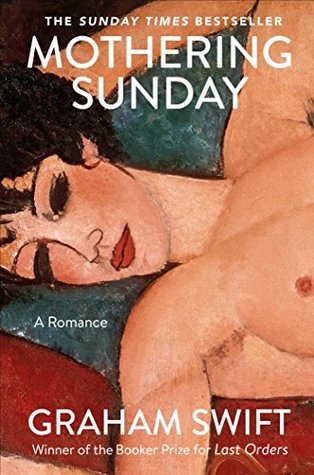 If you’re expecting a cozy tale of maternal love, let the Modigliani nude on the U.K. cover wipe that notion out of your mind. Part of me was impressed by Swift’s compact picture of one sexy, fateful day in 1924 and the reverberations it had for a budding writer even decades later. Interesting class connotations, too. But another part of me thought, isn’t this what you would get if Ian McEwan directed a middling episode of Downton Abbey? It has undeniable similarities to Atonement and On Chesil Beach, after all, and unlike those novels it’s repetitive; it keeps cycling round to restate its main events and points. There’s some good lines, but overall this felt like a strong short story stretched out to try to achieve book length. [Library read]
My rating: 
 Bookish Beck = Rebecca Foster. American transplant to England. Freelance proofreader and book reviewer.
 Bookish Beck