Book Serendipity, April‒Early July
I call it serendipitous when two or more books that I read at the same time or in quick succession have something pretty bizarre in common. Because I have so many books on the go at once (usually around 20), I suppose I’m more prone to such incidents than some. I also list these occasional reading coincidences on Twitter. The following are in rough chronological order. (January to March appeared in this post.)
- Characters named Sonny in Pew by Catherine Lacey, My Father’s Wake by Kevin Toolis, and Sacred Country by Rose Tremain.
- A double dose via Greenery via Tim Dee – while reading it I was also reading Other People’s Countries by Patrick McGuinness, whom he visits in Belgium; and A Cold Spring by Elizabeth Bishop, referenced in a footnote.


- A red thread is worn as a bracelet for its emotional or spiritual significance in The Book of Longings by Sue Monk Kidd and Plan B by Anne Lamott.
- The Library of Alexandria features in Footprints by David Farrier and The Book of Longings by Sue Monk Kidd.
- The Artist’s Way is mentioned in At Hawthorn Time by Melissa Harrison and Traveling Mercies by Anne Lamott.
- Characters sleep in a church in Pew by Catherine Lacey and Abide With Me by Elizabeth Strout. (And both novels have characters named Hilda.)


- Coins being flung away among some trees in In the Springtime of the Year by Susan Hill and The Book of Longings by Sue Monk Kidd (literally the biblical 30 pieces of silver in the Kidd, which is then used as a metaphor in the Hill).
- Rabbit-breeding projects in When the Lights Go Out by Carys Bray and Parable of the Sower by Octavia E. Butler.


- Mentions of the Great Barrier Reef in When the Lights Go Out by Carys Bray and Footprints by David Farrier.
- The same very specific fact – that Seamus Heaney’s last words, in a text to his wife, were “Noli timere” – was mentioned in Curlew Moon by Mary Colwell and Greenery by Tim Dee.
- Klondike ice cream bars appeared in both Small Victories by Anne Lamott and The Fixed Stars by Molly Wizenberg.

- The metaphor of a rising flood only the parent or the child will survive is used in both Exit West by Mohsin Hamid and What We Carry by Maya Lang.
- The necessity of turning right to save oneself in a concentration camp setting is mentioned in both Man’s Search for Meaning by Viktor Frankl and Fugitive Pieces by Anne Michaels.
- An English child is raised in North Africa in Oleander, Jacaranda by Penelope Lively and The Child in Time by Ian McEwan.
- The Bristol Stool Chart appeared in both Gulp by Mary Roach and The Bad Doctor by Ian Williams.


- A Greek island setting in both Exit West by Mohsin Hamid and Fugitive Pieces by Anne Michaels (plus, earlier, in A Theatre for Dreamers by Polly Samson).
- Both Writers & Lovers by Lily King and Mother: A Memoir by Nicholas Royle mention Talking Heads within the first 20 pages.
- A trip to North Berwick in the early pages of Mother: A Memoir by Nicholas Royle, and hunting for cowrie shells on the beach – so familiar from Evie Wyld’s The Bass Rock, read the previous month. (Later, more collecting of cowrie shells in Oleander, Jacaranda by Penelope Lively.)
- Children’s authors are main characters in The Crow Road by Iain Banks and The Child in Time by Ian McEwan.

- A character is killed by a lightning strike in The Crow Road by Iain Banks and Writers & Lovers by Lily King.
- Characters named Ash in The Crow Road by Iain Banks and The Fixed Stars by Molly Wizenberg.
 A brother steals the main character’s object of affection in The Crow Road by Iain Banks and Sacred Country by Rose Tremain.
- A minor character in Parable of the Sower by Octavia E. Butler is called Richard Rohr … meanwhile, I was reading a book by Richard Rohr, The Universal Christ.
- A maternity ward setting in The Pull of the Stars by Emma Donoghue and The Bell in the Lake by Lars Mytting.
- A love triangle is a central element in Writers & Lovers by Lily King and The Bell in the Lake by Lars Mytting.


- Reading a book by a Galloway (The Trick Is to Keep Breathing by Janice Galloway) and a book about Galloway (Native: Life in a Vanishing Landscape by Patrick Laurie) simultaneously.
- Attending college in L.A. in The Vanishing Half by Brit Bennett and Dreams from My Father by Barack Obama.
- Two books that reference the same Darwin quote: Into the Tangled Bank by Lev Parikian, and “The Entangled Bank” is the title of the final poem in Red Gloves by Rebecca Watts.


- Characters with the surname Savage in The Box Garden by Carol Shields and Islands of Mercy by Rose Tremain.
- A character is taught how to eat oysters in The Vanishing Half by Brit Bennett and Kitchen Confidential by Anthony Bourdain.
- A Louisiana setting in The Vanishing Half by Brit Bennett and Property by Valerie Martin.
- Characters named Stella in The Vanishing Half by Brit Bennett and The Group by Lara Feigel.


- The last line of the book has a character saying “Come in” in Americanah by Chimamanda Ngozi Adichie and Ankomst by Gøhril Gabrielsen.
- Currently reading four books with mixed-race narrators: (Black/white) The Girl Who Fell from the Sky by Heidi Durrow, Dreams from My Father by Barack Obama, Memorial Drive by Natasha Trethewey; and (Japanese/white) My Year of Meats by Ruth Ozeki.
- Currently reading two novels in which a pair of orphaned sisters are taken in by relatives (Deerbrook by Harriet Martineau and Rise and Shine by Anna Quindlen). Plus two more novels with orphan characters: The Girl Who Fell from the Sky and My Year of Meats.
-
- In two of these four (not telling which, though you can safely assume it’s not the Victorian novel!), they are orphans because both parents were killed in a car accident. I feel like this is a fictional setup that I encounter all the time (cf. All the Beautiful Girls, The Monsters of Templeton, Saint Maybe) that can’t be that common in real life?
-


- Vassar as an alma mater in Kitchen Confidential by Anthony Bourdain and The Group by Mary McCarthy.
- Punahou School (Honolulu, Hawaii) is the author’s alma mater in The Noonday Demon by Kathleen Norris and Dreams from My Father by Barack Obama.
What’s the weirdest reading coincidence you’ve had lately?
Following Up on the Prescriptions from My Bibliotherapy Appointment
In January 2018 I had the wonderful opportunity to have a free bibliotherapy session at the School of Life in London with Ella Berthoud, one of the authors of The Novel Cure. I wrote about the experience in this post. I quickly got hold of all but a couple of my prescribed reads, but have been slower about actually reading them. Though I’ve read five now, I’ve only written up four, two of which I only managed to finish this week. (These 250-word reviews are in order of my reading.)
Heligoland by Shena Mackay (2002)
(CURE: moving house)
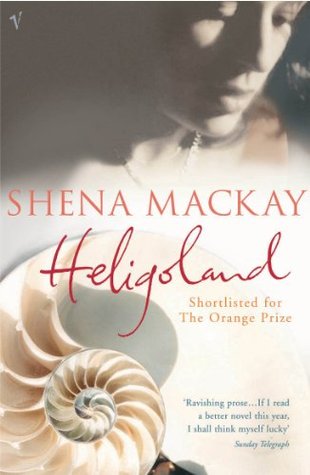 Heligoland is a Scottish island best known from the shipping forecast, but here it’s an almost mythical home. Rowena Snow was orphaned by her Indian/Scottish parents, and a second time by her aunt. Since then she’s drifted between caring and cleaning jobs. The Nautilus represents a fresh chance at life. This shell-shaped artists’ commune in South London houses just three survivors: Celeste Zylberstein, who designed the place; poet Francis Campion; and antiques dealer Gus Crabb. Rowena will be the housekeeper/cook, but she struggles with self-esteem: does she deserve to live in a haven for upper-class creative types?
The omniscient perspective moves between the Nautilus residents but also on to lots of other minor hangers-on, whose stories are hard to keep track of. Mackay’s writing reminded me somewhat of Tessa Hadley’s and is lovely in places – especially when describing a buffet or a moment of light-filled epiphany in a garden. There’s not much to be said beyond what’s in the blurb: Mackay is attempting to give a picture of a drifter who finds an unconventional home; in the barest sense she does succeed, but I never felt a connection with any of the characters. In this ensemble cast there is no one to love and thus no one to root for. While I didn’t love this book, it did inspire me to pick up others by Mackay: since then I’ve read The Orchard on Fire, which I liked a lot more, and the first half of Dunedin.
My rating: 
Family Matters by Rohinton Mistry (2002)
(CURE: worry over ageing parents)
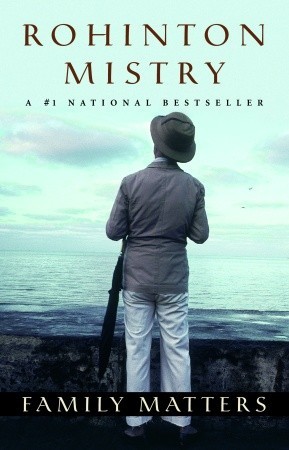 Retired professor Nariman Vakeel, 79, has Parkinson’s disease and within the first few chapters has also fallen and broken his ankle. His grown stepchildren, Coomy and Jal, reluctant to care for him anyway, decide they can’t cope with the daily reality of bedpans, sponge baths and spoon feeding in their large Chateau Felicity apartment. He’ll simply have to recuperate at Pleasant Villa with his daughter Roxana and her husband and sons, even though their two-bedroom apartment is barely large enough for the family of four. You have to wince at the irony of the names for these two Bombay housing blocks, and at the bitter contrast between selfishness and duty.
Perhaps inevitably, Nariman starts to fade into the background. An increasingly speechless invalid, he only comes alive through his past: italicized sections, presented as his night-time ravings, tell of his love for Lucy, whom his parents refused to let him marry, and the untimely end of his arranged marriage. I enjoyed time spent in a vibrantly realized Indian city and appreciated a chance to learn about a lesser-known community: Nariman and family are Parsis (or Zoroastrians). There’s also a faint echo here of King Lear, with one faithful daughter set against two wicked children.
As to ageing parents, this is a pretty relentlessly bleak picture, but there are sparks of light: joy in life’s little celebrations, and unexpected kindnesses. Mistry’s epic has plenty of tender moments that bring it down to an intimate scale. I’m keen to read his other novels.
My rating: 
Maggie & Me by Damian Barr (2013)
(A supplementary prescription because I love memoirs and didn’t experience Thatcher’s Britain.)
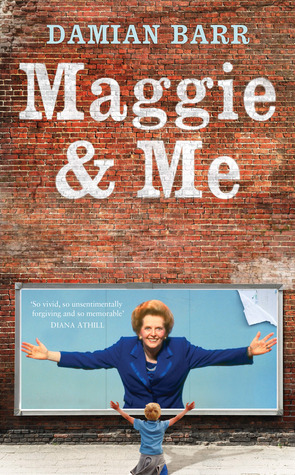 Like a cross between Angela’s Ashes and Toast, this recreates a fairly horrific upbringing from the child’s perspective. Barr was an intelligent, creative young man who early on knew that he was gay and, not just for that reason, often felt that there was no place for him: neither in working-class Scotland, where his father was a steelworker and his brain-damaged mother flitted from one violent boyfriend to another; nor in Maggie Thatcher’s 1980s Britain at large, in which money was the reward for achievement and the individual was responsible for his own moral standing and worldly advancement. “I don’t need to stand out any more,” he recalls, being “six foot tall, scarecrow skinny and speccy with join-the-dots spots, bottle-opener buck teeth and a thing for waistcoats. Plus I get free school dinners and I’m gay.”
There are a lot of vivid scenes in this memoir, some of them distressing ones of abuse, and the present tense, dialect, and childish grammar and slang give it authenticity. However, I never quite bought in to the Thatcher connection as an overarching structure. Three pages at the start, five at the end, and a Thatcher quote as an epigraph for each chapter somehow weren’t enough to convince me that the framing device was necessary or apt. Still, I enjoyed this well enough as memoirs go, and I would certainly recommend it if you loved Nigel Slater’s memoir mentioned above. I also have Barr’s recent debut novel, You Will Be Safe Here, on my Kindle.
My rating: 
The Monsters of Templeton by Lauren Groff (2008)
(A supplementary prescription for uncertainty about having children.)
 I enjoyed this immensely, from the first line on: “The day I returned to Templeton steeped in disgrace, the fifty-foot corpse of a monster surfaced in Lake Glimmerglass.” Twenty-eight-year-old Willie Upton is back in her hometown, pregnant by her older, married archaeology professor after a summer of PhD fieldwork in Alaska. “I had come home to be a child again. I was sick, heartbroken, worn down.” She gives herself a few weeks back home to dig through her family history to find her father – whom Vi has never identified – and decide whether she’s ready to be a mother herself.
We hear from various leading lights in the town’s history and/or Willie’s family tree through a convincing series of first-person narratives, letters and other documents. Groff gives voice to everyone from a Mohican chief to a slave girl who catches her master’s eye. Willie and Vi are backed up by a wonderful set of secondary characters, past and present. Groff wrote this in homage to Cooperstown, New York, where she grew up. (If you’ve heard of it, it’s probably for the baseball museum; it’s not far from where my mother is from in upstate New York.) Templeton is “a slantwise version” of Cooperstown, Groff admits in an opening Author’s Note, and she owes something of a debt to its most famous citizen, James Fenimore Cooper. What a charming way to celebrate where you come from, with all its magic and mundanity. This terrific debut novel cemented my love of Groff’s work.
My rating:
I also have Ella to thank for the inspiration to reread a childhood favorite, Little Women by Louisa May Alcott, last year; the experiment formed the subject of my first piece for Literary Hub. I also worked my way through The Artist’s Way by Julia Cameron, another of my prescriptions, over a number of months in 2018, but failed to keep up with the regular writing exercises so didn’t get the maximum benefit.
My husband and I made a start on reading a few books aloud to each other, including Sum: Forty Tales from the Afterlives by David Eagleman, but that fell by the wayside after a handful of weeks.
(Incidentally, I had forgotten that Cutting for Stone turns up in The Novel Cure on a list of the 10 best books to combat xenophobia.)
 Still to read: Jitterbug Perfume by Tom Robbins (CURE: horror of ageing)
And one I still have to get hold of but haven’t been able to find cheap secondhand because it’s a Persephone classic: The Victorian Chaise-Longue by Marghanita Laski (a supplementary prescription because I love Victorian pastiches).
Live Happy by Bridget Grenville-Cleave and Ilona Boniwell: Review & Giveaway
Today is apparently what’s known as “Blue Monday,” the saddest day of the year. It can be hard to find reasons to be cheerful in mid-January, especially given the state of Anglo-American politics. All too often I give in to melancholy on these dark mornings. However, I aim to do better. Gretchen Rubin’s The Happiness Project was one of the most memorable books I read in the second half of last year. What I appreciated most about it was that her approach is not about undertaking extreme actions to try to achieve happiness, but about finding contentment with the life you already have by adding or tweaking small habits.
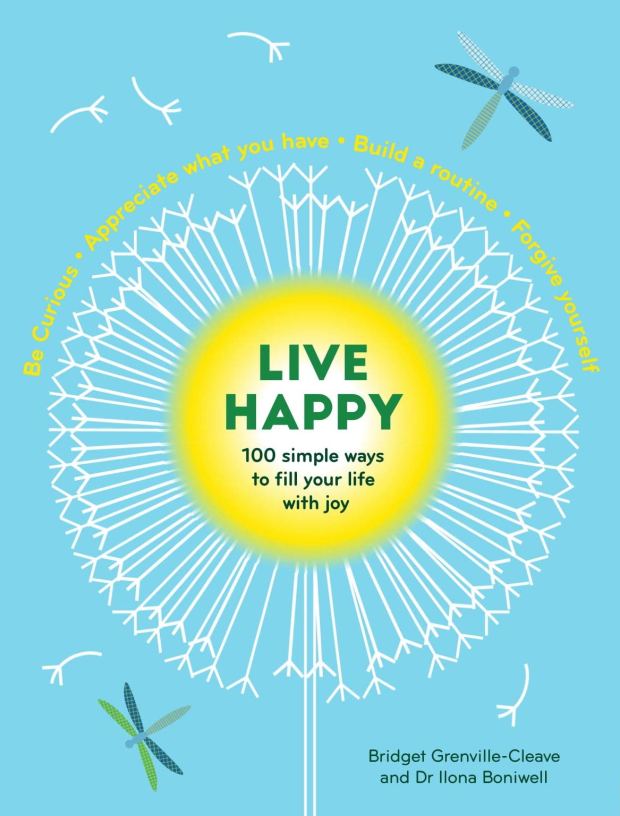
I was keen to see what additional tips I could glean from Live Happy: 100 Simple Ways to Fill Your Life with Joy by positive psychologists Bridget Grenville-Cleave and Ilona Boniwell. They explain that about 50% of the capacity for happiness is genetic, while 10% is related to your current situation. That means that individuals are able to boost their happiness by up to 40% through their attitude and choices.
The key is to focus on what you can influence for the better. The book includes in this category things like luck, health and confidence. I found it difficult to accept the idea that I could choose to have good luck and high energy. It’s just such a foreign concept to me. But according to Grenville-Cleave and Boniwell, perceived control of one’s life course is extremely important.
Live Happy contains good generic advice on diet, use of time, relationships and forming positive habits, though the 100-item format leads to some repetition. In a few cases examples of practical application are necessary; otherwise what we have is just sound bites. For instance, “Try adopting extrovert behaviours such as assertiveness and engaging with others” and “you can also try to face problems head on, rather than simply giving up; you’ll find it easier to bounce back after misfortune.”
On the other hand, I did find specific suggestions that I plan to put into practice. A tip for being more optimistic is to wear a rubber band around your wrist and snap yourself every time you experience an Automatic Negative Thought. I also appreciated these words about making choices: “For unimportant decisions try to be satisfied with an option that is merely good enough, rather than trying to make absolutely the best choice. Lower your expectations – do not expect perfection.”
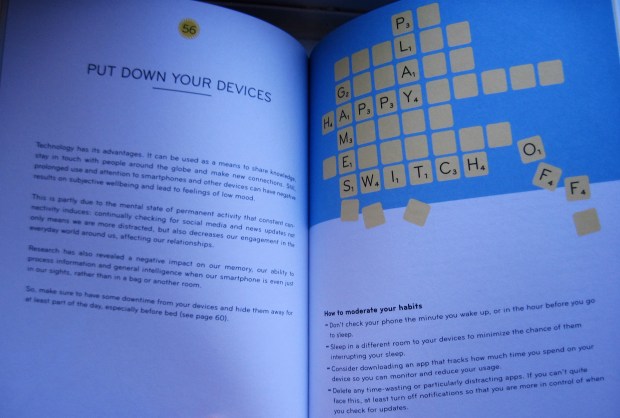
This is an attractive book, with each page containing pull quotes or whimsical drawings that tie into the blue-yellow-green palette. I would recommend it to readers of The Artist’s Way by Julia Cameron, A Manual for Heartache by Cathy Rentzenbrink and Option B by Sheryl Sandberg. It could also make an ideal bedside book for people who aren’t big readers but are interested in injecting a little more happiness into their everyday life.
My rating: 
Live Happy was published by Modern Books on January 17th. My thanks to Alison Menzies for arranging my free copy for review.
GIVEAWAY!
If you would be interested in winning a copy of Live Happy, please comment to that effect below and I will choose one winner at random on Monday the 28th (UK only, sorry!).
American Book Acquisitions and 2019 Reading Goals
We arrived in the UK on January 1, after an overnight flight from Baltimore. There was no midnight announcement, no complimentary champagne; nothing. Clearly I had my hopes too high. So we’re feeling a bit cheated out of our New Year’s Eve experience and will be doing a recreated countdown and toast when we have houseguests over for this Epiphany weekend.
It was a low-key, relaxing couple of weeks back in the States, the majority of it spent seeing family and friends. We also made it into D.C. to see the new Obama portraits. Mostly I enjoyed doing not a lick of work. And I acquired books, of course: a secondhand and remainder stack that, after my trade-in of some cast-off books, cost just $4; and a few ARCs I’m excited about.


2019 Goals
I’m feeling restless in my career, like if someone gave me permission to quit all my gigs I would do it tomorrow. But, of course, only a fool would do so with no plan to replace them with other remunerative work. The year is likely to involve a lot of rethinking for me as I evaluate which of my proofreading and writing jobs feel worthwhile, and what’s taking me in the direction I want to go (not that I currently know what that is).
Life is awfully hard to plan out. Reading is much easier! So here are my fairly modest reading goals for the year, some of them overlapping:
- I plan to reinstate the Classic and Doorstopper of the month features I ran in 2017, since otherwise I hardly ever read them. I’m starting with Annabel’s readalong of The Name of the Rose by Umberto Eco, which is just over 500 pages but also conveniently falls into one of the below categories.

The doorstoppers I have around to choose from.
- I’ll make a second attempt at getting through some of the travel books and biographies I own, though I won’t hold myself to any particular target. At least five of each would be nice.


- I’m determined to up my literature in translation ratio. These are all the books I own that were originally published in other languages – pitiful! – but I will get hold of more through the library and publishers.

- Re-reading is something I undertake very reluctantly. I have friends who swear by it, but to me it can feel like a waste of time. Last year I re-read just four books: Little Women, Give Me Everything You Have, Crossing the Moon, and Diary of a Bookseller. In each case, on the second reading I rated the book a star lower. That suggests that, far from appreciating books more on a second reading, I have less patience with them and find more flaws! All the same, I’ve chosen four books to re-read in 2019. The Collins is a longtime favorite about moving to Hay-on-Wye; the Thomas is one of the books that first got me into reading memoirs. I’ve been let down by Lamott’s latest three books so wanted to go back to one of her spiritual classics; I’ve gotten into L’Engle’s writing for adults and want to revisit her most famous children’s book (which I don’t think I comprehended at age nine or whatever I was).
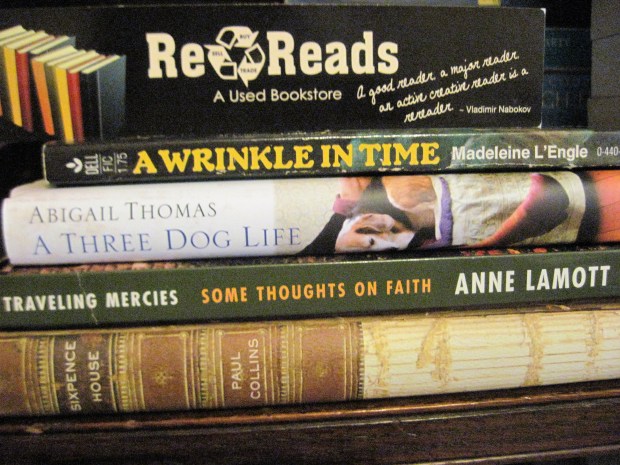
- I have a bad habit of racing through self-help and theology books rather than taking my time mulling over them and fully exploring how I might apply them in my life. This was especially true of The Artist’s Way, one of my bibliotherapy prescriptions. I started out with the aim of completing the daily “morning pages” of free writing (though for me they were ‘evening pages’; I’m not a morning person) and each chapter’s self-knowledge exercises. But soon I’d given up on the writing and contemplation and begun just reading the book straight through, which is not the point of it at all. So this year I mean to go back through the Cameron and Rubin books more mindfully, and use the McLaren devotional as it is intended, reading the recommended Bible passages alongside the weekly reflections.

What are some of your goals (reading-related or otherwise) for 2019?
Polishing off My 20 Books of Summer with Hay, Jones & Markham
I finished off strong with a few books I’ve been meaning to read for months or years.
Late Nights on Air by Elizabeth Hay (2007)
 (This was a Twitter buddy read with Naomi of Consumed by Ink and Penny of Literary Hoarders.) I read my first novel by Hay, A Student of Weather, last year. It was wonderfully rewarding even though it took me a month to read. By contrast, I read the Giller Prize-winning Late Nights on Air in half that time. Most of it is set in 1975–7 in Yellowknife, a small city in Canada’s Northwest Territories. Here winter lasts for eight months and you can still meet with snow and frozen lakes in early July. A tight-knit cast gathers around the local radio station: Harry and Gwen, refugees from Ontario starting new lives; Dido, an alluring Dutch newsreader; Ralph, the freelance book reviewer; menacing Eddie; and pious Eleanor.
Everyone is in love with everyone else, so you get these layers of unrequited romance and a sense of exposure: not just to the elements, but to the vulnerabilities of admitting one’s feelings and risking professional failure. The novel is also about appearances and assumptions – “You don’t look anything like how you sound,” Gwen says to Harry – and the dangers of obsession. Four of the station employees set out one summer to recreate the six-week journey of Arctic explorer John Hornby, a trip that ends up being as wondrous as it is fraught. Hay’s foreshadowing is a bit heavy-handed, and I found the final chapters after the expedition a slight letdown, but overall this is a marvellous story of quiet striving and dislocation. I saw bits of myself in each of the characters, and I loved the extreme setting, both mosquito-ridden summer and bitter winter. I need to read the rest of Hay’s oeuvre stat.
Favorite passages:
Harry’s professional advice to Gwen: “Radio was like poetry, he told her. At its best it could be, while television was like a blockbuster novel: one made you think and feel, the other dulled your mind. … ‘To be any good you have to believe it’s hard. It’s called creative tension. … And you won’t be any good until you’re dedicated to something outside yourself.’ … I learned that a mistake is just something you go on from.”
“Something blossoms in an unlikely place. An oasis of trees miles above the treeline. An arctic river warmer than any other water they’d come upon. The four of them bathed in the waters of the Thelon, wading out into it, almost swimming. On shore they towelled themselves dry and dressed, and there was no feeling to equal the splendour of warm clothes on river-cold skin.”
My rating: 
I ran out of time for Half of a Yellow Sun by Chimamanda Ngozi Adichie so substituted in…
An American Marriage by Tayari Jones (2018)
(If it’s good enough for Barack Obama and Oprah Winfrey, it’s good enough for me!)
 The title feels like an echo of An American Tragedy. It’s both monolithic and generic, as if saying: Here’s a marriage; make of it what you will. Is it representative of the average American situation, or is it exceptional? Roy and Celestial only get a year of happy marriage before he’s falsely accused of rape and sentenced to 12 years in prison in Louisiana. Through their alternating first-person narration and their letters back and forth while Roy is incarcerated, we learn more about this couple: how their family circumstances shaped them, how they met, and how they drift apart as Celestial turns to her childhood friend, Andre, for companionship. When Roy is granted early release, he returns to Georgia to find Celestial and see what might remain of their marriage. I ached for all three main characters: It’s an impossible situation. The novel ends probably the only way it could, on a realistic yet gently optimistic note. Life goes on, if not how you expect, and there will be joys still to come.
This would make a great book club pick: there’s a lot to probe about the characters’ personalities and motivations, and about how they reveal or disguise themselves through their narration. I found it remarkable how the letters, which together make up not even one-fifth of the text, enhance the raw honesty of the book. There are other marriages on display besides Roy and Celestial’s, their range providing a snapshot of African-American lower-middle- and upper-middle-class life in the South. I especially liked the use of two totem objects, Roy’s tooth and the hickory tree outside Celestial’s childhood home (what you see on the cover).
Favorite lines:
Celestial: “I believed that our marriage was a fine-spun tapestry, fragile but fixable. We tore it often and mended it, always with a silken thread, lovely but sure to give way.”
Andre: “I don’t believe that blood makes a family; kin is the circle you create, hands held tight.”
Celestial: “Our marriage was a sapling graft that didn’t have time to take.”
Roy: “mostly my life is good, only it’s a different type of good from what I figured on.”
My rating: 
An American Marriage was published in the UK by Oneworld on April 5th. My thanks to the publisher for the free copy for review.
West With the Night by Beryl Markham (1942)
 (Another Twitter buddy read, with Laila of Big Reading Life.) I’ve meant to pick this up ever since I read Paula McLain’s fantastic novel about Beryl Markham, Circling the Sun. I loved Markham’s memoir even more. She writes so vividly about the many adventures of her life in Africa: hunting lions, training race horses, and becoming one of the continent’s first freelance pilots, delivering mail and locating elephant herds.
It took me a while to get used to the structure – this is a set of discrete stories rather than a chronological narrative – but whether she’s reflecting on the many faces of Africa or the peculiar solitude of night flights, the prose is just stellar. Ernest Hemingway once asserted in a letter that Markham could “write rings around all of us who consider ourselves as writers,” and I certainly enjoyed this more than anything I’ve read by Hemingway.
The text is bookended by two momentous flights: it opens with Markham scrambling to deliver oxygen to an injured miner, and ends with her completing the first east–west solo flight across the Atlantic in 1936. Her engine cut out multiple times; it’s no less than a miracle that she survived to crash land in Nova Scotia. Laila and I agree that Markham’s life is so exciting it’s crying out for a movie version. In the meantime, I’d like to read some more about her circle – Denys Finch Hatton; and Baron von Blixen and his wife Karen (aka Danish writer Isak Dinesen, famous for Out of Africa). In my Circling the Sun review for BookTrib, I wrote that “Markham was the kind of real-life action adventure heroine you expect to find in Indiana Jones movies,” and that sense was only confirmed by her own account.
Favorite passages:
“to fly in unbroken darkness without even the cold companionship of a pair of ear-phones or the knowledge that somewhere ahead are lights and life and a well-marked airport is something more than just lonely. It is at times unreal to the point where the existence of other people seems not even a reasonable possibility. The hills, the forests, the rocks, and the plains are one with the darkness, and the darkness is infinite. The earth is no more your planet than is a distant star—if a star is shining; the plane is your planet and you are its sole inhabitant.”
“I saw how a man can be master of a craft, and how a craft can be master of an element. I saw the alchemy of perspective reduce my world, and all my other life, to grains in a cup. I learned to watch, to put my trust in other hands than mine. And I learned to wander. I learned what every dreaming child needs to know—that no horizon is so far that you cannot get above it or beyond it.”
My rating:
So how did I do on my first-ever #20BooksofSummer challenge? In that I read and reviewed (more than) 20 books by women that I owned in print, it was a smashing success. However, I only read 7 of the books I’d intended to, substituting in the rest from my review pile, books I owned in America, and others that grabbed my attention more than those I’d picked out in early June. Looks like I’m not great at sticking with the specific reading plans I set!
At any rate, as bonuses, here are the additional books by women that I read in print from my own shelves over the summer, not counting ones already reviewed on the blog (in chronological order, with ratings and links to any Goodreads reviews):
- Blue Horses, Mary Oliver
- The Egg and I, Betty Macdonald
- Eye of the Shoal: A Fish-watcher’s Guide to Life, the Ocean and Everything, Helen Scales
- The Partly Cloudy Patriot, Sarah Vowell

- Talk before Sleep, Elizabeth Berg
- The Incendiaries, R.O. Kwon [blog tour review coming on Monday]

- The Artist’s Way: A Spiritual Path to Higher Creativity, Julia Cameron
- Gross Anatomy: My Curious Relationship with the Female Body (The Top Half and the Bottom Half), Mara Altman [Glamour UK review coming soon]
- Questions of Travel, Elizabeth Bishop
- Writers & Company, Eleanor Wachtel

- Help Me!: One woman’s quest to find out if self-help really can change her life, Marianne Power
- Mrs Gaskell & Me: Two Women, Two Love Stories, Two Centuries Apart, Nell Stevens
I’d call that a result!
What have been the best books of the summer? Of the final 20, The Invisible Bridge by Julie Orringer was the winner, followed closely by The Life and Loves of Lena Gaunt by Tracy Farr, Late Nights on Air by Elizabeth Hay, and West With the Night by Beryl Markham. There were no real duds. I’m still very interested in all but one of the books I chose back in June, so I’ll see how many of the rest I can fit into this autumn and winter’s reading.
How was your summer of reading? Did you meet any goals you set?
August Thoughts (via Song Lyrics and Book Quotes)
Can’t believe I let the summer slip away again
Like watermelon juice dripping down my chin
It might be light enough for one last swim
If we hurry on down to the shore
A fool would ask for more
A fool would ask for more
~from “August” by Mark Erelli
Summer is winding down here in southern England. The chilly nights and mornings and the huge ripe blackberries tell us autumn will be here soon. Did I make enough of the summer? Or did I so ardently escape the heat, here and in America, that I didn’t let myself enjoy it?
 We didn’t end up making a summer pudding this year. It’s an old-fashioned, grown-up dessert made of almost nothing but white bread and fresh berries, but if you want to taste July in a bowl this is it. Sweetness from strawberries and raspberries; only just palatable sharpness from currants; smoothness from a generous pouring of cream. As my husband says each year, who knows how many more annual summer puddings we’ll get? Food traditions are as important a way of marking the passing of time and the seasons’ gifts as anything else.
~
I’ve had “August” by Mark Erelli, a New England folk singer/songwriter we discovered through The Darwin Song Project, in my head for weeks and weeks. It presents scenes from a languid summer evening that appeal to my nostalgia for my American childhood. More than that, though, its recurring line – “A fool would ask for more” – encourages me to be grateful for what I have and to appreciate these ordinary, fleeting moments.
“You’re one of those people who wants everything but what they have.” So Ruth, dying of breast cancer, skewers her best friend Ann, the narrator of Talk before Sleep by Elizabeth Berg. That line stung a little, because I fear it’s true of me. When I’m in America I’m silently contemptuous of the lavish lifestyle and the can-do attitude; as soon as I’m back in England I stew in my cluttered house and my shabby little life. I envy friends with design magazine-worthy homes (but I don’t want the hassle of owning a house), sweet kids (but I don’t want to have children), stable careers (but I don’t want a regular job), and comfortable habits not needled by environmental and ethical dilemmas (but once you know you can’t go back).
~
My five-year freelancing anniversary passed quietly at the end of July. Being a freelancer has all the perks you’d expect – no boss or co-workers, at least not in the traditional sense; no commute; flexibility; variety – but also some downsides you might not realize. In my case, it means I virtually never leave my house, and I’m sedentary and sitting most of the time. I don’t get vacation time or sick pay, I have to muddle through my taxes in two countries, and I put hours and hours of work into assignments that pay insultingly little.
When asked recently for advice about freelance writing, I warned that it is extremely difficult to make money from writing about books – so if you want to do it, be sure you’re just doing it for the love of books, and secure another source of income. For me that’s proofreading science journal articles. It’s something I’m good at and find just challenging enough to keep me stimulated, but if I’m honest I don’t really care about this work. It’s just a paycheck.
To put it simply, I’m bored. Some of my writing gigs have spanned the full five years, and I’m still doing exactly the same things. I’ve had a couple small pay rises, but I’m not earning significantly more than I was in 2013, even though I was recently named an associate editor at one of the magazines (an honorary title, alas). I feel restless and like I’m just waiting for the smallest signal to tell me I can drop everything. It would be a relief to let it all go. Julia Cameron captures this feeling in The Artist’s Way: “Restive in our lives, we yearn for more, we wish, we chafe. … We want to do something but we think it needs to be the right something, by which we mean something important.”
So really what I should be doing is aiming higher. I’m now a member of the National Book Critics Circle and have access to a document listing the pay rates for big-name venues, places that pay hundreds of dollars for book reviews and $1+/word for literary articles. But it often takes me months to get up the courage to pitch to a new publication, if I ever do it at all.
In Help Me! (out on September 6th), freelance journalist Marianne Power took on a different self-help book each month for a year to see if she could change her life for the better. One particularly rough month was all about Rejection Therapy. “I should have been constantly sending ideas to different publications but I didn’t. … I didn’t want to get rejected because I would take that as a confirmation of all the insecurities I had in my head – that I was a rubbish writer, that I had been lucky to get even this far, that I would never work again.”
That passage certainly resonated for me. No matter how many hundreds of reviews I write, I still barely trust myself to write another successful one. Temporary triumphs fade fast. Getting a pitch accepted at Literary Hub had been one of the highlights of my year, but pretty much as soon as the article was published on the website I felt deflated. It was a flash in the pan; a few comments and retweets and then it was forgotten before you know it.
I didn’t think I was a flighty person who needed a lot of novelty in my life. But Beryl Markham – lion hunter, horse trainer, aviatrix – has been reminding me that even if you have a good life that many would admire, even if you’d be a fool to ask for more, sometimes you still need a change. Here’s a passage from the formidable adventurer’s West with the Night: “I wonder if I should have a change – a year in Europe this time – something new, something better, perhaps. A life has to move or it stagnates. Even this life, I think. … it is no good anticipating regrets. Every tomorrow ought not to resemble every yesterday.”
My 35th birthday is coming up this autumn. It feels like time for a rethink. What do I want every tomorrow to look like? It’s all too easy to stick with what feels like a sure thing instead of launching into something new.
How do you ensure you’re appreciating your life but also challenging yourself with new things?
“Why We Sleep” … And Why Can’t I Wake Up?
Why We Sleep: The New Science of Sleep and Dreams by Matthew Walker
I’d heard about this book but didn’t feel compelled to get hold of it until David Lodge, one of my favorite authors, named it his book of 2017 in the TLS year-end roundup. I got an e-copy from NetGalley but then found the physical book on the bestsellers display in my local library and found that a more conducive format for skimming. It’s a fairly long and dense book, with smallish type and scientific figures, so I knew I was unlikely to read the whole thing, but enjoyed mining it for fascinating information about evolution, neuroscience and child development.
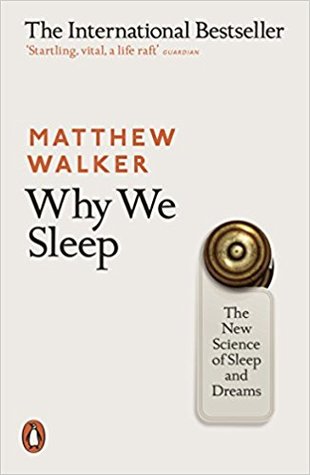 We often hear that sleep, diet and exercise are the three pillars of health, but Walker, a professor of neuroscience at the University of California, Berkeley, goes further: he believes sleep is the platform on which diet and exercise rest. Getting 7–9 hours of sleep a night is not some luxury to aim for but an absolute essential for the brain to process new information and prepare for receiving more the next day. Dreaming is like overnight therapy, and fuels creativity. Sleep deprivation has been associated with dementia and cancer: it’s no accident that Margaret Thatcher and Ronald Reagan, who prided themselves on getting by on just five hours of sleep a night, both developed Alzheimer’s. Just a few nights of insufficient sleep can weaken the immune system and increase the risks of developing a serious illness. It’s no wonder Walker calls sleep loss an epidemic.
Here are some other facts I gleaned:
- During primate evolution, the transition to sleeping on the ground instead of in trees meant we could sleep more deeply – not having to worry about falling out – and the resulting increase in REM sleep and dreams contributed to the development of complex culture and creativity.
- Fetuses are asleep most of the time; they kick in their sleep. Alcohol use during pregnancy or breastfeeding can lead to a decline in the offspring’s sleep quality or quantity.
- People with autism get 30–50% less REM sleep than neurotypical people.
- The postprandial slump in energy many of us experience is evolutionarily inbuilt, and suggests that a short nap (30–40 minutes) would be natural and beneficial. For instance, some African tribespeople still regularly nap at the hottest point of the day.
Walker’s sleep tips are mostly common-sense stuff you will have heard before. His #1 piece of advice is to have a sleep schedule, always going to sleep and waking up at the same time. (“Catching up” on weekends doesn’t work, though napping before 3 p.m. can.) Set an alarm for bedtime so you’ll stick to it, he suggests.
My rating:
Making It Personal
I like my sleep, and I like my lie-ins. It’s one of many reasons why I don’t have kids. But I hoped that the older I got the better I’d be about waking up in the mornings. That hasn’t seemed to be the case. The past couple of weeks have been abnormal in that my husband has been working from home, too – he’s been on strike from the university and/or keeping clear of the snow – but on an average weekday, when the alarm goes off at a time starting with a 6, I feel like I could sleep for hours more. I usually cover my head with a pillow and stay in bed with the cat curled against my legs for an extra half-hour while my husband showers and starts getting things ready; only when I hear the tea being poured do I finally extricate myself from the covers and lurch downstairs to eat breakfast and make our sandwiches for the day.
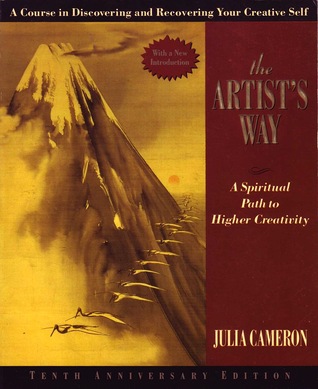 One of my bibliotherapy prescriptions was The Artist’s Way by Julia Cameron, a 12-week set of readings and exercises – chiefly 20 minutes of automatic writing each morning and creative “dates” you take yourself on. For the former, you set your alarm half an hour early each day and fill three longhand pages with whatever comes to mind. It’s not a journal; it’s more a way of processing what’s going on in your life, gradually moving from mundane thoughts about daily pressures to more creative stuff. But if I can’t wake up for our regular alarm, how in the world would I get up even earlier to commit to this creative exercise? I’ve wondered if I could cheat a bit and do the pages after a short nap in the early afternoons, but I think the idea really is to put down whatever comes into your head first thing every morning.
I can see that this would be a good discipline, especially as I come up to my fifth anniversary of freelancing and take stock of my career. I just don’t know if I can make myself do it.
Have you read anything about sleep, creativity or mindfulness recently?
Also on my TBR to be skimmed:
 24/7: Late Capitalism and the Ends of Sleep by Jonathan Crary
- The Business of Sleep: How Sleeping Better Can Transform Your Career by Vicki Culpin, a TEDx speaker and professor of organizational behavior [forthcoming on May 8th from Bloomsbury Business]
- The Secret World of Sleep: The Surprising Science of the Mind at Rest by Penelope A. Lewis
- Dreamland: Adventures in the Strange Science of Sleep by David K. Randall
My Bibliotherapy Appointment at the School of Life
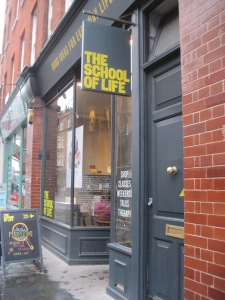 I’ve been interested in bibliotherapy for years, and I love The Novel Cure (see my review), the learned and playful advice book from Ella Berthoud and Susan Elderkin, two of the bibliotherapists at Alain de Botton’s London School of Life. Earlier this month I had the tremendous opportunity to have a personalized bibliotherapy appointment with Ella Berthoud at the School of Life. She’d put out a call on Twitter for volunteers to come for a free session (usually £100) to be observed by a journalist from La Repubblica writing about bibliotherapy – the translation of The Novel Cure has sold remarkably well in Italy. The feature will be part of a special color supplement in February, and I look forward to seeing if my story makes the cut! That is, if I can decipher any of the Italian.
Now, you might not think I’m the kind of person who needs a bibliotherapy assessment since I already find 300+ books per year I want to read; I worried that too, and felt a little bit guilty, but in the end I couldn’t pass up the chance, and Ella was happy to have me.

I took my copy of The Novel Cure along for Ella to sign.
Before my appointment I’d been asked to complete a two-page questionnaire about my reading habits and likes/dislikes, along with what’s going on in my life in general (the ‘therapy’ aspect is real). Once we were set up in the basement therapy room with hot drinks, Ella asked me more about how I read. I’d told her my reading was about two-thirds print books and one-third e-books. Had I ever tried audiobooks or reading aloud, she asked? The answer to both of those is no, I’m afraid. There’s no obvious place for audiobooks in my life because I work from home. However, as I’d mentioned I haven’t been able to get through a Dickens novel in five years, Ella suggested I try listening to one – abridged, it can be more like eight hours long instead of 42, and you still get a terrific story. She also highly recommended New Yorker and Guardian podcasts based around short stories and discussion.
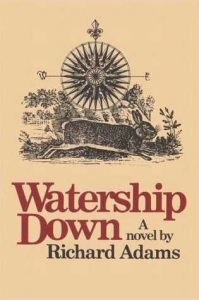 For reading aloud with my husband, Ella prescribed one short story per evening sitting – a way for me to get through short story collections, which I sometimes struggle to finish, and a different way to engage with books. We also talked about the value of rereading childhood favorites such as Watership Down and Little Women, which I haven’t gone back to since I was nine and 12, respectively. In this anniversary year, Little Women would be the ideal book to reread (and the new television adaptation is pretty good too, Ella thinks).
One other reading habit Ella is adamant about is keeping a physical reading journal in which you record the title of each book you read, where you read it, and about a paragraph of thoughts about it. It’s not meant to be a comprehensive response to every book; more like an aide-mémoire that you can get off the shelf in years to come to remind yourself of what you thought about a book. Specifically, Ella thinks writing down the location of your reading (e.g., on a train to Scotland) allows you to put yourself back in the moment. I tend to note where I bought a book, but not necessarily where I read it – for that, I would probably have to cross-reference my annual book list against a calendar. Since 2010 I’ve kept my book lists and responses in computer files, and I also keep full records via Goodreads, but I can see why having a physical journal would be a good back-up as well as a more pleasant representation of my reading. I’ll think about starting one.
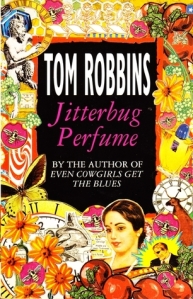 Various books came up over the course of our conversation: Abraham Verghese’s Cutting for Stone [appearance in The Novel Cure: The Ten Best Novels to Cure the Xenophobic, but Ella brought it up because of the medical theme], Tom Robbins’ Jitterbug Perfume [cure: ageing, horror of], and Julia Cameron’s The Artist’s Way, a nonfiction guide to thinking creatively about your life, chiefly through 20-minute automatic writing exercises every morning. We agreed that it’s impossible to dismiss a whole genre, even if I do find myself weary of certain trends, like dystopian fiction (I introduced Ella to Claire Vaye Watkins’ Gold Fame Citrus, one of my favorite recent examples).
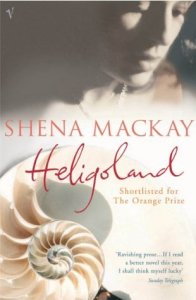 I came away with two instant prescriptions: Heligoland by Shena Mackay [cure: moving house], about a shell-shaped island house that used to be the headquarters of a cult. It’s a perfect short book, Ella tells me, and will help dose my feelings of rootlessness after moving more than 10 times in the last 10 years. She also prescribed Family Matters by Rohinton Mistry [cure: ageing parents] and an eventual reread of Jonathan Franzen’s The Corrections. As we discussed various other issues, such as my uncertainty about having children, Ella said she could think of 20 or more books to recommend me. “That’s a good thing, right?!” I asked.


Before I left, I asked Ella if she would ever prescribe nonfiction. She said they have been known to do so, usually if it’s written in a literary style (e.g. Robert Macfarlane and Alain de Botton). We chatted about medical memoirs and reading with the seasons for a little while, and then I thanked her and headed on my way. I walked around the corner to Skoob Books but, alas, didn’t find any of the books Ella had mentioned during our session. On the way back to the Tube station, though, I stopped at Judd Books and bought several secondhand and remaindered goodies, including these two:


(Imagine my surprise when I spotted The Year of the Hare in The Novel Cure under midlife crisis! Age seemed to be the theme of the day.)
 As soon as I got back from London I ordered secondhand copies of Heligoland, Jitterbug Perfume and The Artist’s Way, and borrowed Family Matters from the public library the next day. Within a few days four further book prescriptions arrived for me by e-mail. Ella did say that her job is made harder when her clients read a lot, so kudos to her for prescribing books I’d not read – with the one exception of Sebastian Barry’s Days Without End, which I love.
I’ve put in another order for Maggie and Me, the memoir by Damian Barr, plus (for reading aloud) Sum: Forty Tales from the Afterlives by David Eagleman and the collected short stories of Saki. I’m also keen to find The Victorian Chaise-Longue by Marghanita Laski, Ella’s final prescription, but as the Persephone Books reprint is pricey at the moment I may hold off and hope to chance upon a secondhand copy later in the year. Ella has been very generous with her recommendations, especially considering that I didn’t pay a penny. I certainly have plenty to be getting on with for now! I’ll report back later on in the year when I’ve had the chance to read some of these prescriptions.

The prescribed books I have gotten hold of so far.
 Bookish Beck = Rebecca Foster. American transplant to England. Freelance proofreader and book reviewer.
 Bookish Beck