Snow-y Reads
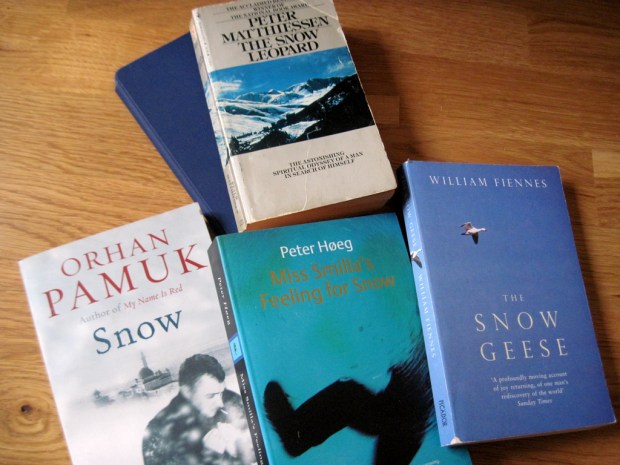
It’s been a frigid start to March here in Europe. Even though it only amounted to a few inches in total, this is still the most snow we’ve seen in years. We were without heating for 46 hours during the coldest couple of days due to an inaccessible frozen pipe, so I’m grateful that things have now thawed and spring is looking more likely. During winter’s last gasp, though, I’ve been dipping into a few appropriately snow-themed books. I had more success with some than with others. I’ll start with the one that stood out.


Miss Smilla’s Feeling for Snow by Peter Høeg (1992)
[trans. from the Danish by Felicity David]
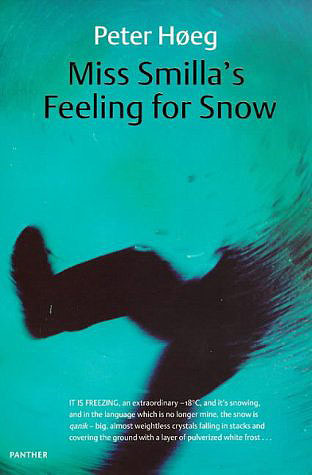 Nordic noir avant la lettre? I bought this rather by accident; had I realized it was a murder mystery, I never would have taken a chance on this international bestseller. That would have been too bad, as it’s much more interesting than your average crime thriller. The narrator/detective is Smilla Jaspersen: a 37-year-old mathematician and former Arctic navigator with a Danish father and Greenlander mother, she’s a stylish dresser and a shrewd, bold questioner who makes herself unpopular by nosing about where she doesn’t belong.
Isaiah, a little Greenlander boy, has fallen to his death from the roof of the Copenhagen apartment complex where Smilla also lives, and she’s convinced foul play was involved. In Part I she enlists the help of a mechanic neighbor (and love interest), a translator, an Arctic medicine specialist, and a mining corporation secretary to investigate Isaiah’s father’s death on a 1991 Arctic expedition and how it might be connected to Isaiah’s murder. In Part II she tests her theories by setting sail on the Greenland-bound Kronos as a stewardess. At every turn her snooping puts her in danger – there are some pretty violent scenes.
I read this fairly slowly, over the course of a month (alongside lots of other books); it’s absorbing but in a literary style, so not as pacey or full of cliffhangers as you’d expect from a suspense novel. I got myself confused over all the minor characters and the revelations about the expeditions, so made pencil notes inside the front cover to keep things straight. Setting aside the plot, which gets a bit silly towards the end, I valued this most for Smilla’s self-knowledge and insights into what it’s like to be a Greenlander in Denmark. I read this straight after Gretel Ehrlich’s travel book about Greenland, This Cold Heaven – an excellent pairing I’d recommend to anyone who wants to spend time vicariously traveling in the far north.
Favorite wintry passage:
“I’m not perfect. I think more highly of snow and ice than of love. It’s easier for me to be interested in mathematics than to have affection for my fellow human beings.”
My rating:
One that I left unfinished:
Snow by Orhan Pamuk (2002)
[trans. from the Turkish by Maureen Freely]
 This novel seems to be based around an elaborate play on words: it’s set in Kars, a Turkish town where the protagonist, a poet known by the initials Ka, becomes stranded by the snow (Kar in Turkish). After 12 years in political exile in Germany, Ka is back in Turkey for his mother’s funeral. While he’s here, he decides to investigate a recent spate of female suicides, keep tabs on the upcoming election, and see if he can win the love of divorcée Ipek, daughter of the owner of the Snow Palace Hotel, where he’s staying. There’s a hint of magic realism to the novel: the newspaper covers Ka’s reading of a poem called “Snow” before he’s even written it. He and Ipek witness the shooting of the director of the Institute of Education. The attempted assassination is revenge for him banning girls who wear headscarves from schools.
As in Elif Shafak’s Three Daughters of Eve, the emphasis is on Turkey’s split personality: a choice between fundamentalism (= East, poverty) and secularism (= West, wealth). Pamuk is pretty heavy-handed with these rival ideologies and with the symbolism of the snow. By the time I reached page 165, having skimmed maybe two chapters’ worth along the way, I couldn’t bear to keep going. However, if I get a recommendation of a shorter and subtler Pamuk novel I would give him another try. I did enjoy the various nice quotes about snow (reminiscent of Joyce’s “The Dead”) – it really was atmospheric for this time of year.
Favorite wintry passage:
“That’s why snow drew people together. It was as if snow cast a veil over hatreds, greed and wrath and made everyone feel close to one another.”
My rating:
One that I only skimmed:
The Snow Geese by William Fiennes (2002)
 Having recovered from an illness that hit at age 25 while he was studying for a doctorate, Fiennes set off to track the migration route of the snow goose, which starts in the Gulf of Mexico and goes to the Arctic territories of Canada. He was inspired by his father’s love of birdwatching and Paul Gallico’s The Snow Goose (which I haven’t read). I thought this couldn’t fail to be great, what with its themes of travel, birds, illness and identity. However, Fiennes gets bogged down in details. When he stays with friendly Americans in Texas he gives you every detail of their home décor, meals and way of speaking; when he takes a Greyhound bus ride he recounts every conversation he had with his random seatmates. This is too much about the grind of travel and not enough about the natural spectacles he was searching for. And then when he gets up to the far north he eats snow goose. So I ended up just skimming this one for the birdwatching bits. I did like Fiennes’s writing, just not what he chose to focus on, so I’ll read his other memoir, The Music Room.
My rating:
 Considered but quickly abandoned: In the Midst of Winter by Isabel Allende
Would like to read soon: The Snow Leopard by Peter Matthiessen – my husband recently rated this 5 stars and calls it a spiritual quest memoir, with elements of nature and travel writing.
What’s been your snowbound reading this year?
Five Perfect Winter Reads
When possible I enjoy reading with the seasons. As the holidays approached last year I picked out a pile of wintry reads that would see me through the dark, cold days of January. I’ve had a chance to read five of them so far, and give review extracts below. I may report back later on in the winter about a few books I plan to read with “snow” in the title.

In the Grip of Winter by Colin Dann
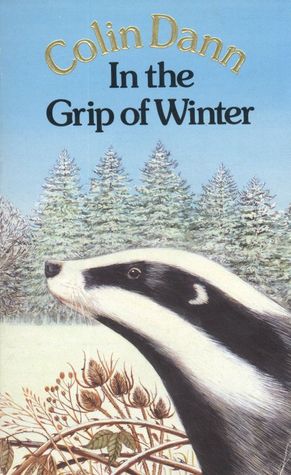 In this second book of the Farthing Wood series, the animals endure a harsh winter in their new home, the White Deer Park. When Badger falls down a slope and injures his leg, he’s nursed back to health at the Warden’s cottage, where Ginger Cat tempts him to join in a life of comfort and plenty. Meanwhile, Fox, Tawny Owl and the others are near starvation, and resort to leaving the park and stealing food from farms and rubbish bins. They have to band together and use their cunning to survive. This was a sweet book that reminded me of my childhood love of anthropomorphized animal stories (like Watership Down and the Redwall series). I doubt I’ll read another from the series, but this was a quaint read for the season.
My husband received this book for free from his school for some reason. Even early on his tastes turned towards wildlife. [One annoyance: the author always referred to Badger’s “set” instead of his “sett”; although it appears this may actually be a permissible variant, it wasn’t cool with me!]


Favorite wintry passage:
“‘Every winter is hard for some,’ Badger answered. ‘The weakest among us always suffer the most. The small creatures: the mice, the shrews, the voles and, particularly, the small birds – every winter takes its toll [on] them. But yes – I sense that this winter will be one to reckon with. There’s something in that wind…’”
My rating:
This Cold Heaven: Seven Seasons in Greenland by Gretel Ehrlich
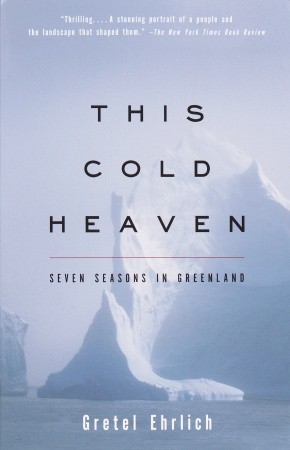 Once a year or so I encounter a book that’s so flawlessly written you could pick out just about any sentence and marvel at its construction. That’s certainly the case here. I never want to go to Greenland; English winters are quite dark and cold enough for me, and I don’t know if I could stomach seal meat at all, let alone for most meals and often raw. But that’s okay: I don’t need to book a flight to Qaanaaq, because through reading this I’ve already been in Greenland in every season, and I thoroughly enjoyed my armchair trek. Impressively, Ehrlich is always describing the same sorts of scenery, and yet every time finds a fresh way to write about ice and sun glare and frigid temperatures. I’ll be looking into her other books for sure.
Favorite wintry passage:
“The ice cap itself was a siren singing me back to Greenland, its walls of blue sapphire and sheer immensity always beguiling. Part jewel, part eye, part lighthouse, part recumbent monolith, the ice is a bright spot on the upper tier of the globe where the world’s purse strings have been pulled tight, nudging the tops of three continents together. Summers, it burns in the sun, and in the dark it hoards moonlight.”
My rating:
Further reading on Greenland: A Wilder Time: Notes from a Geologist at the Edge of the Greenland Ice by William E. Glassley (see my Foreword review) and The Prophets of Eternal Fjord by Kim Leine, an epic novel about an unconventional priest, set in late-eighteenth-century Denmark and Greenland (see my Nudge review). Also Sinéad Morrissey’s multi-part poem “Whitelessness.” You can read the first stanza of it here.
The Short Day Dying by Peter Hobbs
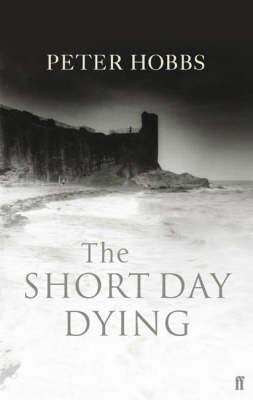 This short novel from 2005 deserves to be better known. It reminded me of Days Without End and On the Black Hill, but most of all of Francis Kilvert’s diary, perhaps as voiced by a rustic from Poldark. We journey through 1870 with Charles Wenmoth, a twenty-seven-year-old blacksmith’s apprentice and Methodist lay preacher in Cornwall mining country. Very little happens; the focus is on atmosphere and voice. The major struggle is with his melancholy spirit, which causes him to doubt his salvation. As winter circles round, the days grow shorter just as he senses life growing shorter. The short chapters are like undated diary entries (apparently based on the author’s great-great-grandfather’s); the sentences are almost completely unpunctuated, which at first had me twitching for my pencil to add commas to the run-on sentences, but eventually I gave myself over to the flow.
Favorite wintry passage:
“It is a shame we cannot stay children for ever and remain blind to the slow death of the land. How different it will all be in a few months the bare trees revealed as dark gnarled bodies. Something inside them though lives through the yearly famine and they always find new colour. I trust it is the same for us all.”
My rating:
Winter by Karl Ove Knausgaard
 This is my favorite of the three Knausgaard books I’ve read so far, and miles better than his Autumn. These short essays successfully evoke the sensations of winter and the conflicting emotions elicited by family life and childhood memories. The series is, loosely speaking, a set of instruction manuals for his unborn daughter, who is born a month premature in the course of this volume. So in the first book he starts with the basics of bodily existence – orifices, bodily fluids and clothing – and now he’s moving on to slightly more advanced but still everyday things she’ll encounter, like coins, stuffed animals, a messy house, toothbrushes, and the moon. I’ll see out this series, and see afterwards if I have the nerve to return to My Struggle.
Favorite wintry passage:
“winter not only muffles some sounds and intensifies others, it also has sounds that are entirely its own, unique to the season, and some of them are among the most beautiful of all. The low boom of ice-covered waters as they freeze, for instance, which can be heard on perfectly clear days or nights when the cold deepens, and which has something menacing or mighty about it, since it isn’t connected to an visible movement”
My rating:
Available Light by Marge Piercy
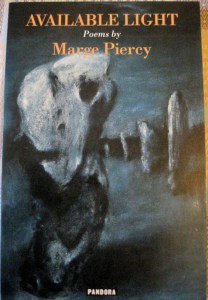 Many poetry volumes get a middling rating from me because some of the poems are memorable but others do nothing for me. This is on the longer side for a collection at 120+ pages, but only a handful of its poems fell flat. The subjects are diverse: travels in Europe (my cover depicts the Avebury stone circle in the gloom), menstruation, identifying as a Jew as well as a feminist, scattering her father’s ashes, the stresses of daily life, and being in love. The title poem, which appears first, has a slightly melancholy tone with its focus on the short days of winter, but the poet defiantly asserts meaning despite the mood: “Even the dead of winter: it seethes with more / than I can ever live to name and speak.” Piercy was a great discovery, and I’ll be trying lots more of her books from various genres.
Favorite wintry passage:
(from “Available light”)
In winter the light is red and short.
The sun hangs its wizened rosehip in the oaks.
By midafternoon night is folding in.
The ground is locked against us like a door.
Yet faces shine so the eyes stretch for them
and tracks in the snow are etched, calligraphy
My rating:
(And one book that didn’t quite work for me; I ended up abandoning it at 14%.
 The Bear and the Nightingale by Katherine Arden: Some striking turns of phrase, an enchanting wintry atmosphere … but a little Disney-fied for me. I got this free for Kindle so may come back to it at some point.
Favorite wintry passage:
“The years slipped by like leaves. …The clouds lay like wet wool above the trees.”)
Have you read any wintry books this year?
Novellas in November, Part 1
This is my second year of joining Laura (Reading in Bed) and others in reading mostly novellas in November. I’ve trawled my shelves and my current library pile for short books, limiting myself to ones of around 150 pages or fewer. First up: four short works of fiction. (I’m at work on various ‘nonfiction novellas’, too.) For the first two I give longer reviews as I got the books from the publishers; the other two are true minis.

Swallowing Mercury by Wioletta Greg
(translated from the Polish by Eliza Marciniak)
[146 pages]
I heard about this one via the Man Booker International Prize longlist. Quirkiness is particularly common in indie and translated books, I find, and while it’s often off-putting for me, I loved it here. Greg achieves an impressive balance between grim subject matter and simple enjoyment of remembered childhood activities. Her novella is, after all, set in Poland in the 1980s, the last decade of it being a Communist state in the Soviet Union.
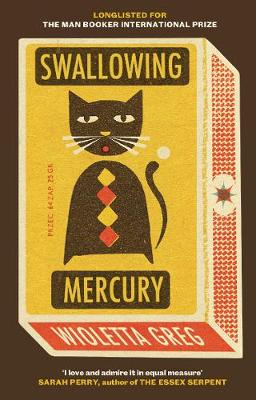 The narrator (and autobiographical stand-in?) is Wiolka Rogalówna, who lives with her parents in a moldering house in the fictional town of Hektary. Her father, one of the most striking characters, was arrested for deserting from the army two weeks before she was born, and now works for a paper mill and zealously pursues his hobbies of hunting, fishing, and taxidermy. The signs of their deprivation – really the whole country’s poverty – are subtle: Wiolka has to go selling hand-picked sour cherries with her grandmother at the market even though she’s embarrassed to run into her classmates; she goes out collecting scrap metal with a gang of boys; and she ties up her hair with a rubber band she cut from an inner tube.
Catholicism plays a major role in these characters’ lives: Wiolka wins a blessed figure in a church raffle, the Pope is rumored to be on his way, and a picture of the Black Madonna visits the town. A striking contrast is set up between the threat of molestation – Wiolka is always fending off unwanted advances, it seems – and lighthearted antics like school competitions and going to great lengths to get rare matchbox labels for her collection. This almost madcap element balances out some of the difficulty of her upbringing.
What I most appreciated was the way Greg depicts some universalities of childhood and adolescence, such as catching bugs, having eerie experiences in the dark, and getting one’s first period. This is a book of titled vignettes of just five to 10 pages, but it feels much more expansive than that, capturing the whole of early life. The Polish title translates as “Unripe,” which better reflects the coming-of-age theme; the English translator has gone for that quirk instead.
A favorite passage:
“Then I sat at the table, which was set with plates full of pasta, laid my head down on the surface and felt the pulsating of the wood. In its cracks and knots, christenings, wakes and name-day celebrations were in full swing, and woodworms were playing dodgeball using poppy seeds that had fallen from the crusts of freshly baked bread.”
Thanks to Portobello Books for the free copy for review.
A Field Guide to the North American Family by Garth Risk Hallberg
[126 pages]
 Written somewhat in the style of a bird field guide, this is essentially a set of flash fiction stories you have to put together in your mind to figure out what happens to two seemingly conventional middle-class families: the Harrisons and the Hungates, neighbors on Long Island. Frank Harrison dies suddenly in 2008, and the Hungates divorce soon after. Their son Gabe devotes much of his high school years to drug-taking before an accident lands him in a burn unit. Here he’s visited by his girlfriend, Lacey Harrison. Her little brother, Tommy, is a compulsive liar but knows a big secret his late father was keeping from his wife.
The chapters, each just a paragraph or two, are given alphabetical, cross-referenced headings and an apparently thematic photograph. For example, “Entertainment,” one of my favorite stand-alone pieces, opens “In the beginning was the Television. And the Television was large and paneled in plastic made to look like wood. It dwelled in a dim corner of the living room and came on for national news, Cosby, Saturday cartoons, and football.”
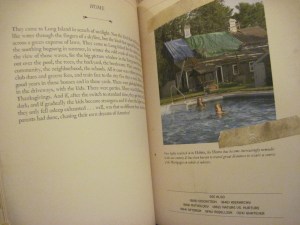 This is a Franzen-esque take on family dysfunction and, like City on Fire, is best devoured in large chunks at a time so you don’t lose momentum: as short as this is, I found it easy to forget who the characters were and had to keep referring to the (handy) family tree at the start. Ultimately I found the mixed-media format just a little silly, and the photos often seem to bear little relation to the text. It’s interesting to see how this idea evolved into the mixed-media sections of City on Fire, which is as epic as this is minimalist, though the story line of this novella is so thin as to be almost incidental.
Favorite lines:
“Depending on parent genotype, the crossbreeding of a Bad Habit and Boredom will result in either Chemistry or Entertainment.”
“Though hardly the most visible member of its kingdom, Love has never been as endangered as conservationists would have us believe, for without it, the Family would cease to function.”
Thanks to Vintage Books for the free copy for review.
The Comfort of Strangers by Ian McEwan
[100 pages]
 This is the earliest McEwan work I’ve read (1981). I could see the seeds of some of his classic themes: obsession, sexual and otherwise; the slow building of suspense and awareness until an inevitable short burst of violence. Mary and Colin are a vacationing couple in Venice. One evening they’ve spent so long in bed that by the time they get out all the local restaurants have shut, but a bar-owner takes pity and gives them sustenance, then a place to rest and wash when they get lost and fail to locate their hotel. Soon neighborly solicitude turns into a creepy level of attention. McEwan has a knack for presenting situations that are just odd enough to stand out but not odd enough to provoke an instant recoil, so along with the characters we keep thinking all will turn out benignly. This reminded me of Death in Venice and The Talented Mr. Ripley.
First Love by Gwendoline Riley
[167 pages – on the long side, but I had a library copy to read anyway]
 Neve tells us about her testy marriage with Edwyn, a Jekyll & Hyde type who sometimes earns our sympathy for his health problems and other times seems like a verbally abusive misogynist. But she also tells us about her past: her excess drinking, her unpleasant father, her moves between various cities in the north of England and Scotland, a previous relationship that broke down, her mother’s failed marriages, and so on. There’s a lot of very good dialogue in this book – I was reminded of Conversations with Friends – and Neve’s needy mum is a great character, but I wasn’t sure what this all amounts to. As best I can make out, we are meant to question Neve’s self-destructive habits, with Edwyn being just the latest example of a poor, masochistic decision. Every once in a while you get Riley waxing lyrical in a way that suggests she’s a really great author who got stuck with a somber, limited subject: “Outside the sunset abetted one last queer revival of light, so the outlook was torched; wet bus stop, wet shutters, all deep-dyed.”
Other favorite lines:
“An illusion of freedom: snap-twist getaways with no plans: nothing real. I’d given my freedom away. Time and again. As if I had contempt for it. Or was it hopelessness I felt, that I was so negligent? Or did it hardly matter, in fact? … Could I trust myself? Not to make my life a lair.”
Have you read any of these novellas? Which one takes your fancy?
9 Things that Surprised Me about Madame Bovary
My classic for September was one of those books that are so ingrained in the canon you most likely know the basic story line even if you’ve never read a word Gustave Flaubert wrote. I’d happened to read a fair bit about Madame Bovary (1857), mostly via Julian Barnes, and had also encountered some modern novels that might be said to be updates (Hausfrau by Jill Alexander Essbaum and perhaps even George and Lizzie by Nancy Pearl), but never picked up the book itself until earlier this month. While the essential turns of the plot were indeed familiar to me, there was also plenty that surprised me in terms of the details and the mechanics. I’ve set this out in nine points below; if you’re determined to avoid anything that seems like spoilers, I’d suggest skipping over #6–8.
#1. We open with Charles Bovary.
And in the first-person plural: “We were studying when the headmaster came in, followed by a new boy”. I suppose I assumed the book would open immediately on Emma Bovary, already married to Charles. Instead, we get a quick tour through Charles’s adolescent schooling and independent medical studies.
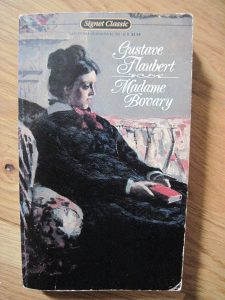 #2. There are two “Madame Bovarys” before the one we’re interested in.
The original Madame Bovary, and the only one to survive the book, is Charles’s mother. Charles also has a brief first marriage to Heloise, an older widow. Conveniently, she dies by the end of the second chapter, in which Charles met Emma when he went to set her farmer father’s broken leg.
#3. There’s a lovely Hardyesque flavor to the novel.
Flaubert’s original subtitle was “Provincial Morals,” and the scenes set among country folk – especially Emma and Charles’s wedding procession and reception and the later agricultural fair – reminded me of Far from the Madding Crowd.
#4. Emma has a child.
Despite all I’d absorbed about the book, I never knew Emma had a baby girl, Berthe. They lodge the infant with a wet nurse and servants do most of the hard work of raising her, so Berthe has only a tiny role. The scene in which Emma violently pushes the little girl away from her is meant, I think, to reflect her fundamental unfitness for motherhood.
#5. In the world of the novel, literature is a danger and religion is no balm.
On the advice of Charles’s mother, he cancels Emma’s lending library subscription lest novels exacerbate her discontent. Manual labor is what Emma needs, Old Madame Bovary proclaims. When Emma goes to the parish priest for advice about her angst, he tells her she must be ill if she benefits from all the physical comforts she could need yet cannot be happy. (An excellent and wrenching scene.)

Gustave Flaubert. (Public domain, via Wikimedia Commons.)
#6. There’s a strong medical theme.
Charles is a doctor, of course, but I didn’t know his profession would enter into the plot. There’s a crucial sequence in which he performs a groundbreaking operation on a stable boy with a clubfoot, but gangrene sets in and the leg has to be amputated. (Emma guiltily buys the boy a false leg.) Emma’s somewhat prolonged death by poisoning, and the appearance of her corpse, are also described in recognizable medical detail.
#7. Emma’s death isn’t the end.
There’s still two more chapters to go, and things only get worse. It’s as if Emma is still a negative influence after her death: pushing Charles on to extravagances he can’t afford, and sending him deeper into despair when he finds undeniable evidence of her two affairs.
#8. Homais, the arrogant pharmacist, is triumphant.
Monsieur Homais is one of the key secondary characters in Yonville, this small town near Rouen. He’s a middling community member who’s gotten above himself, yet he succeeds whereas Emma is crushed. The very last line of the novel goes to him: “He has just received the Legion of Honor.” In the introduction to my Signet Classic edition, Mary McCarthy suggests that Homais is “not just Emma’s foil; he is her alter ego.”
#9. Madame Bovary went on trial.
Appended to my copy is a 78-page transcript of the novel’s trial. As I skimmed it, I was reminded of the Lady Chatterley’s Lover obscenity case, which took place just over 100 years later (1959–60). Flaubert and his publisher were accused of “offenses against public morality and religion,” specifically of portraying Emma as lascivious and making adultery appealing compared to the banality of marriage. The defense countered that Charles receives all the reader’s sympathy and Emma all the reader’s revulsion. Flaubert was acquitted (as was Lady Chatterley), but the judge’s ruling was essentially “Naughty boy, don’t you know literature has a mission to exalt the spirit, not to hold up vice as an object of horror?”
Now for what doesn’t surprise me about Madame Bovary: the beautiful writing and the enduring power of what is ultimately a rather commonplace story line. The percentage of novels with an adultery subplot must be very high nowadays, but Madame Bovary and Anna Karenina were two of the first to consider the female experience.
Flaubert famously declared “Madame Bovary, c’est moi” (“Madame Bovary is me”), and I think every reader must see something of him-/herself in this character: the lure of a romantic and luxurious life, the boredom of the day to day, the longing to make something more out of existence, and an increasing desperation to cover up one’s mistakes. A book that has had meaning for generations, Madame Bovary is a true classic.
Some favorite lines:
“But her life was as cold as an attic with northern exposure, and boredom, that silent spider, was spinning its web in all the dark corners of her heart.”
“Mealtime was the worst of all in that tiny room on the ground floor, with the smoking oven, the creaking door, the damp walls, and the moist flagstones; all the bitterness of her existence seemed to be served up to her on her plate, and the steam from the boiled beef brought up waves of nausea from the depths of her soul.”
“No one can ever express the exact measure of his needs, or conceptions, or sorrows. The human language is like a cracked kettle on which we beat out a tune for a dancing bear, when we hope with our music to move the stars.”
(Isn’t that last sentence incredible?!)
My rating:
I read a Signet Classic edition of Mildred Marmur’s 1964 translation.
See also Susan’s review of Sophie Divry’s recent update, Madame Bovary of the Suburbs, at A life in books.
Library Checkout: September 2017
I’ve mostly been reading review copies, books from my own shelves, and Kindle books this month, though I did manage one library read during our trip to Amsterdam. While I was at the public library on Thursday, however, I was tempted by several titles from the bestsellers display – these are two-week loans with no renewals, so I have to devote some serious time to them this week and into early October. I’ve read and enjoyed one previous book each by Binet, Knausgaard and Higashida (I just realized those are all translated – how about that? Usually I have to urge myself to remember to read literature in translation!), so will be interested to see how their most recent work stacks up.
LIBRARY BOOKS READ
- Tulip Fever by Deborah Moggach
CURRENTLY READING
- The Seventh Function of Language by Laurent Binet
- Autumn by Karl Ove Knausgaard
- A Sand County Almanac by Aldo Leopold [from university library]
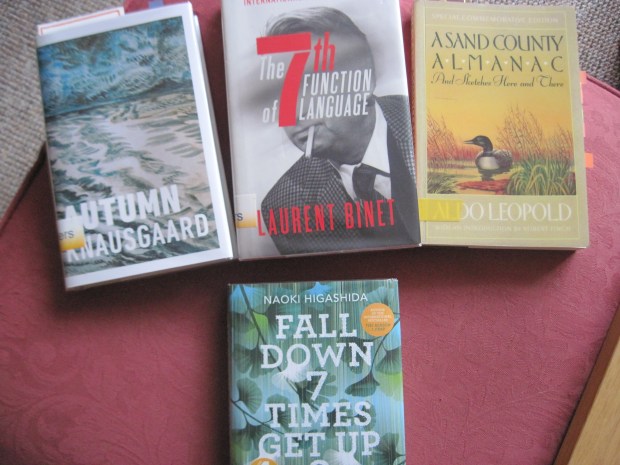
CHECKED OUT, TO BE READ
- Fall Down 7 Times, Get Up 8, Naoki Higashida
(Hosted by Charleen of It’s a Portable Magic.)
Have you been taking advantage of your local libraries? What appeals from my list?
Short Fiction for September
I toyed with the wild idea of only reading short stories as my fiction for the month of September, but it was never really going to happen: I just don’t find short stories compelling enough, and in some ways they feel like hard work – every few pages, it seems, you have to adjust to a new scene and set of characters. In the end I made it through one anthology of flash fiction this month, and read parts of three other story collections. Mini reviews below…
Best Small Fictions 2017, edited by Amy Hempel
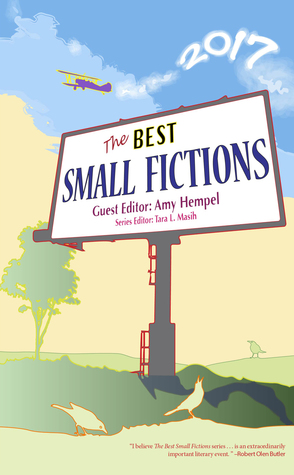 Now in its third year, the Best Small Fictions anthology collects the year’s best short stories under 1000 words. (I reviewed the two previous volumes for BookTrib and the Small Press Book Review.) Starting with a zinger of a first line is one strategy for making a short-short story stand out, and there are certainly some excellent opening sentences here. Symbols and similes are also crucial to conveying shorthand meaning. Two stand-outs are “States of Matter,” Tara Laskowski’s deliciously creepy story of revenge aided by a gravedigger; and Matthew Baker’s “The President’s Doubles,” in which an island nation becomes so protective of its imperiled leader that he ends up a prisoner. They’ve saved the best for last in this collection, though: the late Brian Doyle’s “My Devils,” in which an Irish-American boy learns how to interpret the adult world by deciphering what people say versus what they mean. It’s remarkable how concisely a coming of age and loss of blind faith are conveyed. Although there are fewer overall highlights than in the first volume, this is an excellent snapshot of contemporary super-short story writing, recommended for story lovers and newbies alike. (See my full review for the Pittsburgh Post-Gazette.)
The Bus Driver Who Wanted to Be God and Other Stories by Etgar Keret
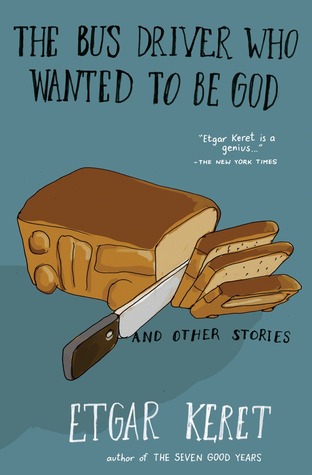 How can you not want to read a book with that title? Unfortunately, “The Story about a Bus Driver Who Wanted to Be God” is the first story and probably the best, so it’s all a slight downhill journey from there. That story stars a bus driver who’s weighing justice versus mercy in his response to one lovelorn passenger, and retribution is a recurring element in the remainder of the book. Most stories are just three to five pages long. Important characters include an angel who can’t fly, visitors from the mouth of Hell in Uzbekistan, and an Israeli ex-military type with the ironic surname of Goodman who’s hired to assassinate a Texas minister for $30,000. You can never predict what decisions people will make, Keret seems to be emphasizing, or how they’ll choose to justify themselves; “Everything in life is just luck.”
Aside from the title story, I particularly liked “Pipes,” in which the narrator makes himself a giant pipe through which to escape to Heaven, a place for misfits who’ve never found a way to be happy on Earth. Twisted biblical allusions like this are rife, including “Plague of the Firstborn.” A few stories have a folktale-like ambiance. It felt like there were too many first-person narrators, though, and too many repeating plots: “Good Intentions” takes up the same contract killing theme as “Goodman,” while both “Katzenstein” and “Jetlag” involve ejection from a plane. I read everything bar the 86-page novella Kneller’s Happy Campers; after so much flash fiction I wasn’t prepared to change pace so dramatically. So I’ve marked this as unfinished even though I read 110 pages in total. (Read in translation from the Hebrew.)
Honeydew by Edith Pearlman
I don’t know what it is with me lately, but I seem to lack staying power with story collections. I read the first 40% of Pearlman’s most recent book on my Kindle and then just felt no need to continue. You could consider that a virtue of story collections: you can read as much or as little at a time as you want and pick and choose what bits interest you, in a way that you can’t with novels. Or you could say an author must be doing something wrong if a reader doesn’t long to keep turning the pages.
 At any rate, I enjoyed Pearlman’s stories well enough. They all apparently take place in suburban Boston and many consider unlikely romances. My favorite was “Castle 4,” set in an old hospital. Zephyr, an anesthetist, falls in love with a cancer patient, while a Filipino widower who works as a security guard forms a tender relationship with the gift shop lady who sells his disabled daughter’s wood carvings. I also liked “Tenderfoot,” in which a pedicurist helps an art historian see that his heart is just as hard as his feet and that may be why he has an estranged wife. “Blessed Harry” amused me because the setup is a bogus e-mail requesting that a Latin teacher come speak at King’s College London (where I used to work). Two stories in a row (four in total, I’m told) center around Rennie’s antique shop – a little too Mitford quaint for me.
Favorite lines: “Happiness lengthens time. Every day seemed as long as a novel. Every night a double feature. Every week a lifetime, a muted lifetime, a lifetime in which sadness, always wedged under her breast like a doorstop, lost some of its bite.” (from “Stone”)
Even though I didn’t finish either of these books, I’d gladly try something else by the authors. Can you recommend something to me?
Currently reading: After enjoying Bernard MacLaverty’s Midwinter Break so much, I picked up one of his short story collections (along with Keret’s) from Book-Cycle in Exeter earlier this month. So far I’ve read the first two stories in The Great Profundo, one about a struggling artist and a lonely widow who connect over an Emily Dickinson passage, and another about a cardinal whose father confesses he lost his faith years ago.

Upcoming: I have collections by Andrea Barrett, T.C. Boyle, Tessa Hadley and Alice Munro on the shelf. I also have far too many languishing on my Kindle, including For a Little While by Rick Bass, Whatever Happened to Interracial Love? by Kathleen Collins, We Come to Our Senses by Odie Lindsey, Music in Wartime by Rebecca Makkai and 99 Stories of God by Joy Williams. The ones I’m most likely to get to fairly soon, I think, are Difficult Women by Roxane Gay and The Garden Party by Katherine Mansfield.

Are you a short story fan? Read any good ones recently?
Three Novellas in Translation
The Institute by Vincent Bijlo
[London’s Holland Park Press specializes in making classic and contemporary Dutch literature available in English translation.]
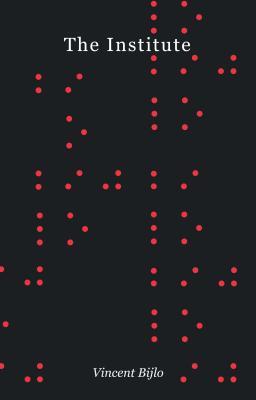 Otto Iking is a resident at the Institute, a boarding school for the blind. He characterizes his fellow students firstly according to their smell – “foul soap,” “piss” or “grated Swiss cheese” – only later adding in details about their speech and habits. It’s a zany sort of place, powered by pranks and strange decisions. Some stand-out scenes include hiding Harry’s glass eyes and a visit from the president of Surinam, a former Dutch colony. The slapstick humor works well (“When I walked into a lamppost, I said sorry. When I struck my head against a traffic sign, I said sorry. No one has ever apologised to street furniture as often as I did”), but some humor translates less well, seeming cruel or even offensive (“Tony was fat and deaf and black-skinned”).
Alongside the silliness is the matter of Otto’s coming of age. He has the first inklings of what sex is about and falls for Sonja, and also undergoes training to prepare him for the real world, things like reading and writing Braille, preparing and eating tricky meals (soup’s a killer). One day he hopes to go to a mainstream school and broadcast radio programs. The institutional setting and quirky cast reminded me of The Secret Diary of Hendrik Groen, 83¼ Years Old and Linda Grant’s The Dark Circle.
The Institute, originally from 1998, was published on April 27th. Translated from the Dutch by Susan Ridder. My thanks to Bernadette Jansen op de Haar for sending a free copy for review.
This is the first of three Otto Iking novels. Vincent Bijlo, a Dutch stand-up comedian, was born blind.
My rating:
Dance by the Canal by Kerstin Hensel
[Peirene Press issues its translated European novellas in trios. This is the final installment in the “East and West: Looking Both Ways” series; I’ve also reviewed the first two, The Last Summer by Ricarda Huch and The Orange Grove by Larry Tremblay.]
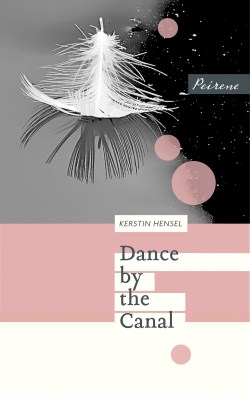 I don’t think I’ve ever read a novel narrated by a homeless person before. Gabriela von Haßlau has a noble name and a solid upper-middle-class background – her father was a surgeon and chief medical officer specializing in varicose veins; her mother was trained as a radiographer before becoming a housewife and society hostess – but her life took a turn for the worse at some point and she now lives in an encampment under a canal bridge in the town of Leibnitz (a fictional stand-in for Leipzig).
It’s July 1994 and she decides to write her life story on whatever scraps of paper she can get her hands on. She remembers being forced to play the violin as a child even though she was largely unmusical, enduring mockery at school for being one of the intelligentsia, playing hooky with her best friend Katka, and failing at a mechanical engineering apprenticeship. The narrative toggles between Gabriela’s memories and her present situation: getting blankets and food from a shelter and trying to avoid being sent to the mental hospital.
My unfamiliarity with German history, especially that relating to East Germany and reunification, means I probably missed some nuances of the plot; I found the ending quite sudden. What was most worthwhile about the book for me was experiencing homelessness with Gabriela and tracing some of the unfortunate events that led her to this situation. It’s also interesting to see how she shapes her life story in scenes and streams of consciousness.
Dance by the Canal, originally from 1994, was published on July 3rd. Translated from the German by Jen Calleja. With thanks to Peirene Press for the free copy for review.
My rating:
Hair Everywhere by Tea Tulić
[London’s Istros Books specializes in Balkans and South-Eastern European literature in translation.]
 How could I resist such a terrific title and cover image? This was Croatian novelist Tea Tulić’s first book. In brief, titled vignettes almost like flash fiction stories, she dramatizes how a cancer diagnosis affects three generations of women. The book is strong on place, sensual detail and scene-setting. The narrator’s mother is in the hospital, and all the specialists and medicinal plant extracts in the world don’t seem to be helping. In such a restrictive narrative format, a line or two of dialogue can reveal a lot about a character’s attitude. The grandmother is a weary pessimist – “I just need to help your mother get through this and then I can die” – while the narrator is quite the hypochondriac.
The tone ranges from poignant to cynical, as in the absurd two-page sequence in which the family cannot locate an on-duty doctor who can read the latest X-ray results for them. The deadpan language and mixture of black humor and pathos reminded me of Adios, Cowboy by Olja Savičevi, which coincidentally is the only other Croatian novel I’ve encountered, and was originally published in the same year, 2011.
A few favorite lines:
“One little cloud was urinating.”
“While I watch her lying in bed, I can feel the umbilical cord between us. Something I have tried to cut a thousand times already. And now I hold onto that invisible cord as though I were hanging from a bridge.”
“Patrick Swayze” in its entirety: “My brother is angry because the doctors say they cannot help Mum. I tell him Patrick Swayze had lots of money but he still died of cancer.”
Hair Everywhere was published on May 22nd. Translated from the Croatian by Coral Petkovich. My thanks to Susan Curtis for sending a free copy for review – and to TJ at My Book Strings for making me aware of this title during Women in Translation Month.
My rating:
Classic of the Month: Fathers and Sons by Ivan Turgenev
Last month’s classic was Father and Son (Edmund Gosse); this month is Fathers and Sons, the 1861 novel by Ivan Turgenev (1818–83). I couldn’t resist pairing up the similar titles, and it turns out that even though one is nonfiction and the other fiction, they are thematically similar, dwelling on the clash of generations and contrasting romanticism and rationalism.
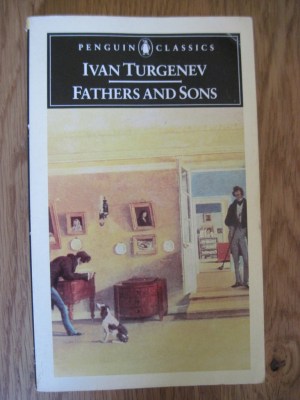 Nikolai Kirsanov’s son Arkady, newly graduated from university, has just returned to his father’s estate with his haughty fellow student Yevgeny Bazarov in tow. Bazarov intends to take a medical degree and follow in his father’s footsteps as a country doctor, so spends the time at his friend’s house dutifully poring over chemistry texts and dissecting frogs. Arkady, by contrast, seems earnest but aimless, happy to simply while away the days. The major change at home is that his father, a widower, has taken the servant girl Fenichka as his mistress and they have a baby, Mitya. (Gasp!) Yet the real shock in the world of the novel seems to be that Nikolai is consorting with someone of the lower classes. “In any case, it’s not for a son to sit in judgment on his father – least of all for me, and least of all with a father like you, who has never restricted my freedom in any way,” Arkady graciously concedes.
Together Nikolai and his rakish brother Pavel (“Women lost their heads over him, and men dubbed him a fop but were secretly envious”) represent an outmoded idealism that values art, nature, poetry, and true love. On the other side is Bazarov, who means to tear down those dated notions and recruit Arkady to the side of realism, even nihilism. “Nature is not a temple, but a workshop, and man’s the workman in it,” he explains to Arkady. But the pals’ notions get uncomfortably muddled when they meet the regal widow Anna Odintsov at the governor’s ball. On extended visits to her country house, Bazarov and Arkady become fixated on her and her younger sister, Katya, but differ in their willingness to give in to love.
Romantic love may be a madness best avoided in some of the characters’ view, but family love is a constant. Even Bazarov, though he makes a show of being embarrassed by their fussing when he goes home briefly after three years away, values his parents’ approval. His father proudly takes him along on his medical rounds, while his superstitious mother buttresses him with her prayers. She reminds her husband that Yevgeny is fundamentally different from them: “A son is an independent person. He’s like a falcon that comes when he wills and flies off when he lists; but you and I are like the funguses growing in a hollow tree.”
I was pleasantly surprised by how enjoyable and accessible Turgenev’s writing is. My experience with the Russian masters is shamefully limited; Leo Tolstoy’s The Death of Ivan Ilyich might literally be the only thing I’ve read previously. I was worried that all the patronymics, place names, and historical and cultural references would trip me up, but it’s no trouble to adjust to them here. You might think of Fathers and Sons as a friendly way of easing in to works like War and Peace: although elements of the story reminded me of Tolstoy’s epic (as I know it purely from the recent BBC miniseries) – the range of characters, from rich to poor, and their interactions; the long visits to acquaintances; the peaceful countryside; even a duel – it is on a much smaller scale, and has a correspondingly lower page count of about 220.
Something in nearly every character’s psyche rang true for me: Arkady’s relief at being home; Nikolai’s sense of being left behind; Bazarov’s feeling of smallness in an uncaring universe; his mother’s benevolent contentment with the status quo; Madame Odintsov’s well-ordered but purposeless life; and so on. Turgenev’s asides about Russia and about human nature give the narration a playful, knowing quality reminiscent of George Eliot. The idea of fathers and children being on different tracks extends to other forms of paternalism: religion (though this is a minor theme compared to in Father and Son) as well as masters versus serfs. “We all know there’s the master’s will; on account of you bein’ like our fathers. An’ the more strict the master rules, the better it be for us peasants,” as one rustic opines to Bazarov.
This is a thought-provoking but markedly readable classic that I can heartily recommend. Turgenev only wrote five other novels; if they’re all as strong (and roughly as short) as this one, I’d be happy to read them all – and will likely return to Fathers and Sons in the future.
My rating:
(With thanks to Karen at Kaggsy’s Bookish Ramblings for putting Turgenev on my radar.)
I read a Penguin Classics edition of Rosemary Edmonds’s 1965 translation. Her brief introduction gives helpful background and is a lovely piece of writing in its own right. Beware: only read a literary introduction after finishing the text, because critics assume you know the basic story line and so spoil who falls in love with whom, who dies in the end, etc. My edition is preceded by a lengthy lecture Isaiah Berlin gave on Turgenev in 1970.
Catching Up on Prize Winners: Alderman, Grossman & Whitehead
Sometimes I love a prize winner and cheer the judges’ ruling; other times I shake my head and puzzle over how they could possibly think this was the best the year had to offer. I’m late to the party for these three recent prize-winning novels. I’m also a party pooper, I guess, because I didn’t particularly like or dislike a one of them. (Reviews are in the order in which I read the books. My rating for all three = )
A Horse Walks into a Bar by David Grossman
(Winner of the Man Booker International Prize)
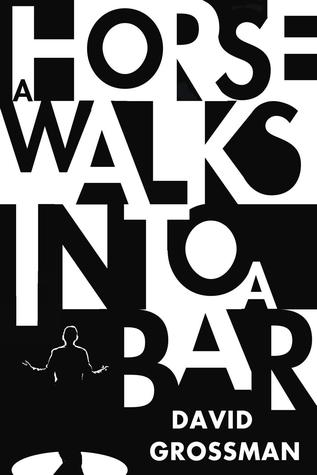 “Why the long face? Did someone die? It’s only stand-up comedy!” Except that for the comedian himself, Dovaleh Greenstein, this swan song of a show in the Israeli town of Netanya devolves into the story of the most traumatic day of his life. Grossman has made what seems to me an unusual choice of narrator: Avishai Lazar, a widower and Supreme Court justice, and Dov’s acquaintance from adolescence – they were in the same military training camp. Dov has invited him here to bear witness, and by the end we know Avishai will produce a written account of the evening.
Although it could be said that Avishai’s asides about the past, and about the increasingly restive crowd in the club, give us a rest from Dov’s claustrophobic monologue, in doing so they break the spell. This would be more hard-hitting as a play or a short story composed entirely of speech; in one of those formats, Dov’s story might keep you spellbound through a single sitting. Instead, I found that I had to force myself to read even five or 10 pages at a time. There’s no doubt Grossman can weave a clever tale about loss, and there are actually some quite funny jokes in here too, but overall I found this significantly less powerful than the author’s previous work, Falling Out of Time.
The Underground Railroad by Colson Whitehead
(Winner of the Pulitzer Prize, National Book Award and Arthur C. Clarke Award; longlisted for the Man Booker Prize)
 Following Cora on her fraught journey from her Georgia plantation through the Carolinas and Tennessee to Indiana is enjoyable enough, with the requisite atrocities like lynchings and rapes thrown in to make sure it’s not just a picaresque cat-and-mouse battle between her and Arnold Ridgeway, the villainous slavecatcher. But I’m surprised that such a case has been made for the uniqueness of this novel based on a simple tweak of the historical record: Whitehead imagines the Underground Railroad as an actual subterranean transport system. This makes less of a difference than you might expect; if anything, it renders the danger Cora faces more abstract. The same might be said for the anachronistic combination of enlightened and harsh societies she passes through: by telescoping out to show the range of threats African-Americans faced between the Civil War and the 1930s, the novel loses immediacy.
Ultimately, I felt little attachment to Cora and had to force myself to keep plodding through her story. My favorite parts were little asides giving other characters’ backstories. There’s no doubt Whitehead can shape a plot and dot in apt metaphors (I particularly liked “Ajarry died in the cotton, the bolls bobbing around her like whitecaps on the brute ocean”). However, I kept thinking, Haven’t I read this story before? (Beloved, Ruby, The Diary of Anne Frank; seen on screen in Twelve Years a Slave, Roots and the like.) This is certainly capably written, but doesn’t stand out for me compared to Homegoing, which was altogether more affecting.
The Power by Naomi Alderman
(Winner of the [Bailey’s] Women’s Prize)
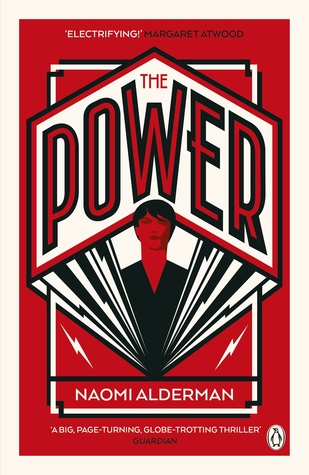 I read the first ~120 pages and skimmed the rest. Alderman imagines a parallel world in which young women realize they wield electrostatic power that can maim or kill. In an Arab Spring-type movement, they start to take back power from their oppressive societies. You’ll cheer as women caught up in sex trafficking fight back and take over. The movement is led by Allie, an abused child who starts by getting revenge on her foster father and then takes her message worldwide, becoming known as Mother Eve.
Alderman has cleverly set this up as an anthropological treatise-cum-historical novel authored by “Neil Adam Armon” (an anagram of her own name), complete with documents and drawings of artifacts. “The power to hurt is a kind of wealth,” and in this situation of gender reversal women gradually turn despotic. They are soldiers and dictators; they inflict genital mutilation and rape on men.
I enjoyed the passages mimicking the Bible, but felt a lack of connection with the characters and didn’t get a sense of years passing even though this is spread over about a decade. This is most like Margaret Atwood’s MaddAddam trilogy – Alderman’s debt to Atwood is explicit, in the dedication as well as the acknowledgments – so if you really like those books, by all means read this one. My usual response to such speculative fiction, though, even if it describes a believable situation, is: what’s the point? As with “Erewhon,” the best story in Helen Simpson’s collection Cockfosters, the points about gender roles are fairly obvious.
I’d be interested to hear if you’ve read any of these books – or plan to read them – and believe they were worthy prize winners. If so, set me straight!
The Orange Grove by Larry Tremblay (Peirene)
Larry Tremblay is a Francophone writer, theatre director and actor based in Montreal. In addition to three novels, he has published a short story collection and many books of poetry and plays. The Orange Grove (2013), which was longlisted for the 2017 International Dublin (formerly IMPAC) literary award, is the fable-like story of one family in the war-torn Middle East and the way notions of justice and sacrifice drive them to make extreme choices.
Tamara and Zahed live with their twin sons, nine-year-old Aziz and Ahmed, alongside an orange grove planted by Zahed’s father. Soulayed, a militant elder from the next village, describes it thus:
Your father, Mounir, worked his whole life on this arid soil. It was desert here. With God’s help your father worked a miracle. Made oranges grow where there had been only sand and stones.
When Mounir and his wife Shahina are killed in a bombing, Soulayed stands among the ruins and counsels Zahed to seek revenge against their enemies by sending one of his sons to be a suicide bomber. There’s no doubt Soulayed is manipulating this grief-stricken family to his own ends, but he isn’t solely to blame when their culture at large romanticizes martyrdom.
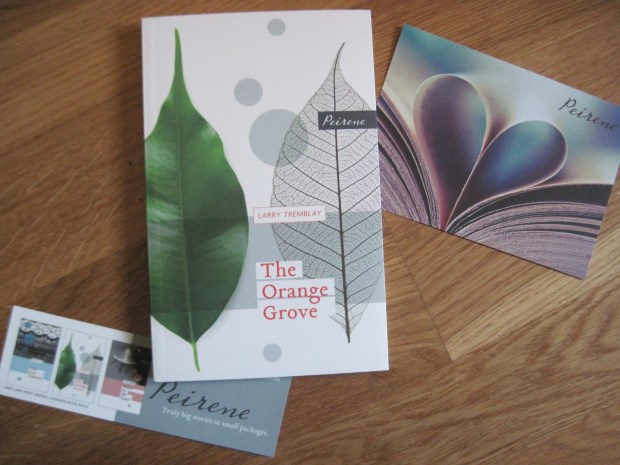
Zahed makes his choice, but Tamara won’t accept it. In a clever reprise of the Genesis story of Jacob and Esau, she helps the boys to make a switch right under their father’s nose. The last third of the book, like a coda, zooms ahead 11 years to show us the surviving brother, coming to the end of a four-year theatre training program in Montreal. He’s given a starring role in his teacher’s wartime play but the story line cuts a little too close to the bone, and for the first time he tells a stranger the story of two brothers: one who died and one who lived.
Peirene Press issues novellas in trios. This is the second in the “East and West: Looking Both Ways” series; I’ve also reviewed the first, The Last Summer by Ricarda Huch. Tremblay and Huch both tackle the theme of betrayal and the practice of choosing one person to die for the crimes of the many. The Orange Grove has a simple style that edges towards flatness but is saved by the occasional striking metaphor (e.g. “Minutes stretched out as if made of dough”). A book about suicide bombing could easily turn mawkish, but the restrained narration reins it in to create a tight and fairly engrossing tale of family ties and religious motivations.
[The third book in the series, Dance by the Canal by Kerstin Hensel, will be released later in 2017.]
The Orange Grove was published in the UK on May 1st. Translated from the French by Sheila Fischman. With thanks to James Tookey of Peirene Press for the free copy for review.
My rating:
 Bookish Beck = Rebecca Foster. American transplant to England. Freelance proofreader and book reviewer.
 Bookish Beck