New Networks for Nature 2020 (Online)
 It’s not November without a New Networks for Nature conference. Originally 2020’s was scheduled to take place in Norwich in July; it was then postponed to the usual November in hopes of an in-person meeting, but ultimately had to be online this year, like so much else. This was my sixth time taking part in this interdisciplinary gathering of authors, academics, and activists (I’ve also written about the 2015, 2016, 2018, and 2019 conferences). The UEA organizers, Jean McNeil and Jos Smith, with New Networks stalwart John Fanshawe, did an excellent job of creating three virtual events for people to engage with from home.
Two pre-recorded panels brought together writers from different fields to reflect on nature literature and the environmental crisis. First up was “New Perspectives on Nature Writing,” picking up on a perennial conference theme.
 I was delighted to hear Jessica J. Lee speak – I’ve reviewed both of her nature-infused memoirs, Turning and Two Trees Make a Forest, and in last year’s feedback I suggested her as a future speaker (I’m sure I’m not solely responsible!). After a PhD in environmental history, she moved into more personal writing. Questions of home, place, language, and identity were natural for her as a third-generation migrant. She initially felt alone as a person of colour in nature writing, but when she founded the Willowherb Review she quickly learned that it wasn’t that POC weren’t out there; it was that they did not have opportunities to publish – she has had 300+ submissions per issue to the online literary magazine, which welcomes work from all genres by authors of colour.

(Clockwise from top left) Smith, Arshi, McNeil, Lee.
Also on the panel were Mona Arshi, a Punjabi poet based in London, and McNeil, a creative writing professor. Arshi has been a human rights lawyer and is the current poet-in-residence at Cley Marshes, Norfolk, in association with the Wildlife Trusts and UEA. She has had to try to absorb the landscape via video and sound recordings since COVID-19 has limited her in-person visits. She read a sonnet she wrote about her last trip there in September. All three panellists spoke about land being in some ways beyond language, though.
 Jean McNeil’s Ice Diaries is a memoir of a year in residence with the British Antarctic Survey, a very male, scientific world. Antarctica is “no one’s country,” she remarked, though it’s the fifth-largest continent; it’s as if the land has no memory of people. She observed that it’s impossible to write about Antarctica without giving a sense of the journey (so she includes travel writing) and mentioning death. Raised without technology by back-to-the-land parents in Canada, McNeil has been active in the environmental movement in Brazil, Central America, and Africa (as a safari guide). Ice Diaries was already on my TBR, but I’m impressed by her breadth of experience and want to explore her varied work.
 The second panel, “States of Emergency,” included an academic, a playwright, the CEO of an environmental charity, and a philosopher and activist. I was intrigued by UEA’s Rebecca Tillett’s brief opening address about contemporary North American indigenous responses to climate change in fiction (her research speciality). Her primary example was the Moon of the Crusted Snow by Waubgeshig Rice, a postapocalyptic thriller in which the Wendigo, a figure from First Nations folklore, embodies capitalism as it consumes people with greed.

(Clockwise from top left) Waters , McNeil, Reed, Tillett, Thornton.
UEA-based playwright Steve Waters is planning outdoor theatre projects at nature reserves. James Thornton, the CEO of ClientEarth, spoke about starting with the science, the “grammar of the Earth.” His team has prevented new coal-fired stations in Europe and encouraged NGOs in China to sue polluting companies. Philosophy professor Rupert Reed was, until recently, an Extinction Rebellion spokesman. He noted that the climate emergency feels too slow and too long – a marathon, not a sprint; people don’t realize how profoundly our way of life and future are threatened. Alas, COVID-19 is not having the desired effect of turning people’s attention to the greater, ongoing emergency. He counselled acceptance and adaptation, stating that hope and action must go hand in hand. Thornton recalled the Dalai Lama telling him early in his career that he needed to get beyond anger because angry people don’t come up with viable solutions. The anger has to be turned into a positive vision.
There were live Q&A sessions for these two panels, but we weren’t able to watch. However, we did attend Saturday’s live keynote event featuring Tim Dee and Kathleen Jamie, two of the finest nature writers working today. Speaking from Cape Town, where he has been stranded since the start of the pandemic, Dee said that his current writing is about birds that are new to him but familiar to his neighbours. He explained that he admires and understands the world through birds, “who carry no bags or passports and are at home wherever they are.” In his work he explores how we are “made by places,” often returning to a place to reprocess his experiences there (e.g. Hungary in his latest book, Greenery). His notebooks, which are often just lists of birds seen, help him to “reinflate” a place when writing about it later.


Jamie agreed that her work also has this quality of “afterwardness” – finding the meaning of an experience long after the moment. She came across as down-to-earth, shrugging off McNeil’s question about transcendence and remarking that a sign above her desk reads “Nay narrative!” What is left for a lyric poet who loses faith in lyricism? For Jamie, the answer is prose poetry, as in “Tree on the Hill,” recently published in the LRB. Her poetry has always been local but her longform nonfiction has only ever come from other places, so while she’s been stuck in Fife she’s been unable to progress. But she never has any idea of what she’s writing, she said; she and her editor work out a theme once a whole book exists (for instance, the linking metaphor for Surfacing – unearthing archaeological evidence and memories).
Dee called himself a materialist – “no ideas but in things” – with language being what we clothe things in. He always double-checks his (sometimes elaborate) metaphors by putting them back onto a bird to ensure they fit. Jamie said she used to believe language was humans’ “fall” and would try to maintain a “pre-language state” for as long as possible every morning, but ultimately she changed her mind, accepting that language is what makes us human; it’s what we do. She acknowledges that nature writing like hers is not going to achieve things in the way that environmental activism can, but she hopes that bringing non-human creatures into the culture (as if it were an ark) can be a way of advocating for them all the same.

 A brilliant programme, capped off with some visual and musical delights: “Where Song Began,” a one-hour cello and violin response/accompaniment to Australian birdsong created by Simone Slattery and Anthony Albrecht in January; and a brief virtual tour of the Nature Writing Collection in the British Archive for Contemporary Writing at UEA, which includes the papers of the late Roger Deakin and of (alive and kicking!) Mark Cocker, a UEA graduate. The archive contains Deakin’s drafts and pitches (Waterlog’s working title was “The Waters of the Wondrous Isle,” and he imagined it as an aquatic Rural Rides), photos, and even his Speedo bathing suit; along with Cocker’s field notebooks and fan mail.
The two panels, musical event, and archive tour are freely available on the NNN website, and you can watch the Dee/Jamie discussion back here.
The IRON Book of Tree Poetry (Blog Tour)
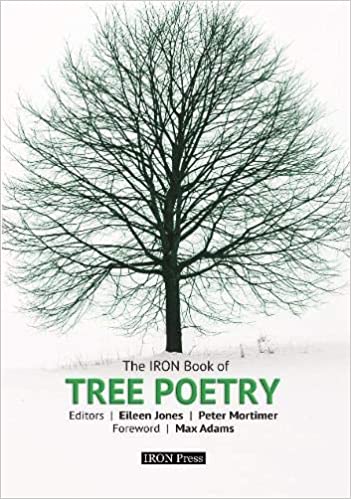 Though I’d only heard of two of the contributors, my love for nature and environmentalist themes made this anthology irresistible. The authors of the 50 poems write about individual and generic trees; forests real and imagined; environmental crisis and personal reckonings. In Sarah Mnatzaganian’s “Father Tree,” a sprawling horse-chestnut symbolizes her dying father and his motherland. Dominic Weston’s “Ancestry.com” literalizes the language of the family tree. In Celia McCulloch’s “Rhododendrons at Stapleford Wood,” an invasive species is a politically charged token of prejudice: “Is it just our xenophobia, this hatred for the Greek-named / tree, the immigrant, the Windrush plantation?”
I enjoyed the playful use of myth in Pauline Plummer’s “The Baobab”: “When God made the baobab He gave / it to the hyena, who laughed and laughed / throwing it into the scrub / where it landed upside down, dancing.” In “Abele,” Di Slaney envisions her post-mortem body feeding a woodland’s worth of creatures and being reincorporated into the flesh of trees.
Again and again, trees serve as a reminder of time passing, of seasons changing, of the vanity of human concerns compared to their centuries-old solidity – as in the final stanza of Mary Anne Perkins’s “To an Unpopular Poplar”:
This summer’s end, if I could translate
just one full hour of the whisperings
between your shimmered leaves,
how much the wiser I might be.
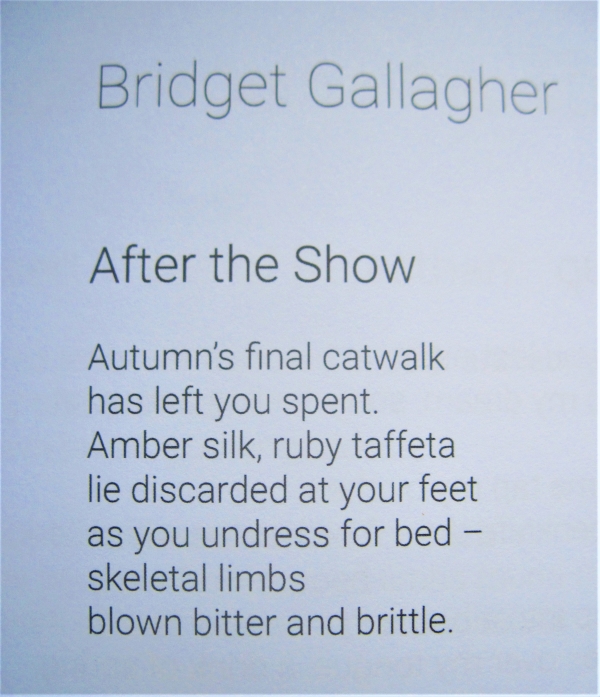
Thematic organization, rather than alphabetical, would have made more sense for this volume, but I appreciated the introduction to many new-to-me poets. Two favorite seasonal poems are pictured below.

My thanks to IRON Press for the free copy for review.
I was delighted to be invited to take part in the blog tour for The IRON Book of Tree Poetry. See below for where more reviews have appeared or will be appearing.
Catching Up on Review Books: Antlers, Arnett, E. Williams, Yamboliev
Four July–August releases: Scottish nature writing, the quirky story of a family taxidermy business in Florida, a dual-timeline novel set at an unusual dictionary’s headquarters, and a critical and personal response to Jeffrey Eugenides’ Middlesex.
Antlers of Water: Writing on the Nature and Environment of Scotland, edited by Kathleen Jamie
 This nature writing anthology of essays, poems and visual art drew me because of contributor names like GP Gavin Francis (reviewed: Shapeshifters), Amy Liptrot (the Wainwright Prize-winning memoir The Outrun), singer/songwriter Karine Polwart, and Shetland chronicler Malachy Tallack (reviewed: The Un-Discovered Islands and The Valley at the Centre of the World), not to mention editor Kathleen Jamie. Archaeology and folk music evoke the past, while climate change scenarios inject a sense of a menacing future. Seabirds circle and coastal and island scenery recurs. Entries from Alec Finlay’s “A Place-Aware Dictionary” disguise political points under tongue-in-cheek language, as in a definition of foraging: “Later sometimes referred to as the Brexit Diet.” The (sub)urban could be more evident, and I didn’t need two bouts of red deer sex, but there’s still a nice mix of tones and approaches here.
Six best pieces (out of 24): Chris Powici on wind turbines and red kites at the Braes of Doune; Jacqueline Bain on how reduced mobility allows her to observe wasps closely; Jim Crumley on sea eagle reintroductions and the ancient sky burials that took place at the Tomb of the Eagles; Jen Hadfield on foraging for whelks at the ocean’s edge, in a run-on hybrid narrative; Sally Huband on how persecution of ravens and of women (still not allowed to take part in Up Helly Aa festivities) continues on Shetland; and Liptrot on how wild swimming prepared her for childbirth and helped her to recover a sense of herself separate from her baby. And if I had to pick just one, the Huband – so brave and righteously angry.
Favorite lines:
“Compromises need to be made. An overlap between the wild and the human has to be negotiated and managed. … So let’s play merry hell with the distinction between what counts as wild and what counts as human, between what’s condemned as a visual obscenity and what’s seen as a marvel of the age. Let’s mess up the boundaries and get a new measure of ourselves as a species.” (Powici)
inspiration to get out walking again: “Don’t wait / thinking you’ve seen it all already … don’t wait thinking you need better boots / or a waterproof that’ll keep out the rain. / It won’t. Don’t wait.” (“Water of Ae” by Em Strang)
My rating: 
My thanks to Canongate for the free copy for review.
Mostly Dead Things by Kristen Arnett
“We couldn’t ever leave roadkill behind. Something inside us always made us stop to pick up dead things.”
 After her father’s suicide, Jessa-Lynn Morton takes over the family taxidermy business in central Florida. Despite her excessive drinking and grief over both her father and her best friend and long-time on-and-off girlfriend (also, inconveniently, her brother’s wife) Brynn, who recently took off, she’s just about holding it together. That is, until 1) her mother takes to composing interspecies orgies and S&M scenes in the shop window and 2) her niece and nephew, Lolee and Bastien, start bringing in specimens for taxidermy that they haven’t exactly obtained legally. Gallery owner Lucinda Rex takes an interest in her mother’s ‘art’ and is soon a new romantic interest for Jessa. But the entire family is going to have to face its issues before her professional and love life can be restored.
This debut novel’s title, cover and premise were utterly irresistible to me, and though I loved the humid Florida setting, it was all a bit too much. At 200 pages this could have been a razor-sharp new favorite, but instead there was a lot of sag in its 350+ pages. Alternating chapters based around mounting particular animals give glimpses into the family’s past but mostly have Jessa mooning over Brynn. Her emotional journey starts to feel belabored; it’s as if an editor tried to rein in Arnett’s campy glee at the dysfunctional family’s breakdown and made her add in some amateur psychoanalysis, and for me this diluted the quirky joy.
Skinning and sex scenes are equally explicit here. This never bothered me, but it should go without saying that it is not a book for the squeamish. It’s when sex and taxidermy mix that things get a little icky, as in her mother’s X-rated tableaux and a line like “Often I found myself comparing the limber body of a deer with the long line of [Lucinda’s] legs or the strong cord of her neck.” Believe it or not, this is not the first queer taxidermy novel I’ve read. The other one, English Animals by Laura Kaye, was better. I’d wanted another Swamplandia! but got something closer to Black Light instead.
My rating: 
My thanks to Corsair for the free copy for review.
The Liar’s Dictionary by Eley Williams
 Mallory is five years into an internship at Swansby House, the London headquarters of Swansby’s dictionary. The dictionary is known for being unfinished – too many of its lexicographers left for WWI and never returned – and for having made-up words. In 1899, Peter Winceworth, the butt of jokes among his colleagues, started composing mountweazels (fake entries) and inserting them into the dictionary. In the contemporary story line, Mallory’s job is to remove the mountweazels as the dictionary is prepared for digitization. But her attention is distracted by anonymous bomb threats and by lingering shame about her sexuality – Mallory thinks she’s “out enough,” but her girlfriend Pip begs to differ.
Chapters are headed with vocabulary words running from A to Z, and alternate between Mallory’s first-person narration and a third-person account of Winceworth’s misadventures at the turn of the twentieth century. In any book with this kind of structure I seem to prefer the contemporary strand and itch to get back to it, though there is a quite astounding scene in which Winceworth intervenes to help a choking pelican. Events at Swansby House resonate and mirror each other across the dozen decades, with both main characters emerging with a new sense of purpose after an epiphany that life is about more than work. Though silly in places, this has a winning love of words and characters you’ll care about.
A favorite made-up word: “Mammonsomniate: to dream that money might make anything possible.”
Readalikes: Enter the Aardvark by Jessica Anthony and Boxer, Beetle by Ned Beauman
My rating:
My thanks to William Heinemann for the proof copy for review.
Looking Was Not Enough: Jeffrey Eugenides’ Middlesex by Irena Yamboliev
 When I worked in a university library and read Middlesex during quiet evenings on the circulation desk in 2009, a colleague asked me, “Is that about the London borough?” My reply: “Er, no, it’s about a hermaphrodite.” That’s an off-putting, clinical sort of word, but it does appear in the first paragraph of this family saga with a difference, after the mythological intensity and medical necessity implied by the killer opening line: “I was born twice: first, as a baby girl, on a remarkably smogless Detroit day in January of 1960; and then again, as a teenage boy, in an emergency room near Petoskey, Michigan, in August of 1974.”
Cal, born Calliope but now living as a man and working in the Foreign Service, recounts three generations of family history, from Greece to Detroit to Berlin. “Because … their parents were dead and their village destroyed, because no one in Smyrna knew who they were,” brother and sister Lefty and Desdemona became lovers and got married on the boat over to America. They were his grandparents. Add to that his parents’ first-cousin marriage and you see how inbreeding played genetic havoc and made way for Callie/Cal.
 I intended to reread Middlesex, which I consider one of my all-time favorite books, but only made it through 60 pages on this occasion. Still, Yamboliev, a Bulgarian-American who teaches at Stanford, reminded me of everything I love about it: the medical theme, the exploration of selfhood, the playful recreation of the past. Drawing parallels with her own family’s move to America, she ponders the disconnection from the home country and the creation of a new life story. “To tell ourselves where we come from—to narrate—is to find a pattern retroactively.” She also looks at literary precursors like Ovid’s Metamorphoses, Herculine Barbin’s memoir, and Balzac’s and Barthes’s writings on a castrato. “Does transformation make the self discontinuous?” is one of her central questions, and she likens Cal’s situation to that of trans men who have to train themselves to speak, dress and act in a convincingly masculine way.
This is part of Fiction Advocate’s “Afterwords” series; all its monographs do a wonderful job of blending literary criticism, enthusiastic appreciation, and autobiographical reflection as life dovetails with (re)reading. I’ve previously reviewed the Fiction Advocate books on Blood Meridian, Fun Home, and The Year of Magical Thinking in this post, and the ones on Karl Ove Knausgaard’s My Struggle and Cheryl Strayed’s Wild in this one.
My rating: 
My thanks to Fiction Advocate for the free e-copy for review.
What recent releases can you recommend?
August Releases: Fiction Advocate, Kingsolver Poetry, Sarah Moss & More
My five new releases for August include two critical responses to contemporary classics; two poetry books, one a debut collection from Carcanet Press and the other by an author better known for fiction; and a circadian novel by one of my favorite authors.
I start with two of the latest releases from Fiction Advocate’s “Afterwords” series. The tagline is “Essential Readings of the New Canon,” and the idea is that “acclaimed writers investigate the contemporary classics.” (I reviewed the monographs on Blood Meridian, Fun Home, and The Year of Magical Thinking in this post.)
Dear Knausgaard: Karl Ove Knausgaard’s My Struggle by Kim Adrian
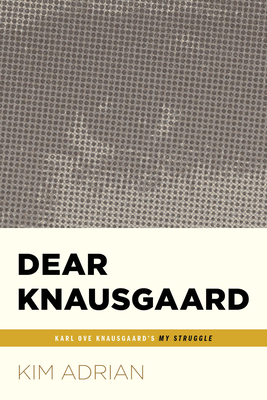 Karl Ove Knausgaard turned his pretty ordinary life into thousands of pages of autofiction that many readers have found addictive. Adrian valiantly grapples with his six-volume exploration of identity, examining the treatment of time and the dichotomies of intellect versus emotions, self versus other, and life versus fiction. She marvels at the ego that could sustain such a project, and at the seemingly rude decision to use all real names (whereas in her own family memoir she assigned aliases to most major figures). At many points she finds the character of “Karl Ove” insufferable, especially when he’s a teenager in Book 4, and the books’ prose dull. Knausgaard’s focus on male novelists and his stereotypical treatment of feminine qualities, here and in his other work, frequently madden her.
So why is My Struggle compelling nonetheless? It occupies her mind and her conversations for years. Is it something about the way that Knausgaard extracts meaning from seemingly inconsequential details? About how he stretches and compresses time in a Proustian manner to create a personal highlights reel? She frames her ambivalent musings as a series of letters written as if to Knausgaard himself (or “KOK,” as she affectionately dubs him) between February and September 2019. Cleverly, she mimics his style in both the critical enquiry and the glimpses into her own life, including all its minutiae – the weather, daily encounters, what she sees out the window and what she thinks about it all. It’s bold, playful and funny, and, all told, I enjoyed it more than Knausgaard’s own writing.
(I myself have only read Book 1, A Death in the Family, and wasn’t planning on continuing with My Struggle, but I think I will make an exception for Book 3 because of my recent fascination with childhood memoirs. I had better luck with Knausgaard’s Seasons Quartet, of which I’ve read all but Spring. I’ve reviewed Summer and Winter.)
My rating: 
My thanks to Fiction Advocate for the free e-copy for review.
The Wanting Was a Wilderness: Cheryl Strayed’s Wild and the Art of Memoir by Alden Jones
Hiking is boring, yet Cheryl Strayed turned it into a beloved memoir. Jones explores how Wild works: how Strayed the author creates “Cheryl,” likeable despite her drug use and promiscuity; how the fixation on the boots and the backpack that carry her through her quest reflect the obsession over the loss of her mother; how the flashbacks break up the narrative and keep you guessing about whether she’ll reach her literal and emotional destinations.
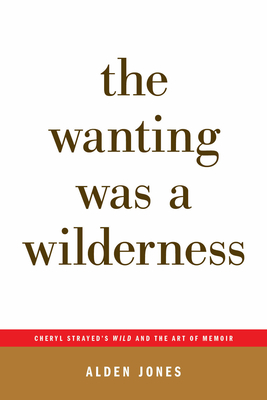 Jones also considers the precedents of wilderness literature and the 1990s memoir boom that paved the way for Wild. I most enjoyed this middle section, which, like Mary Karr’s The Art of Memoir, surveys some of the key publications from a burgeoning genre. Another key point of reference is Vivian Gornick, who draws a distinction between “the situation” (the particulars or context) and “the story” (the message) – sometimes the map or message comes first, and sometimes you only discover it as you go along.
I was a bit less interested in Jones’s reminiscences of her own three-month wilderness experience during college, when, with Outward Bound, she went to North Carolina and Mexico and hiked part of the Appalachian Trail and a volcano. This was the trip on which she faced up to her sexuality and had a short-lived relationship with a fellow camper, Melissa. But working out that she was bisexual and marrying a woman were both, as presented here, false endings. The real ending was her decision to leave her marriage – even though they had three children; even though the relationship was often fine. She attributes her courage to go, believing something better was possible, to Strayed’s work. And that’s the point of this series: rereading a contemporary classic until it becomes part of your own story.
My rating: 
My thanks to Fiction Advocate for the free e-copy for review.
Two poetry releases:
Growlery by Katherine Horrex
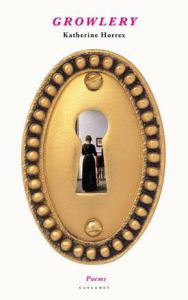 As in Red Gloves by Rebecca Watts, released by Carcanet in June, I noted the juxtaposition of natural and industrial scenes. Horrex’s “Four Muses” include a power plant and a steelworks, and she writes about pottery workers and the Manchester area, but she also explores Goat Fell on foot. Two of my favorite poems were nature-based: “Omen,” about corpse flowers, and “Wood Frog.” Alliteration, metaphors and smells are particularly effective in the former. Though I quailed at the sight of an entry called “Brexit,” it’s a subtle offering that depicts mistrust and closed minds – “People personable as tents zipped shut”. By contrast, “House of Other Tongues” revels in the variety of languages and foods in an international student dorm. A few poems circle around fertility and pregnancy. The linking themes aren’t very strong across the book, but there are a few gems.
My rating: 
My thanks to Carcanet Press for the free e-copy for review.
How to Fly (in Ten Thousand Easy Lessons) by Barbara Kingsolver
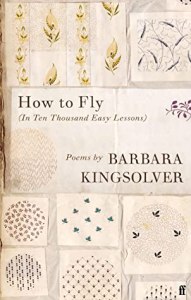 Kingsolver may not be well known for her poetry, but this is actually her second collection of verse after the bilingual Another America/Otra America (1992). The opening segment, “How to Fly,” is full of folk wisdom from nature and the body’s intuitive knowledge. “Pellegrinaggio” is a set of travel poems about accompanying her Italian mother-in-law back to her homeland. “This Is How They Come Back to Us” is composed of elegies for the family’s dead; four shorter remaining sections are inspired by knitting, literature, daily life, and concern for the environment. As with The Undying by Michel Faber, the book’s themes are stronger than its poetic techniques, but Kingsolver builds striking natural imagery and entrancing rhythms.
Two favorite passages to whet your appetite:
How to drink water when there is wine— / Once I knew all these brick-shaped things, / took them for the currency of survival. / Now I have lived long and I know better.
Tiptoe past the dogs of the apocalypse / asleep in the shade of your future. / Pay at the window. You’ll be surprised: you / can pass off hope like a bad check. You still / have time, that’s the thing. To make it good.
(To be reviewed in full, in conjunction with other recent/upcoming poetry releases, including Dearly by Margaret Atwood, for Shiny New Books.)
My rating:
I read an advanced e-copy via Edelweiss. (I’m unsure of the line breaks above because of the formatting.)
And finally, a much-anticipated release – bonus points for it having “Summer” in the title!
Summerwater by Sarah Moss
This is nearly as compact as Moss’s previous novella, Ghost Wall, yet contains a riot of voices. Set on one long day at a Scottish holiday park, it moves between the minds of 12 vacationers disappointed by the constant rain – “not that you come to Scotland expecting sun but this is a really a bit much, day after day of it, torrential” – and fed up with the loud music and partying that’s come from the Eastern Europeans’ chalet several nights this week. In the wake of Brexit, the casual xenophobia espoused by several characters is not surprising, but still sobering, and paves the way for a climactic finale that was not what I expected after some heavy foreshadowing involving a teenage girl going off to the pub through the woods.
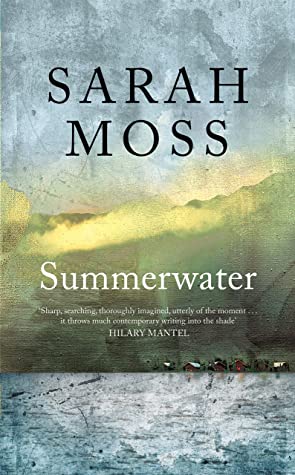 The day starts at 5 a.m. with Justine going for a run, despite a recent heart health scare, and spends time with retirees, an engaged couple spending most of their time in bed, a 16-year-old kayaker, a woman with dementia, and more. We see different aspects of family dynamics as we revisit a previous character’s child, spouse or sibling. I had to laugh at Milly picturing Don Draper during sex with Josh, and at Claire getting an hour to herself without the kids and having no idea what to do with it beyond clean up and make a cup of tea. Moss gets each stream-of-consciousness internal monologue just right, from a frantic mum to a sarcastic teen.
Yet I had to wonder what it all added up to; this feels like a creative writing student exercise, with the ending not worth waiting for. Cosmic/nature interludes are pretentious à la Reservoir 13. It’s not the first time this year that I’ve been disappointed by the latest from a favorite author (see also Hamnet). But my previous advice stands: If you haven’t read Sarah Moss, do so immediately.
My rating:
My thanks to Picador for the free copy for review.
What August releases can you recommend?
Recommended July Releases: Donoghue, Maizes, Miller, Parikian, Trethewey
My five new releases for July include historical pandemic fiction, a fun contemporary story about a father-and-daughter burglar team, a new poetry collection from Carcanet Press, a lighthearted nature/travel book, and a poetic bereavement memoir about a violent death.
The Pull of the Stars by Emma Donoghue
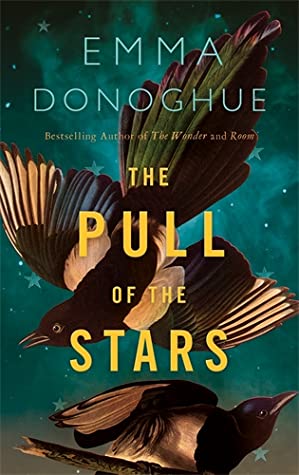 Donoghue’s last two novels, The Wonder and Akin, were big hits with me. Less than a year after the contemporary-set Akin, she’s back to a historical setting – and an uncannily pertinent pandemic theme – with her latest. In 1918, Julia Power is a nurse on a Dublin maternity ward. It’s Halloween and she is about to turn 30, making her a spinster for her day; she lives with her mute, shell-shocked veteran brother, Tim, and his pet magpie.
Because she’s already had “the grip” (influenza), she is considered immune and is one of a few staff members dealing with the flu-ridden expectant mothers in quarantine in her overcrowded hospital. Each patient serves as a type, and Donoghue whirls through all the possible complications of historical childbirth: stillbirth, obstructed labor, catheterization, forceps, blood loss, transfusion, maternal death, and so on.
It’s not for the squeamish, and despite my usual love of medical reads, I felt it was something of a box-ticking exercise, with too much telling about medical procedures and recent Irish history. Because of the limited time frame – just three days – the book is far too rushed. We simply don’t have enough time to get to know Julia through and through, despite her first-person narration; the final 20 pages, in particular, are so far-fetched and melodramatic it’s hard to believe in a romance you’d miss if you blinked. And the omission of speech marks just doesn’t work – it’s downright confusing with so many dialogue-driven scenes.
Donoghue must have been writing this well before Covid-19, but I wouldn’t be surprised if the publication was hurried forward to take advantage of the story’s newfound relevance. It shows: what I read in May and June felt like an unpolished draft, with threads prematurely tied up to meet a deadline. This was an extremely promising project that, for me, was let down by the execution, but it’s still a gripping read that I wouldn’t steer you away from if you find the synopsis appealing. (Some more spoiler-y thoughts here.)
Prescient words about pandemics:
“All over the globe … some flu patients are dropping like flies while others recover, and we can’t solve the puzzle, nor do a blasted thing about it. … There’s no rhyme or reason to who’s struck down.”
“Doctor Lynn went on, As for the authorities, I believe the epidemic will have run its course before they’ve agreed to any but the most feeble action. Recommending onions and eucalyptus oil! Like sending beetles to stop a steamroller.”
Why the title?
Flu comes from the phrase “influenza delle stelle” – medieval Italians thought that illness was fated by the stars. There’s also one baby born a “stargazer” (facing up) and some literal looking up at the stars in the book.
My rating:
My thanks to Picador for the proof copy for review.
Other People’s Pets by R.L. Maizes
 This is Maizes’ debut novel, after her 2019 short story collection We Love Anderson Cooper. Louise “La La” Fine and her father, Zev, share an unusual profession: While outwardly they are a veterinary student and a locksmith, respectively, for many years they broke into homes and sold the stolen goods. Despite close shaves, they’ve always gotten away with it – until now. When Zev is arrested, La La decides to return to her criminal ways just long enough to raise the money to post bail for him. But she doesn’t reckon on a few complications, like her father getting fed up with house arrest, her fiancé finding out about her side hustle, and her animal empathy becoming so strong that when she goes into a house she not only pilfers valuables but also cares for the needs of ailing pets inside.
Flashbacks to La La’s growing-up years, especially her hurt over her mother leaving, take this deeper than your average humorous crime caper. The way the plot branches means that for quite a while Zev and La La are separated, and I grew a bit weary of extended time in Zev’s company, but this was a great summer read – especially for animal lovers – that never lost my attention. The magic realism of the human‒pet connection is believable and mild enough not to turn off readers who avoid fantasy. Think The Twelve Lives of Samuel Hawley meets Hollow Kingdom.
My rating:
My thanks to the author and Celadon Books for the free e-copy for review.
The Long Beds by Kate Miller
 Here and there; now and then: the poems in Miller’s second collection enlarge such dichotomies by showcasing the interplay of the familiar and the foreign. A scientist struggles to transcribe birdsong, and a poppy opens in slow motion. “Flag” evokes the electric blue air and water of a Greek island, while “The Quarters” is set in the middle of the night in a French village. A few commissions, including “Waterloo Sunrise,” stick close to home in London or other southern England locales.
Various poems, including the multi-part “Album Without Photographs,” are about ancestor Muriel Miller’s experiences in India and Britain in the 1910s-20s. “Keepers of the States of Sleep and Wakefulness, fragment from A Masque,” patterned after “The Second Masque” by Ben Jonson, is an up-to-the-minute one written in April that names eight nurses from the night staff at King’s College Hospital (and the short YouTube film based on it is dedicated to all NHS nurses).
My two favorites were “Outside the Mind Shop,” in which urban foxes tear into bags of donations outside a charity shop one night while the speaker lies awake, and “Knapsack of Parting Gifts” a lovely elegy to a lost loved one. I spotted a lot of alliteration and assonance in the former, especially. Thematically, the collection is a bit scattered, but there are a lot of individual high points.
My rating:
My thanks to Carcanet Press for the free e-copy for review.
Into the Tangled Bank: In Which Our Author Ventures Outdoors to Consider the British in Nature by Lev Parikian
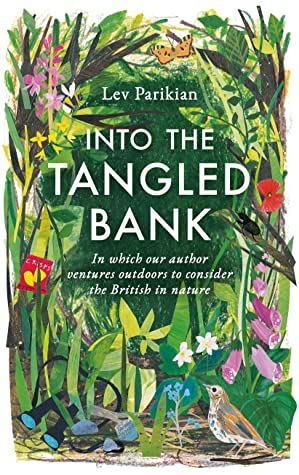 In the same way that kids sometimes write their address by going from the specific to the cosmic (street, city, country, continent, hemisphere, planet, galaxy), this book, a delightfully Bryson-esque tour, moves ever outwards, starting with the author’s own home and garden and proceeding to take in his South London patch and his journeys around the British Isles before closing with the wonders of the night sky. By slowing down to appreciate what is all around us, he proposes, we might enthuse others to engage with nature.
With the zeal of a recent convert, he guides readers through momentous sightings and everyday moments of connection. As they were his gateway, many of these memories involve birds: looking for the year’s first swifts, trying to sketch a heron and realizing he’s never looked at one properly before, avoiding angry terns on the Farne Islands, ringing a storm petrel on Skokholm, and seeing white-tailed eagles on the Isle of Skye. He brings unique places to life, and pays tribute to British naturalists who paved the way for today’s nature-lovers by visiting the homes of Charles Darwin, Gilbert White, Peter Scott, and more.
I was on the blog tour for Parikian’s previous book, Why Do Birds Suddenly Disappear?, in 2018. While the books are alike in levity (pun intended!), being full of self-deprecation and witty asides along with the astute observations, I think I enjoyed this one that little bit more for its all-encompassing approach to the experience of nature. I fully expect to see it on next year’s Wainwright Prize longlist (speaking of the Wainwright Prize, in yesterday’s post I correctly predicted four on the UK nature shortlist and two on the global conservation list!).
Readalikes (that happen to be from the same publisher): Under the Stars by Matt Gaw and The Seafarers by Stephen Rutt
My rating:
My thanks to Elliott & Thompson for the free copy for review.
Memorial Drive: A Daughter’s Memoir by Natasha Trethewey
 Trethewey grew up in 1960s Mississippi with a Black mother and a white Canadian father, at a time when interracial marriage remained illegal in parts of the South. After her parents’ divorce, she and her mother, Gwen, moved to Georgia to start a new life, but her stepfather Joel was physically and psychologically abusive. Gwen’s murder opens and closes the book. Trethewey only returned to that Atlanta apartment on Memorial Drive after 30 years had passed. The blend of the objective (official testimonies and transcripts) and the subjective (interpreting photographs, and rendering dream sequences in poetic language) makes this a striking memoir, as delicate as it is painful. I recommend it highly to readers of Elizabeth Alexander and Dani Shapiro. (Full review forthcoming at Shiny New Books.)
My rating: 
My thanks to Bloomsbury for the proof copy for review.

 I’m reading two more July releases, Mostly Dead Things by Kristen Arnett (Corsair, 2 July; for Shiny New Books review), about a family taxidermy business in Florida, and The Liar’s Dictionary by Eley Williams (William Heinemann, 2 July), about an unusual dictionary being compiled in the Victorian period and digitized in the present day.
What July releases can you recommend?
Most Anticipated Releases of the Second Half of 2020
Although over 100 books from the second half of the year are already on my radar, I’ve limited myself here to the 15 July to November releases that I’m most excited about.
The modest number is a cheat in that I’ve already read seven books from this period in advance (plus I’m currently reading another three), and I haven’t listed any that I already have access to via proofs, promised finished copies, NetGalley, Edelweiss, or library preorders. Some of these that I intend to read are A Traveler at the Gates of Wisdom by John Boyne, D (A Tale of Two Worlds): A Modern-Day Dickensian Fable by Michel Faber, Bringing Back the Beaver by Derek Gow, Just Like You by Nick Hornby, How to Fly (poems) by Barbara Kingsolver, Vesper Flights by Helen Macdonald, Utopia Avenue by David Mitchell, Summerwater by Sarah Moss, Lake Life by David James Poissant, Dear Reader by Cathy Rentzenbrink, Jack by Marilynne Robinson and The Wild Silence by Raynor Winn.

(Meanwhile, two of my overall most anticipated 2020 releases have been pushed back to 2021, at least in the UK: Transcendent Kingdom by Yaa Gyasi and The Anthill by Julianne Pachico.)


The following are in release date order, within sections by genre; the quoted descriptions are from the publisher blurbs on Goodreads. For most I’ve added a note on why I want to read it. Nonfiction dominates: this seems to be the way of 2020 for me. Lots of flora and fauna on the covers and in the themes. Look out for antlers x 2.
Fiction

I love the U.S. cover.
Artifact by Arlene Heyman [July 9, Bloomsbury] “A sweeping debut novel about love, sex, motherhood, and ambition that follows a gifted and subversive scientist’s struggle to reach beyond cultural constraints for the life she wants. … Artifact is an intimate and propulsive portrait of a whole woman.” Susan of A life in books put me onto this one; here’s her review.

I love the U.S. cover.
Sisters by Daisy Johnson [Aug. 13, Jonathan Cape / Aug. 25, Riverhead] “After a serious case of school bullying becomes too much to bear, sisters July and September move across the country with their mother to a long-abandoned family home. … With its roots in psychological horror, Sisters is a taut, powerful and deeply moving account of sibling love.” I loved Johnson’s Booker-shortlisted debut, Everything Under.
 Piranesi by Susanna Clarke [Sept. 15, Bloomsbury] “Piranesi’s house is no ordinary building: its rooms are infinite, its corridors endless. … For readers of Neil Gaiman’s The Ocean at the End of the Lane … Piranesi introduces an astonishing new world.” It feels like forever since we had a book from Clarke. I remember devouring Jonathan Strange & Mr Norrell during a boating holiday on the Norfolk Broads in 2006. But whew: this one is only 272 pages.
 The Swallowed Man by Edward Carey [Nov. 5, Gallic / Oct. 27, Riverhead] “A beautiful and haunting imagining of the years Geppetto spends within the belly of a sea beast. Drawing upon the Pinocchio story while creating something entirely his own, Carey tells an unforgettable tale of fatherly love and loss, pride and regret, and of the sustaining power of art and imagination.” His Little was one of my favorite novels of 2018.
Poetry
 Dearly: New Poems by Margaret Atwood [Nov. 10, Chatto & Windus / Ecco / McClelland & Stewart] “By turns moving, playful and wise, the poems … are about absences and endings, ageing and retrospection, but also about gifts and renewals. They explore bodies and minds in transition … Werewolves, sirens and dreams make their appearance, as do various forms of animal life and fragments of our damaged environment.”
Nonfiction
 Bright Precious Thing: A Memoir by Gail Caldwell [July 7, Random House] “In a voice as candid as it is evocative, Gail Caldwell traces a path from her west Texas girlhood through her emergence as a young daredevil, then as a feminist.” I’ve enjoyed two of Caldwell’s previous books, especially Let’s Take the Long Way Home. Also, I’ve been reading a lot of childhood memoirs and I like comparing them to see how authors capture that time of life.
 The Fragments of My Father by Sam Mills [July 9, Fourth Estate] A memoir of being the primary caregiver for her father, who had schizophrenia; with references to F. Scott Fitzgerald and Leonard Woolf, who also found themselves caring for people struggling with mental illness. “A powerful and poignant memoir about parents and children, freedom and responsibility, madness and creativity and what it means to be a carer.”
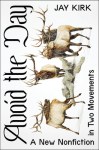 Avoid the Day: A New Nonfiction in Two Movements by Jay Kirk [July 28, Harper Perennial] Transylvania, Béla Bartók’s folk songs, an eco-tourist cruise in the Arctic … “Avoid the Day is part detective story, part memoir, and part meditation on the meaning of life—all told with a dark pulse of existential horror.” It was Helen Macdonald’s testimonial that drew me to this: it “truly seems to me to push nonfiction memoir as far as it can go.”
 World of Wonders: In Praise of Fireflies, Whale Sharks, and Other Astonishments by Aimee Nezhukumatathil [Aug. 3, Milkweed Editions] “From beloved, award-winning poet Aimee Nezhukumatathil comes a debut work of nonfiction—a collection of essays about the natural world, and the way its inhabitants can teach, support, and inspire us. … Even in the strange and the unlovely, Nezhukumatathil finds beauty and kinship.” Who could resist that title or cover?
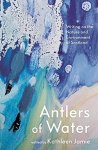 Antlers of Water: Writing on the Nature and Environment of Scotland, edited by Kathleen Jamie [Aug. 6, Canongate] Contributors include Amy Liptrot, musician Karine Polwart and Malachy Tallack. “Featuring prose, poetry and photography, this inspiring collection takes us from walking to wild swimming, from red deer to pigeons and wasps, from remote islands to back gardens … writing which is by turns celebratory, radical and political.”
 The Good Ancestor: How to Think Long Term in a Short-Term World by Roman Krznaric [Aug. 27, W.H. Allen] “Drawing on radical solutions from around the world, Krznaric celebrates the innovators who are reinventing democracy, culture and economics so that we all have the chance to become good ancestors and create a better tomorrow.” I’ve been reading a fair bit around this topic. I got a sneak preview of this one from Krznaric’s Hay Festival talk.
 Eat the Buddha: The Story of Modern Tibet through the People of One Town by Barbara Demick [Sept. 3, Granta / July 28, Random House] “Illuminating a culture that has long been romanticized by Westerners as deeply spiritual and peaceful, Demick reveals what it is really like to be a Tibetan in the twenty-first century, trying to preserve one’s culture, faith, and language.” I read her book on North Korea and found it eye-opening. I’ve read a few books about Tibet over the years; it is fascinating.
 Entangled Life: How Fungi Make Our Worlds, Change Our Minds and Shape Our Futures by Merlin Sheldrake [Sept. 3, Bodley Head / May 12, Random House] “Entangled Life is a mind-altering journey into this hidden kingdom of life, and shows that fungi are key to understanding the planet on which we live, and the ways we think, feel and behave.” I like spotting fungi. Yes, yes, the title and cover are amazing, but also the author’s name!! – how could you not want to read this?
 Between Light and Storm: How We Live with Other Species by Esther Woolfson [Sept. 3, Granta] “Woolfson considers prehistoric human‒animal interaction and traces the millennia-long evolution of conceptions of the soul and conscience in relation to the animal kingdom, and the consequences of our belief in human superiority.” I’ve read two previous nature books by Woolfson and have done some recent reading around deep time concepts. This is sure to be a thoughtful and nuanced take.
 The Stubborn Light of Things: A Nature Diary by Melissa Harrison [Nov. 5, Faber & Faber] “Moving from scrappy city verges to ancient, rural Suffolk, where Harrison eventually relocates, this diary—compiled from her beloved “Nature Notebook” column in The Times—maps her joyful engagement with the natural world and demonstrates how we must first learn to see, and then act to preserve, the beauty we have on our doorsteps.” I love seeing her nature finds on Twitter. I think her writing will suit this format.
Which of these do you want to read, too?
What other upcoming 2020 titles are you looking forward to?
Four June Releases (Fiction & Poetry): Bennett, Gabrielsen, Kwek and Watts
(A rare second post in a day from me, to make way for tomorrow’s list of the best books of the first half of the year.) My four new releases for June are a novel about the complications of race and sexuality in 1950s–80s America, a novella in translation about a seabird researcher struggling through a time of isolation, and two new poetry books from Carcanet Press. As a bonus just in time for Pride Month, I finish with a mini write-up of The Book of Queer Prophets, an anthology of autobiographical essays that was published late last month.
The Vanishing Half by Brit Bennett
 Like some lost mid-career gem from Toni Morrison, this novel is meaty with questions of racial and sexual identity and seems sure to follow in the footsteps of Ruby and An American Marriage with a spot in Oprah’s book club and on Barack Obama’s summer reading list.
It’s the story of light-skinned African American twins Stella and Desiree Vignes, and how their paths divide in 1954. Both are desperate to escape from Mallard, Louisiana, where their father was lynched and their mother cleans white people’s houses. Desiree works in fingerprinting for the FBI in Washington, D.C., but in 1968 leaves an abusive marriage to return to Mallard with her dark-skinned daughter, Jude Winston. Stella, on the other hand, has been passing as white for over a decade. She was a secretary for the man who became her husband, Blake Sanders, and now lives a life of comfort in a Los Angeles subdivision.
The twins’ decisions affect the next generation, too. Both have one daughter. Jude goes to college in L.A., where she meets and falls in love with photographer Reese (born Therese), who is, in a different sense, “passing” until he can afford the surgery that will align his body with his gender. In a coincidence that slightly strains belief, Jude runs into Stella’s daughter, Kennedy, and over the next seven years the cousins – one a medical student; the other an actress – continue to meet occasionally, marvelling at how two family lines that started in Mallard, a tiny town that doesn’t even exist anymore, could have diverged so dramatically.
This is Bennett’s second novel, after The Mothers, which I’m keen to read. It’s perceptive and beautifully written, with characters whose struggles feel genuine and pertinent. Though its story line ends in the late 1980s, it doesn’t feel passé at all. The themes of self-reinvention and running from one’s past resonate. I expected certain characters to be forced into moments of reckoning, but the plot is a little messier than that – and that’s more like real life. A shoo-in for next year’s Women’s Prize list.
My rating:
My thanks to Dialogue Books for the free copy for review.
Ankomst by Gøhril Gabrielsen (2017)
[Translated from the Norwegian by Deborah Dawkin]
 The unnamed narrator of Gabrielsen’s fifth novel is a 36-year-old researcher working towards a PhD on the climate’s effects on populations of seabirds, especially guillemots. During this seven-week winter spell in the far north of Norway, she’s left her three-year-old daughter behind with her ex, S, and hopes to receive a visit from her lover, Jo, even if it involves him leaving his daughter temporarily. In the meantime, they connect via Skype when signal allows. Apart from that and a sea captain bringing her supplies, she has no human contact.
Daily weather measurements and bird observations still leave too much time alone in a cramped cabin, and this starts to tell in the protagonist’s mental state: she’s tormented by sexual fantasies, by memories of her life with S, and by the thought of a local family, the Berthelsens, who experienced a disastrous house fire in 1870. More and more frequently, she finds herself imagining what happened to Olaf and Borghild Berthelsen. Solitude and this growing obsession with ghosts of the past make her start to lose her grip on reality.
I’d encountered an unreliable narrator and claustrophobic setting before from Gabrielsen with her second novel, The Looking-Glass Sisters. Extreme weather and isolation account for this being paired with Snow, Dog, Foot by Claudio Morandini as the first two books in Peirene’s 2020 “Closed Universe” trilogy. I was also reminded of Sarah Moss’s Night Waking. However, I found this novella’s metaphorical links – how seabirds and humans care for their young; physical and emotional threats; lowering weather and existential doom – too obvious.
My rating:
My thanks to Peirene Press for the free copy for review.
Moving House by Theophilus Kwek
 This is the first collection of the Chinese Singaporean poet’s work to be published in the UK. Infused with Asian history, his elegant verse ranges from elegiac to romantic in tone. Many of the poems are inspired by historical figures and real headlines. There are tributes to soldiers killed in peacetime training and accounts of high-profile car accidents; “The Passenger” is about the ghosts left behind after a tsunami. But there are also poems about the language and experience of love. I also enjoyed the touches of art and legend: “Monologues for Noh Masks” is about the Pitt-Rivers Museum collection, while “Notes on a Landscape” is about Iceland’s geology and folk tales. In most places alliteration and enjambment produce the sonic effects, but there are also a handful of rhymes and half-rhymes, some internal.
My individual favorite poems included “Prognosis,” “Sophia” (made up of two letters Sir Thomas Stamford Raffles writes home to his wife while surveying in Singapore), and “Operation Thunderstorm.” As an expat and something of a nomad, I especially loved the title poem, which comes last and explains the cover image: “every house has a skeleton – / while the body learns it must carry less / from place to place, a kind of tidiness / that builds, hardens. Some call it fear, // of change, or losing what we cannot keep. / Others, experience.” Recommended to fans of Mary Jean Chan, Nausheen Eusuf, Kei Miller and Ocean Vuong.
My rating:
My thanks to Carcanet Press for the PDF copy for review.
Red Gloves by Rebecca Watts
 I noted the recurring comparison of natural and manmade spaces; outdoors (flowers, blackbirds, birds of prey, the sea) versus indoors (corridors, office life, even Emily Dickinson’s house in Massachusetts). The style shifts from page to page, ranging from prose paragraphs to fragments strewn across the layout. Most of the poems are in recognizable stanzas, though these vary in terms of length and punctuation. Alliteration and repetition (see, as an example of the latter, her poem “The Studio” on the TLS website) take priority over rhymes. I was reminded of Elizabeth Bishop in places, while “Whereas” had me thinking of Stephen Dunn’s collection of that name (Layli Long Soldier also has a poetry book of the same title). A few of my individual favorite poems were “Surveillance,” “Building” and “Admission” (on a medical theme: “What am I afraid of? / The breaching of skin. / Violation of laws that / separate outside from in. / Liquidation of the thing / I call me.”).
My rating:
My thanks to Carcanet Press for the PDF copy for review.
And a bonus for Pride Month:
The Book of Queer Prophets: 24 Writers on Sexuality and Religion, edited by Ruth Hunt
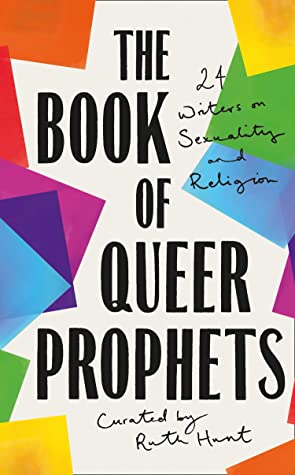 There isn’t, or needn’t be, a contradiction between faith and queerness, as the authors included in this anthology would agree. Many of them are stalwarts at Greenbelt, a progressive Christian summer festival – Church of Scotland minister John L. Bell even came out there, in his late sixties, in 2017. I’m a lapsed regular attendee, so a lot of the names were familiar to me, including those of poets Rachel Mann and Padraig O’Tuama.
Most of the contributors are Christian, then, including ordained priests like Desmond Tutu’s daughter, Mpho, and LGBT ally Kate Bottley, but we also hear from Michael Segalov, a gay Jewish man in London, and from Amrou Al-Kahdi (author of Unicorn: The Memoir of a Muslim Drag Queen), who describes the affirmation they found in the Sufi tradition. Dustin Lance Black tells of the exclusion LGBT Mormons still encounter.
Jarel Robinson-Brown addresses his lament on mistreatment to his nephew, as James Baldwin did in “My Dungeon Shook” (in The Fire Next Time). Tamsin Omond recounts getting married to Melissa on a London bridge in the middle of an Extinction Rebellion protest. Erin Clark, though bisexual, knows she can pass as straight because she’s marrying a man – so is she ‘gay enough?’ Two trans poets write of the way cathedrals drew them into faith. The only weaker pieces are by Jeanette Winterson (there’s nothing new if you’ve read her memoir) and Juno Dawson (entirely throwaway; ‘I’m an atheist, but it’s okay to be religious, too’).
Again and again, these writers voice the certainty that they are who God means them to be. A few of them engage with particular passages from the Bible, offering contextual critiques or new interpretations, but most turn to scripture for its overall message of love and justice. Self-knowledge is a key component of their search for truth. And the truth sets people free.
My rating:
I read an e-copy via NetGalley.
What recent releases can you recommend?
A Few Bizarre Backlist Reads: McEwan, Michaels & Tremain
I’ve grouped these three prize-winning novels from the late 1980s and 1990s together because they all left me scratching my head, wondering whether they were jumbles of random elements and events or if there was indeed a satisfyingly coherent story. While there were aspects I admired, there were also moments when I thought it indulgent of the authors to pursue poetic prose or plot tangents and not consider the reader’s limited patience. I had to think for ages about how to rate these, but eventually arrived at the same rating for each, reflecting my enjoyment but also my hesitation.
The Child in Time by Ian McEwan (1987)
[Whitbread Prize for Fiction (now Costa Novel Award)]
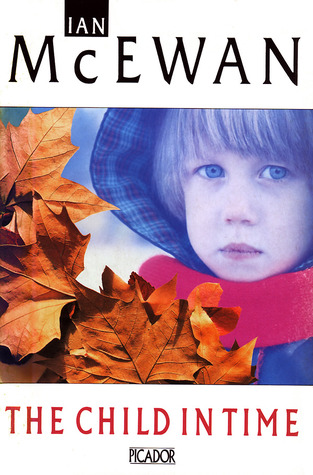 This is the second-earliest of the 13 McEwan books I’ve read. It’s something of a strange muddle (from the protagonist’s hobbies of Arabic and tennis lessons plus drinking onwards), yet everything clusters around the title’s announced themes of children and time.
Stephen Lewis’s three-year-old daughter, Kate, was abducted from a supermarket three years ago. The incident is recalled early in the book, as if the remainder will be about solving the mystery of what happened to Kate. But such is not the case. Her disappearance is an unalterable fact of Stephen’s life that drove him and his wife apart, but apart from one excruciating scene later in the book when he mistakes a little girl on a school playground for Kate and interrogates the principal about her, the missing child is just subtext.
Instead, the tokens of childhood are political and fanciful. Stephen, a writer whose novels accidentally got categorized as children’s books, is on a government committee producing a report on childcare. On a visit to Suffolk, he learns that his publisher, Charles Darke, who later became an MP, has reverted to childhood, wearing shorts and serving lemonade up in a treehouse.
Meanwhile, Charles’s wife, Thelma, is a physicist researching the nature of time. For Charles, returning to childhood is a way of recapturing timelessness. There’s also an odd shared memory that Stephen and his mother had four decades apart. Even tiny details add on to the time theme, like Stephen’s parents meeting when his father returned a defective clock to the department store where his mother worked.
This is McEwan, so you know there’s going to be a contrived but very funny scene. Here that comes in Chapter 5, when Stephen is behind a flipped lorry and goes to help the driver. He agrees to take down a series of (increasingly outrageous) dictated letters but gets exasperated at about the same time it becomes clear the young man is not approaching death. Instead, he helps him out of the cab and they celebrate by drinking two bottles of champagne. This doesn’t seem to have much bearing on the rest of the book, but is the scene I’m most likely to remember.
Other noteworthy elements: Stephen has a couple of run-ins with the Prime Minister; though this is clearly Margaret Thatcher, McEwan takes pains to neither name nor so much as reveal the gender of the PM (in fear of libel claims?). Homeless people and gypsies show up multiple times, making Stephen uncomfortable but also drawing his attention. I assumed this was a political point about Thatcher’s influence, with the homeless serving as additional stand-ins for children in a paternalistic society, representing vulnerability and (misplaced) trust.
This is a book club read for our third monthly Zoom meeting, coming up in the first week of June. While it’s odd and not entirely successful, I think it should give us a lot to talk about: the good and bad aspects of reverting to childhood, whether it matters if Kate ever comes back, the caginess about Thatcher, and so on.
Fugitive Pieces by Anne Michaels (1996)
[Orange Prize (now Women’s Prize for Fiction)]
“One can look deeply for meaning or one can invent it.”
 Poland, Greece, Canada; geology, poetry, meteorology. At times it felt like Michaels had picked her settings and topics out of a hat and flung them together. Especially in the early pages, the dreamy prose is so close to poetry that I had trouble figuring out what was actually happening, but gradually I was drawn into the story of Jakob Beer, a Jewish boy rescued like a bog body or golem from the ruins of his Polish village. Raised on a Greek island and in Toronto by his adoptive father, a geologist named Athos who’s determined to combat the Nazi falsifying of archaeological history, Jakob becomes a poet and translator. Though he marries twice, he remains a lonely genius haunted by the loss of his whole family – especially his sister, Bella, who played the piano. Survivor’s guilt never goes away. “To survive was to escape fate. But if you escape your fate, whose life do you then step into?”
The final third of the novel, set after Jakob’s death, shifts into another first-person voice. Ben is a student of literature and meteorological history. His parents are concentration camp survivors, so he relates to the themes of loss and longing in Jakob’s poetry. Taking a break from his troubled marriage, Ben offers to go back to the Greek island where Jakob last lived to retrieve his notebooks – which presumably contain all that’s come before. Ben often addresses Jakob directly in the second person, as if to reassure him that he has been remembered. Ultimately, I wasn’t sure what this section was meant to add, but Ben’s narration is more fluent than Jakob’s, so it was at least pleasant to read.
Although this is undoubtedly overwritten in places, too often resorting to weighty one-liners, I found myself entranced by the stylish writing most of the time. I particularly enjoyed the puns, palindromes and rhyming slang that Jakob shares with Athos while learning English, and with his first wife. If I could change one thing, I would boost the presence of the female characters. I was reminded of other books I’ve read about the interpretation of history and memory, Everything Is Illuminated and Moon Tiger, as well as of other works by Canadian women, A Student of Weather and Fall on Your Knees. This won’t be a book for everyone, but if you’ve enjoyed one or more of my readalikes, you might consider giving it a try.
Sacred Country by Rose Tremain (1992)
[James Tait Black Memorial Prize, Prix Fémina Etranger]
In 1952, on the day a two-minute silence is held for the dead king, six-year-old Mary Ward has a distinct thought: “I am not Mary. That is a mistake. I am not a girl. I’m a boy.” Growing up on a Suffolk farm with a violent father and a mentally ill mother, Mary asks to be called Martin and binds her breasts with bandages. Kicked out at age 15, she lives with her retired teacher and then starts to pursue a life on her own terms in London. While working for a literary magazine and dating women, she consults a doctor and psychologist to explore the hormonal and surgical options for becoming the man she believes she’s always been.
Meanwhile, a hometown acquaintance with whom she once shared a dentist’s waiting room, Walter Loomis, gives up his family’s butcher shop to pursue his passion for country music. Both he and Mary/Martin are sexually fluid and, dissatisfied with the existence they were born into, resolve to search for something more. The outsiders’ journeys take them to Tennessee, of all places. But when Martin joins Walter there, it’s an anticlimax. You’d expect their new lives to dovetail together, but instead they remain separate strivers.
At a bare summary, this seems like a simple plot, but Tremain complicates it with many minor characters and subplots. The story line stretches to 1980: nearly three decades’ worth of historical and social upheaval. The third person narration shifts perspective often to show a whole breadth of experience in this small English village, while occasional first-person passages from Mary and from her mother, Estelle, who’s in and out of a mental hospital, lend intimacy. Otherwise, the minor characters feel flat, more like symbols or mouthpieces.
To give a flavor of the book’s many random elements, here’s a decoding of the extraordinary cover on the copy I picked up from the free bookshop:
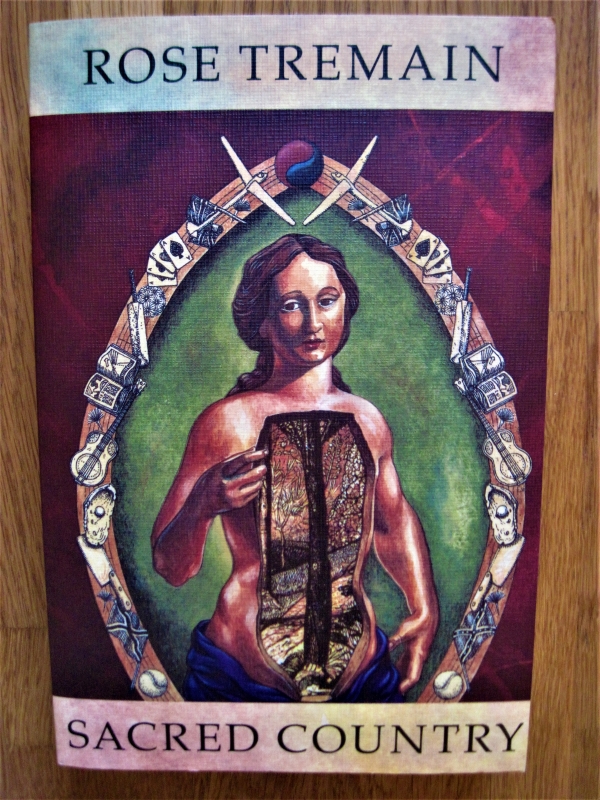
Crimson background and oval shape = female anatomy, menstruation
Central figure in a medieval painting style, with royal blue cloth = Mary
Masculine muscle structure plus yin-yang at top = blended sexuality
Airplane = Estelle’s mother died in a glider accident
Confederate flag = Tennessee
Cards = fate/chance, conjuring tricks Mary learns at school, fortune teller Walter visits
Cleaver = the Loomis butcher shop
Cricket bat = Edward Harker’s woodcraft; he employs and then marries Estelle’s friend Irene
Guitar = Walter’s country music ambitions
Oyster shell with pearl = Irene’s daughter Pearl, whom young Mary loves so much she takes her (then a baby) in to school for show-and-tell
Cutout torso = the search for the title land (both inward and outer), a place beyond duality
Tremain must have been ahead of the times in writing a trans character. She acknowledged that the premise was inspired by Conundrum by Jan Morris (who, born James, knew he was really a girl from the age of five). I recall that Sacred Country turned up often in the footnotes of Tremain’s recent memoir, Rosie, so I expect it has little autobiographical resonances and is a work she’s particularly proud of. I read this in advance of writing a profile of Tremain for Bookmarks magazine. It feels very different from her other books I’ve read; while it’s not as straightforwardly readable as The Road Home, I’d call it my second favorite from her. The writing is somewhat reminiscent of Kate Atkinson, early A.S. Byatt and Shena Mackay, and it’s a memorable exploration of hidden identity and the parts of life that remain a mystery.
Spring Reading 2020, Part I
What a beautiful spring we’ve been having here. And, as usual, I’ve been reading with the seasons: some nature books about birdsong, flowers, etc., as well as a few books with “Spring” in the title. I have several more on the go that I’ll write up next month.
A Cold Spring by Elizabeth Bishop (1955)
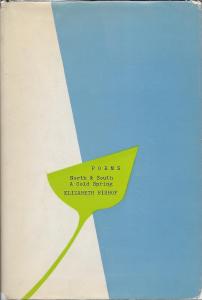 The second of Bishop’s four published collections, this mostly dwells on contrasts between city (e.g. “View of the Capitol from the Library of Congress,” “Varick Street” and “Letter to N.Y.”) and coastal locations (e.g. “The Bight,” “At the Fishhouses” and “Cape Breton”). The three most memorable poems for me were the title one, which opens the book; “The Prodigal,” a retelling of the Prodigal Son parable; and “Invitation to Miss Marianne Moore” (“From Brooklyn, over the Brooklyn Bridge, on this fine morning, please come flying,” with those last three words recurring at the end of each successive stanza; also note the sandpipers – one of her most famous poems was “Sandpiper,” from 1965’s Questions of Travel). I find that I love particular lines or images from Bishop’s poetry but not her overall style.
Favorite lines:
A cold spring:
the violet was flawed on the lawn.
For two weeks or more the trees hesitated;
the little leaves waited
(from “A Cold Spring”)
Spring: A Folio Anthology, edited by Sue Bradbury (2017)
 As a seasonal anthology, this falls short by comparison to the Wildlife Trust’s Spring. There are too many letters or journal entries that only happen to be set in March to May and don’t in any way evoke the season. The selection of poems and passages is fairly predictable, and closing with an ominous extract from Rachel Carson’s Silent Spring (see below) makes for rather a downbeat conclusion. Highlights: the preface by Paul Evans, Parson Woodforde’s pigs getting drunk on the dregs of some beer (1778), Elizabeth David rhapsodizing about a wild asparagus risotto she had in Italy, and Angus Buchanan coming upon an idyllic setting in Wildlife in Canada. The gorgeous cover, the slightly ornate font that liaises s or c with t, and the three two-page green-dominated illustrations somewhat make up for the lackluster contents.
Silent Spring by Rachel Carson (1962)
 When I saw Lucy Jones speak at an event in Hungerford in support of her new book, Losing Eden, early last month, I was intrigued to hear her say that her work was consciously patterned on Silent Spring – right down to the same number of chapters. This prompted me to finally pick up the copy of Carson’s classic that I got free during a cull at the library where I used to work and have a skim through.
Both books are forthright explications of the environmental problems we face, backed up by volumes of irrefutable evidence, and suggest some potential solutions. Both open, though, with a dystopian scene: Carson’s first chapter imagines an American town where things die because nature stops working as it should. Her main target was insecticides that were known to kill birds and had presumed negative effects on human health through the food chain and environmental exposure. Although the details may feel dated, the literary style and the general cautions against submitting nature to a “chemical barrage” remain potent.
A Country Year: Living the Questions by Sue Hubbell (1986)
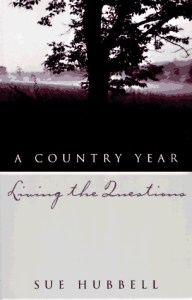 A seasonal diary that runs from one spring to the next, this is a peaceful book about living alone yet finding community with wildlife and fellow country folk. I took nine months over reading it, keeping it as a bedside book.
At her farm in southern Missouri’s Ozark Mountains, Hubbell had a small beekeeping and honey production business, “a shaky, marginal sort of affair that never quite leaves me free of money worries but which allows me to live in these hills that I love.” After her 30-year marriage ended, she found herself alone in “the afternoon of my life,” facing “the work of building a new kind of order, a structure on which a fifty-year-old woman can live”. In few-page essays she reflects on the weather, her interactions with wildlife (from bats and black rat snakes to a fawn caught in a fence), and country events like a hog roast.
I love introspective books like this one that balance solitude with nature and company and that showcase older women’s wisdom (Joan Anderson, May Sarton and Barbara J. Scot also write/wrote in this vein). Hubbell, who died at age 83 in late 2018, wrote broader scientific narratives about evolution and genetic engineering, as well as detailed books about bees and other insects. I’ll look out for more of her work.
A Sweet, Wild Note: What We Hear when the Birds Sing by Richard Smyth (2017)
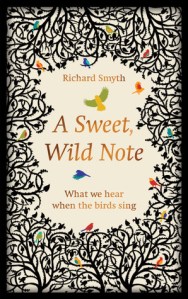 Despite being a birdwatcher since childhood, Smyth had always been ambivalent about birdsong. He certainly wasn’t one of those whizzes who can identify any bird by its call; in fact, he needed convincing that bird vocalizations are inherently beautiful. So he set off to answer a few questions: Why do birds sing? How can we recognize them by their songs? And how have these songs played into the human‒bird relationship throughout history? Ranging from bird anatomy to poetry, his historical survey is lighthearted reading that was perfect for the early days of spring. There are also chapters on captive birds, the use of birdsong in classical music, and the contribution birds make to the British soundscape. A final section, more subdued and premonitory in the vein of Silent Spring, imagines a world without birdsong and “the diminution that we all suffer. … Our lives become less rich.” (The title phrase is how Gilbert White described the blackcap’s song, Smyth’s favorite.)
Favorite lines:
when everything around you seems to be moving at a gallop, a bird’s song reminds you that some things stay the same … that you really can go home again.
in many ways the whole point of birdsong is that it’s beyond our grasp. It’s fleeting, evanescent; you might as well try to take a fistful of morning mist. But that hasn’t stopped us trying.
Have you been reading anything particularly appropriate for spring this year?
Six Degrees of Separation: From Stasiland to The End of the Point
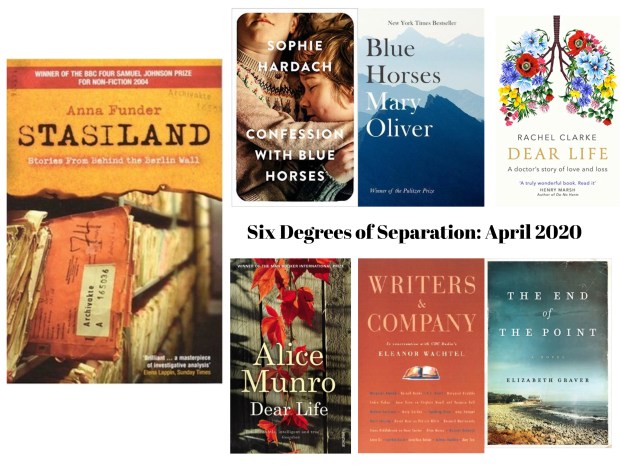
It’s my third time participating in Kate’s Six Degrees of Separation meme (see her introductory post). The challenge starts with Stasiland (2003) by Anna Funder, which I also happened to read recently. While working part-time for an overseas television service in what was once West Berlin, Funder started gathering stories of how ordinary people were put under surveillance and psychologically terrorized by the Stasi, the East German secret police. She molds her travels and her interviewees’ testimonies into riveting stories – though this won the Samuel Johnson Prize for nonfiction in 2004, it’s as character-driven as any novel.
#1 My interest in Stasiland was piqued by reading Sophie Hardach’s Costa Prize-shortlisted novel Confession with Blue Horses (2019). When Ella’s parents, East German art historians under Stasi surveillance, were caught trying to defect during a ‘vacation’ to Hungary in 1987, their three children were taken from them and only two were returned. Ella is determined to find her brother, whom they’ve had no word of since, via a correspondence with the Stasi archive. It’s an emotionally involving story of one ordinary family’s losses and reconstruction.

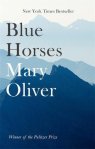 #2 Blue Horses (2014) is one of Mary Oliver’s lesser poetry collections. I found it to be a desperately earnest and somewhat overbaked set of nature observations and pat spiritual realizations. There are a few poems worth reading (e.g., “After Reading Lucretius, I Go to the Pond” and Part 3 of “The Fourth Sign of the Zodiac”), and lines here and there fit for saving, but overall this is so weak that I’d direct readers to Oliver’s landmark 1980s work instead.
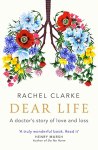
#3 Oliver’s poetry, especially “Wild Geese” and “The Summer Day,” gets quoted everywhere. The latter’s most famous lines, “Tell me, what is it you plan to do / with your one wild and precious life?” appears in Dear Life by Rachel Clarke, my book of 2020 so far. Clarke specializes in palliative medicine and alternates her patients’ stories with her own in a completely natural way. A major theme is her relationship with her late father, also a doctor, and his lessons of empathy and dedication. A passionate yet practical book, this aims to get people talking about end-of-life issues.
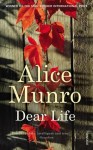
#4 I have meant to read Dear Life by Alice Munro (2012) since before she won the Nobel Prize. I was sent a free paperback copy for a Nudge review, but as the site already had a review of the book up, I let it slip and never followed through. More than once I’ve put this short story collection onto a reading stack, but I have never quite gotten past the first page or two. At some point this must be rectified.
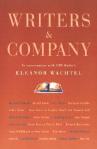
#5 Alice Munro is one of the authors featured in Writers & Co. by Eleanor Wachtel (1993), a terrific collection of interviews from Wachtel’s weekly Canadian Broadcasting Corporation radio program. Whether I’d read anything by these authors (or even heard of them) or not, I found each Q&A chock-full of priceless nuggets of wisdom about creativity, mothers and daughters, drawing on autobiographical material, the writing process, and much more.

#6 My first-ever author Q&A, for Bookkaholic in 2013, was related to The End of the Point by Elizabeth Graver. (Alas that the site is now defunct, so the interview only exists as a file on my computer.) In an astonishing historical sweep, from Massachusetts’s first colonial settlers through the cultural upheavals of the twentieth century, Graver’s family saga with a difference questions parent‒child ties, environmental responsibility, and the dictates of wealth and class. Her complex, elegiac tale, reminiscent of Virginia Woolf’s To the Lighthouse and Liza Klaussmann’s Tigers in Red Weather, offers multiple points of view in a sympathetic gaze at a vanishing way of life – but an enduring sense of place.
Join us for #6Degrees of Separation if you haven’t already!
Have you read any of my selections? Are you tempted by any you didn’t know before?
 Bookish Beck = Rebecca Foster. American transplant to England. Freelance proofreader and book reviewer.
 Bookish Beck