R.I.P. Reads, Part I: Apostolides, Dahl, Harkness, Kingfisher & Kohda
Ghosts, witches, vampires, creepy underground things: It can only be Readers Imbibing Peril time of year! Here’s my first five reviews.
The Homecoming by Zoë Apostolides (2025)
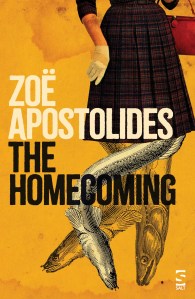 This debut novel dropped through my door as a total surprise: not only was it unsolicited, but I’d not heard about it. In this modern take on the traditional haunted house story, Ellen is a ghostwriter sent from London to Elver House, Northumberland, to work on the memoirs of its octogenarian owner, Catherine Carey. Ellen will stay in the remote manor house for a week and record 20 hours of audio interviews – enough to flesh out an autobiography. Miss Carey isn’t a forthcoming subject, but Ellen manages to learn that her father drowned in the nearby brook and that all Miss Carey did afterwards was meant to please her grieving mother and the strictures of the time. But as strange happenings in the house interfere with her task, Ellen begins to doubt she’ll come away with usable material. I was reminded of The Woman in Black, The Thirteenth Tale, and especially Wakenhyrst what with the local eel legends. The subplot about Ellen drifting apart from her best friend, a new mother, felt unnecessary, though I suppose was intended to bolster the main theme of women’s roles. There’s a twist that more seasoned readers of Gothic fiction and ghost stories might see coming. While I found this very readable and perfectly capably written, I didn’t get a sense of where the author hopes to fit in the literary market; she’s previously published a true crime narrative. Full disclosure: I once collaborated with Zoë on a Stylist assignment.
With thanks to Salt Publishing for the proof copy for review.
The Witches by Roald Dahl (1983)
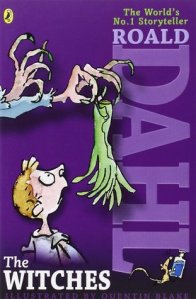 I’m sure I read all of Dahl’s major works when I was a child, though I had no specific memory of this one. After his parents’ death in a car accident, a boy lives in his family home in England with his Norwegian grandmother. She tells him stories from Norway and schools him in how to recognize and avoid witches. They wear wigs and special shoes to hide their baldness and square feet, and with their wide nostrils they sniff out children to turn them into hated creatures like slugs. When Grandmamma falls ill with pneumonia, she and the boy travel to a Bournemouth hotel for her recovery only to stumble upon a convention of witches under the guise of the Royal Society for the Prevention of Cruelty to Children. The Grand High Witch (Anjelica Huston, if you know the movie) has a new concoction that will transform children into mice at enough of a delay to occur the following morning at school. It’s up to the boy and his grandmother to save the day. I really enjoyed this caper, which I interpreted as being – like Tove Jansson’s The Summer Book – about imagination and making the most of one’s time with grandparents. But in the back of my mind was Jen Campbell’s objection to the stereotypical equating of disfigurement with villainy. The Grand High Witch also speaks with a heavy German accent. It would be understandable to dismiss this as dated and clichéd, but I still found it worthwhile. It also fit into my project to read books from my birth year. (Free from a neighbour)
The Black Bird Oracle by Deborah Harkness (2024)
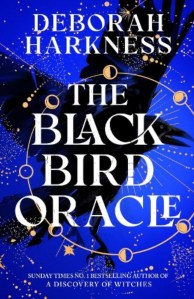 Somehow I’ve read this entire series even though none of the subsequent books lived up to A Discovery of Witches. What I loved about that first novel was how the author drew on her knowledge of the history of science to create a believable backdrop for a story of witches, vampires and other supernatural beings that took place largely in Oxford and its medieval libraries. Each sequel has elaborated further adventures for Diana Bishop, a witch; her vampire husband, Matthew de Clermont; and their family members and other hangers-on. Their twins, especially Becca, have inherited some of Diana’s power. I read the first half of this last year and finally skimmed to the end last week, so I haven’t retained much. Diana is summoned to the ancestral seat of the Bishops in Massachusetts and finds herself part of a community of gossipy, catty witches. (Dahl was right, they’re everywhere!) She has some fun, folksy interactions but things soon get more serious as she girds herself for a showdown with the darker implications of her gift. Overall, this didn’t add much to the ongoing narrative and the love scenes veered too close to romantasy for my liking. (Public library)
What Stalks the Deep by T. Kingfisher [Ursula Vernon] (2025)
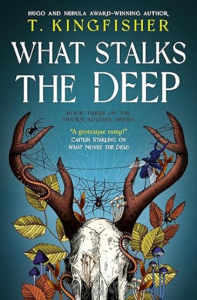 The third in the “Sworn Soldier” series, after What Moves the Dead and What Feasts at Night. Alex Easton is a witty, gender-nonconforming narrator, which is why I persist with these novellas even though I’m underwhelmed by the plots. Denton, the American doctor friend from the first book, begs Easton to come to West Virginia: his cousin Oscar has gone missing in a mine after sending a series of alarming letters about a red light he saw in the depths. Easton and their right-hand man, Angus, soon encounter claustrophobia-inducing cave systems, various kinds of bad air and siphonophore-like marine creatures that can assemble to imitate other beings. (Why aren’t these on the cover, huh?!) In other intriguing matters, Denton seems to have something going on with his friend John Ingold, an Indigenous scientist. Though, as Easton frequently reminds themself, that’s none of our business. There are some great set-pieces and funny, if anachronistic, asides (on learning how to flick a lighter just right: “I used to practice it for hours as a teenager, in hopes of impressing girls. Look, girls were more easily impressed in those days. Shut up.”) But my feeling with all three books is that they’re over before they’ve barely begun, and they never deliver the expected horror. Smart-ass, queer fantasy/horror: these will be some people’s perfect books, just not mine. If you’re intrigued, do at least try the first one, which riffs on Poe. (Read via Edelweiss)
Woman, Eating by Claire Kohda (2022)
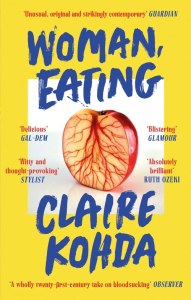 A very different sort of vampire novel. Twenty-three-year-old Lydia is half Japanese and half Malaysian; half human and half vampire. She’s trying to follow in her late father’s footsteps as an artist through an internship at a Battersea gallery, which comes with studio space where she’ll sleep to save money. But she can only drink blood like her mother, who turned her when she was a baby. Mostly she subsists on pig blood – which she can order dried if she can’t buy it fresh from a butcher – though, in one disturbing sequence, she brings home a duck carcass. When she falls for Ben, one of her studio-mates, she imagines what it would be like to be fully human: to make art together, to explore Asian cuisine, to bond over losing their mothers (his is dying of cancer; hers is in a care home with violence-tinged dementia). But Ben is already seeing someone, the internship is predictably dull, and a first attempt at consuming regular food goes badly wrong. There are a lot of promising threads in this debut. It’s fascinating how Lydia can intuit a creature’s whole life story by drinking their blood. She becomes obsessed with the Baba Yaga folk tale (and also mentions Malay vampire legends) and there’s a neat little bit of #MeToo revenge. But overall, it’s half-baked. Really, it’s just a disaster-woman book in disguise. The way Lydia’s identity determines her attitudes towards food and sex feels like a symbol of body dysmorphia. I’ll look out to see if Kohda does something more distinctive in future. (Secondhand – Awesomebooks.com)
More coming up on Halloween (thankfully, including books I liked better on average)!
Reading the Meow, Part II: Books by Bernardine Bishop and Matt Haig
This is my second contribution to the Reading the Meow challenge, hosted by Mallika of Literary Potpourri, after yesterday’s review of Sleeping with Cats by Marge Piercy. One of the below novels is obviously cat-themed; the other less so, but the cover and blurb convinced me to take a chance on a new-to-me author and I discovered a hidden gem.

The Street by Bernardine Bishop (2015)
Prices are so cheap at my local charity warehouse (3/£1 paperbacks) that I recently did something I almost never do: bought a book I’d never heard of, by an author I’d never heard of, and then (something I definitely never do!) read it almost right away instead of letting it gather dust on my shelves for years. Bishop’s biography is wild. As a new Cambridge graduate, she was the youngest witness in the Lady Chatterley trial in 1960, then published two novels in her early twenties. She married twice, had two sons and a psychotherapy career, and returned to writing fiction after 50 years – prompted by a cancer diagnosis. Unexpected Lessons in Love was shortlisted for the Costa Novel Award in 2013, while this and Hidden Knowledge were both published posthumously, after Bishop’s death in 2015.
So: there is a cat on the cover and the blurb mentions it, too: “a beloved cat achieves immortality.” (I should have realized that was a euphemism, but never mind.) The novel opens with news of the death at 90 of formidable Brenda Byfleet, who’d been a Greenham Common woman and taken part in peace protests right into old age. Neighbours quickly realize someone will need to care for her cat Benn (named for Tony Benn), and the duty falls to Anne and Eric, who have also taken in their grandson while his parents are in Canada.
 What follows is a low-key ensemble story that moves with ease between several key residences of Palmerston Street, London, introducing us to a couple struggling with infertility, a war veteran with dementia, an underemployed actor who rescues his wife from her boss’s unwanted attentions, and so on. Most touching is the relationship between Anne and Georgia, a lesbian snail researcher who paints Anne’s portrait. Their friendship shades into quiet, middle-aged love.
There are secrets and threats and climactic moments here, but always the reassuring sense that neighbours are a kind of second family and so someone will be there for you to rely on no matter what you face. (I can think of a certain soap opera theme that expresses a similar sentiment…) Bishop’s style reminds me most of Tessa Hadley’s. She is equally skilled at drawing children and the elderly, and clearly feels love and compassion for her flawed characters: “Everything and everyone in the street was bathed in a blessed ordinariness.”
From Brenda onward, Georgia’s rhetorical question hangs over the short novel: “What is a life?” The implied partial answer is: what is remembered by those left behind. The opening paragraph is perfect –
“Sometimes it is impossible to turn even a short London street into a village. But sometimes it can be easily done. It all depends on one or two personalities.”
… and the last page has kittens. This was altogether a lovely read. Dangit, why didn’t I also buy the other Bishop novel that was on shelf at the charity warehouse?! I’ll have to hope it’s still around the next time I go there. (Secondhand – Community Furniture Project, Newbury) 
To Be a Cat by Matt Haig (2012)
 This was a reasonably cute middle-grade fantasy and careful-what-you-wish-for cautionary tale. On his twelfth birthday, Barney Willow thinks life couldn’t get worse. His parents are divorced, his dad has recently disappeared, he’s bullied by Gavin Needle, and evil head teacher Miss Whipmire seems to have a personal vendetta against him. His only friend is Rissa Fairweather, who lives on a barge. Little does he know that an idle wish to switch places with a cat he pets on the street will set a dangerous adventure in motion. Now he’s a cat and Maurice the cat has his body. Soon Barney realizes there’s a whole subset of cats who are former humans (alongside “swipers,” proper fighting street cats; and “firesides,” who prefer to stay indoors), including Miss Whipmire, who used to be a Siamese cat and has an escape plan that involves Barney. I felt the influence of Roald Dahl and Terry Pratchett, but Haig doesn’t have their writing chops. Apart from Rissa, the characterization is too clichéd. I’m sure I would have enjoyed this at age eight, though. (Little Free Library)
Book Serendipity, October to December 2023
I call it “Book Serendipity” when two or more books that I read at the same time or in quick succession have something in common – the more bizarre, the better. This is a regular feature of mine every couple of months. Because I usually have 20–30 books on the go at once, I suppose I’m more prone to such incidents. The following are in roughly chronological order.
- A woman turns into a spider in Edith Holler by Edward Carey and The Human Origins of Beatrice Porter and Other Essential Ghosts by Soraya Palmer.

- Expulsion from Eden scenes (one literal, after the Masaccio painting; another more figurative by association) in Conversation Among Stones by Willie Lin and North Woods by Daniel Mason.
- Reading my second 2023 release featuring a theatre fire (after The House Is on Fire by Rachel Beanland, which I actually read last year): Edith Holler by Edward Carey.
- The protagonist cuts their foot in The Rituals by Rebecca Roberts and The Last House on Needless Street by Catriona Ward.


- On the same evening, I started two novels where the protagonist’s parents both died in a car crash: The Witches by Roald Dahl and Family Meal by Bryan Washington. This is something I encounter ALL THE TIME in fiction (versus extremely rarely in life) and it’s one of my major pet peeves. I can excuse it more in the children’s book as the orphan trope allows for adventures, but for the most part it just seems lazy to me. The author has decided they don’t want to delve into a relationship with parents at all, so they cut it out in the quickest and easiest possible way.
- A presumed honour killing in Behind You Is the Sea by Susan Muaddi Darraj and The Hundred and Ninety-Nine Steps by Michel Faber.


- A Houston, Texas setting in The Only Way Through Is Out by Suzette Mullen and Family Meal by Bryan Washington.
- Daniel Clowes, whose graphic novel Monica I was also in the middle of at the time, was mentioned in Robin Ince’s Bibliomaniac.
- The author/speaker warns the squeamish reader to look away for a paragraph in Robin Ince’s Bibliomaniac (recounting details of a gross-out horror plot) and one chapter of Daniel Mason’s North Woods.


- A mentally ill man who lives at the end of a lane in Daniel Mason’s North Woods and The Last House on Needless Street by Catriona Ward.
- Reading Last House before the Mountain by Monika Helfer and The Last House on Needless Street by Catriona Ward at the same time.
- The Daedalus myth (via Aeschylus or Brueghel, or just in general) is mentioned in Last House before the Mountain by Monika Helfer, The Ghost Orchid by Michael Longley, and Absolutely and Forever by Rose Tremain.
- A character goes to live with their aunt and uncle in Western Lane by Chetna Maroo and The House of Doors by Tan Twan Eng (both Booker-longlisted), but also The Woman in Black by Susan Hill, Train Dreams by Denis Johnson, and The Story Girl by L.M. Montgomery. I came across all five instances within a few days! Later I also encountered a brief mention of this in Ferdinand by Irmgard Keun. How can this situation be so uncommon in life but so common in fiction?!



- The outdated terms “Chinaman” and “coolie” appear frequently in Train Dreams by Denis Johnson and The House of Doors by Tan Twan Eng.
- A 15-year-old declares true love in The Inseparables by Simone de Beauvoir and Absolutely and Forever by Rose Tremain.
- A French character named Pascal in The Inseparables by Simone de Beauvoir and The Garrick Year by Margaret Drabble.

- A minor character called Mrs Biggs in Harriet Said… by Beryl Bainbridge and The House of Doors by Tan Twan Eng.
- The Chinese zither (guzheng) is mentioned in Dear Chrysanthemums by Fiona Sze-Lorrain, which I read earlier in the year, and The House of Doors by Tan Twan Eng.
- Oscar Wilde’s trial is mentioned in The House of Doors by Tan Twan Eng, as it was in The New Life by Tom Crewe, which I read earlier in the year – in both it was a cautionary case for older homosexual characters (based on real people: W. Somerset Maugham vs. John Addington Symonds) who were married to women but had a live-in male secretary generally known to be their lover. At the same time as I was reading The House of Doors, I was rereading Wilde’s De Profundis, which was written from prison.


- In Fifty Days of Solitude Doris Grumbach mentions reading Bear by Marian Engel. I read both during Novellas in November.
- Living funerals are mentioned in Ferdinand by Irmgard Keun and The Ritual Effect by Michael Norton.
- A character insists that lilac not be included in a bouquet in In the Sweep of the Bay by Cath Barton and Bright Young Women by Jessica Knoll.


- A woman has a lover named Frances in Bright Young Women by Jessica Knoll and The Cancer Journals by Audre Lorde.
- The final word of the Fanny Howe poem in Raised by Wolves (the forthcoming 50th anniversary poetry anthology from Graywolf Press) is “theophanies.” At the same time, I was reading the upcoming poetry collection Theophanies by Sarah Ghazal Ali.


- The Cancer Journals by Audre Lorde, which I’d read the month before, was a major influence on the cancer memoir All In by Caitlin Breedlove.
- Two foodie memoirs I read during our city break, A Waiter in Paris by Edward Chisholm and The Sweet Life in Paris by David Lebovitz, both likened a group of young men to a Dolce & Gabbana ad. (Chisholm initially lived at Porte des Lilas, the next Metro stop up from where we stayed in Mairie des Lilas.)
- A French slang term for penis, “verge,” is mentioned in both The Sweet Life in Paris by David Lebovitz and Learning to Drive by Katha Pollitt.


What’s the weirdest reading coincidence you’ve had lately?
Love Your Library, February 2023
Thanks to Cathy, Elle and Sarah for contributing with their recent library borrows!
While shelving in the large print area at the library I noticed something I’d never seen before: a “Dyslexic Edition” of a novel. I opened it up and saw that it has large type, but various other features: the font is a sans serif, in medium to dark blue, and there are lots of short sections rather than lengthy paragraphs. Instead of passages being in italics, they appear in bold face. The overall effect is fewer words on a page and maximized readability. We shelve these with large print, but there are plans to pull them out for a future display on disability awareness. There are also some children’s series geared towards dyslexic and reluctant readers, as well as the “Quick Reads” books put out by the Reading Agency for adult readers who may struggle with literacy.
This isn’t library-specific, but most of you will have heard about the new UK expurgated versions of Roald Dahl children’s books commissioned from the consultancy Inclusive Minds by his literary estate. Dahl’s work still flies off the shelves at my library. What’s more, it’s inspired countless other writers with his particular brand of snarky/edgy humour. Apparently the specific changes made are to, in hundreds of places, replace words like “fat,” “stupid” and “ugly.” In general, I’m leery of censorship, preferring that parents speak to their children about the appropriate use of words or, if that can’t be guaranteed, adding an introduction or afterword. (The unaltered “classic” Dahl collection will still be sold, too.)
Yet I am sympathetic in this case because I know how hurtful some stereotypes can be. For instance, we have Jen Campbell to thank for this addition to The Witches (who are portrayed as bald and wearing wigs): “There are plenty of other reasons why women might wear wigs and there is certainly nothing wrong with that.” She has various genetic conditions including alopecia and has long been opposed to casual associations of disfigurement with evil in popular culture.
What’s your take?
And my own library reading since last month:
READ
- The New Life by Tom Crewe

- Once Upon a Tome by Oliver Darkshire
- How to Be Sad by Helen Russell
- Lucy by the Sea by Elizabeth Strout

- City of Friends by Joanna Trollope

- Crying in H Mart by Michelle Zauner
Plus a load of picture books about winter and snow; I reviewed them here.


CURRENTLY READING
- A Fortunate Man by John Berger
- The Things We Do to Our Friends by Heather Darwent
- Martha Quest by Doris Lessing
- Nightwalking: Four Journeys into Britain after Dark by John Lewis-Stempel
- His Only Wife by Peace Adzo Medie
- Manorism by Yomi Sode
I also have the rest of the Folio Prize poetry shortlist out on loan to read soon. A lot of the other books pictured in this post have already gone back unread. I never consider that a problem, though, as it still helps libraries retain funding, and authors get royalties!
What have you been reading or reviewing from the library recently?
Share a link to your own post in the comments. Feel free to use the above image. The hashtag is #LoveYourLibrary.
Patrick Gale at Marlborough Literature Festival
It’s been a long time since I attended a literary festival in person rather than online. Four of us from my book club went along yesterday evening to the headline event of Marlborough Literature Festival. Marlborough is a pleasant market town in Wiltshire about 40 minutes from Newbury, and I’d like to get back to it sometime soon when things are open so I can explore its secondhand and plastic-free shops.
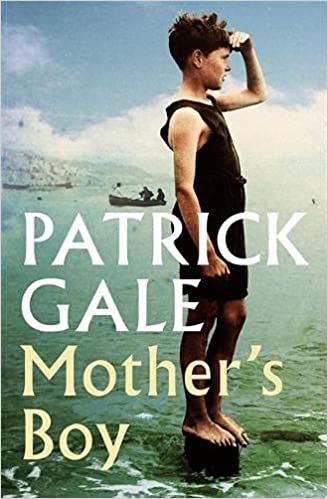
Patrick Gale closed the festival by speaking about his new novel (his 17th), Mother’s Boy. I knew it was a historical novel that covered the Second World War, but I had no idea that it was based on a real person, poet Charles Causley. With Andrew Motion, Gale is a patron of the Charles Causley Trust, which runs an annual poetry competition for children. I hadn’t heard of Causley, but Gale and some members of the audience recall memorizing his poems in school – like Roald Dahl’s, they can have a wicked sense of humour. Causley also wrote in the style of traditional ballads; my husband knows a version of one on a folk album.
Gale called Causley the “least sexy” of the war poets. He was from Launceston, Cornwall and left school at age 15, joining the Navy and later working as a schoolteacher for many years. He lived with his widowed mother and, if you believe the legend, died a virgin. However, Gale unearthed evidence that Causley was in fact a closeted homosexual and had sexual encounters with men during the war. He experienced survivor’s guilt because he escaped his ship’s explosion while he had an on-shore posting so that he could sit his exams.
Equally important to the novel is Causley’s mother, Laura, who grew up in extreme poverty and, after her husband’s death from TB, raised Charles in a slum on a laundress’ salary, even managing to buy him a piano. Launceston was decimated by the two world wars, and essentially colonized by the segregated U.S. Army. Gale made up a Black character named Amos, but gave him a horrific real-life story. Laura would have met Black soldiers and, later, German POWs through her working-class church.
Gale acknowledged that he had to make up more of Laura’s story, relying only on the information about her in Causley’s tiny appointment diaries. In response to an audience question, he said he thinks Causley would be “utterly appalled” at the existence of this novel because he was an intensely private person, but that he’s salved his conscience with the fact that the book is driving people back to Causley’s poems. He wrote this as a novel rather than a biography because he tends to “overempathize” with characters, and likes to go “behind the bedroom door,” as he put it – indeed, one (non-graphic) scene he read was of Charles’s conception, while the other was about Charles learning to read at age five and enjoying his father’s company though he knew he was ill.
Mother’s Boy is most like A Place Called Winter from his oeuvre, Gale remarked, in that it’s historical fiction based on real people – in that earlier case, his own relatives. Gale’s father was the governor of Wandsworth Prison and his mother the daughter of the governor of Liverpool Prison (where he oversaw many hangings). In fact, he’s now at work on a sequel to A Place Called Winter, about his grandparents and parents, and researching from letters.
I was impressed with Gale’s delivery: he spoke engagingly for 45 minutes about the book and its context, peppering in readings and recitations, with no interviewer to prompt him. It was clearly a practiced lecture, but he had no notes and spoke warmly and as if off the cuff.
Are any of these poem titles familiar to you? These were the ones mentioned during last night’s event. (You can listen to Causley reading some of them in his eighties – with his large cat purring in the background – on the Poetry Archive site I linked to above.)
- “Timothy Winters”
- “Rattler Morgan”
- “Eden Rock”
- “The Ballad of a Bread Man”
- “Angel Hill”
I have a copy of Mother’s Boy on hold at the library for me to pick up tomorrow, and we fancy reading A Place Called Winter for book club soon – his Notes from an Exhibition was one of our all-time favourites that we’ve read together.
Are you a Patrick Gale fan? Have you been able to attend any literary events recently?
R.I.P. Reads for Halloween: Ashworth, Bazterrica, Hill, Machado & More
I don’t often read anything that could be classed as suspense or horror, so the R.I.P. challenge is a fun excuse to dip a toe into these genres each year. This year I have an eerie relationship study, a dystopian scenario where cannibalism has become the norm, some traditional ghost stories old and new, and a bonus story encountered in an unrelated anthology.

Ghosted: A Love Story by Jenn Ashworth (2021)
Laurie’s life is thrown off kilter when, after they’ve been together 15 years, her husband Mark disappears one day, taking nothing with him. She continues in her job as a cleaner on a university campus in northwest England. After work she visits her father, who is suffering from dementia, and his Ukrainian carer Olena. In general, she pretends that nothing has happened, caring little how odd it will appear that she didn’t call the police until Mark had been gone for five weeks. Despite her obsession with true crime podcasts, she can’t seem to imagine that anything untoward has happened to him. What happened to Mark, and what’s with that spooky spare room in their flat that Laurie won’t let anyone enter?
 If you find unreliable narrators delicious, you’re in the right place. The mood is confessional, yet Laurie is anything but confiding. Occasionally she apologizes for her behaviour: “I realise this does not sound very sane” is one of her concessions to readers’ rationality. So her drinking problem doesn’t become evident until nearly halfway through, and a bombshell is still to come. It’s the key to understanding our protagonist and why she’s acted this way.
Ghosted wasn’t what I expected. Its air of supernatural menace mellows; what is to be feared is much more ordinary. The subtitle should have been more of a clue for me. I appreciated the working class, northern setting (not often represented; Ashworth is up for this year’s Portico Prize) and the unusual relationships Laurie has with Olena, as well as with co-worker Eddie and neighbour Katrina. Reminiscent of Jo Baker’s The Body Lies and Sue Miller’s Monogamy, this story of a storm-tossed marriage was a solid introduction to Ashworth’s fiction – this is her fifth novel – but I’m not sure the payoff lived up to that amazing cover.
With thanks to Sceptre for the free copy for review.
Tender Is the Flesh by Agustina Bazterrica (2017; 2020)
[Translated from the Spanish by Sarah Moses]
 This sledgehammer of a short Argentinian novel has a simple premise: not long ago, animals were found to be infected with a virus that made them toxic to humans. During the euphemistic “Transition,” all domesticated and herd animals were killed and the roles they once held began to be filled by humans – hunted, sacrificed, butchered, scavenged, cooked and eaten. A whole gastronomic culture quickly developed around cannibalism.
Marcos is our guide to this horrific near-future world. Although he works in a slaughterhouse, he’s still uneasy with some aspects of the arrangement. The standard terminology is an attempt at dispassion: the “heads” are “processed” for their “meat.” Smarting from the loss of his baby son and with his father in a nursing home, Marcos still has enough compassion that when he’s gifted a high-quality female he views her as a person rather than potential cuts of flesh. His decisions from here on will call into question his loyalty to the new system.
I wondered if there would come a point where I was no longer physically able to keep reading. But it’s fiendishly clever how the book beckons you into analogical situations and then forces you to face up to cold truths. It’s impossible to avoid the animal-rights message (in a book full of gruesome scenes, the one that involves animals somehow hits hardest), but I also thought a lot about how human castes might work – dooming some to muteness, breeding and commodification, while others are the privileged overseers granted peaceful ends. Bazterrica also conflates sex and death in uncomfortable ways. In one sense, this was not easy to read. But in another, I was morbidly compelled to turn the pages. Brutal but brilliant stuff. (Public library/Edelweiss)
Fear: Tales of Terror and Suspense, selected by Roald Dahl (2017)
 I reviewed the five female-penned ghost stories for R.I.P. back in 2019. This year I picked out another five, leaving a final four for another year. (Review copy)
“W.S.” by L.P. Hartley: The only thing I’ve read of Hartley’s besides The Go-Between. Novelist Walter Streeter is confronted by one of his characters, to whom he gave the same initials. What’s real and what’s only going on in his head? Perfectly plotted and delicious.
“In the Tube” by E.F. Benson: The concept of time is called into question when someone witnesses a suicide on the London Underground some days before it could actually have happened. All recounted as a retrospective tale. Believably uncanny.
“Elias and the Draug” by Jonas Lie: A sea monster and ghost ship plague Norwegian fishermen.
“The Ghost of a Hand” by J. Sheridan Le Fanu: A disembodied hand wreaks havoc in an eighteenth-century household.
“On the Brighton Road” by Richard Middleton: A tramp meets an ill boy on a road in the Sussex Downs. A classic ghost story that pivots on its final line.
The Small Hand: A Ghost Story by Susan Hill (2010)
 This was my fourth of Hill’s classic ghost stories, after The Woman in Black, The Man in the Picture and Dolly. They’re always concise and so fluently written that the storytelling voice feels effortless. I wondered if this one might have been inspired by “The Ghost of a Hand” (above). It doesn’t feature a disembodied hand, per se, but the presence of a young boy who slips his hand into antiquarian book dealer Adam Snow’s when he stops at an abandoned house in the English countryside, and again when he goes to a French monastery to purchase a Shakespeare First Folio. Each time, Adam feels the ghost is pulling him to throw himself into a pond. When Adam confides in the monks and in his brother, he gets different advice. A pleasant and very quick read, if a little predictable. (Free from a neighbour)
And a bonus story:
 Carmen Maria Machado’s “The Lost Performance of the High Priestess of the Temple of Horror” appears in Kink (2021), a short story anthology edited by Garth Greenwell and R.O. Kwon. (I requested it from NetGalley just so I could read the stories by Machado and Brandon Taylor.) It opens “I would never forget the night I saw Maxa decompose before me.” A seamstress, obsessed with an actress, becomes her dresser. Set in the 19th-century Parisian theatre world, this pairs queer desire and early special effects and is over-the-top sensual in the vein of Angela Carter, with hints of the sadomasochism that got it a place here.
Sample lines: “Women seep because they occupy the filmy gauze between the world of the living and the dead.” & “Her body blotted out the moon. She was an ambulatory garden, a beacon in a dead season, life where life should not grow.”
Also counting the short stories by Octavia E. Butler and Bradley Sides, I did some great R.I.P. reading this year! I think the book that will stick with me the most is Tender Is the Flesh.
Snow and Winter Reads, Part II
Since I wrote about my first batch of wintry reads in early February, it’s turned much more spring-like here in southern England, with blue skies and the daffodils blooming. Still, temperatures continue chilly and some nights I’ve had trouble falling asleep because of the wind tearing down the street and flapping the bin lids. With meteorological spring due to start tomorrow, I’m bidding farewell to winter with a few more snow-covered reads: a children’s classic, a modern classic from the 1990s, and an implausible but enjoyably rollicking thriller.
The Wolves of Willoughby Chase by Joan Aiken (1962)
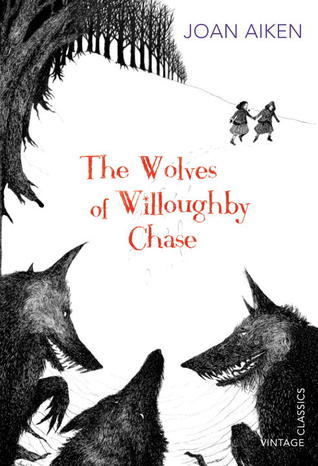 Aiken’s books were not part of my childhood, but I was vaguely aware of this first book in a long series when I plucked it from a neighbor’s giveaway pile. The snowy scene on the cover and described in the first two paragraphs drew me in and the story, a Victorian-set fantasy with notes of Oliver Twist and Jane Eyre, soon did, too. In this alternative version of the 1830s, Britain already had an extensive railway network and wolves regularly used the Channel Tunnel (which did not actually open until 1994) to escape the Continent’s brutal winters for somewhat milder climes.
One winter, the orphaned Sylvia travels by train from London to the north of England to live with her cousin Bonnie and her parents, Sir Willoughby and Lady Green. But dodgy things are afoot at Willoughby Chase: Miss Slighcarp, a distant cousin, has been hired as the girls’ governess but, just as soon as Bonnie’s parents leave on a long trip, she sets about taking over the house. Bonnie and Sylvia, exiled to a workhouse, rely on a secret network of friends and servants to keep them safe and get them home via an intrepid journey.
Miss Slighcarp is just one of the novel’s Dickensian villains – balanced out by some equally Dickensian urchins and helpful adults, all of them with hearts of gold. There’s something perversely cozy about the plight of an orphan in children’s books: the characters call to the lonely child in all of us, and we rejoice to see how ingenuity and luck come together to defeat wickedness. There are charming passages here in which familiar smells and favorite foods offer comfort. I especially loved their friend Simon’s cave and his little rituals. This would make a perfect stepping stone from Roald Dahl to one of the actual Victorian classics.
My only quibble with the book overall would be that the wolves seem unnecessary: they only truly appear once, for a climactic scene during the train ride, and the rest of the time are just a background menace. From fairy tales onwards, wolves have gotten a bad rap, and we don’t need to perpetuate myths about how dangerous they are to humans.
Snow Falling on Cedars by David Guterson (1994)
 My first 5-star read of the year! It certainly took a while, but I’m now on a roll with a bunch of 4.5- and 5-star ratings bunching together. I remember the buzz surrounding this novel, mostly because of the Ethan Hawke film version that came out when I was a teenager. Even though I didn’t see it, I was aware of it, as I was of other literary fiction that got turned into Oscar-worthy films at about that time, like The Shipping News and House of Sand and Fog.
The novel is set in 1954 on San Piedro, an island of 5,000 off the coast of Washington state. A decade on from the war, the community’s chickens come home to roost when a Japanese American man, Kabuo Miyamoto, is charged with murdering a fellow fisherman, Carl Heine. The men had been engaged in a dispute over some land – seven acres of strawberry fields that were seized from the Miyamoto family when, like the rest of the country’s Japanese population, they were rounded up in internment camps. Meanwhile, Ishmael Chambers, who runs the local newspaper and lost an arm in the war, stumbles on a piece of evidence that might turn the case around. Still in love with Hatsue, now Kabuo’s wife but once his teenage obsession, he is torn between winning her back and wanting to do what’s right.
Guterson alternates between trial scenes and flashbacks to war service or stolen afternoons Ishmael and Hatsue spent kissing in the shelter of massive cedar trees. The mystery element held me completely gripped – readers are just as in the dark as the jurors until very close to the end – but this is mostly a powerful picture of the lasting effects of racism. All the characters are well drawn, even minor ones like elderly defense attorney Nels Gudmundsson. Even though I only read 10 or 15 pages at a sitting over the course of a month, every time I picked up the book I was instantly immersed in the atmosphere, whether it was a warm courtroom with a snowstorm swirling outside or a troop ship entering the Pacific Theater. This has the epic feel of a doorstopper, though it’s only 400 pages. I can’t recommend it highly enough.
The Quality of Silence by Rosamund Lupton (2015)
 Ten-year-old Ruby and her mother Yasmin have arrived in Alaska to visit Ruby’s dad, Matt, who makes nature documentaries. When they arrive, police inform them that the town where he was living has been destroyed by fire and he is presumed dead. But Yasmin won’t believe it and they set out on a 500-mile journey north to find her husband, first hitching a ride with a trucker and then going it alone in a stolen vehicle. All the time, with the weather increasingly brutal, they’re aware of someone following them – someone with malicious intent.
The narration is in short segments, alternating between Ruby’s first person and a third-person account from Yasmin’s point-of-view. There are many interesting elements here: Ruby is deaf so communicates via a combination of sign language, voice recognition software, blogs and social media, and describes things synesthetically; Yasmin is a physicist drawing metaphors to scientific concepts, but can’t explain her own mystical certainty that Matt is still alive; and there is an environmentalist message behind the fracking cover-up plot.
But starting with the first page, there are so many improbabilities in play, from a 10-year-old having a Twitter account to Yasmin managing to drive a big rig on ice roads in a foreign country. I knew from reviewing Three Hours last year that Lupton writes addictive thrillers. This one was perfectly readable, but not as good. It’s our book club read for early March, and I expect I won’t be the only one to find it hardly believable.
Plus a skim:
Arctic Dreams by Barry Lopez (1986)
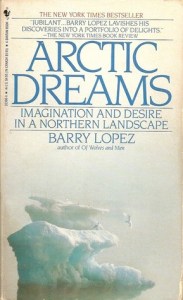 This was my first time trying the late Lopez. It was supposed to be a buddy read with my husband because we ended up with two free copies, but he raced ahead while I limped along just a few pages at a time before admitting defeat and skimming to the end (it was the 20 pages on musk oxen that really did me in). For me, the reading experience was most akin to The Snow Leopard by Peter Matthiessen in that both are about a literal journey in an extreme environment, yet what stands out are the philosophical musings. Where Matthiessen was animated by Buddhist ideas about selfhood and loss, Lopez takes the secular long view of human life and responsibility in light of potential extinction. The epilogue, in particular, is endlessly quotable. It’s depressing to encounter books like this now, though: 30+ years ago, literary nature writers were issuing clarion calls about climate disaster, and we didn’t listen.
Some favorite passages:
“Whenever I met a collared lemming on a summer day and took its stare I would think: Here is a tough animal. Here is a valuable life. … If it could tell me of its will to survive, would I think of biochemistry, or would I think of the analogous human desire? If it could speak of the time since the retreat of the ice, would I have the patience to listen?”
“The cold view to take of our future is that we are therefore headed for extinction in a universe of impersonal chemical, physical, and biological laws. A more productive, certainly more engaging view, is that we have the intelligence to grasp what is happening, the composure not to be intimidated by its complexity, and the courage to take steps that may bear no fruit in our lifetimes.”
“One of the oldest dreams of mankind is to find a dignity that might include all living things. And one of the greatest of human longings must be to bring such dignity to one’s own dreams, for each to find his or her own life exemplary in some way. The struggle to do this is a struggle because an adult sensibility must find some way to include all the dark threads of life. A way to do this is to pay attention to what occurs in a land not touched by human schemes, where an original order prevails.”
Did you read anything particularly wintry this year, or are you and your book stack moving on to spring already?
Classic of the Month: Cider with Rosie by Laurie Lee (1959)
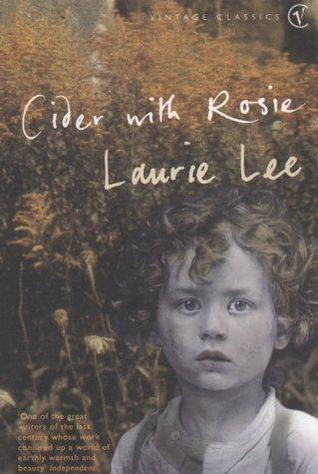 (20 Books of Summer #2) Lee’s quaint family memoir is set in the years immediately after World War I. He was born in 1914 and his childhood unfolded in Stroud, Gloucestershire and nearby village Slad. I started reading Cider with Rosie in April 2019 when we stopped in Stroud for a night on the way back from a holiday in Devon. I got through the first 100 pages quickly, with the voice reminding me slightly of Gerald Durrell’s in his autobiographical trilogy, but then set the book aside for over a year before picking it back up for this summer’s food- and drink-themed reading. Taking such a long break wasn’t a major problem because the book’s vignettes are thematically arranged, so there was no plot as such to lose track of.
Lee was part of his father’s second brood, born out of the widower’s remarriage to his housekeeper. His father left his new family after just a few years, and for the next three decades Lee’s mother dutifully waited for a return that never came. Lee was a sickly child, doted on by his older half-sisters. He was surrounded by a large wider family of brothers, eccentric war-veteran uncles and duelling elderly neighbors who lived one upstairs and one downstairs in a sort of granny annex attached to their untidy, rambling 17th-century stone house. The book depicts a village on the cusp of modernization: everything was still done with wagons and horses, but that was soon to change.
It’s a nostalgic, evocative look at a country childhood. Lee captures a bygone era, portraying himself as similarly on the precipice of losing innocence. The title comes from a late moment when Rosie Burdock tempts the adolescent Lee with alcoholic cider and kisses underneath a hay wagon. This penultimate chapter on the lust of the flesh takes an alarming turn as he describes the village boys’ planned gang rape of a religious 16-year-old, Lizzy. Lee was among the boys who followed her into the woods one Sunday after church. Luckily, they lost their nerve and nothing happened, but Lee’s blasé recounting felt out of keeping and somehow more dated than the rest of his material. It left a sourness I couldn’t get over.
Quintessentially English but not as purely delightful as I expected, this was still a book I valued for its characterization and its description of golden moments in memory.
Some favorite passages:
“Summer, June summer, with the green back on earth and the whole world unlocked and seething – like winter, it came suddenly and one knew it in bed, almost before waking up; with cuckoos and pigeons hollowing the woods since daylight and the chipping of tits in the pear-blossom.”
“Myself, my family, my generation, were born in a world of silence; a world of hard work and necessary patience, of backs bent to the ground, hands massaging the crops, of waiting on weather and growth; of villages like ships in the empty landscapes and the long walking distances between them; … [The horse’s] eight miles an hour was the limit of our movements, as it had been since the days of the Romans. That eight miles an hour was life and death, the size of our world, our prison.”
Source: Free bookshop
My rating:
Ten more childhood memoirs:
A few I’ve written about here and prefer:
- Boy by Roald Dahl
- To the Is-land by Janet Frame
- Don’t Let’s Go to the Dogs Tonight by Alexandra Fuller
- Bookworm by Lucy Mangan
- Period Piece by Gwen Raverat
A couple of favorites I’ve never written up:
- Oleander, Jacaranda by Penelope Lively
- Hellfire and Herring by Christopher Rush
Plus a few that I haven’t liked quite as much:
- Maggie & Me by Damian Barr
- Childhood by Tove Ditlevsen
- Rosie by Rose Tremain
R.I.P. Reads: Dahl, Le Guin, Lessing, Paver
This is my second year participating in R.I.P. – Readers Imbibing Peril, now in its 14th year. I assembled a lovely pile of magical or spooky reads to last me through October and noticed they were almost all by women, so I decided to make it an all-female challenge (yes, even with a Dahl title – see below) this year. I’m in the middle of another book and have a few more awaiting me, but with just two weeks left in the month I don’t know if I’ll manage to follow up this post with a Part II. At any rate, these first four were solid selections: classic ghost stories, children’s fantasy, a horror novella about an evil child, and an Arctic chiller.

Fear: Tales of Terror and Suspense (selected by Roald Dahl) (2017)
“Spookiness is, after all, the real purpose of the ghost story. It should give you the creeps and disturb your thoughts.”
I was sent this selection of Dahl-curated ghost stories as part of a book bundle in advance of a blog tour for Roald Dahl Day last year. For now I’ve read just the five stories by women, and will polish off the rest next year.
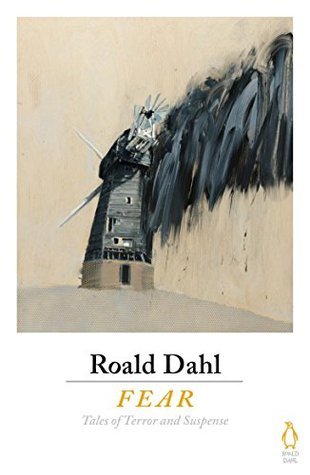 This collection originated from a television series on ghost stories that Dahl proposed for the American market in 1958 (the pilot was poorly received and it never got made). For his research he read nearly 750 ghost stories and whittled them down to the top 24. Women authors dominated early on in the selection process, but by the end the genders came out nearly even, with 13 men and 11 women. It’s disappointing, then, that only five of the 14 stories included here are by women – one of whom gets two entries, so there’s just four female authors recognized. And this even though Dahl claims that, when it comes to ghost stories, “it is the women who have written some of the very best ones.”
Any road, these are the five stories I read, all of which I found suitably creepy, though the Wharton is overlong. Each one pivots on a moment when the narrator realizes that a character they have been interacting with is actually dead. Even if you’ve seen the twist coming, there’s still a little clench of the heart when you have it confirmed by a third party.
“Harry” and “Christmas Meeting” by Rosemary Timperley: A little girl who survived a murder attempt is reclaimed by her late brother; a woman meets a century-dead author one lonely holiday – I liked that in this one each character penetrates the other’s time period.
“The Corner Shop” by Cynthia Asquith: An inviting antique shop is run by two young women during the day, but by a somber old man in the evenings. He likes to give his customers a good deal to atone for his miserly actions of the past.
“The Telephone” by Mary Treadgold: A man continues communicating with his dead ex-wife via the phone line.
“Afterward” by Edith Wharton: An American couple settles in a home in Dorset, and the husband disappears, after a dodgy business deal, in the company of a mysterious stranger.
A Wizard of Earthsea by Ursula K. Le Guin (1968)
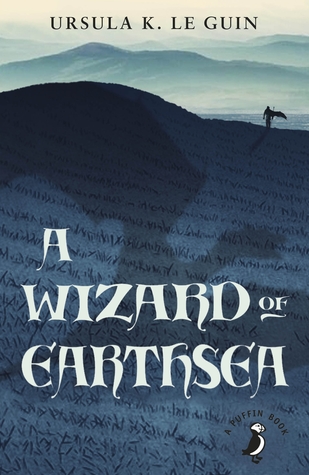 This was my second attempt with the late Le Guin, who would be turning 90 on the 21st; I didn’t get far at all with a buddy read of The Left Hand of Darkness last year. I enjoyed this a fair bit more, perhaps because it’s meant for children – I reckon I would have liked it most when I was ages nine to 11 and obsessed with various series of fantasy novels featuring dragons.
Long before Harry Potter was a glimmer, this was the archetypal story of a boy wizard learning magic at school. Ged meets many cryptic mentors and realizes that naming a thing gives you power over it. In his rivalry with the other boys, he accidentally releases a shadow beast and has to try to gain back control of it. It’s slightly difficult to keep on top of all the names and places (Le Guin created a whole archipelago, which you can see in the opening map) and I found my interest waning after the halfway point, but I did love the scene of Ged fighting with a dragon.
A favorite passage: “But you must not change one thing, one pebble, one grain of sand, until you know what good and evil will follow on the act. … A wizard’s power of Changing and of Summoning can shake the balance of the world.”
The Fifth Child by Doris Lessing (1988)
Shelve this alongside We Need to Talk about Kevin as a book to make you rethink having kids. Harriet and David Lovatt buy a large Victorian house within commuting distance of London and dream of filling it with children – six, eight; however many. Their first four children are all they’d hoped for, if not spaced out as much as they intended. The Lovatts enjoy hosting the extended family at Easter and Christmas and during the summer holidays. Although there are good-natured jokes about the couple’s fertility, everyone enjoys the cozy, bustling atmosphere. “The Lovatts were a happy family. It was what they had chosen and what they deserved.”
[MILD SPOILERS ENSUE]
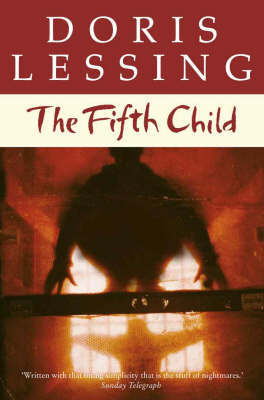 Everything changes with pregnancy #5, which is different right from the off. This “savage thing inside her” is kicking Harriet black and blue from the inside and grown to full term by eight months. When Ben is born Harriet thinks, “He’s like a troll, or a goblin.” Like a succubus, he sucks her dry, biting her nipples black and blue; he screams and thrashes non-stop; he’s freakishly strong and insatiably hungry. He strangles house pets and eats a raw chicken with his bare hands. Although he learns basic language and social skills from watching his older siblings and mimicking his idols from a motorcycle gang, something in him is not human. Yet Harriet cannot bear to leave Ben to rot in an institution.
At first I wondered if this was a picture of an extremely autistic child, but Lessing makes the supernatural element clear. “We are being punished,” Harriet says to David. “For presuming … we could be happy.” I think I was waiting for a few more horrific moments and a climactic ending, whereas Lessing almost normalizes Ben, making him part of a gang of half-feral youths who rampage around late-1980s Britain (and she took up his story in a sequel, Ben in the World). But I raced through this in just a few days and enjoyed the way dread overlays the fable-like simplicity of the family’s early life.
Dark Matter: A Ghost Story by Michelle Paver (2010)
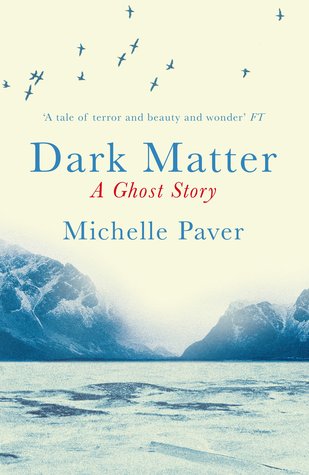 I read Paver’s Thin Air as part of last year’s R.I.P. challenge and it was very similar: a 1930s setting, an all-male adventure, an extreme climate (in that case: the Himalayas). Most of Dark Matter is presented as a journal written by Jack Miller, a lower-class lad who wanted to become a physicist but had to make a living as a clerk instead. He feels he doesn’t truly belong among the wealthier chaps on this Arctic expedition, but decides this is his big chance and he’s not going to give it up.
Even as the others drop out due to bereavement and illness, he stays the course, continuing to gather meteorological data and radio it back to England from this bleak settlement in the far north of Norway. For weeks his only company is a pack of sled dogs, and his grasp on reality becomes shaky as he begins to be visited by the ghost of a trapper who was tortured to death nearby – “the one who walks again.” Paver’s historical thrillers are extremely readable. I tore through this, yet never really found it scary.
Note: This book is the subject of the Bookshop Band song “Steady On” (video here).
And, alas, three DNFs:
 The Wych Elm by Tana French – French writes really fluid prose and inhabits the mind of a young man with admirable imagination. I read the first 100 pages and skimmed another 50 and STILL hadn’t gotten to the main event the blurb heralds: finding a skull in the wych elm in the garden at Ivy House. I kept thinking, “Can we get on with it? Let’s cut to the chase!” I have had French’s work highly recommended so may well try her again.
 The Hoarder by Jess Kidd – Things in Jars was terrific; I thought Kidd’s back catalogue couldn’t fail to draw me in. This was entertaining enough that I made it to page 152, if far too similar to Jars (vice versa, really, as this came first; ghosts/saints only the main character sees; a transgender landlady/housekeeper); I then found that picking it back up didn’t appeal at all. Maud Drennan is a carer to a grumpy giant of a man named Cathal Flood whose home is chock-a-block with stuff. What happened to his wife? And to Maud’s sister? Who cares!
 The Silent Companions by Laura Purcell – Purcell is now on her third Gothic novel in three years. I had a stab at her first and it was distinctly okay. I read the first 24 pages and skimmed to p. 87. Reminiscent of The Shadow Hour, The Familiars, etc.
Have you been reading anything fantastical or spooky this October?
Continuing the Story: Why I’m Wary of Sequels and Series, with Some Exceptions
Most of the time, if I learn that a book has a sequel or is the first in a series, my automatic reaction is to groan. Why can’t a story just have a tidy ending? Why does it need to sprawl further, creating a sense of obligation in its readers? Further adventures with The Hundred-Year-Old Man Who Climbed Out the Window? Returning to the world of The Handmaid’s Tale? No, thank you.
It was different when I was a kid. I couldn’t get enough of series: the Little House on the Prairie books, Encyclopedia Brown, Nancy Drew, the Saddle Club, Redwall, the Baby-Sitters Club, various dragon series, Lilian Jackson Braun’s Cat Who mysteries, the Anne of Green Gables books… You name it, I read it. I think children, especially, gravitate towards series because they’re guaranteed more of what they know they like. It’s a dependable mold. These days, though, I’m famous for trying one or two books from a series and leaving the rest unfinished (Harry Potter: 1.5 books; Discworld: 2 books at random; Jim Butcher’s Dresden Files: 1 book; the first book of crime series by M.J. Carter, Judith Flanders and William Shaw).
But, like any reader, I break my own rules all the time – even if I sometimes come to regret it. I recently finished reading a sequel and I’m now halfway through another. I’ve even read a few high-profile sci fi/fantasy trilogies over the last eight years, even though with all of them I liked each sequel less than the book that went before (Margaret Atwood’s MaddAddam books, Chris Beckett’s Dark Eden series and Deborah Harkness’s All Souls Trilogy).
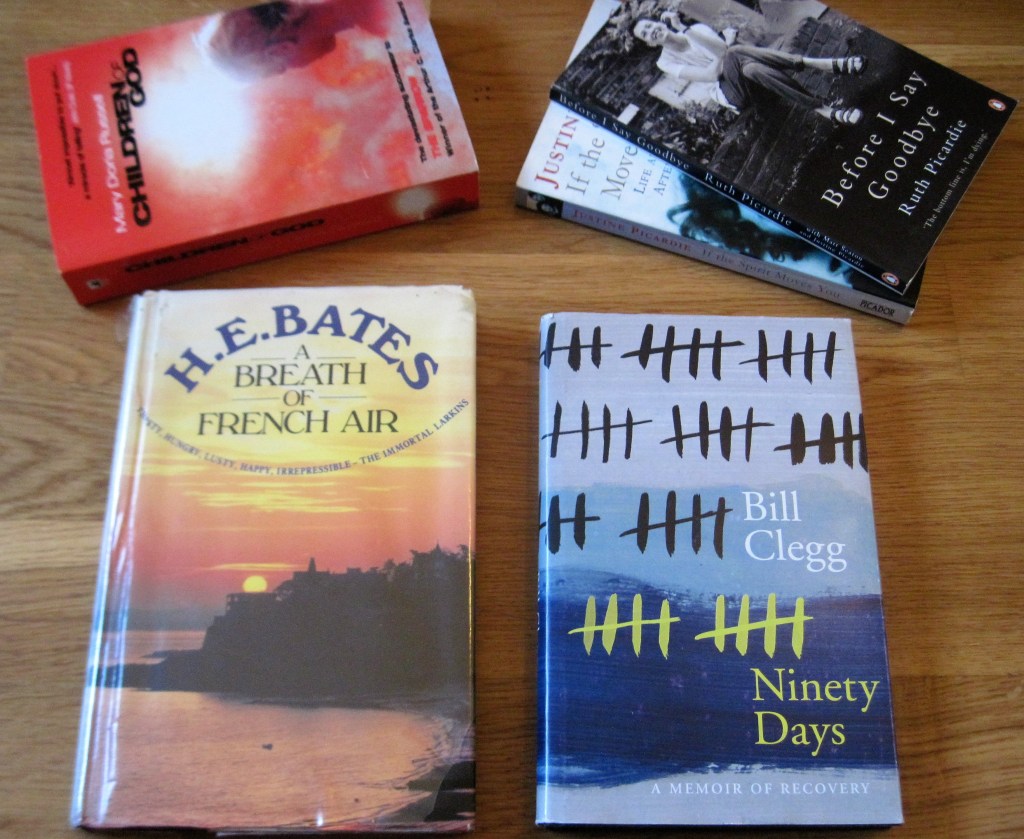
A later book in a series can go either way for me – surpass the original, or fail to live up to it. Nonfiction sequels seem more reliable than fiction ones, though: if I discover that a memoirist has written a follow-up volume, I will generally rush to read it.
So, what would induce me to pick up a sequel?
I want to know what happens next.
WINNERS:
After reading Ruth Picardie’s Before I Say Goodbye, I was eager to hear from her bereaved sister, Justine Picardie. Ruth died of breast cancer in 1997; Justine writes a journal covering 2000 to 2001, asking herself whether death is really the end and if there is any possibility of communicating with her sister and other loved ones she’s recently lost. If the Spirit Moves You: Life and Love after Death is desperately sad, but also compelling.
 Graeme Simsion’s Rosie series has a wonderfully quirky narrator. When we first meet him, Don Tillman is a 39-year-old Melbourne genetics professor who’s decided it’s time to find a wife. Book 2 has him and Rosie expecting a baby in New York City. I’m halfway through Book 3, in which in their son is 11 and they’re back in Australia. Though not as enjoyable as the first, it’s still a funny look through the eyes of someone on the autistic spectrum.
Edward St. Aubyn’s Never Mind, the first Patrick Melrose book, left a nasty aftertaste, but I was glad I tried again with Bad News, a blackly comic two days in the life of a drug addict.
LOSERS:
Joan Anderson’s two sequels to A Year by the Sea are less engaging, and her books have too much overlap with each other.
Perhaps inevitably, Bill Clegg’s Ninety Days, about getting clean, feels subdued compared to his flashy account of the heights of his drug addiction, Portrait of an Addict as a Young Man.
 Patrick Leigh Fermor’s Between the Woods and the Water was an awfully wordy slog compared to A Time of Gifts.
Mary Doria Russell’s The Sparrow was one of my favorite backlist reads last year. I only read the first 60 pages of Children of God, though. It was a recent DNF after leaving it languishing on my pile for many months. While I was, of course, intrigued to learn that (SPOILER) a character we thought had died is still alive, and it was nice to see broken priest Emilio Sandoz getting a chance at happiness back on Earth, I couldn’t get interested in the political machinations of the alien races. Without the quest setup and terrific ensemble cast of the first book, this didn’t grab me.
I want to spend more time with these characters.
WINNERS:
Simon Armitage’s travel narrative Walking Away is even funnier than Walking Home.
 I’m as leery of child narrators as I am of sequels, yet I read all 10 Flavia de Luce novels by Alan Bradley: quaint mysteries set in 1950s England and starring an eleven-year-old who performs madcap chemistry experiments and solves small-town murders. The Dead in Their Vaulted Arches (#6) was the best, followed by Thrice the Brinded Cat Hath Mew’d (#8).
Roald Dahl’s Going Solo is almost as good as Boy.
Alexandra Fuller’s Leaving Before the Rains Come is even better than Don’t Let’s Go to the Dogs Tonight.
Likewise, Sarah Moss’s Signs for Lost Children, about a female doctor in the 1880s, is even better than Bodies of Light.
Doreen Tovey’s Cats in May is just as good as Cats in the Belfry.
LOSERS:
H. E. Bates’s A Breath of French Air revisits the Larkins, the indomitably cheery hedonists introduced in The Darling Buds of May, as they spend a month abroad in the late 1950s. France shows off its worst weather and mostly inedible cuisine; even the booze is barely tolerable. Like a lot of comedy, this feels slightly dated, and maybe also a touch xenophobic.
 The first Hendrik Groen diary, about an octogenarian and his Old-But-Not-Dead club of Amsterdam nursing home buddies, was a joy, but the sequel felt like it would never end.
I loved Marilynne Robinson’s Gilead; I didn’t need the two subsequent books.
The Shakespeare Requirement, Julie Schumacher’s sequel to Dear Committee Members, a hilarious epistolary novel about an English professor on a Midwest college campus, was only mildly amusing; I didn’t even get halfway through it.
I finished Jane Smiley’s Last Hundred Years trilogy because I felt invested in the central family, but as with the SFF series above, the later books, especially the third one, were a letdown.
What next? I’m still unsure about whether to try the other H. E. Bates and Edward St. Aubyn sequels. I’m thinking yes to Melrose but no to the Larkins. Olive Kitteridge, which I’ve been slowly working my way through, is so good that I might make yet another exception and seek out Olive, Again in the autumn.
 Bookish Beck = Rebecca Foster. American transplant to England. Freelance proofreader and book reviewer.
 Bookish Beck