Four (Almost) One-Sitting Novellas by Blackburn, Murakami, Porter & School of Life (#NovNov25)
I never believe people who say they read 300-page novels in a sitting. How is that possible?! I’m a pretty slow reader, I like to bounce between books rather than read one exclusively, and I often have a hot drink to hand beside my book stack, so I’d need a bathroom break or two. I also have a young cat who doesn’t give me much peace. But 100 pages or thereabouts? I at least have a fighting chance of finishing a novella in one go. Although I haven’t yet achieved a one-sitting read this month, it’s always the goal: to carve out the time and be engrossed such that you just can’t put a book down. I’ll see if I can manage it before November is over.
A couple of longish car rides last weekend gave me the time to read most of three of these, and the next day I popped the other in my purse for a visit to my favourite local coffee shop. I polished them all off later in the week. I have a mini memoir in pets, a surreal Japanese story with illustrations, an innovative modern classic about bereavement, and a set of short essays about money and commodification.
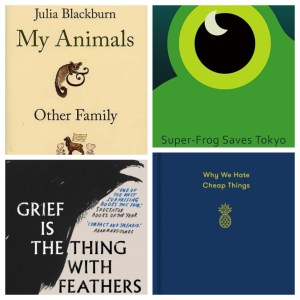
My Animals and Other Family by Julia Blackburn; illus. Herman Makkink (2007)
 In five short autobiographical essays, Blackburn traces her life with pets and other domestic animals. Guinea pigs taught her the facts of life when she was the pet monitor for her girls’ school – and taught her daughter the reality of death when they moved to the country and Galaxy sired a kingdom of outdoor guinea pigs. They also raised chickens, then adopted two orphaned fox cubs; this did not end well. There are intriguing hints of Blackburn’s childhood family dynamic, which she would later write about in the memoir The Three of Us: Her father was an alcoholic poet and her mother a painter. It was not a happy household and pets provided comfort as well as companionship. “I suppose tropical fish were my religion,” she remarks, remembering all the time she devoted to staring at the aquarium. Jason the spaniel was supposed to keep her safe on walks, but his presence didn’t deter a flasher (her parents’ and a policeman’s reactions to hearing the story are disturbingly blasé). My favourite piece was the first, “A Bushbaby from Harrods”: In the 1950s, the department store had a Zoo that sold exotic pets. Congo the bushbaby did his business all over her family’s flat but still was “the first great love of my life,” Blackburn insists. This was pleasant but won’t stay with me. (New purchase – remainder copy from Hay Cinema Bookshop, 2025) [86 pages]
Super-Frog Saves Tokyo by Haruki Murakami; illus. Seb Agresti and Suzanne Dean (2000, 2001; this edition 2025)
[Translated from Japanese by Jay Rubin]
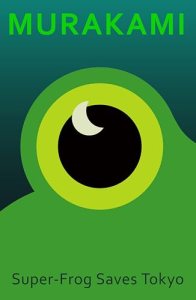 This short story first appeared in English in GQ magazine in 2001 and was then included in Murakami’s collection after the quake, a response to the Kobe earthquake of 1995. “Katigiri found a giant frog waiting for him in his apartment,” it opens. The six-foot amphibian knows that an earthquake will hit Tokyo in three days’ time and wants the middle-aged banker to help him avert disaster by descending into the realm below the bank and doing battle with Worm. Legend has it that the giant worm’s anger causes natural disasters. Katigiri understandably finds it difficult to believe what’s happening, so Frog earns his trust by helping him recover a troublesome loan. Whether Frog is real or not doesn’t seem to matter; either way, imagination saves the city – and Katigiri when he has a medical crisis. I couldn’t help but think of Rachel Ingalls’ Mrs. Caliban (one of my NovNov reads last year). While this has been put together as an appealing standalone volume and was significantly more readable than any of Murakami’s recent novels that I’ve tried, I felt a bit cheated by the it-was-all-just-a-dream motif. (Public library) [86 pages]
Grief Is the Thing with Feathers by Max Porter (2015)
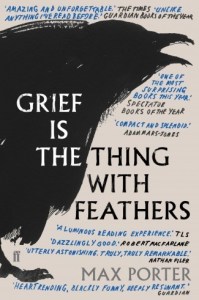 A reread – I reviewed this for Shiny New Books when it first came out and can’t better what I said then. “The novel is composed of three first-person voices: Dad, Boys (sometimes singular and sometimes plural) and Crow. The father and his two young sons are adrift in mourning; the boys’ mum died in an accident in their London flat. The three narratives resemble monologues in a play, with short lines often laid out on the page more like stanzas of a poem than prose paragraphs.” What impressed me most this time was the brilliant mash-up of allusions and genres. The title: Emily Dickinson. The central figure: Ted Hughes’s Crow. The setup: Edgar Allan Poe’s “The Raven” – while he’s grieving his lost love, a man is visited by a black bird that won’t leave until it’s delivered its message. (A raven cronked overhead as I was walking to get my cappuccino.) I was less dazzled by the actual writing, though, apart from a few very strong lines about the nature of loss, e.g. “Moving on, as a concept, is for stupid people, because any sensible person knows grief is a long-term project.” I have a feeling this would be better experienced in other media (such as audio, or the play version). I do still appreciate it as a picture of grief over time, however. Porter won the Sunday Times Young Writer of the Year Award as well as the Dylan Thomas Prize. (Secondhand – Gifted by a friend as part of a trip to Community Furniture Project, Newbury last year; I’d resold my original hardback copy – more fool me!) [114 pages]


My original rating (in 2015): 
My rating now: 
Why We Hate Cheap Things by The School of Life (2017)
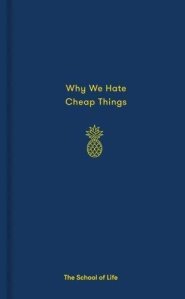 I’m generally a fan of the high-brow self-help books The School of Life produces, but these six micro-essays feel like cast-offs from a larger project. The title essay explores the link between the cost of an item or experience and how much we value it – with reference to pineapples and paintings. The other essays decry the fact that money doesn’t get fairly distributed, such that craftspeople and arts graduates often struggle financially when their work and minds are exactly what we should be valuing as a society. Fair enough … but any suggestions for how to fix the situation?! I’m finding Robin Wall Kimmerer’s The Serviceberry, which is also on a vaguely economic theme, much more engaging and profound. There’s no author listed for this volume, but as The School of Life is Alain de Botton’s brainchild, I’m guessing he had a hand. Perhaps he’s been cancelled? This raises a couple of interesting questions, but overall you’re probably better off spending the time with something more in depth. (Little Free Library) [78 pages]
Short Nonfiction Series for Novellas in November + Nonfiction November
Most Novellas in November participants focus on fiction, which is understandable and totally fine; I also like to incorporate works of short nonfiction during the month, which is a great opportunity to combine challenges with Nonfiction November.
Building on this list I wrote in 2021 (all the recommendations stand, but I’d update it by adding Weatherglass Books to the list of UK publishers), here are some nonfiction series that publish brief, intriguing works:
404 Ink’s Inklings series bears the tagline “big ideas to carry in your pocket.”
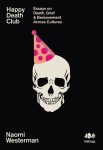 I have reviewed Happy Death Club.
Biteback Publishing’s Provocations series “is a groundbreaking new series of short polemics composed by some of the most intriguing voices in contemporary culture.”
- I have reviewed Last Rights. I spied a pair of books by John Sutherland on youth and ageing at my library.

Bloomsbury’s Object Lessons series “is a series of concise, collectable, beautifully designed books about the hidden lives of ordinary things.”
- I have reviewed Doctor, Dust, Grave, Pregnancy Test, and Recipe.
Bloomsbury’s 33 1/3 is “a series of short books about popular music.”
- I have reviewed Jesus Freak.
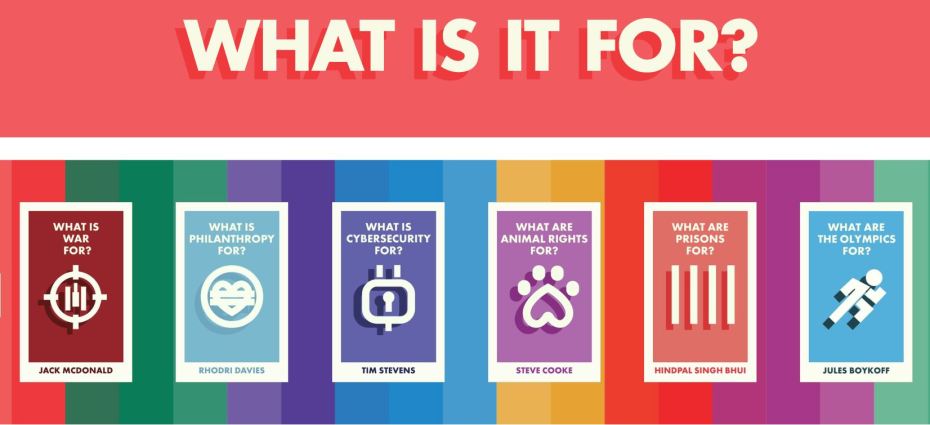
Bristol University Press’s What Is It For series is edited by George Miller, creator of the OUP Very Short Introductions (see below). Miller believes “short, affordable books can, and should, be intelligent and thought-provoking”; he hopes these will “be an agent for positive change,” addressing “tough questions about purpose and fitness for purpose: what has to change for the future to be better?”
A number of Fitzcarraldo Editions’ Essays are significantly under 200 pages.
 I have reviewed Intervals, A Very Easy Death, Happening, I Remain in Darkness, A Woman’s Story, and Alphabetical Diaries (plus others that are longer).
[Edited:] Thanks so much to Liz for letting me know about Jacaranda Books’ A Quick Ting On series, “the first ever non-fiction book series dedicated to Black British culture,” with books on plantains, Grime music, Black hair, and more.
[Edited:] There are three books so far in the Leaping Hare Press Find Your Path self-help series. I have just downloaded Find Your Path through Imposter Syndrome from Edelweiss.
Little Toller Books publishes mostly short nature and travel monographs and reprints.
- I have reviewed Deer Island, Aurochs and Auks, Orison for a Curlew, Herbaceous, The Ash Tree, and Snow.

From the Little Toller website
[Edited:] Thanks so much to Annabel for making me aware of Melville House’s The FUTURES series, which gives “imaginative future visions on a wide range of subjects, written by experts, academics, journalists and leading pop-culture figures.”
MIT Press’s Essential Knowledge series “offers accessible, concise, beautifully produced books on topics of current interest.” I spotted the Plastics book at my library.
Oxford University Press’s Very Short Introductions now cover a whopping 867 subjects!
- I had a couple of them assigned in my college days, including Judaism.
Penguin’s 100-book Great Ideas series reprints essays that introduce readers to “history’s most important and game-changing theories, philosophies and discoveries in accessible, concise editions.”
A number of Profile’s health-themed Wellcome Collection Books are well under 200 pages.
- I have reviewed Recovery, Free for All, Chasing the Sun, An Extra Pair of Hands, and After the Storm (plus others that are longer).


Saraband’s In the Moment series contains “portable, accessible books … exploring the role of both mind and body in movement, purpose, and reflection, finding ways of being fully present in our activities and environment.”
- I’m interested in Writing Landscape by Linda Cracknell and On Community by Casey Plett.
 Most of the original School of Life books are around 150 pages long. Their newer Essential Ideas series of three titles also promises “pocket books.”
- I have reviewed How to Develop Emotional Health, How to Age, How to Be Alone, and How to Think about Exercise.
Why not see if your local library has any selections from one or more of these series? #LoveYourLibrary

If you’re a reluctant nonfiction reader, choosing a short book could be a great way to engage with a topic that interests you – without a major time commitment. #NonfictionNovember
Keep in touch via X (@bookishbeck / @cathy746books) and Instagram (@bookishbeck / @cathy_746books). Add any related posts to the link-up. Don’t forget the hashtag #NovNov24.
Any suitable short nonfiction on your shelves?
Six Degrees of Separation: From Margaret to This Cold Heaven

This month we’re starting with Are You There, God? It’s Me, Margaret (which I have punctuated appropriately!). See Kate’s opening post. I know I read this as a child, but other Judy Blume novels were more meaningful for me since I was a tomboy and late bloomer. The only line that stays with me is the chant “We must, we must, we must increase our bust!”
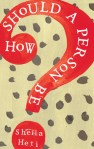 #1 Another book with a question in the title (and dominating the cover) is How Should a Person Be? by Sheila Heti. I found a hardback copy in the unofficial Little Free Library I ran in our neighborhood during the first lockdown before the public library reopened. Heti is a divisive author, but I loved Motherhood for perfectly encapsulating my situation. I think this one, too, is autofiction, and the title question is one I ask myself variations on frequently.
 #2 I’ve read quite a few “How to” books, whether straightforward explanatory/self-help texts or not. Lots happened to be from the School of Life series. One I found particularly enjoyable and helpful was How to Age by Anne Karpf. She writes frankly about bodily degeneration, the pursuit of wisdom, and preparation for death. “Growth and psychological development aren’t a property of our earliest years but can continue throughout the life cycle.”
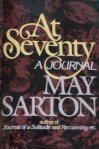 #3 Ageing is a major element in May Sarton’s journals, particularly as she moves from her seventies into her eighties and fights illnesses. I’ve read all but one of her autobiographical works now, and – while my favorite is Journal of a Solitude – the one I’ve chosen as most representative of her usual themes, including inspiration, camaraderie, the pressures of the writing life, and old age, is At Seventy.
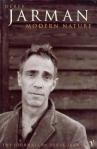 #4 Sarton was a keen gardener, as was Derek Jarman. I learned about him in the context of nature helping people come to terms with their mortality. Modern Nature reproduces the journal the gay, HIV-positive filmmaker kept in 1989–90. Prospect Cottage in Dungeness, Kent, and the unusual garden he cultivated there, was his refuge between trips to London and further afield, and a mental sanctuary when he was marooned in the hospital.
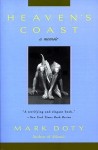 #5 One of the first memoirs I ever read and loved was Heaven’s Coast by Mark Doty, about his partner Wally’s death from AIDS. This sparked my continuing interest in illness and bereavement narratives, and it was through following up Doty’s memoirs with his collections of poems that I first got into contemporary poetry, so he’s had a major influence on my taste. I’ve had Heaven’s Coast on my rereading shelf for ages, so really must get to it in 2021.
 #6 Thinking of heaven, a nice loop back to Blume’s Margaret and her determination to find God … one of the finest travel books I’ve read is This Cold Heaven, about Gretel Ehrlich’s expeditions to Greenland and historical precursors who explored it. Even more than her intrepid wanderings, I was impressed by her prose, which made the icy scenery new every time. “Part jewel, part eye, part lighthouse, part recumbent monolith, the ice is a bright spot on the upper tier of the globe where the world’s purse strings have been pulled tight.”
A fitting final selection for this week’s properly chilly winter temperatures, too. I’ll be writing up my first snowy and/or holiday-themed reads of the year in a couple of weeks.
Join us for #6Degrees of Separation if you haven’t already! (Hosted on the first Saturday of each month by Kate W. of Books Are My Favourite and Best.)
Have you read any of my selections? Are you tempted by any you didn’t know before?
Thinking about the Future with David Farrier & Roman Krznaric (Hay Festival)
My last of three digital Hay Festival* talks this year was by Roman Krznaric, a School of Life philosopher with a background in politics and gardening. I discovered him through Greenbelt Festival eight years ago and have since enjoyed several of his books on the topics of empathy, finding purposeful work, and models for living well. His talk on his upcoming book, The Good Ancestor: How to Think Long Term in a Short Term World, was an ideal follow-up to one of the top three 2020 nonfiction works I’ve read so far:
Footprints: In Search of Future Fossils by David Farrier
Look on my Works, ye Mighty, and despair!
Nothing beside remains. Round the decay
Of that colossal Wreck, boundless and bare
The lone and level sands stretch far away.
~from “Ozymandias” by Percy Bysshe Shelley
In May 2013 a set of fossil human footprints was found at Happisburgh in Norfolk. At 850,000 years old, they were the oldest outside of Africa. In the same month, atmospheric CO2 passed 400 ppm for the first time. It’s via such juxtapositions of past and future, and longevity versus precariousness, that Farrier’s book – a sophisticated lattice of human and planetary history, environmental realism and literary echoes – tells the story of the human impact on the Earth.
Unusually, Farrier is not a historian or a climate scientist, but a senior lecturer in English literature at the University of Edinburgh specializing in nature and place writing, especially in relation to the Anthropocene. That humanities focus allowed him to craft a truly unique, interdisciplinary work in which the canon both foreshadows and responds to environmental collapse. On a sabbatical in Australia, he also gets to hold an ice core taken by an icebreaker, swim above coral reefs and visit a uranium mine exempted from protection in a national park.
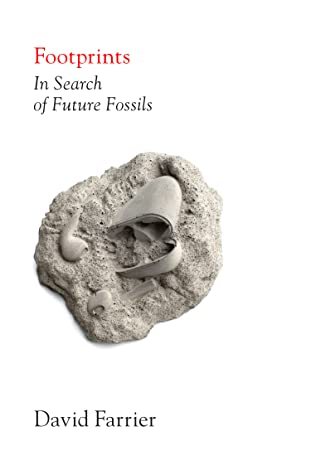 He travels not just through space, but also through time, tracing a plastic bottle from algal bloom to oil to factory to river/landfill to ocean; he thinks about how cultural memory can preserve vanished landscapes; he imagines propitiatory rites arising around radioactive waste to explain poisoned lakes and zinc-lined coffins; and he wonders how to issue appropriate warnings to the future when we don’t even know if English, or language in general, will persist (a nuclear waste storage site in Carlsbad uses a combination of multilingual signs, symbols, monoliths and planned oral tradition, while one in Finland is unmarked).
Each chapter is an intricate blend of fact, experience and story. For example, “The Insatiable Road” is about cars and the concrete landscapes they zip through – all made possible by oil. Farrier wins a chance to be among the first to cross the new Forth Bridge on foot and finds himself awed by the human achievement. Yet he knows that, in a car, the bridge will be crossed in seconds and soon taken for granted. Whether as a driver or a passenger, we have become detached from the journey and from the places we are travelling through. The road trip, a standard element of twentieth-century art and literature, has lost its lustre. “Really, we have conceded so much,” he writes. “Most of us live and wander only where road networks permit us to, creeping along their edges and lulled into deafness by their constant roar.” Ben Okri’s legend provides the metaphor of a famished road that swallows all in its path.
What will the human species leave behind? “The entire atmosphere now bears the marks of our passage … Perhaps no one will be around to read our traces, but nonetheless we are, everywhere, constantly, and with the most astonishing profligacy, leaving a legacy that will endure for hundreds of thousands or even hundreds of millions of years to come.” That legacy includes the concrete foundations of massive road networks, the remnants of megacities on coastal plains, plastics that will endure for many centuries, carbon and methane locked up in permafrost, the 2300-km fossil of the dead Great Barrier Reef, nuclear waste in isolation plants, jellyfish-dominated oceans and decimated microbial life.
Thinking long term doesn’t come naturally. In the same way that multiple books of 2019 (Time Song, Surfacing, Underland) helped us think about the place of humanity in reference to deep time, Footprints offers an invaluable window onto the deep future. Its dichotomies of hubris and atonement, and culpability versus indifference, are essential to ponder. It was always going to be sobering to read about how we have damaged our only home, but I never found this to be a needlessly depressing book; it is clear-eyed and forthright, but also meditative and beautifully constructed. Life on the planet continues in spite of our alterations, but all the diminishment was unavoidable, and perhaps some of it is remediable still.
My rating: 
 Related reading: Notes from an Apocalypse by Mark O’Connell. I’m only up to page 36 and at the moment it’s just him watching loads of crackpot preppers’ videos on YouTube, but already I think that Footprints should have had this book’s spot on the Wainwright Prize for Writing on Global Conservation longlist (a new prize run in addition to the standard UK nature writing one) for being more directly engaged with conservation issues rather than just humorously commenting on the end-of-the-world mindset.
Roman Krznaric at Hay Festival
 Krznaric’s discussion of being a “good ancestor” resonated in connection with the long-term thinking of Farrier’s book. “This is the age of the tyranny of the now,” he began, but “humankind has colonized the future” as well, treating it as a tempus nullius where we can dump our ecological waste and tech failures. Yet long-termism is needed more than ever as a way of planning for environmental challenges (and pandemics and the like). Future generations have no say in the decisions we make now that will affect them. To put this in perspective, he showed an image of three spheres, proportionally sized: one represented the 100 billion dead, one was the 7.7 billion currently living, and one was the 6.75 trillion in unborn generations (if the current birth rate continues).
It was Jonas Salk, creator of the polio vaccine, who asked, “Are we being good ancestors?” Krznaric invited the audience to come up with examples (in the chat window on the sidebar) of long-term projects through which people are trying to help future generations, such as the Svalbard Seed Depository, the Green New Deal, the 10,000-Year Clock (inside a mountain in the Texas desert), the Long Play piece of music to last 1,000 years, rewilding, archives and libraries, and tree planting. He had also opened the talk with his own modest contribution: he and his partner ‘gave’ their 11-year-old twins their votes in the latest election.
Krznaric elaborated on four of his book’s six ways of thinking about the future: 1) Rethink human nature by using the “acorn brain” (long-term thinking) rather than the “marshmallow brain” (instant gratification). 2) Embark on projects with long time horizons (“cathedral thinking”). 3) Think in terms of legacies, whether familial or transcendent – leaving a gift to the citizens of the future (e.g. The Future Library of 100 books not published or read until 2114). 4) Create a politics for the future, e.g. the citizen assembly movement.
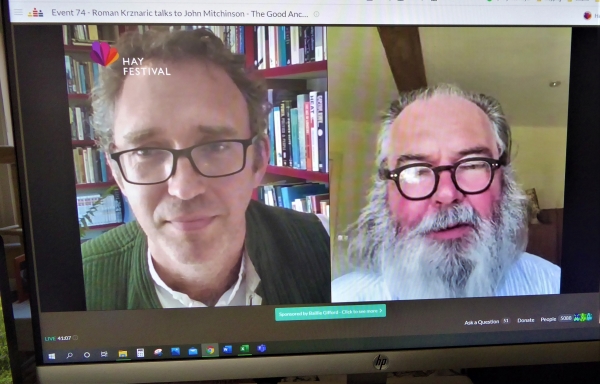
Roman Krznaric at the digital Hay Festival. Q&A led by John Mitchinson (right).
In the case of the UK, Krznaric advocates abolishing the House of Lords, replacing it with a citizens’ assembly and a Minister for the Future, and establishing legal rights for future generations. He noted that globally we’re at a “devil’s fork” where there’s a danger of authoritarian regulations continuing around the world after quarantine ends, endangering the future of social democracy. Instead, we need grassroots activism and “doughnut economics.” He pictures devolution of power away from central governments, with progressive cities becoming new loci of power. Individual actions like vowing not to fly and installing solar panels can inspire peers, but only collective action can tackle environmental breakdown.
 Related reading: I’ll be reviewing Eric Holthaus’s forthcoming book The Future Earth: A Radical Vision for What’s Possible in the Age of Warming for BookBrowse later this month. The meteorologist and science journalist fleshes out some of Krznaric’s ideas, such as a citizen assembly and the cyclical economy, in his proposal for the drastic changes needed over the next three decades.
*You can access the recorded Hay Festival talks by paying a £10 annual subscription here.
Have you read anything about the deep future?
New Reading Projects! (Join Me?)
It’s only one week since we announced the Not the Wellcome Prize winner, the culmination of a month-long project that was months more in the planning. I don’t think I’ll be coordinating another blog tour anytime soon, as it was a lot of work finding participants, working out a schedule and keeping on top of the publicizing via social media. Still, it was a lot of fun, and already I’m missing the buzz and ready to get stuck into more projects.
I’d love it if you joined me for one or more of these. Some could be combined with your 20 Books of Summer or other challenges, too.
Ongoing buddy reads
 It would have been Richard Adams’s 100th birthday on the 9th. That night I started rereading his classic tale of rabbits in peril, Watership Down, which was my favorite book from childhood even though I only read it the once at age nine. I’m 80 pages in and enjoying all the local place names. Who would ever have predicted that that mousy tomboy from Silver Spring, Maryland would one day live just 6.5 miles from the real Watership Down?!
 My husband is joining me for the Watership Down read (he’s not sure he ever read it before), and we’re also doing a buddy read of Arctic Dreams by Barry Lopez. In that case, we ended up with two free copies, one from the bookshop where I volunteer and the other from The Book Thing of Baltimore, so we each have a copy on the go. Lopez’s style, like Peter Matthiessen’s, lends itself to slower, reflective reading, so I’m only two chapters in. It’s novel to journey to the Arctic, especially as we approach the summer.
I plan to take my time over these two, so tell me if you have a copy of either and feel like picking it up at any point over the next few months.
Bibliotherapy self-prescriptions
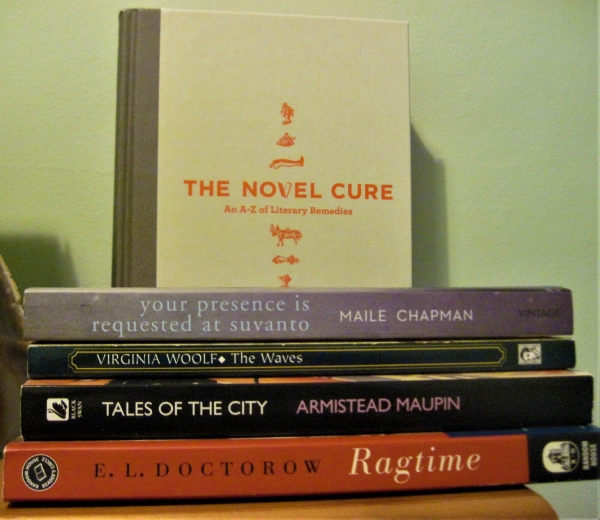
The other day I got out my copy of The Novel Cure by School of Life bibliotherapists Ella Berthoud and Susan Elderkin and browsed through the categories for some prescriptions that might feel relevant to the current situation. I found four books I own that fit the bill:
From the list of “The Ten Best Novels to Lower Your Blood Pressure”: Your Presence Is Requested at Suvanto by Maile Chapman & The Waves by Virginia Woolf (and I’ve read another three of them, including, recently, Crossing to Safety).
One of several prescriptions for Loneliness: Tales of the City by Armistead Maupin.
The cure for Zestlessness: Ragtime by E. L. Doctorow.
If you have access to one of these, or have a copy of The Novel Cure and are keen on following up on another of the prescriptions, let me know.
And now for two memes that I (think I) have created. Although I’m sure something similar has been done in the past, I couldn’t find any specific blogs about them. I don’t know about you, but I always need encouragement to pick up books from my own shelves – even though libraries are currently closed, I’m still working my way through a library stack, and I’m tempted to make another order of new books from Hungerford Bookshop. It’s great to support libraries and independent bookstores, of course, but there could be no better time to mine your own bookshelves for treasures you bought ages ago but still have never read.
Journey through the Day with Books
I enjoyed picking out 18 books from my shelves that refer to particular times of day or meals or activities associated therewith. Four of these are books I’ve already read and four are ones I’m currently reading. You can piggyback on my selections if you wish, or find your own set.
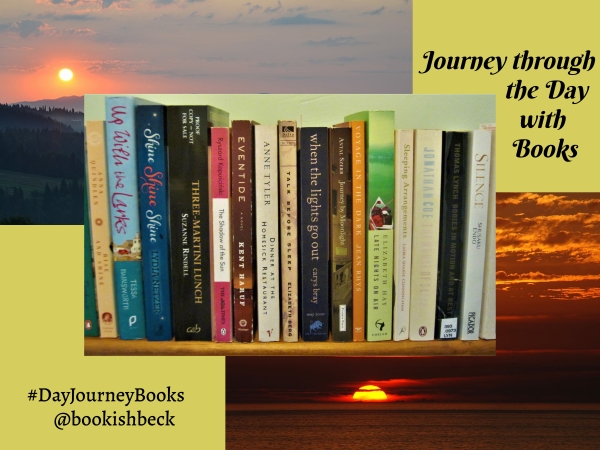
Here’s my full list:
Zennor in Darkness by Helen Dunmore
Rise and Shine by Anna Quindlen
Up with the Larks by Tessa Hainsworth
Shine Shine Shine by Lydia Netzer
Three-Martini Lunch by Suzanne Rindell
The Shadow of the Sun by Ryszard Kapuściński
Eventide by Kent Haruf
Dinner at the Homesick Restaurant by Anne Tyler
Talk before Sleep by Elizabeth Berg
When the Lights Go Out by Carys Bray
Journey by Moonlight by Antal Szerb
Voyage in the Dark by Jean Rhys
Late Nights on Air by Elizabeth Hay
Sleeping Arrangements by Laura Shaine Cunningham
The House of Sleep by Jonathan Coe
Bodies in Motion and at Rest by Thomas Lynch
Silence by Shūsaku Endō
Arctic Dreams by Barry Lopez
The Four in a Row Challenge
I’ve been contemplating this one for quite a while. It’s inspired by Phyllis Rose’s The Shelf –from LEQ to LES: Adventures in Extreme Reading (one of Simon’s favourite books – see his review), for which she picked a shelf of the New York Society Library, eliminated duplicates and repeat entries from the same author, and read the remainder – whether she’d heard of them or not; whether they were awful or not. (“Hands down the worst book on the shelf is Le Queux’s Three Knots, a mystery that reads as if it were written by an eight-year-old on Percocet.”)

This is a variation in that you’re looking at your own TBR shelves and picking a set of four books in a row. For many, that will be four novels whose authors’ surnames all start with the same letter. But if you organize your books differently (especially within nonfiction), you may find that the set of four is more arbitrary. You never know what they might have in common, though (book serendipity!).
I’m no strict challenge host, so if you want to engineer your shelf order, or if you decide to swap a book in later on, that is no problem at all. My one firm rule is only one book per author.
I’ve picked out a few appealing sets, all from my fiction shelves. F, G, L and M had particularly rich pickings. I’ll report back as I finish each set, while the “Journey through a Day” may well take me the whole rest of the year.
Still ongoing (more here): Projects to read as many Bellwether Prize, Wellcome Book Prize and Women’s Prize winners as possible, as well as Wellcome long- and shortlistees.
Can I tempt you to take part in any of these reading projects?
[Journey through the Day: Sunrise in Pieniny, Poland (Pudelek / CC BY-SA (https://creativecommons.org/licenses/by-sa/4.0)) / Sunset (Alvesgaspar / CC BY-SA (https://creativecommons.org/licenses/by-sa/3.0))
Four in a Row: Four pelicans in a row (Sheba_Also 43,000 photos / CC BY-SA (https://creativecommons.org/licenses/by-sa/2.0)) / Phone boxes, Market Place, Ripon (Tim Green from Bradford / CC BY (https://creativecommons.org/licenses/by/2.0))]
The Art of Mindful Reading by Ella Berthoud
Ella Berthoud is one of the bibliotherapists at the School of Life in London and co-author of The Novel Cure. (I wrote about my bibliotherapy session with her in this post.) For her contribution to a Leaping Hare Press series on mindfulness – whose titles range from The Mindful Art of Wild Swimming to Mindfulness and the Journey of Bereavement – she’s thought deeply about how reading can be an active, deliberate practice rather than a time of passive receiving or entertainment. Through handy exercises and quirky tips she encourages readers to take stock of how they read and to become more aware of each word on the page.

To start with, a close reading exercise using a passage from Alice in Wonderland invites you to find out whether you’re an auditory, visual or kinesthetic reader. I learned that I’m a cross between auditory and visual: I hear every word aloud in my head, but I also picture the scenes, usually unfolding in black and white in settings that are familiar to me (my childhood best friend’s home used to be a common backdrop, for instance). The book then discusses ways to incorporate reading into daily life, from breakfast to bedtime and from a favorite chair to the crook of a tree, and how to combine it with other activities. I will certainly be trying out the reading yoga poses!
As I discovered at my bibliotherapy appointment, Ella is passionate about getting people reading in as many different ways as possible. That can include listening to audiobooks, reading aloud with a partner, or reading silently but in company with other people. She also surveys the many ways there are of sharing an enthusiasm for books nowadays, such as Book Crossing, book clubs and Little Free Libraries.

Although she acknowledges the place of e-readers and smartphones, Ella generally describes reading as a tactile experience, and insists on the importance of keeping a print reading journal as well as a ‘Golden Treasury’ of favorite passages, two strategies that will combat the tendency to forget a book as soon as you’ve finished it.
Some of her suggestions of what to do with physical books are beyond the pale for me – such as using a knife to slice a daunting doorstopper into more manageable chunks, or beating up a much-hyped book to “rob [it] of its glamour and gloss, and bring it down from its pedestal to a more humble state, a place where you can read it in comfort” – but there are ideas here to suit every kind of reader. Take a quick break between novels and use this book to think about how you read and in what ways you could improve or intensify the experience.
Favorite passages:
“As a bibliotherapist, I believe that every novel you read shapes the person that you are, speaking to you on a deep, unconscious level, and altering your very nature with the ideas that it shows you.”
“I often find that people imagine reading fiction is a self-indulgent thing to do, and that they ought to be doing something else. Much research has been conducted into the benefits of reading fiction, which deepens your empathy and emotional intelligence, helps with making important life decisions and allows your brain to rest. Research has shown that reading provides as much relaxation as meditation”
My rating: 
With thanks to Leaping Hare Press for the free copy for review.
Following Up on the Prescriptions from My Bibliotherapy Appointment
In January 2018 I had the wonderful opportunity to have a free bibliotherapy session at the School of Life in London with Ella Berthoud, one of the authors of The Novel Cure. I wrote about the experience in this post. I quickly got hold of all but a couple of my prescribed reads, but have been slower about actually reading them. Though I’ve read five now, I’ve only written up four, two of which I only managed to finish this week. (These 250-word reviews are in order of my reading.)
Heligoland by Shena Mackay (2002)
(CURE: moving house)
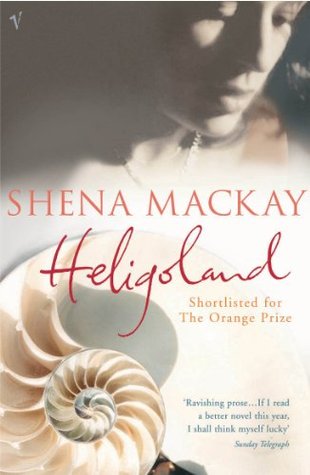 Heligoland is a Scottish island best known from the shipping forecast, but here it’s an almost mythical home. Rowena Snow was orphaned by her Indian/Scottish parents, and a second time by her aunt. Since then she’s drifted between caring and cleaning jobs. The Nautilus represents a fresh chance at life. This shell-shaped artists’ commune in South London houses just three survivors: Celeste Zylberstein, who designed the place; poet Francis Campion; and antiques dealer Gus Crabb. Rowena will be the housekeeper/cook, but she struggles with self-esteem: does she deserve to live in a haven for upper-class creative types?
The omniscient perspective moves between the Nautilus residents but also on to lots of other minor hangers-on, whose stories are hard to keep track of. Mackay’s writing reminded me somewhat of Tessa Hadley’s and is lovely in places – especially when describing a buffet or a moment of light-filled epiphany in a garden. There’s not much to be said beyond what’s in the blurb: Mackay is attempting to give a picture of a drifter who finds an unconventional home; in the barest sense she does succeed, but I never felt a connection with any of the characters. In this ensemble cast there is no one to love and thus no one to root for. While I didn’t love this book, it did inspire me to pick up others by Mackay: since then I’ve read The Orchard on Fire, which I liked a lot more, and the first half of Dunedin.
My rating: 
Family Matters by Rohinton Mistry (2002)
(CURE: worry over ageing parents)
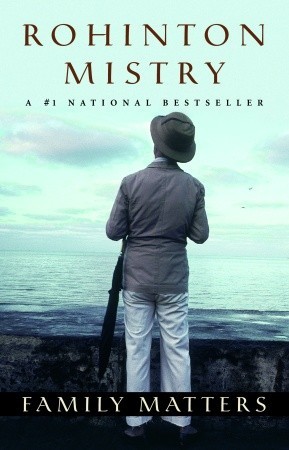 Retired professor Nariman Vakeel, 79, has Parkinson’s disease and within the first few chapters has also fallen and broken his ankle. His grown stepchildren, Coomy and Jal, reluctant to care for him anyway, decide they can’t cope with the daily reality of bedpans, sponge baths and spoon feeding in their large Chateau Felicity apartment. He’ll simply have to recuperate at Pleasant Villa with his daughter Roxana and her husband and sons, even though their two-bedroom apartment is barely large enough for the family of four. You have to wince at the irony of the names for these two Bombay housing blocks, and at the bitter contrast between selfishness and duty.
Perhaps inevitably, Nariman starts to fade into the background. An increasingly speechless invalid, he only comes alive through his past: italicized sections, presented as his night-time ravings, tell of his love for Lucy, whom his parents refused to let him marry, and the untimely end of his arranged marriage. I enjoyed time spent in a vibrantly realized Indian city and appreciated a chance to learn about a lesser-known community: Nariman and family are Parsis (or Zoroastrians). There’s also a faint echo here of King Lear, with one faithful daughter set against two wicked children.
As to ageing parents, this is a pretty relentlessly bleak picture, but there are sparks of light: joy in life’s little celebrations, and unexpected kindnesses. Mistry’s epic has plenty of tender moments that bring it down to an intimate scale. I’m keen to read his other novels.
My rating: 
Maggie & Me by Damian Barr (2013)
(A supplementary prescription because I love memoirs and didn’t experience Thatcher’s Britain.)
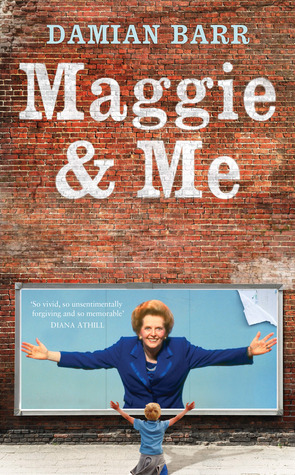 Like a cross between Angela’s Ashes and Toast, this recreates a fairly horrific upbringing from the child’s perspective. Barr was an intelligent, creative young man who early on knew that he was gay and, not just for that reason, often felt that there was no place for him: neither in working-class Scotland, where his father was a steelworker and his brain-damaged mother flitted from one violent boyfriend to another; nor in Maggie Thatcher’s 1980s Britain at large, in which money was the reward for achievement and the individual was responsible for his own moral standing and worldly advancement. “I don’t need to stand out any more,” he recalls, being “six foot tall, scarecrow skinny and speccy with join-the-dots spots, bottle-opener buck teeth and a thing for waistcoats. Plus I get free school dinners and I’m gay.”
There are a lot of vivid scenes in this memoir, some of them distressing ones of abuse, and the present tense, dialect, and childish grammar and slang give it authenticity. However, I never quite bought in to the Thatcher connection as an overarching structure. Three pages at the start, five at the end, and a Thatcher quote as an epigraph for each chapter somehow weren’t enough to convince me that the framing device was necessary or apt. Still, I enjoyed this well enough as memoirs go, and I would certainly recommend it if you loved Nigel Slater’s memoir mentioned above. I also have Barr’s recent debut novel, You Will Be Safe Here, on my Kindle.
My rating: 
The Monsters of Templeton by Lauren Groff (2008)
(A supplementary prescription for uncertainty about having children.)
 I enjoyed this immensely, from the first line on: “The day I returned to Templeton steeped in disgrace, the fifty-foot corpse of a monster surfaced in Lake Glimmerglass.” Twenty-eight-year-old Willie Upton is back in her hometown, pregnant by her older, married archaeology professor after a summer of PhD fieldwork in Alaska. “I had come home to be a child again. I was sick, heartbroken, worn down.” She gives herself a few weeks back home to dig through her family history to find her father – whom Vi has never identified – and decide whether she’s ready to be a mother herself.
We hear from various leading lights in the town’s history and/or Willie’s family tree through a convincing series of first-person narratives, letters and other documents. Groff gives voice to everyone from a Mohican chief to a slave girl who catches her master’s eye. Willie and Vi are backed up by a wonderful set of secondary characters, past and present. Groff wrote this in homage to Cooperstown, New York, where she grew up. (If you’ve heard of it, it’s probably for the baseball museum; it’s not far from where my mother is from in upstate New York.) Templeton is “a slantwise version” of Cooperstown, Groff admits in an opening Author’s Note, and she owes something of a debt to its most famous citizen, James Fenimore Cooper. What a charming way to celebrate where you come from, with all its magic and mundanity. This terrific debut novel cemented my love of Groff’s work.
My rating:
I also have Ella to thank for the inspiration to reread a childhood favorite, Little Women by Louisa May Alcott, last year; the experiment formed the subject of my first piece for Literary Hub. I also worked my way through The Artist’s Way by Julia Cameron, another of my prescriptions, over a number of months in 2018, but failed to keep up with the regular writing exercises so didn’t get the maximum benefit.
My husband and I made a start on reading a few books aloud to each other, including Sum: Forty Tales from the Afterlives by David Eagleman, but that fell by the wayside after a handful of weeks.
(Incidentally, I had forgotten that Cutting for Stone turns up in The Novel Cure on a list of the 10 best books to combat xenophobia.)
 Still to read: Jitterbug Perfume by Tom Robbins (CURE: horror of ageing)
And one I still have to get hold of but haven’t been able to find cheap secondhand because it’s a Persephone classic: The Victorian Chaise-Longue by Marghanita Laski (a supplementary prescription because I love Victorian pastiches).
My Bibliotherapy Appointment at the School of Life
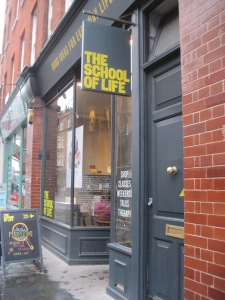 I’ve been interested in bibliotherapy for years, and I love The Novel Cure (see my review), the learned and playful advice book from Ella Berthoud and Susan Elderkin, two of the bibliotherapists at Alain de Botton’s London School of Life. Earlier this month I had the tremendous opportunity to have a personalized bibliotherapy appointment with Ella Berthoud at the School of Life. She’d put out a call on Twitter for volunteers to come for a free session (usually £100) to be observed by a journalist from La Repubblica writing about bibliotherapy – the translation of The Novel Cure has sold remarkably well in Italy. The feature will be part of a special color supplement in February, and I look forward to seeing if my story makes the cut! That is, if I can decipher any of the Italian.
Now, you might not think I’m the kind of person who needs a bibliotherapy assessment since I already find 300+ books per year I want to read; I worried that too, and felt a little bit guilty, but in the end I couldn’t pass up the chance, and Ella was happy to have me.

I took my copy of The Novel Cure along for Ella to sign.
Before my appointment I’d been asked to complete a two-page questionnaire about my reading habits and likes/dislikes, along with what’s going on in my life in general (the ‘therapy’ aspect is real). Once we were set up in the basement therapy room with hot drinks, Ella asked me more about how I read. I’d told her my reading was about two-thirds print books and one-third e-books. Had I ever tried audiobooks or reading aloud, she asked? The answer to both of those is no, I’m afraid. There’s no obvious place for audiobooks in my life because I work from home. However, as I’d mentioned I haven’t been able to get through a Dickens novel in five years, Ella suggested I try listening to one – abridged, it can be more like eight hours long instead of 42, and you still get a terrific story. She also highly recommended New Yorker and Guardian podcasts based around short stories and discussion.
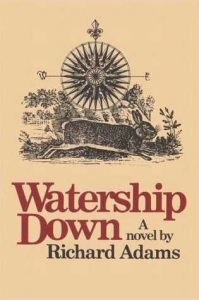 For reading aloud with my husband, Ella prescribed one short story per evening sitting – a way for me to get through short story collections, which I sometimes struggle to finish, and a different way to engage with books. We also talked about the value of rereading childhood favorites such as Watership Down and Little Women, which I haven’t gone back to since I was nine and 12, respectively. In this anniversary year, Little Women would be the ideal book to reread (and the new television adaptation is pretty good too, Ella thinks).
One other reading habit Ella is adamant about is keeping a physical reading journal in which you record the title of each book you read, where you read it, and about a paragraph of thoughts about it. It’s not meant to be a comprehensive response to every book; more like an aide-mémoire that you can get off the shelf in years to come to remind yourself of what you thought about a book. Specifically, Ella thinks writing down the location of your reading (e.g., on a train to Scotland) allows you to put yourself back in the moment. I tend to note where I bought a book, but not necessarily where I read it – for that, I would probably have to cross-reference my annual book list against a calendar. Since 2010 I’ve kept my book lists and responses in computer files, and I also keep full records via Goodreads, but I can see why having a physical journal would be a good back-up as well as a more pleasant representation of my reading. I’ll think about starting one.
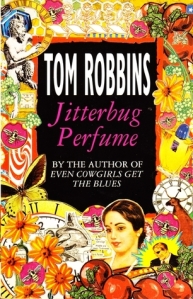 Various books came up over the course of our conversation: Abraham Verghese’s Cutting for Stone [appearance in The Novel Cure: The Ten Best Novels to Cure the Xenophobic, but Ella brought it up because of the medical theme], Tom Robbins’ Jitterbug Perfume [cure: ageing, horror of], and Julia Cameron’s The Artist’s Way, a nonfiction guide to thinking creatively about your life, chiefly through 20-minute automatic writing exercises every morning. We agreed that it’s impossible to dismiss a whole genre, even if I do find myself weary of certain trends, like dystopian fiction (I introduced Ella to Claire Vaye Watkins’ Gold Fame Citrus, one of my favorite recent examples).
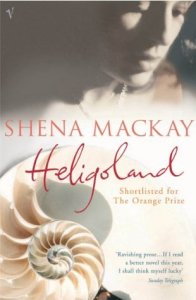 I came away with two instant prescriptions: Heligoland by Shena Mackay [cure: moving house], about a shell-shaped island house that used to be the headquarters of a cult. It’s a perfect short book, Ella tells me, and will help dose my feelings of rootlessness after moving more than 10 times in the last 10 years. She also prescribed Family Matters by Rohinton Mistry [cure: ageing parents] and an eventual reread of Jonathan Franzen’s The Corrections. As we discussed various other issues, such as my uncertainty about having children, Ella said she could think of 20 or more books to recommend me. “That’s a good thing, right?!” I asked.


Before I left, I asked Ella if she would ever prescribe nonfiction. She said they have been known to do so, usually if it’s written in a literary style (e.g. Robert Macfarlane and Alain de Botton). We chatted about medical memoirs and reading with the seasons for a little while, and then I thanked her and headed on my way. I walked around the corner to Skoob Books but, alas, didn’t find any of the books Ella had mentioned during our session. On the way back to the Tube station, though, I stopped at Judd Books and bought several secondhand and remaindered goodies, including these two:


(Imagine my surprise when I spotted The Year of the Hare in The Novel Cure under midlife crisis! Age seemed to be the theme of the day.)
 As soon as I got back from London I ordered secondhand copies of Heligoland, Jitterbug Perfume and The Artist’s Way, and borrowed Family Matters from the public library the next day. Within a few days four further book prescriptions arrived for me by e-mail. Ella did say that her job is made harder when her clients read a lot, so kudos to her for prescribing books I’d not read – with the one exception of Sebastian Barry’s Days Without End, which I love.
I’ve put in another order for Maggie and Me, the memoir by Damian Barr, plus (for reading aloud) Sum: Forty Tales from the Afterlives by David Eagleman and the collected short stories of Saki. I’m also keen to find The Victorian Chaise-Longue by Marghanita Laski, Ella’s final prescription, but as the Persephone Books reprint is pricey at the moment I may hold off and hope to chance upon a secondhand copy later in the year. Ella has been very generous with her recommendations, especially considering that I didn’t pay a penny. I certainly have plenty to be getting on with for now! I’ll report back later on in the year when I’ve had the chance to read some of these prescriptions.

The prescribed books I have gotten hold of so far.
All the Lonely People*
Last week I finished two books, one fiction and one nonfiction, that had loneliness as a central theme – although their treatment of the subject was vastly different.
First was Quartet in Autumn by Barbara Pym, which was recommended to me by various bloggers and certainly lived up to their praise. Originally published in 1977, this was Pym’s seventh novel out of nine; she died in 1980. It’s about four London office workers, all sixty-somethings who are partnerless and don’t have, or at least don’t live with, any immediate family members. We never learn what they do in this office; in fact, Edwin, Norman, Letty and Marcia don’t seem to be filling much of a need, especially given the fact that the two old girls aren’t replaced when they retire midway through the novel.
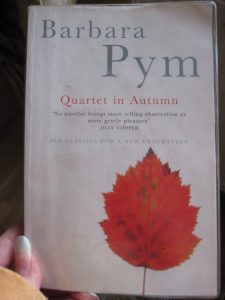 For as long as they’ve been working together, the four haven’t given in to the usual human impulse to know and be known. At first there doesn’t seem to be much to know about them; with only one or two shorthand facts apiece it’s a minor challenge to tell them apart. Widower Edwin’s hobby is attending Anglican services; Norman lives off fried food and visits his brother-in-law in hospital; Letty lives in a boarding house and has a friend in the countryside; Marcia has had a mastectomy and hoards tinned food and empty milk bottles.
But for all of them a line applied to Letty holds true: “It was a comfortable enough life, if a little sterile, perhaps even deprived.” Especially after her retirement, Letty knows “she must never give the slightest hint of loneliness or boredom, the sense of time hanging heavy.”
From what I’d heard about Pym, I might have expected a lighthearted satire about country manners and Anglican vicars. Perhaps that’s a fair assessment of some of her earlier books? But this is much darker, and the humor always has a bitter edge:
- When Marcia finds a plastic bag labeled “To avoid danger of suffocation keep this wrapper away from babies and children,” the narrator adds, “They could have said from middle-aged and elderly persons too, who might well have an irresistible urge to suffocate themselves.”
- Offered the option of moving into a care home, Letty thinks “better to lie down in the wood under the beech leaves and bracken and wait quietly for death.”
Overall it’s quite a melancholy little book, a warning against letting your life become too small and private. Yet the last line, remarkably, is a sudden injection of optimism: “it made one realize that life still held infinite possibilities for change.” I’d recommend this to readers who have enjoyed Mrs. Palfrey at the Claremont by Elizabeth Taylor. 
As an unwittingly positive counterpart, I was at the same time reading How to Be Alone by Sara Maitland. This is part of a School of Life series that turns the “how-to” concept on its head: instead of areas where we think we need instruction, the books are about areas where we feel like experts, topics so simple or automatic they don’t seem to need explanation (e.g. How to Be Bored, or How to Age).

I feel it’s important to point out that the author’s last name is spelled wrong on the cover!
But Maitland argues that although being alone is easy to achieve, there is an art to doing it properly, and solitude and loneliness are by no means the same thing. She knows whereof she speaks: though she grew up in a large Catholic family, after her divorce she moved to a remote area of Scotland and lives alone in a house a quarter mile from the nearest road.
Despite our modern obsession with self-confidence and fulfilling relationships, Maitland believes “the present paradigm is not really working.” More of us than ever are depressed and afraid to spend time alone lest it might make us appear selfish, pathetic or in some way unlovable.
Profiling everyone from the Desert Fathers of early Christianity to the Romantic poets, she counters by enumerating all the benefits that solitude confers: self-knowledge and a rest from constant relating (that goes for extroverts as well as introverts), a connection to nature and to the divine, and the freedom to create. She convinced me, and includes a great bibliography of further reading about solitude.
*I only found out the other week that Eleanor Rigby “picks up the rice” in a church. For my entire life I’d thought she “picks up her ice” (granted, that doesn’t make much sense, but the Beatles could be trippy lads). You learn something new every day!
The Novel Cure—Bibliotherapy in Action
A good book, read at the right moment, should leave you uplifted, inspired, energized and eager for more. With so many books to choose from, what’s the point of reading even one more that leaves you cold?
I’ve mentioned my interest in bibliotherapy before. Well, for anyone new to the concept or interested in finding out more, The Novel Cure by Ella Berthoud and Susan Elderkin, two of the bibliotherapists at London’s School of Life, is an accessible introduction. Subtitled “An A–Z of Literary Remedies,” this is a learned and at times tongue-in-cheek book of advice about what fiction to read if you’re suffering from any sort of malady – physical, psychological, or imagined.
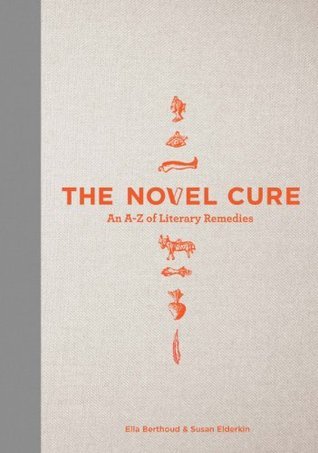 The alphabetical format and “see also” asides make it more like a cross-referenced encyclopedia than a book to read straight through, though I tried it both ways. Initially I flipped through at random, letting one entry take me to another related one and so on, but after a while I went back to the start and caught up on unread entries to finish within a year.
“It helps enormously at times of stress to read about other people who are going through similar things; watching how other people cope or fail to cope will make you feel less alone and give you strength,” the authors write to introduce the “cancer, caring for someone with” entry. I found this to be true when my sister lost her husband to cancer last year. She had never been a reader – apart from celebrity magazines – but in the past year she’s read nearly 90 books, many of them memoirs about illness and bereavement. Books are how I’ve always made sense of the world, so it’s been incredibly gratifying to see her turn to them as well. There are plenty of recommendations I’ll pass on to her from this book, especially “death of a loved one” (After You’d Gone by Maggie O’Farrell and Extremely Loud and Incredibly Close by Jonathan Safran Foer) and “widowed, being” (The Same Sea by Amos Oz and Major Pettigrew’s Last Stand by Helen Simonson).
You’ll be amazed at the range of conditions and circumstances for which the book offers prescriptions. Newly retired? “Bucolic and tranquil, The Enigma of Arrival [by V.S. Naipaul] will encourage you to take stock of your life and enjoy the unfolding of new possibilities.” Workaholic? “Immerse your desiccated soul in something very simple, very rustic, very small. We suggest [Thomas] Hardy’s gentlest, most innocent novel, Under the Greenwood Tree.” Two sections that felt particularly relevant to me as a vertically challenged freelancer were “short, being” and “tax return, fear of doing.” Meanwhile I’ll be pointing my husband to “baldness,” “flying, fear of,” “stress” and “tinnitus” (poor chap). But some of these entries surely resulted from the authors thinking “hey, here’s a great book we have to mention,” and then coming up with a category to fit it into, like “determinedly chasing after a woman even when she’s a nun” for In the Skin of a Lion by Michael Ondaatje.
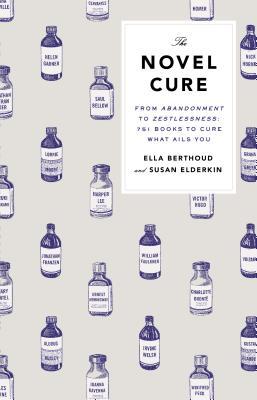
I think I prefer this U.S. cover.
Indeed, there’s a certain levity to this book that I think some reviewers have missed. These aren’t all entirely serious suggestions, though they are all worthwhile books. I especially liked the sections where the authors incorporate pastiche of the book in question. A piece recommending Pamela by Samuel Richardson is in the form of an old-fashioned letter, for example, while “single, being” apes Bridget Jones’s diary entries. They even imitate certain authors’ prose style, as in “Who poses questions without question marks and observes the subtle changes in the light with exquisite brevity.” Answer: J.P. Donleavy, apparently.
The book is also a great source of top ten lists (I’m working through their novels for thirty-somethings) and advice for how to deal with reading crises (e.g. “busy to read, being too” and “giving up halfway through, tendency to”). My only criticism of the book – and this is one I level against many examples from the ‘books about books’ genre – is that there’s a fair bit of plot summary, sometimes so much so that it puts me off reading a book rather than whets my appetite for it.
It’s a bit belated (or early) for suggesting this as a Christmas gift for a book lover, but perhaps you can hand it over as a birthday gift or an anytime present – even to yourself. I got my copy on Amazon for £4, quite a bargain for a book I’ll be returning to again and again over the years.
My rating: 
Do you agree that novels have the power to cure, or at least help with, problems?
 Bookish Beck = Rebecca Foster. American transplant to England. Freelance proofreader and book reviewer.
 Bookish Beck


.jpg)
.jpg)