Book Serendipity, Mid-December 2024 to Mid-February 2025
I call it “Book Serendipity” when two or more books that I read at the same time or in quick succession have something in common – the more bizarre, the better. This is a regular feature of mine every couple of months. Because I usually have 20–30 books on the go at once, I suppose I’m more prone to such incidents. People frequently ask how I remember all of these coincidences. The answer is: I jot them down on scraps of paper or input them immediately into a file on my PC desktop; otherwise, they would flit away!
The following are in roughly chronological order.
- The angel Ariel appears in Through a Glass Darkly by Jostein Gaarder and Constructing a Witch by Helen Ivory.
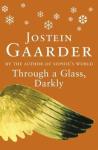
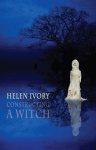
- The protagonist’s surname is English in Wild Houses by Colin Barrett and The Cannibal Owl by Aaron Gwyn.
- I read scenes of grief over a tree being cut down / falling next to one’s house in Dispersals by Jessica J. Lee and Small Rain by Garth Greenwell, one right after the other.
- A mother who does kundalini yoga in All Fours by Miranda July and Unattached by Reannon Muth.
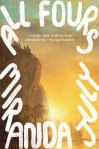
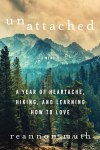
- The idea that happiness (unlike anxiety and sorrow) leaves no trace in writing or in life appeared for me on the same day in Memorial Days by Geraldine Brooks and Small Rain by Garth Greenwell.
- Someone considers suicide by falling but realizes that at the current height they would injure themself but not die in Wild Houses by Colin Barrett, The Snow Queen by Michael Cunningham, and The Courage Consort by Michel Faber.
- The homosexual “bear” stereotype appears in The Snow Queen by Michael Cunningham and Small Rain by Garth Greenwell.
- A William Blake epigraph in Open, Heaven by Seán Hewitt and one of the poems included in Poetry Unbound by Pádraig Ó Tuama.
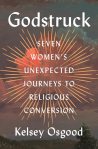
- A group biography including nine pen portraits (plus the author): Nine Minds by Daniel Tammet, followed in quick succession by Uneven by Sam Mills. (Similar, but with just seven subjects, is a book I’m currently reading about women’s religious conversions, Godstruck by Kelsey Osgood.)
- A book–life serendipity moment: in All Fours by Miranda July there is mention of an elderly cat named Alfie who needs to be given medication several times a day. Snap!
- By chance, I started reading Myself and Other Animals, a posthumous collection of short autobiographical pieces by Gerald Durrell, on his centenary (7 January 2025).
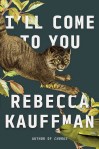
- Guilt over destroying a bird’s nest in The Book of George by Kate Greathead and I’ll Come to You by Rebecca Kauffman.
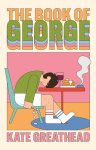
- The main female character has a birthmark in The Book of George by Kate Greathead and The Blindfold by Siri Hustvedt.
- Reading two novels at the same time that open with a new family having to be found for a little boy because his mentally ill mother is presumed to have died by suicide: Unexpected Lessons in Love by Bernardine Bishop and Going Home by Tom Lamont.
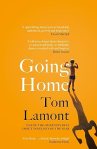 The protagonist is mistaken for a two-year-old boy’s father in The Book of George by Kate Greathead and Going Home by Tom Lamont.
- The mother is named Ellen in The Book of George by Kate Greathead and I’ll Come to You by Rebecca Kauffman.
- An ailing elderly father named Vic in Going Home by Tom Lamont and The God of the Woods by Liz Moore.
- A mother is sent to a mental hospital after the loss of her young son in Invisible by Paul Auster and The God of the Woods by Liz Moore.
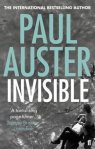
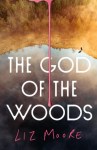
- A brother and sister share a New York City apartment in Invisible by Paul Auster and The Book of George by Kate Greathead.
- A mention of the Japanese artist Hokusai in While the Earth Holds Its Breath by Helen Moat and The Secret Life of Snow by Giles Whittell.
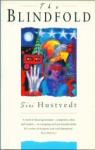 Adults dressing up for Halloween in The Blindfold by Siri Hustvedt and I’ll Come to You by Rebecca Kauffman.
- A second husband named Tim in Unexpected Lessons in Love by Bernardine Bishop and Because We Must by Tracy Youngblom.
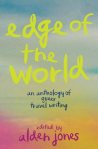
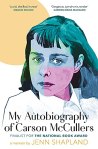
- The idea that ‘queers find each other’ in Edge of the World: An Anthology of Queer Travel Writing edited by Alden Jones and My Autobiography of Carson McCullers by Jenn Shapland.
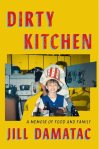
- Experiencing 9/11 as a freshman in college (just like me!) in Dirty Kitchen by Jill Damatac and The Book of George by Kate Greathead. (There is also a 9/11 section in Confessions by Catherine Airey.)
- An intense poker game in I’ll Come to You by Rebecca Kauffman and Going Home by Tom Lamont.
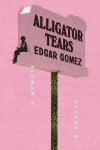 The main character is expelled on false drug possession charges in Invisible by Paul Auster and Alligator Tears by Edgar Gomez.
- Missing the chance to say goodbye before a father’s death, and a parent wondering aloud to their son whether they’ve been a good parent in The Book of George by Kate Greathead and The Remains of the Day by Kazuo Ishiguro.
- Someone departs suddenly, leaving her clothes and books behind, in Invisible by Paul Auster and My Autobiography of Carson McCullers by Jenn Shapland.
- Mentions of DACA (Deferred Action for Childhood Arrivals, an Obama-era U.S. immigration policy) and “Two-Buck Chuck” (a nickname for the Charles Shaw bargain wine sold at Trader Joe’s) in Dirty Kitchen by Jill Damatac and Alligator Tears by Edgar Gomez.
- A City Hall wedding in New York City in Baumgartner by Paul Auster and Dirty Kitchen by Jill Damatac.
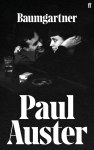
- Polish Jewish heritage and a parent who died of pancreatic cancer in Baumgartner by Paul Auster and The History of Love by Nicole Krauss.
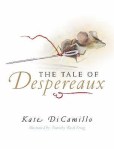
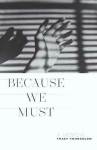
- In Because We Must by Tracy Youngblom, she reads The Tale of Despereaux by Kate DiCamillo aloud to her son while he is recovering in hospital. I was reading Despereaux at the same time! (Also, in real-life serendipity, Youngblom and I both have a sister named Trish.)
- A code of 1–3 knocks is used in Confessions by Catherine Airey and The History of Love by Nicole Krauss.
 A scene of a teacup breaking in Junction of Earth and Sky by Susan Buttenwieser and The Möbius Book by Catherine Lacey.
What’s the weirdest reading coincidence you’ve had lately?
Paul Auster Reading Week: Invisible (#ReadIndies) & Siri Hustvedt’s The Blindfold (#AusterRW25)
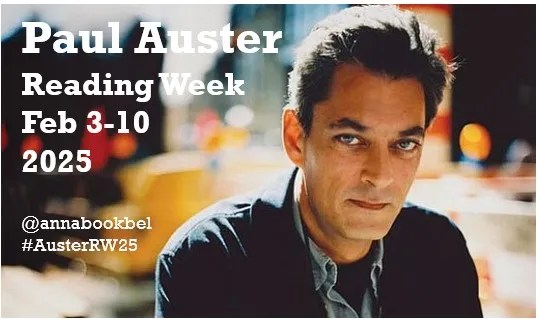
The first time Annabel ran a Paul Auster Reading Week, in 2020, it was a great excuse for me to read six of his books (Winter Journal and The New York Trilogy were amazing; I also really enjoyed Oracle Night). I won’t manage so many this time, but maybe three, as well as one by his widow, Siri Hustvedt. Auster would have been 78 today but died of lung cancer in 2024. As a buddy read, Annabel is inviting people to read his final novel, Baumgartner. I’m partway through that and have another of his novellas waiting in the wings in case I find time.
For now, I’m focusing on a novel that exemplifies some recurring elements of his fiction: a book within a book, fragmented narratives, differing perspectives, cryptic events and the inscrutability of memory and language. I’m pairing it with Hustvedt’s debut novel, which is – not coincidentally, I should think – similarly intricate, weird and unsettling.
Invisible (2009)
To start with, I thought we were in autofiction territory, but Auster swiftly adopts a more typical metafictional approach. Adam Walker is a 20-year-old would-be poet studying at Columbia University in 1967. At a party he meets Rudolf Born, a visiting international affairs professor from Paris, and it seems a good omen: Born invests generously in Adam’s literary magazine and also seems open to sharing his beautiful girlfriend, Margot. But when the men are caught up in an attempted mugging, Adam turns against his idol.
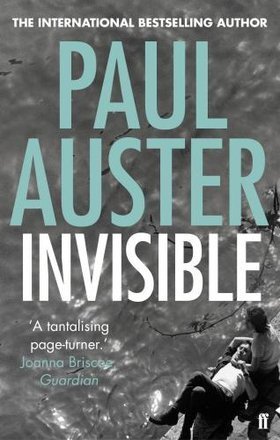 That’s at the heart of Part I (“Spring”). Across four sections, the perspective changes and the narrative is revealed to be 1967, a manuscript Adam began while dying of cancer. “Summer,” in the second person, shines a light on his relationship with his sister, Gwyn. “Fall,” adapted from Adam’s third-person notes by his college friend and fellow author, Jim Freeman, tells of Adam’s study abroad term in Paris. Here he reconnected with Born and Margot with unexpected results. Jim intends to complete the anonymized story with the help of a minor character’s diary, but the challenge is that Adam’s memories don’t match Gwyn’s or Born’s.
I can’t say more about the themes without giving too much away, but this is a provocative novel that makes you question how truth is created or preserved. Who has the right to tell the story, and will justice be done? I wouldn’t say I enjoyed it, but I certainly admired how it was constructed. Auster conjures such a sense of unease, and I always felt like I had no idea what might happen next. With no speech marks, it all flows together in a compulsively readable way. (Secondhand purchase – Awesomebooks.com) 
Faber, Auster’s longtime publisher, counts towards Reading Independent Publishers Month.
The Blindfold by Siri Hustvedt (1992)
“Strange, I thought. Everything is strange.”
I read Hustvedt (The Blazing World) well before I ever tried Auster, and wouldn’t have realized then how similar their books are; they almost seem part of the same body of work. Was Hustvedt a fan or a student of his before they married? I don’t actually know and am loath to dispel the mystery for myself by looking into it. Anyway, there are striking connections between this and Invisible: the narrator is fairly autobiographical and a Columbia University student, the novel is in four loosely connected parts, and the sordid content culminates in a sudden, odd ending. (There’s also the little Easter egg here of “I heard someone shout the name Paul.”) But overall, this is more reminiscent of The New York Trilogy in its surreal randomness and subtly symbolic naming (e.g., the landlord is Mr. Then).
 Iris Vegan (Hustvedt’s mother’s surname), like many an Auster character, is bewildered by what happens to her. An impoverished graduate student in literature, she takes on peculiar jobs. First Mr. Morning hires her to make audio recordings meticulously describing artefacts of a woman he’s obsessed with. Iris comes to believe this woman was murdered and rejects the work as invasive. Next she’s a photographer’s model but hates the resulting portrait and tries to take it off display. Then she’s hospitalized for terrible migraines and has upsetting encounters with a fellow patient, old Mrs. O. Finally, she translates a bizarre German novella and impersonates its protagonist, walking the streets in a shabby suit and even telling people her name is Klaus.
I worked out that the chronological order of the parts is 2 – 4 – 3 – 1, with 1 including a recap of the others. The sections feel like separate vignettes, perhaps reflecting Hustvedt’s previous experience with the short story form, and make a less than satisfying whole. I was most engaged with the segment on working for Mr. Morning and thought that might recur, but it doesn’t. Many of the secondary characters are grotesque, whereas Iris is the intellectual waif trying to make her way in the cruel city, almost like a Dickens or Gissing (anti)hero.
It’s refreshing to get a female take on the Bildungsroman and a little bit of gender-bending with the cross-dressing. (Iris reminds me of Lauren Elkin’s Flaneuse.) The title felt like an enigma to me until close to the end, when it’s revealed to be a tool of sexual sadism. Indeed, each of the sections, in its own way, addresses male exploitation of and violence against women. Disappointingly, Iris remains defined by her relationships with men. She deserves better. Heck, she deserves a sequel! It’s interesting to see where Hustvedt got her start, but I didn’t warm to this as I did to later novels including What I Loved. (Secondhand purchase – Community Furniture Project, Newbury) 
Reading Snapshot for Mid-January
As I said in my last post, I’m in the middle of a bunch of books but hardly finishing anything, so consider this another placeholder until my Love Your Library and January releases posts next week. People often ask how I read so much. One of the answers is that I generally read 20–30 books at once, bouncing between them as the mood takes me and making steady progress in most. A frequent follow-up question is how I keep so many books straight in my head. I maintain a variety of genres and topics in the stack and alternate between fiction, nonfiction and poetry in any reading session. If I’m going to be reviewing something, particularly for pay, I tend to make notes. Here’s a peek at my current stacks, with a line or two on each book and why I’m reading it.

- Myself & Other Animals by Gerald Durrell [public library] – This is a posthumous collection of excerpts from his published work, including newspaper articles, plus mini essays that he wrote towards an autobiography. We own/have read most of his animal-collecting and zoo-keeping memoirs and this is just as delightful, even in unconnected pieces. His conservationist zeal was ahead of his time.
- The God of the Woods by Liz Moore [public library] – It’s rare for me to borrow something from the Crime section, but this came highly lauded by Laila. Set in upstate New York in 1975, it’s a page-turning missing-girl mystery with a literary focus on character backstory, and it’s reminding me of Bright Young Women by Jessica Knoll and When the Stars Go Dark by Paula McLain.
- Gold by Elaine Feinstein [secondhand purchase] – I’ve enjoyed Feinstein’s poetry before so snapped this up on our second trip to Bridport. The first long poem was a monologue from the perspective of a collaborator of Mozart; I think I’ll engage more with the discrete poems to follow.
- Understorey by Anna Chapman Parker [review copy] – Catching up on one I was sent last year. It’s a one-year diary through ‘weeds’ (wild plants!) she observes and sketches near her home of Berwick upon Tweed, where we vacationed in September. I am enjoying reading a few peaceful entries per sitting.
- A God at the Door by Tishani Doshi [secondhand purchase] – Her Girls Are Coming out of the Woods was a favourite of mine a few years ago when I reviewed it for Wasafiri literary magazine. I found this on my last trip to Hay-on-Wye, and it is just as rich in long, forthright, feminist and political poems.
- The Secret Life of Snow by Giles Whittell [secondhand purchase] – I picked up a few snowy titles when we got a dusting the other week, in case it was the only snow of the year. This is so much like The Snow Tourist by Charlie English it’s uncanny; to my memory it’s more meteorological, though still accessible. The science is interspersed with travels and fun trivia about Norway’s Olympic skiers and so on.
- Moon of the Crusted Snow by Waubgeshig Rice [gift] – Probably my first book by an Indigenous Canadian, which was reason enough to read it. I’m about 50 pages in and so far it’s a plodding story of mysterious power outages which could just be part of the onset of winter but I suspect will turn out to be sinister and dystopian instead.
- Knead to Know by Neil Buttery [review copy] – Another 2024 book to catch up on. It’s a history of baking via mini-essays on loads of different breads, cakes, pies and pastries, many of them traditional English ones that you will never have heard of but will now want to cram. Lots of intriguing titbits.
- Invisible by Paul Auster [secondhand purchase] – Getting ready for Annabel’s second Paul Auster Reading Week in early February. A young (and Auster-like) would-be poet gets entangled with a thirtysomething professor who wants to fund a start-up literary magazine – and his French girlfriend. Highly readable and sure to get weirder.
- While the Earth Holds Its Breath by Helen Moat [review copy] – Yet another 2024 book to catch up on. Authors are still jumping on the Wintering bandwagon. This is composed of short autobiographical pieces about winter walks near home or further afield, many of them samey; the trip to Lapland has been a highlight so far.
- The Blindfold by Siri Hustvedt [review copy] – Also part of my preparation for Paul Auster Reading Week, and boy can you see his influence on her first novel! Iris Vegan is employed by Mr. Morning to record audio descriptions of relics left behind by a possibly murdered woman. Odd and enticing.
- Uneven by Sam Mills [review copy] – A group biography of nine bisexuals – make that 10, as there’s plenty of memoir fragments from Mills, too. I’ve read the chapters on Oscar Wilde, Colette & Bessie Smith, and Marlene Dietrich so far. It is particularly enlightening to think of Wilde as bi rather than a closeted homosexual.
- Unexpected Lessons in Love by Bernardine Bishop [secondhand purchase] – Every year I pick up at least a few “love” or “heart” titles in advance of Valentine’s Day. Bishop was one of my top discoveries last year (via The Street) and this Costa Award-nominated posthumous novel is equally engaging, even after just 50 pages.
- My Judy Garland Life by Susie Boyt [secondhand purchase] – After Loved and Missed, I was keen to try more from Boyt and this Ackerley Prize-shortlisted memoir sounded fascinating. I love The Wizard of Oz as much as the next person. Boyt, however, is a Garland mega-fan and blends biography and memoir as she writes about addiction, mental health, celebrity and the search for love.
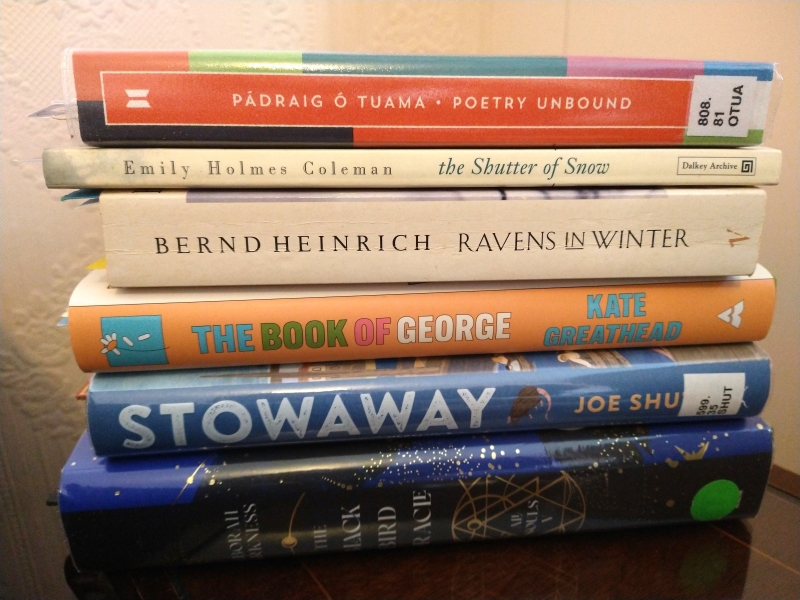
- Poetry Unbound by Pádraig Ó Tuama [public library] – I’m gradually making my way through this set of 50 poems and his critical/personal responses to them. Most of the poets have been unfamiliar to me. Marie Howe has been my top discovery.
- The Shutter of Snow by Emily Holmes Coleman [secondhand purchase] – Another incidental ‘snow’ title; this is autofiction about postpartum psychosis, written in a stream-of-consciousness style with no speech marks or apostrophes. It’s hard to believe it was written in the 1930s because it feels like it could have been yesterday.
- Ravens in Winter by Bernd Heinrich [secondhand purchase] – I’ve long meant to read more by Heinrich, who’s better known in the USA, after Winter World. This was a lucky find at Regent Books in Wantage. It’s a granular scientific study of bird behaviour, so I will likely read it very slowly, maybe even over two winters.
- The Book of George by Kate Greathead [review copy] – Linked short stories about an Everyman schmuck (and my exact contemporary) from adolescence up to today. He’s indecisive, lazy, an underachiever. Life keeps happening around him; will he make something happen? (George, c’est moi?) The deadpan tone is great.
- Stowaway by Joe Shute [public library] – I’ve been reading this off and on since, er, June, which is not to say that it’s not interesting but that it’s never been a priority. Like his book on ravens, it’s intended to rehabilitate the reputation of a species often considered to be a pest. He gets pet rats, too!
- The Black Bird Oracle by Deborah Harkness [public library] – It’s even rarer for me to borrow from the Science Fiction & Fantasy section of the library, but I’ve been following the series since A Discovery of Witches came out in 2011. I’m halfway through and enjoying Diana’s embrace of her witch heritage in the Salem area.
That’s not all, folks! There’s also the e-books.

- Dirty Kitchen by Jill Damatac [Edelweiss] – I’ll be reviewing this May release early for Shelf Awareness. The author’s Filipino family were undocumented immigrants in the USA and as a child she was occasionally abandoned and frequently physically abused. Recipes and legends offer a break from the tough subject matter (reminiscent of Educated or What My Bones Know).
- My Marriage Sabbatical by Leah Fisher [from publicist] – She Writes Press is a reliable source of women’s life writing. I’ve only just started this but will try to review it this month. Fisher, a psychotherapist, was sick of her psychiatrist husband’s workaholism and wanted to try living differently, starting with a house share.
- I’ll Come to You by Rebecca Kauffman [from publicist] – Another American linked short story collection, moving month by month through 1995 (does that count as historical fiction?!), cycling through the members of an extended family as they navigate illnesses and fraught parenting journeys. I’m getting J. Ryan Stradal vibes.
- Constructing a Witch by Helen Ivory [Edelweiss] – This feminist take on the historical persecution and stereotypes of witches is a good match for the Harkness! I just keep forgetting to open it up on my Kindle.
According to Goodreads, I’m reading 28 books at the moment, so I haven’t even covered all of them. (The rest include library books that would more honestly be classified as “set aside.”)
Whew. It somehow seems like even more when I write them all up like this…
Back to the reading!
Six Degrees of Separation: From What I Loved to The Story of an African Farm
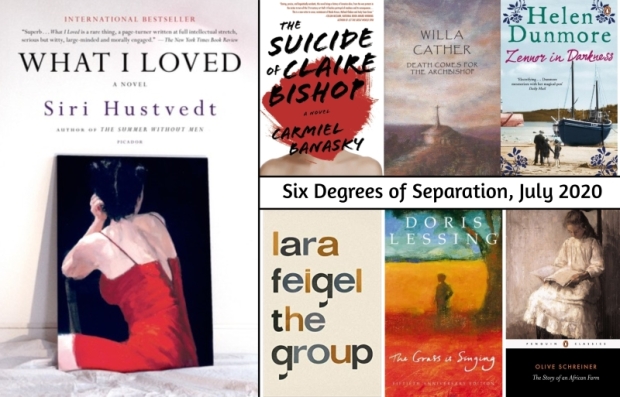
I’m a Six Degrees regular now: this is my sixth month taking part. This time (see Kate’s introductory post) we have all started with Siri Hustvedt’s What I Loved (2003). Narrated by a professor and set between the 1970s and 1990s, it’s about two New York City couples – academics and artists – and the losses they suffer over the years.
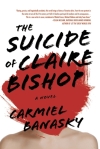 #1 The readalike I chose when I read What I Loved for a Valentine’s Day post in 2017 was The Suicide of Claire Bishop by Carmiel Banasky, which I’d covered for Foreword Reviews in 2015 (see here); it shares the themes of modern art and mental illness.
#2 Death + a “bishop” leads me to Death Comes for the Archbishop (1927), which vies with My Ántonia for the top spot from the six novels I’ve read so far by Willa Cather. It’s set in Santa Fe, New Mexico in the nineteenth century. I read it shortly after my trip to Santa Fe for the D.H. Lawrence Society of North America conference in the summer of 2005.
#3 Although I don’t think I’ve read a Lawrence novel in the past 15 years, I still enjoy reading about him, e.g. in Frieda by Annabel Abbs. My next biographical novel that includes DHL and his wife as characters will be Zennor in Darkness by Helen Dunmore (1994).
#4 Although it’s mostly set in London among university friends now in their late thirties or early forties, a few late scenes of The Group by Lara Feigel (brand new; I’ll be reviewing it in full later this month) are set in Zennor, Cornwall.

#5 The other book I’ve read by Lara Feigel is Free Woman, her bibliomemoir about marriage, motherhood and the works of Doris Lessing. My favorite of the six books I’ve read so far by Lessing is The Grass Is Singing (1950), set on a farm in Zimbabwe.
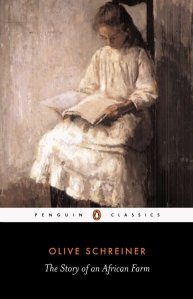 #6 The Story of an African Farm by Olive Schreiner (1883) is one of the novels I wrote about for my MA dissertation on female characters with unconventional religious views in the Victorian novel. In particular, I looked at the intersection of dissenting religious fiction and the “New Woman” novels that paved the way for Modernism. This is an obscure classic well worth picking up for its early feminist perspective; Schreiner was also a socialist and anti-war campaigner.
My chain has featured only books by women again this month: a few classics, a historical novel with real people in it, an updated modern classic (the Feigel – I’ll discuss its debt to Mary McCarthy’s The Group in my review), and more. The themes have included art, death, feminism, friendship, and religion.
Join us for #6Degrees of Separation if you haven’t already! Next month’s starting book is How to Do Nothing by Jenny Odell.
Have you read any of my selections?
Are you tempted by any you didn’t know before?
Paul Auster Reading Week: Oracle Night and Report from the Interior
Paul Auster Reading Week continues! Be sure to check out Annabel’s excellent post on why you should try Auster. On Monday I reviewed Winter Journal and the New York Trilogy. Adding in last year’s review of Timbuktu, I’ve now read six of Auster’s books and skimmed another one (the sequel to Winter Journal). It’s been great to have this project as an excuse to get more familiar with his work and start to recognize some of the recurring tropes.
Oracle Night (2003)
This reminded me most of The Locked Room, the final volume of the New York Trilogy. There’s even a literal locked room in a book within the book by the narrator, a writer named Sidney Orr. It’s 1982 and Orr is convalescing from a sudden, life-threatening illness. At a stationer’s shop, he buys a fine blue notebook from Portugal, hoping its beauty will inspire him to resume his long-neglected work. When he and his wife Grace go to visit John Trause, Grace’s lifelong family friend and a fellow novelist, Orr learns that Trause uses the same notebooks. Only the blue ones, mind you. No other color fosters the same almost magical creativity.
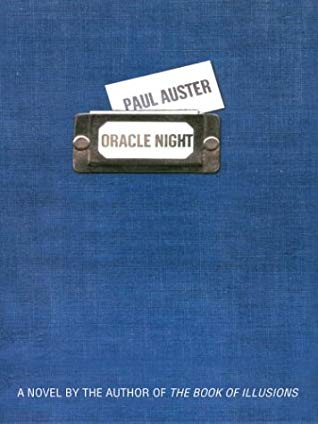 For long stretches of the novel, Orr is lost in his notebook (“I was there, fully engaged in what was happening, and at the same time I wasn’t there—for the there wasn’t an authentic there anymore”), writing in short, obsessive bursts. In one project, a mystery inspired by an incident from The Maltese Falcon, Nick Bowen, a New York City editor, has a manuscript called Oracle Night land on his desk. Spooked by a near-death experience, he flees to Kansas City, where he gets a job working on a cabdriver’s phone book archive, “The Bureau of Historical Preservation,” which includes a collection from the Warsaw ghetto. But then he gets trapped in the man’s underground bunker … and Orr has writer’s block, so leaves him there. Even though it’s fiction (within fiction), I still found that unspeakably creepy.
In the real world, Orr’s life accumulates all sorts of complications over just nine September days. Some of them are to do with Grace and her relationship with Trause’s family; some of them concern his work. There’s a sense in which what he writes is prescient. “Maybe that’s what writing is all about, Sid,” Trause suggests. “Not recording events from the past, but making things happen in the future.” The novel has the noir air I’ve come to expect from Auster, while the layering of stories and the hints of the unexplained reminded me of Italo Calvino and Haruki Murakami. I even caught a whiff of What I Loved, the novel Auster’s wife Siri Hustvedt published the same year. (It wouldn’t be the first time I’ve spotted similar themes in husband‒wife duos’ work – cf. Jonathan Safran Foer and Nicole Krauss; Zadie Smith and Nick Laird.)
This is a carefully constructed and satisfying novel, and the works within the work are so absorbing that you as the reader get almost as lost in them as Orr himself does. I’d rank this at the top of the Auster fiction I’ve read so far, followed closely by City of Glass. 
Report from the Interior (2013)
This sequel to Winter Journal came out a year later. Again, the autobiographical rendering features second-person narration and a fragmentary style. I had a ‘been there, done that’ feeling about the book and only gave it a quick skim. It might be one to try another time.
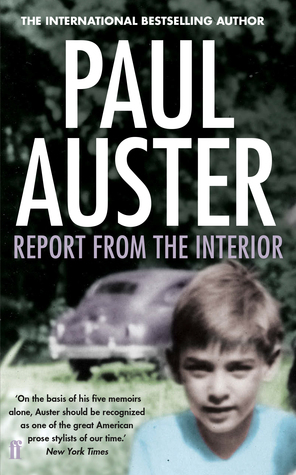 In the first 100-page section Auster highlights key moments from the inner life of a child. For instance, he remembers that the epiphany that a writer can inhabit another mind came while reading Robert Louis Stevenson’s poetry, and he emulated RLS in his own first poetic attempts. The history and pop culture of the 1950s, understanding that he was Jewish, and reaping the creative rewards of boredom are other themes. I especially liked a final anecdote about smashing his seventh-grade teacher’s reading challenge and being driven to tears when the man disbelieved that he’d read so many books and accused him of cheating.
Other sections give long commentary on two films (something he also does in Winter Journal with 10 pages on the 1950 film D.O.A.), select from letters he wrote to his first wife in the late 1960s while living in Paris, and collect an album of black-and-white period images such as ads, film stills and newspaper photographs. There’s a strong nostalgia element, such that the memoir would appeal to Auster’s contemporaries and those interested in learning about growing up in the 1950s.
Ultimately, though, this feels unnecessary after Winter Journal. Auster repeats a circular aphorism he wrote at age 20: “The world is in my head. My body is in the world. You will stand by that paradox, which was an attempt to capture the strange doubleness of being alive, the inexorable union of inner and outer”. But I’m not sure that body and mind can be so tidily separated as these two works posit. I got more of an overall sense of Auster’s character from the previous book, even though it was ostensibly focused on his physical existence. 
The library at the university where my husband works holds another four Auster novels, but I’ll wait until next year to dive back into his work. After reading other people’s reviews, I’m now most keen to try The Brooklyn Follies, Invisible and In the Country of Last Things.
Have you tried anything by Paul Auster this week?
Paul Auster Reading Week: Winter Journal & The New York Trilogy
Before this year, I’d read only one book by Paul Auster: Timbuktu, which fit into last year’s all-animal 20 Books of Summer for its canine main character. This year I’ve enjoyed having Annabel’s Paul Auster Reading Week as an excuse to binge on more Auster, including one of his memoirs, Winter Journal, and his most famous set of novels, the New York Trilogy. I’m reading another two Auster books, one fiction and nonfiction, and will see if I can finish and write them up before the week ends.

Winter Journal (2012)
This is one of the most remarkable memoirs I’ve ever read. Approaching age 64 and the winter of his life, Auster decided to assemble his most visceral memories. Here he parades them past in a seemingly random order yet manages to give a sense of the sweep of his life. The use of the second person draws readers in to (re-)experience things along with the author, while also creating an artistic distance between the subject and his reminiscences. Auster describes his aim thus:
Time is running out, after all. Perhaps it is just as well to put aside your stories for now and try to examine what it has felt like to live inside this body from the first day you can remember being alive until this one. A catalogue of sensory data. What one might call a phenomenology of breathing.
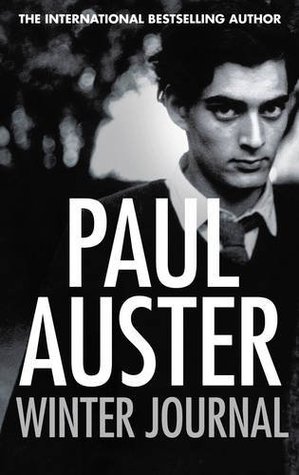 His life reappears through scars, through accidents and near-misses, through what his hands felt and his eyes observed. A three-year-old rips his cheek open on a protruding nail in a department store. A teenager slowly builds up a portfolio of sexual experiences. A young man lives and works in Paris and the South of France. A marriage to one fellow author (Lydia Davis) ends and a relationship with another (Siri Hustvedt) begins. A fiftysomething rushing to get home to the toilet makes an ill-advised turn against traffic and totals his car – luckily, he and his family escape unhurt. Numbness after his mother’s death cedes to a panic attack.
I particularly enjoyed the 53-page section in which Auster gives tours through the 21 places he’s lived since infancy, recounting the details he remembers of the dwellings and what happened during his time there. It’s impressive how much he can condense, but also how much he can convey in just a few pages on each home. This is the sort of format I could imagine borrowing for a short autobiographical piece – it would be a way of redeeming that involuntarily nomadic period when my husband and I moved every six to 18 months.
Reading this alongside the New York Trilogy allowed me to spot the ways, big and small, in which those novels draw on Auster’s life story. I’m now keen to read more of his nonfiction, especially The Invention of Solitude, which offended his relatives by revealing the shameful family story of how his grandmother shot and killed his grandfather in their kitchen. 
Annabel says: “The book is written in the second person – addressing himself; it gives a real sense of intimacy to his story. … Auster is an unconventional, analytical and eloquent writer, and this unconventional memoir was a delight to read, he can look with humour at himself as well as being serious.”
Laura F. says: “You know how people say they’d read anything by their favourite author, even a grocery list? Winter Journal gets pretty close to that territory. … I’ve never read a memoir like this, and though focused on the physical, it’s a fully emotional experience.”
Some favorite lines:
“as long as you continue to travel, the nowhere that lies between the here of home and the there of somewhere else will continue to be one of the places where you live.”
“We are all aliens to ourselves, and if we have any sense of who we are, it is only because we live inside the eyes of others.”
“you can only conclude that every life is marked by a number of close calls, that everyone who manages to reach the age you have come to now has already wriggled out of a number of potentially absurd, nonsensical deaths. All in the course of what you would call ordinary life.”
Readalikes: I Am, I Am, I Am by Maggie O’Farrell & The Lost Properties of Love by Sophie Ratcliffe
The New York Trilogy
(also my Doorstopper of the Month at 580 pages)
City of Glass (1985)
 A metafictional mystery about a crime writer named Daniel Quinn who turns private investigator when he gets a phone call asking for the Paul Auster Detective Agency. This is one of those books where what actually happens is a lot less important than the atmosphere it creates. So what feels essential to me here is the sense of a labyrinthine New York City and a confusion of languages and relationships. Quinn, who is helpfully untethered after the death of his wife and son, is hired to tail Peter Stillman’s father, who has recently been released from a mental hospital, where he was sentenced after being judged insane for keeping his son in isolation in a dark apartment for nine years.
Feral children, maps, eggs, the Tower of Babel and Don Quixote are some of the recurring sources of metaphors in a deliberately disorienting and intertextually rich short novel that kept me turning the pages even when I didn’t know precisely what was going on. We get a glimpse of Auster himself, and are invited to muse on such tiny subjects as destiny, the limitations of language, the purpose of books, and the nature of truth. I’m curious to see whether the other two novels follow on from the story at all or just resemble it thematically.
Ghosts (1986)
I jumped straight into this from City of Glass, and it suffered by comparison. It is not a sequel per se, because it has different characters and is set in the late 1940s instead of the early 1980s, but it shares some of the same concerns (with literature, identity, doubling, the essential otherness of the writer, and so on) and again is a sort of metafictional mystery.
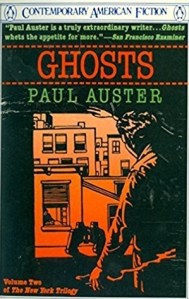 Part of why I couldn’t take this novella entirely seriously is the silly naming: White hires Blue to trail Black (really; all of the secondary characters are named after colors, too). It turns out Black is a writer who does little besides sit in his apartment, writing. Only when Blue disguises himself as a tramp and then as a salesman and meets Black in various other contexts does he realize that Black, too, is an investigator … writing up a case of following a writer who hardly leaves his desk.
While I appreciated the circularity and the uncertainty over whether these accidental twins would destroy each other, as well as the literary references to Whitman, Thoreau and Hawthorne, the whole felt slightly inconsequential (“Blue watches Black, and little of anything happens.”). Plotlessness is part of the point, but makes for only a moderately interesting read.
[There is one coded reference to Auster here: the fact that the book opens on February 3, 1947, the day he was born.]
The Locked Room (1986)
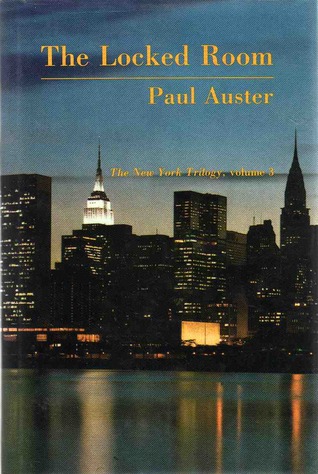 While most of the New York Trilogy is told in the third person, this is a first-person narrative that seems to pick up where City of Glass left off. It begins in 1977, when the unnamed narrator gets a letter from Sophie Fanshawe, the wife of his childhood best friend, telling him that Fanshawe disappeared six months ago, and despite the best efforts of a detective, Quinn (in another link to CoG, the narrator encounters Peter Stillman on a later trip to Paris), no trace can be found. The narrator has been named Fanshawe’s literary executor and takes it upon himself to get the man’s unpublished work out into the world: plays are produced, novels are published. He also starts writing a biography of the friend he always envied.
Except it’s more like he’s becoming Fanshawe, especially when he marries Sophie. Doubling has been a major theme of the trilogy, and here the metaphorical kill-or-be-killed situation seems to turn literal at the conclusion, which I didn’t particularly understand (e.g. he acquires and destroys a red notebook – is this in some way meant to be the same red notebook Quinn left behind at the end of CoG?). The narrator presents himself as the author of all three books, and asserts, “These three stories are finally the same story, but each one represents a different stage in my awareness of what it is about. I don’t claim to have solved any problems.”
The metafictional aspect of this novel is that Fanshawe’s early life is a lot like Auster’s as revealed in Winter Journal, while Sophie’s resembles his wife Siri Hustvedt’s (and the pair would later name their daughter Sophie). 
 Themes of the trilogy:
- Identity complications, including disguises, doubles and substitutes
- Writers and writing; the creator versus characters
- The limits of language (e.g. Stillman’s monologue in CoG is astonishing)
- Freedom/randomness versus fate
One representative passage from each volume:
- “New York was an inexhaustible space, a labyrinth of endless steps, and no matter how far he walked, no matter how well he came to know its neighbourhoods and streets, it always left him with the feeling of being lost. Lost, not only in the city, but within himself as well. … New York was the nowhere he had built around himself” (City of Glass)
- “Writing is a solitary business. It takes over your life. In some sense, a writer has no life of his own. Even when he’s there, he’s not really there. / Another ghost. / Exactly.” (Ghosts)
- “In the end, each life is no more than the sum of contingent facts, a chronicle of chance intersections, of flukes, of random events that divulge nothing but their own lack of purpose.” (The Locked Room)
My rating for the trilogy as a whole:
Have you tried anything by Paul Auster? Grab one of his books and join us for this week’s readalong!
Book Serendipity Incidents of 2019 (So Far)
I’ve continued to post my occasional reading coincidences on Twitter and/or Instagram. This is when two or more books that I’m reading at the same time or in quick succession have something pretty bizarre in common. Because I have so many books on the go at once – usually between 10 and 20 – I guess I’m more prone to such serendipitous incidents. (The following are in rough chronological order.)
What’s the weirdest coincidence you’ve had lately?
- Two titles that sound dubious about miracles: There Will Be No Miracles Here by Casey Gerald and The Unwinding of the Miracle: A Memoir of Life, Death, and Everything that Comes After by Julie Yip-Williams

- Two titles featuring light: A Light Song of Light by Kei Miller and The Age of Light by Whitney Scharer
- Grey Poupon mustard (and its snooty associations, as captured in the TV commercials) mentioned in There Will Be No Miracles Here by Casey Gerald and Drinking: A Love Story by Caroline Knapp
 “I Wanna Dance with Somebody” (the Whitney Houston song) referenced in There Will Be No Miracles Here by Casey Gerald and Don’t Call Us Dead by Danez Smith
- Two books have an on/off boyfriend named Julian: Drinking: A Love Story by Caroline Knapp and Extinctions by Josephine Wilson
- There’s an Aunt Marjorie in When I Had a Little Sister by Catherine Simpson and Extinctions by Josephine Wilson


- Set (at least partially) in a Swiss chalet: This Sunrise of Wonder by Michael Mayne and Crazy for God by Frank Schaeffer
- A character named Kiki in The Sacred and Profane Love Machine by Iris Murdoch, The Age of Light by Whitney Scharer, AND Improvement by Joan Silber
 Two books set (at least partially) in mental hospitals: Mind on Fire by Arnold Thomas Fanning and Faces in the Water by Janet Frame
- Two books in which a character thinks the saying is “It’s a doggy dog world” (rather than “dog-eat-dog”): The Friend by Sigrid Nunez and The Octopus Museum by Brenda Shaughnessy
- Reading a novel about Lee Miller (The Age of Light by Whitney Scharer), I find a metaphor involving her in My Year of Rest and Relaxation by Ottessa Moshfegh: (the narrator describes her mother) “I think she got away with so much because she was beautiful. She looked like Lee Miller if Lee Miller had been a bedroom drunk.” THEN I come across a poem in Clive James’s Injury Time entitled “Lee Miller in Hitler’s Bathtub”

- On the same night that I started Siri Hustvedt’s new novel, Memories of the Future, I also started a novel that had a Siri Hustvedt quote (from The Blindfold) as the epigraph: Besotted by Melissa Duclos
- In two books “elicit” was printed where the author meant “illicit” – I’m not going to name and shame, but one of these instances was in a finished copy! (the other in a proof, which is understandable)
- Three books in which the bibliography is in alphabetical order BY BOOK TITLE! Tell me this is not a thing; it will not do! (Vagina: A Re-education by Lynn Enright; Let’s Talk about Death (over Dinner) by Michael Hebb; Telling the Story: How to Write and Sell Narrative Nonfiction by Peter Rubie)
 References to Gerard Manley Hopkins in Another King, Another Country by Richard Holloway, This Sunrise of Wonder by Michael Mayne and The Point of Poetry by Joe Nutt (these last two also discuss his concept of the “inscape”)
- Creative placement of words on the page (different fonts; different type sizes, capitals, bold, etc.; looping around the page or at least not in traditional paragraphs) in When Death Takes Something from You Give It Back by Naja Marie Aidt [not pictured below], How Proust Can Change Your Life by Alain de Botton, Stubborn Archivist by Yara Rodrigues Fowler, Alice Iris Red Horse: Selected Poems of Yoshimasu Gozo and Lanny by Max Porter

- Twin brothers fall out over a girl in Cutting for Stone by Abraham Verghese and one story from the upcoming book Meteorites by Julie Paul
- Characters are described as being “away with the fairies” in Lanny by Max Porter and Away by Jane Urquhart
 Schindler’s Ark/List is mentioned in In the Beginning: A New Reading of the Book of Genesis by Karen Armstrong and Telling the Story: How to Write and Sell Narrative Nonfiction by Peter Rubie … makes me think that I should finally pick up my copy!
Two “Summer” Books
With summer winding down, I decided it was time to read a couple of books with the word in the title to try to keep the season alive. These turned out to be charming, low-key English novels that I would recommend to fans of costume dramas. Both: 
I knew very little about Jonathan Smith’s Summer in February when I picked it up in a charity shop. From the ads for the 2013 film adaptation with Dan Stevens, I had in mind that this was an obscure classic. It was actually published in 1995, but is inspired by real incidents spanning 1909 to 1949. It’s set among a group of Royal Academy-caliber artists in Lamorna, Cornwall, including Alfred Munnings, who went on to become the academy’s president.
The crisis comes when Munnings and Captain Gilbert Evans, a local land manager, fall for the same woman. A love triangle might not seem like a very original story idea, but I enjoyed this novel particularly for its Cornish setting (“From dawn to dusk it had rained non-stop, as only Cornwall can”; “The sea was slate grey and the sky streaky bacon”) and for the larger-than-life Munnings, who has a huge store of memorized poetry and is full of outspoken opinions. Two characters describe his contradictions thusly: “I can see he’s crude and loud and unpolished and Joey says he cuts his toenails at picnics but…”; “he’s one in a million, a breath of fresh air, and he’s frank and fearless, which is always a fine thing.” The title refers to the way that love can make any day feel like summer.
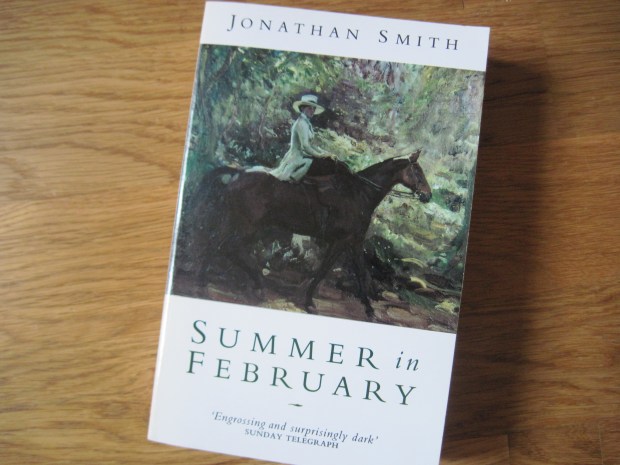
The cover image is the painting Morning Ride by A.J. Munnings.
For more information on Munnings, see here.
For more information on Gilbert Evans, see here. (Beware the spoilers!)
From 1961, In a Summer Season was Elizabeth Taylor’s eighth novel. The ensemble cast is led by Kate Heron – newly remarried to Dermot, a man ten years her junior, after the death of her first husband – and made up of her family circle, a few members of the local community, and her best friend Dorothea’s widower and daughter, who return from living abroad about halfway through the book. Set in the London commuter belt, this is full of seemingly minor domestic dilemmas that together will completely overturn staid life before the end.
From Kate dyeing her hair yet being keen to avoid accusations of “mutton dressed as lamb” to her son Tom’s disgust at his grandfather’s ageing body, old age and wasting one’s time on trivialities are a twin paranoia here. The title is not only a literal note of when much of the action takes place, but also a metaphor for the fleeting nature of happiness (as well as life itself). Kate remembers pleasant days spent with her best friend and their young children: “It was a long summer’s afternoon and it stood for all the others now. There had been many. And she and Dorothea were together day after day. Their friendship was as light and warming as the summer’s air.”
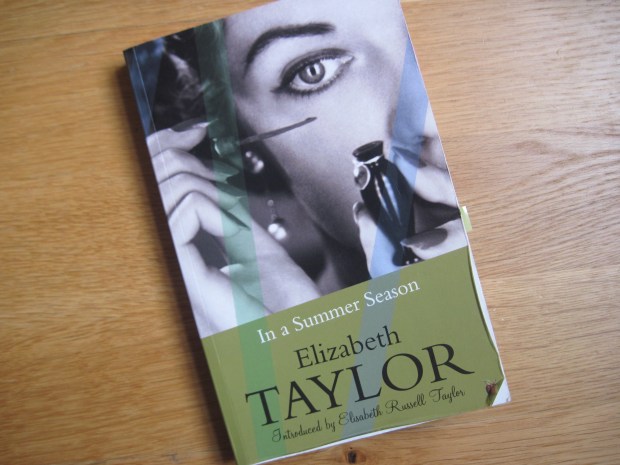
So much happens in the last seven pages. I wished the book could have turned out differently, yet the conclusion effectively sews it all up, and all within a cozy 220 pages. If you enjoy writers like Muriel Spark and Barbara Pym, you must try Elizabeth Taylor. Her work is similarly built around wry, perceptive observations about relationships and ways of life. This was my fourth novel by her, and I’d call it my second favorite so far after Mrs. Palfrey at the Claremont.
(Secondhand books are such good value: These two charity shop paperbacks cost me less than 85 pence in total. Such a low total spend per hour of enjoyment!)
This month I also read The Summer without Men by Siri Hustvedt (discussed here along with a few other recent reads). Earlier in the year I reviewed Ricarda Huch’s The Last Summer, and last year I reviewed the Summer anthology from the Wildlife Trusts. “Summer” turns up fairly frequently in titles of books I’ve read or want to read, in fact. Here’s the whole list!
Have you read any “Summer” books lately?
Some Accidental Thematic Overlaps in My Recent Reading
Five of the books I’ve read recently (most of them while traveling to and from the States) have shared an overarching theme of loss, with mental illness, alcoholism, suicide, and dogs as subsidiary topics running through two or more of them. I hadn’t deliberately chosen these books for their commonalities, so it was uncanny to see the same elements keep popping up. I wanted to come up with some kind of impressively complex Venn diagram to show off these unexpected connections but couldn’t quite manage it, so you’ll have to imagine it instead.
Mental Illness
The Archivist by Martha Cooley
 Matthias Lane is the archivist of the Mason Room, a university collection of rare books and literary papers. One of its treasures is a set of letters that passed between T.S. Eliot and his friend Emily Hale (held at Princeton in real life). Matt is haunted by memories of his late wife, Judith, a poet incarcerated in a mental hospital for over five years. A reckoning comes for Matt when he’s approached by Roberta Spire, a graduate student determined to view the Eliot–Hale letters even though they’re legally sealed until 2020. The more time Matt spends with Roberta, the more similarities start to arise between her and Judith; and between his situation and Eliot’s when the latter also put his wife away in a mental hospital. The novel asks what we owe the dead: whether we conform to their wishes or make our own decisions.
The Summer without Men by Siri Hustvedt
 Thirty years on, poet Mia Fredricksen’s husband Boris asks her for a pause in their marriage so he can explore his feelings for his young French lab assistant. First things first: Mia goes crazy and ends up in a mental hospital for a short time. But then she sucks it up and goes back to her Minnesota hometown to teach poetry writing to teen girls for a summer, getting sucked into a bullying drama. This is a capable if not groundbreaking story of the shifts that occur in a long marriage and the strange things we all do as we face down the possibility of death. There are also wry comments about the unappreciated talents of the female artist. However, compared to the other two novels I’ve read from Hustvedt, this seemed feeble. Still, a quick and enjoyable enough read.
The Dogs of Babel by Carolyn Parkhurst
 A delicious debut novel intellectual enough to bypass labels like ‘women’s fiction’ and ‘mystery’. One thing that sets it apart is how successfully Parkhurst writes from the perspective of a male narrator, Paul Iverson, who’s been knocked for six by the sudden death of his wife Lexy, a mask designer. While he was at the university where he teaches linguistics, she climbed to the top of the apple tree in their backyard and – what? fell? or jumped? The only ‘witness’ was their Rhodesian Ridgeback, Lorelei; in his grief Paul uses his sabbatical to research efforts to teach dogs to communicate, hoping one day Lorelei might tell all. Woven through are scenes from Paul and Lexy’s courtship and marriage; though Lexy occasionally struggled with her mental health, their dialogue is fun and zippy, like you might hear on The Gilmore Girls.
Suicide
The Archivist by Martha Cooley & The Dogs of Babel by Carolyn Parkhurst


Alcoholism
Don’t Let’s Go to the Dogs Tonight by Alexandra Fuller
 A classic memoir that conjures up all the sights, sounds, smells and feelings of Africa on the cusp of a colonial to postcolonial transition. Fuller’s family were struggling tobacco and cattle farmers in Rhodesia (Zimbabwe), Malawi and Zambia. She had absorbed the notion that white people were there to benevolently shepherd the natives, but came to question it when she met Africans for herself. While giving a sense of the continent’s political shifts, she mostly focuses on her own family: the four-person circus that was Bobo (that’s her), Van (older sister Vanessa), Dad, and Mum (an occasionally hospitalized manic-depressive alcoholic who lost three children) – not to mention an ever-changing menagerie of horses, dogs and other pets. This really takes you away to another place and time, as the best memoirs do, and the plentiful black-and-white photos are a great addition.
Let’s Take the Long Way Home by Gail Caldwell
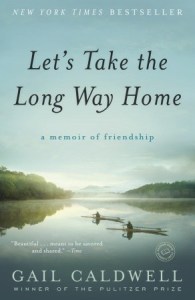 If you loved Ann Patchett’s Truth and Beauty, pick this up immediately. It’s a similar story of best friends: one who dies and one who survives. Caldwell’s best friend was Caroline Knapp (author of Drinking: A Love Story, among other nonfiction), whom she met via puppy ownership in Cambridge, Massachusetts. They were both single and childless, full-time authors with a history of alcoholism. Besides long walks with their dogs, they loved swimming and rowing together. In 2002 Caroline was diagnosed with stage-four lung cancer, inoperable and already metastasized. Despite all their proactive optimism, she was dead a matter of weeks later. In this moving and accessible short memoir, Caldwell drifts through her past, their friendship, Caroline’s illness, and the years of grief that followed the loss of Caroline and then her beloved Samoyed, Clementine, sharing what she learned about bereavement.
Dogs
The Dogs of Babel, Don’t Let’s Go to the Dogs Tonight & Let’s Take the Long Way Home


Do you ever find coincidental thematic connections in your reading?
Six “Love” Books for Valentine’s Day
Starting in mid-January I began surveying my shelves, library stack and Kindle for books with “love” in the title. Here are the six I had time to try; I didn’t get to Alain de Botton’s The Course of Love on my Kindle, nor my paperback copies of Iris Murdoch’s The Sacred and Profane Love Machine and Nancy Horan’s Loving Frank.
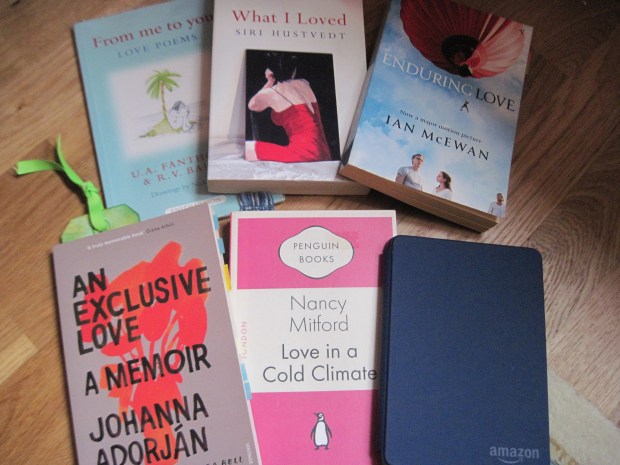
You’ll notice that a number of the books I’ve read aren’t that optimistic about love; in several cases the use of the word in the title even seems to be ironic. As Lady Montdore exclaims in Love in a Cold Climate, “Love indeed – whoever invented love ought to be shot.” So I can’t offer them as particularly romantic choices. But let’s start positively, with some pleasantly out-of-the-ordinary love poems.
From Me to You: Love Poems, U.A. Fanthorpe and R.V. Bailey
 Ursula Fanthorpe and Rosie Bailey met as English teachers at the same Cheltenham school in their late twenties and were partners for nearly 40 years. None of the poems in this short volume are attributed, though I recognized a few from Fanthorpe’s Collected Poems. They’re not particularly distinguished as poetry, but I appreciated the simple, unsentimental examples of what makes up everyday life with a partner: “There is a kind of love called maintenance, / Which stores the WD40 and knows when to use it; // Which checks the insurance, and doesn’t forget / The milkman” (“Atlas”) and “I’m working on a meal you haven’t had to imagine, / A house cleaned to the rafters” (“Dear Valentine”). [Public library]
What I Loved, Siri Hustvedt
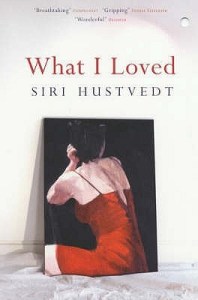 This 2003 novel could just as well have been titled “What I Lost,” which might be truer to its elegiac tone. Narrated by Professor Leo Hertzberg and set between the 1970s and 1990s, it’s about two New York City couples – academics and artists – and the losses they suffer over the years. With themes of modern art, perspective, memory, separation and varieties of mental illness, it asks to what extent we can ever know other people or use replacements to fill the gaps left by who and what is missing. Read it if you’ve enjoyed The Suicide of Claire Bishop by Carmiel Banasky, other books by Siri Hustvedt, or anything by Howard Norman. My favorite lines about love were “I often thought of our marriage as one long conversation” and “love thrives on a certain kind of distance … it requires an awed separateness to continue.” [Charity shop]
Love in a Cold Climate, Nancy Mitford
 I didn’t realize this 1949 novel is a sequel to The Pursuit of Love, so it took a while to figure out who all the characters were. Fanny Logan is a cousin orbiting around Lord and Lady Montdore and their daughter Polly Hampton, all recently returned from some years in India. Fanny marries an Oxford don, while Polly shocks everyone by eloping with her uncle by marriage, “Boy” Dougdale, a recent widower once known as the “Lecherous Lecturer” for interfering with little girls. (This hint of pedophilia is carelessly tossed off in a way no writer would get away with today.) Meanwhile, the heir to the Hampton estate, an effeminate chap named Cedric, comes over from Canada for a visit and wins Lady Montdore over. This amusing picture of aristocratic life in the 1930s marvels at who we love and why. [Bookbarn International]
Enduring Love, Ian McEwan
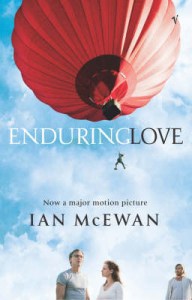 Interesting to consider this as a precursor to Saturday: both have a scientist as the protagonist and get progressively darker through a slightly contrived stalker plot. Enduring Love opens, famously, with a ballooning accident that leaves its witnesses questioning whether they couldn’t have done more to prevent it. Freelance science journalist Joe Rose – on a picnic with his partner, Keats scholar Clarissa, at the time – was one of those who rushed to help, as was Jed Parry, a young Christian zealot who fixates on Joe. He seems to think that by loving Joe, a committed atheist, he can bring him to God. In turn, Joe’s obsession with Jed’s harassment campaign drives Clarissa away. It’s a deliciously creepy read that contrasts rationality with religion and inquires into what types of love are built to last. [Charity shop]
An Exclusive Love: A Memoir, Johanna Adorján
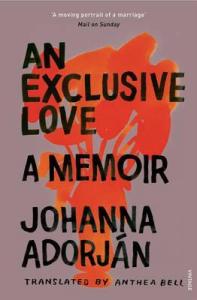 The author’s grandparents, Hungarian Holocaust survivors who moved to Denmark as refugees, committed suicide together on October 13, 1991. Her grandfather, an orthopedic surgeon who had been in an Austrian concentration camp, was terminally ill and his wife was determined not to live a day without him. This short, elegant memoir alternates Adorján’s imagined reconstruction of her grandparents’ last day with an account of their life together, drawn from family memories and interviews with those who knew them. She wonders whether, like Primo Levi and Arthur Koestler, theirs was a typically Jewish failure to fit in wherever they went, and/or a particularly Hungarian melancholy. “The answer is their great love,” the newspaper report of their death insisted. [Waterstones clearance]
Note: That striking cover is by Leanne Shapton.
And another nonfiction selection that I didn’t make it all the way through:
A Book about Love, Jonah Lehrer
 (Abandoned at 31%.) Although I can see why he starts where he does, Lehrer’s early focus on attachment and attunement – two psychological theories of how babies learn to relate affectionately to others – means the book gets bogged down in studies performed on mice and/or children and feels more like a parenting book than anything else. (If that’s what you’re after, read All Joy and No Fun.) A glance at the table of contents suggests the rest of the book will go into marriage, divorce and how love changes over time, but I couldn’t be bothered to stick around. That said, Lehrer’s popular science writing is clear and engaging, and with the heartfelt mea culpa at the start of this book I couldn’t hold a grudge about his earlier plagiarism scandal. [Kindle book from NetGalley.]
No overtly heartwarming love stories in that selection, then, but are there any you fancy reading anyway? Have you read any “love” titles recently?
See also: The Guardian’s list of Top 10 Authentic Romances.
 Bookish Beck = Rebecca Foster. American transplant to England. Freelance proofreader and book reviewer.
 Bookish Beck