May Graphic Novels by Alison Bechdel, Peter Kuper & Craig Thompson
May has been chock-full of new releases for me! For this first batch of reviews, I’m featuring three fantastic graphic novels that have made it onto my Best of 2025 (so far) list. I don’t read graphic books as often as I’d like to – my library tends to major on superhero comics and manga, which aren’t my cup of tea – but I sometimes get a chance to access them for paid review purposes. (The first two below are ones I was sent for potential Shelf Awareness reviews, but I missed the deadlines.) Reading these took me back to the early 2010s when I worked for a university library in South London and would walk to Lambeth Library on my lunch breaks to borrow huge piles of books, mostly taking advantage of their excellent graphic novel selection. That was where my education and fascination began.
Spent: A Comic Novel by Alison Bechdel
 I’ve read all but one of Bechdel’s works now. Fun Home was among the first graphic books I read and is a great choice if you’re new to this form of storytelling. It’s a family memoir about her father’s funeral home business and closeted lifestyle, which emerged shortly after her own coming-out – and shortly before his accidental death. In Spent, Alison and her handy wife Holly live on a Vermont pygmy goat farm. Alison has writer’s block and is struggling financially despite her famous memoir about her taxidermist father having been made into a successful TV series, Death & Taxidermy. Mostly, she’s consumed with anxiety about the state of the world, what with the ongoing pandemic, her sister’s right-wing opinions, and the litany of awful headlines. “Who can draw when the world is burning?” she exclaims.
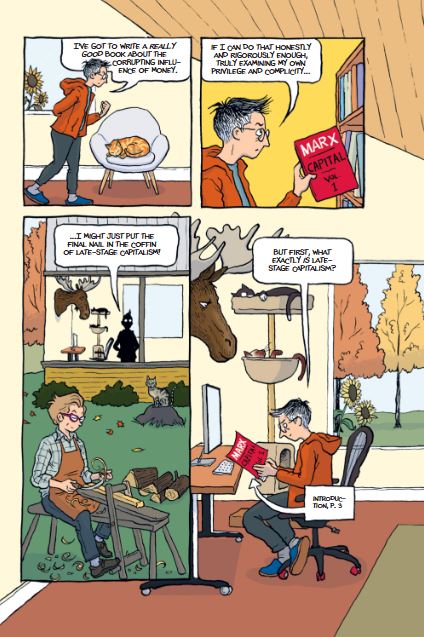
Then Alison has an idea for a book – or maybe a reality TV series – called $UM that will wean people off of capitalism. That creative journey is mirrored in Spent, which is composed of 12 “episodes” titled after Marxist terminology. Through Alison’s ageing hippie friends and their kids, Bechdel showcases alternative ways of living: a commune, a throuple, nonbinary identity, unpaid internships, Just Stop Oil demos, and the influencer lifestyle versus rejection of technology. It’s (auto)fiction exaggerated to the brink of absurdity, with details changed enough to mock but not enough to hide (e.g., she’s published by “Megalopub,” the hardware store is “Home Despot,” her show airs on “Schmamazon”).

Tiny details in the drawings reward close attention, such as Alison and Holly’s five cats’ antics during their morning routine, and a stuffed moose head rolling its eyes. It’s the funniest I can remember Bechdel being, with much broad humour derived from the outrageous screen mangling of her book – cannibalism, volcanoes and dragons come out of nowhere – and her middle-class friends’ hand-wringing over their liberal credentials. Even the throwaway phrases are hilarious. It’s a gleeful and zeitgeist-y satire, yet draws to a touching close as Alison has the epiphany that she can’t fix everything herself so must simply do what she can, “with a little help from her annoying, tender-hearted, and utterly luminous friends.”
Accessed as an e-book from Mariner Books. Published in the UK by Jonathan Cape (Penguin).
Insectopolis: A Natural History by Peter Kuper
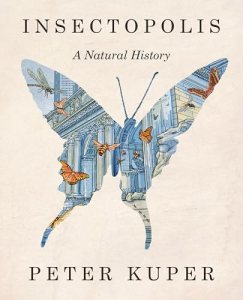 Nearly a decade ago, I reviewed Peter Kuper’s Ruins, which features monarch migration and has as protagonist a laid-off Natural History Museum entomologist. Here insects have even more of a starring role. The E. O. Wilson epigraph sets the stage: “If all mankind were to disappear, the world would regenerate back to the rich state of equilibrium that existed ten thousand years ago. If insects were to vanish, the environment would collapse into chaos.” We follow an African American brother-and-sister pair, the one dubious and the other eager, as they walk downtown to the New York Public Library. The sister, who holds a PhD in entomology, promises that its exhibition on insects is going to be amazing. But just before they reach the building, a red alert flashes up on every smartphone and sirens start blaring. A week later, the city is a ruin of overturned cabs and debris. Only insects remain and, group by group, they guide readers through the empty exhibit, interacting within and across species.


It’s a sly blend of science, history, stories and silliness. I loved the scenes of mosquitoes and ants railing against how they’ve been depicted as villainous, and dignified dung beetles resisting scatological jokes and standing up for their importance in ecosystems. There are interesting interludes about insects in literature (not just Kafka and Nabokov, but the Japanese graphic novel The Book of Human Insects by Osamu Tezuka), and unsung heroines of entomology get their moment in the sun. The pages in which Margaret Collins, an African American termite researcher in the 1950s, and Rachel Carson appear to a dragonfly as ghosts and tell their stories of being dismissed by male researchers were among my favourites. Informative and entertaining at once; what could be better? Welcome our insect overlords!
Accessed as an e-book from W. W. Norton & Company.
Ginseng Roots by Craig Thompson
 I’d read several of Thompson’s works and especially enjoyed his previous graphic memoir, Blankets, about his first love and loss of faith. When I read this blurb, I worried the niche subject couldn’t possibly sustain my attention for nearly 450 pages. But I was wrong; this is a vital book about everything, by way of ginseng. It begins with childhood summers working on American ginseng farms with his siblings in Marathon, Wisconsin. Theirs was a blue collar and highly religious family, but Thompson and his little brother Phil were allowed to spend their earnings from the back-breaking labour of weeding and picking rocks as they pleased. Each hour, each dollar, meant a new comic from the pharmacy. “Comics helped me survive my childhood. But what will help me survive my adulthood?” Thompson asks.

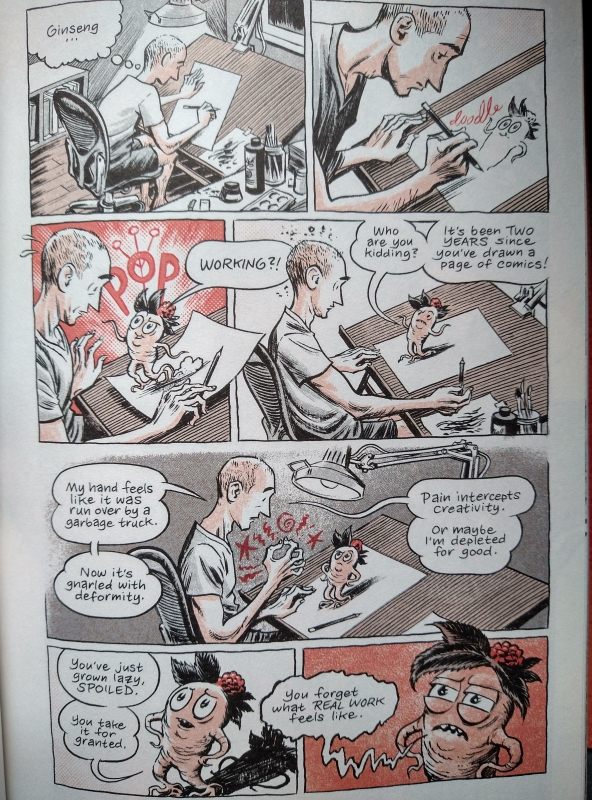
Together with Phil, he travels first to Midwest ginseng farms and festivals and then through China and Korea to learn about the plant’s history, cultivation practices, lore, and medicinal uses. As he meets producers – including a Hmong man whose early life mirrors his own – he feels sheepish about how he makes a living: “I carry this working-class guilt – what I do isn’t real work.” When his livelihood is threatened by worsening autoimmune conditions, he tries everything from acupuncture to psychotherapy to save his hands and his creativity.
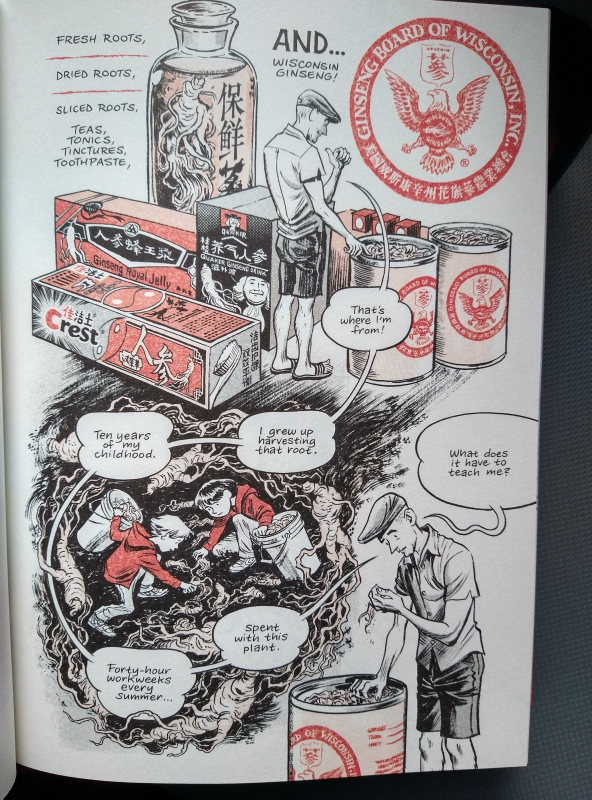
This chunky book has an appealing earth-tones palette and shifts smoothly between locations and styles, memories and research. When interviewing growers and Chinese medicine practitioners, the depictions are almost photorealistic, but there are also superhero pastiche panels and a cute ginseng mascot who pops up throughout the book. Like Spent, this pulls in class and economic issues in a lighthearted way and also explores its own composition process.
The story of ginseng is often sobering, involving the exploitation of immigrants (in the Notes, Thompson regrets that he was unable to speak with any of the Mexican migrant workers on whom the American ginseng harvest now depends), soil degradation, and pesticide pollution. The roots of the title are both literal and symbolic of the family story that unfolds in parallel. Both strands are captivating, but especially the autobiographical material: Thompson’s relationship with Phil, his new understanding but ongoing frustration with his parents, and the way all three siblings exhibit the damage of their upbringing – Phil’s marriage is crumbling; their sister Sarah, who has moved 26 times as an adult, wonders what she’s running from. A conversation with a Chinese herbal pharmacist gets to the heart of the matter: “I learned home is not WHERE I am. Home is HOW I am.”
Both expansive and intimate, this is a surprising gem from one of the best long-form graphic storytellers out there.
With thanks to Faber for the free copy for review. Published in the USA by Pantheon (Penguin).
#1952Club: Patricia Highsmith, Paul Tillich & E.B. White
Simon and Karen’s classics reading weeks are always a great excuse to pick up some older books. I assembled an unlikely trio of lesbian romance, niche theology, and an animal-lover’s children’s classic.

Carol by Patricia Highsmith
Originally published as The Price of Salt under the pseudonym Claire Morgan, this is widely considered the first lesbian novel with a happy ending (it’s more open-ended, really, but certainly not tragic; suicide was a common consequence in earlier fiction). Therese, a 19-year-old aspiring stage designer in New York City, takes a job selling dolls in a department store one Christmas season. Her boyfriend, Richard, is a painter and has promised to take her to Europe, but she’s lukewarm about him and the physical side of their relationship has never interested her. One day, a beautiful blonde woman in a fur coat – “Mrs. H. F. Aird” (Carol) – comes to her counter to order a doll and have it sent to her out in New Jersey. Therese sends a Christmas card to the same address, and the women start meeting up for drinks and meals.
 It takes time for them to clarify their feelings to themselves, let alone to each other. “It would be almost like love, what she felt for Carol, except that Carol was a woman,” Therese thinks early on. When she first visits Carol’s home, a mothering dynamic prevails. Carol is going through a divorce and worries about its effect on her daughter, Rindy. The older woman tucks Therese into bed and brings her warm milk. Scenes like this have symbolic power but aren’t overdone; another has Therese and Richard out flying kites. She brings up homosexuality as a theoretical (“Did you ever hear of it? … I mean two people who fall in love suddenly with each other, out of the blue. Say two men or two girls”) and he cuts her kite strings.
The second half of the book has Carol and Therese setting out on a road trip out West. It should be an idyllic consummation, but they realize they’re being trailed by a private detective collecting evidence for Carol’s husband Harge to use against her in a custody battle. I was reminded of the hunt for Humbert Humbert and his charge in Lolita; “the whole world was ready to be their enemy,” Therese realizes, and to consider their relationship “sordid and pathological,” as Richard describes it in a letter.
The novel is a beautiful and subtle romance that unfolds despite the odds against it. I’d read five of Highsmith’s mysteries and thought them serviceable but nothing special (I don’t read crime in general). This does, however, share their psychological intensity and the suspense about how things will play out. Highsmith gives details about Therese’s early life and Carol’s previous intimate friendship that help to explain some things but never reduce either character to a diagnosis or a tendency. Neither of them wanted just anyone, some woman; it was this specific combination of souls that sparked at first sight. (Secondhand from a charity shop that closed long ago, so I know I’d had it on my shelf unread since 2016!) 
The Courage to Be by Paul Tillich
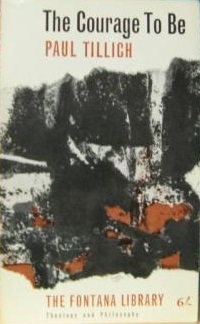 Tillich is a theologian who left Nazi Germany for the USA in 1933. I had to read selections from his work as part of my Religion degree (during the Pauline Theology tutorial I took in Oxford during my year abroad, I think). This book is based on a lecture series he delivered at Yale University. He posits that in an age of anxiety, which “becomes general if the accustomed structures of meaning, power, belief and order disintegrate” – certainly apt for today! – it is more important than ever to develop the courage to be oneself and to be “as a part.” The individual and the collective are of equal importance, then. Tillich discusses various philosophers and traditions, from the Stoics to Existentialism. I have to admit that I barely got anything out of this, I found it so jargon-filled, repetitive and elliptical. It’s been probably 15 years or more since I’ve read any proper theology. I adopted that old student skimming trick of reading the first paragraph of each chapter, followed by the topic sentence of each paragraph, but that left me mostly none the wiser. Anyway, I believe his conclusion is that, when assailed by doubt, we can rely on “the God above the God of theism” – by which I take it he means the ground of all being rather than the deity envisioned by any specific religious system. (University library)
Charlotte’s Web by E.B. White
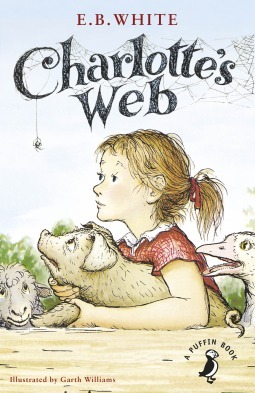 My library has a small section of the children’s department called “Family Matters” that includes the labels “First Time” (starting school, etc.), “Family” (divorce, new baby), “Health” (autism, medical conditions) and “Death.” I have the feeling Charlotte’s Web is not at all well known in the UK, whereas it’s a standard in the USA alongside L.M. Montgomery and Laura Ingalls Wilder. Were it more familiar to British children, it would be a great addition to that “Death” shelf. (Don’t read the Puffin Modern Classics introduction if you don’t want spoilers!) Wilbur is a doubly rescued pig. First, Fern Arable hand-rears him when he’s the doomed runt of the litter. When he’s transferred to Uncle Homer Zuckerman’s farm and an old sheep explains he’ll be fattened up for slaughter, his new friend Charlotte intervenes.
Charlotte is a fine specimen of a barn spider, well spoken and witty. She puts her mind to saving Wilbur’s bacon by weaving messages into her web, starting with “Some Pig.” He’s soon a county-wide spectacle, certain to survive the chop. But a farm is always, inevitably, a place of death. White fashions such memorable characters, including Templeton the gluttonous rat, and captures the hope of new life returning as the seasons turn over. Talking animals aren’t difficult to believe in when Fern can hear every word they say. The black-and-white line drawings are adorable. And making readers care about invertebrates? That’s a lasting achievement. I’m sure I read this several times as a child, but I appreciated it all the more as an adult. (Little Free Library) 
I’ve previously participated in the 1920 Club, 1956 Club, 1936 Club, 1976 Club, 1954 Club, 1929 Club, 1940 Club, 1937 Club, and 1970 Club.
#1962Club: A Dozen Books I’d Read Before
I totally failed to read a new-to-me 1962 publication this year. I’m disappointed in myself as I usually manage to contribute one or two reviews to each of Karen and Simon’s year clubs, and it’s always a good excuse to read some classics.

My mistake this time was to only get one option: Pale Fire by Vladimir Nabokov, which I had my husband borrow for me from the university library. I opened it up and couldn’t make head or tail of it. I’m sure it’s very clever and meta, and I’ve enjoyed Nabokov before (Pnin, in particular), but I clearly needed to be in the right frame of mind for a challenge, and this month I was not.
Looking through the Goodreads list of the top 100 books from 1962, and spying on others’ contributions to the week, though, I can see that it was a great year for literature (aren’t they all?). Here are 12 books from 1962 that I happen to have read before, most of which I’ve reviewed here in the past few years. I’ve linked to those and/or given review excerpts where I have them, and the rest I describe to the best of my muzzy memory.
 The Wolves of Willoughby Chase by Joan Aiken – The snowy scene on the cover and described in the first two paragraphs drew me in and the story, a Victorian-set fantasy with notes of Oliver Twist and Jane Eyre, soon did, too. Dickensian villains are balanced out by some equally Dickensian urchins and helpful adults, all with hearts of gold. There’s something perversely cozy about the plight of an orphan in children’s books: the characters call to the lonely child in all of us; we rejoice to see how ingenuity and luck come together to defeat wickedness. There are charming passages here in which familiar smells and favourite foods offer comfort. This would make a perfect stepping stone from Roald Dahl to one of the Victorian classics.
 Instead of a Letter by Diana Athill – This was Athill’s first book, published when she was 45. An unfortunate consequence of my not having read the memoirs in the order in which they are written is that much of the content of this one seemed familiar to me. It hovers over her childhood (the subject of Yesterday Morning) and centres in on her broken engagement and abortion, two incidents revisited in Somewhere Towards the End. Although Athill’s careful prose and talent for candid self-reflection are evident here, I am not surprised that the book made no great waves in the publishing world at the time. It was just the story of a few things that happened in the life of a privileged Englishwoman. Only in her later life has Athill become known as a memoirist par excellence.
 The Drowned World by J.G. Ballard – (Read in October 2011.) Quite possibly the first ‘classic’ science fiction work I’d ever read. I found Ballard’s debut dated, with passages of laughably purple prose, poor character development (Beatrice is an utter Bond Girl cliché), and slow plot advancement. It sounded like a promising environmental dystopia – perhaps a forerunner of Oryx and Crake – but beyond the plausible vision of a heated-up and waterlogged planet, the book didn’t have much to offer. The most memorable passage was when Strangman drains the water and Kerans discovers Leicester Square beneath; he walks the streets and finds them uninhabited except by sea creatures clogging the cinema entrances. That was quite a potent, striking image. But the scene that follows, involving stereotyped ‘Negro’ guards, seemed like a poor man’s Lord of the Flies rip-off.
 Silent Spring by Rachel Carson – Carson’s first chapter imagines an American town where things die because nature stops working as it should. Her main target was insecticides that were known to kill birds and had presumed negative effects on human health through the food chain and environmental exposure. Although the details may feel dated, the literary style and the general cautions against submitting nature to a “chemical barrage” remain potent.
 We Have Always Lived in the Castle by Shirley Jackson – I loved the offbeat voice and unreliable narration, and the way that the Blackwood house is both a refuge and a prison for the sisters. “Where could we go?” Merricat asks Constance when she expresses concern that she should have given the girl a more normal life. “What place would be better for us than this? Who wants us, outside? The world is full of terrible people.” As the novel goes on, you ponder who is protecting whom, and from what. There are a lot of great scenes, all so discrete that I could see this working very well as a play with just a few backdrops to represent the house and garden. It has the kind of small cast and claustrophobic setting that would translate very well to the stage.
 Tales from Moominvalley by Tove Jansson – Moomintroll discovers a dragon small enough to be kept in a jar; laughter brings a fearful child back from literal invisibility. But what struck me more was the lessons learned by neurotic creatures. In “The Fillyjonk who believed in Disasters,” the title character fixates on her belongings, but when a gale and a tornado come and sweep it all away, she experiences relief and joy. My other favourite was “The Hemulen who loved Silence.” After years as a fairground ticket-taker, he can’t wait to retire and get away from the crowds and the noise, but once he’s obtained his precious solitude he realizes he needs others after all. In “The Fir Tree,” the Moomins, awoken midway through hibernation, get caught up in seasonal stress and experience Christmas for the first time.
The Snowy Day by Ezra Jack Keats – A perennial favourite from my childhood, with a paper-collage style that has influenced many illustrators. Just looking at the cover makes me nostalgic for the sort of wintry American mornings when I’d open an eye to a curiously bright aura from around the window, glance at the clock and realize my mom had turned off my alarm because it was a snow day and I’d have nothing ahead of me apart from sledding, playing boardgames and drinking hot cocoa with my best friend. There was no better feeling.

 A Wrinkle in Time by Madeleine L’Engle – (Reread in 2021.) I probably picked this up at age seven or so, as a follow-on from the Chronicles of Narnia. Interplanetary stories have never held a lot of interest for me. As a child, I was always more drawn to talking-animal stuff. Again I found the travels and settings hazy. It’s admirable of L’Engle to introduce kids to basic quantum physics, and famous quotations via Mrs. Who, but this all comes across as consciously intellectual rather than organic and compelling. Even the home and school talk feels dated. I most appreciated the thought of a normal – or even not very bright – child like Meg saving the day through bravery and love. This wasn’t for me, but I hope that for some kids, still, it will be pure magic.
 The Golden Notebook by Doris Lessing – I read this feminist classic in my early twenties, in the days when I was working at a London university library. Lessing wrote autofiction avant la lettre, and the gist of this novel is that ‘Anna’, a writer, divides her life into four notebooks of different colours: one about her African upbringing, another about her foray into communism, a third containing an autobiographical novel in progress, and the fourth a straightforward journal. The fabled golden notebook is the unified self she tries to create as her romantic life and mental health become more complicated. Julianne Pachico read this recently and found it very powerful. I think I was too young for this and so didn’t appreciate it at the time. Were I to reread it, I imagine I would get a lot more out of it.
 The Pumpkin Eater by Penelope Mortimer – More autofiction. Like a nursery rhyme gone horribly wrong, this is the story of a woman who can’t keep it together. She’s the woman in the shoe, the wife whose pumpkin-eating husband keeps her safe in a pumpkin shell, the ladybird flying home to find her home and children in danger. Aged 31 and already on her fourth husband, the narrator, known only as Mrs. Armitage, has an indeterminate number of children. Her current husband, Jake, is a busy filmmaker whose philandering soon becomes clear, starting with the nanny. A breakdown at Harrods is the sign that Mrs. A. isn’t coping. Most chapters begin in medias res and are composed largely of dialogue, including with Jake or her therapist. The book has a dark, bitter humour and brilliantly recreates a troubled mind.
 One Day in the Life of Ivan Denisovich by Aleksandr Solzhenitsyn – This was required reading in high school, a novella and circadian narrative depicting life for a prisoner in a Soviet gulag. And that’s about all I can tell you about it. I remember it being just as eye-opening and depressing as you might expect, but pretty readable for a translated classic.
 A Cat in the Window by Derek Tangye – Tangye wasn’t a cat fan to start with, but Monty won him over. He lived with newlyweds Derek and Jeannie first in the London suburb of Mortlake, then on their flower farm in Cornwall. When they moved to Minack, there was a sense of giving Monty his freedom and taking joy in watching him live his best life. They were evacuated to St Albans and briefly lived with Jeannie’s parents and Scottie dog, who became Monty’s nemesis. Monty survived into his 16th year, happily tolerating a few resident birds. Tangye writes warmly and humorously about Monty’s ways and his own development into a man who is at a cat’s mercy. This was really the perfect chronicle of life with a cat, from adoption through farewell. Simon thought so, too.
Here’s hoping I make a better effort at the next year club!
Monsters: A Fan’s Dilemma by Claire Dederer
The question posed by Claire Dederer’s third hybrid work of memoir and cultural criticism might be stated thus: “Are we still allowed to enjoy the art made by horrible people?” You might be expecting a hard-line response – prescriptive rules for cancelling the array of sexual predators, drunks, abusers and abandoners (as well as lesser offenders) she profiles. Maybe you’ve avoided Monsters for fear of being chastened about your continuing love of Michael Jackson’s music or the Harry Potter series. I have good news: This book is as compassionate as it is incisive, and while there is plenty of outrage, there is also much nuance.
Dederer begins, in the wake of #MeToo, with film directors Roman Polanski and Woody Allen, setting herself the assignment of re-watching their masterpieces while bearing in mind their sexual crimes against underage women. In a later chapter she starts referring to this as “the stain,” a blemish we can’t ignore when we consider these artists’ work. Try as we might to recover prelapsarian innocence, it’s impossible to forget allegations of misconduct when watching The Cosby Show or listening to Miles Davis’s Kind of Blue. Nor is it hard to find racism and anti-Semitism in the attitude of many a mid-20th-century auteur.

Does “genius” excuse all? Dederer asks this in relation to Picasso and Hemingway, then counteracts that with a fascinating chapter about Lolita – as far as we know, Nabokov never engaged in, or even contemplated, sex with minors, but he was able to imagine himself into the mind of Humbert Humbert, an unforgettable antihero who did. “The great writer knows that even the blackest thoughts are ordinary,” she writes. Although she doesn’t think Lolita could get published today, she affirms it as a devastating picture of stolen childhood.
“The death of the author” was a popular literary theory in the 1960s that now feels passé. As Dederer notes, in the Internet age we are bombarded with biographical information about favourite writers and musicians. “The knowledge we have about celebrities makes us feel we know them,” and their bad “behavior disrupts our ability to apprehend the work on its own terms.” This is not logical, she emphasizes, but instinctive and personal. Some critics (i.e., white men) might be wont to dismiss such emotional responses as feminine. Super-fans are indeed more likely to be women or teenagers, and heartbreak over an idol’s misdoings is bound up with the adoration, and sense of ownership, of the work. She talks with many people who express loyalty “even after everything” – love persists despite it all.

U.S. cover
In a book largely built around biographical snapshots and philosophical questions, Dederer’s struggle to make space for herself as a female intellectual, and write a great book, is a valuable seam. I particularly appreciated her deliberations on the critic’s task. She insists that, much as we might claim authority for our views, subjectivity is unavoidable. “We are all bound by our perspectives,” she asserts; “consuming a piece of art is two biographies meeting: the biography of the artist, which might disrupt the consuming of the art, and the biography of the audience member, which might shape the viewing of the art.”
While men’s sexual predation is a major focus, the book also weighs other sorts of failings: abandonment of children and alcoholism. The “Abandoning Mothers” chapter posits that in the public eye this is the worst sin that a woman can commit. Her two main examples are Doris Lessing and Joni Mitchell, but there are many others she could have mentioned. Even giving more mental energy to work than to childrearing is frowned upon. Dederer wonders if she has been a monster in some ways, and confronts her own drinking problem.

A painting by Cathy Lomax of girls at a Bay City Rollers concert.
Here especially, the project reminded me most of books by Olivia Laing: the same mixture of biographical interrogation, feminist cultural criticism, and memoir as in The Trip to Echo Spring and Everybody; some subjects even overlap (Raymond Carver in the former; Ana Mendieta and Valerie Solanas in the latter – though, unfortunately, these two chapters by Dederer were the ones I thought least necessary; they could easily have been omitted without weakening the argument in any way). I also thought of how Lara Feigel’s Free Woman examines her own life through the prism of Lessing’s.
The danger of being quick to censure any misbehaving artist, Dederer suggests, is a corresponding self-righteousness that deflects from our own faults and hypocrisy. If we are the enlightened ones, we can look back at the casual racism and daily acts of violence of other centuries and say: “1. These people were simply products of their time. 2. We’re better now.” But are we? Dederer redirects all the book’s probing back at us, the audience. If we’re honest about ourselves, and the people we love, we will admit that we are all human and so capable of monstrous acts.
Dederer’s prose is forthright and droll; lucid even when tackling thorny issues. She has succeeded in writing the important book she intended to. Erudite, empathetic and engaging from start to finish, this is one of the essential reads of 2023. 
With thanks to Sceptre for the free copy for review.
Buy Monsters from Bookshop.org [affiliate link]
My Most Memorable Backlist Reads of 2021
Like many bloggers, I’m irresistibly drawn to the new books released each year. However, I consistently find that many of my most memorable reads were published years or decades ago. These 19 selections, in alphabetical order within genre, together with my Best of 2021 posts (fiction and nonfiction), make up the top 15% of my reading for the year. Three of the below were rereads.

(The three books not pictured were read electronically or from the library.)
Fiction
 America Is Not the Heart by Elaine Castillo: Set in the early 1990s in the Filipino immigrant neighbourhoods of the Bay Area in California, this is a complex, confident debut novel that throws you into an unfamiliar culture at the deep end. The characters shine and the dialogue feels utterly authentic in this fresh immigration story.
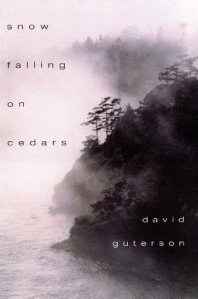
 Snow Falling on Cedars by David Guterson: The mystery element held me completely gripped – readers are just as in the dark as jurors until close to the end – but this is mostly a powerful picture of the lasting effects of racism. I was instantly immersed, whether in a warm courtroom with a snowstorm swirling outside or on a troop ship entering the Pacific Theater.
 Nothing but Blue Sky by Kathleen MacMahon: David is back on Spain’s Costa Brava, where he and his wife Mary Rose holidayed every summer for 20 years. This is a quiet novel about what goes unsaid in any marriage, and a deeply touching look at loss and what comes next. Grief, memory, fate: some of my favourite themes, elegantly treated.
 A Feather on the Breath of God by Sigrid Nunez: From the little I know of Nunez, this seems close to autofiction, especially in terms of her parents. Identifying the self by the key relationships and obsessions of a life makes sense, and this speaks to the universals of how we cope with a troublesome past. It cemented her as one of my favourite authors.
 Woman on the Edge of Time by Marge Piercy: An unusual and fascinating novel with hints of science fiction, but still grounded in the real world, this contrasts utopian and dystopian scenes experienced by a Latina woman who’s been confined to a mental hospital. It’s an intense cultural commentary from a writer ahead of her time on gender roles and the environment.
 My Dark Vanessa by Kate Elizabeth Russell: Obsessed with Lolita since she was a teenager, Russell decided to tell the teenage girl’s side of the story. She uses a dual timeline to great effect, creating an utterly immersive novel – as good a first-person narrative as anything Curtis Sittenfeld has ever written, and the ultimate #MeToo story.
 Saint Maybe by Anne Tyler: Ian Bedloe joins the puritanical Church of the Second Chance and drops out of college to help his parents raise his late brother’s three children. Anyone will be able to find themselves and their family in this story of the life chosen versus the life fallen into, and the difficult necessity of moving past regrets in the search for meaning.
 The Amateur Marriage by Anne Tyler: Unique in her oeuvre for how it bridges historical fiction and her more typical contemporary commentary. The Antons muddle their way through a volatile marriage for decades without figuring out how to change anything for the better. There is deep compassion for their foibles and how they affect the next generation.
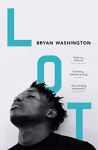 Lot by Bryan Washington: The musical equivalent might be a mixtape blasted from an open-top Corvette while touring the streets of Houston, Texas. Drug dealers, careworn immigrants, and prostitutes: Even the toughest guys have tender hearts in these 13 stories. Washington’s prose is earthy and slang-filled. The matter-of-fact phrasing made me laugh.
 Ethan Frome by Edith Wharton: I was so impressed by this condensed tragedy and the ambiance of a harsh New England winter. It struck me even more on a reread as a flawless parable of a man imprisoned by circumstance and punished for wanting more. A perfect example of how literature can encapsulate the human condition.
Poetry
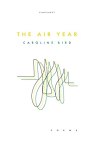 The Air Year by Caroline Bird: I read this with a big smile on my face, delighting in the clever and playful poems. The impermanence of relationships is a recurring theme. Dreams and miscommunication are also common elements, and lists grow increasingly absurd. I particularly liked where structure creates meaning, e.g. the mise en abyme of “Dive Bar.”
Nonfiction
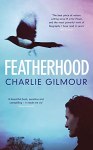 Featherhood by Charlie Gilmour: As an aimless twentysomething, Gilmour tried to rekindle a relationship with his unreliable poet father. Meanwhile, he was raising Benzene, a magpie that fell out of its nest. He makes elegant use of connections and metaphors; he’s so good at scenes, dialogue, and emotion – a truly natural writer.
 Spring in Washington by Louis J. Halle: From first migrant in February to last in June, the author traced the D.C. spring of 1945 mostly through the birds that he saw. More so than the specific observations of familiar places, though, I valued the philosophical outlook. For me this was an ideal combination of thoughtful prose and vicarious travel.
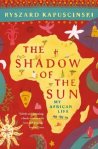 The Shadow of the Sun by Ryszard Kapuściński: This collection of essays spans decades and lots of African countries, yet feels like a cohesive narrative. Kapuściński saw many places right on the cusp of independence or in the midst of coup d’états. I appreciated how he never resorts to stereotypes or flattens differences. One of the few best travel books I’ve read.
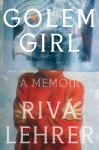 Golem Girl by Riva Lehrer: Lehrer has endured dozens of surgeries for spina bifida. Her touching family memoir is delivered in short, essay-like chapters, most named after books or films. It is also a primer in Disability theory and a miniature art gallery, filled with reproductions of her paintings. This inaugural Barbellion Prize winner is not to be missed.
 The Cost of Living by Deborah Levy: This sparse volume, the middle in an autobiographical trilogy, has Levy searching for the intellectual and physical freedom needed to reinvent her life after divorce. It is made up of conversations and memories; travels and quotations that have stuck with her. Each moment is perfectly chosen to reveal the self.
 Conundrum by Jan Morris: Morris was a trans pioneer; this transformed my understanding of gender when I first read it in 2006. Born James, Morris knew by age four that she was really a girl. A journalism career, marriage, five children, and two decades of hormone therapy preceded sex reassignment surgery. She paints hers as a spiritual quest toward her true identity.
 You’re Not Listening: What You’re Missing and Why It Matters by Kate Murphy: We all fail to listen properly sometimes, for various reasons. A New York Times journalist, Murphy does a lot of listening to her interview subjects. She also talks with representatives of so-called listening careers. This is a short, interesting, and genuinely helpful self-help book.
 Writing in the Dust: After September 11 by Rowan Williams: Williams, then Archbishop of Wales, was in New York City on 9/11, just a few blocks from the World Trade Center. In the months that followed he pondered suffering, peacemaking, and the ways of God. He cautions against labelling the Other as Evil and responding with retribution. A superb book-length essay.
And if I really had to limit myself to just two favourites – my very best fiction and nonfiction reads of the year – they would be Snow Falling on Cedars and The Cost of Living.

What were your best backlist reads this year?
Merry Christmas!
(I’ll be back on the 27th with Love Your Library, then I have various year-end superlatives and statistics posts going through the 31st.)
Six Degrees of Separation: From Shuggie Bain to Girl, Woman, Other

This month we begin with Shuggie Bain by Douglas Stuart (2020), last year’s Booker Prize winner. (See Kate’s opening post.) I tried it a couple of times and couldn’t get past page 100, but I’ve kept my proof copy on the shelf to try some other time.
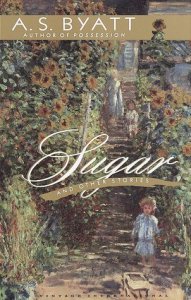 #1 The main character’s sweet nickname takes me to Sugar and Other Stories by A.S. Byatt. Byatt is my favourite author. Rereading her The Matisse Stories last year was rewarding, and I’d eventually like to go back to the rest of her short fiction. I read Sugar and Other Stories in Bath in 2006. (As my MA year in Leeds came to a close, I interviewed at several libraries, hoping to get onto a graduate trainee scheme so I could stay in the UK for another year. It didn’t work out, but I got to tour many wonderful libraries.) I picnicked on the grass on a May day on the University of Bath campus before my interview at the library.
I can’t claim to remember the book well overall, but I do recall the story “The July Ghost,” in which a man at a party tells a story about his landlady and the silent boy he’s seen in her garden. This turns out to be the ghost of her son, who died when he was hit by a car two summers earlier. I’ve never forgotten it because that’s exactly what happened to Byatt’s 12-year-old son.
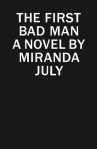 #2 The title of that memorable story takes me to The First Bad Man by Miranda July. This review from the early days of my blog is still inexplicably popular in terms of number of views. The novel is full of unlikable characters and quirkiness for the sake of it; I doubt I would have read it had I not been sent an unsolicited review copy by the U.S. publisher.
 #3 According to a search of my Goodreads library, the only other book I’ve ever read by a Miranda is A Girl Walks into a Book by Miranda K. Pennington, a charming bibliomemoir about the lives and works of the Brontës. I especially enjoyed the cynical dissection of Wuthering Heights, a classic I’ve never managed to warm to.
 #4 From one famous set of sisters in the arts to another with Vanessa and Her Sister by Priya Parmar, a novel about Vanessa Bell and Virginia Woolf. It is presented as Vanessa’s diary, incorporating letters and telegrams. The interactions with their Bloomsbury set are delightful, and sibling rivalry is a perennial theme I can’t resist.
#5 Another Vanessa novel and one I would highly recommend to anyone wanting a nuanced look at the #MeToo phenomenon is My Dark Vanessa by Kate Elizabeth Russell. It’s utterly immersive and as good a first-person narrative as anything Curtis Sittenfeld has ever written. I also appreciated the allusions to other works of literature, from Nabokov (the title is from Pale Fire) to Swift. This would make a great book club selection.
 #6 Speaking of feminist responses to #MeToo, Girl, Woman, Other by Bernardine Evaristo is just as good as you’ve heard. If you haven’t read it yet, why not? It’s a linked short story collection about 12 black women navigating twentieth-century and contemporary Britain – balancing external and internal expectations to build lives of their own. It reads like poetry.
Cycling round from one Booker Prize winner to another, I’ve featured stories by and about strong women, with most of my links coming from names and titles.
Whatever could be on the 2021 Booker Prize longlist? We have a lot of literary prize races to see out before then, but I’m keen to learn what Rev. Rowan Williams and the rest of the judges deem worthy.
Where will your chain take you? Join us for #6Degrees of Separation! (Hosted on the first Saturday of each month by Kate W. of Books Are My Favourite and Best.) Next month’s starting point is Beezus and Ramona, in honour of Beverly Cleary (May 1, 2021).
Have you read any of my selections? Are you tempted by any you didn’t know before?
Novellas in November: 10 Favorite Classic Novellas
For this final week of Novellas in November, we’re focusing on classic literature. The more obscure the better, as far as I’m concerned. Maybe a few of the favorites I feature below will be new to you? (The two not pictured were read from the library.)

 Giovanni’s Room by James Baldwin [150 pages]: David, a penniless American, came to Paris to find himself. His second year there he meets Giovanni, an Italian barman. They fall in love and move in together. There’s a problem, though: David has a fiancée. We know from the first pages that David has fled to the south of France and that Giovanni faces the guillotine in the morning, but throughout Baldwin maintains the tension as we wait to hear why he has been sentenced to death. Deeply sad, but also powerful and brave.
 The Darling Buds of May by H.E. Bates [137 pages]: “Perfick” reading for an afternoon sitting or two; The Novel Cure even prescribes it as a tonic for cynicism. Just like tax inspector Cedric Charlton, you’ll find yourself drawn into the orbit of junk dealer Pop Larkin, Ma, and their six children at their country home in Kent – indomitably cheery hedonists, the lot of them. Ma and Pop are more calculating than they let on, but you can’t help but love them. Plus Bates writes so evocatively about the British countryside in late spring.
 Breakfast at Tiffany’s by Truman Capote [91 pages]: Whether you’ve seen the Audrey Hepburn film or not, this is delightful. Holly Golightly has remade herself as a New York City good-time girl, but her upstairs neighbor discovers her humble origins. This was from my pre-reviewing days, so I have no more detail to add. But whenever I think of its manic cocktail party scenes, I think of a holiday do from my final year of college: packed like sardines, everyone talking over each other, and my professor couldn’t stop shaking my hand.
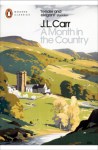 A Month in the Country by J.L. Carr [108 pages]: Summer 1920: Tom Birkin, a WWI veteran, arrives in North Yorkshire to uncover a local church’s medieval wall painting of the Judgment Day. With nothing awaiting him back in London, he gives himself over to the rhythms of working, eating and sleeping. Also embarked on a quest into the past is Charles Moon, searching for the grave of their patroness’ 14th-century ancestor in the churchyard. Moon, too, has a war history he’d rather forget. A Hardyesque, tragicomic romance.
The Pumpkin Eater by Penelope Mortimer [144 pages]: Aged 31 and already on her fourth husband, the narrator, known only as Mrs. Armitage, has an indeterminate number of children. A breakdown at Harrods is the sign that Mrs. A. isn’t coping, and she starts therapy. Meanwhile, her filmmaker husband is having a glass tower built as a countryside getaway, allowing her to contemplate an escape from motherhood. A razor-sharp period piece composed largely of dialogue, it gives a sense of a woman overwhelmed by responsibility.
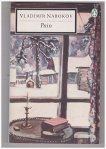 Pnin by Vladimir Nabokov [177 pages]: A comic novel about a Russian professor on an American college campus. In this episodic narrative spanning 1950–4, Timofey Pnin is a figure of fun but also of pathos: from having all his teeth pulled out and entertaining the son his ex-wife had by another man to failing to find and keep a home of his own, he deserves the phrase Nabokov originally thought to use as a title, “My Poor Pnin”. There are shades of Lucky Jim here – I laughed out loud at some of Pnin’s verbal gaffes and slapstick falls.
 No Signposts in the Sea by Vita Sackville-West [156 pages]: Sackville-West’s last novel, published a year before her death, was inspired by world cruises she and her husband, Harold Nicolson, took in later life. Fifty-year-old Edmund Carr, a journalist with a few months to live, has embarked on a cruise ship voyage to be close to the woman he loves, 40-year-old war widow Laura Drysdale. He dares to hope she might return his feelings … but doesn’t tell her of his imminent demise. The novel is presented as Edmund’s diary, found after his death.
 The Catcher in the Rye by J.D. Salinger [192 pages]: Believe it or not, I didn’t read this until December 2018! From the start I found Holden Caulfield’s voice funny and surprising, so drenched in period American slang you can never forget when and where it’s set. He’s a typical lazy teenager, flunking four subjects when he’s kicked out of Pencey Prep. The first part is a languorous farewell tour to classmates and teachers before he takes the train back to NYC. Once there, he lives it up in a hotel for a few days. A shocker of an ending is to come.
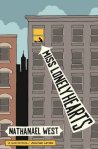 Miss Lonelyhearts by Nathanael West [110 pages]: Like The Great Gatsby, this is a very American tragedy and state-of-the-nation novel. “Miss Lonelyhearts” is a male advice columnist for the New York Post-Dispatch. His letters come from a pitiable cross section of humanity: the abused, the downtrodden and the unloved. Not surprisingly, these second-hand woes start to get him down, and he turns to drink and womanizing for escape. West’s picture of how beleaguered compassion can turn to indifference feels utterly contemporary.
Ethan Frome by Edith Wharton [181 pages]: Unlike Wharton’s NYC society novels, this has a rural setting, but the plot is not dissimilar to that of The Age of Innocence, with extra tragic sauce. The title character makes the mistake of falling in love with his wife’s cousin, and the would-be lovers are punished one New England winter. A quarter of a century later, the narrator learns what happened to this sad old man. It’s probably been 15 years since I’ve read this, and I like the catharsis of a good old-fashioned tragedy. Maybe I’ll reread it soon.
Not enough women on my list! I should redress that by reading some more Jean Rhys…

Keep in touch via Twitter (@bookishbeck / @cathy746books) and Instagram (@bookishbeck / @cathy_746books). We’ll keep adding your review links in to our master posts. Feel free to use the terrific feature image Cathy made and don’t forget the hashtag #NovNov.
Any suitably short classics on your shelves?
Magdalena Mountain by Robert Michael Pyle
“Wasn’t it Nabokov who said ‘It is astounding how little the ordinary person notices butterflies?’”
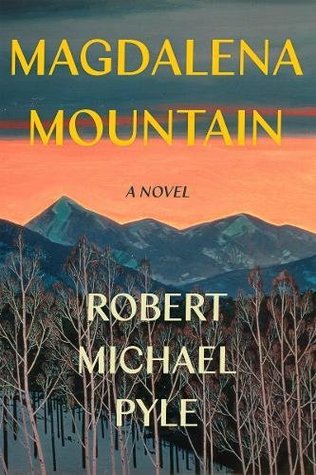 Butterflies, monks, students and teachers, prophets and saints: such is the cast of naturalist Robert Michael Pyle’s unusual and rewarding debut novel, Magdalena Mountain. It’s a golden autumn in the early 1970s as James Mead leaves Albuquerque on a Greyhound bus to travel to New Haven, Connecticut, where he will undertake a PhD in biology at Yale. He squats in a lab on campus to save money and, after some tension with his thesis advisor, decides to keep his head down, feeding the department’s giant cave roaches and becoming engrossed in the field journals written by one October Carson in 1969 during his travels out West.
Pyle presents nature as both beatific and harsh, a continuity of life that human events – like a car going over a cliff in the first chapter – barely disrupt. Occasional chapters check in on the woman who was in the car crash, Mary Glanville. Now suffering from amnesia, she believes she’s a famous figure from history. One day she escapes from her nursing home and hitchhikes into the Colorado mountains. In her weakened state she’s taken in by Attalus and Oberon, monks at a deconsecrated monastery devoted to the god Pan and the creeds of nature writers like John Burroughs, Aldo Leopold and John Muir. Attalus, a compassionless misogynist, vehemently protests Mary’s presence in their community, but Oberon soon falls in love with her.
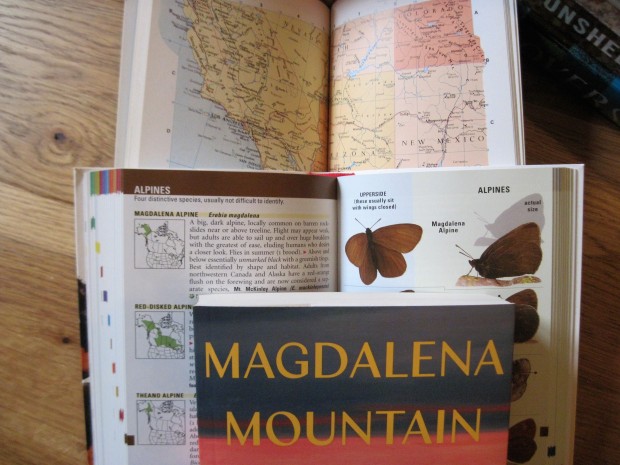
When James, disobeying his supervisor, lights out for Colorado for a summer of research at the Rocky Mountain Biological Laboratory, the stage is set for these major characters to collide on Magdalena Mountain, home to the distinctive, all-black Magdalena Alpine butterfly (Erebia magdalena). “Flight may appear weak, but adults are able to sail up and over huge boulders with the greatest of ease, eluding humans who desire a closer look. Flies in summer,” reads the description in my (Kaufman) field guide to North American butterflies. Intermittent segments of pure nature writing about Erebia’s life cycle – seven short chapters in total – establish the seasons and encourage a long view of local history, but somewhat slow down the novel’s tempo.
Pyle successfully pulls in so many different themes: academic infighting and the impulses of scientific researchers versus amateur collectors; environmentalism, especially through the threats that infestations, pesticides and off-road vehicles pose to the mountain landscape; activism, by way of the Vietnam War and nuclear weapons protests; and even sacred femininity and the myths surrounding Mary Magdalene. Mary Glanville’s name is a nice nod to history – Elinor Glanville was a seventeenth-century English collector who gave her name to the Glanville Fritillary – while Vladimir Nabokov, who was a keen lepidopterist as well as an academic and author, is mentioned several times for his real-life connections to the area.
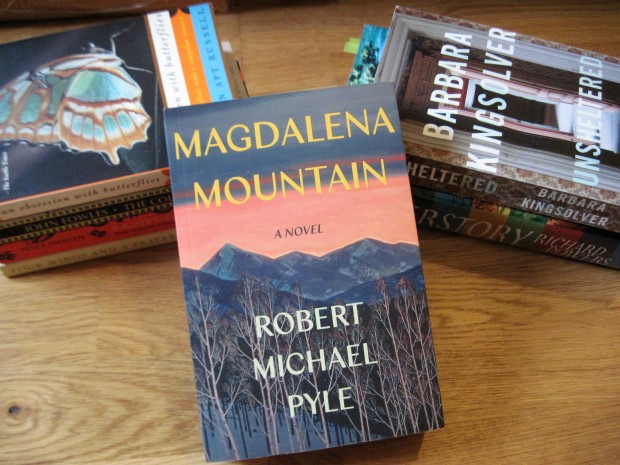
(A selection of my butterfly-themed books, read and unread, in the pile at the left.)
The quirky set of hangers-on at the monastery reminded me of an Iris Murdoch setup (thinking mostly of The Bell), while the passion for science and activism brought to mind two other excellent environmentally minded novels published this year, The Overstory and Unsheltered. Indeed, Mary preaches at one point, “Seek your shelter in nature … In love lies the only real shelter there is.” If you’re interested in the Powers and/or Kingsolver, I would commend Pyle’s book to you as well: it’s offbeat, dreamy yet fervent, with intriguing characters and elegant nature-infused language. One of my favorite descriptive scraps, so simple but so apt, was “a peeled peach of a moon.” I’m grateful to have had a chance to read this, and I will be seeking out Pyle’s nature writing, too.
My rating: 
Magdalena Mountain was published in August 2018. My thanks to the good folk of Counterpoint Press (based in Berkeley, California) for sending a free copy for review.
My Top 10 Nonfiction Reads of 2017
Below I’ve chosen my seven favorite nonfiction books published in 2017, followed by three older titles that I only recently discovered. Many of these books have already featured on the blog in some way over the course of the year. To keep it simple for myself as well as for all of you who are figuring out whether you’re interested in these books or not, I’m mostly limiting myself to two sentences per title: the first is a potted summary; the second tells you why you should read it. I also link to any full reviews.
-
 Landslide: True Stories by Minna Zallman Proctor: This gorgeous set of autobiographical essays circles through some of the overarching themes of the author’s life: losing her mother, a composer; the importance Italy had for both of them; a love for the work of Muriel Spark; their loose connection to Judaism; and the relentless and arbitrary nature of time. Proctor provides a fine example of how to write a non-linear memoir that gets to the essence of what matters in life.
 My Jewish Year by Abigail Pogrebin: From September 2014 to September 2015, Pogrebin celebrated all the holidays in the Jewish calendar, drawing thematic connections and looking for the resonance of religious rituals might have in her daily life. This bighearted, open-minded book strikes me as a perfect model for how any person of faith should engage with their tradition: not just offering lip service and grudgingly showing up to a few services a year, but knowing what you believe and practice, and why.
-

The U.S. cover
In Pursuit of Memory: The Fight against Alzheimer’s by Joseph Jebelli: With the world’s population aging, it is expected that by 2050 Alzheimer’s will be the second leading cause of death after heart disease. Research neurologist Joseph Jebelli gives a thorough survey of the history of Alzheimer’s and the development of our efforts to treat and even prevent it, but balances his research with a personal medical story any reader can relate to – his beloved grandfather, Abbas, succumbed to Alzheimer’s back in Iran in 2012. (See my full review for BookBrowse.)
 My Life with Bob by Pamela Paul: Whether she was hoarding castoffs from her bookstore job, obsessing about ticking off everything in the Norton Anthology, despairing that she’d run out of reading material in a remote yurt in China, or fretting that her new husband took a fundamentally different approach to the works of Thomas Mann, Paul (the editor of the New York Times Book Review) always looks beyond the books themselves to ask what they say about her. It’s just the sort of bibliomemoir I wish I had written.
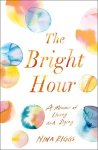 The Bright Hour by Nina Riggs: Beautiful prose enhances this literary and philosophical approach to terminal cancer. Riggs was a great-great-great-granddaughter of Ralph Waldo Emerson and quotes from her ancestor’s essays as well as from Michel de Montaigne’s philosophy to put things into perspective; she’s an expert at capturing the moments that make life alternately euphoric and unbearable – and sometimes both at once.
 Fragile Lives by Stephen Westaby: This is a vivid, compassionate set of stories culled from the author’s long career in heart surgery with the Grim Reaper looking on. I am not a little envious of all that Westaby has achieved: not just saving the occasional life despite his high-mortality field – as if that weren’t enough – but also pioneering various artificial heart solutions and a tracheal bypass tube that’s named after him.
And my nonfiction book of the year was:
1. The Shadow in the Garden: A Biographer’s Tale by James Atlas: I read this in August, planning to contrast it with Claire Tomalin’s A Life of My Own, another biographer’s memoir, for the LARB. It would have been a brilliant article, believe me. But they didn’t bite, and by the time I approached the TLS they’d already arranged coverage of the books. Alas! Such is the life of a freelancer. Since then I’ve struggled to know what to say about Atlas’s book that would explain why I loved it so much that my paperback proof is riddled with Post-It flags. (It’s going to take more than a couple of sentences…)
Much more so than Tomalin, Atlas gave me a real sense of what it’s like to immerse yourself in another person’s life. He made it up as he went along: he was only 25 when he got the contract to write a biography of the poet Delmore Schwartz, who died a penniless alcoholic at age 52. Writing about the deceased was a whole different matter to engaging with a living figure, as Atlas did when he wrote his biography of Saul Bellow in the 1990s.
 Atlas perceptively explores the connections between Schwartz and Bellow (Schwartz was the model for the protagonist of Bellow’s 1975 Pulitzer winner, Humboldt’s Gift) and between Bellow and himself (a Chicago upbringing with Russian Jewish immigrant ancestors), but also sets his work in the context of centuries of biographical achievement – from Boswell’s The Life of Samuel Johnson through master biographers like Richard Holmes, Leon Edel and Richard Ellmann (Atlas’s supervisor during his fellowship at Oxford) to recent controversial biographies of Robert Frost and Vladimir Nabokov.
This book deals with the nitty-gritty of archival research and how technology has changed it; Atlas also talks story-telling strategies and the challenge of impartiality, and ponders how we look for the patterns in a life that might explain what, besides genius, accounts for a writer’s skill. Even the footnotes are illuminating, and from the notes I learned about a whole raft of biographies and books on the biographer’s trade that I’d like to read. After I finished reading it I spent a few days dreamily wondering if I might write a biography some day. For anyone remotely interested in life writing, pick this up with my highest recommendation.
I’ll make it up to an even 10 with a few backlist titles I also loved:
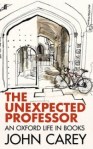 The Unexpected Professor: An Oxford Life in Books by John Carey (2014): Carey gives a thorough picture of events from his personal and professional life, but the focus is always on his literary education: the books that have meant the most to him and the way his taste and academic specialties have developed over the years. Ultimately what this book conveys is the joy of being a lifelong reader.
 A Sand County Almanac and Sketches Here and There by Aldo Leopold (1949): So many of Leopold’s musings ring true today: how we only appreciate wildlife if we can put an economic value on it, the troubles we get into when we eradicate predators and let prey animals run rampant, and the danger of being disconnected from the land that supplies our very life. And all this he delivers in stunning, incisive prose.
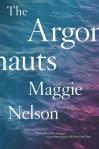 The Argonauts by Maggie Nelson (2015): An exquisite interrogation of gender identity and an invaluable reminder that the supposed complications of making a queer family just boil down to your basic human experiences of birth, love and death. I preferred those passages where Nelson allows herself to string her fragments into more extended autobiographical meditations, like the brilliant final 20 pages interspersing her memories of giving birth to her son Iggy with an account of the deathbed vigil her partner (artist Harry Dodge) held for his mother; it had me breathless and in tears, on a plane of all places.
What were some of your top nonfiction reads of the year?
Tomorrow I’ll be posting my Library Checkout a few days early.
Next week’s planned posts:
26th: Doorstopper of the Month
27th: Top fiction of the year list
28th: Runners-up and other superlatives
29th: Early 2018 recommendations
30th: Final statistics on my 2017 reading
Ghent and Amsterdam, and What I Read
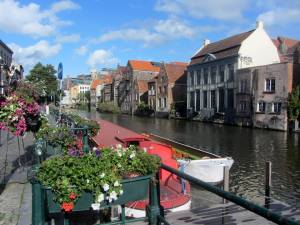
Ghent. Photo by Chris Foster
We got back on Monday from a packed week in Ghent and Amsterdam. Despite the chilly, showery weather and a slightly disappointing Airbnb experience in Ghent, it was a great trip overall. Our charming little B&B apartment in Broek in Waterland, a 20-minute bus ride from Amsterdam, more than made up for the somewhat lackluster accommodation in Belgium and was a perfect base for exploring the area. With our three-day, all-inclusive regional travel passes we were free to hop on as many trams and buses as we wanted.
On Saturday we crammed in lots of Amsterdam’s main attractions: the Rijksmuseum, the Begijnhof cloisters, the Botanical Gardens and the Anne Frank House, interspersed with window shopping, a rainy picnic lunch and an Indonesian takeaway dinner eaten by a canal. I also got to visit a more off-the-beaten-track attraction I’d spotted in our guide book: De Poezenboot or “The Cat Boat,” a home for strays moored on the Singel canal. Alas, the resident kitties were not as friendly as many we met on the rest of the trip, but it was still fun.


The highlight of our Amsterdam stay was the Van Gogh Museum on Sunday morning. It was crowded – everything was; though Ghent was very quiet, Amsterdam doesn’t seem to be into its off season yet, if it even has one – but we took our time and saw every single painting, many of which I’d never come across in reproductions. The galleries are organized in chronological order, so you get to trace Van Gogh’s style and state of mind over the years. Superb.
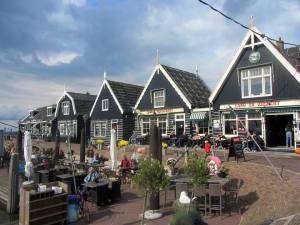
Marken. Photo by Chris Foster
At this point we were just about overwhelmed by the big city atmosphere, so we spent much of the next day and a half in the outlying Dutch towns of Marken and Edam. Flat fields and dykes, cows, cobbled streets and bicycles everywhere – it’s what you’d expect of Holland’s countryside, apart from a surprising dearth of windmills.


Bookish highlights:
- This Ghent University library – I’m presuming it held Special Collections/rare books:


- The American Book Center in Amsterdam:

Photo by Chris Foster
What I read:
 Pnin by Vladimir Nabokov: A comic novel about a Russian professor on an American college campus. While there are indeed shades of Lucky Jim – I certainly laughed out loud at Timofey Pnin’s verbal gaffes and slapstick falls – there’s more going on here. In this episodic narrative spanning 1950–4, Pnin is a figure of fun but also of pathos: from having all his teeth out and entertaining the son his ex-wife had by another man to failing to find and keep a home of his own, he deserves the phrase Nabokov originally thought to use as a title, “My Poor Pnin”.
 Cork Dork by Bianca Bosker: Bosker gave herself a year and a half to learn everything about wine in hopes of passing the Court of Master Sommeliers exam. Along the way she worked in various New York City restaurants, joined blind tasting clubs and attended an olfactory conference. The challenge included educating her palate, absorbing tons of trivia about growers and production methods, and learning accepted standards for sommelier service. The resulting book is a delightful blend of science, memoir and encounters with people who are deadly serious about wine.
 You Should Have Left by Daniel Kehlmann: And I thought my Airbnb experience was a nightmare? This is a horror novella about a writing retreat gone bad. The narrator is a screenplay writer who’s overdue delivering the sequel to Besties. As he argues with his partner, tries to take care of his daughter and produces fragments of the screenplay, the haunted house in the mountains starts to close in on him. I’ve loved Kehlmann’s work before (especially F), but he couldn’t convince me of the narrator’s state of mind or the peril. I actually found the book unintentionally humorous.
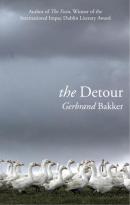 The Detour by Gerbrand Bakker: A Dutch translator and Emily Dickinson scholar has fled a mistake in her personal life and settled in rural Wales at the foot of Snowdon. “She had left everything behind, everything except the poems. They would have to see her through. She forgot to eat.” On her farmstead is a dwindling flock of geese and, later on, a young man surveying for a new footpath. Amidst her quiet, secret-filled days we also learn of her husband’s attempts to find her back in Amsterdam. Bakker’s writing is subtle and lovely, yet the story never quite took off for me.
 Tulip Fever by Deborah Moggach: If you liked Girl with a Pearl Earring and The Miniaturist, you may also enjoy this atmospheric, art-inspired novel set in the 1630s. (Originally from 1999, it’s recently been adapted into a film.) Sophia, married off to an old merchant, falls in love with Jan van Loos, the painter who comes to do their portrait. If Sophia and Jan are ever to be together, they’ll have to scrape together enough money to plot an elaborate escape. I thought this was rather soap opera-ish most of the way through, though I was satisfied with how things turned out in the end.
Plus other books I had on the go (lots of short works and literature in translation):
 Dangling Man by Saul Bellow
- Diary of a Bookseller by Shaun Bythell
- Madame Bovary by Gustave Flaubert
- The Unseen by Roy Jacobsen
- The Bus Driver Who Wanted to Be God and Other Stories by Etgar Keret
- Notes on a Banana: A Memoir of Food, Love and Manic Depression by David Leite
- The Fact of a Body: A Murder and a Memoir by Alexandria Marzano-Lesnevich
- Honeydew: Stories by Edith Pearlman
- A Girl Walks into a Book: What the Brontës Taught Me about Life, Love, and Women’s Work by Miranda Pennington
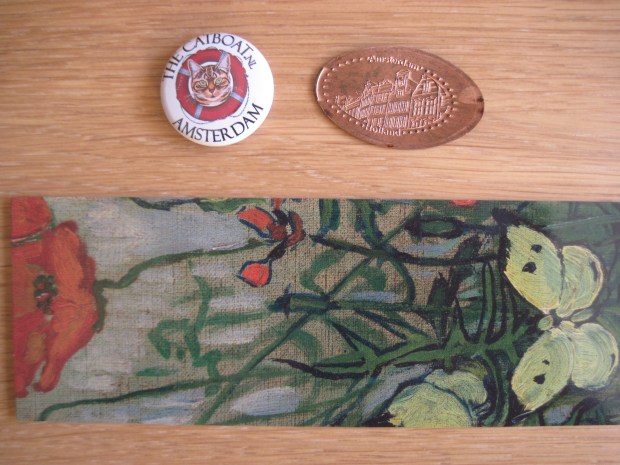
Extremely cheap souvenirs of Amsterdam to add to my collections: a badge, a pressed coin, and a Van Gogh bookmark.
What have you been reading recently?
Do you find that books read ‘on location’ never quite live up to your expectations?
 Bookish Beck = Rebecca Foster. American transplant to England. Freelance proofreader and book reviewer.
 Bookish Beck