Literary Wives Club: The Constant Wife by W. Somerset Maugham (1927)
As far as I know, this is the first play we’ve chosen for the club. While I’m a Maugham fan, I haven’t read him in a while and I’ve never explored his work for the theatre. The Constant Wife is a straightforward three-act play with one setting: a large parlour in the Middletons’ home in Harley Street, London. A true drawing room comedy, then, with very simple staging.
{SPOILERS IN THE REMAINDER}
Rumours are circulating that surgeon John Middleton has been having an affair with his wife Constance’s best friend, Marie-Louise. It’s news to Mrs. Culver and Martha, Constance’s mother and sister – but not to Constance herself. Mrs. Culver, the traditional voice of a previous generation, opines that men are wont to stray and so long as the wife doesn’t find out, what harm can it do? Women, on the other hand, are “naturally faithful creatures and we’re faithful because we have no particular inclination to be anything else,” she says.
Other characters enter in twos and threes for gossip and repartee and the occasional confrontation. Marie-Louise’s husband, Mortimer Durham, shows up fuming because he’s found John’s cigarette-case under her pillow and assumes it can only mean one thing. Constance is in the odd position of defending her husband’s and best friend’s honour, even though she knows full well that they’re guilty. With her white lies, she does them the kindness of keeping their indiscretion quiet – and gives herself the moral upper hand.
Constance is matter of fact about the fading of romance. She is grateful to have had a blissful first five years of marriage; how convenient that both she and John then fell out of love with each other at the same time. The decade since has been about practicalities. Thanks to John, she has a home, respectability, and fine belongings (also a child, only mentioned in passing); why give all that up? She’s still fond of John, anyway, and his infidelity has only bruised her vanity. However, she wants more from life, and a sheepish John is inclined to give her whatever she asks. So she agrees to join an acquaintance’s interior decorating business.
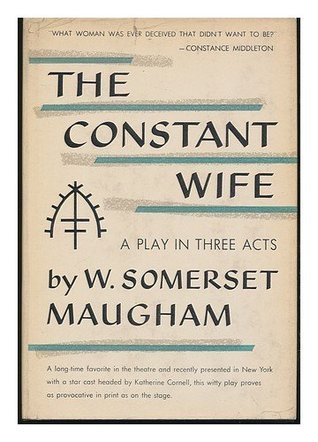
The early reappearance of her old flame Bernard Kersal, who is clearly still smitten with her, seeds her even more daring decision in the final act, set one year after the main events. Having earned £1400 of her own money, she has more than enough to cover a six-week holiday in Italy. She announces to John that she’s deposited the remainder in his account “for my year’s keep,” and slyly adds that she’ll be travelling with Bernard. This part turns out to be a bluff, but it’s her way of testing their new balance of power. “I’m not dependent on John. I’m economically independent, and therefore I claim my sexual independence,” she declares in her mother’s company.
There are some very funny moments in the play, such as when Constance tells her mother she’ll place a handkerchief on the piano as a secret sign during a conversation. Her mother then forgets what it signifies and Constance ends up pulling three hankies in a row from her handbag. I had to laugh at Mrs. Culver’s test for knowing whether you’re in love with someone: “Could you use his toothbrush?” It’s also amusing that Constance ends up being the one to break up with John for Marie-Louise, and with Marie-Louise for John.
However, there are also hidden depths of feeling meant to be brought out by the actors. At least three times in scenes between John and Constance, I noted the stage direction “Breaking down” in parentheses. The audience, therefore, is sometimes privy to the emotion that these characters can’t express to each other because of their sardonic wit and stiff upper lips.
I hardly ever experience plays, so this was interesting for a change. At only 70-some pages, it’s a quick read even if a bit old-fashioned or tedious in places. It does seem ahead of its time in questioning just what being true to a spouse might mean. A clever and iconoclastic comedy of manners, it’s a pleasant waystation between Oscar Wilde and Alan Ayckbourn.
(Free download from Internet Archive – is this legit or a copyright scam??) 
The main question we ask about the books we read for Literary Wives is:
What does this book say about wives or about the experience of being a wife?
Answered by means of quotes from Constance.
- Partnership is important, yes, but so is independence. (Money matters often crop up in the books we read for the club.)
“there is only one freedom that is really important, and that is economic freedom”
- Marriage often outlasts the initial spark of lust, and can survive one or both partners’ sexual peccadilloes. (Maugham, of course, was a closeted homosexual married to a woman.)
“I am tired of being the modern wife.” When her mother asks for clarification, she adds rather bluntly, “A prostitute who doesn’t deliver the goods.”
“I may be unfaithful, but I am constant. I always think that’s my most endearing quality.”
We have a new member joining us this month: Becky, from Australia, who blogs at Aidanvale. Welcome! Here’s the group’s page on Kay’s website.
See Becky’s, Kate’s, Kay’s and Naomi’s reviews, too!
Coming up next, in September: Novel about My Wife by Emily Perkins
Book Serendipity, January to February 2024
I call it “Book Serendipity” when two or more books that I read at the same time or in quick succession have something in common – the more bizarre, the better. This is a regular feature of mine every couple of months. Because I usually have 20–30 books on the go at once, I suppose I’m more prone to such incidents. The following are in roughly chronological order.
- I finished two poetry collections by a man with the surname Barnett within four days in January: Murmur by Cameron Barnett and Birds Knit My Ribs Together by Phil Barnett.

- I came across the person or place name Courtland in The Optimist’s Daughter by Eudora Welty, then Cortland in a story from The Orange Fish by Carol Shields, then Cotland (but where? I couldn’t locate it again! Was it in Elizabeth Is Missing by Emma Healey?).
- The Manet painting Olympia is mentioned in Christmas Holiday by W. Somerset Maugham and The Paris Novel by Ruth Reichl (both of which are set in Paris).


- There’s an “Interlude” section in Babel by R.F. Kuang and The Vulnerables by Sigrid Nunez.
- The Morris (Minor) car is mentioned in Elizabeth Is Missing by Emma Healey and Various Miracles by Carol Shields.
- The “flour/flower” homophone is mentioned in Babel by R.F. Kuang and Various Miracles by Carol Shields.
- A chimney swift flies into the house in Cat and Bird by Kyoko Mori and The Optimist’s Daughter by Eudora Welty.
- A character named Cornelius in The Fruit Cure by Jacqueline Alnes and Wellness by Nathan Hill.
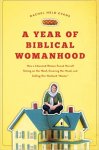
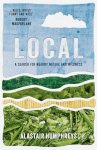
- Reading two year challenge books at the same time, A Year of Biblical Womanhood by Rachel Held Evans and Local by Alastair Humphreys, both of which are illustrated with frequent black-and-white photos by and of the author.
- A woman uses a bell to summon children in one story of Universally Adored and Other One Dollar Stories by Elizabeth Bruce and The Optimist’s Daughter by Eudora Welty.
- Apple turnovers get a mention in A Year of Biblical Womanhood by Rachel Held Evans and Wellness by Nathan Hill.
- A description of rolling out pie crust in A Year of Biblical Womanhood by Rachel Held Evans and Cat and Bird by Kyoko Mori.

- The idea of a house giving off good or bad vibrations in Wellness by Nathan Hill and a story from Various Miracles by Carol Shields.

- Emergency C-sections described or at least mentioned in Brother Do You Love Me by Manni Coe, The Unfamiliar by Kirsty Logan, Wellness by Nathan Hill, and lots more.
- Frustration with a toddler’s fussy eating habits, talk of “gentle parenting” methods, and mention of sea squirts in Wellness by Nathan Hill and Matrescence by Lucy Jones.
- The nickname “Poet” in The Tidal Year by Freya Bromley and My Friends by Hisham Matar.
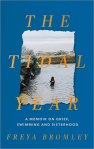
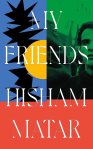
- A comment about seeing chicken bones on the streets of London in The Tidal Year by Freya Bromley and Went to London, Took the Dog by Nina Stibbe.
- Swans in poetry in The Tidal Year by Freya Bromley and Egg/Shell by Victoria Kennefick.
- A mention or image of Captcha technology in Egg/Shell by Victoria Kennefick and Went to London, Took the Dog by Nina Stibbe.
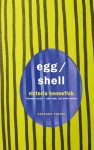

- An animal automaton in Loot by Tania James and Egg/Shell by Victoria Kennefick.
- A mention of Donna Tartt in The Tidal Year by Freya Bromley, Looking in the Distance by Richard Holloway, and Matrescence by Lucy Jones.
- Cathy Rentzenbrink appears in The Tidal Year by Freya Bromley and Went to London, Took the Dog by Nina Stibbe.
 Dialogue is given in italics in the memoirs The Tidal Year by Freya Bromley and The Unfamiliar by Kirsty Logan.
- An account of a man being forced to marry the sister of his beloved in A Year of Biblical Womanhood by Rachel Held Evans, Wellness by Nathan Hill, and The Tiger’s Wife by Téa Obreht.
- Saying that one doesn’t want to remember the loved one as ill (but really, not wanting to face death) so not saying goodbye (in Cat and Bird by Kyoko Mori) or having a closed coffin (Wellness by Nathan Hill).
- An unhappy, religious mother who becomes a hoarder in Wellness by Nathan Hill and I’m Glad My Mom Died by Jennette McCurdy.
- Characters called Lidija and Jin in Exhibit by R. O. Kwon and Lydia and Jing in the first story of This Is Salvaged by Vauhini Vara.
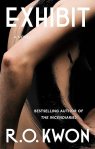
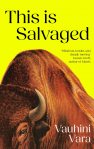
- Distress at developing breasts in Cactus Country by Zoë Bossiere and I’m Glad My Mom Died by Jennette McCurdy.
- I came across mentions of American sportscaster Howard Cosell in Heartburn by Nora Ephron and Stations of the Heart by Richard Lischer (two heart books I was planning on reviewing together) on the same evening. So random!
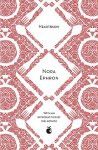
- Girls kissing and flirting with each other (but it’s clear one partner is serious about it whereas the other is only playing or considers it practice for being with boys) in Cactus Country by Zoë Bossiere and Winter’s Bone by Daniel Woodrell.
- A conversion to Catholicism in Places I’ve Taken My Body by Molly McCully Brown and Stations of the Heart by Richard Lischer.
- A zookeeper is attacked by a tiger when s/he goes into the enclosure (maybe not the greatest idea!!) in Tiger by Polly Clark and The Tiger’s Wife by Téa Obreht.

- The nickname Frodo appears in Tiger by Polly Clark and Brother Do You Love Me by Manni Coe.
- Opening scene of a parent in a coma, California setting, and striking pink and yellow cover to Death Valley by Melissa Broder and I’m Glad My Mom Died by Jennette McCurdy.

- An Englishman goes to Nigeria in Howards End by E.M. Forster and Immanuel by Matthew McNaught.
 The Russian practice of whipping people with branches at a spa in Tiger by Polly Clark and Fight Night by Miriam Toews.
- A mother continues washing her daughter’s hair until she is a teenager old enough to leave home in Mrs. March by Virginia Feito and I’m Glad My Mom Died by Jennette McCurdy.
- Section 28 (a British law prohibiting the “promotion of homosexuality” in schools) is mentioned in A Bookshop of One’s Own by Jane Cholmeley, Some Kids I Taught and What They Taught Me by Kate Clanchy, and Brother Do You Love Me by Manni Coe.
- Characters named Gord (in one story from Various Miracles by Carol Shields, and in Fight Night by Miriam Toews), Gordy (in The Absolutely True Diary of a Part-Time Indian by Sherman Alexie), and Gordo (in Blood Red by Gabriela Ponce).

- Montessori and Waldorf schools are mentioned in Cactus Country by Zoë Bossiere and When Fragments Make a Whole by Lory Widmer Hess.
- A trailer burns down in The Absolutely True Diary of a Part-Time Indian by Sherman Alexie and Cactus Country by Zoë Bossiere.
What’s the weirdest reading coincidence you’ve had lately?
Best Books from 2023
Keeping it simple again this year with one post covering all genres: the 24 (or, actually 26) current-year releases that stood out the most for me. (No rankings; anything from my Best of First Half that didn’t make it through can be considered a runner-up, along with The Librarianist.)


Fiction
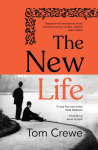 The New Life by Tom Crewe: Two 1890s English sex researchers (based on John Addington Symonds and Havelock Ellis) write a book called Sexual Inversion drawing on ancient Greek history and containing case studies of homosexual behaviour. Oscar Wilde’s trial puts everyone on edge; not long afterwards, their own book becomes the subject of an obscenity trial, and each man has to decide what he’s willing to give up in devotion to his principles. This is deeply, frankly erotic stuff, and, on the sentence level, just exquisite writing.
 The Vaster Wilds by Lauren Groff: Groff’s fifth novel combines visceral detail and magisterial sweep as it chronicles a runaway Jamestown servant’s struggle to endure the winter of 1610. Flashbacks to traumatic events seep into her mind as she copes with the harsh reality of life in the wilderness. The style is archaic and postmodern all at once. Evocative and affecting – and as brutal as anything Cormac McCarthy wrote. A potent, timely fable as much as a historical novel.
Counting as one this thematic trio of women’s true crime pastiches; I liked the Makkai best.
Penance by Eliza Clark: A compelling account of teenage feuds and bullying that went too far and ended in murder. It’s a pretty gruesome crime, but memorable, not least because it coincided with the day of the Brexit vote. I loved Clark’s portrait of Crow-on-Sea, a down-at-heel seaside town near Scarborough, and the depth of character that comes through via interviews and documents. She also nails teenage dialogue and social media use, podcasts, true crime obsession and so on.


 Bright Young Women by Jessica Knoll: An engrossing story of a Type A sorority president whose perfect life goes askew when a serial killer targets the house and kills two of her friends. She and the domestic partner of one of his previous victims are determined to see “the Defendant” brought to justice. 1970s Florida/Washington were interesting settings, and I liked the focus on the victims. The judge in the Defendant’s case lamented that such a bright young man would come to grief; think of the bright young women he extinguished instead.
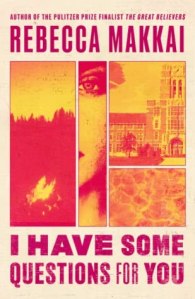
I Have Some Questions for You by Rebecca Makkai: When an invitation comes from her boarding school alma mater, Granby, to teach a two-week course on podcasting, Bodie indulges her obsession with the 1995 murder of her former roommate. Makkai has taken her cues from the true crime genre and constructed a convincing mesh of evidence and theories. She so carefully crafts her pen portraits, and so intimately involves us in Bodie’s psyche, that it’s impossible not to get invested. This is timely, daring, intelligent, enthralling storytelling.
 Sidle Creek by Jolene McIlwain: In this debut collection of 22 short stories, loosely linked by their location in the Appalachian hills in western Pennsylvania and a couple of recurring minor characters, McIlwain softens the harsh realities of addiction, poverty and violence with the tender bruises of infertility and lost love. Grief is a resonant theme in many of the stories, with pregnancy or infant loss a recurring element. At times harrowing, always clear-eyed, these stories are true to life and compassionate about human foibles and animal pain.
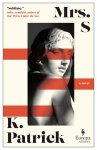 Mrs S by K Patrick: Patrick’s unnamed narrator is an early-twenties Australian butch lesbian who has come to England to be a matron at a girls’ boarding school. Mrs S is the headmaster’s wife, perhaps 20 years her senior. A heat wave gives a sultry atmosphere as hints of attraction between them give way to explicit scenes. Summer romances never last, but their intensity is legendary, and this feels like an instant standard. Not your average coming-of-age story, seduction narrative or cougar stereotype. It’s a new queer classic.
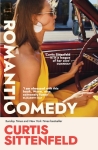 Romantic Comedy by Curtis Sittenfeld: Through her work as a writer for a sketch comedy show modelled on Saturday Night Live, Sally Milz meets Noah Brewster, a pop star with surfer-boy good looks. Plain Jane getting the hot guy – that never happens, right? In fact, Sally has a theory about this very dilemma… As always, Sittenfeld’s inhabiting of a first-person narrator is flawless, and Sally’s backstory and Covid-lockdown existence endeared her to me. Could this be called predictable? Well, what does one want from a romcom?
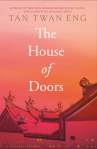 The House of Doors by Tan Twan Eng: In 1921, “Willie” Somerset Maugham and his secretary/lover, Gerald, stay with old friends Robert and Lesley Hamlyn in Penang, Malaysia. Willie’s marriage is floundering and he faces financial ruin. He needs a story that will sell and gets one when Lesley starts recounting the momentous events of 1910: volunteering at the party office of Dr Sun Yat Sen and trying to save her friend from a murder charge. Tan weaves it all into a Maugham-esque plot with sumptuous scene-setting and atmosphere.
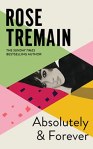 Absolutely and Forever by Rose Tremain: At age 15, Marianne falls in love. She imagines her romance with Simon as a grand adventure (and escape from her parents’ ordinariness), but his post-school life in Paris doesn’t have room for her. Much changes over the next 15 years, but never her attachment to her first love. This has the chic, convincing 1960s setting of Tessa Hadley’s work, and Marianne’s droll narration is a delight. It put me through an emotional wringer – no cheap tear-jerker but a tender depiction of love in all its forms.
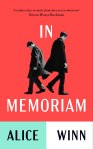 In Memoriam by Alice Winn: Heartstopper on the Western Front; swoon! Will Sidney Ellwood and Henry Gaunt both acknowledge that this is love and not just sex, as it is for so many teenage boys at their English boarding school? And will one or both survive the trenches of the First World War? Winn depicts the full horror of war, but in between there is banter, friendship and poetry. Some moments are downright jolly. This debut is obsessively researched, but Winn has a light touch with it. Engaging, thrilling, and, yes, romantic.
Nonfiction
 All My Wild Mothers by Victoria Bennett: A lovely memoir about grief and gardening, caring for an ill child and a dying parent. The book is composed of dozens of brief autobiographical, present-tense essays, each titled after a wildflower with traditional healing properties. The format realistically presents bereavement and caring as ongoing, cyclical challenges rather than one-time events. Sitting somewhere between creative nonfiction and nature essays, it’s a beautiful read for any fan of women’s life writing.
 Monsters by Claire Dederer: The question posed by this hybrid work of memoir and cultural criticism is “Are we still allowed to enjoy the art made by horrible people?” It begins, in the wake of #MeToo, by reassessing the work of film directors Roman Polanski and Woody Allen. The book is as compassionate as it is incisive. While there is plenty of outrage, there is also much nuance. Dederer’s prose is forthright and funny; lucid even when tackling thorny issues. Erudite, empathetic and engaging from start to finish.
 Womb by Leah Hazard: A wide-ranging and accessible study of the uterus, this casts a feminist eye over history and future alike. Blending medical knowledge and cultural commentary, it cannot fail to have both personal and political significance for readers of any gender. The thematic structure of the chapters also functions as a roughly chronological tour of how life with a uterus might proceed: menstruation, conception, pregnancy, labour, caesarean section, ongoing health issues, menopause. Inclusive and respectful of diversity.
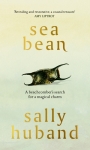 Sea Bean by Sally Huband: Stories of motherhood, the quest to find effective treatment in a patriarchal medical system, volunteer citizen science projects, and studying Shetland’s history and customs mingle in a fascinating way. Huband travels around the archipelago and further afield, finding vibrant beachcombing cultures. In many ways, this is about coming to terms with loss, and the author presents the facts about climate crisis with sombre determination. She writes with such poetic tenderness in this radiant debut memoir.
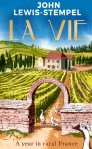 La Vie by John Lewis-Stempel: The author has written much about his Herefordshire haunts, but he’s now relocated permanently to southwest France (La Roche, in the Charente). He proudly calls himself a peasant farmer, growing what he can and bartering for much of the rest. La Vie chronicles a year in his quest to become self-sufficient. It opens one January and continues through the December, an occasional diary with recipes. It’s a peaceful, comforting read that’s attuned to the seasons and the land. Lewis-Stempel’s best book in an age.
 All of Us Together in the End by Matthew Vollmer: In 2019, Vollmer’s mother died of complications of Alzheimer’s and Parkinson’s. Months later, his father reported blinking lights in the woods near the family cemetery. Although Vollmer had left the Seventh-Day Adventist Church in college, his religious upbringing influenced his investigation, which overlapped with COVID-19. Grief, mysticism, and acceptance of the unexplained are resonant themes. An unforgettable record of “a collision with the ineffable.”
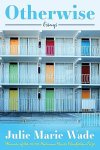 Otherwise by Julie Marie Wade: Nine intricate autobiographical essays reflect on risk, bodily autonomy, and poetry versus prose. A series of meditations composed across Wade’s thirties arranges snapshots of her growing frustration with gendered stereotypes. In particular, she interrogates her rosy childhood notions of marriage. As she explored feminism and accepted her lesbian identity—though not before leaving a man at the altar—she found ways to be “a secular humanist by day and a hopeless romantic by night.” Superb.
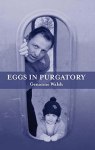 Eggs in Purgatory by Genanne Walsh: This autobiographical essay tells the story of the last few months of her father’s life. Aged 89, he lived downstairs from Walsh and her wife in San Francisco. He was quite the character: idealist, stubborn, outspoken; a former Catholic priest. Although he had no terminal conditions, he was sick of old age and its indignities and ready to exit. The task of a memoir is to fully mine the personal details of a situation but make of it something universal, and that’s just what she does here. Stunning.
Poetry
 More Sky by Joe Carrick-Varty: In this debut collection, the fact of his alcoholic father’s suicide is inescapable. The poet alternates between an intimate “you” address and third-person scenarios, auditioning coping mechanisms. His frame of reference is wide: football, rappers, Buddhist cosmology. The word “suicide” itself is repeated to the point where it becomes just a sibilant collection of syllables. The tone is often bitter, as is to be expected, but there is joy in the deft use of language.
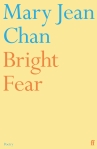 Bright Fear by Mary Jean Chan: This follow-up to Flèche takes up many of the same foundational subjects: race, family, language and sexuality. But this time, the pandemic is the lens through which all is filtered. At a time when Asian heritage merited extra suspicion, English was both a means of frank expression and a source of ambivalence. At the centre of the book, “Ars Poetica,” a multi-part collage incorporating lines from other poets, forms a kind of autobiography in verse. Chan also questions the lines between genres. Excellent.
 Lo by Melissa Crowe: This incandescent autobiographical collection delves into the reality of sexual abuse and growing up in rural poverty. Guns are insidious, used for hunting or mass shootings. Trauma lingers. “Maybe home is what gets on you and can’t / be shaken loose.” The collection is so carefully balanced in tone that it never feels bleak. In elegies and epithalamiums (poems celebrating marriage), Crowe honors family ties that bring solace. The collection has emotional range: sensuality, fear, and wonder at natural beauty.
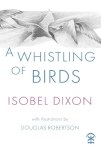 A Whistling of Birds by Isobel Dixon: I was drawn to this for its acknowledged debt to D.H. Lawrence’s Birds, Beasts and Flowers. Snakes, bees, bats and foxes are some of the creatures that scamper through the text. There are poems for marine life, fruit and wildflowers. You get a sense of the seasons turning, and the natural wonders to prize from each. Dixon’s poetry is formal yet playful, the structures and line and stanza lengths varying. There are portraits and elegies. The book is in collaboration with Scottish artist Douglas Robertson. A real gem.
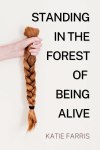 Standing in the Forest of Being Alive by Katie Farris: This debut collection addresses the symptoms and side effects of breast cancer treatment at age 36, but often in oblique or cheeky ways – it can be no mistake that “assistance” appears two lines before a mention of hemorrhoids, for instance, even though it closes an epithalamium distinguished by its gentle sibilance (Farris’s husband is Ukrainian American poet Ilya Kaminsky.) She crafts sensual love poems, and exhibits Japanese influences. (Discussed in my review essay for The Rumpus.)
 The House of the Interpreter by Lisa Kelly: Kelly is half-Danish and has single-sided deafness, and her second collection engages with questions of split identity. One section ends with the Deaf community’s outrage that the Prime Minister’s Covid briefings were not translated into BSL. Bizarre but delightful is the sequence of alliteration-rich poems about fungi, followed by a miscellany of autobiographical poems full of references to colour, language, nature and travel.
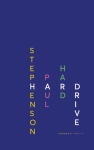 Hard Drive by Paul Stephenson: This wry, wrenching debut collection is an extended elegy for his partner, Tod Hartman, an American anthropologist who died of heart failure at 38. There’s every style, tone and structure imaginable here. Stephenson riffs on his partner’s oft-misspelled name (German for death), and writes of discovery, autopsy, sadmin and rituals. In “The Only Book I Took” he opens up Tod’s copy of Joan Didion’s The Year of Magical Thinking – which came from Wonder Book, the bookstore chain I worked at in Maryland!
Okay, twist my arm … if I had to pick my overall books of the year, I’d concur with the Times in picking The New Life. In nonfiction: Monsters. In poetry: Standing in the Forest of Being Alive.


Have you read any of my favourites? What 2023 releases do I need to catch up on right away?
Christmas Reading and Book Haul
I recently read two novels set in the week of Christmas. Both were good reminders to appreciate the family that you have because whatever your dysfunctional situation, it could probably be much worse.
 Christmas Holiday by W. Somerset Maugham (1939): Twenty-three-year-old Charley Mason heads to Paris on Christmas Eve to see his old friend Simon and live it up in the big city. First thing, Simon takes him to a brothel, where Charley dances with topless Russian prostitute “Princess Olga.” Before things go any further, he ducks out to attend a Mass he happened to get tickets for, and she begs to accompany him. When Lydia (for that is her real name) starts weeping during the service, he takes her back to his hotel and listens with rapt horror as she tells him the sordid story of how her husband, a petty criminal named Robert Berger, murdered a man for fun and ended up in prison overseas. From here on, Charley’s primary feeling for Lydia is pity and any desire he had is neutralized. Simon, too, is fascinated with the Berger case for what it reveals about essential human egoism. The chaste relationship with Lydia and the intensity of the interactions with Simon made me wonder if there was covert homoeroticism here. It was interesting, shortly after my Paris trip, to read something about how sleazy it is rather than how magical. (Secondhand purchase)
 Flight by Lynn Steger Strong (2022): I couldn’t resist the setup: three grown-up siblings and their families meet at the one brother’s house in upstate New York to celebrate their first Christmas since their mother died. The novel takes place over just four days, the 22nd through Christmas Day, but Strong pumps in a lot of backstory about the sibling dynamic and the three marriages. The late Helen has already ascended into legend, and her coastal home in Florida is a bargaining chip. Tess, Martin’s lawyer wife, approaches the problem practically: sell it and split the profits three ways. Henry, an environmentalist artist, wants to sell the land to the state to be part of a nature preserve. Kate, the sentimental one, wants to live in the house herself but isn’t sure she and Josh can afford to buy her brothers out. At first I thought this was going to be a slightly irksome story of privileged white people and their ‘problems’, but there is a biracial character and an ex-heroin addict and her daughter also become key characters. As the family build igloos, bake pies and plan the perfect photo shoot, offences are simmering under the surface (“Mostly they resent each other from a comfortable enough distance that they might call it love”). These all fade, though, when a child goes missing. I was reminded subtly of Ann Patchett’s work, but more, with the environmental and parenting themes, of Ramona Ausubel and Megan Mayhew Bergman. I’d read more by Strong. (Public library)
And now for the promised Christmas book haul.
Here’s what I bought with store credit at 2nd & Charles while in the States for my sister’s graduation with her bachelor’s in nursing.
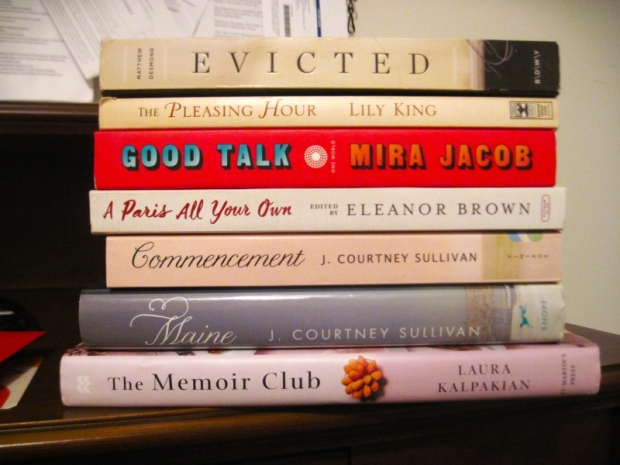
We got to do some fun family Christmassy things while I was there for 10 days, then I flew back to the UK into Christmas Eve and got to do actual Christmas with my in-laws. It’s been a whirlwind of a month!


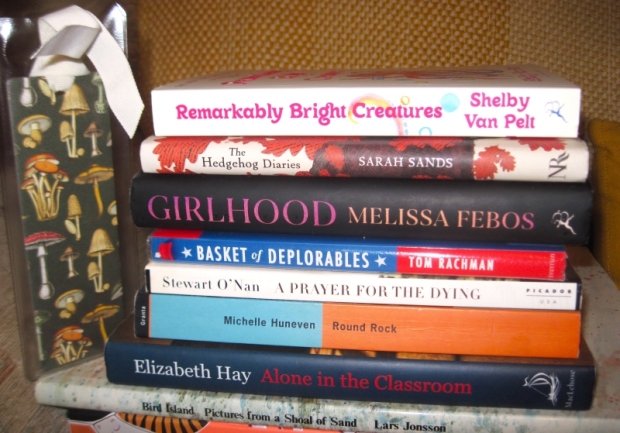
I had this book post waiting for me when I got back.
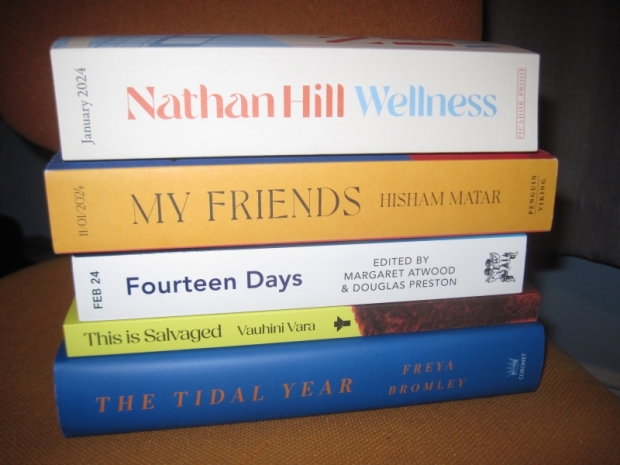
And received these for Christmas!
Book Serendipity, October to December 2023
I call it “Book Serendipity” when two or more books that I read at the same time or in quick succession have something in common – the more bizarre, the better. This is a regular feature of mine every couple of months. Because I usually have 20–30 books on the go at once, I suppose I’m more prone to such incidents. The following are in roughly chronological order.
- A woman turns into a spider in Edith Holler by Edward Carey and The Human Origins of Beatrice Porter and Other Essential Ghosts by Soraya Palmer.

- Expulsion from Eden scenes (one literal, after the Masaccio painting; another more figurative by association) in Conversation Among Stones by Willie Lin and North Woods by Daniel Mason.
- Reading my second 2023 release featuring a theatre fire (after The House Is on Fire by Rachel Beanland, which I actually read last year): Edith Holler by Edward Carey.
- The protagonist cuts their foot in The Rituals by Rebecca Roberts and The Last House on Needless Street by Catriona Ward.


- On the same evening, I started two novels where the protagonist’s parents both died in a car crash: The Witches by Roald Dahl and Family Meal by Bryan Washington. This is something I encounter ALL THE TIME in fiction (versus extremely rarely in life) and it’s one of my major pet peeves. I can excuse it more in the children’s book as the orphan trope allows for adventures, but for the most part it just seems lazy to me. The author has decided they don’t want to delve into a relationship with parents at all, so they cut it out in the quickest and easiest possible way.
- A presumed honour killing in Behind You Is the Sea by Susan Muaddi Darraj and The Hundred and Ninety-Nine Steps by Michel Faber.


- A Houston, Texas setting in The Only Way Through Is Out by Suzette Mullen and Family Meal by Bryan Washington.
- Daniel Clowes, whose graphic novel Monica I was also in the middle of at the time, was mentioned in Robin Ince’s Bibliomaniac.
- The author/speaker warns the squeamish reader to look away for a paragraph in Robin Ince’s Bibliomaniac (recounting details of a gross-out horror plot) and one chapter of Daniel Mason’s North Woods.


- A mentally ill man who lives at the end of a lane in Daniel Mason’s North Woods and The Last House on Needless Street by Catriona Ward.
- Reading Last House before the Mountain by Monika Helfer and The Last House on Needless Street by Catriona Ward at the same time.
- The Daedalus myth (via Aeschylus or Brueghel, or just in general) is mentioned in Last House before the Mountain by Monika Helfer, The Ghost Orchid by Michael Longley, and Absolutely and Forever by Rose Tremain.
- A character goes to live with their aunt and uncle in Western Lane by Chetna Maroo and The House of Doors by Tan Twan Eng (both Booker-longlisted), but also The Woman in Black by Susan Hill, Train Dreams by Denis Johnson, and The Story Girl by L.M. Montgomery. I came across all five instances within a few days! Later I also encountered a brief mention of this in Ferdinand by Irmgard Keun. How can this situation be so uncommon in life but so common in fiction?!



- The outdated terms “Chinaman” and “coolie” appear frequently in Train Dreams by Denis Johnson and The House of Doors by Tan Twan Eng.
- A 15-year-old declares true love in The Inseparables by Simone de Beauvoir and Absolutely and Forever by Rose Tremain.
- A French character named Pascal in The Inseparables by Simone de Beauvoir and The Garrick Year by Margaret Drabble.

- A minor character called Mrs Biggs in Harriet Said… by Beryl Bainbridge and The House of Doors by Tan Twan Eng.
- The Chinese zither (guzheng) is mentioned in Dear Chrysanthemums by Fiona Sze-Lorrain, which I read earlier in the year, and The House of Doors by Tan Twan Eng.
- Oscar Wilde’s trial is mentioned in The House of Doors by Tan Twan Eng, as it was in The New Life by Tom Crewe, which I read earlier in the year – in both it was a cautionary case for older homosexual characters (based on real people: W. Somerset Maugham vs. John Addington Symonds) who were married to women but had a live-in male secretary generally known to be their lover. At the same time as I was reading The House of Doors, I was rereading Wilde’s De Profundis, which was written from prison.

- In Fifty Days of Solitude Doris Grumbach mentions reading Bear by Marian Engel. I read both during Novellas in November.
- Living funerals are mentioned in Ferdinand by Irmgard Keun and The Ritual Effect by Michael Norton.
- A character insists that lilac not be included in a bouquet in In the Sweep of the Bay by Cath Barton and Bright Young Women by Jessica Knoll.

- A woman has a lover named Frances in Bright Young Women by Jessica Knoll and The Cancer Journals by Audre Lorde.
- The final word of the Fanny Howe poem in Raised by Wolves (the forthcoming 50th anniversary poetry anthology from Graywolf Press) is “theophanies.” At the same time, I was reading the upcoming poetry collection Theophanies by Sarah Ghazal Ali.


- The Cancer Journals by Audre Lorde, which I’d read the month before, was a major influence on the cancer memoir All In by Caitlin Breedlove.
- Two foodie memoirs I read during our city break, A Waiter in Paris by Edward Chisholm and The Sweet Life in Paris by David Lebovitz, both likened a group of young men to a Dolce & Gabbana ad. (Chisholm initially lived at Porte des Lilas, the next Metro stop up from where we stayed in Mairie des Lilas.)
- A French slang term for penis, “verge,” is mentioned in both The Sweet Life in Paris by David Lebovitz and Learning to Drive by Katha Pollitt.


What’s the weirdest reading coincidence you’ve had lately?
#NovNov23 Week 4, “The Short and the Long of It”: W. Somerset Maugham & Jan Morris
Hard to believe, but it’s already the final full week of Novellas in November and we have had 109 posts so far! This week’s prompt is “The Short and the Long of It,” for which we encourage you to pair a novella with a nonfiction book or novel that deals with similar themes or topics. The book pairings week of Nonfiction November is always a favourite (my 2023 contribution is here), so think of this as an adjacent – and hopefully fun – project. I came up with two pairs: one fiction and one nonfiction. In the first case, the longer book led me to read a novella, and it was vice versa for the second.
W. Somerset Maugham
The House of Doors by Tan Twan Eng (2023)
&
Liza of Lambeth by W. Somerset Maugham (1897)
I wasn’t a huge fan of The Garden of Evening Mists, but as soon as I heard that Tan Twan Eng’s third novel was about W. Somerset Maugham, I was keen to read it. Maugham is a reliably readable author; his books are clearly classic literature but don’t pose the stylistic difficulties I now experience with Dickens, Trollope et al. And yet I know that Booker Prize followers who had neither heard of nor read Maugham have enjoyed this equally. I’m surprised it didn’t make it past the longlist stage, as I found it as revealing of a closeted gay writer’s life and times as The Master (shortlisted in 2004) but wider in scope and more rollicking because of its less familiar setting, true crime plot and female narration.
The main action is set in 1921, as “Willie” Somerset Maugham and his secretary, Gerald, widely known to be his lover, rest from their travels in China and the South Seas via a two-week stay with Robert and Lesley Hamlyn at Cassowary House in Penang, Malaysia. Robert and Willie are old friends, and all three men fought in the First World War. Willie’s marriage to Syrie Wellcome (her first husband was the pharmaceutical tycoon) is floundering and he faces financial ruin after a bad investment. He needs a good story that will sell and gets one when Lesley starts recounting to him the momentous events of 1910, including a crisis in her marriage, volunteering at the party office of Chinese pro-democracy revolutionary Dr Sun Yat Sen, and trying to save her friend Ethel Proudlock from a murder charge.
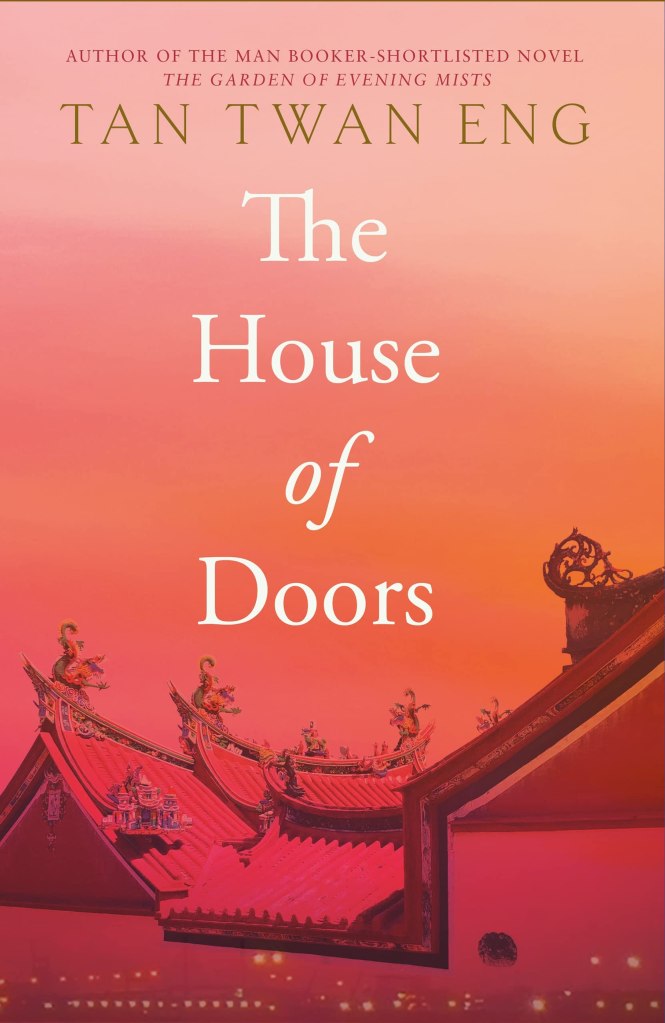
It’s clever how Tan weaves all of this into a Maugham-esque plot that alternates between omniscient third-person narration and Lesley’s own telling. The glimpses of expat life and Asia under colonial rule are intriguing, and the scene-setting and atmosphere are sumptuous – worthy of the Merchant Ivory treatment. I was left curious to read more by and about Maugham, such as Selina Hastings’ biography. (Public library) 
But for now I picked up one of the leather-bound Maugham books I got for free a few years ago. Amusingly, the novella-length Liza of Lambeth is printed in the same volume with the travel book On a Chinese Screen, which Maugham had just released when he arrived in Penang.
{SPOILERS AHEAD}
This was Maugham’s debut novel and drew on his time as a medical intern in the slums of London. In tone and content it falls almost perfectly between Dickens and Hardy, because on the one hand Liza Kemp and her neighbours are cheerful paupers even though they work in factories, have too many children and live in cramped quarters; on the other hand, alcoholism and domestic violence are rife, and the wages of sexual sin are death. All seems light to start with: an all-village outing to picnic at Chingford; pub trips; and harmless wooing as Liza rebuffs sweet Tom in favour of a flirtation with married Jim Blakeston.
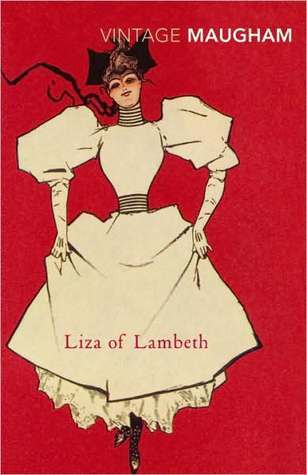 At the halfway point, I thought we were going full Tess of the d’Urbervilles – how is this not a rape scene?! Jim propositions her four times, ignoring her initial No and later quiet. “‘Liza, will yer?’ She still kept silence, looking away … Suddenly he shook himself, and closing his fist gave her a violent, swinging blow in the belly. ‘Come on,’ he said. And together they slid down into the darkness of the passage.” So starts their affair, which leads to Liza getting beaten up by Mrs Blakeston in the street and then dying of an infection after a miscarriage. The most awful character is Mrs Kemp, who spends the last few pages – while Liza is literally on her deathbed – complaining of her own hardships, congratulating herself on insuring her daughter’s life, and telling a blackly comic story about her husband’s corpse not fitting in his oak coffin and her and the undertaker having to jump on the lid to get it to close.
Liza isn’t entirely the stereotypical whore with the heart of gold, but she is a good-time girl (“They were delighted to have Liza among them, for where she was there was no dullness”) and I wonder if she could even have been a starting point for Eliza Doolittle in Pygmalion. Maugham’s rendering of the cockney accent is over-the-top –
“‘An’ when I come aht,’ she went on, ‘’oo should I see just passin’ the ’orspital but this ’ere cove, an’ ’e says to me, ‘Wot cheer,’ says ’e, ‘I’m goin’ ter Vaux’all, come an’ walk a bit of the wy with us.’ ‘Arright,’ says I, ‘I don’t mind if I do.’”
– but his characters are less caricatured than Dickens’s. And, imagine, even then there was congestion in London:
“They drove along eastwards, and as the hour grew later the streets became more filled and the traffic greater. At last they got on the road to Chingford, and caught up numbers of other vehicles going in the same direction—donkey-shays, pony-carts, tradesmen’s carts, dog-carts, drags, brakes, every conceivable kind of wheeled thing, all filled with people”
In short, this was a minor and derivative-feeling work that I wouldn’t recommend to those new to Maugham. He hadn’t found his true style and subject matter yet. Luckily, there’s plenty of other novels to try. (Free mall bookshop) [159 pages] 
Jan Morris
Conundrum by Jan Morris (1974)
&
Jan Morris: Life from Both Sides, A Biography by Paul Clements (2022)

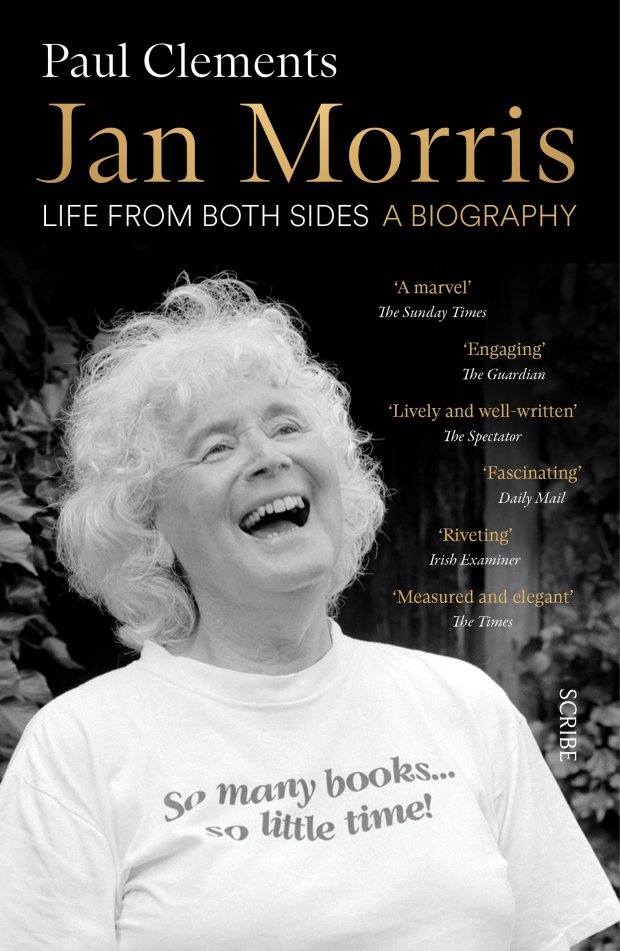
Back in 2021, I reread and reviewed Conundrum during Novellas in November. It’s a short memoir that documents her spiritual journey towards her true identity – she was a trans pioneer and influential on my own understanding of gender. In his doorstopper of a biography, Paul Clements is careful to use female pronouns throughout, even when this is a little confusing (with Morris a choirboy, a soldier, an Oxford student, a father, and a member of the Times expedition that first summited Everest). I’m just over a quarter of the way through the book now. Morris left the Times before the age of 30, already the author of several successful travel books on the USA and the Middle East. I’ll have to report back via Love Your Library on what I think of this overall. At this point I feel like it’s a pretty workaday biography, comprehensive and drawing heavily on Morris’s own writings. The focus is on the work and the travels, as well as how the two interacted and influenced her life.
Daphne du Maurier Reading Week: Rebecca Reread & Forster Biography
It’s been a couple of years since I took part in HeavenAli’s annual Daphne du Maurier Reading Week (the last time was with a review of My Cousin Rachel; this year, links are being hosted by Liz here).

My last-minute and meagre contribution comprises an attempted reread (which ended up being a skim) of Rebecca for book club last month, and a partial, ongoing read of Margaret Forster’s cracking biography of DDM.
Rebecca (1938)
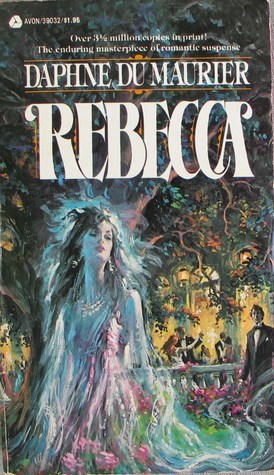 I must have first read this in my early twenties, and remembered it as spooky and atmospheric. I had completely forgotten that the action opens not at Manderley (despite the exceptionally famous first line, which forms part of a prologue-like first chapter depicting the place empty without its master and mistress to tend to it) but in Monte Carlo, where the unnamed narrator meets Maxim de Winter while she’s a lady’s companion to bossy Mrs. Van Hopper. This section functions to introduce Max and his tragic history via hearsay, but I found the first 60 pages so slow that I had trouble maintaining momentum thereafter, especially through the low-action and slightly repetitive scenes as the diffident second Mrs de Winter explores the house and tries to avoid Mrs Danvers, so I ended up skimming most of it.
However, it was satisfying to rediscover the Jane Eyre parallels and there are deliciously chilling scenes, like with Mrs Danvers at the window and the way she then sabotages her young mistress at the costume ball. This was one of four rereads for book club already this year, which has the benefit of reducing pressure and sometimes increasing the comfort-read factor. We have two Rebeccas in my book club, so it seemed an appropriate choice. Others found the book as gripping as ever, with one member reading it in a day thanks to long hospital waits. Would you believe, I hadn’t at all remembered the truth of what happened to Rebecca! So there was that surprise awaiting me. In our discussion we remarked that though this has the trappings of a romance novel or mystery (e.g. see my dreadful paperback cover above!), it also has enduring literary weight – it won the National Book Award, for instance.
Daphne du Maurier by Margaret Forster (1993)
 I read my first work by Forster, My Life in Houses, last year, and adored it, so the fact that she was the author was all the more reason to read this when I found a copy in a library secondhand book sale. I started it immediately after our meeting about Rebecca, but I find biographies so dense and daunting that I’m still only a third of the way into it even though I’ve been liberally skimming.
So far I have noted: du Maurier’s artistic pedigree, including her grandfather’s authorship of Trilby and her parents meeting through stage acting; her frank engagement in sexual activity, and presumed bisexuality (so far only evident through a requited crush on a teacher at her French finishing school, though perhaps there will be more to come); her first publications of short stories (“inspired by her three favourite short story writers, Maugham, Mansfield and Maupassant”) and the early novels, including one from a male point of view; her close relationship with her father and the crushing blow of his death; her determination to escape London for Cornwall; and her marriage to a soldier and ambivalent motherhood.
The last chapter I got to was all about the success of Rebecca. Though the critical reaction was generally favourable, reviewers also deemed it melodramatic … fair?
#DDMReadingWeek
Some 2022 Reading Superlatives
Longest book read this year: To Paradise by Hanya Yanagihara (720 pages)
Shortest book read this year: Everything’s Changing by Chelsea Stickle (37 pages)
Authors I read the most by this year: Nicola Colton (4), Jakob Wegelius (3), Tove Jansson and Sarah Ruhl (2)
Publishers I read the most from: (Besides the ubiquitous Penguin and its many imprints) Canongate, Carcanet and Picador – which is part of the Pan Macmillan group.
An author I ‘discovered’ and now want to read everything by: Matthew Vollmer
My overall top discovery of the year: The Murderer’s Ape by Jakob Wegelius
My proudest non-bookish achievement: Giving a eulogy at my mom’s funeral (and even getting some laughs).
The books that made me laugh the most: Revenge of the Librarians by Tom Gauld, Undoctored by Adam Kay, Forget Me Not by Sophie Pavelle, Blurb Your Enthusiasm by Louise Willder
The books that made me cry the most: Foster by Claire Keegan, The Hero of This Book by Elizabeth McCracken


Most useful fact gleaned from a book: To convert a Celsius temperature to Fahrenheit, double it and add 30. It’s a rough estimate, but it generally works! I learned this from, of all places, The Hero of This Book by Elizabeth McCracken.
Best book club selections: The Boys in the Boat by Daniel James Brown, Falling Angels by Tracy Chevalier, Small Things Like These by Claire Keegan


Best first line encountered this year: “First, I got myself born.” (Demon Copperhead, Barbara Kingsolver)
Best last lines encountered this year:
- “Darling, that’s what life’s for – to take risks.” (Up at the Villa, W. Somerset Maugham)
- “The defiant soul of the city doesn’t die. It stays alive, right below the surface, pressing up against the boot heels, crouched like the life inside an egg, the force that drives the flower, forever reaching for its next breath.” (Feral City, Jeremiah Moss)
 “Until the future, whatever it was going to be.” (This Time Tomorrow, Emma Straub)
A book that put a song in my head every time I picked it up: Heaven Is a Place on Earth by Adrian Shirk

Shortest book title encountered: O (a poetry collection by Zeina Hashem Beck), followed by XO (a memoir by Sara Rauch)
Best 2022 book title: I Want to Die But I Want to Eat Tteokbokki by Baek Se-hee (No, I haven’t read it and I’m unlikely to, not having had great luck with recent translations of work by Japanese and Korean women.)
Favourite title and cover combo of the year: Briefly, A Delicious Life by Nell Stevens
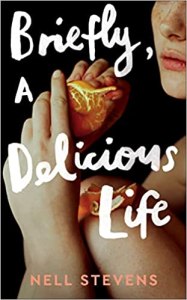
Most fun cover serendipity: Two books I read in 2022 featured Matisse cut-outs.


Biggest disappointment: The Book of Form and Emptiness by Ruth Ozeki ( for me)
Two 2022 books that everyone was in raptures about but me: Trust by Hernan Diaz and Demon Copperhead by Barbara Kingsolver (both for me)


A 2022 book that everyone was reading but I decided not to: The Marriage Portrait by Maggie O’Farrell – since I thought Hamnet her weakest work, I’m not eager to try more historical fiction by her.
A 2022 book I can’t read: (No matter how good the reviews might be, because of the title) I’m Glad My Mom Died by Jennette McCurdy
The worst books I read this year: The Reactor by Nick Blackburn, Treacle Walker by Alan Garner, Anthropology by Dan Rhodes, Bonsai by Alejandro Zambra (1-star ratings are extremely rare from me; these were this year’s four)
The downright strangest book I read this year: The Magic Pudding by Norman Lindsay
Five Final Novellas: Adichie, Glück, Jhabvala, Victory for Ukraine, Woodson (#NovNov22)
We’ll wrap up Novellas in November and give some final statistics tomorrow. Today, I have mini reviews of another five novellas I read this month: one short nonfiction reread and then fiction ranging from India in the 1920s to short stories in comics about the war in Ukraine.
Notes on Grief by Chimamanda Ngozi Adichie (2021)
[85 pages]
 This came out in May last year – I pre-ordered it from Waterstones with points I’d saved up, because I’m that much of a fan – and it’s rare for me to reread something so soon, but of course it took on new significance for me this month. Like me, Adichie lived on a different continent from her family and so technology mediated her long-distance relationships. She saw her father on their weekly Sunday Zoom on June 7, 2020 and he appeared briefly on screen the next two days, seeming tired; on June 10, he was gone, her brother’s phone screen showing her his face: “my father looks asleep, his face relaxed, beautiful in repose.”
My experience of my mother’s death was similar: everything was sudden; my sister was the one there at the hospital, while all I could do was wait by the phone/laptop for news. So these details were particularly piercing, but the whole essay resonated with me as she navigates the early days of grief and remembers what she most admires about her father, including his piety, record-keeping and pride in her. (How lucky I am that Covid travel restrictions were no longer a factor; they delayed his memorial service.) My original review is here. Cathy also reviewed it. If you wish, you can read the New Yorker piece it arose from here.
Marigold and Rose: A Fiction by Louise Glück (2022)
[52 pages]
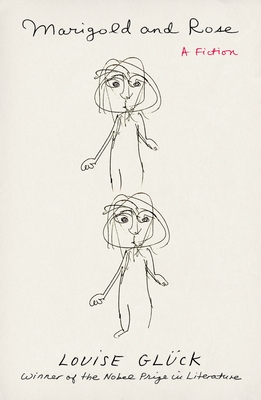 The first (and so far only) fiction by the poet and 2020 Nobel Prize winner, this is a curious little story that imagines the inner lives of infant twins and closes with their first birthday. Like Ian McEwan’s Nutshell, it ascribes to preverbal beings thoughts and wisdom they could not possibly have. Marigold, the would-be writer of the pair, is spiky and unpredictable, whereas Rose is the archetypal good baby.
Marigold did not like people. She liked Mother and Father; everyone else had not yet been properly inspected. Rose did like people and she intended them to like her. … Everyone understood that Marigold lived in her head and Rose lived in the world.
Now every day was like the days when the twins did not perform well at naptime. Then Mother and Father would begin to look tired and harassed. Mother explained that babies got tired too; often, they cried because they were tired. I don’t cry because I’m tired, Marigold thought. I cry because something has disappointed me.
As a psychological allegory, this tracks personality development and the growing awareness of Mother and Father as separate people with their own characteristics, some of which each girl replicates. But I failed to find much of a point. 
With thanks to Carcanet Press for the free e-copy for review.
Heat and Dust by Ruth Prawer Jhabvala (1975)
[181 pages]
 A lesser-known Booker Prize winner that we read for our book club’s women’s classics subgroup. My reading was interrupted by the last-minute trip back to the States, so I ended up finishing the last two-thirds after we’d had the discussion and also watched the movie. I found I was better able to engage with the subtle story and understated writing after I’d seen the sumptuous 1983 Merchant Ivory film: the characters jumped out for me much more than they initially had on the page, and it was no problem having Greta Scacchi in my head.
In 1923, Olivia is a bored young officer’s wife in India who becomes infatuated with the Nawab, an Indian prince involved in some dodgy dealings. In the novel’s present day, Olivia’s step-granddaughter (never named; in the film she’s called Anne, played by Julie Christie and changed to a great-niece for some reason) is also in India, enjoying the hippie freedom and rediscovering Olivia’s life through the letters she wrote to her sister. Both novel and film cut quickly and often between the two time periods to draw increasingly overt parallels between the women’s lives, culminating in unexpected pregnancies and difficult decisions to be made. I enjoyed the atmosphere (see also The Painted Veil and China Room) and would recommend the film, but I doubt I’ll seek out more by Jhabvala. (Public library) 
PEREMOHA: Victory for Ukraine (2022)
[96 pages]
 Various writers and artists contributed these graphic shorts, so there are likely to be some stories you enjoy more than others. “The Ghost of Kyiv” is about a mythical hero from the early days of the Russian invasion who shot down six enemy planes in a day. I got Andy Capp vibes from “Looters,” about Russian goons so dumb they don’t even recognize the appliances they haul back to their slum-dwelling families. (Look, this is propaganda. Whether it comes from the right side or not, recognize it for what it is.) In “Zmiinyi Island 13,” Ukrainian missiles destroy a Russian missile cruiser. Though hospitalized, the Ukrainian soldiers involved – including a woman – can rejoice in the win. “A pure heart is one that overcomes fear” is the lesson they quote from a legend. “Brave Little Tractor” is an adorable Thomas the Tank Engine-like story-within-a-story about farm machinery that joins the war effort. A bit too much of the superhero, shoot-’em-up stylings (including perfectly put-together females with pneumatic bosoms) for me here, but how could any graphic novel reader resist this Tokyopop compilation when a portion of proceeds go to RAZOM, a nonprofit Ukrainian-American human rights organization? (Read via Edelweiss)
Another Brooklyn by Jacqueline Woodson (2016)
[175 pages]
 August looks back on her coming of age in 1970s Bushwick, Brooklyn. She lived with her father and brother in a shabby apartment, but friendship with Angela, Gigi and Sylvia lightened a gloomy existence: “as we stood half circle in the bright school yard, we saw the lost and beautiful and hungry in each of us. We saw home.” As in Very Cold People, though, this is not an untroubled girlhood. Male threat is everywhere, and if boyfriends bring sexual awakening they are also a constant goad to do more than girls are ready for. In short, flitting paragraphs, Woodson explores August’s past – a childhood in Tennessee, her uncle who died in the Vietnam War, her father’s growing involvement with the Nation of Islam. What struck me most, though, was August’s coming to terms with her mother’s death, a fact she doesn’t even acknowledge at first, and the anthropological asides about other cultures’ death rituals. This was my second from Woodson after the Women’s Prize-longlisted Red at the Bone, and I liked them about the same. A problem for me was that Brown Girls, which, with its New York City setting and focus on friendships between girls of colour, must have at least partially been inspired by Another Brooklyn, was better. (Public library)
In total, I read 17 novellas this November, though if you add in the ones I’d read in advance and then reviewed over the course of the month, I managed 24. All things considered, I think that’s a great showing. The 5-star stand-outs for me were The Hero of This Book and Body Kintsugi, but Up at the Villa was also a great read.
Up at the Villa by W. Somerset Maugham (#NovNov22 Short Classics Week)
This was just what I want from a one-sitting read: surprising and satisfying, and in this case with enough suspense to keep the pages turning. When beautiful 30-year-old widow Mary Panton, staying in a villa in the hills overlooking Florence, receives two marriage proposals within the first 33 pages, I worried I was in for a boring, conventional story.
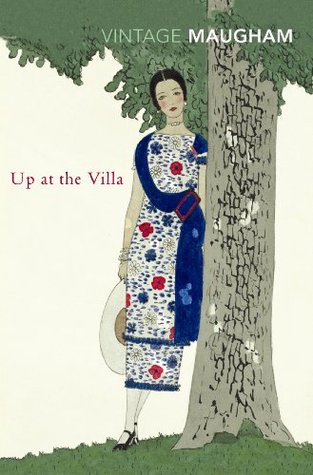 However, things soon get much more interesting. Her suitors are Sir Edgar Swift of the Indian Civil Service, 24 years her senior and just offered a job as the governor of Bengal; and Rowley Flint, a notorious lady’s man. Edgar has to go away on business and will ask for her answer when he’s back in several days. He leaves her with a revolver to take with her if she goes out in the car. A Chekhov’s gun? Absolutely. And it’ll be up to Mary and Rowley to deal with the consequences.
I’ll avoid further details; it’s too much fun to discover those for yourself. I’ll just mention that some intriguing issues get brought in, such as political dissidence in the early days of WWII, charity vs. pity, and the double standard of promiscuity in men vs. women.
Compared to something like Of Human Bondage, sure, this 1941 novella is a minor work, but I found it hugely enjoyable and would recommend it to anyone looking for a short classic or wanting to try Maugham (from here advance to The Painted Veil and The Moon and Sixpence before trying one of the chunksters).
Some plot points are curiously similar to Downton Abbey seasons 1–3, leading me to wonder if this was actually a conscious or unconscious influence on Julian Fellowes. Mostly, though, this reminded me of The Talented Mr. Ripley. It’s a deliciously twisted little book where you find yourself rooting for people you might not sympathize with in real life.
And how’s this for a last line? “Darling, that’s what life’s for – to take risks.”
(See also Simon’s review.)
[120 pages] (Public library)
 Bookish Beck = Rebecca Foster. American transplant to England. Freelance proofreader and book reviewer.
 Bookish Beck