Most Anticipated Books of the Second Half of 2025
My “Most Anticipated” designation sometimes seems like a kiss of death, but other times the books I choose for these lists live up to my expectations, or surpass them!
(Looking back at the 25 books I selected in January, I see that so far I have read and enjoyed 8, read but been disappointed by 4, not yet read – though they’re on my Kindle or accessible from the library – 9, and not managed to get hold of 4.)
This time around, I’ve chosen 15 books I happen to have heard about that will be released between July and December: 7 fiction and 8 nonfiction. (In release date order within genre. UK release information generally given first, if available. Note given on source if I have managed to get hold of it already.)
Fiction
 The Girls Who Grew Big by Leila Mottley [10 July, Fig Tree (Penguin) / June 24, Knopf]: I was impressed with the confident voice in Mottley’s debut, Nightcrawling. She’s just 22 years old so will only keep getting better. This is “about the joys and entanglements of a fierce group of teenage mothers in a small town on the Florida panhandle. … When [16-year-old Adela] tells her parents she’s pregnant, they send her from … Indiana to her grandmother’s in Padua Beach, Florida.” I’ve read one-third so far. (Digital review copy)
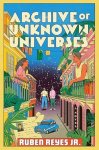 Archive of Unknown Universes by Ruben Reyes Jr. [21 Aug., Footnote Press (Bonnier) / July 1, Mariner Books]: There Is a Rio Grande in Heaven was a strong speculative short story collection and I’m looking forward to his debut novel, which involves alternative history elements. (Starred Kirkus review.) “Cambridge, 2018. Ana and Luis’s relationship is on the rocks, despite their many similarities, including … mothers who both fled El Salvador during the war. In her search for answers, and against her best judgement, Ana uses The Defractor, an experimental device that allows users to peek into alternate versions of their lives.”
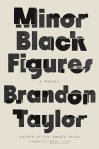 Minor Black Figures by Brandon Taylor [Oct. 7, Riverhead / 5 March 2026, Jonathan Cape (Penguin)]: I’ve read all of his works … but I’m so glad he’s moving past campus settings now. “A newcomer to New York, Wyeth is a Black painter who grew up in the South and is trying to find his place in the contemporary Manhattan art scene. … When he meets Keating, a white former seminarian who left the priesthood, Wyeth begins to reconsider how to observe the world, in the process facing questions about the conflicts between Black and white art, the white gaze on the Black body, and the compromises we make – in art and in life.” (Edelweiss download)
 Heart the Lover by Lily King [16 Oct., Canongate / Oct. 7, Grove Press]: I’ve read several of her books and after Writers & Lovers I’m a forever fan. “In the fall of her senior year of college, [Jordan] meets two star students from her 17th-Century Lit class, Sam and Yash. … she quickly discovers the pleasures of friendship, love and her own intellectual ambition. … when a surprise visit and unexpected news brings the past crashing into the present, Jordan returns to a world she left behind and is forced to confront the decisions and deceptions of her younger self.” (Edelweiss download)
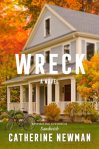 Wreck by Catherine Newman [28 Oct., Transworld / Harper]: This is a sequel to Sandwich, and in general sequels should not exist. However, I can make a rare exception. Set two years on, this finds “Rocky, still anxious, nostalgic, and funny, obsessed with a local accident that only tangentially affects them—and with a medical condition that, she hopes, won’t affect them at all.” In a recent Substack post, Newman compared it to Small Rain, my book of 2024, for the focus on a mystery medical condition. (Edelweiss download)
 Palaver by Bryan Washington [Nov. 4, Farrar, Straus, and Giroux / 1 Jan. 2026, Atlantic]: I’ve read all his work and I’m definitely a fan, though I wish that (like Taylor previously) he wouldn’t keep combining the same elements each time. I’ll be reviewing this early for Shelf Awareness; hooray that I don’t have to wait until 2026! “He’s entangled in a sexual relationship with a married man, and while he has built a chosen family in Japan, he is estranged from his family in Houston, particularly his mother … Then, in the weeks leading up to Christmas, ten years since they’ve last seen each other, the mother arrives uninvited on his doorstep. Separated only by the son’s cat, Taro, the two of them bristle against each other immediately.” (Edelweiss download)
 The Silver Book by Olivia Laing [6 Nov., Hamish Hamilton (Penguin) / 11 Nov., Farrar, Straus and Giroux]: I’ve read all but one of Laing’s books and consider her one of our most important contemporary thinkers. I was also pleasantly surprised by Crudo so will be reading this second novel, too. I’ll be reviewing it early for Shelf Awareness as well. “September 1974. Two men meet by chance in Venice. One is a young English artist, in panicked flight from London. The other is Danilo Donati, the magician of Italian cinema. … The Silver Book is at once a queer love story and a noirish thriller, set in the dream factory of cinema. (Edelweiss download)
Nonfiction
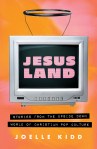 Jesusland: Stories from the Upside[-]Down World of Christian Pop Culture by Joelle Kidd [Aug. 12, ECW]: “Through nine incisive, honest, and emotional essays, Jesusland exposes the pop cultural machinations of evangelicalism, while giving voice to aughts-era Christian children and teens who are now adults looking back at their time measuring the length of their skirts … exploring the pop culture that both reflected and shaped an entire generation of young people.” Yep, that includes me! Looking forward to a mixture of Y2K and Jesus Freak. (NetGalley download)
 Somebody Is Walking on Your Grave: My Cemetery Journeys by Mariana Enríquez; translated from Spanish by Megan McDowell [25 Sept., Granta / Sept. 30, Hogarth]: I’ve enjoyed her creepy short stories, plus I love touring graveyards. “In 2013, when the body of a friend’s mother who was disappeared during Argentina’s military dictatorship was found in a common grave, she began to examine more deeply the complex meanings of cemeteries and where our bodies come to rest. In this vivid, cinematic book … Enriquez travels North and South America, Europe and Australia … [and] investigates each cemetery’s history, architecture, its dead (famous and not), its saints and ghosts, its caretakers and visitors.” (Edelweiss download, for Shelf Awareness review)
 Ghosts of the Farm: Two Women’s Journeys Through Time, Land and Community by Nicola Chester [30 Sept., Chelsea Green]: Nicola is our local nature writer and is so wise on class and countryside matters. On Gallows Down was her wonderful debut and, though I know very little about it, I’m looking forward to her second book. “This is the story of Miss White, a woman who lived in the author’s village 80 years ago, a pioneer who realised her ambition to become a farmer during the Second World War. … Moving between Nicola’s own attempts to work outdoors and Miss White’s desire to farm a generation earlier, Nicola explores the parallels between their lives – and the differences.”
 Death of an Ordinary Man by Sarah Perry [2 Oct., Vintage (Penguin)]: I’ve had a very mixed experience with Perry’s fiction, but a short bereavement memoir should be right up my street. “Sarah Perry’s father-in-law, David, died at home nine days after a cancer diagnosis and having previously been in the good health. The speed of his illness outstripped that of the NHS and social care, so the majority of nursing fell to Sarah and her husband. They witnessed what happens to the body and spirit, hour by hour, as it approaches death.”
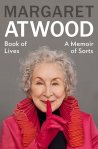 Book of Lives: A Memoir of Sorts by Margaret Atwood [4 Nov., Vintage (Penguin) / Doubleday]: It’s Atwood; ’nuff said, though I admit I’m daunted by the page count. “Raised by ruggedly independent, scientifically minded parents – entomologist father, dietician mother – Atwood spent most of each year in the wild forest of northern Quebec. … [She links] seminal moments to the books that have shaped our literary landscape. … In pages bursting with bohemian gatherings … and major political turning points, we meet poets, bears, Hollywood actors and larger-than-life characters straight from the pages of an Atwood novel.”
 Tigers Between Empires: The Improbable Return of Great Cats to the Forests of Russia and China by Jonathan C. Slaght [4 Nov., Allen Lane / Farrar, Straus and Giroux]: Slaght’s Owls of the Eastern Ice was one of the best books I read in 2022; he’s a top-notch nature and travel writer with an environmentalist’s conscience. After the fall of the Soviet Union, “scientists came together to found the Siberian Tiger Project[, which …] captured and released more than 114 tigers over three decades. … [C]haracters, both feline and human, come fully alive as we travel with them through the quiet and changing forests of Amur.” (NetGalley download)
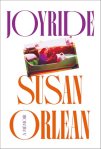 Joyride by Susan Orlean [6 Nov., Atlantic Books / Oct. 14, Avid Reader Press (Simon & Schuster)]: I’m a fan of Orlean’s genre-busting nonfiction, e.g. The Orchid Thief and The Library Book, and have always wanted to try more by her. “Joyride is her most personal book ever—a searching journey through finding her feet as a journalist, recovering from the excruciating collapse of her first marriage, falling head-over-heels in love again, becoming a mother while mourning the decline of her own mother, sojourning to Hollywood for films based on her work. … Joyride is also a time machine to a bygone era of journalism.”
 A Long Game: Notes on Writing Fiction by Elizabeth McCracken [Dec. 2, Ecco]: I’m not big on craft books, but will occasionally read one by an author I admire; McCracken won my heart with The Hero of This Book. “How does one face the blank page? Move a character around a room? Deal with time? Undertake revision? The good and bad news is that in fiction writing, there are no definitive answers. … McCracken … has been teaching for more than thirty-five years [… and] shares insights gleaned along the way, offering practical tips and incisive thoughts about her own work as an artist.” (Edelweiss download)
As a bonus, here are two advanced releases that I reviewed early:
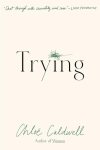 Trying: A Memoir by Chloe Caldwell [Aug. 5, Graywolf] (Reviewed for Foreword): Caldwell devoted much of her thirties to trying to get pregnant via intrauterine insemination. She developed rituals to ease the grueling routine: After every visit, she made a stop for luxury foodstuffs and beauty products. But then her marriage imploded. When she began dating women and her determination to become a mother persisted, a new conception strategy was needed. The book’s fragmentary style suits its aura of uncertainty about the future. Sparse pages host a few sentences or paragraphs, interspersed with wry lists.
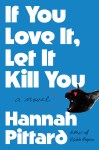 If You Love It, Let It Kill You by Hannah Pittard [July 15, Henry Holt] (Reviewed for Shelf Awareness): A quirky work of autofiction about an author/professor tested by her ex-husband’s success, her codependent family, and an encounter with a talking cat. Hana P. (or should that be Pittard?) relishes flouting the “rules” of creative writing. With her affectations and unreliability, she can be a frustrating narrator, but the metafictional angle renders her more wily than precious. The dialogue and scenes sparkle, and there are delightful characters This gleefully odd book is perfect for Miranda July and Patricia Lockwood fans.
I can also recommend:
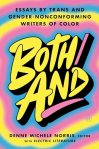
Both/And: Essays by Trans and Gender-Nonconforming Writers of Color, ed. Denne Michele Norris [Aug. 12, HarperOne / 25 Sept., HarperCollins] (Review to come for Shelf Awareness)
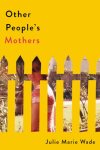
Other People’s Mothers by Julie Marie Wade [Sept. 2, Univ. of Florida Press] (Review pending for Foreword)
Which of these catch your eye? Any other books you’re looking forward to in this second half of the year?
“The Possibilities of Place” Webinar with Nina Mingya Powles
Yesterday was National Nonfiction Day in the UK, apparently, as well as being part of the ongoing Nonfiction November challenge. Appropriately, I attended what I think must be my first writing workshop, run online by The Emma Press, a Birmingham-based publisher whose poetry and essay collections I enjoy. Thanks to Arts Council England funding, they’ve been able to arrange a series of masterclass webinars that explore some of the genres they publish.

The life writing class I participated in was led by Nina Mingya Powles, a poet and essayist whose terrific books Magnolia, Small Bodies of Water, and Tiny Moons (The Emma Press’s best-selling memoir) I’ve read and reviewed. Other attendees hailed from as far afield as Orkney, West Cork, the South of France, Berlin and New Zealand. The seminar was in Zoom presenter mode, so only Nina was on screen and the rest of us communicated via the chat box. I had been nervous about joining from my PC without a webcam or microphone, so I was relieved that this was the setup.


Nina spoke about how broad the umbrella of “life writing” is, potentially incorporating poetry and autofiction as well as straightforward prose. “Creative nonfiction” is a term sometimes used interchangeably with it. Today she wanted to focus on how memories (especially childhood memories), food and place are intertwined.
For our first warm-up exercise, she had us draw a rough map of a body of water and put a point on it, then write ourselves into that place. During this 7-minute freewrite, I compiled a list of not particularly poetic sense impressions of Annapolis harbour. I found myself crying as I realized I might never have a reason to go back to a place that was so important in my teen and early adult years.
Nina’s black-and-white cat, Otto, often butted in, in amusing and feline-appropriate ways. We proceeded to consider food as a portal to memories and to different places we’ve lived or travelled. Nina likes to think about being an outsider and the visitor’s perspective. She acknowledged that our relationships with food can be complicated, so sometimes it is a loaded topic. Mostly she is looking for gentle, tender, joyful depictions of food.
 She read aloud Rebecca May Johnson’s recipe poem “to purge the desire to write like a man,” which on one level is about making tomato sauce (as is Small Fires) but ends with a “found incantation” from Natalia Ginzburg that reclaims the female realm of the kitchen as a place of power. I loved how the first stanzas describe the body as an archive, containing multitudes. Then we considered a Jennifer Wong poem, “A personal history of soups,” about all the Chinese soups she loves and misses, and their personal and legendary meanings.
Taking the Wong title as our prompt, we spent 15 minutes writing a rough piece about a foodstuff. I’ve reproduced mine below, without any tidying-up. I mimicked the part-recipe format of the Johnson and tried to picture the kitchen of our first Bowie house and the cookware we had there.
A personal history of apple pie
As American as…
Dad did all the cooking when I was growing up, so for my mother to accompany me in the kitchen was a big thing. One year of my adolescence, there was a baking contest at the church my best friend and her family attended. I didn’t expect to take part at all or, if anything, perhaps I assumed I’d knock together some simple chocolate chip cookies on my own. But Mom insisted we would make an apple pie from scratch together – crust and all.
An apron each. One green, one red. Hand-embroidered heirlooms made by her grandmother. (Don’t keep them folded away in a drawer. Use them. They are your lineage, your artefacts.)
Half shortening, half butter. Glass bowl. Cold water. Half-moon cutter criss-crosses through chunks of semi-solid fat to render them smaller and smaller, flour-covered pebbles the size of peas.
Scent clouds of cinnamon and cloves billow up from a pan of stewing apples. A ceramic dish with crimping around the rim. A wooden rolling pin to achieve a uniform one-quarter inch round of dough. Freshly washed fingers gently pressing divots into the sides until every air bubble disappears.
Blind bake the crust. Trust that it will hold your creation. The sizzle of softened fruit in contact with the part-baked crust.
I have no memory of whether we won a prize. And me so competitive! The prize was the time. The prize was the attention. The assurance that this was worth it, that I was worth it.
Next we moved on to think about place and journeys, especially departures and arrivals – bringing places with us versus leaving them behind. An attendee commented, and Nina agreed, that often distance is useful: we can most easily write about somewhere after we’ve left it, once there is a sense of yearning. For this section we looked at a few-page extract from Larissa Pham’s essay collection Pop Song in which she describes a drive from Albuquerque to Taos. Expecting beautiful Georgia O’Keeffe-type scenery, she experiences the letdown of signs of the opioid crisis and Trump voters.
Borrowing a line from the Pham essay, Nina invited us to spend 20 minutes writing a piece that would bring the reader into the immediacy of our experience of a place. She reminded us, as a general rule, to remember to cite whatever we borrow, or to remove the borrowed line afterwards and see if it still works. My take on “Here I was now in the distant place…” ended up being a few rambling paragraphs contrasting my two study abroad years, one magical and one difficult. (Sample line: “Everything in England was like that: partially familiar but slightly askew.”)
At the end, three participants unmuted themselves and read their food pieces aloud. One was about food and a mother’s love; milk and rice. The other two, amusingly, were both about meringue: making a cherry meringue pie with a Scottish granny, and assembling pavlovas with aunts in New Zealand.
Nina encouraged us to think of life writing as a fluid thing, including journaling, blogging, travel and nature writing. This was heartening because I’ve always indulged in bits of autobiographical writing on my blog, and I started a journal last month as my 40th birthday approached, inspired in part by the 150 journals I inherited from my mother as well as by the desires to document my life and believe that the day-to-day has meaning.
The two-hour workshop was incredibly good value, especially considering that The Emma Press sent a voucher for £4 off of one of their books. (I’ve ordered their poetry anthology on ageing.) Nina also generously circulated lists of additional writing prompts, magazines that accept life writing submissions, and relevant competitions to enter.
I’d purchased a ticket on a whim but wasn’t sure whether I’d participate fully – I have a bad habit of skipping the exercises in books, after all. I’m so glad I did join, and gave myself over to the writing prompts. Who knows if anything will come of it, but it was cathartic to think about life experiences I don’t often have at the forefront of my mind, and to see how much can be produced in short periods of concerted writing.
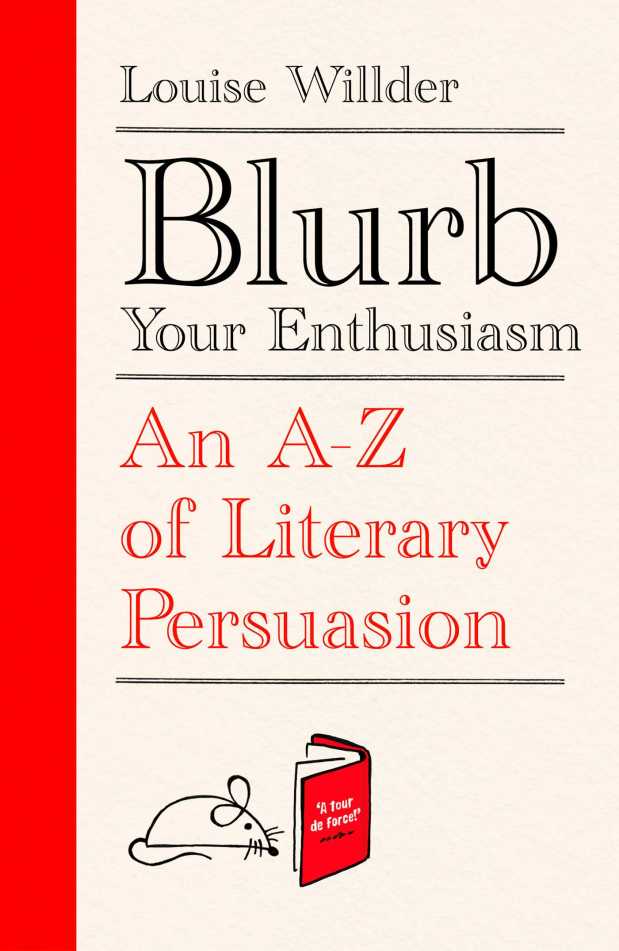
Blurb Your Enthusiasm by Louise Willder
At last, I’m caught up reviewing September releases! It’s one of the busier months in the publishing calendar, so I shouldn’t be surprised that I had such a bounteous crop. Now I can pay more attention to R.I.P. selections, catching up on others’ blog posts, and getting ahead before the start of Novellas in November.
Blurb Your Enthusiasm is a delightful bibliophile’s miscellany with a great title – not just for the play on words, but also for how it encapsulates what this is about: ways of pithily spreading excitement about books. The first part of the subtitle, “An A–Z of Literary Persuasion,” is puzzling in that the structure is scattershot rather than strictly alphabetical, but the second is perfect: from the title and cover to the contents, Louise Willder is interested in what convinces people to acquire and read a book.
Over the last 25 years, she has written the jacket copy for thousands of Penguin releases, so she has it down to a science as well as an art. Book reviewing seems to me to be an adjacent skill. I know from nine years of freelance writing about books, in which I’ve had to produce reviews ranging from 100 to 2,000 words, that the shortest and most formulaic reviews can be the most difficult to compose, but are also excellent writing discipline. As Willder puts it, “Writing short, for whatever reason you do it, forces rigour, and it reminds you that words are a precious and powerful resource. Form both limits and liberates.”
How to do justice to the complexity of several hundred pages of an author’s hard work in just 150 words or so? How to suggest the tone and contents without a) resorting to clichés (“luminous” and “unflinching” are a couple of my bugbears), b) giving too much away, c) overstating the case, or misleading anyone about the merits of a Marmite book, or d) committing the cardinal sin of boring readers before they’ve even opened to the first page?
it can be easy to forget that a potential reader hasn’t read it: they don’t know anything about it. You can’t sell them the experience of the book – you have to sell them the expectation of reading it; the idea of it. And that’s when a copywriter can be an author’s best friend.
[An aside: Literary critics and blog reviewers generally see themselves as having different roles: making objective (pah!) pronouncements about literary value versus cheerleading for the books they love and want others to discover (a sort of unpaid partnership with publicists). I’m in the odd position of being both, and feel I engage in the two activities pretty much equally, perhaps leaning more towards the former. There’s some crossover, of course, with bloggers such as myself happy to publish the occasional more critical review. But we aren’t generally, as Willder is, in the business of selling books, so unless we’re pals with the author on Twitter we don’t tend to have a vested interest in seeing the book do well.]
Each reader will home in on certain topics here: the art of the first line, Dickens’s serialization and self-promotion, Orwell’s guidelines for good writing, the differences between British and American jacket copy, the use of punctuation, and so much more. I particularly loved the mock and bad blurbs she cites (we’ve both commented on the ludicrous one for The Country Girls!), including one an AI created for this book, and her rundown of the conventions of blurb-writing for various genres, everything from children’s books to science fiction. She frequently breaks her own rules (e.g., she’s anti-adjective and -ellipses, yet I found five of the one and two of the other in the Crace blurb; see below) and is very funny to boot.
Here’s some of the bookish and word-nerd trivia that captivated me:
- J. D. Salinger didn’t allow blurbs on his books.
- The American usage of the word “blurb” is for advance review quotes that fellow authors contribute for inclusion on the cover. I didn’t realize I used the word interchangeably for either meaning; in the UK, one might call such a quote a “puff.”
- Marshall McLuhan invented the “page 69 test” – to decide whether you want to buy/read a book, turn to that page instead of (or maybe in addition to) looking at the first paragraph.
- A New York publishing CEO once joked that Lincoln’s Doctor’s Dog would be an optimal title to appeal to readers (respected president + health + animal), but there are actually now six books bearing some variation on that title and all were presumably flops!
- “Wackaging” is the word for quirky marketing that has products talk to us (Innocent Smoothies, established in 1999, is thought to have started the trend).
- I pulled out my copy of Jim Crace’s Quarantine to see how Willder managed to write a blurb about a novel about Jesus without mentioning Jesus (“a Galilean who they say has the power to work miracles”)!
Some more favourite lines:
“There’s always something to love and learn from in a book, especially if it lasts as long as these books [children’s classics] have, and part of the job of people like me is to pick out what makes it special and pass it on.”
“always ask yourself, what’s really going on here? Why should anyone care? And how do we make them care?”
For all of us who value books, whether we write about them or not, those seem like important points to remember. We read to learn, but also to feel, and when we share our love of books with other people we can do so on the basis of how they have engaged our brains and hearts. This was thoroughly entertaining and has prompted me to pay that bit more attention to the few paragraphs on the inside of a book jacket. (See also Susan’s review.) 
With thanks to Oneworld for the free copy for review.
January Releases, Part III: Taylor Harris, Cathy Rentzenbrink & Tanya Shadrick
Rounding off my three-part look at some of the month’s new releases with two memoirs plus a memoir-writer’s self-help guide today. (Can you tell I’m a memoir junkie?) Topics range from medical mysteries and covert racism to a reclaiming of life after a near-death experience, but these three nonfiction works by women are linked by the determination to overcome self-doubt.
This Boy We Made: A Memoir of Motherhood, Genetics, and Facing the Unknown by Taylor Harris
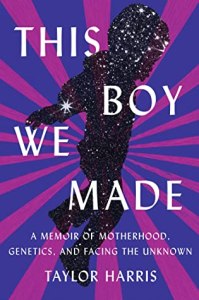 One morning, Taylor Harris and her husband (an African American family based in Charlottesville, Virginia) found their 22-month-old son Christopher, nicknamed “Tophs,” awake but unresponsive in his crib. In the years that followed, she and his doctors looked for answers as to why his body couldn’t regulate his blood sugar levels, sometimes leading to seizures, and to why his speech and mental processing remained delayed. All their tests and theories have never amounted to a conclusive diagnosis. This was a book that repeatedly surprised me. I’d assumed it would be exclusively about the medical mystery of Tophs’s physical and intellectual disability. But Harris elegantly weaves in a lot of other themes, too: mental illness, her own physical concerns (a BRCA2 mutation), racism, faith, and advocating for her children’s health and education. (Full review at BookBrowse.)
Write It All Down: How to put your life on the page by Cathy Rentzenbrink
Cathy Rentzenbrink is a lovely human being, and I’ve always appreciated her enthusiastic support of books. I’ve read all of her work even though I’ve been disappointed with her last few releases. There are so many writing guides out there – including several on memoir-writing specifically – that the first question to ask about one is, does it offer anything new? For me, this one doesn’t. In fact, it’s more of a therapy session than a practical writing guide.
 The undemanding prose slides right down, but 60 pages in (at the end of Part One, “Preparation”) I realized all we’d had thus far was enumerating and countering the hang-ups of unconfident, procrastinating would-be writers. The rest of the book does then get into the nitty-gritty of producing a first draft (“Excavation”) of a life story and editing it into a more polished form. Rentzenbrink peppers in little tricks to keep oneself at the desk, like setting a timer or micro-goals, writing a section in the form of a letter, and dredging up sensory details. Most of the mini chapters are just a couple of pages. Several end with a series of prompts. I’m notorious for skipping the application questions in self-help books, but I’d be interested to hear if other readers have actually gone through these exercises and found them helpful.
I’m so familiar with the author’s own story from her three autobiographical works that I was less than patient about encountering certain incidents again here – though I was intrigued to learn that she gave up alcohol in the recent past after realizing that she was a problem drinker. I’ve also read most of the material in her Further Reading list; all told, I didn’t feel this book offered me much, as a lay reader or a maybe-some-day memoirist. But it seems to have been enormously popular among critics and readers (its average Goodreads rating is 4.38), so clearly a lot of people have been finding Rentzenbrink’s down-to-earth approach reassuring.
With thanks to Emma Finnigan PR and Bluebird for the proof copy for review.
The Cure for Sleep: Memoir of a Late-Waking Life by Tanya Shadrick
From my Most Anticipated list. Shadrick hangs around the fringes of nature writing cliques on Twitter, so I expected this to have more of a nature/travel element. Instead, it bears a fairy tale ambience, of a little girl lost in the woods and craving freedom; of a sleepwalking woman deciding to live more deliberately. It opens with a near-death experience: Shadrick, new mother to a son conceived after infertility treatment, suffered a severe haemorrhage after the placenta tore an artery and was rushed to hospital for emergency surgery.
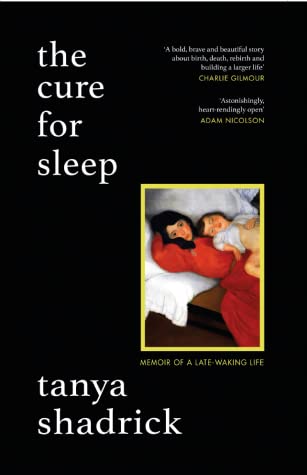 From this point she returns to the beginning of her life and proceeds chronologically, pausing at joyful or traumatic moments. Her childhood feels like the key to understanding everything else: her father left when she was a baby; her mother, all too aware of being of lower class, was driven to improve herself. Shadrick wanted her mother all to herself, at the same time as she felt trapped by her. She injured herself jumping off an outhouse roof in protest at her mother’s new boyfriend, who became her stepfather. At university she reacted against her upbringing in predictable ways, failing her first year and having an abortion. Even once happily married, she kept unconsciously searching for surrogate father (older male) figures.
After the postnatal operation, she felt a need to escape – by suicide if necessary – yet forced herself to stay, make connections in her town and be present for her children. But she remained a free spirit, swimming and writing a mile-long scroll as public performance art. Her work with hospice patients, recording their memories, qualified her to edit Lynne Roper’s wild swimming diaries into a Wainwright Prize-longlisted book.
Awakening versus sleep is the figurative framework for the memoir, with a feminist insistence on freedom and self-fulfilment at the same time as being a mother. This is an unusual book – at times overwritten and too deliberately moulded into tropes as a rebuttal to randomness, even though, looking back, I can’t decipher a coherent plot to the events – that reminded me most of Free Woman by Lara Feigel and I Am, I Am, I Am by Maggie O’Farrell.
With thanks to W&N for the free copy for review.
Does one of these books appeal to you?
January 2022 Releases, Part I: Jami Attenberg and Roopa Farooki
It’s been a big month for new releases! I’m still working on a handful and will report back on two batches of three, tomorrow and Sunday; more will likely turn up in review roundups in future months. For today, I have a memoir in essays about a peripatetic writer’s life and an excerpt from my review of a junior doctor’s chronicle of the early days of the pandemic.
I Came All This Way to Meet You: Writing Myself Home by Jami Attenberg
 I’ve enjoyed Attenberg’s four most recent novels (reviewed here: The Middlesteins and All This Could Be Yours) so was intrigued to hear that she was trying out nonfiction. She self-describes as a “moderately successful author,” now in her early fifties – a single, independent feminist based in New Orleans after years in Manhattan and then Brooklyn. (Name-dropping of author friends: “Lauren” (Groff), “Kristen” (Arnett) and “Viola” (di Grado), with whom she stays in Italy.) Leaving places abruptly had become a habit; travelling from literary festival to holiday to writing residency was her way of counterbalancing a safe, quiet writing life at home. She tells of visiting a friend in Hong Kong and teaching fiction for two weeks in Vilnius – where she learned that, despite her Jewish heritage, Holocaust tourism is not her thing. Anxiety starts to interfere with travel, though, and she takes six months off flying. Owning a New Orleans home where she can host guests is the most rooted she’s ever been.
Along with nomadism, creativity and being a woman are key themes. Attenberg notices how she’s treated differently from male writers at literary events, and sometimes has to counter antifeminist perspectives even from women – as in a bizarre debate she ended up taking part in at a festival in Portugal. She takes risks and gets hurt, physically and emotionally. Break-ups sting, but she moves on and tries to be a better person. There are a lot of hard-hitting one-liners about the writing life and learning to be comfortable in one’s (middle-aged) body:
I believe that one must arrive at an intersection of hunger and fear to make great art.
Who was I hiding from? I was only ever going to be me. I was only ever going to have this body forever. Life was too short not to have radical acceptance of my body.
Whenever my life turns into any kind of cliché, I am furious. Not me, I want to scream. Not me, I am special and unusual. But none of us are special and unusual. Our stories are all the same. It is just how you tell them that makes them worth hearing again.
I did not know yet how books would save me over and over again. I did not know that a book was a reason to live. I did not know that being alive was a reason to live.
Late on comes her #MeToo story, which in some ways feels like the core of the book. When she was in college, a creative writing classmate assaulted her on campus while drunk. She reported it but nothing was ever done; it only led to rumours and meanness towards her, and a year later she attempted suicide. You know how people will walk into a doctor’s appointment and discuss three random things, then casually drop in a fourth that is actually their overriding concern? I felt that way about this episode: that really the assault was what Attenberg wanted to talk about, and could have devoted much more of the book to.
The chapters are more like mini essays, flitting between locations and experiences in the same way she has done, and sometimes repeating incidents. I think the intent was to mimic, and embrace, the random shape that a life takes. Each vignette is like a competently crafted magazine piece, but the whole is no more than the sum of the parts.
With thanks to Serpent’s Tail for the proof copy for review.
Everything Is True: A Junior Doctor’s Story of Life, Death and Grief in a Time of Pandemic by Roopa Farooki
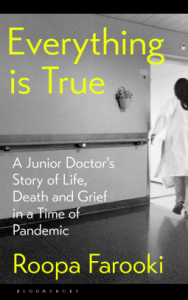 Farooki is a novelist, lecturer, mum of four, and junior doctor. Her storytelling choices owe more to literary fiction than to impassive reportage. The second-person, present-tense narration drops readers right into her position. Frequent line breaks and repetition almost give the prose the rhythm of performance poetry. There is also wry humour, wordplay, slang and cursing. In February 2020, her sister Kiron had died of breast cancer. During the first 40 days of the initial UK lockdown – the book’s limited timeframe – she continues to talk to Kiron, and imagines she can hear her sister’s chiding replies. Grief opens the door for magic realism, despite the title – which comes from a Balzac quote. A hybrid work that reads as fluidly as a novel while dramatizing real events, this is sure to appeal to people who wouldn’t normally pick up a bereavement or medical memoir. (Full review coming soon at Shiny New Books.)
A great addition to my Covid chronicles repertoire!
With thanks to Bloomsbury for the proof copy for review.
Would one of these books interest you?
Recent Online Events: Melanie Finn, Church Times Festival, Gavin Francis
It’s coming up on the one-year anniversary of the first UK lockdown and here we are still living our lives online. The first hint I had of how serious things were going to get was when a London event with Anne Tyler I was due to attend in March 2020 with Eric and Laura T. was cancelled, followed by … everything else. Oh well.
This February was a bountiful month for online literary conversations. I’m catching up now by writing up my notes from a few more events (after Saunders and Ishiguro) that helped to brighten my evenings and weekends.
Melanie Finn in Conversation with Claire Fuller
(Exile in Bookville American online bookstore event on Facebook, February 2nd)
I was a big fan of Melanie Finn’s 2015 novel Shame (retitled The Gloaming), which I reviewed for Third Way magazine. Her new book, The Hare, sounds appealing but isn’t yet available in the UK. Rosie and Bennett, a 20-years-older man, meet in New York City. Readers soon enough know that he is a scoundrel, but Rosie doesn’t, and they settle together in Vermont. A contemporary storyline looking back at how they met contrasts the romantic potential of their relationship with its current reality.
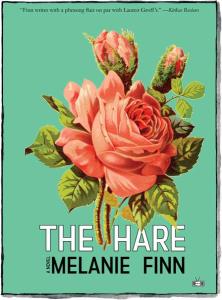 Fuller said The Hare is her favorite kind of novel: literary but also a page-turner. (Indeed, the same could be said of Fuller’s books.) She noted that Finn’s previous three novels are all partly set in Africa and have a seam of violence – perhaps justified – running through. Finn acknowledged that everyday life in a postcolonial country has been a recurring element in her fiction, arising from her own experience growing up in Kenya, but the new book marked a change of heart: there is so much coming out of Africa by Black writers that she feels she doesn’t have anything to add. The authors agreed you have to be cruel to your characters.
Finn believes descriptive writing is one of her strengths, perhaps due to her time as a journalist. She still takes inspiration from headlines. Now that she and her family (a wildlife filmmaker husband and twin daughters born in her forties) are rooted in Vermont, she sees more nature writing in her work. They recovered a clear-cut plot and grow their own food; they also forage in the woods, and a hunter shoots surplus deer and gives them the venison. Appropriately, she read a tense deer-hunting passage from The Hare. Finn also teaches skiing and offers much the same advice as about writing: repetition eventually leads to elegance.
I was especially interested to hear the two novelists compare their composition process. Finn races through a draft in two months, but rewriting takes her a year, and she always knows the ending in advance. Fuller’s work, on the other hand, is largely unplanned; she starts with a character and a place and then just writes, finding out what she’s created much later on. (If you’ve read her Women’s Prize-longlisted upcoming novel, Unsettled Ground, you, too, would have noted her mention of a derelict caravan in the woods that her son took her to see.) Both said they don’t really like writing! Finn said she likes the idea of being a writer, while Fuller that she likes having written – a direct echo of Dorothy Parker’s quip: “I hate writing. I love having written.” Their fiction makes a good pairing and the conversation flowed freely.
Church Times Festival of Faith and Literature, “Light in Darkness,” Part I
(February 20th)
I’d attended once in person, in 2016 (see my write-up of Sarah Perry and more), when this was still known as Bloxham Festival and was held at Bloxham School in Oxfordshire. Starting next year, it will take place in central Oxford instead. I attended the three morning events of Part I; there’s another virtual program taking place on Saturday the 17th of April.
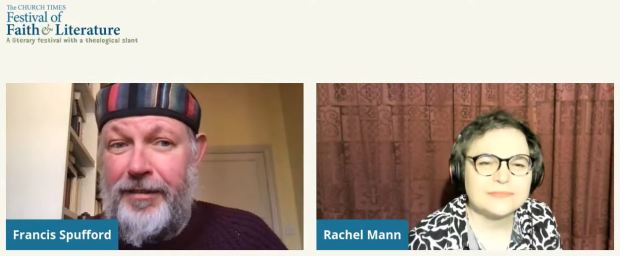
Rachel Mann on The Gospel of Eve
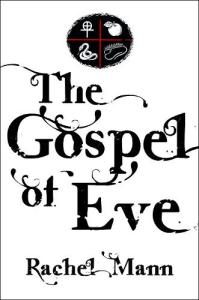 Mann opened with a long reading from Chapter 1 of her debut novel (I reviewed it here) and said it is about her “three favorite things: sex, death, and religion,” all of which involve a sort of self-emptying. Mark Oakley, dean of St John’s College, Cambridge, interviewed her. He noted that her book has been likened to “Dan Brown on steroids.” Mann laughed but recognizes that, though she’s a ‘serious poet’, her gift as a novelist is for pace. She’s a lover of thrillers and, like Brown, gets obsessed with secrets. Although she and her protagonist, Kitty, are outwardly similar (a rural, working-class background and theological training), she quoted Evelyn Waugh’s dictum that all characters should be based on at least three people. Mann argued that the Church has not dealt as well with desire as it has with friendship. She thinks the best priests, like novelists, are genuine and engage with other people’s stories.
Francis Spufford on Light Perpetual
Mann then interviewed Spufford about his second novel, which arose from his frequent walks to his teaching job at Goldsmiths College in London. A plaque on an Iceland commemorates a World War II bombing that killed 15 children in what was then a Woolworths. He decided to commit an act of “literary resurrection” – but through imaginary people in a made-up, working-class South London location. The idea was to mediate between time and eternity. “All lives are remarkable and exceptional if you look at them up close,” he said. The opening bombing scene is delivered in extreme slow motion and then the book jumps on in 15-year intervals, in a reminder of scale. He read a passage from the end of the book when Ben, a bus conductor who fell in love with a Nigerian woman who took him to her Pentecostal Church, is lying in a hospice bed. It was a beautiful litany of “Praise him” statements, a panorama of everyday life: “Praise him at food banks,” etc. It made for a very moving moment.
Mark Oakley on the books that got him through the pandemic
Oakley, in turn, was interviewed by Spufford – everyone did double duty as speaker and questioner! He mentioned six books that meant a lot to him during lockdown. Three of them I’d read myself and can also recommend: Vesper Flights by Helen Macdonald (my nonfiction book of 2020), Tongues of Fire by Seán Hewitt (one of my top five poetry picks from 2020), and Life’s Too Short to Pretend You’re Not Religious by David Dark. His top read of all, though, is a book I haven’t read but would like to: Featherhood by Charlie Gilmour (see Susan’s review). Rounding out his six were The Act of Living by Frank Tallis, about the psychology of finding fulfillment, and The Hunted by Gabriel Bergmoser, a bleak thriller set in the Outback. He read a prepared sermon-like piece on the books rather than just having a chat about them, which made it a bit more difficult to engage.
Spufford asked him if his reading had been about catharsis. Perhaps for some of those choices, he conceded. Oakley spoke of two lessons learned from lockdown. One is “I am an incarnational Christian” in opposition to the way we’ve all now been reduced to screens, abstract and nonmobile. And secondly, “Don’t be prosaic.” He called literalism a curse and decried the thinness of binary views of the world. “Literature is always challenging your answers, asking who you are when you get beyond what you’re good at.” I thought that was an excellent point, as was his bottom line about books: “It’s not how many you get through, but how many get through to you.”
Gavin Francis in Conversation with Louise Welsh
(Wellcome Collection event, February 25th)
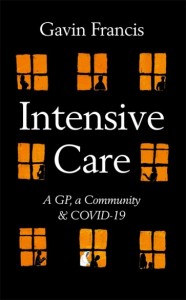 Francis, a medical doctor, wrote Intensive Care (I reviewed it here) month by month and sent chapters to his editor as he went along. Its narrative begins barely a year ago and yet it was published in January – a real feat given the usual time scale of book publishing. It was always meant to have the urgent feel of journalism, to be a “hot take,” as he put it, about COVID-19. He finds writing therapeutic; it helps him make sense of and process things as he looks back to the ‘before time’. He remembers first discussing this virus out of China with friends at a Burns Night supper in January 2020. Francis sees so many people using their “retrospecto-scopes” this year and asking what we might have done differently, if only we’d known.
He shook his head over the unnatural situations that Covid has forced us all into: “we’re gregarious mammals” and yet the virus is spread by voice and touch, so those are the very things we have to avoid. GP practices have had to fundamentally change how they operate, and he foresees telephone triage continuing even after the worst of this is over. He’s noted a rise in antidepressant use over the last year. So the vaccine, to him, is like “liquid hope”; even if not 100% protective, it does seem to prevent deaths and ventilation. Vaccination is like paying for the fire service, he said: it’s not a personal medical intervention but a community thing. This talk didn’t add a lot for me as I’d read the book, but for those who hadn’t, I’m sure it would have been an ideal introduction – and I enjoyed hearing the Scottish accents.
Bookish online events coming up soon: The Rathbones Folio Prize announcement on the 24th and Claire Fuller’s book launch for Unsettled Ground on the 25th.
Have you attended any online literary events recently?
Recent Online Literary Events with George Saunders and Kazuo Ishiguro
I’ve been taking advantage of various free and inexpensive literary events – a bonus of our temporarily virtual-only world. I have five of them stored up to write about, but to keep this post from getting absurdly long I’ll focus on two for now and feature the rest another time.
George Saunders in Conversation with Max Porter
(5×15 event)
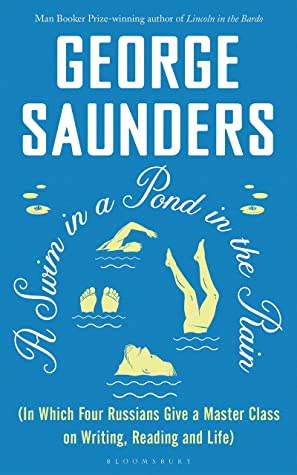 Saunders’s latest book, A Swim in a Pond in the Rain, is a written version of the graduate-level masterclass in the Russian short story that he offers at Syracuse University, where he has taught in the Creative Writing Program since 1997. His aim here was to “elevate the short story form,” he said. While the book reprints and discusses just seven stories (three by Anton Chekhov, two by Leo Tolstoy, and one each by Nikolai Gogol and Ivan Turgenev), in the class he and his students tackle more like 40. He wants people to read a story, react to the story, and trust that reaction – even if it’s annoyance. “Work with it,” he suggested. “I am bringing you an object to consider” on the route to becoming the author you are meant to be – such is how he described his offer to his students, who have already overcome 1 in 100 odds to be on the elite Syracuse program but might still need to have their academic egos tweaked.
The book is, thus, not just a set of essays on the Russian masters but also a guide to how to write well. It was clear there was mutual admiration between Saunders and Max Porter, who interviewed him. They discussed the revision process as an accumulation of micro-decisions that make the work better. For instance, Saunders compared two Tolstoy stories, “The Snowstorm” and “Master and Man” (written 20 years later), and noted that, though they are thematically similar, the later one is more organized.
Saunders spoke about writing as a dual process of intuition and iteration; a bunch of different “yous” have acted on a text by the time it’s done. Early on in his career, he thought that he had to choose which writer he wanted to be (e.g., Hemingway or Kerouac), but as he aged he realized that the mind is never fixed. He went surprisingly deep into Buddhism at this point, likening writing to meditation – both are practices pursued with intensity. To his younger self, he would say to keep going: improving is simply a matter of time (i.e., that 10,000 hours figure that’s bandied about as necessary for developing expertise).
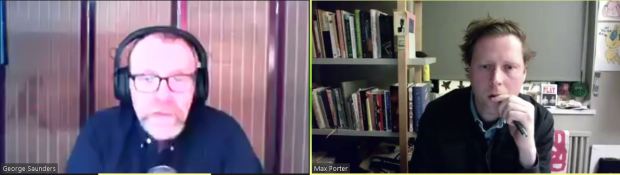
The only drawback to this event was that Saunders was speaking from his snow-encased upstate New York basement and had a horrible Internet connection; often his voice was faint and delayed, while his image stayed static. We and Porter could only stare gormlessly and wait for his face to move to match his words! I think the book would be too niche for me – I’ve hardly read anything by the Russians, and since I don’t write fiction I’m not in need of a guide to those kinds of writing decisions – but it was nice to ‘meet’ Saunders ‘in person’.
An Evening with Kazuo Ishiguro
(Faber Members / Guardian Live event)
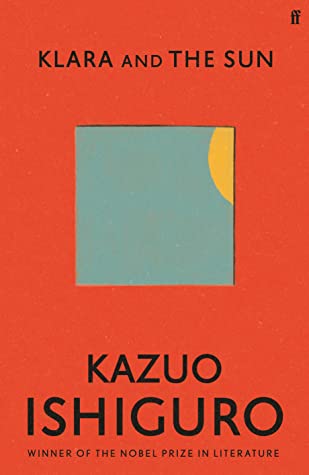 Ishiguro’s new novel, Klara and the Sun, was published by Faber yesterday. This conversation with Alex Clark also functioned as its launch event. It’s one of my most anticipated books of the year, so I pre-ordered a signed copy along with my ticket and look forward to it arriving soon. Klara is an Artificial Intelligence “friend” purchased to combat teenage loneliness. A childlike figure, she is cheerful and treats the sun like a god. Ishiguro said that the book developed from a story he wrote for children aged five to six, about a little girl who takes a doll home – except his daughter, author Naomi Ishiguro, told him no way was it suitable for young children, being far too dark. He likes “displaced or alien narrators, fish out of water,” he said, because the limited perspective allows him to focus on oddness.
In addition to Clark’s questions, a few pre-recorded questions from literary celebs (Daisy Johnson, Bernardine Evaristo, and David Mitchell) encouraged Ishiguro to create a tripartite schema for his novels, reflect on his writing about Japan, and look back at the devices he has used. Asked by Johnson about the connections between his novels, he admitted that his first three novels all retread the same ground: a man who has made a mess of his life or career picks over the past. Then his mid period is set in dreamscapes, while his most recent three novels are dystopian fantasies (though he does not see Klara as set in a dystopian world).
In response to Evaristo’s question about whether he felt an obligation to write about Japan, he said that with his early work he was conscious of needing to represent a group of people who even then (due to World War II) were viewed with suspicion or antipathy. He left Japan at age five so the country didn’t seem entirely real to him. What he knew was based on very early memories, what his mother told him, comic books sent by his grandparents, etc. As he stated in his Nobel Prize acceptance speech, writing about Japan in his twenties therefore felt like “an act of preservation.” Still, he wants his characters and situations to be universal.

Replying to Mitchell’s three questions (cheeky!), he explained that his first ambition was to be a singer/songwriter, and he wrote 100+ songs. Songwriting taught him minimalism. “You can say a huge amount by what you don’t say,” he noted. He hopes to create spaces, or rather vacuums that suck in the reader’s attention. Unlike Mitchell, he always knows the ending of a book before he begins, and his decisions are all about wanting to lodge in the reader’s brain. Thus, memorable endings are a priority for him, whereas they might not be for other writers. I was struck by his characterization of his own life: when he looks back, he doesn’t see a clear path that arose from his choices; instead, he sees a “weird, incoherent mess.” For this reason, he’s turned against the reflective device of his first three books. If he can come up with a theme, he’s hankering to write a book about hitchhikers in the north of England.
Towards the end of the (overlong) discussion, he mentioned that he has been questioning the novelist’s role due to the events of the past year: wondering about the meaning of fiction when so many have died and so many believe fake news. It was a melancholy but realistic point to end on. While I’m not an Ishiguro completist (The Unconsoled doesn’t appeal to me at all and I’m not sure I can be bothered with When We Were Orphans, but I will try The Buried Giant; I’ve read the rest), the event whetted my appetite to read his new book. (See also this Goodreads interview. I loved the anecdotes about learning he’d won the Nobel!)
Bookish online events coming up soon: The Rathbones Folio Prize announcement on the 24th and Claire Fuller’s book launch for Unsettled Ground on the 25th.
Have you attended any online literary events recently?
Writing for Bliss by Diana Raab
For Diana Raab, writing has been a way of coping with all that life has thrown at her, starting with her grandmother’s suicide and also including her daughter’s drug addiction and two bouts with cancer. She’s written poetry, memoir, and various books on the writer’s craft, with the latest, Writing for Bliss, specifically centered around life writing and mindfulness. In particular, I could see this one being helpful supplementary reading for those who have enjoyed Francine Prose’s Reading like a Writer and Mary Karr’s The Art of Memoir.
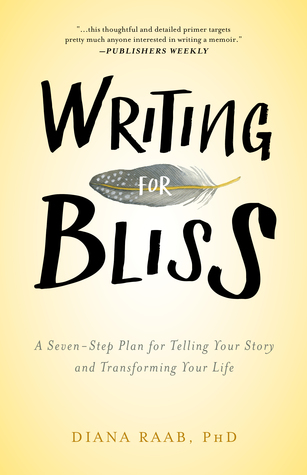 Some keywords Raab emphasizes are patience, journey, healing, and transformation. Writing is often a long process, but it can also be a therapeutic one. It’s important to find a sacred space of one’s own – whether literal like Virginia Woolf’s room of one’s own, or simply a repurposed space that has been made conducive with candles and family photos. Raab encourages would-be memoir writers to look at the patterns in their lives and to focus on writing about moments that are relevant to the story of their personal growth.
As to the nitty-gritty of getting words onto the page, she insists that life writing is just as much about storytelling as fiction is. Fleshing out a story is more important than chronological accuracy, and she advises striving for a mixture of narrative, dialogue, scenes and reflection so that the resulting book does not seem like just a list of facts and events.
Raab also issues warnings. One is about causing offense by revealing family secrets. She suggests consulting the family members you intend to write about beforehand, and later running a rough draft past them for their approval. Another is about the danger of seeking one’s self-worth in publishing. Not all books lead to traditional publication, so it’s better if you write out of love and for yourself, simply because you find fulfillment in creativity.
This is a practical as well as a theoretical guide: 50 writing prompts are dotted through the text, and there’s also an appendix full of more. I’m someone who doesn’t necessarily aspire to write fiction, so I usually skip over such sections in a book about writing, but I think many of these could make a great launch pad for writing a personal essay. The book also ends with a terrific 15-page inventory of further reading, including a list of recommended memoirs.
My rating: 
Writing for Bliss was published by Loving Healing Press on September 1st. My thanks to the author for the free e-copy for review.
I’ve hoarded a number of books about writing on my Kindle, including:
- The Hero Is You by Kendra Levin
- Scratch, ed. by Manjula Martin
- Part Wild by Deb Norton
- Process by Sarah Stodola
Have you read any of these? What other books about writing have you read that you can vouch for?
I’ve read a lot of the classics – Dorothea Brande, Stephen King, Anne Lamott et al. – but I’m always interested to hear what similar books people have found to be helpful.
 Bookish Beck = Rebecca Foster. American transplant to England. Freelance proofreader and book reviewer.
 Bookish Beck