Two terrific novellas I’m belatedly writing up today, one my first selection for Women in Translation month and the other a contribution to Virago’s “Summer of Sigrid.” Both: 

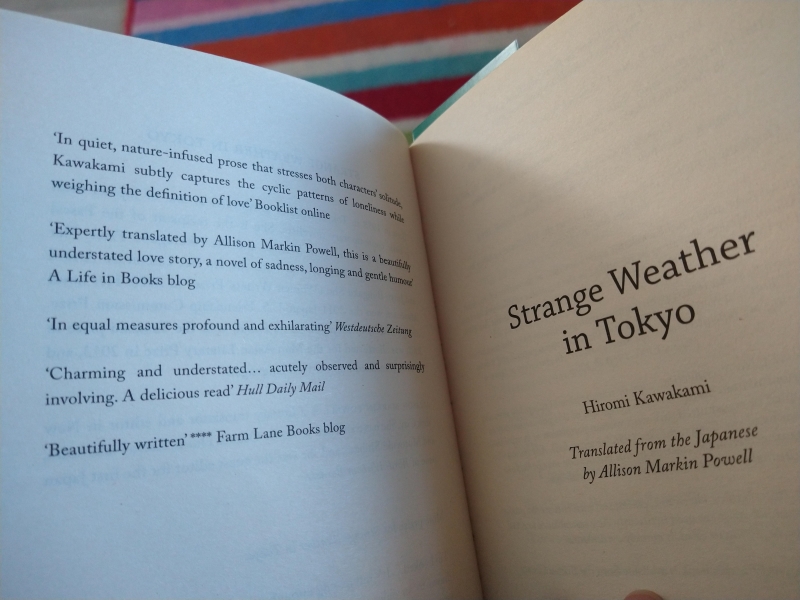
Strange Weather in Tokyo by Hiromi Kawakami (2001; 2012)
[Translated from Japanese by Allison Markin Powell]
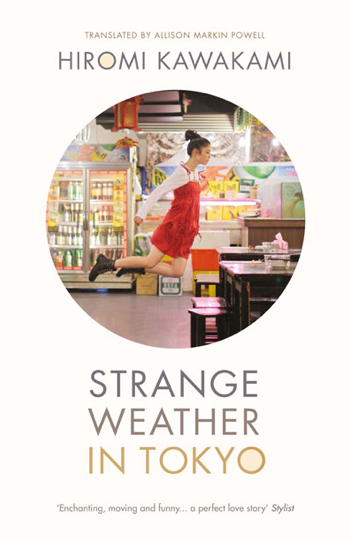 Tsukiko is a lonely barfly in her late thirties when she bumps into her secondary school Japanese teacher, Harutsuna Matsumoto, again. She calls him simply “Sensei,” and they start meeting up for low-key adventures: sharing tofu and saké at Satoru’s bar, marking annual holidays, and leaving the city to forage for mushrooms and visit his late wife’s island grave. Sensei quotes poetry and, ever the teacher, gently corrects his former pupil’s language. Tsukiko is an impassive young woman who never seemed to grow up (“I … still might not be considered a proper adult. … I just wasn’t able to ally myself with time”) and is prone to drinking too much, but finally starts to get a grip on her emotions thanks to this new connection.
Each chapter is discrete, building into a linked short story collection. The erratic (non)use of speech marks somehow didn’t bother me as it seems to suit Tsukiko’s slight disorientation. Kawakami infuses the book with attention to the seasons’ changes and everyday sensual pleasures like food. A drunk at the bar speaks for us readers when he asks the main characters, “You two, just what are you?” The nature of their bond is hard to pin down. Tsukiko is also courted by Kojima, a more age-appropriate boyfriend, but she feels nothing for him. Instead, a May–December relationship unfolds like cherry blossom, ever so gradually, from friendship into something deeper. Powell manages to fit some wordplay into her translation, as in this gently erotic passage:
At some point, sitting beside Sensei, I began to notice the heat that radiated from his body. Through his starched shirt, there came a sense of Sensei. A feeling of nostalgia. This sense of Sensei retained the shape of him. It was dignified, yet tender, like Sensei.
From the title and cover image, I might have expected the magic realism so common to Japanese literature, but this is something different: a lovely, subtle romance. It’s a reminder that it doesn’t have to be torrid passion to be true love. “Even a chance meeting is the result of a karmic connection,” as Sensei quotes. Susan (A life in books), whose review is excerpted in my paperback copy, is quite right. Kawakami was a great new discovery and I’ve got my eye on several more of her books: The Nakano Thrift Shop from the library and Record of a Night Too Brief and Far from Everywhere (forthcoming in February) on my e-reader. (Secondhand – Community Furniture Project, Newbury)

Mitz: The Marmoset of Bloomsbury by Sigrid Nunez (1998)
 What a fun little book from Nunez’s back catalogue! On the one hand, a fictional mini-biography of the Woolfs by way of their pet marmoset might seem like a random choice of topic; on the other hand, you can see the seeds of her future autofiction in which human–animal connection is a starting point for wide-ranging meditations on life and death (a dog in The Friend; a parrot in The Vulnerables; and even, to a lesser extent, the cat in What Are You Going Through).
Mitz is a small monkey who induces strong, conflicting reactions: “You looked at her and thought, How grotesque. And the very next instant, How adorable. And then, How grotesque, again.” She takes a shine to Leonard on a visit the Woolfs pay to their friends the Rothschilds in 1934, and before long they’ve offered to take Mitz home to share their London and Sussex life, along with Pinka and Sally, the spaniels they had in succession. Mitz’s favourite spot thereafter was sat on Leonard’s shoulders, or napping on his feet. She accompanied the couple on their travels, too, so distracting people in Germany that Virginia would write in a letter that “the marmoset saved us from Hitler” (Leonard was Jewish). Visitors were less enamoured, thinking Mitz dirty and bad-tempered.
In any case, the creature was a lucky accessory to genius, and Nunez makes her our eyewitness to the composition of works such as Roger Fry and The Years:
From a distance, then, Mitz observed Virginia. And she saw how this mysterious activity that could bring such a flush to Virginia’s cheek could also have quite the opposite effect: Virginia was as white as her own writing paper. She scribbled and slashed; she muttered and she groaned and she cursed. She jumped up from the chair and wandered in circles about the room.
How much Mitz understands of ageing, death, and conflict, can never be known. These were tumultuous pre-war years, during which Virginia lost a nephew and fascism loomed large. Nunez sets personal cataclysms against international ones, imagining Mitz’s journey from a Brazilian forest, via a hellish ship, to the London junk shop where she was made to sit in a draughty window to drum up business. That she spent her last five years so loved and cosseted was a stroke of good fortune. Her death ends up feeling like a more general omen, as in the book’s final line: “It was Christmas Day, the last year of peace.”
I was reminded of the complications of keeping an exotic pet in My Animals and Other Family by Julia Blackburn, in which she buys Congo the bushbaby from Harrods (and there is also a family spaniel). As part of the backmatter of this reissue, a thank-you letter from Nigel Nicolson to Nunez and a 2019 afterword by Peter Cameron note the undeniable inspiration of Virginia Woolf’s Flush, a playful short biography of Elizabeth Barrett Browning’s cocker spaniel (for whom Pinka, a gift from Vita Sackville-West, was a model). I fancied rereading Flush so have picked that up as one of my substitute Books of Summer and am enjoying discovering the connections between it and Mitz. More anon.
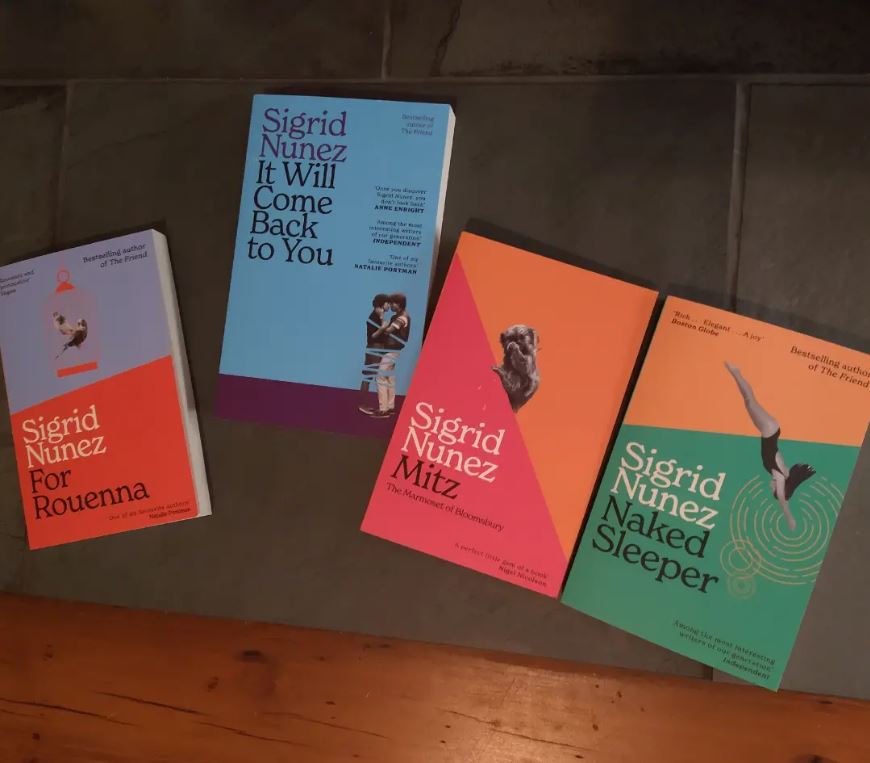
With thanks to Virago for the free copy for review, one of several matching reissues they sent me as part of their “Summer of Sigrid.”
 Bookish Beck = Rebecca Foster. American transplant to England. Freelance proofreader and book reviewer.

My copy of Strange Weather was published as The Briefcase so I was a little confused there. I really liked it.
LikeLiked by 1 person
Susan’s review noted that it was first published in English as The Briefcase in the USA. Such a boring title! Although I don’t think the levitating woman is really an appropriate cover image, it plus the title did at least draw me to pick this up secondhand.
LikeLiked by 1 person
I’ve not read either of these, but I enjoy both authors a lot already. I think I have a copy of the Kawakami.
LikeLiked by 1 person
I think you’d find both to be solid reads from admired authors, then.
LikeLike
Thanks for the mention, Rebecca. The Nakano Thrift Shop is a joy, written in a similar style to this one, while Record of a Night Too Brief is very different, the titular story is quite surreal, but also very enjoyable. Thanks for the Summer of Nunez tip. I’d not come across it.
LikeLiked by 1 person
*Summer of Sigrid*
LikeLike
Nakano Thrift Shop will be right up my street, then. I’ve had Record on my Kindle for many years and don’t remember why I initially downloaded it.
LikeLiked by 1 person
I read Strange Weather in Tokyo when it was first published in English and remember literally nothing about it – still love the cover, though, and I think it may have been my introduction to Japanese fiction in translation.
LikeLiked by 1 person
Great introduction!
LikeLiked by 1 person
Hi Rebecca
We liked to read ‘Strange Weather in Tokyo’. That’s a love story without hype and drama like we experience love as well.
The Fab Four of Cley
🙂 🙂 🙂 🙂
LikeLiked by 1 person
That’s a nice way to think about it. Realistic rather than the frequent Japanese magic realism.
LikeLiked by 1 person
Great reviews!
I so enjiyed Strange Weather in Tokyo! Too bad the stupid cover kept me away form it for a while!
It ended up being my favorite fiction in audio format for 2025:
https://wordsandpeace.com/2025/01/12/sunday-post-128-ice-and-snow/
LikeLiked by 1 person
I put this in my husband’s stack for our book club’s Christmas book swap game, but I swiped it off him as a WIT Month option and I’m so glad I did!
LikeLiked by 1 person
I really enjoyed Strange Weather in Tokyo. It was almost dreamlike. I’d like to read her again.
LikeLiked by 1 person
That’s true, and Tsukiko drifts from one event and activity to another and is often tipsy. The way the speech is sometimes in quotation marks and sometimes not also contributes to an unreal feeling, too. But I think the relationship with Sensei grounds her. I’m eager to try more by Kawakami.
LikeLiked by 1 person
I’ve thought about reading Strange Weather so many times that I had to check Goodreads to make sure I hadn’t actually… this might be the push I need! Nunez has long been on my list too. Both very tempting!
LikeLiked by 1 person
And both novella length, so what have you got to lose!?
LikeLike
[…] five days in a London slum – a thrilling central chapter in an otherwise serene narrative. As in Mitz by Sigrid Nunez, which is an homage to Flush, there is dramatic irony between what readers […]
LikeLike
Strange Weather sounds wonderful, I will have to look out for it.
LikeLiked by 1 person
It seems like one you’d enjoy.
LikeLiked by 1 person
[…] Strange Weather in Tokyo by Hiromi Kawakami: Tsukiko is a lonely barfly in her late thirties when she bumps into a secondary school teacher again. She calls him “Sensei,” and they start meeting up for low-key adventures. Kawakami infuses the book with attention to the seasons’ changes and everyday sensual pleasures like food. A lovely, subtle romance. […]
LikeLike
They both sound appealing to me, and I love the image with your pretty Virago editions too! (My comment on the previous post either got zapped to the “file that shall not be named” or zapped somewhere even more distant… maybe it’s just awaiting approval. At least I’ll remember to copy this one now!)
LikeLiked by 1 person
Both very much your kind of book!
LikeLike