Birthday Goings-on & Booker Prize Predictions
For a low-key early birthday outing we went to The Living Rainforest, a local tourist attraction run by a conservation charity. It’s on the small side, but our tickets got us free annual entry, so we’ll likely come back with family and friends with kids. Along with the tropical plants (including various fig trees I sought out especially!), there are birds both free-roaming and in cages, marmosets and monkeys, fish and turtles, an armadillo, and an elusive sloth we didn’t manage to see. Afterwards we went around the corner for cappuccinos and generous slabs of cake at the Hampstead Norreys community shop café.


My birthday itself was a gloomy day, but I didn’t mind at all; I filled it with reading and feasting, plus listening to music, working on a jigsaw puzzle, and having the cat on my lap. Each year my husband happily takes on impressive cooking and baking projects of my choice. This year we had acorn squash and black bean enchiladas with homemade salsa and guacamole, followed by Mexican rice pudding flavored with cinnamon and lime. In the afternoon with presents we’d had David Lebovitz’s Banana Cake with Mocha Frosting and Salted Candied Peanuts from Ready for Dessert. A delicious and decadent grown-up cake.


I got chocolate, notebooks, Lush shampoo, a bunch of llama/alpaca stuff, and 10 books as gifts (I suspect there might be more books to come, though). Looking back at my birthday book hauls from 2016 and 2017, I can see that I’ve had mixed success with getting through the acquisitions in a timely fashion: I’ve now read 9 out of 12 of 2016’s, but only 4 out of 11 of 2017’s. Though I’m very excited about some of my new books – I marked them as high priority on my wish list, after all – that doesn’t always translate into reading them soon. However, I’ve added two of them to my novellas pile for November, and I’ll read the first L’Engle journal in December as it starts around Christmastime.
Tomorrow the Man Booker Prize will be announced. Although I’ve only read one and a third books from the shortlist, I’m going to have a go at making predictions anyway. Here are the six nominees in what I think is their likelihood of winning:
 #1: I fully expect Richard Powers to win for The Overstory. This is the one I’m partway through; I started reading a library copy on Friday. I’m so impressed by the novel’s expansive nature. It seems to have everything: love, war, history, nature, politics, technology, small-town life, family drama, illness, accidents, death. And all of human life is overshadowed and put into perspective by the ancientness of trees, whose power we disregard at a cost. I’m reminded of the work of Jonathan Franzen (Freedom + Purity), as well as Barbara Kingsolver’s latest, Unsheltered – though Powers is prophetic where she’s polemic.
 #2: Washington Black by Esi Edugyan is a good old-fashioned adventure story about a slave who gets the chance to leave his Barbados sugar plantation behind when he becomes an assistant to an abolitionist inventor, Christopher “Titch” Wilde. Wash discovers a talent for drawing and a love for marine life and pursues these joint interests in the disparate places where life takes him. Part One was much my favorite; none of what followed quite matched it in depth or pace. Still, I enjoyed following along on Wash’s escapades, and I wouldn’t mind seeing this take the prize – it would be great to see a woman of color win.
 #3: The Mars Room by Rachel Kushner: Kushner is well respected, though I’ve failed to get on with her fiction before. An inside look at the prison system, this could be sufficiently weighty and well-timed to win.
 #4: Everything Under by Daisy Johnson: A myth-infused debut novel about a mother and daughter. On my library stack to read next, and the remaining title from the shortlist I’m most keen to read.
 #5: The Long Take by Robin Robertson: A novel, largely in verse, about the aftermath of war service. Also on my library stack. Somewhat experimental forms like this grab Booker attention, but this might be too under-the-radar to win.
 #6: Milkman by Anna Burns: Set in Belfast during the Troubles or a dystopian future? From my Goodreads friends’ reviews this sounds wooden and overwritten. Like the Kushner, I’d consider reading it if it wins but probably not otherwise.
Do you follow the Booker Prize? Which novel do you expect to win?
Last-Minute Thoughts on the Booker Longlist
Tomorrow, the 20th, the Man Booker Prize shortlist will be announced. This must be my worst showing for many years: I’ve read just two of the longlisted books, and both were such disappointments I had to wonder why they’d been nominated at all. I have six of the others on request from the public library; of them I’m most keen to read The Overstory and Sabrina, the first graphic novel to have been recognized (the others are by Gunaratne, Johnson, Kushner and Ryan, but I’ll likely cancel my holds if they don’t make the shortlist). I’d read Robin Robertson’s novel-in-verse if I ever managed to get hold of a copy, but I’ve decided I’m not interested in the other four nominees (Bauer, Burns, Edugyan, Ondaatje*).
The Water Cure by Sophie Mackintosh
(Excerpted from my upcoming review for New Books magazine’s Booker Prize roundup.)
 The first word of The Water Cure may be “Once,” but what follows is no fairy tale. Here’s the rest of that sentence: “Once we have a father, but our father dies without us noticing.” The tense seems all wrong; surely it should be “had” and “died”? From the very first line, then, Sophie Mackintosh’s debut novel has the reader wrong-footed, and there are many more moments of confusion to come. The other thing to notice in the opening sentence is the use of the first person plural. That “we” refers to three sisters: Grace, Lia and Sky. After the death of their father, King, it’s just them and their mother in a grand house on a remote island.
There are frequent flashbacks to times when damaged women used to come here for therapy that sounds more like torture. The sisters still engage in similar sadomasochistic practices: sitting in a hot sauna until they faint, putting their hands and feet in buckets of ice, and playing the “drowning game” in the pool by putting on a dress laced with lead weights. Despite their isolation, the sisters are still affected by the world at large. At the end of Part I, three shipwrecked men wash up on shore and request sanctuary. The men represent new temptations and a threat to the sisters’ comfort zone.
This is a strange and disorienting book. The atmosphere – lonely and lowering – is the best thing about it. Its setup is somewhat reminiscent of two Shakespeare plays, King Lear and The Tempest. With the exception of a few lines like “we look towards the rounded glow of the horizon, the air peach-ripe with toxicity,” the prose draws attention to itself in a bad way: it’s consciously literary and overwritten. In terms of the plot, it is difficult to understand, at the most basic level, what is going on and why. Speculative novels with themes of women’s repression are a dime a dozen nowadays, and the interested reader will find a better example than this one.
My rating: 
Normal People by Sally Rooney
Conversations with Friends was one of last year’s sleeper hits and a surprise favorite of mine. You may remember that I was part of an official shadow panel for the 2017 Sunday Times Young Writer of the Year Award, which I was pleased to see Sally Rooney win. So I jumped at the chance to read her follow-up novel, which has been earning high praise from critics and ordinary readers alike as being even better than her debut. Alas, though, I was let down.
 Normal People is very similar to Tender – which for some will be high praise indeed, though I never managed to finish Belinda McKeon’s novel – in that both realistically address the intimacy between a young woman and a young man during their university days and draw class and town-and-country distinctions (the latter of which might not mean much to those who are unfamiliar with Ireland).
The central characters here are two loners: Marianne Sheridan, who lives in a white mansion with her distant mother and sadistic older brother Alan, and Connell Waldron, whose single mother cleans Marianne’s house. Connell doesn’t know who his father is; Marianne’s father died when she was 13, but good riddance – he hit her and her mother. Marianne and Connell start hooking up during high school in Carricklea, but Connell keeps their relationship a secret because Marianne is perceived as strange and unpopular. At Trinity College Dublin they struggle to fit in and keep falling into bed with each other even though they’re technically seeing other people.
The novel, which takes place between 2011 and 2015, keeps going back and forth in time by weeks or months, jumping forward and then filling in the intervening time with flashbacks. I kept waiting for more to happen, skimming ahead to see if there would be anything more to it than drunken college parties and frank sex scenes. The answer is: not really; that’s mostly what the book is composed of.
I can see what Rooney is trying to do here (she makes it plain in the next-to-last paragraph): to show how one temporary, almost accidental relationship can change the partners for the better, giving Connell the impetus to pursue writing and Marianne the confidence to believe she is loveable, just like ‘normal people’. It is appealing to see into these characters’ heads and compare what they think of themselves and each other with their awareness of what others think. But page to page it is pretty tedious, and fairly unsubtle.
I was interested to learn that Rooney was writing this at the same time as Conversations, and initially intended it to be short stories. It’s possible I would have appreciated it more in that form.
My rating: 
My thanks to Faber & Faber for the free copy for review.
 *I’ve only ever read the memoir Running in the Family plus a poetry collection by Ondaatje. I have a copy of The English Patient on the shelf and have felt guilty for years about not reading it, especially after it won the “Golden Booker” this past summer (see Annabel’s report on the ceremony). I had grand plans of reading all the Booker winners on my shelf – also including Carey and Keneally – in advance of the 50th anniversary celebrations, but didn’t even make it through the books I started by the two South African winners; my aborted mini-reviews are part of the Shiny New Books coverage here. (There are also excerpts from my reviews of Bring Up the Bodies, The Sellout and Lincoln in the Bardo here.)
Last year I’d read enough from the Booker longlist to make predictions and a wish list, but this year I have no clue. I’ll just have a look at the shortlist tomorrow and see if any of the remaining contenders appeal.
What have you managed to read from the Booker longlist? Do you have any predictions for the shortlist?
The Wellcome Book Prize 2018 Awards Ceremony
 Hey, we got it right! Mark O’Connell’s To Be a Machine, our shadow panel’s pick, won the Wellcome Book Prize 2018 last night. Of the three shadow panels I’ve participated in and the many others I’ve observed, this is the only time I remember the shadow winner matching the official one. Clare, Paul and I were there in person for the announcement at the Wellcome Collection in London. When we briefly spoke to the judges’ chair, Edmund de Waal, later in the evening, he said he was “relieved” that their decision matched ours – but I think it was definitely the other way around!
Simon Chaplin, Director of Culture & Society at the Wellcome Trust, said that each year more and more books are being considered for the prize. De Waal revealed that the judges read 169 books over nine months in what was for him his most frightening book club ever. “To bring the worlds of medicine and health into urgent conversation” requires a “lyrical and disciplined choreography,” he said, and “how we shape stories of science … is crucial.” He characterized the judges’ discussions as both “personal and passionate.” The Wellcome-shortlisted books make a space for public debate, he insisted.

Judges Gordon, Paul-Choudhury, Critchlow, Ratcliffe and de Waal. Photo by Clare Rowland.
The judges brought each of the five authors present onto the stage one at a time for recognition. De Waal praised Ayobami Adebayo’s “narrative of hope and fear and anxiety” and Meredith Wadman’s “beautifully researched and paced thriller.” Dr Hannah Critchlow of Magdalene College, Cambridge called Lindsey Fitzharris’s The Butchering Art “gruesome yet fascinating.” Oxford English professor Sophie Ratcliffe applauded Kathryn Mannix’s book and its mission. New Scientist editor-in-chief Sumit Paul-Choudhury said Mark O’Connell’s book is about the future “just as much as what it means to be human in the twenty-first century.” Journalist and mental health campaigner Bryony Gordon thanked Sigrid Rausing for her “great honesty and stunning prose.”
But there can only be one winner, and it was Mark O’Connell, who couldn’t be there as his wife is/was giving birth to their second child imminently. The general feeling in the room was that he’d made the right call by deciding to stay with his family. He must be feeling like the luckiest man on earth right now, to have a baby plus £30,000! Max Porter, O’Connell’s editor at Granta and the author of Grief Is the Thing with Feathers, received the award on his behalf and read out the extremely witty speech he’d written in advance.
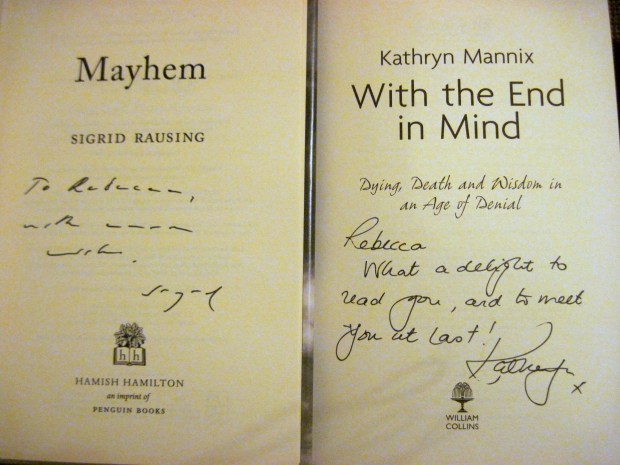
Afterwards we spoke to three of the shortlisted authors. Kathryn Mannix said she’d so enjoyed following our shadow panel reviews and that it was for the best that O’Connell won, as any other outcome might have spoiled the lovely girls’ club the others had going on during the weekend’s events. I got two signatures and we nabbed a quick photo with Lindsey Fitzharris. It was also great to meet Simon Savidge, the king of U.K. book blogging, and author and vlogger Jen Campbell. Other ‘celebrities’ spotted: Sarah Bakewell and Ben Goldacre.
This time I stayed long enough for pudding canapés to come around – raspberry cake pops and mini meringues with strawberries. What a great idea! On the way out I again acquired a Wellcome goody bag: this year’s tote with a copy of The Butchering Art, which I only had on Kindle before. I’d also treated myself to this brainy necklace from the Wellcome shop and wore it to the ceremony. An all-round great evening. I’m looking forward to next year’s prize season already!

Paul, Lindsey Fitzharris, Clare and me.


Wellcome Book Prize Shortlist Event
Five of the six shortlisted authors (barring Dublin-based Mark O’Connell) were at the Wellcome Collection in London yesterday to share more about their books in mini-interviews with Lisa O’Kelly, the associate editor of the Observer. She called each author up onto the stage in turn for a five-minute chat about her work, and then brought them all up for a general conversation and audience questions. Clare and I found it a very interesting afternoon. Here’s some context that I gleaned about the five books and their writers.
 Ayobami Adebayo says sickle cell anemia is a massive public health problem in Nigeria, as brought home to her when some friends died of complications of sickle cell. She herself was tested for the gene and learned that she is a carrier, so her children would have a 25% chance of having the disease if her partner was also a carrier. Although life expectancy with the disease has improved to 45–50, a cure is still out of reach for most Nigerians because bone marrow/stem cell transplantation and anti-rejection drugs are so expensive. Compared to the 1980s, when her book opens, she believes polygamy is becoming less fashionable in Nigeria and people are becoming more open to other means of becoming parents, whether IVF or adoption. It’s a way of acknowledging, she says, that parenthood is “not just about biology.”
Sigrid Rausing started writing her book soon after her sister-in-law Eva’s body was found: just random paragraphs to make sense of what had happened. From there it became an investigation, a quest to find the nature of addiction. She thinks that as a society we still don’t quite understand what addiction is, and the medical research and public perception are very separate. In addition to nature and nurture, she thinks we should consider the influence of culture – as an anthropologist by training, she’s very interested in drug culture and how that drew in her brother, Hans. Although there have been many memoirs by ex-addicts, she can’t think of another one by a family member. Perhaps, she suggested, this is because the addict is seen as the ultimate victim. She referred to her book as a “collage,” a very apt description.
Kathryn Mannix spoke of how her grandmother, born in 1900, saw so much more death than we do nowadays: siblings, a child, and so on. Today, though, Mannix has encountered people in their sixties who are facing, with their parents, their very first deaths. Death is fairly “gentle” and “dull” if you’re not directly involved, she insists; she blames Hollywood and Eastenders for showing unusually dramatic deaths. She said once you understand what exactly people are afraid of about dying (e.g. hell, oblivion, pain, leaving their families behind) you can address their specific concerns and thereby “beat out the demon of terror and fear.” Mannix never intended to write a book, but someone heard her on the radio and invited her to do so. Luckily, from her medical school days onward, she’d been writing an A4 page about each of her most mind-boggling cases to get them out of her head and move on. That’s why, as O’Kelly put it, the characters in her 30 stories “leap off the page.”
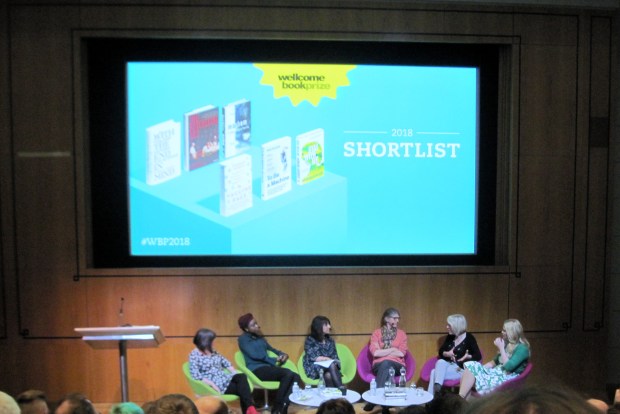
Mannix, Adebayo, O’Kelly, Rausing, Wadman & Fitzharris
Lindsey Fitzharris called The Butchering Art “a love story between science and medicine” – it was the first time that the former (antisepsis) was applied to the latter. She initially thought Robert Liston was her man – he was so colorful, larger than life – but eventually found that the real story was with Joseph Lister, the quiet, persistent Quaker. (However, the book does open with Liston performing the first surgery under ether.) Fitzharris is also involved in the Order of the Good Death, author Caitlin Doughty’s initiative, and affirmed Mannix’s efforts to remove the taboo from talking about death. I think I heard correctly that she said there is a film of The Butchering Art in the works?! I’ll need to look into that some more.
Meredith Wadman started with a brief explanation of how immunization works and why the 1960s were ripe for vaccine research. This segment went really science-y, which I thought was a little unfortunate as it may have made listeners tune out and be less interested in her work than the others’. It was perhaps inevitable given her subject matter, but also a matter of the questions O’Kelly asked – with the others she focused more on stories and themes than on scientific facts. It was interesting to hear what Wadman has been working on recently: for the past 6–8 months, she’s been reporting for Science on sexual harassment in science. For her next book, though, she’s pondering the conflict between a congressman and a Centers for Disease Control scientist over funding into research that might lead to gun control.
The question time brought up the issues of medical misinformation online, the distrust people with chronic illnesses have of medical professionals, and euthanasia – Mannix rather dodged that one, stating that her book is about the natural dying process so that’s not really her area. (Though it does come up in a chapter of her book.) We also heard a bit about the projects up next for each author. Rausing’s next book will be a travel memoir about the Capetown drought, taking in apartheid and her husband’s family’s immigration. Adebayo is at work on a very nebulous novel “about people,” and possibly how privilege affects access to healthcare.
Wellcome Book Prize Shadow Panel Decision
Addiction, death, infertility, surgery, transhumanism and vaccines: It’s been quite the varied reading list for the five of us this spring! Lots of science, lots of medicine, but also a lot of stories and imagination.
After some conferring and voting, we have arrived at our shadow panel winner for the Wellcome Book Prize 2018: To Be a Machine by Mark O’Connell.
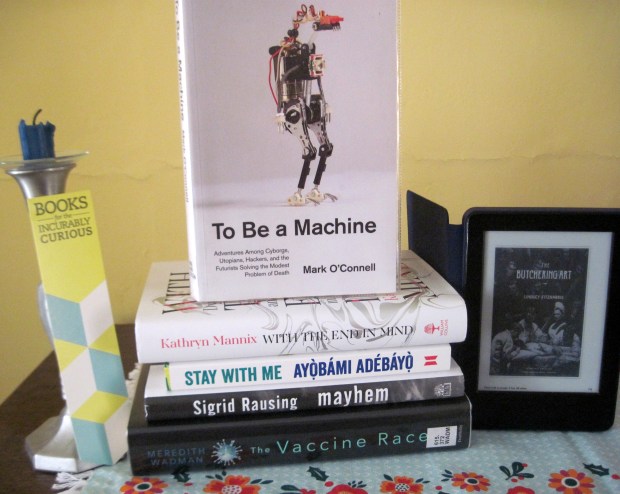
Rarely have I been so surprised to love a book. It’s a delight to read, and no matter what your background or beliefs are, it will give you plenty to think about. It goes deep down, beneath our health and ultimately our mortality, to ask what the essence of being human is.
Here’s what the rest of the shadow panel has to say about our pick:
Annabel: “O’Connell, as a journalist and outsider in the surprisingly diverse field of transhumanism, treats everyone with respect: asking the questions, but not judging, to get to the heart of the transhumanists’ beliefs. For a subject based in technology, To Be a Machine is a profoundly human story.”
Clare: “The concept of transhumanism may not be widely known or understood yet, but O’Connell’s engaging and fascinating book explains the significance of the movement and its possible implications both in the distant future and how we live now.”
Laura: “My brain feels like it’s been wired slightly differently since reading To Be a Machine. It’s not just about weird science and weird scientists, but how we come to terms with the fact that even the luckiest of us live lives that are so brief.”
Paul: “An interesting book that hopefully will provoke further discussion as we embrace technology and it envelops us.”

On Monday we’ll find out which book the official judges have chosen. I could see three or four of these as potential winners, so it’s very hard to say who will take home the £30,000.
Who are you rooting for?
Wellcome Book Prize: Shortlist Recap
Tomorrow morning we will announce our Wellcome Book Prize 2018 shadow panel winner. Beforehand I wanted to do a quick recap of my reviews, especially for the two books that I read before the shortlist announcement. My full reviews are here:
Stay with Me by Ayobami Adebayo 
To Be a Machine by Mark O’Connell 
Mayhem by Sigrid Rausing
The Vaccine Race by Meredith Wadman
I give some extra thoughts on and favorite quotes from the other two below:
The Butchering Art by Lindsey Fitzharris
 This is a great blend of medical history and popular science that should draw in readers who wouldn’t normally gravitate to either topic – provided they aren’t too squeamish. Fitzharris has recently returned to Oxford as a visiting academic, and this has also been nominated for the Wolfson History Prize. Follow her on Instagram (@drlindseyfitzharris) for a steady stream of gruesomely fascinating photos (I wish The Butchering Art had been illustrated!). Her next book will be much of a muchness, it seems, documenting the early years of plastic surgery after World War I through the story of pioneering surgeon Harold Gillies.
In the days before Joseph Lister…
“Operating theaters were gateways to death. It was safer to have an operation at home than in a hospital, where mortality rates were three to five times higher than they were in domestic settings.”
“The surgeon was very much viewed as a manual labourer who used his hands to make his living, much like a key cutter or plumber today.”
See what the rest of the shadow panel has to say about this book:
Annabel’s review: “[A]n extremely readable account of a ground-breaking career which led to real advances in hospital medicine. I enjoyed the whole, but particularly the grisly bits!”
Laura’s review: “It’s easy for me to feel a bit impatient with popular histories of periods or subjects that I know well, but Fitzharris strikes exactly the right note, writing clearly and accessibly with no dumbing down.”
Paul’s review: “It is one of the better books that I have read on medical history[;] Fitzharris writes in an engaging way on a subject that is not going to appeal to everyone, but in amongst all the blood is the fascinating story of Joseph Lister.”
With the End in Mind by Kathryn Mannix
 “It’s time to talk about dying. This is my way of promoting the conversation,” Mannix writes in her introduction to this accessible and reassuring book about death. She believes we are afraid of death because of our misconception that it is inevitably painful and undignified. In her decades of working in hospice care, this has rarely been the case. (Thank goodness that, compared to the earlier nineteenth-century situation Fitzharris surveys, we have reliable pain control options.) Mannix sees the role of the hospice worker as being like a midwife for the dying, a helpful idea I first encountered in Henry Fersko-Weiss’s Caring for the Dying: The Doula Approach to a Meaningful Death.
Many of the stories in this book are of peaceful deaths the patient and family had time to prepare for. Others are sad stories of denial. One, though, is quite gruesome, yet magnificently described. Alex, a young man with testicular teratoma, has a massive GI bleed:
“Alex’s head is thrown back, almost as though it is a voluntary movement. A huge, dark-red python slithers rapidly out of his mouth, pushing his head backwards as it coils itself onto the pillow beside him; the python is wet and gleaming and begins to stain the pillowcase and sheets with its red essence as Alex takes one snoring breath, and then stops breathing. His mother screams as he realises that the python is Alex’s blood. Probably all of his blood.”
See what the rest of the shadow panel has to say about this book:
Annabel’s review: “[I]t is helping patients, and their families and loved ones, to understand the process of dying, and dispelling the taboos around it that make this book such a valuable and compelling read. I wish I’d read something like this book before my mum died.”
Clare’s review: “For me, this enlightening book is a strong potential winner for the Wellcome Book Prize and I hope it brings comfort and guidance for those who need it.”
Laura’s review: “[The book is] written from her own experiences as a specialist in palliative care, and this proved, for me, both its strength and its downfall. … Mannix writes particularly well on the characteristic patterns of somebody who is entering a gradual decline.”
Paul’s review: “Can highly recommend this moving book and I think it should be essential reading for anyone who has any concerns about death.”
I wouldn’t be at all surprised to see either of these win the Wellcome Book Prize on Monday. Stay tuned for tomorrow’s shadow panel winner announcement, and Sunday’s write-up of a shortlist event I’m attending in London.
Quick Reactions to the Wellcome Book Prize Shortlist
From 12, we are now down to six. The 2018 Wellcome Book Prize shortlist is here!

Some quick thoughts:
I sort-of predicted three out of the six in yesterday’s post: The Butchering Art by Lindsey Fitzharris, With the End in Mind by Kathryn Mannix, and To Be a Machine by Mark O’Connell.
I’m relieved that I’d already gotten to two of the shortlisted titles (Fitzharris and Mannix), so I can focus on reading the other four over the next 5+ weeks, and will briefly revisit those first two on my Kindle when it’s decision time.
I am pretty shocked that Maggie O’Farrell’s I Am, I Am, I Am did not advance to the shortlist. Mayhem will have to be a truly amazing memoir to outdo it; I wanted to read it anyway, but now I’m particularly keen – it would be a good one for me to feature on the official blog tour if that happens to work out.
I’m not feeling very cheerful about having to start Stay with Me again (I DNFed it last year), but I’ll try to approach it with an open mind.
To Be a Machine is currently on shelf at my local library (fingers crossed that it’s still there when I go on Friday) and I’ve reserved The Vaccine Race from another branch. I’ll start with one of those.
I’ve also been promised two review copies at random in the post – let’s hope it’s not the two I’ve already read!
(See also Laura’s initial thoughts.)
Feel like joining the shadow panel in reading one or more of these six books?
One More Wellcome Longlist Review & Shortlist Predictions
Tomorrow the six titles on the Wellcome Book Prize shortlist will be revealed. I’ve managed to read one more from the longlist since my last batch.
The Butchering Art: Joseph Lister’s Quest to Transform the Grisly World of Victorian Medicine by Lindsey Fitzharris
Surgery was a gory business with a notably high fatality rate well into the nineteenth century. Surgeons had the fastest hands in the West, but their victims were still guaranteed at least a few minutes of utter agony as they had a limb amputated or a tumor removed, and the danger wasn’t over after they were sewn up either: most patients soon died from hospital infections. The development of anesthetics and antiseptic techniques helped to change all that.
Fitzharris opens with the vivid and rather gruesome scene of a mid-thigh amputation performed by Robert Liston at University College Hospital in London in 1846. This surgery was different, though: it only took 28 seconds, but the patient felt nothing thanks to the ether he had been administered. He woke up a few minutes later asking when the procedure would begin. In the audience that day was Joseph Lister, who would become one of Britain’s most admired surgeons.
Lister came from a Quaker family and, after being educated at University College London, started his career in Edinburgh. Different to many medical professionals of the time, he was fascinated by microscopy and determined to find out what caused deadly infections. Carbolic acid and catgut ligatures were two of Lister’s main innovations that helped to fight infection. In fact, whether we realize it or not, his legacy is forever associated with antiseptics: Listerine mouthwash (invented in 1879) is named after him, and the Johnson brothers of Johnson & Johnson fame started their business mass-producing sterile surgical dressings after attending one of Lister’s lectures.
My interest tailed off a bit after the first third, as the book starts going into more depth about Lister’s work and personal life: he married his boss’s daughter and moved from Edinburgh to Glasgow and then back to London. However, the best is yet to come: the accounts of the surgeries he performed on his sister (a mastectomy that bought her three more years of life) and Queen Victoria (removing an orange-sized abscess from under her arm) are terrific. The chapter on treating the queen in secret at Balmoral Castle in 1871 was my overall favorite.

It probably wasn’t the best idea to start this book over my lunch one day!
I was that kid who loved going to Civil War battlefields and medical museums and looking at all the different surgical saws and bullet fragments in museum cases, so I reveled in the gory details here but was not as interested in the biographical material. Do be sure you have a strong stomach before you try reading the prologue over a meal. This is a comparable read to The Remedy, about the search for a cure to tuberculosis.
My rating:
Shortlist Predictions
Now, I’ve still only read half of the longlisted titles so far, so it’s hard to make any solid guesses. However, the below fall somewhere between wishes and informed predictions:
- In Pursuit of Memory by Joseph Jebelli: A definitive treatment of an epidemic of our time, Alzheimer’s disease. The neuroscientist author achieves the right balance between history and research on the one hand and personal stories readers can relate to on the other.
- The White Book by Han Kang: The only fiction title from the longlist that I haven’t read at least part of. This is also on this year’s Man Booker International Prize longlist and has been well received. From what I can tell, the health theme seems stronger than that of Stay with Me or Midwinter Break, and it would also be nice for one title in translation to make the shortlist.
- With the End in Mind by Kathryn Mannix: As I said in my review last week, this is an excellent all-round guide to preparation for death, based around touching patient stories plus the author’s experience in palliative care and CBT. Practical, compassionate and helpful.
- I Am, I Am, I Am by Maggie O’Farrell: For me, this book stands out as the one that most clearly illuminates the effects of illness, medical treatment, and other threats to life and limb in the course of an ordinary existence. I’d be very happy to see it win the whole thing.
- EITHER The Butchering Art by Lindsey Fitzharris OR The Vaccine Race by Meredith Wadman: I reckon one history of science title deserves to be on there; I think Wadman might have the slight edge.
- EITHER To Be a Machine by Mark O’Connell OR Behave by Robert Sapolsky: The Wellcome Prize loves big books investigating human tendencies and possibilities. I find the thought of either of these daunting, but I know they would also be illuminating. I’d prefer to read the O’Connell, but I’d give the edge to Sapolsky.
Any predictions of your own to make?
Wellcome Book Prize Shadow Panel & Two Longlist Reviews
I’m delighted to announce the other book bloggers on my Wellcome Book Prize 2018 shadow panel: Paul Cheney of Halfman, Halfbook, Annabel Gaskell of Annabookbel, Clare Rowland of A Little Blog of Books, and Dr. Laura Tisdall. Once the shortlist is announced on Tuesday the 20th, we’ll be reading through the six nominees and sharing our thoughts. Before the official winner is announced at the end of April we will choose our own shadow winner.
I’ve been working my way through some of the longlisted titles I was able to access via the public library and NetGalley. Here’s my latest two (both ):
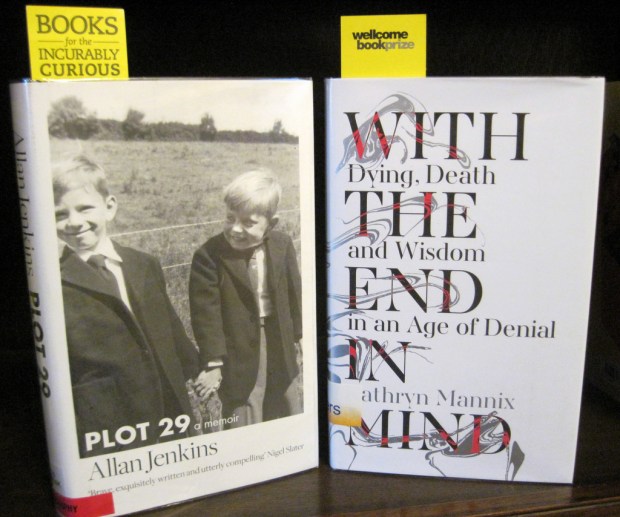
Plot 29: A Memoir by Allan Jenkins
This is an unusual hybrid memoir: it’s a meditative tour through the gardening year, on a plot in London and at his second home in his wife’s native Denmark. But it’s also the story of how Jenkins, editor of the Observer Food Monthly, investigated his early life. Handed over to a Barnardo’s home at a few months of age, he was passed between various family members and a stepfather (with some degree of neglect: his notes show scabies, rickets and TB) and then raised by strict foster parents in Devon with his beloved older half-brother, Christopher. It’s interesting to read that initially Jenkins intended to write a simple gardening diary, with a bit of personal stuff thrown in. But as he got further into the project, it started to morph.

This cover image is so sweet. It’s a photograph from Summer 1959 of Christopher and Allan (on the right, aged five), just after they were taken in by their foster parents in Devon.
The book has a complicated chronology: though arranged by month, within chapters its fragments jump around in time, a year or a date at the start helping the reader to orient herself between flashbacks and the contemporary story line. Sections are often just a paragraph long; sometimes up to a page or two. I suspect some will find the structure difficult and distancing. It certainly made me read the book slowly, which I think was the right way. You take your time adjusting to the gradual personal unveiling just as you do to the slow turn of the seasons. When major things do happen – meeting his mother in his 30s; learning who his father was in his 60s – they’re almost anticlimactic, perhaps because of the rather flat style. It’s the process that has mattered, and gardening has granted solace along the way.
I’m grateful to the longlist for making me aware of a book I otherwise might never have heard about. I don’t think the book’s mental health theme is strong enough for it to make the shortlist, but I enjoyed reading it and I’ll also take a look at Jenkins’s upcoming book, Morning, about the joys of being an early riser. (Ironic after my recent revelations about my own sleep patterns!)
Favorite lines:
“Solitude plus community, the constant I search for, the same as the allotment”
“The last element to be released from Pandora’s box, they say, was hope. So I will mourn the children we once were and I will sow chicory for bitterness. I will plant spring beans and alliums. I’ll look after them.”
“As a journalist, I have learned the five Ws – who, what, where, when, why. They are all needed to tell a story, we are taught, but too many are missing in my tale.”
With the End in Mind: Dying, Death and Wisdom in an Age of Denial by Kathryn Mannix
This is an excellent all-round guide to preparation for death. It’s based around relatable stories of the patients Mannix met in her decades working in the fields of cancer treatment and hospice care. She has a particular interest in combining CBT with palliative care to help the dying approach their remaining time with realism rather than pessimism. In many cases this involves talking patients and their loved ones through the steps of dying and explaining the patterns – decreased energy, increased time spent asleep, a change in breathing just before the end – as well as being clear about how suffering can be eased.
I read the first 20% on my Kindle and then skimmed the rest in a library copy. This was not because I wasn’t enjoying it, but because it was a two-week loan and I was conscious of needing to move on to other longlist books. It may also be because I have read quite a number of books with similar themes and scope – including Caitlin Doughty’s two books on death, Caring for the Dying by Henry Fersko-Weiss, Being Mortal by Atul Gawande, and Waiting for the Last Bus by Richard Holloway. Really this is the kind of book I would like to own a copy of and read steadily, just a chapter a week. Mannix’s introductions to each section and chapter, and the Pause for Thought pages at the end of each chapter, mean the book lends itself to being read as a handbook, perhaps in tandem with an ill relative.
The book is unique in giving a doctor’s perspective but telling the stories of patients and their families, so we see a whole range of emotions and attitudes: denial, anger, regret, fear and so on. Tears were never far from my eyes as I read about a head teacher with motor neurone disease; a pair of women with metastatic breast cancer who broke their hips and ended up as hospice roommates; a beautiful young woman who didn’t want to stop wearing her skinny jeans even though they were exacerbating her nerve pain, as then she’d feel like she’d given up; and a husband and wife who each thought the other didn’t know she was dying of cancer.
Mannix believes there’s something special about people who are approaching the end of their life. There’s wisdom, dignity, even holiness surrounding them. It’s clear she feels she’s been honored to work with the dying, and she’s helped to propagate a healthy approach to death. As her children told her when they visited her dying godmother, “you and Dad [a pathologist] have spent a lifetime preparing us for this. No one else at school ever talked about death. It was just a Thing in our house. And now look – it’s OK. We know what to expect. We don’t feel frightened. We can do it. This is what you wanted for us, not to be afraid.”
I would be happy to see this advance to the shortlist.
Favorite lines:
“‘So, how long has she got?’ I hate this question. It’s almost impossible to answer, yet people ask as though it’s a calculation of change from a pound. It’s not a number – it’s a direction of travel, a movement over time, a tiptoe journey towards a tipping point. I give my most honest, most direct answer: I don’t know exactly. But I can tell you how I estimate, and then we can guesstimate together.”
“we are privileged to accompany people through moments of enormous meaning and power; moments to be remembered and retold as family legends and, if we get the care right, to reassure and encourage future generations as they face these great events themselves.”
Longlist strategy:
Currently reading: The Butchering Art by Lindsey Fitzharris: a history of early surgery and the fight against hospital infection, with a focus on the life and work of Joseph Lister.
Up next: I’ve requested review copies of The White Book by Han Kang and Mayhem by Sigrid Rausing, but if they don’t make it to the shortlist they’ll slip down the list of priorities.
Thoughts on the Wellcome Book Prize Longlist
The 2018 Wellcome Book Prize longlist is here! From the prize’s website, you can click on any of these 12 books’ covers, titles or authors to get more information about them.

Some initial thoughts:
I correctly predicted three of the entries (or 25%) in yesterday’s post: In Pursuit of Memory by Joseph Jebelli, With the End in Mind by Kathryn Mannix, and I Am, I Am, I Am by Maggie O’Farrell. I’m pretty shocked to not see Fragile Lives or Admissions on the list.
Of the remainder, I’ve already read one (Midwinter Break) and DNFed another (Stay with Me). Midwinter Break didn’t immediately suggest itself to me for this prize because its themes of ageing and alcoholism are the background to a story about the disintegration of a long marriage. Nonetheless, it’s a lovely book that hasn’t gotten as much attention as it deserves – it was on my runners-up list from last year – so I’m delighted to see it nominated. Stay with Me was also on the Women’s Prize shortlist; it appears here for its infertility theme, but I wouldn’t attempt it again unless it made the Wellcome shortlist.

As to the rest:
- I’m annoyed with myself for not remembering The Butchering Art, which I have on my Kindle. Sometimes I assume that books I’ve gotten from NetGalley are USA-only and don’t check for a UK publisher. I plan to read this and With the End in Mind (also on my Kindle) soon.
- I already knew about and was interested in Mayhem and The White Book.
- Of the ones I didn’t know about, Plot 29 appeals to me the most. I’m off to get it from the library this very afternoon, in fact. Its health theme seems quite subtle: it’s about a devoted gardener ‘digging’ into his past in an abusive family and foster care. The Guardian review describes it thus: “Like Helen Macdonald’s H Is for Hawk, this is a profoundly moving account of mental trauma told through the author’s encounters with nature. Jenkins sees his garden as a place where a person can try to escape from, and atone for, the darkness of human existence.” This is the great thing about prize lists: they can introduce you to fascinating books you might never have heard of otherwise. Even if it’s just one book that takes your fancy, who knows? It might end up being a favorite.
- While I’m not immediately drawn to the books on the history of vaccines, the evolution of human behavior, and transhumanism, I will certainly be glad to read them if they make the shortlist.
Some statistics on this year’s longlist, courtesy of the press release I was sent by e-mail:
- Three novels, three memoirs, and six nonfiction titles
- Five debut authors
- Three titles from independent publishers (Canongate and Granta/Portobello Books)
- The authors are from the UK, Ireland, USA, Nigeria, Canada, and – making their first appearance – Sweden (Sigrid Rausing) and South Korea (Han Kang)
Chair of judges Edmund de Waal writes: “The Wellcome Book Prize is unique in its reach across genres, and so the range of books that we have considered has been exhilarating in its extent and ambition. This is a remarkable time for readers, with a great flourishing of writing on ideas around science, medicine and health, lives and deaths, histories and futures. After passionate discussions we have arrived at our longlist for the Wellcome Book Prize 2018 and are proud to be part of this process of bringing to a wider public these 12 tremendous books that have moved, intrigued and inspired us. All of them bring something new to our understanding of what it is to be human.”
The shortlist is announced on Tuesday, March 20th, and the winner will be revealed on Monday, April 30th.
 Bookish Beck = Rebecca Foster. American transplant to England. Freelance proofreader and book reviewer.
 Bookish Beck