Spring Reads, Part II: Swifts, a Cuckoo, and a British Road Trip
Despite ongoing worries about biodiversity loss after last year’s drought, I had the most idyllic late spring evening yesterday. On the way home from an evening with Alice Winn hosted by Hungerford Bookshop (more on which anon), I sat at the station awaiting my train. It was 8:30 p.m. and still fully light, warm enough to be comfortable in a jacket, and a cuckoo serenaded me as I watched swifts wheeling by overhead.
For my second instalment of spring-themed reading (see Part I here), I have books about those very birds, one a nonfiction study of a species that is a welcome sign of late spring and summer in Europe, and a novel that takes up the metaphors associated with another notable species; plus a narrative of a circuitous route driven through a British spring.
Swifts and Us by Sarah Gibson (2020)
We first noticed the swifts had returned to Newbury on 29 April. Best of all, we think ‘our’ birds that nested in the space between the roof and rear gutter last year (see footage here) are back. We’ve also installed one swift and two house martin boxes along the wall from the corner, just in case. Swifts are truly amazing for the distances they travel and the almost fully aerial life they lead. They only touch down to breed and otherwise do everything else – eat, sleep, mate – on the wing. I skimmed this book over the course of two springs and learned that the screaming parties you may, if you are lucky, see tearing down your street are likely to be made up of one- or two-year-old birds. Those tending to nestlings will be quieter. (They’ll be ruthless about displacing house sparrows who try to steal their space, so we hope the questing sparrows we saw at the gutter a few weeks before didn’t get as far as nest-building.)
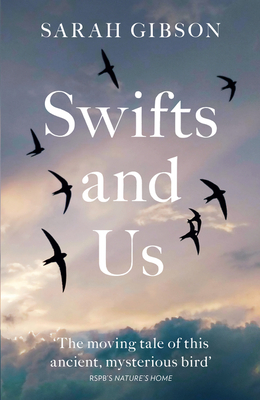 Beaks agape, swifts catch thousands of insects a day and keep them in a bolus in their throat to regurgitate for chicks. The sharp decline in insect numbers is a major concern, as well as the intensification of agriculture, climate change, and new houses or renovations that block up holes birds traditionally nest in. There are multiple species of swift – in southern Spain one can see five types – and in general they are considered to be of least conservation concern, but these matters are all relative in these days of climate crisis. Evolved to nest in cliffs and trees, they now live alongside humans except in rare places like Abernethy Forest near Inverness in Scotland, where they still nest in trees, in holes abandoned by woodpeckers.
Gibson surveys swifts’ distribution and evolution, key figures in how we came to understand them (Gilbert White et al.), and early landmark studies (e.g. David Lack’s in Oxford). She also takes us through a typical summer swift schedule, and interviews some people who rehabilitate and advocate for swifts. Other chapters see her travelling to Italy, Switzerland and Ireland, the furthest west that swifts breed. If you find a grounded swift, she learns from bitter experience, keep it in a box with air holes and give it water on a cotton bud, but don’t feed or throw it up in the air. To release, take it to an open space and hold it on your hand above your head. If it’s ready to fly, it will. The current push to help swifts is requiring that nest blocks or boxes be incorporated in every new home design. (I signed this petition.)
This is a great source of basic information, though some of the background may be more detailed than the average reader needs. If you’re only going to read one book about swifts, I would be more likely to recommend Charles Foster’s The Screaming Sky, a literary monograph, but do follow up with this one. And soon we’ll also have Mark Cocker’s book about swifts, One Midsummer’s Day, which I hope to get hold of. (Public library) 
Favourite lines:
“It is their otherness that makes them so fascinating. They touch our lives briefly and then vanish; this is part of their magic.”
“The brevity of their summer stays enhances their hold on our hearts. The season is short, their bold, wild chases over the roofs and high-pitched screams a fleeting experience: they are a metaphor for life itself. We need to act now to ensure these birds will scythe across our skies forever; to keep them in our streets, to keep them in abundance and common. All of us can do something within the compass of our lives to help tilt the balance back in their favour. If the will to do it is there, it can be done.”
Cuckoo by Wendy Perriam (1991)
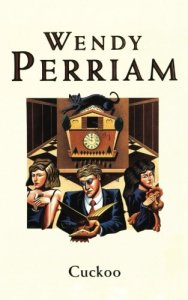 (We started hearing cuckoos locally last week!) My second by Perriam, after The Stillness The Dancing, and I’ve amassed quite a pile for afterwards. Frances Parry Jones, in her early thirties, is desperate for a baby but her husband, Charles, doesn’t seem fussed. He goes along with fertility treatment but remains aloof like the posh snob Perriam depicts him to be – the opening line is “Typical of Charles to decant his sperm sample into a Fortnum and Mason’s jar.” Their comfortable home in Richmond is cut off from the messy reality of life, as represented by Frances’s friend Viv and her brood.
Frances soon learns why Charles is unenthusiastic about having children: he already has one, a sullen teenager named Magda who lived with her mother in Hungary but has just arrived in London, “a greedy little cuckoo, commandeering the nest.” Though tempted to accept Magda as a replacement child, Frances just can’t manage it. However, they do find common ground through their japes with Ned, a free spirit Frances meets during her brief time as a taxi driver, and Frances starts to imagine how her life could be different. The portraits and sex scenes alike were a little grotesque here. I had to skim a lot to get through it. Here’s hoping for a better experience with the next one. (Secondhand copy passed on by Liz – thank you!) 
Springtime in Britain by Edwin Way Teale (1970)
 I discovered Teale a few years ago through the exceptional Autumn Across America, the first volume of a quartet illuminating the nature of the four seasons in the USA; he won a Pulitzer for the final book. Here he applied the same pattern across the pond, taking an 11,000-mile road trip around Britain with his wife Nellie. It’s a delight to see the country through his eyes, particularly places I know well (Devon, the New Forest, Wiltshire/Berkshire) or have visited recently (Northumberland). They find the early spring alarmingly cold and wet, but before long are rewarded with swathes of daffodils and bluebells. Several stake-outs finally result in hearing a nightingale. For the most part, the bird life is completely new to them, but he remarks on what North American species the European birds remind him of. “We felt we would travel to Britain just to hear the song thrush and the blackbird,” he maintains.
Nellie develops pneumonia and has to convalesce in Kent, but otherwise personal matters hardly come into the narrative. Teale is well versed in English nature writing and often references classics by the likes of John Clare and Gilbert White that inspired destinations. (They spend an excessive number of days on their pilgrimage to White’s Selborne.) He also reports on perceived threats of the time, such as small animals getting stuck in littered milk bottles. While it was, inevitably, a little distressing to think of the abundance and diversity he was still experiencing in the late 1960s that has since been lost to development, I mostly found this a pleasant meander. Some things never change: the magic of prehistoric sites; the grossness of some cities (“we forgot the misadventure of Slough”). (Secondhand) 
What signs of late spring are you seeing?
Daphne du Maurier Reading Week: Rebecca Reread & Forster Biography
It’s been a couple of years since I took part in HeavenAli’s annual Daphne du Maurier Reading Week (the last time was with a review of My Cousin Rachel; this year, links are being hosted by Liz here).
My last-minute and meagre contribution comprises an attempted reread (which ended up being a skim) of Rebecca for book club last month, and a partial, ongoing read of Margaret Forster’s cracking biography of DDM.
Rebecca (1938)
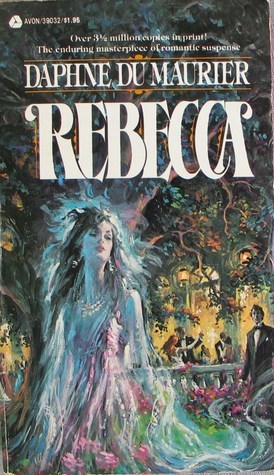 I must have first read this in my early twenties, and remembered it as spooky and atmospheric. I had completely forgotten that the action opens not at Manderley (despite the exceptionally famous first line, which forms part of a prologue-like first chapter depicting the place empty without its master and mistress to tend to it) but in Monte Carlo, where the unnamed narrator meets Maxim de Winter while she’s a lady’s companion to bossy Mrs. Van Hopper. This section functions to introduce Max and his tragic history via hearsay, but I found the first 60 pages so slow that I had trouble maintaining momentum thereafter, especially through the low-action and slightly repetitive scenes as the diffident second Mrs de Winter explores the house and tries to avoid Mrs Danvers, so I ended up skimming most of it.
However, it was satisfying to rediscover the Jane Eyre parallels and there are deliciously chilling scenes, like with Mrs Danvers at the window and the way she then sabotages her young mistress at the costume ball. This was one of four rereads for book club already this year, which has the benefit of reducing pressure and sometimes increasing the comfort-read factor. We have two Rebeccas in my book club, so it seemed an appropriate choice. Others found the book as gripping as ever, with one member reading it in a day thanks to long hospital waits. Would you believe, I hadn’t at all remembered the truth of what happened to Rebecca! So there was that surprise awaiting me. In our discussion we remarked that though this has the trappings of a romance novel or mystery (e.g. see my dreadful paperback cover above!), it also has enduring literary weight – it won the National Book Award, for instance.
Daphne du Maurier by Margaret Forster (1993)
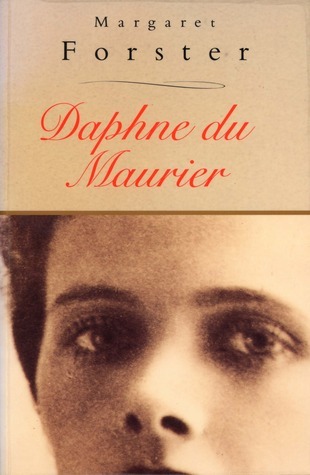 I read my first work by Forster, My Life in Houses, last year, and adored it, so the fact that she was the author was all the more reason to read this when I found a copy in a library secondhand book sale. I started it immediately after our meeting about Rebecca, but I find biographies so dense and daunting that I’m still only a third of the way into it even though I’ve been liberally skimming.
So far I have noted: du Maurier’s artistic pedigree, including her grandfather’s authorship of Trilby and her parents meeting through stage acting; her frank engagement in sexual activity, and presumed bisexuality (so far only evident through a requited crush on a teacher at her French finishing school, though perhaps there will be more to come); her first publications of short stories (“inspired by her three favourite short story writers, Maugham, Mansfield and Maupassant”) and the early novels, including one from a male point of view; her close relationship with her father and the crushing blow of his death; her determination to escape London for Cornwall; and her marriage to a soldier and ambivalent motherhood.
The last chapter I got to was all about the success of Rebecca. Though the critical reaction was generally favourable, reviewers also deemed it melodramatic … fair?
#DDMReadingWeek
19 Claws and a Black Bird by Agustina Bazterrica (Blog Tour)
A couple of years ago, I reviewed Agustina Bazterrica’s Tender Is the Flesh for the R.I.P. challenge. It’s a dystopian horror novel in which cannibalism becomes commonplace. “Brutal but brilliant,” I called it. That’s what I was hoping for from this collection of 20 of the Argentinian author’s speculative short stories. Unfortunately, I found the death-drenched work uneven, but there were a few individual stories and recurring elements that I appreciated.
In “Unamuno’s Boxes,” a woman becomes convinced that her taxi driver is a serial killer; in “Anita and Happiness,” Pablo suspects his lover is an alien. In both of these, the imagined identity is so strongly rooted that it reflects, or even alters, the reality. My favourite line of the book came from the latter: “human beings are a mere parenthesis between two unknowns.”
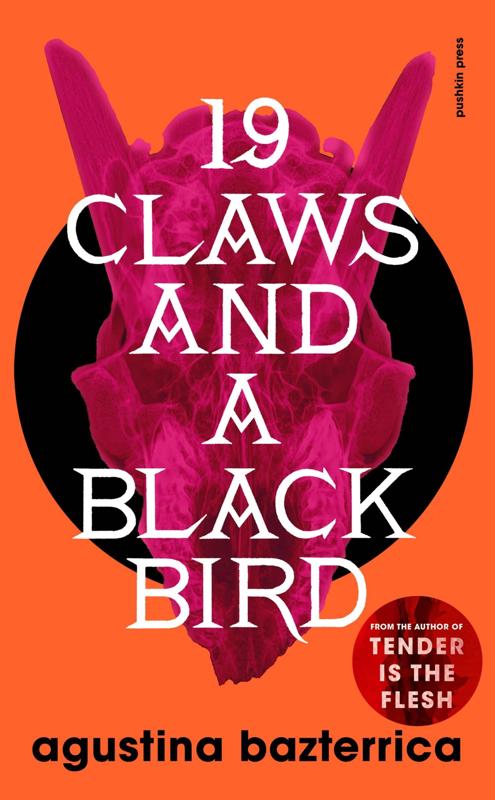
There are a few cases of poetic justice here, such as when a football obsessive decides to take out his feelings on a cat and instead gets his comeuppance. Two other stories, “Roberto” and “Earth,” include revenge for child sexual abuse – they have mighty satisfying conclusions. Along with those two, the stand-out of the collection for me was the final story, “The Solitary Ones,” which is the closest to straight-up horror and features a young woman riding the subway alone when the electricity goes out. It’s one of four second-person narratives; that’s always an interesting point-of-view. (The rest are roughly equally split between first and third person.)
My qualms were about a couple of unpleasant repeated topics and the vague or generic nature of many of the remaining stories. Several involve suicide, which is not problematic in and of itself – “A Light, Swift and Monstrous Sound” is a strong opener in which a woman finds her elderly neighbour dead on her patio – but in two places it’s a too-convenient way of concluding a story about someone with mental illness. Two late stories apply menacing imagery about religion. Perhaps I’m overly sensitive about such things, but I prefer a more balanced depiction.
The title makes intriguing reference to other creatures, particularly birds, but apart from a couple of sinister appearances and one stereotyping page about the threat of a wolf, it doesn’t live up to that promise. Although I cannot wholeheartedly recommend Bazterrica’s short fiction, you might want to seek out select stories. Meanwhile, I would urge you all to read Tender Is the Flesh, which also engages with the question of the ethical treatment of animals.
[Translated from the Spanish by Sarah Moses]
With thanks to Pushkin Press for the free copy for review.
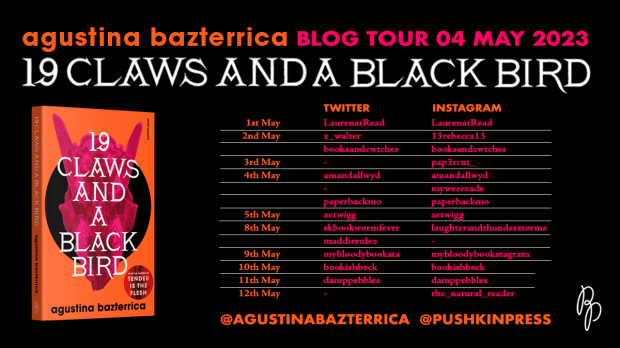
I was happy to participate in the blog tour for 19 Claws and a Black Bird. See below for details of where other reviews have appeared or will be appearing soon.
From the Dylan Thomas Prize Shortlist: Seven Steeples & I’m a Fan
The Swansea University International Dylan Thomas Prize recognizes the best published work in the English language written by an author aged 39 or under. All literary genres are eligible, so the shortlist contains a poetry collection as well as novels and short stories.

I’ve read half of the shortlist (also including Warsan Shire’s poems) and would be interested in trying the rest if I can source the two short story collections; Limberlost is at my library. The winner will be announced at 8 p.m. BST on Thursday 11 May.
Seven Steeples by Sara Baume
Isabel and Simon arrive one January at a shabby rental house in coastal Ireland overlooked by a mountain, in the middle of nowhere. They’d been menial workers in Dublin and met climbing a mountain, but somehow never seem to get around to climbing their new local peak. In moving here, these “two solitary misanthropes” are essentially rejecting society and kin; Baume describes them as “post-family.” It appears that they’re post-employment as well – there is never a single reference to how they pay the rent and buy the hipster foods they favour. Could young people’s savings really fund eight years’ rural living?
It’s an appealingly anti-consumerist vision, anyway: They arrive with one van-load of stuff and their adopted dogs, Pip and Voss, and otherwise make do with a haphazard collection of secondhand belongings left by previous tenants or donated by their estranged families. The house starts to fall apart around them, but for the most part they adjust to the decay rather than do anything to reverse it. “They had become poor and shabby without noticing … accustomed to disrepair”; theirs is a “personalized squalor.”
 Bell and Sigh become increasingly hermit-like, with entrenched ways of doing things. Baume several times describes their compost bin, which struck me as a perfect image for how the stuff of daily life builds up and beds down into the foundation of personalities and a relationship. The fact that they only have each other (and the dogs) for company explains how they adopt each other’s mannerisms, develop a private language, and even conflate their separate memories. The starkest symbol of their refusal of societal norms comes when they miss a clock change and effectively live in their own time zone.
I recognized from Spill Simmer Falter Wither and handiwork several elements that reflect Baume’s interests: nature imagery, dogs, and daily routines. She gives a clear sense of time’s passage and the seasons’ turning, of repetition and attrition and ageing. I wearied of the descriptive passages and hoped that at some point there would be some action and dialogue to counterbalance them, but that is not what this novel is about. Occasional flashes from the point-of-view of a mouse in the house, or a spider in the van, tell you that Baume’s scope is wider. This is in fact an allegory about impermanence, from a mountain’s-eye view.
Although I was frustrated with the central characters’ jolly incompetence (“Just buy leashes and a tick twister, you idiots!” I felt like shouting at them after yet another mention of the dogs killing cats and rabbits; and of the difficulty of removing ticks from their coats), I recognized how easy it is to get stuck in lazy habits; how easy it is to live provisionally, as if all is temporary and not your real existence.
Baume spaces lines and paragraphs almost like hybrid poetry and indulges in overwriting in places. Because of the dearth of action, this was a slog of a months-long read for me, but I admired it in the end and enjoyed it more than the other two books of hers that I’ve read.
If you admire lyrical prose and are okay with little to no plot in a novel, you should get on fine with this one. Or it might be that it requires the right time or reading mood, when you’re after something quiet.
Having read more by Dylan Thomas now, I think this is exactly the sort of place-specific and playful, stylized prose that the prize named after him is looking for. So, I’ll predict Baume as the winner.

With thanks to Tramp Press for the free e-copy for review.
I’m a Fan by Sheena Patel
This was one of my correct predictions for the Women’s Prize longlist; I’d heard a lot about it from Best of 2022 roundups and it seemed like the kind of edgy title they might recognise. It’s also perfect for the Dylan Thomas Prize list because of how voice-driven it is. The unnamed narrator, a woman of colour in her early thirties, muses on art, entitlement, obsession, social media and sex in short titled sections ranging from one paragraph to a few pages long. The twin objects of her fanaticism are “the man I want to be with,” who is married and generally keeps her at arm’s length, and “the woman I am obsessed with,” a lifestyle influencer who, like herself, is one of this man’s girlfriends on the side. She stalks the woman via her impeccably curated Instagram images.
 The narrator has a boyfriend, in fact, a peculiarly perfect-sounding one even, but takes him for granted in her compulsive search for indiscriminate sexual experience (also including a female co-worker she calls “the Peach”). They end up parting ways and she moves back in with her parents, an ignominious retreat from attempted adulting.
She reminded me a bit of Bell and Sigh for her haplessness, but whereas the matter of having children literally never arises for them, the question of motherhood is a background niggle for her (“I thought I had the rest of my life to make this decision but I realise I am on a clock and it runs differently for me. I am female. There was never much time and I’ve wasted so much already”; “I want to gain immortality because of my brain and not because of the potential of my womb”). As the novella goes on, she even considers weaponising her fertility as a way of entrapping her crush.
I was reasonably engaged with the narrator’s deliberations about taste and autobiographical influences, but overall found this rather indulgent, slight and repetitive. Books about social media – this reminded me most of Adults by Emma Jane Unsworth – are in danger of becoming irrelevant all too quickly. The sexual frankness fell on the wrong side of unpleasant for me, and the format for referring to other characters leads to inelegant phrasing like “The man I want to be with’s work centres around conflict”. Something like Luster has that little bit more individuality and energy. (Secondhand – charity shop purchase)

Review: Service by Sarah Gilmartin
The comparison with Sweetbitter, one of my favourite debuts of the past decade, drew me to Service, and it’s an apt one. Irish writer Sarah Gilmartin’s second novel is a before-and-after set partly in the stressful atmosphere of a fine dining restaurant in Dublin. Head chef Daniel Costello worked his way up from an inner-city childhood and teenage carvery-pub job to a two-Michelin-starred establishment known as T. But then came a fall: accusations of sexual assault from several female former employees led to the restaurant’s temporary closure and a high-profile court trial. Daniel maintains his innocence. His lawyer plans to cast shade on the lead waitress’ reputation, and question her failure to come forward until one year after the alleged rape.

Three alternating first-person narrators fill in the background of the macho restaurant world and the Costellos’ marriage. First is Hannah Blake, a former waitress who is not involved in the current lawsuit but has her own stories to tell about Daniel, who treated her as a protégée during the brief time she worked at T while she was a university student. “I’ve never felt as alive as I did that summer,” she writes; it was thrilling for a girl from Tipperary to be at the heart of Dublin’s culinary life and to have a world-leading chef believe her palate was worth training. We also hear from Daniel himself, and then his wife Julie, who begrudgingly supports Daniel but is furious with him for the negative attention the trial has brought her and their two sons. Some family members and neighbours have started avoiding them.
Gilmartin invites the reader to have sympathy for all the protagonists, even when it gets complicated. There was a point about three-quarters of the way through when I had to rethink who I felt sorry for and why. I would have liked a few more restaurant scenes to balance out the aftermath, but that is a minor quibble. This is a solid #MeToo novel with pacey, engaging writing and well-rounded characters. It’s made me eager to go back and catch up on the author’s debut, Dinner Party: A Tragedy.
My rating:
Service was published on 4 May. With thanks to Pushkin Press for the proof copy for review.
Update: Sarah Gilmartin kindly answered a question another blogger and I put to her, about how she decided on, and brought to life, these three narrators.
As a writer I’m drawn to ambivalence, ambiguity, grey areas. I’m curious about how people work, how they behave under pressure, when they think no one is watching, our public and private selves, all of that is the bones of literature. I wanted to tell a story about the abuse of power from different perspectives as I felt it was a subject that could potentially have multiple interpretations. I was interested in nuance and in leaving enough space for the reader to make up their own mind.
With Julie, I was struck that when you hear or read about MeToo stories in the media, one person you never or rarely hear from is the partner of the abuser. Certainly they’re not the most important voice in the scenario – the victim is – but you do think, or at least I do, what must it feel like for the partner of the predator? A woman whose life is being ripped apart in a different way by the same man. I wanted to know more about women in this position. In their own words. With Hannah, we have a different, younger, in some ways closer-to-the-action female perspective. Although she’s in her 30s now, in many ways Hannah is stuck in the past, her summer at the restaurant, as survivors of trauma often are, trying to get on with things but being continually brought back to the point where their lives were derailed. She’s also our guide to the restaurant world, which can often be very colourful and entertaining. Finally, with Daniel, for me the story didn’t feel cohesive without his perspective. He was a compelling character to write, a talented man, celebrated in his field, who has clearly defined private and public personas, and an aura of false humility; he’s a self-fashioned art monster. Then on another level, he’s a predator, with a huge amount of ego and vanity.
All three characters were interesting to me in their own right, which is key, and then they also had important things to contribute with regards to the subject matter of the book. I didn’t do a huge amount of research – read a lot about MeToo in the media, watched some Masterchef – but I worked as a waitress myself in my 20s so had a good idea of the world, the highs and lows, stresses and perks. Characters, once I have an idea of who they are, how they operate and what they want, tend to grow organically on the page. That’s the beauty of fiction!
A May Sarton Birthday Celebration
These days I consider May Sarton one of my favourite authors, but I’ve only been reading her for about nine years, since I picked up Journal of a Solitude on a whim. (Ten years prior, when I was a senior in college working in a used bookstore on evenings and weekends, a customer came up and asked me if we had anything by May Sarton. I had never heard of her so said no, only later discovering that we shelved her in with Classic literature. Huh. I can only apologize to that long-ago customer for my ignorance and negligence.)
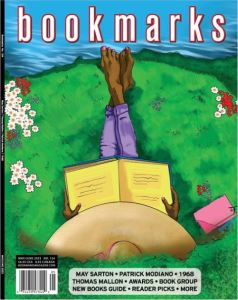 A general-interest article I wrote on May Sarton’s life and work appears in the May/June 2023 issue of Bookmarks magazine, for which I am an associate editor. I submitted this feature back in August 2019, so it’s taken quite some time for it to see the light of day, but I’m pleased that the publication happened to coincide with the anniversary of her birth. In fact, today, May 3rd, would have been her 111th birthday. For the article, I covered a selection of Sarton’s fiction and nonfiction, and gave a brief discussion of her poetry (which the magazine doesn’t otherwise cover).

The two below, a journal and a novel, are works I’ve read more recently. Both were secondhand purchases, I think from Awesomebooks.com.
Encore: A Journal of the Eightieth Year (1993)
 Sarton is one of those reasonably rare authors who published autobiography, fiction AND poetry. I know I’m not alone in thinking that the journals and memoirs are where she really shines. (She herself was proudest of her poetry, and resented the fact that publishers only seemed to be interested in novels because they were what sold.) I came to her through her journals, which she started writing in her sixties, and I love them for how frankly they come to terms with ageing and the ill health and loss it inevitably involves. They are also such good, gentle companions in that they celebrate seasonality and small joys: her beautiful New England homes, her gardening hobby, her pets, and her writing routines and correspondence.
Encore was the only journal I had left unread; soon it will be time to start rereading my top few. When Sarton wrote this in 1991–2, she was recovering from a spell of illness and assumed it would be her final journal. (In fact, At Eighty-Two would appear two years later.) Although she still struggles with pain and low energy, the overall tone is of gratitude and rediscovery of wonder. Whereas a few of the later journals can get a bit miserable because she’s so anxious about her health and the state of the world, here there is more looking back at life’s highlights. Perhaps because Margot Peters was in the process of researching her biography (which would not appear until after her death), she was nudged into the past more often. I especially appreciated a late entry where she lists “peak experiences,” ranging from her teen years to age 80. What a positive way of thinking about one’s life!
For many months I kept this as a bedside book and read just an entry or two a night. When I started reading it more quickly and straight through, I did note some repetition, which Sarton worried would result from her dictating into a recording device. But I don’t think this detracts significantly. In this volume, events of note include a trip to London and commemorative publications plus a conference all to mark her 80th birthday. She’s just as pleased with tiny signs of her success, though, such as a fan letter saying The House by the Sea inspired the reader to put up a bird feeder.
The Education of Harriet Hatfield (1988)
This is my eighth Sarton novel. In general, I’ve had less success with her fiction as it can be formulaic: characters exist to play stereotypical roles and/or serve as mouthpieces for the author’s opinions. That’s certainly true of Harriet Hatfield, who, like the protagonist of Mrs. Stevens Hears the Mermaids Singing, is fairly similar to Sarton. After the death of her long-time partner, Vicky, who ran a small publishing house, sixty-year-old Harriet decides to open a women’s bookstore in a Boston suburb. She has no business acumen, just enthusiasm (and money, via the inheritance from Vicky). College girls, housewives, nuns and older feminists all become regulars, but Hatfield House also attracts unwanted attention in this dodgy neighbourhood, especially after a newspaper outs Harriet: graffiti, petty theft and worse. The police are little help, but Harriet’s brothers and a local gay couple promise to look out for her.
 The central struggle for Harriet is whether she will remain a private lesbian – as one customer says to her, “you are old and respectable and no one would ever guess”; that is, she can pass as straight – or become part of a more audible, visible movement toward equal rights. It’s cringe-worthy how unsubtly Sarton has Harriet recognize (the “Education” the title speaks of) her privilege and accept her parity with other minorities through friendships with a Black mother, a battered wife who gets an abortion, and a man whose partner is dying of AIDS. Harriet’s brother, too, comes out to her as gay, and I was uneasy with the portrayal of him and the AIDS patient as promiscuous to the point of bringing any suffering on themselves.
Still, when I consider that Sarton was in her late seventies at the time she was writing this, and that public knowledge of AIDS would have been poor at best, I think this was admirably edgy. Harriet’s dilemma reflects Sarton’s own identity crisis, as expressed in Encore: “I do not wish to be labeled as a lesbian and do not wish to be labeled as a woman writer but consider myself a universal writer who is writing for human beings.” Nowadays, though, what Harriet deems discretion comes across as cowardice and priggishness.
While there are elements of Harriet Hatfield that have not aged well, if you focus on the Bythell-esque bookshop stuff (“I find that the people I love best are those who come in to browse, the silent shy ones, who are hungry for books rather than for conversation”) rather than the consciousness-raising or the mystery subplot, you might enjoy it as much as I did. Kudos for the first and last lines, anyway: “How rarely is it possible for anyone to begin a new life at sixty!” and “It’s the real world and I am fully alive in it.”
The Chosen by Elizabeth Lowry (2022)
“What’s lost when your idea of the other dies? He knows the answer: only the entire world.”
Elizabeth Lowry’s utterly immersive third novel, The Chosen, currently on the shortlist for the Walter Scott Prize for Historical Fiction*, examines Thomas Hardy’s relationship with his first wife, Emma Gifford. The main storyline is set in November–December 1912 and opens on the morning of Emma’s death at Max Gate, their Dorchester home of 27 years. The couple had long been estranged and effectively lived separate lives on different floors of the house, but instantly Hardy is struck with pangs of grief – and remorse for how he had treated Emma. (He would pour these emotions out into some of his most famous poems.)
That guilt is only compounded by what he finds in her desk: her short memoir, Some Recollections, with an account of their first meeting in Cornwall; and her journals going back two decades, wherein she is brutally honest about her husband’s failings and pretensions. “I expect nothing from him now & that is just as well – neither gratitude nor attention, love, nor justice. He belongs to the public & all my years of devotion count for nothing.” She describes him as little better than a jailor, and blames him for their lifelong childlessness.
It’s an exercise in self-flagellation, yet as weeks crawl by after her funeral, Hardy continues to obsessively read Emma’s “catalogue of her grievances.” In the fog of grief, he relives scenes his late wife documented – especially the composition and controversial publication of Tess of the d’Urbervilles. Emma hoped to be his amanuensis and so share in the thrill of creation, but he nipped a potential reunion in the bud. Lowry intercuts these flashbacks with the central narrative in a way that makes Hardy feel like a bumbling old man; he has trouble returning to reality afterwards, and his sisters and the servants are concerned for him.

Hardy was that stereotypical figure: the hapless man who needs women around to do everything for him. Luckily, he’s surrounded by an abundance of strong female characters: his sister Kate, who takes temporary control of the household; his secretary, Florence Dugdale, who had been his platonic companion and before long became his second wife; even Emma’s money-grubbing niece, Lilian, who descends to mine her aunt’s wardrobe.
I particularly enjoyed Hardy’s literary discussions with Edmund Gosse, who urged him to temper the bleakness of his plots, and the stranger-than-fiction incident of a Chinese man visiting Hardy at home and telling him his own story of neglecting his wife and repenting his treatment of her after her death.
For anyone who’s read and loved Hardy’s major works, or visited his homes, this feels absolutely true to his life story, and so evocative of the places involved. I could picture every locale, from Stinsford churchyard to Emma’s attic bedroom. It was perfect reading for my short break in Dorset earlier in the month and brought back memories of the Hardy tourism I did at the end of my study abroad year in 2004. Although Hardy’s written words permeate the book, I was impressed to learn that Lowry invented all of Emma’s journal entries, based on feelings she had expressed in letters.
But there is something universal, of course, about a tale of waning romance, unexpected loss, and regret for all that is left undone. This is such a beautifully understated novel, perfectly convincing for the period but also timeless. It’s one to shelve alongside Winter by Christopher Nicholson, another favourite of mine about Hardy’s later life. 
With thanks to riverrun (Quercus) for the free copy for review. The Chosen came out in paperback on 13 April.
*The winner will be announced on 15 June.
April Releases: Frida Kahlo, Games and Rituals, Romantic Comedy
It’s been a big month for new releases and I have loads more April books on the go or waiting in the wings to be reviewed in catch-up posts in the future. For now, I have a biographical graphic novel about a celebrated painter whose medical struggles coloured her art, a set of witty short stories about modern preoccupations and relationships, and a guilty pleasure of a novel from one of my favourite contemporary authors.
Frida Kahlo: Her Life, Her Work, Her Home by Francisco de la Mora
[Translated from the Spanish by Lawrence Schimel]
 The latest in SelfMadeHero’s Art Masters series (I’ve also reviewed their books on Munch, Van Gogh, Gauguin and O’Keeffe). De la Mora imagines Kahlo (1907–1954) hosting a party at her famous blue house in Coyoacán, Mexico in her final summer – unknown to everyone there, it’s exactly one week before her death. “Hola, come in, welcome. I’m so glad you’re all here. Today is my birthday, and I want to tell all of you the story of my life…” she invites her guests, and thereby the reader. It’s a handy conceit that justifies a chronological approach.
I was reminded of traumatic events from Kahlo’s life that I’d already encountered in various places (such as Constellations by Sinéad Gleeson and Frida Kahlo and My Left Leg by Emily Rapp Black): childhood polio and the Mexican Revolution, the hideous bus accident that reshaped her body, and two miscarriages. Periods of confinement alternate with travels. We see her devotion to traditional dress and the development of her frank self-portraiture style. I’d forgotten, or never knew, that she married Diego Rivera twice and divorced in between. They hosted many cultural giants of the time (e.g., Trotsky’s stay with them forms part of Barbara Kingsolver’s The Lacuna), and both had their infidelities. I loved the use of vibrant colours, but learned little. This is really only an introduction for those new to her.

With thanks to Paul Smith and SelfMadeHero for the free copy for review.
Games and Rituals by Katherine Heiny
Early Morning Riser was one of my favourite books of 2021, and I caught up earlier this year with Heiny’s only previous novel, Standard Deviation. Both are hilarious takes on the quirks of relationships, exploring a specific dynamic that recurs in a couple of these stories: the uncomfortable triangle between a man, his second (invariably younger) wife, and the very different, generally formidable, woman he was formerly married to and who continues to play a role in his life. One of the strongest stories is “561,” which was first published as a stand-alone e-book in 2018. Charlie stole Forrest away from Barbara and now the two women have a frosty relationship. It might seem like poetic justice that Charlie later has to load all of Barbara’s possessions into a moving van, but the notion of penance gets murkier when we learn what happened when they worked together on a suicide prevention hotline.
 Eight of the 11 stories are in the third person and most protagonists are young or middle-aged women navigating marriage/divorce and motherhood. A driving examiner finds herself in the same situation as her teenage test-taker; a wife finds evidence of her actor husband’s adultery. In “Damascus,” Mia worries her son might be on drugs, but doesn’t question her own self-destructive habits. Inspired by Marie Kondo, Rachel tries to pare her life back to the basics in “CobRa.” In “King Midas,” Oscar learns that all is not golden with his mistress. “Sky Bar” has Fawn stuck in her hometown airport during a blizzard. I particularly liked the ridiculous situations Florida housemates get themselves into in “Pandemic Behavior,” and the second-person “Twist and Shout,” about loving an elderly father even though he’s infuriating.
Heiny mixes humour with bitter truths in engaging stories about characters whose mistakes and futile attempts to escape the past only make them the more relatable. Her first and last lines are particularly strong; who could resist a piece that opens with “Your elderly father has mistaken his four-thousand-dollar hearing aid for a cashew and eaten it”?
With thanks to 4th Estate for the proof copy for review.
Romantic Comedy by Curtis Sittenfeld
Curtis Sittenfeld is one of my favourite contemporary authors (I’ve also reviewed You Think It, I’ll Say It and Rodham) and I’ve read everything she’s published. Her work might seem lighter than my usual fare, but I’ve always maintained that she, like Maggie O’Farrell, perfectly treads the line between literary fiction and women’s fiction. This was one of my most anticipated releases of the year and it met my expectations.
Sally Milz is a mid-thirties writer for The Night Owls, a long-running sketch comedy show modelled on Saturday Night Live. Sittenfeld clearly did a lot of research into women in comedy, and Chapter 1 is a convincing blow-by-blow of a typical TNO schedule of pitches, edits, rehearsals, all-nighters and afterparties. This particular week in 2018, the host and musical guest are the same person: Noah Brewster, a pop star with surfer-boy good looks who rose to fame in the early 2000s with radio singles like “Making Love in July” and has maintained steady popularity since then. (I imagined him as a cross between Robbie Williams and Chris Hemsworth.) Sally had been expecting a self-absorbed ignoramus so, when she helps Noah edit a sketch he’s written, is pleasantly surprised to discover he’s actually smart, funny and humble. Sparks seem to fly between them, too, though the week ends all too soon.
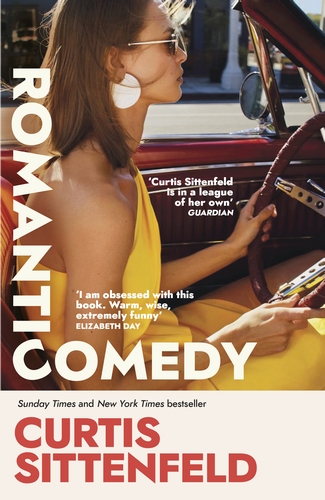 Plain Jane getting the hot guy … that never happens, right? In fact, Sally has a theory about this very dilemma, named after her schlubby TNO office-mate: The Danny Horst Rule states that ordinary men may date and even marry actresses or supermodels, but reverse the genders and it never works. A fundamental lack of confidence means that, whenever she feels too vulnerable, Sally resorts to snarky comedy and sabotages her chances at happiness. But when, midway through the summer of 2020, she gets an out-of-the-blue e-mail from Noah, she wonders if this relationship has potential in the real world. (This, for me, is the peak: when you find out that interest is requited; that the person you’ve been thinking about for years has also been thinking about you. Whatever comes next pales in comparison to this moment.)
The correspondence section was my favourite element. “I do still wonder whether a person’s writing self is their realest self, their fakest self, or just a different self than their in-the-world self?” Sally writes to Noah. As always, Sittenfeld’s inhabiting of a first-person narrator is flawless, and Sally’s backstory and Covid-lockdown, Kansas City existence with her octogenarian stepfather and his beagle endeared her to me. I also appreciated that a woman in her mid- to late thirties could be a romantic lead, and that the question of whether she wants children simply never comes up. Of Sittenfeld’s books, I’d call this closest in tone and content to Eligible, and some familiarity with SNL would probably be of benefit.
Could this be called a predictable story? Well, what does one expect or want from a romcom (watching or reading)? There may be a feminist leaning in places, but this is conventional wish fulfilment, which, I assume, is what keeps romance readers hooked. I enjoyed every sentence and, when it was over, wished I could stay in Sally’s world. (See also Susan’s review.)
With thanks to Doubleday for the proof copy for review.
Would you be interested in reading one or more of these?
Women’s Prize Longlist Reviews (Croft, Grudova, O’Farrell) & Shortlist Predictions
The Women’s Prize shortlist will be announced on Wednesday the 26th. I’ve managed to read a few more novels from the longlist and started another (Fire Rush by Jacqueline Crooks), which would take me up to 6 read out of 16. I have a couple of others on order from the library (Kennedy and Patel), but will only bother to read them if they are shortlisted.
Homesick by Jennifer Croft
I was intrigued by the publication history of this one: Croft first wrote it in Spanish, then produced an English-language version which, in the USA, was marketed as a memoir illustrated with her own photographs. Here in the UK, though, Charco Press published it as part of their new range of untranslated fiction – with no photos, alas. So, it’s clear that this is thinly veiled autobiography; literally all that may have been changed is the character names.
 The protagonist is ‘Amy’, who lives in a tornado-ridden Oklahoma and whose sister, ‘Zoe’ – a handy A to Z of growing up there – has a mysterious series of illnesses that land her in hospital. The third person limited perspective reveals Amy to be a protective big sister who shoulders responsibility: “There is nothing in the world worse than Zoe having her blood drawn. Amy tries to show her the pictures [she’s taken of Zoe’s dog] at just the right moment, just right before the nurse puts the needle in”.
The girls are home-schooled and Amy, especially, develops a genius for languages, receiving private tutoring in Russian from Sasha, a Ukrainian former student of their father’s. Both sister are more than a little in love with Sasha. They alternate between competing for attention and indulging their joint passions – such as for the young Russian figure-skating couple who sweep the Winter Olympics. Amy starts college at 15, which earns her unwanted attention among her classmates, and struggles with her mental health before deciding to see the world. Despite periods of estrangement, her relationship with Zoe is what grounds her.
In a sense this is a simple chronological story, told in a matter-of-fact way. Yet each of its vignettes – some just a paragraph long – is perfectly chosen to reveal the family dynamic and the moment in American history. Detailed chapter headings continue the narrative and sometimes contain a shocking truth. What Croft does so brilliantly is to chart the accretion of ordinary and landmark events that form a life; Amy realizes this as she looks back at a packet of her photographs: “laid out step by step like this, more or less in order, the pictures also form a kind of path.”
Initially, I had my doubts as to whether this should have been eligible for the Women’s Prize. In the end it didn’t matter whether it was presented as memoir or autofiction, so true was it to the experience of 1990s girlhood, as well as to sisterhood and coming of age at any time in history. It reminded me strongly of Very Cold People by Sarah Manguso, but felt that little bit more universal in how it portrays family ties, ambition, and life’s winding path. (See also Annabel’s review for Shiny New Books.) 
With thanks to Charco Press for the free copy for review.
Children of Paradise by Camilla Grudova
 In 2017 I reviewed Grudova’s surreal story collection, The Doll’s Alphabet, describing its tales as “perverted fairytales or fragmentary nightmares.” Okay then, let’s continue in that perverted, nightmarish vein. Holly, new to the country/city, finds a room in a shared flat and a job as an usher at the Paradise Cinema, which shows a random assortment of art films and cult classics. The building is so low-rent it’s almost half derelict, and the staff take full advantage of the negligent management to get up to all sorts of sexual shenanigans, as well as drinking and drug-taking, while on duty. Holly and her co-workers are truly obsessed with the cinema, watching every showing at work but also hosting all-night movie marathons in their apartments. “The outside world, all of its news, faded away, and the movies became my main mirror of the world,” she confesses. “They were a necessary evil, customers, so that we, the true devotees, could have access to the screen, our giant godlike monument.”
The title is simultaneously ironic and an homage to Les Enfants du Paradis (1945), and the chapters are named after particular films. A change of ownership forces the Paradise to become more mainstream – hello, Marvel flicks and hipster snacks – but a series of horrific accidents and deliberate acts makes it seem like a cursed place. Aping movie genres, perhaps, Children of Paradise starts off as an offbeat stoner comedy and by the end approaches horror to an extent I didn’t expect. The content becomes increasingly sordid, visceral, with no opportunity missed to mention bodily fluids and excretions. I’m not notably opposed to gross-out humour, but the whole thing felt quite distasteful as well as miserable. (Public library e-book) 
My general feeling about these first two books, and probably a few others from the longlist (Crooks, McKenzie, Paull, et al.), is that the judges are trying to showcase the breadth of women’s writing: ‘Hey, guys, women can write autofiction and horror and humour and patois and speculative fiction and everything in between!’ But I don’t think these more niche or genre fiction representatives will make it any further in the race, especially because each may have been championed by a different judge.
Where the judges will find common ground will be on the standard stuff that always gets shortlisted: fairly run-of-the-mill character- and issue-driven contemporary or historical fiction. That makes it sound like I’m being dismissive, but in fact I do generally like much of the fiction that gets shortlisted for the WP: it’s readable book club fodder. It’s just maybe not inventive in the way that certain longlist titles can be. On which note, er, see the below!
The Marriage Portrait by Maggie O’Farrell
What a relief it was to wholeheartedly enjoy this sumptuous work of historical fiction, after the disappointment that was Hamnet (though perhaps I’ll feel more kindly towards the latter when I reread it for Literary Wives in November).
 Lucrezia di Cosimo de’ Medici is a historical figure who died at age 16, having been married off from her father’s Tuscan palazzo as a teenager to Alfonso II d’Este, Duke of Ferrara. She was reported to have died of a “putrid fever” but the suspicion has persisted that her husband actually murdered her, a story perhaps best known via Robert Browning’s poem “My Last Duchess.”
The focus is on the final year of Lucrezia’s life, but in flashbacks we meet her as a rebellious girl with a talent for drawing and a fascination with animals. At first it appears that Alfonso esteems her for her spiritedness – he gives her a painting of a stone marten as a betrothal gift, after all, and has her depicted with paintbrush in hand – but as the gradual storyline meets up with the 1561 spotlight, it becomes clear that she is only valued for her ability to produce an heir. However spacious and opulent they are, it is impossible to forget that Lucrezia, as a noblewoman, is confined to the edifices owned by her father or her husband.
O’Farrell’s usual present-tense narration is engaging throughout, and the two long chapters either side of the midpoint, one concerning her wedding day and the other the preparation for her portrait, are particularly absorbing. I was convinced I knew how this story would end, yet the author pulls off a delicious surprise. This is ripe for the miniseries treatment, not least because it is so attentive to visuals: the architecture of the main buildings, the lavish clothing, the colours, and the eye for what makes a good painting. Scenes are even described in terms of a spatial arrangement appreciated from afar: how three figures form a triangle in the centre of a room; how two people on a balcony bisect the view from a window.
Despite the length, this was thoroughly engrossing and one I’d recommend to readers of Geraldine Brooks and Tracy Chevalier. (See also Laura’s review.) (Public library)
The other nominees I’ve read are:
Demon Copperhead by Barbara Kingsolver
Black Butterflies by Priscilla Morris
My ideal shortlist (a wish list based on my reading and what I still want to read):
Homesick by Jennifer Croft
Fire Rush by Jacqueline Crooks
Black Butterflies by Priscilla Morris
The Marriage Portrait by Maggie O’Farrell
I’m a Fan by Sheena Patel
Memphis by Tara M. Stringfellow
vs.
My predicted shortlist:
Trespasses by Louise Kennedy
Demon Copperhead by Barbara Kingsolver
Stone Blind by Natalie Haynes
The Marriage Portrait by Maggie O’Farrell
Memphis by Tara M. Stringfellow
Wandering Souls by Cecile Pin
An overall winner? Perhaps Trespasses by Louise Kennedy, or an unprecedented repeat win from Barbara Kingsolver or Maggie O’Farrell.
(See also Laura’s predictions post.)
What have you read from the longlist so far? Which of these books are calling to you?
Spring Reads, Part I: Violets and Rain
We had both rain and spring sunshine on a recent overnight trip to Bridport, Dorset – a return visit after enjoying it so much in 2019. Several elements were repeated: Dorset Nectar cider farm, dinner at Dorshi, and a bookshop and charity shop crawl of the main streets. While we didn’t revisit Thomas Hardy sites, I spent plenty of time at Max Gate by reading Elizabeth Lowry’s The Chosen. Beach walks plus one in the New Forest on the way back were splendid. This was my haul from Bridport Old Books. Stocking up on novellas and poetry, plus a novel by a Canadian author I’ve enjoyed work from before.
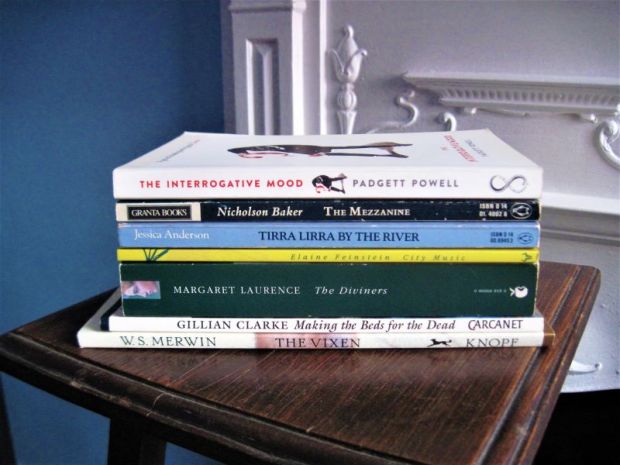
Now for a quick look at two tangentially spring-related books I’ve read recently: a short novel about two women’s wartime experiences of motherhood and an elegiac and allusive poetry collection.
Violets by Alex Hyde (2022)
I was intrigued by the sound of this debut novel, which juxtaposes the lives of two young British women named Violet at the close of the Second World War. One miscarries twins and, told she’ll not be able to bear children, has to rethink her whole future; another sails from Wales to Italy on ATS war service, hiding the fact that she’s pregnant by a departed foreign soldier. Hyde’s spare style – no speech marks; short paragraphs or solitary lines separated by spaces – alternates between their stories in brief numbered chapters, bringing them together in a perhaps predictable way that also forms a reimagining of her father’s life story. The narration at times addresses this future character in poems that I think are supposed to be fond and prophetic but I instead found strangely blunt and even taunting (as in the excerpt below). There’s inadequate time to get to know, or care about, either Violet.

Can you feel it, Pram Boy?
Can you march in time?
A change, a hardening,
the jarring of the solid ground as she treads,
gets her pockets picked.
[…]
Quick! March!
And your Mama, Pram Boy,
yeasty in her private parts.
Granta sent a free copy. Violets came out in paperback in February.
Rain by Don Paterson (Faber, 2009)
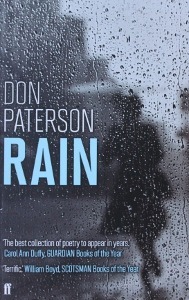 I’d previously read Paterson’s 40 Sonnets, in 2015. This collection is in memoriam of the late poet Michael Donaghy, the subject of the late multi-part “Phantom.” There are a couple of poems in Scots and a sequence of seven nature-infused ones designated as being “after” poets from Li Po to Robert Desnos. Several appear to express concern for a son. There’s a haiku-like rhythm to the short stanzas of “Renku: My Last Thirty-Five Deaths.” I didn’t understand why “Unfold i.m. Akira Yoshizawa” was a blank page until I looked him up and learned that he was a famous origamist. The title poem closes the collection:
I love all films that start with rain:
rain, braiding a windowpane
or darkening a hung-out dress
or streaming down her upturned face;
one big thundering downpour
right through the empty script and score
before the act, before the blame,
before the lens pulls through the frame
to where the woman sits alone
beside a silent telephone
I liked individual passages or images but didn’t find much of a connecting theme behind Paterson’s disparate interests. (University library)
Another favourite passage:
So I collect the dull things of the day
in which I see some possibility
[…]
I look at them and look at them until
one thing makes a mirror in my eyes
then I paint it with the tear to make it bright.
This is why I sit up through the night.
(from “Why Do You Stay Up So Late?”)
And a DNF:
 Corpse Beneath the Crocus by N.N. Nelson – I loved the title and the cover, and a widow’s bereavement memoir in poems seemed right up my street. I wish I’d realized Atmosphere is a vanity press, which would explain why these are among the worst poems I’ve read: cliché-riddled and full of obvious sentiments and metaphors as she explores specific moments but mostly overall emotions. Three excerpts:
All things die
In the flowering cycle
Of growth and life
Time passes
Like sand in an hourglass
Feelings are changeful
Like the tide
Ebbing and flowing
“Love Letter,” a prose piece, held the most promise, which suggests Nelson would have been better off attempting memoir. I slogged (hate-read, really) my way through to the halfway point but could bear it no longer. (NetGalley) 
I have a few more spring-themed books on the go: Hoping for a better set next time!
Any spring reads on your plate?
 Bookish Beck = Rebecca Foster. American transplant to England. Freelance proofreader and book reviewer.
