A Bouquet of Spring Reading
In March through May I often try to read a few gardening-themed books and/or ones with “spring” in the title. Here are some of the ones that I have on the go as occasional reading:
Flowers and gardens
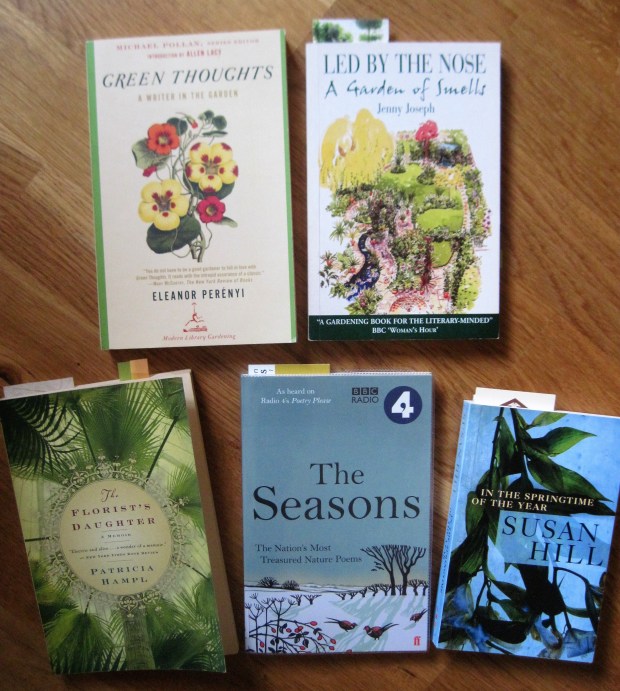
The Florist’s Daughter by Patricia Hampl: Her mother’s final illness led Hampl to reflect on her upbringing in St. Paul, Minnesota as the daughter of an Irish Catholic library clerk and a Czech florist. I love how she writes about small-town life and helping out in her father’s flower shop:
“These apparently ordinary people in our ordinary town, living faultlessly ordinary lives … why do I persist in thinking—knowing—they weren’t ordinary at all? … Nostalgia is really a kind of loyalty”
“it was my father’s domain, but it was also marvelously other, this place heavy with the drowsy scent of velvet-petaled roses and Provençal freesias in the middle of winter, the damp-earth spring fragrance of just-watered azaleas and cyclamen”
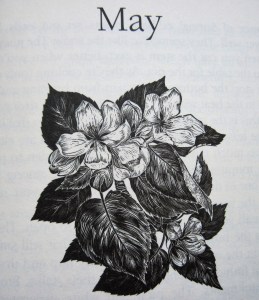 Led by the Nose: A Garden of Smells by Jenny Joseph: Joseph’s name might not sound familiar, but she was the author of the famous poem “Warning: When I Am an Old Woman I Shall Wear Purple” and died early last year. This is a pleasant set of short pieces about what you might see and sense in your garden month by month. “Gardeners do indeed look before and after, at the same time living, as no one else, in the now of the nose,” she maintains. I’m particularly fascinated by the sense of smell and how a writer can describe odors, so I was delighted to find this in a charity shop in Edinburgh last year and have been reading it a few pages at a time as a bedside book. I especially like the wood engravings by Yvonne Skargon that head each chapter.
Green Thoughts: A Writer in the Garden by Eleanor Perényi: A somewhat dense collection of few-page essays, arranged in alphabetical order, on particular plants, tools and techniques. I tried reading it straight through last year and only made it as far as “Beans.” My new strategy is to keep it on my bedside shelves and dip into whichever pieces catch my attention. I don’t have particularly green fingers, so it’s not a surprise that my eye recently alighted on the essay “Failure,” which opens, “Sooner or later every gardener must face the fact that certain things are going to die on him. It is a temptation to be anthropomorphic about plants, to suspect that they do it to annoy.”
 With One Lousy Free Packet of Seed by Lynne Truss (DNF at page 131 out of 210): A faltering gardening magazine is about to be closed down, but Osborne only finds out when he’s already down in Devon doing the research for his regular “Me and My Shed” column with a TV actress. Hijinks were promised as the rest of the put-out staff descend on Honiton, but by nearly the two-thirds point it all still felt like preamble, laying out the characters and their backstories, connections and motivations. My favorite minor character was Makepeace, a pugnacious book reviewer: “he used his great capacities as a professional know-all as a perfectly acceptable substitute for either insight or style.”
Spring
The Seasons, a Faber & Faber / BBC Radio 4 poetry anthology: From Chaucer and other Old English poets to Seamus Heaney (“Death of a Naturalist”) and Philip Larkin (“The Trees”), the spring section offers a good mixture of recent and traditional, familiar and new. A favorite passage was “May come up with fiddle-bows, / May come up with blossom, / May come up the same again, / The same again but different” (from “Nuts in May” by Louis MacNeice). Once we’re back from America I’ll pick up with the summer selections.
In the Springtime of the Year by Susan Hill: Early one spring, Ruth Bryce’s husband, Ben, dies in a forestry accident. They had only been married a year and here she is, aged twenty-one and a widow. Ben’s little brother, 14-year-old Jo, is a faithful visitor, but after the funeral many simply leave Ruth alone. I’m 100 pages in and still waiting for there to be a plot as such; so far it’s a lovely, quiet meditation on grief and solitude amid the rhythms of country life. Ben’s death is described as a “stone cast into still water,” and here at nearly the halfway point we’re seeing how some of the ripples spread out beyond his immediate family. I’m enjoying the writing more than in the three other Hill books I’ve read.
 Absent in the Spring by Mary Westmacott: (The title doesn’t actually have anything to do with the season; it’s a quotation from Shakespeare’s Sonnet 98: “From you have I been absent in the spring.”) From 1944, this is the third of six novels Agatha Christie published under the alias Mary Westmacott. Joan Scudamore, traveling back to London from Baghdad after a visit to her adult daughter, encounters bad weather and misses her train, which leaves her stranded in the desert for days that feel more like weeks. We’re led back through scenes from Joan’s earlier life and realize that she’s utterly clueless about what those closest to her want and think. Rather like Olive Kitteridge, Joan is difficult in ways she doesn’t fully acknowledge. Like a desert mirage, the truth of who she’s been and what she’s done is hazy, and her realization feels a little drawn out and obvious. Once she gets back to London, will she act on what she’s discovered about herself and reform her life, or just slip back into her old habits? This is a short and immersive book, and a cautionary tale to boot. It examines the interplay between duty and happiness, and the temptation of living vicariously through one’s children.
Have you been reading anything particularly appropriate for spring this year?
Four Recent Review Books: Butler, Hunt, Paralkar and Vestre
Four February–April releases: A quiet novel about the clash of religion and reason; a birdwatching odyssey in London; a folktale-inspired story of the undead descending on an Indian medical clinic; and a layman’s introduction to fetal development – you can’t say I don’t read a wide variety of books! See if any of these tempt you.
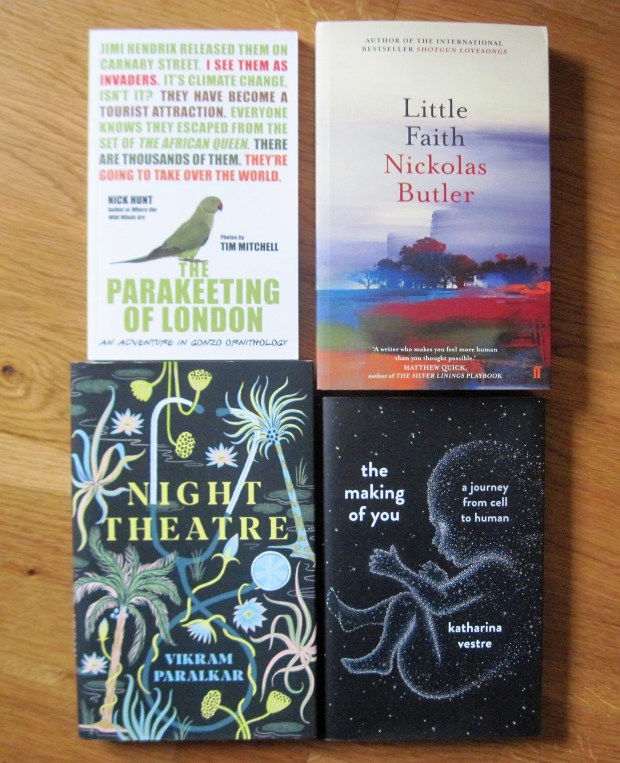
Little Faith by Nickolas Butler
Butler follows in Kent Haruf’s footsteps with this quiet story of ordinary Midwesterners facing a series of small crises. Lyle Hovde works at a local Wisconsin orchard but is more interested in spending time with Isaac, his five-year-old grandson. Lyle has been an atheist since he and Peg lost a child in infancy, making it all the more ironic that their adopted daughter, Shiloh, has recently turned extremely religious. She attends a large non-denominational church that meets in an old movie theatre and is engaged to Pastor Steven*, whose hardline opinions are at odds with his hipster persona.
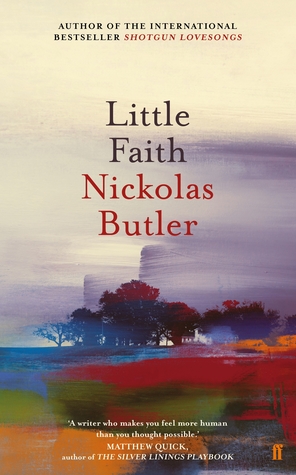 Steven and Shiloh believe Isaac has a healing gift – perhaps he can even help Lyle’s old pal, Hoot, who’s just been diagnosed with advanced cancer? The main story line reminded me most of Emily Fridlund’s History of Wolves (health and superstition collide) and Carolyn Parkhurst’s Harmony (the dangers of a charismatic leader). It’s all well and good to have faith in supernatural healing, but not if it means rejecting traditional medicine.
This is the epitome of a slow burner, though: things don’t really heat up until the final 35 pages, and there were a few chapters that could have been cut altogether. The female characters struck me as underdeveloped, but I did have a genuine warm feeling for Lyle. There are some memorable scenes, like Lyle’s heroic effort to save the orchard from an ice storm – a symbolic act that’s more about his desperation to save his grandson from toxic religion. But mostly this is a book to appreciate for the slow, predictable rhythms of a small-town life lived by the seasons. 
[*So funny because that’s my brother-in-law’s name! I’ve also visited a Maryland church that meets in a former movie theatre. I was a part of somewhat extreme churches and youth groups in my growing-up years, but luckily nowhere that would have advocated foregoing traditional medicine in favor of faith healing. There were a few false notes here that told me Butler was writing about a world he wasn’t familiar with.]
A favorite passage:
“‘Silent Night’ in a darkened country chapel was, to Lyle, more powerful than any atomic bomb. He was incapable of singing it without feeling his eyes go misty, without feeling that his voice was but one link in a chain of voices connected over the generations and centuries, that line we sometimes call family. Or memory itself.”
With thanks to Faber & Faber for the free copy for review.
The Parakeeting of London: An Adventure in Gonzo Ornithology by Nick Hunt
 Rose-ringed parakeets were first recorded in London in the 1890s, but only in the last couple of decades have they started to seem ubiquitous. I remember seeing them clustered in treetops and flying overhead in various Surrey, Kent and Berkshire suburbs we’ve lived in. They’re even more noticeable in London’s parks and cemeteries. “When did they become as established as beards and artisan coffee?” Nick Hunt wonders about his home in Hackney. He and photographer Tim Mitchell set out to canvass public opinion about London’s parakeets and look into conspiracy theories about how they escaped (Henry VIII and Jimi Hendrix are rumored to have released them; the set of The African Queen is another purported origin) and became so successful an invasive species.
A surprising cross section of the population is aware of the birds, and opinionated about them. Language of “immigrants” versus “natives” comes up frequently in the interviews, providing an uncomfortable parallel to xenophobic reactions towards human movement – “people had a tendency to conflate the avian with the human, turning the ornithological into the political. Invading, colonizing, taking over.” This is a pleasant little book any Londoner or British birdwatcher in general would appreciate.
With thanks to Paradise Road for the free copy for review.
Night Theatre by Vikram Paralkar
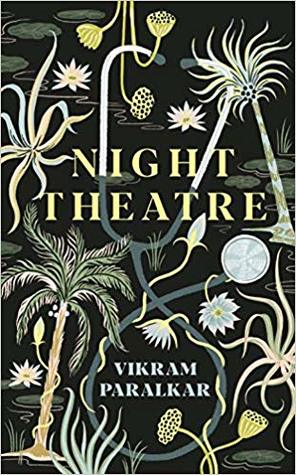 This short novel has an irresistible (cover and) setup: late one evening a surgeon in a rural Indian clinic gets a visit from a family of three: a teacher, his pregnant wife and their eight-year-old son. But there’s something different about this trio: they’re dead. They each bear hideous stab wounds from being set upon by bandits while walking home late from a fair. In the afterlife, an angel reluctantly granted them a second chance at life. If the surgeon can repair their gashes before daybreak, and as long as they stay within the village boundaries, their bodies will be revivified at dawn.
Paralkar draws on dreams, folktales and superstition, and the descriptions of medical procedures are vivid, as you would expect given the author’s work as a research physician at the University of Pennsylvania. The double meaning of the word “theatre” in the title encompasses the operating theatre and the dramatic spectacle that is taking place in this clinic. But somehow I never got invested in any of these characters and what might happen to them; the précis is more exciting than the narrative as a whole. 
A favorite passage:
“Apart from the whispering of the dead in the corridor, the silence was almost deliberate – as if the crickets had been bribed and the dogs strangled. The village at the base of the hillock was perfectly still, its houses like polyps erupting from the soil. The rising moon had dusted them all with white talc. They appeared to have receded in the hours after sunset, abandoning the clinic to its unnatural deeds.”
With thanks to Serpent’s Tail for the free copy for review.
The Making of You: A Journey from Cell to Human by Katharina Vestre
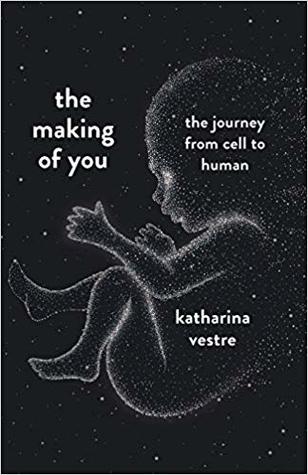 A sprightly layman’s guide to genetics and embryology, written by Doctoral Research Fellow at the University of Oslo Department of Biosciences. Addressed in the second person, as the title suggests, the book traces your development from the sperm Leeuwenhoek studied under a microscope up to labor and delivery. Vestre looks at all the major organs and the five senses and discusses what can go wrong along with the normal quirks of the body.
I learned all kinds of bizarre facts. For instance, did you know that sperm have a sense of smell? And that until the 1960s pregnancy tests involved the death of a mouse or rabbit? Who knew that babies can remember flavors and sounds experienced in utero?
Vestre compares human development with other creatures’, including fruit flies (with whom we share half of our DNA), fish and alligators (which have various ways of determining gender), and other primates (why is it that they stay covered in fur and we don’t?). The charming style is aimed at the curious reader; I rarely felt that things were being dumbed down. Most chapters open with a fetal illustration by the author’s sister. I’m passing this on to a pregnant friend who will enjoy marveling at everything that’s happening inside her.
A representative passage:
“This may not sound terribly impressive; I promised you dramatic changes, and all that’s happened is that a round plate has become a triple-decker cell sandwich. But you’re already infinitely more interesting than the raspberry you were a short while ago. These cells are no longer confused, needy newcomers with no idea where they are or what they’re supposed to do. They have completed a rough division of labour. The cells on the top layer will form, among other things, skin, hair, nails, eye lenses, nerves and your brain. From the bottom layer you’ll get intestines, liver, trachea and lungs. And the middle layer will become your bones, muscles, heart and blood vessels.”
With thanks to Wellcome Collection/Profile Books for the free copy for review.
Would you be interested in reading one or more of these?
Classics and Doorstoppers of the Month
April was something of a lackluster case for my two monthly challenges: two slightly disappointing books were partially read (and partially skimmed), and two more that promise to be more enjoyable were not finished in time to review in full.
Classics
Wise Blood by Flannery O’Connor (1952)
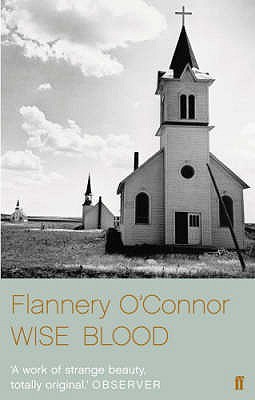 When Hazel Motes, newly released from the Army, arrives back in Tennessee, his priorities are to get a car and to get laid. In contrast to his preacher grandfather, “a waspish old man who had ridden over three counties with Jesus hidden in his head like a stinger,” he founds “The Church Without Christ.” Heaven, hell and sin are meaningless concepts for Haze; “I don’t have to run from anything because I don’t believe in anything,” he declares. But his vociferousness belies his professed indifference. He’s particularly invested in exposing Asa Hawkes, a preacher who vowed to blind himself, but things get complicated when Haze is seduced by Hawkes’s 15-year-old illegitimate daughter, Sabbath – and when his groupie, eighteen-year-old Enoch Emery, steals a shrunken head from the local museum and decides it’s just the new Jesus this anti-religion needs. O’Connor is known for her very violent and very Catholic vision of life. In a preface she refers to this, her debut, as a comic novel, but I found it bizarre and unpleasant and only skimmed the final two-thirds after reading the first 55 pages.
In progress: Cider with Rosie by Laurie Lee (1959) – I love to read ‘on location’ when I can, so this was a perfect book to start during a weekend when I visited Stroud, Gloucestershire for the first time.* Lee was born in Stroud and grew up there and in the neighboring village of Slad. I’m on page 65 and it’s been a wonderfully evocative look at a country childhood. The voice reminds me slightly of Gerald Durrell’s in his autobiographical trilogy.
*We spent one night in Stroud on our way home from a short holiday in Devon so that I could see The Bookshop Band and member Beth Porter’s other band, Marshes (formerly Beth Porter and The Availables) live at the Prince Albert pub. It was a terrific night of new songs and old favorites. I also got to pick up my copy of the new Marshes album, When the Lights Are Bright, which I supported via an Indiegogo campaign, directly from Beth.


Doorstoppers
The Resurrection of Joan Ashby by Cherise Wolas (2017)
Joan Ashby’s short story collection won a National Book Award when she was 21 and was a bestseller for a year; her second book, a linked story collection, was nominated for a Pulitzer Prize. In contravention of her childhood promise to devote herself to her art, she marries Martin Manning, an eye surgeon, and is soon a mother of two stuck in the Virginia suburbs. Two weeks before Daniel’s birth, she trashes a complete novel. Apart from a series of “Rare Babies” stories that never circulate outside the family, she doesn’t return to writing until both boys are in full-time schooling. When younger son Eric quits school at 13 to start a computer programming business, she shoves an entire novel in a box in the garage and forgets about it.
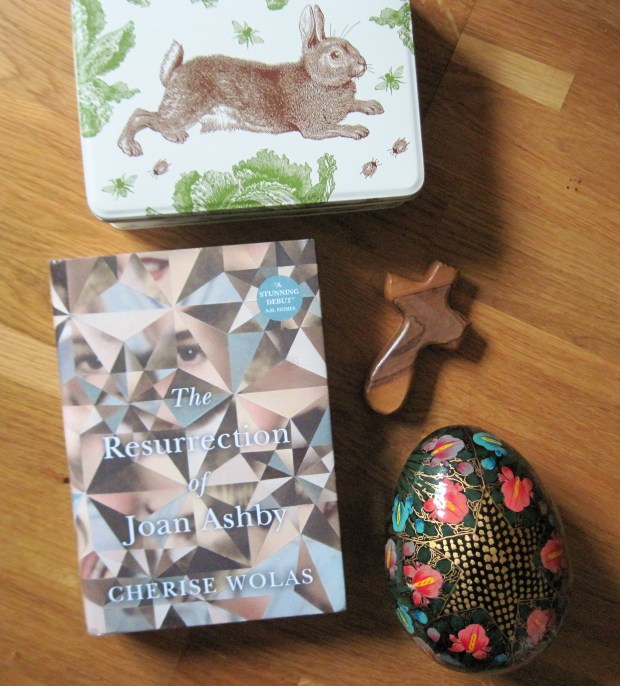
I chose this for April based on the Easter-y title (it’s a stretch, I know!).
Queasy feelings of regret over birthing parasitic children – Daniel turns out to be a fellow writer (of sorts) whose decisions sap Joan’s strength – fuel the strong Part I, which reminded me somewhat of Doris Lessing’s The Golden Notebook in that the protagonist is trying, and mostly failing, to reconcile the different parts of her identity. However, this debut novel is indulgently long, and I lost interest by Part III, in which Joan travels to Dharamshala, India to reassess her relationships and career. I skimmed most of the last 200 pages, and also skipped pretty much all of the multi-page excerpts from Joan’s fiction. At a certain point it became hard to sympathize with Joan’s decisions, and the narration grew overblown (“arc of tragedy,” “tortured irony,” etc.) [Read instead: Forty Rooms by Olga Grushin]
Page count: 523
In progress: Mary Ann Sate, Imbecile by Alice Jolly, a 613-page historical novel in verse narrated by a semi-literate servant from Stroud, then a cloth mill town. I’d already committed to read it for a Nudge/New Books magazine review, having had my interest redoubled by its shortlisting for the Rathbones Folio Prize, but it was another perfect choice for a weekend that involved a visit to that part of Gloucestershire. Once you’re in the zone, and so long as you can guarantee no distractions, this is actually a pretty quick read. I easily got through the first 75 pages in a couple of days.
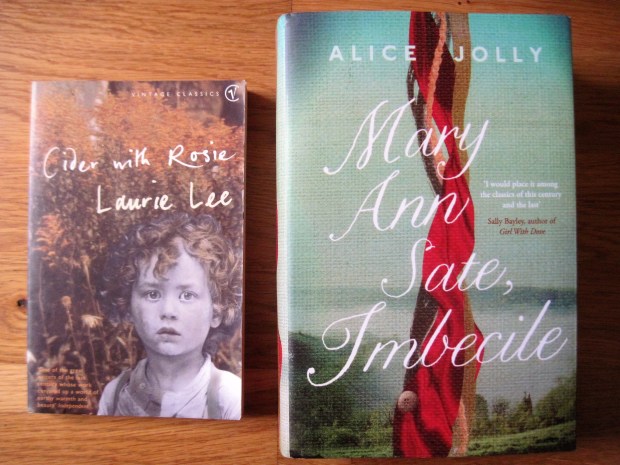
My Stroud-themed reading.
Next month’s plan: As a doorstopper Annabel and I are going to read The Amazing Adventures of Kavalier & Clay by Michael Chabon (636 pages, or roughly 20 pages a day for the whole month of May). Join us if you like! I’m undecided about a classic, but might choose between George Eliot, William Faulkner, Robert Louis Stevenson and Emile Zola.
Women’s Prize 2019: Longlist Review Excerpts and Shortlist Thoughts
There’s a reason I could never wholeheartedly shadow the Women’s Prize: although each year the prize introduces me one or two great novels I might never have heard of otherwise, inevitably there are also some I don’t care for, or have zero interest in reading. Here’s how I fared this year, in categories from best to worst, with excerpts and links to any I’ve reviewed in full:
Loved! (5)
- The Pisces by Melissa Broder: This starts off as a funny but somewhat insubstantial novel about a thirtysomething stuck with a life she isn’t sure she wants, morphs into a crass sex comedy (featuring a merman), but ultimately becomes a profound exploration of possession, vulnerability and the fluidity of gender roles. It’s about the prison of the body, and choosing which of the many different siren voices calling us we’ll decide to listen to. It’s a Marmite book, but perfect Women’s Prize material.
 Ordinary People by Diana Evans: Reminds me of On Beauty by Zadie Smith, one of my favorite novels of this millennium. It focuses on two Black couples in South London and the suburbs who, in the wake of Obama’s election, are reassessing their relationships. Their problems are familiar middle-class ones, but Evans captures them so candidly that many passages made me wince. The chapter in which two characters experience mental instability is a standout, and the Black slang and pop music references a nice touch.
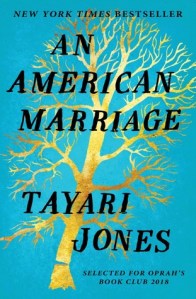
- An American Marriage by Tayari Jones: Roy and Celestial only get a year of happy marriage before he’s falsely accused of rape and sentenced to 12 years in prison in Louisiana. I ached for all three main characters: It’s an impossible situation. There’s a lot to probe about the characters’ personalities and motivations, and about how they reveal or disguise themselves through their narration. I found it remarkable how the letters, which together make up not even one-fifth of the text, enhance the raw honesty of the book.
- Ghost Wall by Sarah Moss: It’s the late 1980s and teenager Silvie Hampton and her parents have joined a university-run residential archaeology course in the North of England, near the bogs where human sacrifice once took place. Nationalism, racism, casual misogyny – there are lots of issues brewing under the surface here. Women’s bodies and what can be done to them is central; as the climax approaches, the tricksy matter of consent arises. I ended up impressed by how much Moss conveys in so few pages. Another one custom-made for the Women’s Prize.
 Bottled Goods by Sophie van Llewyn: I just finished this the other day. It’s a terrific hybrid work that manages to combine several of my favorite forms: a novella, flash fiction and linked short stories. The content is also an intriguing blend, of the horrific and the magical. After her brother-in-law’s defection, Alina and her husband Liviu come under extra scrutiny in Communist Romania. Bursts of magic realism and a delightful mixture of narrative styles (lists and letters; alternating between the first and third person) make all this material bearable.
Did not particularly enjoy (2)
- Freshwater by Akwaeke Emezi: Magic realism and mental illness fuel a swirl of disorienting but lyrical prose. Much of the story is told by the ọgbanje (an Igbo term for evil spirits) inhabiting Ada’s head. The conflation of the abstract and the concrete didn’t quite work for me, and the whole is pretty melodramatic. Although I didn’t enjoy this as much as some other inside-madness tales I’ve read, I can admire the attempt to convey the reality of mental illness in a creative way.
 Normal People by Sally Rooney: This book’s runaway success continues to baffle me. I kept waiting for more to happen, skimming ahead to see if there would be anything more to it than drunken college parties and frank sex scenes. It is appealing to see into these characters’ heads and compare what they think of themselves and each other with their awareness of what others think. But page to page it is pretty tedious, and fairly unsubtle.
Attempted but couldn’t get through (3)
- Remembered by Yvonne Battle-Felton: A historical novel marked by the presence of ghosts, this is reminiscent of the work of Cynthia Bond, Toni Morrison and Jesmyn Ward. It’s the closest thing to last year’s Sing, Unburied, Sing. I only read the first 36 pages as neither the characters nor the prose struck me as anything special.
 Swan Song by Kelleigh Greenberg-Jephcott: Full of glitzy atmosphere contrasted with washed-up torpor. I have no doubt the author’s picture of Truman Capote is accurate, and there are great glimpses into the private lives of his catty circle. I always enjoy first person plural narration, too. However, I quickly realized I don’t have sufficient interest in the figures or time period to sustain me through nearly 500 pages. I read the first 18 pages and skimmed to p. 35.
- Number One Chinese Restaurant by Lilian Li: Vague The Nest vibes, but the prose felt flat and the characters little more than clichés (especially scheming ‘Uncle’ Pang). I grew up in Silver Spring, Maryland so was expecting there to be more local interest for me, but this could be taking place anywhere. Reviews from trusted Goodreads friends suggested that the plot and characterization don’t significantly improve as the book goes on, so I gave up after the first two chapters.
Not interested (6)
(Don’t you go trying to change my mind!)

- The Silence of the Girls by Pat Barker: Updated Greek classics are so not my bag.
- My Sister, the Serial Killer by Oyinkan Braithwaite: Meh.
- Milkman by Anna Burns: Nah.
- Lost Children Archive by Valeria Luiselli: I’ll try something else by Luiselli.
- Praise Song for the Butterflies by Bernice L. McFadden: The setting of a fictional African country and that title already have me groaning.
- Circe by Madeline Miller: See the note on Barker above.
The shortlist will be announced on Monday the 29th. Broder and Moss will most likely make the cut. I’d love to see the van Llewyn make it through, as it’s my favorite of what I’ve read from the longlist, but I think it will probably be edged out by more high-profile releases. Either Evans or Jones will advance; Jones probably has the edge with more of an issues book. One of the Greek myth updates is likely to succeed. Luiselli is awfully fashionable right now. Emezi’s is an interesting book and the Prize is making a statement by supporting a non-binary author. Rooney has already won or been nominated for every prize going, so I don’t think she needs the recognition. Same for Burns, having won the Booker.
So, quickly pulling a combination of wanted and expected titles out of the air would give this predicted shortlist:
 The Silence of the Girls by Pat Barker
The Pisces by Melissa Broder
Freshwater by Akwaeke Emezi
An American Marriage by Tayari Jones
Lost Children Archive by Valeria Luiselli
Ghost Wall by Sarah Moss
Eleanor, Eric, Laura and Rachel have been posting lots of reviews and thoughts related to the Women’s Prize. Have a look at their blogs!
Stanley and Elsie by Nicola Upson & A Visit to Sandham Memorial Chapel
“I don’t want them to look like war paintings, Elsie. I want them to look like heaven.”
When I was offered a copy of this novel to review as part of the blog tour, I was unfamiliar with the name of its subject, the artist Sir Stanley Spencer (1891–1959) – until I realized that he painted the WWI-commemorative Sandham Memorial Chapel in Hampshire, which I had never visited* but knew was just 5.5 miles from our home in Berkshire.

Take another look at the title, though: two characters are given double billing, the second of whom is Elsie Munday, who in the opening chapter presents herself for an interview with Stanley and his wife, Hilda (also a painter), who promptly hire her to be their housemaid at Chapel View in 1928. This creates a setup similar to that in Girl with a Pearl Earring, with a lower-class character observing the inner workings of an artist’s household and giving plain-speaking commentary on what she sees. Upson’s close third-person narration sticks with Elsie for the whole of Part I, but in Part II the picture widens out, with the point of view rotating between Hilda, Elsie and Dorothy Hepworth, the reluctant third side in a love triangle that develops between Stanley and her partner, Patricia Preece.
Hilda and Stanley argue about everything, from childrearing to art: they even paint dueling portraits of Elsie – with Hilda’s Country Girl winning out. Elsie knows she’s lucky to have such a comfortable position with the Spencers and their daughters at Burghclere, and later at Cookham, but she’s uneasy at how Stanley turns her into a confidante in his increasingly tempestuous marriage. Hilda, frustrated at Stanley’s selfish, demanding ways, often returns to her family home in Hampstead, leaving Elsie alone with her employer. Stanley doesn’t give a fig for local opinion, but Elsie knows she has a reputation to protect – especially considering that her moments alone with Stanley aren’t entirely free of sexual tension.
 I love reading about artists’ habits – how creative work actually gets done – so I particularly loved the scenes where Elsie, sent on errands, finds Stanley up a ladder in the chapel, pondering how to get a face or object just right. On more than one occasion he borrows her kitchen items, such as a sponge and cooked and uncooked rashers of bacon, so he can render them perfectly in his paintings. I also loved that this is a local interest book for me, with Newbury, where I live, mentioned four or five times in passing as the nearest big town. Part II, with its account of Stanley’s extramarital doings becoming ever more sordid, didn’t grip me as much as Part I, but I found the whole to be an elegantly written study of a very difficult man and the ties that he made and broke over the course of several decades.
For the tone as well as the subject matter, I would particularly recommend it to readers of Jonathan Smith’s Summer in February and Graham Swift’s Mothering Sunday, and especially Esther Freud’s Mr. Mac and Me.
My rating:
Stanley and Elsie will be published by Duckworth on May 2nd. My thanks to the publisher for the proof copy for review. They also sent a stylish tote bag!


Nicola Upson
Nicola Upson is best known for her seven Josephine Tey crime novels. She has also published nonfiction, including a book on the sculpture of Helaine Blumenfeld. This is her first stand-alone novel.
*Until now. On a gorgeous Easter Saturday that felt more like summer than spring, I had my husband drop me off on his way to a country walk so I could tour the chapel. I appreciated Spencer’s “holy box” so much more having read the novel than I ever could have otherwise – even though the paintings were nothing like I’d imagined from Upson’s descriptions.

You enter the chapel through the wooden double doors at the center.
What struck me immediately is that, for war art, the focus is so much more on domesticity. Spencer briefly served in Salonika, Macedonia (like his patrons’ brother, Harry Sandham, to whose memory the chapel is dedicated), but had initially been rejected by the army and started off as a medical orderly in an English hospital. Both Salonika and Beaufort hospital appear in the paintings, but there are no battle scenes or bloody injuries. Instead we see tableaux of cooking, doing laundry, making beds, inventorying kitbags, filling canteens, reading maps, dressing under mosquito nets and making stone mosaics. It’s as if Spencer wanted to spotlight what happens in between the fighting. These everyday activities would have typified the soldiers’ lives more than active combat, after all.
I was reminded of how Stanley explains his approach in the novel:
“There’s something heroic in the everyday, don’t you think?”
“Isn’t that what peace is sometimes? A succession of bland moments? We have to cherish them, though, otherwise what was the point of fighting for them?”
The paintings show inventive composition but are in an unusual style that sometimes verges on the grotesque. Many of the figures are lumpen and childlike, especially in Tea in the Hospital Ward, where the soldiers scoffing bread and jam look like cheeky schoolboys. There are lots of animals on display, especially horses and donkeys, but they often look enormous and not entirely realistic. The longer you look, the more details you spot, like a dog raiding a stash of Fray Bentos tins and a young man looking at his reflection in a picture frame to part his hair with a comb. These aren’t desolate, burnt-out landscapes but rich with foliage and blossom, even in Macedonia, which recalls the Holy Land and seems timeless.


The central painting behind the altar, The Resurrection of the Soldiers, imagines the dead rising out of their graves, taking up their white crosses and delivering them to Jesus, a white-clad figure in the middle distance. There’s an Italian Renaissance feeling to this one, with one face in particular looking like it could have come straight out of Giotto (an acknowledged influence on Spencer’s chapel work). It’s as busy as Bosch, but not as dark thematically or in terms of the color scheme – while some of the first paintings in the sequence, like the one of scrubbing hospital floors, recall Edward Hopper with their somber realism. We see all these soldiers intact: at their resurrection they are whole, with no horrific wounds or humiliating nudity. Like Stanley says to Elsie, it’s more heaven than war.


If you are ever in the area, I highly recommend even a quick stop at this National Trust property. I showed a few workers my advanced copy of the novel; while the reception staff were unaware of its existence, a manager I caught up with after my tour knew about it and had plans to read it soon. She also said they will stock it in the NT shop on site.
Wellcome Book Prize Blog Tour: Will Eaves’s Murmur
“This is the death of one viewpoint, and its rebirth, like land rising above the waves, or sea foam running off a crowded deck: the odd totality of persons each of whom says ‘me’.”
When I first tried reading Murmur, I enjoyed the first-person “Part One: Journal,” which was originally a stand-alone story (shortlisted for the BBC National Short Story Award 2017) but got stuck on “Part Two: Letters and Dreams” and ended up just giving the rest of the book a brief skim. I’m glad that the book’s shortlisting prompted me to return to it and give it proper consideration because, although it was a challenge to read, it was well worth it.

Eaves’s protagonist, Alec Pryor, sometimes just “the scientist,” is clearly a stand-in for Alan Turing, quotes from whom appear as epigraphs heading most chapters. Turing was a code-breaker and early researcher in artificial intelligence at around the time of the Second World War, but was arrested for homosexuality and subjected to chemical castration. Perhaps due to his distress at his fall from grace and the bodily changes that his ‘treatment’ entailed, he committed suicide at age 41 – although there are theories that it was an accident or an assassination. If you’ve read about the manner of his death, you’ll find eerie hints in Murmur.
Every other week, Alec meets with Dr Anthony Stallbrook, a psychoanalyst who encourages him to record his dreams and feelings. This gives rise to the book’s long central section. As is common in dreams, people and settings whirl in and out in unpredictable ways, so we get these kinds of flashes: sneaking out from the boathouse at night with his schoolboy friend, Chris Molyneux, who died young; anti-war protests at Cambridge; having sex with men; going to a fun fair; confrontations with his mother and brother; and so on. Alec and his interlocutors discuss the nature of time, logic, morality, and the threat of war.
There are repeated metaphors of mirrors, gold and machines, and the novel’s language is full of riddles and advanced vocabulary (volutes, manumitted, pseudopodium) that sometimes require as much deciphering as Turing’s codes. The point of view keeps switching, too, as in the quote I opened with: most of the time the “I” is Alec, but sometimes it’s another voice/self observing from the outside, as in Akwaeke Emezi’s Freshwater. There are also fragments of second- and third-person narration, as well as imagined letters to and from June Wilson, Alec’s former Bletchley Park colleague and fiancée. All of these modes of expression are ways of coming to terms with the past and present.
 I am usually allergic to any book that could be described as “experimental,” but I found Murmur’s mosaic of narrative forms an effective and affecting way of reflecting its protagonist’s identity crisis. There were certainly moments where I wished this book came with footnotes, or at least an Author’s Note that would explain the basics of Turing’s situation. (Is Eaves assuming too much about readers’ prior knowledge?) For more background I recommend The Imitation Game, starring Benedict Cumberbatch as Turing.
To my surprise, given my initial failure to engage with Murmur, it is now my favorite to win the Wellcome Book Prize. For one thing, it’s a perfect follow-on from last year’s winner, To Be a Machine. (“It is my fate to make machines that think,” Alec writes.) For another, it connects the main themes of this year’s long- and shortlists: mental health and sexuality. In particular, Alec’s fear that in developing breasts he’s becoming a sexual hybrid echoes the three books from the longlist that feature trans issues. Almost all of the longlisted books could be said to explore the mutability of identity to some extent, but Murmur is the very best articulation of that. A playful, intricate account of being in a compromised mind and body, it’s written in arresting prose. Going purely on literary merit, this is my winner by a mile.
My rating:
With thanks to Midas PR for the free copy for review.

From Gallop: Selected Poems by Alison Brackenbury. Originally published in the volume After Beethoven.
Will Eaves is an associate professor in the Writing Programme at the University of Warwick and a former arts editor of the Times Literary Supplement. Murmur, his fourth novel, was also shortlisted for the 2018 Goldsmiths Prize and was the joint winner of the 2019 Republic of Consciousness Prize. He has also published poetry and a hybrid memoir.
Opinions on this book vary within our shadow panel; our final votes aren’t in yet, so it remains to be seen who we will announce as our winner on the 29th.
If you are within striking distance of London, please consider coming to the “5×15” shortlist event being held next Tuesday evening the 30th.
I was delighted to be asked to participate in the Wellcome Book Prize blog tour. See below for details of where other reviews have appeared or will be appearing soon.

Following Up on the Prescriptions from My Bibliotherapy Appointment
In January 2018 I had the wonderful opportunity to have a free bibliotherapy session at the School of Life in London with Ella Berthoud, one of the authors of The Novel Cure. I wrote about the experience in this post. I quickly got hold of all but a couple of my prescribed reads, but have been slower about actually reading them. Though I’ve read five now, I’ve only written up four, two of which I only managed to finish this week. (These 250-word reviews are in order of my reading.)
Heligoland by Shena Mackay (2002)
(CURE: moving house)
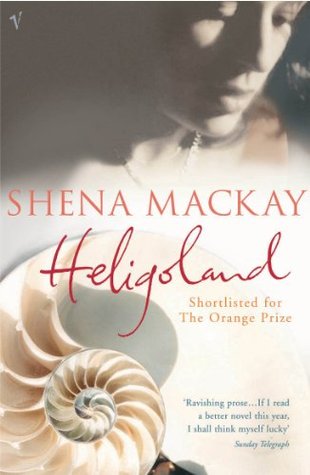 Heligoland is a Scottish island best known from the shipping forecast, but here it’s an almost mythical home. Rowena Snow was orphaned by her Indian/Scottish parents, and a second time by her aunt. Since then she’s drifted between caring and cleaning jobs. The Nautilus represents a fresh chance at life. This shell-shaped artists’ commune in South London houses just three survivors: Celeste Zylberstein, who designed the place; poet Francis Campion; and antiques dealer Gus Crabb. Rowena will be the housekeeper/cook, but she struggles with self-esteem: does she deserve to live in a haven for upper-class creative types?
The omniscient perspective moves between the Nautilus residents but also on to lots of other minor hangers-on, whose stories are hard to keep track of. Mackay’s writing reminded me somewhat of Tessa Hadley’s and is lovely in places – especially when describing a buffet or a moment of light-filled epiphany in a garden. There’s not much to be said beyond what’s in the blurb: Mackay is attempting to give a picture of a drifter who finds an unconventional home; in the barest sense she does succeed, but I never felt a connection with any of the characters. In this ensemble cast there is no one to love and thus no one to root for. While I didn’t love this book, it did inspire me to pick up others by Mackay: since then I’ve read The Orchard on Fire, which I liked a lot more, and the first half of Dunedin.
My rating:
Family Matters by Rohinton Mistry (2002)
(CURE: worry over ageing parents)
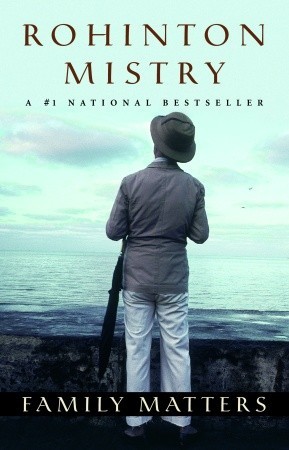 Retired professor Nariman Vakeel, 79, has Parkinson’s disease and within the first few chapters has also fallen and broken his ankle. His grown stepchildren, Coomy and Jal, reluctant to care for him anyway, decide they can’t cope with the daily reality of bedpans, sponge baths and spoon feeding in their large Chateau Felicity apartment. He’ll simply have to recuperate at Pleasant Villa with his daughter Roxana and her husband and sons, even though their two-bedroom apartment is barely large enough for the family of four. You have to wince at the irony of the names for these two Bombay housing blocks, and at the bitter contrast between selfishness and duty.
Perhaps inevitably, Nariman starts to fade into the background. An increasingly speechless invalid, he only comes alive through his past: italicized sections, presented as his night-time ravings, tell of his love for Lucy, whom his parents refused to let him marry, and the untimely end of his arranged marriage. I enjoyed time spent in a vibrantly realized Indian city and appreciated a chance to learn about a lesser-known community: Nariman and family are Parsis (or Zoroastrians). There’s also a faint echo here of King Lear, with one faithful daughter set against two wicked children.
As to ageing parents, this is a pretty relentlessly bleak picture, but there are sparks of light: joy in life’s little celebrations, and unexpected kindnesses. Mistry’s epic has plenty of tender moments that bring it down to an intimate scale. I’m keen to read his other novels.
My rating:
Maggie & Me by Damian Barr (2013)
(A supplementary prescription because I love memoirs and didn’t experience Thatcher’s Britain.)
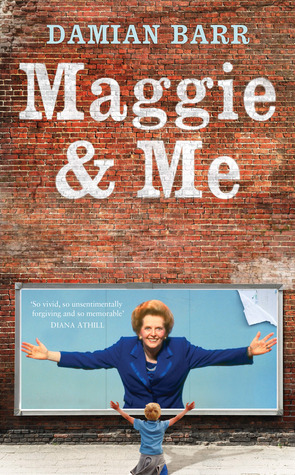 Like a cross between Angela’s Ashes and Toast, this recreates a fairly horrific upbringing from the child’s perspective. Barr was an intelligent, creative young man who early on knew that he was gay and, not just for that reason, often felt that there was no place for him: neither in working-class Scotland, where his father was a steelworker and his brain-damaged mother flitted from one violent boyfriend to another; nor in Maggie Thatcher’s 1980s Britain at large, in which money was the reward for achievement and the individual was responsible for his own moral standing and worldly advancement. “I don’t need to stand out any more,” he recalls, being “six foot tall, scarecrow skinny and speccy with join-the-dots spots, bottle-opener buck teeth and a thing for waistcoats. Plus I get free school dinners and I’m gay.”
There are a lot of vivid scenes in this memoir, some of them distressing ones of abuse, and the present tense, dialect, and childish grammar and slang give it authenticity. However, I never quite bought in to the Thatcher connection as an overarching structure. Three pages at the start, five at the end, and a Thatcher quote as an epigraph for each chapter somehow weren’t enough to convince me that the framing device was necessary or apt. Still, I enjoyed this well enough as memoirs go, and I would certainly recommend it if you loved Nigel Slater’s memoir mentioned above. I also have Barr’s recent debut novel, You Will Be Safe Here, on my Kindle.
My rating:
The Monsters of Templeton by Lauren Groff (2008)
(A supplementary prescription for uncertainty about having children.)
 I enjoyed this immensely, from the first line on: “The day I returned to Templeton steeped in disgrace, the fifty-foot corpse of a monster surfaced in Lake Glimmerglass.” Twenty-eight-year-old Willie Upton is back in her hometown, pregnant by her older, married archaeology professor after a summer of PhD fieldwork in Alaska. “I had come home to be a child again. I was sick, heartbroken, worn down.” She gives herself a few weeks back home to dig through her family history to find her father – whom Vi has never identified – and decide whether she’s ready to be a mother herself.
We hear from various leading lights in the town’s history and/or Willie’s family tree through a convincing series of first-person narratives, letters and other documents. Groff gives voice to everyone from a Mohican chief to a slave girl who catches her master’s eye. Willie and Vi are backed up by a wonderful set of secondary characters, past and present. Groff wrote this in homage to Cooperstown, New York, where she grew up. (If you’ve heard of it, it’s probably for the baseball museum; it’s not far from where my mother is from in upstate New York.) Templeton is “a slantwise version” of Cooperstown, Groff admits in an opening Author’s Note, and she owes something of a debt to its most famous citizen, James Fenimore Cooper. What a charming way to celebrate where you come from, with all its magic and mundanity. This terrific debut novel cemented my love of Groff’s work.
My rating:
I also have Ella to thank for the inspiration to reread a childhood favorite, Little Women by Louisa May Alcott, last year; the experiment formed the subject of my first piece for Literary Hub. I also worked my way through The Artist’s Way by Julia Cameron, another of my prescriptions, over a number of months in 2018, but failed to keep up with the regular writing exercises so didn’t get the maximum benefit.
My husband and I made a start on reading a few books aloud to each other, including Sum: Forty Tales from the Afterlives by David Eagleman, but that fell by the wayside after a handful of weeks.
(Incidentally, I had forgotten that Cutting for Stone turns up in The Novel Cure on a list of the 10 best books to combat xenophobia.)
 Still to read: Jitterbug Perfume by Tom Robbins (CURE: horror of ageing)
And one I still have to get hold of but haven’t been able to find cheap secondhand because it’s a Persephone classic: The Victorian Chaise-Longue by Marghanita Laski (a supplementary prescription because I love Victorian pastiches).
Four Recent Review Books: Aidt, Brackenbury, Duclos & Zidrou
Four February–March releases: A shape-shifting bereavement memoir; a poet’s selected works, infused with nature and history; a novel set among expatriates in Shanghai; and a graphic novel about a romance at the watershed of age 60 – you can’t say I don’t read a variety of books! I’m particularly pleased that two of these four are in translation. All:

When Death Takes Something from You Give It Back: Carl’s Book by Naja Marie Aidt
[Translated from the Danish by Denise Newman]
 In March 2015 Aidt got a call telling her that her second of four sons, Carl Emil, was dead. The 25-year-old experienced drug-induced psychosis after taking some mushrooms that he and his friend had grown in their flat and, naked, jumped out of his fifth-floor Copenhagen window. In italicized sections she cycles back to the moment she was notified, each time adding on a few more harrowing details about Carl’s accident and the condition she found him in. The rest of the text is a collage of fragments: memories, dreams, dictionary definitions, journal entries, and quotations from the patron saints of bereavement (C.S. Lewis and Joan Didion) and poets who lost children, such as Stéphane Mallarmé.
The playful disregard for chronology and the variety of fonts, typefaces and sizes are a way of circumventing the feeling that grief has made words lose their meaning forever. David Grossman, whose son died during his service in the Israeli army, does a similar thing in Falling Out of Time, which, although it is fiction, blends poetry and dialogue in an attempt to voice the unspeakable. Han Kang’s The White Book and Yiyun Li’s Where Reasons End are two other comparable precursors.

A representative passage:
“no language possible language died with my child could not be artistic could not be art did not want to be fucking art I vomit over art over syntax write like a child main clauses searching everything I write is a declaration I hate writing don’t want to write any more”
With thanks to Quercus Books for the free copy for review.
Gallop: Selected Poems by Alison Brackenbury
 I first encountered Alison Brackenbury’s poetry through her reading as part of the 2016 “Nature Matters” conference in Cambridge. From four generations of Lincolnshire shepherds, Brackenbury writes about history, nature, country life (especially horses, as you might guess from the title and cover) and everyday joys and regrets. A Collected/Selected Poems volume is often difficult to assess as a whole because there can be such a variety of style and content; while that is certainly true here in terms of the poems’ length and rhyme schemes, the tone and themes are broadly similar throughout. I connected most to her middle period. Her first and last lines are especially honed.
Highlights include “The Wood at Semmering” (“This is a dismal wood. We missed our train.”), “Half-day” (“Will she lift / Her face from cloth’s slow steam: will she find out / Ironing is duty; summer is a gift?”), “Hill Mist” (“I am too fond of mist, which is blind / without tenderness”), “On the Road” (the bravery of a roadkill squirrel), “Epigrams” (being in the sandwich generation), “The Card” (“Divorce comes close to death”), “Cycles” (“Would I go back?”), “The Jane Austen Reader” (“Welcome to the truth. Miss Bingley married Darcy”), “On the Aerial” (a starling’s many songs), and “Dickens: a daydream.”

A wee poem that’s perfect for this time of year. (I can see sparrows in a forsythia bush from my office window.)
Some favorite lines:
“we are love’s strange seabirds. We dive there, still.” (from “The Divers’ Death”)
“Ancestors are not in our blood, but our heads: / we make history.” (from “Robert Brackenbury”)
With thanks to Carcanet Press for the free copy for review.
Besotted by Melissa Duclos
 Sasha is soon to leave Shanghai, her departure hastened by the collapse of her relationship with Liz, whom she hired to work at her international school because she had no teaching experience or Chinese – and maybe because she signed her cover letter “Besottedly,” thinking it meant drunkenly. Even before Liz arrived, Sasha built romantic fantasies around her, thinking she’d show her the ropes and give her a spare room to live in. All went according to plan – the erstwhile straight Liz even ended up in Sasha’s bed – until it all fell apart.
The novel is set over one school year and shows the main characters exploring the expat community, which primarily involves going to happy hours. Liz starts language exchange sessions at Starbucks with a Chinese guy, Sam, and both women try to ignore the unwanted advances of their acquaintance Dorian, an architect. Little misunderstandings and betrayals go a long way towards rearranging these relationships, while delicate flashbacks fill in the women’s lives before China.
There were a couple of narrative decisions here that didn’t entirely work for me: Sasha narrates the whole book, even scenes she isn’t present for; and there is persistent personification of abstractions like Loneliness and Love. But the descriptions of the city and of expat life are terrific, and the wistful picture of a romance that starts off sweet but soon sours is convincing.
A favorite passage:
“Shanghai had found its own identity since then: a glittering capitalist heart, hardened into a diamond and barely hidden beneath its drab, brown communist cloak. … Constantly under construction, Shanghai was a place to reinvent yourself.”
Full disclosure: Melissa and I worked together on Bookkaholic web magazine, and are Facebook friends. She sent me a free proof copy for review.
Blossoms in Autumn by Zidrou and Aimée de Jongh
[Translated from the French by Matt Madden]
 The French-language title, translated literally, is The Programmed Obsolescence of Our Feelings. (Talk about highfalutin!) Both that and the English title defy the notion that we become less capable of true love and growth the older we are – as will be dramatized through the story of a later-life romance between the two main characters. Ulysses Varennes, a 59-year-old widower who retired early from his career as a mover, hates books (gasp!) because moving boxes of them ruined his back (he even refuses to read them!). Mediterranea Solenza, coming up on 62, was a nude model in her prime and is now a cheesemaker. At the book’s opening she has just laid her mother to rest, and her affair with Ulysses serves as a chance at a new life that somehow counterbalances the loss.


We come to understand these characters through the sadness of their past but also through their hopeful future, both encompassed by the metaphor of a Homeric journey (Ulysses, get it?). Indeed, the book takes an unusual turn I never would have expected; if it beggars belief, it is at least touching. Zidrou is a Belgian comics writer and Aimée de Jongh is a Dutch-born illustrator. She portrays these ageing bodies sensitively but realistically, retreating into an appropriately impressionistic style for the spreads that show their actual lovemaking. In a nice touch, the first two words and last two words of the book are exactly the same.
With thanks to SelfMadeHero for the free copy for review.
Would you be interested in reading one or more of these?
Reading Ireland Month 2019: Jess Kidd and Jane Urquhart
Last month I picked out this exchange from East of Eden by John Steinbeck:
“But the Irish are said to be a happy people, full of jokes.”
“They’re not. They’re a dark people with a gift for suffering way past their deserving. It’s said that without whisky to soak and soften the world, they’d kill themselves. But they tell jokes because it’s expected of them.”
There’s something about that mixture of darkness and humor, isn’t there? I also find that Irish art (music as well as literature) has a lot of heart. I only read two Ireland-related historical novels this month, but they both have that soulful blend of light and somber. Both:
Things in Jars by Jess Kidd (2019)
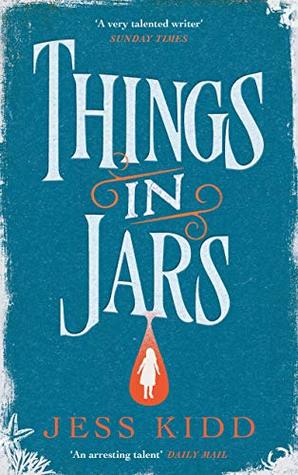
In the autumn of 1863 Bridie Devine, female detective extraordinaire, is tasked with finding the six-year-old daughter of a baronet. Problem is, this missing girl is no ordinary child, and collectors of medical curiosities and circus masters alike are interested in acquiring her.
In its early chapters this delightful Victorian pastiche reminded me of a cross between Sarah Waters’s Fingersmith and Neil Gaiman’s The Graveyard Book, and that comparison played out pretty well in the remainder. Kidd paints a convincingly gritty picture of Dickensian London, focusing on an underworld of criminals and circus freaks: when Bridie first arrived in London from Dublin, she worked as an assistant to a resurrectionist; her maid is a 7-foot-tall bearded lady; and her would-be love interest, if only death didn’t separate them, is the ghost of a heavily tattooed boxer.
Medicine (surgery – before and after anesthesia) and mythology (mermaids and selkies) are intriguing subplots woven through, such that this is likely to appeal to fans of The Way of All Flesh and The Mermaid and Mrs Hancock. Kidd’s prose is spry and amusing, particularly in her compact descriptions of people (but also in her more expansive musings on the dirty, bustling city): “a joyless string of a woman, thin and pristine with a halibut pout,” “In Dr Prudhoe’s countenance, refinement meets rogue,” and “People are no more than punctuation from above.”
I’ll definitely go back and read Kidd’s two previous novels, Himself and The Hoarder. I didn’t even realize she was Irish, so I’m grateful to Cathy for making me aware of that in her preview of upcoming Irish fiction. [Trigger warnings: violence against women and animals.] (Out from Canongate on April 4th.)
Away by Jane Urquhart (1993)
I was enraptured from the first line: “The women of this family leaned towards extremes” – starting with Mary, who falls in love with a sailor who washes up on the Irish coast in the 1840s amid the cabbages, silver teapots and whiskey barrels of a shipwreck and dies in her arms. Due to her continued communion with the dead man, people speak of her being “away with the fairies,” even after she marries the local schoolteacher, Brian O’Malley.
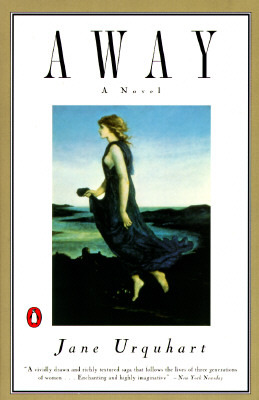 With their young son, Liam, they join the first wave of emigration to Canada during the Potato Famine, funded by their landlords, the Sedgewick brothers of Puffin Court (amateur naturalist Osbert and poet Granville). No sooner have the O’Malleys settled and had their second child, Eileen, than Mary disappears. As she grows, Eileen takes after her mother, mystically attuned to portents and prone to flightiness, while Liam is a happily rooted Great Lakes farmer. Like Mary, Eileen has her own forbidden romance, with a political revolutionary who dances like a dream.
I’ve been underwhelmed by other Urquhart novels, Sanctuary Line and The Whirlpool, but here she gets it just right, wrapping her unfailingly gorgeous language around an absorbing plot – which is what I felt was lacking in the others. The Ireland and Canada settings are equally strong, and the spirit of Ireland – the people, the stories, the folk music – is kept alive abroad. I recommend this to readers of historical fiction by Margaret Atwood, A.S. Byatt and Hannah Kent.
Some favorite lines:
Osbert says of Mary: “There’s this light in her, you see, and it must not be put out.”
“When summer was finished the family was visited by a series of overstated seasons. In September, they awakened after night frosts to a woods awash with floating gold leaves and a sky frantic with migrating birds – sometimes so great in number that they covered completely with their shadows the acre of light and air that Brian had managed to create.”
“There are five hundred and forty different kinds of weather out there, and I respect every one of them. White squalls, green fogs, black ice, and the dreaded yellow cyclone, just to mention a few.”
It’s my second time participating in Reading Ireland Month, run each March by Cathy of 746 Books and Niall of Raging Fluff.
Did you manage to read any Irish literature this month?
Four Recent Review Books: Ernaux, Nunez, Rubin & Scharer
Two nonfiction books: a frank account of an abortion; clutter-busting techniques.
Two novels: amusing intellectual fare featuring a big dog or the Parisian Surrealists.
Happening by Annie Ernaux (2000; English translation, 2019)
[Translated from the French by Tanya Leslie]
 “I believe that any experience, whatever its nature, has the inalienable right to be chronicled,” Ernaux writes. In 1963, when she was 23 and living in a student residence in Rouen, she realized she was pregnant. An appointment with a gynecologist set out the facts starkly: “Pregnancy certificate of: Mademoiselle Annie Duchesne. Date of delivery: 8 July, 1964. I saw summer, sunshine. I tore up the certificate.” Abortion was illegal in France at that time. Ernaux tried to take things into her own hands – “plunging a knitting needle into a womb weighed little next to ruining one’s career” – but couldn’t go through with it. Instead she went to the home of a middle-aged nurse she’d heard about…
This very short book (just 60-some pages) is told in a matter-of-fact style – apart from the climactic moment when her pregnancy ends: “It burst forth like a grenade, in a spray of water that splashed the door. I saw a baby doll dangling from my loins at the end of a reddish cord.” It’s such a garish image, almost cartoonish, that I didn’t know whether to laugh or be horrified. Mostly, Ernaux reflects on memory and the reconstruction of events. I haven’t read many nonfiction accounts of abortion/miscarriage and for that reason found this interesting, but it was perhaps too brief and detached for me to be fully engaged.
My rating:
With thanks to Fitzcarraldo Editions for the free copy for review.
The Friend by Sigrid Nunez (2018)
 “Does something bad happen to the dog?” We animal lovers are wary when approaching a book about a pet. Nunez playfully anticipates that question as she has her unnamed female narrator reflect on her duty of care to her dead friend’s dog. The narrator is a writer and academic – like her late friend, a Bellovian womanizer who recently committed suicide, leaving behind two ex-wives, a widow, and Apollo the aging Great Dane. She addresses the friend directly as “you” for almost the whole book, which unfolds – in a similar style to Jenny Offill’s Department of Speculation – via quotations, aphorisms, and stories from literary history as well as mini-incidents from a life.
This won the 2018 National Book Award in the USA and is an unashamedly high-brow work whose intertextuality comes through in direct allusions to many classic works of autofiction (Coetzee, Knausgaard and Lessing) and/or doggy lit (Ackerley; Coetzee again – Disgrace). As Apollo starts to take up more physical, mental and emotional space in the narrator’s life, she waits for a miracle that will allow her to keep him despite an eviction notice and muses on lots of questions: Is all writing autobiographical? Why does animal suffering pain us so much (especially compared to human suffering)? I was impressed: it feels like Nunez has encapsulated everything she’s ever known or thought about, all in just over 200 pages, and alongside a heart-warming little plot. (Animal lovers need not fear.)
My rating:
With thanks to Virago for the free copy for review.
Outer Order, Inner Calm: Declutter and Organize to Make More Room for Happiness by Gretchen Rubin (2019)
 What with all the debate over Marie Kondo’s clutter-reducing tactics, the timing is perfect for this practical guide to culling and organizing all the stuff that piles up around us at home and at work. Unlike the rest of Rubin’s self-help books, this is not a narrative but a set of tips – 150 of them! It’s not so much a book to read straight through as one to keep at your bedside and read a few pages to summon up motivation for the next tidying challenge.
 Famously, Kondo advises one to ask whether an item sparks joy. Rubin’s central questions are more down-to-earth: Do I need it? Do I love it? Do I use it? With no index, the book is a bit difficult to navigate; you just have to flip through until you find what you want. The advice seems in something of a random order and can be slightly repetitive. But since this is really meant as a book of inspiration, I think it will be a useful jumping-off point for anyone trying to get on top of clutter. I plan to work through the closet checklist before I pass the book to my sister – who’s dealing with a basement full of stuff after she and her second husband merged their households. If I could add one page, it would be a flowchart of what to do with unwanted stuff that corresponds to the latest green recommendations.
My rating:
With thanks to Two Roads for the free copy for review.
The Age of Light by Whitney Scharer (2019)
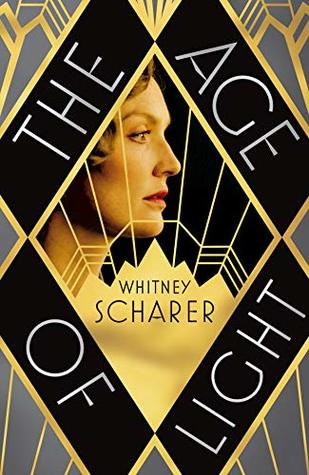 This novel about Lee Miller’s relationship with Man Ray is in the same vein as The Paris Wife, Z, Loving Frank and Frieda: all of these have sought to rescue a historical woman from the shadow of a celebrated, charismatic male and tell her own fascinating life story. Scharer captures the bohemian atmosphere of 1929–30 Paris in elegant but accessible prose. Along with the central pair we meet others from the Dada group plus Jean Cocteau, and get a glimpse of Josephine Baker. The novel is nearly 100 pages too long, I think, such that my interest in the politics of the central relationship – Man becomes too possessive and Lee starts to act out, longing for freedom again – started to wane.
Miller was a photographer as well as a model and journalist, and this is an appropriately visual novel that’s interested in appearances, lighting and what gets preserved for posterity. It’s also fairly sexually explicit for literary fiction, sometimes unnecessarily so, so keep that in mind if it’s likely to bother you. I especially enjoyed the brief flashes of Lee at other points in her life: in London during the Blitz, photographing the aftermath of the war in Germany (there’s a famous image of her in Hitler’s bathtub), and hoping she’s more than just a washed-up alcoholic in the 1960s. It would be a boon to have a prior interest in or some knowledge of the Surrealists.
My rating:
With thanks to Picador for the free copy for review.
Would you be interested in reading one or more of these?
 Bookish Beck = Rebecca Foster. American transplant to England. Freelance proofreader and book reviewer.
 Bookish Beck