Booker Longlist Mini Reviews
Tomorrow the Man Booker Prize shortlist will be announced. I’d already read and reviewed four of the nominees (see my quick impressions here), and in the time since the longlist announcement I’ve managed to read another three and ruled out one more. Two were terrific; another was pretty good; the last I’ll never know because it’s clear to me I won’t read it.
His Bloody Project by Graeme Macrae Burnet
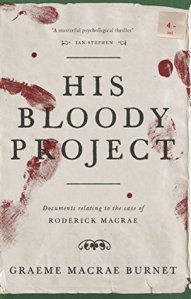 What a terrific, propulsive tale Burnet has woven out of a real-life (I think) nineteenth-century Scottish murder case. The seams between fact and fiction are so subtle you might forget you’re reading a novel, but it’s clear the author has taken great care in assembling his “documents”: witness testimonies, medical reports, a psychologist’s assessment, trial records, and – the heart of the book and the most fascinating section – a memoir written by the murderer himself. As you’re reading it you believe Roddy implicitly and feel deeply for his humiliation (the meeting with the factor and the rejection by Flora are especially agonizing scenes), but as soon as you move on to the more ‘objective’ pieces you question how he depicted things. I went back and read parts of his account two or three times, wondering how his memories squared with the facts of the case. A great one for fans of Alias Grace, though I liked this much better. This is my favorite from the Booker longlist so far.

Eileen by Ottessa Moshfegh
 “I often felt there was something wired weird in my brain, a problem so complicated only a lobotomy could solve it—I’d need a whole new mind or a whole new life.” This isn’t so much a book to enjoy as one to endure. Being in Eileen’s mind is profoundly unsettling. She’s simultaneously fascinated and disgusted by bodies; she longs for her alcoholic father’s approval even as she wonders whether she could get away with killing him. They live a life apart in their rundown home in X-ville, New England, and Eileen can’t wait to get out by whatever means necessary. When Rebecca St. John joins the staff of the boys’ prison where Eileen works, she hopes this alluring woman will be her ticket out of town.
There’s a creepy Hitchcock flavor to parts of the novel (I imagined Eileen played by Patricia Hitchcock as in Strangers on a Train, with Rebecca as Gene Tierney in Laura), and a nice late twist – but Moshfegh sure makes you wait for it. In the meantime you have to put up with the tedium and squalor of Eileen’s daily life, and there’s no escape from her mind. This is one of those rare novels I would have preferred to be in the third person: it would allow the reader to come to his/her own conclusions about Eileen’s psychology, and would have created more suspense because Eileen’s hindsight wouldn’t result in such heavy foreshadowing. I expected suspense but actually found this fairly slow and somewhat short of gripping.

Hot Milk by Deborah Levy
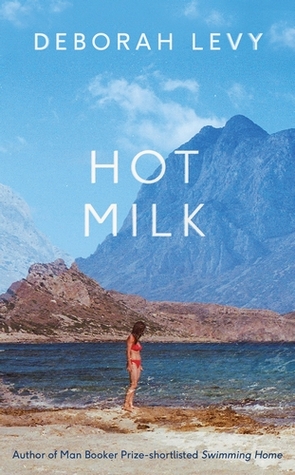 This is a most unusual mother–daughter story, set on the southern coast of Spain. Twenty-five-year-old Sofia Papastergiadis has put off her anthropology PhD to accompany her mother, Rose, on a sort of pilgrimage to Dr. Gómez’s clinic to assess what’s wrong with Rose’s legs. What I loved about this novel is the uncertainty about who each character really is. Is Rose an invalid or a first-class hypochondriac? Is Dr. Gómez a miracle worker or a quack who’s fleeced them out of 25,000 euros? As a narrator, Sofia pretends to objective anthropological observation but is just as confused by her actions as we are: she seems to deliberately court jellyfish stings, is simultaneously jealous and contemptuous of her Greek father’s young second wife, and sleeps with both Juan and Ingrid.
Levy imbues the novel’s relationships with psychological and mythological significance, especially the Medusa story. I don’t think the ending quite fits the tone, but overall this is a quick and worthwhile read. At the same time, it’s such an odd story that it will keep you thinking about the characters. A great entry I’d be happy to see make the shortlist.
[One I won’t be reading: The Schooldays of Jesus by J.M. Coetzee. I opened up the prequel, The Childhood of Jesus, and could only manage the first chapter. I quickly skimmed the rest but found it unutterably dull. It would take me a lot of secondary source reading to try to understand what was going on here allegorically, and it’s not made me look forward to trying more from Coetzee.]
 As for the rest: I have All That Man Is by David Szalay and Serious Sweet by A.L. Kennedy on my Kindle and will probably read them whether or not they’re shortlisted. The same goes for Do Not Say We Have Nothing by Madeleine Thien, for which I’m third in a library hold queue. I’d still like to get hold of The Many by Wyl Menmuir. That leaves just Hystopia by David Means, which I can’t say I have much interest in.
I rarely feel like I have enough of a base of experience to make accurate predictions, but if I had to guess which six books would make it through tomorrow, I would pick:
His Bloody Project by Graeme Macrae Burnet
The Schooldays of Jesus by J.M. Coetzee
Hot Milk by Deborah Levy
The North Water by Ian McGuire
My Name Is Lucy Barton by Elizabeth Strout
Do Not Say We Have Nothing by Madeleine Thien
That would be three men and three women, and a pretty good mix of countries and genres. I’d be happy with that list.
What have you managed to read from the Booker longlist? How do your predictions match up against mine?
Six from My Shelves
My resolution to read just my own books for the summer largely fell by the wayside, but I did manage to get through another handful of print books from the shelves. Below I give brief write-ups of what I’ve finished lately and recall how these books came to be in my collection.
 In Fond Remembrance of Me by Howard Norman: A strange, short book that blends memoir and Inuit legends. In 1977 Norman travelled to Churchill, Manitoba to transcribe an oral storyteller’s folktales. Most of these were about Noah coming into contact with the peoples of the far north and displeasing them by refusing to give over the exotic animals of his ark as food. Helen Tanizaki, a scholar in her late thirties who tried half-heartedly to hide the fact that she was dying of stomach cancer, was also there to translate stories into Japanese. It’s easy to see why she impressed Norman with her mystical stoicism. She was a keen birdwatcher, and declared she wanted to be reincarnated as a seabird. The portrait of Helen is compelling, but the book doesn’t hang together well, especially because the interspersed legends are so repetitive. [From my Amazon wish list last Christmas.]
 An Anthology of Animal Poetry, ed. Kenneth A. Mason: This was assembled in 1940 by a 19-year-old, and it shows. The choices are obvious and old-fashioned; too many of the poems are long and insist on rhyming. However, I discovered some real gems. Three poems in a row are about skylarks – by Gerard Manley Hopkins, Wordsworth and Shelley – and they’re all brilliant, using the bird as an emblem of freedom. Shelley’s “To a Skylark,” in particular, I can’t believe I’ve never encountered before. Its 21 stanzas praise the bird’s pure joy and wonder how careworn humans might emulate it: “We look before and after, / And pine for what is not … Teach me half the gladness / That thy brain must know.” My vintage Pelican copy has ads for chocolate and cigarettes that made me laugh. [Bought from a secondhand bookstore in Tunbridge Wells for 10 pence.]


 The Mistress’s Daughter by A.M. Homes: This grew out of a New Yorker article Homes published about meeting her biological parents in her early 30s. Her mother carried on an affair with her married boss, starting when she was just a teenager – Homes learned that she was the mistress’s daughter. This is the story of how her birth mother tried to get involved in her life, in a really rather stalker-ish way, and the occasional contact she had from her birth father. The blow-by-blow gets a little boring, especially when it’s Homes and her father only communicating via lawyers. Homes doesn’t really make much of a contribution to the literature of adoption, though this is a pleasant enough read. “I am an amalgam. I will always be something glued together, something slightly broken.” [Bought from a library book sale in America for $1.]
 Summertime by Vanessa Lafaye: An enjoyable historical novel based on several true-life elements: a work camp of army veterans based at the Florida Keys, segregation and lynching, and a massive hurricane that hit in 1935. Main characters Missy and Henry are well drawn, but beyond them I thought Lafaye splits the perspective too far: I didn’t need to see through the eyes of lots of the veterans, the shopkeeper, or the policeman investigating the brutal beating of a local white woman. As for this crime, I knew whodunit pretty much right away, so there wasn’t any suspense regarding that plot point. However, Lafaye does do a great job of building tension in the novel’s final third as the storm approaches. The U.S. title (Under a Dark Summer Sky) is much better; “Summertime” evokes strangely rosy images and so is inappropriate. [I won a copy in a Goodreads giveaway.]
 So Many Books, So Little Time: A Year of Passionate Reading by Sara Nelson: Nelson is forthright about what she likes and doesn’t like; she also ruefully reflects on the gap between what she meant to read and what she actually read in 2002. Her reading diary tells a lot about her personal life too: having a non-reading spouse and a novelist sister; memories of her late father; and the struggle to instill a love of reading into her young son. Inevitably a little dated as it engages with ‘It’ books of the time like A Million Little Pieces and Kitchen Confidential, the book has staying power because in each chapter Nelson broadens out from her discussion of one or more books to craft a thematic essay. This was meant to be my bedside book for the second half of the year, but I devoured it in less than seven weeks. It’s full of lines bibliophiles can relate to. [Free from The Book Thing of Baltimore.]
 The Debt to Pleasure by John Lanchester: Tarquin Winot, the snobby Francophile who narrates Lanchester’s debut novel, has a voice reminiscent of Oliver in Julian Barnes’s Talking It Over and Love etc. His opinionated, verbose speech provides much of the book’s wit. “This is not a conventional cookbook,” the first line warns, but a foodie’s tribute to traditional English and French dishes that compose the best seasonal menus. As we travel with Tarquin from Portsmouth to Provence we learn more about this peculiar character through the memories dishes elicit: about his Irish nanny, his sculptor brother’s boarding school years, etc. Lanchester subtly introduces notes of doubt about the narrator’s reliability, until we have to wonder how much his tale resembles Perfume or The Talented Mr. Ripley. Deliciously clever and sinuous. [Bought from a London charity shop for 20 pence.]
I spent much of the summer bogged down in several very good but not particularly page-turning works of nonfiction. I’ll review those in due course.
Up next, though, are a few Booker Prize longlist mini-reviews in advance of the shortlist announcement on Tuesday.
Literary Blind Spots: Hemingway and Fitzgerald
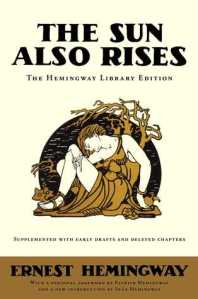 Despite being educated through university level in the United States, I’m better acquainted with British literature than American, in part due to my own predilections. Ernest Hemingway and F. Scott Fitzgerald are two of the American authors I’ve most struggled with. For one thing, their novels’ titles are interchangeable, abstract quotations that I can never keep straight. Which is which? The Sun Also Rises is the bullfighting one, right? And is A Farewell to Arms the other one I’ve read? Fitzgerald is an even worse offender as titles go, with The Great Gatsby the only one that actually refers to its contents.
 For the record, I recognize The Great Gatsby as a masterpiece, and I absolutely loved A Moveable Feast, Hemingway’s memoir of life in Paris. I also enjoy reading about the Hemingways (Paula McLain’s The Paris Wife and Naomi Wood’s Mrs. Hemingway) and the Fitzgeralds (Therese Anne Fowler’s Z: A Novel of Zelda Fitzgerald and R. Clifton Spargo’s Beautiful Fools). But when I’ve tried to go deeper into the authors’ work, it hasn’t been an unmitigated success. The above two Hemingway novels are just okay for me. The Sun Also Rises struck me as having a thin plot, two-dimensional characters and repetitious dialogue.
When I eagerly approached Tender Is the Night last year – having recently read a novel about the real-life couple who inspired Fitzgerald’s portrait of Dick and Nicole Diver, Gerald and Sara Murphy (Villa America by Liza Klaussmann) – I pulled out a lot of great individual lines but had trouble following the basic plot and only really enjoyed the early chapters of Book Two. Here are some of those pearls of prose:
The delight in Nicole’s face—to be a feather again instead of a plummet, to float and not to drag. She was a carnival to watch—at times primly coy, posing, grimacing and gesturing—sometimes the shadow fell and the dignity of old suffering flowed down into her finger tips.
somehow Dick and Nicole had become one and equal, not apposite and complementary; she was Dick too, the drought in the marrow of his bones. He could not watch her disintegrations without participating in them.
Well, you never knew exactly how much space you occupied in people’s lives.
women marry all their husbands’ talents and naturally, afterwards, are not so impressed with them as they may keep up the pretense of being.
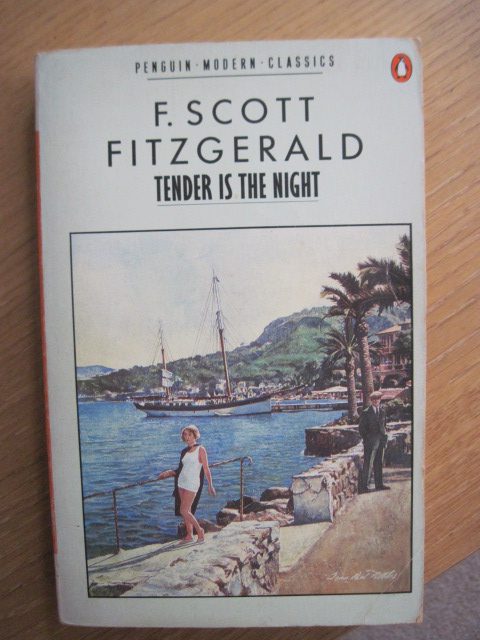
Imagine my surprise when I learned from a note at the end of my Penguin paperback that Fitzgerald made a major revision that rearranged the action into chronological order, thus opening with Book Two. That text, edited by Malcolm Cowley, appeared in 1951 and was printed by Penguin from 1955. However, the version I have – as reprinted from 1982 onwards – goes back to Fitzgerald’s first edition. Would I have had a more favorable reaction to the novel if I’d encountered it in its revised version? Somehow I think so.
Is there a Hemingway or Fitzgerald novel that will change my opinion about these literary lions? Share your favorites.
Mini Reviews Roundup for the Summer
Here’s a quick look at some of the book reviews I’ve had published elsewhere on the web over the past few months, with a taster so you can decide whether to read more by clicking on the link. These are all 4-star reads I can highly recommend.
The Bookbag
Trio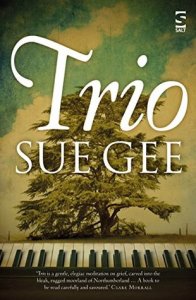 by Sue Gee: Sue Gee’s tenth novel is a sensitive portrait of life’s transience and the things that give us purpose. In the late 1930s, a widowed history teacher in Northumberland finds a new lease on life when he falls for one of the members of a local trio of musicians. My favorite passages of the book are descriptive ones, often comprised of short, evocative phrases; I also loved the banter between the musicians. The novel has a reasonably simple plot. We delve into the past to discover each main character’s backstory and some unexpected romantic entanglements, but in the 1930s storyline there aren’t a lot of subplots to distract from the main action. I was reminded in places of Downton Abbey: the grand hall and its village surroundings, the build-up to war, the characters you come to love and cheer for. [Thanks to Elle for piquing my interest in this one.]
How to Set a Fire and Why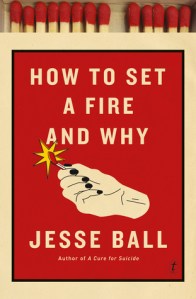 by Jesse Ball: Lucia Stanton is a cynical 14-year-old misfit who lives with her elderly aunt in a garage. At first she only supports the idea of arson, but events draw her into getting personally involved. This is one of those fairly rare novels that stand out immediately for the first-person voice. Lucia reminded me of Holden Caulfield or of Mim Malone from David Arnold’s Mosquitoland. She’s like a cynical philosopher. For as heartbreaking as her family history is, she was always either making me laugh or impressing me with her wisdom. Although this is his sixth novel, I hadn’t heard much about Jesse Ball prior to picking it up. His skill at creating the interior world of a troubled 14-year-old girl leads me to believe that the rest of his work would be well worth a look.
BookBrowse
[Non-subscribers can read excerpts of my reviews]
Imagine Me Gone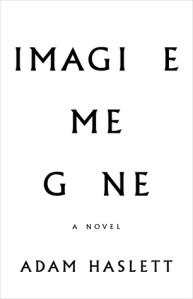 by Adam Haslett: Mental illness plagues two generations of an Anglo-American family in Haslett’s moving second novel. Narration duties are split between the five members: father John, mother Margaret, and siblings Alec, Michael, and Celia. By giving each main character a first-person voice, Haslett offers readers a full picture of how mental illness takes a toll not only on sufferers but also on those who love and care for them. John’s descriptions of what mental illness is like are among the most striking passages in the book. Michael’s sections are wonderfully humorous, a nice counterbalance to some of the aching sadness. The multiple points of view fit together beautifully in this four-decade family symphony, although I sometimes felt that Celia was one main character too many – her story doesn’t contribute very much to the whole. A powerful read for fans of family stories.
Dinner with Edward by Isabel Vincent: In this heartwarming memoir, a journalist tells how friendship with an elderly gentleman rekindled her appetite for life. New to NYC and with a faltering marriage, Isabel received an unusual request from her friend Valerie: Would she look in on Valerie’s father, Edward? In his nineties, he’d recently been widowed and Valerie was worried about him losing the will to live. If he could have a guest to cook for and entertain, it might give him a new sense of purpose. As it turned out, it was a transformative friendship for the author as much as for Edward. Each chapter opens with a mouth-watering menu. Although Edward is now deceased, when we see him for the final time, he is still alive and well. This is a nice way to leave things – rather than with a funeral, which might have altered the overall tone.
Nudge
Ruby by Cynthia Bond: When Ruby Bell returns to Liberty Township, her east Texas hometown, in 1964, her fellow black folk turn her into a victim of derision. The churchgoing men of the town get the idea that they can use her body however they want. In part this is because her mental health is deteriorating, and the more she struggles to stifle traumatic memories the stranger she acts. The only one who continues to see Ruby as a human being rather than a demon or a subhuman object is Ephram Jennings. I found their relationship, reminiscent of that between Sethe and Paul D. in Toni Morrison’s Beloved, very touching. The novel moves fluidly between the past and present to give all of the central characters’ backstories – most of them unremittingly tragic. As difficult as some of the later scenes are to take, you feel entranced into continuing because of the touches of magic realism. Out of the darkness Bond weaves enchanting language and scenes. I highly recommend this to fans of Ayana Mathis’s The Twelve Tribes of Hattie and Angela Flournoy’s The Turner House.
The Hatred of Poetry by Ben Lerner: This fluid essay asks how poetry navigates between the personal and the universal. Socrates famously wanted to ban poets, fearing poetry might be turned to revolutionary purposes. Lerner wonders whether poetry still has a political role. Whitman’s goal was to create a new American verse style. But was it realistic for him to think that he could speak for everyone? The same might be asked about the poets who read at presidential inaugurations. Can different races and genders speak to and for each other, or is it only white males who are assumed to be able to pronounce on humanity’s behalf? Those are some of the questions addressed in this conversational yet unabashedly highbrow essay. Lerner’s points of reference range from Keats and Dickinson to Claudia Rankine, with ample quotations and astute commentary.
Pittsburgh Post-Gazette
Before the Fall by Noah Hawley: The key is in the title: perhaps playing on the theological implications of “the Fall” and Scott and JJ’s “salvation” from a plane crash, the novel toggles between build-up and aftermath. Disasters bring disparate people together to make superb fictional setups. Crucially, Hawley doesn’t make the mistake of conflating characters under easy labels like “victims” and “survivors.” Instead, he renders them all individuals with complete backstories. Some of their potted histories are relevant, while others throw up red herrings in the ensuing enquiry. Readers’ task is to weigh up what is happenstance and what is destiny. This lies somewhere on the continuum between crime and literary fiction; if it’s not quite Jonathan Franzen, nor is it Robert Ludlum. It’s a pretty much ideal summer vacation read – though you might think twice about taking it on a plane.
Books in Brief: Five I Enjoyed Recently
Despite my largely successful resolution to focus on my own books for the summer, I’ve also gotten through plenty of e-books from NetGalley and Edelweiss, too. I just find it easier to fit time with the Kindle into my day, whether it’s 20 minutes over lunch (food-themed nonfiction works particularly well for such situations) or 30 minutes on the cross trainer. Here’s a sample of the e-books I’ve enjoyed this summer: four nonfiction and one fiction.
Pancakes in Paris: Living the American Dream in France
By Craig Carlson
 A good-natured memoir about the travails of opening the first American-style diner in Paris. Carlson charts his somewhat chaotic growing-up years in Connecticut, the college study abroad experience that kindled his love for France, his years trying to make it as a screenwriter and director in Hollywood, his long-held dream of opening Breakfast in America, and finding a French sweetheart of his own. Much of the book is devoted to a blow-by-blow of the bureaucratic nightmare of opening a restaurant, starting with getting investors on board and continuing through France’s ridiculously restrictive labor laws. (The impression I came away with was: France – great place to be an employee or rent property; terrible place to start a business.) Next time I’m in Paris, I will be looking to get myself a stack of his signature blueberry and white chocolate chip pancakes. Releases September 6th.
When in French: Love in a Second Language
By Lauren Collins
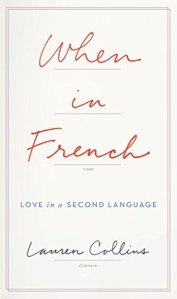 Collins, a journalist from North Carolina, married a Frenchman named Olivier she met while working in London. They then moved to Geneva, a mutually unfamiliar place but one where French reigned. For the first time, she was forced to learn a new language to survive. I love how she blends her own story with the philosophy, history and science behind language use. As she learned how to do things she never expected to have to in French – deal with her in-laws and give birth, for instance – she developed a new appreciation for the marvel that is bilingualism and pondered whether she was the same person in a different language. My favorite section recounts a holiday to Corsica that brought her family and Olivier’s into close quarters and cast her in the unforeseen role of translator. There’s a surprising amount of linguistic detail here, but Collins incorporates it well. Releases September 13th.
A Body, Undone: Living On After Great Pain
By Christina Crosby
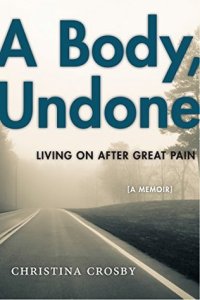 Crosby teaches English and gender studies at Wesleyan University. Her inclusion in this “Sexual Cultures” series has to do with her lesbian feminist ideology but also the new understanding of her body an accident forced upon her at age 50. While she was cycling, a stick stuck in her spokes and she fell over onto concrete, breaking vertebrae in her neck that damaged her spinal cord. In the midst of a full and physical life, she became a quadriplegic. The great irony was that in this she joined her brother Jeff, whose MS had long since reduced him to a wheelchair. Here, in a memoir written 11 years after the accident, she reflects on chronic pain and new limitations – even including bowel habits – with blunt honesty as well as literary allusions. Along the way she remembers physical pleasures now denied to her. Nonetheless, she never comes across as sorry for herself. I found this to be highly absorbing.
The Reader on the 6.27
By Jean-Paul Didierlaurent
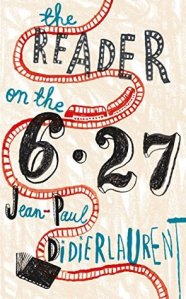 Guylain Vignolles works in a paper pulping plant. Rather than an enemy of books, however, he’s really a champion of the written word and its power to improve people’s lives. Every day when he descends into the belly of “The Thing” to clean it, he rescues the stray pages that escaped destruction and reads them aloud the following morning on his twenty-minute train commute, or to the residents of an old-folks home, no matter what their subject. He also helps his disabled former colleague Giuseppe stockpile all the books made from the recycled paper created on the fateful day the machine shredded his legs. There’s a charming Amélie vibe to this short novel, especially in the later chapters when Guylain sets off on a romantic quest to find the lavatory attendant whose wry diary he finds on a memory stick on the train. Most of the subplots could do with some expanding, but it’s a pleasant and super-quick read.
Stir: My Broken Brain and the Meals that Brought Me Home
By Jessica Fechtor
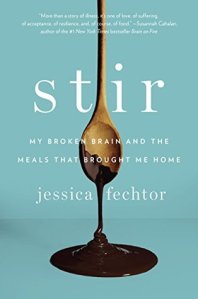 For me this is right up there with Molly Wizenberg and Ruth Reichl in how the author merges food writing with a frank recounting of personal experiences with crisis and heartache. At age 28 Fechtor, then a graduate student in history and Yiddish, collapsed on a treadmill with a brain bleed. Surgery to clip the aneurysm left her blind in one eye. During her long recovery process she started a food blog. At the end of each chapter she shares recipes that alternate between simple, favorite dishes and more involved ones. It’s that unpretentiousness that really endears her to me. She doesn’t think she was particularly brave in getting through an unwanted illness; nor does she think the perfect almond macaroon or cherry clafoutis is beyond anyone’s capability. Instead, she gives a glimpse into an ordinary life turned upside down and the foods that helped her regain a zest for life.
Have you read any of these? Which one takes your fancy?
To the Bright Edge of the World by Eowyn Ivey
Eowyn Ivey’s intricate second novel weaves together diaries, letters, photographs, and various other documents and artifacts to tell the gently supernatural story of an exploratory mission along Alaska’s Wolverine River in 1885 and its effects through to the present day. If you have read Ivey’s 2012 debut, The Snow Child, you’ll remark once again on her skill in bringing the bleak beauty of Alaska to life on the page and blending magic realism and folktales with a nonetheless realistic view of history.
In March 1885 Lieutenant Colonel Allen Forrester sets out with a small team – including brash Sergeant Bradley Tillman, melancholy photographer Lieutenant Andrew Pruitt, native guides, and Samuelson, a trapper who serves as a go-between – to navigate a previously unmapped portion of Alaska. Back at Vancouver Barracks he’s left his wife of four months, Sophie. Bold and curious, she intended to travel into Alaska with Allen until she learned she was pregnant. Now she passes the months of her confinement – and raises eyebrows among the military wives – by pursuing her amateur hobbies of birdwatching and photography.
 Through alternating passages from journals by Allen and Sophie, Ivey contrasts the big adventures of surveying new territory with the smaller adventures of domestic life. Along their perilous journey Allen and his men encounter many legends and incidents they cannot explain: shape-shifters, like the women who morph into flocks of geese or the shaman who takes the form of a half-lame raven; a baby born out of a tree trunk; and a prehistoric creature that guards a lake. As Allen writes in a letter to Sophie towards the end of his journey:
I can find no means to account for what we have witnessed, except to say that I am no longer certain of the boundaries between man & beast, of the living and & dead. It has been a strange experience indeed. All that I have taken for granted, of what is real & true, has been called into question.
A framing story sets the historical narrative in the context of the present day: Walter Forrester has sent his great-uncle Allen’s letters and journal to a small Alaska museum for safekeeping. Initially the young curator, Joshua Sloan, is annoyed at the unwanted donation and the extra work it creates for him, but gradually – right alongside the novel’s readers – he starts to be sucked into the story the documents reveal. Through their correspondence, Josh and Walt develop a touching friendship despite their differences.
Ivey fits the pieces of her epistolary together in a sophisticated manner and makes you care about each of the characters. Sophie and Pruitt, especially, have traumatic backstories that help you understand their behavior. Sophie reminded me most of Meridian Wallace in Elizabeth J. Church’s The Atomic Weight of Love – both are self-taught scientists with a deep love for birds and a determination to live interesting lives even if others disapprove. The novel also brings to mind Maggie O’Farrell’s This Must Be the Place in that it skips back and forth in time and intersperses a central narrative with other documents, including an auction catalogue of relevant objects.
I found Sophie’s voice instantly more engaging than Allen’s shorthand-like style, and it took me a while – maybe 60–80 pages – to warm up to the storyline and characters. I would have appreciated an Author’s Note at the end of the book explaining what, if anything, was based on a true story and which documents are authentic. (As it is, I assume that all the characters are fictional but the explorers’ journey is based on the historical record.) Nonetheless, I can highly recommend this rollicking adventure tale to fans of historical fiction and magic realism.
With thanks to Katie Brown at Tinder Press for the free review copy.
My rating:
Her Father’s Daughter (Peirene)
Originally issued in 2005, Her Father’s Daughter was French author Marie Sizun’s first of seven novels, published when she was 65. It’s an autobiographical reflection on a painful experience from her childhood: in 1945, when she was four and a half, the father she had never met returned from the war and reentered the family, only to leave again two years later. That is the essential storyline of this spare novella, told from the perspective of a four-year-old girl whose name is France but who is usually just referred to as “the child.”
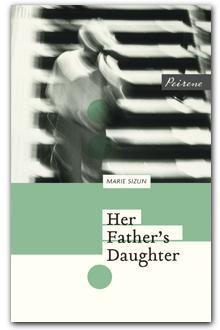 “Of the outside world, the child still knows pretty much nothing.” Her universe is limited to her Paris neighborhood and apartment; her mother, Liliane (Li), is the star around which she orbits. Li gives her daughter free rein, even leaving her alone in the apartment while she goes shopping. When the child learns that her father, a prisoner of war, is soon to return from Germany, she is anxious and resentful. The “secret, intimate world” she has with her mother looks fragile, and she is jealous of anyone who tries to encroach. Meanwhile her father and grandmother both think France has been spoiled and seek to instill a new sense of discipline.
There’s a secret at the heart of the book, something big that the mother and grandmother are covering up. It involves a trip to Normandy, yet whenever the girl tries to speak of the event later on, they deny it and tell her she’s only dreaming. My favorite passages of the book recount her helpless anger as she tries to expose their lies: “Fury from the child, who ploughs on, incredulous. Protests. Persists. In vain.” All she can do in retaliation for this deception and the increasing tension between her parents is pour her mother’s perfumes down the sink.
Sizun’s style is characterized by short, simple phrases. The child is not the narrator, yet the prose imitates the straightforward language that a child might use: “A very strange thing for the child, having a father. A father who’s there. At home. All the time. Morning, noon and night.” The compact chapters chronicle the family’s descent into silence, ignoring each other and walking away – which eventually the father does for good.
Peirene issues books in trios. This one is part of the “Fairy Tale: End of Innocence” series, along with The Man I Became by Peter Verhelst. It’s interesting to think about the book in that context, with the Eden of the mother and daughter being shattered by the entry of the father. “Fathers are found in fairy tales, and they’re always slightly unreal and not very kind,” the child thinks. Unfortunately, I found this novella to be slightly monotonous, with a particularly flat ending. I’ll leave you with a few words from the author about what she was trying to do with the book:
I needed to tell this story. To speak about that wound. … As my writing progressed and the book took shape, I felt this therapy wasn’t only for my personal use but spoke to everyone who, like me, may have been immersed in misunderstandings, in emotional distortions with loved ones, for example being forced to choose between a father and a mother.
It’s not exactly a cheery Father’s Day read, but an intriguing little book all the same.
Translated from the French by Adriana Hunter. With thanks to Peirene Press for the free copy.
My rating: 
Note: I’m traveling until the 24th so won’t be responding to comments right away, but will be sure to catch up soon after I’m back. I always welcome your thoughts!
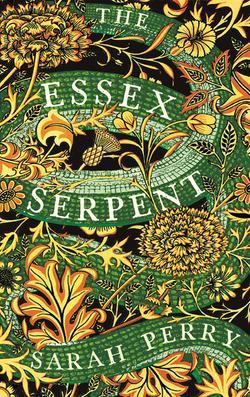
The Essex Serpent by Sarah Perry
This exquisite work of historical fiction explores the gaps – narrower than one might think – between science and superstition and between friendship and romantic love. The Essex Serpent was a real-life legend from the latter half of the seventeenth century, but Perry’s second novel has fear of the sea creature re-infecting Aldwinter, her invented Essex village, in the 1890s. Mysterious deaths and disappearances are automatically attributed to the Serpent who dwells in the depths of the Blackwater. This atmosphere of paranoia triggers some schoolgirls to erupt in frenzied delusions as in The Crucible. It is unclear whether the Church should tolerate a source of mystery or dismiss it all as nonsense – after all, there’s a winged serpent carved onto one of the pews at the parish church.
 In a domestic counterpart to all these supernatural goings-on, we gain entry into two middle-class households. Cora Seaborne’s abusive husband, Michael, has recently died of throat cancer, leaving her to raise their odd (autistic, I wondered?) eleven-year-old son Francis on her own. She has an amateur interest in fossils to rival Mary Anning’s, so when she hears of a cache near Colchester she leaves London for Essex, bringing along Frankie and her companion, Martha. Mutual friends put her in touch with Will Ransome, the vicar of Aldwinter, sure that he and his family – consumptive wife Stella and children Joanna, James and John – will be able to show her around the coast.
Despite an inauspicious first meeting, which sees Cora and Will, still unknown to each other, hauling a drowning sheep out of a lake, theirs soon becomes a close, easy friendship. Cora feels she can speak her mind about the faith she lost and the new marvels she finds in nature:
I had faith, the sort I think you might be born with, but I’ve seen what it does and I traded it in. It’s a sort of blindness, or a choice to be mad – to turn your back on everything new and wonderful – not to see that there’s no fewer miracles in the microscope than in the gospels!
She holds her own in cerebral debates with Will as he deplores his parishioners’ fantasies about the Serpent. Is there really such a big difference between his faith – “all strangeness and mystery – all blood, and brimstone,” Cora teases – and the Serpent legend? In seeming contradiction to his career path, Will is more suspicious than many of the other characters of things he doesn’t understand and can’t explain away, like hypnosis and a Fata Morgana.
The novel’s nuanced treatment of faith and doubt is enhanced by references to Victorian science, including fossil hunting and early medical procedures. Dr. Luke Garrett, Michael’s surgeon, is one of Cora’s best friends back in London; she calls him “The Imp.” In one of the most striking passages of the entire book, he performs rudimentary heart surgery on the young victim of a stab wound. Perry fills in the novel’s background with a plethora of apt Victorian themes, including housing reform and London crime. For a book of 440 pages, it has a large cast and a fairly epic scope. Although there are places where subplots and minor characters might have been expanded upon, Perry wisely refrains from stuffing the novel with evidence of her research. Indeed, it’s a restrained book overall, yet breaks out into effusiveness in just the right places, as in Stella’s mystical adoration of the color blue.
Descriptive passages and the letters passing between the characters give a clear sense of the months passing, yet there is also something timelessly English about the narrative – Dickensian in places (Our Mutual Friend) and Hardyesque in others (Far from the Madding Crowd). I especially loved this picture of the June countryside:
Essex has her bride’s gown on: there’s cow parsley frothing by the road and daisies on the common, and the hawthorn’s dressed in white; wheat and barley fatten in the fields, and bindweed decks the hedges.
Cross this cozy pastoral vision with the Gothic nature of the Serpent craze and you get quite a unique atmosphere. The vague, unexplained sense of menace didn’t work for me at all in Perry’s previous novel, After Me Comes the Flood, but here it’s just right.
It was no doubt true in the late Victorian period that “men and women can’t be friends because the sex part always gets in the way” (as famously declared in When Harry Met Sally). No one is sure what to make of a sexually available, self-assured female like Cora. The different kinds of Greek love, from philia to eros, keep shading into each other here. Like the water that forms the book’s metaphorical substrate, the relationships ebb and flow. Yet there’s no denigrating any connection as just friendship; in fact, friendship is enough to rescue one character from suicide. Like Hanya Yanagihara’s A Little Life, the novel asks whether love is ever enough to save us – and gives a considerably more optimistic answer.

My proof copy didn’t have quite such a gorgeous cover but did come intriguingly wrapped in snakeskin ribbon…
The fact that I have an MA in Victorian literature means I’m drawn to Victorian-set novels but also highly critical about their authenticity. While reading this, though, I thoroughly believed that I was in 1890. Moreover, Perry adroitly illuminates the situation of the independent “New Woman” and the quandary of science versus religion (which were the joint subjects of my dissertation: women’s faith and doubt narratives in Victorian fiction).
I’m delighted, especially having seen Perry speak at Bloxham Festival in February (see my write-up for more on her background and the inspirations behind this novel), to have liked The Essex Serpent three times as much as her debut. It has an elegant, evocative writing style reminiscent of A.S. Byatt and Penelope Fitzgerald. Something holds me back from the full 5 stars – too diffuse? Too much staying on the surface of things? Not quite intimate enough, especially about Cora’s inner life? – but I still declare myself mightily impressed. The Essex Serpent counts as one of my favorite novels of 2016 so far. You can see why Serpent’s Tail (how perfect is her publisher’s name?!) rushed this one into publication a few weeks early. Expect to see it on the Booker Prize shortlist and any other award list you care to mention.
With thanks to Anna-Marie Fitzgerald at Serpent’s Tail for the free review copy.
My rating: 
Four Books Abandoned Recently (+ One I SHOULD Have)
I’d like to think I’ve gotten better at choosing books that are sure to suit me, but sometimes it’s still a matter of ditching the duds when it becomes clear they’re not working. Here’s the small (digital) pile of abandoned novels I’ve amassed over the last couple of months. I’d be interested to hear if you’ve read any of them and thought they were worth persisting with.
Mrs. Houdini by Victoria Kelly
 Perfectly serviceable historical fiction, but with no spark. I felt like I was just being given a lot of information about the two major time periods (1894 and 1929). Alas, scenes set at a séance, a circus, and an insane asylum are not nearly as exciting as they promise to be. And, as is often the case with these famous wives books – a genre I generally love but can also find oddly disappointing from time to time – the protagonist tries but fails to explain why she finds her husband so fascinating. “His eyes danced. There was a madness to his passion, but he was not insane. There was something real and familiar about him. … Harry was promising her a life of possibility, of magic, and it was unlike anything she had ever imagined for herself.” [Read the first 40%.]
My rating:
 Terrible Virtue by Ellen Feldman
Another case of expectations too high and payoff too little. Fictionalized biographies can be among my favorite historical fiction, but the key is that they have to do something that a biography doesn’t do. They have to shape a story that goes beyond the chronology of what happened to whom and when. This novel about contraception activist Margaret Sanger failed to tell me anything I didn’t already know from The Birth of the Pill, a more engaging book all round. If anything this left me more confused about why Sanger consented to marriage and motherhood. These cringe-worthy lines try to explain it: “His [Bill’s] sex upended the world. His love filled the hole my childhood had carved out of me. Maybe that was the reason I married him.” [Read the first 26%.]
My rating: 
Vexation Lullaby by Justin Tussing
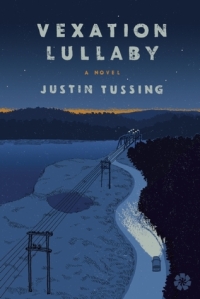 This started off very promising, with Pete Silver, a doctor in Rochester, New York, being summoned by ageing rock star Jimmy Cross for a consult. Jimmy knows Pete’s mother from way back and wants to know if he’ll accompany him on the airplane during this comeback tour as his personal physician. However, after that there was a lot of downtime filling in Pete’s backstory and introducing a first-person voice that didn’t feel relevant. This is Arthur Pennyman, a fan who’s seen every Jimmy Cross show and writes them up on his website. I didn’t care for Arthur’s sections and thought they pulled attention away from Pete’s story. That’s a shame, as the plot reminded me of Jennifer Egan’s A Visit from the Goon Squad. [Read the first nearly 100 pages.]
My rating:
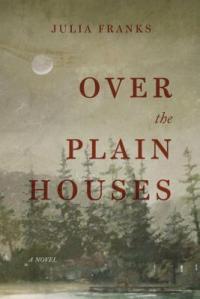 Over the Plain Houses by Julia Franks
Entirely decent historical fiction with a flavor of Ron Rash or Virginia Reeves (Work Like Any Other), but it felt so slow and aimless. Irenie Lambey is married to a harsh fundamentalist preacher named Brodis. She longs for their son to get a good education and hopes that the appearance of a USDA agent may be the chance, but Brodis cares about the boy’s soul rather than his mind. On night-time walks, Irenie stores up artifacts and memories in a cave – desperately trying to have a life larger than what her husband controls. It could well just be my lack of patience, but the believable dialect and solid characters weren’t quite enough to keep me reading. [Read the first 16%.]
My rating:
And now for the one I should have stopped reading at about the 25% point. I have an expanded version of this review on Goodreads; click on the title to read more.
The Mandibles: A Family, 2029–2047 by Lionel Shriver
 Shriver does a good line in biting social commentary. Here she aims at Atwood-style near-future speculative fiction and takes as her topic the world economy. I had big problems with this one. Worst is the sheer information overload: tons of economic detail crammed into frequent, wearisome conversations. Instead of making America’s total financial collapse a vague backdrop for her novel, she takes readers through it event by agonizing event. This means the first third or more of the novel feels like prologue, setting the scene. When she finally gets around to the crux of the matter – the entire extended Mandible family descending on Florence’s small New York City house – it feels like too little plot, too late. Everything Shriver imagines for the near future, except perhaps the annoying slang (e.g. “boomerpoop”), is more or less believable. But boy is it tedious in the telling.
My rating: 
Now in November by Josephine Johnson
I’d never heard of this 1935 Pulitzer Prize winner before I saw a large display of titles from publisher Head of Zeus’s new imprint, Apollo, at Foyles bookshop in London the night of the Diana Athill event. Apollo, which launched with eight titles in April, aims to bring lesser-known classics out of obscurity: by making “great forgotten works of fiction available to a new generation of readers,” it intends to “challenge the established canon and surprise readers.” I’ll be reviewing Howard Spring’s My Son, My Son for Shiny New Books soon, and I’m tempted by the Eudora Welty and Christina Stead titles. Rounding out the list are two novels set in Eastern Europe, a Sardinian novel in translation, and an underrated Western.
 Missouri-born Johnson was just 24 years old when she published Now in November. The novel is narrated by the middle Haldmarne daughter, Marget, looking back at a grueling decade on the family farm. She recognizes how unsuited her father, Arnold, was to farming: “He hadn’t the resignation that a farmer has to have – that resignation which knows how little use to hope or hate.” The remaining members of this female-dominated household are mother Willa, older sister Kerrin and younger sister Merle. Half-feral Kerrin is a creature apart. She’s always doing something unpredictable, like demonstrating knife-throwing to disastrous effect or taking over as the local schoolteacher, a job she’s not at all right for.
The arrival of Grant Koven, a neighbor in his thirties hired to help Arnold with hard labor, seems like the only thing that might break the agricultural cycle of futile hope and disappointment. Marget quickly falls in love with him, but it takes her a while to realize that her sisters are smitten too. They all keep hoping their fortunes will change:
‘This year will have to be different,’ I thought. ‘We’ve scrabbled and prayed too long for it to end as the others have.’ The debt was still like a bottomless swamp unfilled, where we had gone year after year, throwing in hours of heat and the wrenching on stony land, only to see them swallowed up and then to creep back and begin again.
Yet as drought settles in, things only get worse. The fear of losing everything becomes a collective obsession; a sense of insecurity pervades the community. The Ramseys, black tenant farmers with nine children, are evicted. Milk producers go on strike and have to give the stuff away before it sours. Nature is indifferent and neither is there a benevolent God at work: when the Haldmarnes go to church, they are refused communion as non-members.
Marget skips around in time to pinpoint the central moments of their struggle, her often fragmentary thoughts joined by ellipses – a style that seemed to me ahead of its time:
if anything could fortify me against whatever was to come […] it would have to be the small and eternal things – the whip-poor-wills’ long liquid howling near the cave… the shape of young mules against the ridge, moving lighter than bucks across the pasture… things like the chorus of cicadas, and the ponds stained red in evenings.
Michael Schmidt, the critic who selected the first eight Apollo books, likens Now in November to the work of two very different female writers: Marilynne Robinson and Emily Brontë. What I think he is emphasizing with those comparisons is the sense of isolation and the feeling that struggle is writ large on the landscape. The Haldmarne sisters certainly wander the nearby hills like the Brontë sisters did the Yorkshire moors.

The cover image, reproduced in full on the endpapers, is Jackson Pollock’s “Man with Hand Plow,” c. 1933.
As points of reference I would also add Jane Smiley’s A Thousand Acres and Joan Chase’s During the Reign of the Queen of Persia (resurrected by NYRB Classics in 2014), which also give timeless weight to the female experience of Midwest farming. Like the Smiley, Now in November stars a trio of sisters and makes conscious allusions to King Lear. Kerrin reads the play and thinks of their father as Lear, while Marget quotes it as a prophecy that the worst is yet to come: “I remembered the awful words in Lear: ‘The worst is not so long as we can say “This is the worst.”’ Already this year, I’d cried, This is enough! uncounted times, and the end had never come.”
Johnson lived to age 80 and published another 11 books, but nothing ever lived up to the success of her first. This is an atmospheric and strangely haunting novel. The plot is simple enough, but the writing elevates it into something special. The plaintive tone, the folksy metaphors, and the philosophical earnestness all kept me eagerly traveling along with Marget to see where this tragic story might lead. Apollo has done the literary world a great favor in bringing this lost classic to light.
With thanks to Blake Brooks at Head of Zeus for the free copy.
My rating: 
 Bookish Beck = Rebecca Foster. American transplant to England. Freelance proofreader and book reviewer.
 Bookish Beck