Three Novellas in Translation
The Institute by Vincent Bijlo
[London’s Holland Park Press specializes in making classic and contemporary Dutch literature available in English translation.]
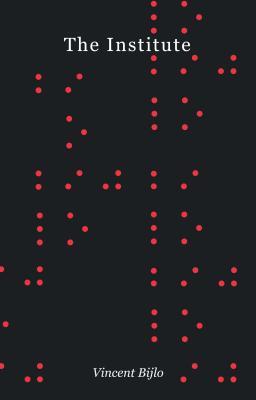 Otto Iking is a resident at the Institute, a boarding school for the blind. He characterizes his fellow students firstly according to their smell – “foul soap,” “piss” or “grated Swiss cheese” – only later adding in details about their speech and habits. It’s a zany sort of place, powered by pranks and strange decisions. Some stand-out scenes include hiding Harry’s glass eyes and a visit from the president of Surinam, a former Dutch colony. The slapstick humor works well (“When I walked into a lamppost, I said sorry. When I struck my head against a traffic sign, I said sorry. No one has ever apologised to street furniture as often as I did”), but some humor translates less well, seeming cruel or even offensive (“Tony was fat and deaf and black-skinned”).
Alongside the silliness is the matter of Otto’s coming of age. He has the first inklings of what sex is about and falls for Sonja, and also undergoes training to prepare him for the real world, things like reading and writing Braille, preparing and eating tricky meals (soup’s a killer). One day he hopes to go to a mainstream school and broadcast radio programs. The institutional setting and quirky cast reminded me of The Secret Diary of Hendrik Groen, 83¼ Years Old and Linda Grant’s The Dark Circle.
The Institute, originally from 1998, was published on April 27th. Translated from the Dutch by Susan Ridder. My thanks to Bernadette Jansen op de Haar for sending a free copy for review.
This is the first of three Otto Iking novels. Vincent Bijlo, a Dutch stand-up comedian, was born blind.
My rating: 
Dance by the Canal by Kerstin Hensel
[Peirene Press issues its translated European novellas in trios. This is the final installment in the “East and West: Looking Both Ways” series; I’ve also reviewed the first two, The Last Summer by Ricarda Huch and The Orange Grove by Larry Tremblay.]
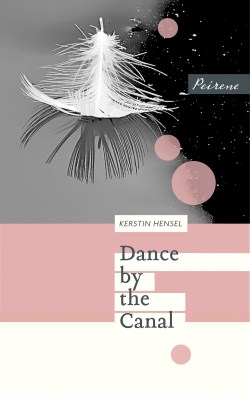 I don’t think I’ve ever read a novel narrated by a homeless person before. Gabriela von Haßlau has a noble name and a solid upper-middle-class background – her father was a surgeon and chief medical officer specializing in varicose veins; her mother was trained as a radiographer before becoming a housewife and society hostess – but her life took a turn for the worse at some point and she now lives in an encampment under a canal bridge in the town of Leibnitz (a fictional stand-in for Leipzig).
It’s July 1994 and she decides to write her life story on whatever scraps of paper she can get her hands on. She remembers being forced to play the violin as a child even though she was largely unmusical, enduring mockery at school for being one of the intelligentsia, playing hooky with her best friend Katka, and failing at a mechanical engineering apprenticeship. The narrative toggles between Gabriela’s memories and her present situation: getting blankets and food from a shelter and trying to avoid being sent to the mental hospital.
My unfamiliarity with German history, especially that relating to East Germany and reunification, means I probably missed some nuances of the plot; I found the ending quite sudden. What was most worthwhile about the book for me was experiencing homelessness with Gabriela and tracing some of the unfortunate events that led her to this situation. It’s also interesting to see how she shapes her life story in scenes and streams of consciousness.
Dance by the Canal, originally from 1994, was published on July 3rd. Translated from the German by Jen Calleja. With thanks to Peirene Press for the free copy for review.
My rating: 
Hair Everywhere by Tea Tulić
[London’s Istros Books specializes in Balkans and South-Eastern European literature in translation.]
 How could I resist such a terrific title and cover image? This was Croatian novelist Tea Tulić’s first book. In brief, titled vignettes almost like flash fiction stories, she dramatizes how a cancer diagnosis affects three generations of women. The book is strong on place, sensual detail and scene-setting. The narrator’s mother is in the hospital, and all the specialists and medicinal plant extracts in the world don’t seem to be helping. In such a restrictive narrative format, a line or two of dialogue can reveal a lot about a character’s attitude. The grandmother is a weary pessimist – “I just need to help your mother get through this and then I can die” – while the narrator is quite the hypochondriac.
The tone ranges from poignant to cynical, as in the absurd two-page sequence in which the family cannot locate an on-duty doctor who can read the latest X-ray results for them. The deadpan language and mixture of black humor and pathos reminded me of Adios, Cowboy by Olja Savičevi, which coincidentally is the only other Croatian novel I’ve encountered, and was originally published in the same year, 2011.
A few favorite lines:
“One little cloud was urinating.”
“While I watch her lying in bed, I can feel the umbilical cord between us. Something I have tried to cut a thousand times already. And now I hold onto that invisible cord as though I were hanging from a bridge.”
“Patrick Swayze” in its entirety: “My brother is angry because the doctors say they cannot help Mum. I tell him Patrick Swayze had lots of money but he still died of cancer.”
Hair Everywhere was published on May 22nd. Translated from the Croatian by Coral Petkovich. My thanks to Susan Curtis for sending a free copy for review – and to TJ at My Book Strings for making me aware of this title during Women in Translation Month.
My rating: 
Spinning by Tillie Walden (A Graphic Memoir)
I’m uncomfortable with the term “graphic memoir,” which to me connotes a memoir with graphically violent or sexual content. However, it seems to be accepted parlance nowadays for a graphic novel that’s autobiographical rather than fictional. Tillie Walden’s Spinning is in the same vein as Alison Bechdel’s Fun Home and Craig Thompson’s Blankets: a touching coming-of-age story delivered through the medium of comics.
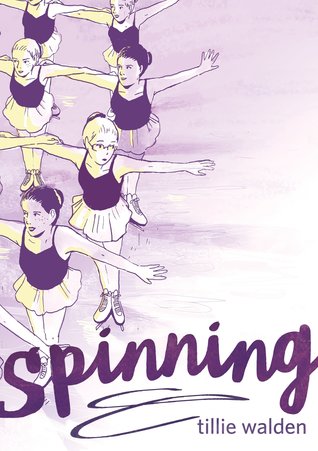 Specifically, this is about the 12 years Walden spent in the competitive figure skating world. She grew up in New Jersey, and when the family moved to Austin, Texas the bullying she’d experienced in her previous school continued. Mornings started at 4 a.m. when she got up for individual skating lessons; after school she had synchronized skating practice at another rink.
These years were full of cello lessons, unrequited crushes and skating competitions she rode to with her friend Lindsay and Lindsay’s mother. The femininity of the skating world – the slicked-back buns and thick make-up; the way every girl was made to look the same – chafed with Walden because she’d known since age five that she was gay. All told, she was disillusioned with what once seemed like her whole life:
Skating changed when I came to Texas. It wasn’t strict or beautiful or energizing any more. Now it just felt dull and exhausting. I couldn’t understand why I should keep skating after it lost all its shine.
Every chapter is named after a different skating move: waltz jump, axel, camel spin, etc. Walden’s drawing style initially reminded me most of This One Summer by Jillian and Mariko Tamaki, which is also about teens finding their way in the world and shares the same mostly purple and gray coloring. Walden’s work is more sketch-like, and also includes yellow on certain pages. The last third or so of the book is the most momentous: between when Walden comes out at 15 and when she gives up skating at 17.
Believe it or not, Walden was born in 1996 and this is her fourth book. She’s already won two Ignatz Awards. I felt this book would have benefited from more hindsight: time to mull over her skating experience and figure out what it all meant. The Author’s note at the end struck me as particularly shallow, like this project was about quick catharsis rather than considered reflection. However, the book’s scope (nearly 400 pages) is impressive, and Walden is adept at capturing the emotional milestones of her early life.
Published in the UK on September 12th. With thanks to Paul Smith of SelfMadeHero – celebrating its 10th anniversary this year – for the free copy for review.
My rating:
Virginia Woolf Down Under: The Singing Ship by Rebecca Winterer
Memories are stored vertically, fluid and accessible from the strangest depths. … [T]o explore was to salvage, to record a story was to remember one.
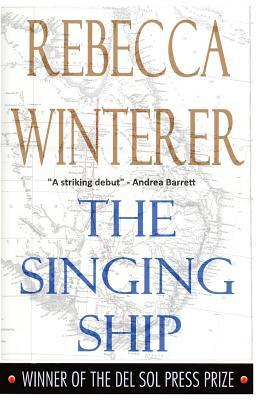
Rebecca Winterer won the 2016 Del Sol Press First Novel Prize for The Singing Ship, her sophisticated story of the afflictions and creative transformations that shape the Pilgrim family of Mt. Isaac, Queensland over the course of six decades. However, the book opens with an even longer view – a cosmic one – via a prologue offering a millennia-old perspective on human life. An epilogue returns full circle, telescoping from the Pilgrims back out to the enormity of the earth without belittling the value of the individual. In between those two points of vastness, we spend time on the dusty Australian ground with four characters who nurse their traumas with some unusual obsessions.
 Eleven-year-old Bernadette emulates her hero, nineteenth-century explorer Charles Sturt, by trekking out into the bush with a log book and carefully amassed provisions. Younger sister Jane combats her nightmares by focusing on stories of the saints and constructing little altars, “earnestly fabricating solace and safe havens.” Already the signs of who they’ll grow up to be are evident – Bernadette an award-winning historian, and Jane a nun. But the road there will not be easy: Winterer plants tiny hints of an attack the girls suffer out in the bush.
Meanwhile, the girls’ father, Robert, admits to a sexual peccadillo with a customer at his department store and has a nervous breakdown. Their mother Audrey, an unfulfilled housewife with creative ambitions, responds with affairs of her own but also embarks on her magnum opus, an enormous quilt decorated with her button collection. One day the quilt will be part of the permanent folk art collection at the National Gallery in Canberra. For now it’s like an echo of the bowerbird nest Bernadette finds: a visual display of newfound confidence.
The novel follows the Pilgrims from perhaps the late 1950s through to the present day; and from drought-plagued Mt. Isaac to the university where Bernadette teaches and the convent where Jane lives. There will be more losses along the way – deaths and broken relationships – but these characters keep reinventing themselves to survive. In two cases name changes are symbolic of leaving a previous life behind: we learn that Robert chose the new surname Pilgrim when he escaped from his father’s hotel-cum-brothel, to signify his eagerness in setting out on his life’s journey; and when Jane takes her vows she becomes Sister Ava.
I was impressed by how much ground this novel covers in just 210 pages. It takes in so many weighty topics: mental illness, adultery, sexual assault, bereavement, suicide, art, history, legacy and culture. Perhaps for that reason, I found that I had to parcel it out into small chunks, reading just 10 pages or so at a time. The chronology can be difficult to follow – unspecified lengths of time pass between the sections and the narrative skips back and forth, such that I longed for date headings to help me orient myself. But some of this is deliberate, I’m sure: as in Virginia Woolf’s work, the past bleeds into the present, with memory and action sometimes indistinguishable. Indeed, one part is entitled “The Voyage Out”; though I’m unfamiliar with that Woolf novel, I had To the Lighthouse in mind while reading.

The Singing Ship sculpture at Emu Park, Queensland. ZayZayEM at the English language Wikipedia [CC-BY-SA-3.0 (http://creativecommons.org/licenses/by-sa/3.0/)%5D, via Wikimedia Commons.
The title itself has metaphorical significance, referring to a sculpture of Captain Cook’s Endeavor, sited on a headland over Keppel Bay. It’s “white as bleached cuttlebone” and fitted with organ pipes so that when the wind passes through it creates an uncanny music. Later on Winterer likens the sculpture to the human body. That’s one of the images that will stick with me from this dreamy novel: of music emerging from the detritus of troubled lives.
My rating: 
The Singing Ship was published by Del Sol Press on July 21st. My thanks to the author for sending a free copy for review.
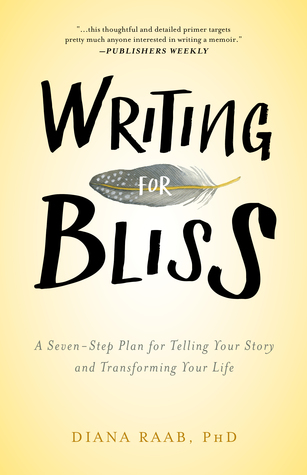
Writing for Bliss by Diana Raab
For Diana Raab, writing has been a way of coping with all that life has thrown at her, starting with her grandmother’s suicide and also including her daughter’s drug addiction and two bouts with cancer. She’s written poetry, memoir, and various books on the writer’s craft, with the latest, Writing for Bliss, specifically centered around life writing and mindfulness. In particular, I could see this one being helpful supplementary reading for those who have enjoyed Francine Prose’s Reading like a Writer and Mary Karr’s The Art of Memoir.
 Some keywords Raab emphasizes are patience, journey, healing, and transformation. Writing is often a long process, but it can also be a therapeutic one. It’s important to find a sacred space of one’s own – whether literal like Virginia Woolf’s room of one’s own, or simply a repurposed space that has been made conducive with candles and family photos. Raab encourages would-be memoir writers to look at the patterns in their lives and to focus on writing about moments that are relevant to the story of their personal growth.
As to the nitty-gritty of getting words onto the page, she insists that life writing is just as much about storytelling as fiction is. Fleshing out a story is more important than chronological accuracy, and she advises striving for a mixture of narrative, dialogue, scenes and reflection so that the resulting book does not seem like just a list of facts and events.
Raab also issues warnings. One is about causing offense by revealing family secrets. She suggests consulting the family members you intend to write about beforehand, and later running a rough draft past them for their approval. Another is about the danger of seeking one’s self-worth in publishing. Not all books lead to traditional publication, so it’s better if you write out of love and for yourself, simply because you find fulfillment in creativity.
This is a practical as well as a theoretical guide: 50 writing prompts are dotted through the text, and there’s also an appendix full of more. I’m someone who doesn’t necessarily aspire to write fiction, so I usually skip over such sections in a book about writing, but I think many of these could make a great launch pad for writing a personal essay. The book also ends with a terrific 15-page inventory of further reading, including a list of recommended memoirs.
My rating:
Writing for Bliss was published by Loving Healing Press on September 1st. My thanks to the author for the free e-copy for review.
I’ve hoarded a number of books about writing on my Kindle, including:
- The Hero Is You by Kendra Levin
- Scratch, ed. by Manjula Martin
- Part Wild by Deb Norton
- Process by Sarah Stodola
Have you read any of these? What other books about writing have you read that you can vouch for?
I’ve read a lot of the classics – Dorothea Brande, Stephen King, Anne Lamott et al. – but I’m always interested to hear what similar books people have found to be helpful.
Four Recommended September Releases
Here are four enjoyable books due out this month that I was lucky enough to read early. The first two are memoirs that are linked by a strong theme of mothers and children, though one has a primary topic of mental illness; the third is a quirky bibliomemoir partially written in letters; and the last is an elegant poetry collection. I’ve pulled 150–200-word extracts from my full reviews and hope you’ll be tempted by one or more of these.
Gorilla and the Bird: A Memoir of Madness and a Mother’s Love, by Zack McDermott
(Coming from Little, Brown [USA] and Piatkus [UK] on the 26th)
 As a public defender in New York City, Zack McDermott worked with seemingly crazy people every day at Legal Aid, little knowing that he was on his way to a psychotic break himself. Soon he’d covered the walls of his apartment with marker scrawl and fully taken on his stand-up comedian persona, Myles. Convinced that he was in a Truman Show-style reality show, he ended up half-naked and crying on a subway platform. That’s when police showed up to take him to Bellevue mental hospital.
McDermott takes readers on a wild tour through his life: from growing up with a no-good drug addict father and a Superwoman high school teacher mother in Wichita, Kansas “a baloney sandwich throw from the trailer park” to finally getting medication and developing strategies that would keep his bipolar disorder under control. His sense of pace and ear for dialogue are terrific. Despite the vivid Cuckoo’s Nest-style settings, this book is downright funny where others might turn the subject matter achingly sad. It’s a wonderful memoir and should attract readers who don’t normally read nonfiction. (An explanatory note: “Gorilla” is McDermott’s nickname and “The Bird” is his mother’s; she’s the real hero of this book.)
My rating:
Landslide: True Stories, by Minna Zallman Proctor
(Coming from Catapult on the 19th)
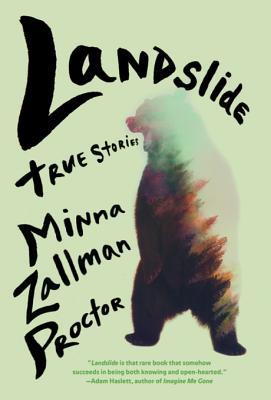 This gorgeous set of autobiographical essays circles through some of the overarching themes of Proctor’s life: losing her mother, a composer – but only after three bouts with cancer over 15 years; the importance Italy had for both of them, including years spent in Tuscany and her work as a translator; a love for the work of Muriel Spark; their loose connection to Judaism; and the relentless and arbitrary nature of time. She ponders the stories she heard from her mother, and the ones she now tells her children. “We all have totemic stories. The way we choose them—and then choose to tell them—is more important ultimately than the actual events.” Proctor provides a fine model of how to write non-linear memoir that gets to the essence of what matters in life.
Another favorite line:
“I was never good at making stuff up; I’m much more interested in parsing the density, inanity, confusion, and occasional brilliance of life around me.”
My rating:
Dear Fahrenheit 451: Love and Heartbreak in the Stacks, by Annie Spence
(Coming from Flatiron Books on the 26th, and in the UK on Oct. 13th)
Dear Annie Spence,
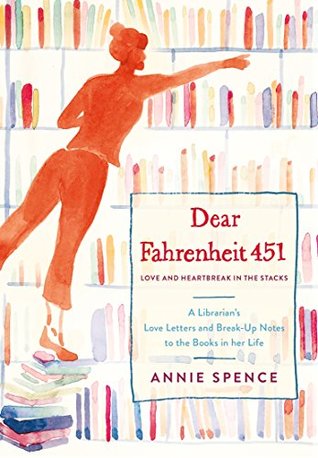 You’re on your way to being the next Nancy Pearl, girlie. Your book recommendations are amazeballs! How have you read so many books I’ve never even heard of?! Thanks to you I’ve added 13 books to my TBR when I’m desperately trying to cull it. Argh!
Anyway, gotta be honest here: I wasn’t digging the snarky, sweary style of the letter section of your book. True, it’s super clever how you use the epistolary format for so many different purposes – to say sayonara to books weeded from your public library’s stock, declare undying love for The Virgin Suicides and other faves, express mixed feelings about books you abandoned or didn’t get the appeal of, etc. – but, I dunno, the chatty, between-girlfriends style was irking me.
But then I got to Part II, where you channel Ms. Pearl and the authors of The Novel Cure with these original suggestions for themed and paired reading. Here’s books to read after making various excuses for not joining a social event, recommended sci-fi and doorstoppers (aka “Worth the Weight”), etc. I freakin’ loved it.
When’s your full-length Book Lust-style thematic recommendations guide coming out??
Happy reading until then!
Bookish Beck
My rating:
Panicle, by Gillian Sze
(Coming from ECW Press on the 19th)
 Gillian Sze is a Montreal poet with five collections to her name. Panicle contains many responses to films, photographs, and other poems, including some classical Chinese verse. Travel and relationships are recurring sources of inspiration, and scenes are often described as if they are being captured by a camera. There are a number of prose paragraphs, including the “Sound No. 1–5” series. As lovely as the writing is, I found few individual poems to latch onto. Two favorites were “Nocturne,” which opens “When I can’t sleep I think of the lupines that grow in the country, their specific palette, a mix of disregard and generosity” [the line breaks are unclear in my Kindle book], and “Dawning.” My favorite lines were “memory is a wicker chair that creaks in the wind” (from “To the Photographer in the Countryside”) and “I age / as it is typically done: slowly / unconsciously / surprisingly” (from the title poem).
My rating:
In case you’re curious, here are some September releases I can’t recommend quite as highly, with links to my Goodreads reviews:
- bone by Yrsa Daley-Ward [poetry]
- Afterglow (a Dog Memoir) by Eileen Myles
- George and Lizzie by Nancy Pearl

Have you read any September releases that you would recommend? Which of these appeal to you?
Mini-Reviews: The Graybar Hotel & Saints for All Occasions
My attention was drawn to The Graybar Hotel, the debut story collection by Curtis Dawkins, because the author is a convicted murderer serving a life sentence in a Michigan prison. (You can read more about his background in this Guardian article.) These 14 short stories are all set at least partially in prison, and feature men learning how to live with the consequences of their mistakes and how to fill long, empty days. They perfect their amateur tattooing skills, write raps, or carve soap figures; they watch TV or make collect calls to random numbers. There’s a kind of make-do attitude in the air, as well as the idea that you can reinvent yourself – starting with your past. But of course there are also more destructive forces around, with drugs, suicide, and violent revenge always lurking in the background.
 Perhaps of necessity, the collection is rather homogeneous. For instance, all but two stories are in the first person, with the typical narrator an observer who recounts other prisoners’ dreams and desperate actions but reveals little or nothing about himself. My favorite stories are those that also look backward and/or forward to show the protagonist’s life before and after prison rather than just dwelling on daily life in the pen. In one stand-out, “Leche Quemada,” Clyde is released after 12 years and tries to slip back into life with Melissa but finds that – like the boiled milk candies his Hispanic cellmates made and he always coveted – what you’ve been waiting for all this time might not be all that you hope for. My overall favorite is “Engulfed,” in which Steven, who admitted selling phony security systems after he fell for a set designer, calls his roommate out for lies about his past. Fire as a destructive yet cleansing force that reveals the truth is a potent symbol here as well as in “Six Pictures of a Fire at Night.”
*All proceeds from the book go into an education fund for Dawkins’s children.
My rating:
The Graybar Hotel was published in the UK by Canongate on July 20th. My thanks to Alice Laing for the free copy for review.
 Having enjoyed J. Courtney Sullivan’s The Engagements, I was keen to try her new novel, Saints for All Occasions. It opens in 2009 with Nora Rafferty, a mother of four, rushing to the hospital after being informed of a death in the family. She reluctantly accepts that her next task will be to contact the abbey where her estranged sister Theresa, now known as Mother Cecilia, lives. From County Clare, the girls moved to Boston together in the late 1950s: Nora to join Charlie, the fiancé she didn’t really love, and Theresa to have a chance at a new and exciting life. Moving back and forth between 2009 and earlier points in the sisters’ history, the novel considers the way their decisions have played out over the course of half a century, musing over what was fated and what they might have changed. We meet and spend much time with Nora’s children, especially John, who worked on the campaigns of a suspiciously Mitt Romney-esque figure and adopted a daughter from China with his wife; and Bridget, who’s planning to have a baby with her partner Natalie but hasn’t come out to her mother yet.
I’m not sure I ever gave this book a fair shake; from the earliest pages it reminded me so strongly of other Irish-American family stories I’ve read: Mary Costello’s Academy Street, Anne Enright’s The Green Road, Nick Laird’s Modern Gods, Maggie O’Farrell’s This Must Be the Place, and Colm Tóibín’s Brooklyn. With these forebears in my mind, it was hard to judge the book on its own merits. I also thought the ‘secret’ was as plain as day from the beginning. If it’s a less familiar story line for you, you may well enjoy it more than I did.
Favorite lines:
Charlie gave her a sad smile. ‘Isn’t there anything you like about Boston?’ Nora thought it over. ‘Brigham’s vanilla ice cream,’ she said. ‘That’s it.’
It was amazing that you did not become your grief entirely, and walk around leaking it everywhere. It could lie dormant inside of you for days, weeks, years. You could seem a perfectly whole person to everyone you met. Without warning, grief might poke you in the ribs, punch you in the gut, knock the wind out of you. But even then, you seemed just fine. The world went on and on.
My rating:
Saints for All Occasions is published in the UK today, August 31st, by Fleet. My thanks to Hayley Camis for the free review copy.
Doorstopper of the Month: By Gaslight by Steven Price
My 2017 goal of reading one book of 500+ pages per month has been a mixed success. With the best doorstoppers the pages fly by and you enjoy every minute spent in a fictional world. From this past year Murakami’s The Wind-Up Bird Chronicle fits that bill, and a couple of novels I read years ago on holidays also come to mind: Susanna Clarke’s Jonathan Strange and Mr. Norrell and Michel Faber’s The Crimson Petal and the White. But then there are the books that feel like they’ll never end and you have to drag yourself through page by page.
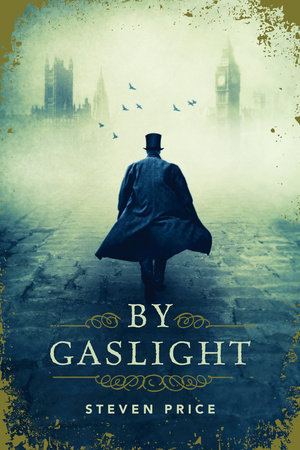 Unfortunately, Steven Price’s second novel, By Gaslight, a Victorian cat-and-mouse mystery, tended more towards the latter group for me. Like Eleanor Catton’s The Luminaries, it has the kernel of a fascinating story but piles up the words unnecessarily. Between July and August I read the first 300 pages and then skimmed the rest (in total the paperback has 731 small-type pages). This is the story of William Pinkerton, a 39-year-old Civil War veteran and private investigator from Chicago who comes to London in 1885 to chase up a name from his father’s files: Edward Shade. His best lead comes to nothing when Charlotte Reckitt evades him and turns up as a set of dismembered remains in the Thames. Keeping in mind the rudimentary state of forensics, though, there’s some uncertainty about the corpse’s identity.
The other central character in this drama is Adam Foole, a master thief. Half Indian and half English, he has violet eyes and travels in the company of Molly, a young pickpocket he passes off as his daughter, and Japheth Fludd, a vegetarian giant just out of prison. Foole was Charlotte’s lover ten years ago in South Africa, where they together pulled off a legendary diamond heist. Now he’s traveling back to England: she’s requested his help with a job as she knows she’s being tailed by a detective. The remaining cast is large and Dickensian: a medium and her lawyer brother, Charlotte’s imprisoned uncle, sewer dwellers, an opium dealer, and so on. Settings include a rare goods emporium, a Miss Havisham-type lonely manor house, the Record Office at Chancery Lane, and plenty of shabby garrets.
What I most enjoyed about the book was the restless, outlaw spirit of both main characters, but particularly Pinkerton. His troubled relationship with his father, in whose footsteps he’s following as a detective, is especially poignant: “William feared him and loved him and loathed him every day of his life yet too not a day passed that he did not want to be him.”
Price’s style is not what you’d generally expect of a Victorian pastiche. He uses no speech marks and his punctuation is non-standard, with lots of incomplete or run-in sentences like the one above. The critics’ blurbs liken By Gaslight to William Faulkner or Cormac McCarthy, apt comparisons that tell you just how unusual a hybrid it is.
I liked Price’s writing and starting around page 150 found the book truly gripping for a time, but extended flashbacks to Pinkerton and Foole’s earlier years really drag the story down, taking away from the suspense of the hunt. Meanwhile, the two major twists aren’t confirmed until over halfway through, but are hinted at so early that the watchful reader will know what’s going on long before the supposedly shrewd Pinkerton does. The salient facts about both characters’ past might have been conveyed in one short chapter each and the 1885 plot streamlined to make a taut novel of less than half the length.
There are many reasons to admire this Canadian novelist’s achievement, but whether it’s a reading experience you’d enjoy is something you’ll have to decide for yourself.
A favorite passage:
There is in every life a shadow of the possible, she said to him. The almost and the might have been. There are the histories that never were. We imagine we are keeping our accounts but what we are really saying is, I was here, I was real, this did happen once. It happened.
My rating:
By Gaslight was first published in the UK by Oneworld in September 2016. My thanks to Margot Weale for sending a free paperback for review.
Fun trivia: Steven Price is married to Esi Edugyan, author of the Booker Prize-shortlisted novel Half Blood Blues.
Two “Summer” Books
With summer winding down, I decided it was time to read a couple of books with the word in the title to try to keep the season alive. These turned out to be charming, low-key English novels that I would recommend to fans of costume dramas. Both:
I knew very little about Jonathan Smith’s Summer in February when I picked it up in a charity shop. From the ads for the 2013 film adaptation with Dan Stevens, I had in mind that this was an obscure classic. It was actually published in 1995, but is inspired by real incidents spanning 1909 to 1949. It’s set among a group of Royal Academy-caliber artists in Lamorna, Cornwall, including Alfred Munnings, who went on to become the academy’s president.
The crisis comes when Munnings and Captain Gilbert Evans, a local land manager, fall for the same woman. A love triangle might not seem like a very original story idea, but I enjoyed this novel particularly for its Cornish setting (“From dawn to dusk it had rained non-stop, as only Cornwall can”; “The sea was slate grey and the sky streaky bacon”) and for the larger-than-life Munnings, who has a huge store of memorized poetry and is full of outspoken opinions. Two characters describe his contradictions thusly: “I can see he’s crude and loud and unpolished and Joey says he cuts his toenails at picnics but…”; “he’s one in a million, a breath of fresh air, and he’s frank and fearless, which is always a fine thing.” The title refers to the way that love can make any day feel like summer.
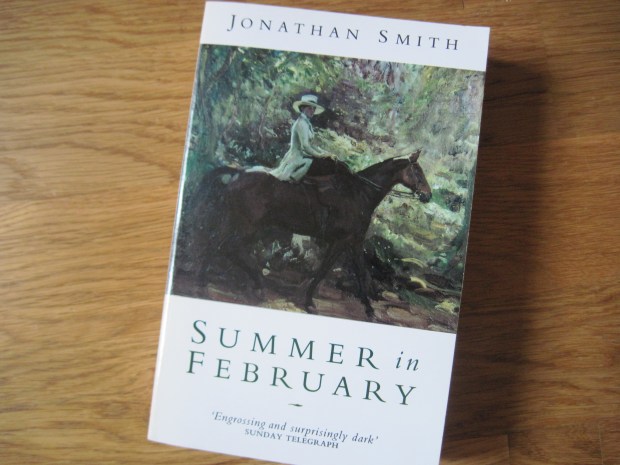
The cover image is the painting Morning Ride by A.J. Munnings.
For more information on Munnings, see here.
For more information on Gilbert Evans, see here. (Beware the spoilers!)
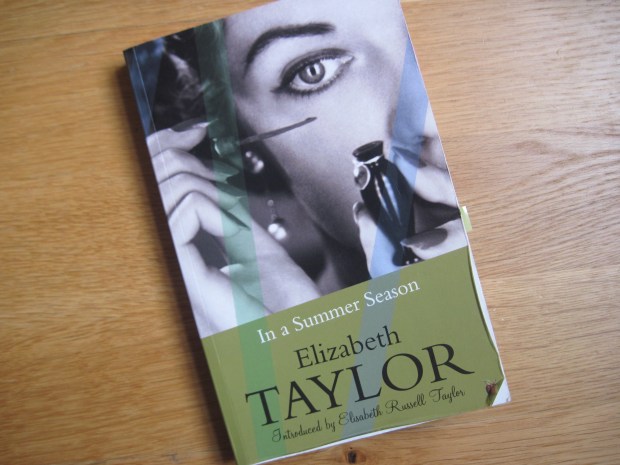
From 1961, In a Summer Season was Elizabeth Taylor’s eighth novel. The ensemble cast is led by Kate Heron – newly remarried to Dermot, a man ten years her junior, after the death of her first husband – and made up of her family circle, a few members of the local community, and her best friend Dorothea’s widower and daughter, who return from living abroad about halfway through the book. Set in the London commuter belt, this is full of seemingly minor domestic dilemmas that together will completely overturn staid life before the end.
From Kate dyeing her hair yet being keen to avoid accusations of “mutton dressed as lamb” to her son Tom’s disgust at his grandfather’s ageing body, old age and wasting one’s time on trivialities are a twin paranoia here. The title is not only a literal note of when much of the action takes place, but also a metaphor for the fleeting nature of happiness (as well as life itself). Kate remembers pleasant days spent with her best friend and their young children: “It was a long summer’s afternoon and it stood for all the others now. There had been many. And she and Dorothea were together day after day. Their friendship was as light and warming as the summer’s air.”
So much happens in the last seven pages. I wished the book could have turned out differently, yet the conclusion effectively sews it all up, and all within a cozy 220 pages. If you enjoy writers like Muriel Spark and Barbara Pym, you must try Elizabeth Taylor. Her work is similarly built around wry, perceptive observations about relationships and ways of life. This was my fourth novel by her, and I’d call it my second favorite so far after Mrs. Palfrey at the Claremont.
(Secondhand books are such good value: These two charity shop paperbacks cost me less than 85 pence in total. Such a low total spend per hour of enjoyment!)
This month I also read The Summer without Men by Siri Hustvedt (discussed here along with a few other recent reads). Earlier in the year I reviewed Ricarda Huch’s The Last Summer, and last year I reviewed the Summer anthology from the Wildlife Trusts. “Summer” turns up fairly frequently in titles of books I’ve read or want to read, in fact. Here’s the whole list!
Have you read any “Summer” books lately?
Classic of the Month: Fathers and Sons by Ivan Turgenev
Last month’s classic was Father and Son (Edmund Gosse); this month is Fathers and Sons, the 1861 novel by Ivan Turgenev (1818–83). I couldn’t resist pairing up the similar titles, and it turns out that even though one is nonfiction and the other fiction, they are thematically similar, dwelling on the clash of generations and contrasting romanticism and rationalism.
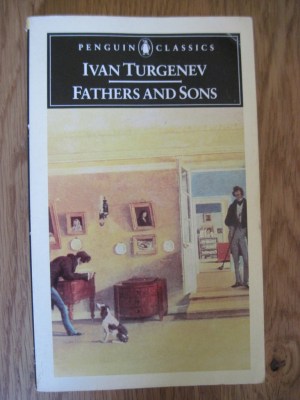 Nikolai Kirsanov’s son Arkady, newly graduated from university, has just returned to his father’s estate with his haughty fellow student Yevgeny Bazarov in tow. Bazarov intends to take a medical degree and follow in his father’s footsteps as a country doctor, so spends the time at his friend’s house dutifully poring over chemistry texts and dissecting frogs. Arkady, by contrast, seems earnest but aimless, happy to simply while away the days. The major change at home is that his father, a widower, has taken the servant girl Fenichka as his mistress and they have a baby, Mitya. (Gasp!) Yet the real shock in the world of the novel seems to be that Nikolai is consorting with someone of the lower classes. “In any case, it’s not for a son to sit in judgment on his father – least of all for me, and least of all with a father like you, who has never restricted my freedom in any way,” Arkady graciously concedes.
Together Nikolai and his rakish brother Pavel (“Women lost their heads over him, and men dubbed him a fop but were secretly envious”) represent an outmoded idealism that values art, nature, poetry, and true love. On the other side is Bazarov, who means to tear down those dated notions and recruit Arkady to the side of realism, even nihilism. “Nature is not a temple, but a workshop, and man’s the workman in it,” he explains to Arkady. But the pals’ notions get uncomfortably muddled when they meet the regal widow Anna Odintsov at the governor’s ball. On extended visits to her country house, Bazarov and Arkady become fixated on her and her younger sister, Katya, but differ in their willingness to give in to love.
Romantic love may be a madness best avoided in some of the characters’ view, but family love is a constant. Even Bazarov, though he makes a show of being embarrassed by their fussing when he goes home briefly after three years away, values his parents’ approval. His father proudly takes him along on his medical rounds, while his superstitious mother buttresses him with her prayers. She reminds her husband that Yevgeny is fundamentally different from them: “A son is an independent person. He’s like a falcon that comes when he wills and flies off when he lists; but you and I are like the funguses growing in a hollow tree.”
I was pleasantly surprised by how enjoyable and accessible Turgenev’s writing is. My experience with the Russian masters is shamefully limited; Leo Tolstoy’s The Death of Ivan Ilyich might literally be the only thing I’ve read previously. I was worried that all the patronymics, place names, and historical and cultural references would trip me up, but it’s no trouble to adjust to them here. You might think of Fathers and Sons as a friendly way of easing in to works like War and Peace: although elements of the story reminded me of Tolstoy’s epic (as I know it purely from the recent BBC miniseries) – the range of characters, from rich to poor, and their interactions; the long visits to acquaintances; the peaceful countryside; even a duel – it is on a much smaller scale, and has a correspondingly lower page count of about 220.
Something in nearly every character’s psyche rang true for me: Arkady’s relief at being home; Nikolai’s sense of being left behind; Bazarov’s feeling of smallness in an uncaring universe; his mother’s benevolent contentment with the status quo; Madame Odintsov’s well-ordered but purposeless life; and so on. Turgenev’s asides about Russia and about human nature give the narration a playful, knowing quality reminiscent of George Eliot. The idea of fathers and children being on different tracks extends to other forms of paternalism: religion (though this is a minor theme compared to in Father and Son) as well as masters versus serfs. “We all know there’s the master’s will; on account of you bein’ like our fathers. An’ the more strict the master rules, the better it be for us peasants,” as one rustic opines to Bazarov.
This is a thought-provoking but markedly readable classic that I can heartily recommend. Turgenev only wrote five other novels; if they’re all as strong (and roughly as short) as this one, I’d be happy to read them all – and will likely return to Fathers and Sons in the future.
My rating:
(With thanks to Karen at Kaggsy’s Bookish Ramblings for putting Turgenev on my radar.)
I read a Penguin Classics edition of Rosemary Edmonds’s 1965 translation. Her brief introduction gives helpful background and is a lovely piece of writing in its own right. Beware: only read a literary introduction after finishing the text, because critics assume you know the basic story line and so spoil who falls in love with whom, who dies in the end, etc. My edition is preceded by a lengthy lecture Isaiah Berlin gave on Turgenev in 1970.
Madness Is Better than Defeat by Ned Beauman
I’ve been a Ned Beauman fan ever since I read his debut, Boxer, Beetle, in 2011. Born in 1985, the Londoner is now the author of four novels and was named one of Granta’s 20 best British novelists under the age of 40. His books are madcap and complex; three out of four have historical settings (all broadly in the World War II era), but this is definitely not historical fiction as we know it. If I tell you that some common elements in his work are Nazis, pharmaceuticals and gay sex, and that his first two books reminded me most of Nick Harkaway, you’ll get some idea of the niche he’s working in.
 Madness Is Better than Defeat takes its title from a line in Orson Welles’s never-filmed screenplay of Heart of Darkness. We open in 1959 with Zonulet, a 43-year-old alcoholic CIA officer, writing a tell-all memoir about what happened when two parties set out to find a Mayan temple in Honduras in 1938. Sadistic business magnate Elias Coehorn, Sr. sent his feckless son, Elias Jr., to dismantle the temple and bring it back to New York City, while Arnold Spindler, chairman of Kingdom Pictures, tasked Jervis Whelt with directing a movie on location at the temple: Hearts in Darkness, a comedy about a spoiled society boy who’s sent on an archaeological dig to a Mayan temple and opens a nightclub when he gets there.
The scene is set for a clash of cultures: the New York faction bent on destruction versus the Los Angeles crew intent on creation. They’re joined by Joan Burlingame, a stuffy Cambridge anthropologist, and Leland Trimble, a gossip journalist who was formerly Zonulet’s colleague at the New York Evening Mirror. To start with the screwball plot is uncannily similar to that of Hearts in Darkness itself, and it seems the stalemate between the two groups will be mined purely for comic potential. But as the years pass and the deadlock continues, this becomes more of a psychological study of a community in isolation, rather like The Lord of the Flies or T.C. Boyle’s The Terranauts.
Alliances are formed and broken based on blackmail over the characters’ past and present indiscretions; routines and workarounds are developed (though an attempt to recreate Bloody Marys and Eggs Benedict fails); soon a whole new generation is being raised with little knowledge of what’s happened outside this jungle for more than a decade; all they have to go on is false information about the outcome of World War II conveyed by an ex-Nazi.
They spoke in American accents and they had all been taught a sort of eschatology in which they would one day return with their parents to Hollywood or New York. But they belonged to the rainforest and to the temple. And the geometry of the latter … was so primal to them that any talk of disassembly or reassembly struck them as abstract, almost paradoxical.
One of the hardest things to believe about the story line – so you’ll simply have to suspend your disbelief – is that no one was overly concerned when these two groups failed to reappear after assignments that were meant to last only a matter of weeks. Not until Zonulet gets to Honduras in 1956 to learn more about a secret CIA guerrilla training camp in the area is there sustained interest in what became of these exiled Americans, and it’s another two years before their jungle idyll comes to an explosive end.
What we have here is a twist on the Mummy’s Curse trope, with the temple causing many to lose their minds or their lives. I wish the novel could have retained its initial screwball charm without going quite so dark and strange, but that’s Beauman for you. I also thought that this was a good 100–150 pages too long, with many more secondary characters, subplots and asides than necessary. Ironically, even after nearly 500 pages, its conclusion left me wondering about some loose ends. But the writing is consistently amusing, particularly the voices captured in letters or diaries and the wacky metaphors:
- “The sky in the west was mixing an Old-Fashioned”
- “All her blood had thickened in her head like the last of the catsup”
- “They were so slathered in mulch that their two bodies together might have been some octopod newly burped from a mudpot.”
- “To describe the truck as temperamental would have been condescending; rather, I had the impression it had been earnestly wrestling with a deep crisis of personal faith about the very principle of internal combustion as a motive power.”
If you’re new to Ned Beauman, I’d suggest starting with The Teleportation Accident, my favorite of his novels. From there you could move on to Boxer, Beetle or Glow; this one can wait until you’re a confirmed admirer.
My rating:
Madness Is Better than Defeat is published in the UK today, August 24th, by Sceptre and will be available in the USA in February. With thanks to Ruby Mitchell for the free review copy.
 Bookish Beck = Rebecca Foster. American transplant to England. Freelance proofreader and book reviewer.
 Bookish Beck