All the Books I’ve Abandoned So Far This Year
Hard to believe, but it’s time to start on the mid-year roundups already. I’ll be doing a few posts with statistics on my reading from the first half of 2019: where my books came from, how I fared with my most anticipated reads and how I’m doing towards any projects, the best 2019 releases so far, etc. But first, let’s get this out of the way:
I’ve DNFed 37 books so far this year, equating to roughly 20% of what I started. Although that’s higher than my usual 15% average, suggesting that I’m particularly lacking in stick-to-itiveness lately, I don’t think it’s unreasonable that a fifth of the books I pick up don’t work for me for whatever reason (e.g. tone, voice, writing style, subject matter or similarity to other things I’ve read).
My biannual posts on abandoned books are always perversely popular. If you’re reading this post to feel better about the books you’ve abandoned recently: 1) Welcome! 2) I absolve you of any perceived guilt! 3) I encourage readers to give up on books they are not enjoying – at any time, but as early on as possible. You owe it to yourself to devote your limited, precious time to the books you’ll love and find worthwhile. I apologize in advance for not getting on with a book that you loved.
I won’t mention books I’ve already written about, perhaps in one of my monthly Library Checkout posts. No cover images, tags, links or full reviews here – though I might write that little bit more if I got the book from the publisher. So this is just a text dump, I’m afraid. The titles are mostly in chronological order (with some grouped together); the number of pages I read is generally given in brackets at the end.
The Gunners by Rebecca Kauffman: A group of six kids grew up playing together in the abandoned Gunner house in Lackawanna, New York. They’re now all around 30 and have dispersed to their different lives, but, reeling from the suicide of one of their own, they’ll be brought back together for a funeral. Too much time is spent with Mikey early on, and the sentences don’t flow all that well – the language is a bit simplistic and repetitive. Other reviews have suggested this is a nice read but not all that special. I’ll watch The Big Chill sometime instead. (23 pp.)
Wonder Valley by Ivy Pochoda: There’s a striking opening, as a naked runner bypasses a morning traffic jam in 2010 Los Angeles. We meet a couple of the other main characters, including Ren, who’s come west via a Greyhound bus after eight years in juvenile detention, while they’re stuck in traffic, then cut to Britt, who in 2006 got attracted to a hippie commune near Joshua Tree. The writing is fine, but I didn’t feel invested in any of the characters. (34 pp.)
The Last Samurai by Helen De Witt: Alas, once I got past the prologue I found this impenetrable. It was one of my bibliotherapy prescriptions for uncertainty about whether to have children. I liked the opening legend about an atheist father being talked into attending seminary. The language is repetitive but I thought I could forgive it because it was narrated by an eleven-year-old. But once the book proper starts we’re in Oxford in the 1980s, splitting hairs over translations. I skimmed to page 90 and was ultimately none the wiser about who’s narrating and what’s going on. (20 pp.)
Mr Wrong by Elizabeth Jane Howard: I read the two shortest stories, “Summer Picnic” and “The Proposition.” The former was pleasantly like Elizabeth Taylor or Tessa Hadley lite; I got zero out of the latter. I tried to settle into the opening, title story, but couldn’t.
Underbug: An Obsessive Tale of Termites and Technology by Lisa Margonelli: On the one hand, Margonelli writes enjoyable science for laymen, in a style that reminds me of Ed Yong’s. Termite research has surprising relevance in various fields, such as biofuel production, architecture, and swarm intelligence. On the other hand, I’m simply not interested enough in this set of species. I can imagine having better luck with a book that considered a different group of insects per chapter. My favorite bit was Chapter 13 because it was autobiographical – she tells the ironic story of how termites ate through the wall of her place, and remembers her back-to-nature existence in Maine with a father who trapped and skinned muskrats. I’ll seek out her previous book on petroleum. (131 pp.)
The Hope Fault by Tracy Farr: The style is reminiscent of Virginia Woolf’s, or Tessa Hadley’s, especially as in The Past. The whole family has returned to the ancestral home, which has just been sold and needs to be cleared, in the midst of a deluge. We meet Iris, her grown son Kurt, her niece Lulu, and her ex-husband Paul – with his new wife Kristin and their still-unnamed one-month-old daughter. The shifting POV mostly sticks with Iris. Chapter titles are nicely random phrases plucked from that chapter. The short sections, some of them pure dialogue, are so short you don’t feel you get anywhere or have anything to latch onto. I loved Farr’s previous novel, The Life and Loves of Lena Gaunt, and hoped to love this one too, but the narrative drive just wasn’t there. (44 pp.)
The Heat of the Day by Elizabeth Bowen: I read about the first 35 pages, and in that time hadn’t warmed to any characters or gotten any sense of what this would be about. However, I can see what contemporary authors like A.J. Pearce and Sarah Waters were aiming for. Odd phrasing, too: “By casting about—but then hitherto this had always been done calmly—he had never yet not come on a policy which both satisfied him and in the end worked. There never had yet not been a way through.” (Passive voice, double negatives, and unnecessary verbiage? No thanks.)
The Dinner List by Rebecca Serle: I should have done my homework on Serle; if I had, I would have realized that she writes young adult romances, and though this has been marketed as adult commercial fiction, it still has that YA vibe. The book’s conceit is that the vision board Sabrina’s college roommate Jessica made her do about the five people, alive or dead, whom she’d invite to her ideal dinner party, has become a reality. Short snippets from this dinner – which includes Sabrina’s ex, Tobias; her dead father, Robert, who left her and her mother when she was a little girl; Professor Conrad, her philosophy instructor; Jessica; and Audrey Hepburn – are interspersed with glimpses of Sabrina’s relationship with Tobias, which started by chance one day in Santa Monica and unexpectedly picked up again four years later in New York City. Apart from the lite romance feel, there is lots of weird phrasing: “it came out to be cheaper,” “ripping open a teabag” to make tea (who would do that and why?!), “any way else,” and so on. (65 pp.)
The Altruists by Andrew Ridker: In 2015 Maggie and Ethan Alter, both living in New York City – she a do-gooder who tutors immigrant children and lives so frugally she’s always a little bit hungry; he a compulsive shopper and hermit, since he broke up with his last boyfriend – unexpectedly get letters from their father, Arthur, a widowed engineering professor, inviting them home for spring break. Ridker writes well, as you’d expect from any Iowa Writers’ Workshop graduate. This reminded me most of The Futures by Anna Pitoniak, with traces of Jonathan Franzen or Jonathan Safran Foer in the mix of quirky and cynical characters. But in the chunk I read, I didn’t warm to any of the central characters and never even really got a clear sense of them. I’ll keep an eye out for what Ridker does and maybe try something else by him. (50 pp.)
Sea Monsters by Chloe Aridjis: I had no idea what’s happening (apart from nothing much), except that a 17-year-old girl is exploring derelict mansions in a Mexican town with one guy or another. The atmosphere is well done, but there’s no way the nonexistent plot can keep me reading for another 145 pages. Shame I never even got to those Ukrainian dwarves. (30 pp.)
Children of God by Mary Doria Russell: The Sparrow was one of my favorite backlist reads last year, and when I heard there was a sequel I rushed to put it on my wish list and got a copy for my birthday. While I was, of course, intrigued to learn that a character we thought was dead is still alive, and it was nice to see Emilio Sandoz, the broken priest, having a chance at happiness back on Earth, I couldn’t get myself interested in the political machinations of the alien races. Without the quest setup and terrific ensemble cast of the first book, this didn’t grab me. I’ll pass it on to my minion (aka husband) and he can tell me if anything of interest happens. (60 pp.)
Memories of the Future by Siri Hustvedt: “I am writing not only to tell. I am writing to discover. … I have always believed that memory and the imagination are a single faculty.” As clever a meditation as this is on identity and memory, at a certain point I found it a chore to pick up. I have no objection to autofiction, but I wanted more current wisdom than twentysomething folly, and what I’ve read about the later #MeToo theme suggests that it is unfortunately heavy-handed. I still plan to read the three Hustvedt novels I haven’t read yet, as well as her memoir; I’ll also dip into her essays and poetry. I think she’s an immense talent; this one just wasn’t for me. (112 pp.)
The Secret Barrister: Stories of the Law and How It’s Broken: Although I’ve lived in the UK off and on for 14 years now, I still know very little about its politics and particularly the criminal justice system. I was interested to learn more, and found the opening chapter usefully basic (judges, solicitors, barristers, etc.). The following chapter on magistrates’ court lost me; all I gleaned was that it’s a Bad Thing because the accused don’t get a fair shake. I can’t decide if you’d need to know more or less about the law to find this engaging; I have a law clerk friend who read it and enjoyed it well enough while also finding it depressing. (73 pp.)
A View of the Empire at Sunset by Caryl Phillips: I read the first chapter and skimmed another two. I’m afraid this is utterly lifeless writing; informative but not at all inviting.
Our Lady of Everything by Susan Finlay: The blurb sounded irresistible, but the writing was an instant turn-off. (Starting with a 10-step “Banishing Ritual” was an awful idea; the introduction to two main characters then wasn’t inviting; the following chapters all introduce a different point-of-view character.) (5 pp.)
Liar by Ayelet Gundar-Goshen: I liked the Atonement-style setup: a 17-year-old ice cream scooper has a run-in with a disgruntled, washed-up reality show star and allows rumors of an attempted sexual assault to bloom. Nice biblical echoes and metaphors, though some are a bit belabored (e.g. “Nofar’s guilt, like a Persian cat, rubbed her legs fleetingly, sat for a brief moment on her lap, then moved onward”). Mostly I just felt no pull to keep going and find out what happened. (63 pp.)
Prayer: Letters to Malcolm by C.S. Lewis: Lewis’s last book is a fictional one-sided correspondence that debates the nature of prayer. I thought I might be able to interest myself in prayer as an academic matter, but it turns out that not believing in it means I don’t care enough. (26 pp.)
A Handful of Dust by Evelyn Waugh: Mitford-esque flippant depiction of some upper-class types. (16 pp.)
The Bibliophile’s Dictionary: 2,054 masterful words and phrases by Miles Westley: A secondhand purchase from The Book Shop, Wigtown. The idea is a treasury of obscure vocabulary words, divided into thematic categories and grouped by synonyms. Each word/phrase is illustrated with an example of its use in context in a work of literature, or in a few cases a newspaper article. I kept it as a bedside book for a number of weeks and moderately enjoyed reading a few entries per night. My main annoyances were that Westley often confuses forms, giving a definition for the adjective when he’s using the noun or vice versa, and that his field of reference is pretty narrow: he’s always quoting from authors like Saul Bellow, Pat Conroy, Jack London and Tom Wolfe – dead white guys. I’ll keep this around as a reference book but can’t see myself reading it all the way through. (50 pp.)
The Pocket Mirror by Janet Frame: Having read from Frame’s fiction and memoirs, I wanted to dip into her poetry as well. This collection of free verse from 1967 is mostly written in the first person and concerns everyday local sights and sounds: beaches, town scenes, the view out the window of a morning, and so on; some are short while others are rambling. However, there are also several poems of death and war, and a particular obsession with napalm. While there’s nothing especially off-putting about these poems, nor are they very compelling in style or theme. (22 pp.)
In West Mills by De’Shawn Charles Winslow: There are echoes of Toni Morrison (especially Song of Solomon) in this debut novel set in the small fictional town of West Mills, North Carolina. Wilson has crafted a memorable antiheroine in Azalea “Knot” Centre, who likes to pretend she doesn’t care what people think about her but actually cares deeply. Alcohol and sex are her two vices, and in the 1940s her two out-of-wedlock daughters are secretly adopted by other families in the town, such that she can watch them grow up. The plot is initially slow-moving – it takes nearly half the length to introduce all the characters and deal with Knot’s first baby – but then leaps ahead to 1960 and further community entanglements. The rendering of the local dialect struck me as hokey, and none of the secondary characters seem worthy of sharing a stage with Knot. (162 pp.)
Convenience Store Woman by Sayaka Murata: I feared an Eleanor Oliphant trajectory in this story of a thirtysomething woman who’s worked in the same convenience store for half her life and only barely succeeds in convincing herself and others that she’s a normal person. Even in the little I read, the language was quite repetitive, with Keiko several times describing herself as just a cog in society’s workings, and frequently repeating the rote conversations she has with customers. (30 pp.)
The Rapture by Claire McGlasson: I would normally thrill to any book about a cult, but the writing in this one – maybe it was Dilys’s narration, I don’t know – never grabbed me. What a gorgeous book, though: corduroy-type ridging on the yellow cover, and a colorful deckle-cut dust jacket (with a jackdaw perched in an aggressively ordinary bedroom) that doesn’t quite cover the whole thing. Kudos to Faber for the design. (22 pp.)
I’m so weary of books of anonymized case studies:
- Growing Pains: Making Sense of Childhood, A Psychiatrist’s Story by Mike Shooter
- Seven Signs of Life: Stories from an Intensive Care Doctor by Aoife Abbey
- The Heartland: Finding and Losing Schizophrenia by Nathan Filer: Filer was completely unprepared when he arrived to work in a psychiatric hospital outside Bristol. This book is a record of what he learned: about the history of schizophrenia as a diagnosis, its social stigma, and the experience of living it via speaking to patients and hearing their stories. I read the first of those stories, about Erica, a fashion journalist who became so paranoid that she was being hunted down for committing unwitting crimes that she tried to commit suicide. Compared to Nancy Tucker’s That Was When People Started to Worry, this is dull and not very enlightening. I also found myself irritated by Filer’s habit of hedging around all his terms with “so-called,” and the title is all wrong – people seeing just the two words “The Heartland” on the spine will have no idea that this is a book about mental illness. (They might be thinking it’s about the American Midwest, or whatever.) (58 pp.)
The Narrow Land by Christine Dwyer Hickey: I was attracted by the cover and the prospect of learning about the Hoppers’ marriage, but the first section sticks with a small boy, a German refugee, heading up to Cape Cod. Mrs. Hopper is a more appealing character, yet somehow I never gained traction with the story. (46 pp.)
A Stranger City by Linda Grant: An unidentified woman who jumped off a bridge in London is buried in a paupers’ grave. Flashback to seven months earlier and various conversations and train rides, promising that we’ll learn how these characters are interconnected. The prospect sounds similar to John Lanchester’s Capital, but none of the characters, nor the writing, were interesting enough to bait me. (32 pp.)
Book Serendipity Strikes Again
Only two months since my last Book Serendipity entry, and already another 17 occurrences! I post these occasional reading coincidences on Twitter and/or Instagram. I call it serendipitous when two or more books that I’m reading at the same time or in quick succession have something pretty bizarre in common. Because I have so many books on the go at once – usually between 10 and 20 – I guess I’m more prone to such incidents. What’s the weirdest one you’ve had lately? (The following are in rough chronological order.)
- Characters with lupus in The Monsters of Templeton by Lauren Groff and Daisy Jones & The Six by Taylor Jenkins Reid [I also read about one who features in Lost and Wanted by Nell Freudenberger] PLUS I then read Wise Blood by Flannery O’Connor, who died of lupus
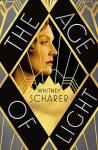
- Daisy’s declaration of “I am not a muse. I am the somebody. End of fucking story” in Daisy Jones & The Six by Taylor Jenkins Reid reminded me of Lee Miller’s attitude in The Age of Light by Whitney Scharer
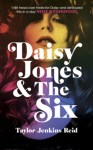
- Mentions of old ladies’ habit of keeping tissues balled up in their sleeves in The Girls by Lori Lansens and Growing Pains by Mike Shooter
 (A sad one, this) The stillbirth of a child is an element in three memoirs I’ve read within a few months, Notes to Self by Emilie Pine, Threads by William Henry Searle, and The Chronology of Water by Lidia Yuknavitch
- A character’s parents both died in a car accident in The Monsters of Templeton by Lauren Groff and Saint Maybe by Anne Tyler
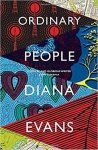
- Two books open on New Year’s Eve 2008 and comment on President Obama’s election: Ordinary People by Diana Evans and Rabbits for Food by Binnie Kirshenbaum

- Three novels in which both romantic partners are artists and find themselves (at least subconsciously) in competition: The Narrow Land by Christine Dwyer Hickey, The Age of Light by Whitney Scharer and Stanley and Elsie by Nicola Upson
- There’s a Czech father (or father figure) in The Florist’s Daughter by Patricia Hampl and The Girls by Lori Lansens
 I’d never heard of 4chan before, but then encountered it twice in quick succession, first in So You’ve Been Publicly Shamed by Jon Ronson and then in The Unauthorised Biography of Ezra Maas by Daniel James
- (Another sad one) Descriptions of the awful sound someone makes when they learn a partner or child has died in Hard Pushed by Leah Hazard and Jesus’ Son by Denis Johnson
- Alan Turing is a character in Murmur by Will Eaves and Machines Like You by Ian McEwan

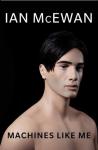
- Antonie van Leeuwenhoek (a pioneer of microscopy) is mentioned in Machines Like You by Ian McEwan and The Making of You by Katharina Vestre
- A woman is described as smelling like hay in Memoirs of a Book Thief by Alessandro Tota and Pierre Van Hove and The Chronology of Water by Lidia Yuknavitch
 An inside look at the anti-abortion movement in Priestdaddy by Patricia Lockwood and Crazy for God by Frank Schaeffer
- The attempted adoption of a four-year-old boy who’s been in foster care is an element in The Ginger Child by Patrick Flanery and Machines Like You by Ian McEwan
- The loss of a difficult father who was an architect is an element in All the Lives We Ever Lived by Katharine Smyth and The Chronology of Water by Lidia Yuknavitch (and in last year’s Implosion by Elizabeth Garber)


- The improv mantra “Yes, and…” is mentioned in No Happy Endings: A Memoir by Nora McInerny by Sorry I’m Late, I Didn’t Want to Come: An Introvert’s Year of Living Dangerously by Jessica Pan
A Keeper of Records: What’s Worth Saving?
It’s safe to say that book bloggers love lists: not only do we keep a thorough list of everything we read in a year, but we also leap to check out every new top 5/10/50/100 or thematic book list that’s posted so we can see how many of them we’ve read. And then, at the end of any year, most of us put together our own best-of lists, often for a number of categories.
When I was younger, though, I took the list-making to an extreme. As I was going back through boxes of mementos in America a few weeks ago, I found stacks of hand-written records I’d kept. Here’s a list of what I used to list:
- every book I read
- every movie I saw
- dreams, recounted in detail
- money I found on the ground
- items I bought or sold on eBay
- gifts given or received for birthdays and Christmas
- transactions made through my mail-order music club
- all my weekday outfits, with a special shorthand designating each item of clothing
Age 14 (1997-8) was the peak of my record-keeping, and the only year when I faithfully kept a diary. I cringe to look back at all this now. Most of the dreams are populated by my crushes of the time, names and faces that mean nothing to me now. And to think that I was so self-conscious and deluded to assume people at school might notice if I wore a shirt twice within a couple of weeks! My diary isn’t particularly illuminating from this distance, either; mostly it brings back how earnest and pious I was in my teens. It’s occasionally addressed in the second person, as if to an imaginary bosom friend who would know me as well as I knew myself.
What’s clear is that I was convinced that the minutiae of my life mattered. Between us, my mother and I had kept a huge cache of my schoolwork and craft projects from kindergarten right through graduate school. I was also a devoted collector – of stamps, coins, figurines, tea sets, shells, anything with puffins or llamas – so I obviously felt that physical objects had real importance, too. It’s a wonder I didn’t become an archivist or a museum curator.
Why did I save all this stuff in the first place? Even as a teen, was I imagining an illustrious career for myself and some future biographer who would gleefully mine my records and personal writings for clues to who I really was? I’m not sure whether to admire the confidence or deplore the presumption. We all want to believe we’re living lives of significance, but when I take a long view – if I never have a child … if I never publish a book (though I think I will) … if human society does indeed collapse by 2050 (as some are predicting) – it’s hard to see what, if anything, will be preserved of my time on earth.
This is deeper than I usually get in a blog post, but these are the sorts of thoughts that preoccupy me when I’m not just drifting along in life’s routines. My nieces’ and nephews’ generation may be the last to inhabit this planet if we don’t take drastic and immediate action to deal with the environmental crisis. Many are working for change (my husband, a new Town Councillor, recently voted for the successful motion to declare a climate emergency and commit Newbury to going carbon-neutral by 2030), but some remain ignorant that there is any kind of problem and so consume and dispose like there is (literally) no tomorrow.
My home is a comfortable bubble I hardly ever leave, but more and more I feel that I need to become part of larger movements: first to ensure the continuation of human and non-human existence; then to improve the quality of human life, especially for those who have contributed least to climate change but will suffer the most from it. I have no idea what form my participation should take, but I know that focusing on outside causes will mean less time obsessing about myself and my inconsequential problems.
That’s not to say I won’t listen to the angst that’s telling me I’m not living my life as fully as I should, but I know that working with others, in whatever way, to tackle global issues will combat the lack of purpose that’s been plaguing me for years.
Appreciation for my past can only help with bolstering a healthy self-image, so I’ve kept a small selection of all those records, and a larger batch of school essays and assignments. Even if this archive is only ever for me, I like being able to look back at the well-rounded student I was – I used to get perfect scores on calculus tests and chemistry lab reports! I could write entire papers in French! – and see the seeds of the sincere, meticulous book lover I still am. As Eve Schaub writes in Year of No Clutter, “I’m not about to stop collecting my own life. It has been a source of pleasure for me ever since I can remember; it helps define me.”
A selection of favorite mementos I discovered back in the States:

In high school I started making my way through the American Film Institute’s list of Top 100 movies. I’ve now seen 89 of them.
I kept a list of new vocabulary words encountered in novels, especially Victorian ones. Note trumpery: (noun) attractive articles of little value or use; (adjective) showy but worthless – how apt!
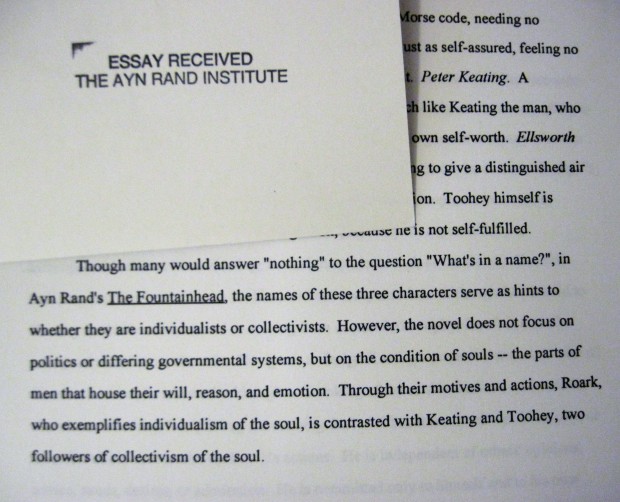
As a high school senior, I waded through Ayn Rand’s The Fountainhead to write an essay that won me an honorable mention, a point of interest on my college applications. Though I find it formulaic now, it’s a precursor to a career partially devoted to writing about books.
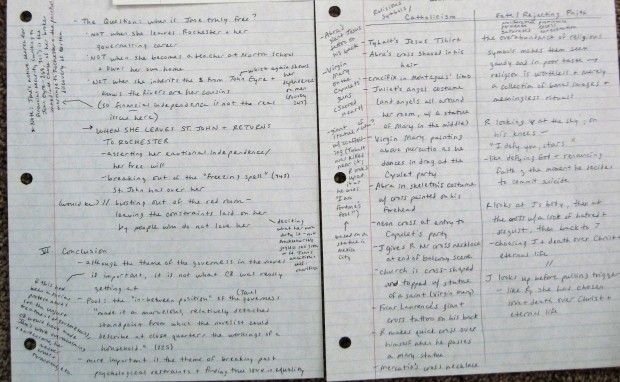
I planned my every college paper via incredibly detailed outlines. (I’m far too lazy to do this for book reviews now!) Can you work out what these essays were about?

As a college sophomore I wrote weekly essays in what looks like pretty flawless French. This one was an imagined interview with Charles Dickens and Thomas Hardy about the autobiographical and religious influences on their fiction.
Are you a list keeper? Do you have a personal ‘archive’?
How do you balance a healthy self-regard with working for the good of the world?
Three Review Books: Brian Kimberling, Jessica Pan & Francesca Segal
Three May–June releases: A fish-out-of-water comic novel about teaching English in Prague; and memoirs about acting like an extrovert and giving birth to premature twins.
Goulash by Brian Kimberling
 “Look where we are. East meets West. Communism meets capitalism.” In 1998 Elliott Black leaves Indiana behind for a couple of years to teach English in Prague. The opening sequence, in which he discovers that his stolen shoes have been incorporated into an art installation, is an appropriate introduction to a country where bizarre things happen. Elliott doesn’t work for a traditional language school; his students are more likely to be people he meets in the pub or tobacco company executives. Their quirky, deadpan conversations are the highlight of the book.
Elliott starts dating a fellow teacher from England, Amanda (she “looked like azaleas in May and she spoke like the BBC World Service”), who also works as a translator. They live together in an apartment they call Graceland. Much of this short novel is about their low-key, slightly odd adventures, together and separately, while the epilogue sees Elliott looking back at their relationship from many years later.
I was tickled by a number of the turns of phrase, but didn’t feel particularly engaged with the plot, which was inspired by Kimberling’s own experiences living in Prague. 
With thanks to Tinder Press for a proof copy to review.
Favorite passages:
“Sorrowful stories like airborne diseases made their way through the windows and under the doorframe, bubbled up like the bathtub drain. It was possible to fill Graceland with light and color and music and the smell of good food, and yet the flat was like a patient with some untreatable condition, and we got tired of palliative care.”
“‘It’s good to be out of Prague,’ he said. ‘Every inch drenched in blood and steeped in alchemy, with a whiff of Soviet body odor.’ ‘You should write for Lonely Planet,’ I said.”
Sorry I’m Late, I Didn’t Want to Come: An Introvert’s Year of Living Dangerously by Jessica Pan
 Like Jessica Pan, I’m a shy introvert (a “shintrovert”) as well as an American in the UK, so I was intrigued to see the strategies she employed and the experiences she sought out during a year of behaving like an extrovert. She forced herself to talk to strangers on the tube, give a talk at London’s Union Chapel as part of the Moth, use friendship apps to make new girlfriends, do stand-up comedy and improv, go to networking events, take a holiday to an unknown destination, eat magic mushrooms, and host a big Thanksgiving shindig.
Like Help Me!, which is a fairly similar year challenge book, it’s funny, conversational and compulsive reading that was perfect for me to be picking up and reading in chunks while I was traveling. Although I don’t think I’d copy any of Pan’s experiments – there’s definitely a cathartic element to reading this; if you’re also an introvert, you’ll feel nothing but relief that she’s done these things so you don’t have to – I can at least emulate her in initiating deeper conversations with friends and pushing myself to attend literary and networking events instead of just staying at home. 
With thanks to Doubleday UK for a proof copy to review.
Mother Ship by Francesca Segal
I’m a big fan of Segal’s novels, especially The Innocents, one of the loveliest debut novels of the last decade, so I was delighted to hear she was coming out with a health-themed memoir about giving birth to premature twins. Mother Ship is a visceral diary of the first eight weeks in the lives of her daughters, who were born by Caesarean section at 29 weeks in October 2015 and spent the next two months in the NICU, “an extremely well-funded prison or perhaps more accurately a high-tech zoo.”
Segal strives to come to terms with this unnatural start to motherhood. “Taking my unready daughters from within me felt not like a birth but an evisceration,” she writes; “my children do not appear to require mothering. Instead they need sophisticated medical intervention.” She describes with tender precision the feeling of being torn: between the second novel she’d been in the middle of writing and the all-consuming nature of early parenthood; and between her two girls (known for much of the book as “A-lette” and “B-lette”), who are at one point separated in different hospitals.

Spotted at Philadelphia airport.
As well as portraying her own state of mind, Segal crafts twinkly pen portraits of the others she encountered in the NICU, including the staff but especially her fellow preemie mums, who met in a “milking shed” where they pumped breast milk for the babies they were so afraid of losing that they resisted naming. (Though it was touch and go for a while, A-lette and B-lette finally earned the names Raffaella and Celeste and came home safely.) Female friendship is a subsidiary theme in this exploration of desperate love and helplessness. The layman’s look at the inside workings of medicine would have made this one of my current few favorites for next year’s Wellcome Book Prize (which, alas, is on hiatus). After encountering some unpleasant negativity about the NHS in a recent read, I was relieved to find that Segal’s outlook is pure gratitude.
With thanks to Chatto & Windus for the free copy for review.
Would you be interested in reading one or more of these?
America Reading & Book Haul, Etc.
The wedding of a college friend – who I calculated I’ve known at least half my life – was the excuse we needed to book a trip back to the States for the last two weeks of May. Along with the classy nuptials in the Fell’s Point area of Baltimore, we enjoyed a day’s sightseeing in Philadelphia, a couple of outings to watch birds and other wildlife on Cape May (a migration hotspot in New Jersey), two meet-ups with other friends, and plenty of relaxation time with my mom and sister, including a Memorial Day picnic at my mom’s retirement community and a tour of Antietam Battlefield. It was much hotter than anticipated, including some days in the high 80s or even 90s, and the hayfever, ticks and mosquitoes were bad, too, but we survived.


While back in Maryland I continued the intermittent downsizing process I’ve been going through for a while now. After being on the market for nearly a year, my family home finally sold and went to closing while we were over there. So that provided a scrap of closure, but my current estrangement from my father (we don’t even know where he’s living) means there’s a lot of continuing uncertainty.
In any case, I managed to reduce the number of boxes I’m storing with my sister from 29 to 20 by recycling lots of my old schoolwork, consolidating my mementos, reselling one box of books and donating another, donating a box of figurines and decorative bottles to a thrift store, displaying some at my mom’s place, giving away a few trinkets to a friend’s kids, and packing a bunch of stuff – photo albums and decorations as well as 64 books – in our various suitcases and hand luggage to take back to the UK.


And I also acquired more books, of course! A whopping 46 of these were free: eight review copies were waiting for me at my mom’s place; three were from the outdoor free bin at 2nd & Charles, a secondhand bookstore; one was found in a Little Free Library near our friends’ place in New Jersey (Emerald City by Jennifer Egan, not pictured); and the rest were from The Book Thing of Baltimore, a legendary volunteer-run free bookshop. I mostly raided the biography section for an excellent selection of women’s life writing; the fiction is unalphabetized so harder to find anything in, but I picked up a few novels, too. My only purchases were new (remainder) copies of one novel and one memoir from Dollar Tree. Total book spending on the trip: just $2.12.
What I Read:
Two that I’d already started but finished on the plane ride over:
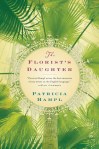 The Florist’s Daughter by Patricia Hampl: (As featured in my spring reading list.) “Love and flowers, death and flowers.” Poetic writing about small-town Minnesota life, a tense relationship with her late mother, and her late father’s flower shop.
 - The Girls by Lori Lansens: I love reading about sister relationships, and the Darlen girls’ situation is an extreme case of love and jealousy given that they literally can’t get away from each other. Not as good as the two other conjoined-twin novels I’ve read, Chang and Eng by Darin Strauss and Cutting for Stone by Abraham Verghese, but I would read more from Lansens, a solid Oprah Book Club sort of author.

Three review books that will be featuring here in the near future:
- Goulash by Brian Kimberling
- Sorry I’m Late, I Didn’t Want to Come: An Introvert’s Year of Living Dangerously by Jessica Pan
- Mother Ship by Francesca Segal
A few quick reads:
 A Certain Loneliness: A Memoir by Sandra Gail Lambert: (A proof copy passed on by an online book reviewing friend.) A memoir in 29 essays about living with the effects of severe polio. Most of the pieces were previously published in literary magazines. While not all are specifically about the author’s disability, the challenges of life in a wheelchair seep in whether she’s writing about managing a feminist bookstore or going on camping and kayaking adventures in Florida’s swamps. I was reminded at times of Constellations by Sinéad Gleeson.
  No Happy Endings: A Memoir by Nora McInerny: (Borrowed from my sister.) I didn’t appreciate this as much as the author’s first memoir, It’s Okay to Laugh, though it’s in the same style: lots of short, witty but bittersweet essays reflecting on life’s losses. Within a year of being widowed by cancer, she met a new partner and soon was – surprise! – pregnant with his baby. Together they formed a blended family of four children ranging from 0 to 15 and two wounded adults. McInerny also writes about her newfound spirituality and feminism. The problem with the essay format is that she cycles through aspects of the same stories multiple times.
  Native Guard by Natasha Trethewey: (Free from 2nd & Charles.) Trethewey writes beautifully disciplined verse about her mixed-race upbringing in Mississippi, her mother’s death and the South’s legacy of racial injustice. She occasionally rhymes, but more often employs forms that involve repeated lines or words. The title sequence concerns a black Civil War regiment in Louisiana. Two favorites from this Pulitzer-winning collection by a former U.S. poet laureate were “Letter” and “Miscegenation”; stand-out passages include “In my dream, / the ghost of history lies down beside me, // rolls over, pins me beneath a heavy arm” (from “Pilgrimage”) and “I return / to Mississippi, state that made a crime // of me — mulatto, half-breed” (from “South”).
 I also read the first half or more of: The Music Shop by Rachel Joyce, my June book club book; Hungry by Jeff Gordinier, a journalist’s travelogue of his foodie journeys with René Redzepi of Noma fame, coming out in July; and the brand-new novel In West Mills by De’Shawn Charles Winslow – these last two are for upcoming BookBrowse reviews.
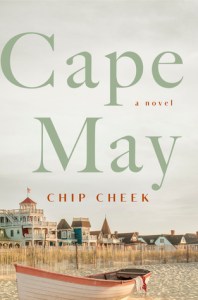
But the book I was most smug to have on my reading list for the trip was the recent novel Cape May by Chip Cheek. What could be more perfect for reading on location? I asked myself. Unfortunately, it stood out for the wrong reasons. In October 1957 a young pair of virgins, Effie and Henry, travel from Georgia to New Jersey for an off-season honeymoon in her uncle’s vacation home. They’re happy enough with each other but underwhelmed with the place (strangely, this matched my experience of Cape May), and even consider going home early until they fall in with Clara, a friend of Effie’s cousin; Clara’s lover, Max; and Max’s younger sister, Alma. Effie and Henry join the others for nightly drunken revelry.
[SPOILERS!] As the weeks pass Effie, ill and dejected, almost seems to disappear as Cheek delves into Henry’s besotted shenanigans, described in unnecessarily explicit sexual detail. When Effie makes a bid or two for her own sexual freedom late on, it only emphasizes the injustice of spending so much time foregrounding Henry’s perspective. Despite the strength of the period atmosphere and seaside location, this ends up being dull and dated. If you’re after a typically ‘trashy’ beach read and don’t mind lots of sex scenes, you may get on with it better than I did. 

Reading a few pages of Cape May over an ice-cold G&T at the wedding reception.
Bonus bookishness:
Vineland, New Jersey was on the way from our friends’ house to Cape May, so we stopped to take my proof copy of Barbara Kingsolver’s Unsheltered to its spiritual home. Alas, Vineland is an utterly boring small American town. However, Mary Treat at least appears on a painted mural on a building on the main street. The Historical Society, where Kingsolver did her research, was closed, but we photographed the outside.


What’s the last book you read ‘on location’? Did it work out well for you?
Plans for 20 Books of Summer

This is my second time taking part in Cathy’s 20 Books of Summer project. Once again I plan to focus solely on books that I own to try to get through a respectable number of them. For 2019 I’ve decided to read books that are about animals or have an animal in the title. I’ve set aside a few back-ups (the ones standing upright in the photos), and if I’m struggling I can cheat a bit by including books that happen to have an animal on the cover.


In the interest of statistics … last year I read eight nonfiction titles and 12 fiction – so that’s exactly what I’ve pulled out for this year. (For the record, I only intend to read the first of Updike’s Rabbit novels at this stage.) I have two re-reads set aside this time (Julian Barnes and Abigail Thomas) versus one last year. Last year I read one doorstopper; this year I don’t have any on the docket. In 2018 I was particularly proud of getting through two short story collections, so this year I’ve chosen one animal-themed one to read. Randomly, three of last year’s books were review copies from publishers or the author, and three were signed copies. This time I have none of either, unless I do some substituting.
Also interesting to note is that this year three of the books I’ve picked are by Canadian authors (André Alexis, Michael Crummey and Mary Lawson), and another has a Canadian setting (The Tenderness of Wolves). Canadian readers, rejoice!
Another project I might join in with this summer is the Robertson Davies reading week – I own his Deptford trilogy, and would at least read one of the books, if not attempt all three.
What are your summer reading plans?
The Amazing Adventures of Kavalier & Clay by Michael Chabon (Doorstopper of the Month)
Annabel and I did a buddy read of The Amazing Adventures of Kavalier & Clay by Michael Chabon; at 636 pages, it worked out to roughly 21 pages a day for the whole month of May. As I went along I summarized each day’s reading on Twitter, so to make things super-easy for myself, especially while I’m away in the States, I’ve put this post together as a collection of tweets.
There’s a lot of plot summary here, and perhaps some spoilers, so if you plan to read the novel you might not want to read too closely. I’ve set out my more general reactions in bold.
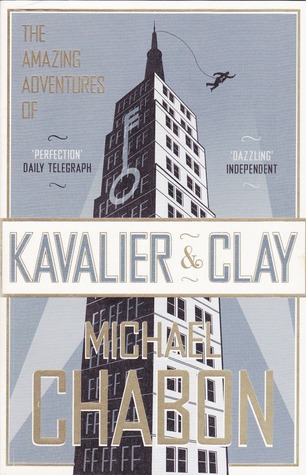
6:12 am – 1 May 2019
Kavalier & Clay, #1: Oct. 1939. Teen cousins Sam (American) and Josef (Czech) meet up in Brooklyn. Both dream of fame and fortune, Josef through drawing; Sam through any old scheme. Lots of ref’s to illusionists. Great adjectives and metaphors. Reminds me of The Invisible Bridge.
(Coincidentally, while I was at the Wellcome Collection yesterday I browsed their current exhibit on magic and illusions and there was a vintage Houdini poster advertising one of his famous escapes.)
K&C, #2: Flashback to Josef’s illusionist training under Bernard Kornblum c. 1935. Goaded by his little brother, Thomas, Josef practiced a Houdini-style underwater escape after jumping off a bridge tied up in a laundry bag. Disaster nearly ensued. Madcap and sobering all at once.
K&C, #3: Josef escapes Prague in a coffin housing a golem [animated humanoid figure made of clay]. He has a premonition of the horror to come for the Jews. Close shaves, but he makes it to Brooklyn — as we already know. Looking forward to getting back to NYC and Sam in Part II.
K&C, #4: Brief history of comics in America. Superman was a watershed in 1938. Sam pitches an idea to half-dressed boss Sheldon Anapol and shows Joe’s quick sketch of a golem-like hero. Though skeptical, he decides to give them the weekend to come up with a complete 12-page comic.
K&C, #5: Sam enlists the Glovsky brothers to work for him. We get the story of his late father, a vaudeville strong man named ‘The Mighty Molecule’. Joe breaks into locked premises with a flourish, inspiring The Escapist. Over 1/6 through! Hankering for a proper female character.
K&C, #6: Well, we got a female, Rosa Luxembourg Saks, but so far she hasn’t said a word and is only an object of the male gaze. J draws her nude for $3. My interest waned in Ch. 8 as S and J develop a backstory for The Escapist. He is to free the oppressed with his Golden Key.
K&C, #7: With 5 helpers, S&J pull all-nighters to piece together a 1st issue of Masked Men with mult. 12-pp stories. J draws the Escapist punching Hitler for the cover. Anapol makes them a good offer but wants a new cover. It’s a deal breaker; S&J walk out. Great period dialogue.
K&C, #8: Part III, Oct. 1940. Empire Comics is a phenomenon. Anapol is now so rich he bought a house in FL. Joe toils away at his violent, audacious scenes and pesters the German consulate re: his family. After some bad news, he decides to move to Montreal so he can join the RAF.
K&C, #9: Joe has 2nd thoughts re: RAF. He now seems to cross paths with every pugilistic German in the city. He stumbles on the offices of the “Aryan-American League,” breaks in and learns that he has in Carl Ebling a fan in spite of himself. Sure I’ve heard that name before…
K&C, #10: Joe is so confident a ‘bomb’ on 25th fl. of Empire State Bldg is a bluff by his nemesis, Ebling, that he chains himself to his desk to keep working. S&J realize how foolish it was to sell rights to the Escapist: they won’t make a penny on the upcoming radio adaptation.
K&C, #11: S&J attend a party at which Salvador Dali is in a breathing apparatus. Rosa reappears, saying the F word. She’s empathetic re: J’s family. J plays the hero and saves Dali when he runs out of oxygen. Rosa invites him up to see her paintings (not a euphemism — I think!).
K&C, #12 (catch-up): Rosa paints still lifes and has a room full of moths, a sort of family plague. She sets Joe’s dislocated finger and, via her work for the Transatlantic Rescue Agency, may be able to help him save his brother. They share a kiss before Sam interrupts them.
K&C, #13: Rosa’s boss agrees to help Joe if he pays 3x the regular fare for Thomas … and is the magician for his son’s bar mitzvah. Joe’s new idea for a sexy female superhero is inspired by a Luna moth. He and Sam try to bargain for a greater share of the rights to their work.
K&C, #14-15 (somehow got ahead!): 1941. S&J so rich they don’t know what to do with the $. Sharing apt. with Rosa, who keeps trying to find S a girlfriend. J is performing magic at parties; S is writing a novel, takes a radio actor auditioning for Escapist home to Shabbos dinner.
Some general thoughts at the halfway point, while I’m ahead: delighted to have a solid female character in Rosa, and more interiority with Sam in Part IV. (There are also intriguing hints about his sexuality.) Chabon is an exuberant writer; the novel could definitely be shorter.
K&C, #16: Joe is carrying around an unopened letter from his mother. At one of his bar mitzvah magician gigs, Ebling attacks him with an explosive and both incur minor injuries. The letter mysteriously disappears…
K&C, #17: Sam is a volunteer plane spotter for the war effort, giving him a vantage point high above NYC. Actor Tracy Bacon surprises him by joining him up there at 1 a.m. one day. Literal sparks fly.
K&C, #18: Sam meets Orson Welles, whose “Citizen Kane” is a huge influence on the lads’ work — they want to write for adults more than kids now. Tracy accompanies Sam to his favorite place in NYC: the site of the former World’s Fair. (Traveling tomorrow but will catch up soon.)
Sigh. I hugely lost momentum after we arrived in the States on Sunday. I’ve caught up, but (confession time) have had to do a lot of skimming. I find the dialogue a lot more engaging than the expository prose, unfortunately.
K&C #19-25: Awful news about the ship bearing Joe’s brother. Both Joe and Rosa decide to take drastic action. Carl Ebling is imprisoned for 12 years for the bar mitzvah bombing. J is stationed near the Antarctic as a radioman. JUMP to 1954, with S raising a 12yo kid named Tommy.
K&C, #26: We realize Sam and Rosa have formed an unusual family with her child Tommy, who’s learning magic tricks from Joe, who makes a failed jump…
K&C wrap-up: Joe’s living in the Empire State Building, writing a novel about a golem. Anapol kills off the Escapist. In ’54, Sam appears at a televised hearing about whether comic books create delinquents. He decides to start over in CA, leaving Joe, Rosa and Tommy a family of 3
K&C wrap-up (cont.): I did occasional skimming starting at ~p. 120 and mostly skimmed from p. 400 onwards, so I’ve marked the whole thing as ‘skimmed’ rather than ‘read’. Slightly disappointed with myself for lacking staying power, but I do think the book overlong.
The action should have been condensed, rather than sprawling over 15 years. I often lost patience with the expository prose and wanted more scenes and dialogue. It took too long for Rosa to appear, and too long to get initiated into Sam’s private life.
However, Chabon does have some wonderful turns of phrase. Here’s a few faves. “The view out the windows was pure cloud bank, a gray woolen sock pulled down over the top of the building.”
“Orderly or chaotic, well inventoried and civil or jumbled and squabbling, the Jews of Prague were dust on the boots of the Germans, to be whisked off with an indiscriminate broom.”
“Sammy felt that he was standing on the border of something wonderful, a land where wild cataracts of money and the racing river of his own imagination would, at last, lift his makeshift little raft and carry it out to the boundless freedom of the open sea.”
My favorite passage of all: “Dinner was a fur muff, a dozen clothespins, and some old dish towels boiled up with carrots. The fact that the meal was served with a bottle of prepared horseradish enabled Sammy to conclude that it was intended to pass for braised short ribs of beef”
I also discovered that Chabon coined a word in the novel: “aetataureate,” meaning related to a golden age. It’s a good indication of the overall tone.
My rating:
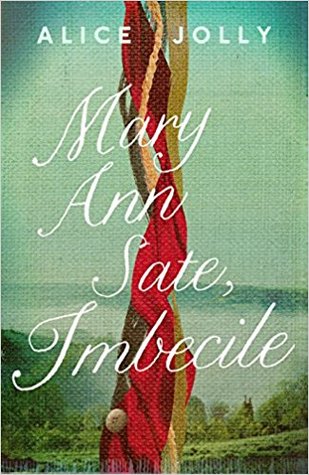 The other doorstopper I finished reading this month was Mary Ann Sate, Imbecile by Alice Jolly, which I reviewed for Nudge. I had heard about this Unbound release before, but my interest was redoubled by its shortlisting for the Rathbones Folio Prize and the RSL Ondaatje Prize. Although I was initially intimidated by the heft of the 600+-page hardback that came through my door for review, I found that I could easily settle into the rhythm and – provided I had no distractions – read 40 or 50 pages of it at a sitting.
As an elderly woman in Gloucestershire in the 1880s, Mary Ann Sate looks back at the events of the 1820s and 1830s, a time of social turmoil and upheaval in the family for whom she worked as a servant. Writing is a compulsion and a form of confession for her. The book has no punctuation, not even apostrophes, and biblical allusions, spelling errors, archaisms and local pronunciation (such as “winder” for window and “zummer” for summer) make it feel absolutely true to the time period and to the narrator’s semi-literate status.
There are no rhymes in this free verse epic, but occasionally Mary Ann comes out with some alliteration, perhaps incidental, or particularly poetic lines (“The road ahead unravel / Like a spool of canary thread / Taking me always away”) that testify to her gifts for storytelling and language, even though she made her living by manual labor for some seven decades.
The manner of the telling makes this a unique work of historical fiction, slightly challenging but very worthwhile. I would particularly recommend it to fans of Jane Harris’s The Observations.
My rating:
Next month’s plan: The Stillness The Dancing by Wendy Perriam, passed on to me by Liz Dexter.
Re-Reading Modern Classics: Fiction Advocate’s “Afterwords” Series
I didn’t manage a traditional classic this month: I stalled on Cider with Rosie and gave up on Evelyn Waugh’s A Handful of Dust after just 16 pages. Instead, I’m highlighting three books from Fiction Advocate’s new series about re-reading modern classics, “…Afterwords.” Their tagline is “Essential Readings of the New Canon,” and the concept is to have “acclaimed writers investigate the contemporary classics.”
As Italo Calvino notes in his invaluable essay “Why Read the Classics?”, “The classics are those books about which you usually hear people saying: ‘I’m rereading…’, never ‘I’m reading…’.” Harold Bloom agrees in The Western Canon: “One ancient test for the canonical remains fiercely valid: unless it demands rereading, the work does not qualify.” But readers will also encounter books that strike such a chord with them that they become personal classics. Calvino exhorts readers that “during unenforced reading … you will come across the book which will become ‘your’ book…‘Your’ classic is a book to which you cannot remain indifferent, and which helps you define yourself in relation or even in opposition to it.”
For the Afterwords series, the three writers below have each chosen a modern classic that they can’t stop reading for all it has to say to their own situation and on humanity in general.
I Meant to Kill Ye: Cormac McCarthy’s Blood Meridian by Stephanie Reents (2018)
Blood Meridian must be one of the two or three bleakest books I’ve ever read. I was led to it by Bloom, who speaks about it as a, if not the, Great American Novel. It’s over 10 years since I’ve read it now, but I still remember some of the specific incidences of violence, like skewering babies and sodomizing corpses on a battlefield, as well as the overall feeling of nihilism: there’s no reason for the evil promulgated by characters like the Judge; it is simply a reality – perhaps the human condition.
 Reents, who teaches English at the College of the Holy Cross, returns to Blood Meridian, a novel she has re-read compulsively over the years, to ask why it continues to have such a hold over her. Its third-person perspective is so distant that we never understand characters’ motivations or glimpse their inner lives, she notes; everyone seems like a pawn in a fated course. She usually shies away from violence and long descriptive passages; she has an uneasy relationship with the West, having moved away from Idaho to live on the East coast. So why should this detached, brutal Western based on the Glanton Gang’s Mexico/Texas killing spree have so captivated her? “Often, we most admire the books that we could never produce, the writing styles or intellects so different from our own that we aren’t even tempted to try imitating them,” she offers as explanation. “It’s a pure kind of admiration, unsullied by envy.” (I feel that way about Faulkner and Steinbeck.)
As part of her quest, Reents recreated some of the Gang’s desert route and traveled to the Texas State University library near Austin to look at McCarthy’s early drafts, notes and correspondence. She was intrigued to learn that the Kid was a more conventional POV character to start with, and McCarthy initially included more foreshadowing. By cutting all of it, he made it so that the book’s extreme violence comes out of nowhere. Reents also explores the historical basis for the story via General Samuel Chamberlain’s dubious memoir. Pondering the volatility of the human heart as she drives along the Mexican border, she ends on the nicely timely note of a threatened Trump-built wall. I doubt I could stomach reading Blood Meridian again (though I’ve read another two McCarthy novels since), but I enjoyed revisiting it with Reents as she finds herself “re-bewildered by its beauty and horror.”
A Little in Love with Everyone: Alison Bechdel’s Fun Home by Genevieve Hudson (2018)
Alison Bechdel is one of Hudson’s queer heroes (along with James Baldwin, Tracy Chapman, and seven others), portrayed opposite the first page of each chapter in black and white drawings by Pace Taylor – the sort of people who gave her the courage to accept her lesbian identity after a conventional Alabama upbringing.
 As portrayed in her landmark graphic memoir Fun Home, Bechdel was in college and finally coming to terms with her sexuality at the same time that she learned that her father was gay and her parents were about to divorce. Her father died in an accident just a few months later and, though he had many affairs, had never managed to live out his homosexuality openly. As Bechdel’s mother scoffed, “Your father tell the truth? Please!” By contrast, Hudson appreciates Bechdel so much because of her hard-won honesty: “In her work, Bechdel does the opposite of lying. She excavates the real. She dredges up the stuff of her life, embarrassing parts and all.”
Hudson looks at how people craft their own coming-out narratives, the importance of which cannot be overemphasized, in her experience. “Coming out was a tangible thing with tangible effects. For every friend who left my life, a new person arrived—usually someone with broader horizons, exciting stories, and a deviance that seemed sweet and sexy and sincere. After I came out, roaming the streets of Charleston in fat sunglasses and thin dresses, a group of beautiful lesbians appeared out of nowhere. … Everyone was a little in love with everyone.”
A Cool Customer: Joan Didion’s The Year of Magical Thinking by Jacob Bacharach (2018)
 I made the mistake of not taking any notes on, or even marking out any favorite passages in, this, so all I can tell you is that for me it was the most powerful of the three I’ve tried from the series. The author re-examines Didion’s work in the light of his own encounter with loss – his brother’s death from a drug overdose – and ponders why it has become such a watershed in bereavement literature. Didion really is the patron saint of grief thanks to her two memoirs, Magical Thinking and Blue Nights – after she was widowed she also lost her only daughter – even though she writes with a sort of intellectual detachment; you have to intuit the emotion between the lines. Bacharach smartly weaves his family story with a literate discussion of Didion’s narratives and cultural position to make a snappy and inviting book you could easily read in one sitting.
Indeed, all of the Afterwords books are 120–160-page, small-format paperbacks that would handily slip into a pocket or purse.
My thanks to the publisher for the free copies for review.
The other titles in the series are An Oasis of Horror in a Desert of Boredom by Jonathan Russell Clark (on 2666 by Roberto Bolaño), New Uses for Failure by Adam Colman (on 10:04 by Ben Lerner, and Bizarro Worlds by Stacie Williams (on The Fortress of Solitude by Jonathan Lethem).
Next month’s plan: The Leopard by Giuseppe di Lampedusa will be my classic to get me in the mood for traveling to Italy for the first week of July.
Library Checkout: May 2019
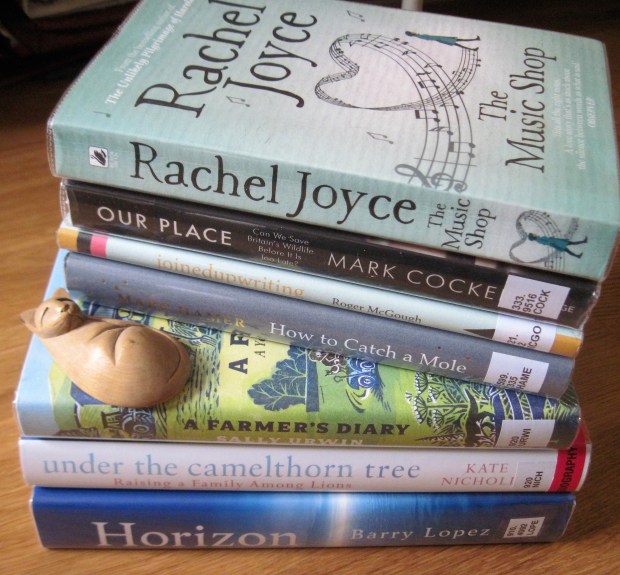
A more modest library reading month for me as we were off to America midway through – I’ve taken the Chabon with me to finish off by the 31st for my Doorstopper of the Month post, but my 15 holds are suspended until we come back. I give links to reviews of any books that I haven’t already featured on the blog in some way, and ratings for all.

What have you been reading from your local library? I don’t have an official link-up system, so please just pop a link to your blog in the comments if you’ve taken part in Library Checkout this month. Feel free to use this image in your post.
LIBRARY BOOKS READ
- Jesus’ Son by Denis Johnson
- Machines Like Me by Ian McEwan
- I’ll Be Gone in the Dark: One Woman’s Obsessive Search for the Golden State Killer by Michelle McNamara
- The Butcher’s Hands [poetry] by Catherine Smith
- A Farmer’s Diary: A Year at High House Farm by Sally Urwin
SKIMMED
- Horizon by Barry Lopez
CURRENTLY READING
- The Amazing Adventures of Kavalier and Clay by Michael Chabon
(Set aside temporarily)
- An Angel at My Table by Janet Frame
- A Pocket Mirror by Janet Frame
- The Crossway by Guy Stagg

CURRENTLY SKIMMING
- The Seasons, a Faber & Faber / BBC Radio 4 poetry anthology
CHECKED OUT, TO BE READ
- Stroke: A 5% Chance of Survival by Ricky Monahan Brown
- Our Place: Can We Save Britain’s Wildlife before It Is Too Late? by Mark Cocker
- How to Catch a Mole and Find Yourself in Nature by Marc Hamer
- The Music Shop by Rachel Joyce
- Because: A Lyric Memoir by Joshua Mensch
- Under the Camelthorn Tree: Raising a Family among Lions by Kate Nicholls
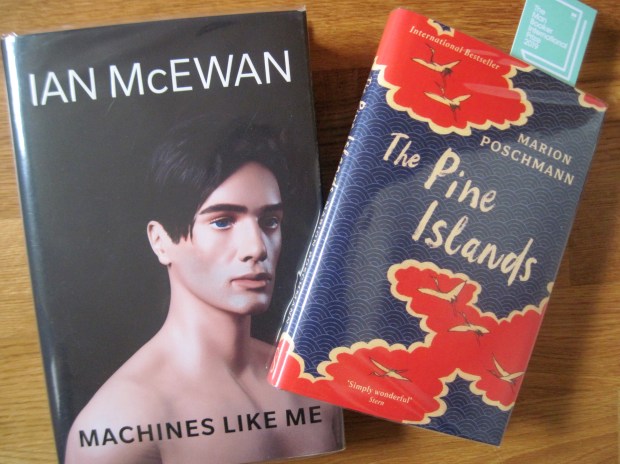
- The Pine Islands by Marion Poschmann
- The Lost Properties of Love: An Exhibition of Myself by Sophie Ratcliffe
IN THE RESERVATION QUEUE
- On the Marsh: A Year Surrounded by Wildness and Wet by Simon Barnes
- How Do You Like Me Now? by Holly Bourne
- Queenie by Candice Carty-Williams
- How to Treat People: A Nurse’s Notes by Molly Case
- How to Fail: Everything I’ve Ever Learned from Things Going Wrong by Elizabeth Day
- The Years by Annie Ernaux
- City of Girls by Elizabeth Gilbert
- Once More We Saw Stars by Jayson Greene
- Lowborn: Growing Up, Getting Away and Returning to Britain’s Poorest Towns by Kerry Hudson
- The Doll Factory by Elizabeth Macneal
- The Electricity of Every Living Thing: One Woman’s Walk with Asperger’s by Katherine May
- The Wild Remedy: How Nature Mends Us: A Diary by Emma Mitchell
- Convenience Store Woman by Sayaka Murata
- Feel Free: Essays by Zadie Smith
- Frankisstein: A Love Story by Jeanette Winterson
RETURNED UNREAD
- Joinedupwriting by Roger McGough (lost interest)
- First Time Ever by Peggy Seeger (requested after me; I’ll try again sometime)
Does anything appeal from my stacks?
Two New Bookish Volunteering Ventures
Working from home, I don’t get out or see other people nearly often enough, so any time I think of a way that I can get more human interaction while contributing to a worthy cause – like spreading the love of reading – it’s worth seizing.
I don’t know what it’s like where you live, but here in our town there are tons of empty storefronts on the main street and in the mall, which makes everything feel half-derelict. The Global Educational Trust was donated a shop space in my local mall and set up a free bookshop that has since been taken over by Fair Close Centre, a non-residential center where the elderly can socialize and take advantage of hot meals and other services. The shop creates awareness of Fair Close and what it has to offer, and also promotes reading and lifelong learning.
I volunteered late last year when it was first being set up, and for the past few weeks I’ve been putting in two hours every Friday afternoon. Did I mention it’s full of free books!? This is kind of a problem for someone who already has a house full of books plus boxes of them in storage back in America. (But not really a problem.) The first time I was there I scored eight books; on four subsequent visits I’ve both donated and acquired books, sometimes in unhelpful ratios. Seven given versus two taken: excellent! Two donated and nine acquired: not so good. Six out; three in: A-OK. This past Friday I broke even with four of each.


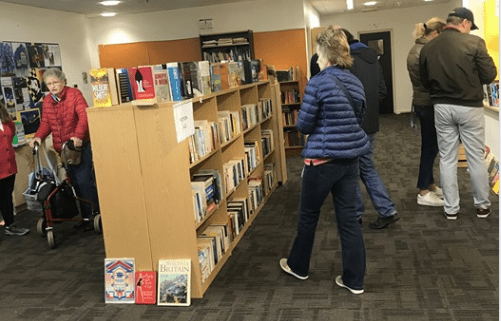
We’re making do with insufficient shelving, whatever we’ve been able to scrounge from going-out-of-business shops, etc., so the categories are not very precise yet. Most of my work so far has been rearranging the central area for fiction (someone thought it was a good idea to have the alphabetical sequence going across the four bays of shelves, rather than from top to bottom in one case and then on to the next one to the right, as is the custom in any library or bookstore!) and pulling out all the nonfiction that snuck in. You often see this in charity shops: people who don’t know much about books end up shelving memoirs, travel books and history in with the fiction. In this photo you can see evidence of my tidying in fiction, A–F.
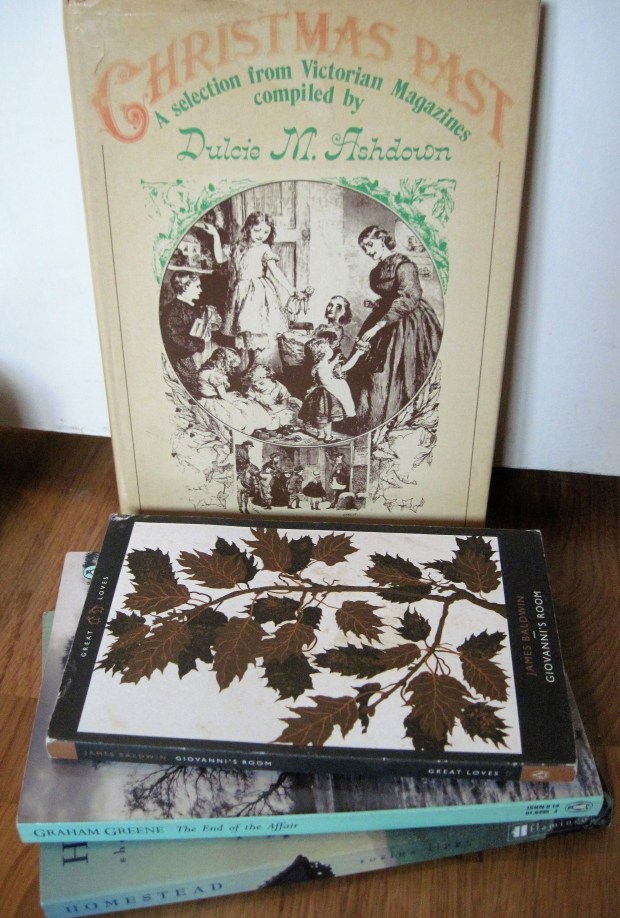
The other project I’ve been working on lately, though it’s still very much in the planning stages, is a theological lending library at my church. This was prompted by me looking through our shelves of religion books and deciding that there were upwards of 20 books that we would likely never read again/ever but that others might find edifying. In the end I pulled out 36 books to donate, ranging in outlook from C.S. Lewis to Rob Bell. I’m also aware that my mother-in-law, who’s retiring from ministry this year, will likely shed many theology books when they downsize to leave the rectory, and there are various retired clergy members in our church who might have books to pass on. So I had a meeting with our vicar last week to talk through some ideas about where we might house a library and how the system might work.
For now we plan to trial a pop-up library in the cloisters in mid-July, advertised via the notice sheet in early June. In the weeks leading up to it, we’ll accept book donations to a box at the back of the church (and reserve the right to jettison books that seem dated or unhelpful!). The lending will be on an honesty system, with people writing their name and the book title(s) in a ledger. We’ll suggest that books borrowed at the pop-up in mid-July could be returned in early September, though keeping them out longer wouldn’t be a problem. Nor, for that matter, would it be a problem if some books never make it back to the shelves – we’d like to hope they’ll be helpful to people.
The only other equipment to get hold of now is a set of bookplates with the church logo. As to how to classify the books, I may well model our system on this one. I know I’ll have fun cataloguing the books and affixing spine labels and bookplates. It’ll be like my library assistant days all over again – except just the fun working-with-books bit and not the babysitting-students bit.
 Bookish Beck = Rebecca Foster. American transplant to England. Freelance proofreader and book reviewer.
 Bookish Beck