Two Memoirs of Women’s Freedom: Lara Feigel and Rebecca Loncraine
I have read some truly phenomenal memoirs this year, most of them by women. These two have rather different starting points – frustration with the constraints of marriage and motherhood, and breast cancer treatment – but I’ve paired them because both are journeys of self-discovery in which the author commits to determining how to live a free and true life.
Free Woman: Life, Liberation and Doris Lessing by Lara Feigel
 It started with a spate of weddings one summer. Lara Feigel, a literature lecturer at King’s College London, found herself strangely irked at all this capitulation to marital convention, even though she herself had married in her twenties and had a young son. What did her mild outrage signify? At the same time, she was rereading the works of Doris Lessing, whom she found simultaneously admirable and vexing: Lessing lived by her ideals of free love and Communism, but it came at the price of abandoning her children. Feigel could identify with Lessing in some ways but not in others, and as she entered a rocky time in her mid-thirties – a miscarriage followed by IVF, which was a strain on her marriage; the death of a close friend; and ongoing worry over how motherhood might affect her academic career – she set out to find what Lessing could teach her about how to be free.
Throughout, Feigel holds up her own experiences of marriage and motherhood in parallel to Lessing’s. She maintains a delicate balance between biographical and autobiographical information and brings in references to other writers – everyone from Rachel Cusk to D.H. Lawrence – to explore various opinions on maternal ambivalence and sexual fulfillment. I could relate to the bookworm’s impulse to turn to literature for comfort and direction – “the most enduring novelists … illuminate our lives,” and “we live differently as a result of reading them,” Feigel insists. Lessing seemed to her the perfect “writer to discover in your thirties; a writer who wrote about the lives of grown-up women with an honesty and fullness I had not found in any novelist before or since.”
And yet a familiarity with or fondness of the works of Doris Lessing is not a prerequisite to enjoying this book. I’ve only ever read The Golden Notebook (1962) and Alfred and Emily (2008), a fictionalized biography of Lessing’s parents, both during my mid-twenties. The former I almost certainly read before I could fully appreciate it. It’s about the ways in which women compartmentalize their lives and the struggle to bring various strands into harmony; that’s what Free Woman is all about as well. Feigel often looks for clues in Lessing’s heavily autobiographical Martha Quest novels, which I’d like to read, and also travels to California to meet one of Lessing’s lovers and to Zimbabwe to see the farm where Lessing grew up.
Like Samantha Ellis’s How to Be a Heroine and Rebecca Mead’s My Life in Middlemarch, this is a richly satisfying hybrid of biography, literary criticism and memoir. I would also recommend it to readers of Alexandra Fuller’s Don’t Let’s Go to the Dogs Tonight, Nancy Horan’s Loving Frank, and Adrienne Rich’s Of Woman Born. Feigel’s is a particularly brave and forthright book. I feel proud of her in an oddly personal way: during my years as a library assistant at King’s, I saw her chair countless literature and life writing events. She seemed impossibly young for a professor type, and wore her navy blue shift dress and string of pearls like it was her grown-up’s uniform. I can tell that the years since, including the difficult experiences she recounts here, have both softened and toughened her, sandpapering away what she calls her “diffident angularity” and replacing it with womanly wisdom.
My rating: 
Free Woman was published by Bloomsbury UK on March 8th. My thanks to the publisher for the free copy for review.
Skybound: A Journey in Flight by Rebecca Loncraine
 In 2016 it was When Breath Becomes Air by Paul Kalanithi; in 2017 it was The Bright Hour by Nina Riggs. And now Skybound. Each year seems to bring one exquisite posthumous memoir about facing a death from cancer with dignity. For Rebecca Loncraine, after treatment for breast cancer in her early thirties, taking flying lessons in an unpowered glider was her way of rediscovering joy and experiencing freedom by facing her fears in the sky.
She was a freelance writer based on her parents’ farm in the Black Mountains of Wales, an area that’s familiar to me from trips to Hay-on-Wye and from my reading of Bruce Chatwin’s On the Black Hill. The history and geography of the region, as revealed from the air, weave through the book, as do childhood memories and recollections of chemotherapy. Loncraine discovered a particular love for flying alongside birds: the red kites in Wales, and later vultures in Nepal. The most remarkable passages of the book are the exhilarating descriptions of being thousands of feet up in the air and the reflections on why humans are drawn to flight and what it does for our bodies and spirits. She learned from a British Airways pilot that 500,000 people are airborne at any one moment! We take for granted what should still be acknowledged as a miraculous feat.
“There’s no road in the sky. Each individual glider pilot finds a new pathless way through the air, a unique scribble. We locate a bit of ridge lift, here; fly out to a thermal, there; we wind and manoeuvre over the curving land. We never take the same route twice, so flight offers me a new perspective each time I fly.”
“Influenced by the ancient seam of human thought that associates the sky with the imagination, weaving and circling in the sky begins to feel like sailing through the realm of the subconscious itself.”
This hobby-turned-obsession was not without its inconveniences and dangers. Even when it’s warm at ground level it’s frigid at 13,000 feet, so you have to bundle up. Meanwhile, the strength of the sun means you keep guzzling water and have to wear either a urine-collecting device or adult diapers. The earliest attempts at unpowered flight were generally fatal, and when Loncraine went to New Zealand for a bonus season of flying to replace the Welsh winter, one of her fellow flyers died in a crash. Her instructor told her she’d become fearless, even reckless. But when she met one of the pioneers of gliding, then in his nineties, in New Zealand he spoke an aphorism that perfectly captures the role flying played for Loncraine: “The antidote to fear is fascination.”
There’s a brief afterword by Loncraine’s mother, Trisha. Her daughter had virtually finished this manuscript when the cancer returned, and underwent another 14 grueling months of treatment before her death in September 2016. This is a simply wonderful book; what a shame that we won’t get another.
My rating: 
Skybound was published by Picador on April 19th. My thanks to the publisher for a proof copy for review.
Mini-Reviews of Three Recent Releases: Chariandy, Dean & Tallack
Brother by David Chariandy
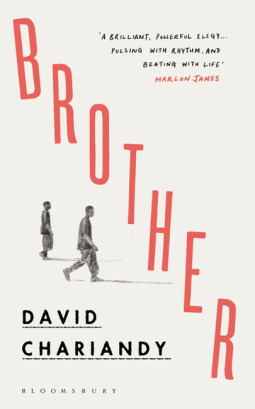 Canadian author David Chariandy’s second novel was longlisted for the Giller Prize and won the Rogers Writers’ Trust Fiction Prize. Narrator Michael and his older brother Francis grew up in the early 1980s in The Park, a slightly dodgy area of Toronto. Their single mother, Ruth, is a Trinidadian immigrant who worked long shifts as a cleaner to support the family after their father left early on. From the first pages we know that Francis is an absence, but don’t find out why until nearly the end of the book. The short novel is split between the present, as Michael and Ruth try to proceed with normal life, and vignettes from the past, culminating in the incident that took Francis from them 10 years ago.
The title is literal, of course, but also street slang for friends or comrades. Michael looked up to street-smart Francis, who fell in with a gang of “losers and neighbourhood schemers” and got expelled from school at age 18. Francis tried to teach his little brother how to carry himself: “You’ve got to be cooler about things, and not put everything out on your face all the time.” Yet the more we hear about Francis staying with friends at a barber shop and getting involved with preparations for a local rap DJ competition, the more his ideal of aloof masculinity starts to sound ironic, if not downright false.
I came into the book with pretty much no idea of what it was about. It didn’t fit my narrow expectations of Canadian fiction (sweeping prairie stories or hip city ones); instead, it reminded me of The Corner by David Simon, We, the Animals by Justin Torres, and Another Day in the Death of America by Gary Younge. It undoubtedly gives a powerful picture of immigrant poverty and complicated grief. Yet the measured prose somehow left me cold.
My rating: 
Brother was published in the UK by Bloomsbury on March 8th. My thanks to the publisher for the free copy for review.
Sharp by Michelle Dean
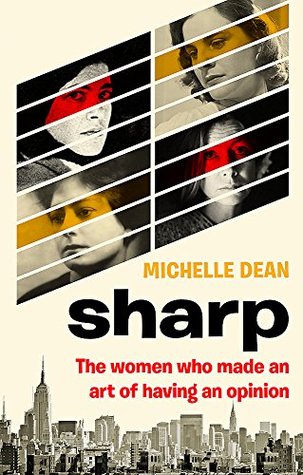 “People have trouble with women who aren’t ‘nice,’ … who have the courage to sometimes be wrong in public.” In compiling 10 mini-biographies of twentieth-century women writers and cultural critics who weren’t afraid to be unpopular, Dean (herself a literary critic) celebrates their feminist achievements and insists “even now … we still need more women like this.” Her subjects include Rebecca West, Mary McCarthy, Susan Sontag, Joan Didion, Nora Ephron and Renata Adler. She draws on the women’s correspondence and published works as well as biographies to craft concise portraits of their personal and professional lives.
You’ll get the most out of this book if a) you know nothing about these women and experience this as a taster session; or b) you’re already interested in at least a few of them and are keen to learn more. I found the Dorothy Parker and Hannah Arendt chapters most interesting because, though I was familiar with their names, I knew very little about their lives or works. Parker’s writing was pulled from a slush pile in 1914 and she soon replaced P.G. Wodehouse as Vanity Fair’s drama critic. Her famous zingers masked her sadness over her dead parents and addict husband. “This was her gift,” Dean writes: “to shave complex emotions down to a witticism that hints at bitterness without wearing it on the surface.”
Unfortunately, such perceptive lines are few and far between, and the book as a whole lacks a thesis. Chance meetings between figures sometimes provide transitions, but the short linking chapters are oddly disruptive. In one, by arguing that Zora Neale Hurston would have done a better job covering a lynching than Rebecca West, Dean only draws attention to the homogeneity of her subjects: all white and middle-class; mostly Jewish New Yorkers. I knew too much about Sontag and Didion to find their chapters interesting, but enjoyed reading more about Ephron. I’ll keep the book to refer back to when I finally get around to reading Mary McCarthy. It has a terrific premise, but I found myself asking what the point was.
My rating: 
Sharp was published in the UK by Fleet on May 3rd. My thanks to the publisher for a proof copy for review.
The Valley at the Centre of the World by Malachy Tallack
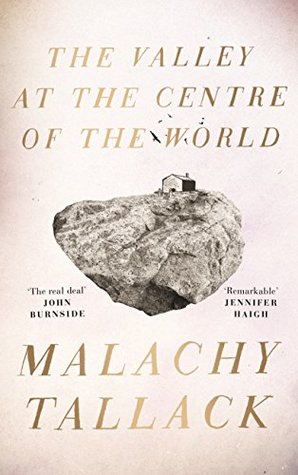 I’d previously enjoyed Malachy Tallack’s two nonfiction books, Sixty Degrees North and The Undiscovered Islands. In his debut novel he returns to Shetland, where he spent some of his growing-up and early adult years, to sketch out a small community and the changes it undergoes over about ten months. Sandy has lived in this valley for three years with Emma, but she left him the day before the action opens. Unsure what to do now, he sticks around to help her father, David, butcher the lambs. After their 90-year-old neighbor, Maggie, dies, Sandy takes over her croft. Other valley residents include Ryan and Jo, a troubled young couple; Terry, a single dad; and Alice, who moved here after her husband’s death and is writing a human and natural history of the place, The Valley at the Centre of the World. (This strand reminded me of Annalena McAfee’s Hame.)
The prose is reminiscent of the American plain-speaking style of books set in the South or Appalachia – Richard Ford, Walker Percy, Ron Rash and the like. We dive deep into this tight-knit community and its secrets. It’s an offbeat blend of primitive and modern: the minimalism of the crofting life contrasts with the global reach of Facebook, for instance. When Ryan and Jo host a housewarming party, all the characters are brought together at about the halfway point, and some relationships start to shift. Overall, though, this is a slow and meandering story. Don’t expect any huge happenings, just some touching reunions and terrific scenes of manual labor. David is my favorite character, an almost biblical patriarch who seems “to live in a kind of eternal present, looking neither forward nor backward but always, somehow, towards the land.”
Tallack has taken a risk by writing in phonetic Shetland dialect. David’s speech is particularly impenetrable. The dialect does rather intrude; the expository passages are a relief. I’ve been to Shetland once, in 2006. This quiet story of belonging versus being an outsider is one to reread there some years down the line: I reckon I’d appreciate it more on location.
My rating: 
The Valley at the Centre of the World was published by Canongate on May 3rd. My thanks to the publisher for the free copy for review.
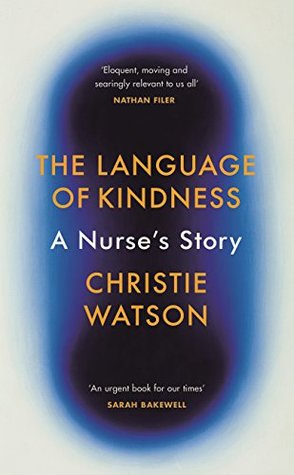
The Language of Kindness: A Nurse’s Story by Christie Watson
After all that Wellcome Book Prize reading, I’ve given myself a break from the medical reads, right? No way! I’m already eagerly looking out for hopefuls for next year’s prize – I’ve amassed quite a nice little pile – and this is a particularly strong candidate, based on the 20 years that Watson spent as a nurse in England’s health system before leaving to write full-time. (Her debut, Tiny Sunbirds Far Away, won the Costa First Novel Award in 2011; she followed it up with Where Women Are Kings in 2013.) It taps into the widespread feeling that medicine is in desperate need of a good dose of compassion, and will ring true for anyone who spends time in hospitals, whether as a patient or a carer.
 Watson presents her book as a roughly chronological tour through the stages of nursing – from pediatrics through to elderly care and the tending to dead bodies – but also through her own career, as she grows from a seventeen-year-old trainee who’s squeamish about blood to a broadly experienced nurse who can hardly be fazed by anything. The first chapter is set up like a tour of the hospital, describing everything she sees and hears as she makes her way up to her office, and the final chapter takes place on her very last day as a nurse, when, faced with a laboring mother in a taxi, she has to deliver the baby right there in the carpark.
In between we hear a series of vivid stories that veer between heartwarming and desperately sad. Watson sees children given a second shot at life. Aaron gets a heart–lung transplant to treat his cystic fibrosis and two-year-old Charlotte bounces back from sepsis – though with prosthetic limbs. But she also sees the ones who won’t get better: Tia, a little girl with a brain tumor; Mahesh, who has muscular dystrophy and relies on a breathing tube; and Jasmin, who is brought to the hospital after a house fire but doesn’t survive for long. She dies in the nurses’ arms as they’re washing the smoke smell out of her hair.
Although Watson specialized in children’s intensive care nursing, she trained in all branches of nursing, so we follow her into the delivery room, mental health ward, and operating theatre. As in Maggie O’Farrell’s I Am, I Am, I Am, we learn about her links to hospitals over the years, starting with her memories of being nursed as a child. She met her former partner, a consultant, at the hospital; they had a child together and adopted another before splitting 12 years later. And as her father was dying of lung cancer, she developed a new appreciation for what nurses do as she observed the dedicated care he received from his hospice nurse. She characterizes nursing as a career that requires great energy, skill and emotional intelligence, “that demands a chunk of your soul on a daily basis,” yet is all too often undervalued.

(The superior American cover.)
For me the weakest sections of Watson’s book are the snippets of history about hospitals and the development of the theory and philosophy of nursing. These insertions feel a little awkward and break up the flow of personal disclosure. The same applies to the occasional parenthetical phrase that seems to talk down to the reader, such as “women now receive medical help (IVF) to have their babies” and “obstetricians (doctors) run the show.” Footnotes or endnotes connected to a short glossary might have been a less obtrusive way of adding such explanatory information.
I would particularly recommend this memoir to readers of Kathryn Mannix’s With the End in Mind and Henry Marsh’s Admissions. But with its message of empathy for suffering and vulnerable humanity, it’s a book that anyone and everyone should read. I have it on good authority that there has recently been a copy on the desk of Jeremy Hunt, Health Secretary of the UK, which seems like an awfully good start.
A few favorite passages:
“I wanted to live many lives, to experience different ways of living. I didn’t know then that I would find exactly what I searched for: that both nursing and writing are about stepping into other shoes all the time.”
“What I thought nursing involved when I started: chemistry, biology, physics, pharmacology and anatomy. And what I now know to be the truth of nursing: philosophy, psychology, art, ethics and politics.”
“You get used to all sorts of smells, as a nurse. [An amazingly graphic passage!] But for all that I’ve seen and touched and smelled, and as difficult as it is at the time, there is a patient at the centre of it, afraid and embarrassed. … The horror of our bodies – our humanity, our flesh and blood – is something nurses must bear, lest the patient think too deeply, remember the lack of dignity that makes us all vulnerable. It is our vulnerability that unites us. Promoting dignity in the face of illness is one of the best gifts a nurse can give.”
My rating: 
The Language of Kindness was published in the UK on May 3rd by Chatto & Windus. My thanks to the publisher for the free review copy. It is released today, May 8th, by Doubleday Canada and Tim Duggan Books in the States.
You Think It, I’ll Say It: Stories by Curtis Sittenfeld
“Oh, our private habits, our private selves—how strange we all are, how full of feelings and essentially alone.”
You could say that Curtis Sittenfeld is the reason I’m a book reviewer. Back when I worked as a library assistant in London, I filled the hours of tedium by writing one- or two-paragraph responses to every book I read, but these just sat in a Word file and never saw the light of day. I had so little confidence in my writing that I didn’t show these proto-reviews to anyone, not even on Goodreads. One day in 2011, though, I saw that Stylist magazine was looking for a temporary books columnist; to be considered you had to submit a 100-word review of your favorite book by a woman. I chose Sittenfeld’s American Wife, her masterfully introspective 2008 novel from the perspective of a fictionalized Laura Bush. It was great practice in being concise, that’s for sure, and Stylist chose me as a finalist. (You can see my 100-word review here.) From there it went to public voting on the website. Alas, I didn’t win, but it was the first time I got recognition for a book review, and I was hooked. When I left my job in 2013 to go freelance, I was determined that reviewing would be part of my work.
Sittenfeld is still one of my favorite authors, and I’ve read everything she’s written. Like Maggie O’Farrell and Carolyn Parkhurst, her work is perfectly balanced between women’s fiction and literary fiction and she describes families and romantic relationships expertly, in prose so deliciously smooth it slides right down. If you’re a fan of her novels, I would certainly recommend these 11 short stories to you. They’re about marriage, parenting, authenticity, celebrity and social media in Trump’s America, with the two key recurring elements of role reversal and retrospect.
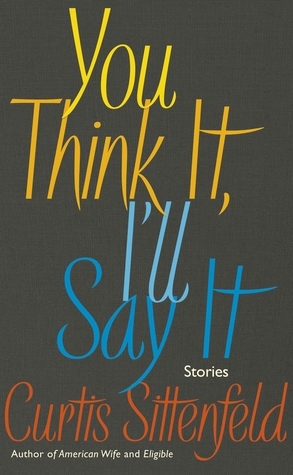 The opening story, “The Nominee,” which only appears in the U.K. edition, feels like a natural follow-up to American Wife. Though never named, the narrator is clearly Hillary Clinton, and in a voice that’s consistent with her memoirs she ponders her struggle to earn popular appeal: “The typical American voter doesn’t wish to share a beer with me.” It’s 2016 and she’s about to be interviewed by a younger female journalist who has written about her dozens of times. Back in 2002 she was compassionate when this journalist fell apart during an interview, but she knows not to expect the same courtesy in return. No, she fully expects to be burned. But still the nominee truly believes she’ll win, as the opposite outcome would be catastrophic.
Yet that’s the reality in the final story, “Do-Over,” which was shortlisted for this year’s Sunday Times EFG Short Story Award. In the wake of Trump’s election, Clay hears from Sylvia, a high school classmate, out of the blue and meets up with her for dinner in Chicago. She’s still sore about the sexist nature of the election at Bishop Academy in which, despite having tied, she was given the patronizing, made-up role of “assistant prefect” while Clay was named senior prefect. Sylvia has engineered this fake date as a gift to herself, to see what could happen, and she’s going to behave as badly as she wants.
The role reversal is clearest in “Gender Studies” and “A Regular Couple.” In the former, Nell, a gender studies professor, accidentally uses a taxi driver for sex. In the latter, Maggie is on her honeymoon with Jason; though they’re both lawyers, she recently handled a sportsman’s rape trial and earns 20 times what Jason does in nonprofit immigration law. There’s another flipping of positions in this one: among the other honeymooners at their ski resort is Ashley Frye, who was one of the popular girls at Maggie’s high school and made her feel awkward and inferior. But Maggie’s TV appearances have given her an aura of celebrity: now she’s the popular one, and she has an idea for how to get revenge on Ashley.
The most similar to Sittenfeld’s early fare is “Vox Clamantis in Deserto,” in which a college student loses her virginity under bizarre circumstances in 1994. Several stories involve a dual time setting: a decade or more later, characters reflect on the strange turns their lives have taken to get them where they are now and have a chance to rethink the decisions they made.
My favorite single story is “Plausible Deniability,” the only time I can think of that Sittenfeld has used a male point-of-view. The narrator is William, a 41-year-old lawyer in St. Louis who has distinctly different relationships with his brother and his sister-in-law. There’s a clever surprise in this one, as there is later on in “The Prairie Wife,” and it makes you ask about the various ways there are of being close with another person.
Other stories concern new mothers’ guilt and compromises, the temptation of adultery, and the danger of jealousy and making up your mind about someone too soon. I was less sure about “Volunteers Are Shining Stars,” voiced by a character with OCD and set among African-Americans at a family shelter in Washington, D.C., and I thought “Off the Record” was a bit too similar to “The Nominee.” Overall, though, this is a whip-smart, current and relatable book, ideal for readers who don’t think they like short stories.
My rating: 
You Think It, I’ll Say It is published in the UK today, May 3rd, by Doubleday. My thanks to the publisher for the free review copy.
The Wellcome Book Prize 2018 Awards Ceremony
 Hey, we got it right! Mark O’Connell’s To Be a Machine, our shadow panel’s pick, won the Wellcome Book Prize 2018 last night. Of the three shadow panels I’ve participated in and the many others I’ve observed, this is the only time I remember the shadow winner matching the official one. Clare, Paul and I were there in person for the announcement at the Wellcome Collection in London. When we briefly spoke to the judges’ chair, Edmund de Waal, later in the evening, he said he was “relieved” that their decision matched ours – but I think it was definitely the other way around!
Simon Chaplin, Director of Culture & Society at the Wellcome Trust, said that each year more and more books are being considered for the prize. De Waal revealed that the judges read 169 books over nine months in what was for him his most frightening book club ever. “To bring the worlds of medicine and health into urgent conversation” requires a “lyrical and disciplined choreography,” he said, and “how we shape stories of science … is crucial.” He characterized the judges’ discussions as both “personal and passionate.” The Wellcome-shortlisted books make a space for public debate, he insisted.

Judges Gordon, Paul-Choudhury, Critchlow, Ratcliffe and de Waal. Photo by Clare Rowland.
The judges brought each of the five authors present onto the stage one at a time for recognition. De Waal praised Ayobami Adebayo’s “narrative of hope and fear and anxiety” and Meredith Wadman’s “beautifully researched and paced thriller.” Dr Hannah Critchlow of Magdalene College, Cambridge called Lindsey Fitzharris’s The Butchering Art “gruesome yet fascinating.” Oxford English professor Sophie Ratcliffe applauded Kathryn Mannix’s book and its mission. New Scientist editor-in-chief Sumit Paul-Choudhury said Mark O’Connell’s book is about the future “just as much as what it means to be human in the twenty-first century.” Journalist and mental health campaigner Bryony Gordon thanked Sigrid Rausing for her “great honesty and stunning prose.”
But there can only be one winner, and it was Mark O’Connell, who couldn’t be there as his wife is/was giving birth to their second child imminently. The general feeling in the room was that he’d made the right call by deciding to stay with his family. He must be feeling like the luckiest man on earth right now, to have a baby plus £30,000! Max Porter, O’Connell’s editor at Granta and the author of Grief Is the Thing with Feathers, received the award on his behalf and read out the extremely witty speech he’d written in advance.
Afterwards we spoke to three of the shortlisted authors. Kathryn Mannix said she’d so enjoyed following our shadow panel reviews and that it was for the best that O’Connell won, as any other outcome might have spoiled the lovely girls’ club the others had going on during the weekend’s events. I got two signatures and we nabbed a quick photo with Lindsey Fitzharris. It was also great to meet Simon Savidge, the king of U.K. book blogging, and author and vlogger Jen Campbell. Other ‘celebrities’ spotted: Sarah Bakewell and Ben Goldacre.
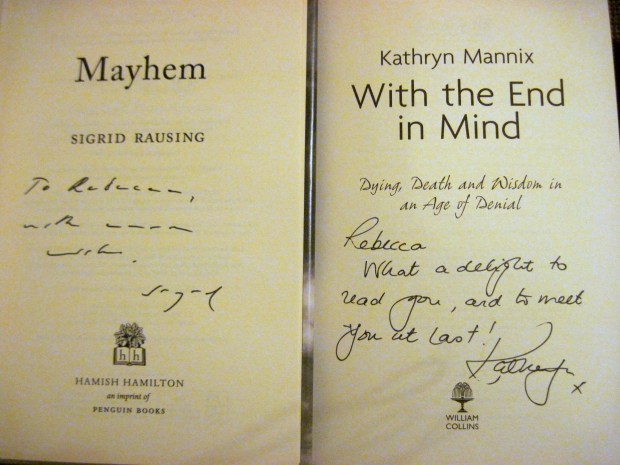
This time I stayed long enough for pudding canapés to come around – raspberry cake pops and mini meringues with strawberries. What a great idea! On the way out I again acquired a Wellcome goody bag: this year’s tote with a copy of The Butchering Art, which I only had on Kindle before. I’d also treated myself to this brainy necklace from the Wellcome shop and wore it to the ceremony. An all-round great evening. I’m looking forward to next year’s prize season already!

Paul, Lindsey Fitzharris, Clare and me.


Recommended May Releases
May and June are HUGE months for new releases. I’ve been doing enough early reading via NetGalley and Edelweiss that I’ve found plenty to recommend to you for next month. From a novel voiced by one of Hemingway’s wives to a physicist’s encouragement to waste more time, I hope there will be something here for everyone.
The Pisces by Melissa Broder
[Coming from Hogarth Press (USA) on the 1st and Bloomsbury (UK) on the 3rd]
 At first I thought this was one of those funny, quirky but somewhat insubstantial novels about a thirtysomething stuck with a life she isn’t sure she wants – something along the lines of Goodbye, Vitamin, The Portable Veblen, or All Grown Up. Then I thought it was just a crass sex comedy. But the further I read the deeper it all seemed to become: tropes from Greek myth and the fluidity of gender roles made me think of You Too Can Have a Body Like Mine, another debut novel that surprised me for its profundity. Lucy, a thirty-eight-year-old PhD student, agrees to spend a summer dog-sitting for her yoga entrepreneur sister in Venice Beach, California while she undertakes therapy for the twin problems of low self-esteem and love addiction. If you know one thing about this book, it’s that there’s sex with a merman. Ultimately, though, I’d say it’s about “the prison of the body” and choosing which of the different siren voices calling us to listen to. I found it outrageous but rewarding.
My rating:
How to Be a Perfect Christian by Adam Ford and Kyle Mann
[Coming from Multnomah (USA) on the 1st]
 The Babylon Bee is a Christian version of The Onion, so you know what you’re getting here: a very clever, pitch-perfect satire of evangelical Christianity today. If, like me, you grew up in a nondenominational church and bought into the subculture hook, line and sinker (Awana club, youth group, courtship, dc Talk albums, the whole shebang), you will find that so much of this rings true. The book is set up as a course for achieving superficial perfection through absolute “conformity to the status quo of the modern church.” Sample advice: find an enormous church that meets your needs, has a great coffee bar and puts on a laser-lit worship performance to rival “an amusement park for cats or a Def Leppard concert”; master the language of Christianese (“Keeping it in prayer” pretty much covers your bases); and bring as little as you can to the church potluck (a 25-pack of napkins) but consume as much as is anatomically possible. So, a lot of fun, just a little overlong because you get the joke early on.
My rating:
The Ensemble by Aja Gabel
[Coming from Riverhead (USA) on the 15th]
 In May 1994, the members of the Van Ness String Quartet are completing their final graduate recital at a San Francisco conservatory and preparing for the Esterhazy quartet competition in the Canadian Rockies. These four talented musicians – Jana, first violin; Brit, second violin; Henry, viola; and Daniel, cello – have no idea what the next 15 years will hold for them: a cross-country move, romances begun and lost, and career successes and failures. Drawing on her own history as a violinist and cellist, Aja Gabel infuses her debut novel with the simultaneous uncertainty and euphoria of both the artistic life and early adulthood in general. An alternating close third-person perspective gives glimpses into the main characters’ inner lives, and there are evocative descriptions of classical music. I think The Ensemble will mean even more to those readers who are involved in music, but anyone can relate to the slow fade from youth into middle age and the struggle to integrate art with the rest of life.
My rating:
Tropic of Squalor by Mary Karr
[Coming from Harper (USA) on the 8th]
 Mary Karr is mostly known as a memoirist, but this is actually her fifth poetry collection. Death is a major theme, with David Foster Wallace’s suicide and 9/11 getting multiple mentions. Karr also writes self-deprecatingly about her Texas childhood. Best of all is the multi-part “The Less Holy Bible”: a sort of Devil’s Dictionary based loosely around the books of the Bible, it bounces between Texas and New York City and twists biblical concepts into commonsense advice. Not one for those who are quick to cry heresy, perhaps, but I enjoyed it very much, especially “VI. Wisdom: The Voice of God”: “Ninety percent of what’s wrong with you could be cured with a hot bath, / says God through the manhole covers, but you want magic, to win / the lottery you never bought a ticket for. … Don’t look for initials in the geese honking / overhead or to see through the glass even darkly. It says the most obvious shit, / i.e. Put down that gun, you need a sandwich.”
My rating:
In Praise of Wasting Time by Alan Lightman
[Coming from Simon & Schuster / TED (USA and UK) on the 15th]
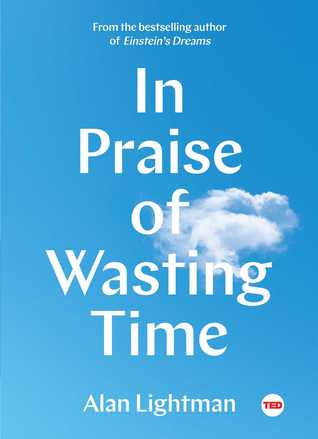 Lightman, a physicist and MIT professor, argues that only in unstructured time can we rediscover our true identity and recover our carefree childhood creativity. This work-as-play model goes against the modern idea that time is money and every minute must be devoted to a project. “For any unexpected opening of time that appears during the day, I rush to patch it, as if a tear in my trousers. … I feel compelled to find a project, to fill up the hole.” Yet there is another way of approaching time, as he discovered when doing research in a village in Cambodia. He realized that the women he talked to didn’t own watches and thus had no real sense of how long any task took them. This sharp, concise treatise ruminates on the cultural forces that have enslaved us in the West to productivity. (In short, he blames the Internet, but specifically smartphones.) Lightman insists on the spiritual benefits of free time and solitude. “With a little determination, each of us can find a half hour a day to waste time,” he asserts.
My rating:
Love and Ruin by Paula McLain
[Coming from Ballantine Books (USA) and Fleet (UK) on the 1st]
 This is the weakest of the three McLain novels I’ve read, but when we’re talking about a writer of this caliber that isn’t much of a criticism. It’s strange to me that, having written a novel from the perspective of Hadley Richardson, Ernest Hemingway’s first wife, McLain would choose to tell the story of another Hemingway wife – this time Martha Gellhorn, a war reporter and author in her own right. If I set aside this misgiving, though, and just assess the quality of the writing, there are definitely things to praise, such as the vivid scenes set during the Spanish Civil War, the dialogues between Martha and Hem, the way he perhaps fills in for her dead father, her fondness for his sons, and her jealousy over his growing success while her books sink like stones. I especially liked their first meeting in a bar in Key West, and the languid pace of their life in Cuba. I read such books because I’m intrigued about the appeal of a great man, but here I got a little bogged down with the many settings and events.
My rating:
What May books do you have on the docket? Have you already read any that you can recommend?
Library Checkout: April 2018
The last two months were bumper editions and saw me getting through loads of library books. That’s slowed down this month, replaced by books I own, review copies and advanced reads from NetGalley or Edelweiss. Boy, are the library books stacking up! My public library system’s website says you can have 15 books out at a time … but the self-service machines don’t cut you off until after you pass 30, at least not in my experience, so I currently have 32 books on loan. (No, I’m not particularly sorry about that. I’m keeping the library system in business, and the few remaining staff members in their jobs! And anyone who wants these books can simply put in a free reservation request, so I don’t feel that I’m hogging them.)
The “Checked Out” pile is so stupidly big that I’m just going to list and photograph new arrivals since last month. As usual, I’ve added in star ratings and any links to Goodreads reviews of books I haven’t already featured on the blog.
LIBRARY BOOKS READ
- The Grave’s a Fine and Private Place by Alan Bradley
- The Church Mouse by Graham Oakley
- To Be a Machine: Adventures among Cyborgs, Utopians, Hackers, and the Futurists Solving the Modest Problem of Death by Mark O’Connell
- In the Days of Rain by Rebecca Stott
SKIMMED ONLY
- The Wood: The Life and Times of Cockshutt Wood by John Lewis-Stempel
- The Vaccine Race by Meredith Wadman
CURRENTLY READING
- The Woman in the Window by A.J. Finn
- How to Develop Emotional Health by Oliver James
- The Enchanted April by Elizabeth von Arnim
- Night Sky with Exit Wounds [poetry] by Ocean Vuong
- Island Home: A Landscape Memoir by Tim Winton
CURRENTLY READING-ish (set aside temporarily)
- To the Is-Land: An Autobiography by Janet Frame
- Tender by Belinda McKeon
- Never Mind by Edward St. Aubyn
CHECKED OUT, TO BE READ
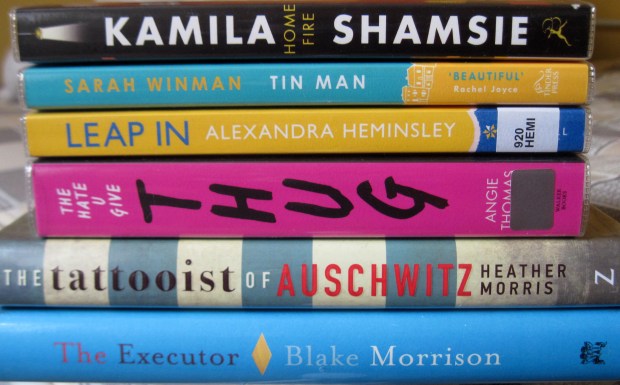
- The Tattooist of Auschwitz by Heather Morris
- The Executor by Blake Morrison
- The Seabird’s Cry: The Lives and Loves of Puffins, Gannets and Other Ocean Voyagers by Adam Nicolson
- Home Fire by Kamila Shamsie
- The Hate U Give by Angie Thomas
- Tin Man by Sarah Winman

ON HOLD, READY TO BE PICKED UP
- The Sun Does Shine: How I Found Life and Freedom on Death Row by Anthony Ray Hinton with Lara Love Hardin
- Eat Up! by Ruby Tandoh
IN THE RESERVATION QUEUE
- The Trick to Time by Kit de Waal
- The Unmapped Mind: A Memoir of Neurology, Incurable Disease and Learning How to Live by Christian Donlan
- Happiness by Aminatta Forna
- Other Minds: The Octopus and the Evolution of Intelligent Life by Peter Godfrey-Smith
- Sight by Jessie Greengrass
- When I Hit You by Meena Kandasamy
- The White Book by Han Kang
- The Sealwoman’s Gift by Sally Magnusson
- Mrs. Moreau’s Warbler: How Birds Got Their Names by Stephen Moss
- Brainstorm: Detective Stories from the World of Neurology by Suzanne O’Sullivan
- The Still Point by Amy Sackville
- See What I Have Done by Sarah Schmidt
- Rosie: Scenes from a Vanished Life by Rose Tremain
RETURNED UNFINISHED
- The Mermaid and Mrs. Hancock by Imogen Hermes Gowar
- Leap In: A Woman, Some Waves, and the Will to Swim by Alexandra Heminsley
- Life in the Garden by Penelope Lively
What have you been reading from your local libraries? Does anything appeal from my stacks?
Wellcome Book Prize Shortlist Event
Five of the six shortlisted authors (barring Dublin-based Mark O’Connell) were at the Wellcome Collection in London yesterday to share more about their books in mini-interviews with Lisa O’Kelly, the associate editor of the Observer. She called each author up onto the stage in turn for a five-minute chat about her work, and then brought them all up for a general conversation and audience questions. Clare and I found it a very interesting afternoon. Here’s some context that I gleaned about the five books and their writers.
 Ayobami Adebayo says sickle cell anemia is a massive public health problem in Nigeria, as brought home to her when some friends died of complications of sickle cell. She herself was tested for the gene and learned that she is a carrier, so her children would have a 25% chance of having the disease if her partner was also a carrier. Although life expectancy with the disease has improved to 45–50, a cure is still out of reach for most Nigerians because bone marrow/stem cell transplantation and anti-rejection drugs are so expensive. Compared to the 1980s, when her book opens, she believes polygamy is becoming less fashionable in Nigeria and people are becoming more open to other means of becoming parents, whether IVF or adoption. It’s a way of acknowledging, she says, that parenthood is “not just about biology.”
Sigrid Rausing started writing her book soon after her sister-in-law Eva’s body was found: just random paragraphs to make sense of what had happened. From there it became an investigation, a quest to find the nature of addiction. She thinks that as a society we still don’t quite understand what addiction is, and the medical research and public perception are very separate. In addition to nature and nurture, she thinks we should consider the influence of culture – as an anthropologist by training, she’s very interested in drug culture and how that drew in her brother, Hans. Although there have been many memoirs by ex-addicts, she can’t think of another one by a family member. Perhaps, she suggested, this is because the addict is seen as the ultimate victim. She referred to her book as a “collage,” a very apt description.
Kathryn Mannix spoke of how her grandmother, born in 1900, saw so much more death than we do nowadays: siblings, a child, and so on. Today, though, Mannix has encountered people in their sixties who are facing, with their parents, their very first deaths. Death is fairly “gentle” and “dull” if you’re not directly involved, she insists; she blames Hollywood and Eastenders for showing unusually dramatic deaths. She said once you understand what exactly people are afraid of about dying (e.g. hell, oblivion, pain, leaving their families behind) you can address their specific concerns and thereby “beat out the demon of terror and fear.” Mannix never intended to write a book, but someone heard her on the radio and invited her to do so. Luckily, from her medical school days onward, she’d been writing an A4 page about each of her most mind-boggling cases to get them out of her head and move on. That’s why, as O’Kelly put it, the characters in her 30 stories “leap off the page.”
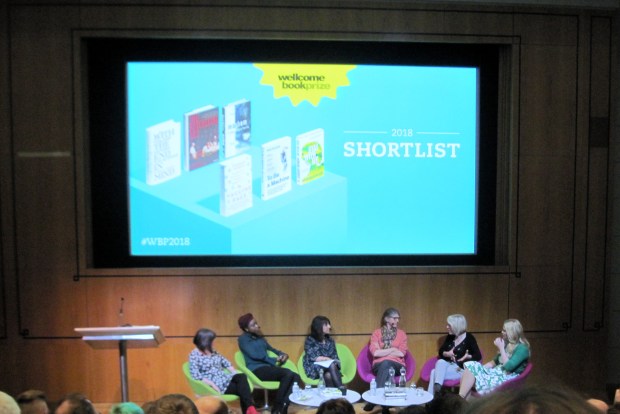
Mannix, Adebayo, O’Kelly, Rausing, Wadman & Fitzharris
Lindsey Fitzharris called The Butchering Art “a love story between science and medicine” – it was the first time that the former (antisepsis) was applied to the latter. She initially thought Robert Liston was her man – he was so colorful, larger than life – but eventually found that the real story was with Joseph Lister, the quiet, persistent Quaker. (However, the book does open with Liston performing the first surgery under ether.) Fitzharris is also involved in the Order of the Good Death, author Caitlin Doughty’s initiative, and affirmed Mannix’s efforts to remove the taboo from talking about death. I think I heard correctly that she said there is a film of The Butchering Art in the works?! I’ll need to look into that some more.
Meredith Wadman started with a brief explanation of how immunization works and why the 1960s were ripe for vaccine research. This segment went really science-y, which I thought was a little unfortunate as it may have made listeners tune out and be less interested in her work than the others’. It was perhaps inevitable given her subject matter, but also a matter of the questions O’Kelly asked – with the others she focused more on stories and themes than on scientific facts. It was interesting to hear what Wadman has been working on recently: for the past 6–8 months, she’s been reporting for Science on sexual harassment in science. For her next book, though, she’s pondering the conflict between a congressman and a Centers for Disease Control scientist over funding into research that might lead to gun control.
The question time brought up the issues of medical misinformation online, the distrust people with chronic illnesses have of medical professionals, and euthanasia – Mannix rather dodged that one, stating that her book is about the natural dying process so that’s not really her area. (Though it does come up in a chapter of her book.) We also heard a bit about the projects up next for each author. Rausing’s next book will be a travel memoir about the Capetown drought, taking in apartheid and her husband’s family’s immigration. Adebayo is at work on a very nebulous novel “about people,” and possibly how privilege affects access to healthcare.
Wellcome Book Prize Shadow Panel Decision
Addiction, death, infertility, surgery, transhumanism and vaccines: It’s been quite the varied reading list for the five of us this spring! Lots of science, lots of medicine, but also a lot of stories and imagination.
After some conferring and voting, we have arrived at our shadow panel winner for the Wellcome Book Prize 2018: To Be a Machine by Mark O’Connell.
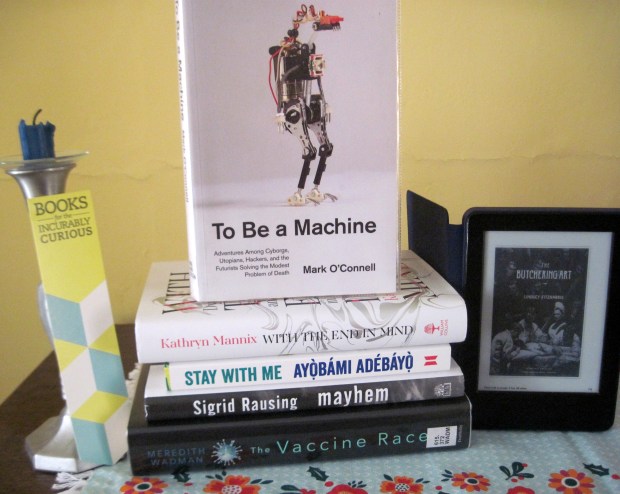
Rarely have I been so surprised to love a book. It’s a delight to read, and no matter what your background or beliefs are, it will give you plenty to think about. It goes deep down, beneath our health and ultimately our mortality, to ask what the essence of being human is.
Here’s what the rest of the shadow panel has to say about our pick:
Annabel: “O’Connell, as a journalist and outsider in the surprisingly diverse field of transhumanism, treats everyone with respect: asking the questions, but not judging, to get to the heart of the transhumanists’ beliefs. For a subject based in technology, To Be a Machine is a profoundly human story.”
Clare: “The concept of transhumanism may not be widely known or understood yet, but O’Connell’s engaging and fascinating book explains the significance of the movement and its possible implications both in the distant future and how we live now.”
Laura: “My brain feels like it’s been wired slightly differently since reading To Be a Machine. It’s not just about weird science and weird scientists, but how we come to terms with the fact that even the luckiest of us live lives that are so brief.”
Paul: “An interesting book that hopefully will provoke further discussion as we embrace technology and it envelops us.”

On Monday we’ll find out which book the official judges have chosen. I could see three or four of these as potential winners, so it’s very hard to say who will take home the £30,000.
Who are you rooting for?
Wellcome Book Prize: Shortlist Recap
Tomorrow morning we will announce our Wellcome Book Prize 2018 shadow panel winner. Beforehand I wanted to do a quick recap of my reviews, especially for the two books that I read before the shortlist announcement. My full reviews are here:
Stay with Me by Ayobami Adebayo
To Be a Machine by Mark O’Connell
Mayhem by Sigrid Rausing
The Vaccine Race by Meredith Wadman
I give some extra thoughts on and favorite quotes from the other two below:
The Butchering Art by Lindsey Fitzharris
 This is a great blend of medical history and popular science that should draw in readers who wouldn’t normally gravitate to either topic – provided they aren’t too squeamish. Fitzharris has recently returned to Oxford as a visiting academic, and this has also been nominated for the Wolfson History Prize. Follow her on Instagram (@drlindseyfitzharris) for a steady stream of gruesomely fascinating photos (I wish The Butchering Art had been illustrated!). Her next book will be much of a muchness, it seems, documenting the early years of plastic surgery after World War I through the story of pioneering surgeon Harold Gillies.
In the days before Joseph Lister…
“Operating theaters were gateways to death. It was safer to have an operation at home than in a hospital, where mortality rates were three to five times higher than they were in domestic settings.”
“The surgeon was very much viewed as a manual labourer who used his hands to make his living, much like a key cutter or plumber today.”
See what the rest of the shadow panel has to say about this book:
Annabel’s review: “[A]n extremely readable account of a ground-breaking career which led to real advances in hospital medicine. I enjoyed the whole, but particularly the grisly bits!”
Laura’s review: “It’s easy for me to feel a bit impatient with popular histories of periods or subjects that I know well, but Fitzharris strikes exactly the right note, writing clearly and accessibly with no dumbing down.”
Paul’s review: “It is one of the better books that I have read on medical history[;] Fitzharris writes in an engaging way on a subject that is not going to appeal to everyone, but in amongst all the blood is the fascinating story of Joseph Lister.”
With the End in Mind by Kathryn Mannix
 “It’s time to talk about dying. This is my way of promoting the conversation,” Mannix writes in her introduction to this accessible and reassuring book about death. She believes we are afraid of death because of our misconception that it is inevitably painful and undignified. In her decades of working in hospice care, this has rarely been the case. (Thank goodness that, compared to the earlier nineteenth-century situation Fitzharris surveys, we have reliable pain control options.) Mannix sees the role of the hospice worker as being like a midwife for the dying, a helpful idea I first encountered in Henry Fersko-Weiss’s Caring for the Dying: The Doula Approach to a Meaningful Death.
Many of the stories in this book are of peaceful deaths the patient and family had time to prepare for. Others are sad stories of denial. One, though, is quite gruesome, yet magnificently described. Alex, a young man with testicular teratoma, has a massive GI bleed:
“Alex’s head is thrown back, almost as though it is a voluntary movement. A huge, dark-red python slithers rapidly out of his mouth, pushing his head backwards as it coils itself onto the pillow beside him; the python is wet and gleaming and begins to stain the pillowcase and sheets with its red essence as Alex takes one snoring breath, and then stops breathing. His mother screams as he realises that the python is Alex’s blood. Probably all of his blood.”
See what the rest of the shadow panel has to say about this book:
Annabel’s review: “[I]t is helping patients, and their families and loved ones, to understand the process of dying, and dispelling the taboos around it that make this book such a valuable and compelling read. I wish I’d read something like this book before my mum died.”
Clare’s review: “For me, this enlightening book is a strong potential winner for the Wellcome Book Prize and I hope it brings comfort and guidance for those who need it.”
Laura’s review: “[The book is] written from her own experiences as a specialist in palliative care, and this proved, for me, both its strength and its downfall. … Mannix writes particularly well on the characteristic patterns of somebody who is entering a gradual decline.”
Paul’s review: “Can highly recommend this moving book and I think it should be essential reading for anyone who has any concerns about death.”
I wouldn’t be at all surprised to see either of these win the Wellcome Book Prize on Monday. Stay tuned for tomorrow’s shadow panel winner announcement, and Sunday’s write-up of a shortlist event I’m attending in London.
 Bookish Beck = Rebecca Foster. American transplant to England. Freelance proofreader and book reviewer.
 Bookish Beck