R.I.P. Reads, Part II: Cox, Gaiman, Paver
Happy Halloween! I enjoyed taking part in R.I.P. for the first time this year. My top two choices out of the six fantastical and/or spooky books I managed to read would be The Loney and The Graveyard Book (see below). For this second installment I’ve been reading eerie short stories that take place in the English countryside, a young adult fantasy novel set mostly in a graveyard, and a ghost story that unfolds in the Himalayas of the 1930s.

Help the Witch by Tom Cox (2018)
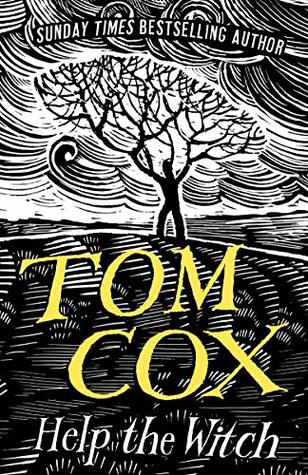 I knew Tom Cox for his witty books about his many cats, including The Good, the Bad and the Furry. His first foray into fiction was published by Unbound earlier this month; I pre-ordered it on a Kindle deal for £1. The settings are dilapidated cottages, moorland and villages, mostly in the North of England. Even in the spookier stories, there’s always a welcome touch of humor. “Seance” raises the ghost of a cyclist who was killed on his bike and now is destined to cycle evermore. He doesn’t, at first, realize that he’s dead. “‘Morning!’ he called to a middle-aged couple with a labradoodle, cheerfully, as he cycled past Whiddon Scrubs. They ignored him. ‘Shitbags,’ he said under his breath.”
The three sets of flash fictions, “Listings,” “Nine Tiny Stories about Houses,” and “Folk Tales of the Twenty-third Century,” particularly made me laugh, though each perhaps overstays its welcome a bit. My two favorites were proper ghost stories: “Speed Awareness,” about a peculiar mix-up with the course teacher, and “Just Good Friends,” in which a woman’s Internet dating experiences turn strange when she meets someone with inside knowledge about her past. I could see the latter being anthologized. These are enjoyable enough stories to flip through around Halloween.
My rating: 
The Graveyard Book by Neil Gaiman (2008)
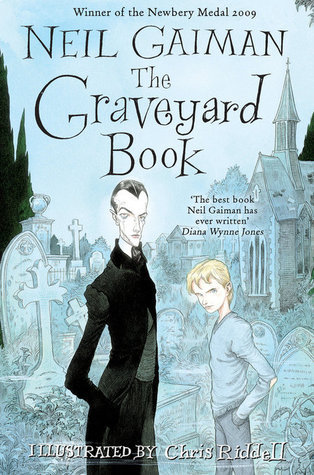 Nobody “Bod” Owens has lived in a graveyard ever since the night he climbed out of his cot and toddled there – the same night that a man named Jack murdered his parents and older sister. He was the only member of his family to survive the slaughter. Although he passes a happy childhood among the graveyard’s witches, ghouls and ghosts from many centuries, he knows he’s different. He’s alive; he has to eat and craves human friendship. As valuable as his lessons in Fading and Dreamwalking prove to be, he longs to attend school and discover more of the world outside – provided he can keep his head down and avoid notice; previous trips beyond the cemetery walls, such as to a pawnshop, have bordered on the disastrous.
Bod’s japes with his returning friend Scarlett turn more serious when he learns that Jack is still after him. This is quite a dark book for its young teen audience, but as I remember from the only other Gaiman book I’ve read, The Ocean at the End of the Lane, he’s a master at balancing sadness with humor and magic. The illustrations by Chris Riddell are terrific, too.
Favorite lines:
Silas, Bod’s guardian: “You’re alive, Bod. That means you have infinite potential. You can do anything, make anything, dream anything. If you change the world, the world will change.”
“Mother Slaughter’s headstone [was] so cracked and worn and weathered that all it said now was:
LAUGH
which had puzzled the local historians for over a hundred years.”
My rating: 
Thin Air: A Ghost Story by Michelle Paver (2016)
 In 1935 Dr. Stephen Pearce and his brother Kits are part of a five-man mission to climb the most dangerous mountain in the Himalayas, Kangchenjunga. Thirty years before, Sir Edmund Lyell led an ill-fated expedition up the same mountain: more than one man did not return, and the rest lost limbs to frostbite. “I don’t want to know what happened to them. It’s in the past. It has nothing to do with us,” Dr. Pearce tells himself, but from the start it feels like a bad omen that they, like Lyell’s party, are attempting the southwest approach; even the native porters are nervous. And as they climb, they fall prey to various medical and mental crises; hallucinations of ghostly figures on the crags are just as much of a danger as snow blindness.
This is pacey, readable historical fiction with a good sense of period and atmosphere. I enjoyed Pearce’s narration, and the one-upmanship type of relationship with his brother adds an interesting dimension to the expedition dynamics. However, I never submitted sufficiently to Paver’s spell to find anything particularly scary. I’ll try again with her other ghost story, Dark Matter, about an Arctic expedition from the same time period.
Favorite passage:
“The Sherpas are wrong. This mountain has no spirit, no sentience and no intent. It’s not trying to kill us. It simply is.” [famous last words…]
My rating:
Have you been reading anything fantastical or spooky this October?
Library Checkout: October 2018
 It’s been a year since I relaunched the Library Checkout meme. I want to say a big thank you to the handful of bloggers who have joined in since then. It’s such a quick, fun and easy post to put together by the final Monday of each month. Why not take part?!
In the past month I’ve been reading from the Booker Prize longlist. Although I also read within my comfort zones of historical fiction and memoirs, I’ve dabbled in genres I don’t read as often, like graphic novels and middle-grade fiction.
For November’s challenges I’m stockpiling novella-length books, one of them for Margaret Atwood Reading Month. At some point I’ll have to get real about how many more 2018 releases I can read before I fly to America for Christmas, which may mean canceling some reservations. I’m holding out for at least the Murakami and Obama titles to arrive in time!
(As usual, I’ve added in star ratings and links to Goodreads reviews where I haven’t already featured the books on the blog in some way.)
LIBRARY BOOKS READ
- Another Year of Plumdog by Emma Chichester Clark [graphic novel]
- French Exit by Patrick deWitt
- Sabrina by Nick Drnaso [graphic novel]

- Washington Black by Esi Edugyan
- All Among the Barley by Melissa Harrison

- Tilly & the Bookwanderers (Pages & Co., #1) by Anna James
- The Seabird’s Cry: The Lives and Loves of Puffins, Gannets and Other Ocean Voyagers by Adam Nicolson

- Rosie: Scenes from a Vanished Life by Rose Tremain
SKIMMED ONLY
- My Father and Myself by J.R. Ackerley
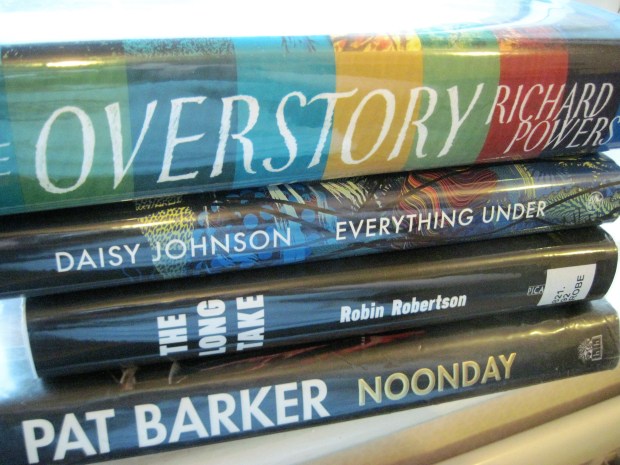
- Noonday by Pat Barker
- The Gracekeepers by Kirsty Logan [Read in 2015; re-skimmed for book club.]
- Wilding by Isabella Tree
CURRENTLY READING
- Everything Under by Daisy Johnson
- The Overstory by Richard Powers
CURRENTLY READING-ish (set aside temporarily)
- The Catcher in the Rye by J.D. Salinger
CHECKED OUT, TO BE READ
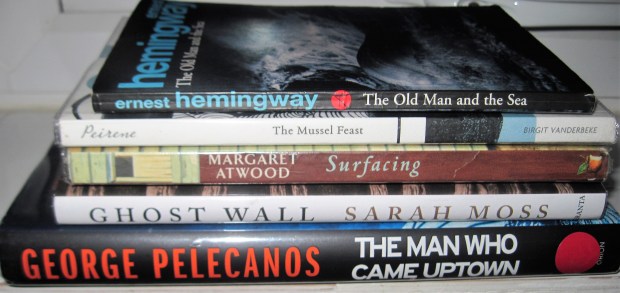
- Surfacing by Margaret Atwood
- The Old Man and the Sea by Ernest Hemingway
- Ghost Wall by Sarah Moss
- The Man Who Came Uptown by George Pelecanos
- The Long Take by Robin Robertson
- The Mussel Feast by Birgit Vanderbeke
ON HOLD, TO BE PICKED UP
- Varina by Charles Frazier
IN THE RESERVATION QUEUE
- The Bus on Thursday by Shirley Barrett
- Boy Erased: A Memoir of Identity, Faith, and Family by Garrard Conley
- West by Carys Davies
- Sincerity by Carol Ann Duffy [poetry]
- House of Glass by Susan Fletcher
- In Miniature: How Small Things Illuminate the World by Simon Garfield
- The Glorious Life of the Oak by John Lewis-Stempel
- Holloway by Robert Macfarlane et al.
- Killing Commendatore by Haruki Murakami
- Becoming by Michelle Obama
- Fox 8 by George Saunders
- Cassandra Darke by Posy Simmonds [graphic novel]
RETURNED UNFINISHED
- Swan Song by Kelleigh Greenberg-Jephcott
RETURNED UNREAD
- A Man in Love by Karl Ove Knausgaard – Too dang long! Tiny print and over 500 pages. I don’t think I’ll be completing the My Struggle series.
- Now We Shall Be Entirely Free by Andrew Miller – This was requested after me, and I knew I wouldn’t have time for it. Also, I think I’ve lost interest for now.
What have you been reading from your local libraries? Does anything appeal from my stacks?
I don’t have an official link-up system, so please just pop a link to your blog in the comments if you’ve taken part in Library Checkout this month. (Feel free to use the image in your post.)
Magdalena Mountain by Robert Michael Pyle
“Wasn’t it Nabokov who said ‘It is astounding how little the ordinary person notices butterflies?’”
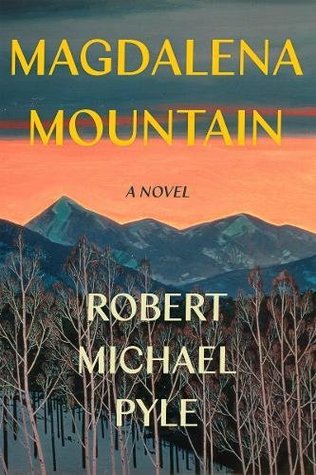 Butterflies, monks, students and teachers, prophets and saints: such is the cast of naturalist Robert Michael Pyle’s unusual and rewarding debut novel, Magdalena Mountain. It’s a golden autumn in the early 1970s as James Mead leaves Albuquerque on a Greyhound bus to travel to New Haven, Connecticut, where he will undertake a PhD in biology at Yale. He squats in a lab on campus to save money and, after some tension with his thesis advisor, decides to keep his head down, feeding the department’s giant cave roaches and becoming engrossed in the field journals written by one October Carson in 1969 during his travels out West.
Pyle presents nature as both beatific and harsh, a continuity of life that human events – like a car going over a cliff in the first chapter – barely disrupt. Occasional chapters check in on the woman who was in the car crash, Mary Glanville. Now suffering from amnesia, she believes she’s a famous figure from history. One day she escapes from her nursing home and hitchhikes into the Colorado mountains. In her weakened state she’s taken in by Attalus and Oberon, monks at a deconsecrated monastery devoted to the god Pan and the creeds of nature writers like John Burroughs, Aldo Leopold and John Muir. Attalus, a compassionless misogynist, vehemently protests Mary’s presence in their community, but Oberon soon falls in love with her.
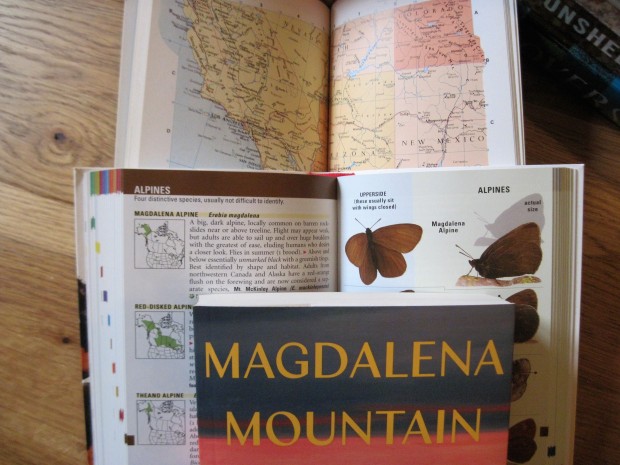
When James, disobeying his supervisor, lights out for Colorado for a summer of research at the Rocky Mountain Biological Laboratory, the stage is set for these major characters to collide on Magdalena Mountain, home to the distinctive, all-black Magdalena Alpine butterfly (Erebia magdalena). “Flight may appear weak, but adults are able to sail up and over huge boulders with the greatest of ease, eluding humans who desire a closer look. Flies in summer,” reads the description in my (Kaufman) field guide to North American butterflies. Intermittent segments of pure nature writing about Erebia’s life cycle – seven short chapters in total – establish the seasons and encourage a long view of local history, but somewhat slow down the novel’s tempo.
Pyle successfully pulls in so many different themes: academic infighting and the impulses of scientific researchers versus amateur collectors; environmentalism, especially through the threats that infestations, pesticides and off-road vehicles pose to the mountain landscape; activism, by way of the Vietnam War and nuclear weapons protests; and even sacred femininity and the myths surrounding Mary Magdalene. Mary Glanville’s name is a nice nod to history – Elinor Glanville was a seventeenth-century English collector who gave her name to the Glanville Fritillary – while Vladimir Nabokov, who was a keen lepidopterist as well as an academic and author, is mentioned several times for his real-life connections to the area.
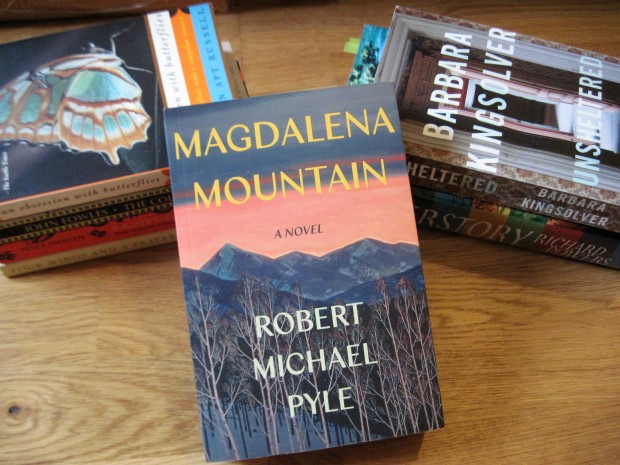
(A selection of my butterfly-themed books, read and unread, in the pile at the left.)
The quirky set of hangers-on at the monastery reminded me of an Iris Murdoch setup (thinking mostly of The Bell), while the passion for science and activism brought to mind two other excellent environmentally minded novels published this year, The Overstory and Unsheltered. Indeed, Mary preaches at one point, “Seek your shelter in nature … In love lies the only real shelter there is.” If you’re interested in the Powers and/or Kingsolver, I would commend Pyle’s book to you as well: it’s offbeat, dreamy yet fervent, with intriguing characters and elegant nature-infused language. One of my favorite descriptive scraps, so simple but so apt, was “a peeled peach of a moon.” I’m grateful to have had a chance to read this, and I will be seeking out Pyle’s nature writing, too.
My rating:
Magdalena Mountain was published in August 2018. My thanks to the good folk of Counterpoint Press (based in Berkeley, California) for sending a free copy for review.
Marilla of Green Gables by Sarah McCoy
There’s no doubt about it: fans of Lucy Maud Montgomery’s Anne series will throng to read Sarah McCoy’s prequel. McCoy was inspired by the brief moment in Anne of Green Gables when Marilla tells Anne that John Blythe used to be her beau. Just like Anne, she wanted to know the story behind that offhand remark.
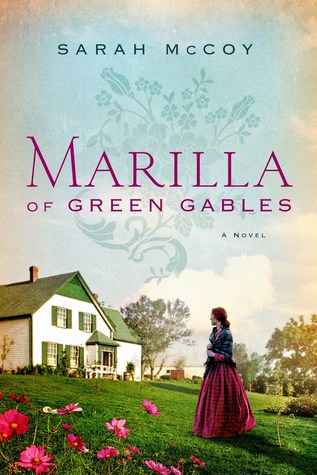 So although Marilla of Green Gables begins in 1876 with a short prologue in which Matthew and Marilla decide to ‘get a boy’ to help around the place, most of it is set in 1837–8, with Marilla taking a break from her schooling to assist her parents, Hugh and Clara (it’s no coincidence that these are the names of L.M. Montgomery’s parents), in the months before her new sibling is to arrive. Brother Matthew is 21 and testing out adulthood, but Marilla is just 13 and impressionable. John Blythe offers to bring her the school readings she’s missed out on, and later invites her to the Avonlea May Picnic. It’s clear she’s smitten.
Aunt Izzy, a dressmaker from St. Catharines, arrives in time to cheer her twin sister through the impending birth and ends up being Marilla’s new role model. She’s fanciful, exuberant and spontaneous and believes “A young girl needs as much time to dream as possible,” surely making her a deliberate precursor of Anne Shirley. Indeed, much of the fun of reading this book is in spotting the seeds of the Anne books: Clara and Izzy making their famous redcurrant wine and laughing about the time Clara lost a thumbnail in the mix; meeting Rachel White (Lynde) at a sewing circle; a visit to the orphanage in Hopetown; raspberry cordial at a picnic; the Ladies’ Aid Society; and looking to a mistake-free tomorrow.
Before long, though, personal and political upheaval take their toll at Green Gables and drive a wedge between Marilla and John. I found Part Two significantly less engaging, what with all the talk of Reformers versus Loyalists (though I did enjoy glimpses of escaped slaves’ experiences in Canada). I tend not to read anything approaching a romance novel, so I groaned to find that there’s not one but two Mr. Darcy-esque wet-shirt scenes featuring John.
This is not meant to be a substitute for reading Montgomery’s own work; if anything it’s prompted me to reread the original series as soon as I can. While I wouldn’t call Marilla a must-read for fans, then, if you enjoy women’s historical fiction set in the nineteenth century, you may want to pick up this companion volume anyway.
My rating:
Marilla of Green Gables was published by William Morrow on October 23rd. My thanks to publicist Beth Parker for the proof copy for review. Sarah McCoy is the author of four previous works of fiction, including The Mapmaker’s Children and The Baker’s Daughter.
Blog Tour: Literary Landscapes, edited by John Sutherland
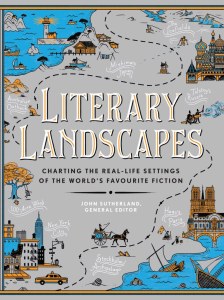 The sense of place can be a major factor in a book’s success – did you know there is a whole literary prize devoted to just this? (The Royal Society of Literature’s Ondaatje Prize, “for a distinguished work of fiction, non-fiction or poetry, evoking the spirit of a place.”) No matter when or where a story is set, an author can bring it to life through authentic details that appeal to all the senses, making you feel like you’re on Prince Edward Island or in the Gaudarrama Mountains even if you’ve never visited Atlantic Canada or central Spain. The 75 essays of Literary Landscapes, a follow-up volume to 2016’s celebrated Literary Wonderlands, illuminate the real-life settings of fiction from Jane Austen’s time to today. Maps, author and cover images, period and modern photographs, and other full-color illustrations abound.
Each essay serves as a compact introduction to a literary work, incorporating biographical information about the author, useful background and context on the book’s publication, and observations on the geographical location as it is presented in the story – often through a set of direct quotations. (Because each work is considered as a whole, you may come across spoilers, so keep that in mind before you set out to read an essay about a classic you haven’t read but still intend to.) The authors profiled range from Mark Twain to Yukio Mishima and from Willa Cather to Elena Ferrante. A few of the world’s great cities appear in multiple essays, though New York City as variously depicted by Edith Wharton, Jay McInerney and Francis Spufford is so different as to be almost unrecognizable as the same place.
One of my favorite pieces is on Charles Dickens’s Bleak House. “Dickens was not interested in writing a literary tourist’s guide,” it explains; “He was using the city as a metaphor for how the human condition could, unattended, go wrong.” I also particularly enjoyed those on Thomas Hardy’s The Return of the Native and Robert Louis Stevenson’s Kidnapped. The fact that I used to live in Woking gave me a special appreciation for the essay on H. G. Wells’s The War of the Worlds, “a novel that takes the known landscape and, brilliantly, estranges it.” The two novels I’ve been most inspired to read are Thomas Wharton’s Icefields (1995; set in Jasper, Alberta) and Kate Grenville’s The Secret River (2005; set in New South Wales).

The essays vary subtly in terms of length and depth, with some focusing on plot and themes and others thinking more about the author’s experiences and geographical referents. They were contributed by academics, writers and critics, some of whom were familiar names for me – including Nicholas Lezard, Robert Macfarlane, Laura Miller, Tim Parks and Adam Roberts. My main gripe about the book would be that the individual essays have no bylines, so to find out who wrote a certain one you have to flick to the back and skim through all the contributor biographies until you spot the book in question. There are also a few more typos than I tend to expect from a finished book from a traditional press (e.g. “Lady Deadlock” in the Bleak House essay!). Still, it is a beautifully produced, richly informative tome that should make it onto many a Christmas wish list this year; it would make an especially suitable gift for a young person heading off to study English at university. It’s one to have for reference and dip into when you want to be inspired to discover a new place via an armchair visit.
Literary Landscapes will be published by Modern Books on Thursday, October 25th. My thanks to Alison Menzies for arranging my free copy for review.
R.I.P. Reads, Part I: Bender, Harkness, Hurley
I’ve been reading twisted fairy tales, a novel about witches and vampires with historical and contemporary timelines, and a subtle work of Gothic horror set on a remote stretch of the English coast.
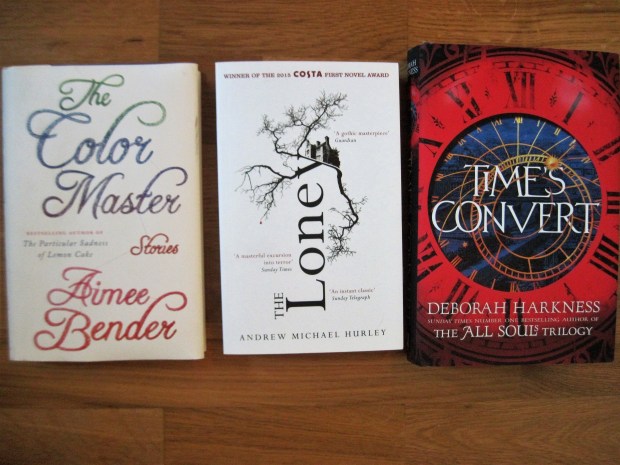
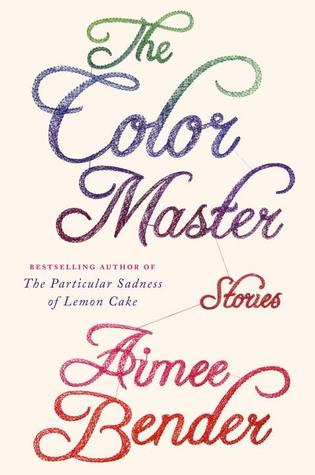
The Color Master by Aimee Bender (2013)
Aimee Bender is best known for The Particular Sadness of Lemon Cake. This is the second collection of her stories that I’ve read. Most have a touch of the bizarre to them – a tiny tweak to normal life – but some are set in completely alternate worlds. One character experiences extreme face blindness; another deludes himself that he was a famously vicious Nazi during the Second World War. Seamstresses take on odd tasks like repairing endangered animals or, in the title story, creating a dress that resembles the moon and embodies female anger. In “Appleless,” vigilantes punish a girl who won’t eat apples, while “The Devourings” is a dark riff on Shrek in which a woman comes to terms with her ogre husband’s innate violence.
 A few favorites were “A State of Variance,” in which a character can’t seem to avoid perfect facial symmetry no matter how he tries to mar his natural beauty, “The Doctor and the Rabbi,” a philosophical conversation between an ill rabbi and her atheist-leaning parishioner, and “The Red Ribbon” (which draws on the same source material as Carmen Maria Machado’s “The Husband Stitch”), about a bored housewife who starts acting out sexual fantasies to try to save her marriage.
Bender deploys a good mixture of voices and protagonists, though at least four of the 15 stories felt unnecessary to me. Her approach is similar to Kelly Link’s and Karen Russell’s, but I’ve failed to get on with their surreal stories before – Bender’s writing is that bit more accessible. I’d recommend her to fans of stories by Amy Bloom and Sarah Hall.
My rating: 
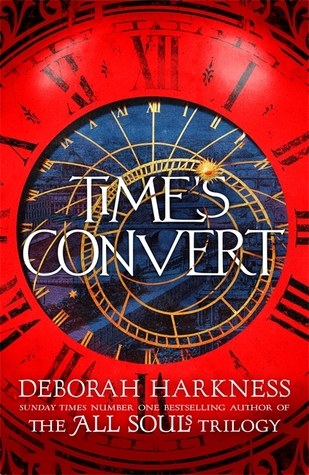
Time’s Convert by Deborah Harkness (2018)
This is a companion volume to Harkness’s All Souls Trilogy, which is like the thinking gal’s Twilight, as written by a historian of science. I read the first book, A Discovery of Witches, in 2011 and surprised myself by completely loving the story of the witch Diana Bishop, who researches alchemy at the Bodleian Library and falls hard for a centuries-old vampire, Matthew de Clermont. Although Time’s Convert is likely intended to stand alone, I felt it could do with a dramatis personae at the start as I’d forgotten who many of the minor characters were.
 Diana and Matthew are still major characters, though not at the heart of the book. One strand has Diana and her family staying in the French countryside. She and Matthew now have toddler twins, Philip and Becca, who are just starting to show magical powers: Philip summons a griffon named Apollo as his familiar. Another is set in Paris, where Phoebe Taylor is willingly being transformed into a vampire so she can marry Matthew’s son, Marcus. A final strand recreates Marcus’s experiences during the American and French Revolutions and onward: he was born in Massachusetts in 1757 and was a surgeon during the Revolutionary War before he met Matthew and received the offer of immortality.
I almost always feel that sequels fail to live up to the original. Time’s Convert is most like Shadow of Night, the second book of the series and my least favorite because it spends so much time in 1590s England. Here the three different story lines split my focus and I resented being taken away from Diana’s first-person narration, which is much more engaging than the third-person material. I would only recommend this volume to diehard fans of the series.
My rating:
With thanks to Headline for the free copy for review.
Note: A television adaptation of A Discovery of Witches recently aired on Sky One in the UK and is coming to North America in January.
The Loney by Andrew Michael Hurley (2014)
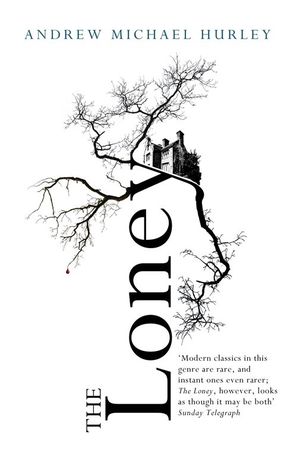 The Loney is not a monster, as I suppose I expected, but a place: an isolated coastline in the northwest of England that the narrator and his family visited on pilgrimage with their Roman Catholic congregation every Easter in the 1970s. The narrator, only identified by the nickname Tonto, explores their strange rental house – full of taxidermied animals and hidden rooms, it also has a rifle under the floorboards – and goes to the beach with his mute brother Andrew (“Hanny”). Mummer and Farther hold out hope that their son Hanny will be healed on a visit to the local shrine, and Mummer especially is frustrated that Father Bernard isn’t as strict and devout as their previous priest, Father Wilfred, who died under a cloud of suspicion not long before this trip.
Last year at around this time I read Hurley’s follow-up, Devil’s Day, which has a similarly bleak and eerie atmosphere. Both look at rural superstitions as experienced by outsiders. The Loney was more profound for me, though, in how it subverts religious rituals and posits a subtle evil influence without ever disappearing down doctrinal rabbitholes. It asks how far people will go to get what they want, what meaning there is to human life if there is no supernatural being looking out for us, and – through a framing story set 30 or more years later – how guilt and memory persist. I especially loved the Tenebrae service in a gloomy church featuring Bosch-like horrors in its artwork. This reminded me of a less abstract After Me Comes the Flood and a more contemporary The Short Day Dying; I highly recommend it.
Favorite lines:
“The Church of the Sacred Heart was an ancient place – dark and squat and glistening amphibiously in the rain.”
“The wind continued to rise and fall. Whining and shrilling. It was as insistent as the priest, louder sometimes, preaching an older sermon, about the sand and the sea.”
My rating:
Have you been reading anything fantastical or spooky this October?
Birthday Goings-on & Booker Prize Predictions
For a low-key early birthday outing we went to The Living Rainforest, a local tourist attraction run by a conservation charity. It’s on the small side, but our tickets got us free annual entry, so we’ll likely come back with family and friends with kids. Along with the tropical plants (including various fig trees I sought out especially!), there are birds both free-roaming and in cages, marmosets and monkeys, fish and turtles, an armadillo, and an elusive sloth we didn’t manage to see. Afterwards we went around the corner for cappuccinos and generous slabs of cake at the Hampstead Norreys community shop café.


My birthday itself was a gloomy day, but I didn’t mind at all; I filled it with reading and feasting, plus listening to music, working on a jigsaw puzzle, and having the cat on my lap. Each year my husband happily takes on impressive cooking and baking projects of my choice. This year we had acorn squash and black bean enchiladas with homemade salsa and guacamole, followed by Mexican rice pudding flavored with cinnamon and lime. In the afternoon with presents we’d had David Lebovitz’s Banana Cake with Mocha Frosting and Salted Candied Peanuts from Ready for Dessert. A delicious and decadent grown-up cake.


I got chocolate, notebooks, Lush shampoo, a bunch of llama/alpaca stuff, and 10 books as gifts (I suspect there might be more books to come, though). Looking back at my birthday book hauls from 2016 and 2017, I can see that I’ve had mixed success with getting through the acquisitions in a timely fashion: I’ve now read 9 out of 12 of 2016’s, but only 4 out of 11 of 2017’s. Though I’m very excited about some of my new books – I marked them as high priority on my wish list, after all – that doesn’t always translate into reading them soon. However, I’ve added two of them to my novellas pile for November, and I’ll read the first L’Engle journal in December as it starts around Christmastime.
Tomorrow the Man Booker Prize will be announced. Although I’ve only read one and a third books from the shortlist, I’m going to have a go at making predictions anyway. Here are the six nominees in what I think is their likelihood of winning:
 #1: I fully expect Richard Powers to win for The Overstory. This is the one I’m partway through; I started reading a library copy on Friday. I’m so impressed by the novel’s expansive nature. It seems to have everything: love, war, history, nature, politics, technology, small-town life, family drama, illness, accidents, death. And all of human life is overshadowed and put into perspective by the ancientness of trees, whose power we disregard at a cost. I’m reminded of the work of Jonathan Franzen (Freedom + Purity), as well as Barbara Kingsolver’s latest, Unsheltered – though Powers is prophetic where she’s polemic.
 #2: Washington Black by Esi Edugyan is a good old-fashioned adventure story about a slave who gets the chance to leave his Barbados sugar plantation behind when he becomes an assistant to an abolitionist inventor, Christopher “Titch” Wilde. Wash discovers a talent for drawing and a love for marine life and pursues these joint interests in the disparate places where life takes him. Part One was much my favorite; none of what followed quite matched it in depth or pace. Still, I enjoyed following along on Wash’s escapades, and I wouldn’t mind seeing this take the prize – it would be great to see a woman of color win.
 #3: The Mars Room by Rachel Kushner: Kushner is well respected, though I’ve failed to get on with her fiction before. An inside look at the prison system, this could be sufficiently weighty and well-timed to win.
 #4: Everything Under by Daisy Johnson: A myth-infused debut novel about a mother and daughter. On my library stack to read next, and the remaining title from the shortlist I’m most keen to read.
 #5: The Long Take by Robin Robertson: A novel, largely in verse, about the aftermath of war service. Also on my library stack. Somewhat experimental forms like this grab Booker attention, but this might be too under-the-radar to win.
 #6: Milkman by Anna Burns: Set in Belfast during the Troubles or a dystopian future? From my Goodreads friends’ reviews this sounds wooden and overwritten. Like the Kushner, I’d consider reading it if it wins but probably not otherwise.
Do you follow the Booker Prize? Which novel do you expect to win?
35 Years, 35 Favorite Books
I love book lists: ticking off what I’ve read from newspaper and website selections, comparing my “best-of” choices and prize predictions with other people’s, and making up my own thematic inventories. Earlier in the year I spotted Desert Island-style 100-book lists on Annabookbel and A life in books, as well as Lonesome Reader’s reconsideration of the 100 favorite books he’d chosen half a lifetime ago. For my 35th birthday today, I’ve looked back at my “Absolute Favorites” shelf on Goodreads and picked the 35 titles that stand out the most for me: some are childhood favorites, some are books that changed my thinking, some I have read two or three times (an extreme rarity for me), and some are recent discoveries that have quickly become personal classics. I’ve listed these in rough chronological order of when I first read them, rather than ranking them, which would be nigh on impossible! Perhaps I’ll revisit the list on future significant birthdays and see how things change. Interesting to note that this works out as about two-thirds fiction and one-third nonfiction.
~
- Miss Rumphius by Barbara Cooney
- The Silver Chair by C.S. Lewis
- Watership Down by Richard Adams
- Anne of Green Gables by L.M. Montgomery
- David Copperfield by Charles Dickens
 The Scarlet Letter by Nathaniel Hawthorne
- Far from the Madding Crowd by Thomas Hardy
- Jane Eyre by Charlotte Brontë
- A Portrait of the Artist as a Young Man by James Joyce
- Possession by A.S. Byatt
- Flaubert’s Parrot by Julian Barnes
- Sixpence House by Paul Collins
 A History of God by Karen Armstrong
- Conundrum by Jan Morris
- The Heart of Christianity by Marcus Borg
- The Blind Assassin by Margaret Atwood
- My Family and Other Animals by Gerald Durrell
- On Beauty by Zadie Smith
- Heaven’s Coast by Mark Doty
 Secrets in the Dark by Frederick Buechner
- A Prayer for Owen Meany by John Irving
- American Wife by Curtis Sittenfeld
- Middlesex by Jeffrey Eugenides
- Caribou Island by David Vann
- To Travel Hopefully by Christopher Rush
- We, the Drowned by Carsten Jensen
 The Emperor of All Maladies by Siddhartha Mukherjee
- Leaving Alexandria by Richard Holloway
- An Exact Replica of a Figment of My Imagination by Elizabeth McCracken
- A Tale for the Time Being by Ruth Ozeki
- Want Not by Jonathan Miles
- Journal of a Solitude by May Sarton
- F by Daniel Kehlmann
 Dinner at the Homesick Restaurant by Anne Tyler
- March by Geraldine Brooks
Are any of these among your favorites, too?
Incidents of Book Serendipity
Since May I’ve been posting my occasional reading coincidences on Twitter and/or Instagram. This is when two or more books that I’m reading at the same time or in quick succession have something pretty bizarre in common. Because I have so many books on the go at once – usually between 10 and 20 – I guess I’m more prone to such serendipitous incidents. What’s the weirdest one you’ve had lately? (The following are in rough chronological order.)
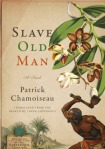
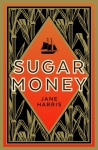
- Two historical novels set (partially) among the slaves of Martinique and featuring snippets of Creole (Patrick Chamoiseau’s Slave Old Man and Jane Harris’s Sugar Money)
- A book about epilepsy and a conductor’s memoir, followed by a novel with a conductor character and another who has seizures (Suzanne O’Sullivan’s Brainstorm and Lev Parikian’s Why Do Birds Suddenly Disappear? to Caoilinn Hughes’s Orchid & the Wasp)
- Two characters mistake pregnancy for cholera (in Alexandra Fuller’s Leaving Before the Rains Come and W. Somerset Maugham’s The Painted Veil)
 Two characters are reading Ursula K. Le Guin’s The Left Hand of Darkness (in Lily Brooks-Dalton’s Good Morning, Midnight and Julie Buntin’s Marlena) … I’ve since tried again with Le Guin’s book myself, but it’s so dry I can only bear to skim it.
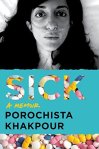
- Two memoirs by Iranian-American novelists with mental health and drug use issues (Porochista Khakpour’s Sick and Afarin Majidi’s Writing and Madness in a Time of Terror)

- References to the blasé response to Martin Luther King’s assassination in North Carolina (in Paulette Bates Alden’s Crossing the Moon and David Sedaris’s Calypso)
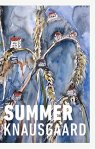
- The Police lyrics (in Less by Andrew Sean Greer and Summer by Karl Ove Knausgaard [a whole essay called “Sting”])

- Salmon croquettes mentioned in Less by Andrew Sean Greer and An American Marriage by Tayari Jones
 I’m reading Beryl Markham’s West with the Night … and then Glynnis MacNicol picks that very book up to read on a plane in No One Tells You This
- Starting two books with the word “Ladder” in the title, one right after the other: Ladders to Heaven by Mike Shanahan and Ladder of Years by Anne Tyler (followed just a couple of weeks later by A Ladder to the Sky by John Boyne!)


 Two books set in Dunedin, New Zealand, one right after the other – I planned it that way, BUT both have a character called Myrtle (To the Is-Land by Janet Frame and Dunedin by Shena Mackay). Then I encountered Harold Gillies, the father of plastic surgery, in Jim McCaul’s Face to Face, and guess what? He was from Dunedin!
- Then I was skimming Louisa Young’s You Left Early and she mentioned that her grandmother was a sculptor who worked with Gillies on prostheses, which was the inspiration for her WWI novel, My Dear I Wanted to Tell You.
- Two novels featuring drug addicts (Pretend I’m Dead by Jen Beagin and Bad News by Edward St. Aubyn)
- The same Wallace Stevens lines that appear as an epigraph to Barbara Kingsolver’s Unsheltered are mentioned in Elaine Pagels’s Why Religion? – “After the final no there comes a yes / And on that yes the future world depends.”

 “Twinkle, Twinkle, Little Star” is mentioned in Little by Edward Carey and Marilla of Green Gables by Sarah McCoy
- Reading Nine Pints, Rose George’s book about blood, at the same time as Deborah Harkness’s Time’s Convert, which is partially about vampires; in this it takes 90 days for a human to become fully vampirized – the same time it takes to be cured of an addiction according to the memoir Ninety Days by Bill Clegg.
The Life of Madame Tussaud: Little by Edward Carey
There is a state between life and death: it’s called the waxworks.
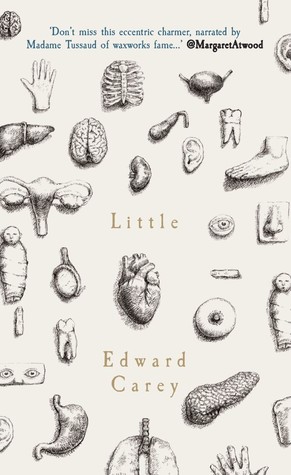 Apparently the 4th was Super Thursday: 544 books were published in the UK as part of the autumn rush leading up to Christmas. I’ve read just one of those multitudinous releases so far, but what a corker it was. Little is Edward Carey’s deliciously macabre novel about Madame Tussaud, who starts life as Anne Marie Grosholtz in Switzerland in 1761 and loses both parents by the age of six. Known as Marie, she soon picks up the nickname “Little” at the studio where she helps Dr. Philip Curtius make wax anatomical models. When the indebted Curtius flees to Paris, Marie goes with him as his servant. Along with their landlady, a tailor’s widow named Charlotte Picot, and her son Edmond, they form a makeshift family and a successful business, making wax heads and then dressing them in wigs and clothes to create whole figures of (in)famous citizens to display in their new quarters, a former monkey house.
In the years to come Marie occupies an uncomfortable in-between position: she’s treated like a servant but never paid, and though she’s fond of Curtius and falls in love with Edmond she’s made to understand that she’s not their equal. However, her fortunes change when Princess Élisabeth, on an unannounced visit to the Cabinet of Dr. Curtius, is impressed with Marie’s art and anatomy skills and invites her to be her sculpture tutor at Versailles. Marie and the young royal make wax models of local peasants’ ailments so they can pray for them. By the time Marie returns to the monkey house, the Revolution is in full swing and there’s widespread hunger not just for wax heads in cabinets, but for real decapitated ones. It will take cunning and luck for Marie and her odd little family to survive the years of upheaval.

(For a look inside the book, go to https://www.book2look.com/book/H8skBPiuJ9.)
The grimy picture of eighteenth-century Paris reminded me of Pure by Andrew Miller, and I often thought of Dickens as I was reading. Little starts off most like David Copperfield: a first-person “I am born”-style account with each chapter headed by a pithy summary. The characters have exaggerated physical features and recurring verbal tics, and there is an unmistakable message that whether a royal or a lowly servant we are all the same inside. Of course, as that pivotal July 14th approaches, the Dickensian echo is more along the lines of A Tale of Two Cities.
I think the novel would benefit from a more suggestive title and could stand to be a bit shorter, but it’s still a delightful piece of historical fiction and another hit from Gallic Books, responsible for two of my other favorite reads of the year so far, Salt Creek and The Life and Loves of Lena Gaunt. Part of the joy of reading it is encountering Carey’s slightly grotesque black-and-white illustrations, dozens of which appear through the text; you can see a few more of them on the postcards that accompanied my review copy.
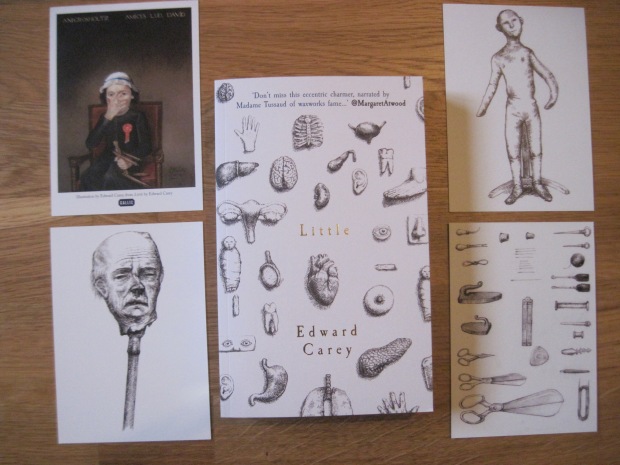
In fact, I’ll sheepishly admit that before I read this I had Edward Carey confused for Edward Gorey, who was known for his ghoulish black-and-white drawings. Carey, an English playwright and novelist whose previous books include the Iremonger Trilogy, is married to Elizabeth McCracken and teaches at the University of Austin, Texas. After university he worked as a steward at Madame Tussaud’s in London, which is how he first came across her story. It’s an unforgettable one.
My rating:
With thanks to the publisher for the free copy for review.
 Bookish Beck = Rebecca Foster. American transplant to England. Freelance proofreader and book reviewer.
