September’s Focus: Short Stories
This is the seventh year in a row in which I’m making a special effort to read short stories in September; otherwise, story collections tend to languish on my shelves (and Kindle) unread. In September 2020 I read 8 collections, and in September 2021 it was 12. How many can I get through this time?! Here are my options, including, at far right, some I’m partway through, a thematic trio (“Birds” titles) I fancy reviewing together, and a few from the library.


To my surprise, if I count linked short stories, I’ve already read 13 collections this year. Highlights: Dance Move by Wendy Erskine, The Summer Book by Tove Jansson, Antipodes by Holly Goddard Jones, and How High We Go in the Dark by Sequoia Nagamatsu.
 The best of the lot, though, has been Stories from the Tenants Downstairs by Sidik Fofana, which I’ll be reviewing for BookBrowse over the weekend. It’s a character- and voice-driven set of eight stories about the residents of a Harlem apartment complex, many of them lovable rogues who have to hustle to try to make rent in this gentrifying area.
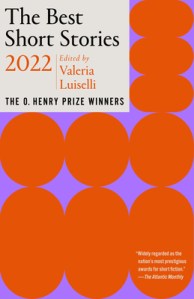 A September release I’ll quickly plug: The Best Short Stories 2022: The O. Henry Prize Winners, selected by Valeria Luiselli. I read this for Shelf Awareness and my review will be appearing in a couple of weeks. Half of the 20 stories are in translation – Luiselli insists this was coincidental – so it’s a nice taster of international short fiction. Contributing authors you will have heard of: Chimamanda Ngozi Adichie, Lorrie Moore, Samanta Schweblin and Olga Tokarczuk. The style runs the gamut from metafiction to sci-fi/horror. Covid-19, loss and parenting are frequent elements. My two favourites: Joseph O’Neill’s “Rainbows,” about sexual misconduct allegations, then and now; and the absolutely bonkers novella-length “Horse Soup” by Vladimir Sorokin, about a woman and a released prisoner who meet on a train and bond over food. (13 September, Anchor Books)
 Here’s a short story collection I received for review but, alas, couldn’t finish: Milk Blood Heat by Dantiel W. Moniz. This was longlisted for the Dylan Thomas Prize and won the NB Magazine Blogger’s Book Prize. The link, I have gathered, is adolescent girls in Florida. I enjoyed the title story, which opens the collection and takes peer pressure and imitation to an extreme, but couldn’t get through more than another 1.5 after that; they left zero impression.
Currently reading: The Boat by Nam Le (it won the Dylan Thomas Prize; I’ve read the first story so far and it was knockout!), Birds of a Lesser Paradise by Megan Mayhew Bergman.
 Resuming soon: The Predatory Animal Ball by Jennifer Fliss (e-book), Hearts & Bones by Niamh Mulvey, The Secret Lives of Church Ladies by Deesha Philyaw – all were review copies.
Are you a short story fan? Read any good ones recently?
Join me in this low-key challenge if you wish!
20 Books of Summer, 17–20: Bennett, Davidson, Diffenbaugh, Kimmerer
As per usual, I’m squeezing in my final 20 Books of Summer reviews late on the very last day of the challenge. I’ll call it a throwback to the all-star procrastination of my high school and college years. This was a strong quartet to finish on: two novels, the one about (felling) trees and the other about communicating via flowers; and two nonfiction books about identifying trees and finding harmony with nature.
Tree-Spotting: A Simple Guide to Britain’s Trees by Ros Bennett; illus. Nell Bennett (2022)
Botanist Ros Bennett has designed this as a user-friendly guide that can be taken into the field to identify 52 of Britain’s most common trees. Most of these are native species, plus a few naturalized ones. “Walks in the countryside … take on a new dimension when you find yourself on familiar, first-name terms with the trees around you,” she encourages. She introduces tree families, basics of plant anatomy and chemistry, and the history of the country’s forests before moving into identification. Summer leaves make ID relatively easy with a three-step set of keys, explained in words as well as with impressively detailed black-and-white illustrations of representative species’ leaves (by her daughter, Nell Bennett).

Seasonality makes things trickier: “Identifying plants is not rocket science, though occasionally it does require lots of patience and a good hand lens. Identifying trees in winter is one of those occasions.” This involves a close look at details of the twigs and buds – a challenge I’ll be excited to take up on canalside walks later this year. The third section of the book gives individual profiles of each featured species, with additional drawings. I learned things I never realized I didn’t know (like how to pronounce family names, e.g., Rosaceae is “Rose-A-C”), and formalized other knowledge. For instance, I can recognize an ash tree by sight, but now I know you identify an ash by its 9–13 compound, opposite, serrated leaflets.

Some of the information was more academic than I needed (as with one of my earlier summer reads, The Ash Tree by Oliver Rackham), but it’s easy to skip any sections that don’t feel vital and come back to them another time. I most valued the approachable keys and their accompanying text, and will enjoy taking this compact naked hardback on autumn excursions. Bennett never dumbs anything down, and invites readers to delight in discovery. “So – go out, introduce yourself to your neighbouring trees and wonder at their beauty, ingenuity and variety.”
With thanks to publicist Claire Morrison and Welbeck for the free copy for review.
Damnation Spring by Ash Davidson (2021)
When this would-be Great American Novel* arrived unsolicited through my letterbox last summer, I was surprised I’d not encountered the pre-publication buzz. The cover blurb is from Nickolas Butler, which gives you a pretty good sense of what you’re getting into: a gritty, working-class story set in what threatens to be an overwhelmingly male milieu. For generations, Rich Gundersen’s family has been involved in logging California’s redwoods. Davidson is from Arcata, California, and clearly did a lot of research to recreate an insider perspective and a late 1970s setting. There is some specialist vocabulary and slang (the loggers call the largest trees “big pumpkins”), but it’s easy enough to understand in context.
 What saves the novel from going too niche is the double billing of Rich and his wife, Colleen, who is an informal community midwife and has been trying to get pregnant again almost ever since their son Chub’s birth. She’s had multiple miscarriages, and their family and acquaintances have experienced alarming rates of infant loss and severe birth defects. Conservationists, including an old high school friend of Colleen’s, are attempting to stop the felling of redwoods and the spraying of toxic herbicides.
A major element, then, is people gradually waking up to the damage chemicals are doing to their waterways and, thereby, their bodies. The problem, for me, was that I realized this much earlier than any of the characters, and it felt like Davidson laid it on too thick with the many examples of human and animal deaths and deformities. This made the book feel longer and less subtle than, e.g., The Overstory. I started it as a buddy read with Marcie (Buried in Print) 11 months ago and quickly bailed, trying several more times to get back into the book before finally resorting to skimming to the end. Still, especially for a debut author, Davidson’s writing chops are impressive; I’ll look out for what she does next. 
*I just spotted that it’s been shortlisted for the $25,000 Mark Twain American Voice in Literature Award.
With thanks to Tinder Press for the proof copy for review.
The Language of Flowers by Vanessa Diffenbaugh (2011)
The cycle would continue. Promises and failures, mothers and daughters, indefinitely.
 The various covers make this look more like chick lit than it is. Basically, it’s solidly readable issues- and character-driven literary fiction, on the lighter side but of the caliber of any Oprah’s Book Club selection. It reminded me most of White Oleander by Janet Fitch, one of my 20 Books selections in 2018, because of the focus on the foster care system and a rebellious girl’s development in California, and the floral metaphors.
In Diffenbaugh’s debut, Victoria Jones ages out of foster care at 18 and leaves her group home for an uncertain future. She spends time homeless in San Francisco but her love of flowers, and particularly the Victorian meanings assigned to them, lands her work in a florist’s shop and reconnects her with figures from her past. Chapters alternate between her present day and the time she came closest to being adopted – by Elizabeth, who owned a vineyard and loved flowers, when she was nine. We see how estrangements and worries over adequate mothering recur, with Victoria almost a proto-‘Disaster Woman’ who keeps sabotaging herself. Throughout, flowers broker reconciliations.
I won’t say more about a plot that would be easy to spoil, but this was a delight and reminded me of a mini flower dictionary with a lilac cover and elaborate cursive script that I owned when I was a child. I loved the thought that flowers might have secret messages, as they do for the characters here. Whatever happened to that book?! (Charity shop)
Braiding Sweetgrass: Indigenous Wisdom, Scientific Knowledge and the Teachings of Plants by Robin Wall Kimmerer (2013)
I’d heard Kimmerer recommended by just about every nature writer around, North American or British, and knew I needed this on my shelf. Before I ever managed to read it, I saw her interviewed over Zoom by Lucy Jones in July 2021 about her other popular science book, Gathering Moss, which was first published 18 years ago but only made it to the UK last year. So I knew what a kind and peaceful person she is: she just emanates warmth and wisdom, even over a computer screen.
And I did love Braiding Sweetgrass nearly as much as I expected to, with the caveat that the tiny-print 400 pages of my paperback edition make the essays feel very dense. I could only read a handful of pages in a sitting. Also, after about halfway, it started to feel a bit much, like maybe she had given enough examples from her life, Native American legend and botany. The same points about gratitude for the gifts of the Earth, kinship with other creatures, responsibility and reciprocity are made over and over.
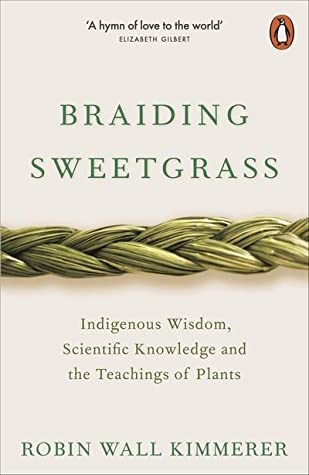 However, I feel like this is the spirituality the planet needs now, so I’ll excuse any repetition (and the basket-weaving essay I thought would never end). “In a world of scarcity, interconnection and mutual aid become critical for survival. So say the lichens.” (She’s funny, too, so you don’t have to worry about the contents getting worthy.) She effectively wields the myth of the Windigo as a metaphor for human greed, essential to a capitalist economy based on “emptiness” and “unmet desires.”
I most enjoyed the shorter essays that draw on her fieldwork or her experience of motherhood. “The Gift of Strawberries” – “An Offering” – “Asters and Goldenrod” make a stellar three-in-a-row, and “Collateral Damage” is an excellent later one about rescuing salamanders from the road, i.e. doing the small thing that we can do rather than being overwhelmed by the big picture of nature in crisis. “The Sound of Silverbells” is one of the most well-crafted individual pieces, about taking a group of students camping when she lived in the South. At first their religiosity (creationism and so on) grated, but when she heard them sing “Amazing Grace” she knew that they sensed the holiness of the Great Smoky Mountains.
But the pair I’d recommend most highly, the essays that made me weep, are “A Mother’s Work,” about her time restoring an algae-choked pond at her home in upstate New York, and its follow-up, “The Consolation of Water Lilies,” about finding herself with an empty nest. Her loving attention to the time-consuming task of bringing the pond back to life is in parallel to the challenges of single parenting, with a vision of the passing of time being something good rather than something to resist.
Here are just a few of the many profound lines:
For all of us, becoming indigenous to a place means living as if your children’s future mattered, to take care of the land as if our lives, both material and spiritual, depended on it.
I’m a plant scientist and I want to be clear, but I am also a poet and the world speaks to me in metaphor.
Ponds grow old, and though I will too, I like the ecological idea of aging as progressive enrichment, rather than progressive loss.
This will be a book to return to time and again. (Gift from my wish list several years ago)
I also had one DNF from this summer’s list:
Human Croquet by Kate Atkinson: This reminded me of a cross between The Crow Road by Iain Banks and The Heavens by Sandra Newman, what with the teenage narrator and a vague time travel plot with some Shakespearean references. I put it on the pile for this challenge because I’d read it had a forest setting. I haven’t had much luck with Atkinson in the past and this didn’t keep me reading past page 60. (Little Free Library)
A Look Back at My 20 Books of Summer 2022
Half of my reads are pictured here. The rest were e-books (represented by the Kindle) or have already had to go back to the library.

My fiction standout was The Language of Flowers, reviewed above. Nonfiction highlights included Forget Me Not and Braiding Sweetgrass, with Tree-Spotting the single most useful book overall. I also enjoyed reading a couple of my selections on location in the Outer Hebrides. The hands-down loser (my only 1-star rating of the year so far, I think?) was Bonsai. As always, there are many books I could have included and wished I’d found the time for, like (on my Kindle) A House among the Trees by Julia Glass, This Is Your Mind on Plants by Michael Pollan and Finding the Mother Tree by Suzanne Simard.
At the start, I was really excited about my flora theme and had lots of tempting options lined up, some of them literally about trees/flowers and others more tangentially related. As the summer went on, though, I wasn’t seeing enough progress so scrambled to substitute in other things I was reading from the library or for paid reviews. This isn’t a problem, per se, but my aim with this challenge has generally been to clear TBR reads from my own shelves. Maybe I didn’t come up with enough short and light options (just two novella-length works and a poetry collection; only the Diffenbaugh was what I’d call a page-turner); also, even with the variety I’d built in, having a few plant quest memoirs got a bit samey.

Next year…
I’m going to skip having a theme and set myself just one simple rule: any 20 print books from my shelves (NOT review copies). There will then be plenty of freedom to choose and substitute as I go along.
Summery Reads from Holly Hopkins, Sarah McCoy, Phil Stamper and Edith Wharton
Every season, I try to choose a few books that feel appropriate for their settings or titles. A few of these I’ve already mentioned briefly, as part of my heat wave reading suggestions. Much as I love autumn, the end of summer tends to coincide with gloomy musings for me. However, it’s farewell to August with four reasonably cheerful books: a poetry collection about England then and now, city and country; an escapist novel set on the Caribbean island of Mustique in the 1970s; the story of four gay friends going their separate ways for a high school summer of adventure; and a less-tragic-than-expected American classic.
The English Summer by Holly Hopkins (2022)
 Colour, geology and history are major sources of imagery in this debut full-length collection. Churches and cemeteries, museums and manor houses, versus hospitals and rental flats: this is the stuff of a country that has swapped its illustrious past for the dismal reality of the everyday. The collection closes with “England, Where Did You Go?” which ends, “should I get out in search of you, … / I’d be left wandering down dual carriageways, / looking across bean fields and filthy ditches.” Hopkins imagines a government that decides to address climate change by assigning weekly community service hours – nearly twice as many for women, who always bear the greater burden for domestic work.
It’s mostly alliteration, repetition, and internal or slant rhymes here. I particularly liked the pair “Rows of Differently Coloured Houses,” which contrasts bright seaside facades with the “Lakes of postwar pebbledash / grey on grey on grey on grey” seen from a Megabus, and “Stratigraphy,” about the archaeologist’s work. Not many standouts otherwise, but it was still worth a try. (New purchase – the publisher, Penned in the Margins, lured me with a sale)
Mustique Island by Sarah McCoy (2022)
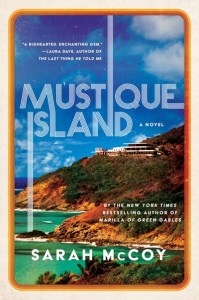 Mustique is a private island in the St. Vincent archipelago that became a playground of the rich and famous in the 1970s, with Princess Margaret and Mick Jagger regular visitors. In McCoy’s novel – inspired by real events and people, and featuring cameos from the aforementioned celebrities as well as the island’s owners at the time, the baron Colin Tennant and his wife, Lady Anne Glenconner (who, I was amused to spot at the library the other day, has written her own fictional tribute to the island, Murder on Mustique) – Willy May, a Texan with a small fortune at her disposal thanks to her divorce from an English brewing magnate, sails in on a private boat and decides to build her own villa on Mustique. She’s uncomfortable with the way locals, who only have service jobs, are sometimes paraded out for colonial displays of pomp. Her two young adult daughters, Hilly and Joanne, later join her. The one has been a model in Paris, where she became addicted to amphetamines.
Love is on the cards for all three main female characters, but there’s heartache along the way as well. Closer to women’s fiction than I generally choose, this was a frothy indulgence that was fun to read but could be shorter and needn’t have tried so hard to make serious points about motherhood and to evoke the time period, e.g., with a list of what’s on the radio. I have also reviewed McCoy’s Marilla of Green Gables. (Offered by publicist via NetGalley)
Golden Boys by Phil Stamper (2022)
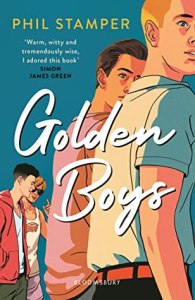 Four gay high schoolers in small-town Ohio look forward to a summer of separate travels for jobs and internships and hope their friendships will stay the course. We have Gabriel, a nature lover off to volunteer for a Boston save-the-trees non-profit; Sal, his friend with benefits, who dreams of bypassing college for a career in politics so interns at his local senator’s office in Washington, DC; Reese, headed to Paris for a fashion design course; and Heath, escaping his parents’ divorce and moving chaos to stay with an aunt and cousin in Florida and work at their beach café. With alternating first-person passages from all four characters, plus transcriptions of their conversation threads, this moves quickly.
Reese has been secretly infatuated with Heath for ages, but three of the four will consider new dating opportunities this summer (the fourth just becomes a workaholic). Secondary characters are pansexual and nonbinary – it’s a whole new world from when I was in high school! Initially, I found the inner monologues too one-note, but I think Stamper’s aim was to recreate the teenage struggle for self-confidence and individuality and has captured that life stage’s inherent anxiety. I also would have trimmed the preparatory stuff; nearly 100 pages before the first of them leaves Ohio is a bit much. This YA novel was a sweet, fun page turner and the perfect replacement to the Heartstopper series as my summer crush. However, I don’t think I was taken enough with the characters to read next year’s projected sequel. (Public library)
Summer by Edith Wharton (1917)
 Charity Royall was born into poverty but brought down the mountain and adopted by a kindly couple into respectable North Dormer society. Mrs. Royall has died before the action starts, but as a young woman Charity still lives with Lawyer Royall, her guardian, and works at the library. When a stranger, Mr. Harney, arrives in their New England town to survey the local architecture, it’s clear right away that he’ll be a romantic prospect for her. “She had always thought of love as something confused and furtive, and he made it as bright and open as the summer air.” However, shame over her lowly origins – she is so snobbish every time she comes into contact with someone from the mountain – continues to plague her.
Although Harney returns her affections and they set up a little love nest in an abandoned house in the woods, uncertainty lingers as to whether he’ll consider marriage to Charity beneath him. This skirts Tess of the d’Urbervilles territory but doesn’t turn nearly as tragic as Ethan Frome (apparently, Wharton called this a favourite among her works, and referred to it as “the Hot Ethan”). Charity isn’t as vain as another Hardy heroine, Bathsheba Everdene; she’s an endearing blend of innocent and worldly, and her realistic reaction to what fate seems to decree feels like about the best one can expect for her time. Melodrama aside, I truly enjoyed the descriptions of a quintessential American summer with picnics and Fourth of July fireworks. Ethan fan or not, you should definitely read this one. (University library)
Love Your Library, August 2022
Edited: Belatedly adding in links to this month’s posts by Eleanor and Marcie, with a huge thank you for participating!
And here’s my haul from today. A few short story collections there because in September I always try to focus a bit more on stories.
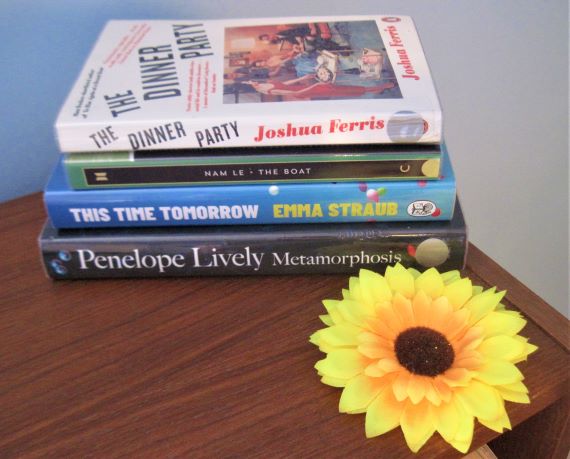
Naomi has also been reading a lot from her local libraries, and Laura stocked up before heading out on holiday:

Normally my library system would be busily buying up the Booker Prize longlist, the Wainwright Prize shortlists, and big-name upcoming releases by the likes of John Irving and Ian McEwan. I have a file on my desktop with a list of 29 author names I periodically check for, as any on-order titles from them will show up at the top of the results. But there’s been a huge slowdown on acquisitions, and I know exactly why: the librarian who orders and processes new books experienced a family tragedy this summer and has been on compassionate leave for a while already. Were I not a library volunteer who also vaguely knows her socially, I’d have no idea and might be simmering with impatience right now. Instead, I’ll be patient, read what I already have out, and address my review book backlog.
Since last month…
READ
- Where the Wildflowers Grow by Leif Bersweden

- Bridget Jones: Mad About the Boy by Helen Fielding (for book club)

- My Life in Houses by Margaret Forster
- Black Narcissus by Rumer Godden
- Julia and the Shark by Kiran Millwood Hargrave
- The Summer Book by Tove Jansson
- From the Hedgerows by Lew Lewis
- The Last Wild Horses by Maja Lunde
- Golden Boys by Phil Stamper
- The False Rose by Jakob Wegelius
Also a children’s book I spotted while shelving – who knew it existed?!
- River Rose and the Magical Lullaby by Kelly Clarkson; illus. Laura Hughes
CURRENTLY READING
- Brief Lives by Anita Brookner (for book club)
- Case Study by Graeme Macrae Burnet
- Nightcrawling by Leila Mottley
- State of Wonder by Ann Patchett (a reread)
- Oh William! by Elizabeth Strout
- The Young Accomplice by Benjamin Wood
A few of these are from the Booker Prize longlist, in advance of the shortlist announcement on 6 September.
And from the university library:
- Summer by Edith Wharton
Still lots around that I’ve borrowed and not gotten into yet:


And various new releases on hold or awaiting me on the reservation shelf.
What have you been reading or reviewing from the library recently?

Share a link to your own post in the comments. Feel free to use the above image. The hashtag is #LoveYourLibrary.
20 Books of Summer, 14–16: Barba, Bersweden and Solnit
I’m all about flowers today: American wildflowers in poetry and prose, a year of hunting down the flora of the British Isles, and a discursive account of a famous English author’s life and times through the prism of his rose garden.
American Wildflowers: A Literary Field Guide, ed. Susan Barba; illus. Leanne Shapton (2022)
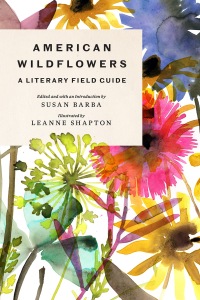 This comes out from Abrams Press in the USA on 8 November and I’ll be reviewing it for Shelf Awareness, so I’ll just give a few brief thoughts for now. Barba is a poet and senior editor for New York Review Books. She has collected pieces from a wide range of American literature, including essays, letters and early travel writings as well as poetry, which dominates.
Apart from a closing section on various/anonymous wildflowers, where particular species are named they are grouped into families, which are arranged alphabetically. The Asteraceae section is particularly strong, with poems on dandelions and sunflowers, a typically prophetic Aldo Leopold fragment about the decline of native flora, and “Asters and Goldenrod,” an extract from Robin Wall Kimmerer’s Braiding Sweetgrass (itself one of my 20 Books of Summer – review to come in the week) that I think was also excerpted in This Book Is a Plant.
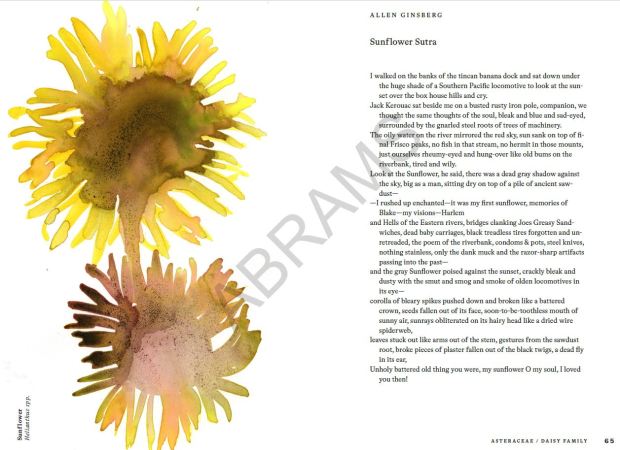
Sample two-page spread with a Leanne Shapton watercolor and part of an Allen Ginsberg poem.
In general, I engaged more with the poetry than with the prose. Barba has ensured a real variety of styles, with good representation for BIPOC. What draws it all together into a beautiful whole I wish I could see as a physical object is Leanne Shapton’s watercolor illustrations, painted from pressed flowers. “What a gift to stare at flowers—these ephemeral miracles of color and synthesis and botany,” she writes in an opening note. This would be a perfect coffee table book for any gardener or nature lover. (E-review copy)
Where the Wildflowers Grow: My Botanical Journey through Britain and Ireland by Leif Bersweden (2022)
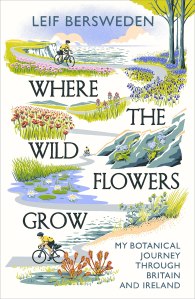 A good case of nominative determinism – the author’s name is pronounced “leaf” – and fun connections abound: during the course of his year-long odyssey, he spends time plant-hunting with Jon Dunn and Sophie Pavelle, whose books featured earlier in my flora-themed summer reading: Orchid Summer and Forget Me Not. With Dunn on Unst, Shetland, he sees not only rare flowers but close-up orcas. Like Pavelle, who he meets up with in Cornwall, he has an eye to how species will be affected by climate change and commits to doing his hunting by train and bike; there’s only so much you can see when zooming by in a car. Bersweden makes a case for spending time with plants – after all, they don’t move, so once you’ve found them you can commune in a way you can’t during, say, a fleeting mammal encounter.
He starts 2021 with a New Year Plant Hunt in central London with his mother – more is in bloom in January than ever before, at least in part due to climate warming. Even when the weather is foul on his travels, there is plenty to be seen. Everywhere he goes, he meets up with fellow experts and plant enthusiasts to marvel at bluebell woodlands or ancient pine forests, alpine or bog species. The floral circuit (documented in full on the book’s website through chapter-by-chapter photographs; there are two small sections of colour plates in the hardback) is also a chance to tour the British Isles, from Kent to Cork, coast to mountaintop.
Bersweden has been in love with plants ever since childhood; he believes they have nostalgia value for many people, and can be an easy way into appreciation of nature. “A wildflower growing from a crack in the wall is an everyday miracle.” His casual writing style and clear zeal for his subject – his author photo is of him hugging a tree, and another has such a cute caption: “Being given the opportunity to hold a Greater Bladderwort (Utricularia vulgaris) was one of the best things that’s ever happened to me!” – make this a pleasure even though it’s a bit overlong at points. (Public library)
Orwell’s Roses by Rebecca Solnit (2021)
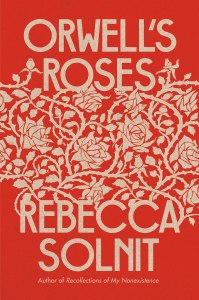 I was fascinated by the concept behind this one. “In the spring of 1936 a writer planted roses” is Solnit’s refrain; from there sprawls a book that’s somehow about everything: botany, geology, history, politics and war – as well as, of course, George Orwell’s life and works (with significant overlap with the graphic novel biography of him that I read last year). On a trip to England with a friend who is a documentary filmmaker, Solnit had the impulse to go find what might be left of Orwell’s garden. When she arrived in the Hertfordshire village of Wallington, the current owners of his home kindly showed her round. His fruit trees had long since been cut down, but the rosebushes were still going strong some 80 years later.
This goes down as a skim for me: though I read the first 30%, after that I just browsed to the end. Some side tracks lost me, e.g. Tina Modotti’s presentation of roses in her photographs; Orwell’s interest in mining, which leads Solnit to investigate how coal is formed; much history; and a week spent observing the rose-growing industry in Colombia. I most enjoyed the book when it stayed close to Orwell’s biography and writings, positing gardening as his way of grounding his ideas in the domestic and practical. “Pursuits like that can bring you back to earth from the ether and the abstractions.” I also liked – briefly, at least – thinking about the metaphorical associations of roses, and flowers in general.
If you’ve read Solnit before, you’ll know that her prose is exquisite, but I think this was the stuff of a long article rather than a full book. As it is, it’s a pretty indulgent project. (Kaggsy reviewed this recently and came to somewhat similar conclusions.) (NetGalley)
Four for #WITMonth: Jansson, Lamarche, Lunde and Vogt
I’ve managed four novels for this year’s Women in Translation month: a nostalgic, bittersweet picture of island summers poised between childhood and old age; a brief, impressionistic account of domestic violence and rape; the third in a series looking at how climate change and species loss reverberate amid family situations; and a visceral meditation on women’s bodies and relationships. Two of these were review copies from the recently launched Héloïse Press, which “champions world-wide female talent”.

The Summer Book by Tove Jansson (1972; 1974)
[Translated from the Swedish by Thomas Teal]
It was just the same long summer, always, and everything lived and grew at its own pace.
 This was only the second time I’ve read one of Jansson’s books aimed at adults (as opposed to five from the Moomins series). Whereas A Winter Book didn’t stand out to me when I read it in 2012 – though I will try it again this winter, having acquired a free copy from a neighbour – this was a lovely read, so evocative of childhood and of languid summers free from obligation. For two months, Sophia and Grandmother go for mini adventures on their tiny Finnish island. Each chapter is almost like a stand-alone story in a linked collection. They make believe and welcome visitors and weather storms and poke their noses into a new neighbour’s unwanted construction.
Six-year-old Sophia, based on Jansson’s niece of the same name, is precocious and opinionated, liable to change her mind in an instant. In “The Cat,” one of my favourite stand-alone bits, she’s fed up with their half-feral pet who kills lots of birds and swaps him for a friend’s soppy lap cat, but then regrets it. She’s learning that logic and emotion sometimes contradict each other, which becomes clearer as she peppers Grandmother with questions about religion and superstition.
As is common to Jansson’s books, there’s a melancholy undercurrent here.
Everything was fine, and yet everything was overshadowed by a great sadness. It was August, and the weather was sometimes stormy and sometimes nice, but for Grandmother, no matter what happened, it was only time on top of time, since everything is vanity and a chasing after the wind.
Sophia’s mother died, and although her grandmother has the greater presence, Papa is also around, dealing with practicalities in the background. Death stalks around the edges, reminding Grandmother of her mortality through bouts of vertigo that have her grabbing for her heart medication. On just the second page we have this memento mori:
“When are you going to die?” the child asked.
And Grandmother answered, “Soon. But that is not the least concern of yours.”
And so it doesn’t feel like our concern either; the focus is on the now, on these beautiful little moments of connection across the generations – like in “Playing Venice,” when Grandmother stays up all night rebuilding Sophia’s model city that was washed away by the rain. (Public library)
The Memory of the Air by Caroline Lamarche (2014; 2022)
[Winner of an English PEN Award; translated from the French by Katherine Gregor]
 In a hypnotic monologue, a woman tells of her time with a violent partner (the man before, or “Manfore”) who thinks her reaction to him is disproportionate and all due to the fact that she has never processed being raped two decades ago. When she goes in for a routine breast scan, she shows the doctor her bruised arm, wanting there to be a definitive record of what she’s gone through. It’s a bracing echo of the moment she walked into a police station to report the sexual assault (and oh but the questions the male inspector asked her are horrible).
The novella opens with an image that returns in dreams but is almost more a future memory of what might have been: “I went down into a ravine and, at the bottom, found a dead woman. She was lying in a shroud, on a carpet of fallen leaves.” I read this in one sitting – er, yoga session – and it has stayed in my mind in intense flashes like that and the flounce of her red dress on the summer day that turned into a nightmare. At an intense 70 pages, this reminded me of Annie Ernaux’s concise autofiction (I’ve reviewed Happening and I Remain in Darkness). An introduction by Dr Dominique Carlini-Versini contextualizes the work by considering the treatment of rape in contemporary French women’s writing.
The Memory of the Air will be published on 26 September. With thanks to Héloïse Press for the proof copy for review.
The Last Wild Horses by Maja Lunde (2019; 2022)
[Translated from the Norwegian by Diane Oatley]
The third in Lunde’s “Climate Quartet,” with its recurring elements of migration, shortages and environmental collapse. Always, though, the overall theme is parent–child relationships and the love that might be the only thing that keeps us going in the face of unspeakable challenges. Here she returns to the tripartite structure of The History of Bees (much my favourite of the three): a historical strand, a near-contemporary one, and a dystopian future story line. The link between the three is Przewalski’s horses (aka takhi).
 In the early 1880s, Mikhail Alexandrovich Kovrov, assistant director of St. Petersburg Zoo, is brought the hide and skull of an ancient horse species assumed extinct. Although a timorous man who still lives with his mother, he becomes part of an expedition to Mongolia to bring back live specimens. In 1992, Karin, who has been obsessed with Przewalski’s horses since encountering them as a child in Nazi Germany, spearheads a mission to return the takhi to Mongolia and set up a breeding population. With her is her son Matthias, tentatively sober after years of drug abuse. In 2064 Norway, Eva and her daughter Isa are caretakers of a decaying wildlife park that houses a couple of wild horses. When a climate migrant comes to stay with them and the electricity goes off once and for all, they have to decide what comes next. This future story line engaged me the most.
I appreciated some aspects: queer and middle-aged romances, the return of a character from The End of the Ocean, the consideration across all three plots of what makes a good mother. However, the horses seemed neither here nor there. There are also many, many animal deaths. Perhaps an unsentimental attitude is necessary to reflect past and future values, and the apparent cruelty of natural processes, but it limits the book’s appeal to animal lovers. Maybe the tone fits the Norwegian prose, which the translator describes as lean.
The fourth book of the quartet, publishing in Norway next month, is called something like The Dream of a Tree; a focus on trees would be a draw for me. After the disappointment of Books 2 and 3, I’m unsure whether I want to bother with the final volume, but it makes sense to do so, if only to grasp Lunde’s full vision. (Public library)
What Concerns Us by Laura Vogt (2020; 2022)
[Translated from the German by Caroline Waight]
 Vogt’s Swiss-set second novel is about a tight-knit matriarchal family whose threads have started to unravel. For Rahel, motherhood has taken her away from her vocation as a singer. Boris stepped up when she was pregnant with another man’s baby and has been as much of a father to Rico as to Leni, the daughter they had together afterwards. But now Rahel’s postnatal depression is stopping her from bonding with the new baby, and she isn’t sure this quartet is going to make it in the long term.
Meanwhile, Rahel’s sister Fenna knows she’s pregnant but refuses a doctor’s care. When she comes to stay with Rahel, she confides that the encounter with her partner, Luc, that led to conception was odd, rough; maybe not consensual. And all this time, the women’s mother, Verena, has been undergoing treatment for breast cancer. All three characters appear to be matter-of-factly bisexual; Rahel and Fenna’s father has long been out of the picture, replaced in Verena’s affections by Inge.
As I was reading, I kept thinking of the declaration running through A Ghost in the Throat by Doireann Ní Ghríofa: “This is a female text.” Vogt’s vision is all breasts and eggs, genitals actual and metaphorical. I loved the use of food in the novel: growing up, the girls cherished “silly nights” when their mother prepared an egg feast and paired it with a feminist lecture on reproduction. Late on, there’s a wonderful scene when the three main characters gorge on preserved foodstuffs from the cellar and share their secrets. (Their language is so sexually frank; would anyone really talk to their mother and siblings in that way?!) As in the Lunde, the main question is what it means to be a mother, but negotiating their relationships with men stretches the bonds of this feminine trio. One for fans of Rachel Cusk and Sally Rooney.
With thanks to Héloïse Press for the proof copy for review.
20 Books of Summer, 12–13: Black Narcissus & The False Rose
I’m limping towards the finish line with my flora-themed summer reading. Expect the reviews to come fast and furious over the next week and a half. Today’s novels aren’t about flowers, per se, but the title references do play a role. Both: (Public library) 
Black Narcissus by Rumer Godden (1939)
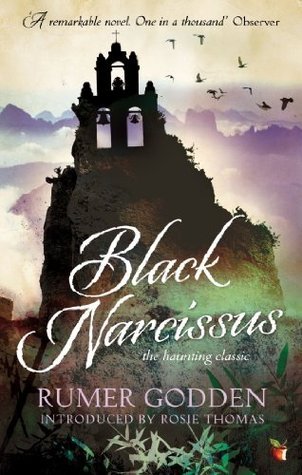 I saw the Deborah Kerr film version of this way back in my teen years but had never read anything by Rumer Godden. My interest was renewed by Laura’s post on nun books. A group of idealistic English nuns sets up a convent school and hospital in the mountains above Darjeeling. “They were going into the wilderness, to pioneer, to endure, to work; but surely not to enjoy themselves.” Much of the appeal of reading about small communities is seeing how different personalities play off each other: aloof leader Sister Clodagh, pensive Sister Philippa, impetuous Sister Ruth. The land belongs to the General, whose teenage son Dilip Rai comes for lessons (he’s a bit of a dandy and wears Black Narcissus perfume); the General’s caretaker, Mr. Dean, is a go-between between the nuns and the natives. Though cynical and often drunk, he pulls through for the sisters more than once.
There are vaguely racist attitudes here, perhaps inevitable for the time this was written, but the English characters do start to change: “[Sister Clodagh] was fond of these people. She could not remember when it was that she began to think of them as people; not as natives, persons apart, but as people like themselves, and she was beginning to see with their eyes.” An erotic undercurrent explodes into a couple of obsessive crushes that threaten the entire mission. I read the first third of this on a bus in the Highlands and when I tried to get back into it a month later, it couldn’t recapture my attention despite an enticing Indian atmosphere.
The False Rose by Jakob Wegelius (2020; 2021)
[Translated from the Swedish by Peter Graves]
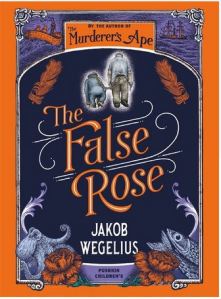 This is why I shouldn’t read sequels. The Murderer’s Ape was a pure delight and perfect companion on my long sea voyage to Spain back in May. Its every character and plot twist twinkle and the pages flew by. By contrast, this was … fine, but unnecessary. The plot turns on a pearl necklace Sally Jones the gorilla and Captain Koskela find hidden on their boat. Its centerpiece is a carved mother-of-pearl and silver rose and it belongs to Rose Henderson, the estranged daughter of Shetland Jack. They decide to return it to the rightful owner, but before they can track Rose down the necklace is stolen and a whole spiral is set underway. Once again, Sally Jones is separated from her captain and has to survive by her wits. Held prisoner by Glasgow bootleggers, she has to let them think her deaf and dumb, but makes friends with a former boxer named Bernie, who’s in thrall to his sister, harsh gang boss Moira. The final 100 pages or so, as everything finally unwinds, is satisfying, but it took me forever to make it there. I missed the supporting characters of the first book and gangster stories aren’t my jam.
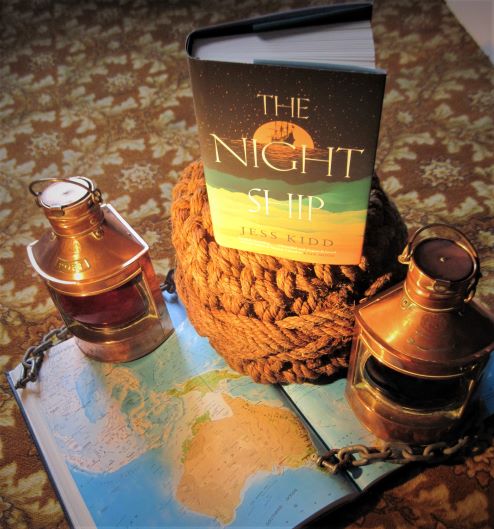
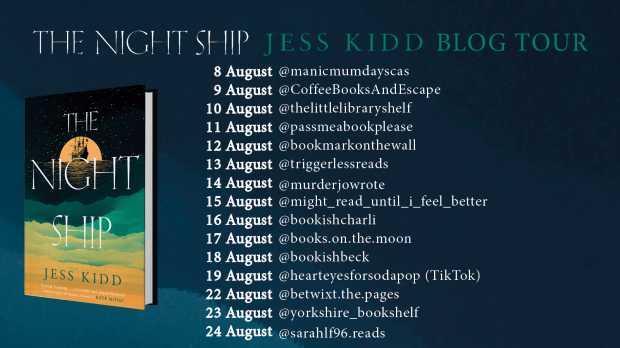
The Night Ship by Jess Kidd (Blog Tour Review)
Jess Kidd’s fourth novel is based on a true story: the ill-fated voyage of the Batavia, which set off from the Netherlands in 1628, bound for Indonesia, but wrecked on the Abrolhos Islands off the western coast of Australia in June 1629. If you look into it at all, you find a grim story of mutiny and murder. But we experience the voyage, and view its historical legacy, through the eyes of two motherless children: Mayken, travelling on the Batavia to be reunited with her merchant father abroad; and Gil, who, in 1989, moves in with his grandfather at his Australian beach hut and observes archaeologists diving into the wreck.
Chapters alternate between the two time periods. Mayken is in the care of her old nursemaid, Imke, who has second sight. As Imke’s health fails, Mayken goes semi-feral, dressing up as a cabin boy to explore the belowdecks world. Gil, a tender, traumatized boy in the company of rough grown-ups, becomes obsessed with the local dig and is given a pet tortoise – named Enkidu to match his own full name, Gilgamesh. Mayken and Gil both have to navigate a harsh adult world with its mixture of benevolent guardians and cruel strangers.
An explicit connection between the protagonists is set up early on, when a neighbour tells Gil there’s a “dead girl who haunts the island … Old-time ghost, from the shipwreck,” known as Little May. But there are little links throughout. For instance, both have a rote story to explain their mother’s death, and both absorb legends about a watery monster (the Dutch Bullebak and the Aboriginal Bunyip) that pulls people under. The symmetry of the story lines is most evident in the shorter chapters towards the end, such as the rapid-fire pair of 33–34.
These echoes, some subtle and some overt, are the saving grace of an increasingly bleak novel. Don’t be fooled by the focus on children’s experience: this is a dark, dark story, with only pinpricks of light at the end for one of the two. In terms of similar fiction I’ve read, the tone is more Wakenhyrst than The Essex Serpent; more Jamrach’s Menagerie than Devotion. (It didn’t help that I’d just read Julia and the Shark, an exceptional children’s book with a maritime setting and bullying/mental health themes.) I engaged more with the contemporary strand – as is pretty much always the case for me with a dual timeline – yet appreciated the atmosphere and the research behind the historical segments. This doesn’t match Things in Jars, but I was still pleased to have the chance to try something else by Jess Kidd.
With thanks to Canongate for my free copy for review.
I was delighted to be part of the social media tour for The Night Ship. See below for details of where other reviews and features have appeared or will be appearing soon.
Book Serendipity, May to Mid-August 2022
This is a regular feature of mine every few months. I call it “Book Serendipity” when two or more books that I read at the same time or in quick succession have something in common – the more bizarre, the better. Because I usually have 20–30 books on the go at once, I suppose I’m more prone to such incidents. The following are in roughly chronological order.
- Not only did the opening scene of All Down Darkness Wide by Seán Hewitt share with Falling Angels by Tracy Chevalier a graveyard setting, but more specifically an angel statue whose head falls off.

- SPOILER: {The protagonist has a backstory of a mother who drowned, presumably by suicide, in Secrets of the Sea House by Elisabeth Gifford and The Dance Tree by Kiran Millwood Hargrave.}
- I started reading two e-books on the same day that had Taylor Swift lyrics as an epigraph: Bad Vibes Only by Nora McInerny and Tracy Flick Can’t Win by Tom Perrotta. I have never knowingly heard a Taylor Swift song.
- Rescuing insects from a swimming pool in Fledgling by Hannah Bourne-Taylor and In the Quaker Hotel by Helen Tookey.
- Reading two feminist works of historical fiction in which the protagonist refuses to marry (even though it’s true love) at the same time: Lessons in Chemistry by Bonnie Garmus and Madwoman by Louisa Treger (about Nellie Bly).
- Two London-set books featuring a daughter named Mabel, one right after the other: This Is Not a Pity Memoir by Abi Morgan and Bridget Jones: Mad about the Boy by Helen Fielding.
- In Jenn Shapland’s My Autobiography of Carson McCullers I came across the fact that McCullers married the same man twice. Just a few days before, I’d seen that same odd fact about Hilary Mantel in her Wikipedia bio.
- A character named Clodagh in Black Narcissus by Rumer Godden and “Rainbows” by Joseph O’Neill, one of the entries in The Best Short Stories 2022: The O. Henry Prize Winners.
- Reading two books about an English author who died young of TB at the same time: Tenderness by Alison MacLeod (about D.H. Lawrence) and Orwell’s Roses by Rebecca Solnit.
- Reading two novels that mention the shipwreck of the Batavia at the same time: The Night Ship by Jess Kidd (where it’s a major element) and Cloudstreet by Tim Winton (just a tiny reference that nonetheless took me aback). According to Wikipedia, “Batavia was a ship of the Dutch East India Company. Built in Amsterdam in 1628 as the company’s new flagship, she sailed that year on her maiden voyage for Batavia, capital of the Dutch East Indies. On 4 June 1629, Batavia was wrecked on the Houtman Abrolhos, a chain of small islands off the western coast of Australia.”
- David Lack’s Swifts in a Tower is mentioned in Swifts and Us by Sarah Gibson (no surprise there) but also in From the Hedgerows by Lew Lewis.
- There’s a child nicknamed Chub in Damnation Spring by Ash Davidson and Cloudstreet by Tim Winton (which both also at least started off being buddy reads with Marcie of Buried in Print!).
- Two novels in quick succession in which the discovery of a horse skeleton sparks the action in one story line: The Last Wild Horses by Maja Lunde and (coming up soon – I have a library reservation placed) Horse by Geraldine Brooks.
- Unst, Shetland as a setting in Orchid Summer by Jon Dunn, Sightlines by Kathleen Jamie, Julia and the Shark by Kiran Millwood Hargrave, and Where the Wildflowers Grow by Leif Bersweden.
- “Quiet as it’s kept” (a quote from the opening line of Toni Morrison’s The Bluest Eye) is borrowed in a poem in No Country for Eight-Spot Butterflies by Julian Aguon and one in the anthology American Wildflowers: A Literary Field Guide, ed. Susan Barba (“A Siren Patch of Indigo” by Cyrus Cassells).
- I didn’t recognize the word “swingeing” in The Reindeer Hunters by Lars Mytting and encountered it again the same day in Brief Lives by Anita Brookner before I had a chance to look it up (it means extreme or severe).
- A 1950s setting and a main character who is a man with missing fingers/arm in Cloudstreet by Tim Winton and The Young Accomplice by Benjamin Wood.
What’s the weirdest reading coincidence you’ve had lately?
20 Books of Summer #11, Review Catch-up, and Wainwright Children’s Picks
Comparing my January–April reading totals with my May–July average, I see that my reading is down 57% over the last few months (at least in terms of number of books finished), and I can only blame the stress and time-consuming processes of moving house and DIY. I feel like I’ve slowed to a crawl through my various challenges, including my 20 Books.
With increasingly apocalyptic news filling my feeds, I find that I simultaneously a) want to retreat into books all the more and b) wonder what the point of all this compulsive reading is. For now, I’m taking as back-up Gretchen Rubin’s motto shared on National Book Lovers Day (“Reading is my tree house and my cubicle, my treadmill and my snow day” – what a perfect summary! It’s playtime, escape, mental exercise, indulgence but also, in some cases, work) and the premise of San Diego philosopher Nick Riggle’s upcoming This Beauty, which I’m reading for an early review: the purpose of life is to participate in and replicate beauty.
20 Books of Summer, #11
From the hedgerows: A collection of short stories on the wildlife, places and people of Newbury District by Lew Lewis (2008)
 The love and appreciation of natural beauty starts at home, and we are lucky here in West Berkshire to have a very good newspaper that still hosts a nature column (currently by beloved local author Nicola Chester). This collection of Newbury Weekly News articles spans 1979 to 1996, with the majority of the pieces from 1990–5. They were contributed by 17 authors, but most are by Lew Lewis (including under a pseudonym).
If you regularly read the Guardian Country Diary feature, you’ll find the format familiar. The general idea is to pick a natural phenomenon that’s seasonal or timely in some way, and write a short essay on it that incorporates context, personal observation, a political conscience and sometimes whimsical or nostalgic musing. Many pieces are about bird sightings; a few are about plants and insects; others celebrate the unique landscapes we have here, like heath and chalk downland. Some are quaint, like an introduction to “ticking” (birders’ list-keeping).
It was faintly depressing to see that we’ve been noting these habitat and species losses and their causes (generally, intensified agriculture) for over 30 years, and haven’t done enough to reverse them. But there are some good news stories, too, like “Return of the Red Kite,” one of our flagship species. This is basically self-published and could have done with some extra proofreading, but the black-and-white illustrations, most by Richard Allen, are charming. I was so pleased to find this on my library reshelving trolley one day. It’s an important artefact of a nature-lover’s heritage. There should be a follow-up volume or two! (Public library)
Review Book Catch-up
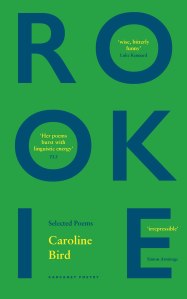 Rookie: Selected Poems by Caroline Bird (2022)
I discovered Caroline Bird early last year through In These Days of Prohibition and her latest collection, The Air Year, was one of my favourite reads of 2021. Part of the joy of working my way through this chronological volume was finding the traces of Bird’s later surrealism. Her first collection, Looking through Letterboxes, was written when she was just 14 and published when she was 16, but you’d never guess that from reading these poems of family, fairy tales and unspecified longing. I particularly liked the first stanza of “Passing the Time”:
Thirty paperclip statues on every table in the house
and things are slightly boring without you.
I’ve knitted a multi-coloured jacket for every woodlouse
in the park. But what can you do?
Trouble Came to the Turnip has some cheeky and randy fare, with the title poem offering a beleaguered couple various dubious means of escape. Watering Can pits monogamy and marriage against divorce and the death of love, via some twisted myths and fairy tales (e.g., Narcissus and Red Riding Hood). “Last Tuesday” is a stand-out. The Hat-Stand Union has more of what I most associate with Bird’s verse: dreams and the surreal. “How the Wild Horse Stopped Me” was a favourite. Mostly, I’m glad I own this so I can have access to the material from her two latest collections, but it was also fun to encounter her earlier style. In an afterword, she writes: “I chose poetry because it let me hide and, once hidden, I could be brave, roll my heart in sequins and chuck it out, glittering, into the street.”
With thanks to Carcanet Press for the free copy for review.
Getting through It: My Year of Cancer during Covid by Helen Epstein (2022)
 Given my love of medical memoirs and my recent obsession with Covid chronicles, this was always going to appeal to me. Epstein, an arts journalist and nonfiction author born in Prague and based in Massachusetts, was diagnosed with endometrial cancer in June 2020. She documents the next year or so in a matter-of-fact diary format, never shying away from the details of symptoms, medical procedures and side effects. Her husband Patrick’s e-mail updates sent out to friends and family, and occasional medical reports, fill in the parts she was less clear on due to fatigue and brain fog – including two small strokes she suffered. Surgery was followed by chemo and then the fraught decision of whether to decline brachytherapy (internal radiation). And, of course, all this was happening at a time when people were less able to see loved ones and rely on their regular diversions. The apt cover conjures up the outdoor chaise longue where Epstein would hold court and receive visitors.
In my mind, cancer patients fall into two camps: those who want to read everything they can about their illness so they know what to expect, and those who avoid thinking about it at all costs. For those in the former group, a no-nonsense book like this will be invaluable. I particularly appreciated Epstein’s attention to her husband’s experience, which she had to dig a little deeper to understand, and her realization that having female cancer brought back memories of childhood sexual molestation. She is also candid about how other people’s emotional demands (e.g., recounting a family member’s illness, or expecting effusive gratitude for small thoughtful acts) weighed on her. A forthright Everywoman’s narrative.
With thanks to the author for the free e-copy for review. Full disclosure: We are acquaintances through a Facebook group for book reviewers.
Wainwright Children’s Prize shortlist
I’ve now read 4 of 7 books on the Wainwright Prize’s Children’s Nature and Conservation Writing shortlist. I’m unlikely to have a chance to read the other three before the winner is announced unless my library system acquires them quickly. Any of the ones I’ve read would make a deserving winner, but the two I review below really grabbed me by the heartstrings and I would be particularly delighted to see one or the other take this inaugural award.
One World: 24 Hours on Planet Earth by Nicola Davies, illus. Jenni Desmond (2022)
 It’s one minute to midnight in London. Two Brown sisters are awake and looking at the moon. A journey of the imagination takes them through the time zones to see the natural spectacles the world has to offer: polar bears hunting at the Arctic Circle, baby turtles scrambling for the sea on an Indian beach, humpback whales breaching in Hawaii, and much more. Each spread has no more than two short paragraphs of text to introduce the landscape and fauna and explain the threats each ecosystem faces due to human influence. As the girls return to London and the clock chimes to welcome in 22 April, Earth Day, the author invites us to feel kinship with the creatures pictured: “They’re part of us, and every breath we take. Our world is fragile and threatened – but still lovely. And now it’s the start of a new day: a day when I’ll speak about these wonders, shout them out”.

A lot of research went into ensuring accuracy, and the environmentalist message is clear but not overstated. Fantastic! (Public library)
Julia and the Shark by Kiran Millwood Hargrave, illus. Tom de Freston (2021)
 I could never have predicted when I read The Way Past Winter that Hargrave would become one of my favourite contemporary writers. Julia and her parents (and not forgetting the cat, Noodle) are off on an island adventure to Unst, in the north of Shetland, where her father will keep the lighthouse for a summer and her mother, a marine biologist, will search for the Greenland shark, a notably long-lived species she’s researching in hopes of discovering clues to human longevity – a cause close to her heart after her own mother’s death with dementia. Julia makes friends with Kin, a South Asian boy whose family run the island laundromat-cum-library. They watch stars and try to evade local bullies together. But one thing Julia can’t escape is her mother’s mental health struggle (late on named as bipolar: “Mum sometimes bounced around like Tigger, and other times she was mopey like Eeyore”). Julia thinks that if she can find the shark, it might fix her mother.
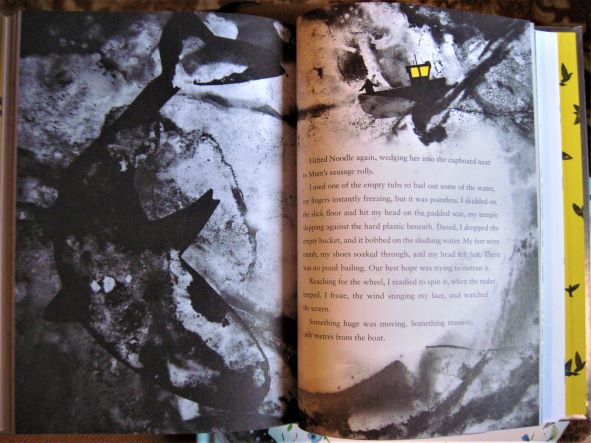
Hargrave treats the shark as both a real creature and a metaphor for all that lurks – all that we fear and don’t understand. It and murmurations of starlings are visual motifs throughout the book, which has a yellow and black colour scheme. Like One World, it’s as beautifully illustrated as it is profound in its messages. Julia is no annoyingly precocious child narrator, just a believable one who shows us her struggling family and the love and magic that get them through. I could see this becoming a modern children’s classic. (Public library)
 Bookish Beck = Rebecca Foster. American transplant to England. Freelance proofreader and book reviewer.
 Bookish Beck