Local Resistance: On Gallows Down by Nicola Chester
It’s mostly by accident that we came to live in Newbury: five years ago, when a previous landlord served us notice, we viewed a couple of rental houses in the area to compare with what was available in Reading and discovered that our money got us more that little bit further out from London. We’ve come to love this part of West Berkshire and the community we’ve found. It may not be flashy or particularly famous, but it has natural wonders worth celebrating and a rich history of rebellion that Nicola Chester plumbs in On Gallows Down. A hymn-like memoir of place as much as of one person’s life, her book posits that the quiet moments of connection with nature and the rights of ordinary people are worth fighting for.
So many layers of history mingle here: from the English Civil War onward, Newbury has been a locus of resistance for centuries. Nicola* has personal memories of the long-running women’s peace camps at Greenham Common, once a U.S. military base and cruise missile storage site – to go with the Atomic Weapons Establishment down the road at Aldermaston. As a teenager and young woman, she took part in symbolic protests against the Twyford Down and Newbury Bypass road-building projects, which went ahead and destroyed much sensitive habitat and many thousands of trees. Today, through local and national newspaper and magazine columns on wildlife, and through her winsome nagging of the managers of the Estate she lives on, she bears witness to damaging countryside management and points to a better way.

While there is a loose chronological through line, the book is principally arranged by theme, with experiences linked back to historical or literary precedents. An account of John Clare and the history of enclosure undergirds her feeling of the precarity of rural working-class life: as an Estate tenant, she knows she doesn’t own anything, has no real say in how things are done, and couldn’t afford to move elsewhere. Nicola is a school librarian and has always turned to books and writing to understand the world. I particularly loved Chapter 6, about how she grounds herself via the literature of this area: Kenneth Grahame’s The Wind in the Willows, Adam Thorpe’s Ulverton, and especially Richard Adams’s Watership Down.
Whatever life throws at her – her husband being called up to fight in Iraq, struggling to make ends meet with small children, a miscarriage, her father’s unexpected death – nature is her solace. She describes places and creatures with a rare intimacy borne out of deep knowledge. To research a book on otters for the RSPB, she seeks out every bridge over every stream. She goes out “lamping” with the local gamekeeper after dark and garners priceless nighttime sightings. Passing on her passion to her children, she gets them excited about badger watching, fossil collecting, and curating shelves of natural history treasures like skulls and feathers. She also serves as a voluntary wildlife advocate on her Estate. For every victory, like the re-establishment of the red kite population in Berkshire and regained public access to Greenham Common, there are multiple setbacks, but she continues to be a hopeful activist, her lyrical writing a means of defiance.
We are writing for our very lives and for those wild lives we share this one, lonely planet with. Writing was also a way to channel the wildness; to investigate and interpret it, to give it a voice and defend it. But it was also a connection between home and action; a plank bridge between a domestic and wild sense. A way both to home and resist.
You know that moment when you’re reading a book and spot a place you’ve been or a landmark you know well, and give a little cheer? Well, every site in this book was familiar to me from our daily lives and countryside wanderings – what a treat! As I was reading, I kept thinking how lucky we are to have such an accomplished nature writer to commemorate the uniqueness of this area. Even though I was born thousands of miles away and have moved more than a dozen times since I settled in England in 2007, I feel the same sense of belonging that Nicola attests to. She explicitly addresses this question of where we ‘come from’ versus where we fit in, and concludes that nature is always the key. There is no exclusion here. “Anyone could make a place their home by engaging with its nature.”
*I normally refer to the author by surname in a book review, but I’m friendly with Nicola from Twitter and have met her several times (and she’s one of the loveliest people you’ll ever meet), so somehow can’t bring myself to be that detached!
On Gallows Down was released by Chelsea Green Publishing on October 7th. My thanks to the author and publisher for arranging a proof copy for review.
My husband and I attended the book launch event for On Gallows Down in Hungerford on Saturday evening. Nicola was introduced by Hungerford Bookshop owner Emma Milne-White and interviewed by Claire Fuller, whose Women’s Prize-shortlisted novel Unsettled Ground is set in a fictional version of the village where Nicola lives.
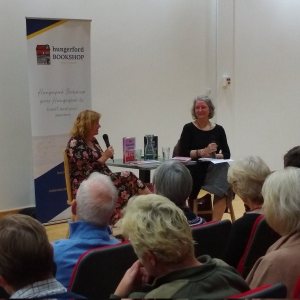
Nicola Chester and Claire Fuller. Photo by Chris Foster.
Nicola dated the book’s genesis to the moment when, 25 years ago, she queued up to talk to a TV news reporter about Newbury Bypass and froze. She went home and cried, and realized she’d have to write her feelings down instead. Words generally come to her at the time of a sighting, as she thinks about how she would tell someone how amazing it was.
Her memories are tied up with seasons and language, especially poetry, she said, and she has recently tried her hand at poetry herself. Asked about her favourite season, she chose two, the in-between seasons – spring for its abundance and autumn for its nostalgia and distinctive smells like tar spot fungus on sycamore leaves and ivy flowers.


A bonus related read:
Anarchipelago by Jay Griffiths (2007)
This limited edition 57-page pamphlet from Glastonbury-based Wooden Books caught my eye from the library’s backroom rolling stacks. Griffiths wrote her impish story of Newbury Bypass resistance in response to her time among the protesters’ encampments and treehouses. Young Roddy finds a purpose for his rebellious attitude wider than his “McTypical McSuburb” by joining other oddballs in solidarity against aggressive policemen and detectives.
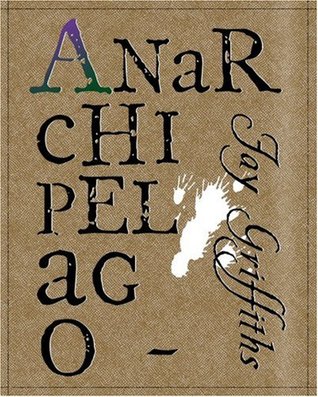
There are echoes of Ali Smith in the wordplay and rendering of accents.
“When I think of the road, I think of more and more monoculture of more and more suburbia. What I do, I do in defiance of the Louis Queasy Chintzy, the sickly stale air of suburban car culture. I want the fresh air of nature, the lifefull wind of the French revolution.”
In a nice spot of Book Serendipity, both this and On Gallows Down recount the moment when nature ‘fought back’ as a tree fell on a police cherry-picker. Plus Roddy is kin to the tree-sitting protesters in The Overstory by Richard Powers as well as another big novel I’m reading now, Damnation Spring by Ash Davidson.
Short Stories in September, Part II: Tove Jansson, Brandon Taylor, Eley Williams
Each September I make a special effort to read short stories, which otherwise tend to languish on my shelves and TBR unread. After my first four reviewed last week, I have another three wonderfully different collections, ranging from bittersweet children’s fantasy in translation to offbeat, wordplay-filled love notes via linked stories suffused with desire and desperation.
Tales from Moominvalley by Tove Jansson (1962; 1963)
[Trans. from the Swedish by Thomas Warburton]
 I only discovered the Moomins in my late twenties, but soon fell in love with the quirky charm of Jansson’s characters and their often melancholy musings. Her stories feel like they can be read on multiple levels, with younger readers delighting in the bizarre creations and older ones sensing the pensiveness behind their quests. There are magical events here: Moomintroll discovers a dragon small enough to be kept in a jar; laughter is enough to bring a fearful child back from literal invisibility. But what struck me more was the lessons learned by neurotic creatures. In “The Fillyjonk who believed in Disasters,” the title character fixates on her belongings—
“we are so very small and insignificant, and so are our tea cakes and carpets and all those things, you know, and still they’re important, but always they’re threatened by mercilessness…”
—but when a gale and a tornado come and sweep it all away, she experiences relief and joy:
“the strange thing was that she suddenly felt quite safe. It was a very strange feeling, and she found it indescribably nice. But what was there to worry about? The disaster had come at last.”
My other favourite was “The Hemulen who loved Silence.” After years as a fairground ticket-taker, he can’t wait to retire and get away from the crowds and the noise, but once he’s obtained his precious solitude he realizes he needs others after all. The final story, “The Fir Tree,” is a lovely Christmas one in which the Moomins, awoken midway through their winter hibernation, get caught up in seasonal stress and experience the holiday for the first time. (Public library) 
Filthy Animals by Brandon Taylor (2021)
Real Life was one of my five favourite novels of 2020, and we are in parallel fictional territory here. Lionel, the protagonist in four of the 11 stories, is similar to Wallace insomuch as both are gay African Americans at a Midwestern university who become involved with a (straight?) white guy. The main difference is that Lionel has just been released from hospital after a suicide attempt. A mathematician (rather than a biochemist like Wallace), he finds numbers soothingly precise in comparison to the muddle of his thoughts and emotions.
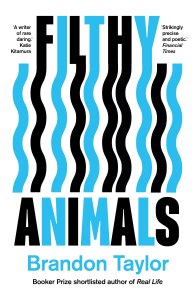 In the opening story, “Potluck,” he meets Charles, a dancer who’s dating Sophie, and the three of them shuffle into a kind of awkward love triangle where, as in Real Life, sex and violence are uncomfortably intertwined. It’s a recurring question in the stories, even those focused around other characters: how does tenderness relate to desire? In the throes of lust, is there room for a gentler love? The troubled teens of the title story are “always in the thick of violence. It moves through them like the Holy Ghost might.” Milton, soon to be sent to boot camp, thinks he’d like to “pry open the world, bone it, remove the ugly hardness of it all.”
Elsewhere, young adults face a cancer diagnosis (“Mass” and “What Made Them Made You”); a babysitter is alarmed by her charge’s feral tendencies (“Little Beast”); and same-sex couples renegotiate their relationships (Simon and Hartjes in “As Though That Were Love” and Sigrid and Marta in “Anne of Cleves,” one of my favourites). While the longer Lionel/Charles/Sophie stories, “Potluck” and “Proctoring,” are probably the best and a few others didn’t make much of an impression, the whole book has an icy angst that resonates. Taylor is a confident orchestrator of scenes and conversations, and the slight detachment of the prose only magnifies his characters’ longing for vulnerability (Marta says to Sigrid before they have sex for the first time: “I’m afraid I’ll mess it up. I’m afraid you’ll see me.” To which Sigrid replies, “I see you. You’re wonderful.”). (New purchase, Forum Books)
 A bonus story: “Oh, Youth” was published in Kink (2021), an anthology edited by Garth Greenwell and R.O. Kwon. I requested this from NetGalley just so I could read the stories by Carmen Maria Machado and Brandon Taylor. All of Taylor’s work feels of a piece, such that his various characters might be rubbing shoulders at a party – which is appropriate because the centrepiece of Real Life is an excruciating dinner party, Filthy Animals opens at a potluck, and “Oh, Youth” is set at a dinner party.
Grisha is here with Enid and Victor, his latest summer couple. He’s been a boytoy for hire since his architecture professor, Nate, surprised him by inviting him into his open marriage with Brigid. “His life at the time was a series of minor discomforts that accumulated like grit in a socket until rotation was no longer possible.” The liaisons are a way to fund a more luxurious lifestyle and keep himself in cigarettes.
While Real Life brought to mind Virginia Woolf, Taylor’s stories recall E.M. Forster or Thomas Mann. In other words, he’s the real deal: a blazing talent, here to stay.
Attrib. and Other Stories by Eley Williams (2017)
 After enjoying her debut novel, The Liar’s Dictionary, this time last year, I was pleased to find Williams’s first book in a charity shop last year. Her stories are brief (generally under 10 pages) and 15 of the 17 are first-person narratives, often voiced by a heartbroken character looking for the words to describe their pain or woo back a departed lover. A love of etymology is patent and, as in Ali Smith’s work, the prose is enlivened by the wordplay.
The settings range from an art gallery to a beach where a whale has washed up, and the speakers tend to have peculiar careers like an ortolan chef or a trainer of landmine-detecting rats. My favourite was probably “Synaesthete, Would Like to Meet,” whose narrator is coached through online dating by a doctor.
 I found a number of the stories too similar and thin, and it’s a shame that the hedgehog featured on the cover of the U.S. edition has to embody human carelessness in “Spines,” which is otherwise one of the standouts. But the enthusiasm and liveliness of the language were enough to win me over. (Secondhand purchase from the British Red Cross shop, Hay-on-Wye – how fun, then, to find the line “Did you know Timbuktu is twinned with Hay-on-Wye?”)
I’ll have one more set of short story reviews coming up before the end of the month, with a few other collections then spilling into October for R.I.P.
Women’s Prize Longlist Reviews (Leilani, Lockwood, and Lyon) & Predictions
Tomorrow, Wednesday the 28th, the Women’s Prize shortlist will be revealed. I have read just over half of the longlist so far and have a few more of the nominees on order from the library – though I may cancel one or two of my holds if they don’t advance to the shortlist. Also, my neighbourhood book club has applied to be one of six reading groups shadowing the shortlist this year via a Reading Agency initiative. If I do say so myself, I think we put in a rather strong application. We’ll hear later this week if we’ve been chosen – fingers crossed!
The three longlisted novels I’ve read most recently were all by L authors:
Luster by Raven Leilani
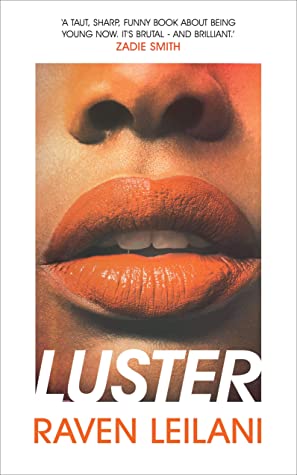 Edie’s voice is immediately engaging: cutting, funny, pithy. It reminded me of Ava’s in a fellow Women’s Prize nominee, Exciting Times, and both novels even employ a near-identical metaphor: “I wondered if Victoria was a real person or three Mitford sisters in a long coat” (Dolan) versus “all the kids stacked underneath my trench coat rejoice” (Leilani). They are also both concerned with how young women negotiate a confusing romantic landscape and look for meaning beyond a dead-end career. The African-American Edie’s entry-level work for a New York City publisher barely covers her rent at a squalid shared apartment. She’s shagged every male in the office and is now on to one she met online: Eric, a white, middle-aged archivist with an open marriage and a Black adopted daughter.
As Edie insinuates herself into Eric’s suburban New Jersey life in peculiar and sometimes unwitting ways, we learn more about her traumatic past: Both of her parents are dead, one by suicide, and she had an abortion at age 16. Along with sex, her main escape is her painting, which is described in tender detail. There are a number of amusing scenes set at off-the-wall locations, like a theme park, a clown school, and Comic Con. Leilani has a knack for capturing an entire realm of experience in just a few pages, as when she satirizes current publishing trends or encapsulates what it’s like to be a bicycle delivery person.
But, as a Goodreads acquaintance put it, all this sharp writing is rather wasted on the plot. I found the direction of the book in its second half utterly unrealistic, and never believed that Edie would have found Eric attractive in any way. (His interest in her is beyond creepy, really.) What I found most intriguing, along with the painting hobby, were Edie’s interactions with other Black characters, such as a publishing company colleague and Eric’s adopted daughter – there’s an uncomfortable sense that they should have a natural camaraderie and/or that Edie should be some kind of role model. I might have liked more of that dynamic, instead of the unbearable awkwardness of temporary instalment in a white neighbourhood. Other readalikes: Queenie, Here Is the Beehive, and On Beauty. 
No One Is Talking About This by Patricia Lockwood
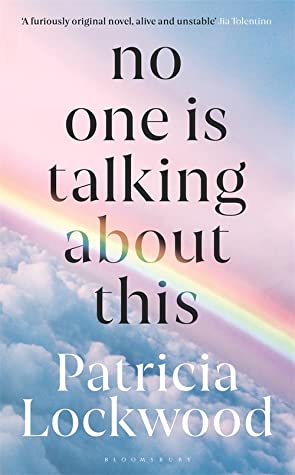 Priestdaddy is one of my absolute favourite books, so Lockwood’s debut novel was one of the 2021 releases I was most looking forward to reading. It took me a while to warm to, but ultimately did not disappoint. It probably helped that I was familiar with the author’s iconoclastic sense of humour. This is a work of third-person autofiction – much more so than I’d realized before I read the Acknowledgments – and to start with it feels like a flippant skewering of modern life, which for some is all about online personality and performance. A woman who became a social media star by tweeting quips like “Can a dog be twins?” reflects on life on “the portal” and under “the dictator.”
Midway through the book, she receives a wake-up call in the form of texts from her mother summoning her back to the Midwest for a family emergency. “It was a marvel how cleanly and completely this lifted her out of the stream of regular life.” Shit just got real, as they say. But “Would it change her?” she asks herself. Apparently, this very thing happened to Lockwood’s own family, which accounts for how heartfelt the second half is – still funny, but with an ache behind it, the same that I sensed and loved in Priestdaddy.
It is the about-face that makes this novel, forcing readers to question the value of a digital existence based on glib pretence. As the protagonist tells her students at one point, “Your attention is holy,” and with life so fragile there is no time to waste. What Lockwood is trying to do here is even bigger than that, though, I think. She mocks the whole idea of plot yet takes up the mantle of the “social novel,” as if creating a new format for the Internet-age novel in short, digestible sections. I’m not sure this is as earth-shattering as all that, but it is entertaining and deceptively deep. It also feels like a very current book, playing the role that Weather did in last year’s Women’s Prize race. (See my Goodreads review for more quotes, spoiler-y discussion, and why this book held personal poignancy for me.)
Consent by Annabel Lyon
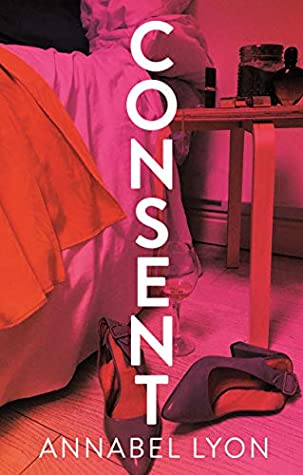 I’m always drawn to stories of sisters and this was an intriguing one, though the jacket text sets it up to be more of a thriller than it actually is. After their mother’s death, Sara, a medical ethicist, looks after Mattie, her intellectually disabled sister. When Mattie is lured into eloping, Sara’s protective instinct goes into overdrive. Meanwhile, Saskia, a graduate student in French literature, feels obliged to put her twin sister Jenny’s needs first after a car accident leaves Jenny in a coma. There are two decades separating the sets of sisters, but aspects of their experiences reverberate, with fashion, perfume, and alcoholism appearing as connecting elements even before a more concrete link emerges.
For much of the novel, Lyon bounces between the two storylines. I occasionally confused Sara and Saskia, but I think that’s part of the point (why else would an author select two S-a names?) – their stories overlap as they find themselves in the position of making decisions on behalf of an incapacitated sister. The title invites deliberation about how control is parcelled out in these parallel situations, but I’m not sure consent was the right word to encapsulate the whole plot; it seems to give too much importance to some fleeting sexual relationships.
At times I found Lyon’s prose repetitive or detached, but I enjoyed the overall dynamic and the medical threads. There are some stylish lines that land perfectly, like “There she goes … in her lovely coat, that cashmere-and-guilt blend so few can afford. That lovely perfume she trails, lilies and guilt.” The Vancouver setting and French–English bilingualism, not things I often encounter in fiction, were also welcome, and the last few chapters are killer.
The other nominees I’ve read, with ratings and links to reviews, are:
The Vanishing Half by Brit Bennett
Piranesi by Susanna Clarke
Exciting Times by Naoise Dolan
Transcendent Kingdom by Yaa Gyasi
Burnt Sugar by Avni Doshi
Unsettled Ground by Claire Fuller
The rest of the longlist is:
- Small Pleasures by Clare Chambers – I might read this from the library.
- The Golden Rule by Amanda Craig – I’d thought I’d give this one a miss, but I recently found a copy in a Little Free Library. My plan is to read it later in the year as part of a Patricia Highsmith kick, but I’ll move it up the stack if it makes the shortlist.
- Because of You by Dawn French – Not a chance. Right? Please!
- How the One-Armed Sister Sweeps Her House by Cherie Jones – A DNF; I would only try it again from the library if it was shortlisted.
- Nothing but Blue Sky by Kathleen MacMahon – I might read this from the library.
- Detransition, Baby by Torrey Peters – I will definitely read this from the library.
- Summer by Ali Smith – I struggle with her work and haven’t enjoyed this series; I would only read this if it was shortlisted and my book club was assigned it!
My ideal shortlist (a wish list based on my reading and what I still want to read):
- The Vanishing Half by Brit Bennett
- Piranesi by Susanna Clarke
- Exciting Times by Naoise Dolan
- Transcendent Kingdom by Yaa Gyasi
- No One Is Talking About This by Patricia Lockwood
- Detransition, Baby by Torrey Peters
vs.
My predicted shortlist and reasoning:
 The Vanishing Half by Brit Bennett – A dead cert. I’ve said so since I reviewed it in June 2020.
- Burnt Sugar by Avni Doshi – Others don’t seem to fancy Doshi’s chances, and it’s true that she was already shortlisted for the Booker, but I feel like this could be more unifying a choice for the judges than, e.g. Clarke or Lockwood.
- Transcendent Kingdom by Yaa Gyasi – Another definite.
- Luster by Raven Leilani – Not as strong as the Dolan, in my opinion, but it seems to have a lot of love from these judges (especially Vick Hope, who emphasized how perfectly it captured what it’s like to be young today), and from critics generally.
- Detransition, Baby by Torrey Peters – Ordinarily I would have said the Prize is too staid to shortlist a trans author, but after all the online abuse that has been directed at Peters, I think the judges will want to make a stand in support of her legitimacy.
- Summer by Ali Smith – The most establishment author on the list, and not one I generally care for, but this would be a way of recognizing the four-part Seasons opus and her work in general. Of the middle-aged white cohort, she seems most likely.
I will happily accept some mixture of my wished-for and predicted titles, and would be surprised if any of the five books I have not mentioned is shortlisted. (Though quite a few others are predicting that Claire Fuller will advance; I’d have no problem with that.) I don’t think my book club would get a say in which of the six titles we’d be sent to read for the shadowing project, which is risky as I may have already read it and not want to reread, or it may be a surprise nominee that I don’t want to read, but I’ll cross that bridge if we come to it.
Callum, Eric, Laura and Rachel have been posting lots of reviews and thoughts related to the Women’s Prize. Have a look at their blogs!
Rachel also produced a priceless spreadsheet of all the Prize nominees by year, so you can tick off the ones you’ve read. I’m up to 150 now!
Book Serendipity in the Final Months of 2020
I call it Book Serendipity when two or more books that I read at the same time or in quick succession have something pretty bizarre in common. Because I have so many books on the go at once (20+), I suppose I’m more prone to such incidents than some. I also list these occasional reading coincidences on Twitter. (Earlier incidents from the year are here, here, and here.)
- Eel fishing plays a role in First Love, Last Rites by Ian McEwan and The Gospel of the Eels by Patrik Svensson.
- A girl’s body is found in a canal in First Love, Last Rites by Ian McEwan and Carrying Fire and Water by Deirdre Shanahan.
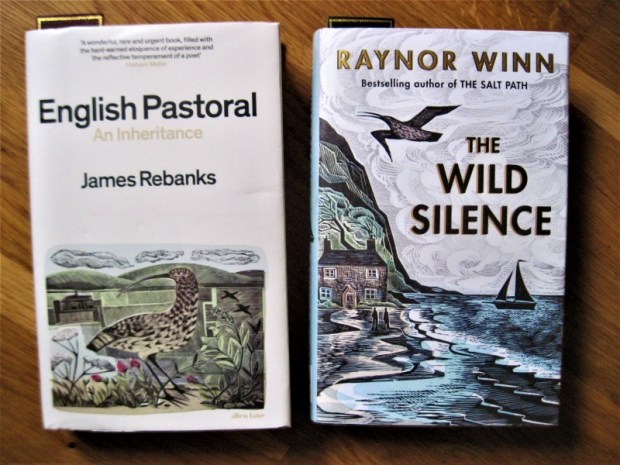
- Curlews on covers by Angela Harding on two of the most anticipated nature books of the year, English Pastoral by James Rebanks and The Wild Silence by Raynor Winn (and both came out on September 3rd).
- Thanksgiving dinner scenes feature in 666 Charing Cross Road by Paul Magrs and Such a Fun Age by Kiley Reid.
- A gay couple has the one man’s mother temporarily staying on the couch in 666 Charing Cross Road by Paul Magrs and Memorial by Bryan Washington.
- I was reading two “The Gospel of…” titles at once, The Gospel of Eve by Rachel Mann and The Gospel of the Eels by Patrik Svensson (and I’d read a third earlier in the year, The Gospel of Trees by Apricot Irving).

- References to Dickens’s David Copperfield in The Cider House Rules by John Irving and Mudbound by Hillary Jordan.
- The main female character has three ex-husbands, and there’s mention of chin-tightening exercises, in The Idea of Perfection by Kate Grenville and The Pumpkin Eater by Penelope Mortimer.
- A Welsh hills setting in On the Red Hill by Mike Parker and Along Came a Llama by Ruth Janette Ruck.


- Rachel Carson and Silent Spring are mentioned in A Year on the Wing by Tim Dee, The Frayed Atlantic Edge by David Gange, English Pastoral by James Rebanks and The Gospel of the Eels by Patrik Svensson. SS was also an influence on Losing Eden by Lucy Jones, which I read earlier in the year.
- There’s nude posing for a painter or photographer in The Glass Hotel by Emily St. John Mandel, How to Be Both by Ali Smith, and Adults by Emma Jane Unsworth.
- A weird, watery landscape is the setting for The Swallowed Man by Edward Carey and Piranesi by Susanna Clarke.
- Bawdy flirting between a customer and a butcher in The Idea of Perfection by Kate Grenville and Just Like You by Nick Hornby.


- Corbels (an architectural term) mentioned in The Idea of Perfection by Kate Grenville and Wakenhyrst by Michelle Paver.
- Near or actual drownings (something I encounter FAR more often in fiction than in real life, just like both parents dying in a car crash) in The Idea of Perfection, The Glass Hotel, The Gospel of Eve, Wakenhyrst, and Love and Other Thought Experiments.
- Nematodes are mentioned in The Gospel of the Eels by Patrik Svensson and Real Life by Brandon Taylor.
- A toxic lake features in The New Wilderness by Diane Cook and Real Life by Brandon Taylor (both were also on the Booker Prize shortlist).


- A black scientist from Alabama is the main character in Transcendent Kingdom by Yaa Gyasi and Real Life by Brandon Taylor.
- Graduate studies in science at the University of Wisconsin, and rivals sabotaging experiments, in Artifact by Arlene Heyman and Real Life by Brandon Taylor.
- A female scientist who experiments on rodents in Transcendent Kingdom by Yaa Gyasi and Artifact by Arlene Heyman.
- There are poems about blackberrying in Dearly by Margaret Atwood, Passport to Here and There by Grace Nichols, and How to wear a skin by Louisa Adjoa Parker. (Nichols’s “Blackberrying Black Woman” actually opens with “Everyone has a blackberry poem. Why not this?” – !)


What’s the weirdest reading coincidence you’ve had lately?
Completing the Women’s Prize Winners Reading Project and Voting
In this 25th anniversary year of the Women’s (previously Orange/Baileys) Prize, people have been encouraged to read all of the previous winners. I duly attempted to catch up on the 11 winners I hadn’t yet read, starting with Fugitive Pieces by Anne Michaels; Half of a Yellow Sun by Chimamanda Ngozi Adichie and A Crime in the Neighborhood by Suzanne Berne as part of a summer reading post; and When I Lived in Modern Times by Linda Grant, Property by Valerie Martin and Larry’s Party by Carol Shields (a reread) in this post.
This left just four for me to read before voting for my all-time favorite in the web poll. I managed two as recent buddy reads but had to admit defeat on the others, giving them just the barest skim before sending them back to the library.
The Idea of Perfection by Kate Grenville (1999; 2001 prize)
(Buddy read with Laura T.; see her review here)
 This is essentially an odd-couple romance, but so awkward I don’t think any of its scenes could accurately be described as a meet-cute. Harley Savage, a thrice-married middle-aged widow, works for the Applied Arts Museum in Sydney. The tall, blunt woman is in Karakarook, New South Wales to help the little town launch a heritage museum. Douglas Cheeseman is a divorced engineer tasked with tearing down a local wooden bridge and building a more suitable structure in its place. Their career trajectories are set to clash, but the novel focuses more on their personal lives. From the moment they literally bump into each other outside Douglas’ hotel, their every meeting is so embarrassing you have to blush – she saves him from some angry cows, while he tends to her after a bout of food poisoning.
Grenville does well to make the two initially unappealing characters sympathetic, primarily by giving flashes of backstory. Douglas is the posthumous child of a war hero, but has never felt he’s a proper (macho) Australian man. In fact, he has a crippling fear of heights, which is pretty inconvenient for someone who works on tall bridges. Harley, meanwhile, is haunted by the scene of her last husband’s suicide and is also recovering from a recent heart attack.
The title is, I think, meant to refer to how the protagonists fail to live up to ideals or gender stereotypes. However, it more obviously applies to the subplot about Felicity Porcelline, a stay-at-home mother who has always sought to be flawless – a perfect pregnancy, an ageless body (“Sometimes she thought she would rather be dead than old”), the perfect marriage – but gets enmired in a dalliance with the town butcher. I was never convinced Felicity’s storyline was necessary. Without it, the book might have been cut from 400 pages to 300.
Still, this was a pleasant narrative of second chances and life’s surprises. The small-town setting reminded Laura of Olive Kitteridge in particular, and I also thought frequently of Anne Tyler and her cheerfully useless males (“There was a lot to be said for being boring, and it was something [Douglas] was good at”). But I suspect the book won’t remain vivid in my memory, especially with its vague title that doesn’t suggest the contents. I enjoyed Grenville’s writing, though, so will try her again. In my mind she’s more known for historical fiction. I have a copy of The Secret River, so will see if she lives up to that reputation.
My rating: 
How to Be Both by Ali Smith (2014)
(Buddy read with Marcie of Buried in Print.)
 A book of two halves, one of which I thoroughly enjoyed; the other I struggled to engage with. I remembered vaguely as I was reading it that this was published in two different versions. As it happened, my library paperback opened with the contemporary storyline.
New Year’s Day marks the start of George’s first full year without her mother, a journalist who died at age 50. Her mother’s major project was “Subvert,” which used Internet pop-ups to have art to comment on politics and vice versa. George remembers conversations with her mother about the nature of history and art, and a trip to Italy. She’s now in therapy, and has a flirty relationship with Helena (“H”), a mixed-race school friend.
Smith’s typical wordplay comes through in the book’s banter, especially in George and H’s texts. George is a whip-smart grammar pedant. Her story was, all in all, a joy to read. There is even a hint of mystery here – is it possible that her mother was being monitored by MI5? When George skips school to gaze at her mother’s favorite Francesco del Cossa painting in the National Gallery, she thinks she sees Lisa Goliard, her mother’s intense acquaintance, who said she was a bookbinder but acted more like a spy…
The second half imagines a history for Francesco del Cossa, who rises from a brick-making family to become a respected portrait and fresco painter. The artist shares outward similarities with George, such as a dead mother and homoerotic leanings. There are numerous tiny connections, too, some of which I will have missed as my attention waned. The voice felt all wrong for the time period; I sensed that Smith wasn’t fully invested in the past, so I wasn’t either. (In dual-timeline novels, I pretty much always prefer the contemporary one and am impatient to get back to it; at least in books like Unsheltered and The Liar’s Dictionary there are alternate chapters to look forward to if the historical material gets tedious.)
An intriguing idea, a very promising first half, then a drift into pretension. Or was that my failure to observe and appreciate? Smith impishly mocks: “If you notice, it changes everything about the picture.” With her format and themes, she questions accepted binaries. There are interesting points about art, grief and gender, even without the clever links across time. But had the story opened with the other Part 1, I may never have gotten anywhere.
My rating:
Skims
I made the mistake of leaving the three winners that daunted me the most stylistically – McBride, McInerney and Smith – for last. I eventually made it through the Smith, though the second half was quite the slog, but quickly realized these two were a lost cause for me.
 A Girl Is a Half-formed Thing by Eimear McBride: I’d glanced at the first few pages in a shop before and found the style immediately off-putting. When I committed to this #ReadingWomen project, I diligently requested a copy from the university library even though I seriously doubted I’d have the motivation to read it. It turns out my first impression was correct: I would have to be paid much more than I’ve ever been paid for writing about a book just to get through this one. From the first paragraph on, it’s deliberately impenetrable in a sub-Joycean way. Ron Charles, the Washington Post book critic and one of my literary heroes/gurus, found the subject matter relentlessly depressing and the obfuscating style elitist. (Might it work as an audiobook? I can’t say; I’ve never listened to one.)
 The Glorious Heresies by Lisa McInerney: Not as stylistically difficult as expected, though there is mild dialect and long passages in italics (one of my reading pet peeves). But I’m not drawn to gangster stories, and after a couple of chapters didn’t feel like pushing myself through the book. I did enjoy the setup of Maureen killing an intruder with a holy stone, eliciting this confession: “I crept up behind him and hit him in the head with a religious ornament. So first I suppose God would have to forgive me for killing one of his creatures and then he’d have to forgive me for defiling one of his keepsakes.” For Anna Burns and Donal Ryan fans, perhaps?
It’s been many years since I’ve read some of these novels, such that all I have to go on is my vague memories and Goodreads ratings, and there are a handful there towards the bottom that I couldn’t get through at all, but I still couldn’t resist having a go at ranking the 25 winners, from best to least. My completely* objective list:
(*not at all)
Larry’s Party by Carol Shields
Half of a Yellow Sun by Chimamanda Ngozi Adichie
We Need to Talk about Kevin by Lionel Shriver
An American Marriage by Tayari Jones
The Tiger’s Wife by Téa Obreht
On Beauty by Zadie Smith
Home Fire by Kamila Shamsie
A Crime in the Neighborhood by Suzanne Berne
The Road Home by Rose Tremain
When I Lived in Modern Times by Linda Grant
The Idea of Perfection by Kate Grenville
Fugitive Pieces by Anne Michaels
The Lacuna by Barbara Kingsolver
Bel Canto by Ann Patchett
May We Be Forgiven by A.M. Homes
Property by Valerie Martin
Small World by Andrea Levy
Home by Marilynne Robinson
How to Be Both by Ali Smith
The Power by Naomi Alderman
Hamnet by Maggie O’Farrell
A Spell of Winter by Helen Dunmore
The Glorious Heresies by Lisa McInerney
The Song of Achilles by Madeline Miller
A Girl Is a Half-formed Thing by Eimear McBride
You can see the arbitrary nature of prizes at work here: some authors I love have won for books I don’t consider their best (Adichie, Kingsolver, O’Farrell, Patchett), while some exceptional female authors have been nominated but never won (Toni Morrison, Elizabeth Strout, Anne Tyler). Each year the judges are different, and there are no detailed criteria for choosing the winner, so it will only ever be the book that five people happen to like the best.
As she came out top of the heap with what is, coincidentally, the only one of the winning novels that I have managed to reread, my vote goes to Carol Shields for Larry’s Party. (People’s memory for prize winners is notoriously short, so I predict that one of the last two years’ winners, Tayari Jones or Maggie O’Farrell, will win the public’s best of the best vote.)

You have until midnight GMT on Sunday November 1st to vote for your favorite winner at this link. That’s less than a week away now, so get voting!
Note: If you’re interested in tracking your Women’s Prize reading over the years, check out Rachel’s extremely helpful list of all the nominees. It comes in spreadsheet form for you to download and fill out. I have read 138 nominees (out of 477) and DNFed another 19 so far.
Who gets your vote?
My (Not the) Booker Prize Reading
A week from today, on the 14th (my birthday, as well as Susan’s – be sure to wish her a happy one!), this year’s Booker Prize will be announced. The Prize’s longlist didn’t contain much that piqued my interest this time around; I read one book from it and didn’t get on with it well at all, and I also DNFed another three.
Read
Frankissstein by Jeanette Winterson
 Winterson does her darndest to write like Ali Smith here (no speech marks, short chapters and sections, random pop culture references). Cross Smith’s Seasons quartet with the vague aims of the Hogarth Shakespeare project and Margaret Atwood’s The Heart Goes Last and you get this odd jumble of a novel that tries to combine the themes and composition of Frankenstein with the modern possibilities of transcending bodily limitations. Her contemporary narrator is Ry Shelley, a transgender doctor sponsored by the Wellcome Trust who supplies researcher Victor Stein with body parts for his experiments in Manchester. In Memphis for a tech expo, Ry meets Ron Lord, a tactless purveyor of sexbots.
Their interactions alternate with chapters narrated by Mary Shelley in the 1810s; I found this strand much more engaging and original, perhaps because I haven’t read that much about Shelley and her milieu, whereas it feels like I’ve read a lot about machine intelligence and transhumanism recently (To Be a Machine, Murmur, Machines Like Me). I think Winterson’s aim was to link the two time periods through notions of hybridness and resistance to death. It never really came together for me. 
DNFed
 Night Boat to Tangier by Kevin Barry – I read the first 76 pages. The other week two grizzled Welsh guys came to deliver my new fridge. Their barely comprehensible banter reminded me of that between Maurice and Charlie, two ageing Irish gangsters. The long first chapter is terrific. At first these fellas seem like harmless drunks, but gradually you come to realize just how dangerous they are. Maurice’s daughter Dilly is missing, and they’ll do whatever is necessary to find her. Threatening to decapitate someone’s dog is just the beginning – and you know they could do it. “I don’t know if you’re getting the sense of this yet, Ben. But you’re dealing with truly dreadful fucken men here,” Charlie warns at one point. I loved the voices; if this was just a short story it would have gotten a top rating, but I found I had no interest in the backstory of how these men got involved in heroin smuggling.
The Wall by John Lanchester – I lost interest in it and wasn’t drawn in by the first pages.
 The Man Who Saw Everything by Deborah Levy – I read the first 35 pages. There’s a lot of repetition; random details seem deliberately placed as clues. I’m sure there’s a clever story in here somewhere, but apart from a few intriguing anachronisms (in 1988 a smartphone is just “A small, flat, rectangular object … lying in the road. … The object was speaking. There was definitely a voice inside it”) there is not much plot or character to latch onto. I suspect there will be many readers who, like me, can’t be bothered to follow Saul Adler from London’s Abbey Road, where he’s hit by a car in the first paragraph, to East Berlin.
 There’s only one title from the Booker shortlist that I’m interested in reading: Girl, Woman, Other by Bernardine Evaristo. I’ll be reviewing it later this month as part of a blog tour celebrating the Aké Book Festival, but as a copy hasn’t yet arrived from either the publisher or the library I won’t have gotten far into it before the Prize announcement.
As for the other five on the shortlist…
- I’m a conscientious objector to Margaret Atwood’s The Testaments. I haven’t appreciated her previous dystopian sequels, and I’ve never really understood all the hype around The Handmaid’s Tale.
- I don’t plan on reading Lucy Ellmann’s Ducks, Newburyport – unless some enterprising soul produces an abridged version of no more than 250 pages.*

Ducks, Newbury
- I didn’t rate The Fishermen highly enough to give Chigozie Obioma’s An Orchestra of Minorities a try.
- I forced myself through Midnight’s Children some years back. What a pointless slog! Lukewarm reviews of his recent work mean I’m now doubly determined to avoid Salman Rushdie’s Quichotte.
- Although the setup appeals to me (a prostitute’s whole life spooling out in front of her in the moments before her death) and I enjoyed her previous novel well enough, I’ve not heard enough good things to pick up Elif Shafak’s 10 Minutes 38 Seconds in this Strange World.
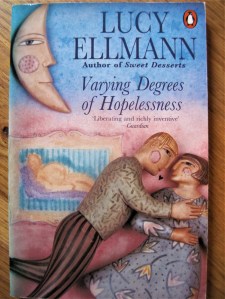 *However, I was delighted to find a copy of her 1991 novel, Varying Degrees of Hopelessness (just 182 pages, with short chapters often no longer than a paragraph and pithy sentences) in a 3-for-£1 sale at our local charity warehouse. Isabel, a 31-year-old virgin whose ideas of love come straight from the romance novels of ‘Babs Cartwheel’, hopes to find Mr. Right while studying art history at the Catafalque Institute in London (a thinly veiled Courtauld, where Ellmann studied). She’s immediately taken with one of her professors, Lionel Syms, whom she dubs “The Splendid Young Man.” Isabel’s desperately unsexy description of him had me snorting into my tea:
He had a masculinity.
His broad shoulders and narrow hips gave him a distinctive physique.
He held seminars and wore red socks.
To hold seminars seemed to indicate a wish to develop a rapport with his students.
The red socks seemed to indicate testosterone.
I swooned in admiration of him.
Unfortunately, the Splendid Young Man is more interested in Isabel’s portly flatmate, Pol. There’s a screwball charm to this campus novel full of love triangles and preposterous minor characters. I laughed at many of Ellmann’s deadpan lines, and would recommend this to fans of David Lodge’s academic comedies. But if you wish to, you could read this as a cautionary tale about the dangers of romantic fantasies. Ellmann even offers two alternate endings, one melodramatic and one more prosaic but believable. I’ll seek out the rest of her back catalogue – so thanks to the Booker for putting her on my radar.
In the meantime, I did a bit better with the “Not the Booker Prize” (administered by the Guardian) shortlist, reading three out of their six:
Flames by Robbie Arnott
 This strange and somewhat entrancing debut novel is set in Arnott’s native Tasmania. The women of the McAllister family are known to return to life – even after a cremation, as happened briefly with Charlotte and Levi’s mother. Levi is determined to stop this from happening again, and decides to have a coffin built to ensure his 23-year-old sister can’t ever come back from the flames once she’s dead. The letters that pass between him and the ill-tempered woodworker he hires to do the job were my favorite part of the book. In other strands, we see Charlotte traveling down to work at a wombat farm in Melaleuca, a female investigator lighting out after her, and Karl forming a close relationship with a seal. This reminded me somewhat of The Bus on Thursday by Shirley Barrett and Orkney by Amy Sackville. At times I had trouble following the POV and setting shifts involved in this work of magic realism, though Arnott’s writing is certainly striking.
A favorite passage:
“The Midlands droned on, denuded hill after denuded hill, until I rolled into sprawling suburbs around noon. Here’s a list of the places I’d choose to visit before the capital: hell, anywhere tropical, the Mariana Trench, a deeper pit of hell, my mother’s house.”
My thanks to Atlantic Books for the free paperback copy for review.
See Susan’s review for a more enthusiastic response.
 The Unauthorised Biography of Ezra Maas by Daniel James: A twisty, clever meta novel about “Daniel James” trying to write a biography of Ezra Maas, an enigmatic artist who grew up a child prodigy in Oxford and attracted a cult following in 1960s New York City, where he was a friend of Warhol et al. (See my full review.)
Supper Club by Lara Williams: A great debut novel with strong themes of female friendship and food. The Supper Club Roberta and Stevie create is performance art, but it’s also about creating personal meaning when family and romance have failed you. (See my full review.)
The other three books on the shortlist are:
- Skin by Liam Brown: A dystopian novel in which people become allergic to human contact. I think I’ll pass on this one.
 Please Read This Leaflet Carefully by Karen Havelin: A debut novel by a Norwegian author that proceeds backwards to examine the life of a woman struggling with endometriosis and raising a young daughter. I’m very keen to read this one.
- Spring by Ali Smith: I’ve basically given up on Ali Smith – and certainly on the Seasons quartet, after DNFing Winter.
(The Not the Booker Prize will be announced on the Guardian website this Friday the 11th.)
Have you read something from the (Not the) Booker shortlist(s)? Any predictions for next week?
My Patchy Experience with Book Clubs
I know that a number of you have long-term, faithful book clubs. Boy, am I envious! You might find it surprising that I’ve only ever been in one traditional book club, and it wasn’t a resounding success. Partway through my time working for King’s College, London, an acquaintance from another library branch started the club. A group of five to eight of us from Library Services aimed to meet after work one evening a month at a Southbank venue or a staff room to discuss our latest pick. By poring over old e-mails and my Goodreads library, I’ve managed to remember 10 of the books we read between November 2011 and June 2013:
- Do Androids Dream of Electric Sheep?, Philip K. Dick [classic science fiction]
- The Little Shadows, Marina Endicott [Canadian historical fiction]
- A Spot of Bother, Mark Haddon [contemporary fiction]
- The Talented Mr. Ripley, Patricia Highsmith [classic suspense]
- The Vintner’s Luck, Elizabeth Knox [bizarre historical fiction/magic realism]
- What Was Lost, Catherine O’Flynn [contemporary fiction]
- Franny and Zooey, J.D. Salinger [classic short fiction]
- The Rabbi’s Cat, Joann Sfar [graphic novel in translation]
- Girl Meets Boy, Ali Smith [an update of Greek myth]
- Angel, Elizabeth Taylor [an obscure English classic]
That may well be the complete list. Although I was a member for 20 months until I quit to go freelance, we often only managed to meet every other month because we couldn’t find a mutually convenient free evening or no one had read the book in time. I was consistently frustrated that – even when our selections were only about 200 pages long – I was often one of the only people to have read the whole book.
Overall, the quality of books we chose struck me as mediocre: I rated half of these books 2 stars, and the rest 3 stars. (I think I was a harsher rater then, but it’s not a good sign, is it?) Perhaps this is part of the inevitable compromising that goes with book clubs, though: You humor other people in their choices and hope they’ll be kind about yours? My suggestion, for the record, was the pretty dismal Little Shadows, for which I got a free set of book club copies to review for Booktime magazine. But I also voted in favor of most of the above list.
Looking back, I am at least impressed by how varied our selections were. People were interested in trying out different genres, so we ranged from historical fiction to sci-fi, and even managed a graphic novel. But when we did get together for discussion there was far too much gossipy chat about work, and when we finally got around to the book itself the examination rarely went deeper than “I liked it” or “I hated all the characters.”
If it was profound analysis I was after, I got that during the years I volunteered at Greenbelt, an annual summer arts festival with a progressive Christian slant. I eagerly read the eclectic set of three books the literature coordinator chose for book club meetings in 2010 – Star of the Morning: The Extraordinary Life of Lady Hester Stanhope by Kirsten Ellis, The First Person and Other Stories by Ali Smith, and The Bridge of San Luis Rey by Thornton Wilder – and then as a literature volunteer for the next three years I read and prepared copious notes and questions about our festival “Big Read.” We did Exile by Richard North Patterson in 2011, Dark Eden by Chris Beckett in 2012 and So Many Ways to Begin by Chris Beckett in 2013, and each time I offered to chair the book club meetings.
Unfortunately, due at least in part to logistical considerations, these were run in the way many festival events are: a panel of two to five talking heads with microphones was at the front of the tent, sometimes on a raised dais, while the audience of whatever size sat towards the back. This created a disconnect between the “experts” and the participants, and with the exception of the McGregor meeting I don’t recall much audience input. I’ve mostly blanked out the events – as I tend to for anything that entails public speaking and nervous preparation for something you can’t control – but I was pleased to be involved and I should probably make more of this on my CV. It wasn’t your average book club setting, that’s for sure.
In recent years the closest thing I’ve had to a book club has been online buddy reading. The shadow panels for the Wellcome Book Prize and Sunday Times Young Writer of the Year Award fall into this category, as do online readalongs I’ve done for several Iris Murdoch novels and for C.S. Lewis’s Mere Christianity with various female family members. A few of us book bloggers chatted about Andrea Levy’s Small Island in an online document earlier this year, and my mom and I e-mailed back and forth while reading W. Somerset Maugham’s The Painted Veil in May. I’m also doing my last three of the #20BooksofSummer as online buddy reads, checking in occasionally on Twitter.
Of course, there are some inherent limitations to this kind of discussion – people read at different paces and don’t want to spoil the plot for others, and at some point the back-and-forth fizzles out – but it’s always been easier for me to organize my thoughts in writing, so I likely feel more comfortable contributing than I might in an in-person meeting.
This is all context for my decision to join my neighborhood book club next month. The club arose some months back out of our community’s Facebook group, a helpful resource run by a go-getting lady a few doors down from us. So far it’s turning out to be a small group of thirty- and fortysomething women who alternate meetings at each other’s houses, and the name they’ve chosen gives an idea of the tone: “Books, Booze and Banter.”
I made the mistake of not getting involved right at the start; I wanted to hang back and see what kind of books they’d choose. This means I wasn’t part of the early process of putting titles in a hat, so I’ve looked on snobbishly for several months as they lurched between crime and women’s fiction, genres I generally avoid. (Still, there were actually a couple books I might have joined them for had I not been in America and had they been readily available at the public library.) For many people a book club selection will be the only book they get through that month, so I can understand how they’d want it to be something ‘readable’ that they’d be happy to pick up anyway. Even though statistically I read 27 books a month, I’m still jealously protective of my reading time; I want everything I read to be worthwhile.
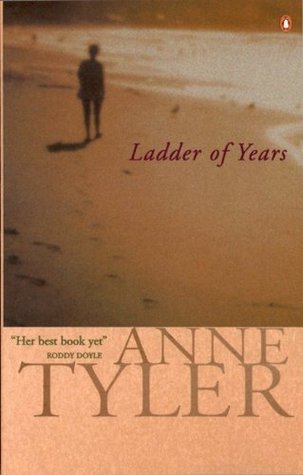 So for September I managed to steer the group away from a poorly received historical novel of over 400 pages and the new Joël Dicker and onto Ladder of Years by Anne Tyler, which the bookstore chain Waterstones has been promoting heavily as one of their books of the month. I already had a charity shop copy in hand and the others liked the sound of it, so we’re all set for September 12th! Future months’ literary fiction choices look promising, too, so provided I enjoy the discussion and the camaraderie I plan to stick with it: a backlist Pat Barker novel I’ve not read, and Kirsty Logan and Jonathan Coe novels I’ve read before and won’t reread but will remind myself about briefly before the meetings.
I’m out of practice with this book club thing. My mother tells me that I have a lot to contribute but that I must also be open to what I’ll learn from other people – even if I don’t expect to. So I don’t want to set myself up as some kind of expert. In fact, I probably won’t even mention that I’m a freelance book reviewer and book blogger. Mostly I’m hoping to find some friendly faces around the neighborhood, because even though we’ve lived here just over two years I still only know a handful of names and keep myself to myself as I work from home. Even if I have to read books I wouldn’t normally, it’ll be worth it to meet more people.
What has your experience with book clubs (in person and online) been?
A Trip to Wigtown, Scotland’s Book Town
Wigtown is tucked away in the southwest corner of Scotland in Galloway, a region that doesn’t draw too many tourists. It did remind us a lot of Hay-on-Wye, the Book Town in Wales, what with the dry-stone walls, rolling green hills with more imposing mountains behind, sheep in the fields, and goodly number of bookshops. Wigtown is a sleepier place – it’s really just one main street and square – and has fewer bookshops and eateries overall, but the shops it does have are mainly large and inviting, and several are lovely bookshops-cum-cafés where you can pause for tea/coffee and cake before continuing with your book browsing. It rained for much of our trip and even snowed on a couple of brief occasions, but we got one day of very good weather and made the best of all the rest.


Day 1, Monday the 2nd: Six-plus hours of driving, partially in the sleet and snow, saw us arriving to our spacious and comfortable B&B by 6 p.m., giving us an hour to freshen up before dinner in the dining room. Cullen skink (leek and potato soup with chunks of smoked haddock); pork chops in a mustard cream sauce with roast parsnips, boiled potatoes and carrots, and mashed swede (aka rutabaga); and chocolate cake with gingerbread sauce. All delicious!
Day 2, Tuesday the 3rd: Smoked salmon and scrambled eggs for breakfast, accompanied by plenteous tea and toast. Off in the drizzle to see some local sites: Torhouse stone circle and Crook of Baldoon RSPB bird reserve. Nice sightings of whooper swans, pink-footed geese and lapwings, and a panoramic view of Wigtown across the way. Back to the car in the steady rain to find that we had a flat tire. Thanks to our foot pump, we got back to the W. Barclay garage in town, where they ordered a new tire and fitted the spare wheel. In the afternoon we drove to the Isle of Whithorn to see the 13th-century St. Ninian’s Chapel ruins and St. Ninian’s Cave. In the evening we went to Craft for beer/cider and the weekly acoustic music night, which, alas, just ended up being two old guys playing Americana songs on guitars.


Today’s book shopping: Glaisnock Café, where we also stopped for coffee and a tasty slice of courgette and avocado cake; The Open Book (run by Airbnb customers – this week it was Maureen from Pennsylvania and her niece Rebecca from Switzerland; they’d booked the experience two years ago, and the wait is now up to three years); the Wigtown Community shop (a charity shop); and browsing at Old Bank Books and Byre Books.


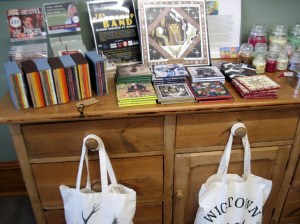
I loved seeing lots of Bookshop Band merchandise around. This was in the Festival Shop.
Day 3, Wednesday the 4th: Vegetarian ‘full Scottish’ cooked breakfast to fuel us for a rainy day of bookshops and explorations further afield. 12 p.m.: return trip to the garage to have our tire fitted. All the staff were so friendly and pleasant. They seemed delighted to see tourists around, and were interested in where we came from and what we were finding to do in the area. Mr. Barclay himself had one of the thickest Scottish accents I’ve ever heard, but I managed to decipher that he thinks of Galloway as “the next best place to heaven,” despite the weather. We spotted a local ‘celebrity’, Ben of the Bookshop Band, in the Co-op, but didn’t say hello as he was trying to pay for his shopping and had the baby in tow.
In the afternoon we ventured to Newton Stewart, the nearest big town, to buy petrol, picnic supper food, and another secondhand book at the community shop there. We retreated from the sudden snow for a scrumptious dinner of smoked salmon, black pudding and haggis (all of them battered and fried, with chips!) at a diner-like smokehouse. Back in Wigtown, we got a mainly dry evening to do the Martyrs’ Walk. In 1685 two Covenanters (Scottish reformers who broke from Charles I’s Anglican Church), Margaret McLachlan, 63, and Margaret Wilson, 18, were tied to stakes on the mud flats and allowed to drown in the rising tide.


Today’s book shopping: THE BOOKSHOP. I’ve meant to visit ever since I read Jessica Fox’s memoir, Three Things You Need to Know about Rockets, in February 2013. Previously based in California, Fox decided on a whim to visit a bookshop in Scotland and ended up here at the country’s largest. She promptly fell in love with the bookshop owner and with Wigtown itself; though she and Shaun Bythell are no longer an item, she has been a major mover and shaker in the town, playing a role in the annual festival and establishing The Open Book.


The Bookshop is a wonderfully rambling place with lots of nooks and crannies housing all sorts of categories. Look out for the shot and mounted Kindle, the Festival bed, the stuffed badger, a scroll of bookseller’s rules, Captain the cat, and a display of Bythell’s The Diary of a Bookseller. Together we found £35 worth of books we wanted to buy – whew! – thanks to my husband’s niche nature books, and had a nice chat with the man himself at the till. He signed my book, commiserated with us about the weather and our trip to see “Willie” (Barclay), and gave us tips for what to see locally. You’d hardly believe he’s the same curmudgeon who wrote the book. Now that I’ve been to the town and the shop, it’s time for me to start rereading it.


We also perused the smallish but very nice selection at Beltie Books, where we made a welcome stop for a cappuccino and some cookies, and I bought a cut-price new book at the Festival Shop. (They stock books by festival speakers plus a curated selection of new releases.)
Day 4, Thursday the 5th: SUNSHINE, at last! After hearty omelettes, we headed to the hill that overlooks the town to get the best views of the week. On to Monreith for a charming coastal walk up to the Gavin Maxwell monument of a bronze otter. (He wrote Ring of Bright Water, which my husband brought along to read on our trip.) After a lunch stop back in town, it was out to the red kite feeding station about 40 minutes away – I came for the books; my husband came for the red kites. Though they’re common enough in our part of Berkshire, he was keen to see the site of another recent reintroduction. Wales also has a feeding station we visited some years ago, and on both occasions seeing dozens of birds swoop down for meat was quite the spectacle – though here you sit on an open porch, even closer to the action. We did a few other short walks in the area, finishing off with a sunset sit in Wigtown’s bird hide.


Today’s book shopping: ReadingLasses calls itself Britain’s only women’s bookshop. They stock Persephone Books direct from Bloomsbury, and they also have a large selection of secondhand books. This is the best place to go in town for a light meal and a snack. We had delicious homemade soup with soda bread for an early lunch, followed by coffee and tiffin. I bought a novel by Candia McWilliam, a Scottish author I’ve only read nonfiction by before.


At Curly Tale Books, the children’s bookshop next-door to The Bookshop, we bought a picture book about the local ‘belted’ Galloway cows for our niece. We didn’t realize the shop owner is also the author! She offered to sign the book for us, but we decided that a five-year-old wouldn’t appreciate it enough.
Day 5, Friday the 6th: Full Scottish breakfast to see us on our way, and a farewell to the two B&B cats, including the fluffiest cat on earth. To break up the rather arduous journey, we stopped early on at the Cairn Holy stone circle/tomb and the Cream o’ Galloway farm shop for cheese and ice cream. Home at 7:30 p.m. to find something from the freezer for dinner, unpack and shelve all these new books.
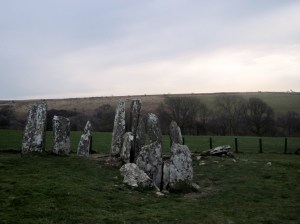
Cairn Holy
Total acquisitions: 13 books for me, 7 books for my husband, 3 books for gifts
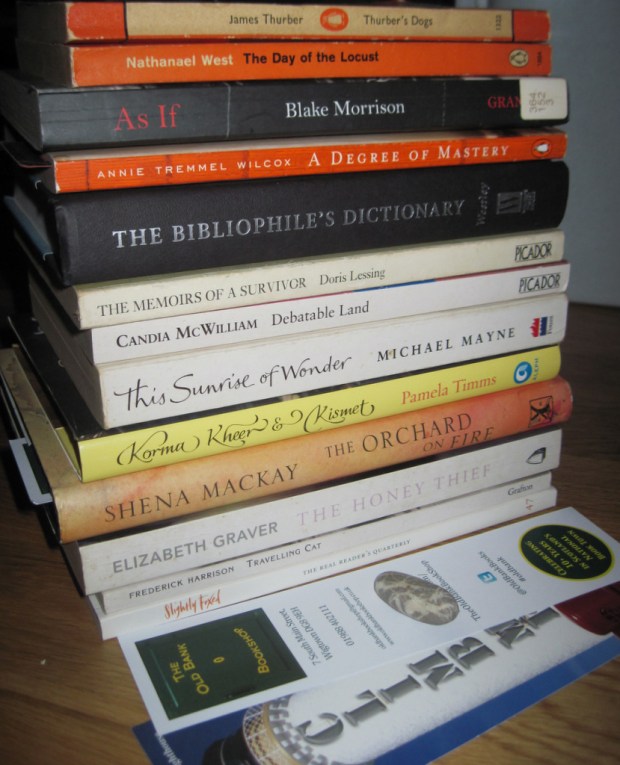
Wigtown is more than twice as far away as Hay is for us, so we’re less likely to go back. (It’s also a tough place to find a decent evening meal.) However, I’d like to think that life will take me back to Wigtown someday, perhaps for the Festival, or for a stay at The Open Book – though I’d have to start planning ahead to 2021!
What I read:
Bits of lots of books I had on the go, but mostly a few vaguely appropriate titles:
Under the Skin by Michel Faber was the perfect book for reading on rainy Scottish highways. I’m so glad I decided at the last minute to bring it. Isserley drives along Highland roads picking up hitchhikers – but only the hunky males – to take back to her farm near the Moray Firth. It’s likely that you already know the setup of this even if you haven’t read it, perhaps from the buzz around the 2013 film version starring Scarlett Johansson. It must have been so difficult for the first reviewers and interviewers to discuss the book without spoilers back in 2000. David Mitchell, in his introduction to my Canons series reprint, does an admirable job of suggesting the eeriness of the contents without giving anything significant away.
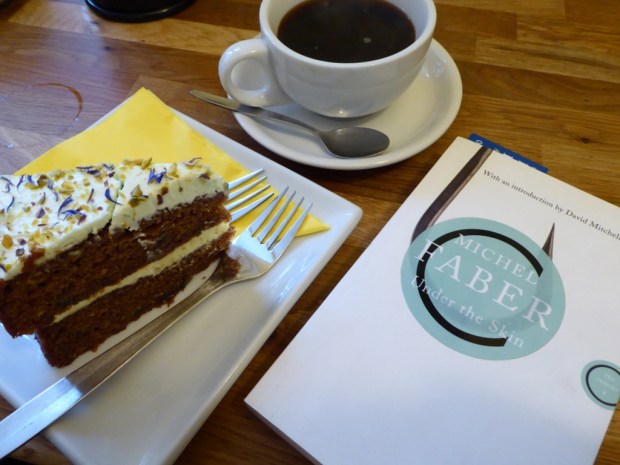
Shelve this under science fiction, though it veers towards horror and then becomes a telling allegory. I knew the basic plot beforehand, but there were still some surprises awaiting me, and I was impressed with how Faber pulled it all off. Keep an eye open for how he uses the word “human.” This has a lot to say about compassion and dignity, and how despite our differences we are fundamentally the same “under the skin.”
An atmospheric line: “The fields all around her house were shrouded in snow, with patches of dark earth poking through here and there as if the world were a rich fruit cake under cream.”
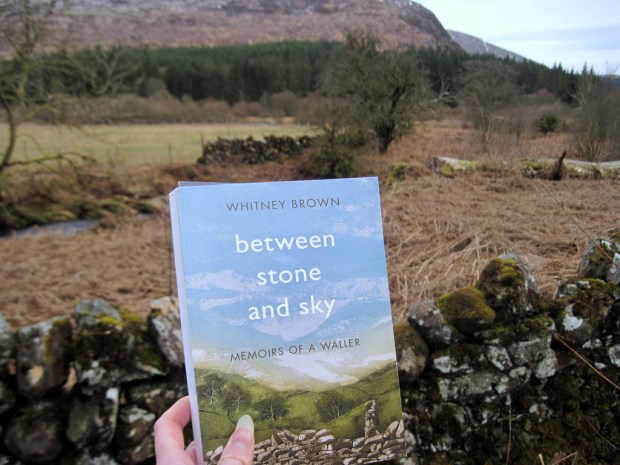
Between Stone and Sky: Memoirs of a Waller by Whitney Brown: For a TLS review. Brown, from South Carolina, trained as a dry-stone waller in Wales (where she fell in love with a man who wouldn’t marry her), but we saw plenty such walls in Scotland too. As an expat I could relate to her feeling of being split between two countries. (Releases May 17th.)
I n the Days of Rain: A daughter. A father. A cult. by Rebecca Stott: I read the first two-fifths or so, mostly in the car and over our leisurely B&B breakfasts. One branch of Stott’s Exclusive Brethren family came from Eyemouth, a Scottish fishing village. A family memoir, a bereavement memoir, a theological theme: this brings together a lot of my favorite things. And it won last year’s Costa Biography Award, so you know it’s got to be good.
I also started two books by Scottish novelists, The Orchard on Fire by Shena Mackay and The Accidental by Ali Smith – though I don’t know if I’ll make it through the latter.
What to Look Out for in April
April will be a busy month on the blog what with four Wellcome Book Prize shortlist reviews plus posts on our shadow panel decision and the awards ceremony, three blog tours within a week, and various other review books jostling for my attention.

To be reviewed at any time.
April 5th seems to be a huge day for new releases. I own four print books that are all coming out on that day; alas, the only one I’ve been able to start is Elizabeth J. Church’s All the Beautiful Girls, for an upcoming Shiny New Books review. I’m approaching the one-quarter point. The others may well have to wait for a quieter time.
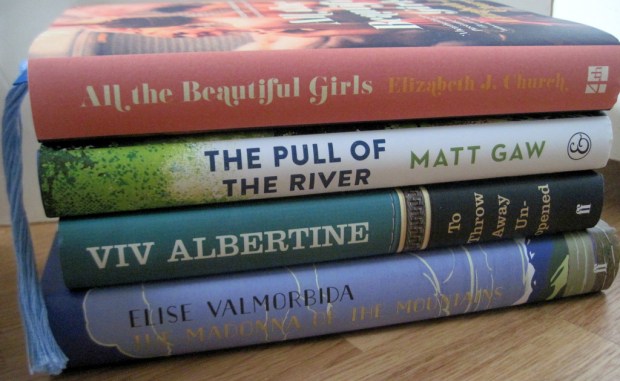
April 5th releases.
 I started another April 5th release on my Kindle a couple of weeks ago, Things Bright and Beautiful by Anbara Salam. It’s about a missionary couple whose lives are disrupted by the return of an older missionary. I was thinking of abandoning it until I got to the last line of the prologue, which threw in a pretty great twist. So maybe I’ll go back to it.
For now, I can recommend the one April 5th release I actually managed to finish:
Dear Mrs. Bird by A.J. Pearce
 If you loved The Guernsey Literary and Potato Peel Pie Society, I have just the book for you: another feel-good World War II-set novel with characters you’ll cheer for. December 1940, London: Twenty-two-year-old Emmeline Lake dreams of being a Lady War Correspondent, but for now she’ll start by typing up the letters submitted to Henrietta Bird’s advice column in Woman’s Friend. All too quickly, though, the job feels too small for Emmy. Mrs. Bird refuses to print letters on Unpleasant subjects, which could include anything from an inappropriate crush to anxiety. She thinks cowardly readers bring their troubles on themselves and need to buck up instead of looking to others for help. But Emmy can’t bear to throw hurting people’s missives away. Perhaps she could send some advice of her own?
Emmy shares a flat with her best friend Bunty, and they each have a fiancé who is part of the war effort. As a volunteer for the Fire Brigade, Emmy sees the effects of Luftwaffe bombings up close. But it’s only after heartache hits home for both of these young women that they really understand how much is at stake in the war. The novel got a little melodramatic for me in its last quarter, but it’s overall a charming “Keep Calm and Carry On” and Stick It to Hitler-style story that never strays far from jollity for too long.
Other readalikes: My Salinger Year by Joanna Rakoff and The Night Watch by Sarah Waters
Some favorite lines:
“I told myself we could all get blown up by tomorrow so we might just as well enjoy ourselves.”
“Granny didn’t spend half her life chaining herself to railings for today’s woman to moon around waiting for some chap to look after her.”
My rating:
 On Monday we’re off to Wigtown, Scotland’s Book Town, for five days. Though we’ve been to Hay-on-Wye, Wales six times, we’ve never been to Wigtown despite meaning to for years. When I read Shaun Bythell’s Wigtown bookselling memoir last autumn, it felt like a sign that it was time. Did you see his The Diary of a Bookseller has been described in French as le quotidien d’un libraire misanthrope écossais (literally, “the daily life of a misanthropic Scottish bookseller”)?
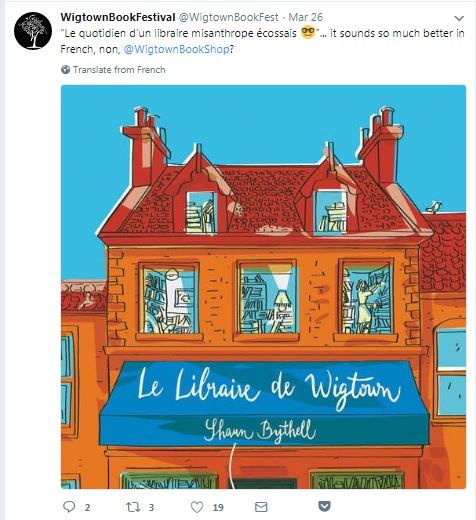
That’s too good! If only it were the official French title. I will of course be visiting his shop, and asking for a signature on my proof copy if I can pluck up the nerve. We’ll strive to be model customers lest we become the subject of a grumpy Tweet or Facebook post.
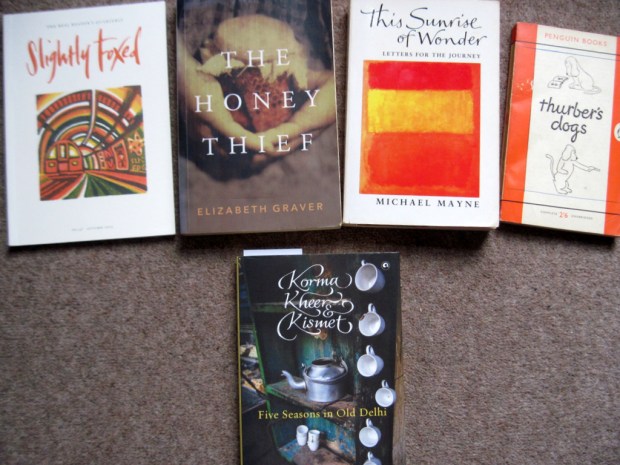
Coals to Newcastle and all that, but here’s the pile I’ve packed for Wigtown.
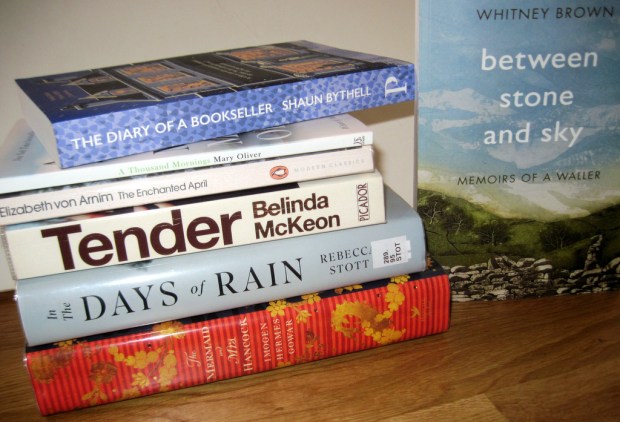
This is mostly for the six-hour car rides there and back. During the days we’ll be busy with outings to the surrounding countryside plus book shopping and café visits, but I daresay there will be some time for reading at the B&B in the afternoons and evenings.
For once I haven’t scoured my shelves for place-appropriate books; I don’t think I own any particularly Scottish reads, unless Michel Faber’s Under the Skin counts (ah wait, I also have an Ali Smith novel on the shelf).
Anyway, this time I’ve really just put together a pile of books I’ve been wanting to read for ages. The only ‘work’-related one is Between Stone and Sky, for a TLS review; otherwise I’m giving myself from Easter through the 6th off. I’m not even sure I’ll take my Kindle, except as a backup – that kind of thing could get you (or, rather, your Kindle) shot in this town. If I do, I’ll be sure to leave it behind in the B&B room or the glove box when we go into town for the day!
What are you up to in April?
Last-Minute Booker Prize Predictions
The Man Booker Prize 2017 will be announced this evening (roughly 22:00 GMT, in my memory). Ever since the shortlist announcement I’ve felt that George Saunders is a shoo-in for Lincoln in the Bardo. I think he will win, and should. However, I’ve still only read four out of the six on the shortlist, so my predictions are not entirely based on personal knowledge of the books. I can’t say I’m hugely enthused about trying Auster or Hamid, but I’d be more likely to do so if either won.
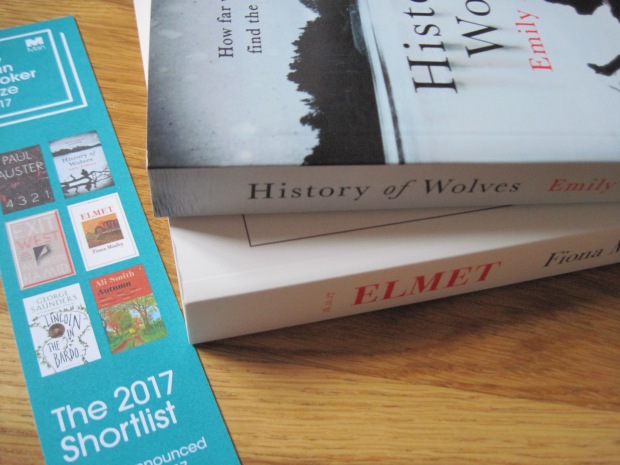
The two from the shortlist that I own + the annual bookmark, picked up from the public library.
Here, in what I predict is their descending order of likelihood to win, are the six shortlisted titles, with a pithy three words on why each one would take the prize:
Lincoln in the Bardo by George Saunders – Something actually novel.
Exit West by Mohsin Hamid – Timely re: refugees.
Autumn by Ali Smith – Timely re: Brexit.
4 3 2 1 by Paul Auster – Great American Novel.
Elmet by Fiona Mozley – Gorgeous, talented debut.
History of Wolves by Emily Fridlund – Haunting, underrated debut.
 Bookish Beck = Rebecca Foster. American transplant to England. Freelance proofreader and book reviewer.
 Bookish Beck