Richard Rohr at Greenbelt Festival (Online) & The Naked Now Review
Back in late August, I attended another online talk that really chimed with the one by Richard Holloway, this time as part of Greenbelt Festival, a progressive Christian event we used to attend annually but haven’t been to in many years now.
Not just as a Covid holdover but also in a conscious sustainability effort, Greenbelt hosted a “fly-free zone” where overseas speakers appeared on a large screen instead of travelling thousands of miles. So Richard Rohr, who appeared old and frail to me – no wonder, as he is now 81 and has survived five unrelated cancers (doctors literally want to do a genetic study on him) – appeared from the communal lounge of his Center for Action and Contemplation in New Mexico to introduce his upcoming book The Tears of Things, due in March 2025. The title is from the same Virgil quote as Holloway’s The Heart of Things. It’s about the Old Testament prophets’ shift from rage to lamentation to doxology (“the great nevertheless,” he called it): a psychological journey we all must make as part of becoming spiritually mature.
From reading his Falling Upward, I was familiar with Rohr’s central teaching of life being in two halves: the first, ego-led, is about identity and argumentation; the second is about transcending the self to tap into a universal consciousness. “It’s a terrible burden to carry your own judgementalism,” he declared. A God encounter provokes the transformation, and generally it comes through suffering, he said; you can’t take a shortcut. Anger is a mark of “incomplete” prophets such as John the Baptist, he explained. Rage might seem to empower, but it’s unrefined and only gives people permission to be nasty to others, he said. We can’t preach about a wrathful God or we will just produce wrathful people, he insisted; instead, we have to teach mercy.
When Rohr used to run rites of passage for young men, he would tell them that they weren’t actually angry, they were sad. There are tears that come from God, he said: for Gaza, for Ukraine. We know that Jesus wept at least twice, as recorded in scripture: once for Jerusalem (the collective) and once for his dead friend Lazarus (the individual). Doing the “grief work” is essential, he said. A parallel to that anger to sadness to praise trajectory is order to disorder to reorder, a paradigm he takes from the Bible’s wisdom literature. Brian McLaren’s recent work is heavily influenced by these ideas, too.
During the question time, Rohr was drawn out on the difference between Buddhism and Christianity (the latter gives reality a personal and benevolent face, he said) and how he understands hope – it is participation in the life of God, he said, and it certainly doesn’t come from looking at the data. He lauded Buddhism for its insistence on non-dualism or unitive consciousness, which he also interprets as the “mind of Christ.” The love of God is the Absolute, he said, and although he has experienced it throughout his life, he has known it especially when (as now) he was weak and poor.
Non-dualism is the theme that led me to go back to a book that had been on my bedside table, partly read, for months.
The Naked Now: Learning to See as the Mystics See (2009)
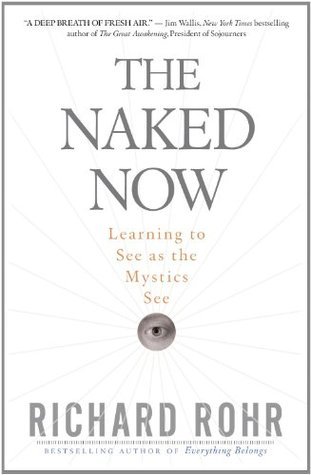 This was my fourth book by Rohr, and as with The Universal Christ, I feel at a loss trying to express how wise and earth-shaking it is. The kernel of the argument is simple. Dualistic thinking is all or nothing, us and them. The mystical view of life involves nonduality; not knowing the right things but “knowing better” through contemplation. It’s an opening of the heart that then allows for a change of mind. And yes, as he said at Greenbelt, it mostly comes about through great suffering – or great love. Jesus embodies nonduality by being not human or divine, but both, as does God through the multiplicity of the Trinity.
The book completely upends the fundamentalist Christianity I grew up with. Its every precept is based on Bible quotes or Christian tradition. It’s only 160 pages long, very logical and readable; I only went through it so slowly because I had to mark out and reread brilliant passages every few pages.
You can tell adult and authentic faith by people’s ability to deal with darkness, failure, and nonvalidation of the ego—and by their quiet but confident joy!
[I’ve met people who are like this.]
If your religious practice is nothing more than to remain sincerely open to the ongoing challenges of life and love, you will find God — and also yourself.
[This reminded me of “God is change,” the doctrine in Parable of the Sower by Octavia E. Butler.]
If you can handle/ignore a bit of religion, I would recommend Rohr to readers of Brené Brown, Susan Cain (thinking of Bittersweet in particular) and Anne Lamott, among other self-help and spirituality authors – e.g., he references Eckhart Tolle. Rohr is also known for being one of the popularizers of the Enneagram, a personality tool similar to the Myers-Briggs test but which in its earliest form dates back to the Desert Father Evagrius Ponticus. 
Nonfiction and Poetry Review Catch-Up: Carson, Dixon, McLaren, Sharpe
Today I’m finally writing up four review copies that came my way quite a while ago (last year in one case). A bereavement memoir about a friend lost to opiate addiction, a nature-rich poetry collection, a practical book about being part of positive movements whether led by religion or not, and an eye-opening work of cultural criticism about Black art and suffering.
The Dead Are Gods: A Memoir by Eirinie Carson (2023)
When I was back in the States in May for my sister’s nursing school graduation, I got a chance to talk to her best friend, who is a library assistant. During the never-ending reading-out of names (it was a whole-college ceremony, as opposed to the one earlier in the day just for the nursing cohort), I read Hello Beautiful on my Kindle, tucked inside the graduation program; this friend openly read a library copy of The Dead Are Gods on her lap. When I teased her that at least I kept my book hidden, like I do at church inside the hymn book, she said (re: church), “Or you could just … not go?” (On which, see the McLaren review below!)
 Anyway, it was nice to see this book out and about in the world, and it reminded me to belatedly pick up my review copy once I got back. As a bereavement memoir, the book is right in my wheelhouse, though I’ve tended to gravitate towards stories of the loss of a family memoir or spouse, whereas Carson is commemorating her best friend, Larissa, who died in 2018 of a heroin overdose, age 32, and was found in the bath in her Paris flat one week later.
Carson wrote this three years afterward, yet the feeling is still raw. Addressing Larissa as “you” for much of the book, she loops through their history in short chapters that hop around like memory does. They met as teenagers in London and bonded over being Black models and rock music fans. After their wild years, their paths started to drift apart. Carson moved to California and married and had children; Larissa relocated to Paris and, apparently, kept partying. Her dependency came as news to Carson – all the more ironic because her father, too, is a heroin addict and mostly not present in her life.
Anyone who has suffered a loss will find much that resonates here, no matter the circumstances or timing. Carson puzzles over the difficulty of making a narrative out of death and grief (“How should I remember you? Am I doing it right? Is this enough?”), of even comprehending the bare facts of permanent absence. She’s working towards understanding, and desperate to let people know about the marvel that was Larissa. Apart from in the title chapter, the language does not stand out so much as the relatable emotion. (And it’s hard to take their pet name- and typo-strewn e-mails seriously.) Still, I marked out lots of passages to save: “It is frustrating when the one person who could answer all of your many, many questions is the dead person. … Searching for meaning in the most meaningless event in our lives feels a little stupid but I still search.”
With thanks to Melville House for the proof copy for review.
A Whistling of Birds by Isobel Dixon (illus. Douglas Robertson) (2023)
 Dixon was a new name for me, but the South African poet, now based in Cambridge, has published five collections. I was drawn to this latest one by its acknowledged debt to D.H. Lawrence: the title phrase comes from one of his essays, and the book as a whole is said to resemble his Birds, Beasts and Flowers, which is in its centenary year. I’m more familiar with Lawrence’s novels than his verse, but I do own his Collected Poems and was fascinated to find here echoes of his mystical interest in nature as well as his love for the landscape of New Mexico. England and South Africa are settings as well as the American Southwest.
Snakes, bees, bats and foxes are some of the creatures that scamper through the text. There are poems for marine life, fruit and wildflowers. You get a sense of the seasons turning, and the natural wonders to prize from each. Dixon’s poetry is formal yet playful, the structures and line and stanza lengths varying. “Tirrick” is full of wordplay relating to Arctic terns; phrases flit across the page to mimic flight in “the bats”; “Hummingbird ~” mixes Latin names with vivid descriptions: “the oil spill of God’s glory / taking wing” and “sweet-wrapper glamour scrap / hovering shadow-gloss”.
There are portraits and elegies; moments where the speaker is present versus fable-like omniscient warnings or teasing. I particularly loved “River Mother” (an ode to a pregnant crab), “The Guests” (about a “festival of frogs” after rain), the praying mantis depicted in “A Missionary in Neon Green” (“Soul on stilts, / a gog-eyed alien”), and the everyday ecstasy of “On First Spotting a Snake’s Head Fritillary.” The book is in collaboration with Scottish artist Douglas Robertson, who provided 12 black-and-white illustrations, and is a real gem.
With thanks to Nine Arches Press for the free copy for review.
Do I Stay Christian? A Guide for the Doubters, the Disappointed and the Disillusioned by Brian McLaren (2022)
McLaren is one of the important gurus in my life. This follows on closely from his previous book, Faith after Doubt, which I reviewed last year. You might think that the title question is only rhetorical and the answer is a firmly implied Yes. But what’s refreshing is that the author genuinely does not have a secret agenda. He doesn’t mind whether you continue to consider yourself Christian or not; what he does care about is inviting people into a spiritual life that includes working towards a regenerative future, the only way the human race is going to survive. And he believes that people of all faiths and none can be a part of that.
 But first to address the central question: Part One is No and Part Two is Yes; each is allotted 10 chapters and roughly the same number of pages. McLaren has absolute sympathy with those who decide that they cannot in good conscience call themselves Christians. He’s not coming up with easily refuted objections, straw men, but honestly facing huge and ongoing problems like patriarchal and colonial attitudes, the condoning of violence, intellectual stagnation, ageing congregations, and corruption. From his vantage point as a former pastor, he acknowledges that today’s churches, especially of the American megachurch variety, feature significant conflicts of interest around money. He knows that Christians can be politically and morally repugnant and can oppose the very changes the world needs.
And yet. He believes Christianity can still be a force for good, and it would be a shame to give up on the wealth of its (comparatively short) history and the paragon that is Jesus (whom he provocatively describes as “an indigenous man who prepared for his public ministry with a forty-day vision quest”). The arguments in this section are more emotional, whereas in the previous section they were matter-of-fact. However, McLaren poses a middle option between leaving the religion dramatically and remaining meekly; he calls it “staying defiantly.” My husband and I read this as a buddy read, and that will be an important concept for us: how can we challenge the status quo of our church, our denomination, this too often staid faith?
Part Three, “How,” offers ideas for how to build a resilient faith that prioritizes harmony with the environment and with others while sidelining economic concerns. He may not believe in literal hell, but he’s as end-times-oriented as any fire-and-brimstone preacher when he insists, “we have to prepare ourselves to live good lives of defiant joy in the midst of chaos and suffering. This can be done. It has been done by billions of our ancestors and neighbours.” He ends with a supremely practical piece of advice: ask yourself “whether your current context will allow the highest and best use of your gifts and time.” Lucid and well argued, this is a book I’d recommend to anyone questioning the value of Christianity.
With thanks to Hodder & Stoughton for the free copy for review.
Ordinary Notes by Christina Sharpe (2023)
This work of cultural criticism takes the form of 248 numbered micro-essays, some as short as one line and others up to a few pages. The central topics are Black art and Black suffering – specifically, how the latter is depicted. The book kept slapping me awake, because her opinions were not what I was expecting. Her responses to her 2018 visits to two landmarks in Montgomery, Alabama, the Legacy Museum and the National Memorial for Peace and Justice, give a taste of her outlook. The museum draws a direct line between slavery and mass incarceration; the memorial documents all known cases of lynching, and she’s in its graveyard when a white woman comes up to her, crying and apologizing. When people ask Sharpe why she didn’t reply, she says, “she tries to hand me her sorrow … to super-add her burden to my own. It is not mine to bear.”
 Many of these early notes question the purpose of reliving racial violence. For instance, Sharpe is appalled to watch a Claudia Rankine video essay that stitches together footage of beatings and murders of Black people. “Spectacle is not repair.” She later takes issue with Barack Obama singing “Amazing Grace” at the funeral of slain African American churchgoers because the song was written by a slaver. The general message I take from these instances is that one’s intentions do not matter; commemorating violence against Black people to pull at the heartstrings is not just in poor taste, but perpetuates cycles of damage.
The book is a protest, strident yet calm, but also a celebration of the Black humanities and an elegy to her late mother, who prepared her to live as a confident, queer woman of colour in a white world. Sharpe decries the notion that art by BIPOC is only of sociological interest, to inform white people about “identity” – this is both a simplification and a means of othering.
Books—poetry, fiction, nonfiction, theory, memoir, biography, mysteries, plays—have always helped me locate myself, tethered me, helped me to make sense of the world and to act in it. I know that books have saved me. By which I mean that books always give me a place to land in difficult times. They show me Black worlds of making and possibility.
And she mainly credits her mother for introducing her to the literature that would sustain her: “My mother wanted me to build a life that was nourishing and Black. … My mother gifted me a love of beauty, a love of works. She gave me every Black book that she could find.” I loved the account of their Sunday afternoon teas, when they had cake and each read aloud a short piece they had memorized by the likes of Gwendolyn Brooks or Langston Hughes.
I found the straightforward autobiographical material, particularly the grief over the loss of her mother, more emotionally resonant than much of the book’s theorizing. The scholarly register can occasionally be off-putting, e.g., “I write these ordinary things to detail the everyday sonic and haptic vocabularies of living life under these brutal regimes.” The other media include letters, headlines, lists, and photographs, creating an overall collage effect. That the book occasionally made me uncomfortable is, no doubt, proof that I needed to read it.
With thanks to Daunt Books for the free copy for review.
Review Catch-Up: Brackenbury, McLaren, Wellcome Collection
As usual, I have a big backlog of 2021–22 releases I’m working my way through. I’ll get there eventually! Today I’m reporting on a poetry collection about English ancestry and wildlife, a vision of post-doubt Christian faith, and a set of essays on connection to nature, specifically flora. (I also take a brief look at some autofiction that didn’t work for me.)
Thorpeness by Alison Brackenbury (2022)
 I’m familiar with Brackenbury from her appearance at New Networks for Nature in 2016 and her latest selected poems volume, Gallop. This, her tenth stand-alone collection, features abundant imagery of animals and the seasons, as in “Cucu” and “Postcard,” which marks the return of swifts. Alliteration is prominent, but there is also a handful of rhymes, like in “Fern.” Family history and the perhaps-idyllic rural underpin the verse set in Lincolnshire and Gloucestershire as Brackenbury searches for ancestral graves and delivers elegies.
I especially loved “Aunt Margaret’s Pudding,” a multipart poem about her grandmother’s life as a professional cook and then a mother of four, and “My Grandmother Waits for Christmas,” about a simple link between multiple generations’ Christmases: a sugar mouse. Caring for horses is another recurring theme; a 31-year-old blind pony receives a fond farewell.
There are also playful meetings between historical figures (“Purple Haze,” a dialogue between George Frideric Handel and Jimi Hendrix, who saw the composer’s ghost in their shared London home) and between past and contemporary, like “Thomas Hardy sends an email” (it opens “I need slide no confessions under doors”). “Charles Dickens at Home” was another favourite of mine. The title is the never-to-be-reached destination in the final poem, “Shingle.” A number of these poems were first broadcast on BBC Radio. 
With thanks to Carcanet Press for the e-copy for review.
Faith after Doubt: Why Your Beliefs Stopped Working and What to Do about It by Brian McLaren (2021)
I’ve explained before how McLaren’s books were pivotal to my spiritual journey, even before I attended the church he founded in Maryland. (I’ve also reviewed his previous book, God Unbound). His progressive, environmentalist theology is perfect for continuing searchers like me. At one of last year’s online Church Times Festival events, I saw him introduce the schema that underpins this book. He proposes that the spiritual life (not just Christian) has four stages that may overlap or repeat: simplicity, complexity, perplexity and harmony. The first stage is for new zealots who draw us–them divisions and are most concerned with orthodoxy. In the second, practitioners are more concerned with practicalities: what works, what makes life better. Perplexity is provoked by cynicism about injustice and hypocrisy, while harmony moves beyond dualism and into connection with other people and with nature.
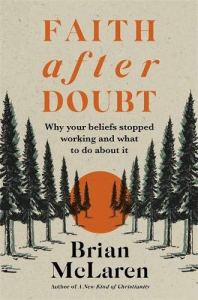 McLaren suggest that honest doubting, far from being a problem, might present an opportunity for changing in the right direction, getting us closer to the “revolutionary love” at the heart of the gospel. He shares stories from his own life, in and out of ministry, and from readers who have contacted him remotely or come up to him after events, caught in dilemmas about what they believe and whether they want to raise their children into religion. Though he’s fully aware of the environmental crisis and doesn’t offer false hope that we as a species will survive it, he isn’t ready to give up on religion; he believes that a faith seasoned by doubt and matured into an understanding of the harmony of all things can be part of a solution.
It’s possible some would find McLaren’s ideas formulaic and his prose repetitive. His point of view always draws me in and gives me much to think about. I’ve been stuck in perplexity for, ooh, 20 years? I frequently ask myself why I persist in going to church when it’s so boring and so often feels like a social club for stick-in-the-mud white people instead of a force for change. But books like this and Robin Wall Kimmerer’s Braiding Sweetgrass, my current soul food, encourage me to keep pursuing spiritual connection as a worthwhile path. I’ll be seeking out his forthcoming book (due out in May), Do I Stay Christian?, too.
Some favourite lines:
“only doubt can save the world. Only doubt will open a doorway out of hostile orthodoxies – whether religious, cultural, economic or political. Only through the difficult passage of doubt can we emerge into a new stage of faith and a new regenerative way of life. Everything depends on making this passage.”
“Among all the other things doubt is – loss, loneliness, crisis, doorway, descent, dissent [these are each the subject of individual chapters early on in the book] – it is also this: a crossroads. At the crossroads of doubt, we either become better or bitter. We either break down or break through. We become cynics or sages, hollow or holy. We choose love or despair.”
“Blessed are the wonderers, for they shall find what is wonderful. … Blessed are the doubters, for they shall see through false gods. Blessed are the lovers, for they shall see God everywhere.”
With thanks to Hodder & Stoughton for the free copy for review.
This Book Is a Plant: How to Grow, Learn and Radically Engage with the Natural World (2022)
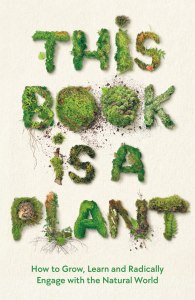 This collection of new essays and excerpts from previously published volumes accompanies the upcoming Wellcome Collection exhibition Rooted Beings (a collaboration with La Casa Encendida, Madrid, it’s curated by Bárbara Rodríguez Muñoz and Emily Sargent and will run from 24 March to 29 August). The overarching theme is our connection with plants and fungi, and the ways in which they communicate. Some of the authors are known for their nature writing – there’s an excerpt from Merlin Sheldrake’s Entangled Life, Jessica J. Lee (author of Turning and Two Trees Make a Forest) contributes an essay on studying mosses, and a short section from Kimmerer’s Braiding Sweetgrass closes the book – while others are better known in other fields, like Susie Orbach and Abi Palmer (author of Sanatorium).
I especially enjoyed novelist Rowan Hisayo Buchanan’s “Wilder Flowers,” which is about landscape painting, balcony gardening in pots, and what’s pretty versus what’s actually good for nature. (Wildflowers aren’t the panacea we are sometimes sold.) I was also interested to learn about quinine, which comes from the fever tree, in Kim Walker and Nataly Allasi Canales’ “Bitter Barks.” Sheila Watt-Cloutier’s essay on the Western influence on Inuit communities in northern Canada, reprinted from Granta, is one of the best individual pieces – forceful and with a unique voice, it advocates reframing the climate change debate in terms of human rights as opposed to the economy – but has nothing to do with plants specifically. There are also a couple of pieces that go strangely mystical, such as one on plant metaphors in the Kama Sutra. So, a mixed bag that jumbles science, paganism and postcolonial thought, but if you haven’t already encountered the Kimmerer and Sheldrake (or, e.g., Rooted by Lyanda Lynn Haupt and Losing Eden by Lucy Jones) you might find this a good primer. 
With thanks to Profile Books / Wellcome Collection for the free copy for review.
And one that really didn’t work for me; my apologies to the author and publisher.
I Love You but I’ve Chosen Darkness by Claire Vaye Watkins (2021)
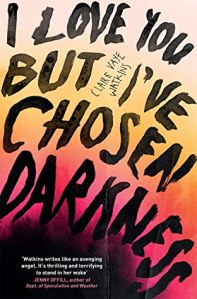 What a letdown after Gold Fame Citrus, one of my favourite novels of 2015. I’d also read Watkins’s debut short story collection, Battleborn, which won the Dylan Thomas Prize. Despite the amazing title and promising setup – autofiction that reflects on postpartum depression and her Mojave Desert upbringing as a daughter of one of the Manson Family cult members – this is indulgent, misguided, and largely unreadable.
A writer named Claire Vaye Watkins flies to Nevada to give a lecture and leaves her husband and baby daughter behind – for good? To commemorate her mother Martha, who died of an opiate overdose, she reprints Martha’s 1970s letters, which are unspeakably boring. I feel like Watkins wanted to write a memoir but didn’t give herself permission to choose nonfiction, so tried to turn her character Claire’s bad behaviour into a feminist odyssey of sexual freedom and ended up writing such atrocious lines as the below:
“I mostly boinked millennial preparers of beverages and schlepped to book festivals to hook up with whatever adequate rando lurked at the end of my signing line. This was what our open marriage looked like”
“‘Psychedelics tend to find me when I need them,’ she said, sending a rush of my blood to my vulva.”
Her vagina dentata (a myth, or a real condition?!) becomes a bizarre symbol of female power and rage. I could only bear to skim this. 
Some lines I liked:
Listen: I am a messenger from the future. I am you in ten years. Pay attention! Don’t fetishize marriage and babies. Don’t succumb to the axial tilt of monogamy! I don’t pretend to know the details of your…situation, but I guarantee you, you’re as free as you’ll ever be. Have sex with anyone you want. Enjoy the fact that it might happen any minute. You could have sex with a man, a woman, both—tonight!
I went from being raised by a pack of coyotes to a fellowship at Princeton where I sat next to John McPhee at a dinner and we talked about rocks and he wasn’t at all afraid of me.
With thanks to riverrun for the proof copy for review.
Would you be interested in reading one or more of these?
Book Serendipity, January to February 2022
This is a bimonthly feature of mine. I call it Book Serendipity when two or more books that I read at the same time or in quick succession have something in common – the more bizarre, the better. Because I usually 20–30 books on the go at once, I suppose I’m more prone to such incidents. (I’ve realized that, of course, synchronicity is really the more apt word, but this branding has stuck.) I always like hearing about your bookish coincidences, too!
The following are in roughly chronological order.
- The author takes Valium to cope with fear of flying in two memoirs I read at the same time, I Came All This Way to Meet You by Jami Attenberg and This Boy We Made by Taylor Harris.


- The fact that the Spanish brought wild horses to the USA is mentioned in the story “The Team” by Tommy Orange (in The Decameron Project) and the poetry collection Rise and Float by Brian Tierney – this also links back to a book I reread in late 2021, Misty of Chincoteague by Marguerite Henry.
- There are roaches in a New York City apartment in I Came All This Way to Meet You by Jami Attenberg and the story “Other People’s Lives” in Loss of Memory Is Only Temporary by Johanna Kaplan.
- The same Dostoevsky passage from The Brothers Karamazov, about loving everything (“Love all the earth, every ray of God’s light, every grain of sand or blade of grass, every living thing. If you love the earth enough, you will know the divine mystery” and so on), is quoted in Faith after Doubt by Brian McLaren and Reflections from the North Country by Sigurd Olson.

- A description of nicotine-stained yellow fingers in What I Wish People Knew About Dementia by Wendy Mitchell, The Cure for Sleep by Tanya Shadrick, and Free by Lea Ypi.
- Joni Mitchell’s music is mentioned in The Reactor by Nick Blackburn and The Cure for Sleep by Tanya Shadrick, two memoirs I was reading at the same time.
- From one summer camp story to another … I happened to follow up The Interestings by Meg Wolitzer with Honor Girl by Maggie Thrash.
- Audre Lorde’s definition of the erotic is quoted in Body Work by Melissa Febos and Heaven Is a Place on Earth by Adrian Shirk, both of which are March 15, 2022 nonfiction releases I’ve reviewed for Shelf Awareness.


- The 2017 white supremacist terrorist attack in Charlottesville, Virginia is mentioned in This Boy We Made by Taylor Harris (who lives there), Faith after Doubt by Brian McLaren (who was part of the clergy counterprotest group that day), and Heaven Is a Place on Earth by Adrian Shirk (she went there for a literary event a few months later).
- The Salvador Dalí painting The Persistence of Memory (that’s the one with the melting clock) is described in The Reactor by Nick Blackburn and This Boy We Made by Taylor Harris.
- On the same day, I came across the fact that Mary Shelley was pregnant while she wrote Frankenstein in two books: Linea Nigra by Jazmina Barrera and Smile by Sarah Ruhl.

- The fact that cysts in female organs can contain teeth comes up in Heaven Is a Place on Earth by Adrian Shirk and I Love You but I’ve Chosen Darkness by Claire Vaye Watkins.
- Reading two novels by Japanese-American authors who grew up in Hawaii at the same time: How High We Go in the Dark by Sequoia Nagamatsu and To Paradise by Hanya Yanagihara.

- Twins are everywhere! Including, just in a recent reading pile, in Hands by Lauren Brown (she’s a twin, so fair enough), Birth Notes by Jessica Cornwell, The Snow Collectors by Tina May Hall, Smile by Sarah Ruhl (this and the Cornwell are memoirs about birthing twins, so also fair enough), Ordinary Love by Jane Smiley, and The Priory by Dorothy Whipple. For as uncommon as they are in real life, they turn up way too often in fiction.
- Bell’s palsy AND giving birth to twins are elements in Birth Notes by Jessica Cornwell and Smile by Sarah Ruhl.
- There’s a no-nonsense maternity nurse in Birth Notes by Jessica Cornwell and The Priory by Dorothy Whipple.


- U.S. West Coast wolves (a particular one in each case, known by a tracking number) are the subject of a poem in Postcolonial Love Poem by Natalie Diaz and The Necessity of Wildfire by Caitlin Scarano.
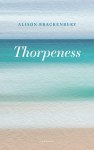
- Herons appear and/or have metaphorical/symbolic meaning in Thorpeness by Alison Brackenbury, What Willow Says by Lynn Buckle, Maggie Blue and the Dark World by Anna Goodall, and The Priory by Dorothy Whipple.

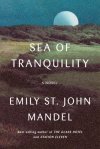
- There’s a character named Edwin in Booth by Karen Joy Fowler and Sea of Tranquility by Emily St. John Mandel.

- The use of “hoard” where it should be “horde” in Maggie Blue and the Dark World by Anna Goodall and Acts of Desperation by Megan Nolan – both errors were encountered in the same evening.
- I read about Lindisfarne in Jini Reddy’s essay in Women on Nature (ed. Katharine Norbury) and The Interior Silence by Sarah Sands in the same evening.
- “Flitting” as a synonym for moving house in Thorpeness by Alison Brackenbury and Nature Cure by Richard Mabey.

- A brother named Paul in Tides by Sara Freeman and Sea of Tranquility by Emily St. John Mandel.
- A woman knows her lover is on the phone with his ex by his tone of voice in Tides by Sara Freeman and Acts of Desperation by Megan Nolan.
- In two novels I’ve read so far this year – but I won’t say which ones as it’s a spoiler – the big reveal, towards the very end, is that a woman was caught breastfeeding someone who was not her baby and it caused a relationship-destroying rupture.
- Reading a second memoir this year where the chapters are titled after pop songs: Dear Queer Self by Jonathan Alexander (for a Foreword review) and now This Will Only Hurt a Little by Busy Philipps.


- A second short novel entitled The Swimmers this year: the first was Julie Otsuka’s, recently reviewed for Shiny New Books; a proof copy is on the way to me of Chloe Lane’s, coming out from Gallic Books in May.
- Reading a second memoir this year whose author grew up in the Chicago suburbs of Illinois (Arlington Heights/Buffalo Grove vs. Oak Park): I Came All This Way to Meet You by Jami Attenberg and This Will Only Hurt a Little by Busy Philipps.
- The linea nigra (a stripe of dark hair down a pregnant woman’s belly) provides the title for Linea Nigra by Jazmina Barrera and is also mentioned in Birth Notes by Jessica Cornwell.
 The famous feminist text Our Bodies, Ourselves is mentioned in Birth Notes by Jessica Cornwell and I Love You but I’ve Chosen Darkness by Claire Vaye Watkins.
- Childbirth brings back traumatic memories of rape in Birth Notes by Jessica Cornwell and This Will Only Hurt a Little by Busy Philipps.
What’s the weirdest reading coincidence you’ve had lately?
How Not to Be Afraid (of Everything): Gareth Higgins and Jane Wong
I’ve done a couple of other dual review posts this year (and I have another planned for Friday) where the books’ titles are so similar that I couldn’t resist discussing them together, even if the books themselves were extremely different. First I featured two books called Ex Libris; later I reviewed The Still Point with The Still Point of the Turning World. This time I have two 2021 releases: How Not to Be Afraid, Gareth Higgins’s self-help/theology book about resisting despair and living in faith; and Chinese American poet Jane Wong’s collection How to Not Be Afraid of Everything, which draws on her family history. Together the titles seemed like a perfect antidote to R.I.P. (more coming up for that on Halloween!).
How Not to Be Afraid: Seven Ways to Live When Everything Seems Terrifying by Gareth Higgins
 I saw Higgins at the online Church Times Festival of Faith and Literature in April, after which I promptly ordered all the speakers’ books; I’m still reading the other three. He grew up in Northern Ireland in the waning days of the Troubles and has been involved in peacemaking projects as well as in artistic expressions of progressive Christianity such as Wild Goose Festival, which he co-founded, and The Porch, an online magazine he edits. Fear was ingrained in him from his upbringing and reinforced by the bullying he experienced over his sexuality. He writes that it took him decades to learn that fear is a story, one often based on false assumptions about our powerlessness, and that we can change the story.
There’s a psychological/self-help bent to the book as Higgins invites readers, through the exercises at the end of each chapter, to ponder what myths about the true self and its possibilities are limiting their lives. The “seven” of the subtitle actually refers to seven main types of fear, each addressed in turn, such as “fear of having done something that can’t be fixed,” “fear of not having enough,” and “fear of a meaningless life.” There’s a good mix of memoir, theory, anecdotes and therapy speak (though it’s never jargon-y), and while the perspective is Christian, the content is not so religious as to turn off anyone – unless they’re dead set against faith. Many passages hit me right in the solar plexus and made me long to work out how my life can be bigger and part of telling a better story. Particularly recommended to fans of Barbara Brown Taylor, Brian McLaren and Richard Rohr. (New purchase) 
How to Not Be Afraid of Everything by Jane Wong
 Wong is an assistant professor of creative writing at Western Washington University. The centerpiece of her second collection is “When You Died,” a 20-page epic about her grandparents’ experience during China’s “Great Leap Forward,” a 1950s–60s Maoist campaign of agricultural reform that led to severe famine. Her grandfather survived it and her mother was born at the tail end of it. Wong was born to immigrant parents in New Jersey and the atmosphere and imagery she uses to describe her living situation there reminded me of Qian Julie Wang’s in her memoir Beautiful Country.
Foodstuffs provide the figurative palette, with decay never far behind. I most enjoyed the multi-part poem “The Frontier” (“The frontier arranges itself / around me like a moat. / The frontier drops fruit / upon my head. I break open, / hot cantaloupe in winter. / I wobble around, spilling fruit / everywhere. All day, fruit flies / pay their respects.”) and “The Cactus,” about her spiky self-preservation instincts. This is the theme of the title poem as well:
How to not punch everyone in the face.
How to not protect everyone’s eyes from
my own punch. I have been practicing
my punch for years, loosening my limbs.
My jaw unhinged creates a felony I refuse
to go to court for.
There are many unusual metaphors and word choices, and a lot of the alliteration I love. Opening poem “Mad” is playfully set up like a Mad Libs game with all the key words as blanks. But at the same time, there are loads of prose poems – never my favourite thing to come across in a collection – and some long ones that I kept getting lost in. 
Released by Alice James Books on the 12th. With thanks to Nectar Literary for the free e-copy for review.
Final Book Serendipity Incidents to Close out 2019
Just a short post this time. I call it serendipitous when two or more books that I’m reading at the same time or in quick succession have something pretty bizarre in common. Because I have so many books on the go at once – usually between 10 and 20 – I guess I’m more prone to such incidents. I post these occasional reading coincidences on Twitter. What’s the weirdest one you’ve had lately? (The following are in rough chronological order.)
[Previous 2019 Book Serendipity posts covered April, July and October.]
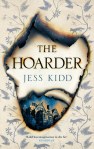
- Characters sit for a portrait in The Confession by Jessie Burton and The Hoarder by Jess Kidd.
- An obsession with saints in Fifth Business by Robertson Davies and The Hoarder by Jess Kidd.

- A mention of the urban myth regarding why our fingertips prune in water (something about an outdated evolutionary strategy for gripping underwater) in The Body by Bill Bryson and Humiliation: Stories by Paulina Flores.
- Memories of childhood trips to Martha’s Vineyard in Chances Are by Richard Russo and The Dearly Beloved by Cara Wall.
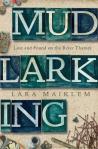
- The River Thames is the setting for Mudlarking by Lara Maiklem and Once Upon a River by Diane Setterfield.

- Mentions of pelicans being clubbed to death in God Unbound: Theology in the Wild by Brian McLaren and Autumn Across America by Edwin Way Teale.
- A character who speaks and writes backwards words in The Poisonwood Bible and The Robber Bride.
- Epigraphs containing folk names for the hare, and soon enough a dead hare, in Ring the Hill by Tom Cox and Starve Acre by Andrew Michael Hurley.

- An unexpected THIRD set of conjoined twins encountered this year (after Cutting for Stone and The Girls) in Fall on Your Knees by Ann-Marie Macdonald.
- The song “Oh My Darling, Clementine” is quoted in The Robber Bride and Fall on Your Knees.
- Warming an orphaned lamb in a low oven in Moral Disorder by Margaret Atwood and The Dig by Cynan Jones.
- A character is presumed incapable of laughter in Agatha by Anne Cathrine Bomann and Bowlaway by Elizabeth McCracken.
- Marilynne Robinson’s Housekeeping is mentioned in The River Capture by Mary Costello and Surrender by Joanna Pocock.
Nonfiction Review Books Roundup: Hay, Hope et al., Lee, Long, McLaren, Zuckerman
I’m continuing with the Nonfiction November focus by catching up on six nonfiction review books I’ve been sent over the last half a year. We’ve got a record of elderly parents’ decline, letters and poems written about the climate crisis, a family memoir set between Taiwan and Canada, a widow’s mushroom-hunting quest, a work of ecotheology that reflects on travels in the Galápagos Islands, and a defense of an entirely secular basis for morality. You can’t say I don’t read a variety, even within nonfiction! See if one or more of these tempts you.
All Things Consoled: A Daughter’s Memoir by Elizabeth Hay
 Gordon and Jean Hay stumbled into their early nineties in an Ottawa retirement home starting in 2009. Elizabeth Hay is one of four children, but caregiving fell to her for one reason and another, and it was a fraught task because of her parents’ prickly personalities: Jean was critical and thrifty to the point of absurdity, spooning thick mold off apple sauce before serving it and needling Elizabeth for dumping perfectly good chicken juice a year before; Gordon had a terrible temper and a history of corporal punishment of his children and of his students when he was a school principal. Jean’s knee surgery and subsequent infection finally put paid to their independence; her mind was never the same and she could no longer paint.
There are many harsh moments in this memoir, but almost as many wry ones, with Hay picking just the right anecdotes to illustrate her parents’ behavior and the shifting family dynamic. She never looks away, no matter how hard it all gets. Her father’s rage against the dying of the light contrasts with her mother’s fade into confusion – lightened by the surprisingly poetic turns of phrase she came out with despite her dementia and aphasia. The title phrase, for instance, was her attempt at “all things considered.” I would wholeheartedly recommend this to readers of Hay’s novels, but anyone can appreciate the picture of complicated love and grief. (See also Susan’s review.)
With thanks to MacLehose Press for the free copy for review.
Letters to the Earth: Writing to a Planet in Crisis, edited by Anna Hope et al.
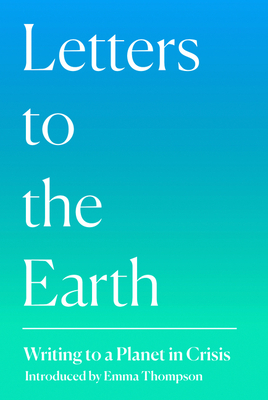 Culture Declares Emergency launched in April to bring the arts into the conversation about the climate emergency. Letters to the Earth compiles 100 short pieces by known and unknown names alike. Alongside published authors, songwriters, professors and politicians are lots of ordinary folk, including children as young as seven. The brief was broad: to write a letter in response to environmental crisis, whether to or from the Earth, to future generations (there are wrenching pieces written to children: “What can I say, now that it’s too late? … that I’m sorry, that I tried,” writes Stuart Capstick), to the government or to other species.
There are certainly relatable emotions here, especially the feeling of helplessness. “We take the train, go vegan, refuse plastic, buy less and less. But that is tiny. We are tiny,” novelist Jo Baker writes. I loved retired bishop Richard Holloway’s wry letter calling the author of Genesis to account for unhelpful language of dominion, Rob Cowen’s poem to a starling, and Anna Hope’s essay about parenting in a time of uncertainty. Unfortunately, much of the rest is twee or haranguing, e.g. “Forest fires are scorching INNOCENT wildlife. Plastic is strangling INNOCENT turtles and dolphins,” a 12-year-old writes. This was put together in a matter of months, and it shows. There is not enough tonal variety, a lot of overwriting has crept through, and errors, especially in the kids’ work, remain uncorrected. Perhaps six to 10 pieces stood out to me overall. I’d recommend the Extinction Rebellion handbook instead.
With thanks to Alison Menzies / William Collins for the free copy for review.
Two Trees Make a Forest: On Memory, Migration and Taiwan by Jessica J. Lee
 I loved Turning, Lee’s 2017 memoir about swimming in one of Berlin’s lakes per week for a year, so I jumped at the chance to read her follow-up, which delves into her maternal line’s history in Taiwan. She travels to Taipei for three months to brush up on her Chinese, write and hike. Interspersed with the lush descriptions of her walks are reflections on Taiwan’s history and on the hidden aspects of her grandfather Gong’s past that only came to light after Lee’s grandmother, Po, died and she and her mother discovered an autobiographical letter he’d written before he drifted into dementia. Nature, language, history and memory flow together in a delicate blend of genres – “I moved from the human timescale of my family’s story through green and unfurling dendrological time,” she writes.
This has got to be one of the most striking title and cover combinations of the year. Along with Chinese characters, the book includes some looping text and Nico Taylor’s maps and illustrations of Taiwanese flora and fauna. While you will likely get more out of this if you have a particular interest in Asian history, languages and culture, it’s impressive how Lee brings the different strands of her story together to form a hybrid nature memoir that I hope will be recognized by next year’s Wainwright Prize and Young Writer of the Year Award shortlists. She’d also be a perfect New Networks for Nature speaker.
With thanks to Virago for the free copy for review.
The Way through the Woods: Of Mushrooms and Mourning by Long Lit Woon
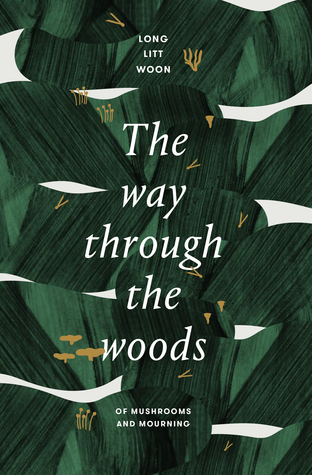 [Trans. from the Norwegian by Barbara J. Haveland]
I couldn’t resist the sound of a bereavement memoir crossed with a mushroom hunting guide. When Long met her husband, Eiolf Olsen, she was an 18-year-old Malaysian exchange student in Stavanger, Norway. Meeting Eiolf changed the whole course of her life, keeping her in Europe for good; decades later, her life changed forever once again when Eiolf dropped dead at work one morning. “If anyone had told me that mushrooms would be my lifeline, the thing that would help me back onto my feet and quite literally back onto life’s track, I would have rolled my eyes. What had mushrooms to do with mourning?” she writes.
 The answer to that rhetorical question is nothing much, at least not inherently, so this ends up becoming a book of two parts, with the bereavement strand (printed in green and in a different font – green is for grief? I suppose) engaging me much more than the mushroom-hunting one, which takes her to Central Park and the annual Telluride, Colorado mushroom festival as well as to Norway’s woods again and again – “In Norway, outdoor life is tantamount to a religion.” But the quest for wonder and for meaning is a universal one. In addition, if you’re a mushroom fan you’ll find gathering advice, tasting notes, and even recipes. I fancy trying the “mushroom bacon” made out of oven-dried shiitakes.
With thanks to Scribe for the free copy for review.
God Unbound: Theology in the Wild by Brian McLaren
 McLaren was commissioned to launch a series that was part travel guide, part spiritual memoir and part theological reflection. Specifically, he was asked to write about the Galápagos Islands because he’d been before and they were important to him. He joins a six-day eco-cruise that tours around the island chain off Ecuador, with little to do except observe the birds, tortoises and iguanas, and swim with fish and sea turtles. For him this is a peaceful, even sacred place that reminds him of the beauty that still exists in the world despite so much human desecration. Although he avoids using his phone except to quickly check in with his wife, modernity encroaches unhelpfully through a potential disaster with his laptop.
I was surprised to see that McLaren leaves the Galápagos at the midpoint – whatever could fill the rest of the book, I wondered? He starts by reassessing Darwin, so often painted as a villain by Evangelical Christianity but actually a model of close, loving attention to nature. He also recalls how some of his most intense spiritual experiences have arisen from time in nature. McLaren’s books have been pivotal to my spiritual journey as we’ve both gradually become more liberal and environmentalist. His definition of God might horrify traditionalists, but holds appeal for me: “a centering singularity whose gravity holds me in insistent orbit, pulling me deeper into mystery, pondering who I am and what my life means.” This is an unusual but gently entrancing book full of photos and quotes from other thinkers including John Muir, Pope Francis and Richard Rohr. It’s an ideal introduction to ecotheology.
With thanks to Canterbury Press for the free copy for review.
What It Means to Be Moral: Why Religion Is Not Necessary for Living an Ethical Life by Phil Zuckerman
 From one end of the spectrum (progressive Christianity) to the other (atheism). Here’s a different perspective from a sociology professor at California’s Pitzer College. Zuckerman’s central argument is that humanism and free choice can fuel ethical behavior; since there’s no proof of God’s existence and theists have such a wide range of beliefs, it’s absurd to slap a “because God says so” label on our subjective judgments. Morals maintain the small communities our primate ancestors evolved into, with specific views (such as on homosexuality) a result of our socialization. Alas, the in-group/out-group thinking from our evolutionary heritage is what can lead to genocide. Instead of thinking in terms of ‘evil’, though, Zuckerman prefers Dr. Simon Baron-Cohen’s term, “empathy erosion.”
To tackle violent crime, Zuckerman contends, we need a more equal society, with the Scandinavian countries a model of how to achieve that through higher taxes, social services and the rehabilitation of prisoners. He uses a lot of relatable examples from history and from his own experience, as well as theoretical situations, to think through practical morality. I found his indictment of American Christianity accurate – how does it make sense for people who say they follow the way of Jesus to fight against equality, tolerance and scientific advances and instead advocate guns, the death penalty and Trump? Well, indeed.
It might seem odd for me to recommend this alongside the McLaren, but there is much to be gained from both viewpoints. Zuckerman’s work overlaps a fair bit with another I’ve read on the topic, Richard Holloway’s Godless Morality – even a bishop agrees we needn’t take our societal ethics straight from the Bible! I can’t go along fully with Zuckerman because I think progressive religion has been and can continue to be a force for good, but I would agree that atheists can be just as moral as people of faith – and often more so.
With thanks to Counterpoint Press for sending a proof copy for review.
Would you be interested in reading one or more of these?
American Book Acquisitions and 2019 Reading Goals
We arrived in the UK on January 1, after an overnight flight from Baltimore. There was no midnight announcement, no complimentary champagne; nothing. Clearly I had my hopes too high. So we’re feeling a bit cheated out of our New Year’s Eve experience and will be doing a recreated countdown and toast when we have houseguests over for this Epiphany weekend.
It was a low-key, relaxing couple of weeks back in the States, the majority of it spent seeing family and friends. We also made it into D.C. to see the new Obama portraits. Mostly I enjoyed doing not a lick of work. And I acquired books, of course: a secondhand and remainder stack that, after my trade-in of some cast-off books, cost just $4; and a few ARCs I’m excited about.


2019 Goals
I’m feeling restless in my career, like if someone gave me permission to quit all my gigs I would do it tomorrow. But, of course, only a fool would do so with no plan to replace them with other remunerative work. The year is likely to involve a lot of rethinking for me as I evaluate which of my proofreading and writing jobs feel worthwhile, and what’s taking me in the direction I want to go (not that I currently know what that is).
Life is awfully hard to plan out. Reading is much easier! So here are my fairly modest reading goals for the year, some of them overlapping:
- I plan to reinstate the Classic and Doorstopper of the month features I ran in 2017, since otherwise I hardly ever read them. I’m starting with Annabel’s readalong of The Name of the Rose by Umberto Eco, which is just over 500 pages but also conveniently falls into one of the below categories.

The doorstoppers I have around to choose from.
- I’ll make a second attempt at getting through some of the travel books and biographies I own, though I won’t hold myself to any particular target. At least five of each would be nice.


- I’m determined to up my literature in translation ratio. These are all the books I own that were originally published in other languages – pitiful! – but I will get hold of more through the library and publishers.

- Re-reading is something I undertake very reluctantly. I have friends who swear by it, but to me it can feel like a waste of time. Last year I re-read just four books: Little Women, Give Me Everything You Have, Crossing the Moon, and Diary of a Bookseller. In each case, on the second reading I rated the book a star lower. That suggests that, far from appreciating books more on a second reading, I have less patience with them and find more flaws! All the same, I’ve chosen four books to re-read in 2019. The Collins is a longtime favorite about moving to Hay-on-Wye; the Thomas is one of the books that first got me into reading memoirs. I’ve been let down by Lamott’s latest three books so wanted to go back to one of her spiritual classics; I’ve gotten into L’Engle’s writing for adults and want to revisit her most famous children’s book (which I don’t think I comprehended at age nine or whatever I was).
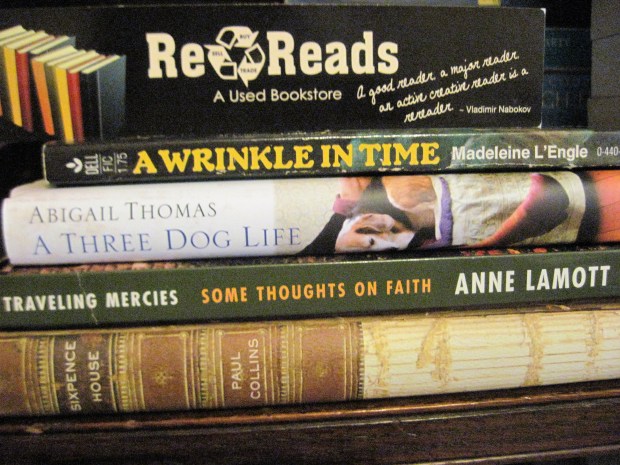
- I have a bad habit of racing through self-help and theology books rather than taking my time mulling over them and fully exploring how I might apply them in my life. This was especially true of The Artist’s Way, one of my bibliotherapy prescriptions. I started out with the aim of completing the daily “morning pages” of free writing (though for me they were ‘evening pages’; I’m not a morning person) and each chapter’s self-knowledge exercises. But soon I’d given up on the writing and contemplation and begun just reading the book straight through, which is not the point of it at all. So this year I mean to go back through the Cameron and Rubin books more mindfully, and use the McLaren devotional as it is intended, reading the recommended Bible passages alongside the weekly reflections.

What are some of your goals (reading-related or otherwise) for 2019?
Books that (Should Have) Literally Changed My Life
(Following on from my posts Landmark Books from My Early Life and Landmark Books in My Life, Part II.)
Every once in a while you’ll hear someone claim that a certain book will change your life. I think of a scene in Garden State, still one of my favorite movies of all time, where Natalie Portman’s character tells Zach Braff’s character “this song will change your life” and puts The Shins’ “New Slang” on his headphones. (Ok, it’s a good song, but not that great.)
Are there any books that have literally changed my life? I can think of a handful that have been extremely influential on my worldview and, in a couple of cases, also changed my behavior. As it happens, they’re all nonfiction.
Religion
 After I got back to the States from my year abroad, I spent a few years doing some intensive reading about progressive Christianity (it was sometimes also called the emergent church) and other religions, trying to decide if it was worth sticking with the faith I’d grown up in. Although I still haven’t definitively answered this for myself, and have drifted in and out of lots of churches over the last 12 years, two authors were key to me never ditching Christianity entirely: Brian McLaren and Marcus Borg.
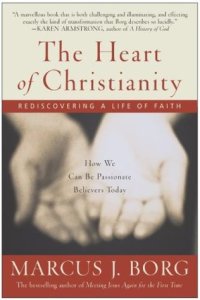 McLaren founded the church we attend whenever we’re back in Maryland and is the author of over a dozen theology titles, including the New Kind of Christian trilogy of allegorical novels. For me his best book is A New Kind of Christianity, which pulls together all his recurrent themes. Borg, who died in 2015, wrote several books that made a big impression on me, but none more so than The Heart of Christianity, which is the best single book I’ve found about what Christianity can and should be, going back to Jesus’ way of peace and social justice and siphoning off the unhelpful doctrines that have accumulated over the centuries.
 Any number of other Christian books and authors have been helpful to me over the years (Secrets in the Dark by Frederick Buechner, How (Not) to Speak of God by Peter Rollins, Falling Upward by Richard Rohr, An Altar in the World by Barbara Brown Taylor, Without Buddha I Could Not be a Christian by Paul Knitter, Unapologetic by Francis Spufford, and various by Kathleen Norris, Rowan Williams, Richard Holloway and Anne Lamott), reassuring me that it’s not all hellfire/pie in the sky mumbo-jumbo for anti-gay Republicans, but Borg and McLaren were there at the start of my journey.
Sexuality
 Reading is my primary means of examining society as well as my own life, so it’s no wonder that I have turned to books to learn from some gender pioneers. Hanne Blank’s accessible social history Straight (2012) is particularly valuable for its revelation of the surprisingly short history of heterosexuality as a concept – the term has only existed since the 1860s. But the book that most helped me adjust my definitions of gender and broaden my tolerance was Conundrum by Jan Morris (1974).
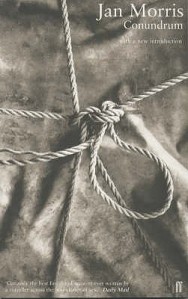 James Morris, born in 1926, was a successful reporter, travel writer, husband and father. Yet all along he knew he was meant to be female; it was something he had sensed for the first time as a young child sitting under the family piano: “I was three or perhaps four years old when I realized that I had been born into the wrong body, and should really be a girl … the conviction was unfaltering from the start.” In 1954 he began taking hormones to start his transition to womanhood, completed by a sex reassignment surgery in Morocco in 1972. This exceptional memoir of sex change evokes the swirl of determination and doubt, as well as the almost magical process of metamorphosing from one thing to another. Morris has been instrumental in helping me see sexuality as a continuum rather than a fixed entity.
Food
Apart from Michael Pollan, can you guess who’s had the greatest influence on my eating habits? You might be surprised to learn it’s American novelist Jonathan Safran Foer. In 2009 he published a provocative book called Eating Animals. I’m still surprised by how powerful and challenging I found it, considering that I knew pretty much what to expect: anti-meat rhetoric from a trendy vegetarian, with plenty of arresting statistics and horrifying behind-the-scenes accounts of factory farming and slaughter. But I set aside my jaded approach to potential propaganda and let it all saturate me, and it was devastating.
 The fact that I still haven’t completely given up meat is proof of how difficult it is to change, even once you’ve been convicted. We’ve gone from eating meat occasionally to almost never, and then mostly when we’re guests at other people’s houses. But if I really reminded myself to think about where my food was coming from, I’m sure we’d be even more hardline. Foer didn’t answer all my questions – what about offal and wild game, and why not go all the way to veganism? – but I appreciated that he never characterizes the decision to be vegetarian as an easy one. He recognizes the ways food is bound up with cultural traditions and family memories, but still thinks being true to one’s principles outweighs all. (He’s brave enough to suggest to middle America that it’s time to consider a turkey-free Thanksgiving!)
Daily Life
 There’s nothing more routine than brushing your teeth, and I never thought I would learn a new way to do it at age 32! But that’s just what Ignore Your Teeth and They’ll Go Away by Sheldon Dov Sydney gave me. He advises these steps: (1) brushing with a dry brush to remove bits of food and plaque, (2) flossing, and (3) brushing with toothpaste as a polish and to freshen breath. It takes a little bit longer than your usual quick brush and thus I can’t often be bothered to do it, but it does always leave my mouth feeling super-clean.
 I frequently succumb to negative self-talk, thinking “I can’t cope” or “There’s no way I could…” Feel the Fear and Do It Anyway by Susan Jeffers helped me see that I need to be more positive in my thought life. Originally published in 1987, the self-help classic says that at the base of every fear is a belief that “I can’t handle it.” Our fears are either of things that can happen to us (aging and natural disasters) or actions we might take (going back to school or changing jobs). You can choose to hold fear with either pain (leading to paralysis) or power (leading to action). This is still a struggle for me, but whenever I start to think “I can’t” I try to replace it with Jeffers’ mantra, “Whatever it is, I’ll handle it.”
Can you think of any books that have literally changed your life?
Practical Theology: Something More by John Pritchard
This is only the second theology book I’ve reviewed here, after Joan Chittister’s Between the Dark and the Daylight in May 2015. I requested John Pritchard’s Something More from SPCK after reading a leaflet about it at Bloxham Festival, thinking it sounded like a relevant, non-preachy approach to the spiritual side of life. And that is indeed what I found. It’s a book stuffed full of relatable themes under one overarching topic: the moments that cause us to question whether there is more to life than what we see and do in the everyday.
 Each chapter has many of the familiar elements of a short sermon: opening prompts, personal or borrowed anecdotes, exposition of a theme, quotations from the Bible and other writers or poets, and life application questions. At times I felt Pritchard was too reliant on quotes from other authors, meaning I didn’t get a particular sense of his own style. However, like an Anglican sermon, each chapter is something you can work through in 10 or 15 minutes – understandable, solidly put together, and with plenty of take-home messages.
Some examples of the chapter-by-chapter themes are suffering, social justice, the arts, and the search for stillness and wonder. There are a few slightly overlapping pieces that might have been combined, but that would have altered the digestible format. A recurring image is of the church building as a tranquil place of holiness and power – no matter if you view it religiously or not. Whether Pritchard is discussing pain or poetry, his tactic is always to expose hints of the supernatural. “To describe the Bruch violin concerto as the product of horse hair scraping over catgut doesn’t feel adequate. There’s more to be said,” he writes.
That word “more” is the book’s clarion call, encouraging readers to look deeper into every situation for sparks of light that point to God. SPCK is a venerable Christian publishing company and Pritchard is a retired Bishop of Oxford, so it’s clear where the book is coming from. Its assumptions may not reflect your own, as Pritchard is well aware. He remembers being in a hospital in London and telling his nurse about the book he was planning. “The entire Christian world-view is probably a foreign country to my nurse,” he realized, which encouraged him to avoid religious jargon and keep it simple and applicable here.
I think everyone can relate to the circumstances Pritchard sets out at the beginning of the book: “Life is OK in an OK kind of way but it fails the test of ecstasy or lament. It rolls on in a safe, middling register, but it feels as if there should be more. … In the meantime we get on with secondary things, with our habits of low hope.” If you dare to think there must be more to life than going to work and paying the bills and want to explore what might be out there, I’d recommend picking this up alongside books by some of the other terrific writers Pritchard quotes, such as Brian McLaren, Marcus Borg, and Barbara Brown Taylor.
With thanks to Sarah Head at SPCK for sending a free copy for review.
My rating: 
 Bookish Beck = Rebecca Foster. American transplant to England. Freelance proofreader and book reviewer.
 Bookish Beck