The #1929Club: Passing and Letters to a Young Poet
A year club hosted by Karen and Simon is always a great excuse to read more classics. I appear to be getting in training for Novellas in November – both of these were notably short at under 100 pages, particularly the Rilke, which is little more than a pamphlet. (Both:  )
)

Passing by Nella Larsen
By the time of her death in 1964, this Harlem Renaissance author had mostly fallen into obscurity, but she has received renewed attention in recent decades. I learned about Passing in connection to Brit Bennett’s The Vanishing Half, which it partially inspired.
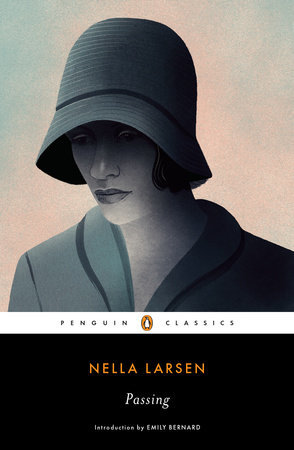 Irene Redfield and Clare Kendry grew up together in Chicago. Both are light-skinned African American women, their features described as “olive” or “golden.” Irene has remained within the Black community, marrying a doctor named Brian and living a comfortable life in Harlem. However, she is able to pass as white in certain circumstances, such as when she and Clare meet for tea in a high-end establishment. Clare, on the other hand, is hiding her ancestry from her white husband, Jack Bellew, who spews hatred for Black people. “It’s such a frightfully easy thing to do. If one’s the type, all that’s needed is a little nerve,” she insists.
Clare and Irene’s relationship could be characterized as that of frenemies, though critics have posited repressed homoeroticism based on how Larsen describes Clare’s beauty from Irene’s perspective. This is very subtle – I only spotted potential infatuation in the letter from Clare that Irene reads in the opening pages. Most of the time, Irene appears to disapprove of Clare for her recklessness, knowing that there could be dire consequences if Jack discovers her deception. She also starts to suspect that Clare is having an affair with Brian, and for these reasons, as well as her own discomfort and guilt, she avoids Clare as much as possible.
The trouble with Clare was, not only that she wanted to have her cake and eat it too, but that she wanted to nibble at the cakes of other folk as well.
Things come to a head in the final six pages, turning what had for much of its length been an ambling read into something of a shocker. Apparently scholars feel that Larsen flubs her endings, but I thought this one was fantastic, giving a Gatsby-esque tragic weight. Comparing Black women’s strategies of coping with a white world was also fascinating. My experience with African American classics is limited, so I was happy to increase my repertoire.
My secondhand copy – a dual volume with Quicksand, which I’ll plan on reading next November – came from the much-mourned Bookbarn International.
Letters to a Young Poet by Rainer Maria Rilke
[Translated from the German by Charlie Louth]
 I’d long wanted to read this and couldn’t find it through a library, so bought a copy as part of a Foyles order funded by last year’s Christmas money. I’m not clear on whether the Penguin Little Black Classics edition is abridged, but the 1929 preface by Franz Xaver Kappus, Rilke’s correspondent, only mentions 10 letters, which is how many are printed here, so I have at least gotten the gist. Most of the letters were sent in 1903–4, with a final one dated 1908, from various locations on Rilke’s European travels.
Kappus sent Rilke his early poetic efforts and received in reply a frank letdown – “the poems are not yet anything in themselves” – but also much kind, general advice about creativity, confidence, post-faith life, and thriving in spite of suffering. Even so tiny a book is almost endlessly quotable, with many self-help-oriented phrases I’d read in other contexts and found wonderfully reassuring:
Go into yourself. Examine the reason that bids you to write; check whether it reaches its roots into the deepest region of your heart, admit to yourself whether you would die if it should be denied you to write.
To be an artist means: not to calculate and count; to grow and ripen like a tree which does not hurry the flow of its sap and stands at ease in the spring gales without fearing that no summer may follow. But it comes only to those who are patient, who are simply there in their vast, quiet tranquillity, as if eternity lay before them.
be patient towards all that is unresolved in your heart and … try to love the questions themselves
I also got this 1929 autobiography out from the library. While I much admire the tone in the first paragraph and final pages (especially that last word!), I find I don’t have enough interest in the WWI poets to read what’s in between. It put a Sufjan Stevens song in my head, though.


I’ve previously participated in: 1920 Club, 1956 Club, 1936 Club, 1976 Club and 1954 Club.
Wainwright and Women’s Prizes: Predictions & Wishes
It’s that time of year when all the literary prize news comes at once. Tonight: the announcement of the Wainwright Prize winners. (I was honoured to be invited to the ceremony, but traveling into London was more than I felt up to handling under the circumstances.) Tomorrow, the 8th, the Women’s Prize for Fiction is awarded. It’s been so long since the shortlist announcement that my enthusiasm has waned, but nonetheless, I make predictions and wishes for it as well as the Wainwright below.
Wainwright Prize
I’d read (or skimmed, or decided against) all 13 of the UK nature writing nominees, as well as a few from the global conservation longlist, before the shortlists were announced (see my mini-reviews and predictions).
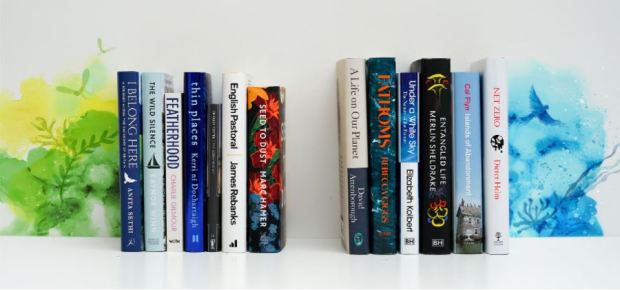
Unfortunately, my favourite from the lists, Vesper Flights by Helen Macdonald, did not make it through to the final round. To some extent it was a victim of the new division into two prizes: the idea seems to be to separate the narrative-driven, personal writing from the scientific, environmentally minded nonfiction. Books that draw on both genres, like Macdonald’s essays this year, and Tim Dee’s and Kathleen Jamie’s excellent travelogues (Greenery and Surfacing) last year, fall into the gap.
Since the shortlist announcement, I’ve read more of Islands of Abandonment by Cal Flyn and started Fathoms by Rebecca Giggs. Both are exceptionally written and impressive in scope, but as her portraits of the world’s derelict places have truly captivated my imagination, I stand by my initial prediction that Cal Flyn will win the global conservation prize.

As for the nature writing prize, I’m torn: The book that I think is of most lasting UK importance, with vital lessons to teach, is English Pastoral by James Rebanks. By contrast, the book that I wholeheartedly loved and admired was Featherhood by Charlie Gilmour. I’d be happy to see either one win.


Women’s Prize
Like last year, the winner announcement was delayed by several months, giving me time to forget all about it. Back in April I was very invested in the race (see my thoughts on the longlist; my wish list correctly predicted four of the six on the shortlist), and since then I’ve read and enjoyed a couple more from the longlist.
I predicted it would be Women’s Prize fodder when I read it back in June 2020, and I still think it the safest, strongest contender: The Vanishing Half by Brit Bennett. It’s easy to see this following in the footsteps of An American Marriage: a book club book concerned with race and relationships.
So that’s what I think will win, whereas I marginally preferred the superficially similar but subtler Transcendent Kingdom by Yaa Gyasi and would like to see its author get some recognition, so that’s what should win.


Next prize to think about: The Booker, whose shortlist will be announced on the 14th. On the 13th I’ll give my thoughts on the longlisted novels that I’ve read so far.
Book Serendipity, May to June 2021
I call it Book Serendipity when two or more books that I read at the same time or in quick succession have something pretty bizarre in common. Because I have so many books on the go at once (usually 20‒30), I suppose I’m more prone to such incidents. I’ve realized that, of course, synchronicity is really the more apt word, but this branding has stuck.
The following are in roughly chronological order.
- Sufjan Stevens songs are mentioned in What Is a Dog? by Chloe Shaw and After the Storm by Emma Jane Unsworth.
- There’s a character with two different coloured eyes in The Mothers by Brit Bennett and Painting Time by Maylis de Kerangal.

- A description of a bathroom full of moisturizers and other ladylike products in The Mothers by Brit Bennett and The Interior Silence by Sarah Sands.
- A description of having to saw a piece of furniture in half to get it in or out of a room in A Braided Heart by Brenda Miller and After the Storm by Emma Jane Unsworth.

- The main character is named Esther Greenwood in the Charlotte Perkins Gilman short story “The Unnatural Mother” in the anthology Close Company and The Bell Jar by Sylvia Plath. Indeed, it seems Plath may have taken her protagonist’s name from the 1916 story. What a find!
- Reading two memoirs of being in a coma for weeks and on a ventilator, with a letter or letters written by the hospital staff: Many Different Kinds of Love by Michael Rosen and Coma by Zara Slattery.


- Reading two memoirs that mention being in hospital in Brighton: Coma by Zara Slattery and After the Storm by Emma Jane Unsworth.
- Reading two books with a character named Tam(b)lyn: My Cousin Rachel by Daphne du Maurier and Coma by Zara Slattery.
- A character says that they don’t miss a person who’s died so much as they miss the chance to have gotten to know them in Featherhood by Charlie Gilmour and In by Will McPhail.

- A man finds used condoms among his late father’s things in The Invention of Solitude by Paul Auster and Featherhood by Charlie Gilmour.
- An absent husband named David in Open House by Elizabeth Berg and Ruby by Ann Hood.
- The murder of Thomas à Becket featured in Murder in the Cathedral by T.S. Eliot (read in April) and Heavy Time by Sonia Overall (read in June).


- Adrienne Rich is quoted in (M)otherhood by Pragya Agarwal and Heavy Time by Sonia Overall.
- A brother named Danny in Immediate Family by Ashley Nelson Levy and Saint Maybe by Anne Tyler.
- The male lead is a carpenter in Early Morning Riser by Katherine Heiny and Saint Maybe by Anne Tyler.
- An overbearing, argumentative mother who is a notably bad driver in Early Morning Riser by Katherine Heiny and Blue Shoe by Anne Lamott.
- That dumb 1989 movie Look Who’s Talking is mentioned in (M)otherhood by Pragya Agarwal and Early Morning Riser by Katherine Heiny.
- In the same evening, I started two novels that open in 1983, the year of my birth: The Other Black Girl by Zakiya Dalila Harris and Malibu Rising by Taylor Jenkins Reid.


- “Autistic” is used as an unfortunate metaphor for uncontrollable or fearful behavior in Open House by Elizabeth Berg and Blue Shoe by Anne Lamott (from 2000 and 2002, so they’re dated references rather than mean-spirited ones).
 A secondary character mentions a bad experience in a primary school mathematics class as being formative to their later life in Blue Shoe by Anne Lamott and Saint Maybe by Anne Tyler (at least, I think it was in the Tyler; I couldn’t find the incident when I went back to look for it. I hope Liz will set me straight!).
- The panopticon and Foucault are referred to in Great Circle by Maggie Shipstead and I Live a Life Like Yours by Jan Grue. Specifically, Jeremy Bentham’s panopticon is the one mentioned in the Shipstead, and Bentham appears in The Cape Doctor by E.J. Levy.
What’s the weirdest reading coincidence you’ve had lately?
An Embarrassment of Riches at the (Digital) Hay Festival 2021
There was a phenomenal program for this year’s digital Hay Festival. I signed up to a whopping eight events and enjoyed them all. If you missed watching live, it’s not too late to donate and catch up on the archived talks. For three of these, the host-cum-interviewer appeared in person on a studio stage, with the guest(s) joining, perhaps from thousands of miles away, on a large screen mounted on the wall behind them. I thought this was a neat hybrid approach. The rest of my sessions had interviewer and interviewee appearing remotely on a split screen. Let me know which, if any, events you attended and how you found them.
Richard Flanagan
Flanagan’s The Living Sea of Waking Dreams is my novel of 2021 so far (my review), so it was a delight to hear him say more (and in that fantastic accent) about it in the course of a conversation with Stephanie Merritt. Tasmania, where he lives, had always seemed like an ark for species, but now they are vanishing. Ninety percent of the kelp forest has disappeared within the last 20 years because of warming oceans; there are only 300 swift parrots remaining; and the bushfires of 2018–19 were unprecedented in severity. Although he had already roughed out the novel by the time of the fires, Flanagan said he rewrote it in response to the sense of accelerating environmental collapse.

The novel’s twin themes are species extinction and personal extinction, with an elderly family matriarch being kept alive at all costs. Flanagan spoke of the “evasions of the soul” that make us ignore the environmental losses around us and refuse to die – “the final avoidance of life.” He thinks the pandemic has forced people to rethink these ideas and ponder the meaning of life. At age 21, he nearly drowned while kayaking, and ever since he has been frightened not of death, but of the pain of dying. He is not optimistic per se, but hopeful because the world is still so beautiful – on the island he goes to for writing, he is surrounded by wild creatures.
 Merritt asked about the novel’s magic realist element and how stylistically different his novels have been from each other. He was glad she found the book funny, as “life is tragicomic.” In an effort not to get stuck in a rut, he deliberately ‘breaks the mould’ after each book and starts over. This has not made him popular with his publisher!
Three take-aways:
- The one obligation of a writer? “Not to be boring.”
- Novels are not about messages; “that’s what Twitter is for.”
- “To despair is rational, but to hope is the very essence of what it means to be human.”
Rachel Clarke interviewing Jim Down and Michael Rosen
All three authors have written books about the coronavirus pandemic (I have reviewed Clarke’s Breathtaking and Rosen’s Many Different Kinds of Love). Clarke said that the belief foundational to the NHS is that all lives have equal value, but as an ICU doctor Down found that the question of who would benefit most from the use of ventilation was creeping in as there was a risk that there would be more patients than there was equipment to treat them with. With decisions needing to be made very quickly, his hospital adopted the “three wise people” collaborative method. The element that often felt lost, however, was the patient’s wishes, since they might be unresponsive and no family or other visitors were around.

Rosen, who contracted Covid-19 in March 2020 and was in an induced coma for six weeks, included letters from his medical team in his book to give a 360° view of NHS treatment. He thinks of the NHS as being almost in the role of parents, giving altruistic care and support. “Tell the truth about herd immunity” was his pithy message to the government. He read the poem “These Are the Hands,” which he wrote for the 60th anniversary of the NHS, to close.


Bryan Washington and Raven Leilani
 Last year’s Dylan Thomas Prize winner interviewed this year’s winner, and it was clear that the mutual admiration was strong. Though I had mixed feelings about Luster (my review), I was blown away by this high-level intellectual discussion. Both authors are invested in the debate around what it means to be a Black artist. Leilani said she did not want to make concessions in the form of Edie comporting herself better; this character is open about her wants, giving the novel a libidinal flavour. She said she almost envies her protagonist her autonomy, and thinks of the novel as a letter to her old self, granting permission and reassuring herself that “the mess has merit.”

Three take-aways:
- Writing offers Leilani a sanctuary or sense of control.
- While Washington sees works full of strife, grief, and malice as most likely to be considered the pinnacle of American literary fiction, he admires Luster for its theme of communion (especially via the character Akila).
- Leilani sees her novel as being in conversation with Queenie, Sula, The New Me, and Detransition, Baby.
Maggie Shipstead
 Shipstead (also a Dylan Thomas Prize winner) echoed something Leilani had said: that she starts a novel with questions, not answers. Such humility is refreshing, and a sure way to avoid being preachy in fiction. Her new novel, Great Circle, is among my most anticipated books of the year and tells the stories of a fictional female pilot from the golden age of aviation and the actress playing her in a biopic. The book was long in the gestation: In 2012 Shipstead saw a sculpture commemorating a female pilot in Auckland, and in 2014 she started researching. She came to appreciate the miracle of flight and read many books by and about female pilots. The book is dedicated to her brother, recently retired from 20 years in the Air Force. She told Sameer Rahim that, although she used to say this is not a love story, she has since changed her mind.

Three take-aways:
- Shipstead was a competitive show jumper and applied to a creative writing program on a whim.
- She has made a name for herself as a travel writer, too, often combining magazine assignments with her research for the novel (e.g., various trips to Antarctica).
- While she has appreciated the year off from Covid, she is looking forward to getting back to travelling; her first booking is a women’s wilderness experience in Alaska.
Patricia Lockwood
 Lockwood is the only novelist to be included on the Atlantic’s roster of best tweets. She and Nina Stibbe, who interviewed her, agreed that 1) things aren’t funny when they try too hard and 2) the Internet used to be a taboo subject for fiction – producing time-stamped references that editors used to remove. “I had so many observations and I didn’t know where to put them,” Lockwood said, and it seems to her perverse to not write about something that is such a major part of our daily lives. The title of her Women’s Prize-shortlisted novel, No One Is Talking About This (my review), refers to many things, including this reticence to grant the Internet a place in our discourse.

Lockwood said she has been delighted by the high-quality literary pieces coming out about her book, often in comparison with Lauren Oyler’s Fake Accounts. The timing of the publication meant that her initial (U.S.) media interviews ended up being more about Trump than she would have liked. “I think I’m not a natural fiction writer,” she said; it’s true that the novel is so autobiographical it can only be described as autofiction – the second half is all true and all sincere, she was careful to point out – but it’s a gem.
Julianne Pachico
 Like Lockwood, Pachico was part of the “10 @ 10” series featuring debut novelists (though her first book, the linked story collection The Lucky Ones, was marketed as a novel in the USA). Her new book, The Anthill, another of my most anticipated books of the year, is about a young woman returning to Medellín, Colombia, where Pachico spent her formative years. Although she is not a citizen and only goes back on a tourist visa, it feels like going home each time. For her, writing fiction has been a way of sorting out her feelings about the place. She wrote 50,000 words of the novel at her sister’s apartment in Medellín. Pachico told Rosie Goldsmith that, though she considers herself part of the Latin American literary tradition, she is conscious of presenting the country to English-speaking readers: a politically divided place that has gentrified in pockets, but is still plagued by extreme poverty and hardship. She described The Anthill as “a ghost story without ghosts.” I can’t wait to dive into my copy.

Brit Bennett
 Speaking to Arifa Akbar about The Vanishing Half, Bennett admitted that she was worried a historical setting was a cop-out, but reassured herself that she was not writing out of nostalgia and that she did not allow readers a sense of distance – the characters are so ordinary that we know we’d do the same sorts of things. She thinks of passing as a distinctly American project of self-reinvention but acknowledged that we have no definitive statistics on it because, if someone succeeds, they disappear. Some of Stella’s psychology – a very interior character who makes decisions that are difficult to understand – came from her reading of Playing Dead by Elizabeth Greenwood. She loves writing about small towns because they force people to interact with each other. Akbar noted that passing is a double-edged sword, involving subterfuge but also offering liberation (e.g. for a trans character later in the book).

Three take-aways:
- “That’s the most exciting place to be, writing into a mystery.”
- “Race is a fiction, but racism is a reality.”
- An HBO adaptation is in the works, but Bennett doesn’t know if it will cast real twins, two actors, or meld separate people using CGI.
Rachel Cusk and Sheila Heti
 I’ve read more of and gotten on better with Heti’s work than Cusk’s, so this was a rare case of being perhaps more interested in interviewer than interviewee. Heti said that, compared with the Outline trilogy, Cusk’s new novel Second Place feels wilder and more instinctual. Cusk, speaking from the Greek island of Tinos, where she is researching marble quarrying, described her book in often vague yet overall intriguing terms: it’s about exile and the illicit, she said; about femininity and entitlement to speak; about the domestic space and how things are legitimized; about the adoption of male values and the “rightness of the artist.”

Ironically, given that Cusk initially hesitated over revealing her debt to Mabel Dodge Luhan’s memoir Lorenzo in Taos, much of the discussion ended up revolving around Luhan and D.H. Lawrence, about whom Cusk now considers herself an amateur scholar. In his personal writings he reserved special scorn for Luhan, with whom he stayed in New Mexico in the 1920s. This was something Cusk wanted to explore: misogyny and Luhan’s “voice of obscurity.” She hopes that her book will contribute to a better understanding of Luhan’s; not vice versa.
Three take-aways:
- A reviewer noted the use of exclamation points, counting 189 of them in the novel. Cusk equates an exclamation point to a laying down of arms – proof that someone (especially her protagonist, M) means to be nonthreatening.
- Cusk thinks of this book as being like a play: staged and in the moment.
- A woman observing but not being noticed is, like in the Outline trilogy, Cusk’s basic framework.
Review Book Catch-Up: Ante, Evans, Foster and White
Today I have a book of poems about the Filipinx experience in the UK, a collection of short stories reflecting on racial injustice, a monograph on a bird that spells summer for many of us, and a biographical investigation into a little-understood medical condition.
Antiemetic for Homesickness by Romalyn Ante
I was drawn to this debut collection by the terrific title and cover, but also by the accolades it received: it was on the Dylan Thomas Prize longlist and the Jhalak Prize shortlist. I hope we’ll see it on the Sunday Times Young Writer of the Year Award shortlist, too. Ante grew up in the Philippines but at age 16 joined her mother in the UK, where she had moved years before to work as a nurse in the NHS. She has since followed in her mother’s footsteps as a nurse – indeed, overseas Filipinx workers (Jamaicans, too) are a mainstay of the NHS.
 Ante remembers the years when her mother was absent but promised to send for the rest of the family soon: “You said all I needed to do was to sleep and before I knew it, / you’d be back. But I woke to the rice that needed rinsing, / my siblings’ school uniforms that needed ironing.” The medical profession as a family legacy and noble calling is a strong element of these poems, especially in “Invisible Women,” an ode to the “goddesses of caring and tending” who walk the halls of any hospital. Hard work is a matter of survival, and family – whether physically present or not – bolsters weary souls. A series of short, untitled poems are presented as tape recordings made for her mother.
Food is inextricably entwined with memory (reminding me of Nina Mingya Powles’s approach in Tiny Moons) and provides some of the standout metaphors, especially in “Patis” and “Ode to a Pot Noodle.” Ante uses a lot of alliteration and adapts various forms. I especially liked “Tagay!”, a traditional drinking song, and “Mateo,” printed in the shape of a pound sign. The nuanced look at the immigrant experience reminded me of Jenny Xie’s Eye Level. Movement entails losses as well as benefits. The focus on the Filipinx experience also made me think of America Is Not the Heart. My favourite single poem was “The Making of a Smuggler,” which opens “Wherever we travel, we carry / the whole country with us – // our rice terraces are folded garments, / we have pillars of trees, a rainforest // on a hairbrush.”
Favourite lines:
“Gone are the nights he steals / the moon with a mango picker / and swaps it for her pocket mirror”
“The yellow admission papers in my hands escaped / flustering at my face into a flight of orioles.”
“I am halved in order to be whole – / I rebuild by leaving / everything I love.”
With thanks to Chatto & Windus for the free copy for review.
The Office of Historical Corrections by Danielle Evans
To boil these six stories and a novella down to the topic of race in America risks painting them as solemn or strident – more concerned with meaning than with art – when the truth is that they are playful and propulsive even though they keep cycling back to bereavement and injustice. Several of the protagonists are young Black women coming to terms with a loss.
 In “Happily Ever After,” Lyssa works in the gift shop of a Titanic replica and is cast as an extra in a pop star’s music video. Mythical sea monsters are contrasted with the real dangers of her life, like cancer and racism. “Anything Could Disappear” was a favourite of mine, though it begins with that unlikely scenario of a single woman acquiring a baby as if by magic. What starts off as a burden becomes a bond she can’t bear to let go. A family is determined to clear the name of their falsely imprisoned ancestor in “Alcatraz.” In “Richard of York Gave Battle in Vain” (a mnemonic for the colours of the rainbow), photojournalist Rena is wary about attending the wedding of a friend she met when their plane was detained in Africa some years ago. The only wedding she’s been in is her sister’s, which ended badly.
Mistakes and deceit seem to follow these characters. In the title novella that closes the book, Cassie and her colleagues combat fake news, going around putting correction labels on plaques that whitewash history. When she and her former colleague meet up in Wisconsin to find the truth behind a complex correction case, a clash with a white supremacist group quickly turns pedantry into a matter of life and death. The story I’d heard the most about beforehand was “Boys Go to Jupiter,” about a college girl who dons a Confederate flag bikini, not caring what message it sends to others in her dorm. It turns out she has history with a Black family, but has chosen to airbrush this experience out of her life.
There was only one story I didn’t care for, “Why Won’t Women Just Say What They Want,” about a celebrity who turns apologizing into performance art. Overall, this is a very strong collection I would recommend to readers of Brit Bennett and Raven Leilani, with some stories also reminding me of recent work by Curtis Sittenfeld and Mary South. I’ll be sure to seek out Evans’s previous book (also short stories), too.
With thanks to Picador for the proof copy for review.
The Screaming Sky by Charles Foster
The other week I was volunteering at our local community garden and looked up to see a dozen common swifts wheeling over the Kennet & Avon canal and picking off insects among the treetops. I hope this fellow Foster (for whom my husband was once confused on a nature conference attendee list) would be proud of me for pausing to gaze at the birds for a while. My impression of the author is as a misanthropic eccentric. A Renaissance man as well versed in law and theology as he is in natural history, he’s obsessed with swifts and ashamed of his own species: for looking down at their feet when they could be watching the skies; for the “pathological tidiness” that leaves swifts and so many other creatures no place to live.
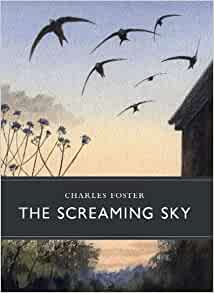 The obsession began when he was eight years old and someone brought him a dead swift fledgling for his taxidermy hobby. Ever since, he’s dated the summer by their arrival. “It is always summer for them,” though, as his opening line has it. This monograph is structured chronologically. Much like Tim Dee does in Greenery, Foster follows the birds for a year: from their winter territory in Africa to the edges of Europe in spring and then to his very own Oxford street in high summer. When they leave, he’s bereft and ready to book a flight back to Africa.
Along the way, Foster delivers heaps of information: the fossil evidence of swifts, how they know where to migrate (we have various theories but don’t really know), their nesting habits and lifespan, and the typical fates of those individuals that don’t survive. But, thumbing his nose at his “ex-friend” (a closed-minded biologist he repeatedly, and delightfully, rails against), he refuses to stick to a just-the-facts approach. Acknowledging the risks of anthropomorphizing, he speaks of swifts as symbols of aspiration, of life lived with intensity. He believes that we can understand animal emotions analogously through our own, so that, inappropriate as such words might seem, we can talk about what birds hope and plan for. He scorns reductive ecosystem services lingo that defines creatures by what we get out of them.
Also like Dee, Foster quotes frequently from poetry. His prose is full of sharp turns of phrase and moments of whimsy and made me eager to try more of his work (I know the most about but have not yet read Being a Beast).
Swifts know the roar of lions better than the roar of the M25, the piping of hornbills better than the Nunc Dimittis of parish Evensong … Are memories of our eaves spiralling high above the Gulf of Guinea? … They don’t seem to prevaricate. One moment they’re there, the next they’re off, diving straight into the journey. It’s the way we should run into cold water.
 As I’ve found with a number of Little Toller releases now (On Silbury Hill, Snow, Landfill), knowledge meets passion to create a book that could make an aficionado of the most casual of readers. Towards the close I was also reminded of Richard Smyth’s An Indifference of Birds: “When Homo sapiens has gone there will be lots of ideal swift holes in the decaying buildings we’ll leave behind.” It’s comforting to think of natural cycles continuing after we’re gone … but let’s start making the space for them now. Jonathan Pomroy’s black-and-white illustrations of swift behaviour only add to this short book’s charms.
With thanks to Little Toller Books for the free copy for review.
Waiting for Superman: One Family’s Struggle to Survive – and Cure – Chronic Fatigue Syndrome by Tracie White
Like Suzanne O’Sullivan’s books (most recently, The Sleeping Beauties), this is presented as an investigation into a medical mystery. White, a Stanford Medicine journalist, focuses on one family that has been indelibly changed by chronic fatigue syndrome – now linked with myalgic encephalomyelitis and termed ME/CFS for short. Whitney Dafoe was a world traveller and promising photographer before, in 2010, a diagnosis of ME/CFS explained his exhaustion and gastrointestinal problems. By the time White first met the family in 2016, the thirtysomething was bedbound in his parents’ home with a feeding tube, only able to communicate via gestures and rearranging Scrabble tiles. He couldn’t bear loud noises, or to be touched. At times he was nearly comatose.
 Whitney’s father, Ron Davis, is a Stanford geneticist whose research has contributed to the Human Genome Project. He has devoted himself to studying ME/CFS, which affects 20 million people worldwide yet receives little research funding; he calls it “the last major disease we know nothing about.” Testing his son’s blood, he found a problem with the citric acid cycle that produces ATP, essential fuel for the body’s cells – proof that there was a physiological reason for Whitney’s condition. Frustratingly, though, a Stanford colleague who examined Whitney prescribed a psychological intervention. This is in line with the current standard of care for ME/CFS: a graded exercise regime (nigh on impossible for someone who can’t get out of bed) and cognitive behavioural therapy.
White delves into Whitney’s past, looking for clues to what could have triggered his illness (having mono in high school? a parasite he picked up in India?). She also goes back to the mid-1980s to consider the Lake Tahoe outbreak of ME/CFS, whose victims “looked too healthy to be sick and were repeatedly disbelieved.” The media called it “yuppie flu,” downplaying the extreme fatigue involved. White also meets Laura Hillenbrand, author of Seabiscuit, who suffers from ME/CFS and managed to write her bestselling books from bed. Like Whitney, she only has a certain allotment of energy and mustn’t use it up too fast.
- A neat connection: Stephanie Land, author of Maid, was Whitney’s ex-girlfriend when he was 19 and living in Alaska; she wrote a Longreads article about their relationship.
- The title is from a Flaming Lips lyric and expresses Whitney’s trust in his dad’s ability to cure him; the U.S. title is The Puzzle Solver and the working title was The Invisible Patient.
With thanks to Atlantic Books for the free copy for review.
Would you be interested in reading one or more of these?
Three on a Theme for Mother’s Day
In advance of (American) Mother’s Day, I picked up two novels and a set of short stories that explore the bonds between mothers and their children, especially daughters. The relationships can be fraught or fractured, but always provide good fodder for psychologically astute fiction.
Mother for Dinner by Shalom Auslander (2020)
Hope: A Tragedy, Auslander’s 2012 debut, is among my absolute favorites, an outrageously funny novel that imagines Anne Frank is alive and dwelling in a suburban attic, frantically tapping out her endless magnum opus. Solomon Kugel, the sap blessed to have an icon sharing his home, has a deluded mother who actually grew up in Brooklyn but believes she survived the Holocaust and now hoards food and curses the Nazis who ruined her life.
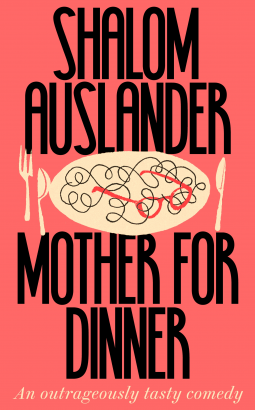 I start with that bit of synopsis because Mother for Dinner showcases rather analogous situations and attitudes, but ultimately didn’t come together as successfully for me. It’s a satire on the immigrant and minority experience in the USA – the American dream of ‘melting pot’ assimilation that we see contradicted daily by tribalism and consumerism. Seventh Seltzer works in Manhattan publishing and has to vet identity stories vying to be the next Great American Novel: “The Heroin-Addicted-Autistic-Christian-American-Diabetic one” and “the Gender-Neutral-Albino-Lebanese-Eritrean-American” one are two examples. But Seventh is a would-be writer himself, compelled to tell the Cannibal-American story.
For years Mudd, the Seltzer family matriarch, has been eating Whoppers for each meal in a customary fattening-up called the Cornucopiacation. She expects her 12 children, who are likely the last of the Cannibal kind, to carry on the tradition of eating her corpse after her death. It’s a way for ancestors to live on in their descendents. The Cannibal Guide, disguised as a deer processing manual, sets out the steps: Drain (within two hours), Purge, Partition, Consume (within 24 hours). Unclish, the Seltzers’ uncle, drilled the rules into them when they were kids through rhymes like “A bite and half / and you won’t need another, / whether it’s your father, your sister, / or even your mother.” From her deathbed, Mudd apportions her body parts to her offspring, some tenderly and some vengefully. Their inheritance – a Brooklyn dump that will still net $5.2 million – is conditional on them performing the ritual.
Interspersed with sections on the practicalities of butchering and cooking a morbidly obese woman are flashbacks to key moments of Cannibal history, which has turned into myth. In 1914, Julius Seltzer left the paradisiacal “Old Country” with his sister Julia, who pretended to be his wife and traveled with him to Detroit to work for Henry Ford. (An overt parody of Jeffrey Eugenides’ Middlesex.) Mudd is vocally intolerant of all other minority groups, from Blacks to homosexuals, and always chooses the version of history that reflects best on her own ancestors, while the Seltzers’ father was more willing to admit flaws.

My proof copy, with a joke on the cover, came with a napkin!
Auslander is pushing the boundary of what an author can get away with, not just with a literal cannibalism storyline but also with jokes about historical atrocities and the recent trend for outing beloved figures as reprehensible (what Seventh calls “Contemporary Assholization Studies”). He shares Lionel Shriver’s glee for tipping sacred cows. I did appreciate his picture of the pervasiveness of xenophobia – the “You’re Not Me” look that anyone can get when walking in an unfamiliar neighborhood – and his willingness to question the value of beliefs and ceremonies once they’ve stopped being reasonable or of use. But with all the siblings known by numbers, it’s hard to distinguish between them. The novel ends up heavy on ideas but light on characterization, and as a whole it leaves a bit of a bad taste in the mouth.
My rating: 
With thanks to Picador for the proof copy for review.
The Mothers by Brit Bennett (2016)
{CONTAINS MILD SPOILERS.}
Like so many who were impressed with the Women’s Prize-shortlisted The Vanishing Half, I rushed to get hold of Bennett’s California-set first novel, which, while not as skillfully put together, is nearly as emotionally engaging. After her mother’s suicide, 17-year-old Nadia Turner only has her father, a Marine, but they are bolstered by their church family at Upper Room Chapel. Nadia is a bright girl headed to Michigan for college, but in her senior year she gets mixed up with Pastor Sheppard’s 21-year-old son, Luke, leading to a pregnancy and abortion that his parents swiftly cover up / pay for. Luke drops her at the clinic and hands over the money, but doesn’t pick her up; that looks the acrimonious end of their relationship.
But in the years to come, especially when Nadia takes a break from law school to care for her father, their lives will intersect again. Nadia’s best friend in that final year of high school was Aubrey Evans, who is estranged from her mother, who failed to protect the girl from sexual abuse at the hands of her own boyfriend. Now Aubrey wears a purity ring, enamored with the idea that faith will make her clean again. Once Nadia leaves, she starts dating Luke, ignorant of her best friend’s history with him. This sets up a love triangle mired in layers of secrets.
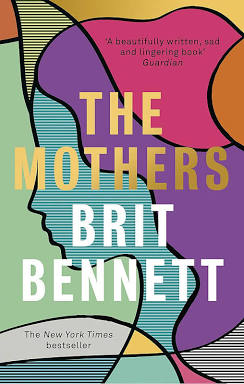 There is dramatic irony here between what the characters know about each other and what we, the readers, know – echoed by what “we,” the church Mothers, observe in the first-person plural sections that open most chapters. I love the use of a Greek chorus to comment on a novel’s action, and The Mothers reminded me of the elderly widows in the Black church I grew up attending. (I watched the video of a wedding that took place there early this month and there they were, perched on aisle seats in their prim purple suits and matching hats.)
Nadia and Aubrey are relatable characters, and Luke earns our sympathy after the cruel return of his football injury. (I was intrigued to see that Peter Ho Davies was one of Bennett’s teachers – his novel A Lie Someone Told You About Yourself is a rare picture of male grief after abortion, also present here.) Bennett explores multiple facets of motherhood: memories of a mother, the absence of a mother, the choice to become a mother, and people who act in the place of a mother by providing physical care or being a source of moral support.
The timeline is a bit too long, which makes the plot wander more than it needs to, but this is a warm and bittersweet novel that always held my interest. Bennett has produced two winners in a row, and I look forward to seeing what she’ll do next.
A favorite line: “Maybe mothers were inherently vast and unknowable.” (not literally vast like in the Auslander!)
Source: Birthday gift (secondhand) from my wishlist last year
My rating:
Close Company: Stories of Mothers and Daughters, ed. by Christine Park and Caroline Heaton (1987)
I read 14 of 25 stories, skipping to the ones that most interested me (by familiar names like Sue Miller, Sylvia Plath, and Jeanette Winterson), and will read the rest next year. The only story I’d encountered before was Margaret Atwood’s “Significant Moments in the Life of My Mother,” originally published in Bluebeard’s Egg. The title phrase comes from Jamaica Kincaid’s story. A recurring theme is women’s expectations for their daughters, who might repeat or reject their own experiences. As the editors quote from Simone de Beauvoir in the introduction, “the daughter is for the mother at once her double and another person.”
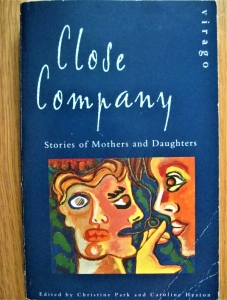 I particularly liked “The Pangs of Love” by Jane Gardam, a retelling of the Hans Christian Andersen fairy tale of “The Little Mermaid,” and “Swans” by Janet Frame, in which a mother takes her two little girls for a cheeky weekday trip to the beach. Fay and Totty are dismayed to learn that their mother is fallible: she chose the wrong beach, one without amenities, and can’t guarantee that all will be well on their return. A dusky lagoon full of black swans is an alluring image of peace, quickly negated by the unpleasant scene that greets them at home.
Two overall standouts thus far were “Everyday Use” by Alice Walker and “The Unnatural Mother” by Charlotte Perkins Gilman. In Walker’s story, which draws on the parable of the Prodigal Son, a hip Afro-wearing daughter returns to her mother’s rural home and covets the quilts and butter churn – to her this is quaint folk art that she wants to take away and display, but her mother and sister resent her condescension towards their ‘backward’ lives.
Gilman is best known for The Yellow Wallpaper, but this story has a neat connection with another classic work: the main character is named Esther Greenwood, which is also the protagonist’s name in Plath’s The Bell Jar (consider this a preview of my next Book Serendipity roundup!). A gossiping gaggle of women discuss Esther’s feral upbringing and blame it for her prioritizing altruism over her duty to her child. A perfect story.
Source: Free mall bookshop
My rating: (so far) 
If you read just one … Make it The Mothers. (But do also pick out at least a few stories from the Close Company anthology.)
Book Serendipity, Mid-March to Early May 2021
In early April, the publisher Canongate ran a newsletter competition for one reader to win a stack of their recent releases. All you had to do was reply with your favourite word. On Twitter they gave a rundown of the most popular responses. Turning up several times each were petrichor, mellifluous, and oleaginous. Most frequent of all was serendipity: I was one of 15 to submit it! And one of those entries, but not mine, won. Anyway, fun little story there.
I call it Book Serendipity when two or more books that I read at the same time or in quick succession have something pretty bizarre in common. Because I have so many books on the go at once (usually 20‒30), I suppose I’m more prone to such incidents. I’ve realized that, of course, synchronicity is really the more apt word, but this branding has stuck.
The following are in roughly chronological order.
- A white peacock is mentioned in Indelicacy by Amina Cain and The Mermaid of Black Conch by Monique Roffey, both of which were on the 2021 Rathbones Folio Prize shortlist.

- Speaking of that Rathbones Folio Prize shortlist, four of the eight were paperbacks with French flaps.
- The main character takes ballet lessons in Indelicacy by Amina Cain and A Feather on the Breath of God by Sigrid Nunez.
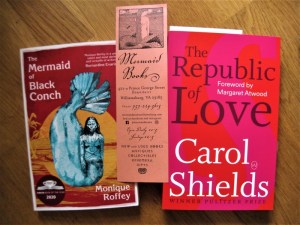
- Mermaids! A big theme in The Mermaid of Black Conch by Monique Roffey (of course) and The Republic of Love by Carol Shields, but they’re also mentioned in the opening story of The Office of Historical Corrections by Danielle Evans and are main characters in “The Pangs of Love” by Jane Gardam in the anthology Close Company.
- The Brothers Grimm story about brothers who have been transformed into swans and their sister who sews shirts out of nettles to turn them back is reworked in The Charmed Wife by Olga Grushin and used as a metaphor in Dusk, Night, Dawn by Anne Lamott.
- An electric carving knife is mentioned as a means of suicide (yipes!) in The Inevitable by Katie Engelhart and Woman on the Edge of Time by Marge Piercy.
- A discussion of the distinction between the fear of dying and the fear of being dead in This Party’s Dead by Erica Buist and The Inevitable by Katie Engelhart.
- Two novels in a row in which an older man is appalled by the squalor of his young girlfriend’s apartment, and she calls him “daddy” during sex (double yipes!), made the Dylan Thomas Prize shortlist: Luster by Raven Leilani and My Dark Vanessa by Kate Elizabeth Russell.


- Architect husbands in The Push by Ashley Audrain and The Art of Falling by Danielle McLaughlin (and, last year, in A Celibate Season by Blanche Howard and Carol Shields), as well as a female architect as a main character in The Living Sea of Waking Dreams by Richard Flanagan earlier this year.
- The next-to-last essay in the Trauma anthology quotes from The Bell Jar by Sylvia Plath, which I was also reading at the time.
- A mention of the eels in London absorbing cocaine from the Thames in the final essay in the Trauma anthology; I then moved right on to the last 40 pages of Nobody Is Talking About This by Patricia Lockwood and the same bizarre fact was mentioned. A week and a half later, there it was again, this time in Asylum Road by Olivia Sudjic.
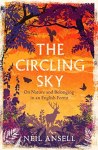
- A mention of sailors’ habit of getting tattoos of swallows in The Circling Sky by Neil Ansell (who has a swallow tattoo, even though he’s not a sailor) and Birdsong in a Time of Silence by Steven Lovatt.

- A father and teenage child wander an unfamiliar city and enter a sex shop together (yipes yet again!) in Three O’Clock in the Morning by Gianrico Carofiglio and Ten Days by Austin Duffy.
- A mention of the same University of Virginia study in which people self-administered electric shocks to alleviate the boredom of sitting alone with their thoughts in Rooted by Lyanda Lynn Haupt and You’re Not Listening by Kate Murphy.
- Basho’s poetry and George Monbiot’s Feral are both cited in The Circling Sky by Neil Ansell and Rooted by Lyanda Lynn Haupt.
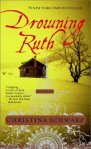
- A dead sister named Mattie in Consent by Annabel Lyon and Drowning Ruth by Christina Schwarz.

- A young Black female protagonist and the same family dynamic (the mother committed suicide and the father is in the Marines/Navy) in The Mothers by Brit Bennett and Luster by Raven Leilani.
- On the same night, I read about two pets encountering snow for the first time: a cat in Close Encounters of the Furred Kind by Tom Cox and a dog in Open Water by Caleb Azumah Nelson.
- A character is described as being as wide as they are tall in Mother for Dinner by Shalom Auslander and The Absolute Book by Elizabeth Knox.


- A character is known as Seventh in Mother for Dinner by Shalom Auslander and the story “The Pangs of Love” by Jane Gardam in the Close Company anthology. Plus, there’s Septimus in Mrs Dalloway by Virginia Woolf, which I’m reading concurrently with those two.
What’s the weirdest reading coincidence you’ve had lately?
Women’s Prize Longlist Reviews (Leilani, Lockwood, and Lyon) & Predictions
Tomorrow, Wednesday the 28th, the Women’s Prize shortlist will be revealed. I have read just over half of the longlist so far and have a few more of the nominees on order from the library – though I may cancel one or two of my holds if they don’t advance to the shortlist. Also, my neighbourhood book club has applied to be one of six reading groups shadowing the shortlist this year via a Reading Agency initiative. If I do say so myself, I think we put in a rather strong application. We’ll hear later this week if we’ve been chosen – fingers crossed!
The three longlisted novels I’ve read most recently were all by L authors:
Luster by Raven Leilani
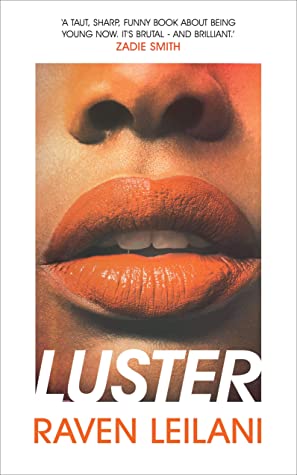 Edie’s voice is immediately engaging: cutting, funny, pithy. It reminded me of Ava’s in a fellow Women’s Prize nominee, Exciting Times, and both novels even employ a near-identical metaphor: “I wondered if Victoria was a real person or three Mitford sisters in a long coat” (Dolan) versus “all the kids stacked underneath my trench coat rejoice” (Leilani). They are also both concerned with how young women negotiate a confusing romantic landscape and look for meaning beyond a dead-end career. The African-American Edie’s entry-level work for a New York City publisher barely covers her rent at a squalid shared apartment. She’s shagged every male in the office and is now on to one she met online: Eric, a white, middle-aged archivist with an open marriage and a Black adopted daughter.
As Edie insinuates herself into Eric’s suburban New Jersey life in peculiar and sometimes unwitting ways, we learn more about her traumatic past: Both of her parents are dead, one by suicide, and she had an abortion at age 16. Along with sex, her main escape is her painting, which is described in tender detail. There are a number of amusing scenes set at off-the-wall locations, like a theme park, a clown school, and Comic Con. Leilani has a knack for capturing an entire realm of experience in just a few pages, as when she satirizes current publishing trends or encapsulates what it’s like to be a bicycle delivery person.
But, as a Goodreads acquaintance put it, all this sharp writing is rather wasted on the plot. I found the direction of the book in its second half utterly unrealistic, and never believed that Edie would have found Eric attractive in any way. (His interest in her is beyond creepy, really.) What I found most intriguing, along with the painting hobby, were Edie’s interactions with other Black characters, such as a publishing company colleague and Eric’s adopted daughter – there’s an uncomfortable sense that they should have a natural camaraderie and/or that Edie should be some kind of role model. I might have liked more of that dynamic, instead of the unbearable awkwardness of temporary instalment in a white neighbourhood. Other readalikes: Queenie, Here Is the Beehive, and On Beauty.
No One Is Talking About This by Patricia Lockwood
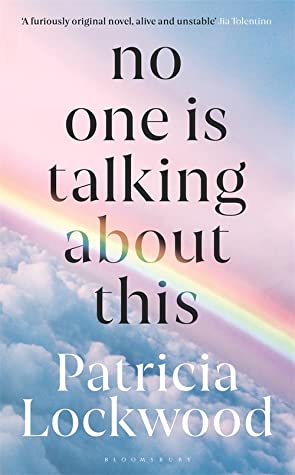 Priestdaddy is one of my absolute favourite books, so Lockwood’s debut novel was one of the 2021 releases I was most looking forward to reading. It took me a while to warm to, but ultimately did not disappoint. It probably helped that I was familiar with the author’s iconoclastic sense of humour. This is a work of third-person autofiction – much more so than I’d realized before I read the Acknowledgments – and to start with it feels like a flippant skewering of modern life, which for some is all about online personality and performance. A woman who became a social media star by tweeting quips like “Can a dog be twins?” reflects on life on “the portal” and under “the dictator.”
Midway through the book, she receives a wake-up call in the form of texts from her mother summoning her back to the Midwest for a family emergency. “It was a marvel how cleanly and completely this lifted her out of the stream of regular life.” Shit just got real, as they say. But “Would it change her?” she asks herself. Apparently, this very thing happened to Lockwood’s own family, which accounts for how heartfelt the second half is – still funny, but with an ache behind it, the same that I sensed and loved in Priestdaddy.
It is the about-face that makes this novel, forcing readers to question the value of a digital existence based on glib pretence. As the protagonist tells her students at one point, “Your attention is holy,” and with life so fragile there is no time to waste. What Lockwood is trying to do here is even bigger than that, though, I think. She mocks the whole idea of plot yet takes up the mantle of the “social novel,” as if creating a new format for the Internet-age novel in short, digestible sections. I’m not sure this is as earth-shattering as all that, but it is entertaining and deceptively deep. It also feels like a very current book, playing the role that Weather did in last year’s Women’s Prize race. (See my Goodreads review for more quotes, spoiler-y discussion, and why this book held personal poignancy for me.)
Consent by Annabel Lyon
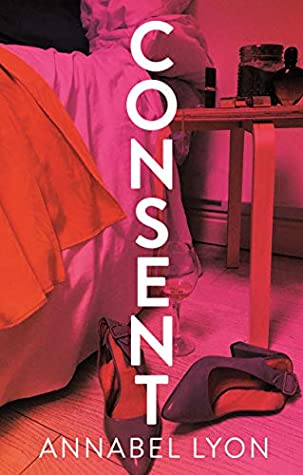 I’m always drawn to stories of sisters and this was an intriguing one, though the jacket text sets it up to be more of a thriller than it actually is. After their mother’s death, Sara, a medical ethicist, looks after Mattie, her intellectually disabled sister. When Mattie is lured into eloping, Sara’s protective instinct goes into overdrive. Meanwhile, Saskia, a graduate student in French literature, feels obliged to put her twin sister Jenny’s needs first after a car accident leaves Jenny in a coma. There are two decades separating the sets of sisters, but aspects of their experiences reverberate, with fashion, perfume, and alcoholism appearing as connecting elements even before a more concrete link emerges.
For much of the novel, Lyon bounces between the two storylines. I occasionally confused Sara and Saskia, but I think that’s part of the point (why else would an author select two S-a names?) – their stories overlap as they find themselves in the position of making decisions on behalf of an incapacitated sister. The title invites deliberation about how control is parcelled out in these parallel situations, but I’m not sure consent was the right word to encapsulate the whole plot; it seems to give too much importance to some fleeting sexual relationships.
At times I found Lyon’s prose repetitive or detached, but I enjoyed the overall dynamic and the medical threads. There are some stylish lines that land perfectly, like “There she goes … in her lovely coat, that cashmere-and-guilt blend so few can afford. That lovely perfume she trails, lilies and guilt.” The Vancouver setting and French–English bilingualism, not things I often encounter in fiction, were also welcome, and the last few chapters are killer.
The other nominees I’ve read, with ratings and links to reviews, are:
The Vanishing Half by Brit Bennett
Piranesi by Susanna Clarke
Exciting Times by Naoise Dolan
Transcendent Kingdom by Yaa Gyasi
Burnt Sugar by Avni Doshi
Unsettled Ground by Claire Fuller
The rest of the longlist is:
- Small Pleasures by Clare Chambers – I might read this from the library.
- The Golden Rule by Amanda Craig – I’d thought I’d give this one a miss, but I recently found a copy in a Little Free Library. My plan is to read it later in the year as part of a Patricia Highsmith kick, but I’ll move it up the stack if it makes the shortlist.
- Because of You by Dawn French – Not a chance. Right? Please!
- How the One-Armed Sister Sweeps Her House by Cherie Jones – A DNF; I would only try it again from the library if it was shortlisted.
- Nothing but Blue Sky by Kathleen MacMahon – I might read this from the library.
- Detransition, Baby by Torrey Peters – I will definitely read this from the library.
- Summer by Ali Smith – I struggle with her work and haven’t enjoyed this series; I would only read this if it was shortlisted and my book club was assigned it!
My ideal shortlist (a wish list based on my reading and what I still want to read):
- The Vanishing Half by Brit Bennett
- Piranesi by Susanna Clarke
- Exciting Times by Naoise Dolan
- Transcendent Kingdom by Yaa Gyasi
- No One Is Talking About This by Patricia Lockwood
- Detransition, Baby by Torrey Peters
vs.
My predicted shortlist and reasoning:
 The Vanishing Half by Brit Bennett – A dead cert. I’ve said so since I reviewed it in June 2020.
- Burnt Sugar by Avni Doshi – Others don’t seem to fancy Doshi’s chances, and it’s true that she was already shortlisted for the Booker, but I feel like this could be more unifying a choice for the judges than, e.g. Clarke or Lockwood.
- Transcendent Kingdom by Yaa Gyasi – Another definite.
- Luster by Raven Leilani – Not as strong as the Dolan, in my opinion, but it seems to have a lot of love from these judges (especially Vick Hope, who emphasized how perfectly it captured what it’s like to be young today), and from critics generally.
- Detransition, Baby by Torrey Peters – Ordinarily I would have said the Prize is too staid to shortlist a trans author, but after all the online abuse that has been directed at Peters, I think the judges will want to make a stand in support of her legitimacy.
- Summer by Ali Smith – The most establishment author on the list, and not one I generally care for, but this would be a way of recognizing the four-part Seasons opus and her work in general. Of the middle-aged white cohort, she seems most likely.
I will happily accept some mixture of my wished-for and predicted titles, and would be surprised if any of the five books I have not mentioned is shortlisted. (Though quite a few others are predicting that Claire Fuller will advance; I’d have no problem with that.) I don’t think my book club would get a say in which of the six titles we’d be sent to read for the shadowing project, which is risky as I may have already read it and not want to reread, or it may be a surprise nominee that I don’t want to read, but I’ll cross that bridge if we come to it.
Callum, Eric, Laura and Rachel have been posting lots of reviews and thoughts related to the Women’s Prize. Have a look at their blogs!
Rachel also produced a priceless spreadsheet of all the Prize nominees by year, so you can tick off the ones you’ve read. I’m up to 150 now!
Women’s Prize 2021: Predictions & Eligible Titles
In previous years I’ve been a half-hearted follower of the Women’s Prize – often half or more of the longlist doesn’t interest me – but given that nearly two-thirds of my annual reading is by women, and that I so enjoyed catching up on the previous winners last year, I somehow feel more invested this year. Following literary prizes is among my greatest bookish joys, so this time round I’ve made more of an effort to look back through a year of UK fiction releases by women, whether I’ve read the books or not, and make some informed predictions.
Here is the scope of the prize: “Any woman writing in English – whatever her nationality, country of residence, age or subject matter – is eligible. Novels must be published in the United Kingdom between 1 April in the year the Prize calls for entries, and 31 March the following year, when the Prize is announced.” (Note: no novellas or short stories; the judges are looking for the best work by a woman – or a trans person legally defined as a woman.)
Based on the books by women that I have admired, loved, or found most relevant in 2020‒21, here are my predictions for the longlist, which will be revealed on March 10th (two weeks from today) and will contain 16 titles. I’ve aimed for a balance between new and established voices, and a mix of genres. I link to my reviews where available.


- The Vanishing Half by Brit Bennett
- Piranesi by Susanna Clarke
- Exciting Times by Naoise Dolan
- Burnt Sugar by Avni Doshi
- Mrs Death Misses Death by Salena Godden
- Transcendent Kingdom by Yaa Gyasi
- Sisters by Daisy Johnson
- Pew by Catherine Lacey
- No One Is Talking about This by Patricia Lockwood – currently reading
- A Burning by Megha Majumdar*
- The Glass Hotel by Emily St. John Mandel
- Hot Stew by Fiona Mozley**
- Outlawed by Anna North
- Love After Love by Ingrid Persaud
- The Mermaid of Black Conch by Monique Roffey***
- The Liar’s Dictionary by Eley Williams
* Not read yet. It seems like this year’s Home Fire.
** Not read yet, but I loved Elmet so much that I’m confident this will be a hit with me, too.
*** Not read yet. I plan to read it, but after its Costa win there’s a long library holds queue.
Note: “The Prize only accepts novels entered by publishers, who may each submit a maximum of two titles per imprint and one title for imprints with a list of five fiction titles or fewer published in a year. Previously shortlisted and winning authors are awarded a ‘free pass’ in addition to a publisher’s general submissions.”
- Because of all the funds the publishers are expected to contribute to the Prize’s publicity at each level of judging, the process unfairly discriminates against small, independent publishers.
Bernardine Evaristo is the chair of judges this year, so I expect a strong showing from BIPOC and LGBTQ authors AND a leaning towards experimental prose, probably even more so than my above list reflects.
Other novels I considered:
Runners-up – books that I enjoyed and would be perfectly happy to see nominated:


- Milk Fed by Melissa Broder – not reviewed yet
- Here Is the Beehive by Sarah Crossan
- The Group by Lara Feigel
- Unsettled Ground by Claire Fuller – not reviewed yet
- Artifact by Arlene Heyman
- The Book of Longings by Sue Monk Kidd
- A Town Called Solace by Sue Lawson – not reviewed yet
- Monogamy by Sue Miller
- What Are You Going Through by Sigrid Nunez
- Islands of Mercy by Rose Tremain
Reads that didn’t match up for me, but would be eligible:


- When the Lights Go Out by Carys Bray
- The New Wilderness by Diane Cook
- Tennis Lessons by Susannah Dickey
- The Pull of the Stars by Emma Donoghue
- As You Were by Elaine Feeney (DNF)
- The Charmed Wife by Olga Grushin
- Miss Benson’s Beetle by Rachel Joyce
- The Animals in That Country by Laura Jean McKay
- Scenes of a Graphic Nature by Caroline O’Donoghue
- True Story by Kate Reed Petty (DNF)
- Rodham by Curtis Sittenfeld
- The Lamplighters by Emma Stonex – currently reading
- Redhead by the Side of the Road by Anne Tyler
- little scratch by Rebecca Watson
- Three Women and a Boat by Anne Youngson
Haven’t had a chance to read yet / don’t have access to, so can only list without comment (most likely alternative nominees in bold):


- Against the Loveless World by Susan Abulhawa
- You Exist Too Much by Zaina Arafat
- The Push by Ashley Audrain
- If I Had Your Face by Frances Cha
- [The Death of Vivek Oji by Akwaeke Emezi] – Update: would not be eligible according to the new requirement that trans people be legally defined as female; before that regulation was in place, Emezi was longlisted for Freshwater.
- Sea Wife by Amity Gaige
- The Wild Laughter by Caoilinn Hughes
- How We Are Translated by Jessica Gaitán Johannesson
- Consent by Annabel Lyon
- A Crooked Tree by Una Mannion
- The Last Migration by Charlotte McConaghy
- The Art of Falling by Danielle McLaughlin
- His Only Wife by Peace Adzo Medie
- A Ghost in the Throat by Doireann Ní Ghríofa
- Acts of Desperation by Megan Nolan
- Fake Accounts by Lauren Oyler
- An Ordinary Wonder by Buki Papillon
- Detransition, Baby by Torrey Peters
- Jack by Marilynne Robinson – gets a “free pass” entry as MR is a previous winner
- Belladonna by Anbara Salam
- Kololo Hill by Neema Shah
- All Adults Here by Emma Straub
- Friends and Strangers by J. Courtney Sullivan
- Saving Lucia by Anna Vaught
- We Are All Birds of Uganda by Hafsa Zayyan
- How Much of These Hills Is Gold by C. Pam Zhang
I overlapped with this Goodreads list (which I didn’t look at until after compiling mine) on 28 titles. It erroneously includes The Anthill by Julianne Pachico – not released in the UK until May 2021 – but otherwise has another nearly 50, mostly solid, ideas, such as Luster by Raven Leilani, Blue Ticket by Sophie Mackintosh, and Death in her Hands by Ottessa Moshfegh.
See also Laura’s and Rachel’s predictions.
Any predictions or wishes for the Women’s Prize longlist?
The Best Books of 2020: Some Runners-Up
I’ve chosen 25 more cracking reads that were first released in 2020. (Asterisks = my hidden gems of the year.) Between this post and my Fiction/Poetry and Nonfiction best-of lists, I’ve now highlighted about the top 12% of my year’s reading.
Novels:
 The Vanishing Half by Brit Bennett: Like some lost mid-career gem from Toni Morrison, this novel is meaty with questions of racial and sexual identity. Light-skinned African-American twins’ paths divide in 1950s Louisiana. Perceptive and beautifully written, this has characters whose struggles feel genuine and pertinent.
 Piranesi by Susanna Clarke: To start with, Piranesi traverses his watery labyrinth like he’s an eighteenth-century adventurer, his resulting notebooks reading rather like Alexander von Humboldt’s writing. I admired how the novel moved from the fantastical and abstract into the real and gritty. Read it even if you say you don’t like fantasy.
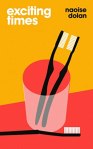 Exciting Times by Naoise Dolan: At 22, Ava leaves Dublin to teach English as a foreign language to wealthy preteens and almost accidentally embarks on affairs with an English guy and a Chinese girl. Dolan has created a funny, deadpan voice that carries the entire novel. I loved the psychological insight, the playfulness with language, and the zingy one-liners.
 *A Good Neighborhood by Therese Anne Fowler: Issues of race and privilege undermine a teen romance in a perfect-seeming North Carolina community. This is narrated in a first-person plural voice, like the Greek chorus of a classical tragedy. If you loved An American Marriage, it should be next on your list. I’m puzzled by how overlooked it’s been this year.
 Transcendent Kingdom by Yaa Gyasi: A more subdued and subtle book than Homegoing, but its treatment of themes of addiction, grief, racism, and religion is so spot on that it packs a punch. Gifty is a PhD student at Stanford, researching reward circuits in the mouse brain. There’s also a complex mother–daughter relationship and musings on love and risk. [To be published in the UK in March]
 The Mercies by Kiran Millwood Hargrave: A rich, natural exploration of a place and time period – full of detail but wearing its research lightly. Inspired by a real-life storm that struck on Christmas Eve 1617 and wiped out the male population of the Norwegian island of Vardø, it intimately portrays the lives of the women left behind. Tender, surprising, and harrowing.
 Sisters by Daisy Johnson: Teenagers September and July were born just 10 months apart, with July always in thrall to her older sister. For much of this short novel, Johnson keeps readers guessing as to why the girls’ mother, Sheela, took them away to Settle House, her late husband’s family home in the North York Moors. As mesmerizing as it is unsettling.
 The Book of Longings by Sue Monk Kidd: Kidd’s bold fourth novel started as a what-if question: What if Jesus had a wife? Although this retells biblical events, it is chiefly an attempt to illuminate women’s lives in the 1st century and to chart the female contribution to sacred literature and spirituality. An engrossing story of women’s intuition and yearning.
 *The Ninth Child by Sally Magnusson: Intense and convincing, this balances historical realism and magical elements. In mid-1850s Scotland, there is a move to ensure clean water. The Glasgow waterworks’ physician’s wife meets a strange minister who died in 1692. A rollicking read with medical elements and a novel look into Victorian women’s lives.
 *The Bell in the Lake by Lars Mytting: In this first book of a magic-fueled historical trilogy, progress, religion, and superstition are forces fighting for the soul of a late-nineteenth-century Norwegian village. Mytting constructs the novel around compelling dichotomies. Astrid, a feminist ahead of her time, vows to protect the ancestral church bells.
 What Are You Going Through by Sigrid Nunez: The narrator is called upon to help a terminally ill friend commit suicide. The voice is not solely or even primarily the narrator’s but Other: art consumed and people encountered become part of her own story; curiosity about other lives fuels empathy. A quiet novel that sneaks up to seize you by the heartstrings.
 Weather by Jenny Offill: A blunt, unromanticized, wickedly funny novel about how eco-anxiety permeates everyday life, written in an aphoristic style. Set either side of Trump’s election in 2016, the novel amplifies many voices prophesying doom. Offill’s observations are dead right. This felt like a perfect book for 2020 and its worries.
 Love and Other Thought Experiments by Sophie Ward: An intriguing set of linked short stories that combine philosophy and science fiction. Rachel and Eliza are preparing to have a baby together when an ant crawls into Rachel’s eye and she falls ill. I was particularly taken by the chapter narrated by the ant. It’s well worth making a rare dip into sci-fi for this one.
 *The Inland Sea by Madeleine Watts: The young female narrator of this debut novel lives in Sydney and works for Australia’s emergency call service. Against a backdrop of flooding and bush fires, a series of personal catastrophes play out. A timely, quietly forceful story of how women cope with concrete and existential threats.
Short Stories:
 To Be a Man by Nicole Krauss: These 10 stories from the last 18 years are melancholy and complex, often featuring several layers of Jewish family history. Europe, Israel, and film are frequent points of reference. “Future Emergencies,” though set just after 9/11, ended up feeling the most contemporary because it involves gas masks and other disaster preparations.
 *Help Yourself by Curtis Sittenfeld: A bonus second UK release from Sittenfeld in 2020 after Rodham. Just three stories, but not leftovers; a strong follow-up to You Think It, I’ll Say It. They share the theme of figuring out who you really are versus what others think of you. “White Women LOL,” especially, compares favorably to Kiley Reid’s Such a Fun Age.
 You Will Never Be Forgotten by Mary South: In this debut collection, characters turn to technology to stake a claim on originality, compensate for losses, and leave a legacy. These 10 quirky, humorous stories never strayed so far into science fiction as to alienate me. I loved the medical themes and subtle, incisive observations about a technology-obsessed culture.
Poetry:
 *Survival Is a Style by Christian Wiman: Wiman examines Christian faith in the shadow of cancer. This is the third of his books that I’ve read, and I’m consistently impressed by how he makes room for doubt, bitterness, and irony – yet a flame of faith remains. There is really interesting phrasing and vocabulary in this volume.
Nonfiction:
 Inferno: A Memoir by Catherine Cho: Cho experienced stress-induced postpartum psychosis after the birth of her son. She alternates between her time in the mental hospital and her life before the breakdown, weaving in family history and Korean sayings and legends. It’s a painstakingly vivid account.
 *The Lost Family: How DNA Testing Is Upending Who We Are by Libby Copeland: DNA tests can find missing relatives within days. But there are troubling aspects to this new industry, including privacy concerns, notions of racial identity, and criminal databases. A thought-provoking book with all the verve and suspense of fiction.
 *Signs of Life: To the Ends of the Earth with a Doctor by Stephen Fabes: Fabes is an emergency room doctor in London and spent six years of the past decade cycling six continents. This warm-hearted and laugh-out-loud funny account of his travels achieves a perfect balance between world events, everyday discomforts, and humanitarian volunteering.
 Losing Eden: Why Our Minds Need the Wild by Lucy Jones: Nature’s positive effect on human mental health is something we know intuitively and can explain anecdotally, but Jones wanted to investigate the scientific mechanism behind it. Losing Eden is full of common sense and passion, cramming in lots of information yet never losing sight of the big picture.
 *Nobody Will Tell You This But Me: A True (As Told to Me) Story by Bess Kalb: Jewish grandmothers are renowned for their fiercely protective love, but also for nagging. Both sides of the stereotypical matriarch are on display in this funny, heartfelt family memoir, narrated in the second person – as if from beyond the grave – by her late grandmother. A real delight.
 Diary of a Young Naturalist by Dara McAnulty: McAnulty is a leader in the UK’s youth environmental movement and an impassioned speaker on the love of nature. This is a wonderfully observant and introspective account of his fifteenth year and the joys of everyday encounters with wildlife. Impressive perspective and lyricism.
 Memorial Drive: A Daughter’s Memoir by Natasha Trethewey: Trethewey grew up biracial in 1960s Mississippi, then moved with her mother to Atlanta. Her stepfather was abusive; her mother’s murder opens and closes the book. Trethewey only returned to their Memorial Drive apartment after 30 years had passed. A striking memoir, delicate and painful.

(Books not pictured were read digitally, or have already gone back to the library.)
Coming tomorrow: My best backlist reads of the year.
 Bookish Beck = Rebecca Foster. American transplant to England. Freelance proofreader and book reviewer.
 Bookish Beck