July Releases, II: Howard Norman, Andrés N. Ordorica, Neil D. A. Stewart
Three more July releases after yesterday’s Disability Pride Month special. Today is all fiction, but with rather different settings: Atlantic Canada, upstate New York and Mexico, and a London restaurant. The time period ranges from the last days of the First World War to 2013. The themes? Murder, plagues, accidental deaths and gourmet food in addition to those perennial subjects of finding love and coming to terms with identity.
Come to the Window by Howard Norman
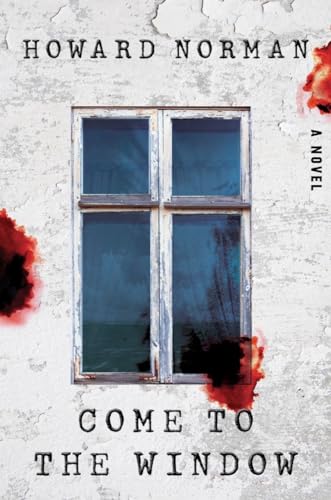 This was my eighth book by Norman and felt most similar to My Darling Detective and Next Life Might Be Kinder. Nothing much happens in the Nova Scotia fishing village of Parrsboro – until the night in April 1918 that Elizabeth Frame shoots dead her husband of 11 hours and throws the revolver into the blowhole of a beached whale. The story is a boon for Toby Havenshaw, a journalist with the Halifax Evening Mail, and quickly becomes an obsession. It’s never a whodunit so much as a why as Toby reports on the trial and follows Elizabeth when she goes on the lam. The sordid case just keeps getting stranger, drawing in bigamy, illegitimate pregnancy, and so on.
But Norman never treats all this too seriously; it is almost a tragicomic foil to the more consequential matters of world war and an influenza pandemic, which soon has Atlantic Canada in its grip as well. Toby’s wife, Amelia, is a hospital surgeon operating on returning veterans. She’s so quietly capable she makes Toby look a dunce, and their everyday rapport and unusual road to parenthood in their late thirties are charming. I also enjoyed Norman’s Dickensian naming (Bevel Cousins, Dr. S. S. Particulate) and literary references: the title phrase is from Matthew Arnold, and L. M. Montgomery gets a mention.
No doubt Norman wrote this as a Covid response; the parallel with the Spanish flu has been irresistible for many. He really captures the feeling of living through a uniquely terrible world situation. However, I’m not sure this short novel will prove memorable. Such has been true for his other recent novels, which pale in comparison with The Bird Artist. (Read via Edelweiss)
How We Named the Stars by Andrés N. Ordorica
I learned about this through the Observer’s 10 best new novelists feature and requested a copy via a Northern Fiction Alliance online showcase. There’s a sweet Heartstopper vibe to the story of an unlikely romance blooming between Daniel de la Luna and Sam Morris, his roommate at the University of Cayuga (= Cornell). Sam is a hunky jock while Daniel is a nervous would-be writer who has only just become comfortable with calling himself gay.
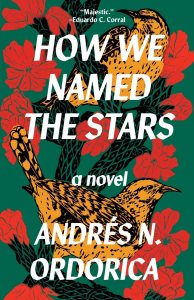 Ordorica, also a poet, immediately sets an elegiac tone by revealing Sam’s untimely death soon after the end of their freshman year. To cope with losing the love of his life, Daniel writes this text as if it’s an extended letter to Sam, recounting the course of their relationship – from strangers to best friends to secret lovers – and telling of his summer spent in Mexico exploring his family history, especially the parallels between his life and that of his late uncle and namesake, who was brave enough to be openly gay in the early days of the AIDS crisis.
Unfortunately, solid ideas and a warm-hearted approach are swamped by a host of problems. Ordorica writes a pretty good sex scene but the rest is clichéd, purple or awkward prose (“I snapped photo after photo of you, laughing all the while from your infectious elation”; “I felt unmoored, unsettled, and utterly liminal, in a state of flux”; “I sank into my pillows, muffling my tears as my mind floundered into even deeper waves of sadness”) and stiff dialogue. The cultural references and terminology feel all wrong for 2011, let alone for the 1988 diary entries of Uncle Daniel’s. The Mexico subplot is too tidy and Daniel’s breakdown after news of Sam’s death, which appears to involve full-blown alcohol addiction, is implausibly resolved within a chapter. The characterization of the secondary figures, particularly Daniel’s trio of queer Cayuga friends, is tissue thin.
It seems likely that Ordorica channeled much of his own experience into this queer coming-of-age narrative. He may have been aiming for star-crossed lovers and a groundbreaking own voices story, but this is run-of-the-mill stuff – more like a college student’s first draft than a finished book.
With thanks to Saraband for the proof copy for review.
Test Kitchen by Neil D. A. Stewart
 I spied this in one of Susan’s monthly previews. (If you haven’t already subscribed to her blog, do so at once. You’ll never be short of ideas for what to read.) Midgard is a fine dining restaurant with a tree in the middle whose multiple small courses evoke childhood memories and disguise one foodstuff as another. The London establishment earned two Michelin stars and has a perpetual waiting list, but as a news piece at the start presages, it will be forced to close its doors within five years after a series of disasters. Every other chapter introduces another set of diners, table by table: a first date, a reunion of old friends, a 12-year-old foodie trying to forestall his parents’ divorce, a restaurant critic and her freeloading acquaintances, and a solitary man who should really get that face wound seen to.
Many of these situations aren’t what they seem; the same goes for the intervening glimpses into the kitchen. Our host for these is Marley, the most recently hired waitress, who fled a chaotic home life in Melbourne. She didn’t show for work today; she’s in hiding, yet knows everything about the staff dynamics so is a perfect tour guide. There’s a mixture of nerves and bravado running through the kitchen as dinner starts. A knife accident, a food allergy, and a champagne cork hitting a customer are only the beginning of the evening’s mishaps. While I was initially drawn to the structure, which is almost like a linked short story collection, and I can’t resist a restaurant setting, the narrative trickery and the way that the mood evolves from slapstick to grotesque put me off. I enjoyed individual vignettes, but the whole didn’t come together as satisfyingly as in Sweetbitter or Service, among others.
With thanks to Corsair (Hachette) for the free copy for review.
Any July releases you’d recommend?
Summery Reading, Part I: The Greengage Summer & Sunburn by Watson
Brief thoughts on a first pair of summer-themed reads: coming-of-age stories about teenage girls who trade England for somewhere more exciting – France or Greece – for a summer and awaken to the complications of sex when let down by the adults in their lives. Both: 
The Greengage Summer by Rumer Godden (1958)
 We wanted to read something by Godden in my book club’s women’s classics subgroup, and decided on this almost purely for the evocative title. Cecil is the second of five children who run amok at a French hotel while their father is botanizing in Tibet and their mother in hospital with an infected horsefly bite. Hotel staff and hangers-on are engaged in all sorts of shenanigans – affairs and casual molestation of the maids, for instance – and the children, caught up in the thrill of it, attach themselves to Eliot, the English lover of Mademoiselle Zizi. The adults get Cecil and her older sister, Joss, drunk on champagne. Joss is the belle of the ball and attracts an inappropriate suitor; Cecil gets her first period and tells Eliot, of all people. It’s a familiar message in mid-century fiction, I suppose: loss of sexual innocence leads to disaster. I found this quite melodramatic, with a sudden ending; it didn’t live up to the terrific premise. I was similarly underwhelmed by Black Narcissus. (University library)
Sunburn by Andi Watson; illus. Simon Gane (2022)
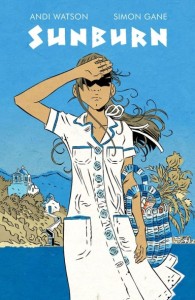 We open in suburban London in what appears to be the 1950s. Sixteen-year-old Rachel is offered a lucky escape from a summer of working at the butcher shop to stay with her parents’ friends, the Warners, at their home on a Greek island. Their life is a heady mix of languorous shopping, swimming and nightly parties. There’s a big contrast between the sophisticated expats and the local peasantry. When Rachel meets Ben, a fellow English teenager, it seems like her idyllic summer is complete, but things sour between them. Over the course of the book, Rachel realizes that not all grown-ups can be trusted. The plot took a twist I wasn’t expecting, which is always refreshing, but I should probably have been ready for it based on the depictions. The graphic novel is all in shades of blue, with white and light brown accents, as befitting the Greek flag and scenery. A problem I had was that most of the characters look the same – the artist has just the one way of drawing faces, so Rachel, Mrs. Warner and Ben have pretty much identical features. I would have catalogued this in YA. (Public library)
Both at least had a steamy summer atmosphere! My next seasonal read, picked up from the library today, will be One Midsummer’s Day by Mark Cocker, which is all about swifts. We have a pair nesting in our eaves again this year – hurrah! – and have been enjoying watching their (albeit diminished) screaming parties tear down the streets on warm summer evenings.
Any “summer” or “sun” books for you this year?
Novellas in November, Part 1
This is my second year of joining Laura (Reading in Bed) and others in reading mostly novellas in November. I’ve trawled my shelves and my current library pile for short books, limiting myself to ones of around 150 pages or fewer. First up: four short works of fiction. (I’m at work on various ‘nonfiction novellas’, too.) For the first two I give longer reviews as I got the books from the publishers; the other two are true minis.

Swallowing Mercury by Wioletta Greg
(translated from the Polish by Eliza Marciniak)
[146 pages]
I heard about this one via the Man Booker International Prize longlist. Quirkiness is particularly common in indie and translated books, I find, and while it’s often off-putting for me, I loved it here. Greg achieves an impressive balance between grim subject matter and simple enjoyment of remembered childhood activities. Her novella is, after all, set in Poland in the 1980s, the last decade of it being a Communist state in the Soviet Union.
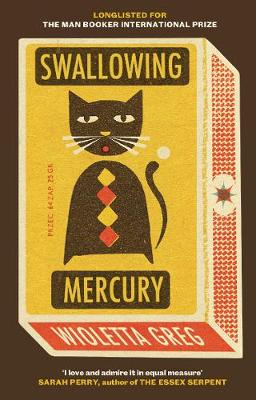 The narrator (and autobiographical stand-in?) is Wiolka Rogalówna, who lives with her parents in a moldering house in the fictional town of Hektary. Her father, one of the most striking characters, was arrested for deserting from the army two weeks before she was born, and now works for a paper mill and zealously pursues his hobbies of hunting, fishing, and taxidermy. The signs of their deprivation – really the whole country’s poverty – are subtle: Wiolka has to go selling hand-picked sour cherries with her grandmother at the market even though she’s embarrassed to run into her classmates; she goes out collecting scrap metal with a gang of boys; and she ties up her hair with a rubber band she cut from an inner tube.
Catholicism plays a major role in these characters’ lives: Wiolka wins a blessed figure in a church raffle, the Pope is rumored to be on his way, and a picture of the Black Madonna visits the town. A striking contrast is set up between the threat of molestation – Wiolka is always fending off unwanted advances, it seems – and lighthearted antics like school competitions and going to great lengths to get rare matchbox labels for her collection. This almost madcap element balances out some of the difficulty of her upbringing.
What I most appreciated was the way Greg depicts some universalities of childhood and adolescence, such as catching bugs, having eerie experiences in the dark, and getting one’s first period. This is a book of titled vignettes of just five to 10 pages, but it feels much more expansive than that, capturing the whole of early life. The Polish title translates as “Unripe,” which better reflects the coming-of-age theme; the English translator has gone for that quirk instead. 
A favorite passage:
“Then I sat at the table, which was set with plates full of pasta, laid my head down on the surface and felt the pulsating of the wood. In its cracks and knots, christenings, wakes and name-day celebrations were in full swing, and woodworms were playing dodgeball using poppy seeds that had fallen from the crusts of freshly baked bread.”
Thanks to Portobello Books for the free copy for review.
A Field Guide to the North American Family by Garth Risk Hallberg
[126 pages]
 Written somewhat in the style of a bird field guide, this is essentially a set of flash fiction stories you have to put together in your mind to figure out what happens to two seemingly conventional middle-class families: the Harrisons and the Hungates, neighbors on Long Island. Frank Harrison dies suddenly in 2008, and the Hungates divorce soon after. Their son Gabe devotes much of his high school years to drug-taking before an accident lands him in a burn unit. Here he’s visited by his girlfriend, Lacey Harrison. Her little brother, Tommy, is a compulsive liar but knows a big secret his late father was keeping from his wife.
The chapters, each just a paragraph or two, are given alphabetical, cross-referenced headings and an apparently thematic photograph. For example, “Entertainment,” one of my favorite stand-alone pieces, opens “In the beginning was the Television. And the Television was large and paneled in plastic made to look like wood. It dwelled in a dim corner of the living room and came on for national news, Cosby, Saturday cartoons, and football.”
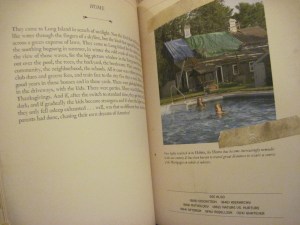 This is a Franzen-esque take on family dysfunction and, like City on Fire, is best devoured in large chunks at a time so you don’t lose momentum: as short as this is, I found it easy to forget who the characters were and had to keep referring to the (handy) family tree at the start. Ultimately I found the mixed-media format just a little silly, and the photos often seem to bear little relation to the text. It’s interesting to see how this idea evolved into the mixed-media sections of City on Fire, which is as epic as this is minimalist, though the story line of this novella is so thin as to be almost incidental.
Favorite lines:
“Depending on parent genotype, the crossbreeding of a Bad Habit and Boredom will result in either Chemistry or Entertainment.”
“Though hardly the most visible member of its kingdom, Love has never been as endangered as conservationists would have us believe, for without it, the Family would cease to function.”
Thanks to Vintage Books for the free copy for review.
The Comfort of Strangers by Ian McEwan
[100 pages]
 This is the earliest McEwan work I’ve read (1981). I could see the seeds of some of his classic themes: obsession, sexual and otherwise; the slow building of suspense and awareness until an inevitable short burst of violence. Mary and Colin are a vacationing couple in Venice. One evening they’ve spent so long in bed that by the time they get out all the local restaurants have shut, but a bar-owner takes pity and gives them sustenance, then a place to rest and wash when they get lost and fail to locate their hotel. Soon neighborly solicitude turns into a creepy level of attention. McEwan has a knack for presenting situations that are just odd enough to stand out but not odd enough to provoke an instant recoil, so along with the characters we keep thinking all will turn out benignly. This reminded me of Death in Venice and The Talented Mr. Ripley.
First Love by Gwendoline Riley
[167 pages – on the long side, but I had a library copy to read anyway]
 Neve tells us about her testy marriage with Edwyn, a Jekyll & Hyde type who sometimes earns our sympathy for his health problems and other times seems like a verbally abusive misogynist. But she also tells us about her past: her excess drinking, her unpleasant father, her moves between various cities in the north of England and Scotland, a previous relationship that broke down, her mother’s failed marriages, and so on. There’s a lot of very good dialogue in this book – I was reminded of Conversations with Friends – and Neve’s needy mum is a great character, but I wasn’t sure what this all amounts to. As best I can make out, we are meant to question Neve’s self-destructive habits, with Edwyn being just the latest example of a poor, masochistic decision. Every once in a while you get Riley waxing lyrical in a way that suggests she’s a really great author who got stuck with a somber, limited subject: “Outside the sunset abetted one last queer revival of light, so the outlook was torched; wet bus stop, wet shutters, all deep-dyed.”
Other favorite lines:
“An illusion of freedom: snap-twist getaways with no plans: nothing real. I’d given my freedom away. Time and again. As if I had contempt for it. Or was it hopelessness I felt, that I was so negligent? Or did it hardly matter, in fact? … Could I trust myself? Not to make my life a lair.”
Have you read any of these novellas? Which one takes your fancy?
Talking ’bout My Generation? Conversations with Friends by Sally Rooney
 Sunday Times Young Writer of the Year Award shortlist review #2
The first thing to note about a novel with “Conversations” in the title is that there are no quotation marks denoting speech. In a book so saturated with in-person chats, telephone calls, texts, e-mails and instant messages, the lack of speech marks reflects the swirl of voices in twenty-one-year-old Frances’ head; thought and dialogue run together. This is a work in which communication is a constant struggle but words have lasting significance.
 It’s the summer between years at uni in Dublin, and Frances is interning at a literary agency and collaborating with her best friend (and ex-girlfriend) Bobbi on spoken word poetry events. She’s the ideas person, and Bobbi brings her words to life. At an open mic night they meet Melissa, an essayist and photographer in her mid-thirties who wants to profile the girls. She invites them back for a drink and Frances, who is from a slightly rough background – divorced parents and an alcoholic father who can’t be relied on to send her allowance – is dazzled by the apparent wealth of Melissa and her handsome actor husband, Nick. Bobbi develops a crush on Melissa, and before too long Frances falls for Nick. The stage is set for some serious amorous complications over the next six months or so.
Young woman and older, married man: it may seem like a cliché, but Sally Rooney is doing a lot more here than just showing us an affair. For one thing, this is a coming of age in the truest sense: Frances, forced into independence for the first time, is figuring out who she is as she goes along and in the meantime has to play roles and position herself in relation to other people:
At any time I felt I could do or say anything at all, and only afterwards think: oh, so that’s the kind of person I am.
I couldn’t think of anything witty to say and it was hard to arrange my face in a way that would convey my sense of humour. I think I laughed and nodded a lot.
What will be her rock in the uncertainty? She can’t count on her parents; she alienates Bobbi as often as not; she reads the Gospels out of curiosity but finds no particular solace in religion. Her other challenge is coping with the chronic pain of a gynecological condition. More than anything else, this brings home to her the disappointing nature of real life:
I realised my life would be full of mundane physical suffering, and that there was nothing special about it. Suffering wouldn’t make me special, and pretending not to suffer wouldn’t make me special. Talking about it, or even writing about it, would not transform the suffering into something useful. Nothing would.
 Rooney writes in a sort of style-less style that slips right down. There’s a flatness to Frances’ demeanor: she’s always described as “cold” and has trouble expressing her emotions. I recognized the introvert’s risk of coming across as aloof. Before I started this I worried that I’d fail to connect to a novel about experiences so different from mine. I was quite the strait-laced teen and married at 23, so I wasn’t sure I’d be able to relate to Frances and Bobbi’s ‘wildness’. But this is much more about universals than it is about particulars: realizing that you’re stuck with yourself, exploring your sexuality and discovering that sex is its own kind of conversation, and deciding whether ‘niceness’ is really the same as morality.
With its prominent dialogue and discrete scenes, I saw the book functioning like a minimalist play, and I could also imagine it working as an on-location television miniseries. In some ways the dynamic between Frances and Bobbi mirrors that between the main characters in Paulina and Fran by Rachel B. Glaser, Friendship by Emily Gould, and The Animators by Kayla Rae Whitaker, so if you enjoyed any of those I highly recommend this, too. Rooney really captures the angst of youth:
You’re twenty-one, said Melissa. You should be disastrously unhappy.
I’m working on it, I said.
This is a book I was surprised to love, but love it I did. Rooney is a tremendous talent whose career we’ll have the privilege to watch unfolding. I’ve told the shadow panel that if we decide our focus is on the “Young” in Young Writer, there’s no doubt that this nails the zeitgeist and should win.
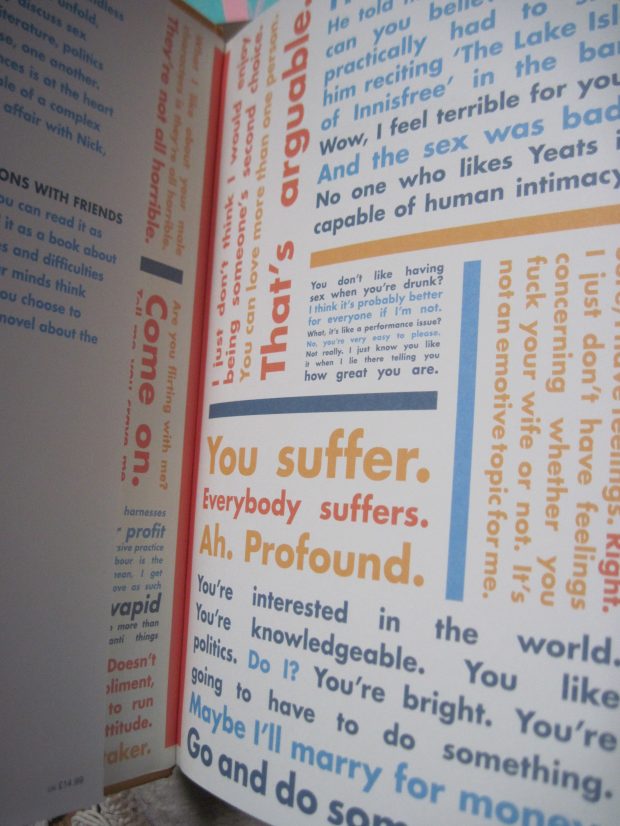
The conversations even spill out onto the endpapers.
Reviews of Conversations with Friends:
From the shadow panel:
Annabel’s at Annabookbel
Clare’s at A Little Blog of Books
Dane’s at Social Book Shelves
Eleanor’s at Elle Thinks
Others:
 Bookish Beck = Rebecca Foster. American transplant to England. Freelance proofreader and book reviewer.
 Bookish Beck