#ReadIndies Nonfiction Catch-Up: Ansell, Farrier, Febos, Hoffman, Orlean and Stacey
These are all 2025 releases; for some, it’s approaching a year since I was sent a review copy or read the book. Silly me. At last, I’ve caught up. Reading Indies month, hosted by Kaggsy in memory of her late co-host Lizzy Siddal, is the perfect time to feature books from five independent publishers. I have four works that might broadly be classed as nature writing – though their topics range from birdsong and technology to living in Greece and rewilding a plot in northern Spain – and explorations of celibacy and the writer’s profession.
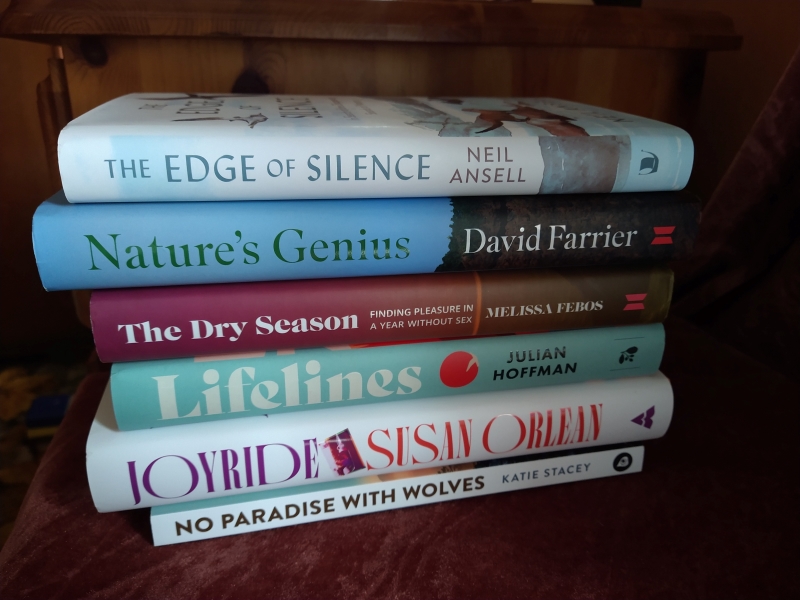
The Edge of Silence: In Search of the Disappearing Sounds of Nature by Neil Ansell
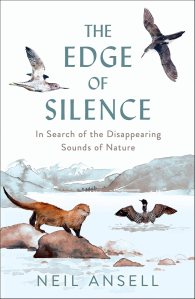 Ansell draws parallels between his advancing hearing loss and the biodiversity crisis. He puts together a wish list of species – mostly seabirds (divers, grebes), but also inland birds (nightjars) and a couple of non-avian representatives (otters) – that he wants to hear and sets off on public transport adventures to find them. “I must find beauty where I can, and while I still can,” he vows. From his home on the western coast of Scotland near the Highlands, this involves trains or buses that never align with the ferry timetables. Furthest afield for him are two nature reserves in northern England where his mission is to hear bitterns “booming” and natterjack toads croaking at night. There are also mountain excursions to locate ptarmigan, greenshank, and black grouse. His island quarry includes Manx shearwaters (Rum), corncrakes (Coll), puffins (Sanday), and storm petrels (Shetland).
Camping in a tent means cold nights, interrupted sleep, and clouds of midges, but it’s all worth it to have unrepeatable wildlife experiences. He has a very high hit rate for (seeing and) hearing what he intends to, even when they’re just on the verge of what he can decipher with his hearing aids. On the rare occasions when he misses out, he consoles himself with earlier encounters. “I shall settle for the memory, for it feels unimprovable, like a spell that I do not want to break.” I’ve read all of Ansell’s nature memoirs and consider him one of the UK’s top writers on the natural world. His accounts of his low-carbon travels are entertaining, and the tug-of-war between resisting and coming to terms with his disability is heartening. “I have spent this year in defiance of a relentless, unstoppable countdown,” he reflects. What makes this book more universal than niche is the deadline: we and all of these creatures face extinction. Whether it’s sooner or later depends on how we act to address the environmental polycrisis.
With thanks to Birlinn for the free copy for review.
Nature’s Genius: Evolution’s Lessons for a Changing Planet by David Farrier
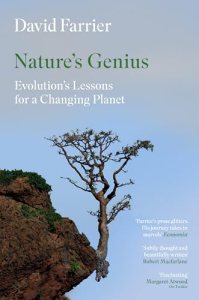 Farrier’s Footprints, which tells the story of the human impact on the Earth, was one of my favourite books of 2020. This contains a similar blend of history, science, and literary points of reference (Farrier is a professor of literature and the environment at the University of Edinburgh), with past changes offering a template for how the future might look different. “We are forcing nature to reimagine itself, and to avert calamity we need to do the same,” he writes. Cliff swallows have evolved blunter wings to better evade cars; captive breeding led foxes to develop the domesticated traits of pet dogs.
It’s not just other species that experience current evolution. Thanks to food abundance and a sedentary lifestyle, humans show a “consumer phenotype,” which superseded the Palaeolithic (95% of human history) and tends toward earlier puberty, autoimmune diseases, and obesity. Farrier also looks at notions of intelligence, language, and time in nature. Sustainable cities will have to cleverly reuse materials. For instance, The Waste House in Brighton is 90% rubbish. (This I have to see!)
There are many interesting nuggets here, and statements that are difficult to argue with, but I struggled to find an overall thread. Cool to see my husband’s old housemate mentioned, though. (Duncan Geere, for collaborating on a hybrid science–art project turning climate data into techno music.)
With thanks to Canongate for the free copy for review.
The Dry Season: Finding Pleasure in a Year without Sex by Melissa Febos
Febos considers but rejects the term “sex addiction” for the years in which she had compulsive casual sex (with “the Last Man,” yes, but mostly with women). Since her early teen years, she’d never not been tied to someone. Brief liaisons alternated with long-term relationships: three years with “the Best Ex”; two years that were so emotionally tumultuous that she refers to the woman as “the Maelstrom.” It was the implosion of the latter affair that led to Febos deciding to experiment with celibacy, first for three months, then for a whole year. “I felt feral and sad and couldn’t explain it, but I knew that something had to change.”
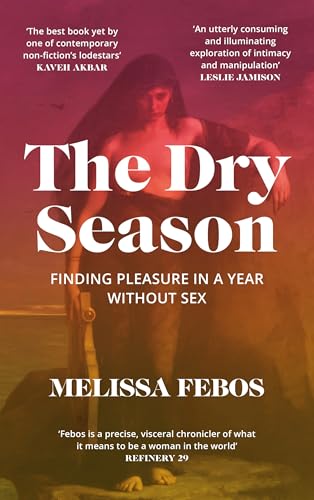 The quest involved some research into celibate movements in history, but was largely an internal investigation of her past and psyche. Febos found that she was less attuned to the male gaze. Having worn high heels almost daily for 20 years, she discovered she’s more of a trainers person. Although she was still tempted to flirt with attractive women, e.g. on an airplane, she consciously resisted the impulse to spin random meetings into one-night stands. (A therapist had stopped her short with the blunt observation, “you use people.”) With a new focus on the life of the mind, she insists, “My life was empty of lovers and more full than it had ever been.” (This reminded me of Audre Lorde’s writing on the erotic.) As Silvana Panciera, an Italian scholar on the beguines (a secular nun-like sisterhood), told her: “When you don’t belong to anyone, you belong to everyone. You feel able to love without limits.”
Intriguing that this is all a retrospective, reflecting on her thirties; Febos is now in her mid-forties and married to a woman (poet Donika Kelly). Clearly she felt that it was an important enough year – with landmark epiphanies that changed her and have the potential to help others – to form the basis for a book. For me, she didn’t have much new to offer about celibacy, though it was interesting to read about the topic from an areligious perspective. But I admire the depth of her self-knowledge, and particularly her ability to recreate her mindset at different times. This is another one, like her Girlhood, to keep on the shelf as a model.
With thanks to Canongate for the free copy for review.
Lifelines: Searching for Home in the Mountains of Greece by Julian Hoffman
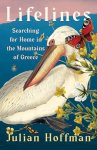
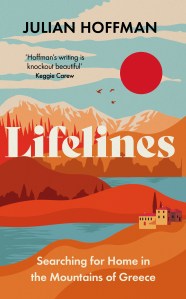 Hoffman’s Irreplaceable was my nonfiction book of 2019. Whereas that was a work with a global environmentalist perspective, Lifelines is more personal in scope. It tracks the author’s unexpected route from Canada via the UK to Prespa, a remote area of northern Greece that’s at the crossroads with Albania and North Macedonia. He and his wife, Julia, encountered Prespa in a book and, longing for respite from the breakneck pace of life in London, moved there in 2000. “Like the rivers that spill into these shared lakes, lifelines rarely flow straight. Instead, they contain bends, meanders and loops; they hold, at times, turns of extraordinary surprise.” Birdwatching, which Hoffman suggests is as “a way of cultivating attention,” had been their gateway into a love for nature developed over the next quarter-century and more, and in Greece they delighted in seeing great white and Dalmatian pelicans (which feature on the splendid U.S. cover. It would be lovely to have an illustrated edition of this.)
 One strand of this warm and fluent memoir is about making a home in Greece: buying and renovating a semi-derelict property, experiencing xenophobia and hospitality from different quarters, and finding a sense of belonging. They’re happy to share their home with nesting wrens, who recur across the book and connect to the tagline of “a story of shelter shared.” In probing the history of his adopted country, Hoffman comes to realise the false, arbitrary nature of borders – wildlife such as brown bears and wolves pay these no heed. Everything is connected and questions of justice are always intersectional. The Covid pandemic and avian influenza (which devastated the region’s pelicans) are setbacks that Hoffman addresses honestly. But the lingering message is a valuable one of bridging divisions and learning how to live in harmony with other people – and with other species.
With thanks to Elliott & Thompson for the free copy for review.
Joyride by Susan Orlean
As a long-time staff writer for The New Yorker, Orlean has had the good fortune to be able to follow her curiosity wherever it leads, chasing the subjects that interest her and drawing readers in with her infectious enthusiasm. She grew up in suburban Ohio, attended college in Michigan, and lived in Portland, Oregon and Boston before moving to New York City. Her trajectory was from local and alternative papers to the most enviable of national magazines: Esquire, Rolling Stone and Vogue. Orlean gives behind-the-scenes information on lots of her early stories, some of which are reprinted in an appendix. “If you’re truly open, it’s easy to fall in love with your subject,” she writes; maintaining objectivity could be difficult, as when she profiled an Indian spiritual leader with a cult following; and fended off an interviewee’s attachment when she went on the road with a Black gospel choir.
 Her personal life takes a backseat to her career, though she is frank about the breakdown of her first marriage, her second chance at love and late motherhood, and a surprise bout with lung cancer. The chronological approach proceeds book by book, delving into her inspirations, research process and publication journeys. Her first book was about Saturday night as experienced across America. It was a more innocent time, when subjects were more trusting. Orlean and her second husband had farms in the Hudson Valley of New York and in greater Los Angeles, and she ended up writing a lot about animals, with books on Rin Tin Tin and one collecting her animal pieces. There was also, of course, The Library Book, about the wild history of the main Los Angeles public library. But it’s her The Orchid Thief – and the movie (not) based on it, Adaptation – that’s among my favourites, so the long section on that was the biggest thrill for me. There are also black-and-white images scattered through.
It was slightly unfortunate that I read this at the same time as Book of Lives – who could compete with Margaret Atwood? – but it is, yes, a joy to read about Orlean’s writing life. She’s full of enthusiasm and good sense, depicting the vocation as part toil and part magic:
“I find superhuman self-confidence when I’m working on a story. The bashfulness and vulnerability that I might otherwise experience in a new setting melt away, and my desire to connect, to observe, to understand, powers me through.”
“I like to do a gut check any time I dismiss or deplore something I don’t know anything about. That feels like reason enough to learn about it.”
“anything at all is worth writing about if you care about it and it makes you curious and makes you want to holler about it to other people”
With thanks to Atlantic Books for the free copy for review.
No Paradise with Wolves: A Journey of Rewilding and Resilience by Katie Stacey
I had the good fortune to visit Wild Finca, Luke Massey and Katie Stacey’s rewilding site in Asturias, while on holiday in northern Spain in May 2022, and was intrigued to learn more about their strategy and experiences. This detailed account of the first four years begins with their search for a property in 2018 and traces the steps of their “agriwilding” of a derelict farm: creating a vegetable garden and tending to fruit trees, but also digging ponds, training up hedgerows, and setting up rotational grazing. Their every decision went against the grain. Others focussed on one crop or type of livestock while they encouraged unruly variety, keeping chickens, ducks, goats, horses and sheep. Their neighbours removed brush in the name of tidiness; they left the bramble and gorse to welcome in migrant birds. New species turned up all the time, from butterflies and newts to owls and a golden fox.
Luke is a wildlife guide and photographer. He and Katie are conservation storytellers, trying to get people to think differently about land management. The title is a Spanish farmers’ and hunters’ slogan about the Iberian wolf. Fear of wolves runs deep in the region. Initially, filming wolves was one of the couple’s major goals, but they had to step back because staking out the animals’ haunts felt risky; better to let them alone and not attract the wrong attention. (Wolf hunting was banned across Spain in 2021.) There’s a parallel to be found here between seeing wolves as a threat and the mild xenophobia the couple experienced. Other challenges included incompetent house-sitters, off-lead dogs killing livestock, the pandemic, wildfires, and hunters passing through weekly (as in France – as we discovered at Le Moulin de Pensol in 2024 – hunters have the right to traverse private land in Spain).
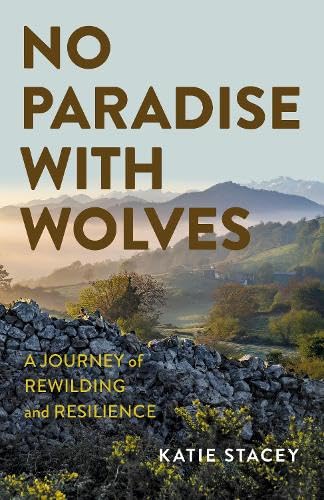
Luke and Katie hope to model new ways of living harmoniously with nature – even bears and wolves, which haven’t made it to their land yet, but might in the future – for the region’s traditional farmers. They’re approaching self-sufficiency – for fruit and vegetables, anyway – and raising their sons, Roan and Albus, to love the wild. We had a great day at Wild Finca: a long tour and badger-watching vigil (no luck that time) led by Luke; nettle lemonade and sponge cake with strawberries served by Katie and the boys. I was clear how much hard work has gone into the land and the low-impact buildings on it. With the exception of some Workaway volunteers, they’ve done it all themselves.
Katie Stacey’s storytelling is effortless and conversational, making this impassioned memoir a pleasure to read. It chimed perfectly with Hoffman’s writing (above) about the fear of bears and wolves, and reparation policies for farmers, in Europe. I’d love to see the book get a bigger-budget release complete with illustrations, a less misleading title, the thorough line editing it deserves, and more developmental work to enhance the literary technique – as in the beautiful final chapter, a present-tense recreation of a typical walk along The Loop. All this would help to get the message the wider reach that authors like Isabella Tree have found. “I want to be remembered for the wild spaces I leave behind,” Katie writes in the book’s final pages. “I want to be remembered as someone who inspired people to seek a deeper connection to nature.” You can’t help but be impressed by how much of a difference two people seeking to live differently have achieved in just a handful of years. We can all rewild the spaces available to us (see also Kate Bradbury’s One Garden against the World), too.
With thanks to Earth Books (Collective Ink) for the free copy for review.
Which of these do you fancy reading?
Book Serendipity, November to December 2024
I call it “Book Serendipity” when two or more books that I read at the same time or in quick succession have something in common – the more bizarre, the better. This is a regular feature of mine every couple of months. Because I usually have 20–30 books on the go at once, I suppose I’m more prone to such incidents. People frequently ask how I remember all of these coincidences. The answer is: I jot them down on scraps of paper or input them immediately into a file on my PC desktop; otherwise, they would flit away! The following are in roughly chronological order.
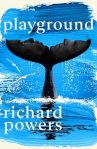
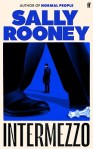
- Characters who were in a chess club and debating society in high school/college in Playground by Richard Powers and Intermezzo by Sally Rooney.
- Pondering the point of a memorial and a mention of hiring mourners in Immemorial by Lauren Markham and Basket of Deplorables by Tom Rachman.
- A mention of Rachel Carson, and her The Sea Around Us in particular, in Playground by Richard Powers, while I was also reading for review Rachel Carson and the Power of Queer Love by Lida Maxwell.
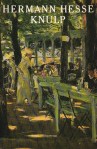
- A character pretends to be asleep when someone comes into the room to check on them in Knulp by Hermann Hesse and Rental House by Weike Wang.
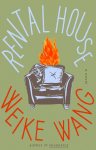
- A mention of where a partner puts his pistachio shells in After the Rites and Sandwiches by Kathy Pimlott and Rental House by Weike Wang.
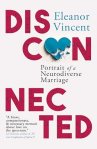 A character who startles very easily (in the last two cases because of PTSD) in Life before Man by Margaret Atwood, A History of Sound by Ben Shattuck, and Disconnected by Eleanor Vincent.
- The husband is named Nate in Life before Man by Margaret Atwood and Rental House by Weike Wang.
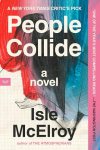
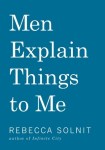
- In People Collide by Isle McElroy, there’s a mention of Elizabeth reading “a popular feminist book about how men explained things to women.” The day I finished reading the novel, I started reading the book in question: Men Explain Things to Me by Rebecca Solnit.
- I learned about the “he’s-at-home” (19th-century dildo) being used by whalers’ wives on Nantucket while the husbands are away at sea through historical fiction – Daughters of Nantucket by Julie Gerstenblatt, which I read last year – and encountered the practice again through an artefact found in the present day in The History of Sound by Ben Shattuck. Awfully specific!
- A week after I finished reading Station Eleven by Emily St. John Mandel, it turned up in a discussion of Vancouver Island in Island by Julian Hanna.
- A Cape Cod setting in Sandwich by Catherine Newman (earlier in the year) plus The History of Sound by Ben Shattuck and Rental House by Weike Wang.
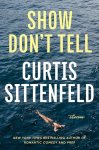
- A gay character references Mulder and Scully (of The X-Files) in the context of determining sexual preference, and there’s a female character named Kit, in The Old Haunts by Allan Radcliffe and one story of Show Don’t Tell by Curtis Sittenfeld.
- A mention of The Truman Show in the context of delusions in The Year of Living Biblically by A.J. Jacobs and You Don’t Have to Be Mad to Work Here by Benji Waterhouse.
- St. Lucia is mentioned in Beasts by Ingvild Bjerkeland, Brightly Shining by Ingvild Rishøi (two Norwegian authors named Ingvild there!), and Mudhouse Sabbath by Lauren Winner.
- A pet named Darwin: in Levels of Life by Julian Barnes it’s Sarah Bernhardt’s monkey; in Cold Kitchen by Caroline Eden it’s her beagle. Within days I met another pet beagle named Darwin in Island by Julian Hanna. (It took me a moment to realize why it’s a clever choice!)
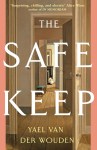
- A character named Henrik in The Place of Tides by James Rebanks and one story of Show Don’t Tell by Curtis Sittenfeld, and a Hendrik in The Safekeep by Yael van der Wouden.
- A hat with a green ribbon in The Safekeep by Yael van der Wouden and one story of Show Don’t Tell by Curtis Sittenfeld (in which it’s an emoji).
- Romanian neighbours who speak very good English in Island by Julian Hanna and Rental House by Weike Wang.
- A scene of returning to a house one used to live in in Hyper by Agri Ismaïl, The Old Haunts by Allan Radcliffe, and one story of Show Don’t Tell by Curtis Sittenfeld.
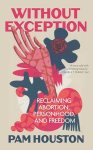
- A woman has had three abortions in The House of Dolls by Barbara Comyns and Without Exception by Pam Houston.
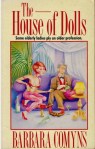
- Household items keep going missing and there’s broken china in The House of Dolls by Barbara Comyns and The Safekeep by Yael van der Wouden.
- Punctuated equilibrium (a term from evolutionary biology) is used as a metaphor in Hyper by Agri Ismaïl and Men Explain Things to Me by Rebecca Solnit.
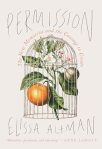 The author’s mother repeatedly asked her daughter a rhetorical question along the lines of “Do you know what I gave up to have you?” in Permission by Elissa Altman and Without Exception by Pam Houston.
- The author/character looks in the mirror at the end of a long day and hardly recognizes him/herself in The Place of Tides by James Rebanks, You Don’t Have to Be Mad to Work Here by Benji Waterhouse, and Amphibian by Tyler Wetherall.
- A man is afraid to hold his boyfriend’s hand in public in another country because he’s unsure about the cultural attitudes towards homosexuality in Clinical Intimacy by Ewan Gass and Small Rain by Garth Greenwell.
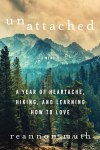
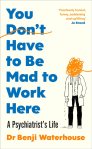
- The author’s mother is a therapist/psychologist and the author her/himself is undergoing some kind of mental health treatment in Unattached by Reannon Muth and You Don’t Have to Be Mad to Work Here by Benji Waterhouse.
- A man declares that dying in one’s mid-40s is nothing to complain about in A Beginner’s Guide to Dying by Simon Boas and Small Rain by Garth Greenwell.
- A woman ponders whether her ongoing anxiety is related to the stressful circumstances of her birth in Unattached by Reannon Muth and When the World Explodes by Amy Lee Scott.
What’s the weirdest reading coincidence you’ve had lately?
Summer Reads, Part II: Cocker, Kroon, Levy & Lewis-Stempel
(Part I was here, ICYMI.) Cooler days here as we say a drawn-out farewell to summer and welcome in early autumn; I’ve been seeing ripe blackberries and Vs of geese for a few weeks now. This batch of books I read from the library truly encapsulated summer: swifts flying overhead, cold lemonade as a reward for sticky outdoor activities, and travels through the confusing cities and inviting countryside of the Continent.
One Midsummer’s Day: Swifts and the Story of Life on Earth by Mark Cocker (2023)
We saw our last swift in Newbury somewhere around 13 August. The three and a half months they were with us passed in what felt like an instant, leaving us bereft until they come back.
 Why is it that books seem to bunch together by topic, with several about Henry James or swifts or whatever all being published within the same year or few years? It’s unfortunate for Mark Cocker, a well-respected author on birds and environmental issues in general, that he is two years behind Charles Foster and Sarah Gibson with this work on swifts. I also think he attempts too much, in terms of both literary strategy and subject matter (see the second part of the subtitle), and so loses focus.
The book employs a circadian structure, recording what he sees from his garden from one midsummer evening to the next as he looks up at the sky. Within this framework he delivers a lot of information about the world’s swift species, a fair bit of it familiar to me from those previous books; more novel are his stories of remarkable sightings, like a vagrant white-throated needletail in the Outer Hebrides (it later died in a collision with a wind turbine). But he also tries to set swifts in the context of the grand sweep of evolution. I skipped over these sections, which felt superfluous. With his literary allusions, Cocker is aiming for something like Tim Dee’s exceptional Greenery but falls short.
This could have made a superb concentrated essay, maybe as part of a collection devoting each chapter to a different species, because his passion is clear and his metaphors excellent as he holds up swifts as an emblem of the aerial life, and of hope (“In a social screaming display these weaponised shapes blaze together as a black-swarming meteor in a widening orbit that burns over the houses or between them”). The few-page run-on sentence about how humanity has gotten itself into the climate crisis is pretty great (though Lev Parikian did so much more concisely in Into the Tangled Bank: It’s “f***ing f***ed”). But Foster has written the definitive tribute to swifts, The Screaming Sky, and in just 150 small pages. 
Rhubarb Lemonade by Oskar Kroon (2019; 2023)
[Translated from the Swedish by A. A. Prime]
 This was like an update of The Summer Book by Tove Jansson: the delicious innocence of a Scandinavian island summer is threatened by change and, ultimately, death. Vinga is happy to escape her troubles for a simple island life with Grandpa. They eat the same foods day after day, do the same things week after week, and slowly work on refurbishing the wooden sailing boat he gave her. Ruth, the shopkeeper’s granddaughter, couldn’t be more different: she hates the sea, misses the city, and is fully immersed in social media and celebrity culture. Yet Vinga finds her captivating and tingles when she’s near. “Things would be so much easier if we’d never met. Things would be so much more boring if we’d never met.”
Prime won Sweden’s August Prize for this YA novel (spot the reference to The Murderer’s Ape, which won the same prize!). As will be familiar to regular readers of YA, we see Vinga dealing with issues like bullying, loneliness, body image, and family breakdown. She’s called back to the mainland to meet the baby her father has had by the new woman in his life – a trip that coincides with the worst storm the island has seen in ages and a chance for Grandpa to play the sea captain hero. But falling for Ruth, kissing a girl, is not a reason for angst. It’s just the way things are. Kroon makes no grand claim that this will be true love, forever. It’s a teen summer romance, and exaggerated by the cover. Maybe it will last; maybe it won’t. The deeper love is familial, particularly between Vinga and her grandfather. 
August Blue by Deborah Levy (2023)
 My third novel from Levy, and a typically confounding one. The facts are simple enough: Elsa M. Anderson is a pianist who has had something of a breakdown. She retreats from giving concerts, dyes her hair blue, and bounces between European capitals in the later days of the pandemic, giving music lessons and caring for her mentor and adoptive father, Arthur, who’s dying on Sardinia. In between there are laughs and lovers, searching and sadness, all muffled by Elsa’s (Levy’s) matter-of-factness. Meanwhile, there’s a touch of the uncanny in the doppelganger Elsa keeps seeing. First, her double buys the carousel horses she had her eye on in Athens. Then Elsa steals her twin’s trilby hat. There’s a confrontation late on but it doesn’t seem to make much difference. The doubling appears to be a way of making literal the adopted Elsa’s divided self. I’m not entirely sure what to say about this one. I enjoyed reading it well enough. Though I never felt compelled to pick it up, when I did I easily got through several chapters at a time. But I’m not convinced it meant much.
La Vie: A Year in Rural France by John Lewis-Stempel (2023)
Lewis-Stempel’s best book in an age; my favourite, certainly, since Meadowland. I’m featuring it in a summer post because, like Peter Mayle’s Provence series, it’s ideal for armchair travelling. Especially with the heat waves that have swept Europe this summer, I’m much happier reading about France or Italy than being there. The author has written much about his Herefordshire haunts, but he’s now relocated permanently to southwest France (La Roche, in the Charente). He proudly calls himself a peasant farmer, growing what he can and bartering for much of the rest. La Vie chronicles a year in his quest to become self-sufficient. It opens one January and continues through the December, an occasional diary with recipes.
 The family’s small-scale potager is organic agriculture at its best. He likens it to turning the clock back to the 1970s, or earlier, before England wrecked its countryside with industrial production. (His list of birds in the area is impressive, including some you’d be lucky to come across in the UK – turtledove, nightingale, stone curlew.) In fact, he estimates that his yield per square metre is triple what it was when he participated in that damaging system, for the same amount of work. His lifestyle is also a deliberate resistance to hyper-speed modernity: he scythes his grass, spends days preserving a haul of walnuts, and tries his hand at pressing oil and making spirits. There’s a make-do-and-mend attitude here: when his sheep-shearing equipment goes missing, he buys a beard trimmer at the supermarket and uses that instead.
It’s a peaceful, comforting read that’s attuned to the seasons and the land. There is also gentle mockery of the French with their bureaucracy and obsession with hunting, and self-deprecation of his own struggle to get his point across in a second language. I could never make a living by manual labour, but I like reading about back-to-the-land adventures, especially ones as bucolic as this – two-hour lunches, six-course dinners with homemade wine? Mais oui! 
Recent Poetry Reads
I love interspersing poetry with my other reading, and this year it seems like I’m getting to more of it than ever. Although I try to have a poetry collection on the go at all times, I still consider myself a novice and enjoy discovering new-to-me poets. However, I know many readers who totally avoid poetry because they assume they won’t understand it or it would feel too much like hard work.
Sinking into poems is certainly a very different experience from opening up a novel or a nonfiction narrative. Often I read parts of a poem two or three times – to make sure I’ve taken it in properly, or just to savor the language. I try to hear the lines aloud in my head so I can appreciate the sonic techniques at work, whether rhyming or alliteration. Reading or listening to poetry engages a different part of the brain, and it may be best to experience it in something of a dreamlike state.
I hope you’ll find a book or two that appeals from the selection below.
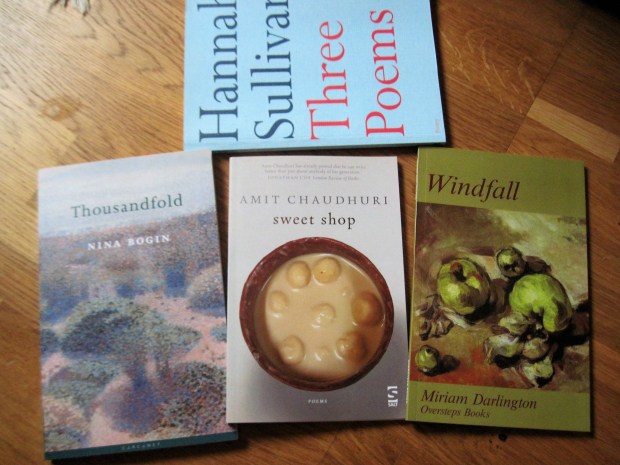
Thousandfold by Nina Bogin (2019)
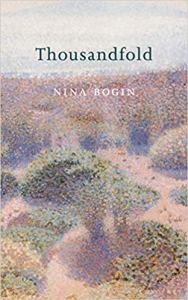 This is a lovely collection whose poems devote equal time to interactions with nature and encounters with friends and family. Birds – along with their eggs and feathers – are a frequent presence. Often a particular object will serve as a totem as the poet remembers the most important people in her life: her father’s sheepskin coat, her grandmother’s pink bathrobe, and the slippers her late husband shuffled around in – a sign of how diminished he’d become due to dementia. Elsewhere Bogin greets a new granddaughter and gives thanks for the comforting presence of her cat. Gentle rhymes and half-rhymes lend a playful or incantatory nature. I’d recommend this to fans of Linda Pastan.
My rating: 
Thousandfold will be published by Carcanet Press on January 31st. My thanks to the publisher for the free copy for review.
Sweet Shop by Amit Chaudhuri (2019)
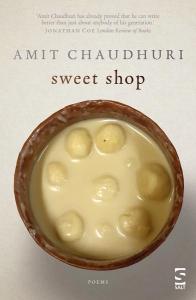 I was previously unfamiliar with Chaudhuri’s work, and unfortunately this insubstantial book about his beloved Indian places and foods hasn’t lured me into trying any more. The one poem I liked best was “Creek Row,” about a Calcutta lane used as a shortcut: “you are a thin, short-lived, / decaying corridor” and an “oesophageal aperture”. I also liked, as stand-alone lines go, “Refugees are periodic / like daffodils.” Nothing else stood out for me in terms of language, sound or theme. Poetry is so subjective; all I can say is that some poets will click with you and others don’t. In any case, the atmosphere is similar to what I found in Korma, Kheer and Kismet: Five Seasons in Old Delhi by Pamela Timms.
My rating: 
My thanks to Salt Publishing for the free copy for review.
Windfall by Miriam Darlington (2008)
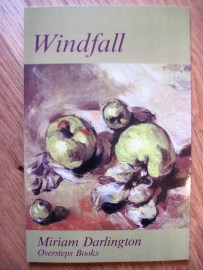 Before I picked this up from the bookstall at the New Networks for Nature conference in November, I had no idea that Darlington had written poetry before she turned to nature writing (Otter Country and Owl Sense). These poems are rooted in the everyday: flipping pancakes, sitting down to coffee, tending a garden, smiling at a dog. Multiple poems link food and erotic pleasure; others make nature the source of exaltation. I loved her descriptions of a heron (“a standing stone / perched in silt / a wrap of grey plumage”) and a blackbird (“the first bird / a glockenspiel in C / an improvisation on morning / a blue string of notes”), Lots of allusions and delicious alliteration. Pick this up if you’re missing Mary Oliver.
My rating:
A Responsibility to Awe by Rebecca Elson (2018)
 Elson, an astronomer who worked on the Hubble Space Telescope, died of breast cancer; this is a reprint of her posthumous 2001 publication. Along with a set of completed poems, the volume includes an autobiographical essay and extracts from her notebooks. Her impending mortality has a subtle presence in the book. I focused on the finished poems, which take their metaphors from physics (“Dark Matter”), mathematics (“Inventing Zero”) and evolution (indeed, “Evolution” was my favorite). In the essay that closes the book, Elson remembers long summers of fieldwork and road trips across Canada with her geologist father (I was reminded of Margaret Atwood’s Cat’s Eye), and traces her academic career as she bounced between the United States and Great Britain.
My rating: 
My thanks to Carcanet Press for the free copy for review.
These next two were on the Costa Prize for Poetry shortlist, along with Hannah Sullivan’s Three Poems, which was one of my top poetry collections of 2018 and recently won the T. S. Eliot Prize. I first encountered the work of all three poets at last year’s Faber Spring Party.
Us by Zaffar Kunial (2018)
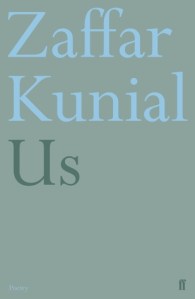 Many of these poems are about split loyalties and a composite identity – Kunial’s father was Kashmiri and his mother English – and what the languages we use say about us. He also writes about unexpectedly developing a love for literature, and devotes one poem to Jane Austen and another to Shakespeare. My favorites were “Self Portrait as Bottom,” about doing a DNA test (“O I am translated. / The speech of numbers. / Here’s me in them / and them in me. … What could be more prosaic? / I am split. 50% Europe. / 50% Asia.”), and the title poem, a plea for understanding and common ground.
My rating:
Soho by Richard Scott (2018)
 When I saw him live, Scott read two of the amazingly intimate poems from this upcoming collection. One, “cover-boys,” is about top-shelf gay porn and what became of the models; the other, “museum,” is, on the face of it, about mutilated sculptures of male bodies in the Athens archaeological museum, but also, more generally, about “the vulnerability of / queer bodies.” If you appreciate the erotic verse of Mark Doty and Andrew McMillan, you need to pick this one up immediately. Scott channels Verlaine in a central section of gritty love poems and Whitman in the final, multi-part “Oh My Soho!”
My rating:
Don’t Call Us Dead by Danez Smith (2017)
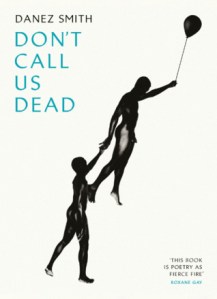 Like Claudia Rankine’s Citizen, this is a book whose aims I can admire even though I didn’t particularly enjoy reading it. It’s about being black and queer in an America where both those identifiers are dangerous, where guns and HIV are omnipresent threats. “reader, what does it / feel like to be safe? white?” Smith asks. “when i was born, i was born a bull’s-eye.” The narrator and many of the other characters are bruised and bloody, with blood used literally but also metaphorically for kinship and sexual encounters. By turns tender and biting, exultant and uncomfortable, these poems are undeniably striking, and a necessary wake-up call for readers who may never have considered the author’s perspective.
My rating:
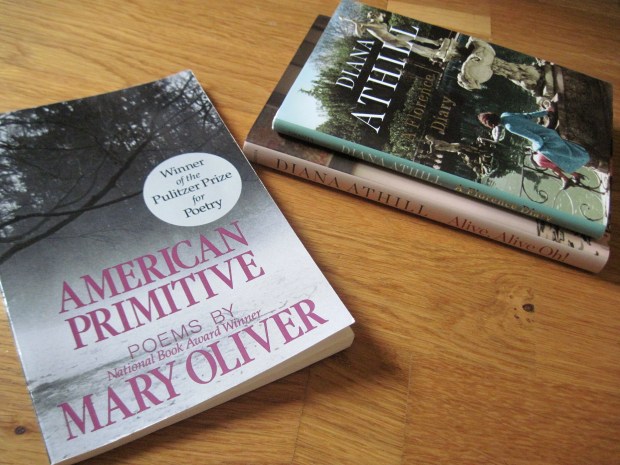
Up next: This Pulitzer-winning collection from the late Mary Oliver, whose work I’ve had mixed success with before (Dream Work is by far her best that I’ve read so far). We lost two great authors within a week! RIP Diana Athill, too, who was 101.
Any recent poetry reads you can recommend to me?
Natural Causes by Barbara Ehrenreich & Human Errors by Nathan Lents
Two recent books about our flawed bodies and the ultimate pointlessness of trying to control them…
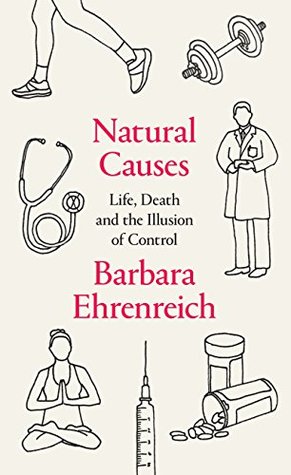
Natural Causes: Life, Death and the Illusion of Control by Barbara Ehrenreich
 A decade ago, Barbara Ehrenreich discovered a startling paradox through a Scientific American article: the immune system assists the growth and spread of tumors, including in breast cancer, which she had in 2000. It was an epiphany for her, confirming that no matter how hard we try with diet, exercise and early diagnosis, there’s only so much we can do to preserve our health; “not everything is potentially within our control, not even our own bodies and minds.” I love Ehrenreich’s Smile or Die (alternate title: Bright-Sided), which is what I call an anti-self-help book refuting the supposed health benefits of positive thinking. In that book I felt like her skeptical approach was fully warranted, and I could sympathize with her frustration – nay, outrage – when people tried to suggest she’d attracted her cancer and limited her chances of survival through her pessimism.
However, Natural Causes is so relentlessly negative and so selective in the evidence it provides that, even though it’s sure to be considered for next year’s Wellcome Book Prize longlist, I would be unlikely to recommend it. In the first chapter, “Midlife Revolt,” which has been excerpted at Literary Hub and is worth reading, Ehrenreich writes of her decision to give up routine medical screening after a false positive mammogram caused undue stress. She decided once she passed 70 she was old enough to die without accepting a “medicalized life.” Moreover, she believes there’s an epidemic of “overdiagnosis,” especially in the USA, where there can be a profit motive behind testing. (This is certainly not the case in the UK, where the NHS doesn’t pester me about getting cervical smear tests to line any pockets; no, it’s about saving taxpayers money by catching cancer early and thus minimizing treatment costs.)
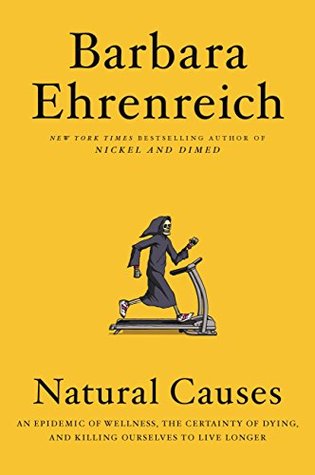
I love the U.S. cover. (Note the different subtitle.)
Ehrenreich goes on to argue that many medical procedures are simply rituals to establish patient trust, that cancer screening is invasive and ineffective, that there is little evidence that meditation does any good, and that fitness has become a collective obsession that probably doesn’t help us live any longer. It’s uncomfortable to hear her dismiss early detection techniques as worthless; no one whose doctor found cancer in the early stages would agree. The author also seems unwilling to confront her own personal prejudices (e.g. against yoga).
Although she uses plenty of statistics to back up her points, these usually come from newspapers and websites rather than peer-reviewed journals; only in two chapters about how macrophages ‘betray’ the body by abetting cancer does she consult the scientific literature, in keeping with her PhD in cellular immunology. Her most bizarre example of how our bodies aren’t evolutionarily fit for purpose is copious menstruation. Overall, the book is a strange mixture of hard science, social science, and, in later chapters, philosophy, as Ehrenreich asks about the nature of the self and the soul and what survives of us after death. As usual, her work is very readable, but this doesn’t match up to many other mind/body books I’ve read.
Favorite lines:
“The only cure for bad science is more science, which has to include both statistical analysis and some recognition that the patient is not ‘just a statistic,’ but a conscious, intelligent agent, just as the doctor is.”
“The objection raised over and over to any proposed expansion of health insurance was, in so many words: Why should I contribute to the care of those degenerates who choose to smoke and eat cheeseburgers? … we persist in subjecting anyone who dies at a seemingly untimely age to a kind of bio-moral autopsy: Did she smoke? Drink excessively? Eat too much fat and not enough fiber? Can she, in other words, be blamed for her own death?”
My rating: 
Natural Causes was published in the UK by Granta on April 12th. My thanks to the publisher for the free copy for review.
Human Errors: A Panorama of Our Glitches, from Pointless Bones to Broken Genes by Nathan H. Lents
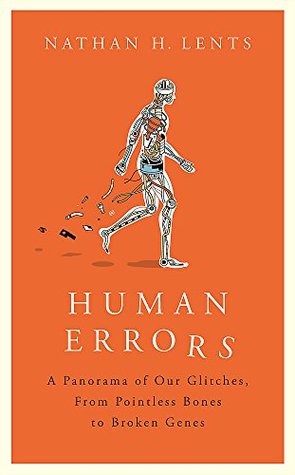 Lents is a biology professor at John Jay College, City University of New York, and in this, his second book, he explores the ways in which the human body is flawed. These errors come in three categories: adaptations to the way the world was for early humans (to take advantage of once-scarce nutrients, we gain weight quickly – but lose it only with difficulty); incomplete adaptations (our knees are still not fit for upright walking); and the basic limitations of our evolution (inefficient systems such as the throat handling both breath and food, and the recurrent laryngeal nerve being three times longer than necessary because it loops around the aorta). Consider that myopia rates are 30% or higher, the retina faces backward, sinuses drain upwards, there are 100+ autoimmune diseases, we have redundant bones in our wrist and ankle, and we can’t produce most of the vitamins we need. Put simply, we’re not a designer’s ideal. And yet this all makes a lot of sense for an evolved species.
My favorite chapter was on the inefficiencies of human reproduction compared to that of other mammals. Infertility and miscarriage rates are notably high, and gestation is shorter than it really needs to be: because otherwise their heads would get too big to pass through the birth canal, all babies are effectively born premature, so are helpless for much longer than other newborn mammals. I also especially liked the short section on cancer, which would eventually get us all if we only lived long enough. As it is, “evolution has struck an uneasy balance with cancer. Mutations cause cancer, which kills individuals, but it also brings diversity and innovation, which is good for the population.”
Lents writes in a good conversational style and usually avoids oversimplifying the science. In places his book reminded me of Kathryn Schulz’s Being Wrong and Mark O’Connell’s To Be a Machine. It’s a wry and gentle treatment of human weakness; the content never turns depressing or bitter. Recommended for all curious readers of popular science.
Favorite lines:
“While lithopedions [“stone babies”] and abdominal pregnancies are quite rare, they are also 100 percent the result of poor design. Any reasonable plumber would have attached the fallopian tube to the ovary, thereby preventing tragic and often fatal mishaps like these.”
“to call our immune system perfectly designed would be equally inaccurate. There are millions of people who once happily walked this planet only to meet their demise because their bodies simply self-sabotaged. When bodies fight themselves, there can be no winner.”
My rating:
Human Errors was published in the UK by Weidenfeld & Nicolson on May 3rd. My thanks to the publisher for the free copy for review.
“Why We Sleep” … And Why Can’t I Wake Up?
Why We Sleep: The New Science of Sleep and Dreams by Matthew Walker
I’d heard about this book but didn’t feel compelled to get hold of it until David Lodge, one of my favorite authors, named it his book of 2017 in the TLS year-end roundup. I got an e-copy from NetGalley but then found the physical book on the bestsellers display in my local library and found that a more conducive format for skimming. It’s a fairly long and dense book, with smallish type and scientific figures, so I knew I was unlikely to read the whole thing, but enjoyed mining it for fascinating information about evolution, neuroscience and child development.
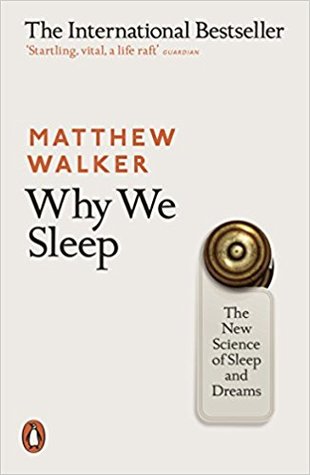 We often hear that sleep, diet and exercise are the three pillars of health, but Walker, a professor of neuroscience at the University of California, Berkeley, goes further: he believes sleep is the platform on which diet and exercise rest. Getting 7–9 hours of sleep a night is not some luxury to aim for but an absolute essential for the brain to process new information and prepare for receiving more the next day. Dreaming is like overnight therapy, and fuels creativity. Sleep deprivation has been associated with dementia and cancer: it’s no accident that Margaret Thatcher and Ronald Reagan, who prided themselves on getting by on just five hours of sleep a night, both developed Alzheimer’s. Just a few nights of insufficient sleep can weaken the immune system and increase the risks of developing a serious illness. It’s no wonder Walker calls sleep loss an epidemic.
Here are some other facts I gleaned:
- During primate evolution, the transition to sleeping on the ground instead of in trees meant we could sleep more deeply – not having to worry about falling out – and the resulting increase in REM sleep and dreams contributed to the development of complex culture and creativity.
- Fetuses are asleep most of the time; they kick in their sleep. Alcohol use during pregnancy or breastfeeding can lead to a decline in the offspring’s sleep quality or quantity.
- People with autism get 30–50% less REM sleep than neurotypical people.
- The postprandial slump in energy many of us experience is evolutionarily inbuilt, and suggests that a short nap (30–40 minutes) would be natural and beneficial. For instance, some African tribespeople still regularly nap at the hottest point of the day.
Walker’s sleep tips are mostly common-sense stuff you will have heard before. His #1 piece of advice is to have a sleep schedule, always going to sleep and waking up at the same time. (“Catching up” on weekends doesn’t work, though napping before 3 p.m. can.) Set an alarm for bedtime so you’ll stick to it, he suggests.
My rating: 
Making It Personal
I like my sleep, and I like my lie-ins. It’s one of many reasons why I don’t have kids. But I hoped that the older I got the better I’d be about waking up in the mornings. That hasn’t seemed to be the case. The past couple of weeks have been abnormal in that my husband has been working from home, too – he’s been on strike from the university and/or keeping clear of the snow – but on an average weekday, when the alarm goes off at a time starting with a 6, I feel like I could sleep for hours more. I usually cover my head with a pillow and stay in bed with the cat curled against my legs for an extra half-hour while my husband showers and starts getting things ready; only when I hear the tea being poured do I finally extricate myself from the covers and lurch downstairs to eat breakfast and make our sandwiches for the day.
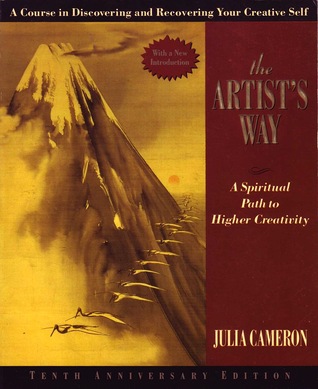 One of my bibliotherapy prescriptions was The Artist’s Way by Julia Cameron, a 12-week set of readings and exercises – chiefly 20 minutes of automatic writing each morning and creative “dates” you take yourself on. For the former, you set your alarm half an hour early each day and fill three longhand pages with whatever comes to mind. It’s not a journal; it’s more a way of processing what’s going on in your life, gradually moving from mundane thoughts about daily pressures to more creative stuff. But if I can’t wake up for our regular alarm, how in the world would I get up even earlier to commit to this creative exercise? I’ve wondered if I could cheat a bit and do the pages after a short nap in the early afternoons, but I think the idea really is to put down whatever comes into your head first thing every morning.
I can see that this would be a good discipline, especially as I come up to my fifth anniversary of freelancing and take stock of my career. I just don’t know if I can make myself do it.
Have you read anything about sleep, creativity or mindfulness recently?
Also on my TBR to be skimmed:
 24/7: Late Capitalism and the Ends of Sleep by Jonathan Crary
- The Business of Sleep: How Sleeping Better Can Transform Your Career by Vicki Culpin, a TEDx speaker and professor of organizational behavior [forthcoming on May 8th from Bloomsbury Business]
- The Secret World of Sleep: The Surprising Science of the Mind at Rest by Penelope A. Lewis
- Dreamland: Adventures in the Strange Science of Sleep by David K. Randall
 Bookish Beck = Rebecca Foster. American transplant to England. Freelance proofreader and book reviewer.
 Bookish Beck