Reading Ireland Month, Part II: Hughes, Kennedy, Murray
My second contribution to Reading Ireland Month after a first batch that included poetry and a novel.

Today I have a poetry collection based around science and travel, and two multi-award-winning novels, one set in the thick of the Troubles in Belfast and another about the crumbling of an ordinary suburban family.
Gathering Evidence by Caoilinn Hughes (2014)
 I bought this in the same order as Patricia Lockwood’s poetry collection, thinking a segue to another genre within an author’s oeuvre (I’d enjoyed Hughes’s 2018 debut novel, Orchid & the Wasp) might be a clever strategy. That worked out with Lockwood, but not as well here. A collection about scientific discoveries and medical advances seemed likely to be up my street. “The Moon Should Be Turned” is about the future of the HeLa cells harvested from Henrietta Lacks; poems are dedicated to the Curies and Johannes Kepler and one has Fermi as a main character. Russian nuclear force is a background menace. There are also some poems about growing up in Dublin and travels in the Andes. “Vagabond Monologue” stood out for its voice, “Marbles” for its description of childhood booty: “A netted bag of green glass marbles with aquamarine swirls / deep in the otherworld of spherical transparency (simultaneous opacity) / was the first thing I ever stole when I was three and far from the last.” Elsewhere, though, I found the precision vocabulary austere and offputting. (New purchase with Amazon voucher)
Trespasses by Louise Kennedy (2022)
Despite its many accolades, not least a shortlisting for the Women’s Prize, I couldn’t summon much enthusiasm for reading a novel about the Troubles. I don’t know why I tend to avoid this topic; perhaps it’s the insidiousness of fighting that’s not part of a war somewhere else, but ongoing domestic terrorism instead. Combine that with an affair – Cushla is a 24-year-old schoolteacher who starts sleeping with a middle-aged, married barrister she meets in her family’s pub – and it sounded like a tired, ordinary plot. But after this won last year’s McKitterick Prize (for debut authors over 40) and I was sent the whole shortlist in thanks for being a manuscript judge, I thought I should get over myself and give it a try.
 Little surprise that Kennedy’s writing – compassionate, direct, heart-rending – is what sets the book apart. With no speech marks, radio reports of everyday atrocities blend in with thoughts and conversations. We meet and develop fondness for characters across classes and the Catholic–Protestant divide: Cushla’s favourite pupil, Davy, whose father was assaulted in the street; her alcoholic mother, Gina, who knows more than she lets on, despite her inebriation; Gerry, a colleague who takes Cushla on friend dates and covers for her when she goes to see Michael. An Irish language learning circle introduces the 1970s bourgeoisie with their dinner parties and opinions.
This doesn’t read like a first novel at all, with each character fully realized and the plot so carefully constructed that I was as shocked as Cushla by a revelation four-fifths of the way through. Desire is bound up with guilt; can anyone ever be happy when violence is so ubiquitous and random? “Booby trap. Incendiary device. Gelignite. Nitroglycerine. Petrol bomb. Rubber bullets. Saracen. Internment. The Special Powers Act. Vanguard. The vocabulary of a seven-year-old child now.” But a brief framing episode set in 2015 gives hope of life beyond seemingly inescapable tragedy. (Free from the Society of Authors) 
The Bee Sting by Paul Murray (2023)
“The trouble is coming from inside; from his family. And unless something happens to stop it, it will keep billowing out, worse and worse”
Another great Irish novel I nearly missed out on, despite it being shortlisted for the Booker Prize and Writers’ Prize and winning the inaugural Nero Book Awards’ Gold Prize, this one because I was daunted by its doorstopper proportions. I’d gotten it in mind that it was all about money: Dickie Barnes’s car dealership is foundering and the straitened circumstances affect his whole family (wife Imelda, teenage daughter Cass, adolescent son PJ). A belated post-financial crash novel? Again, it sounded tired, maybe clichéd.
 But actually, this turned out to be just the kind of wry, multi-perspective dysfunctional family novel that I love, such that I was mostly willing to excuse a baggy midsection. Murray opens with long sections of close third person focusing on each member of the Barnes family in turn. Cass is obsessed with sad-girl poetry and her best friend Elaine, but self-destructive habits threaten her university career before it’s begun. PJ is better at making friends through online gaming than in real life because of his family’s plunging reputation, so concocts a plan to run away to Dublin. Imelda is flirting with Big Mike, who’s taking over the dealership, but holds out hope that Dickie’s wealthy father will bail them out. Dickie, under the influence of a weird handyman named Victor, has become fixated on eradicating grey squirrels and building a bunker to keep his family safe.
There are no speech marks throughout, and virtually no punctuation in Imelda’s sections. There are otherwise no clever tricks to distinguish the points-of-view, though. The voice is consistent. Murray doesn’t have to strain to sound like a teenage girl; he fully and convincingly inhabits each character (even some additional ones towards the end). I particularly liked the final “Age of Loneliness” section, which starts rotating between the perspectives more quickly, each one now in the second person. It all builds towards a truly thrilling yet inconclusive ending. I could imagine this as a TV miniseries for sure.
SPOILERS, if you’re worried about that sort of thing:
It was all the details I didn’t pick up from my pre-reading about The Bee Sting that made it so intricate and rewarding. Imelda’s awful upbringing in macho poverty and how it seemed that Rose, then Frank, might save her. The cruelty of Frank’s accidental death and the way that, for both Imelda and Dickie, being together seemed like the only way of getting over him, even if Imelda was marrying the ‘wrong’ brother. The recurrence of same-sex attraction for Dickie, then Cass. The irony of the bee sting that never was.
BUT. Yes, it’s too long, particularly Imelda’s central section. I had to start skimming to have any hope of making it through. Trim the whole thing by 200 pages and then we’re really talking. But I will certainly read Murray again, and most likely will revisit this book in the future to give it the attention it deserves. I read it from the library’s Bestsellers collection; the story of how I own a copy as of this week is a long one…

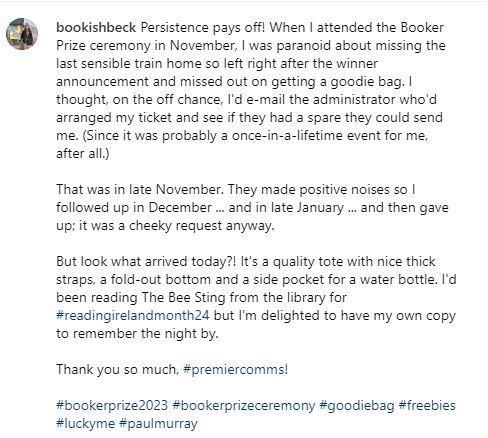
(Public library; free from the Booker Prize/Premier Comms)

I’ll be catching up on reviewing March releases in early April.
Happy Easter to those who celebrate!
Short Stories in September Roundup: Munro, Ulrich; Virago Anthology
This comes a few days later than I intended, but better late than never. I’ve been focusing on short stories in September for the last eight years. In September 2021 I read 12 short story collections; last year it was 11.5; this year I finished 11, so pretty much par for the course, and pushing my year-to-date total to 30 story collections – not bad going for someone who feels like she hardly ever reads stories and doesn’t seek them out. This year’s reviews are here, here and here.
Hateship, Friendship, Courtship, Loveship, Marriage by Alice Munro (2001)
I always think I’ve never read Munro before, but that’s not the case. A decade or more ago I read Lives of Girls and Women. The ironic thing is that I chose it because I thought it was the odd one out in her oeuvre, being a novel rather than short stories. In fact, it’s a linked story collection, and really they might as well be discrete stories. That book left no impression, but I’d happened to accumulate several more Munro collections over the years and, especially after she won the Nobel, felt delinquent for not reading her.
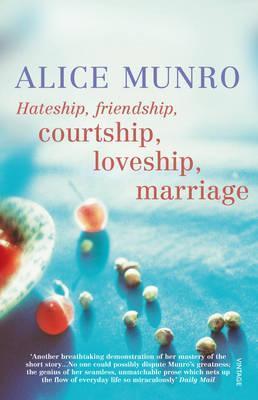 There are nine stories in the 320-page volume, so the average story here is 30–35 pages – a little longer than I tend to like, but it allows Munro to fill in enough character detail that these feel like miniature novels; they certainly have all the emotional complexity. Her material is small-town Ontario and the shifts and surprises in marriages and dysfunctional families.
More commonly, she employs an omniscient third person to allow her to move between minds, yet I found that the three first-person stories were among the most memorable: in “Family Furnishings,” a woman recalls the encounter with her father’s cousin that made her resolve to be a writer; in “Nettles,” childhood friends meet again in midlife and a potential affair is quashed by the report of a tragedy; in “Queenie,” a young woman spends a short time living with her older stepsister and her husband, her music teacher she ran off with. This last one reminded me of Tessa Hadley’s stories – no doubt Munro has been an influence on many.
For instance, the title story, which opens the collection, gave me strong Elizabeth Hay and Mary Lawson vibes. A housekeeper sets off on the train to start a new life, encouraged by a romantic correspondence fabricated by her adolescent charge, Sabitha, and her friend. Munro pays close attention to domestic minutiae like furniture and clothing. Illness and death are frequent seeds of a story: cancer in “Floating Bridge,” the suicide of an ALS patient in “Comfort,” and dementia in the oft-anthologized “The Bear Came Over the Mountain.”
Individual plots are less likely to stay with me than the quality of the prose, the compassionate eye, and the feeling of being immersed in a novel-length narrative when really I was only halfway through a few dozen pages. I’ll certainly read more Munro collections. (Free from a neighbour) 
Close Company: Stories of Mothers and Daughters, ed. Christine Park and Caroline Heaton (1987)
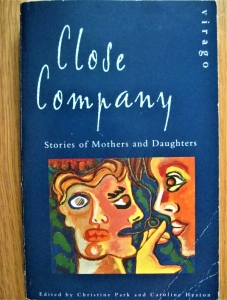 Back in 2021, I read 14 of these 25 stories (reviewed here) and set the book aside. At that time I noted the repeated theme of women’s expectations of their daughters, and that was true of the remainder as well. The editors quote Simone de Beauvoir in the introduction, “the daughter is for the mother at once her double and another person.” So in Emily Prager’s “A Visit from the Footbinder,” Lady Guo Guo subjects her spirited daughter to the same painful procedure she underwent as a child. The cultural detail was overpowering in this one, like the author felt she had to prove she’d done her research on China. The father–daughter relationship struck me more in Judith Chernaik’s Jewish Brooklyn-set “Honor Thy Father and Thy Mother.”
From this batch, two stood out the most: in “Children’s Liberation” by Jan Clausen, Lisa rebels against her lesbian mother’s bohemian lifestyle by idolizing heterosexual love stories; and in Zhang Jie’s “Love Must Not Be Forgotten,” a daughter comes to understand her mother by reading her diary about her doomed romance. My overall favourites, though, were still the stories by Jane Gardam, Janet Frame, Alice Walker and Charlotte Perkins Gilman. (Free mall bookshop) 
Small, Burning Things by Cathy Ulrich (2023)
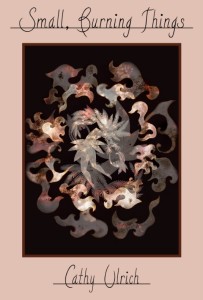 Ulrich’s second collection contains 50 flash fiction pieces, most of which were first published in literary magazines. She often uses the first-person plural and especially the second person; both “we” and “you” are effective ways of implicating the reader in the action. Her work is on a speculative spectrum ranging from magic realism to horror. Some of the situations are simply bizarre – teenagers fall from the sky like rain; a woman falls in love with a giraffe; the mad scientist next door replaces a girl’s body parts with robotic ones – while others are close enough to the real world to be terrifying. The dialogue is all in italics. Some images recur later in the collection: metamorphoses, spontaneous combustion. Adolescent girls and animals are omnipresent. At a certain point this started to feel repetitive and overlong, but in general I appreciated the inventiveness.
Published on 2 July by Okay Donkey Press. With thanks to publicist Lori Hettler for the free e-copy for review.
 I also read the first two stories in The Best Short Stories 2023: The O. Henry Prize Winners, edited by Lauren Groff. If these selections by Ling Ma and Catherine Lacey are anything to go by, Groff’s taste is for gently magical stories where hints of the absurd or explained enter into everyday life. Ma’s “Office Hours” has academics passing through closet doors into a dream space; the title of Lacey’s “Man Mountain” is literal. I’ll try to remember to occasionally open the book on my e-reader to get through the rest.
Winter Reads, Part I: Patrick Gale & Tove Jansson (#NordicFINDS23)
This winter has been a disappointment: it’s bloody cold, but with no snow. It’s impossible to keep our house warm, even with extra loft insulation and new double-glazed windows (home ownership is boring and overrated), so I’m ready for signs of spring. Maybe by the time I review a second batch of seasonal reads in February, winter will truly be on its way out.
A Place Called Winter by Patrick Gale (2015)
 This was our January book club read. We’d had good luck with Gale before: his Notes from an Exhibition received our joint highest rating ever. As he’s often done in his fiction, he took inspiration from family history: here, the story of his great-grandfather Harry Cane, who emigrated to the Canadian prairies to farm in the most challenging of conditions. Because there is some uncertainty as to what precipitated his ancestor’s resettlement, Gale has chosen to imagine that Harry, though married and the father of a daughter, was in fact gay and left England to escape blackmailing and disgrace after his affair with a man was discovered.
There are very evocative descriptions of the pioneer life, lightened for Harry by his relationship with his closest neighbours, siblings Petra and Paul. The novel covers the First World War and the start of the Spanish flu epidemic, which provide much fodder for melodrama, but somehow I don’t mind it from Gale. Harry himself is so diffident as to seem blank, but that means he is free to become someone else in a new land. My other main criticism would be that the villain is implausibly evil. Some of our book club members also thought there were too many coincidences. Gale really makes you feel for these characters and their suffering, though. Sexuality and mental health, both so misunderstood at that time, are the two main themes and he explores them beautifully. In that both are historical fiction where homosexuality is simply a fact of life, not a titillating novelty, this reminded me a lot of Days Without End by Sebastian Barry. (Free from mall bookshop)
A Winter Book: Selected Stories by Tove Jansson (2006)
[Translated from the Swedish by Silvester Mazzarella, David McDuff and Kingsley Hart]
 A brief second review for Nordic FINDS. It’s the third time I’ve encountered some of these autofiction stories: this was a reread for me, and 13 of the pieces are also in Sculptor’s Daughter, which I skimmed from the library a few years ago. And yet I remembered nothing; not a single one was memorable. Most of the pieces are impressionistic first-person fragments of childhood, with family photographs interspersed. In later sections, the protagonist is an older woman, Jansson herself or a stand-in. I most enjoyed “Messages” and “Correspondence,” round-ups of bizarre comments and requests she received from readers. Of the proper stories, “The Iceberg” was the best. It’s a literal object the speaker alternately covets and fears, and no doubt a metaphor for much else. This one had the kind of profound lines Jansson slips into her children’s fiction: “Now I had to make up my mind. And that’s an awful thing to have to do” and “if one doesn’t dare to do something immediately, then one never does it.” A shame this wasn’t a patch on The Summer Book. (Free from a neighbour)

Original rating in 2012: 
Rating now: 
Averaged rating: 
And a DNF:
Winter’s Tale by Mark Helprin (1983)
 Laila (Big Reading Life) and I attempted this as a buddy read, but we both gave up on it. I got as far as page 53 (in the 600+-page pocket paperback). The premise was alluring, with a magical white horse swooping in to rescue Peter Lake from a violent gang. I also appreciated the NYC immigration backstory, but not the adjective-heavy wordiness, the anachronistic exclamations (“Crap!” and “Outta my way, you crazy midget” – this is presumably set some time between the 1900s and 1920s) or the meandering plot. It was also disturbing to hear about Peter’s sex life when he was 12. From a Little Free Library (at Philadelphia airport) it came, and to a LFL (at the Bar Convent in York) it returned. Laila read a little further than me, enough to tell the library patron who recommended it to her that she’d given it a fair try.
Any snowy or icy reading (or weather) for you lately?
Random 2020 Superlatives and Statistics
My top ‘discoveries’ of the year: Chimamanda Ngozi Adichie (4 books), Octavia E. Butler, Tim Dee (3 books each, read or in progress), and Louise Erdrich (2 books, one in progress).


Also the publisher Little Toller Books: I read four of their releases this year and they were fantastic.
The authors I read the most by this year: Carol Shields tops the list at 6 books (3 of these were rereads) thanks to my buddy reads with Buried in Print, followed by Paul Auster with 5 due to Annabel’s reading week in February, then Chimamanda Ngozi Adichie with 4, and finally Anne Lamott with 3 comfort rereads.


Debut authors whose next work I’m most looking forward to: Naoise Dolan, Bess Kalb, Dara McAnulty, Mary South, Brandon Taylor, and Madeleine Watts
My proudest reading achievement: 16 rereads, which must be a record for me. Also, I always say I’m not really a short story person … and yet somehow I’ve read 19 collections of them this year (and one stand-alone story, plus another collection currently on the go)!
My proudest (non-reading) bookish achievement: Conceiving of and coordinating the Not the Wellcome Prize blog tour.
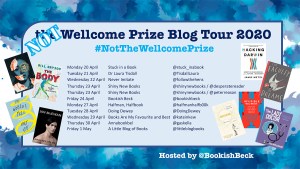
Five favorite blog posts of the year: Love, Etc. – Some Thematic Reading for Valentine’s Day; Polio and the Plague: Epidemics in Fiction; Thinking about the Future with David Farrier & Roman Krznaric (Hay Festival); Three Out-of-the-Ordinary Memoirs: Kalb, Machado, McGuinness; Asking What If? with Rodham by Curtis Sittenfeld (I had a lot of fun putting the current post together, too!)
The bookish experience that most defined my year: Watching the Bookshop Band’s live shows from their living room. Between their Friday night lockdown performances and one-offs for festivals and book launches, I think I saw them play 33 times in 2020!

Biggest book read this year: Going by dimensions rather than number of pages, it was the oversize hardback The Lost Words by Robert Macfarlane and Jackie Morris.
vs.
Smallest book read this year: Pocket-sized and only about 60 pages: No One Is Too Small to Make a Difference by Greta Thunberg.

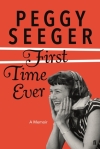 Oldest author read this year: Peggy Seeger was 82 when her memoir First Time Ever was published. I haven’t double-checked the age of every single author, but I think second place at 77 is a tie between debut novelist Arlene Heyman for Artifact and Sue Miller for Monogamy. (I don’t know how old Michael McCarthy, Jeremy Mynott and Peter Marren, the joint authors of The Consolation of Nature, are; Mynott may actually be the oldest overall, and their combined age is likely over 200.)
vs.
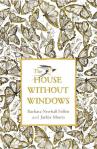 Youngest author read this year: You might assume it was 16-year-old Dara McAnulty with Diary of a Young Naturalist, which won the Wainwright Prize (as well as the An Post Irish Book Award for Newcomer of the Year, the Books Are My Bag Reader Award for Non-Fiction, and the Hay Festival Book of the Year!) … or Thunberg, above, who was 16 when her book came out. They were indeed tied for youngest until, earlier in December, I started reading The House without Windows (1927) by Barbara Newhall Follett, a bizarre fantasy novel published when the child prodigy was 12.
Most As on a book cover: Americanah by Chimamanda Ngozi Adichie
vs.
Most Zs on a book cover: The Hiding Place by Trezza Azzopardi. I haven’t read it yet, but a neighbor passed on a copy she was getting rid of. It was nominated for both the Booker Prize and the Orange Prize.

 The book that made me laugh the most: Kay’s Anatomy by Adam Kay
Books that made me cry: Writers and Lovers by Lily King, Monogamy by Sue Miller, First Time Ever by Peggy Seeger, and Catalogue Baby: A Memoir of (In)fertility by Myriam Steinberg (coming out in March 2021)
 The book that put a song in my head every single time I looked at it, much less read it: I Am an Island by Tamsin Calidas (i.e., “I Am a Rock” by Simon and Garfunkel, which, as my husband pointed out, has very appropriate lyrics for 2020: “In a deep and dark December / I am alone / Gazing from my window to the streets below … Hiding in my room / Safe within my womb / I touch no one and no one touches me.”)
Best book club selections: Notes from an Exhibition by Patrick Gale and The Wife by Meg Wolitzer tied for our highest score ever and gave us lots to talk about.

 Most unexpectedly apt lines encountered in a book: “People came to church wearing masks, if they came at all. They’d sit as far from each other as they could.” (Gilead by Marilynne Robinson. Describing not COVID-19 times but the Spanish flu.)
 Most ironic lines encountered in a book: “September 12—In the ongoing hearings, Senator Joseph Biden pledges to consider the Bork nomination ‘with total objectivity,’ adding, ‘You have that on my honor not only as a senator, but also as the Prince of Wales.’ … October 1—Senator Joseph Biden is forced to withdraw from the Democratic presidential race when it is learned that he is in fact an elderly Norwegian woman.” (from the 1987 roundup in Dave Barry’s Greatest Hits – Biden has been on the U.S. political scene, and mocked, for 3.5+ decades!)
 Best first line encountered this year: “And then there was the day when Addie Moore made a call on Louis Waters.” (Our Souls at Night by Kent Haruf)
Best last lines encountered this year:
- “my childhood falls silently to the bottom of my memory, that library of the soul from which I will draw knowledge and experience for the rest of my life.” (Childhood by Tove Ditlevsen)
- “What I want to say is: I misremember all this so vividly it’s as if it only happened yesterday.” (Other People’s Countries: A Journey into Memory by Patrick McGuinness)
- “these friends would forever be her stitches, her scaffold, her ballast, her home.” (The Dearly Beloved by Cara Wall)
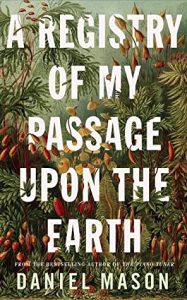
My favorite title and cover combo of the year: A Registry of My Passage Upon the Earth by Daniel Mason
The book I wish had gotten a better title and cover: Tennis Lessons by Susannah Dickey – I did enjoy this second-person novel about a young woman who is her own worst enemy, to the tune of 3.5 stars, but the title says nothing about it and the cover would have been a turnoff had I not won a signed copy from Mslexia.

The most unfortunate typos I found in published works: In English Pastoral by James Rebanks, “sewn” where he meant “sown” (so ironic in a book about farming!) versus, in Mr Wilder & Me by Jonathan Coe, “sown” in place of “sewn.” Also “impassible” where it should read “impassable” in Apeirogon by Colum McCann. This is what proofreaders like myself are for. We will save you from embarrassing homophone slips, dangling modifiers, and more!
The 2020 books that everybody else loved, but I didn’t: The Mirror and the Light by Hilary Mantel, Hamnet by Maggie O’Farrell, and Shuggie Bain by Douglas Stuart


The year’s biggest disappointments: I don’t like to call anything “worst” (after all, I didn’t read anything nearly as awful as last year’s Jonathan Livingston Seagull), but my lowest ratings went to A Traveller at the Gates of Wisdom by John Boyne and At Hawthorn Time by Melissa Harrison, and I was disappointed that When the Lights Go Out by Carys Bray was misleadingly marketed.
 The downright strangest books I read this year: Enter the Aardvark by Jessica Anthony, A Traveller at the Gates of Wisdom by John Boyne, The House Without Windows by Barbara Newhall Follett, and The Child in Time by Ian McEwan
The people and themes that kept turning up in my reading: Rachel Carson and Henry David Thoreau; curlews and plagues; how we define and relate to history; childhood memoirs (seven of them).

Some of my 2020 curlew reading. (Two more books with curlews on the cover were borrowed from the library.)
Some statistics on my 2020 reading:
Fiction: 57.2%
Nonfiction: 36.8%
Poetry: 6%
(Fiction reigned supreme this year! Last year my F:NF ratio was roughly 1:1. Poetry was down by ~5% this year compared to 2019.)
Male author: 34.1%
Female author: 63.8%
Nonbinary author: 0.3% (= 1 author, Jay Bernard)
Multiple genders (anthologies): 1.8%
(Women dominated by an extra ~5% this year over 2019. I’ve said this for four years now: I find it intriguing that female authors significantly outweigh male authors in my reading because I have never consciously set out to read more books by women; it must be a matter of being interested in the kinds of stories women tell and how they capture their experiences in nonfiction.)
E-books: 10.6%
Print books: 89.4%
(Almost exactly the same as last year. My e-book reading has been declining, partially because I’ve cut back on the reviewing gigs that involve only reading e-books and partially because I’ve done less traveling. Increasingly, I prefer to sit down with a big stack of print books.)
Books by BIPOC: 14.7%
Literature in translation: 6.6%
(Down from last year’s 7.2%; how did this happen?! This will be something to address in 2021.)
Where my books came from for the whole year:
- Free print or e-copy from publisher: 25.6%
- Public library: 25.6%
- Free (giveaways, The Book Thing of Baltimore, the free mall bookshop, etc.): 14.9%
- Secondhand purchase: 11.6%
- Downloaded from NetGalley, Edelweiss or Project Gutenberg: 6.7%
- New purchase (sometimes at a bargain price): 6.3%
- Gifts: 5.5%
- University library: 3.8%
I promised to scale back on review copies this year, and I did: last year they accounted for nearly 37% of my reading. My library reading was higher than last year’s, despite the challenges of lockdowns; my e-book reading decreased in general. I bought more than twice as many new books as usual this year, and read lots that I either bought secondhand or got for free.
Number of unread print books in the house: 435
At the end of last year this figure was at 440 after lots of stock-ups from the free mall bookshop, which has since closed. So even though it might look like I have only read five books of my own, I have in fact read loads from my shelves this year … but also acquired many more books, both new and secondhand.
In any case, the overall movement has been downward, so I’m calling it a win!
Margaret Atwood Reading Month: Wilderness Tips and CWWA Symposium
For this third annual Margaret Atwood Reading Month (#MARM), hosted by Canadian bloggers extraordinaires Marcie of Buried in Print and Naomi of Consumed by Ink, I picked up Wilderness Tips, a short story collection I’m not sure I’d even heard of before I liberated this battered paperback from the Hay-on-Wye Airbnb where we stayed in September (shhhhhh!).
I also listened in to one of the papers given at the Contemporary Women’s Writing Association’s mini online symposium held to mark her 81st birthday yesterday.

Wilderness Tips (1991)
 If pressed to give a one-line summary, I would say the overall theme of this collection is the power that women have (or do not have) in relationships – this is often a question of sex, but not always. Much of the collection falls neatly into pairs: “True Trash” and “Death by Landscape” are about summer camp and the effects that experiences had there still have decades later; “The Bog Man” and “The Age of Lead” both use the discovery of a preserved corpse (one a bog body, the other a member of the Franklin Expedition) as a metaphor for a frozen relationship; and “Hairball” and “Weight” are about a mistress’s power plays. I actually made myself a key on the table of contents page, assigning A, B, and C to those topics. The title story I labeled [A/C] because it’s set at a family’s lake house but the foreign spouse of one of the sisters has history with or designs on all three.
“Uncles,” a standout, didn’t fit into my framework. Susanna’s three uncles played a major role in her life, so when she got a job with a Toronto newspaper she welcomed her colleague Percy’s avuncular attentions. To her surprise, though, his tell-all autobiography reveals he wasn’t so happy about his protégée’s success after all. Two overall favorites were “Hairball,” about a mistress’s superbly executed act of revenge, and the final story, “Hack Wednesday,” in which Marcia takes stock of her life as she prepares for her children coming home for Christmas. Swap the Berlin Wall and Noriega for, I don’t know, Syria and Trump or suchlike, and it would be absolutely current, what with her partner Eric’s eco-warrior escapades (and hypocrisy) and her wish to situate herself in the context of history but also transcend it. I marked out the most passages in this one, and so many made me laugh:
Time is going faster and faster; the days of the week whisk by like panties. The panties she’s thinking about are the kind she had when was a little girl, in pastels, with ‘Monday,’ ‘Tuesday,’ ‘Wednesday’ embroidered on them. Ever since then the days of the week have had colours for her: Monday is blue, Tuesday is cream, Wednesday is lilac. You counted your way through each week by panty, fresh on each day, then dirtied and thrown into the bin. Marcia’s mother used to tell her that she should always wear clean panties in case a bus ran over her, because other people might see them as her corpse was being toted off to the morgue. It wasn’t Marcia’s potential death that loomed uppermost in her mind, it was the state of her panties.
“One of these days I’m going to kill that beast,” says Eric. … “You poor baby!” says Marcia, scooping up the cat, which is overweight. It’s on a diet, but mooches in secret from the neighbours. Marcia sympathizes. “I just let the damn thing out. In, out, in, out. It can’t make up its mind,” says Eric. “It’s confused,” says Marcia.
Marcia will get a little drunk on the eggnog, and later, after the dishes are done, she will cry silently to herself, shut into the bathroom and hugging in her festive arms the grumbling cat, which she will have dragged out from under a bed for this purpose. She will cry because the children are no longer children, or because she herself is not a child any more, or because there are children who have never been children, or because she can’t have a child any more, ever gone. Her body has gone past too quickly for her.
My rating:
CWWA Symposium
 To open the afternoon program, Dr. Fiona Tolan of Liverpool John Moores University spoke on “21st-century Gileads: Feminist Dystopian Fiction after Atwood.” She noted that The Handmaid’s Tale casts a long shadow; it’s entered into our cultural lexicon and isn’t going anywhere. She showed covers of three fairly recent books that take up the Handmaid’s red: The Power, Vox, and Red Clocks. However, the two novels she chose to focus on do not have comparable covers: The Water Cure by Sophie Mackintosh (my review) and The Natural Way of Things by Charlotte Wood. I was unfamiliar with the premise of the Wood. Ten young women who have been involved in public sex scandals (e.g. with politicians) are kidnapped and imprisoned in a compound in the Outback; their heads are shaven and they are forced to undertake hard labor. Although it’s a female-dominated space, the patriarchy is perpetuated. Is sisterhood a possibility here?
Atwood has said, “Some books haunt the reader and some haunt the writer.” Tolan argued that Handmaid’s clearly does both, since Atwood chose to return to Gilead with The Testaments. While Tolan believes Atwood’s overall emphasis has always been on liberty, she notes that the author has been reluctant to be associated with feminism as a movement.
I feel like my #MARM participation has been somewhat half-hearted this year – I won’t be getting a Bingo on this chart! – but I always enjoy engaging with Atwood’s writing and thinking. With any luck, I’ll still get to read her new poetry collection, Dearly, for review in 2020, and before long I can start planning what I’ll read for this challenge next November.
Reading Statistics for the First Half of 2020, Including Where My Books Came From
Almost halfway through the year: how am I doing on the reading goals I set for myself? Pretty well!
- It might not look like it from the statistics below, but I have drastically cut down on the number of review copies I’m requesting or accepting from publishers. (This time last year they made up 43% of my reading.)
- I’ve reread nine books so far, which is more than I can remember doing in any other year – and I intend to continue prioritizing rereads in the remaining months.
- Thanks to COVID-19, over the past few months I have been reading a lot less from the libraries I use and, consequently, more from my own shelves. This might continue into next month but thereafter, when libraries reopen, my borrowing will increase.
- I’ve also bought many more new books than is usual for me, to directly support authors and independent bookshops.
- I’m not managing one doorstopper per month (I’ve only done May so far, though I have a few lined up for June‒August), but I am averaging at least one classic per month (I only missed January, but made up for it with multiple in two other months).
- On literature in translation, I’m doing better: it’s made up 9.7% of my reading, versus 8.1% in 2019.
The breakdown:
Fiction: 57.6%
Nonfiction: 36.3%
Poetry: 6.1%
(This time last year I’d read exactly equal numbers of fiction and nonfiction books. Fiction seems to be winning this year. Poetry is down massively: last June it was at 15.4%.)
Male author: 34.7%
Female author: 63.5%
Anthologies with pieces by authors of multiple genders: 1.8%
(No non-binary authors so far this year. Even more female-dominated than last year.)
E-books: 12.7%
Print books: 87.3%
(E-books have crept up a bit since last year due to some publishers only offering PDF review copies during the pandemic, but I have still been picking up many more print books.)
I always find it interesting to look back at where my books come from. Here are the statistics for the year so far, in percentages (not including the books I’m currently reading, DNFs or books I only skimmed):
- Free print or e-copy from the publisher: 25.5%
- Public library: 21.2%
- Free, e.g. from Book Thing of Baltimore, local swap shop or free mall bookshop: 16.4%
- Secondhand purchase: 10.3%
- Downloaded from NetGalley or Edelweiss: 8.5%
- New purchase: 7.3%
- Gifts: 5.4%
- University library: 5.4%
How are you doing on any reading goals you set for yourself?
Where do you get most of your books from?
Other 2019 Superlatives and Some Statistics
My best discoveries of the year: The poetry of Tishani Doshi; Penelope Lively and Elizabeth Strout (whom I’d read before but not fully appreciated until this year); also, the classic nature writing of Edwin Way Teale.


The authors I read the most by this year: Margaret Atwood and Janet Frame (each: 2 whole books plus parts of 2 more), followed by Doris Lessing (2 whole books plus part of 1 more), followed by Miriam Darlington, Paul Gallico, Penelope Lively, Rachel Mann and Ben Smith (each: 2 books).
Debut authors whose next work I’m most looking forward to: John Englehardt, Elizabeth Macneal, Stephen Rutt, Gail Simmons and Lara Williams.
My proudest reading achievement: A 613-page novel in verse (Mary Ann Sate, Imbecile by Alice Jolly) + 2 more books of over 600 pages (East of Eden by John Steinbeck and Cutting for Stone by Abraham Verghese).


Best book club selection: Red Dust Road by Jackie Kay was our first nonfiction book and received our highest score ever.
Some best first lines encountered this year:
 “What can you say about a twenty-five-year old girl who died?” (Love Story by Erich Segal)
- “The women of this family leaned towards extremes” (Away by Jane Urquhart)
- “The day I returned to Templeton steeped in disgrace, the fifty-foot corpse of a monster surfaced in Lake Glimmerglass.” (from The Monsters of Templeton by Lauren Groff)
The downright strangest book I read this year: Lanny by Max Porter
The 2019 books everybody else loved (or so it seems), but I didn’t: Fleishman Is in Trouble by Taffy Brodesser-Akner, The Topeka School by Ben Lerner, Underland by Robert Macfarlane, The Boy, The Mole, The Fox and The Horse by Charlie Mackesy, Three Women by Lisa Taddeo and The Nickel Boys by Colson Whitehead
 The year’s major disappointments: Cape May by Chip Cheek, We Are the Weather: Saving the Planet Begins at Breakfast by Jonathan Safran Foer, Letters to the Earth: Writing to a Planet in Crisis, ed. Anna Hope et al., Bowlaway by Elizabeth McCracken, Rough Magic: Riding the World’s Loneliest Horse Race by Lara Prior-Palmer, The Lager Queen of Minnesota by J. Ryan Stradal, The Knife’s Edge by Stephen Westaby and Frankissstein by Jeanette Winterson
The worst book I read this year: Jonathan Livingston Seagull by Richard Bach
Some statistics on my 2019 reading:
Fiction: 45.4%
Nonfiction: 43.4%
Poetry: 11.2%
(As usual, fiction and nonfiction are neck and neck. I read a bit more poetry this year than last.)
Male author: 39.4%
Female author: 58.9%
Nonbinary author (the first time this category has been applicable for me): 0.85%
Multiple genders (anthologies): 0.85%
(I’ve said this the past three years: I find it interesting that female authors significantly outweigh male authors in my reading; I have never consciously set out to read more books by women.)
E-books: 10.3%
Print books: 89.7%
(My e-book reading has been declining year on year, partially because I’ve cut back on the reviewing gigs that involve only reading e-books and partially because I’ve done less traveling; also, increasingly, I find that I just prefer to sit down with a big stack of print books.)
Work in translation: 7.2%
(Lower than I’d like, but better than last year’s 4.8%.)
Where my books came from for the whole year:
- Free print or e-copy from publisher: 36.8%
- Public library: 21.3%
- Secondhand purchase: 13.8%
- Free (giveaways, The Book Thing of Baltimore, the free mall bookshop, etc.): 9.2%
- Downloaded from NetGalley, Edelweiss or Project Gutenberg: 7.8%
- Gifts: 4.3%
- University library: 2.9%
- New purchase (usually at a bargain price): 2.9%
- Church theological library: 0.8%
- Borrowed: 0.2%
(Review copies accounted for over a third of my reading; I’m going to scale way back on this next year. My library reading was similar to last year’s; my e-book reading decreased in general; I read more books that I either bought new or got for free.)
Number of unread print books in the house: 440
(Last thing I knew the figure was more like 300, so this is rather alarming. I blame the free mall bookshop, where I volunteer every Friday. Most weeks I end up bringing home at least a few books, but it’s often a whole stack. Surely you understand. Free books! No strings attached!)
Novellas in November, Part 1: 3 Nonfiction, 2 Super-Short Fiction
Short books; short reviews.
Nonfiction:
The Measure of My Days by Florida Scott-Maxwell (1968)
[150 pages]
 I learned about this from one of May Sarton’s journals, which shares its concern with ageing and selfhood. The author was an American suffragist, playwright, mother and analytical psychologist who trained under Jung and lived in England and Scotland with her Scottish husband. She kept this notebook while she was 82, partly while recovering from gallbladder surgery. It’s written in short, sometimes aphoristic paragraphs. While I appreciated her thoughts on suffering, developing “hardihood,” the simplicity that comes with giving up many cares and activities, and the impossibility of solving “one’s own incorrigibility,” I found this somewhat rambly and abstract, especially when she goes off on a dated tangent about the equality of the sexes. (Free from The Book Thing of Baltimore)
Hope in the Dark: Untold Histories, Wild Possibilities by Rebecca Solnit (2004)
[143 pages]
 “Activism is not a journey to the corner store, it is a plunge into the unknown. The future is always dark.” This resonated with the Extinction Rebellion handbook I reviewed earlier in the year. Solnit believes in the power of purposeful individuals working towards social justice, even in the face of dispiriting evidence (the largest protests the world had seen didn’t stop the Iraq War). Instead of perfectionism, she advises flexibility and resilience; things could be even worse had we not acted. At first I thought it depressing that 15 years on we’re still dealing with many of the issues she mentions here, and the environmental crisis has only deepened. But her strong and stirring writing is a reminder that, though injustice is always with us, so is everyday heroism. (Free from The Book Thing of Baltimore)
Lama by Derek Tangye (1966)
[160 pages]
 Tangye wrote a series of cozy animal books similar to Doreen Tovey’s. He and his wife Jean ran a flower farm in Cornwall and had a succession of cats, along with donkeys and a Muscovy duck named Boris. After the death of their beloved cat Monty, Jean wanted a kitten for Christmas but Tangye, who considered himself a one-cat man rather than a wholesale cat lover, hesitated. The matter was decided for them when a little black stray started coming round and soon made herself at home. (Her name is a tribute to the Dalai Lama’s safe flight from Tibet.) Mild adventures ensue, such as Lama going down a badger sett and Jeannie convincing herself that she’s identified another stray as Lama’s mother. Pleasant, if slight; I’ll read more by Tangye. (From Kennet Centre free bookshop)
Fiction:
The Small Miracle by Paul Gallico (1951)
[47 pages]
 Like Tangye, Gallico is known for writing charming animal books, but fables rather than memoirs. Set in postwar Assisi, Italy, this stars Pepino, a 10-year-old orphan boy who runs errands with his donkey Violetta to earn his food and board. When Violetta falls ill, he dreads losing not just his livelihood but also his only friend in the world. But the powers that be won’t let him bring her into the local church so that he can pray to St. Francis for her healing. Pepino takes to heart the maxim an American corporal gave him – “don’t take no for an answer” – and takes his suit all the way to the pope. This story of what faith can achieve just manages to avoid being twee. (From Kennet Centre free bookshop)
Birthday Girl by Haruki Murakami (2002; English translation by Jay Rubin, 2003)
[42 pages]
 Reprinted as a stand-alone pamphlet to celebrate the author’s 70th birthday, this is about a waitress who on her 20th birthday is given the unwonted task of taking dinner up to the restaurant owner, who lives above the establishment. He is taken with the young woman and offers to grant her one wish. We never hear exactly what that wish was. It’s now more than 10 years later and she’s recalling the occasion for a friend, who asks her if the wish came true and whether she regrets what she requested. She surveys her current life and says that it remains to be seen whether her wish will be fulfilled; I could only assume that she wished for happiness, which is shifting and subjective. Encountering this in a larger collection would be fine, but it wasn’t particularly worth reading on its own. (Public library)
I’ve also had a number of novella DNFs so far this month, alas: Atlantic Winds by William Prendiville (not engaging in the least), By Grand Central Station I Sat Down and Wept by Elizabeth Smart (fascinating autobiographical backstory; pretentious prose) and The Dream Life of Balso Snell by Nathanael West (even more bizarre and crass than I’m used to from him).
Onwards!
Have you read any of these novellas? Which one takes your fancy?
Reading Statistics for the First Half of 2019, Including Where My Books Came From
Almost halfway through the year: how am I doing on the reading goals I set for myself? So-so. I’m mostly managing one doorstopper and one classic per month, though sometimes I’ve had to fudge it a little with modern classics or a skim read. I’ve read precisely 0 travel classics, biographies, or re-reads, so those aims are a fail thus far. As to literature in translation, I’m doing better: it’s made up 8.1% of my reading, nearly double my 2018 percentage. And it looks like I’m on track to meet or exceed my Goodreads target.

The breakdown:
Fiction: 42.3%
Nonfiction: 42.3%
Poetry: 15.4%
(Exactly equal numbers of fiction and nonfiction books! What are the odds?!)
Male author: 41.3%
Female author: 56.7%
Non-binary author: 2%
(This is the first year when I’ve consciously read work by non-binary authors – three of them.)
E-books: 9.3%
Print books: 90.7%
(I seem to be moving further and further away from e-books now that they no longer make up the bulk of my paid reviewing.)
I always find it interesting to look back at where my books come from. Here are the statistics for the year so far, in both real numbers and percentages (not including books I’m currently reading, DNFs or books I only skimmed):
- Free print or e-copy from the publisher or author: 65 (43%)
- Public library: 31 (21%)
- Secondhand purchase: 21 (14%)
- Downloaded from NetGalley or Edelweiss: 12 (8%)
- Gifts: 9 (6%)
- Free, e.g. from Book Thing of Baltimore, local swap shop or free mall bookshop: 5 (3.5%)
- University library: 4 (2.5%)
- New book purchase: 2 (1.5%)
- Borrowed: 1 (0.5%)
How are you doing on any reading goals you set for yourself?
Where do you get most of your books from?
America Reading & Book Haul, Etc.
The wedding of a college friend – who I calculated I’ve known at least half my life – was the excuse we needed to book a trip back to the States for the last two weeks of May. Along with the classy nuptials in the Fell’s Point area of Baltimore, we enjoyed a day’s sightseeing in Philadelphia, a couple of outings to watch birds and other wildlife on Cape May (a migration hotspot in New Jersey), two meet-ups with other friends, and plenty of relaxation time with my mom and sister, including a Memorial Day picnic at my mom’s retirement community and a tour of Antietam Battlefield. It was much hotter than anticipated, including some days in the high 80s or even 90s, and the hayfever, ticks and mosquitoes were bad, too, but we survived.


While back in Maryland I continued the intermittent downsizing process I’ve been going through for a while now. After being on the market for nearly a year, my family home finally sold and went to closing while we were over there. So that provided a scrap of closure, but my current estrangement from my father (we don’t even know where he’s living) means there’s a lot of continuing uncertainty.
In any case, I managed to reduce the number of boxes I’m storing with my sister from 29 to 20 by recycling lots of my old schoolwork, consolidating my mementos, reselling one box of books and donating another, donating a box of figurines and decorative bottles to a thrift store, displaying some at my mom’s place, giving away a few trinkets to a friend’s kids, and packing a bunch of stuff – photo albums and decorations as well as 64 books – in our various suitcases and hand luggage to take back to the UK.


And I also acquired more books, of course! A whopping 46 of these were free: eight review copies were waiting for me at my mom’s place; three were from the outdoor free bin at 2nd & Charles, a secondhand bookstore; one was found in a Little Free Library near our friends’ place in New Jersey (Emerald City by Jennifer Egan, not pictured); and the rest were from The Book Thing of Baltimore, a legendary volunteer-run free bookshop. I mostly raided the biography section for an excellent selection of women’s life writing; the fiction is unalphabetized so harder to find anything in, but I picked up a few novels, too. My only purchases were new (remainder) copies of one novel and one memoir from Dollar Tree. Total book spending on the trip: just $2.12.
What I Read:
Two that I’d already started but finished on the plane ride over:
 The Florist’s Daughter by Patricia Hampl: (As featured in my spring reading list.) “Love and flowers, death and flowers.” Poetic writing about small-town Minnesota life, a tense relationship with her late mother, and her late father’s flower shop.
 - The Girls by Lori Lansens: I love reading about sister relationships, and the Darlen girls’ situation is an extreme case of love and jealousy given that they literally can’t get away from each other. Not as good as the two other conjoined-twin novels I’ve read, Chang and Eng by Darin Strauss and Cutting for Stone by Abraham Verghese, but I would read more from Lansens, a solid Oprah Book Club sort of author.
Three review books that will be featuring here in the near future:
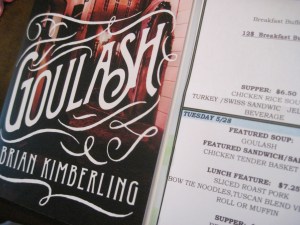
- Goulash by Brian Kimberling
- Sorry I’m Late, I Didn’t Want to Come: An Introvert’s Year of Living Dangerously by Jessica Pan
- Mother Ship by Francesca Segal
A few quick reads:
 A Certain Loneliness: A Memoir by Sandra Gail Lambert: (A proof copy passed on by an online book reviewing friend.) A memoir in 29 essays about living with the effects of severe polio. Most of the pieces were previously published in literary magazines. While not all are specifically about the author’s disability, the challenges of life in a wheelchair seep in whether she’s writing about managing a feminist bookstore or going on camping and kayaking adventures in Florida’s swamps. I was reminded at times of Constellations by Sinéad Gleeson.
  No Happy Endings: A Memoir by Nora McInerny: (Borrowed from my sister.) I didn’t appreciate this as much as the author’s first memoir, It’s Okay to Laugh, though it’s in the same style: lots of short, witty but bittersweet essays reflecting on life’s losses. Within a year of being widowed by cancer, she met a new partner and soon was – surprise! – pregnant with his baby. Together they formed a blended family of four children ranging from 0 to 15 and two wounded adults. McInerny also writes about her newfound spirituality and feminism. The problem with the essay format is that she cycles through aspects of the same stories multiple times.
  Native Guard by Natasha Trethewey: (Free from 2nd & Charles.) Trethewey writes beautifully disciplined verse about her mixed-race upbringing in Mississippi, her mother’s death and the South’s legacy of racial injustice. She occasionally rhymes, but more often employs forms that involve repeated lines or words. The title sequence concerns a black Civil War regiment in Louisiana. Two favorites from this Pulitzer-winning collection by a former U.S. poet laureate were “Letter” and “Miscegenation”; stand-out passages include “In my dream, / the ghost of history lies down beside me, // rolls over, pins me beneath a heavy arm” (from “Pilgrimage”) and “I return / to Mississippi, state that made a crime // of me — mulatto, half-breed” (from “South”).
 I also read the first half or more of: The Music Shop by Rachel Joyce, my June book club book; Hungry by Jeff Gordinier, a journalist’s travelogue of his foodie journeys with René Redzepi of Noma fame, coming out in July; and the brand-new novel In West Mills by De’Shawn Charles Winslow – these last two are for upcoming BookBrowse reviews.
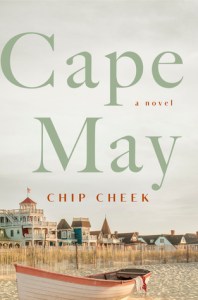
But the book I was most smug to have on my reading list for the trip was the recent novel Cape May by Chip Cheek. What could be more perfect for reading on location? I asked myself. Unfortunately, it stood out for the wrong reasons. In October 1957 a young pair of virgins, Effie and Henry, travel from Georgia to New Jersey for an off-season honeymoon in her uncle’s vacation home. They’re happy enough with each other but underwhelmed with the place (strangely, this matched my experience of Cape May), and even consider going home early until they fall in with Clara, a friend of Effie’s cousin; Clara’s lover, Max; and Max’s younger sister, Alma. Effie and Henry join the others for nightly drunken revelry.
[SPOILERS!] As the weeks pass Effie, ill and dejected, almost seems to disappear as Cheek delves into Henry’s besotted shenanigans, described in unnecessarily explicit sexual detail. When Effie makes a bid or two for her own sexual freedom late on, it only emphasizes the injustice of spending so much time foregrounding Henry’s perspective. Despite the strength of the period atmosphere and seaside location, this ends up being dull and dated. If you’re after a typically ‘trashy’ beach read and don’t mind lots of sex scenes, you may get on with it better than I did. 

Reading a few pages of Cape May over an ice-cold G&T at the wedding reception.
Bonus bookishness:
Vineland, New Jersey was on the way from our friends’ house to Cape May, so we stopped to take my proof copy of Barbara Kingsolver’s Unsheltered to its spiritual home. Alas, Vineland is an utterly boring small American town. However, Mary Treat at least appears on a painted mural on a building on the main street. The Historical Society, where Kingsolver did her research, was closed, but we photographed the outside.


 Bookish Beck = Rebecca Foster. American transplant to England. Freelance proofreader and book reviewer.
 Bookish Beck