Women’s Prize for Non-Fiction, Writers’ Prize & Young Writer of the Year Award Catch-Up
This time of year, it’s hard to keep up with all of the literary prize announcements: longlists, shortlists, winners. I’m mostly focussing on the Carol Shields Prize for Fiction this year, but I like to dip a toe into the others where I can. I ask: What do I have time to read? What can I find at the library? and Which books are on multiple lists so I can tick off several at a go??
Women’s Prize for Non-Fiction

(Shortlist to be announced on 27 March.)
Read so far: Intervals by Marianne Brooker, Matrescence by Lucy Jones
&
A Flat Place by Noreen Masud
Past: Sunday Times/Charlotte Aitken Young Writer of the Year Award shortlist
Currently: Jhalak Prize longlist
I also expect this to be a strong contender for the Wainwright Prize for nature writing, and hope it doesn’t end up being a multi-prize bridesmaid as it is an excellent book but an unusual one that is hard to pin down by genre. Most simply, it is a travel memoir taking in flat landscapes of the British Isles: the Cambridgeshire fens, Orford Ness in Suffolk, Morecambe Bay, Newcastle Moor, and the Orkney Islands.
 But flatness is a psychological motif as well as a physical reality here. Growing up in Pakistan with a violent Pakistani father and a passive Scottish mother, Masud chose the “freeze” option when in fight-or-flight situations. When she was 15, her father disowned her and she moved with her mother and sisters to Scotland. Though no particularly awful things happened, a childhood lack of safety, belonging and love left her with complex PTSD that still affects how she relates to her body and to other people, even after her father’s death.
Masud is clear-eyed about her self and gains a new understanding of what her mother went through during their trip to Orkney. The Newcastle chapter explores lockdown as a literal Covid-era circumstance but also as a state of mind – the enforced solitude and stillness suited her just fine. Her descriptions of landscapes and journeys are engaging and her metaphors are vibrant: “South Nuns Moor stretched wide, like mint in my throat”; “I couldn’t stop thinking about the Holm of Grimbister, floating like a communion wafer on the blue water.” Although she is an academic, her language is never off-puttingly scholarly. There is a political message here about the fundamental trauma of colonialism and its ongoing effects on people of colour. “I don’t want ever to be wholly relaxed, wholly at home, in a world of flowing fresh water built on the parched pain of others,” she writes.
What initially seems like a flat authorial affect softens through the book as Masud learns strategies for relating to her past. “All families are cults. All parents let their children down.” Geography, history and social justice are all a backdrop for a stirring personal story. Literally my only annoyance was the pseudonyms she gives to her sisters (Rabbit, Spot and Forget-Me-Not). (Read via Edelweiss) 
And a quick skim:
Doppelganger: A Trip into the Mirror World by Naomi Klein
Past: Writers’ Prize shortlist, nonfiction category
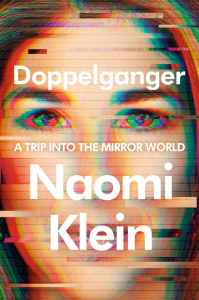 For years people have been confusing Naomi Klein (geography professor, climate commentator, author of No Logo, etc.) with Naomi Wolf (feminist author of The Beauty Myth, Vagina, etc.). This became problematic when “Other Naomi” espoused various right-wing conspiracy theories, culminating with allying herself with Steve Bannon in antivaxxer propaganda. Klein theorizes on Wolf’s ideological journey and motivations, weaving in information about the doppelganger in popular culture (e.g., Philip Roth’s novels) and her own concerns about personal branding. I’m not politically minded enough to stay engaged with this but what I did read I found interesting and shrewdly written. I do wonder how her publisher was confident this wouldn’t attract libel allegations? (Public library)
Predictions: Cumming (see below) and Klein are very likely to advance. I’m less drawn to the history or popular science/tech titles. I’d most like to read Some People Need Killing: A Memoir of Murder in the Philippines by Patricia Evangelista, Wifedom: Mrs Orwell’s Invisible Life by Anna Funder, and How to Say Babylon: A Jamaican Memoir by Safiya Sinclair. I’d be delighted for Brooker, Jones and Masud to be on the shortlist. Three or more by BIPOC would seem appropriate. I expect they’ll go for diversity of subject matter as well.
Writers’ Prize
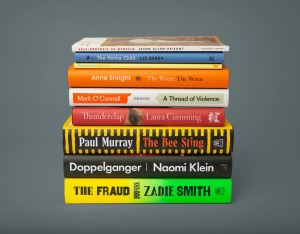
Last year I read most books from the shortlists and so was able to make informed (and, amazingly, thoroughly correct) predictions of the winners. I didn’t do as well this year. In particular, I failed with the nonfiction list in that I DNFed Mark O’Connell’s book and twice borrowed the Cumming from the library but never managed to make myself start it; I thought her On Chapel Sands overrated. (I did skim the Klein, as above.) But at least I read the poetry shortlist in full:
 Self-Portrait as Othello by Jason Allen-Paisant: I found more to sink my teeth into here than I did with his debut collection, Thinking with Trees (2021). Part I’s childhood memories of Jamaica open out into a wider world as the poet travels to London, Paris and Venice, working in snippets of French and Italian and engaging with art and literature. “I’m haunted as much by the character Othello as by the silences in the story.” Part III returns home for the death of his grandmother and a coming to terms with identity. [Winner: Forward Prize for Best Collection; Past: T.S. Eliot Prize shortlist] (Public library)
 The Home Child by Liz Berry: A novel in verse “loosely inspired,” as Berry puts it, by her great-aunt Eliza Showell’s experience: she was a 12-year-old orphan when, in 1908, she was forcibly migrated from the English Midlands to Nova Scotia. The scenes follow her from her home to the Children’s Emigration Home in Birmingham, on the sea voyage, and in her new situation as a maid to an elderly invalid. Life is gruelling and lonely until a boy named Daniel also comes to the McPhail farm. This was a slow and not especially engaging read because of the use of dialect, which for me really got in the way of the story. (Public library)
 & Bright Fear by Mary Jean Chan (Current: Dylan Thomas Prize shortlist)
Three category winners:
- The Wren, The Wren by Anne Enright (Fiction)
- Thunderclap by Laura Cumming (Nonfiction) (Current: Women’s Prize for Non-Fiction longlist)
- The Home Child by Liz Berry (Poetry)
Overall winner: The Home Child by Liz Berry
Observations: The academy values books that cross genres. It appreciates when authors try something new, or use language in interesting ways (e.g. dialect – there’s also some in the Allen-Paisant, but not as much as in the Berry). But my taste rarely aligns with theirs, such that I am unlikely to agree with its judgements. Based on my reading, I would have given the category awards to Murray, Klein and Chan and the overall award perhaps to Murray. (He recently won the inaugural Nero Book Awards’ Gold Prize instead.)
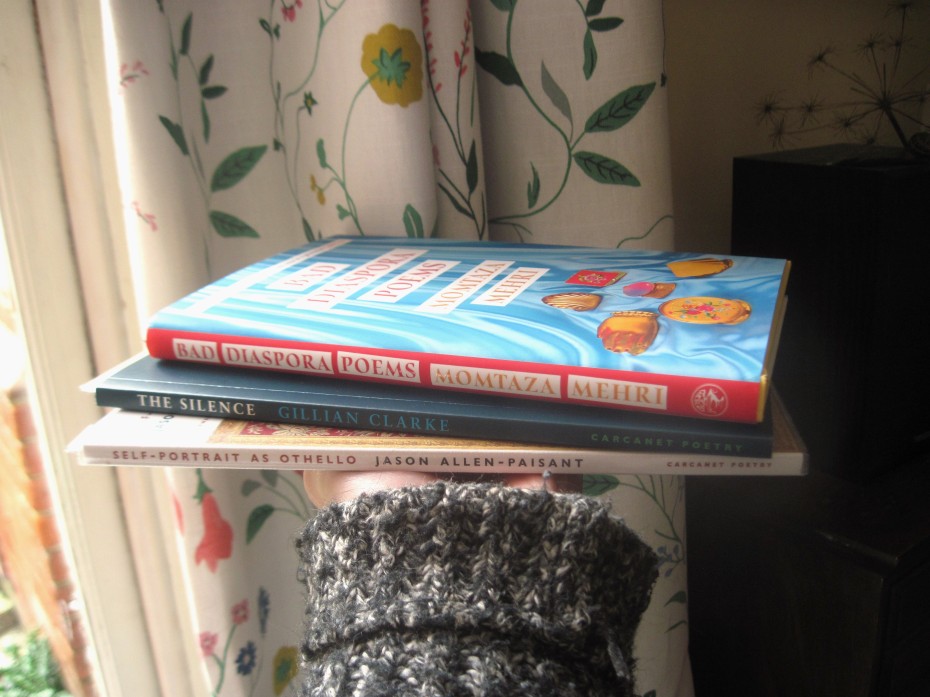
World Poetry Day stack last week
Young Writer of the Year Award
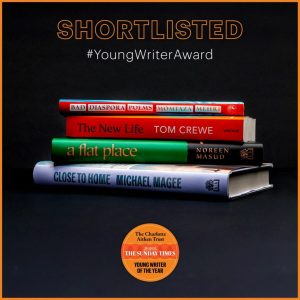
Shortlist:
- The New Life by Tom Crewe
 (Past: Nero Book Award shortlist, debut fiction)
 - Close to Home by Michael Magee (Winner: Nero Book Award, debut fiction category)
- A Flat Place by Noreen Masud (see above)
&
Bad Diaspora Poems by Momtaza Mehri
Winner: Forward Prize for Best First Collection
Nostalgia is bidirectional. Vantage point makes all the difference. Africa becomes a repository of unceasing fantasies, the sublimation of our curdled angst.
 Crossing between Somalia, Italy and London and proceeding from the 1830s to the present day, this debut collection sets family history amid wider global movements. It’s peopled with nomads, colonisers, immigrants and refugees. In stanzas and prose paragraphs, wordplay and truth-telling, Mehri captures the welter of emotions for those whose identity is split between countries and complicated by conflict and migration. I particularly admired “Wink Wink,” which is presented in two columns and opens with the suspension of time before the speaker knew their father was safe after a terrorist attack. There’s super-clever enjambment in this one: “this time it happened / after evening prayer // cascade of iced tea / & sugared straws // then a line / break // hot spray of bullets & / reverb & // in less than thirty minutes we / they the land // lose twenty of our children”. Confident and sophisticated, this is a first-rate debut.
A few more favourite lines:
IX. Art is something we do when the war ends.
X. Even when no one dies on the journey, something always does.
(from “A Few Facts We Hesitantly Know to Be Somewhat True”)
You think of how casually our bodies are overruled by kin,
by blood, by heartaches disguised as homelands.
How you can count the years you have lived for yourself on one hand.
History is the hammer. You are the nail.
(from “Reciprocity is a Two-way Street”)
With thanks to Jonathan Cape (Penguin) for the free copy for review.
I hadn’t been following the Award on Instagram so totally missed the news of them bringing back a shadow panel for the first time since 2020. The four young female Bookstagrammers chose Mehri’s collection as their winner – well deserved.
Winner: The New Life by Tom Crewe
This was no surprise given that it was the Sunday Times book of the year last year (and my book of the year, to be fair). I’ve had no interest in reading the Magee. It’s a shame that a young woman of colour did not win as this year would have been a good opportunity for it. (What happened last year, seriously?!) But in that this award is supposed to be tied into the zeitgeist and honour an author on their way up in the world – as with Sally Rooney in my shadowing year – I do think the judges got it right.
Short Stories in September, Part III: Linked Collections by Jonathan Escoffery & Soraya Palmer
These two debut linked short story collections had enough in common to get a mention in yesterday’s Book Serendipity post, including a 2023 publication date, a central sibling pair, Jamaican heritage, and memories of a devastating hurricane.
If I Survive You by Jonathan Escoffery
A starred Kirkus review first put this on my radar, and I requested a copy back in February. Though I enjoyed the first two stories, I then set the book aside. Its longlisting for this year’s Booker Prize reminded me to pick it back up and it’s now one of the six on the shortlist.
Five of eight stories are filtered through the consciousness of Trelawny, the younger son of Topper and Sanya, who immigrated to Miami in the late 1970s to escape unrest in Kingston, Jamaica. Older brother Delano is the golden boy, yet in a post-recession landscape both sons struggle to get by. After their parents’ split, the family home seems like a totem of security.
An accident leads Delano to give up his tree service business and pursue reggae music professionally. Trees play a pivotal role: when Topper humiliates him at a party by calling him “soft” and “defective,” Trelawny attacks his father’s beloved ackee tree with an axe. After Topper kicks him out, Trelawny lives in his car, accepting a succession of strange and sordid gigs (the stuff of “Odd Jobs” and the title story; “in Miami … you’re as likely to wind up getting your organs harvested as you are to make a profit”) before settling on teaching.

Three stories are in the always engaging second person (one of those inhabiting Topper’s perspective), three are narrated in the first person by Trelawny, and two are in the third person – the one about Delano and another about their cousin Cukie (“Splashdown”). Family legacy, particularly from fathers, is a major theme. “I felt sick with hatred,” Trelawny says. “For her [racist] father, yes, but for all fathers, for their propensity for passing down the worst of themselves.”
Trelawny is an entertaining POV character, jaded but quick-witted as he navigates microaggressions. People are confused about whether he’s African American or Latino. “In Flux,” the opening story and probably the strongest, has him coming to terms with what it means to be Black in America while living in Florida or at college in the Midwest, prompted by a question he frequently has to field: “What are you?” My other favourite story was “Independent Living,” in which he’s an administrator for an oversubscribed senior housing block and has to become as wily as his residents.
Escoffery creates a strong sense of place and character. I suspect there’s a lot that’s autobiographical here, as is common in first books. His ambivalence about sites that hold personal significance is palpable. Ideally, a linked collection will be composed of confident stand-alone stories that together are more than the sum of their parts. I didn’t really feel that about these. While the voice is promising and several stories are highlights, the whole didn’t set me on fire. (And I’d be astonished if it won the Booker. That’ll go to a guy named Paul.) Maybe Escoffery has a great novel brewing, though. 
A favourite passage:
“On the day you are scheduled to begin the sixth grade, a hurricane named Andrew pops your house’s roof open, peeling it back like the lid of a Campbell’s soup can, pouring a fraction of the Atlantic into your bedroom, living room—everywhere—bloating carpet, drywall, and fibreboard with sopping sea salt corrosion. It disinters the kidney-colored fibreglass from the walls and ceiling, splaying the house’s entrails on the lawn. The storm chops your neighbor’s house to rubble, parks a tugboat at the far end of your street.”
With thanks to 4th Estate for the free copy for review.
Buy from Bookshop [affiliate link].
The Human Origins of Beatrice Porter & Other Essential Ghosts by Soraya Palmer
Sasha and Zora are steeped in Caribbean folklore absorbed from their parents. Nigel, from Jamaica, tells them about “Rolling Calf,” the vengeful ghost of a butcher paying penance for all the animals he slaughtered; Trinidadian Beatrice reminds them that the hero of the Anansi stories is a woman. Like the trickster spider, these Brooklyn adolescents will have to live by their wits when their family disintegrates – Nigel leaves to marry a German woman and Beatrice returns to Trinidad when she’s diagnosed with metastatic skin cancer.
 Apart from a few third-person segments about the parents, the chapters, set between 1997 and 2005, trade off first-person narration duties between Zora, a romantic would-be writer, and Sasha, the black sheep and substitute family storyteller-in-chief, who dates women and goes by Ashes when she starts wearing a binder. It’s interesting to discover examples of queer erasure in both parents’ past, connecting Beatrice more tightly to Sasha than it first appears – people always condemn most vehemently what they’re afraid of revealing in themselves.
I’ve had too much of the patois + legends/magic realism combo recently (e.g., When We Were Birds) and Palmer tries too hard to root her stories in time through 1990s pop culture references. She also exhibits a slightly annoying MFA stylistic showiness, whereas Escoffery’s work feels more natural. Still, this is more novel than stories (the opposite is true for If I Survive You) and thus the kind of book that would make a good wildcard selection on the Women’s Prize longlist. (Passed along by a book club friend) 
A favourite passage:
Zora: “It was like the end of a Jenga game, the way shit just fell apart. Our family foundation had been fading slowly for years, and yet when it all collapsed, it seemed to happen all at once.”
Buy from Bookshop [affiliate link].
Final reviews and a roundup coming up soon.
Currently reading: Hateship, Friendship, Courtship, Loveship, Marriage by Alice Munro; Close Company: Stories of Mothers and Daughters, ed. Christine Park; Small, Burning Things by Cathy Ulrich
11 Days, 11 Books: 2023’s Reading So Far
I realized that, as in 2020, I happen to have finished 11 books so far this year (including a Patrick Gale again). Some of the below I’ll be reviewing in full for other themes or challenges coming up, and others have paid reviews pending that I can’t share yet, but I’ve written a little bit about each of the others. Here’s how my reading year has started off…


A children’s book
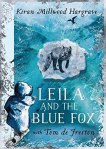 Leila and the Blue Fox by Kiran Millwood Hargrave – Similar in strategy to Hargrave’s previous book (also illustrated by her husband Tom de Freston), Julia and the Shark, one of my favourite reads of last year – both focus on the adventures of a girl who has trouble relating to her mother, a scientific researcher obsessed with a particular species. Leila, a Syrian refugee, lives with family in London and is visiting her mother in the far north of Norway. She joins her in tracking an Arctic fox on an epic journey, and helps the expedition out with social media. Migration for survival is the obvious link. There’s a lovely teal and black colour scheme, but I found this unsubtle. It crams too much together that doesn’t fit.
Celebrity autobiographies
A genre that pretty much never makes it onto my stacks, but I read these two despite knowing little to nothing about the authors; instead, I was drawn in by their particular stories.
 A Heart that Works by Rob Delaney – Delaney is an American actor who was living in London for TV filming in 2016 when his third son, baby Henry, was diagnosed with a brain tumour. He died before the age of three. The details of disabling illness and brutal treatment could not be other than wrenching, but the tone is a delicate balance between humour, rage, and tenderness. The tribute to his son may be short in terms of number of words, yet includes so much emotional range and a lot of before and after to create a vivid picture of the wider family. People who have never picked up a bereavement memoir will warm to this one.
 Born a Crime: Stories from a South African Childhood by Trevor Noah – Again, I was not familiar with the author’s work in TV/comedy, but had heard good things so gave this a try. It reminded me of Barack Obama’s Dreams from My Father what with the African connection, the absent father, the close relationship with his mother, and the reflections on race and politics. I especially loved his stories of being dragged to church multiple times every Sunday. He writes a lot about her tough love, and the difficulty of leaving hood life behind once you’ve been sucked into it. The final chapter is exceptional. Noah does a fine job of creating scenes and dialogue; I’d happily read another book of his.
Novels
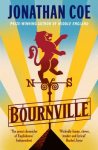 Bournville by Jonathan Coe – Coe does a good line in witty state-of-the-nation novels. Patriotism versus xenophobia is the overarching dichotomy in this one, as captured through a family’s response to seven key events from English history over the last 75+ years, several of them connected with the royals. Mary Lamb, the matriarch, is an Everywoman whose happy life still harboured unfulfilled longings. Coe mixes things up by including monologues, diary entries, and so on. In some sections he cuts between the main action and a transcript of a speech, TV commentary, or set of regulations. Covid informs his prologue and the highly autobiographical final chapter, and it’s clear he’s furious with the government’s handling.
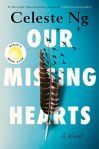 Our Missing Hearts by Celeste Ng – Disappointing compared to her two previous novels. I’d read too much about the premise while writing a synopsis for Bookmarks magazine, so there were no surprises remaining. The political commentary, though necessary, is fairly obvious. The structure, which recounts some events first from Bird’s perspective and then from his mother Margaret Miu’s, makes parts of the second half feel redundant. Still, impossible not to find the plight of children separated from their parents heart-rending, or to disagree with the importance of drawing attention to race-based violence. It’s also appealing to think about the power of individual stories and how literature and libraries might be part of an underground protest movement.
And a memoir in miniature
 Heating & Cooling: 52 Micro-Memoirs by Beth Ann Fennelly – I love memoirs-in-essays. Fennelly goes for the same minimalist approach as Abigail Thomas’s Safekeeping. Pieces range from one line to six pages and mostly pull out moments of note from the everyday of marriage, motherhood and house maintenance. I tended to get more out of the ones where she reinhabits earlier life, like “Goner” (growing up in the Catholic church); “Nine Months in Madison” (poetry fellowship in Wisconsin, running around the lake where Otis Redding died in a plane crash); and “Emulsionar,” (age 23 and in Barcelona: sexy encounter, immediately followed by scary scene). Two about grief, anticipatory for her mother (“I’ll be alone, curator of the archives”) and realized for her sister (“She threaded her arms into the sleeves of grief” – you can tell Fennelly started off as a poet), hit me hardest. Sassy and poignant.
The best so far? Probably Born a Crime, followed by Bournville.
Any of these you have read or would read?
#NovNov22 Nonfiction Week Begins! with Strangers on a Pier by Tash Aw
Short nonfiction week of Novellas in November is (not so) secretly my favourite theme of this annual challenge. About 40% of my reading is nonfiction, and I love finding books that illuminate a topic or a slice of life in well under 200 pages. I’ll see if I can review one per day this week.
Back in 2013 I read Tash Aw’s Booker-longlisted Five Star Billionaire and thought it was a fantastic novel about strangers thrown together in contemporary Shanghai. I don’t know why it hadn’t occurred to me to find something else by him in the meantime, but when I spotted this slim volume up in the library’s biography section, I knew it had to come home with me.
 Originally published in the USA as The Face in 2016, this is a brief family memoir reflecting on migration and belonging. Aw was born in Taiwan and grew up in Malaysia in an ethnically Chinese family; wherever he goes, he can pass as any number of Asian ethnicities. Both of his grandfathers were Chinese immigrants to Malaysia, but from different regions and speaking separate dialects. (This is something those of us in the West unfamiliar with China can struggle to understand: it has no monolithic identity or language. The food and culture might vary as much by region as they do in, say, different countries of Europe.)
Aw imagines his ancestors’ arrival and the disorientation they must have known as they made their way to an address on a piece of paper. His family members never spoke about their experiences, but the sense of being an outsider, a minority is something that has recurred through their history. Aw himself felt it keenly as a university student in Britain.
After the first long essay, “The Face,” comes a second, “Swee Ee, or Eternity,” addressed in the second person to his late grandmother, about whom, despite having worked in her shop as a boy, he knew next to nothing before he spent time with her as she was dying of cancer.
When is short nonfiction too short? Well, I feel that what I just read was actually two extended magazine articles rather than a complete book – that I read a couple of stories rather than the whole story. Perhaps that is inevitable for such a short autobiographical work, though I can think of two previous memoirs from last year alone that managed to be comprehensive, self-contained and concise: The Story of My Life by Helen Keller and The Cost of Living by Deborah Levy. (Public library) 
[91 pages]

Six Degrees of Separation: What Are You Going Through to No Saints Around Here
I’ve become an occasional Six Degrees of Separation post-er, when the mood strikes me and/or I get a flash of inspiration. This month we began with What Are You Going Through, which I reviewed back in October 2020. (See Kate’s opening post.)
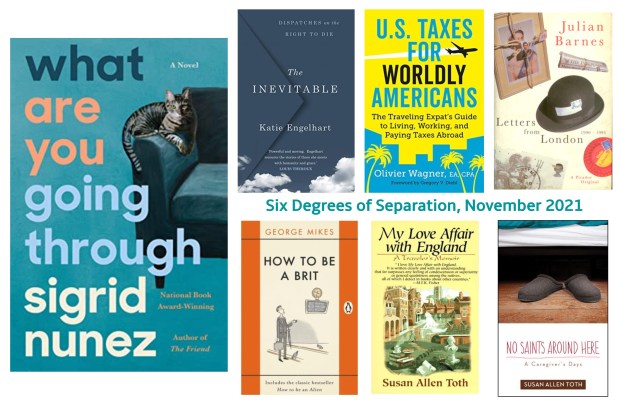
 Between that, The Friend and A Feather on the Breath of God, Sigrid Nunez has quickly become one of my favourite contemporary authors. I have two more of her novels on the shelf to read soon, one from my birthday haul.
In What Are You Going Through, the narrator is called upon to help a terminally ill friend commit suicide. However, I summed up the message as “Curiosity about other lives fuels empathy,” and noted “a sort of slapstick joy early in this morbid adventure.”
 #1 One of the stand-out books from my 2021 reading so far has been The Inevitable, which is about assisted dying. The case studies are wrenching but compassionately told. Katie Engelhart explores the nuances of situations, crafting expert portraits of suffering people and the medical professionals who seek to help them, and adding much in the way of valuable context.
 #2 As the saying goes, if there’s one thing inevitable besides death, it’s taxes. And if you’re a U.S. citizen, you will remain accountable to the IRS until the day you die, no matter where you live. (Eritrea is the only other country that requires expatriates to fill in tax returns.) I’ve now gotten my U.S. tax forms down to a science, keeping a list of pointers and previous years’ forms as scanned files so that I just have to plug in the year’s numbers, put zeroes in all the important boxes (since I’ve already paid income tax in the UK), and send it off. A matter of an hour or two’s work, rewarded by a G&T.
But I distinctly remember the Junes when I would spend days muddling through byzantine IRS forms, so I am very grateful that an offer for this e-book arrived in my inbox via my blog contact form in 2017: U.S. Taxes for Worldly Americans by Olivier Wagner. It goes through each form, often line by line. Three cheers for actually helpful self-help guides!
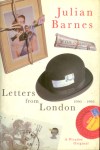 #3 Another expat tip that I found extremely useful, small as it might seem, is that “quite” means something different in American vs. British English. To an American it’s a synonym for “very”; to the guarded Brits, it’s more like “rather.” I have the Julian Barnes essay collection Letters from London to thank for this vital scrap of etymological knowledge.
 #4 Unsurprisingly, I have built up a small library of books about understanding the English and their ways. In the How to Be a Brit omnibus, collecting three short volumes from the 1940s–70s, George Mikes (a Hungarian immigrant) makes humorous observations that have, in general, aged well. His mini-essays on tea, weather and queuing struck me as particularly apt. I would draw a straight line from this through Bill Bryson’s Notes from a Small Island to the Very British Problems phenomenon.
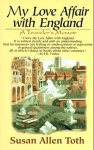 #5 As I was preparing to fly to England for the first time for my study abroad year, one of the authors who most whetted my appetite for British travel was Susan Allen Toth, whose trilogy of UK-themed memoirs-with-recommendations began with My Love Affair with England – included in one of my Landmark Books in My Life posts. I’m rereading one of the other three now.
 #6 Toth is a very underrated author, I feel. I’ve read most of her memoirs and have a short nonfiction work of hers on my pile for #NovNov. Her most recent book is No Saints Around Here: A Caregiver’s Days (2014), in which she chronicled the last 18 months of her husband James’s life, as she and an army of caregivers coped with his decline from Parkinson’s disease. Toth gets the tone just right: although she is honest, she is never melodramatic; although she often feels sorry for herself, she also recognizes how lucky she has been, not just to have done a good job of looking after James, but to have had him in her life at all.
I’ve gone full circle from one story of caregiving to another, via death, taxes and Englishness. The starting and ending books are reminders that you never fully know what another person is going through; all we can do is our best while cutting others some slack.
Where will your chain take you? Join us for #6Degrees of Separation! (Hosted on the first Saturday of each month by Kate W. of Books Are My Favourite and Best.) Next month’s starting point is our buddy read for week 4 of #NovNov, Ethan Frome by Edith Wharton.
Have you read any of my selections? Are you tempted by any you didn’t know before?
Review Book Catch-Up: Motherhood, Nature Essays, Pandemic, Poetry
July slipped away without me managing to review any current-month releases, as I am wont to do, so to those three I’m adding in a couple of other belated review books to make up today’s roundup. I have: a memoir-cum-sociological study of motherhood, poems of Afghan women’s experiences, a graphic novel about a fictional worst-case pandemic, seasonal nature essays from voices not often heard, and poetry about homosexual encounters.
(M)otherhood: On the choices of being a woman by Pragya Agarwal
“Mothering would be my biggest gesture of defiance.”
 Growing up in India, Agarwal, now a behavioural and data scientist, wished she could be a boy for her father’s sake. Being the third daughter was no place of honour in society’s eyes, but her parents ensured that she got a good education and expected her to achieve great things. Still, when she got her first period, it felt like being forced onto a fertility track she didn’t want. There was a dearth of helpful sex education, and Hinduism has prohibitions that appear to diminish women, e.g. menstruating females aren’t permitted to enter a temple.
Married and unexpectedly pregnant in 1996, Agarwal determined to raise her daughter differently. Her mother-in-law was deeply disappointed that the baby was a girl, which only increased her stubborn pride: “Giving birth to my daughter felt like first love, my only love. Not planned but wanted all along. … Me and her against the world.” No element of becoming a mother or of her later life lived up to her expectations, but each apparent failure gave a chance to explore the spectrum of women’s experiences: C-section birth, abortion, divorce, emigration, infertility treatment, and finally having further children via a surrogate.
While I enjoyed the surprising sweep of Agarwal’s life story, this is no straightforward memoir. It aims to be an exhaustive survey of women’s life choices and the cultural forces that guide or constrain them. The book is dense with history and statistics, veers between topics, and needed a better edit for vernacular English and smoothing out academic jargon. I also found that I wasn’t interested enough in the specifics of women’s lives in India.
With thanks to Canongate for the free copy for review.
Forty Names by Parwana Fayyaz
“History has ungraciously failed the women of my family”
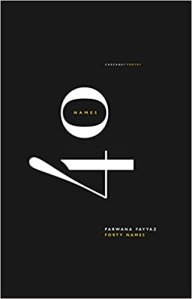 Have a look at this debut poet’s journey: Fayyaz was born in Kabul in 1990, grew up in Afghanistan and Pakistan, studied in Bangladesh and at Stanford, and is now, having completed her PhD, a research fellow at Cambridge. Many of her poems tell family stories that have taken on the air of legend due to the translated nicknames: “Patience Flower,” her grandmother, was seduced by the Khan and bore him two children; “Quietude,” her aunt, was a refugee in Iran. Her cousin, “Perfect Woman,” was due to be sent away from the family for infertility but gained revenge and independence in her own way.
Fayyaz is bold to speak out about the injustices women can suffer in Afghan culture. Domestic violence is rife; miscarriage is considered a disgrace. In “Roqeeya,” she remembers that her mother, even when busy managing a household, always took time for herself and encouraged Parwana, her eldest, to pursue an education and earn her own income. However, the poet also honours the wisdom and skills that her illiterate mother exhibited, as in the first three poems about the care she took over making dresses and dolls for her three daughters.
As in Agarwal’s book, there is a lot here about ideals of femininity and the different routes that women take – whether more or less conventional. “Reading Nadia with Eavan” was a favourite for how it brought together different aspects of Fayyaz’s experience. Nadia Anjuman, an Afghan poet, was killed by her husband in 2005; many years later, Fayyaz found herself studying Anjuman’s work at Cambridge with the late Eavan Boland. Important as its themes are, I thought the book slightly repetitive and unsubtle, and noted few lines or turns of phrase – always a must for me when assessing a poetry collection.
With thanks to Carcanet Press for the free copy for review.
Resistance by Val McDermid; illus. Kathryn Briggs
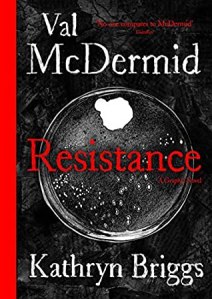 The second 2021 release I read in quick succession in which all but a small percentage of the human race (here, 2 million people) perishes in a pandemic – the other was Under the Blue. Like Aristide’s novel, this story had its origins in 2017 (in this case, on BBC Radio 4’s “Dangerous Visions”) but has, of course, taken on newfound significance in the time of Covid-19. McDermid imagines the sickness taking hold during a fictional version of Glastonbury: Solstice Festival in Northumberland. All the first patients, including a handful of rockstars, ate from Sam’s sausage sandwich van, so initially it looks like food poisoning. But vomiting and diarrhoea give way to a nasty rash, listlessness and, in many cases, death.
Zoe Beck, a Black freelance journalist who conducted interviews at Solstice, is friends with Sam and starts investigating the mutated swine disease, caused by an Erysipelas bacterium and thus nicknamed “the Sips.” She talks to the festival doctor and to a female Muslim researcher from the Life Sciences Centre in Newcastle, but her search for answers takes a backseat to survival when her husband and sons fall ill.
The drawing style and image quality – some panes are blurry, as if badly photocopied – let an otherwise reasonably gripping story down; the best spreads are collages or borrow a frame/backdrop (e.g. a medieval manuscript, NHS forms, or a 1910s title page).


SPOILER
{The ending, which has an immune remnant founding a new community, is VERY Parable of the Sower.}
With thanks to Profile Books/Wellcome Collection for the free copy for review.
Gifts of Gravity and Light: A Nature Almanac for the 21st Century, ed. Anita Roy and Pippa Marland
I hadn’t heard about this upcoming nature anthology when a surprise copy dropped through my letterbox. I’m delighted the publisher thought of me, as this ended up being just my sort of book: 12 autobiographical essays infused with musings on landscapes in Britain and elsewhere; structured by the seasons to create a gentle progression through the year, starting with the spring. Best of all, the contributors are mostly female, BIPOC (and Romany), working class and/or queer – all told, the sort of voices that are heard far too infrequently in UK nature writing. In momentous rites of passage, as in routine days, nature plays a big role.
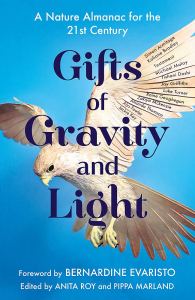 A few of my favourite pieces were by Kaliane Bradley, about her Cambodian heritage (the Wishing Dance associated with cherry blossom, her ancestors lost to genocide, the Buddhist belief that people can be reincarnated in other species); Testament, a rapper based in Leeds, about capturing moments through photography and poetry and about the seasons feeling awry both now and in March 2008, when snow was swirling outside the bus window as he received word of his uni friend’s untimely death; and Tishani Doshi, comparing childhood summers of freedom in Wales with growing up in India and 2020’s Covid restrictions.
Most of the authors hold two places in mind at the same time: for Michael Malay, it’s Indonesia, where he grew up, and the Severn estuary, where he now lives and ponders eels’ journeys; for Zakiya McKenzie, it’s Jamaica and England; for editor Anita Roy, it’s Delhi versus the Somerset field her friend let her wander during lockdown. Trees lend an awareness of time and animals a sense of movement and individuality. Alys Fowler thinks of how the wood she secretly coppices and lays on park paths to combat the mud will long outlive her, disintegrating until it forms the very soil under future generations’ feet.
A favourite passage (from Bradley): “When nature is the cuddly bunny and the friendly old hill, it becomes too easy to dismiss it as a faithful retainer who will never retire. But nature is the panic at the end of a talon, and it’s the tree with a heart of fire where lightning has struck. It is not our friend, and we do not want to make it our enemy.”
Also featured: Bernardine Evaristo (foreword), Raine Geoghegan, Jay Griffiths, Amanda Thomson, and Luke Turner.
With thanks to Hodder & Stoughton for the free copy for review.
Records of an Incitement to Silence by Gregory Woods
 Woods is an emeritus professor at Nottingham Trent University, where he was appointed the UK’s first professor of Gay & Lesbian Studies in 1998. Much of his sixth poetry collection is composed of unrhymed sonnets in two stanzas (eight lines, then six). The narrator is often a randy flâneur, wandering a city for homosexual encounters. One assumes this is Woods, except where the voice is identified otherwise, as in “[Walt] Whitman at Timber Creek” (“He gives me leave to roam / my idle way across / his prairies, peaks and canyons, my own America”) and “No Title Yet,” a long, ribald verse about a visitor to a stately home.
Other times the perspective is omniscient, painting a character study, like “Company” (“When he goes home to bed / he dare not go alone. … This need / of company defeats him.”), or of Frank O’Hara in “Up” (“‘What’s up?’ Frank answers with / his most unseemly grin, / ‘The sun, the Dow, my dick,’ / and saunters back to bed.”). Formalists are sure to enjoy Woods’ use of form, rhyme and meter. I enjoyed some of the book’s cheeky moments but had trouble connecting with its overall tone and content. That meant that it felt endless. I also found the end rhymes, when they did appear, over-the-top and silly (Demeter/teeter, etc.).
Two favourite poems: “An Immigrant” (“He turned away / to strip. His anecdotes / were innocent and his / erection smelled of soap.”) and “A Knot,” written for friends’ wedding in 2014 (“make this wedding supper all the sweeter / With choirs of LGBT cherubim”).
With thanks to Carcanet Press for the free copy for review.
Would you be interested in reading one or more of these?
Review Book Catch-Up: Fox, Le Riche, Nunez, and Thammavongsa
Today I have a book of poems about Covid lockdown and being autistic, a reprint of a vintage cookbook with a difference, the pinnacle of autofiction that I’ve found thus far, and a prize-winning collection of short stories about immigrants’ everyday challenges.
The Oscillations by Kate Fox (2021)
 The first section, “After,” responds to the events of 2020; six of its poems were part of a “Twelve Days of Lockdown” commission. Fox remembers how sinister a cougher at a public event felt on 13th March and remarks on how quickly social distancing came to feel like the norm, though hikes and wild swimming helped her to retain a sense of possibility. I especially liked “Pharmacopoeia,” which opens the collection and looks back to the Black Death that hit Amsterdam in 1635 – “suddenly the plagues / are the most interesting parts / of a city’s history.” “Returns” plots her next trip to a bookshop (“The plague books won’t be in yet, / but the dystopia section will be well stocked / … I spend fifty pounds I no longer had last time, will spend another fifty next. / Feeling I’m preserving an ecology, a sort of home”), while “The Funerals” wryly sings the glories of a spring the deceased didn’t get to see.
The second section, “Before,” is more wide-ranging, responding to artworks, historical events, family situations, and more. Fox has been vocal about her ASD, which is the subject of “What Could Be Called Communication,” about some habits of the neurodivergent that you might recognize. I also liked “The Fruits,” which narrates the end of a pregnancy, and the closing poem, “Emergency” (“between us, / sometimes despite us / love spreads like a satellite signal, / like sea foam, / like spilt coffee on a counter top, / like home.”). That was one of the few places in the whole book where the language (alliteration and an end-rhyme) struck me; elsewhere, the themes felt more notable than the poetic techniques.
With thanks to Nine Arches Press for the proof copy for review.
Eating Alone by Kathleen Le Riche (1954)
Recently reprinted as a facsimile edition by Faber, this was Le Riche’s third cookbook. It’s like no other cookbook I’ve read, though: It doesn’t list ingredients or, generally, quantities, and its steps are imprecise, more like suggestions. What it reads like is a set of short stories with incidental recipes. Le Riche had noted that people who live alone some or all of the time, for whatever reason, often can’t be bothered to cook for themselves properly. Through these old ladies, bachelors, career girls, and mothers with children off at school, she voices her ideas on shopping, food storage, simple cooking, and making good use of leftovers, but all through the medium of anecdote.
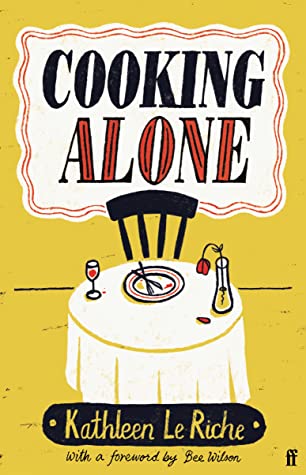 For instance, “The Grass Widower,” while his wife is away visiting her mother, indulges his love of seafood and learns how to wash up effectively. A convalescent plans the uncomplicated meals she’ll fix, including lots of egg dishes and some pleasingly dated fare like “junket” and cherries in brandy. A brother and sister, students left on their own for a day, try out all the different pancakes and quick breads in their repertoire. The bulk of the actual meal ideas come in a chapter called “The Happy Potterer,” whom Le Riche styles as a friend of hers named Flora who wrote out all her recipes on cards collected in an envelope. I enjoyed some of the little notes to self in this section: appended to a recipe for kidney and mushrooms, “Keep a few back for mushrooms-on-toast next day for a mid-morning snack”; “Forgive yourself if you have to use margarine instead of butter for frying.”
I don’t think there are any recipes here that I would actually try to reproduce, though I may one day attempt the Grass Widower’s silver-polishing method (put a strip of aluminium foil and some “washing soda” (soda crystals?) in the sink and pour over some boiling water from the kettle; dip in the silver items, touching them to the foil, and watch the tarnish disappear like magic!). This was interesting as a cultural artefact, to see the meals and ingredients that were mainstays of the 1950s (evaporated milk, anyone?) and how people coped without guaranteed refrigeration. It’s also a good reminder to eat well no matter your circumstances.
With thanks to Faber for the free copy for review.
A Feather on the Breath of God by Sigrid Nunez (1995)
My third from Nunez, after The Friend and What Are You Going Through, and my most loved of her books thus far, cementing her as one of my favourite authors. Like the other two, it’s narrated by an unnamed woman who defines herself by the people she encounters and the experiences she has in an unforgiving but still somehow beautiful and funny old world. From the little I know of Nunez, this seems the closest to autofiction, especially in terms of her parental origins. The father, Chang, born in Panama and raised in China, immigrated to the USA at age 12. In Germany for war service, he met her mother, Christa, just after VE Day.
 Chang and Christa, the subjects of the book’s first two sections – accounting for about half the length – were opposites and had a volatile relationship. Their home in the New York City projects was an argumentative place the narrator was eager to escape. She felt she never knew her father, a humourless man who lost touch with Chinese culture. He worked on the kitchen staff of a hospital and never learned English properly. Christa, by contrast, was fastidious about English grammar but never lost her thick accent. An obstinate and contradictory woman, she resented her lot in life and never truly loved Chang, but was good with her hands and loved baking and sewing for her daughters.
Growing up, the narrator never knew quite what to make of her mixed, “exotic” background. For a time, she escaped into ballet, a tantalizingly female discipline that threw up a lot of issues: class pretensions, the eroticization of young girls and of pain, and eating disorders. When she went without solid food for days at a time, she felt she was approaching the weightlessness Saint Hildegard likened to being “a feather on the breath of God.” The final chapter, “Immigrant Love,” jumps ahead to when the narrator taught English as a foreign language and had an affair with Vadim, a married Russian taxi driver full of charisma but also of flaws. This finale is a brilliant twist on her parents’ situation, and a decision to teach English in China brings things full circle, promising a connection to her late father’s heritage.
The strategy of identifying the self by the key relationships and obsessions of a life struck me as spot on. This short novel punches above its weight, with profound observations on every page. Its specific situations are engaging, yet it speaks to the universals of how we cope with a troublesome past. “One wants a way of looking back without anger or bitterness or shame. One wants to be able to tell everything without blaming or apologizing,” Nunez writes, crystallizing her frank, wry approach. I’m eager to read all the rest of her oeuvre.
First published in the UK in 2021. With thanks to Virago Press for the free copy for review.
How to Pronounce Knife by Souvankham Thammavongsa (2020)
 Thammavongsa pivoted from poetry to short stories and won Canada’s Giller Prize for this debut collection that mostly explores the lives of Laotian immigrants and refugees in a North American city. The 14 stories are split equally between first- and third-person perspectives, many of them narrated by young women remembering how they and their parents adjusted to an utterly foreign culture. The title story and “Chick-A-Chee!” are both built around a misunderstanding of the English language – the latter is a father’s approximation of what his children should say on doorsteps on Halloween. Television soaps and country music on the radio are ways to pick up more of the language. Farm and factory work are de rigueur, but characters nurture dreams of experiences beyond menial labour – at least for their children.
The stories are punchy: perfect snapshots of lives lived on the tightrope between expectation and despair. In “Mani Pedi,” Raymond is a former boxer who starts working at his sister’s nail salon and falls in love with a client. His sister warns him, “Don’t you be dreaming big now, little brother. Keep your dreams small. The size of a grain of rice.” In “Slingshot,” an older woman loses touch with her much younger lover, while in “The Gas Station,” Mary, a prim tax accountant, opens herself to love but ends up disappointed. The great-grandmother in “Ewwrrrkk” warns an eight-year-old that “I love you” pries open one’s legs like nothing else. “Randy Travis” and “Picking Worms” were probably my two overall favourites. Looking back, I have trouble remembering some of the individual stories. It’s not so much that they all blend into one, but that they form a cohesive whole. I’d recommend this even to readers who don’t normally pick up short stories, and will look out for more from this author.
Out in paperback on Thursday the 18th. With thanks to Bloomsbury for the free copy for review.
Would you be interested in reading one or more of these?
Three on a Theme: “Heart”
From a vibrant novel about trauma and second chances to a cultural history of our knowledge of the organ and its symbols, via a true story of the effects of being struck by lightning, what might these three disparate books have to tell us about the human heart on Valentine’s Day?
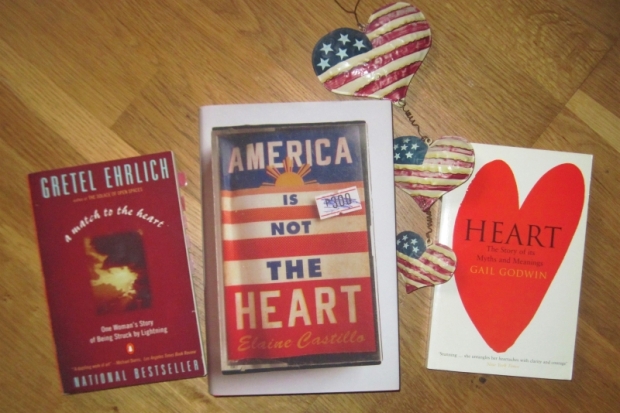
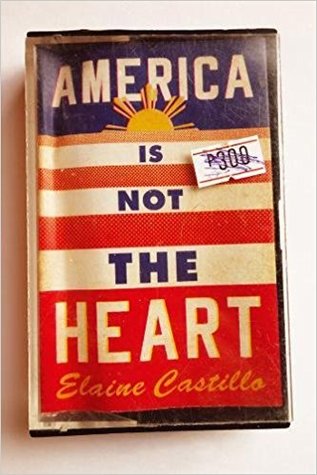
America Is Not the Heart by Elaine Castillo (2018)
This was criminally overlooked a few years ago, though I do remember Naomi F. featuring it on The Writes of Womxn. Set in the early 1990s in the Filipino immigrant neighborhoods of the Bay Area in California, it throws you into an unfamiliar culture at the deep end. There are lots of different ethnicities mentioned, and snippets of various languages (not just Tagalog, the one I knew of previously) run through the text, sometimes translated but often not. It’s a complex, confident debut novel that references episodes from the history of the Philippines of which I was mostly ignorant – genocide and reforms, dictatorship and a Marxist resistance.
 Geronima is a family name for the De Veras; not many realize that Hero, in her mid-thirties and newly arrived in the USA as an undocumented immigrant, and her cousin Roni, her uncle Pol’s seven-year-old daughter, share the same first name. Hero is estranged from her wealthy parents: they were friendly with the Marcos clan, while she ran away to serve as a doctor in the New People’s Army for 10 years. We gradually learn that she was held in a prison camp for two years and subjected to painful interrogations. Still psychologically as well as physically marked by the torture, she is reluctant to trust anyone. She stays under the radar, just taking Roni to and from school and looking after her while her parents are at work.
When Roni’s mother Paz, a medical professional, turns to traditional practices for help with Roni’s extreme eczema, Hero takes Roni to the Boy’s BBQ & Grill / Mai’s Hair and Beauty complex to see Adela Cabugao, a Filipina faith healer. The restaurant becomes a refuge for Hero and Roni – a place where they hang out with Adela’s granddaughter, Rosalyn, and her friends in the long hours Paz is away at her hospital jobs, eating and watching videos or reading Asian comics. Over the next few years Rosalyn introduces Hero to American holidays and customs. Castillo is matter-of-fact about Hero’s hook-ups with guys and girls but never strident about a bisexuality label. Hero pursues sex but remains wary of romance.
The everydayness of life here – car rides, cassette tapes, job applications, foil trays of food – contrasts with too-climactic memories. Though the plot can meander, there’s forward motion in that Hero shifts from a survival mindset into an assurance of safety that allows her to start rebuilding her life. I loved the 1990s as a setting. The characters shine and the dialogue (not in speech marks) feels utterly authentic in this fresh immigration story. My only minor disappointment was that second-person narration does not recur beyond a chapter about Paz and one about Rosalyn. The title riffs on a classic of Filipino American literature, America Is in the Heart (1946) by Carlos Bulosan, though I didn’t explore that comparison; it’s a novel that opens up real Google wormholes, should you take up the challenge. Castillo’s vibrant, distinctive voice reminded me of authors from Chimamanda Ngozi Adichie to Viet Thanh Nguyen. Please tell me she has another book in the works.
Favorite line: “Baggage means no matter how far you go, no matter how many times you immigrate, there are countries in you you’ll never leave.”
Words about the heart:
“Hero had no truck with people for whom the heart was a dreamt-up thing, held together by divine saliva, a place where gods of love still made their beds. A heart was something you could buy on the street, six to a skewer … served with garlicky rice and atsuete oil.”
“Hero had never even felt ambivalence toward Pol … She’d only ever known what it felt like to love him, to keep the minor altar of admiration for him in her heart well cleaned, its flowers rotless and blooming. What she hadn’t known was that her love was a room, cavernous, and hate could enter there, too; curl up in the same bed, blanketed and sleep-warm.”
“May tinik sa puso. You know what that means? Like she has a fishbone in the heart. She’s angry about something.”
Source: Free from a neighbor
My rating: 
A Match to the Heart by Gretel Ehrlich (1994)
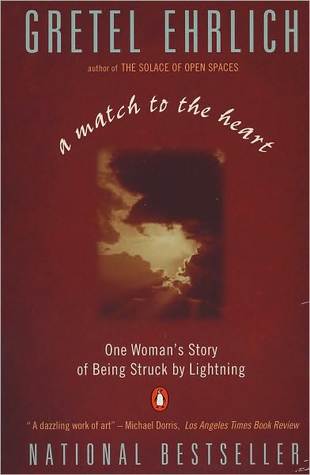 In August 1991, as a summer thunderstorm approached her Wyoming ranch, Ehrlich was struck by lightning. Although she woke up in a pool of blood, her dogs stayed by her side and she was able to haul herself the quarter-mile home and call 911 before she collapsed completely. Being hit by so much electricity (10–30 million volts) had lasting effects on her health. Her heart rhythms were off and she struggled with fatigue for years to come. In a sense, she had died and come back to a subtly different life.
After relocating to the California coast, she shadows her cardiologist and observes open-heart surgery, attends the annual Lightning Strike and Electric Shock Conference, and explores a new liminal land of beaches and islands. Again and again, she uses metaphors of the bardo and the phoenix to make sense of the in-between state she perhaps still inhabits. Full-on medical but also intriguingly mystical, this is another solid memoir from a phenomenal author. I know of her more as a nature/travel writer (This Cold Heaven is fantastic) and have another of her books on the shelf, The Solace of Open Spaces.
Words about the heart:
“Above and beyond the drama of cardiac arrest, or the threat of it, is the metaphorical territory of the heart: if love desists, if passion arrests, if compassion stops circulating through the arteries of society, then civilization, such as it is, will stop.”
“The thoracic cavity must have been the place where human music began, the first rhythm was the beat of the heart, and after that initial thump, waltzes and nocturnes, preludes and tangos rang out, straight up through flesh and capillary, nerve ganglion and epidermal layer, resonating in sternum bone: it wasn’t light that created the world but sound.”
Source: Birthday gift (secondhand) a couple years ago
My rating: 
Heart: The Story of Its Myths and Meanings by Gail Godwin (2001)
 I’d read one novel and one memoir by Godwin and was excited to learn that she had once written a wide-ranging study of the religious and literary meanings overlaid on the heart. While there are some interesting pinpricks here, the delivery is shaky: she starts off with a dull, quotation-stuffed, chronological timeline, all too thorough in its plod from the Epic of Gilgamesh to the Industrial Revolution. I quickly resorted to skimming and my eye alighted on Chinese philosophy (“True knowledge, Confucius taught, lies in the heart. He created and taught an ethical system that emphasized ‘human-heartedness,’ stressing balance in the heart”) and Dickens’s juxtaposition of facts and emotion in Hard Times.
Part Two, “Heart Themes in Life and Art,” initially seemed more promising in that it opens with the personal stories of her half-brother’s death in a murder–suicide and her mother’s fatal heart attack while driving a car, but I didn’t glean much from her close readings of, e.g. Joseph Conrad and Elizabeth Bowen. Still, I’ll keep this on the shelf as a reference book for any specific research I might do in the future.
Source: Bookbarn International on February 2020 visit (my last time there)
My rating: 
If you read just one … It’s got to be America Is Not the Heart. (Though, if you’re also interested in first-person medical accounts, add on A Match to the Heart.)
The 1956 Club: The Lonely Londoners and Night
It’s my second time participating in one of Simon and Karen’s reading weeks (after the 1920 Club earlier this year). It was a boon that the two books I chose and borrowed from the library were of novella length. As in April, I managed one very enjoyable read and one slightly less successful skim.
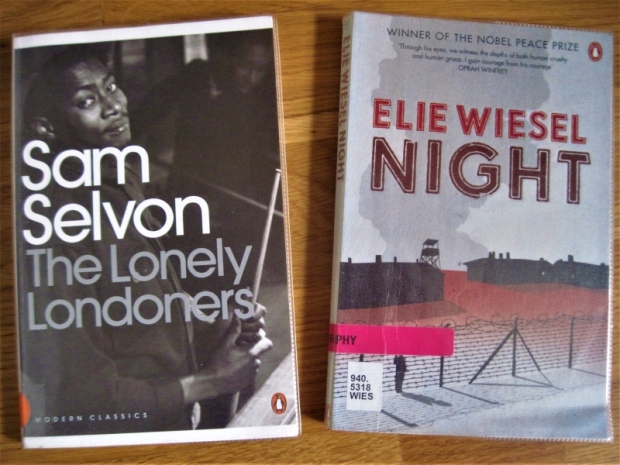
The Lonely Londoners by Sam Selvon
This title was familiar to me because it was one of the texts the London secondary school students could choose to review for a special supplement of Wasafiri literary magazine when I did a few in-school sessions mentoring them in the basics of book reviewing in early 2014. (An experience that was totally outside my comfort zone and now feels like a lifetime away.)
 Selvon, a Trinidadian journalist who settled in London in 1950, became known as the “father of black writing” in Britain. Moses Aloetta, an expert in London life after a few years here, lends a hand to his West Indian brethren who are fresh off the boat. As the book opens, he’s off to meet Henry Oliver, whom he soon dubs “Sir Galahad” for his naïve idealism. Moses warns Galahad that, although racism isn’t as blatant as in America, the British certainly aren’t thrilled about black people coming over and taking their jobs. Galahad reassures him that he’s a “born hustler.” We meet a series of other immigrants, like Cap and Bart, who move flats and change jobs frequently, drink and carouse, and “love woman too bad.”
I read and enjoyed the first 52 pages but skimmed from that point on because the patois, while initially captivating, got to be a bit much – I have a limited tolerance for dialect, and for episodic storytelling. I did love the sequences about Galahad catching pigeons for food and Cap following up with seagulls. There is a strong voice and sense of place here: if you want to experience London in the 1950s and see a rarer immigrant perspective, it would be a great choice. (Also recently reviewed by Liz and Annabel.)
Representative passages:
“It have people living in London who don’t know what happening in the room next to them, far more the street, or how other people living. London is a place like that. It divide up in little worlds, and you stay in the world you belong to and you don’t know anything about what happening in the other ones except what you read in the papers.”
the nine-page stream-of-consciousness paragraph that starts “Oh what a time it is when summer come to the city and all them girls throw away heavy winter coat and wearing light summer frocks so you could see the legs and shapes that was hiding away from the cold blasts”
My rating:
Night by Elie Wiesel
[Translated from the French by Marion Wiesel]
A short, harrowing memoir of concentration camp life. Eliezer Wiesel was a young teenager obsessed with the Kabbalah when his family was moved into a Romanian ghetto for Jews and then herded onto a transport train. Uniquely in my reading of Holocaust memoirs, Wiesel was not alone but had his father by his side for much of the time as they were shuttled between various concentration camps including Auschwitz and Buchenwald, from which he was liberated in April 1945. But if the presence of family started as a blessing in a life of privation and despair, it became more of a liability as his father fell ill with dysentery.
 Like Viktor Frankl, Wiesel puts his survival down to luck: not once but several times, he and his father were sent to the left (towards the crematoria), but spared at the last minute. They endured infection, a stampede, a snowstorm and near-starvation. But their faith did not survive intact. “For God’s sake, where is God?” someone watching the hanging of a child burst out. “And from within me, I heard a voice answer: ‘Where He is? This is where—hanging here from this gallows.’” I’d heard that story before, twisted by Christian commentators into a “Hey, that’s like Jesus on the cross! God is right here suffering with us” message when actually it’s more “God is dead. God has abandoned us.”
From the preface to a new translation by his wife, I learned that the original Yiddish manuscript was even bleaker in outlook, with opening and closing passages that voice a cynical loss of trust in God and fellow man. “I am not so naïve as to believe that this slim volume will change the course of history or shake the conscience of the world. Books no longer have the power they once did. Those who kept silent yesterday will remain silent tomorrow” was the chilling final line of his first version. And yet Night has been taught in many high schools, and if it opens even a few students’ eyes – given the recent astonishing statistics about American ignorance of the scope of the Holocaust – it has been of value.
Wiesel won the Nobel Peace Prize in 1986. His acceptance speech is appended to the text of my 2008 Penguin paperback. In it he declares: “I swore never to be silent whenever and wherever human beings endure suffering and humiliation. We must take sides. Neutrality helps the oppressor, never the victim. Silence encourages the tormentor, never the tormented. Sometimes we must interfere. When human lives are endangered, when human dignity is in jeopardy, national borders and sensitivities become irrelevant. Wherever men and women are persecuted because of their race, religion, or political views, that place must—at that moment—become the center of the universe.” Wise words with perennial relevance.
My rating:
#5–6 Short Fiction: Animal Crackers and Barnacle Love
I may have fallen behind on my 20 Books of Summer reading – August is going to have to be jam-packed! – but I have been enjoying the all-animals challenge. One of these two collections of short fiction sustains an animal theme for most of its length, while the other draws on metaphors from a fishing community but isn’t specifically about nature.
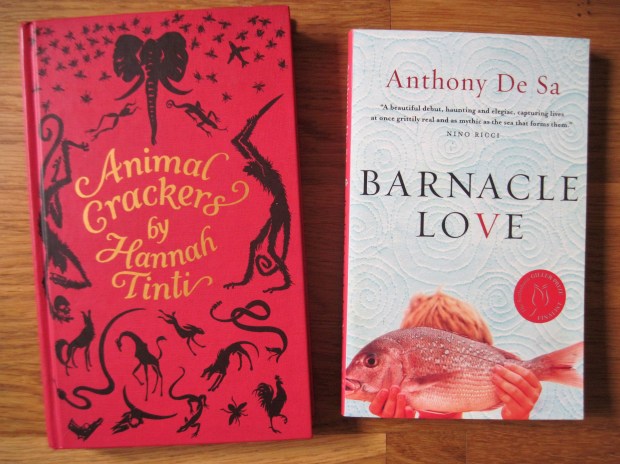
Animal Crackers by Hannah Tinti (2004)
A zoo, a circus, a turkey farm, a natural history museum, an African hunting expedition: several of the 11 stories are set in locales where human–animal interactions are formalized and exploitative, but all mention an animal at least once. In two cases the animal reference seems incidental and the stories really belong elsewhere – “Home Sweet Home,” which opens with the excellent line “Pat and Clyde were murdered on pot roast night,” appeared in Best American Mystery Stories 2003; “Hit Man of the Year” feels like a trial run for The Twelve Lives of Samuel Hawley – and in others there are gratuitous animal deaths at the hands of disturbed boys or angry men, which is always a strike against a book for me.
 I only found four stand-outs here. “Reasonable Terms” is a playful piece of magic realism in which a zoo’s giraffes get the gorilla to write out a list of demands for their keepers and, when agreement isn’t forthcoming, stage a mass mock suicide. In “How to Revitalize the Snake in Your Life,” a woman takes revenge on her boa constrictor-keeping boyfriend. In “Miss Waldron’s Red Colobus,” which reminded me of Ned Beauman’s madcap style, a boarding school teenager eludes the private detectives her parents have hired to keep tabs on her and makes it all the way to Ghana, where a new species of monkey is named after her. My favorite of all was “Preservation,” in which Mary saves wildlife paintings through her work as an art conservator but can’t save her father from terminal illness.
Barnacle Love by Anthony De Sa (2008)
When I plucked this Giller Prize finalist from a secondhand bookshop’s clearance shelf, I assumed it was a novel. The 10 titled chapters are in chronological order and recount the Rebelos’ experiences in Canada between the mid-1950s and the early 1980s, but in that each focuses on a discrete incident from the family’s history, they are more like linked short stories. Manuel, a fisherman from the Azores, is shipwrecked on the coast of Newfoundland and begins a new life in Canada. He’s deliberately gone far from his home village, far from his controlling mother and the priest who abused him: “I knew that if I stayed in our town, on our stifling island, I’d be consumed by what it was you [his mother] hoped and dreamed for me.” He moves from St. John’s to Toronto, brings over a Portuguese wife, and raises two children while hopping from one unsuccessful money-making scheme to another.
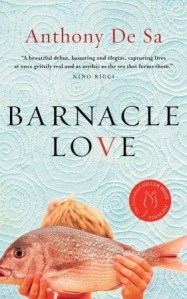 The first half of the book reports Manuel’s life in the third person, while the second is in the first person, narrated by his son, Antonio. Through that shift in perspective we come to see Manuel as both a comic and a tragic figure: he insists on speaking English, but his grammar and accent are atrocious; he cultivates proud Canadian traditions, like playing the anthem on repeat on Canada Day and spending Christmas Eve at Niagara Falls, but he’s also a drunk the neighborhood children laugh at. Although the two chapters set back in Portugal were my favorites, Manuel is a compelling, sympathetic character throughout, and I appreciated De Sa’s picture of the immigrant’s contrasting feelings of home and community. Particularly recommended if you’ve enjoyed That Time I Loved You by Carrianne Leung.
Representative passages:
Manuel’s mother: “My husband used to say that men are all barnacles. A barnacle starts out life swimming freely in the ocean. But, when it matures, it must settle down and choose a home. My dear husband used to say that it chooses to live with other barnacles of the same kind so that they can mate.”
Manuel: “I leave Portugal on fishing boat and I know I not going to come back. I give everything away to follow something new. I no understand what but something inside push me here—to make something of myself in this land. I come to be someone in this world.”
 Bookish Beck = Rebecca Foster. American transplant to England. Freelance proofreader and book reviewer.
 Bookish Beck