March Releases by Akbar, Bosker, García Márquez, and Wrenn
I’m catching up after a busy end to last month. Today I have an uneven debut novel from a poet whose work I’ve enjoyed before, a journalist’s jaunty submersion in the world of modern art, a posthumous novella from a famous Colombian author I’d not previously read, and a (literally) trippy memoir about C-PTSD, coral, climate breakdown, queerness and more. I can pinpoint a couple of elements that some or all of them have in common: beauty (whether in art or in nature) and dead mothers.
Martyr! by Kaveh Akbar
I’d read the Iranian American poet’s two full-length collections and particularly admired Pilgrim Bell, one of my favourite books of 2021. That was enough for me to put this on my Most Anticipated list for 2024, even though based on the synopsis I wrote: “His debut novel sounds kind of unhinged, but I figure it’s worth a try.” Here’s an excerpt from the publisher’s blurb: “When Cyrus’s obsession with the lives of the martyrs – Bobby Sands, Joan of Arc – leads him to a chance encounter with a dying artist, he finds himself drawn towards the mysteries of an uncle who rode through Iranian battlefields dressed as the Angel of Death; and toward his [late] mother, who may not have been who or what she seemed.”
 Cyrus Shams is an Iranian American aspiring poet who grew up in Indiana with a single father, his mother Roya having died in a passenger aircraft mistakenly shot down by a U.S. Navy missile cruiser (this really happened: Iran Air Flight 655, on 3 July 1988). He continues to lurk around the Keady University campus, working as a medical actor at the hospital, but his ambition is to write. During his shaky recovery from drug and alcohol abuse, he undertakes a project that seems divinely inspired: “Tired of interventionist pyrotechnics like burning bushes and locust plagues, maybe God now worked through the tired eyes of drunk Iranians in the American Midwest”. By seeking the meaning in others’ deaths, he hopes his modern “Book of Martyrs” will teach him how to cherish his own life.
This document, which we see in fragments, sets up hypothetical dialogues between figures real and imaginary, dead and living, and intersperses them with poems and short musings. But when a friend tells Cyrus about the Brooklyn Museum installation “DEATH-SPEAK,” which has terminally ill Iranian artist Orkideh living out her last days in public, he spies an opportunity to move the work beyond theory and into the physical realm. So he flies to New York City with his best friend (and occasional f**kbuddy), bartender Zee Novak, and visits Orkideh every day until the installation’s/artist’s end.
This is a wildly original but unruly novel with a few problems. One: Akbar has clung too obviously to his own story and manner of speaking with Cyrus (e.g., “I honestly actually do worry about that, no joke. Being a young Iranian man making a book about martyrdom, going around talking to people about becoming a martyr. It’s not inert, you know?”). Another is that the poems, and poetic descriptions, are much the best material. The only exception might be a zany scene where Zee and Cyrus chop wood while high. But the main issue I had is that the plot turns on a twist 50 pages from the end, a huge coincidence that feels unearned. I admire the ambition Akbar had for this – a seething, open-hearted enquiry into addiction, love, suicide and queerness – but look forward to him getting back to poetry. 
With thanks to Picador for the proof copy for review.
Get the Picture: A Mind-Bending Journey among the Inspired Artists and Obsessive Art Fiends Who Taught Me How to See by Bianca Bosker
I was a big fan of Bosker’s Cork Dork (2017), her deep dive into the world of fine wine. Her second book is similarly constructed and equally fun: more personal than authoritative, light yet substantial, and accessible to the uninitiated as well as those with an existing interest in the subject. She begins as a complete novice, wondering if she’ll ever know what art is, let alone what it means and whether it’s any good (“the familiar feeling that everyone got the punch line except me”). By the end, she has discovered that, like the love of wine, art appreciation can be a way of expanding and savouring one’s life.
The aim was to get the broadest experience possible, generally through voluntary placements. She started out as an assistant at Jack Barrett’s 315 Gallery, where one of her tasks was to paint a wall white; she failed miserably to meet his expectations even for this simple task. He never lost his fundamental distrust of her, a writer and outsider, as one of “the enemy.” It was expected that she would attend as many art shows and openings as possible per week. “Talking shit was essentially a job requirement.” Bosker might not have known what to make of the art, but others were gossipy, snobbish and opinionated enough to make up for it. When she was tasked with writing a press release for an exhibit, a gallerist taught her the clichéd shorthand: “Every f**king artist allegedly transforms the familiar into the unfamiliar, or vice versa.”

In the course of the book, the New York City-based author also:
- attends the Art Basel Miami Beach contemporary art fair and sells photographs on behalf of Denny Dimin Gallery;
- befriends performance artist and “ass influencer” Mandy AllFIRE, who – ahem – sits on Bosker’s face as part of a temporary installment;
- serves as a studio assistant for French painter Julie Curtiss, whose work is selling for alarmingly high amounts at auction (not actually what a painter wants, as it tends to signal bad things for a career);
- meets a pair of North Dakota collectors known as “the Icy Gays”; and
- works as a Guggenheim Museum guard.
This last was my favourite episode. Forty-minute placements on particular ramps gave her time to focus on one chosen artwork – for instance, an abstract sculpture. She challenged herself to stay with it for that whole time, doing as one artist advised and simply noticing five things about the work. Before, her “default approach to art had just been to plant myself in front of a piece and wait for the epiphany to wash over me.” Now, she worked at it. In fact, she counsels newcomers to not read a caption because many people take a title at face value and an interpretation as gospel, and so don’t experience the art for themselves.
At times I found the book slightly scattered in the way that it zigzags from one challenge to another. There’s differing attention to various experiences; a week-long art school merits just one paragraph. And there’s no getting past the fact that some art she encounters sounds outlandish or just plain silly. (Is it any surprise that she mistakes part of a wall, and a mousetrap, for art pieces?) Ultimately, I think it’s best if you have at least a modicum of appreciation for modern art, which I don’t; whereas I do enjoy drinking wine even if I don’t have a trained palate.
Even so, Bosker’s writing has such verve (“artists were coyly evasive about their work and treated my questions like I was a cactus running after their balloon”; “a hazy daydream of an idea solidified into a yappy, un-shut-uppable chihuahua of want”) that you’ll be glad you went along for the ride. She concludes that taste is subjective, but “Beauty … pulls you close.” Art is valuable because it “knocks us off our well-worn pathways” into something uncharted, a tantalizing prospect. 
With thanks to Allen & Unwin (Grove Press) for the free copy for review.
{SPOILERS IN THIS NEXT ONE}
Until August by Gabriel García Márquez
[Translated from the Spanish by Anne McLean]
A posthumous ‘lost’ novella was not a good place for me to have started with this celebrated author. García Márquez okayed the fifth draft of the text in 2004, 10 years before his death. By this time he was already suffering with memory loss that interfered with his creativity. His sons got the message that he didn’t think the book worked and should be destroyed. But they didn’t do his bidding and, revisiting the book nearly a decade on from his death, decided it wasn’t that bad, if not up to the standard of his best work, and that it should see the light of day after all.
Every August 16th, Ana Magdalena Bach travels to the island where her mother is buried to visit the grave and lay gladioli on it. (My review book came with a bag of three gladioli bulbs and a mini Colombian chocolate bar.) Each year she takes a different lover for the one night at a hotel. The first time, the man leaves her a $20 bill and she feels ashamed, but it doesn’t stop her doing the same thing again for the next four years in a row. Once it’s a long-ago school friend whom she runs into on the ferry. Another time, by golly, it’s a bishop.

It’s refreshing to have a woman in middle age as protagonist and for her to claim sexual freedom. However, the setup is formulaic and repetitive, the sex scenes are somewhat excruciating, and the hypocrisy of her gleefully having one-night stands while fretting over her husband’s potential infidelity is grating. I did like the ending – Ana hears that an anonymous elderly gentleman has been paying to have gladioli laid on her mother’s grave year-round and she wonders if she is in a sense following in her mother’s footsteps all along without knowing it; and decides she’s had enough and exhumes her mother’s remains, returning to her husband with a bag of bones (gruesome!).
But nothing about the plot or the writing – fluid enough bar one awkward sentence (“She listened to him worried that he meant it, but she had the strength not to appear as easy a woman as he might think”) – suggested to me a master at work. At best, this might be reminiscent of the late work of misogynist-leaning authors like Coetzee or Updike.
In my mind García Márquez is linked with magic realism, so I’d be better off trying one of his more representative works. I have several of his earlier novellas on the shelf (received as review copies as part of the same recent marketing push), and if I get on better with those then I’ll be sure to try one of the most famous full-length novels. 
With thanks to Viking (Penguin) for the free copy for review.
Mothership: A Memoir of Wonder and Crisis by Greg Wrenn
Wrenn is an associate English professor teaching environmental literature at James Madison University. He has also been exploring coral reefs for 25 years, with a love of marine wildlife sparked by growing up in Florida. But all along, he’s been trying (much like Cyrus Shams) to come to terms with addiction, queerness, suicidal inclinations, and especially his mother’s place in his life. She made him feel dirty, that he would never be good enough; she hit him with a wooden spoon and bathed him until he was 17. Though he never found out for sure, he suspects his mother was sexually abused by her father and repeated the cycle of molestation.
 This is the third C-PTSD memoir I’ve read (after What My Bones Know and A Flat Place), and has a lot in common with I’m Glad My Mom Died, which features a co-dependent relationship with an abusive mother. After Wrenn’s parents’ divorce, he and his mother remained close. “I had been her therapist, confessor, girlfriend, and punching bag.” He helped care for her after a stroke but eventually had to throw up his hands at her stubborn refusal to follow doctors’ orders. Drawing on the Greek etymology of ecology (oikos means house or family), Wrenn insists on a parallel between the personal and the environmental here: “What we’re facing amounts to global C-PTSD” as “Mother” Earth turns against us. On each trip to Raja Ampat, he knows the coral reef is dying, his carbon footprint only accelerating it.
There’s a lot in this short memoir. Even the summary had me shaking my head in disbelief. For me, though, the tone and style were too erratic. Wrenn can be wry, sorrowful, or campy; he includes scientific data, letters to Adrienne Rich and an imagined descendent, a chapter riffing on “Otters” (the animal and the gay stereotype), flashbacks, and E.T. metaphors. The final third of the book then takes a left turn as he experiments with therapeutic psychedelics via ayahuasca ceremonies in South America, and ditches dating apps and casual sex to try to find a long-term relationship. The drug literally alters his brain, allowing him to feel trust and love. Add on nature and a husband and that’s why he’s still here rather than dead by suicide.
Like Akbar, Wrenn published poetry before switching genre. Their books are both amazing in premise but wobbly in execution. Still, I’d say both authors are laudable for their effort to depict lives wrenched back from extremity. 
With thanks to Regalo Press (USA) for the proof copy for review.
Books of Summer, 6–8: Elizabeth Berg, Patricia Lockwood & Wendy Mitchell
Although I have foodie lit as a background theme for the summer’s reading, my main goal is simply to read books that I own, especially recent acquisitions and long-time shelf-sitters (whereas last year, in slavish conformity to a theme, I substituted in a bunch of library books, review books and e-books). My latest batch includes a slightly twee novel, an outlandish poetry collection, and an uneven nonfiction swan song.
The Year of Pleasures by Elizabeth Berg (2005)
 From the cover, I was expecting this to be more foodie than it was. The protagonist does enjoy cooking for other people and reading cookbooks, though. Betta Nolan, 55 and recently widowed by cancer, drives from Boston to the Midwest and impulsively purchases a house in a Chicago suburb, something she and her late husband had fantasized about doing in retirement. It’s the kind of sweet little town where the only realtor is a one-woman operation and Betta as a newcomer automatically gets invited onto the local radio show. She also reconnects with her college roommates, tries dating, and mulls over her dream of opening a women’s boutique that sells silk scarves, handmade journals, essential oils and brownies.
While Berg is true to the shifting emotions that accompany grief, and gives Betta plenty of cute opportunities to make friends across the generations – with Lydia, the nonagenarian former owner of her house, now in a nursing home; Matthew, the fickle young man who does some odd jobs for her; and Benny, the next-door neighbor’s nine-year-old boy – I found the subplot about Matthew’s messy house and relationships silly, and Betta’s “What a Woman Wants” shop idea is so stereotyping I could feel myself rolling my eyes. Still, Berg’s novels, of which this was my fifth, are always reliably light and pleasant reads in an Anne Tyler vein. (Secondhand – 2nd & Charles) 
Motherland Fatherland Homelandsexuals by Patricia Lockwood (2014)
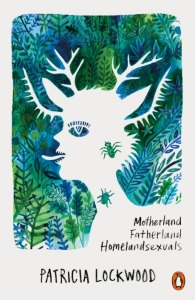 One of the more bizarre books I’ve ever read. I loved both Priestdaddy and No One Is Talking About This, but had no idea what to expect from Lockwood’s poems. They’re somewhere between absurdist monologues and thought experiments, often choosing an object or abstraction to animate (“A Recent Transformation Tries to Climb the Stairs”) and generally sexualized to the max (“Nessie Wants to Watch Herself Doing It”). Though they’re in stanzas, they aren’t heavy on poetic techniques. Some tangential topics are Bambi, Canada, basketball, waterfalls, King Kong adaptations, American poetry, Shirley Temple, and childhood hobbies like Animorphs, Egyptology and Magic Eye puzzles.
But really, her poetry is only “about” things in the loosest sense; the repetition, wordplay and snark are paramount. If you’ve heard of one, it’s likely to be the lengthy “Rape Joke,” which went as viral as it’s possible for a poem to and is, ironically, probably the sincerest entry here. Presumably based on her own bad experience with a teenage boyfriend, it is heartbreakingly banal: “The rape joke is that he was your father’s high school student … The rape joke is that come on, you should have seen it coming. … The rape joke is that you asked why he did it. The rape joke is he said he didn’t know, like what else would a rape joke say?”
A couple of my favourites were “List of Cross-Dressing Soldiers” and “He Marries the Stuffed-Owl Exhibit at the Indiana Welcome Center”; “The Father and Mother of American Tit-Pics,” in which a resurrected Emily Dickinson and Walt Whitman swap genders, had some of the more outrageous lines: “Walt Whitman is the Number Two Beach Body every year, because look at the way he snapped back into shape only months after giving birth to American Poetry.” Not really like any other poetry I’ve ever read. (New purchase with Christmas money) 
One Last Thing: Conversations on Life, Death and Assisted Dying by Wendy Mitchell with Anna Wharton (2023)
“We talk so often about prolonging life, but we are actually prolonging death by not discussing the suffering part of it.”
Wendy Mitchell’s first two books, Somebody I Used to Know and What I Wish People Knew About Dementia, are valuable peeks into daily life with young-onset Alzheimer’s. She has been a dedicated activist and educator in the nine years since her diagnosis, and I admire the work she’s done to get dementia services into the public eye.
 The problem with her final book is that I’ve read so much about preparations for dying and the question of assisted suicide and she doesn’t bring much new to the discussion – apart from the specific viewpoint of someone deciding when and how to end their life when they don’t know what the future course of their illness looks like. Mitchell believes people should have this choice, but current UK law does not allow for assisted dying. A loophole is voluntarily stopping eating and drinking (VSED), which she deems her best option. She stopped attending assessments in 2017 and has filed forms with her GP refusing treatment – her nightmare situation is being reliant on care in hospital and she doesn’t want to become that future, dependent Wendy.
Like Henry Marsh’s farewell book, And Finally, this gives the impression of having been written in a hurry and rushed into print, and so could have been edited more. As it is, it’s fairly scattered, repetitive and unpolished. The interviews could all be streamlined and tidied up, and the one with Kathryn Mannix is split up in a confusing way.
For readers new to the topic, however, this could be a useful introduction to the issues. It’s up-to-date in that Mitchell attends a Death Café, meets an end-of-life doula, and talks through the different forms (power of attorney, advance directive and so on) with experts. I also thought the epilogue was a lovely touch: after going for a ‘wing walking’ airplane adventure, she imagines that, having taken a bus into York, she sees her pre-diagnosis self and tells her everything she would want her to know, good and bad, about the challenges to come. (Proof copy from Hungerford Bookshop Summer Reading Celebration) [Different subtitle on finished edition?] 
Finishing 20 Books of Summer: The Anthropocene Reviewed by John Green
The final choice for my colour-themed 20 Books of Summer, a terrific essay collection about the best and worst of the modern human experience, also happened to be the only one where the colour was part of the author’s name rather than the book’s title. I also have a bonus rainbow-covered read and a look back at the highlights of my summer reading.
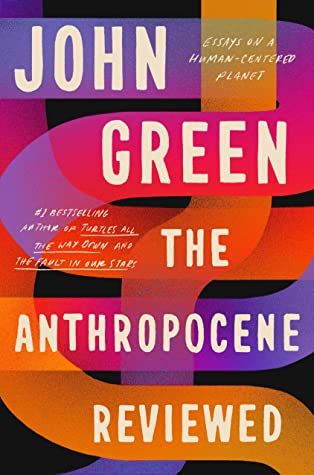
The Anthropocene Reviewed: Essays on a Human-Centered Planet by John Green (2021)
(20 Books of Summer, #20) How Have You Enjoyed the Anthropocene So Far? That’s the literal translation of the book’s German title, but also a tidy summary of its approach. John Green is not only a YA author but also a new media star – he and his brother Hank are popular vlogging co-hosts, and this book arose from a podcast of the same name. Some of the essays first appeared on his various video projects, too. In about 5–10 pages, he takes a phenomenon experienced in the modern age, whether miraculous (sunsets, the Lascaux cave paintings, favourite films or songs), regrettable (Staph infections, CNN, our obsession with grass lawns), or just plain weird, and riffs on it, exploring its backstory, cultural manifestations and personal resonance.
Indeed, the essays reveal a lot about Green himself. I didn’t know of his struggles with anxiety and depression. “Harvey,” one of the standout essays, is about a breakdown he had in his early twenties when living in Chicago and working for Booklist magazine. His boss told him to take as much time as he needed, and urged him to watch Harvey, the Jimmy Stewart film about a man with an imaginary friend that happens to be a six-foot rabbit. It was the perfect prescription. In “Auld Lang Syne,” Green toggles between the history of the song and a friendship from his own old times, with an author and mentor who has since died. “Googling Strangers” prides itself on a very 21st-century skill by which he discovers that a critically injured boy from his time as a student chaplain at a children’s hospital lived to adulthood.
Green is well aware of the state of things: “Humans are already an ecological catastrophe … for many forms of life, humanity is the apocalypse.” He plays up the contradictions in everyday objects: air-conditioning is an environmental disaster, yet makes everyday life tolerable in vast swathes of the USA; Canada geese are still, to many, a symbol of wildness, but are almost frighteningly ubiquitous – one of the winners in the species roulette we’ve initiated. And although he’s clued in, he knows that in many respects he’s still living as if the world isn’t falling apart. “In the daily grind of a human life, there’s a lawn to mow, soccer practices to drive to, a mortgage to pay. And so I go on living the way I feel like people always have.” A sentiment that rings true for many of us: despite the background dread about where everything is headed, we just have to get on with our day-to-day obligations, right?
Although he’s from Indianapolis, a not particularly well regarded city of the Midwest, Green is far from the conservative, insular stereotype of that region. There are pockets of liberal, hipster culture all across the Midwest, in fact, and while he does joke about Indy in the vein of “well, you’ve gotta live somewhere,” it’s clear that he’s come to love the place – enough to set climactic scenes from two of his novels there. However, he’s also cosmopolitan enough – he’s a Liverpool FC fan, and one essay is set on a trip to Iceland – to be able to see America’s faults (which, to an extent, are shared by many Western countries) of greed and militarism and gluttony and more.
In any book like this, one might quibble with the particular items selected. I mostly skipped over the handful of pieces on sports and video games, for instance. But even when the phenomena were completely unknown to me, I was still tickled by Green’s take. For example, here he is rhapsodizing on Diet Dr Pepper: “Look at what humans can do! They can make ice-cold, sugary-sweet, zero-calorie soda that tastes like everything and also like nothing.” He veers between the funny and the heartfelt: “I want to be earnest, even if it’s embarrassing.”
Each essay closes with a star rating. What value does a numerical assessment have when he’s making such apples-and-oranges comparisons (a sporting performance vs. sycamore trees vs. hot dog eating contests)? Not all that much. (Of course, some might make that very argument about rating books, but I persist!) At first I thought the setup was a silly gimmick, but since reviewing anything and everything on Amazon/TripAdvisor/wherever is as much a characteristic of our era as everything he’s writing about, why not? Calamities get 1–1.5 stars, things that seemed good but have turned out to be mixed blessings might get 2–3 stars, and whatever he unabashedly loves gets 4.5–5 stars.
As Green astutely remarks, “when people write reviews, they are really writing a kind of memoir—here’s what my experience was.” So, because I found a lot that resonated with me and a lot that made me laugh, and admired his openness on mental health à la Matt Haig, but also found the choices random such that a few essays didn’t interest me and the whole doesn’t necessarily build a cohesive argument, I give The Anthropocene Reviewed four stars. I’d only ever read The Fault in Our Stars, one of the first YA books I loved, so this was a good reminder to try more of Green’s fiction soon.
(Public library) 
Initially, I thought I might struggle to find 20 appealing colour-associated books, so I gave myself latitude to include books with different coloured covers. As it happens, I didn’t have to resort to choosing by cover, but I’ve thrown in this rainbow cover as an extra.
Songs in Ursa Major by Emma Brodie (2021)
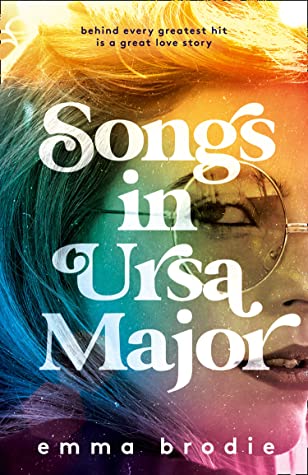 A Daisy Jones and the Six wannabe for sure, and a fun enough summer read even though the writing doesn’t nearly live up to Reid’s. Set largely between 1969 and 1971, the novel stars Jane Quinn, who lives on New England’s Bayleen Island with her aunt, grandmother and cousin – her aspiring singer mother having disappeared when Jane was nine. Nursing and bartending keep Jane going while she tries to make her name with her band, the Breakers. Aunt Grace, also a nurse, cares for local folk rocker Jesse Reid during his convalescence from a motorcycle accident. He then invites the Breakers to open for him on his tour and he and Jane embark on a turbulent affair. After Jane splits from both Jesse and the Breakers, she shrugs off her sexist producer and pours her soul into landmark album Songs in Ursa Major. (I got the Sufjan Stevens song “Ursa Major” in my head nearly every time I picked this up.)
There are some soap opera twists and turns to the plot, and I would say the novel is at least 100 pages too long, with an unnecessary interlude on a Greek island. Everyone loves a good sex, drugs and rock ’n roll tale, but here the sex scenes were kind of cringey, and the lyrics and descriptions of musical styles seemed laboured. Also, I thought from the beginning that the novel could use the intimacy of a first-person narrator, but late on realized it had to be in the third person to conceal a secret of Jane’s – which ended up feeling like a trick. There are also a few potential anachronisms (e.g. I found myself googling “how much did a pitcher of beer cost in 1969?”) that took me out of the period. Brodie is a debut novelist who has worked in book publishing in the USA for a decade. Her Instagram has a photo of her reading Daisy Jones and the Six in March 2019! That and the shout-out to Mandy Moore, of all the musical inspirations, in her acknowledgments, had me seriously doubting her bona fides to write this story. Maybe take it as a beach read if you aren’t too picky.
(Twitter giveaway win)

Looking back, my favourite read from this project was Nothing but Blue Sky by Kathleen MacMahon, closely followed by the novels Under the Blue by Oana Aristide and Ruby by Ann Hood, the essay collection The Anthropocene Reviewed by John Green (above), the travel book The Glitter in the Green by Jon Dunn, and the memoirs Darkness Visible by William Styron and Direct Red by Gabriel Weston. A varied and mostly great selection, all told! I read six books from the library and the rest from my shelves. Maybe next year I’ll not pick a theme but allow myself completely free choice – so long as they’re all books I own.
What was the highlight of your summer reading?
The Stone Diaries by Carol Shields (Blog Tour Review)
Is it possible to capture the complete course of a life, whether looking from the outside or telling it from the inside? What is set in stone and what is fleeting? These are questions Carol Shields addresses in her 1995 Pulitzer Prize winner, which plays with perspective and forms of storytelling as it conveys the extra/ordinary life of Daisy Stone Goodwill Flett. What with the family tree and section of black-and-white photographs, you might expect this to be a family saga; with the chronological chapters proceeding from “Birth” in 1905 to “Death” in the 1990s, you might expect an objective faux-biography. But The Stone Diaries is neither.
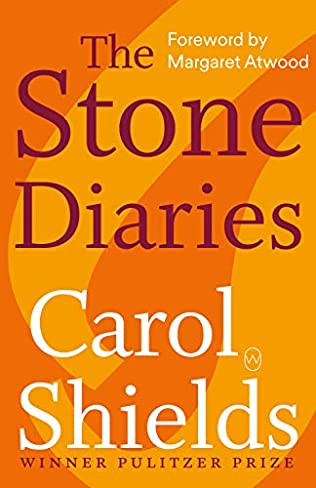 The facts are these. Daisy’s mother, Mercy, dies giving birth to her in rural Manitoba. Raised by a neighbor, Daisy later moves to Indiana with her stonecutter father, Cuyler. After a disastrously short first marriage, Daisy returns to Canada to marry Barker Flett. Their three children and Ottawa garden become her life. She temporarily finds purpose in her empty-nest years by writing a “Mrs. Green Thumb” column for a local newspaper, but her retirement in Florida is plagued by illness and the feeling that she has missed out on what matters most.
What makes this surprising life story so remarkable is its unpicking of (auto)biographical authenticity: Shields switches between the first and third person, between Daisy’s point of view and a feigned omniscience. Some sections foreground others’ opinions: Chapter 6 is composed entirely of letters Daisy receives, while Chapter 7 collects short first-person narratives from her children and friends as they speculate on why she has fallen into a depression.
As in Shields’s Happenstance and Larry’s Party, which I’ve also reread this year, I was struck by the role that chance plays in any life:
History indeed! As though this paltry slice of time deserves such a name. Accident, not history, has called us together, and what an assembly we make. What confusion, what a clamor of inadequacy and portent.
Talk of bias, gaps and unreliability undermines the narrative:
Well, a childhood is what anyone wants to remember of it. It leaves behind no fossils, except perhaps in fiction. Which is why you want to take Daisy’s representation of events with a grain of salt, a bushel of salt.
Daisy herself almost disappears from the parts of the book where she is voiceless, consumed by her roles – by the end she is universally known as “Grandma Flett.” This meant that other characters stood out as more memorable to me: Cuyler for his obsessive building of stone monuments and streams of words, Barker for his love of plants and long-deferred sexual fulfillment, Daisy’s friend Fraidy Hoyt for her careful chronicling of fast living, and Magnus, Barker’s father, who lives long past his 100th birthday after his return to the Orkney Islands.
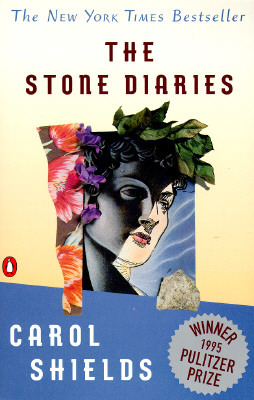 As in Moon Tiger, one of my absolute favorites, the author explores how events and memories turn into artifacts. The meta approach also, I suspect, tips the hat to other works of Canadian literature: in her introduction, Margaret Atwood mentions that the poet whose story inspired Shields’s Mary Swann had a collection entitled A Stone Diary, and surely the title’s similarity to Margaret Laurence’s The Stone Angel (1964) can’t be pure coincidence.
Experiencing the novel again after 14 years, I was impressed by the experimentation but ultimately somewhat detached from the story. It was admiration rather than love; I enjoyed earlier chapters more than the last few. But isn’t that just like life, to keep going past the point where it’s fun? And isn’t that the point, that the meaning you long for may not be there at all?
Marcie (Buried in Print) and I have reread – or, in my case for half of them, read for the first time – six Shields novels together in 2020. I hope I’ll find time to respond to the rest of them in the next few weeks. It has been so rewarding to observe how her themes recur and interlock. How heartening to see that, 17 years after her death, Shields is still being read and remembered, through the World Editions reissues (three more are coming in 2021) and through the Carol Shields Prize for Fiction, a new $100,000 annual award for North American women’s writing.
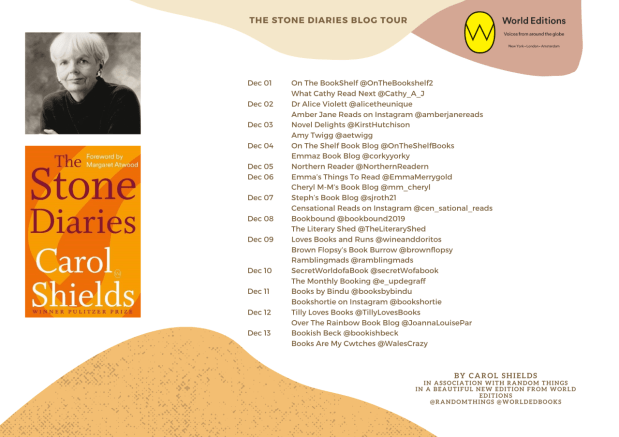
The Stone Diaries was reissued in the UK by World Editions on December 3rd. My thanks to the publisher for the free copy for review.
I was delighted to be invited to help close out the blog tour for The Stone Diaries. See below for details of where other reviews have appeared.
Three Out-of-the-Ordinary Memoirs: Kalb, Machado, McGuinness
Recently I have found myself drawn to memoirs that experiment with form. I’ve read so many autobiographical narratives at this point that, if it’s to stand out for me, a book has to offer something different, such as a second-person point-of-view or a structure of linked essays. Here are a few such that I’ve read this year but not written about yet. All have strong themes of memory and the creation of the self or the family.
Nobody Will Tell You This But Me: A True (As Told to Me) Story by Bess Kalb (2020)
 You know from the jokes: Jewish (grand)mothers are renowned for their fiercely protective, unconditional love, but also for their tendency to nag. Both sides of a stereotypical matriarch are on display in this funny and heartfelt family memoir, narrated in the second person – as if straight to Kalb from beyond the grave – by her late grandmother, Barbara “Bobby” Bell.
Bobby gives her beloved Bessie a tour through four generations of strong women, starting with her own mother, Rose, and her lucky escape from a Belarus shtetl. The formidable émigré ended up in a tiny Brooklyn apartment, where she gave birth to five children on the dining room table. Bobby and her husband, a real estate entrepreneur and professor, had one daughter, Robin, who in turn had one daughter, Bess. Bobby and Robin had a fraught relationship, but Bess’s birth seemed to reset the clock. Grandmother and granddaughter had a special bond: Bobby was the one to take her to preschool and wait outside the door until she was sure she’d be okay, and always the one to pick her up from sleepovers gone wrong.
Kalb is a Los Angeles-based writer for Jimmy Kimmel Live! With her vivid scene-setting and comic timing, you can see why she’s earned a Writers Guild Award and an Emmy nomination. But she also had great material to work with: Bobby’s e-mails and verbatim voicemail messages are hilarious. Kalb dots in family photographs and recreates in-person and phone conversations, with her grandmother forthrightly questioning her fashion choices and non-Jewish boyfriend. As the title phrase shows, Bobby felt she was the only one who would come forward with all this (unwanted but) necessary advice. Kalb keeps things snappy, alternating between narrative chapters and the conversations and covering a huge amount of family history in just 200 pages. It gets a little sentimental towards the end, but with her grandmother’s death still fresh you can forgive her that. This was a real delight.
My rating:
My thanks to Zoe Hood and Kimberley Nyamhondera of Little, Brown (Virago) for the free PDF copy for review.
In the Dream House: A Memoir by Carmen Maria Machado (2019)
I’m stingy with 5-star ratings because, for me, giving a book top marks means a) it’s a masterpiece, b) it’s a game/mind/life changer, and/or c) it expands the possibilities of its particular genre. In the Dream House fits all three criteria. (Somewhat to my surprise, given that I couldn’t get through more than half of Machado’s acclaimed story collection, Her Body and Other Parties, and only enjoyed it in parts.)
Much has been written about this memoir of an abusive same-sex relationship since its U.S. release in November. I feel I have little to add to the conversation beyond my deepest admiration for how it prioritizes voice, theme and scenes; gleefully does away with the chronology and (not directly relevant) backstory – in other words, the boring bits – that most writers would so slavishly detail; and engages with history, critical theory and the tropes of folk tales to constantly interrogate her experiences and perceptions.
 Most of the book is, like the Kalb, in the second person, but in this case the narration is not addressing a specific other person; instead, it’s looking back at the self that was caught in this situation (“If, one day, a milky portal had opened up in your bedroom and an older version of yourself had stepped out and told you what you know now, would you have listened?”), as well as – what the second person does best – putting the reader right into the narrative.
The “Dream House” is the Victorian house where Machado lived with her ex-girlfriend in Bloomington, Indiana for two years while she started an MFA course. It was a paradise until it wasn’t; it was a perfect relationship until it wasn’t. No one, least of all her, would have believed the perky little blonde writer she fell for would turn sadistic. A lot of it was emotional manipulation and verbal and psychological abuse, but there was definitely a physical element as well. Fear and self-doubt kept her trapped in a fairy tale that had long since turned into a nightmare. Writing it all out seven years later, the trauma was still there. Yet there was no tangible evidence (a police report, a restraining order, photos of bruises) to site her abuse anywhere outside of her memory. How fleeting, yet indelible, it had all been.
The book is in relatively short sections headed “Dream House as _________” (fill in the blank with everything from “Time Travel” to “Confession”), and the way that she pecks at her memories from different angles is perfect for recreating the spiral of confusion and despair. She also examines the history of our understanding of queer domestic violence: lesbian domestic violence, specifically, wasn’t known about until 30-some years ago.
The story has a happy ending in that Machado is now happily married. The bizarre twist, though, is that her wife, YA author Val Howlett, was the girlfriend of the woman in the Dream House when they first met. To start with, it was an “open relationship” (or at least the blonde told her so) that Machado reluctantly got in the middle of, before Val drifted away. That the two of them managed to reconnect, and got past their mutual ex, is truly astonishing. (See some super-cute photos from their wedding here.)
Some favorite lines:
“Clarity is an intoxicating drug, and you spent almost two years without it, believing you were losing your mind”
“That there’s a real ending to anything is, I’m pretty sure, the lie of all autobiographical writing. You have to choose to stop somewhere. You have to let the reader go.”
My rating: 
I read an e-copy via NetGalley.
Other People’s Countries: A Journey into Memory by Patrick McGuinness (2014)
This is a wonderfully atmospheric tribute to Bouillon, Belgium, a Wallonian border town with its own patois. However, it’s chiefly a memoir about the maternal side of the author’s family, which had lived there for generations. McGuinness grew up spending summers in Bouillon with his grandparents and aunt. Returning to the place as an adult, he finds it half-derelict but still storing memories around every corner.
 It is as much a tour through memory as through a town, reflecting on how our memories are bound up with particular sites and objects – to the extent that I don’t think I would find McGuinness’s Bouillon even if I went back to Belgium. “When I’m asked about events in my childhood, about my childhood at all, I think mostly of rooms. I think of times as places, with walls and windows and doors,” he writes. The book is also about the nature of time: Bouillon seems like a place where time stands still or moves more slowly, allowing its residents (including his grandfather, and Paprika, “Bouillon’s laziest man, who held a party to celebrate sixty years on the dole”) a position of smug idleness.
The book is in short vignettes, some as short as a paragraph; each is a separate piece with a title that remembers a particular place, event or local character. Some are poems, and there are also recipes and an inventory. The whole is illustrated with frequent period or contemporary black-and-white photographs. It’s an altogether lovely book that overcomes its narrow local interest to say something about how the past remains alive for us.
Some favorite lines:
“that hybrid long-finished but real-time-unfolding present tense … reflects the inside of our lives far better than those three stooges, the past, present and future”
a fantastic last line: “What I want to say is: I misremember all this so vividly it’s as if it only happened yesterday.”
My rating:
I read a public library copy.
Other unusual memoirs I’ve loved and reviewed here:
 Notes Made while Falling by Jenn Ashworth (essays, experimental structures)
Winter Journal by Paul Auster (second person)
This Really Isn’t about You by Jean Hannah Edelstein (nonchronological)
Traveling with Ghosts by Shannon Leone Fowler (short sections and time shifts)
The Lost Properties of Love by Sophie Ratcliffe (nonchronological essays)
Any offbeat memoirs you can recommend?
20 Books of Summer #9–14: Alden, Colwin, Danticat, Kimmel, Lipman & Steinbach
I fly back to the UK later today after a fairly busy few weeks of packing, unpacking, and more packing as I got my mom settled into her new home and dealt with the substantial amount of stuff I still had in storage with my parents. I’ll post later in the week about book culling versus acquisitions. For now, here’s a quick look at the books by women I’ve been reading in print towards my summer challenge: everything from a memoir of infertility to a perfectly summery novel set at a Vermont lake resort.
Crossing the Moon by Paulette Bates Alden (1998)
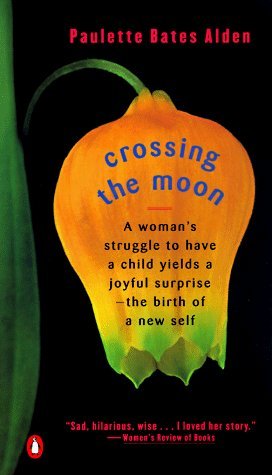 I first read this nearly four years ago (you can find my initial review in an early blog post that rounds up three of Alden’s works), and was moved to reread it this summer as a follow-up to Sheila Heti’s Motherhood. The book focuses on Alden’s uncertainty about having children all the way up to her late thirties, when she underwent three years of somewhat desperate, and ultimately unsuccessful, infertility treatment. “From the very start, I had seen writing and motherhood as mutually exclusive,” she writes, an attitude very similar to Heti’s. Yet she feared missing out on the meaning and love a child could bring to her life.
More broadly, the memoir is about the search to integrate the different aspects of a life – including family history and the fateful decisions that seem to have been made for you – into a realistic vision of the future. I didn’t find the book quite as profound this time around, but I noticed that I marked many of the same passages I did four years ago, about the dearth of childless role models and the struggle to accept the life that has become yours, even if it’s not what you predicted for yourself. That proves how influential and comforting it’s been for me.
Favorite lines:
“About the closest I can come to imagining what it would be like to have a child is with our cat, Cecil. For Cecil I feel the most delicious love, but also the most anxious responsibility.”
“It came to me that it really was a choice between two good things—having a child and not having a child. Our life without a child seemed good to me. I caught a glimpse that it was what was right for us, for the best. But who can say what is ‘best’? Maybe it’s possible to get to a place where what is best is simply what is.”
My rating: 
Passion and Affect by Laurie Colwin (1974)
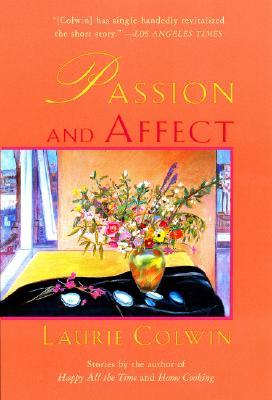 I mostly know Colwin as a food writer, but she also published fiction. This subtle story collection turns on quiet, mostly domestic dramas: people falling in and out of love, stepping out on their spouses and trying to protect their families. I didn’t particularly engage with the central two stories about cousins Vincent and Guido (characters from her novel Happy All the Time, which I abandoned a few years back), but the rest more than made up for them.
Several stories reveal the hidden depths of a character who’s only been a bit player in a protagonist’s life: a family friend who suddenly commits suicide, a Hispanic cook who has a rich boyfriend, a widowed piano teacher whose young student’s accomplishments buoy him up, and a supermarket employee whose ordinary life doesn’t live up to the fantasy background her manager, an art history PhD student, dreams up for her. In “The Water Rats” and “Wet,” water symbolizes all that we can’t control and understand, whether that’s our family’s safety or the inner life of a spouse.
Colwin writes funny, sharp descriptions, like “he was greeted by a young man wearing his hair in the manner of John Donne, a three-piece suit, and cowboy boots” and “she windowshopped, staring with rapt depression at rows of mannikins in glossy trousers.”
Favorite lines:
“She was three years married and when she looked at herself in the mirror, she did not see that she had become any more serious, any less young and heedless, or any more willing to get down to what Richard called ‘the things of life.’ He was right when he said that she had not made up her mind about anything.”
“He looked at his dissertation, or the heap that was to become his dissertation, and sighed again. He was of two minds about this Vermeer business, and he was of two minds about this supermarket business. That accounted for four minds in all, and it made life painful for him.”
My rating:
Breath, Eyes, Memory by Edwidge Danticat (1994)
 Like her protagonist, Sophie Caco, Danticat was raised by her aunt in Haiti and reunited with her parents in the USA at age 12. As Sophie grows up and falls in love with an older musician, she and her mother are both haunted by sexual trauma that nothing – not motherhood, not a long-awaited return to Haiti – seems to heal. I loved the descriptions of Haiti (“The sun, which was once god to my ancestors, slapped my face as though I had done something wrong. The fragrance of crushed mint leaves and stagnant pee alternated in the breeze” and “The stars fell as though the glue that held them together had come loose”), and the novel gives a powerful picture of a maternal line marred by guilt and an obsession with sexual purity. However, compared to Danticat’s later novel, Claire of the Sea Light, I found the narration a bit flat and the story interrupted – thinking particularly of the gap between ages 12 and 18 for Sophie. (Another Oprah’s Book Club selection.)
Favorite lines:
“She cannot stay out of duty. The things one does, one should do out of love.”
“I knew my hurt and hers were links in a long chain and if she hurt me, it was because she was hurt, too.”
My rating: 
A Girl Named Zippy by Haven Kimmel (2001)
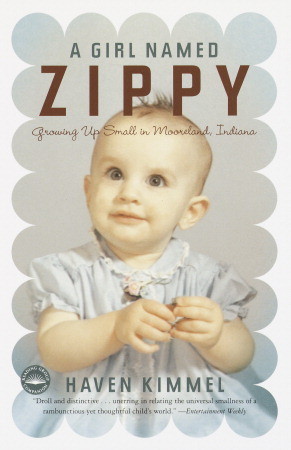 Maybe you grew up in or near a town like Mooreland, Indiana (population 300). Born in 1965 when her brother and sister were 13 and 10, Kimmel was affectionately referred to as an “Afterthought” and nicknamed “Zippy” for her boundless energy. Gawky and stubborn, she pulled every trick in the book to try to get out of going to Quaker meetings three times a week, preferring to go fishing with her father. The short chapters, headed by family or period photos, are sets of thematic childhood anecdotes about particular neighbors, school friends and pets. I especially loved her parents: her mother reading approximately 40,000 science fiction novels while wearing a groove into the couch, and her father’s love of the woods (which he called his “church”) and elaborate preparations for camping trips an hour away.
The tone is light-hearted despite hints of unpleasantness around town: open hostility towards people of color, a lecherous music teacher and a kid who abused animals. The more exaggerated stories are reminiscent of David Sedaris’s work – did she really cut hippies’ hair in exchange for an Irish Setter puppy?! Mostly, the book made me think about my mother’s small-town childhood versus my own suburban one, and how I would try to put all my early experiences together in a funny, nostalgic but honest way. It wouldn’t be easy at all, which makes Kimmel’s a noteworthy achievement.
Favorite lines:
“I figure heaven will be a scratch-and-sniff sort of place … I will ask for the smell of my dad’s truck, which was a combination of basic truck (nearly universal), plus his cologne (Old Spice), unfiltered Lucky Strikes, and when I was very lucky, leaded gasoline.”
“Mom used to say that my dad was a mountain man, which was obviously just a figure of speech, since most of Indiana is flat as a pancake. Her point was that Dad is a wild man, which was certainly true.”
My rating:
The Inn at Lake Devine by Elinor Lipman (1998)
 This was a breezy, delightful novel perfect for summer reading. In 1962 Natalie Marx’s family is looking for a vacation destination and sends query letters to various Vermont establishments. Their reply from the Inn at Lake Devine (proprietress: Ingrid Berry) tactfully but firmly states that the inn’s regular guests are Gentiles. In other words, no Jews allowed. The adolescent Natalie is outraged, and when the chance comes for her to infiltrate the Inn as the guest of one of her summer camp roommates, she sees it as a secret act of revenge.
In fact, in the years to come, after she trains as a chef, Natalie will become further entwined in the inn’s life, helping the family recover from a tragedy, falling in love with one of the Berry sons, and unwittingly contributing to a livelihood-threatening accident. Natalie’s voice drew me in right from the start. Lipman’s comedies of manners have been compared to Jane Austen’s, and you can see that likeness in the witty dialogue. I’ll certainly read more by her.
My rating:
Without Reservations: The Travels of an Independent Woman by Alice Steinbach (2000)
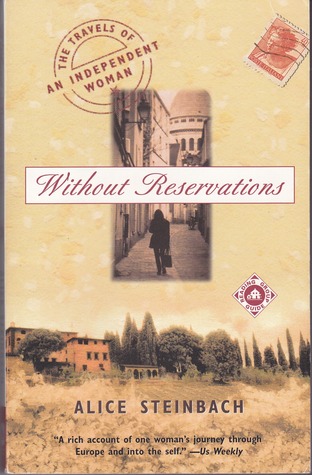 In 1993 Steinbach, then in her fifties, took a sabbatical from her job as a Baltimore Sun journalist to travel for nine months straight in Paris, England and Italy. As a divorcee with two grown sons, she no longer felt shackled to her Maryland home and wanted to see if she could recover a more spontaneous and adventurous version of herself and not be defined exclusively by her career. Her innate curiosity and experience as a reporter helped her to quickly form relationships with other English-speaking tourists, which was an essential for someone traveling alone.
I enjoyed spotting familiar sites I’ve visited, but I don’t think you need to know these countries or even have a particular interest in them to appreciate the book. Whether she’s attending a swanky party or nearly getting mugged, Steinbach is an entertaining and unpretentious tour guide. Her attitude is impressive, too: “I had surprised myself this year by jumping in to reshape my life before life stepped in to reshape it for me.” You might not be willing to give up your normal existence for nine months, but I suspect that this travel memoir might make you consider how you could be more daring in your daily life.
My rating:
 Bookish Beck = Rebecca Foster. American transplant to England. Freelance proofreader and book reviewer.
 Bookish Beck