Doorstopper(s) of the Month: Julia Glass (& Umberto Eco)
The Whole World Over by Julia Glass (2006)
When I plucked this from the sidewalk clearance area of my favorite U.S. bookstore, all I knew about it was that it featured a chef and was set in New York City and New Mexico. Those facts were enough to get me interested, and my first taste of Julia Glass’s fiction did not disappoint. I started reading it in the States at the very end of December and finished it in the middle of this month, gobbling up the last 250 pages or so all in one weekend.
 Charlotte “Greenie” Duquette is happy enough with her life: a successful bakery in Greenwich Village, her psychiatrist husband Alan, and their young son George. But one February 29th – that anomalous day when anything might happen – she gets a call from the office of the governor of New Mexico, who tasted her famous coconut cake (sandwiched with lemon curd and glazed in brown sugar) at her friend Walter’s tavern and wants her to audition for a job as his personal chef at the governor’s mansion in Santa Fe. It’s just the right offer to shake up her stagnating career and marriage.
One thing you can count on from a doorstopper, from Dickens onward, is that most of the many characters will be connected (“a collection of invisibly layered lives” is how Glass puts it). So: Walter’s lover is one of Alan’s patients; Fenno, the owner of a local bookstore, befriends both Alan and Saga, a possibly homeless young woman with brain damage who volunteers in animal rescue – along with Walter’s dog-walker, who’s dating his nephew; and so on. The title refers to how migrating birds circumnavigate the globe but always find their way home, and the same is true of these characters: no matter how far they stray – even as Greenie and Alan separately reopen past romances – the City always pulls them back.
My only real complaint about the novel is that it’s almost overstuffed: with great characters and their backstories, enticing subplots, and elements that seemed custom-made to appeal to me – baking, a restaurant, brain injury, the relatively recent history of the AIDS crisis, a secondhand bookstore, rescue dogs and cats, and much more. I especially loved the descriptions of multi-course meals and baking projects. Glass spins warm, effortless prose reminiscent of what I’ve read by Louise Miller and Carolyn Parkhurst. I will certainly read her first, best-known book, Three Junes, which won the National Book Award. I was also delighted to recall that I have her latest on my Kindle: A House Among the Trees, based on the life of Maurice Sendak.
All told, this was quite the bargain entertainment at 95 cents! Two small warnings: 1) if you haven’t read Three Junes, try not to learn too much about it – Glass likes to use recurring characters, and even a brief blurb (like what’s on the final page of my paperback; luckily, I didn’t come across it until the end) includes a spoiler about one character. 2) Glass is deliberately coy about when her book is set, and it’s important to not know for as long as possible. So don’t glance at the Library of Congress catalog record, which gives it away.
Page count: 560
My rating: 
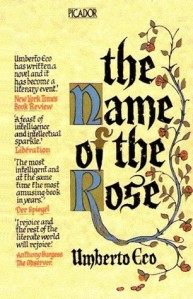 I started Umberto Eco’s The Name of the Rose (1983) with the best intentions of keeping up with Annabel’s buddy read. The first 50–100 pages really flew by and drew me into the mystery of a medieval abbey where monks keep getting murdered in hideous ways. I loved the Sherlockian shrewdness and tenacity of Brother William; the dutiful recording of his sidekick, narrator Adso of Melk; and the intertextual references to Borges’s idea of a library as a labyrinth. But at some point the historical and theological asides and the untranslated snippets of other languages (mostly Latin) began to defeat me, and I ended up just skimming most of the book. I’d recommend this if you liked Samantha Harvey’s The Western Wind, or if you fancy an astronomically more intelligent version of The Da Vinci Code.
A favorite passage: “Books are not made to be believed, but to be subjected to inquiry. When we consider a book, we mustn’t ask ourselves what it says but what it means”
My rating: 
American Book Acquisitions and 2019 Reading Goals
We arrived in the UK on January 1, after an overnight flight from Baltimore. There was no midnight announcement, no complimentary champagne; nothing. Clearly I had my hopes too high. So we’re feeling a bit cheated out of our New Year’s Eve experience and will be doing a recreated countdown and toast when we have houseguests over for this Epiphany weekend.
It was a low-key, relaxing couple of weeks back in the States, the majority of it spent seeing family and friends. We also made it into D.C. to see the new Obama portraits. Mostly I enjoyed doing not a lick of work. And I acquired books, of course: a secondhand and remainder stack that, after my trade-in of some cast-off books, cost just $4; and a few ARCs I’m excited about.


2019 Goals
I’m feeling restless in my career, like if someone gave me permission to quit all my gigs I would do it tomorrow. But, of course, only a fool would do so with no plan to replace them with other remunerative work. The year is likely to involve a lot of rethinking for me as I evaluate which of my proofreading and writing jobs feel worthwhile, and what’s taking me in the direction I want to go (not that I currently know what that is).
Life is awfully hard to plan out. Reading is much easier! So here are my fairly modest reading goals for the year, some of them overlapping:
- I plan to reinstate the Classic and Doorstopper of the month features I ran in 2017, since otherwise I hardly ever read them. I’m starting with Annabel’s readalong of The Name of the Rose by Umberto Eco, which is just over 500 pages but also conveniently falls into one of the below categories.

The doorstoppers I have around to choose from.
- I’ll make a second attempt at getting through some of the travel books and biographies I own, though I won’t hold myself to any particular target. At least five of each would be nice.


- I’m determined to up my literature in translation ratio. These are all the books I own that were originally published in other languages – pitiful! – but I will get hold of more through the library and publishers.

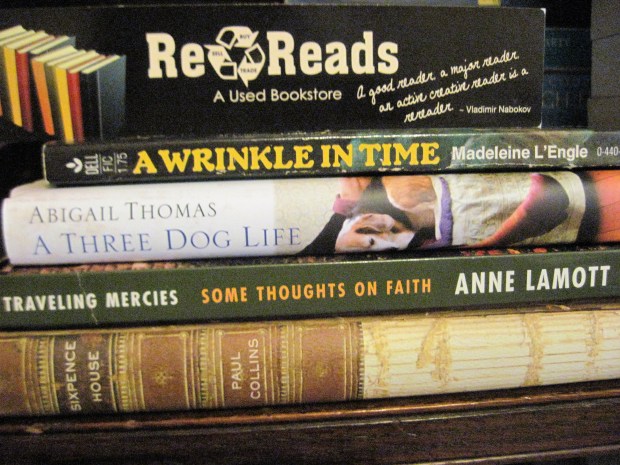
- Re-reading is something I undertake very reluctantly. I have friends who swear by it, but to me it can feel like a waste of time. Last year I re-read just four books: Little Women, Give Me Everything You Have, Crossing the Moon, and Diary of a Bookseller. In each case, on the second reading I rated the book a star lower. That suggests that, far from appreciating books more on a second reading, I have less patience with them and find more flaws! All the same, I’ve chosen four books to re-read in 2019. The Collins is a longtime favorite about moving to Hay-on-Wye; the Thomas is one of the books that first got me into reading memoirs. I’ve been let down by Lamott’s latest three books so wanted to go back to one of her spiritual classics; I’ve gotten into L’Engle’s writing for adults and want to revisit her most famous children’s book (which I don’t think I comprehended at age nine or whatever I was).
- I have a bad habit of racing through self-help and theology books rather than taking my time mulling over them and fully exploring how I might apply them in my life. This was especially true of The Artist’s Way, one of my bibliotherapy prescriptions. I started out with the aim of completing the daily “morning pages” of free writing (though for me they were ‘evening pages’; I’m not a morning person) and each chapter’s self-knowledge exercises. But soon I’d given up on the writing and contemplation and begun just reading the book straight through, which is not the point of it at all. So this year I mean to go back through the Cameron and Rubin books more mindfully, and use the McLaren devotional as it is intended, reading the recommended Bible passages alongside the weekly reflections.

What are some of your goals (reading-related or otherwise) for 2019?
Final 2018 Statistics and Where My Books Came From
My most prolific year yet! (I’m sure I said the same last year, but really, this is a number I will most likely never top and shouldn’t attempt to.) People sometimes joke to me, “why not shoot for a book a day?!” but that’s not how I do things. Instead of reading one book from start to finish, I almost always have 10 to 20 books on the go at a time, and I tend to start and finish books in batches – I’m addicted to starting new books, but also to finishing them.

The breakdown:
Fiction: 44.9%
Nonfiction: 45.8%
Poetry: 9.3%
(I think this is the first time nonfiction has surpassed fiction! They’re awfully close, though. I read a bit less poetry this year than last.)
Male author: 38.1%
Female author: 61.9%
(Roughly the same thing has happened the last two years, which I find interesting because I have never consciously set out to read more books by women.)
E-books: 15.7%
Print books: 84.3%
(In 2016 I read one-third e-books; in 2017 it was one-quarter. For some reason I seem to find e-books less and less appealing. They are awfully useful for traveling. However, I’ve been cutting back on the reviewing gigs that rely on me reading only e-books.)
Works in translation: 4.8%
(Ouch – my reading in translation almost halved compared to last year. I’m going to have to make a point of reading more translated work next year.)
Where my books came from for the whole year:
- Free print or e-copy from publisher: 28.7%
- Public library: 20.8%
- Secondhand purchase: 20.6%
- Downloaded from NetGalley or Edelweiss: 14.9%
- Gifts: 5%
- Free (giveaways, GET Free Bookshop, Book Thing of Baltimore, etc.): 3.8%
- University library: 3.2%
- New purchase (usually at a bargain): 1.5%
- Kindle purchase: 0.9%
- Borrowed: 0.6%
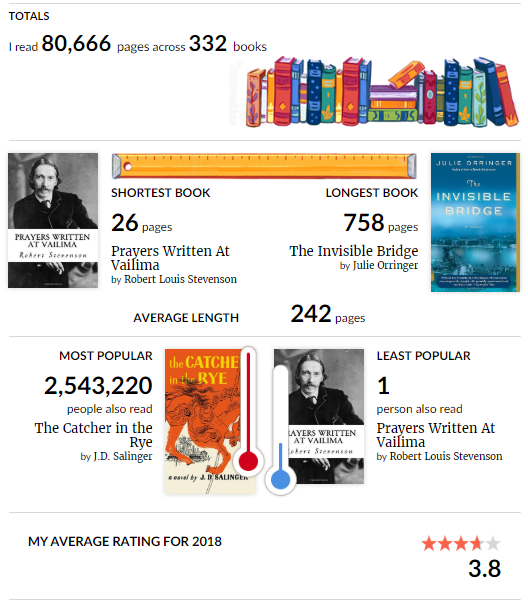
Some interesting additional statistics courtesy of Goodreads:
How did 2018 turn out for you reading-wise?
Happy New Year!
Recent Bylines: Glamour, Shiny New Books, Etc.
Following up on my post from June, here are excerpts from and links to some of my recent online writing for places that aren’t my blog.
Review essay of Gross Anatomy by Mara Altman for Glamour UK
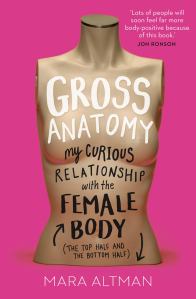 The female body has been a source of deep embarrassment for Altman, but here she swaps shame for self-deprecating silliness and cringing for chuckling. Through a snappy blend of personal anecdotes and intensive research, she exposes the cultural expectations that make us dislike our bodies, suggesting that a better knowledge of anatomy might help us feel normal. While 11 of her 15 topics aren’t exclusive to women’s anatomy—birthmarks, hemorrhoids, warts and more apply to men, too—she always presents an honest account of the female experience. This is one of my favorite books of the year and one I’d recommend to women of any age. It’s funny, it’s feminist, and it’s a cracking good read. (My full review is complete with embarrassing personal revelations!)
Essay on two books about “wasting time” for the Los Angeles Review of Books
In Praise of Wasting Time by Alan Lightman  &
&
 The Art of the Wasted Day by Patricia Hampl: A poet’s delight in lyricism and free association is in evidence here. The book blends memoir with travel and biographical information about some of Hampl’s exemplars of solitary, introspective living, and it begins, quite literally, with daydreaming.
 Hampl and Lightman start from the same point of frazzled frustration and arrive at many of the same conclusions about the necessity of “wasted” time but go about it in entirely different ways. Lightman makes a carefully constructed argument and amasses a sufficient weight of scientific and anecdotal evidence; Hampl drifts and dreams through seemingly irrelevant back alleys of memory and experience. The latter is a case of form following function: her book wanders along with her mind, in keeping with her definition of memoir as “lyrical quest literature,” where meaning always hovers above the basics of plot.
Book list for OZY on the refugee crisis & another coming up on compassion in medicine.
Pittsburgh Post-Gazette reviews
(Their website is not available outside the USA, so the links may not work for you).
Slave Old Man by Patrick Chamoiseau
 Chamoiseau is a social worker and author from the Caribbean island of Martinique. Translator Linda Coverdale has chosen to leave snippets of Martinican Creole in this text, creating a symphony of languages. The novel has an opening that might suit a gloomy fairytale: “In slavery times in the sugar isles, once there was an old black man.” The novel’s language is full of delightfully unexpected verbs and metaphors. At not much more than 100 pages, it is a nightmarish novella that alternates between feeling like a nebulous allegory and a realistic escaped slave narrative. It can be a disorienting experience: like the slave, readers are trapped in a menacing forest and prone to hallucinations. The lyricism of the writing and the brief glimpse back from the present day, in which an anthropologist discovers the slave’s remains and imagines the runaway back into life, give this book enduring power.
Lake Success by Gary Shteyngart
 Barry Cohen, a conceited hedge fund manager under SEC investigation for insider trading, sets out on a several-month picaresque road trip in the second half of 2016. The ostensible aim is to find his college girlfriend, but he forms fleeting connections with lots of ordinary folks along the way. Barry may be a figure of fun, but it’s unpleasant to spend so much time with his chauvinism (“he never remembered women’s names” but gets plenty of them to sleep with him), which isn’t fully tempered by alternating chapters from his wife’s perspective. Pitched somewhere between the low point of “Make America Great Again” and the loftiness of the Great American novel, Lake Success may not achieve the profundity it’s aiming for, but it’s still a biting portrait of an all-too-recognizable America where money is God and villains gets off easy.
Shiny New Books reviews
(Upcoming: Nine Pints by Rose George and Under the Rock by Benjamin Myers.) Latest:
The Immeasurable World: Journeys in Desert Places by William Atkins
 Atkins has produced an appealing blend of vivid travel anecdotes, historical background and philosophical musings. He is always conscious that he is treading in the footsteps of earlier adventurers. He has no illusions about being a pioneer here; rather, he eagerly picks up the thematic threads others have spun out of desert experience and runs with them – things like solitude, asceticism, punishment for wrongdoing and environmental degradation. The book is composed of seven long chapters, each set in a different desert. In my favorite segment, the author rents a cabin in the Sonoran Desert of Arizona for $100 a week. My interest waxed and waned from chapter to chapter, but readers of travelogues should find plenty to enjoy. Few of us would have the physical or emotional fortitude to repeat Atkins’s journeys, but we get the joy of being armchair travelers instead.
Mrs Gaskell & Me: Two Women, Two Love Stories, Two Centuries Apart by Nell Stevens
 I was ambivalent about the author’s first book (Bleaker House), but for a student of the Victorian period this was unmissable, and the meta aspect was fun and not off-putting this time. Stevens has a light touch, and flits between Gaskell’s story and her own in alternating chapters. One strand covers the last decade of Gaskell’s life, but what makes it so lively and unusual is that Stevens almost always speaks of Gaskell as “you.” The intimacy of that address ensures her life story is anything but dry. The other chapters are set between 2013 and 2017 and narrated in the present tense, which makes Stevens’s dilemmas feel pressing. For much of the first two years her PhD takes a backseat to her love life. She’s obsessed with Max, a friend and unrequited crush from her Boston University days who is now living in Paris. This is a whimsical, sentimental, wry book that will ring true for anyone who’s ever been fixated on an idea or put too much stock in a relationship that failed to thrive.
Times Literary Supplement reviews
I’ve recently submitted my sixth and seventh for publication. All of them have been behind a paywall so far, alas. (Upcoming: Face to Face: True stories of life, death and transformation from my career as a facial surgeon by Jim McCaul; On Sheep: Diary of a Swedish Shepherd by Axel Lindén.) Latest:
How To Build A Boat: A Father, his Daughter, and the Unsailed Sea by Jonathan Gornall
 Gornall’s genial memoir is the story of a transformation and an adventure, as a fifty-something freelance journalist gets an unexpected second chance at fatherhood and decides to build his daughter, Phoebe, a boat. It was an uncharacteristic resolution for “a man who [had] never knowingly wielded a plane or a chisel,” yet in a more metaphorical way it made sense: the sea was in his family’s blood. Gornall nimbly conveys the precarious financial situation of the freelancer, as well as the challenges of adjusting to new parenthood late in life. This is a refreshingly down-to-earth account. The nitty-gritty details of the construction will appeal to some readers more than to others, but one can’t help admiring the combination of craftsmanship and ambition. (Full review in September 7th issue.)
Three Reads for Women in Translation Month 2018
An offer of the latest Latin American import from Charco Press prompted me to scour my shelves and see what other books I might add for #WITMonth. I dug out two novella-length books I’d bought secondhand over the past year to make it a trio. My rating for all: 
The Lost Daughter by Elena Ferrante
[Translated from the Italian by Ann Goldstein]
 Leda is a 47-year-old teacher on holiday in southern Italy. She mostly sits on the beach, minding her own business, but still gets drawn into the minor daily dramas of a large Neapolitan family. One woman is pregnant; another has a small child named Elena who is devastated at losing her doll. Their mother–daughter dynamic takes Leda back to the time when she abandoned her own daughters and didn’t see them for three years. She temporarily found it impossible to reconcile motherhood with her career and her general sense of herself. Leda sees herself as part of a “chain of mute or angry women” – “I seemed to be falling backward toward my mother, my grandmother.”
I was definitely on board for the memories of motherly guilt. Where Ferrante lost me was when Leda steals the doll the child left behind and takes it up to her room to care for it – washing it, buying it new clothes, etc. Every time she sets out to give the doll back or at least leave it somewhere it will be found, she finds another excuse to put it off. Leda herself is unsure why she’s fixated on the doll; “The hardest things to talk about are the ones we ourselves can’t understand,” she says early on.
Most likely the doll could be interpreted as a symbol of Leda’s desire to be part of a functional family, to get a second chance at perfection with her daughters. But the book was a little too strange for me, and I never really engaged with the Neapolitan characters. After this and a skim of My Brilliant Friend a couple years back, I doubt I’ll pick up anything else by Ferrante. The themes and style of this one reminded me of Rachel Cusk’s Outline trilogy, A Separation by Katie Kitamura, and Hot Milk by Deborah Levy.
Favorite passage:
“Life can have an ironic geometry. Starting from the age of thirteen or fourteen I had aspired to a bourgeois decorum, proper Italian, a good life, cultured and reflective. Naples had seemed a wave that would drown me. I didn’t think the city could contain life forms different from those I had known as a child, violent or sensually lazy, tinged with sentimental vulgarity or obtusely fortified in defense of their own wretched degradation. I didn’t even look for them, those forms, in the past or in a possible future. I had run away like a burn victim who, screaming, tears off the burned skin, believing that she is tearing off the burning itself.”
Fish Soup by Margarita García Robayo
[Translated from the Spanish by Charlotte Coombe]
 Fish Soup contains two novellas (one of them, Sexual Education, was previously unpublished) separated by a set of seven short stories, and marks the first time the Colombian author Margarita García Robayo’s work has appeared in English. I especially liked the title story, in which a widower starts to smell his dead wife Helena’s fish soup in the bar that he owns and goes to investigate, all the while mixing up his dreams and memories with what’s really happening.
My other favorite piece was the opening novella, Waiting for a Hurricane, in which the narrator longs for escape from her seaside home, wanting nothing more than to be a “foreigner.” She starts a law degree but gives it up to become an air hostess, making flights to and from Miami and elsewhere. From her childhood onward, Gustavo has been a major presence in her life, teaching her to prepare fish and telling her stories, but there’s an uncomfortable element to their relationship that’s never really addressed. The mixture of quirky happenings and darker material reminded me of Swallowing Mercury, while the cancer theme of the story “Like a Pariah” recalls Hair Everywhere.
One of my frequent issues with short fiction is a preponderance of inconclusive endings that make you wonder what the point could be. I experienced that a few times with this collection, especially at the close of Waiting for a Hurricane. Judging by the title, though, the main message I drew from the novella is that you can’t just go around waiting for momentous things to happen to you, for your ‘real’ life to start; you have to recognize that this is life, here and now: in storytelling, in spicy stews, in everyday moments with friends and family.
With thanks to Charco Press for the free copy for review.
Sky Burial: An Epic Love Story of Tibet by Xinran
[Translated from the Chinese by Julia Lovell and Esther Tyldesley]
 In 1994 Xinran, a Chinese journalist who later moved to London, met a woman whose story captured her imagination. Shu Wen received word that her husband, Kejun, had died just months into their marriage. A doctor in the People’s Liberation Army, he’d been sent into Tibet in the 1960s after its ‘liberation’. With no details or body to confirm his demise, though, Wen refused to believe Kejun was gone, and traveled to Tibet to find him. She stayed there for over 30 years – more than half her life – living with a Tibetan family and adjusting to their culture and rituals as she sought word of her husband. The gender roles surprised her: men did the sewing and women had multiple husbands. It was a land of lamas and temples; “the whole of Tibet was one great monastery,” she felt.
Wen does eventually learn the truth of what happened to her husband (whew!), and after decades of living as a superstitious Buddhist in primitive conditions has to readjust to life in a new China, having completely missed the Cultural Revolution. She clings to words of wisdom from a military official: “Whatever happens, remember one thing: just staying alive is a victory” and “Writing can be a source of strength.” He then gave her a diary that she filled with letters to Kejun over the years.
It’s a pleasant, short book made up of layers of tales: the legends and history lessons Wen hears from Tibetans; what she conveys to Xinran during their two intense days together; and the resulting narrative Xinran spent nearly a decade imagining herself into. Kejun’s fate is worth waiting around to hear about (but if you know what the title refers to you might consider it a spoiler), though this is something of a thin story overall. I’ve seen it referred to as a novel, though I consider it more of a stylized biography.
Did you do any special reading for Women in Translation month this year?
Two “Summer” Reads: Knausgaard and Trevor
Last year at about this time I reviewed Jonathan Smith’s Summer in February and Elizabeth Taylor’s In a Summer Season, two charming English novels about how love can upend ordinary life. This month I read my first William Trevor novel, Love and Summer, which is very much in that vein. My other selection, Karl Ove Knausgaard’s last of four seasonal installments written for his young daughter, is a mostly nonfiction hybrid.
Summer by Karl Ove Knausgaard (2016; English translation, 2018)

Illustrated by German artist Anselm Kiefer.
I’ve now read three volumes from the Seasons Quartet – all but Spring. The series started with Knausgaard addressing his fourth child in utero. By now she’s two years old but still the recipient of his nostalgic, slightly didactic essays on seasonal topics, as well as the “you” some of his journal entries are written to. I wasn’t so keen on Autumn, but Winter and Summer are both brilliant for how they move from tangibles – ice cream cones, camping, fruit flies, seagulls, butterflies and the circus – into abstract notions of thought, memory, identity and meaning. That fluidity is especially notable here when Knausgaard drifts in and out of the imagined experience of an elderly woman of his grandfather’s acquaintance who fell in love with an Austrian soldier and abandoned her children during World War II.
I especially enjoyed two stories: traveling with his son to Brazil for a literary festival where he ran into English surgeon Henry Marsh, and fainting at an overcrowded publisher party in London. He’s always highly aware of himself (he never gives open-mouthed smiles because of his awful teeth) and of others (this woman at the party is desperate to appear young). But more so than these stand-out events and his memories of childhood, he gives pride of place to everyday life, things like chauffeuring his three older children to their various activities and shopping at the supermarket for barbecue food. “By writing it I reveal that not only do I think about it, I attach importance to it. … I love repetition. Repetitions turn time into a place, turn the days into a house.” I highlighted dozens of passages in the Kindle book. I’ll need to catch up on Spring, and then perhaps return to the My Struggle books; I only ever read the first.
My rating:
Love and Summer by William Trevor (2009)
 Trevor (1928–2016) was considered a writer’s writer and a critic’s dream for the simple profundity of his prose. I had long meant to try his work. This short novel is set over the course of one summer in a small Irish town in the 1950s, and opens on the day of the funeral of old Mrs. Connulty. A stranger is seen taking photographs around town, and there is much murmuring about who he might be. He is Florian Kilderry, who recently inherited his Anglo-Italian artist parents’ crumbling country house. It’s impossible to pay the debts and keep the house going, so he plans to sell it and its contents as soon as possible and move abroad, perhaps to Scandinavia.
But he hasn’t passed through Rathmoye without leaving ripples. Ellie Dillahan, a young farmer’s wife who was raised by nuns and initially moved to Dillahan’s as his housekeeper, falls in love with the stranger almost before she meets him, and they embark on a short-lived liaison. Blink and you’ll miss that the relationship is actually sexual; Trevor only uses the word “embraced” twice, I think. That reticence keeps it from being a torrid affair, yet we do get a sense of how wrenching the thought of Florian leaving becomes for Ellie. Trevor often moves from descriptions of nature or farm chores straight into Ellie’s thoughts, or vice versa.
“In the crab-apple orchard she scattered grain and the hens came rushing to her. She hadn’t been aware that she didn’t love her husband. Love hadn’t come into it”
“He [Florian] would be gone, as the dead are gone, and that would be there all day, in the kitchen and in the yard, when she brought in anthracite for the Rayburn, when she scalded the churns, while she fed the hens and stacked the turf.”
This is quietly beautiful writing – perhaps too quiet for me, despite the quirky secondary characters around the town (including the busybody Connulty daughter and the madman Orpen Wren) – but I would recommend Trevor to readers of Mary Costello and Colm Tóibín. I would also like to try Trevor’s short stories, for which he was particularly known; I think in small doses his subtle relationship studies and gentle writing would truly shine.
My rating:
Summery reading options for next year: The Heat of the Day by Elizabeth Bowen, One Summer: America, 1927 by Bill Bryson, and The Go-Between by L. P. Hartley (set over a long, hot summer). I may also get Sunburn by Laura Lippman and Heat Wave by Penelope Lively out from the library.
Have you read any “Summer” books lately?
Die, My Love by Ariana Harwicz
This intense Argentinian novella, originally published in 2012 and nominated for this year’s Republic of Consciousness and Man Booker International Prizes, is an inside look at postpartum depression as it shades into what looks like full-blown psychosis. We never learn the name of our narrator, just that she’s a foreigner living in France (like Harwicz herself) and has a husband and young son. The stream-of-consciousness chapters are each composed of a single paragraph that stretches over two or more pages. From the first page onwards, we get the sense that this character is on the edge: as she’s hanging laundry outside, she imagines a sun shaft as a knife in her hand. But for now she’s still in control. “I wasn’t going to kill them. I dropped the knife and went to hang out the washing like nothing had happened.”
 Not a lot happens over the course of the book; what’s more important is to be immersed in this character’s bitter and perhaps suicidal or sadistic outlook. But there are a handful of concrete events. Her father-in-law has recently died, so she tells of his funeral and what she perceives as his sad little life. Her husband brings home a stray dog that comes to a bad end. Their son attends a children’s party and they take along a box of pastries that melt in the heat.
The only escape from this woman’s mind is a chapter from the point of view of a neighbor, a married radiologist with a disabled daughter who passes her each day on his motorcycle and desires her. With such an unreliable narrator, though, it’s hard to know whether the relationship they strike up is real. This woman is racked by sexual fantasies, but doesn’t seem to be having much sex; when she does, it’s described in disturbing terms: “He opened my legs. He poked around with his calloused hands. Desire is the last thing there is in my cries.”
The language is jolting and in-your-face, but often very imaginative as well. Harwicz has achieved the remarkable feat of showing a mind in the process of cracking up. It’s all very strange and unnerving, and I found that the reading experience required steady concentration. But if you find the passages below intriguing, you’ll want to seek out this top-class translation from new Edinburgh-based publisher Charco Press. It’s the first book in what Harwicz calls “an involuntary trilogy” and has earned her comparisons to Virginia Woolf.
“My mind is somewhere else, like I’ve been startled awake by a nightmare. I want to drive down the road and not stop when I reach the irrigation ditch.”
“I take off my sleep costume, my poisonous skin. I recover my sense of smell and my eyelashes, go back to pronouncing words and swallowing. I look at myself in the mirror and see a different person to yesterday. I’m not a mother.”
“The look I’m going for is Zelda Fitzgerald en route to Switzerland, and not for the chocolate or watches, either.”
My rating:
Translated from the Spanish by Sarah Moses and Carolina Orloff. My thanks to the publisher for the free copy for review.
Snow-y Reads
It’s been a frigid start to March here in Europe. Even though it only amounted to a few inches in total, this is still the most snow we’ve seen in years. We were without heating for 46 hours during the coldest couple of days due to an inaccessible frozen pipe, so I’m grateful that things have now thawed and spring is looking more likely. During winter’s last gasp, though, I’ve been dipping into a few appropriately snow-themed books. I had more success with some than with others. I’ll start with the one that stood out.


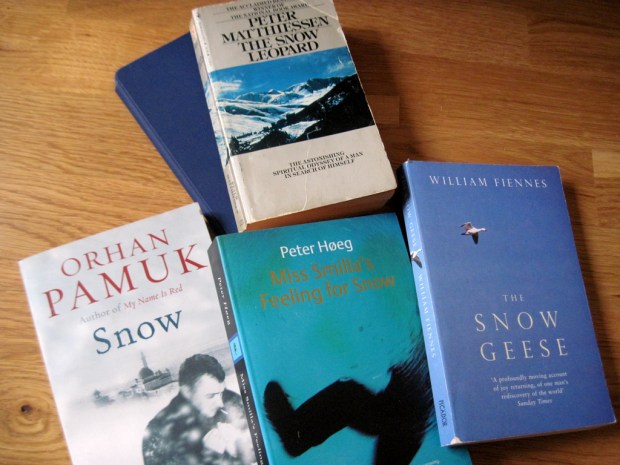
Miss Smilla’s Feeling for Snow by Peter Høeg (1992)
[trans. from the Danish by Felicity David]
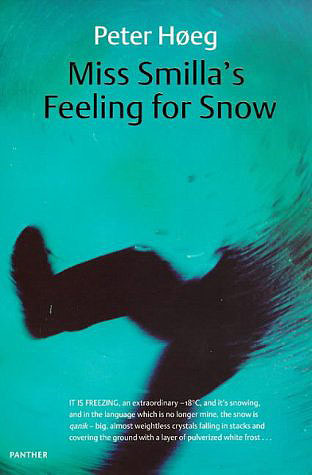 Nordic noir avant la lettre? I bought this rather by accident; had I realized it was a murder mystery, I never would have taken a chance on this international bestseller. That would have been too bad, as it’s much more interesting than your average crime thriller. The narrator/detective is Smilla Jaspersen: a 37-year-old mathematician and former Arctic navigator with a Danish father and Greenlander mother, she’s a stylish dresser and a shrewd, bold questioner who makes herself unpopular by nosing about where she doesn’t belong.
Isaiah, a little Greenlander boy, has fallen to his death from the roof of the Copenhagen apartment complex where Smilla also lives, and she’s convinced foul play was involved. In Part I she enlists the help of a mechanic neighbor (and love interest), a translator, an Arctic medicine specialist, and a mining corporation secretary to investigate Isaiah’s father’s death on a 1991 Arctic expedition and how it might be connected to Isaiah’s murder. In Part II she tests her theories by setting sail on the Greenland-bound Kronos as a stewardess. At every turn her snooping puts her in danger – there are some pretty violent scenes.
I read this fairly slowly, over the course of a month (alongside lots of other books); it’s absorbing but in a literary style, so not as pacey or full of cliffhangers as you’d expect from a suspense novel. I got myself confused over all the minor characters and the revelations about the expeditions, so made pencil notes inside the front cover to keep things straight. Setting aside the plot, which gets a bit silly towards the end, I valued this most for Smilla’s self-knowledge and insights into what it’s like to be a Greenlander in Denmark. I read this straight after Gretel Ehrlich’s travel book about Greenland, This Cold Heaven – an excellent pairing I’d recommend to anyone who wants to spend time vicariously traveling in the far north.
Favorite wintry passage:
“I’m not perfect. I think more highly of snow and ice than of love. It’s easier for me to be interested in mathematics than to have affection for my fellow human beings.”
My rating:
One that I left unfinished:
Snow by Orhan Pamuk (2002)
[trans. from the Turkish by Maureen Freely]
 This novel seems to be based around an elaborate play on words: it’s set in Kars, a Turkish town where the protagonist, a poet known by the initials Ka, becomes stranded by the snow (Kar in Turkish). After 12 years in political exile in Germany, Ka is back in Turkey for his mother’s funeral. While he’s here, he decides to investigate a recent spate of female suicides, keep tabs on the upcoming election, and see if he can win the love of divorcée Ipek, daughter of the owner of the Snow Palace Hotel, where he’s staying. There’s a hint of magic realism to the novel: the newspaper covers Ka’s reading of a poem called “Snow” before he’s even written it. He and Ipek witness the shooting of the director of the Institute of Education. The attempted assassination is revenge for him banning girls who wear headscarves from schools.
As in Elif Shafak’s Three Daughters of Eve, the emphasis is on Turkey’s split personality: a choice between fundamentalism (= East, poverty) and secularism (= West, wealth). Pamuk is pretty heavy-handed with these rival ideologies and with the symbolism of the snow. By the time I reached page 165, having skimmed maybe two chapters’ worth along the way, I couldn’t bear to keep going. However, if I get a recommendation of a shorter and subtler Pamuk novel I would give him another try. I did enjoy the various nice quotes about snow (reminiscent of Joyce’s “The Dead”) – it really was atmospheric for this time of year.
Favorite wintry passage:
“That’s why snow drew people together. It was as if snow cast a veil over hatreds, greed and wrath and made everyone feel close to one another.”
My rating:
One that I only skimmed:
The Snow Geese by William Fiennes (2002)
 Having recovered from an illness that hit at age 25 while he was studying for a doctorate, Fiennes set off to track the migration route of the snow goose, which starts in the Gulf of Mexico and goes to the Arctic territories of Canada. He was inspired by his father’s love of birdwatching and Paul Gallico’s The Snow Goose (which I haven’t read). I thought this couldn’t fail to be great, what with its themes of travel, birds, illness and identity. However, Fiennes gets bogged down in details. When he stays with friendly Americans in Texas he gives you every detail of their home décor, meals and way of speaking; when he takes a Greyhound bus ride he recounts every conversation he had with his random seatmates. This is too much about the grind of travel and not enough about the natural spectacles he was searching for. And then when he gets up to the far north he eats snow goose. So I ended up just skimming this one for the birdwatching bits. I did like Fiennes’s writing, just not what he chose to focus on, so I’ll read his other memoir, The Music Room.
My rating:
 Considered but quickly abandoned: In the Midst of Winter by Isabel Allende
Would like to read soon: The Snow Leopard by Peter Matthiessen – my husband recently rated this 5 stars and calls it a spiritual quest memoir, with elements of nature and travel writing.
What’s been your snowbound reading this year?
Five Perfect Winter Reads
When possible I enjoy reading with the seasons. As the holidays approached last year I picked out a pile of wintry reads that would see me through the dark, cold days of January. I’ve had a chance to read five of them so far, and give review extracts below. I may report back later on in the winter about a few books I plan to read with “snow” in the title.

In the Grip of Winter by Colin Dann
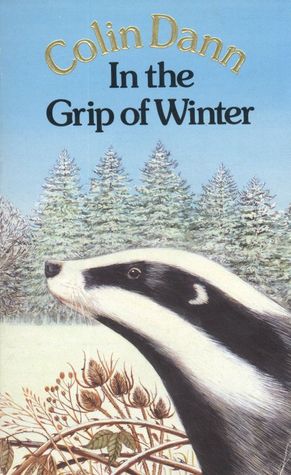 In this second book of the Farthing Wood series, the animals endure a harsh winter in their new home, the White Deer Park. When Badger falls down a slope and injures his leg, he’s nursed back to health at the Warden’s cottage, where Ginger Cat tempts him to join in a life of comfort and plenty. Meanwhile, Fox, Tawny Owl and the others are near starvation, and resort to leaving the park and stealing food from farms and rubbish bins. They have to band together and use their cunning to survive. This was a sweet book that reminded me of my childhood love of anthropomorphized animal stories (like Watership Down and the Redwall series). I doubt I’ll read another from the series, but this was a quaint read for the season.
My husband received this book for free from his school for some reason. Even early on his tastes turned towards wildlife. [One annoyance: the author always referred to Badger’s “set” instead of his “sett”; although it appears this may actually be a permissible variant, it wasn’t cool with me!]


Favorite wintry passage:
“‘Every winter is hard for some,’ Badger answered. ‘The weakest among us always suffer the most. The small creatures: the mice, the shrews, the voles and, particularly, the small birds – every winter takes its toll [on] them. But yes – I sense that this winter will be one to reckon with. There’s something in that wind…’”
My rating:
This Cold Heaven: Seven Seasons in Greenland by Gretel Ehrlich
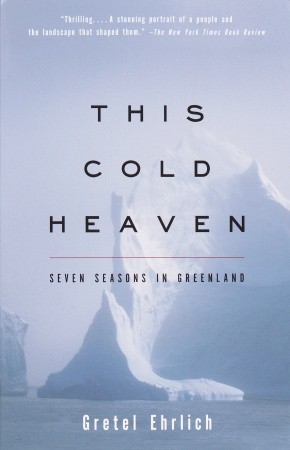 Once a year or so I encounter a book that’s so flawlessly written you could pick out just about any sentence and marvel at its construction. That’s certainly the case here. I never want to go to Greenland; English winters are quite dark and cold enough for me, and I don’t know if I could stomach seal meat at all, let alone for most meals and often raw. But that’s okay: I don’t need to book a flight to Qaanaaq, because through reading this I’ve already been in Greenland in every season, and I thoroughly enjoyed my armchair trek. Impressively, Ehrlich is always describing the same sorts of scenery, and yet every time finds a fresh way to write about ice and sun glare and frigid temperatures. I’ll be looking into her other books for sure.
Favorite wintry passage:
“The ice cap itself was a siren singing me back to Greenland, its walls of blue sapphire and sheer immensity always beguiling. Part jewel, part eye, part lighthouse, part recumbent monolith, the ice is a bright spot on the upper tier of the globe where the world’s purse strings have been pulled tight, nudging the tops of three continents together. Summers, it burns in the sun, and in the dark it hoards moonlight.”
My rating:
Further reading on Greenland: A Wilder Time: Notes from a Geologist at the Edge of the Greenland Ice by William E. Glassley (see my Foreword review) and The Prophets of Eternal Fjord by Kim Leine, an epic novel about an unconventional priest, set in late-eighteenth-century Denmark and Greenland (see my Nudge review). Also Sinéad Morrissey’s multi-part poem “Whitelessness.” You can read the first stanza of it here.
The Short Day Dying by Peter Hobbs
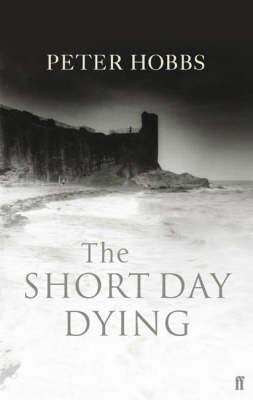 This short novel from 2005 deserves to be better known. It reminded me of Days Without End and On the Black Hill, but most of all of Francis Kilvert’s diary, perhaps as voiced by a rustic from Poldark. We journey through 1870 with Charles Wenmoth, a twenty-seven-year-old blacksmith’s apprentice and Methodist lay preacher in Cornwall mining country. Very little happens; the focus is on atmosphere and voice. The major struggle is with his melancholy spirit, which causes him to doubt his salvation. As winter circles round, the days grow shorter just as he senses life growing shorter. The short chapters are like undated diary entries (apparently based on the author’s great-great-grandfather’s); the sentences are almost completely unpunctuated, which at first had me twitching for my pencil to add commas to the run-on sentences, but eventually I gave myself over to the flow.
Favorite wintry passage:
“It is a shame we cannot stay children for ever and remain blind to the slow death of the land. How different it will all be in a few months the bare trees revealed as dark gnarled bodies. Something inside them though lives through the yearly famine and they always find new colour. I trust it is the same for us all.”
My rating:
Winter by Karl Ove Knausgaard
 This is my favorite of the three Knausgaard books I’ve read so far, and miles better than his Autumn. These short essays successfully evoke the sensations of winter and the conflicting emotions elicited by family life and childhood memories. The series is, loosely speaking, a set of instruction manuals for his unborn daughter, who is born a month premature in the course of this volume. So in the first book he starts with the basics of bodily existence – orifices, bodily fluids and clothing – and now he’s moving on to slightly more advanced but still everyday things she’ll encounter, like coins, stuffed animals, a messy house, toothbrushes, and the moon. I’ll see out this series, and see afterwards if I have the nerve to return to My Struggle.
Favorite wintry passage:
“winter not only muffles some sounds and intensifies others, it also has sounds that are entirely its own, unique to the season, and some of them are among the most beautiful of all. The low boom of ice-covered waters as they freeze, for instance, which can be heard on perfectly clear days or nights when the cold deepens, and which has something menacing or mighty about it, since it isn’t connected to an visible movement”
My rating:
Available Light by Marge Piercy
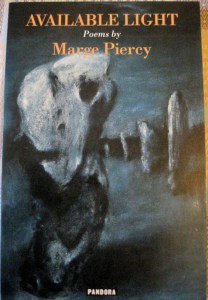 Many poetry volumes get a middling rating from me because some of the poems are memorable but others do nothing for me. This is on the longer side for a collection at 120+ pages, but only a handful of its poems fell flat. The subjects are diverse: travels in Europe (my cover depicts the Avebury stone circle in the gloom), menstruation, identifying as a Jew as well as a feminist, scattering her father’s ashes, the stresses of daily life, and being in love. The title poem, which appears first, has a slightly melancholy tone with its focus on the short days of winter, but the poet defiantly asserts meaning despite the mood: “Even the dead of winter: it seethes with more / than I can ever live to name and speak.” Piercy was a great discovery, and I’ll be trying lots more of her books from various genres.
Favorite wintry passage:
(from “Available light”)
In winter the light is red and short.
The sun hangs its wizened rosehip in the oaks.
By midafternoon night is folding in.
The ground is locked against us like a door.
Yet faces shine so the eyes stretch for them
and tracks in the snow are etched, calligraphy
My rating:
(And one book that didn’t quite work for me; I ended up abandoning it at 14%.
 The Bear and the Nightingale by Katherine Arden: Some striking turns of phrase, an enchanting wintry atmosphere … but a little Disney-fied for me. I got this free for Kindle so may come back to it at some point.
Favorite wintry passage:
“The years slipped by like leaves. …The clouds lay like wet wool above the trees.”)
Have you read any wintry books this year?
Novellas in November, Part 1
This is my second year of joining Laura (Reading in Bed) and others in reading mostly novellas in November. I’ve trawled my shelves and my current library pile for short books, limiting myself to ones of around 150 pages or fewer. First up: four short works of fiction. (I’m at work on various ‘nonfiction novellas’, too.) For the first two I give longer reviews as I got the books from the publishers; the other two are true minis.

Swallowing Mercury by Wioletta Greg
(translated from the Polish by Eliza Marciniak)
[146 pages]
I heard about this one via the Man Booker International Prize longlist. Quirkiness is particularly common in indie and translated books, I find, and while it’s often off-putting for me, I loved it here. Greg achieves an impressive balance between grim subject matter and simple enjoyment of remembered childhood activities. Her novella is, after all, set in Poland in the 1980s, the last decade of it being a Communist state in the Soviet Union.
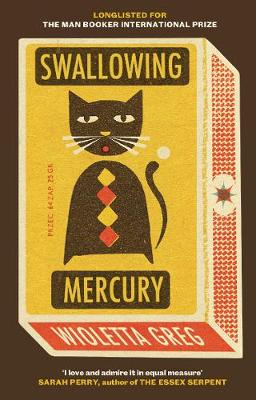 The narrator (and autobiographical stand-in?) is Wiolka Rogalówna, who lives with her parents in a moldering house in the fictional town of Hektary. Her father, one of the most striking characters, was arrested for deserting from the army two weeks before she was born, and now works for a paper mill and zealously pursues his hobbies of hunting, fishing, and taxidermy. The signs of their deprivation – really the whole country’s poverty – are subtle: Wiolka has to go selling hand-picked sour cherries with her grandmother at the market even though she’s embarrassed to run into her classmates; she goes out collecting scrap metal with a gang of boys; and she ties up her hair with a rubber band she cut from an inner tube.
Catholicism plays a major role in these characters’ lives: Wiolka wins a blessed figure in a church raffle, the Pope is rumored to be on his way, and a picture of the Black Madonna visits the town. A striking contrast is set up between the threat of molestation – Wiolka is always fending off unwanted advances, it seems – and lighthearted antics like school competitions and going to great lengths to get rare matchbox labels for her collection. This almost madcap element balances out some of the difficulty of her upbringing.
What I most appreciated was the way Greg depicts some universalities of childhood and adolescence, such as catching bugs, having eerie experiences in the dark, and getting one’s first period. This is a book of titled vignettes of just five to 10 pages, but it feels much more expansive than that, capturing the whole of early life. The Polish title translates as “Unripe,” which better reflects the coming-of-age theme; the English translator has gone for that quirk instead.
A favorite passage:
“Then I sat at the table, which was set with plates full of pasta, laid my head down on the surface and felt the pulsating of the wood. In its cracks and knots, christenings, wakes and name-day celebrations were in full swing, and woodworms were playing dodgeball using poppy seeds that had fallen from the crusts of freshly baked bread.”
Thanks to Portobello Books for the free copy for review.
A Field Guide to the North American Family by Garth Risk Hallberg
[126 pages]
 Written somewhat in the style of a bird field guide, this is essentially a set of flash fiction stories you have to put together in your mind to figure out what happens to two seemingly conventional middle-class families: the Harrisons and the Hungates, neighbors on Long Island. Frank Harrison dies suddenly in 2008, and the Hungates divorce soon after. Their son Gabe devotes much of his high school years to drug-taking before an accident lands him in a burn unit. Here he’s visited by his girlfriend, Lacey Harrison. Her little brother, Tommy, is a compulsive liar but knows a big secret his late father was keeping from his wife.
The chapters, each just a paragraph or two, are given alphabetical, cross-referenced headings and an apparently thematic photograph. For example, “Entertainment,” one of my favorite stand-alone pieces, opens “In the beginning was the Television. And the Television was large and paneled in plastic made to look like wood. It dwelled in a dim corner of the living room and came on for national news, Cosby, Saturday cartoons, and football.”
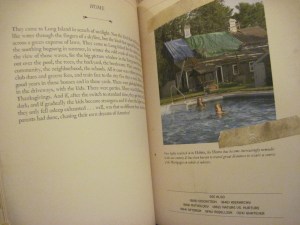 This is a Franzen-esque take on family dysfunction and, like City on Fire, is best devoured in large chunks at a time so you don’t lose momentum: as short as this is, I found it easy to forget who the characters were and had to keep referring to the (handy) family tree at the start. Ultimately I found the mixed-media format just a little silly, and the photos often seem to bear little relation to the text. It’s interesting to see how this idea evolved into the mixed-media sections of City on Fire, which is as epic as this is minimalist, though the story line of this novella is so thin as to be almost incidental.
Favorite lines:
“Depending on parent genotype, the crossbreeding of a Bad Habit and Boredom will result in either Chemistry or Entertainment.”
“Though hardly the most visible member of its kingdom, Love has never been as endangered as conservationists would have us believe, for without it, the Family would cease to function.”
Thanks to Vintage Books for the free copy for review.
The Comfort of Strangers by Ian McEwan
[100 pages]
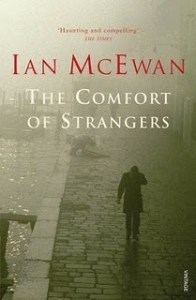 This is the earliest McEwan work I’ve read (1981). I could see the seeds of some of his classic themes: obsession, sexual and otherwise; the slow building of suspense and awareness until an inevitable short burst of violence. Mary and Colin are a vacationing couple in Venice. One evening they’ve spent so long in bed that by the time they get out all the local restaurants have shut, but a bar-owner takes pity and gives them sustenance, then a place to rest and wash when they get lost and fail to locate their hotel. Soon neighborly solicitude turns into a creepy level of attention. McEwan has a knack for presenting situations that are just odd enough to stand out but not odd enough to provoke an instant recoil, so along with the characters we keep thinking all will turn out benignly. This reminded me of Death in Venice and The Talented Mr. Ripley.
First Love by Gwendoline Riley
[167 pages – on the long side, but I had a library copy to read anyway]
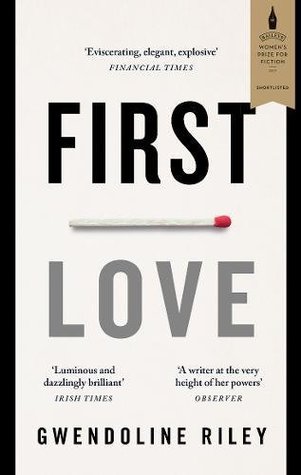 Neve tells us about her testy marriage with Edwyn, a Jekyll & Hyde type who sometimes earns our sympathy for his health problems and other times seems like a verbally abusive misogynist. But she also tells us about her past: her excess drinking, her unpleasant father, her moves between various cities in the north of England and Scotland, a previous relationship that broke down, her mother’s failed marriages, and so on. There’s a lot of very good dialogue in this book – I was reminded of Conversations with Friends – and Neve’s needy mum is a great character, but I wasn’t sure what this all amounts to. As best I can make out, we are meant to question Neve’s self-destructive habits, with Edwyn being just the latest example of a poor, masochistic decision. Every once in a while you get Riley waxing lyrical in a way that suggests she’s a really great author who got stuck with a somber, limited subject: “Outside the sunset abetted one last queer revival of light, so the outlook was torched; wet bus stop, wet shutters, all deep-dyed.”
Other favorite lines:
“An illusion of freedom: snap-twist getaways with no plans: nothing real. I’d given my freedom away. Time and again. As if I had contempt for it. Or was it hopelessness I felt, that I was so negligent? Or did it hardly matter, in fact? … Could I trust myself? Not to make my life a lair.”
 Bookish Beck = Rebecca Foster. American transplant to England. Freelance proofreader and book reviewer.
