Short Nonfiction Series for Novellas in November + Nonfiction November
Most Novellas in November participants focus on fiction, which is understandable and totally fine; I also like to incorporate works of short nonfiction during the month, which is a great opportunity to combine challenges with Nonfiction November.
Building on this list I wrote in 2021 (all the recommendations stand, but I’d update it by adding Weatherglass Books to the list of UK publishers), here are some nonfiction series that publish brief, intriguing works:
404 Ink’s Inklings series bears the tagline “big ideas to carry in your pocket.”
 I have reviewed Happy Death Club.
Biteback Publishing’s Provocations series “is a groundbreaking new series of short polemics composed by some of the most intriguing voices in contemporary culture.”
- I have reviewed Last Rights. I spied a pair of books by John Sutherland on youth and ageing at my library.

Bloomsbury’s Object Lessons series “is a series of concise, collectable, beautifully designed books about the hidden lives of ordinary things.”
- I have reviewed Doctor, Dust, Grave, Pregnancy Test, and Recipe.
Bloomsbury’s 33 1/3 is “a series of short books about popular music.”
- I have reviewed Jesus Freak.
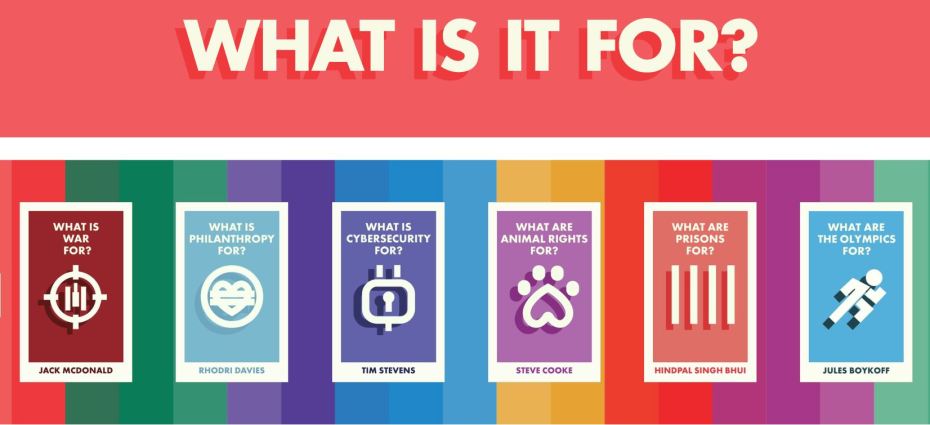
Bristol University Press’s What Is It For series is edited by George Miller, creator of the OUP Very Short Introductions (see below). Miller believes “short, affordable books can, and should, be intelligent and thought-provoking”; he hopes these will “be an agent for positive change,” addressing “tough questions about purpose and fitness for purpose: what has to change for the future to be better?”
A number of Fitzcarraldo Editions’ Essays are significantly under 200 pages.
 I have reviewed Intervals, A Very Easy Death, Happening, I Remain in Darkness, A Woman’s Story, and Alphabetical Diaries (plus others that are longer).
[Edited:] Thanks so much to Liz for letting me know about Jacaranda Books’ A Quick Ting On series, “the first ever non-fiction book series dedicated to Black British culture,” with books on plantains, Grime music, Black hair, and more.
[Edited:] There are three books so far in the Leaping Hare Press Find Your Path self-help series. I have just downloaded Find Your Path through Imposter Syndrome from Edelweiss.
Little Toller Books publishes mostly short nature and travel monographs and reprints.
- I have reviewed Deer Island, Aurochs and Auks, Orison for a Curlew, Herbaceous, The Ash Tree, and Snow.

From the Little Toller website
[Edited:] Thanks so much to Annabel for making me aware of Melville House’s The FUTURES series, which gives “imaginative future visions on a wide range of subjects, written by experts, academics, journalists and leading pop-culture figures.”
MIT Press’s Essential Knowledge series “offers accessible, concise, beautifully produced books on topics of current interest.” I spotted the Plastics book at my library.
Oxford University Press’s Very Short Introductions now cover a whopping 867 subjects!
- I had a couple of them assigned in my college days, including Judaism.
Penguin’s 100-book Great Ideas series reprints essays that introduce readers to “history’s most important and game-changing theories, philosophies and discoveries in accessible, concise editions.”
A number of Profile’s health-themed Wellcome Collection Books are well under 200 pages.
- I have reviewed Recovery, Free for All, Chasing the Sun, An Extra Pair of Hands, and After the Storm (plus others that are longer).


Saraband’s In the Moment series contains “portable, accessible books … exploring the role of both mind and body in movement, purpose, and reflection, finding ways of being fully present in our activities and environment.”
- I’m interested in Writing Landscape by Linda Cracknell and On Community by Casey Plett.
 Most of the original School of Life books are around 150 pages long. Their newer Essential Ideas series of three titles also promises “pocket books.”
- I have reviewed How to Develop Emotional Health, How to Age, How to Be Alone, and How to Think about Exercise.
Why not see if your local library has any selections from one or more of these series? #LoveYourLibrary

If you’re a reluctant nonfiction reader, choosing a short book could be a great way to engage with a topic that interests you – without a major time commitment. #NonfictionNovember
Keep in touch via X (@bookishbeck / @cathy746books) and Instagram (@bookishbeck / @cathy_746books). Add any related posts to the link-up. Don’t forget the hashtag #NovNov24.
Any suitable short nonfiction on your shelves?
Spring Journeys with Edwin Way Teale and Edward Thomas
When I heard that Little Toller were reissuing their edition of Edward Thomas’s In Pursuit of Spring, I couldn’t resist pairing it with Edwin Way Teale’s book about the progress of the season up the United States, North with the Spring. These spring journeys, documented by authors delighting in nature’s bounty and responding with poetry, inspired mixed feelings in me: vicarious nostalgia, but also sadness for all that has been lost since they set out in the 1910s and 1950s, respectively.
It’s hard to live joyfully when evidence of the destruction of nature is overwhelming. Enjoying what still exists doesn’t seem like enough. But it’s a start. So this year I’ve been careful to note every phenological landmark: the first swift, the first hearing of a cuckoo, a rare sighting of a live hedgehog. One day in late April I stood on the towpath for hours watching a cloud of swallows and martins swooping for insects. I’ve also enjoyed watching from my office window as sparrows come and go from a nest box.
North with the Spring by Edwin Way Teale (1951)
I’ve previously reviewed Teale’s Autumn Across America and Springtime in Britain and consider him one of the classic – and most underrated – American nature writers. I was delighted to find a copy of this first seasonal volume on our trip to Northumberland a few years ago. As in the autumn book, he and his wife Nellie undertake a road trip, this time travelling from Florida up to New England, a total of 17,000 miles. Their journey lasted 130 days because instead of waiting for 21 March they started weeks before; spring comes early to the Gulf coast. Their time in Florida feels endless, constituting over a third of the book. Although it’s true that there are (were?) many peerless ecosystems there between the scrub and swamp, I grew impatient to move on to other states. The meet-up with Marjorie Kinnan Rawlings, who took them on a picnic to ‘The Yearling country,’ was a highlight.
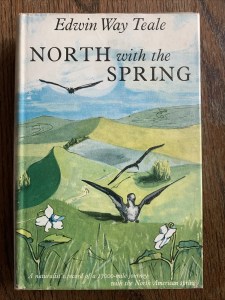 They travel alongside the spring warblers; past river deltas and barrier islands, by mountain meadows and forests. Other stops include Monticello and New Jersey’s pine barrens. A stopover in New York City dramatizes the difference between civilization and relative wilderness. I particularly enjoyed a pair of chapters set in Tennessee: first the wonder of Nickajack Cave, then the horror of the deforested and poisoned Ducktown Desert. Teale seems ahead of his time in decrying people’s wilful ignorance – one man they met denied the fact of migration, insisting the birds were always around – and failure to consider nature. His scenes and conversations feel fully natural; he’s as interested in people as in wildlife, and that humanism comes across in his writing.
“We longed for a thousand springs on the road instead of this one. For spring is like life. You never grasp it entire; you touch it here, there; you know it only in parts and fragments.”
(Secondhand – Barter Books, Alnwick)
In Pursuit of Spring by Edward Thomas (1914)
On Good Friday, 21 March 1913, Edward Thomas set off on his bicycle from his parents’ home in South London. He was bound southwest, toward Somerset and the height of spring. At cycling and walking pace, he would truly experience the development of the season, whereas
“Many days in London have no weather. We are aware only that it is hot or cold, dry or wet; that we are in or out of doors; that we are at ease or not.”
He prepares himself for hardship and slog:
“Spring would come, of course – nothing, I supposed, could prevent it – and I should have to make up my mind how to go westward. Whatever I did, Salisbury Plain was to be crossed”
 It’s remarkable both how much and how little has changed in the intervening century and more. The place names, plant and bird species, and alternation of town and countryside are all familiar, but the difference is stark when you see Thomas’s black-and-white photographs that illustrate the text. These dirt roads are empty. You’d have to search high and low today to find the kind of unspoiled fields, rivers, churchyards, hedgerows and stone walls that he memorializes.
Everything he sees drives him back to poetry, with long passages quoted from authors who have fallen somewhat out of fashion, such as George Herbert and Alexander Pope. I loved the scene where he buys a book at a secondhand furniture shop (for two pence, mind you) and then ignores it to eavesdrop on fellow diners at a restaurant. He has words of high praise for W.H. Hudson:
“Were men to disappear they might be reconstructed from the Bible and the Russian novelists; … Hudson so writes of birds that if ever … they should cease to exist, and should leave us to ourselves on a benighted planet, we should have to learn from him what birds were.”
Thomas also mentions William Cobbett, whose Rural Rides this reminded me of strongly. Both are slow-paced journeys around a rural England that no longer exists. Today Thomas is better remembered as a poet; he would be one of the fallen in a First World War battle just four years after this expedition. It was great to have a chance to read his nature writing, too.
With thanks to Little Toller for the free copy for review.
We’re off to rural France on Wednesday for eight days of relaxation and nature-watching; it’s not a sight-seeing or foodie trip like our time in Paris back in December. Ironically, it seems that it may be cold and rainy for much of the holiday, having been gorgeous in both countries this past week. We will hope for some sun and warmth, but have packed plenty of books and board games (and will acquire much wine) for when the weather is to be avoided inside.
What signs of the spring have you been seeing?
#ReadIndies Catch-up: Ansell, Kinard, McNaught, Ponce, Toews and Vara
At last, my first dedicated selections for Read Indies month, two of which have been languishing on the shelf since 2022! A few more indie titles will appear in my February roundup tomorrow. I’ve got a huge variety here: an extended essay comparing life among the unhoused in London in the 1980s with the freedom of the open road and the island of Jura; gospel-saturated poems of queer African American life; an exposé of spiritual abuse in a Pentecostal church with branches in England and Nigeria; an Ecuadorian novella obsessed with bodies and sex; a funny yet heartbreaking novel about a zany family trying not to fall apart; and short stories about siblings, adolescence, memory, death and much more. I name the publishers and other books I have on the docket from each one.

Deer Island by Neil Ansell (2013)
 My last unread book by Ansell (whose Deep Country, The Last Wilderness, and The Circling Sky I’ve loved) and one that had been out of print for many years, so it was great to hear that Little Toller was reissuing it. Ansell has visited most countries; pressed for a favourite place, he names the Scottish isle of Jura. In memory he returns to a place he hadn’t been in over 20 years. In the early 1980s he lived in London and volunteered with The Simon Community, a homeless charity, for three years. Later that decade, he found himself in the same situation as those he served, squatting in chaotic multi-occupancy London properties. But in between he’d had a magical jaunt to Jura by hitchhiking and motorbike with a girlfriend. And later, when his only sentimental keepsake was stolen from his squat bedroom, he left that lifestyle behind and fled to Jura, haunt of golden eagles and otters; refuge for George Orwell, who experienced his fair share of squalor – Down and Out in Paris and London gets a mention, but Ansell doesn’t belabour a comparison he more than earns. It’s a shame this is so short, but it’s a carefully crafted slice of life, and illustrates a sobering truth: “Security is an illusion.”
With thanks to Little Toller Books for the free copy for review. Deer Island came out in paperback on 27 February.
Little Toller
Also read recently: brother. do. you. love. me. by Manni Coe
Currently reading: The Long Field by Pamela Petro
Orders of Service by Willie Lee Kinard III (2023)
 At a confluence of Southern, Black and gay identities, Kinard writes of matriarchal families, of congregations and choirs, of the descendants of enslavers and enslaved living side by side. The layout mattered more than I knew, reading an e-copy: often it is white text on a black page; words form rings or an infinity symbol; erasure poems gray out much of what has come before. “Boomerang” interludes imagine a chorus of fireflies offering commentary – just one of numerous insect metaphors. Mythology also plays a role. “A Tangle of Gorgons,” a sample poem I’d read before, wends its serpentine way across several pages. “Catalog of My Obsessions or Things I Answer to” presents an alphabetical list. For the most part, the poems were longer, wordier and more involved (four pages of notes on the style and allusions) than I tend to prefer, but I could appreciate the religious frame of reference and the alliteration.
Two favorite passages:
Ma taught me how to change a tire
the fall before it got real cold one October,
on the plot of dirt the pole beans we call Babel
spiral from, where our boozy station wagon
sat after hobbling home & passing out
in the backyard
(from “Work”)
I left before the door was closed.
I built myself of drowning hymns.
I stole every one to fly.
(from “Icarus Confesses”)
With thanks to Alice James Books for the advanced e-copy for review.
Alice James Books
Also read recently: Theophanies by Sarah Ghazal Ali
Immanuel by Matthew McNaught (2022)
 “Immanuel was the centre of the world once. Long after it imploded, its gravitational pull remains.” McNaught grew up in an evangelical church in Winchester, England, but by the time he left for university he’d fallen away. Meanwhile, some peers left for Nigeria to become disciples at charismatic preacher TB Joshua’s Synagogue Church of All Nations in Lagos. It’s obvious to outsiders that this was a cult, but not so to those caught up in it. It took years and repeated allegations for people to wake up to faked healings, sexual abuse, and the ceding of control to a megalomaniac who got rich off of duping and exploiting followers. This book won the inaugural Fitzcarraldo Editions Essay Prize. I admired its blend of journalistic and confessional styles: research, interviews with friends and strangers alike, and reflection on the author’s own loss of faith. He gets to the heart of why people stayed: “A feeling of holding and of being held. A sense of fellowship and interdependence … the rare moments of transcendence … It was nice to be a superorganism.” This gripped me from page one, but its wider appeal strikes me as limited. For me, it was the perfect chance to think about how I might write about traditions I grew up in and spurned.
With thanks to Fitzcarraldo Editions for the proof copy for review.
Fitzcarraldo Editions
Currently reading: Intervals by Marianne Brooker
Up next: Alphabetical Diaries by Sheila Heti
Blood Red by Gabriela Ponce (2020; 2024)
[Translated from the Spanish by Sarah Booker]
 Like other short works I’ve read by Hispanic women authors (Die, My Love, September and the Night, In Vitro), this Ecuadorian novella is intense, fragmentary, and obsessed with the female body and psyche. The unnamed narrator, a woman separated from her husband and freed from inhibitions, gives in to her substance and sex addictions – “For me, anything that isn’t falling in love has never merited much attention. That giddiness from proximity or bodies”. I was reminded of A Spy in the House of Love in that she flits compulsively from one lover to another, but Ponce is much more explicit than Nin. At least at the start, the sex scenes are almost constant and described in graphic detail. The narrator meets her lovers in warehouses and caves. Literal holes/orifices and blood are profuse, but also symbolically weighty, with fear of pregnancy also featuring heavily. I was impressed at how Booker rendered the stream-of-consciousness approach, which involves several-page paragraphs and metaphors of moths and moss. I wouldn’t say this was a pleasant book to spend time with, but the style and vocabulary made it worthy of note.
With thanks to Dead Ink for the free copy for review. Blood Red was first published in English by Restless Books in the USA in 2022.
Dead Ink
Up next: Sinking Bell by Bojan Louis
Fight Night by Miriam Toews (2022)
 I knew from All My Puny Sorrows that Canadian author Miriam Toews has a knack for combining humour and heartbreak. I can’t believe it took me since 2015 to read another of her novels. Once again, there seems to be a strong autobiographical element and suicide in the family is part of the backstory. Although abandonment and failure haunt these three female generations, we see everything through a child’s point-of-view, which turns life into a jolly adventure. Swiv’s mother, an underemployed actress, is heavily pregnant with “Gord”; her father is out of the picture. Swiv has been expelled, which gives her plenty of time with Grandma Elvira, who makes friends with everyone she meets but, alas, is crumbling physically. Luckily, Swiv knows just how to keep her going with nitro spray and compression socks and pills rescued from the floor. Before Gord arrives, Grandma wants one last adventure: a flight from Canada to Fresno, California to see her remaining family. Their trip is a disaster, in hilarious ways. Child narrators are tough to pull off, so kudos to Toews for making eight-year-old Swiv almost completely believable (though a bit too precocious). These characters are all foul-mouthed fighters, with a quick wit and the determination to make their stories matter. You’ll laugh and cry.
With thanks to Faber for the proof copy for review.
Faber
Also read recently: Happiness Falls by Angie Kim
Currently reading: Places I’ve Taken My Body by Molly McCully Brown
This Is Salvaged by Vauhini Vara (2023)
 The epigraph is from the two pages of laughter (“Ha!”) in “Real Estate,” one of the stories of Birds of America by Lorrie Moore. Vara shares Moore’s themes, which are the stuff of literary fiction generally – adolescence, friendship, ageing, memory, romantic relationships – but also her tone of dark comedy. The death of a sibling recurs. In “The Irates,” teenage Swati, whose brother died of cancer, and her friend Lydia get phone sales jobs through the Chinese restaurant where they go for egg rolls. In “I, Buffalo,” Sheila tries to hide her alcoholism when her sister Priya comes for a visit with Sheila’s brother-in-law and niece. “The girl” in “You Are Not Alone” is delighted to spend her eighth birthday in Florida with her estranged father, but less so when she learns there’s a stepmother figure in the picture. The women of “Sibyls” look after an elderly neighbour with dementia. The querulous child in “Unknown Unknowns” reminded me of Good Talk by Mira Jacob. My two favourites were the title story, about building a Noah’s Ark replica, and “What Next,” about a woman accompanying her teenage daughter to meet her father for the first time. A few stories didn’t stand out, and while I liked the writing, this didn’t necessarily feel like a cohesive collection.
With thanks to Grove Press UK for the free copy for review. This Is Salvaged came out in paperback in the UK on 1 February.
Grove Atlantic
Up next: Get the Picture by Bianca Bosker, Home/Land by Rebecca Mead, We Play Ourselves by Jen Silverman
Have you discovered any new-to-you independent publishers recently?
20 Books of Summer, 6–7: Melissa Harrison & Oliver Rackham
After two days in Inverness, our Western Isles adventure is ready to begin. I’m writing on the ferry from Ullapool to Stornoway (the main population centre on the island of Lewis in the Outer Hebrides of Scotland), where we’ll pick up a rental car and head to our Airbnb before exploring standing stones and bird reserves well into the long evening.
On the bus this morning I started Black Narcissus by Rumer Godden, the next in my flora-themed reading. For today, I have brief responses to two books I finished before we left: a genial children’s fantasy novel and an in-depth guide to a tree. Ash is today’s linking word.
By Ash, Oak and Thorn by Melissa Harrison (2021)
 Burnet, Cumulus and Moss are “Hidden Folk” (like Iceland’s elves), ancient, tiny beings who hibernate for winter in an ash tree. When they lose their home and Cumulus, the oldest, starts fading away, they set off on a journey to look for more of their kind and figure out what is happening. This eventually takes them to “the Hive” (London, presumably); they are helped along the way by creatures they might have been wary of: they hitch rides on deer and pigeons, and a starling, fox and rat are their allies in the city.
This reminded me of Watership Down with the classic quest feel, the many perils faced, and the way the species communicate with each other and are rendered as having different accents. The feasts and creative use of miniature objects recalled what I most love about the Brambly Hedge books. There is an important message about overcoming fear and prejudice, and a warning that Mortals have lost their connection to the Wild World. The hint is that the trio might play a role in helping humans reclaim it – perhaps in the sequel, recently longlisted for the Wainwright Prize (more on which anon).
Although there is a didactic element, with Harrison also commenting on emotions and pointing out natural phenomena for children to notice through the seasons, this didn’t bother me, and – in the Tove Jansson tradition – there are plenty of asides for grown-ups to appreciate, too. I’m unfamiliar with the series that inspired this, the 1930s The Little Grey Men books by “B.B.” (Denys Watkins-Pitchford), so can’t comment on it in comparison to the source material. I’ve read four other Harrison books, nonfiction and adult fiction, but this outstripped them all. (Public library) 
A favourite passage:
“Going on an adventure might be exciting, but if you’re a home-loving person, it’s not long until you start wanting to feel safe and indoorsy again.”
The Ash Tree by Oliver Rackham (2014)
 A single-species monograph, this was more academic than I expected from Little Toller – it has statistics, tables and figures. So, it contains everything you ever wanted to know about ash trees, and then some. I actually bought it for my husband, who has found the late Rackham’s research on British landscapes useful, but thought I’d take a look as well. (The rental house we recently left had a self-seeded ash in the front garden that sprang up to almost the height of the house within the five years we lived there. Every time our landlords came round, we held our breath waiting for them to notice that the roots had started to push up the pavement and tell us it had to be cut down, but until now it has survived.)
Topics include the birds and insects the trees shelter, the lichen that grows on them, coppicing and pollarding techniques (“plashing” into hedges, the creation of horizontal seats), and the designation of ancient and veteran trees. Ash dieback disease, a major global issue, is another point for discussion. I found myself skimming through a lot of the detail, especially in later chapters. My favourite bits of trivia were that Yeats mentions the ash the most out of a handful of notable UK/Ireland poets, and that baseball bats are generally made out of ash wood. There are loads of colour photographs to help visualize tree features and locations. (New purchase)
Short Nature Books for #NovNov by John Burnside, Jim Crumley and Aimee Nezhukumatathil
#NovNov meets #NonfictionNovember as nonfiction week of Novellas in November continues!
Tomorrow I’ll post my review of our buddy read for the week, The Story of My Life by Helen Keller (free from Project Gutenberg, here).
Today I review four nature books that celebrate marvelous but threatened creatures and ponder our place in relation to them.
Aurochs and Auks: Essays on Mortality and Extinction by John Burnside (2021)
[127 pages]
 I’ve read a novel, a memoir, and several poetry collections by Burnside. He’s a multitalented author who’s written in many different genres. These four essays are rich with allusions and chewy with philosophical questions. “Aurochs” traces ancient bulls from the classical world onward and notes the impossibility of entering others’ subjectivity – true for other humans, so how much more so for extinct animals. Imagination and empathy are required. Burnside recounts an incident from when he went to visit his former partner’s family cattle farm in Gloucestershire and a poorly cow fell against his legs. Sad as he felt for her, he couldn’t help.
“Auks” tells the story of how we drove the Great Auk to extinction and likens it to whaling, two tragic cases of exploiting species for our own ends. The second and fourth essays stood out most to me. “The hint half guessed, the gift half understood” links literal species extinction with the loss of a sense of place. The notion of ‘property’ means that land becomes a space to be filled. Contrast this with places devoid of time and ownership, like Chernobyl. Although I appreciated the discussion of solastalgia and ecological grief, much of the material here felt a rehashing of my other reading, such as Footprints, Islands of Abandonment, Irreplaceable, Losing Eden and Notes from an Apocalypse. Some Covid references date this one in an unfortunate way, while the final essay, “Blossom Ruins,” has a good reason for mentioning Covid-19: Burnside was hospitalized for it in April 2020, his near-death experience a further spur to contemplate extinction and false hope.
The academic register and frequent long quotations from other thinkers may give other readers pause. Those less familiar with current environmental nonfiction will probably get more out of these essays than I did, though overall I found them worth engaging with.
With thanks to Little Toller Books for the proof copy for review.
Kingfisher and Otter by Jim Crumley (2018)
[59 pages each]
Part of Crumley’s “Encounters in the Wild” series for the publisher Saraband, these are attractive wee hardbacks with covers by Carry Akroyd. (I’ve previously reviewed his The Company of Swans.) Each is based on the Scottish nature writer’s observations and serendipitous meetings, while an afterword gives additional information on the animal and its appearances in legend and literature.


An unexpected link between these two volumes was beavers, now thriving in Scotland after a recent reintroduction. Crumley marvels that, 400 years after their kind could last have interacted with beavers, otters have quickly gotten used to sharing rivers – to him this “suggests that race memory is indestructible.” Likewise, kingfishers gravitate to where beaver dams have created fish-filled ponds.
Kingfisher was, marginally, my preferred title from the pair. It sticks close to one spot, a particular “bend in the river” where the author watches faithfully and is occasionally rewarded by the sight of one or two kingfishers. As the book opens, he sees what at first looks like a small brown bird flying straight at him, until the head-on view becomes a profile that reveals a flash of electric blue. As the Gerard Manley Hopkins line has it (borrowed for the title of Alex Preston’s book on birdwatching), kingfishers “catch fire.” Lyrical writing and self-deprecating honesty about the necessity of waiting (perhaps in the soaking rain) for moments of magic made this a lovely read. “Colour is to kingfishers what slipperiness is to eels. … Vanishing and theory-shattering are what kingfishers do best.”
In Otter, Crumley ranges a bit more widely, prioritizing outlying Scottish islands from Shetland to Skye. It’s on Mull that he has the best views, seeing four otters in one day, though “no encounter is less than unforgettable.” He watches them playing with objects and tries to talk back to them by repeating their “Haah?” sound. “Everything I gather from familiar landscapes is more precious as a beholder, as a nature writer, because my own constant presence in that landscape is also a part of the pattern, and I reclaim the ancient right of my own species to be part of nature myself.”
From time to time we see a kingfisher flying down the canal. Some of our neighbors have also seen an otter swimming across from the end of the gardens, but despite our dusk vigils we haven’t been so lucky as to see one yet. I’ve only seen a wild otter once, at Ham Wall Nature Reserve in Somerset. One day, maybe there will be one right here in my backyard. (Public library)
World of Wonders: In Praise of Fireflies, Whale Sharks and Other Astonishments by Aimee Nezhukumatathil (2020)
[160 pages]
 Nezhukumatathil, a professor of English and creative writing at the University of Mississippi, published four poetry collections before she made a splash with this beautifully illustrated collection of brief musings on species and the self – this was shortlisted for the Kirkus Prize. Some of the 28 pieces spotlight an animal simply for how head-shakingly wondrous it is, like the dancing frog or the cassowary. More often, though, a creature or plant is a figurative vehicle for uncovering an aspect of her past. An example: “A catalpa can give two brown girls in western Kansas a green umbrella from the sun. Don’t get too dark … our mother would remind us as we ambled out into the relentless midwestern light.”
The author’s Indian/Filipina family moved frequently for her mother’s medical jobs, and sometimes they were the only brown people around. Loneliness, the search for belonging and a compulsion to blend in are thus recurrent themes. As an adult, traveling for poetry residencies and sabbaticals exposes her to new species like whale sharks. Childhood trips back to India allowed her to spend time among peacocks, her favorite animal. In the American melting pot, her elementary school drawing of a peacock was considered unacceptable, but when she featured a bald eagle and flag instead she won a prize.
These pinpricks of the BIPOC experience struck me more powerfully than the actual nature writing, which can be shallow and twee. Talking to birds, praising the axolotl’s “smile,” directly addressing the reader – it’s all very nice, but somewhat uninformed; while she does admit to sadness and worry about what we are losing, her sunny outlook seemed out of touch at times. On the one hand, it’s great that she wanted to structure her fragments of memoir around amazing animals; on the other, I suspect that it cheapens a species to only consider it as a metaphor for the self (a vampire squid or potoo = her desire to camouflage herself in high school; flamingos = herself and other fragile long-legged college students; a bird of paradise = the guests dancing the Macarena at her wedding reception).

My favorite pieces were one on the corpse flower and the bookend duo on fireflies – she hits just the right note of nostalgia and warning: “I know I will search for fireflies all the rest of my days, even though they dwindle a little bit more each year. I can’t help it. They blink on and off, a lime glow to the summer night air, as if to say, I am still here, you are still here.”
With thanks to Souvenir Press for the free copy for review.
Any nature books on your reading pile?
Review Book Catch-Up: Ante, Evans, Foster and White
Today I have a book of poems about the Filipinx experience in the UK, a collection of short stories reflecting on racial injustice, a monograph on a bird that spells summer for many of us, and a biographical investigation into a little-understood medical condition.
Antiemetic for Homesickness by Romalyn Ante
I was drawn to this debut collection by the terrific title and cover, but also by the accolades it received: it was on the Dylan Thomas Prize longlist and the Jhalak Prize shortlist. I hope we’ll see it on the Sunday Times Young Writer of the Year Award shortlist, too. Ante grew up in the Philippines but at age 16 joined her mother in the UK, where she had moved years before to work as a nurse in the NHS. She has since followed in her mother’s footsteps as a nurse – indeed, overseas Filipinx workers (Jamaicans, too) are a mainstay of the NHS.
 Ante remembers the years when her mother was absent but promised to send for the rest of the family soon: “You said all I needed to do was to sleep and before I knew it, / you’d be back. But I woke to the rice that needed rinsing, / my siblings’ school uniforms that needed ironing.” The medical profession as a family legacy and noble calling is a strong element of these poems, especially in “Invisible Women,” an ode to the “goddesses of caring and tending” who walk the halls of any hospital. Hard work is a matter of survival, and family – whether physically present or not – bolsters weary souls. A series of short, untitled poems are presented as tape recordings made for her mother.
Food is inextricably entwined with memory (reminding me of Nina Mingya Powles’s approach in Tiny Moons) and provides some of the standout metaphors, especially in “Patis” and “Ode to a Pot Noodle.” Ante uses a lot of alliteration and adapts various forms. I especially liked “Tagay!”, a traditional drinking song, and “Mateo,” printed in the shape of a pound sign. The nuanced look at the immigrant experience reminded me of Jenny Xie’s Eye Level. Movement entails losses as well as benefits. The focus on the Filipinx experience also made me think of America Is Not the Heart. My favourite single poem was “The Making of a Smuggler,” which opens “Wherever we travel, we carry / the whole country with us – // our rice terraces are folded garments, / we have pillars of trees, a rainforest // on a hairbrush.”
Favourite lines:
“Gone are the nights he steals / the moon with a mango picker / and swaps it for her pocket mirror”
“The yellow admission papers in my hands escaped / flustering at my face into a flight of orioles.”
“I am halved in order to be whole – / I rebuild by leaving / everything I love.”
With thanks to Chatto & Windus for the free copy for review.
The Office of Historical Corrections by Danielle Evans
To boil these six stories and a novella down to the topic of race in America risks painting them as solemn or strident – more concerned with meaning than with art – when the truth is that they are playful and propulsive even though they keep cycling back to bereavement and injustice. Several of the protagonists are young Black women coming to terms with a loss.
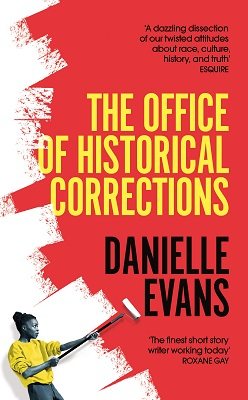 In “Happily Ever After,” Lyssa works in the gift shop of a Titanic replica and is cast as an extra in a pop star’s music video. Mythical sea monsters are contrasted with the real dangers of her life, like cancer and racism. “Anything Could Disappear” was a favourite of mine, though it begins with that unlikely scenario of a single woman acquiring a baby as if by magic. What starts off as a burden becomes a bond she can’t bear to let go. A family is determined to clear the name of their falsely imprisoned ancestor in “Alcatraz.” In “Richard of York Gave Battle in Vain” (a mnemonic for the colours of the rainbow), photojournalist Rena is wary about attending the wedding of a friend she met when their plane was detained in Africa some years ago. The only wedding she’s been in is her sister’s, which ended badly.
Mistakes and deceit seem to follow these characters. In the title novella that closes the book, Cassie and her colleagues combat fake news, going around putting correction labels on plaques that whitewash history. When she and her former colleague meet up in Wisconsin to find the truth behind a complex correction case, a clash with a white supremacist group quickly turns pedantry into a matter of life and death. The story I’d heard the most about beforehand was “Boys Go to Jupiter,” about a college girl who dons a Confederate flag bikini, not caring what message it sends to others in her dorm. It turns out she has history with a Black family, but has chosen to airbrush this experience out of her life.
There was only one story I didn’t care for, “Why Won’t Women Just Say What They Want,” about a celebrity who turns apologizing into performance art. Overall, this is a very strong collection I would recommend to readers of Brit Bennett and Raven Leilani, with some stories also reminding me of recent work by Curtis Sittenfeld and Mary South. I’ll be sure to seek out Evans’s previous book (also short stories), too.
With thanks to Picador for the proof copy for review.
The Screaming Sky by Charles Foster
The other week I was volunteering at our local community garden and looked up to see a dozen common swifts wheeling over the Kennet & Avon canal and picking off insects among the treetops. I hope this fellow Foster (for whom my husband was once confused on a nature conference attendee list) would be proud of me for pausing to gaze at the birds for a while. My impression of the author is as a misanthropic eccentric. A Renaissance man as well versed in law and theology as he is in natural history, he’s obsessed with swifts and ashamed of his own species: for looking down at their feet when they could be watching the skies; for the “pathological tidiness” that leaves swifts and so many other creatures no place to live.
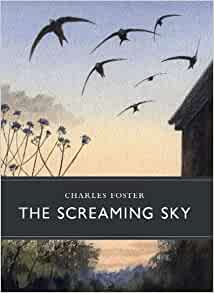 The obsession began when he was eight years old and someone brought him a dead swift fledgling for his taxidermy hobby. Ever since, he’s dated the summer by their arrival. “It is always summer for them,” though, as his opening line has it. This monograph is structured chronologically. Much like Tim Dee does in Greenery, Foster follows the birds for a year: from their winter territory in Africa to the edges of Europe in spring and then to his very own Oxford street in high summer. When they leave, he’s bereft and ready to book a flight back to Africa.
Along the way, Foster delivers heaps of information: the fossil evidence of swifts, how they know where to migrate (we have various theories but don’t really know), their nesting habits and lifespan, and the typical fates of those individuals that don’t survive. But, thumbing his nose at his “ex-friend” (a closed-minded biologist he repeatedly, and delightfully, rails against), he refuses to stick to a just-the-facts approach. Acknowledging the risks of anthropomorphizing, he speaks of swifts as symbols of aspiration, of life lived with intensity. He believes that we can understand animal emotions analogously through our own, so that, inappropriate as such words might seem, we can talk about what birds hope and plan for. He scorns reductive ecosystem services lingo that defines creatures by what we get out of them.
Also like Dee, Foster quotes frequently from poetry. His prose is full of sharp turns of phrase and moments of whimsy and made me eager to try more of his work (I know the most about but have not yet read Being a Beast).
Swifts know the roar of lions better than the roar of the M25, the piping of hornbills better than the Nunc Dimittis of parish Evensong … Are memories of our eaves spiralling high above the Gulf of Guinea? … They don’t seem to prevaricate. One moment they’re there, the next they’re off, diving straight into the journey. It’s the way we should run into cold water.
 As I’ve found with a number of Little Toller releases now (On Silbury Hill, Snow, Landfill), knowledge meets passion to create a book that could make an aficionado of the most casual of readers. Towards the close I was also reminded of Richard Smyth’s An Indifference of Birds: “When Homo sapiens has gone there will be lots of ideal swift holes in the decaying buildings we’ll leave behind.” It’s comforting to think of natural cycles continuing after we’re gone … but let’s start making the space for them now. Jonathan Pomroy’s black-and-white illustrations of swift behaviour only add to this short book’s charms.
With thanks to Little Toller Books for the free copy for review.
Waiting for Superman: One Family’s Struggle to Survive – and Cure – Chronic Fatigue Syndrome by Tracie White
Like Suzanne O’Sullivan’s books (most recently, The Sleeping Beauties), this is presented as an investigation into a medical mystery. White, a Stanford Medicine journalist, focuses on one family that has been indelibly changed by chronic fatigue syndrome – now linked with myalgic encephalomyelitis and termed ME/CFS for short. Whitney Dafoe was a world traveller and promising photographer before, in 2010, a diagnosis of ME/CFS explained his exhaustion and gastrointestinal problems. By the time White first met the family in 2016, the thirtysomething was bedbound in his parents’ home with a feeding tube, only able to communicate via gestures and rearranging Scrabble tiles. He couldn’t bear loud noises, or to be touched. At times he was nearly comatose.
 Whitney’s father, Ron Davis, is a Stanford geneticist whose research has contributed to the Human Genome Project. He has devoted himself to studying ME/CFS, which affects 20 million people worldwide yet receives little research funding; he calls it “the last major disease we know nothing about.” Testing his son’s blood, he found a problem with the citric acid cycle that produces ATP, essential fuel for the body’s cells – proof that there was a physiological reason for Whitney’s condition. Frustratingly, though, a Stanford colleague who examined Whitney prescribed a psychological intervention. This is in line with the current standard of care for ME/CFS: a graded exercise regime (nigh on impossible for someone who can’t get out of bed) and cognitive behavioural therapy.
White delves into Whitney’s past, looking for clues to what could have triggered his illness (having mono in high school? a parasite he picked up in India?). She also goes back to the mid-1980s to consider the Lake Tahoe outbreak of ME/CFS, whose victims “looked too healthy to be sick and were repeatedly disbelieved.” The media called it “yuppie flu,” downplaying the extreme fatigue involved. White also meets Laura Hillenbrand, author of Seabiscuit, who suffers from ME/CFS and managed to write her bestselling books from bed. Like Whitney, she only has a certain allotment of energy and mustn’t use it up too fast.
- A neat connection: Stephanie Land, author of Maid, was Whitney’s ex-girlfriend when he was 19 and living in Alaska; she wrote a Longreads article about their relationship.
- The title is from a Flaming Lips lyric and expresses Whitney’s trust in his dad’s ability to cure him; the U.S. title is The Puzzle Solver and the working title was The Invisible Patient.
With thanks to Atlantic Books for the free copy for review.
Would you be interested in reading one or more of these?
Snow and Winter Reads, Part I
We’ve only had a couple of inches of snow, plus another afternoon of flurries, so far this winter, but January was the UK’s coldest month since 2013. As usual, I’m charting the season’s passage through books as well as by taking walks and looking out the window. I have a few more wintry books on the go that I’ll hope to report on at the end of the month. Today I have a few short works, ranging from poetry to nonfiction, plus a novel set partly in frigid Nebraska.

“The Snows of Kilimanjaro” by Ernest Hemingway (1936)
 During a laughably basic New Testament class in college, a friend and I passed endless notes back and forth, discussing everything but the Bible. I found these the last time I was back in the States going through boxes. My friend’s methodical cursive looked so much more grown-up than my off-topic scrawls. Though she was only two years older, I saw her as a kind of mentor, and when she told me the gist of this Hemingway story I took heed. We must have been comparing our writing ambitions, and I confessed a lack of belief in my ability. She summed up the point of this story more eloquently than Hem himself: if you waited until you were ready to write something perfectly, you’d never write it at all. Well, 19 years later and I’m still held back by lack of confidence, but I have, finally, read the story itself. It’s about a writer on safari in Africa who realizes he is going to die of this gangrene in his leg.
Now he would never write the things that he had saved to write until he knew enough to write them well. Well, he would not have to fail at trying to write them either. Maybe you could never write them, and that was why you put them off and delayed the stating. Well, he would never know, now.
he had always thought that he would write it finally. There was so much to write. He had seen the world change; not just the events; although he had seen many of them and had watched the people, but he had seen the subtler change and he could remember how the people were at different times. He had been in it and he had watched it and it was his duty to write of it; but now he never would.
This duty: to be a witness, to crystallize your perspective and experience as a way of giving back to the world that has sustained you – it’s a compelling vision. Of course, Hemingway was a chauvinist and so the protagonist is annoyingly dismissive of the woman in his life; she might as well be a servant. I still found this everyday tragedy affecting. I couldn’t, however, be bothered to read any further in the volume (mostly Nick Adams autobiographical stories).
The World Before Snow by Tim Liardet (2015)
 I couldn’t resist the title and creepy Magritte cover, so added this to my basket during the Waterstones online sale at the start of the year. Liardet’s name was unfamiliar to me, though this was the Bath University professor’s tenth poetry collection. Most of the unusual titles begin with “Self-Portrait” – for instance, “Self-Portrait as the Nashua Girl’s Reverse Nostalgia” and “Self-Portrait with Blind-Hounding Viewed in Panoramic Lens.” Apparently there is a throughline here, but if it weren’t for the blurb I would have missed it entirely. (“During a record-breaking blizzard in Boston, two poets met, one American and one English. This meeting marked the beginning of a life-transforming love affair.”) There were some turns of phrase and alliteration I liked, but overall I preferred the few poems that were not part of that pretentious central plot, e.g. “Ommerike” (part I) about mysterious mass deaths of birds and fish, “Nonagenaria,” a portrait of an old woman, and “The Guam Fever,” voiced by an ill soldier.
The Magician’s Assistant by Ann Patchett (1997)
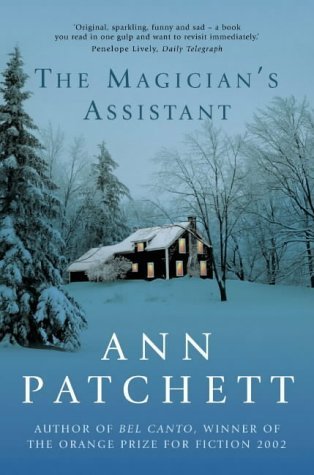 I’d only seen covers with a rabbit and top hat, so was confused that the secondhand copy I ordered with a birthday voucher featured a lit-up farmhouse set back into snowy woods. The first third of the novel takes place in Los Angeles, where Sabine lived with her husband Parsifal, the magician she assisted for 20 years, but the rest is set in winter-encased Nebraska. The contrast between the locations forms a perfect framework for a story of illusions versus reality.
SPOILERS FOLLOW – impossible to avoid them.
Patchett opens with the terrific lines “Parsifal is dead. That is the end of the story.” Ironically, his brain aneurysm burst while he was inside a hospital MRI machine, but it’s a mercy that he died quickly; he could have lingered for years with AIDS – like his lover, Phan, who died 14 months before. You see, while Parsifal while Sabine’s best friend, and in some ways the love of her life, their marriage was only a formality so that she could receive his assets. She knows little of his past; in taking on the name and persona of Parsifal the magician, he created a new life for himself. Only after his death does she learn from the will that his real name was Guy Fetters and that he has a mother, Dot, and sisters, Kitty and Bertie, back in Nebraska.
Dot and Bertie come out to L.A. to see how Guy lived and pay their respects at the cemetery, and then Sabine, lost without a magician to assist, flies out to Nebraska to stay with them for the week leading up to Bertie’s wedding. There is a tacit understanding among the family that Guy was gay, and Sabine assumes that’s why he was sent off to a boys’ reformatory. In fact, it’s because he was involved in his father’s accidental death. This kitchen has seen more than its fair share of climactic events.
END OF SPOILERS
The long section set in Nebraska went in directions I wasn’t expecting. It’s mostly based around late-night kitchen table and bedroom conversations; it’s a wonder it doesn’t become tedious. Patchett keeps the tension high as revelations emerge about what went on in this family. There are two moments when threat looks poised to spill into outright violence, in an echo of previous domestic violence.
For a long time I didn’t know what to make of the novel. It’s odd that all the consequential events happened before the first page and that we never truly meet Parsifal. Yet I loved the way that Sabine’s dreams and flashbacks widen the frame. Magic initially appears to be an arbitrary career choice, but gradually becomes a powerful metaphor of deception and control. Parsifal’s family are obsessed with a Johnny Carson performance he and Sabine once gave: they watch the video recording nightly, longing for the magic to be real. Maybe it is in the end? 
Snow by Marcus Sedgwick (2016)
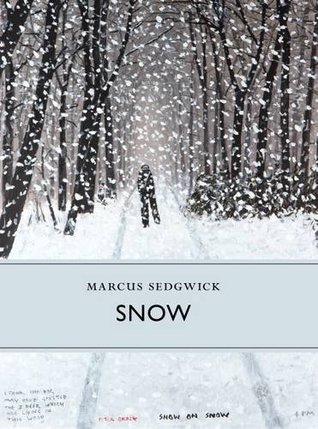 This Little Toller book is, at just over 100 pages, the perfect read for a wintry afternoon. It’s a lot like The Snow Tourist by Charlie English, though that book is travel-based, whereas for this one Sedgwick stayed put at his home in the Haute-Savoie, an alpine region of eastern France (and was even snowed in for part of the time), and wandered in his memory instead.
He writes that snow is “a form of nostalgia” for him, bringing back childhood days off school when he could just stay home and play – he loves it for “the freedom it represented.” He asks himself, “did it snow more when I was young, or is it just my desire and recreated memory?” Looking at weather statistics from Kent, he is able to confirm that, yes, it really did snow more in the 1960s and 70s.
Sedgwick briefly considers the science, history, art, and literature of snow, including polar expeditions and film, music, and paintings as well as Thomas Mann’s The Magic Mountain et al. He also likens the blank page to a snow-covered field, such that writers should not be daunted by it but excited by the possibility of creation.
In the Winter Dark by Tim Winton (1988)
 A taut early novella (just 110 pages) set in an Australian valley called the Sink. Animals have been disappearing: a pet dog snatched from its chain; livestock disemboweled. Four locals are drawn together by fear of an unidentified killer. Maurice Stubbs is the only one given a first-person voice, but passages alternate between his perspective and those of his wife Ida, Murray Jaccob, and Veronica, a pregnant teen. These are people on the edge, reckless and haunted by the past. The malevolent force comes to take on a vengeful nature. I was reminded of Andrew Michael Hurley’s novels. My first taste of Winton’s fiction has whetted my appetite to read more by him – I have Cloudstreet on the shelf.
Have you been reading anything particularly wintry this year?
Random 2020 Superlatives and Statistics
My top ‘discoveries’ of the year: Chimamanda Ngozi Adichie (4 books), Octavia E. Butler, Tim Dee (3 books each, read or in progress), and Louise Erdrich (2 books, one in progress).


Also the publisher Little Toller Books: I read four of their releases this year and they were fantastic.
The authors I read the most by this year: Carol Shields tops the list at 6 books (3 of these were rereads) thanks to my buddy reads with Buried in Print, followed by Paul Auster with 5 due to Annabel’s reading week in February, then Chimamanda Ngozi Adichie with 4, and finally Anne Lamott with 3 comfort rereads.


Debut authors whose next work I’m most looking forward to: Naoise Dolan, Bess Kalb, Dara McAnulty, Mary South, Brandon Taylor, and Madeleine Watts
My proudest reading achievement: 16 rereads, which must be a record for me. Also, I always say I’m not really a short story person … and yet somehow I’ve read 19 collections of them this year (and one stand-alone story, plus another collection currently on the go)!
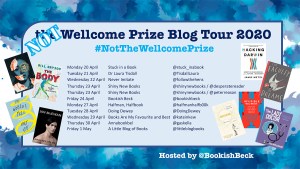
My proudest (non-reading) bookish achievement: Conceiving of and coordinating the Not the Wellcome Prize blog tour.
Five favorite blog posts of the year: Love, Etc. – Some Thematic Reading for Valentine’s Day; Polio and the Plague: Epidemics in Fiction; Thinking about the Future with David Farrier & Roman Krznaric (Hay Festival); Three Out-of-the-Ordinary Memoirs: Kalb, Machado, McGuinness; Asking What If? with Rodham by Curtis Sittenfeld (I had a lot of fun putting the current post together, too!)
The bookish experience that most defined my year: Watching the Bookshop Band’s live shows from their living room. Between their Friday night lockdown performances and one-offs for festivals and book launches, I think I saw them play 33 times in 2020!

Biggest book read this year: Going by dimensions rather than number of pages, it was the oversize hardback The Lost Words by Robert Macfarlane and Jackie Morris.
vs.
Smallest book read this year: Pocket-sized and only about 60 pages: No One Is Too Small to Make a Difference by Greta Thunberg.

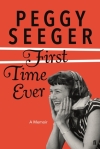 Oldest author read this year: Peggy Seeger was 82 when her memoir First Time Ever was published. I haven’t double-checked the age of every single author, but I think second place at 77 is a tie between debut novelist Arlene Heyman for Artifact and Sue Miller for Monogamy. (I don’t know how old Michael McCarthy, Jeremy Mynott and Peter Marren, the joint authors of The Consolation of Nature, are; Mynott may actually be the oldest overall, and their combined age is likely over 200.)
vs.
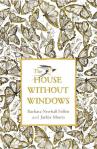 Youngest author read this year: You might assume it was 16-year-old Dara McAnulty with Diary of a Young Naturalist, which won the Wainwright Prize (as well as the An Post Irish Book Award for Newcomer of the Year, the Books Are My Bag Reader Award for Non-Fiction, and the Hay Festival Book of the Year!) … or Thunberg, above, who was 16 when her book came out. They were indeed tied for youngest until, earlier in December, I started reading The House without Windows (1927) by Barbara Newhall Follett, a bizarre fantasy novel published when the child prodigy was 12.
Most As on a book cover: Americanah by Chimamanda Ngozi Adichie
vs.
Most Zs on a book cover: The Hiding Place by Trezza Azzopardi. I haven’t read it yet, but a neighbor passed on a copy she was getting rid of. It was nominated for both the Booker Prize and the Orange Prize.

 The book that made me laugh the most: Kay’s Anatomy by Adam Kay
Books that made me cry: Writers and Lovers by Lily King, Monogamy by Sue Miller, First Time Ever by Peggy Seeger, and Catalogue Baby: A Memoir of (In)fertility by Myriam Steinberg (coming out in March 2021)
 The book that put a song in my head every single time I looked at it, much less read it: I Am an Island by Tamsin Calidas (i.e., “I Am a Rock” by Simon and Garfunkel, which, as my husband pointed out, has very appropriate lyrics for 2020: “In a deep and dark December / I am alone / Gazing from my window to the streets below … Hiding in my room / Safe within my womb / I touch no one and no one touches me.”)
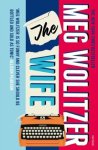
Best book club selections: Notes from an Exhibition by Patrick Gale and The Wife by Meg Wolitzer tied for our highest score ever and gave us lots to talk about.

 Most unexpectedly apt lines encountered in a book: “People came to church wearing masks, if they came at all. They’d sit as far from each other as they could.” (Gilead by Marilynne Robinson. Describing not COVID-19 times but the Spanish flu.)
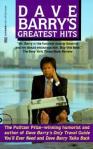 Most ironic lines encountered in a book: “September 12—In the ongoing hearings, Senator Joseph Biden pledges to consider the Bork nomination ‘with total objectivity,’ adding, ‘You have that on my honor not only as a senator, but also as the Prince of Wales.’ … October 1—Senator Joseph Biden is forced to withdraw from the Democratic presidential race when it is learned that he is in fact an elderly Norwegian woman.” (from the 1987 roundup in Dave Barry’s Greatest Hits – Biden has been on the U.S. political scene, and mocked, for 3.5+ decades!)
 Best first line encountered this year: “And then there was the day when Addie Moore made a call on Louis Waters.” (Our Souls at Night by Kent Haruf)
Best last lines encountered this year:
- “my childhood falls silently to the bottom of my memory, that library of the soul from which I will draw knowledge and experience for the rest of my life.” (Childhood by Tove Ditlevsen)
- “What I want to say is: I misremember all this so vividly it’s as if it only happened yesterday.” (Other People’s Countries: A Journey into Memory by Patrick McGuinness)
- “these friends would forever be her stitches, her scaffold, her ballast, her home.” (The Dearly Beloved by Cara Wall)
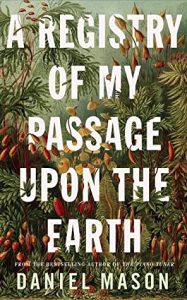
My favorite title and cover combo of the year: A Registry of My Passage Upon the Earth by Daniel Mason
The book I wish had gotten a better title and cover: Tennis Lessons by Susannah Dickey – I did enjoy this second-person novel about a young woman who is her own worst enemy, to the tune of 3.5 stars, but the title says nothing about it and the cover would have been a turnoff had I not won a signed copy from Mslexia.

The most unfortunate typos I found in published works: In English Pastoral by James Rebanks, “sewn” where he meant “sown” (so ironic in a book about farming!) versus, in Mr Wilder & Me by Jonathan Coe, “sown” in place of “sewn.” Also “impassible” where it should read “impassable” in Apeirogon by Colum McCann. This is what proofreaders like myself are for. We will save you from embarrassing homophone slips, dangling modifiers, and more!
The 2020 books that everybody else loved, but I didn’t: The Mirror and the Light by Hilary Mantel, Hamnet by Maggie O’Farrell, and Shuggie Bain by Douglas Stuart


The year’s biggest disappointments: I don’t like to call anything “worst” (after all, I didn’t read anything nearly as awful as last year’s Jonathan Livingston Seagull), but my lowest ratings went to A Traveller at the Gates of Wisdom by John Boyne and At Hawthorn Time by Melissa Harrison, and I was disappointed that When the Lights Go Out by Carys Bray was misleadingly marketed.
 The downright strangest books I read this year: Enter the Aardvark by Jessica Anthony, A Traveller at the Gates of Wisdom by John Boyne, The House Without Windows by Barbara Newhall Follett, and The Child in Time by Ian McEwan
The people and themes that kept turning up in my reading: Rachel Carson and Henry David Thoreau; curlews and plagues; how we define and relate to history; childhood memoirs (seven of them).

Some of my 2020 curlew reading. (Two more books with curlews on the cover were borrowed from the library.)
Some statistics on my 2020 reading:
Fiction: 57.2%
Nonfiction: 36.8%
Poetry: 6%
(Fiction reigned supreme this year! Last year my F:NF ratio was roughly 1:1. Poetry was down by ~5% this year compared to 2019.)
Male author: 34.1%
Female author: 63.8%
Nonbinary author: 0.3% (= 1 author, Jay Bernard)
Multiple genders (anthologies): 1.8%
(Women dominated by an extra ~5% this year over 2019. I’ve said this for four years now: I find it intriguing that female authors significantly outweigh male authors in my reading because I have never consciously set out to read more books by women; it must be a matter of being interested in the kinds of stories women tell and how they capture their experiences in nonfiction.)
E-books: 10.6%
Print books: 89.4%
(Almost exactly the same as last year. My e-book reading has been declining, partially because I’ve cut back on the reviewing gigs that involve only reading e-books and partially because I’ve done less traveling. Increasingly, I prefer to sit down with a big stack of print books.)
Books by BIPOC: 14.7%
Literature in translation: 6.6%
(Down from last year’s 7.2%; how did this happen?! This will be something to address in 2021.)
Where my books came from for the whole year:
- Free print or e-copy from publisher: 25.6%
- Public library: 25.6%
- Free (giveaways, The Book Thing of Baltimore, the free mall bookshop, etc.): 14.9%
- Secondhand purchase: 11.6%
- Downloaded from NetGalley, Edelweiss or Project Gutenberg: 6.7%
- New purchase (sometimes at a bargain price): 6.3%
- Gifts: 5.5%
- University library: 3.8%
I promised to scale back on review copies this year, and I did: last year they accounted for nearly 37% of my reading. My library reading was higher than last year’s, despite the challenges of lockdowns; my e-book reading decreased in general. I bought more than twice as many new books as usual this year, and read lots that I either bought secondhand or got for free.
Number of unread print books in the house: 435
At the end of last year this figure was at 440 after lots of stock-ups from the free mall bookshop, which has since closed. So even though it might look like I have only read five books of my own, I have in fact read loads from my shelves this year … but also acquired many more books, both new and secondhand.
In any case, the overall movement has been downward, so I’m calling it a win!
Nonfiction Novellas for November
Nonfiction novellas – that’s a thing, right? Lots of bloggers are doing Nonfiction November, but I feel like I pick up enough nonfiction naturally (at least 40% of my reading, I’d estimate) that I don’t need a special challenge related to it. I’ve read seven nonfiction works this month that aren’t much longer than 100 pages, or sometimes significantly shorter. For the most part these are nature books and memoirs. I’m finishing off a few more fiction novellas and will post a roundup of mini reviews before the end of the month, along with a list of the titles that didn’t take and some general thoughts on novellas.
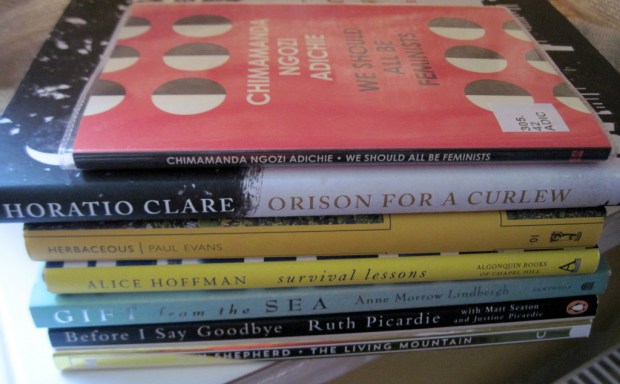
“We Should All Be Feminists” by Chimamanda Ngozi Adichie
[48 pages]
 This isn’t even a novella, but an essay published in pamphlet form, based on a TED talk Adichie gave as part of a conference on Africa. I appreciate and agree with everything she has to say, yet didn’t find it particularly groundbreaking. Her discussion of the various stereotypes associated with feminists and macho males is more applicable to a society like Lagos, though of course the pay gap and negative connotations placed on women managers are as relevant in the West.
Favorite line: “At some point I was a Happy African Feminist Who Does Not Hate Men And Who Likes To Wear Lip Gloss And High Heels For Herself And Not For Men.”
Orison for a Curlew: In search of a bird on the edge of extinction by Horatio Clare
[101 pages]
 Clare was commissioned to tell the story of the slender-billed curlew, a critically endangered marsh-dwelling bird that might be holding out in places like Siberia and Syria but is largely inaccessible to the European birding community. With little hope of finding a bird as good as extinct, he set out instead to speak to those in Greece, Romania and Bulgaria who had last seen the bird before its disappearance: conservationists, hunters, bird watchers and photographers. Clare writes well about nostalgia, hope and the difference individuals can make, but there’s no getting around the fact that this book doesn’t really do what it promises to. [Also, much as I hate to say it, this is atrociously edited. I know Little Toller is a small operation, but there are some shocking typos in here: “pilgrimmage,” “bridwatching,” “govenor,” “refinerey”; even the name of the author’s town, “Hebdon Bridge”!]
Some favorite lines:
“A huge cloud of black storks jump up like an ambush of Hussars in their red bills and leggings, white fronts and dark uniforms.”
“The wheels click-beat the rails as we follow a river valley north past dozy dolomitic scenery in ageing lemon sunlight”
Herbaceous by Paul Evans
[106 pages]
 This was Evans’s first book, and the first issued in the Little Toller monograph series. These are generally exceptionally produced nature books on niche subjects. Herbaceous is hard to categorize. In some ways it’s similar to Evans’s Guardian Country Diary columns: short pieces blending straightforward observations with poetic musings. However, some of them read more like short stories, and the language – appropriately for a book about flora? – can be florid. They probably work better read aloud as poems: I remember him reading “Skunk cabbage” at the New Networks for Nature conference some years back, for instance. Some lines are a little oversaturated with metaphor. But others are truly lovely.
A few favorite lines:
“The following morning the text of journeys appear[s] on snow: trident marks of pheasant, double slots of fallow deer, dabs of rabbit.”
“Bordello black and scarlet, six-spot burnet moths swing on the nodding idiot scabious flower through a lavender-blue sky and deep, deep under roots, the fossilised fury of the mollusc’s empire heaves.”
“A bed of pansies tilts flat blue faces to the sun like a deaf and dumb funeral.”
Survival Lessons by Alice Hoffman
[83 pages]
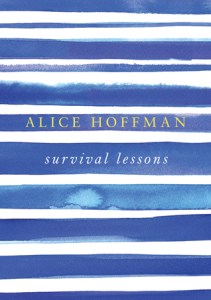 Hoffman wrote this 15 years after her own bout with breast cancer to encourage anyone going through a crisis. Each chapter title begins with the word “Choose” – a reminder that, even when you can’t choose your circumstances, you can choose your response. For instance, “Choose Whose Advice to Take” and “Choose to Enjoy Yourself.” This has been beautifully put together with blue-tinted watercolor-effect photographs and an overall yellow and blue theme (along with deckle edge pages – a personal favorite book trait). It’s a sweet little memoir with a self-help edge, and I think most people would appreciate being given a copy. The only element that felt out of place was the five-page knitting pattern for a hat. Though very similar to Cathy Rentzenbrink’s A Manual for Heartache, this is that tiny bit better.
Favorite lines:
“Make a list of what all you have loved in this unfair and beautiful world.”
“When I couldn’t write about characters that didn’t have cancer and worried I might never get past this single experience, my oncologist told me that cancer didn’t have to be my entire novel. It was just a chapter.”
Gift from the Sea by Anne Morrow Lindbergh
[130 pages]
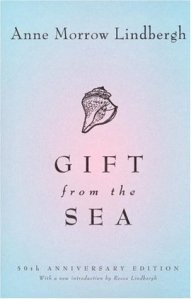 Though written in 1955 (I read a 50th anniversary edition copy), this still resonates and deserves to be read alongside feminist nonfiction by Virginia Woolf, May Sarton and Madeleine L’Engle. Solitude is essential for women’s creativity, Lindbergh writes, and this little book, written during a beach vacation in Florida, is about striving for balance in a midlife busy with family commitments. Like Joan Anderson, Lindbergh celebrates the pull of the sea and speaks of life, and especially marriage, as a fluid thing that ebbs and flows. Divided into short, meditative chapters named after different types of shells, this is a relatable work about the search for a simple, whole, purposeful life. The afterword from 1975 and her daughter Reeve’s introduction from 2005 testify to how lasting an influence the book has had.
Favorite lines:
“Patience, patience, patience, is what the sea teaches. Patience and faith.”
“The most exhausting thing in life, I have discovered, is being insincere.”
“I no longer pull out grey hairs or sweep down cobwebs.”
“It is fear, I think, that makes one cling nostalgically to the last moment or clutch greedily toward the next.”
Before I Say Goodbye by Ruth Picardie
[116 pages]
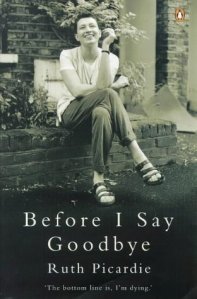 Ruth Picardie, an English freelance journalist and newspaper editor, was younger than I am now when she died of breast cancer in September 1997. The cancer had moved into her liver, lungs, bones and brain, and she only managed to write 6.5 weekly columns for Observer Life magazine, which her older sister, Justine Picardie, edited. Matt Seaton, Ruth’s widower, and Justine gathered a selection of e-mails exchanged with friends and letters sent by Observer readers and put them together with the columns to make a brief chronological record of Ruth’s final illness, ending with a 20-page epilogue by Seaton. Ruth comes across as down-to-earth and self-deprecating. All the rather Bridget Jones-ish fretting over her weight and complexion perhaps reflects that it felt easier to think about daily practicalities than about the people she was leaving behind. This is a poignant book, for sure, but feels fixed in time, not really reaching into Ruth’s earlier life or assessing her legacy. I’ve moved straight on to Justine’s bereavement memoir, If the Spirit Moves You, and hope it adds more context.
Favorite lines:
“You ram a non-organic carrot up the arse of the next person who advises you to start drinking homeopathic frogs’ urine.”
“Worse than the God botherers, though, are the road accident rubber-neckers, who seem to find terminal illness exciting, the secular Samaritans looking for glory.”
The Living Mountain by Nan Shepherd
[108 pages]
 This is something of a lost nature classic that has been championed by Robert Macfarlane (who contributes a 25-page introduction to this Canongate edition). Composed during the later years of World War II but only published in 1977, it’s Shepherd’s tribute to her beloved Cairngorms, a mountain region of Scotland. But it’s not a travel or nature book in the way you might usually think of those genres. It’s a subtle, meditative, even mystical look at the forces of nature, which are majestic but also menacing: “the most appalling quality of water is its strength. I love its flash and gleam, its music, its pliancy and grace, its slap against my body; but I fear its strength.” Shepherd dwells on the senses, the mountain flora and fauna, and the special quality of time and existence (what we’d today call mindfulness) achieved in a place of natural splendor and solitude: “Yet often the mountain gives itself most completely when I have no destination, when I reach nowhere in particular, but have gone out merely to be with the mountain as one visits a friend with no intention but to be with him.”
 Bookish Beck = Rebecca Foster. American transplant to England. Freelance proofreader and book reviewer.
 Bookish Beck