Review Catch-up: Matt Gaw, Sheila Heti, Liz Jensen (and a Pile of DNFs)
Today I have a travel book about appreciating nature in any weather, a sui generis memoir drawn from a decade of diaries, and an impassioned cry for the environment in the wake of a young adult son’s death.
I’m also bidding farewell to a whole slew of review books that have been hanging around, in some cases, for literal years – I think one is from 2021, and several others from 2022. Putting a book on my “set aside” shelf can be a kiss of death … or I can go back at a better time and end up loving it. It’s hard to predict which will occur. On these, alas, I have had to admit defeat and will pass the books on to other homes.
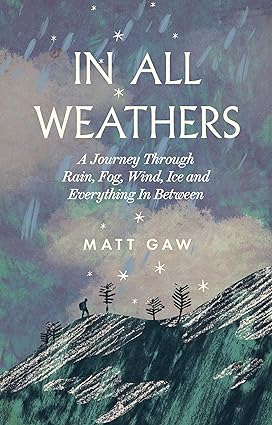
In All Weathers: A Journey through Rain, Fog, Wind, Ice and Everything in Between by Matt Gaw
Gaw’s two previous nature/travel memoirs, the enjoyable The Pull of the River and Under the Stars, involve gentle rambles through British landscapes, along with commentary on history, nature and science. The remit is much the same here. The book is split into four long sections: “Rain,” “Fog,” “Ice and Snow,” and “Wind.” The adventures always start from and end up at the author’s home in Suffolk, but he ranges as far as the Peak District, Cumbria and the Isle of Skye. Wild swimming is one way in which he experiences places. He notices a lot and describes it all in lovely and relatable prose.
 I was tickled by the definitions of, and statistics about, a “white Christmas”: in the UK, it counts if there’s even a single snowflake falling, whereas in the US there has to be 2.5 cm or more of standing snow. (Scotland is most likely to experience white Christmases; it has had 37 since 1960 vs. 26 in northern England. The English snow record is 43 cm, at Buxton and Malham Tarn in 1981 and 2009.) There’s underlying mild dread as he notes how weather patterns have changed and will likely continue changing, ever more dramatically, into his children’s future.
I find I don’t have much to say about this book because it is very nice but doesn’t do anything interesting or tackle anything that isn’t familiar from many other nature books (such as Rain by Melissa Harrison and Forecast by Joe Shute). It’s unfortunate for Gaw that his ideas often seem to have been done before – his book on night-walking, in particular, was eclipsed by several other works on that topic that came out at around the same time. I hope that the next time around he’ll get more editorial guidance to pursue original topics. It might take just a little push to get him to the next level where he could compete with top UK nature writers.
With thanks to Elliott & Thompson Books for the free copy for review.
Alphabetical Diaries by Sheila Heti
Heti put the contents of ten years of her diaries into a spreadsheet, alphabetizing each sentence (including articles), and then ruthlessly culled the results until she had a 25-chapter (no ‘X’) book. You could hardly call it a narrative, yet looking for one is so hardwired that every few sentences you are jolted out of what feels like a mini-story and into something new. Instead, you might think of it as an autobiographical mosaic. The recurring topics are familiar from the rest of Heti’s oeuvre, with obsessive cogitating about relationships, art and identity. But there are also the practicalities of trying to make a living as a woman in a creative profession. Tendrils of the everyday poke out here and there as she makes a meal, catches a plane, or buys clothes. Men loom large: explicit accounts of sex with Pavel and Lars (though also Fiona); advising her friend Lemons on his love life. There are also meta musings on what she is trying to achieve with her book projects and on what literature can be.
 Grammatically, the document is a lot more interesting than it could be – or than a similar experiment based on my diary would be, for instance – because Heti sometimes writes in incomplete sentences, dropping the initial pronoun; or intersperses rhetorical questions or notes to self in the imperative. So, yes, ‘I’ is a long chapter, but not only because of self-absorbed “I…” statements; there’s also plenty of “If…” and “It’s…” ‘H’ and ‘W’ are longer sections than might be expected because of the questioning mode. But it’s at the sentence level that the book makes the biggest impression: lines group together, complement or contradict each other, or flout coherence by being so merrily à propos of nothing. Here are a few passages to give a flavour:
Am I wasting my time? Am low on money. Am making noodles. Am reading Emma. Am tired and will go to sleep. Am tired today and I feel like I may be getting a cold. Ambivalence gives you something to do, something to think about.
Best not to live too emotionally in the future—it hardly ever comes to pass. Better to be on the outside, where you have always been, all your life, even in school, nothing changes. Better to look outward than inward. Blow jobs and tenderness. Books that fall in between the cracks of all aspects of the human endeavour.
It’s 2:34 every time I check the time these days. It’s 4 p.m. It’s 4:41 now. It’s a fantasy of being saved. It’s a stupid idea. It’s a yellow, cloudy sky. It’s amazing to me how life keeps going. It’s better to work, to go into the underground cave where there are books, than to fritter away time online. It’s crazy that I need all of these mental crutches in order to live. It’s fiction. It’s fine.
Scrambled eggs on toast at Yaddo. Second-guessing everything. Second, he said that no one is buying fiction. See the complexity. See the souls. See what kind of story the book can accommodate, if any. Seeing her for coffee was not so bad.
It’s surprising how much sense a text constructed so apparently haphazardly makes, perhaps because of the same subject and style throughout. Sometimes aphoristic, sometimes poetic (all that anaphora), the book is playful but overall serious about the capturing of a life on the page. Heti transcends the quotidian by exploding the one-thing-after-another tedium of chronology. Remarkably, the collage approach produces a more genuine, crystalline vision of the self than precise scenes and cause-and-effect chains ever could. A work of life writing like no other, it must be read in a manner all its own that it teaches you as you go along. I admire it enormously and hope I might write something even half as daring one day.
With thanks to Fitzcarraldo Editions for the free copy for review.
Your Wild and Precious Life: On grief, hope and rebellion by Liz Jensen
Jensen’s younger son, Raphaël Coleman, was just 25 when he collapsed while filming a documentary in South Africa and died of a previously undiagnosed heart condition. Raph had been involved in Extinction Rebellion and Jensen is a founding member of Writers Rebel. They both deemed activism “the best antidote to depression.” Her son had been obsessed with wildlife from a young age and was rewilding acres of their land in France, as well as making environmentalist films (he had achieved minor fame as a child actor in Nanny McPhee) and participating in direct action, such as at the Brazilian embassy in London.
 For Jensen, the challenge, especially after lockdown confined her to her Copenhagen flat, was to channel grief into further radicalism rather than retreating into herself or giving in to the lure of suicide. She tried to see personal grief as a reminder of ecogrief, and therefore as a spur. One way that she coped was turning towards the supernatural. She continued to hear and speak to Raph, in daily life as well as through a medium, and interpreted bird sightings as signs of his continued presence. An additional point of interest to me was that the author’s husband is Carsten Jensen, the writer of one of my favourite books, We, the Drowned.
This doesn’t particularly stand out among the dozens of bereavement memoirs I’ve read. (It was also remarkably similar to Alexandra Fuller’s Fi, which I’d read not long before.) Perhaps more years of reflection would have helped – Mary Karr advises seven – though I suspect Jensen felt, quite rightly, that given the current state of the environment we have no time to waste. And I have no doubt that the combination of a mother’s love and an ecological conscience will make this book meaningful to many readers.
With thanks to Canongate for the free copy for review.
And the DNFs…
there are more things, Yara Rodrigues Fowler – I loved Stubborn Archivist so much that I leapt at the chance to read her follow-up, but it was just too dull and involved about Brazilian versus UK politics. Nor did the stylistic tricks feel as novel this time around. I read 66 pages. (Fleet)
The Rabbit Hutch, Tess Gunty – Gunty dazzled critics and prize judges in the USA, winning a National Book Award. I was drawn to her debut novel for the composite picture of the residents of one Indiana apartment building and the strange connections that develop between them over one summer week, including perhaps a murder? Blandine, the central character, is a sort of modern-day mystic but hard to warm to (“She normally tries to avoid saying in which out loud, to minimize the number of people who find her insufferable”), as are all the characters. This felt like try-hard MFA writing. I read 85 pages. (Oneworld)
Eve: The Disobedient Future of Birth, Claire Horn – I usually get on well with Wellcome Collection books. I think the problem here was that there was too much material that was familiar to me from having read Womb by Leah Hazard – even the SF-geared stuff about artificial wombs. I read 45 pages. (Profile Books)
Blessings, Chukwuebuka Ibeh – This debut novel has a confident voice, buttressed by determination to reveal what life is like for queer people living in countries where homosexuality is criminalized. Obiefuna is cast out for having a crush on Aboy, his father’s apprentice, even though the two young men share nothing more physical than a significant gaze into each other’s eyes. The strict boarding school his father sends him to is a place of privation, hierarchy, hazing and, I suspect, same-sex experimentation. I found the writing capable but couldn’t get past a sense of dread about what was going to happen. Meanwhile, I didn’t think the alternating chapters from Obiefuna’s mother’s perspective added anything to the narrative. I read 62 pages. (Penguin Viking)
The War for Gloria, Atticus Lish – Lish’s debut novel, Preparation for the Next Life, was excellent, but I could never get stuck in to this follow-up, despite the appealing medical theme. When Gloria Goltz is diagnosed with ALS, her 15-year-old son Corey turns to his absent father and others for support. It was also unfortunate that Lish mentions the Ice Bucket Challenge: that was popularized in 2014, whereas the book is set in 2010. I read 75 pages. (Serpent’s Tail)
Snow Widows: Scott’s Fatal Antarctic Expedition through the Eyes of the Women They Left Behind, Katherine MacInnes – I seriously overestimated my interest in polar exploration narratives. MacInnes seems to have done quite a good job of creating novelistic scenes through research, though. I read 35 pages. (William Collins)
The Woodcock, Richard Smyth – I feel particularly bad about this one as I’ve read and enjoyed three of Smyth’s nature books and my husband and I are friendly with him on Twitter. Initially, I got Thomas Hardy, D.H. Lawrence and Sarah Perry (The Essex Serpent, anyway) vibes from this 1920s-set novel about the upheaval a naturalist and his wife experience when an American whaler and his daughters arrive in their small coastal English town. I read 90 pages. (Fairlight Books)
Better Broken than New: A Fragmented Memoir, Lisa St Aubin de Terán – I accepted this for review because I’d often seen the author’s name on spines in secondhand bookstores but didn’t know anything about her work. The précis of her globe-trotting life is stranger than fiction: marriage to a Venezuelan freedom fighter, managing a sugar plantation in the Andes, living in an Italian palace for 20 years, founding a charity in Mozambique. The vignettes in the early part of the book (e.g., skipping school and going on daytrips by train at age eight) are entertaining, if written with blithe disregard for a reader’s need for context or perspective. But the fragmented nature means it all feels as random as life, without the necessary authorial shaping. The publisher has done her a disservice as she seeks to relaunch her career by not proofreading properly: Many small errors slipped through the net, making this look like a sloppy manuscript. The worst happen to be other authors’ names: Jane ‘Austin’, ‘Kahil’ Gibran, Virginia ‘Wolfe’. Are you kidding me?! I read 53 pages. (Amaurea Press)
Three “Love” or “Heart” Books for Valentine’s Day: Ephron, Lischer and Nin
Every year I say I’m really not a Valentine’s Day person and yet put together a themed post featuring books that have “Love” or a similar word in the title. This is the eighth year in a row, in fact (after 2017, 2018, 2019, 2020, 2021, 2022, and 2023)! Today I’m looking at two classic novellas, one of them a reread and the other my first taste of a writer I’d expected more from; and a wrenching, theologically oriented bereavement memoir.
Heartburn by Nora Ephron (1983)
I’d already pulled this out for my planned reread of books published in my birth year, so it’s pleasing that it can do double duty here. I can’t say it better than my original 2013 review:
The funniest book you’ll ever read about heartbreak and betrayal, this is full of wry observations about the compromises we make to marry – and then stay married to – people who are very different from us. Ephron readily admitted that her novel is more than a little autobiographical: it’s based on the breakdown of her second marriage to investigative journalist Carl Bernstein (All the President’s Men), who had an affair with a ludicrously tall woman – one element she transferred directly into Heartburn.
Ephron’s fictional counterpart is Rachel Samstad, a New Yorker who writes cookbooks or, rather, memoirs with recipes – before that genre really took off. Seven months pregnant with her second child, she has just learned that her second husband is having an affair. What follows is her uproarious memories of life, love and failed marriages. Indeed, as Ephron reflected in a 2004 introduction, “One of the things I’m proudest of is that I managed to convert an event that seemed to me hideously tragic at the time to a comedy – and if that’s not fiction, I don’t know what is.”
As one might expect from a screenwriter, there is a cinematic – that is, vivid but not-quite-believable – quality to some of the moments: the armed robbery of Rachel’s therapy group, her accidentally flinging an onion into the audience during a cooking demonstration, her triumphant throw of a key lime pie into her husband’s face in the final scene. And yet Ephron was again drawing on experience: a friend’s therapy group was robbed at gunpoint, and she’d always filed the experience away in a mental drawer marked “Use This Someday” – “My mother taught me many things when I was growing up, but the main thing I learned from her is that everything is copy.” This is one of celebrity chef Nigella Lawson’s favorite books ever, for its mixture of recipes and rue, comfort food and folly. It’s a quick read, but a substantial feast for the emotions.
 Sometimes I wonder why I bother when I can’t improve on reviews I wrote over a decade ago (see also another upcoming reread). What I would add now, without disputing any of the above, is that there’s more bitterness to the tone than I’d recalled, even though Ephron does, yes, play it for laughs. But also, some of the humour hasn’t aged well, especially where based on race/culture or sexuality. I’d forgotten that Rachel’s husband isn’t the only cheater here; pretty much every couple mentioned is currently working through the aftermath of an affair or has survived one in the past. In one of these, the wife who left for a woman is described not as a lesbian but by another word, each time, which felt unkind rather than funny.
Still, the dialogue, the scenes, the snarky self-portrayal: it all pops. This was autofiction before that was a thing, but anyone working in any genre could learn how to write readable content by studying Ephron. “‘I don’t have to make everything into a joke,’ I said. ‘I have to make everything into a story.’ … I think you often have that sense when you write – that if you can spot something in yourself and set it down on paper, you’re free of it. And you’re not, of course; you’ve just managed to set it down on paper, that’s all.” (Little Free Library)
My original rating (2013): 
My rating now:
Stations of the Heart: Parting with a Son by Richard Lischer (2013)
“What we had taken to be a temporary unpleasantness had now burrowed deep into the family pulp and was gnawing us from the inside out.” Like all life writing, the bereavement memoir has two tasks: to bear witness and to make meaning. From a distance that just happens to be Mary Karr’s prescribed seven years, Lischer opens by looking back on the day when his 33-year-old son Adam called to tell him that his melanoma, successfully treated the year before, was back. Tests revealed that the cancer’s metastases were everywhere, including in his brain, and were “innumerable,” a word that haunted Lischer and his wife, their daughter, and Adam’s wife, who was pregnant with their first child.
 The next few months were a Calvary of sorts, and Lischer, an emeritus professor at Duke Divinity School, draws deliberate parallels with the biblical and liturgical preparations for Good Friday that feel appropriate for this Ash Wednesday. Lischer had no problem with Adam’s late-life conversion from Protestantism to Catholicism, whose rites he followed with great piety in his final summer. He traces Adam and Jenny’s daily routines as well as his own helpless attendance at hospital appointments. Doped up on painkillers, Adam attended one last Father’s Day baseball game with him; one last Fourth of July picnic. Everyone so desperately wanted him to keep going long enough to meet his baby girl. To think that she is now a young woman and has opened all the presents Adam bought to leave behind for her first 18 birthdays.
The facts of the story are heartbreaking enough, but Lischer’s prose is a perfect match: stately, resolute and weighted with spiritual allusion, yet never morose. He approaches the documenting of his son’s too-short life with a sense of sacred duty: “I have acquired a new responsibility: I have become the interpreter of his death. God, I must do a better job. … I kissed his head and thanked him for being my son. I promised him then that his death would not ruin my life.” This memoir brought back so much about my brother-in-law’s death from brain cancer in 2015, from the “TEAM [ADAM/GARNET]” T-shirts to Adam’s sister’s remark, “I never dreamed this would be our family’s story.” We’re not alone. (Remainder book from the Bowie, Maryland Dollar Tree) 
A Spy in the House of Love by Anaïs Nin (1954)
 I’d heard Nin spoken of in the same breath as D.H. Lawrence, so thought I might similarly appreciate her because of, or despite, comically overblown symbolism around sex. I think I was also expecting something more titillating? (I guess I had this confused for Delta of Venus, her only work that would be shelved in an Erotica section.) Many have tried to make a feminist case for this novella about Sabina, an early liberated woman in New York City who has extramarital sex with four other men who appeal to her for various not particularly good reasons (the traumatized soldier whom she comforts like a mother; the exotic African drummer – “Sabina did not feel guilty for drinking of the tropics through Mambo’s body”). She herself states, “I want to trespass boundaries, erase all identifications, anything which fixes one permanently into one mould, one place without hope of change.” The most interesting aspect of the book was Sabina’s questioning of whether she inherited her promiscuity from her father (it’s tempting to read this autobiographically as Nin’s own father left the family for another woman, a foundational wound in her life).
Come on, though, “fecundated,” “fecundation” … who could take such vocabulary seriously? Or this sex writing (snort!): “only one ritual, a joyous, joyous, joyous impaling of woman on a man’s sensual mast.” I charge you to use the term “sensual mast” wherever possible in the future. (Secondhand – Oxfam, Newbury) 
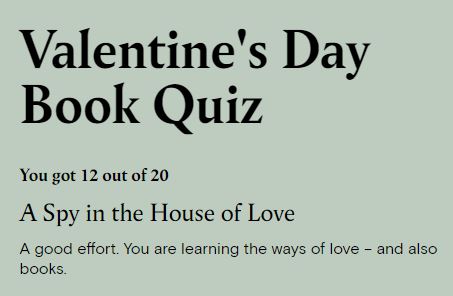
But hey, check out my score for the Faber Valentine’s quiz!
I own too many unread books by…
A side effect of packing my library in preparation for moving: I’ve noticed there are certain authors whose works I tend to acquire secondhand and then stockpile rather than read. (I’ve also included in the tallies copies that I know are sitting in boxes in the USA.)
 D.H. Lawrence: 9+ (Aaron’s Rod, Kangaroo, The Lost Girl, The Plumed Serpent, a Complete Poems volume, Sea and Sardinia, a Selected Short Stories volume, Studies in Classic American Literature, The Woman Who Rode Away)
Lawrence was one of my research specialties as an undergraduate, so I read all his major works in my early twenties, as well as some lesser-known stuff, but haven’t felt compelled to pick up anything by him since. I’m not sure I’d care for him anymore, and it’s as if I don’t want to destroy the mystique. Yet I also can’t bring myself to get rid of these.
 T.C. Boyle: 7 (A Friend of the Earth, The Inner Circle, Riven Rock, The Tortilla Curtain, Water Music, The Women, World’s End)
I’ve read five of Boyle’s books and have had a mixed experience, but his plots – whether biographical (Alfred Kinsey! the wives and lovers of Frank Lloyd Wright!) or environmental – tend to attract me. My husband has actually become the bigger fan, so has read 3–4 of these that I haven’t.
 W. Somerset Maugham: 7 (Ashenden, Christmas Holiday, Creatures of Circumstance, Liza of Lambeth, The Magician, The Razor’s Edge, The Summing Up)
I read four of Maugham’s novels between 2014 and 2020. He’s an unappreciated author these days. Back when we had a free bookshop in my local mall, I volunteered weekly and most weeks came away with a backpack full of goodies. One week it was a partial leatherbound set of Maugham, which I’ve since supplemented with other paperbacks.
 Robertson Davies: 6.5 (The Salterton Trilogy, The Deptford Trilogy, The Cornish Trilogy)
I loved Fifth Business and The Rebel Angels, read for subsequent Robertson Davies week challenges run by Lory, but made aborted attempts at both ‘sequels’, so the rest of his three major trilogies remain unread on my shelves.
 Barbara Comyns: 5 (The Juniper Tree, The House of Dolls, Mr Fox, The Skin Chairs, A Touch of Mistletoe)
I blame Liz for this one: after I read Who Was Changed and Who Was Dead during Novellas in November last year, she passed on her Comyns stash in a lovely Christmas parcel. Most are short enough to suit a future #NovNov, but I have The Juniper Tree earmarked for 20 Books of Summer (flora themed) and A Touch of Mistletoe for Christmastide.

 Wendy Perriam: 5 (Absinthe for Elevenses, Breaking and Entering, Cuckoo, Michael, Michael, Sin City)
Again, mostly Liz’s fault. (Though two others came from my Hay-on-Wye haul in September 2020.) I’ve still only read the one novel by Perriam, The Stillness The Dancing, but it was great and made me confident that I’d enjoy engaging with her repeated themes.
 Richard Mabey: 4 (The Common Ground, Gilbert White biography, Nature Cure, The Unofficial Countryside)
Considering that Mabey is the father of modern British nature writing, it’s kind of shocking that I’ve never read anything by him. I’ve put Nature Cure on my bedside pile to start soon.
 Virginia Woolf: 4 (Between the Acts, The Waves, The Years, a volume of her diaries)
I’ve tried The Waves and The Years and didn’t get further than a few pages; I find Woolf unreadably dense in a way I didn’t in my early twenties, when I studied To the Lighthouse (go figure). But there’s still this compulsion to have read them so that I can be a well-rounded literary person.
 Kent Haruf: 3 (Plainsong, Eventide, Benediction)
Our Souls at Night topped my backlist reads in 2020, but an attempt at reading Plainsong soon after failed. I think it was more involved, with more strands, than I was expecting after the simplicity of his novella. So the trilogy, acquired piecemeal secondhand, has languished on my shelves. I’ll try again with Plainsong this year.
 Elizabeth Jane Howard: 3 (Marking Time, Confusion, Casting Off)
I loved sinking into The Light Years, the first volume of The Cazalet Chronicles (read for a book club meeting last January), and even read the first 60 pages of the sequel, Marking Time, but then tailed off – you can see I’m terrible about continuing with series. But I’d like to get back into this one and, when I do, I have Books 2–4 out of five awaiting me.
 Mary Karr: 3 (The Liars’ Club, Cherry, Lit)
Karr was key to the resurgence in popularity of memoirs in the 1990s. I’ve read her book about memoir (as well as a commencement speech she gave, and a volume of her poems), but not yet one of her actual memoirs. I found them all free or secondhand on trips back to the States. I don’t know whether it’s important to go in the chronological order listed above, or if I should just jump in with whichever, maybe Lit, about her struggle with alcoholism.
 Sue Miller: 3 (The Lake Shore Limited, While I Was Gone, The World Below)
After I read Monogamy in December 2020 and it ended up on my Best-of list for that year, I scurried to get hold of a bunch of her other books. I’ve since read The Senator’s Wife, which was a big disappointment, but I’m looking forward to trying more.
 Howard Norman: 3 (Devotion, The Northern Lights, What Is Left the Daughter)
I’ve read six of Norman’s books; he’s an underrated treasure of an author. I have no idea why I haven’t read these yet. Two are marooned in America, but The Northern Lights could make it onto a reading stack anytime. I just need the right excuse, it seems.
I’m thinking back to 2020, when I realized I had four unread Chimamanda Ngozi Adichie books on my shelves. Through various challenges – doorstoppers, summer reads, short stories, novellas – I managed to read them ALL that year, followed by another two in 2021. I don’t usually enjoy binging on particular authors in that way, but her books are different enough from each other (and just so good) that I didn’t mind.
I can’t promise to try the same tactic with these underread authors this year, but I can at least resolve to read one book by each of them, to reduce the backlog.
Do you have particular authors you own a lot by … but fail to read?
The Still Point (of the Turning World & Sanctuary)
Amy Sackville’s debut novel, The Still Point, had been on my radar ever since I read her follow-up, Orkney. I finally put it on my wish list and got a copy for Christmas. In the meantime, I’d also acquired a copy of Emily Rapp’s memoir The Still Point of the Turning World as part of a big secondhand book haul at the start of the first lockdown.
Both books take their title from the eminently quotable T.S. Eliot*, specifically his poem “Burnt Norton.” I couldn’t resist the urge to review them together (along with Rapp’s recent sequel) – although, unlike with my dual review of two books titled Ex Libris, I won’t pit them against each other because they’re such different books.
That said, they do share a dreamlike quality and the search for people and places that might serve as refuges in a shattered life. All:
The Still Point by Amy Sackville (2010)
no
I am not heroic, I prefer
not to conquer
polar regions, my
gardens in July
serve for me.
~from “emperor’s walk” by G.F. Dutton
 A sweltering summer versus an encasing of ice; an ordinary day versus decades of futile waiting. Sackville explores these contradictions only to deflate them, collapsing time such that a polar explorer’s wife and her great-great-niece can inhabit the same literal and emotional space despite being separated by more than a century. When Edward Mackley went off on his expedition in the early 1900s, he left behind Emily, his devoted, hopeful new bride. She was to live out the rest of her days in the Mackley family home with her brother-in-law and his growing family; Edward never returned. Now Julia and her husband Simon reside in that same Victorian house, serving as custodians of memories and artifacts from her ancestors’ travels and naturalist observations. From one early morning until the next, we peer into this average marriage with its sadness and silences. On this day, Julia discovers a family secret, and late on reveals another of her own, that subtly change how we see her and Emily.
This is a highly fluid and sensual novel, but somehow so sinuous as to be hard to grasp. I took in its interlocking story lines just a few pages at a time; floating on the gorgeous prose, basking in the alternating heat and chill. Sackville’s greatest stylistic debt must be to Virginia Woolf, but I was also reminded of Lucy Wood’s Weathering and Evie Wyld’s The Bass Rock – two similarly beautiful books in which a house and its ghosts are major characters – and of how some of Sarah Moss’s work braids the past into the everyday. I suspect this won’t be for every reader, but if you can find the right moment and mood, you might just be entranced.
One of Sackville’s research sources was Arctic Dreams by Barry Lopez, a work I recently skimmed for a winter post. Two passages that stood out to me apply equally well to Rapp’s books:
 “The literature of nineteenth-century arctic exploration is full of coincidence and drama—last-minute rescues, a desperate rifle shot to secure food for starving men, secret letters written to painfully missed loved ones. There are moments of surreal stillness, as in Parry’s journal when he writes of the sound of the human voice in the land. And of tender ministration and quiet forbearance in the face of inevitable death.”
“The continuous work of the imagination, I thought, to bring what is actual together with what is dreamed is an expression of human evolution. The conscious desire is to achieve a state, even momentarily, that like light is unbounded, nurturing, suffused with wisdom and creation, a state in which one has absorbed that very darkness which before was the perpetual sign of defeat.”
The Still Point of the Turning World by Emily Rapp (2013)
 In 2011 Rapp’s baby son Ronan was diagnosed with Tay-Sachs disease, a degenerative nerve condition that causes blindness, deafness, seizures, paralysis and, ultimately, death. Tay-Sachs is usually seen in Ashkenazi Jews, so it came as a surprise: Rapp and her husband Rick both had to be carriers, whereas only he was Jewish; they never thought to get tested.
This memoir was written while Ronan was still alive, and the rapid, in-the-thick-of-it composition is evident: it rides the same rollercoaster of feelings over and over again, even repeating some of the same facts. I put this down to the brain fog of anticipatory grief. “The constant push-pull: here but not for long. What will come next?” Rapp quotes extensively from other writers who have grappled with bereavement, especially poets, as if building an inner library to bolster herself against what is to come (“it wasn’t consolation I needed or desired, but the tools to walk through this fire without being consumed by it”).
Rapp puts her son’s life into context through memories of growing up disabled (she had a rare condition that necessitated the amputation of a leg as a child, and wore a prosthesis) in the conservative Midwest, contrasting the Christian theology she grew up in and studied at college with the Eastern and New Age spiritualities that prevail in Santa Fe, where she and Rick then lived with Ronan. She ponders the worth of a life that will be marked by no traditional achievements.
In The Art of Memoir, Mary Karr advises seven years between the events and the writing about them, but Rapp explains her strategy of instant reaction thus:
grief, this extreme experience, forces a writer to draw on her deepest resources, and such a dive demands so much work that what comes up must be heaved onto the page almost immediately; otherwise it might eat the thinker alive, drown them … Or at least that’s how I felt. You can eat fire for only so long, and then you’ve got to spit it out in another form or risk the burn.
She felt that “rendering loss was a way of honoring life,” which even with this death sentence hanging over the family had its times of pure joy: “there existed inside this helpless, frantic sadness exquisite moments of pristine happiness and an almost-perfect peace.” The title perfectly captures the necessity of finding this calmness of soul amidst a tumultuous life.
Sanctuary by Emily Rapp Black (2021)
 Things got worse before they got better. As is common for couples who lose a child, Rapp and her first husband separated, soon after she completed her book. In the six months leading up to Ronan’s death in February 2013, his condition deteriorated rapidly and he needed hospice caretakers. Rapp came close to suicide. But in those desperate months, she also threw herself into a new relationship with Kent, a 20-years-older man who was there for her as Ronan was dying and would become her second husband and the father of her daughter, Charlotte (“Charlie”). The acrimonious split from Rick and the astonishment of a new life with Kent – starting in the literal sanctuary of his converted New Mexico chapel, and then moving to California – were two sides of a coin. So were missing Ronan and loving Charlie.
Sanctuary is a similarly allusive text, with each chapter prefaced by a poem, and it is again full of flashbacks, threading all the seemingly disparate parts of a life into a chaotic tapestry. Rapp Black questions the sorts of words that she and her experience got branded with: “brave,” “tragic,” “resilient” – “I unwittingly became the poster child,” she wryly reports. In the same way that she’d been praised for “overcoming disability,” she saw that she was now being trotted out as an example of coping with unimaginable loss. But she didn’t want to be someone’s model; she just wanted the chance to live her life and be happy again. Her wisdom isn’t what makes it onto inspirational stickers, but it’s genuine and hard-won:
“It has little or nothing to do with bravery. Nobody is charging into warfare here. No gold stars are given because none are earned. I am no warrior of love or anything else.”
“Time doesn’t heal anything; it just changes things—reshapes and reorients them.”
“resilience is not always a function of the desire to survive. Either you survive, or you don’t. There’s no fault, no moral judgment, assigned to either outcome.”
“Isn’t it true that what doesn’t kill you makes you stronger? No. What doesn’t kill you changes you, and those who chose to love you. That is what it means to bear witness, a unique and salvific form of resilience.”
Although I was glad to have read both, to have experienced both the in-the-moment and the after-the-fact, I think Sanctuary could easily function as a standalone memoir because of how much of Ronan’s illness it relives. For being that bit more measured and wrought, I think it’s the better book by a hair’s breadth. It tames the fire and just radiates the light and warmth.
I read an advanced e-copy via NetGalley. Thanks to John Murray Press for the approval.
*Other Eliot-sourced titles I have reviewed: Teach Us to Sit Still by Tim Parks and The Stillness The Dancing by Wendy Perriam.
Ex Libris x 2: Who Wears It Better, Anne Fadiman or Michiko Kakutani?
When I heard about the new book by Michiko Kakutani, former chief book critic of the New York Times, I rushed to put it on my wish list – though I ended up accessing it via the library instead. I also felt a hankering to reread Anne Fadiman’s essay collection by the same title, so I ordered myself a secondhand copy earlier this year. Both books are by (more or less) famous New York City bibliophiles and take old-fashioned bookplate designs as an inspiration. Here’s how the two fared in a head-to-head battle.
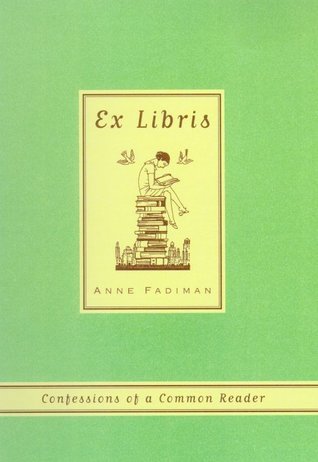
Ex Libris: Confessions of a Common Reader by Anne Fadiman (1998)
Like many a bibliophile, I have a soft spot for books about books. However, I’m also a real stickler about them, because all too often they make common mistakes: they’re too generic or too obscure in their points of reference, they slip into plot summary and include spoilers, or they alienate the reader by presenting the author as being on another echelon.
Fadiman, though, is a very relatable narrator in these expanded versions of 18 essays originally written for publication in Civilization, the Library of Congress magazine published from 1994 to 2000. (Can you imagine, your own bookish column in which you could write whatever you like?!) Her father was the well-known intellectual Clifton Fadiman. Theirs was a family of book-obsessed, vocabulary-loving, trivia-spouting readers, and she was also crafting her own with her husband and two young children.
 I saw my family – especially my mother and me – in a number of these pieces: in “The Joy of Sesquipedalians,” about the love of obscure words and word games played on a board or along with the TV (I was a spelling bee champion, and we’re all Scrabble fiends to a greater or lesser extent), in “Insert a Caret [Inset a Carrot],” about compulsive proofreading, in “The Catalogical Imperative,” about a build-up of print catalogues and the different selves one can imagine using the products therein, and in “Secondhand Prose,” about collecting used books.
There’s one respect in which I differ from the Fadiman family, though. Tom Mole’s The Secret Life of Books had reminded me of Fadiman’s division of readers into “courtly” and “carnal” lovers of books: the courtly ones keep a book pristine, while the carnal ones use and abuse them however they wish. She introduces this piece with an episode from a family trip to Copenhagen when she was a teenager. Her brother left a book open, facedown, on the bedside table at their hotel and the next day they found that the chambermaid had carefully put a marker at the right page, closed the book, and set a note on top reading, “Sir, you must never do that to a book.” I wholeheartedly agree. While I always say “your books, your rules” to other readers, I would have to suppress a cringe if I witnessed dog-earing, reading in the bath, cracking the spine, tearing out pages, doodling in the margins, and so on.
What I can get on board with, though, is the love of books as both narratives and physical objects. In the former camp, you get essays on books about polar exploration, sonnets, outdated guides to femininity, food literature, and reading aloud. On the latter, you’ll hear about her New York City apartment groaning with books absorbed from her husband’s and father’s collections, the good and bad of inscriptions, and Prime Minister William Gladstone’s tips for storing books.
Two essays have not aged well: one on a beloved pen (though she acknowledges that this was already multiply outdated by that time, by the typewriter and then by the computer she now uses for composition) and especially one on the quandary of gender-neutral pronouns (as opposed to “every man for himself” types of constructions) – nowadays we have no qualms about employing “them” for the unknown and the nonbinary.
My favorite essay overall was “You Are There,” about the special joy of reading on location. Additional irony points for Joe Biden being mentioned in the piece on plagiarism! I’d read this from a library some years before. I enjoyed it just as much the second time around, and certain essays will reward additional future rereadings, too.
My original rating (c. 2008):
My rating now:
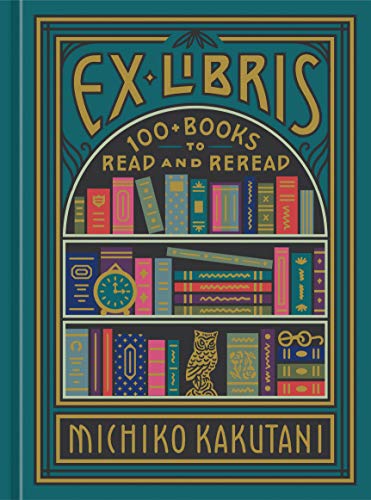
Ex Libris: 100+ Books to Read and Reread by Michiko Kakutani (2020)
In my more morbid moments, when I imagine how I would approach the remainder of my life if I knew that I was going to die young of a terminal illness, I think about self-publishing a selection of my best blog posts and book reviews. A personal greatest hits, if you would, and anyone could forgive the self-indulgence because, hey, she’s probably going to die soon. But then I open a book like this and realize that a collection of book reviews can actually be pretty tedious, even when written by one of the greats.
“Like all lists and anthologies, the selections here are subjective and decidedly arbitrary,” Kakutani warns in her introduction. What this means in practice is that: a) if I’d read a particular book, I didn’t need to read a ~1000-word review of it; b) if I hadn’t read the book but wanted to, I avoided the essay in fear of spoilers (e.g. she does reveal some specific incidents from Mary Karr’s The Liars’ Club, which I have on the shelf and was looking forward to; I’ll just wait until I’ve forgotten); and c) if I hadn’t read the book and didn’t want to (there is LOTS of history and politics here, with plenty of Trump jabs shoehorned in; you do know her only previous book was a diatribe against Trump, right?), I wasn’t interested. So, while there were a few pieces I appreciated, such as one on the enduring appeal of The Great Gatsby, which I recently read a third time for book club, not many caught my eye as I skimmed the book.
In any case, it’s not a book for reading all the way through but one for having on the coffee table to read the occasional essay. It is gorgeously put together, what with Dana Tanamachi’s illustrations in the style of vintage bookplates, so would still be a lovely reference book to have around. Think of it as a collection of amuse-bouches to whet your appetite to read the books you’ve always meant to pick up but haven’t managed yet (for me, that would be As I Lay Dying and Mason & Dixon). See Susan’s more judicious review here.
My rating: 
 I found plenty of other books on Goodreads with the title Ex Libris, such as this one, a compendium of library-themed fantasy and science fiction stories. (Yes, really.)
Have you read one of these? Which did you prefer?
August Releases: Fiction Advocate, Kingsolver Poetry, Sarah Moss & More
My five new releases for August include two critical responses to contemporary classics; two poetry books, one a debut collection from Carcanet Press and the other by an author better known for fiction; and a circadian novel by one of my favorite authors.
I start with two of the latest releases from Fiction Advocate’s “Afterwords” series. The tagline is “Essential Readings of the New Canon,” and the idea is that “acclaimed writers investigate the contemporary classics.” (I reviewed the monographs on Blood Meridian, Fun Home, and The Year of Magical Thinking in this post.)
Dear Knausgaard: Karl Ove Knausgaard’s My Struggle by Kim Adrian
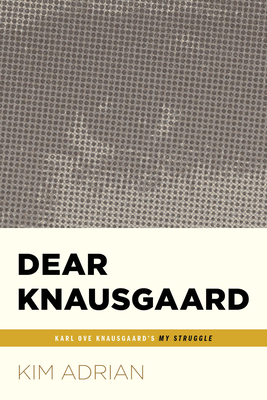 Karl Ove Knausgaard turned his pretty ordinary life into thousands of pages of autofiction that many readers have found addictive. Adrian valiantly grapples with his six-volume exploration of identity, examining the treatment of time and the dichotomies of intellect versus emotions, self versus other, and life versus fiction. She marvels at the ego that could sustain such a project, and at the seemingly rude decision to use all real names (whereas in her own family memoir she assigned aliases to most major figures). At many points she finds the character of “Karl Ove” insufferable, especially when he’s a teenager in Book 4, and the books’ prose dull. Knausgaard’s focus on male novelists and his stereotypical treatment of feminine qualities, here and in his other work, frequently madden her.
So why is My Struggle compelling nonetheless? It occupies her mind and her conversations for years. Is it something about the way that Knausgaard extracts meaning from seemingly inconsequential details? About how he stretches and compresses time in a Proustian manner to create a personal highlights reel? She frames her ambivalent musings as a series of letters written as if to Knausgaard himself (or “KOK,” as she affectionately dubs him) between February and September 2019. Cleverly, she mimics his style in both the critical enquiry and the glimpses into her own life, including all its minutiae – the weather, daily encounters, what she sees out the window and what she thinks about it all. It’s bold, playful and funny, and, all told, I enjoyed it more than Knausgaard’s own writing.
(I myself have only read Book 1, A Death in the Family, and wasn’t planning on continuing with My Struggle, but I think I will make an exception for Book 3 because of my recent fascination with childhood memoirs. I had better luck with Knausgaard’s Seasons Quartet, of which I’ve read all but Spring. I’ve reviewed Summer and Winter.)
My rating: 
My thanks to Fiction Advocate for the free e-copy for review.
The Wanting Was a Wilderness: Cheryl Strayed’s Wild and the Art of Memoir by Alden Jones
Hiking is boring, yet Cheryl Strayed turned it into a beloved memoir. Jones explores how Wild works: how Strayed the author creates “Cheryl,” likeable despite her drug use and promiscuity; how the fixation on the boots and the backpack that carry her through her quest reflect the obsession over the loss of her mother; how the flashbacks break up the narrative and keep you guessing about whether she’ll reach her literal and emotional destinations.
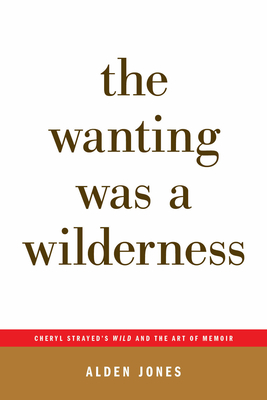 Jones also considers the precedents of wilderness literature and the 1990s memoir boom that paved the way for Wild. I most enjoyed this middle section, which, like Mary Karr’s The Art of Memoir, surveys some of the key publications from a burgeoning genre. Another key point of reference is Vivian Gornick, who draws a distinction between “the situation” (the particulars or context) and “the story” (the message) – sometimes the map or message comes first, and sometimes you only discover it as you go along.
I was a bit less interested in Jones’s reminiscences of her own three-month wilderness experience during college, when, with Outward Bound, she went to North Carolina and Mexico and hiked part of the Appalachian Trail and a volcano. This was the trip on which she faced up to her sexuality and had a short-lived relationship with a fellow camper, Melissa. But working out that she was bisexual and marrying a woman were both, as presented here, false endings. The real ending was her decision to leave her marriage – even though they had three children; even though the relationship was often fine. She attributes her courage to go, believing something better was possible, to Strayed’s work. And that’s the point of this series: rereading a contemporary classic until it becomes part of your own story.
My rating: 
My thanks to Fiction Advocate for the free e-copy for review.
Two poetry releases:
Growlery by Katherine Horrex
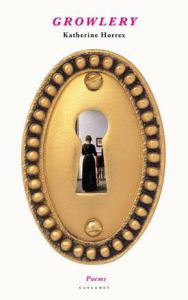 As in Red Gloves by Rebecca Watts, released by Carcanet in June, I noted the juxtaposition of natural and industrial scenes. Horrex’s “Four Muses” include a power plant and a steelworks, and she writes about pottery workers and the Manchester area, but she also explores Goat Fell on foot. Two of my favorite poems were nature-based: “Omen,” about corpse flowers, and “Wood Frog.” Alliteration, metaphors and smells are particularly effective in the former. Though I quailed at the sight of an entry called “Brexit,” it’s a subtle offering that depicts mistrust and closed minds – “People personable as tents zipped shut”. By contrast, “House of Other Tongues” revels in the variety of languages and foods in an international student dorm. A few poems circle around fertility and pregnancy. The linking themes aren’t very strong across the book, but there are a few gems.
My rating:
My thanks to Carcanet Press for the free e-copy for review.
How to Fly (in Ten Thousand Easy Lessons) by Barbara Kingsolver
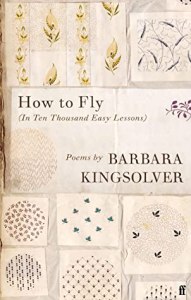 Kingsolver may not be well known for her poetry, but this is actually her second collection of verse after the bilingual Another America/Otra America (1992). The opening segment, “How to Fly,” is full of folk wisdom from nature and the body’s intuitive knowledge. “Pellegrinaggio” is a set of travel poems about accompanying her Italian mother-in-law back to her homeland. “This Is How They Come Back to Us” is composed of elegies for the family’s dead; four shorter remaining sections are inspired by knitting, literature, daily life, and concern for the environment. As with The Undying by Michel Faber, the book’s themes are stronger than its poetic techniques, but Kingsolver builds striking natural imagery and entrancing rhythms.
Two favorite passages to whet your appetite:
How to drink water when there is wine— / Once I knew all these brick-shaped things, / took them for the currency of survival. / Now I have lived long and I know better.
Tiptoe past the dogs of the apocalypse / asleep in the shade of your future. / Pay at the window. You’ll be surprised: you / can pass off hope like a bad check. You still / have time, that’s the thing. To make it good.
(To be reviewed in full, in conjunction with other recent/upcoming poetry releases, including Dearly by Margaret Atwood, for Shiny New Books.)
My rating:
I read an advanced e-copy via Edelweiss. (I’m unsure of the line breaks above because of the formatting.)
And finally, a much-anticipated release – bonus points for it having “Summer” in the title!
Summerwater by Sarah Moss
This is nearly as compact as Moss’s previous novella, Ghost Wall, yet contains a riot of voices. Set on one long day at a Scottish holiday park, it moves between the minds of 12 vacationers disappointed by the constant rain – “not that you come to Scotland expecting sun but this is a really a bit much, day after day of it, torrential” – and fed up with the loud music and partying that’s come from the Eastern Europeans’ chalet several nights this week. In the wake of Brexit, the casual xenophobia espoused by several characters is not surprising, but still sobering, and paves the way for a climactic finale that was not what I expected after some heavy foreshadowing involving a teenage girl going off to the pub through the woods.
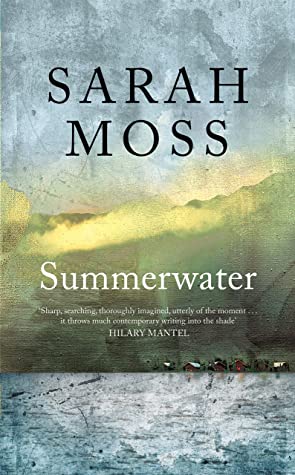 The day starts at 5 a.m. with Justine going for a run, despite a recent heart health scare, and spends time with retirees, an engaged couple spending most of their time in bed, a 16-year-old kayaker, a woman with dementia, and more. We see different aspects of family dynamics as we revisit a previous character’s child, spouse or sibling. I had to laugh at Milly picturing Don Draper during sex with Josh, and at Claire getting an hour to herself without the kids and having no idea what to do with it beyond clean up and make a cup of tea. Moss gets each stream-of-consciousness internal monologue just right, from a frantic mum to a sarcastic teen.
Yet I had to wonder what it all added up to; this feels like a creative writing student exercise, with the ending not worth waiting for. Cosmic/nature interludes are pretentious à la Reservoir 13. It’s not the first time this year that I’ve been disappointed by the latest from a favorite author (see also Hamnet). But my previous advice stands: If you haven’t read Sarah Moss, do so immediately.
My rating:
My thanks to Picador for the free copy for review.
What August releases can you recommend?
The Best Books from the First Half of 2018
Here’s a quick look back at a baker’s dozen of 2018 releases that have stood out most for me so far. I’ve linked to books that I’ve already reviewed in full on the blog or elsewhere.
Fiction:
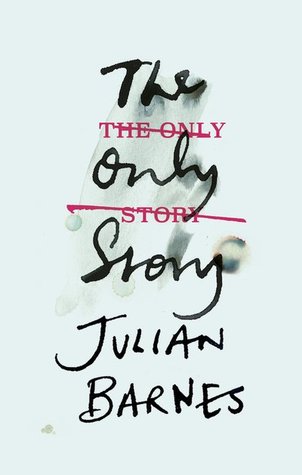 The Only Story by Julian Barnes: A familiar story: a May–December romance fizzles out. A sad story: an idealistic young man who swears he’ll never be old and boring has to face that this romance isn’t all he wanted it to be. A love story nonetheless. Paul met 48-year-old Susan, a married mother of two, at the local tennis club when he was 19. The narrative is partly the older Paul’s way of salvaging what happy memories he can, but also partly an extended self-defense. Barnes takes what could have been a dreary and repetitive story line and makes it an exquisitely plangent progression: first-person into second-person into third-person. The picture of romantic youth shading into cynical but still hopeful middle age really resonates, as do the themes of unconventionality, memory, addiction and pity.
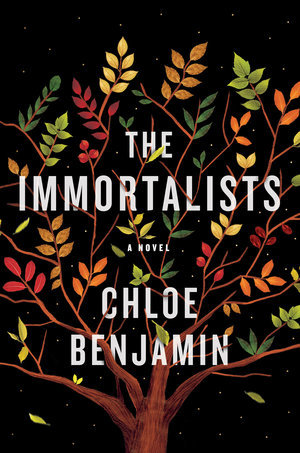 The Immortalists by Chloe Benjamin: Summer 1969: four young siblings escape a sweltering New York City morning by visiting a fortune teller who can tell you the day you’ll die. In the decades that follow, they have to decide what to do with this advance knowledge: will it spur them to live courageous lives, or drive them to desperation? This compelling family story lives up to the hype. Imagine the fun Benjamin had researching four distinct worlds: Daniel, a military doctor, examines Iraq War recruits; Klara becomes a magician in Las Vegas; Varya researches aging via primate studies; and Simon is a dancer in San Francisco. The settings, time periods, and career paths are so diverse that you get four novels’ worth of interesting background.
 Florida by Lauren Groff: Two major, connected threads in this superb story collection are ambivalence about Florida, and ambivalence about motherhood. There’s an oppressive atmosphere throughout, with environmental catastrophe an underlying threat. Set-ups vary in scope from almost the whole span of a life to one scene. A dearth of named characters emphasizes just how universal the scenarios and emotions are. Groff’s style is like a cross between Karen Russell’s Swamplandia! and Cormac McCarthy’s The Road, and her unexpected turns of phrase jump off the page. A favorite was “Above and Below,” in which a woman slips into homelessness. Florida feels innovative and terrifyingly relevant. Any one of its stories is a bracing read; together they form a masterpiece.
 Motherhood by Sheila Heti: Should one have children? Should I have children? No matter who’s asking the questions or in what context, you’re going to get the whole gamut of replies. Heti’s unnamed heroine consults a fortune teller and psychics, tosses coins and interprets her dreams as The Decision looms. Chance, inheritance, and choice vie for pride of place in this relentless, audacious inquiry into the purpose of a woman’s life. I marked out dozens of quotes that could have been downloaded directly from my head or copied from my e-mails and journal pages. The book encapsulates nearly every thought that has gone through my mind over the last decade as I’ve faced the intractable question of whether to have children. Heti has captured brilliantly what it’s like to be in this situation in this moment in time.
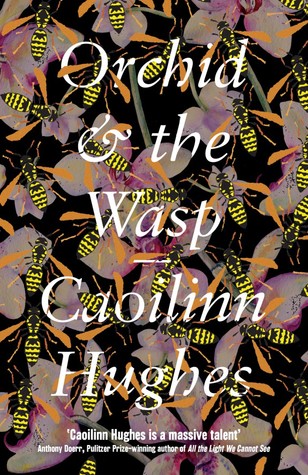 Orchid & the Wasp by Caoilinn Hughes: The action spans about nine years: a politically turbulent decade that opens with the Iraq War protests and closes with the Occupy movement in New York City. Gael Foess, our lovable antiheroine, is a trickster. She’s learned well her banker father’s lesson that money and skills don’t get distributed fairly in this life, so she’s going to do what she can to ensure that her loved ones succeed. Art, music, religion and health are major interlocking themes. The author is wonderfully adept at voices, and the book’s frenetic pace is well matched by the virtuosic use of language – wordplay, neologisms, and metaphors drawn from the arts and nature. Hughes is an exciting writer who has rightfully attracted a lot of buzz for her debut.
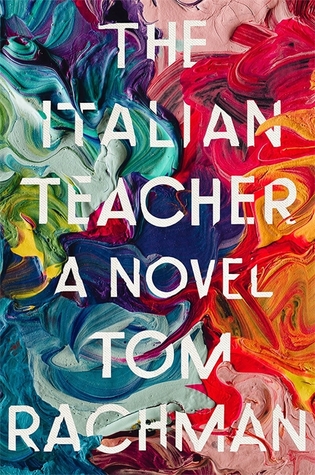 The Italian Teacher by Tom Rachman: Charles “Pinch” Bavinsky is just an Italian teacher, though as a boy in Rome in the 1950s–60s he believed he would follow in the footsteps of his sculptor mother and his moderately famous father, Bear Bavinsky, who paints close-ups of body parts. We follow Pinch through the rest of his life, a sad one of estrangement, loss and misunderstandings – but ultimately there’s a sly triumph in store for the boy who was told that he’d never make it as an artist. Rachman jets between lots of different places – Rome, New York City, Toronto, rural France, London – and ropes in quirky characters in the search for an identity and a place to belong. This is a rewarding story about the desperation to please, or perhaps exceed, one’s parents, and the legacy of artists in a fickle market.

The ‘bests’ that I happen to own in print.
Nonfiction:
 The Line Becomes a River by Francisco Cantú: Francisco Cantú was a U.S. Border Patrol agent for four years in Arizona and Texas. Impressionistic rather than journalistic, his book is a loosely thematic scrapbook. He inserts snippets of U.S.–Mexico history, including the establishment of the border, and quotes from other primary and secondary texts. He also adds in fragments of his family’s history: His ancestors left Mexico during the Mexican Revolution of the 1910s, but there’s no doubt his Latino name and features made him a friendly face for illegal immigrants. The final third of the book makes things personal when his friend is detained in Mexico. Giving faces to an abstract struggle, this work passionately argues that people should not be divided by walls but united in common humanity.
 The Unmapped Mind by Christian Donlan: Some of the best medical writing from a layman’s perspective I’ve ever read. Donlan, a Brighton-area video games journalist, was diagnosed with (relapsing, remitting) multiple sclerosis in 2014. “I think sometimes that early MS is a sort of tasting menu of neurological disease,” Donlan wryly offers. He approaches his disease with good humor and curiosity, using metaphors of maps to depict himself as an explorer into uncharted territory. The accounts of going in for an MRI and a round of chemotherapy are excellent. Short interludes also give snippets from the history of MS and the science of neurology in general. What’s especially nice is how he sets up parallels with his daughter’s early years. My frontrunner for next year’s Wellcome Book Prize so far.
 Free Woman by Lara Feigel: Doris Lessing lived by ideals of free love and Communism, but it came at the price of abandoning her children. Lara Feigel could identify with Lessing in some ways, and as she entered a rocky time in her mid-thirties – a miscarriage followed by IVF, which was a strain on her marriage; the death of a close friend; ongoing worry over how motherhood might affect her academic career – she set out to find what Lessing could teach her about how to be free. A familiarity with the works of Doris Lessing is not a prerequisite to enjoying this richly satisfying hybrid of biography, literary criticism and memoir. The Golden Notebook is about the ways in which women compartmentalize their lives and the struggle to bring various strands into harmony; that’s what Free Woman is all about as well.
 Implosion by Elizabeth W. Garber: The author grew up in a glass house designed by her father, Modernist architect Woodie Garber, outside Cincinnati in the 1960s to 70s. This and Woodie’s other most notable design, Sander Hall, a controversial tower-style dorm at the University of Cincinnati that was later destroyed in a controlled explosion, serve as powerful metaphors for her dysfunctional family life. Woodie is such a fascinating, flawed figure. Garber endured sexual and psychological abuse yet likens him to Odysseus, the tragic hero of his own life. She connected with him over Le Corbusier’s designs, but it was impossible for a man born in the 1910s to understand his daughter’s generation. This definitely is not a boring tome just for architecture buffs. It’s a masterful memoir for everyone.
 Skybound by Rebecca Loncraine: Each year seems to bring one exquisite posthumous memoir about facing death with dignity. For Rebecca Loncraine, after treatment for breast cancer in her early thirties, taking flying lessons in an unpowered glider was her way of rediscovering joy and experiencing freedom by facing her fears in the sky. She discovered a particular love for flying alongside birds: red kites in Wales, and vultures in Nepal. The most remarkable passages of the book are the exhilarating descriptions of being thousands of feet up in the air and the reflections on why humans are drawn to flight and what it does for our bodies and spirits. Loncraine had virtually finished this manuscript when her cancer returned; she underwent another 14 grueling months of treatment before her death in September 2016.
 Bookworm by Lucy Mangan: Mangan takes us along on a nostalgic chronological tour through the books she loved most as a child and adolescent. No matter how much or how little of your early reading overlaps with hers, you’ll appreciate her picture of the intensity of children’s relationship with books – they can completely shut out the world and devour their favorite stories over and over, almost living inside them, they love and believe in them so much – and her tongue-in-cheek responses to them upon rereading them decades later. There are so many witty lines that it doesn’t really matter whether you give a fig about the particular titles she discusses or not. A delightful paean to the joys of being a lifelong reader; recommended to bibliophiles and parents trying to make bookworms out of their children.
 Educated by Tara Westover: This is one of the most powerful and well-written memoirs I’ve ever read. It tells of a young woman’s off-grid upbringing in Idaho and the hard work that took her from almost complete ignorance to a Cambridge PhD. Westover’s is an incredible story about testing the limits of perseverance and sanity. Her father may have been a survivalist, but her psychic survival is the most impressive outcome here. What takes this astonishing life story to the next level, making it a classic to sit alongside memoirs by Alexandra Fuller, Mary Karr and Jeannette Walls, is the writing. Westover writes with calm authority, channeling the style of the scriptures and history books that were formative in her upbringing and education.
What are some of the best books you’ve read so far this year?
What 2018 releases do I need to catch up on right away?
20 Books of Summer 2018
This is my first year joining in with the 20 Books of Summer challenge run by Cathy of 746 Books. I’ve decided to put two twists on it. One: I’ve only included books that I own in print, to work on tackling my mountain of unread books (300+ in the house at last count). As I was pulling out the books that I was most excited to read soon, I noticed that most of them happened to be by women. So for my second twist, all 20 books are by women. Why not? I’ve picked roughly half fiction and half life writing, so over the next 12 weeks I just need to pick one or two from the below list per week, perhaps alternating fiction and non-. I’m going to focus more on the reading than the reviewing, but I might do a few mini roundup posts.
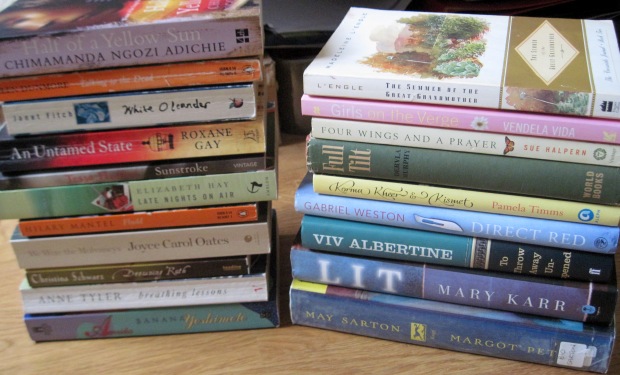
I’m doing abysmally with the goal I set myself at the start of the year to read lots of travel classics and biographies, so I’ve chosen one of each for this summer, but in general my criteria were simply that I was keen to read a book soon, and that it mustn’t feel like hard work. (So, alas, that ruled out novels by Elizabeth Bowen, Ursula K. LeGuin and Virginia Woolf.) I don’t insist on “beach reads” – the last two books I read on a beach were When Breath Becomes Air by Paul Kalanithi and Grief Cottage by Gail Godwin, after all – but I do hope that all the books I’ve chosen will be compelling and satisfying reads.
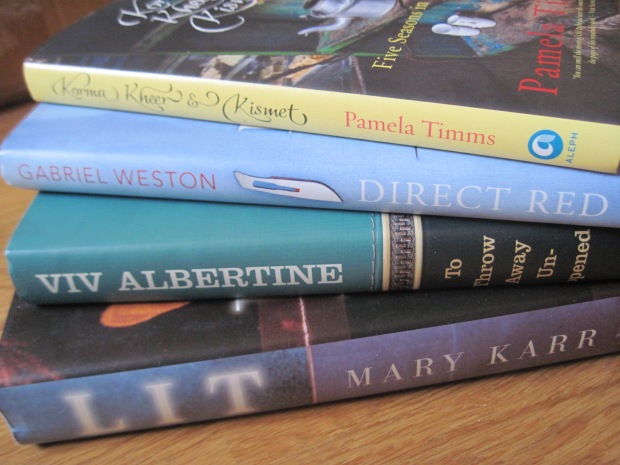
- To Throw Away Unopened by Viv Albertine – I picked up a copy from the Faber Spring Party, having no idea who Albertine was (guitarist of the all-female punk band The Slits). Everyone I know who has read this memoir has raved about it.
- Lit by Mary Karr – I’ve read Karr’s book about memoir, but not any of her three acclaimed memoirs. This, her second, is about alcoholism and motherhood.
- Korma, Kheer and Kismet: Five Seasons in Old Delhi by Pamela Timms – I bought a bargain copy at the Wigtown Festival shop earlier in the year. Timms is a Scottish journalist who now lives in India. This should be a fun combination of foodie memoir and travel book.
- Direct Red: A Surgeon’s Story by Gabriel Weston (a woman, honest!) – Indulging my love of medical memoirs here. I bought a copy at Oxfam Books earlier this year.
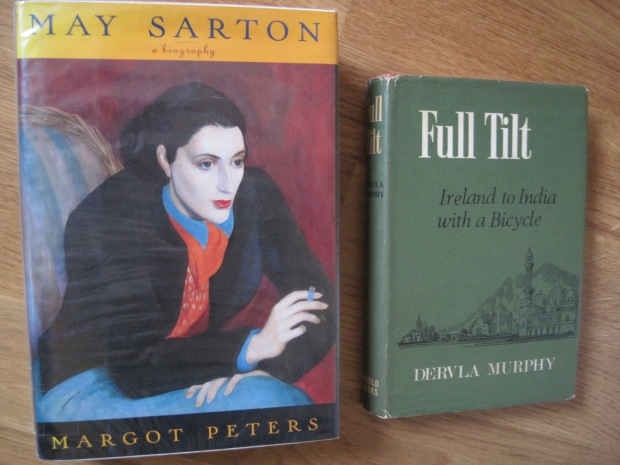 5. May Sarton by Margot Peters – I’ve been on a big May Sarton kick in recent years, so have been eager to read this 1997 biography, which apparently is not particularly favorable.
6. Full Tilt: Ireland to India with a Bicycle by Dervla Murphy – I bought this 1960s hardback from a charity shop in Cambridge a couple of years ago. It will at least be a start on that travel classics challenge.
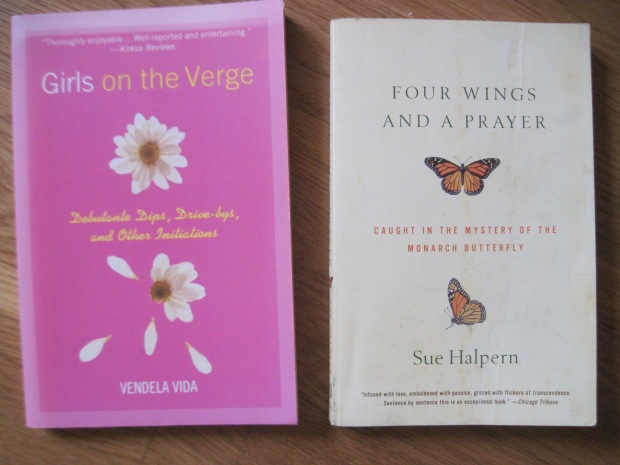
7. Girls on the Verge: Debutante Dips, Drive-bys, and Other Initiations by Vendela Vida – This was Vida’s first book. It’s about coming-of-age rituals for young women in America.
8. Four Wings and a Prayer: Caught in the Mystery of the Monarch Butterfly by Sue Halpern – Should fall somewhere between science and nature writing, with a travel element.
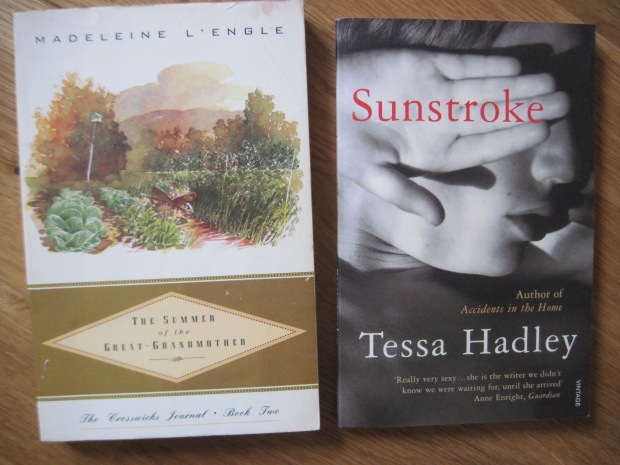
9. The Summer of the Great-Grandmother by Madeleine L’Engle – L’Engle is better known for children’s books, but she wrote tons for adults, too: fiction, memoirs and theology. I read the stellar first volume of the Crosswicks Journal, A Circle of Quiet, in September 2015 and have meant to continue the series ever since.
10. Sunstroke by Tessa Hadley – You know how I love reading with the seasons when I can. This slim 2007 volume of stories is sure to be a winner. Seven of the 10 originally appeared in the New Yorker or Granta.
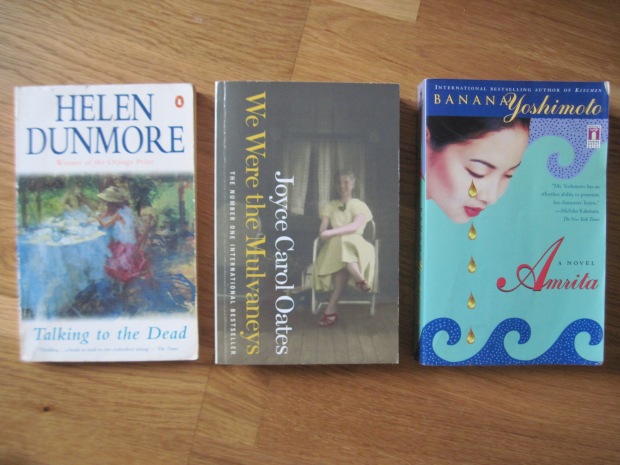
11. Talking to the Dead by Helen Dunmore – I’ve only ever read Dunmore’s poetry. It’s long past time to try her fiction. This one comes highly recommended by Susan of A life in books.
12. We Were the Mulvaneys by Joyce Carol Oates – Oates is intimidatingly prolific, but I’m finally going to jump in and give her a try.
13. Amrita by Banana Yoshimoto – A token lit in translation selection. “This is the story of [a] remarkable expedition through grief, dreams, and shadows to a place of transformation.” (Is it unimaginative to say that sounds like Murakami?)
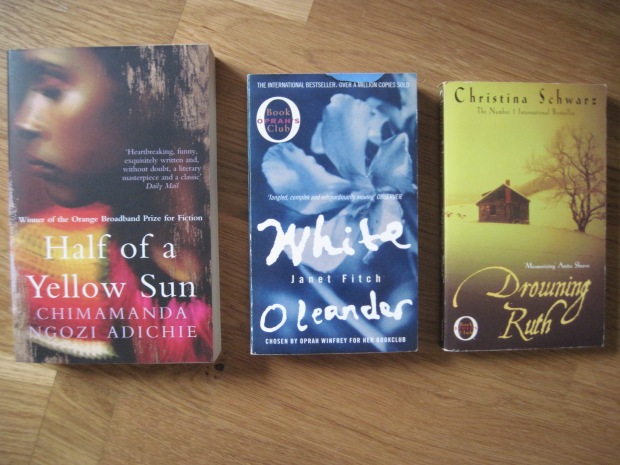
14. Half of a Yellow Sun by Chimamanda Ngozi Adichie – How have I not read any of her fiction yet?! This has been sitting on my shelf for years. I only vaguely remember the story line from the film, so it should be fairly fresh for me.
15. White Oleander by Janet Fitch – An Oprah’s Book Club selection from 1999. I reckon this would make a good beach or road trip read.
16. Drowning Ruth by Christina Schwarz – Another Oprah’s Book Club favorite from 2000. Set in Wisconsin in the years after World War I.
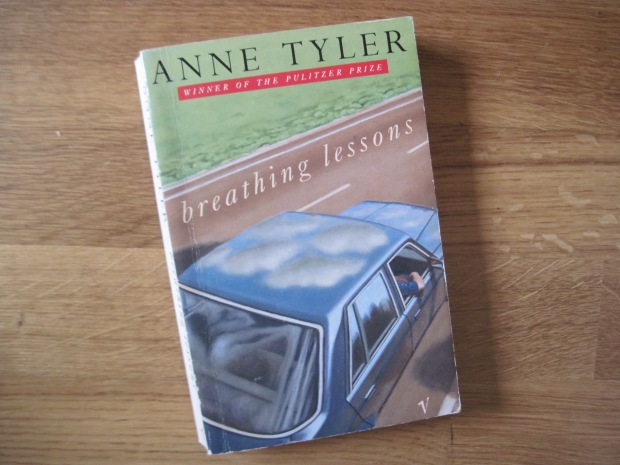
- Breathing Lessons by Anne Tyler – Tyler novels are a tonic. I have six unread on the shelf; the blurb on this one appealed to me the most. This summer actually brings two Tylers as Clock Dance comes out on July 12th – I’ll either substitute that one in, or read both!
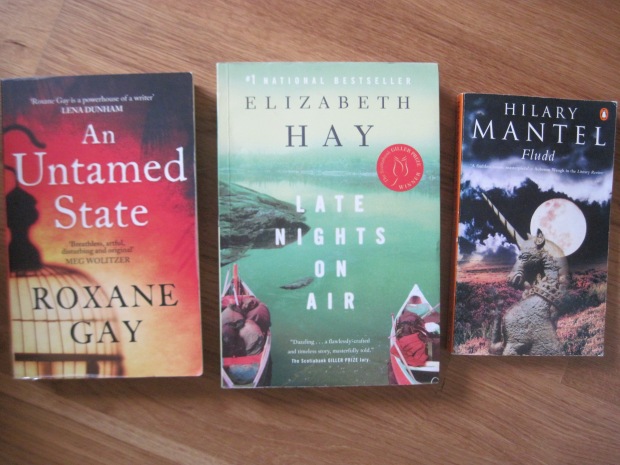
18. An Untamed State by Roxane Gay – I’ve only read Gay’s memoir, Hunger. She’s an important cultural figure; it feels essential to read all her books. I expect this to be rough.
19. Late Nights on Air by Elizabeth Hay – This has been on my radar for such a long time. After loving my first Hay novel (A Student of Weather) last year, what am I waiting for?
20. Fludd by Hilary Mantel – I haven’t read any Mantel in years, not since Bring Up the Bodies first came out. While we all await the third Cromwell book, I reckon this short novel about a curate arriving in a fictional town in the 1950s should hit the spot.
I’ll still be keeping up with my review books (paid and unpaid), blog tours, advance reads and library books over the summer. The aim of this challenge, though, is to make inroads into the physical TBR. Hopefully the habit will stick and I’ll keep on plucking reads from my shelves during the rest of the year.
Where shall I start? If I was going to sensibly move from darkest to lightest, I’d probably start with An Untamed State and/or Lit. Or I might try to lure in the summer weather by reading the two summery ones…
Which of these books have you read? Which ones appeal?
Recommended May Releases
May and June are HUGE months for new releases. I’ve been doing enough early reading via NetGalley and Edelweiss that I’ve found plenty to recommend to you for next month. From a novel voiced by one of Hemingway’s wives to a physicist’s encouragement to waste more time, I hope there will be something here for everyone.
The Pisces by Melissa Broder
[Coming from Hogarth Press (USA) on the 1st and Bloomsbury (UK) on the 3rd]
 At first I thought this was one of those funny, quirky but somewhat insubstantial novels about a thirtysomething stuck with a life she isn’t sure she wants – something along the lines of Goodbye, Vitamin, The Portable Veblen, or All Grown Up. Then I thought it was just a crass sex comedy. But the further I read the deeper it all seemed to become: tropes from Greek myth and the fluidity of gender roles made me think of You Too Can Have a Body Like Mine, another debut novel that surprised me for its profundity. Lucy, a thirty-eight-year-old PhD student, agrees to spend a summer dog-sitting for her yoga entrepreneur sister in Venice Beach, California while she undertakes therapy for the twin problems of low self-esteem and love addiction. If you know one thing about this book, it’s that there’s sex with a merman. Ultimately, though, I’d say it’s about “the prison of the body” and choosing which of the different siren voices calling us to listen to. I found it outrageous but rewarding.
My rating:
How to Be a Perfect Christian by Adam Ford and Kyle Mann
[Coming from Multnomah (USA) on the 1st]
 The Babylon Bee is a Christian version of The Onion, so you know what you’re getting here: a very clever, pitch-perfect satire of evangelical Christianity today. If, like me, you grew up in a nondenominational church and bought into the subculture hook, line and sinker (Awana club, youth group, courtship, dc Talk albums, the whole shebang), you will find that so much of this rings true. The book is set up as a course for achieving superficial perfection through absolute “conformity to the status quo of the modern church.” Sample advice: find an enormous church that meets your needs, has a great coffee bar and puts on a laser-lit worship performance to rival “an amusement park for cats or a Def Leppard concert”; master the language of Christianese (“Keeping it in prayer” pretty much covers your bases); and bring as little as you can to the church potluck (a 25-pack of napkins) but consume as much as is anatomically possible. So, a lot of fun, just a little overlong because you get the joke early on.
My rating:
The Ensemble by Aja Gabel
[Coming from Riverhead (USA) on the 15th]
 In May 1994, the members of the Van Ness String Quartet are completing their final graduate recital at a San Francisco conservatory and preparing for the Esterhazy quartet competition in the Canadian Rockies. These four talented musicians – Jana, first violin; Brit, second violin; Henry, viola; and Daniel, cello – have no idea what the next 15 years will hold for them: a cross-country move, romances begun and lost, and career successes and failures. Drawing on her own history as a violinist and cellist, Aja Gabel infuses her debut novel with the simultaneous uncertainty and euphoria of both the artistic life and early adulthood in general. An alternating close third-person perspective gives glimpses into the main characters’ inner lives, and there are evocative descriptions of classical music. I think The Ensemble will mean even more to those readers who are involved in music, but anyone can relate to the slow fade from youth into middle age and the struggle to integrate art with the rest of life.
My rating:
Tropic of Squalor by Mary Karr
[Coming from Harper (USA) on the 8th]
 Mary Karr is mostly known as a memoirist, but this is actually her fifth poetry collection. Death is a major theme, with David Foster Wallace’s suicide and 9/11 getting multiple mentions. Karr also writes self-deprecatingly about her Texas childhood. Best of all is the multi-part “The Less Holy Bible”: a sort of Devil’s Dictionary based loosely around the books of the Bible, it bounces between Texas and New York City and twists biblical concepts into commonsense advice. Not one for those who are quick to cry heresy, perhaps, but I enjoyed it very much, especially “VI. Wisdom: The Voice of God”: “Ninety percent of what’s wrong with you could be cured with a hot bath, / says God through the manhole covers, but you want magic, to win / the lottery you never bought a ticket for. … Don’t look for initials in the geese honking / overhead or to see through the glass even darkly. It says the most obvious shit, / i.e. Put down that gun, you need a sandwich.”
My rating:
In Praise of Wasting Time by Alan Lightman
[Coming from Simon & Schuster / TED (USA and UK) on the 15th]
 Lightman, a physicist and MIT professor, argues that only in unstructured time can we rediscover our true identity and recover our carefree childhood creativity. This work-as-play model goes against the modern idea that time is money and every minute must be devoted to a project. “For any unexpected opening of time that appears during the day, I rush to patch it, as if a tear in my trousers. … I feel compelled to find a project, to fill up the hole.” Yet there is another way of approaching time, as he discovered when doing research in a village in Cambodia. He realized that the women he talked to didn’t own watches and thus had no real sense of how long any task took them. This sharp, concise treatise ruminates on the cultural forces that have enslaved us in the West to productivity. (In short, he blames the Internet, but specifically smartphones.) Lightman insists on the spiritual benefits of free time and solitude. “With a little determination, each of us can find a half hour a day to waste time,” he asserts.
My rating:
Love and Ruin by Paula McLain
[Coming from Ballantine Books (USA) and Fleet (UK) on the 1st]
 This is the weakest of the three McLain novels I’ve read, but when we’re talking about a writer of this caliber that isn’t much of a criticism. It’s strange to me that, having written a novel from the perspective of Hadley Richardson, Ernest Hemingway’s first wife, McLain would choose to tell the story of another Hemingway wife – this time Martha Gellhorn, a war reporter and author in her own right. If I set aside this misgiving, though, and just assess the quality of the writing, there are definitely things to praise, such as the vivid scenes set during the Spanish Civil War, the dialogues between Martha and Hem, the way he perhaps fills in for her dead father, her fondness for his sons, and her jealousy over his growing success while her books sink like stones. I especially liked their first meeting in a bar in Key West, and the languid pace of their life in Cuba. I read such books because I’m intrigued about the appeal of a great man, but here I got a little bogged down with the many settings and events.
My rating:
What May books do you have on the docket? Have you already read any that you can recommend?
Writing for Bliss by Diana Raab
For Diana Raab, writing has been a way of coping with all that life has thrown at her, starting with her grandmother’s suicide and also including her daughter’s drug addiction and two bouts with cancer. She’s written poetry, memoir, and various books on the writer’s craft, with the latest, Writing for Bliss, specifically centered around life writing and mindfulness. In particular, I could see this one being helpful supplementary reading for those who have enjoyed Francine Prose’s Reading like a Writer and Mary Karr’s The Art of Memoir.
 Some keywords Raab emphasizes are patience, journey, healing, and transformation. Writing is often a long process, but it can also be a therapeutic one. It’s important to find a sacred space of one’s own – whether literal like Virginia Woolf’s room of one’s own, or simply a repurposed space that has been made conducive with candles and family photos. Raab encourages would-be memoir writers to look at the patterns in their lives and to focus on writing about moments that are relevant to the story of their personal growth.
As to the nitty-gritty of getting words onto the page, she insists that life writing is just as much about storytelling as fiction is. Fleshing out a story is more important than chronological accuracy, and she advises striving for a mixture of narrative, dialogue, scenes and reflection so that the resulting book does not seem like just a list of facts and events.
Raab also issues warnings. One is about causing offense by revealing family secrets. She suggests consulting the family members you intend to write about beforehand, and later running a rough draft past them for their approval. Another is about the danger of seeking one’s self-worth in publishing. Not all books lead to traditional publication, so it’s better if you write out of love and for yourself, simply because you find fulfillment in creativity.
This is a practical as well as a theoretical guide: 50 writing prompts are dotted through the text, and there’s also an appendix full of more. I’m someone who doesn’t necessarily aspire to write fiction, so I usually skip over such sections in a book about writing, but I think many of these could make a great launch pad for writing a personal essay. The book also ends with a terrific 15-page inventory of further reading, including a list of recommended memoirs.
My rating:
Writing for Bliss was published by Loving Healing Press on September 1st. My thanks to the author for the free e-copy for review.
I’ve hoarded a number of books about writing on my Kindle, including:
- The Hero Is You by Kendra Levin
- Scratch, ed. by Manjula Martin
- Part Wild by Deb Norton
- Process by Sarah Stodola
Have you read any of these? What other books about writing have you read that you can vouch for?
I’ve read a lot of the classics – Dorothea Brande, Stephen King, Anne Lamott et al. – but I’m always interested to hear what similar books people have found to be helpful.
 Bookish Beck = Rebecca Foster. American transplant to England. Freelance proofreader and book reviewer.
 Bookish Beck