Heart and Mind: New Nonfiction by Sandeep Jauhar and Jan Morris
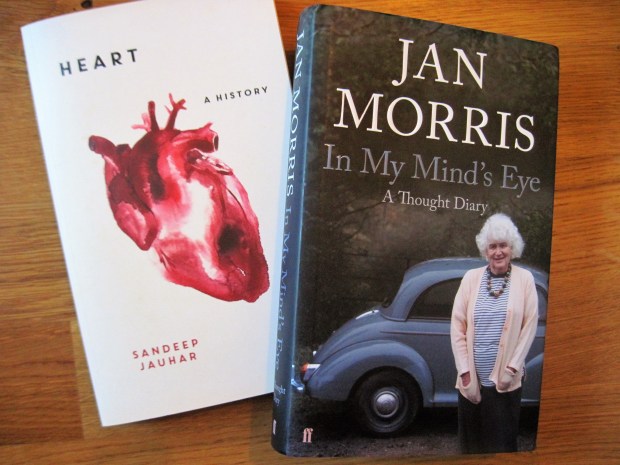
Heart: A History, by Sandeep Jauhar
There could hardly be an author better qualified to deliver this thorough history of the heart and the treatment of its problems. Sandeep Jauhar is the director of the Heart Failure Program at Long Island Medical Center. His family history – both grandfathers died of sudden cardiac events in India, one after being bitten by a snake – prompted an obsession with the heart, and he and his brother both became cardiologists. As the book opens, Jauhar was shocked to learn he had up to a 50% blockage of his own coronary vessels. Things had really gotten personal.
Cardiovascular disease has been the #1 killer in the West since 1910 and, thanks to steady smoking rates and a continuing rise in obesity and sedentary lifestyles, will still affect 60% of Americans. However, the key is that fewer people will now die of heart disease thanks to the developments of the last six decades in particular. These include the heart–lung machine, cardiac catheterization, heart transplantation, and artificial hearts.
 Along the timeline, Jauhar peppers in bits of his own professional and academic experience, like experimenting on frogs during high school in California and meeting his first cadaver at medical school. My favorite chapter was the twelfth, “Vulnerable Heart,” which is about how trauma can cause heart arrhythmias; it opens with an account of the author’s days cataloguing body parts in a makeshift morgue as a 9/11 first responder. I also particularly liked his account of being called out of bed to perform an echocardiogram, which required catching a taxi at 3 a.m. and avoiding New York City’s rats.
Maybe I’ve read too much surgical history this year (The Butchering Art by Lindsey Fitzharris and Face to Face by Jim McCaul), though, because I found myself growing fairly impatient with the medical details in the long Part II, which centers on the heart as a machine, and was drawn more to the autobiographical material in the first and final sections. Perhaps I would prefer Jauhar’s first book, Intern: A Doctor’s Initiation.
In terms of readalikes, I’d mention Siddhartha Mukherjee’s The Gene, in which the personal story also takes something of a backseat to the science, and Gavin Francis’s Shapeshifters, which exhibits a similar interest in the metaphors applied to the body. While I didn’t enjoy this quite as much as two other heart-themed memoirs I’ve read, The Sanctuary of Illness by Thomas Larson and Echoes of Heartsounds by Martha Weinman Lear, I still think it’s a strong contender for next year’s Wellcome Book Prize (the judging panel is announced tomorrow!).
Some favorite lines:
“it is increasingly clear that the biological heart is extraordinarily sensitive to our emotional system—to the metaphorical heart, if you will.”
“Who but the owner can say what lies inside a human heart?”“As a heart-failure specialist, I’d experienced enough death to fill up a lifetime. At one time, it was difficult to witness the grief of loved ones. But my heart had been hardened, and this was no longer that time.”
My rating: 
Heart is published in the UK today, September 27th, by Oneworld. My thanks to the publisher for the proof copy for review.
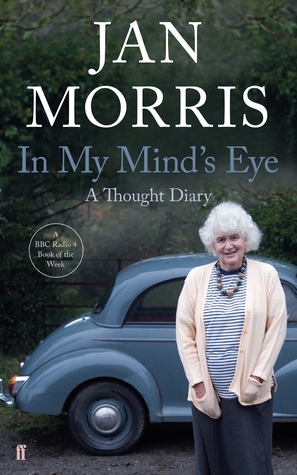
In My Mind’s Eye: A Thought Diary, by Jan Morris
I’ve been an admirer of Jan Morris’s autobiographical and travel writing for 15 years or more. In this diary covering 2017 into early 2018, parts of which were originally published in the Financial Times and the Welsh-language literary newspaper O’r Pedwar Gwynt, we get a glimpse into her life in her early nineties. It was a momentous time in the world at large but a fairly quiet and reflective span for her personally. Though each day’s headlines seem to herald chaos and despair, she’s a blithe spirit – good-natured about the ravages of old age and taking delight in the routines of daily one-mile walks down the lane and errands in local Welsh towns with her beloved partner Elizabeth, who’s in the early stages of dementia.
 There are thrilling little moments, though, when a placid domestic life (a different kind of marmalade with breakfast each day of the week!) collides with exotic past experiences, and suddenly we’re plunged into memories of travels in Swaziland and India. Back when she was still James, Morris served in World War II, was the Times journalist reporting from the first ascent of Everest, and wrote a monolithic three-volume history of the British Empire. She took her first airplane flight 70 years ago, and is nostalgic for the small-town America she first encountered in the 1950s. Hold all that up against her current languid existence among the books and treasures of Trefan Morys and it seems she’s lived enough for many lifetimes.
There’s a good variety of topics here, ranging from current events to Morris’s love of cats; I particularly liked the fragments of doggerel. However, as is often the case with diaries, read too many entries in one go and you may start to find the sequence of (non-)events tedious. Each piece is only a page or two, so I tried never to read many more than 10 pages at a time. Even so, I noticed that the plight of zoo animals, clearly a hobby-horse, gets mentioned several times. It seemed to me a strange issue to get worked up about, especially as enthusiastic meat-eating and killing mice with traps suggest that she’s not applying a compassionate outlook consistently.
In the end, though, kindness is Morris’s cardinal virtue, and despite minor illness, telephone scams and a country that looks to be headed to the dogs, she’s encouraged by the small acts of kindness she meets with from friends and strangers alike. Like Diana Athill (whose Alive, Alive Oh! this resembles), I think of Morris as a national treasure, and I was pleased to spend some time seeing things from her perspective.
Some favorite lines:
“If I set out in the morning for my statutory thousand daily paces up the lane, … I enjoy the fun of me, the harmless conceit, the guileless complexity and the merriment. When I go walking in the evening, on the other hand, … I shall recognize what I don’t like about myself – selfishness, self-satisfaction, foolish self-deceit and irritability. Morning pride, then, and evening shame.” (from Day 99)
“Good or bad, virile or senile, there’s no life like the writer’s life.” (from Day 153)
My rating: 
In My Mind’s Eye was published by Faber & Faber on September 6th. My thanks to the publisher for the free copy for review.
Out and About in Edinburgh
After going to Wigtown in April, I never expected I’d be back in Scotland this year. This was a fairly last-minute trip we booked so that my husband could attend a short rewilding workshop for PhD students. They all met up in Edinburgh and proceeded by bus into the Cairngorms to see sites of habitat restoration and potential future wildlife releases. I stayed behind at our Airbnb flat and kept up a reduced work load while enjoying the city break.
Day 1, Wednesday the 19th: A travel day. Our journey – two train rides plus a short walk at either end – should have taken just over 7 hours. Instead, it took 14. Recent storms had taken down wires at Durham and left debris on the line, so our original train was terminated at York. We managed to get a connection to Newcastle, queued outside for two hours for rail replacement buses that never came, and finally got a very delayed train through to Edinburgh. Our poor Airbnb hostess’s parents had to wait up for us until 12:40 a.m.
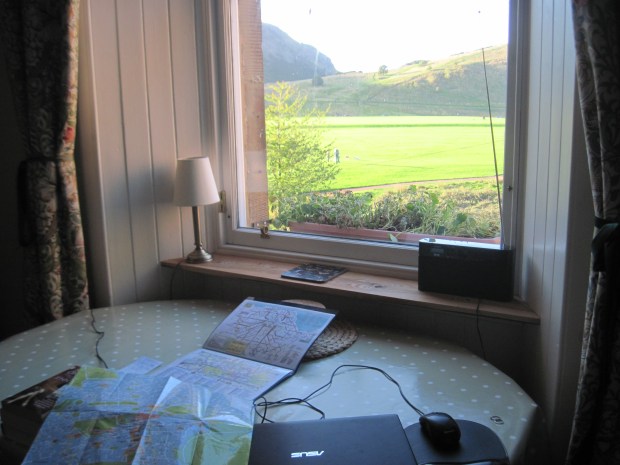
Day 2, Thursday the 20th: After just a few hours of sleep, we were up early so that Chris could leave by 7:15 for his meet-up on the Edinburgh campus. The props and sketches scattered about suggest that the flat owner is a theatre costume and set designer. The view overlooking Holyrood Park and Arthur’s Seat is spectacular – a great place to put in a few hours of proofreading before heading out to town after lunch.


On Clare’s recommendation I started with the Surgeons’ Hall Museums on the Royal College of Surgeons campus. They have several collections covering the history of surgery, dentistry, and pathology specimens. Many of the names and developments were familiar to me from Lindsey Fitzharris’s The Butchering Art. Joseph Lister’s frock coat is on display, and in one corner rare video footage plays of Sir Arthur Conan Doyle (who was initially a practicing physician) explaining how he based Sherlock Holmes on his university mentor, Joseph Bell.
 It’s not a place for the squeamish as there are mummified skeletons, details about Burke and Hare’s grave-robbing, surgical tools, and tumors and other anatomical deformities in jars everywhere. I found it all fascinating and spent a good two hours poking around. My favorite bits were the case full of foreign bodies removed from noses, stomachs and intestines and the temporary exhibition, “A Quest for Healing” by Zhang Yanzi, who had a residency at the museums in the summer of 2017. Her pieces included a 2D mountain made of pill packets, a cotton and gauze sculpture bristling with acupuncture needles, a matching hanging sculpture of capillaries, two surgical beds, and various silk screen panels.
The pathology museum, spread across two floors, was a little overwhelming and almost distressingly faceless – so many human beings reduced to the conditions that had defined and perhaps killed them. The most striking specimen for me, then, was one that actually included a face. I think it was a First World War soldier whose nose had been sewn back together, and what was so remarkable was that you could see his ginger whiskers and eyebrows, and his eyes were closed as if he was just taking a nap. (For ever. In a museum case.)

The sculpture outside is From Here Health by Denys Mitchell (1994).
There are only explanatory panels about a select few samples, so it can be hard to spot just what’s wrong with the organs unless you have specialist medical knowledge. I appreciated the few places where notes have been added along the lines of “see your doctor if…” There were four polycystic kidneys on display in various cases, so including mine there were at least six present in the building that day. “More lives would be saved if more people carried kidney donor cards,” one caption read. Amen.
Clare also recommended the university area for its charity shops. I had a good trawl around Nicolson Street and bought one book, but a lot of the shops are geared towards vintage and High Street fashion. I had better luck at the Salvation Army store on Forrest Road (near the National Museum), where I found three books and two classical CDs.


On to the Writers’ Museum, which commemorates Robert Burns, Sir Walter Scott and Robert Louis Stevenson. I was most interested in the Stevenson material, including memorabilia from his later life on Samoa, especially as I’m currently reading a novel about his relationship with the American divorcee Fanny Osbourne. By now I was museum-ed out and headed back to the flat for a leftovers dinner and some reading before an early bedtime.


Day 3, Friday the 21st: Another morning of work followed by an afternoon of wandering on foot between free attractions and charity shops and avoiding the drizzle. I visited the unusual Scottish Parliament building (which cost a cool £414 million) and saw inside the debating chamber. Four books from the Lothian Cat Rescue charity shop; quick jaunts around the Museum of Childhood, the Museum of Edinburgh, Canongate Kirk, the Music Museum, and the Central Library. When it came to it I couldn’t be bothered to pay £14 to go around Holyrood Palace, but I enjoyed a reasonably priced cappuccino and carrot cake at their café. Chris was back in the evening for a dinner of frozen pizza with local beer and cider.


Day 4, Saturday the 22nd: Our one full day in the City together. We weren’t feeling up to the Arthur’s Seat walk, so we did a gentle stroll up the Salisbury Crags and back instead. Then we caught a bus out to the Stockbridge area for more charity shopping (two more books) and a scrumptious brunch at The Pantry. This was a recommendation on chef David Lebovitz’s food blog and it more than lived up to expectations. It’s no wonder we had to wait half an hour for a table. I could have eaten anything on the menu, but in the end I had smoked salmon eggs Benedict followed by a cherry and Nutella brownie.


After a brief browse at Golden Hare Books, we went on along the Water of Leith to the lovely Royal Botanic Garden. It’s free to walk around, but we also paid to tour the Glasshouses, which recreate the flora of 10 different climates. The RBG is also home to the National Memorial for Organ and Tissue Donors, a peaceful circular space set back in the woods and marked out by a few benches and stone monuments. As I have organ donors to thank for the continued life and health of my mother and several other relatives, it was well worth a visit.


Back into town for gelato (I had a delicious poached plum and cinnamon sorbet) at Mary’s Milk Bar, which is on Grassmarket across from the Castle and was another Lebovitz recommendation. A quick circuit of the animal hall at the National Museum before it closed, a stroll along the Royal Mile, and a rest with tea and books back at the flat before going back out for a veggie curry.
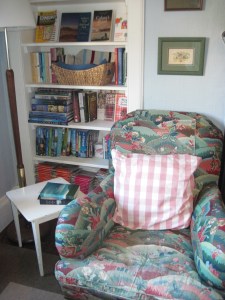
Airbnb bedroom reading nook
Day 5, Sunday the 23rd: Return travel day. No major issues, but still enough of a delay to apply for compensation – refunds from LNER and my husband’s work will have made the journey very cheap indeed.
I was sad to leave Edinburgh this time. I loved our Airbnb flat and felt very at home in it. If I had a bicycle to get into town a little faster, I could easily live there. The tourists would probably drive me mad, but Edinburgh is a wonderful place with so much to see and do and such incredible scenery within a short drive.
Thank you to everyone who offered suggestions of what to see and do. I managed to fit in most of what you recommended!
What I read:
The bulk of Unsheltered, Barbara Kingsolver’s bold new novel about distrust and displacement in America then (the 1870s) and now (during the rise of Trump), and Come to Me by Amy Bloom, a wonderful story collection about people who love who they shouldn’t love. More about this one in my upcoming round-up of short stories I’ve read this month.
 A Ladder to the Sky by John Boyne is a delicious piece of literary suspense with a Tom Ripley-like hero you’ll love to hate: Maurice Swift, who wants nothing more than to be a writer but doesn’t have any ideas of his own, so steals them from other people. I loved how we see this character from several outside points of view – first Erich Ackerman, whose Nazi-era history provides the basis for Maurice’s first novel; then Gore Vidal, to whose Italian home Maurice pays a visit with his new mentor; and finally Maurice’s wife Edith, a celebrated author in her own right – before getting Maurice’s own perspective. By this point we know enough about him to understand just how unreliable a narrator he is. My one criticism is that I would have binned the whole subplot about Edith’s sister and brother-in-law. (A nice touch: at one point Maurice buys a reprint copy of Maude Avery’s Like to the Lark, which should ring a bell from The Heart’s Invisible Furies.)
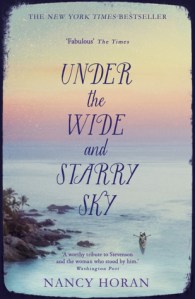 I also read over half of Jenny Diski’s Stranger on a Train, a memoir about two long train journeys she took across America in the late 1990s that also incorporates memories from a troubled adolescence – she started smoking at 14 and was in and out of mental hospitals at 15 – in which she loved nothing more than to read while riding the Circle line all day long. I’m a quarter of the way through both Nancy Horan’s Under the Wide and Starry Sky, about Stevenson and his wife, and Peter Hill’s Stargazing, a memoir about dropping out of art school to become a Scottish lighthouse keeper in 1973; he started on Pladda, a tiny island off of Arran. And on my Nook I read a good bit of All You Can Ever Know, Nicole Chung’s forthcoming memoir about being raised by adoptive white parents in Oregon and meeting members of her Korean family in her mid-twenties, just as she became a mother herself.
The Way of All Flesh by Ambrose Parry
This historical novel set in Edinburgh in 1847 has one of the best opening paragraphs I’ve come across in a while:
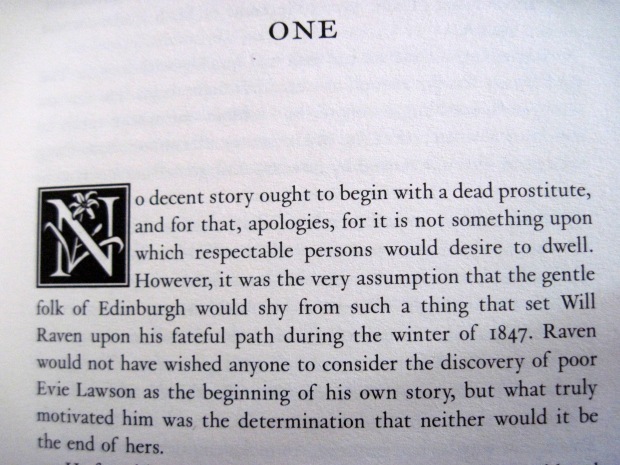
That immediately sets the tone: realistic, sly, and somewhat seedy. If the title sounds familiar, it’s because it’s borrowed from Samuel Butler’s gloomy 1903 meditation on sin and salvation in several generations of a Victorian family. I remember trudging through it on a weekend break to Strasbourg during my year abroad.
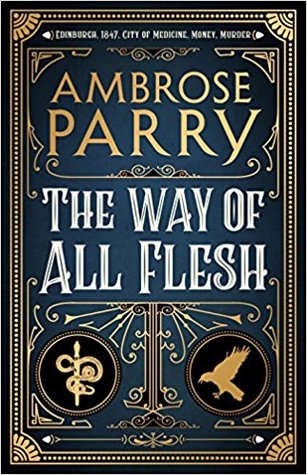 Parry (a pseudonym for husband–wife duo Chris Brookmyre and Marisa Haetzman) uses the allusion to highlight the hidden sins of the Victorian period and hint at the fleshy concerns of their book, which contains somewhat gruesome scenes of childbirth and surgery. Ether and chloroform were recent introductions and many were still apprehensive about them or even opposed to their use on religious grounds, as Haetzman, a consultant anesthetist, learned while researching for her Master’s degree in the History of Medicine.
Into this milieu enters Will Raven, the new apprentice to Dr. Simpson, a professor of midwifery. Will is troubled by the recent loss of his friend Evie Lawson, the dead prostitute of the first paragraph, and wonders if she could have been poisoned by some bad moonshine. Only as he hears rumors about a local abortionist – no better than a serial killer – who’s been giving women quack pills and potions, followed by rudimentary operations that leave them to die of peritonitis, does he begin to wonder if Evie could have been pregnant when she died.
The novel peppers in lots of period slang and details about homeopathy, phrenology and early photography. Best of all, it has a surprise heroine: the Simpsons’ maid, Sarah Fisher, who keeps shaming Will with her practical medical know-how and ends up being something of a sidekick in his investigations. She wants to work as a druggist’s assistant, but the druggist insists that only a man can do the job. Dr. Simpson recognizes that the housemaid’s role is rather a waste of Sarah’s talents and expresses his hope that she’ll seek to be part of a widespread change for women.
The Way of All Flesh is sure to appeal to readers of Michel Faber’s The Crimson Petal and the White and Steven Price’s By Gaslight. It’s not quite as rewarding as the former, but the length and style make it significantly more engaging than the latter. It also serves as a good fictional companion to Lindsey Fitzharris’s The Butchering Art; for that reason, I wouldn’t be surprised to see it appear on next year’s Wellcome Book Prize longlist.

Victorian Edinburgh on the endpapers.
Favorite lines:
“That was Edinburgh for you: public decorum and private sin, city of a thousand secret selves.”
“‘Simpson likes to think of medicine as more than pure science,’ [Raven] countered. ‘There must also be empathy, concern, a human connection.’ ‘I suggest that both elements are required,’ offered Henry. ‘Scientific principles married to creativity. Science and art.’ If it is an art, it is at times a dark one, Raven thought, though he chose to keep this observation to himself.”
My rating:
The Way of All Flesh comes out today, August 30th, in the UK. It was published in the States by HarperCollins on the 28th. My thanks to Canongate for sending a free copy for review.
Two Records of Bodily Transformation: Amateur and Shapeshifters
Amateur: A True Story about What Makes a Man, Thomas Page McBee
 Thomas Page McBee was the first transgender man to box at Madison Square Garden. In his second memoir, which arose from a Quartz article entitled “Why Men Fight,” he recounts the training leading up to his charity match and ponders whether aggression is a natural male trait. McBee grew up in a small town outside Pittsburgh with a stepfather who sexually abused him from age four. In 2011 he started the testosterone injections that would begin his gender transformation. During the years that followed, other men seemed to pick fights with him fairly often, and he was unsure what to do about it. Finally, in 2015, the Manhattan editor decided to confront the belligerent male stereotype by starting boxing training.
What I most appreciated were the author’s observations of how others have related to him since his transition. He notices that he’s taken more seriously at work as a man, and that he can be an object of fear – when jogging behind a woman at night, for instance. One of the most eye-opening moments of the book is when he realizes that he’s been talking over his own sister. Thankfully, McBee is sensitive enough to stop and change, recognizing that kindness and vulnerability are not faults but attributes any person should be proud of.
I have a feeling I would have preferred his previous memoir, Man Alive, which sounds like it has more about the transition itself. Jonathan Eig’s biography of Muhammad Ali is one of the best books I’ve read this year, and in comparison I didn’t find the boxing writing here very interesting. Likewise, this pales beside two similar but more perceptive books I’ve read that have been hugely influential on my own understanding of gender identity: Conundrum by Jan Morris and The Argonauts by Maggie Nelson.
My rating: 
Amateur was published in the UK by Canongate on August 2nd. My thanks to the publisher for the free copy for review.
Shapeshifters: On Medicine and Human Change by Gavin Francis
 Gavin Francis is a physician with a practice near Edinburgh. His latest book is like a taster course in medical topics. The overarching theme is the modifications the body undergoes, so there are chapters on, for example, body-building, tattoos, puberty, prosthetic limbs, dementia and menopause. Over his years in general practice Francis has gotten to know his patients’ stories and seen them change, for better or worse. These anecdotes of transformation are one source for his book, but he also applies insight from history, mythology, literature, etymology and more. So in a chapter on conception he discusses the Virgin Mary myth, Leonardo da Vinci’s fetal diagrams, the physiological changes pregnant women experience, and the case of a patient, Hannah, who had three difficult, surprise pregnancies in quick succession.
We are all in the process of various transformations, Francis argues, whether by choice or involuntarily. (I decided on the link with McBee because of a chapter on sex changes.) I was less convinced by the author’s inclusion of temporary, reversible changes such as sleep, hallucinations, jet lag and laughter. And while each chapter is finely wrought, I felt some sort of chronological or anatomical order was necessary to give the book more focus. All the same, I suspect this will be a strong contender for next year’s Wellcome Book Prize because of its broad relevance to human health and its compassionate picture of bodies in flux.
My rating:
Shapeshifters was published by the Wellcome Collection/Profile Books on May 2nd. My thanks to the publisher for the proof copy for review.
Wellcome Book Prize: Shortlist Recap
Tomorrow morning we will announce our Wellcome Book Prize 2018 shadow panel winner. Beforehand I wanted to do a quick recap of my reviews, especially for the two books that I read before the shortlist announcement. My full reviews are here:
Stay with Me by Ayobami Adebayo
To Be a Machine by Mark O’Connell 
Mayhem by Sigrid Rausing
The Vaccine Race by Meredith Wadman
I give some extra thoughts on and favorite quotes from the other two below:
The Butchering Art by Lindsey Fitzharris
 This is a great blend of medical history and popular science that should draw in readers who wouldn’t normally gravitate to either topic – provided they aren’t too squeamish. Fitzharris has recently returned to Oxford as a visiting academic, and this has also been nominated for the Wolfson History Prize. Follow her on Instagram (@drlindseyfitzharris) for a steady stream of gruesomely fascinating photos (I wish The Butchering Art had been illustrated!). Her next book will be much of a muchness, it seems, documenting the early years of plastic surgery after World War I through the story of pioneering surgeon Harold Gillies.
In the days before Joseph Lister…
“Operating theaters were gateways to death. It was safer to have an operation at home than in a hospital, where mortality rates were three to five times higher than they were in domestic settings.”
“The surgeon was very much viewed as a manual labourer who used his hands to make his living, much like a key cutter or plumber today.”
See what the rest of the shadow panel has to say about this book:
Annabel’s review: “[A]n extremely readable account of a ground-breaking career which led to real advances in hospital medicine. I enjoyed the whole, but particularly the grisly bits!”
Laura’s review: “It’s easy for me to feel a bit impatient with popular histories of periods or subjects that I know well, but Fitzharris strikes exactly the right note, writing clearly and accessibly with no dumbing down.”
Paul’s review: “It is one of the better books that I have read on medical history[;] Fitzharris writes in an engaging way on a subject that is not going to appeal to everyone, but in amongst all the blood is the fascinating story of Joseph Lister.”
With the End in Mind by Kathryn Mannix
 “It’s time to talk about dying. This is my way of promoting the conversation,” Mannix writes in her introduction to this accessible and reassuring book about death. She believes we are afraid of death because of our misconception that it is inevitably painful and undignified. In her decades of working in hospice care, this has rarely been the case. (Thank goodness that, compared to the earlier nineteenth-century situation Fitzharris surveys, we have reliable pain control options.) Mannix sees the role of the hospice worker as being like a midwife for the dying, a helpful idea I first encountered in Henry Fersko-Weiss’s Caring for the Dying: The Doula Approach to a Meaningful Death.
Many of the stories in this book are of peaceful deaths the patient and family had time to prepare for. Others are sad stories of denial. One, though, is quite gruesome, yet magnificently described. Alex, a young man with testicular teratoma, has a massive GI bleed:
“Alex’s head is thrown back, almost as though it is a voluntary movement. A huge, dark-red python slithers rapidly out of his mouth, pushing his head backwards as it coils itself onto the pillow beside him; the python is wet and gleaming and begins to stain the pillowcase and sheets with its red essence as Alex takes one snoring breath, and then stops breathing. His mother screams as he realises that the python is Alex’s blood. Probably all of his blood.”
See what the rest of the shadow panel has to say about this book:
Annabel’s review: “[I]t is helping patients, and their families and loved ones, to understand the process of dying, and dispelling the taboos around it that make this book such a valuable and compelling read. I wish I’d read something like this book before my mum died.”
Clare’s review: “For me, this enlightening book is a strong potential winner for the Wellcome Book Prize and I hope it brings comfort and guidance for those who need it.”
Laura’s review: “[The book is] written from her own experiences as a specialist in palliative care, and this proved, for me, both its strength and its downfall. … Mannix writes particularly well on the characteristic patterns of somebody who is entering a gradual decline.”
Paul’s review: “Can highly recommend this moving book and I think it should be essential reading for anyone who has any concerns about death.”
I wouldn’t be at all surprised to see either of these win the Wellcome Book Prize on Monday. Stay tuned for tomorrow’s shadow panel winner announcement, and Sunday’s write-up of a shortlist event I’m attending in London.
 Bookish Beck = Rebecca Foster. American transplant to England. Freelance proofreader and book reviewer.
 Bookish Beck