Three on a Theme for Father’s Day: Holt Poetry, Filgate & Virago Anthologies
A rare second post in a day for me; I got behind with my planned cat book reviews. I happen to have had a couple of fatherhood-themed books come my way earlier this year, an essay anthology and a debut poetry collection. To make it a trio, I finished an anthology of autobiographical essays about father–daughter relationships that I’d started last year.
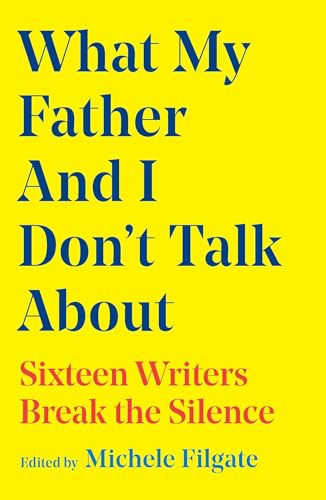
What My Father and I Don’t Talk About: Sixteen Writers Break the Silence, ed. Michele Filgate (2025)
This follow-up to Michele Filgate’s What My Mother and I Don’t Talk About is an anthology of 16 compassionate, nuanced essays probing the intricacies of family relationships.
 Understanding a father’s background can be the key to interpreting his later behavior. Isle McElroy had to fight for scraps of attention from their electrician father, who grew up in foster care; Susan Muaddi Darraj’s Palestinian father was sent to America to make money to send home. Such experiences might explain why the men were unreliable or demanding as adults. Patterns threaten to repeat across the generations: Andrew Altschul realizes his father’s hands-off parenting (he joked he’d changed a diaper “once”) was an outmoded convention he rejects in raising his own son; Jaquira Díaz learns that the depression she and her father battle stemmed from his tragic loss of his first family.
Some take the title brief literally: Heather Sellers dares to ask her father about his cross-dressing when she visits him in a nursing home; Nayomi Munaweera is pleased her 82-year-old father can escape his arranged marriage, but the domestic violence that went on in it remains unspoken. Tomás Q. Morín’s “Operation” has the most original structure, with the board game’s body parts serving as headings. All the essays display psychological insight, but Alex Marzano-Lesnevich’s—contrasting their father’s once-controlling nature with his elderly vulnerability—is the pinnacle.
Despite the heavy topics—estrangement, illness, emotional detachment—these candid pieces thrill with their variety and their resonant themes. (Read via Edelweiss)
Reprinted with permission from Shelf Awareness. (The above is my unedited version.)
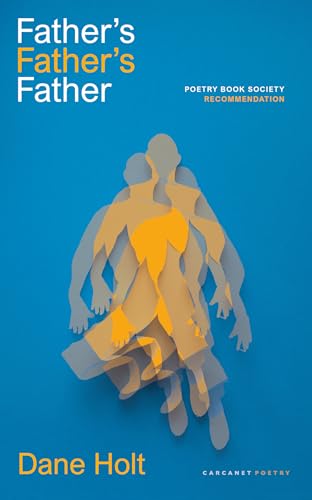
Father’s Father’s Father by Dane Holt (2025)
Holt’s debut collection interrogates masculinity through poems about bodybuilders and professional wrestlers, teenage risk-taking and family misdemeanours.
Your father’s father’s father
poisoned a beautiful horse,
that’s the story. Now you know this
you’ve opened the door marked
‘Family History’.
(from “‘The Granaries are Bursting with Meal’”)
The only records found in my grandmother’s attic
were by scorned women for scorned women
written by men.
(from “Tammy Wynette”)
He writes in the wake of the deaths of his parents, which, as W.S. Merwin observed, makes one feel, “I could do anything,” – though here the poet concludes, “The answer can be nothing.” Stylistically, the collection is more various than cohesive, with some of the late poetry as absurdist as you find in Caroline Bird’s. My favourite poem is “Humphrey Bogart,” with its vision of male toughness reinforced by previous generations’ emotional repression:
My grandfather
never told his son that he loved him.
I said this to a group of strangers
and then said, Consider this:
his son never asked to be told.
They both loved
the men Humphrey Bogart played.
…
There was
one thing my grandfather could
not forgive his son for.
Eventually it was his son’s dying, yes.
With thanks to Carcanet Press for the free e-copy for review.
Fathers: Reflections by Daughters, ed. Ursula Owen (1983; 1994)
“I doubt if my father will ever lose his power to wound me, and yet…”
~Eileen Fairweather
I read the introduction and first seven pieces (one of them a retelling of a fairy tale) last year and reviewed that first batch here. Some common elements I noted in those were service in a world war, Freudian interpretation, and the alignment of the father with God. The writers often depicted their fathers as unknown, aloof, or as disciplinarians. In the remainder of the book, I particularly noted differences in generations and class. Father and daughter are often separated by 40–55 years. The men work in industry; their daughters turn to academia. Her embrace of radicalism or feminism can alienate a man of conservative mores.
 Sometimes a father is defined by his emotional or literal absence. Dinah Brooke addresses her late father directly: “Obsessed with you for years, but blind – seeing only the huge holes you had left in my life, and not you at all. … I did so want someone to be a father to me. You did the best you could. It wasn’t a lot. The desire was there, but the execution was feeble.” Had Mary Gordon been tempted to romanticize her father, who died when she was seven, that aim was shattered when she learned how much he’d lied about and read his reactionary and ironically antisemitic writings (given that he was a Jew who converted to Catholicism).
I mostly skipped over the quotes from novels and academic works printed between the essays. There are solid pieces by Adrienne Rich, Michèle Roberts, Sheila Rowbotham, and Alice Walker, but Alice Munro knocks all the other contributors into a cocked hat with “Working for a Living,” which is as detailed and psychologically incisive as one of her stories (cf. The Beggar Maid with its urban/rural class divide). Her parents owned a fox farm but, as it failed, her father took a job as night watchman at a factory. She didn’t realize, until one day when she went in person to deliver a message, that he was a janitor there as well.
This was a rewarding collection to read and I will keep it around for models of autobiographical writing, but it now feels like a period piece: the fact that so many of the fathers had lived through the world wars, I think, might account for their cold and withdrawn nature – they were damaged, times were tough, and they believed they had to be an authority figure. Things have changed, somewhat, as the Filgate anthology reflects, though father issues will no doubt always be with us. (Secondhand – National Trust bookshop)
Book Serendipity, April to May 2024
I call it “Book Serendipity” when two or more books that I read at the same time or in quick succession have something in common – the more bizarre, the better. Of course, the truer term would be synchronicity, but the branding has stuck. In Liz Jensen’s Your Wild and Precious Life, she mentions that Carl Jung coined the term “synchronicity” for what he described as “a meaningful coincidence of two or more events where something other than the probability of chance is involved.” I like thinking that it’s not just a matter of luck.
This is a regular feature of mine every couple of months. I would normally have waited until the end of June, but I had way too many coincidences stored up! Because I usually have 20–30 books on the go at once, I suppose I’m more prone to finding them. People frequently ask how I remember all of these incidents. The answer is: I jot them down on scraps of paper or input them immediately into a file on my PC desktop; otherwise, they would flit away.
The following are in roughly chronological order.
- Reading two King Lear updates at the same time: Private Rites by Julia Armfield and Daughter by Claudia Dey. The former has been specifically marketed as a “lesbian Lear,” but I had no idea that the latter also features two sisters plus a younger half-sister and their interactions with a larger-than-life father.

- Eating beans straight out of the tin in The Waterfall by Margaret Drabble and Of Mice and Men by John Steinbeck.
- Dead mice in Of Mice and Men by John Steinbeck and Stone Yard Devotional by Charlotte Wood.

-

- Screenshot
- Cloth holding the jaw of a corpse closed in one story from Barcelona by Mary Costello and A Woman’s Story by Annie Ernaux.
- Others see a character’s wife as a whore but the husband is oblivious in The Shipping News by E. Annie Proulx and Of Mice and Men by John Steinbeck.
 Setting up a game of solitaire in The Snow Hare by Paula Lichtarowicz and Of Mice and Men by John Steinbeck.
- Main character called Mona in Daughter by Claudia Dey and Mona of the Manor by Armistead Maupin.
- Being surprised at an older man still having his natural hair colour in one story of Barcelona by Mary Costello (where he’s aged 76) and Life in the Balance by Jim Down (where it’s Alan Bennett, at 84!).
- A character named Anjali in Brotherless Night by V.V. Ganeshananthan and Moral Injuries by Christie Watson.

- A character named Cherry in Daughter by Claudia Dey and one story of This Is Why We Can’t Have Nice Things by Naomi Wood.
- My second memoir in two months in which a twentysomething son dies suddenly of a presumed heart problem: Fi by Alexandra Fuller, followed by Your Wild and Precious Life by Liz Jensen. (And a third in which his young friend died in the same way: The Uptown Local by Cory Leadbeater.) Also, Fuller and Jensen both see signs of their sons’ continued presence in bird sightings.
- Scratches on the inside of a coffin as proof of being buried alive in one story of Barcelona by Mary Costello and Life in the Balance by Jim Down.


- Surprise that one didn’t know the exact moment that a loved one died in one story of Barcelona by Mary Costello and Your Wild and Precious Life by Liz Jensen.
- Discussion of the meaning of brain stem death and a mention of meningococcal sepsis in Life in the Balance by Jim Down and Moral Injuries by Christie Watson.
- A scene set in a Denny’s diner in The Whole Staggering Mystery by Sylvia Brownrigg and After Dark by Haruki Murakami.


- A description of halal butchery in Barcelona by Mary Costello and Between Two Moons by Aisha Abdel Gawad.
- A mention of ballet choreographer George Balanchine in Dances by Nicole Cuffy and The Uptown Local by Cory Leadbeater.
- A woman has an affair with a female postal worker in Mona of the Manor by Armistead Maupin and The Shipping News by Annie Proulx, both of which I DNFed.
- A character named Magdalena in Cloistered by Catherine Coldstream and The Snow Hare by Paula Lichtarowicz. The latter goes by Lena, which is also the name of the main character in Jungle House by Julianne Pachico. And there’s a character named Lina in Between Two Moons by Aisha Abdel Gawad.


- Being presented with powdered milk in Cloistered by Catherine Coldstream and Whale Fall by Elizabeth O’Connor.
- First I read a novel about a convent plagued by mice (Stone Yard Devotional by Charlotte Wood). Then I read a memoir about a convent plagued by feral cats (Cloistered by Catherine Coldstream).
- Buffalo, New York as a setting in Consent by Jill Ciment and The Age of Loneliness by Laura Marris. It’s also mentioned in Enter Ghost by Isabella Hammad.

- Watching pigeons on one’s balcony in Keep by Jenny Haysom, Your Wild and Precious Life by Liz Jensen, and The Uptown Local by Cory Leadbeater.
 The family’s pet chicken is cooked for dinner in Coleman Hill by Kim Coleman Foote and The Snow Hare by Paula Lichtarowicz.
- The mother is named Gloria in Consent by Jill Ciment and Cold Spring Harbor by Richard Yates (and The War for Gloria by Atticus Lish, a DNF).
- A character named Anton in The Snow Hare by Paula Lichtarowicz and Jungle House by Julianne Pachico.
- A cat named Dog in The Door-to-Door Bookstore by Carsten Henn and a dog named Tiger in Jungle House by Julianne Pachico.
- Two nature books that feature wild cold-water swimming (though don’t they all these days?!): In All Weathers by Matt Gaw and Your Wild and Precious Life by Liz Jensen.

- Two nature books that mention W.H. Hudson: In All Weathers by Matt Gaw and North with the Spring by Edwin Way Teale.
 A large anonymous donation to a church in Slammerkin by Emma Donoghue and Excellent Women by Barbara Pym (£10–11, which was much more in the 18th century of the former than in the 1950s of the latter).
- A mention of Poughkeepsie, New York in Birdeye by Judith Heneghan and Woman of Interest by Tracy O’Neill.
- A 1950s scene of perusing a lipstick display in Recipe for a Perfect Wife by Karma Brown and Excellent Women by Barbara Pym.

- A woman with a broken leg worries about how her garden will fare in Recipe for a Perfect Wife by Karma Brown and Remarkably Bright Creatures by Shelby Van Pelt.
- The same silent film image of a spaceship entering the moon’s eye (from Georges Méliès’s A Trip to the Moon) appears in Knife by Salman Rushdie and The Invention of Hugo Cabret by Brian Selznick. (I think this is the uncanniest coincidence of all this time!)

- A cleric who wears a biretta in Excellent Women by Barbara Pym and Daughters of the House by Michèle Roberts.
- A Black single mother who believes in the power of crystals in Company by Shannon Sanders and Another Word for Love by Carvell Wallace.


- An older woman really doesn’t want to leave her home but is moving into a retirement facility in Keep by Jenny Haysom and Remarkably Bright Creatures by Shelby Van Pelt. (There’s also a young woman who refuses to leave her house in Recipe for a Perfect Wife by Karma Brown.)
 A man throws his tie over his shoulder before eating in Recipe for a Perfect Wife by Karma Brown and Keep by Jenny Haysom.
- A mother writing a bad check becomes an important plot point in Remarkably Bright Creatures by Shelby Van Pelt and Another Word for Love by Carvell Wallace.
 A scene of self-induced abortion in Recipe for a Perfect Wife by Karma Brown and Sleeping with Cats by Marge Piercy.
- The Yiddish word feh (an expression of disappointment) appears in Feh by Shalom Auslander (no surprise there!) but also in A Reason to See You Again by Jami Attenberg, both of which are pre-release books I am reading for Shelf Awareness reviews.

What’s the weirdest reading coincidence you’ve had lately?
Nine Days in France and What I Read
Who would have predicted that the South of France would be colder and rainier than the England we left behind? Nonetheless, we had a pleasant, low-key week at the Limousin–Dordogne border. We stayed in a gîte at Le Moulin de Pensol, a complex run by an English couple who keep horses, donkeys and chickens but are otherwise rewilding their land (similar to the Wild Finca project we visited in Spain two years ago). Their site is known for butterflies, including multiple almost indistinguishable fritillary species, so there was plenty of insect and bird watching for my husband in brief bursts of sunshine between showers. When it was too wet to go out, we played board games, drank wine and read books.
-

- Our gite. Photos by Chris Foster.
-
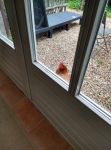
- The chickens wanted in!
-

- Wandering the meadows
-

- Butterfly watching
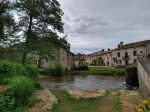
However, we did manage a few short outings: the Trou de Philippou gorge; a peek at a Saturday morning repair café (I’m a volunteer doing admin and publicity for our local repair café, which started in February) and its “recyclerie” charity shop in a nearby village; and St-Jean-de-Côle, “one of the loveliest villages in the Dordogne” according to the Rough Guide. We were taken by the main square’s church, castle and screaming swift parties – so much bigger than back home – which we’d likewise watched circling the château in the attractive medieval town of Saumur on the Loire, where we stopped for a night on the way down. There were also fresh cheeses and produce, including the most delicious strawberries ever (the “Charlotte” variety), from the two closest markets. Piégut’s is the largest market in southwest France but we had to use our imaginations as the downpour kept plenty of sellers away.


-

- St-Jean-de-Cole’s main square
-
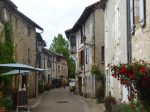
- Photo by Chris Foster.
The highlight of the trip was a visit to Grotte de Villars, a cave network with spectacular stalactites and stalagmites. Less well known than Lascaux, which is now inaccessible to visitors except via a reproduction, it too has prehistoric cave paintings of horses and bison, and 20,000-year-old bear claw marks. The paintings are gradually disappearing behind the constant calcite-creating drips; I pondered whether they will vanish before the human race does. We were lucky to find it so quiet that we got a private English-language tour. Proprietors were also so kind as to speak English to us when we shopped at a nano-brewery and did a tasting at a cider and calvados producer in Normandy on our way back to the ferry. Otherwise, we muddled through with the bare minimum of French at shops and eateries.
-

- Abbaye de Nouaillé-Maupertuis (lunch stop en route)
-

- (Photo at left by Chris Foster.)
-

- Saumur castle
My other highlight was finding two Little Free Libraries, a walk-in one that we happened to pass in Saint-Martin-l’Ars on our initial drive down south and another in Abjat-sur-Bandiat. I felt slightly bad about taking a book at the first because of its insistence on returning or replacing once you’d read it, so I made up for it by donating Cold Spring Harbor to the book exchange box in Abjat when we returned to its crêperie for our one meal out of the holiday.
-
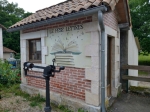
- Le Pese Lettres, Saint-Martin-l’Ars
-
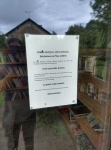
- Stricter than the usual LFL policy
-
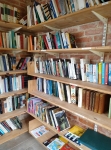
- Several English-language shelves
-
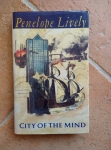
- My chosen book
-
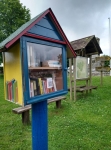
- Abjat-sur-Bandiat book exchange box
-
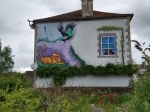
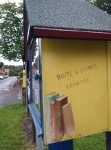
- Cute cat mural in Abjat
What I Read
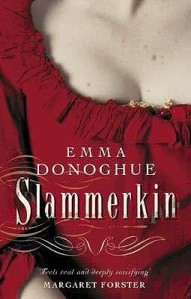 Slammerkin by Emma Donoghue (2000): A slammerkin was, in eighteenth-century parlance, a loose gown or a loose woman. Donoghue was inspired by the bare facts about Mary Saunders, a historical figure. In her imagining, Mary is thrown out by her family at age 14 and falls into prostitution in London. Within a couple of years, she decides to reform her life by becoming a dressmaker’s assistant in her mother’s hometown of Monmouth, but her past won’t let her go. The close third person narration shifts to depict the constrained lives of the other women in the household: the mistress, Mrs Jones, who has lost multiple children and pregnancies; governess Mrs Ash, whose initial position as a wet nurse was her salvation after her husband left her; and Abi, an enslaved Black woman. This was gripping throughout, like a cross between Alias Grace and The Crimson Petal and the White. The only thing that had me on the back foot was that, it being Donoghue, I expected lesbianism. (Secondhand purchase – Awesomebooks.com)
 Paris Trance by Geoff Dyer (1998): Only my second novel from Dyer, an annoyingly talented author who writes whatever he wants, in any genre, inimitably. This reminded me of Jeff in Venice, Death in Varanasi for its hedonistic travels. Luke and Alex, twentysomething Englishmen, meet as factory workers in Paris and quickly become best mates. With their girlfriends, Nicole and Sahra, they form what seems an unbreakable quartet. The couples carouse, dance in nightclubs high on ecstasy, and have a lot of sex. A bit more memorable are their forays outside the city for Christmas and the summer. The first-person plural perspective resolves into a narrator who must have fantasized the other couple’s explicit sex scenes; occasional flash-forwards reveal that only one pair is destined to last. This is nostalgic for the heady days of youth in the same way as Sweetbitter. I was intrigued to learn that random lines were sampled from Fiesta; though it is lad lit, I wouldn’t have expected a Hemingway homage from the style. (Secondhand purchase – Awesomebooks.com)
 Sanctuary in the South: The Cats of Mas des Chats by Margaret Reinhold (1993): Reinhold (still alive at 96?!) is a South African psychotherapist who relocated from London to Provence, taking her two cats with her and eventually adopting another eight, many of whom had been neglected by owners in the vicinity. This sweet and meandering book of vignettes about her pets’ interactions and hierarchy is generally light in tone, but with the requisite sadness you get from reading about animals ageing, falling ill or meeting with accidents, and (in two cases) being buried on the property. “Les chats sont difficiles,” as a local shop owner observes to her. But would we cat lovers have it any other way? Reinhold often imagines what her cats would say to her. Like Doreen Tovey, whose books this closely resembles, she is as fascinated by human foibles as by feline antics. One extended sequence concerns her doomed attempts to hire a live-in caretaker for the cats. She never learned her lesson about putting a proper contract in place; several chancers tried the role and took advantage of her kindness. (Secondhand purchase – Community Furniture Project)
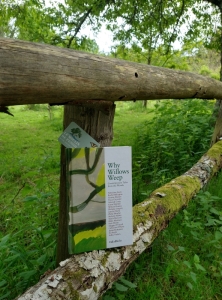
Why Willows Weep: Contemporary Tales from the Woods, ed. Tracy Chevalier and Simon Prosser (2011): These 19 short fictions, rather like Rudyard Kipling’s Just-So Stories, imagine how certain tree species developed their particular characteristics. I wasn’t expecting the fable setup and probably would have preferred a miscellany of essays and various fictional approaches. However, there is a run of great stories in the middle: from Susan Elderkin on “How the Blackthorn Got Its Flowers” to Terence Blacker on “Why Elms Die Young.” The stand-outs for me were by Rachel Billington and Maria McCann. It was a cute touch to have each author’s mini-bio end with their favourite tree, except, um, bamboo isn’t one (it’s a giant grass). I’ll probably keep this for the randomness of where I found it and the Leanne Shapton illustrations. (Secondhand purchase – La Monnerie recyclerie) 
 And the first two-thirds of Daughters of the House by Michèle Roberts (1993): Thérèse and Léonie are cousins: the one French and the other English but making visits to her relatives in Normandy every summer. In the slightly forbidding family home, the adolescent girls learn about life, loss and sex. Each short chapter is named after a different object in the house. That Thérèse seems slightly otherworldly can be attributed to her inspiration, which Roberts reveals in a prefatory note: Saint Thérèse, aka The Little Flower. Roberts reminds me of A.S. Byatt and Shena Mackay; her work is slightly austere and can be slow going, but her ideas always draw me in. (Secondhand – Newbury charity shop)
A DNF: Claudine at School by Colette (a free download), which was dull and in way too small a print on my e-reader.
Plus portions of: various e-books for paid reviews, two May review books, and several library books including Moominpappa at Sea by Tove Jansson and The Invention of Hugo Cabret by Brian Selznick.


I’m happy to be home with my cat and canal, the two things I miss most when we’re away.
Some 2022 Reading Superlatives
Longest book read this year: To Paradise by Hanya Yanagihara (720 pages)

Shortest book read this year: Everything’s Changing by Chelsea Stickle (37 pages)

Authors I read the most by this year: Nicola Colton (4), Jakob Wegelius (3), Tove Jansson and Sarah Ruhl (2)
Publishers I read the most from: (Besides the ubiquitous Penguin and its many imprints) Canongate, Carcanet and Picador – which is part of the Pan Macmillan group.
An author I ‘discovered’ and now want to read everything by: Matthew Vollmer
My overall top discovery of the year: The Murderer’s Ape by Jakob Wegelius

My proudest non-bookish achievement: Giving a eulogy at my mom’s funeral (and even getting some laughs).
The books that made me laugh the most: Revenge of the Librarians by Tom Gauld, Undoctored by Adam Kay, Forget Me Not by Sophie Pavelle, Blurb Your Enthusiasm by Louise Willder
The books that made me cry the most: Foster by Claire Keegan, The Hero of This Book by Elizabeth McCracken


Most useful fact gleaned from a book: To convert a Celsius temperature to Fahrenheit, double it and add 30. It’s a rough estimate, but it generally works! I learned this from, of all places, The Hero of This Book by Elizabeth McCracken.
Best book club selections: The Boys in the Boat by Daniel James Brown, Falling Angels by Tracy Chevalier, Small Things Like These by Claire Keegan


Best first line encountered this year: “First, I got myself born.” (Demon Copperhead, Barbara Kingsolver)
Best last lines encountered this year:
- “Darling, that’s what life’s for – to take risks.” (Up at the Villa, W. Somerset Maugham)
- “The defiant soul of the city doesn’t die. It stays alive, right below the surface, pressing up against the boot heels, crouched like the life inside an egg, the force that drives the flower, forever reaching for its next breath.” (Feral City, Jeremiah Moss)
 “Until the future, whatever it was going to be.” (This Time Tomorrow, Emma Straub)
A book that put a song in my head every time I picked it up: Heaven Is a Place on Earth by Adrian Shirk

Shortest book title encountered: O (a poetry collection by Zeina Hashem Beck), followed by XO (a memoir by Sara Rauch)
Best 2022 book title: I Want to Die But I Want to Eat Tteokbokki by Baek Se-hee (No, I haven’t read it and I’m unlikely to, not having had great luck with recent translations of work by Japanese and Korean women.)
Favourite title and cover combo of the year: Briefly, A Delicious Life by Nell Stevens

Most fun cover serendipity: Two books I read in 2022 featured Matisse cut-outs.


Biggest disappointment: The Book of Form and Emptiness by Ruth Ozeki ( for me)
Two 2022 books that everyone was in raptures about but me: Trust by Hernan Diaz and Demon Copperhead by Barbara Kingsolver (both for me)


A 2022 book that everyone was reading but I decided not to: The Marriage Portrait by Maggie O’Farrell – since I thought Hamnet her weakest work, I’m not eager to try more historical fiction by her.
A 2022 book I can’t read: (No matter how good the reviews might be, because of the title) I’m Glad My Mom Died by Jennette McCurdy
The worst books I read this year: The Reactor by Nick Blackburn, Treacle Walker by Alan Garner, Anthropology by Dan Rhodes, Bonsai by Alejandro Zambra (1-star ratings are extremely rare from me; these were this year’s four)
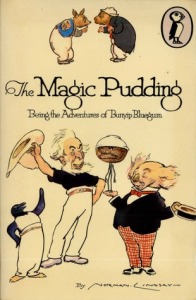
The downright strangest book I read this year: The Magic Pudding by Norman Lindsay
Short Stories in September, Part III/Roundup: Ausubel, Bynum, Roberts
A rare second post in a day from me – there’s just too much to try to fit in at the end of a month! This year I read a total of 11.5 short story collections in September, nearly matching last year’s 12. I’ve already written about the first three and the next four. I’ll give details on a few more below, but the final 1.5 are going to be part of a later Three on a Theme post on “Birds” story collections. The highlight of the month was one of those: Birds of a Lesser Paradise by Megan Mayhew Bergman. However, I read lots of winners, including Brown Girls, The Secret Lives of Church Ladies and the three below. Just shorthand responses this time; all were  .
.
Awayland by Ramona Ausubel (2018)
 Basics: 11 stories, grouped under 4 mythical locales
Settings: California, Beirut, Africa, Turkey, a museum, an unnamed island
Themes: motherhood, loss, travel
Links: Greek myths (opener “You Can Find Love Now” is the Cyclops’ online dating profile); the sister in #2 is the main character in #4
Stand-out: “Template for a Proclamation to Save the Species” (the mayor of a Minnesota town, concerned about underpopulation, offers a car to the first mother to give birth on a date 9 months in the future)
Similar authors: Aimee Bender, Lydia Millet
Aside: I’d want to read her novels just for the titles: No One Is Here Except All of Us and Sons and Daughters of Ease and Plenty
(New/remainder purchase from Dollar Tree on a recent USA trip)
Ms. Hempel Chronicles by Sarah Shun-Lien Bynum (2008)
 Basics: 8 linked stories following 7th-grade teacher Beatrice Hempel through her twenties and thirties
Setting: Massachusetts
Themes: love, loss, motherhood, adventure vs. overprotectiveness, idealism vs. being jaded
Stand-outs: “Crossing” (Ms. Hempel, previously an English teacher, is asked to cover history, and takes her students to Plimoth Plantation; meanwhile, her department chair wishes she’d hyphenate her name to make it more clear she’s half-Chinese); “Satellite” (after her father’s death, Beatrice’s mother and younger sister decide to turn the family home into a B&B)
A similar read: Olive Kitteridge, though that takes more of an interest in the town and its other residents than this – it’s ironic that this came out in the same year, and even got lots of positive and high-profile reviews based on the quotes in my paperback copy, yet I doubt it’s been remembered as Strout’s book has. Such is the power of the Pulitzer.
Aside: I’d read Bynum’s other story collection, Likes (2020), and didn’t care much for it, but I’m glad I tried her again.
(Secondhand purchase from 2nd & Charles on a recent USA trip)
Playing Sardines by Michèle Roberts (2001)
 Basics: 18 stories, some of flash fiction length
Settings: France, England, Italy
Themes: reinvention, love affairs, obsession, food, literature
Stand-outs: The ones with funny twists/shock endings: “The Sheets” (French maid beds visiting English author), “The Cookery Lesson” (woman stalks celebrity chef), “Lists” (pillar of the community prepares for Christmas, starting months ahead), “Blathering Frights” (a Wuthering Heights spoof)
Similar authors: Julian Barnes (one story is indeed dedicated to him!), A.S. Byatt, John Lanchester, Helen Simpson
Aside: I own two unread novels by Roberts and need to prioritize them.
(Secondhand purchase from local charity shop)
Alas, I also had some DNFs for the month. I read one or two stories in each of these and didn’t take to the style and/or contents:
- The Quarry by Ben Halls
- One Good Story, That One by Thomas King
- Speak Gigantular by Irenosen Okojie
- What Is Not Yours Is Not Yours by Helen Oyeyemi
Book Serendipity, September to October 2021
I call it Book Serendipity when two or more books that I read at the same time or in quick succession have something pretty bizarre in common. Because I have so many books on the go at once (usually 20–30), I suppose I’m more prone to such incidents. I’ve realized that, of course, synchronicity is really the more apt word, but this branding has stuck. This used to be a quarterly feature, but to keep the lists from getting too unwieldy I’ve shifted to bimonthly.
The following are in roughly chronological order.
- Young people studying An Inspector Calls in Somebody Loves You by Mona Arshi and Heartstoppers, Volume 4 by Alice Oseman.
- China Room (Sunjeev Sahota) was immediately followed by The China Factory (Mary Costello).


- A mention of acorn production being connected to the weather earlier in the year in Light Rains Sometimes Fall by Lev Parikian and Noah’s Compass by Anne Tyler.
- The experience of being lost and disoriented in Amsterdam features in Flesh & Blood by N. West Moss and Yearbook by Seth Rogen.
- Reading a book about ravens (A Shadow Above by Joe Shute) and one by a Raven (Fox & I by Catherine Raven) at the same time.


- Speaking of ravens, they’re also mentioned in The Elements by Kat Lister, and the Edgar Allan Poe poem “The Raven” was referred to and/or quoted in both of those books plus 100 Poets by John Carey.
- A trip to Mexico as a way to come to terms with the death of a loved one in This Party’s Dead by Erica Buist (read back in February–March) and The Elements by Kat Lister.
- Reading from two Carcanet Press releases that are Covid-19 diaries and have plague masks on the cover at the same time: Year of Plagues by Fred D’Aguiar and 100 Days by Gabriel Josipovici. (Reviews of both coming up soon.)


- Descriptions of whaling and whale processing and a summary of the Jonah and the Whale story in Fathoms by Rebecca Giggs and The Woodcock by Richard Smyth.
 An Irish short story featuring an elderly mother with dementia AND a particular mention of her slippers in The China Factory by Mary Costello and Blank Pages and Other Stories by Bernard MacLaverty.
- After having read two whole nature memoirs set in England’s New Forest (Goshawk Summer by James Aldred and The Circling Sky by Neil Ansell), I encountered it again in one chapter of A Shadow Above by Joe Shute.
- Cranford is mentioned in Corduroy by Adrian Bell and Cut Out by Michèle Roberts.
- Kenneth Grahame’s life story and The Wind in the Willows are discussed in On Gallows Down by Nicola Chester and The Elements by Kat Lister.


- Reading two books by a Jenn at the same time: Ghosted by Jenn Ashworth and The Other Mothers by Jenn Berney.
- A metaphor of nature giving a V sign (that’s equivalent to the middle finger for you American readers) in On Gallows Down by Nicola Chester and Light Rains Sometimes Fall by Lev Parikian.
- Quince preserves are mentioned in The Book of Difficult Fruit by Kate Lebo and Light Rains Sometimes Fall by Lev Parikian.
- There’s a gooseberry pie in Talking to the Dead by Helen Dunmore and The Book of Difficult Fruit by Kate Lebo.


- The ominous taste of herbicide in the throat post-spraying shows up in On Gallows Down by Nicola Chester and Damnation Spring by Ash Davidson.
- People’s rude questioning about gay dads and surrogacy turns up in The Echo Chamber by John Boyne and the DAD anthology from Music.Football.Fatherhood.
- A young woman dresses in unattractive secondhand clothes in The Echo Chamber by John Boyne and Beautiful World, Where Are You by Sally Rooney.

- A mention of the bounty placed on crop-eating birds in medieval England in Orchard by Benedict Macdonald and Nicholas Gates and A Shadow Above by Joe Shute.
- Hedgerows being decimated, and an account of how mistletoe is spread, in On Gallows Down by Nicola Chester and Orchard by Benedict Macdonald and Nicholas Gates.
 Ukrainian secondary characters in Ghosted by Jenn Ashworth and The Echo Chamber by John Boyne; minor characters named Aidan in the Boyne and Beautiful World, Where Are You by Sally Rooney.
- Listening to a dual-language presentation and observing that the people who know the original language laugh before the rest of the audience in The Book of Difficult Fruit by Kate Lebo and Beautiful World, Where Are You by Sally Rooney.
- A character imagines his heart being taken out of his chest in Tender Is the Flesh by Agustina Bazterrica and The Book of Form and Emptiness by Ruth Ozeki.

- A younger sister named Nina in Talking to the Dead by Helen Dunmore and Sex Cult Nun by Faith Jones.
- Adulatory words about George H.W. Bush in The Echo Chamber by John Boyne and Thinking Again by Jan Morris.
- Reading three novels by Australian women at the same time (and it’s rare for me to read even one – availability in the UK can be an issue): Sorrow and Bliss by Meg Mason, The Performance by Claire Thomas, and The Weekend by Charlotte Wood.


- There’s a couple who met as family friends as teenagers and are still (on again, off again) together in Sorrow and Bliss by Meg Mason and Beautiful World, Where Are You by Sally Rooney.
- The Performance by Claire Thomas is set during a performance of the Samuel Beckett play Happy Days, which is mentioned in 100 Days by Gabriel Josipovici.
 Human ashes are dumped and a funerary urn refilled with dirt in Tender Is the Flesh by Agustina Bazterrica and Public Library and Other Stories by Ali Smith.
- Nicholas Royle (whose White Spines I was also reading at the time) turns up on a Zoom session in 100 Days by Gabriel Josipovici.
- Richard Brautigan is mentioned in both The Mystery of Henri Pick by David Foenkinos and White Spines by Nicholas Royle.


- The Wizard of Oz and The Railway Children are part of the plot in The Book Smugglers (Pages & Co., #4) by Anna James and mentioned in Public Library and Other Stories by Ali Smith.
What’s the weirdest reading coincidence you’ve had lately?
Short Stories in September, Part I: Byatt, Hildyard, Okorie, Simpson
Each September I make a special effort to read short stories, which otherwise tend to languish on my shelves unread. In 2020 I read eight collections for this challenge. This year I hope to outdo myself. I’m knee-deep in seven more collections at the moment, including a couple from the library and two from my set-aside-temporarily shelf. Here’s my first four.
Medusa’s Ankles: Selected Stories by A.S. Byatt (2021)
I’ve long considered Byatt my favourite author, and have read all of her published short story collections before. One I even reread last year. So when approaching this chronological selection of 18 stories, I skipped the couple I’d read recently, even though that includes perhaps my favourite stand-alone story of all time (“Medusa’s Ankles”), plus a few more that I’d read before. This time around, I found I wasn’t as interested in the historical stories in the Angels and Insects or Possession vein – chiefly “Precipice-Encurled,” a long story about Robert Browning from her first collection – and instead focused on stories where fantasy or horror breaks into everyday life, and writerly or metafictional ones.
As David Mitchell notes in his introduction, Byatt’s range, from fairy tales to historical realism, is almost overwhelming; it’s hard to do it justice in a short review, but I’ll highlight five brilliant stories beyond the title one. “The July Ghost,” an early story, is another that has stuck with me over the years, turning up in one of my Six Degrees posts. It’s a straight-up ghost story but also a tale within a tale being recounted by a man at a party, and blends sex and death in a creepy way. “Racine and the Tablecloth” pits a clever boarding school girl and her literature professor against each other in a tacit psychological conflict. “Who won, you will ask, Emily or Miss Crichton-Walker, since the Reader is mythical and detached?”

“A Lamia in the Cévennes,” about a seductive snake-spirit living in a painter’s swimming pool, provides a delicious lick of magic. I’m surprised I didn’t remember “Raw Material,” as it was a favourite on this reread. A working-class author teaches his creative writing students to write what they know and avoid melodrama. Yet most of them craft over-the-top graphic tales of torture and revenge. Only an unassuming octogenarian follows his instructions, spinning lovingly meticulous accounts of polishing stoves and washing laundry by hand in the old days. He is captivated by her stories, reading them aloud to an unappreciative class and even entering them into a competition. But the old woman’s life holds a sordid surprise. It’s mind-blowing how Byatt turns all our expectations for this story on their head and forces us to question nostalgia and the therapeutic value of writing fiction.
Five of the late stories were originally printed in other publications and had not previously been collected. Of these, I most liked “Dolls’ Eyes” (2013), which is available as a Comma Singles e-book and was in the anthology The New Uncanny. A schoolteacher who lives in a house full of dolls welcomes a new fellow teacher to be her lodger and trusts her with her love and her dolls, only to be betrayed and call down vengeance. “Sea Story,” which appeared in the Guardian, is a thoroughly depressing closer about the persistence of plastic (but how about that last line?!).
One of the things I most admire about Byatt is her use of colour, and visual detail in general. As Mitchell puts it, “It is not easy to think of another writer with so painterly and exact an eye for the colours, textures and appearances of things. The visual is in constant dialogue with the textual.” Witness in the autobiographical “Sugar” the descriptions of boiled sweets being made almost like blown glass in a grandfather’s factory, or the colourful minerals participating in the metamorphosis in “A Stone Woman.”
If you’re new to Byatt’s work, picking a handful of stories from this collection would be a great way of trying out her style and figuring out which of her full-length books you might like to read. Fans of Margaret Atwood, Julian Barnes and Michèle Roberts are specially invited to the feast. (Public library)
Some favourite lines:
“Such wonder, such amazement, are the opposite, the exact opposite, of boredom, and many people only know them after fear and loss. Once known, I believe, they cannot be completely forgotten; they cast flashes and floods of paradisal light in odd places and at odd times.”
“the world is full of light and life, and the true crime is not to be interested in it. You have a way in. Take it. It may incidentally be a way out, too, as all skills are.”
After that in-depth review, I’ll give just brief responses to the next three slim volumes.
Slaughter by Rosanna Hildyard (2021)
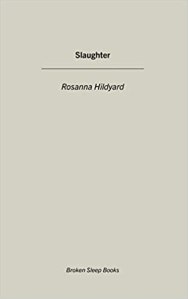 A debut trio of raw stories set in the Yorkshire countryside. In “Offcomers,” the 2001 foot and mouth disease outbreak threatens the happiness of a sheep-farming couple. The effects of rural isolation on a relationship resurface in “Outside Are the Dogs.” In “Cull Yaw,” a vegetarian gets involved with a butcher who’s keen on marketing mutton and ends up helping him with a grisly project. This was the stand-out for me. I appreciated the clear-eyed look at where food comes from. At the same time, narrator Star’s mother is ailing: a reminder that decay is inevitable and we are all naught but flesh and blood. I liked the prose well enough, but found the characterization a bit thin. One for readers of Andrew Michael Hurley and Cynan Jones. (See also Annabel’s review.)
A favourite passage:
“his mother silently spoons out second helpings of beef lasagne. Outside, the lasagne’s sisters cavort in the paddock.”
This story pamphlet was released by Broken Sleep Books, an indie publisher in Wales, in March. My thanks to Annabel for passing on her review copy.
This Hostel Life by Melatu Uche Okorie (2018)
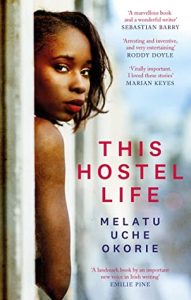 Okorie emigrated from Nigeria to Ireland in 2005. Her time living in a direct provision hostel for asylum seekers informed the title story about women queuing for and squabbling over food rations, written in an African pidgin. In “Under the Awning,” a Black woman fictionalizes her experiences of racism into a second-person short story her classmates deem too bleak. The Author’s Note reveals that Okorie based this one on comments she herself got in a writers’ group. “The Egg Broke” returns to Nigeria and its old superstition about twins.
Fans of Chimamanda Ngozi Adichie will find a similar voice here, and enough variety to distract from the low page count (the book is padded out with an essay on refugees in Ireland) and so-so writing. (Little Free Library)
Dear George and Other Stories by Helen Simpson (1995)
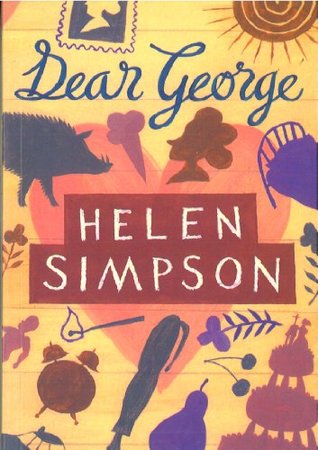 This is the third time Simpson has made it into one of my September features (after Four Bare Legs in a Bed in 2018 and In the Driver’s Seat in 2019); safe to say she’s becoming one of my favourite short story writers. Deciding to have children (or not) looms large. In “When in Rome,” Geraldine is relieved to get her period as her relationship limps to an end. In “Last Orders,” the heavily pregnant protagonist, now 12 days overdue, fears the transformation ahead of her. “To Her Unready Boyfriend,” echoing Andrew Marvell’s “To His Coy Mistress,” has the narrator warn him time runs short for babymaking.
I also liked “Bed and Breakfast,” about a young couple hoping not to turn into their boring parents; “Caput Apri” and its magical twist on the story behind “The Boar’s Head Carol” (a Christmas story or two is a trademark of Simpson’s collections, like the focus on motherhood); and “Heavy Weather,” in which parents of two small children have a manic Dorset holiday that takes in some beloved sites like Hardy’s cottage and marvel at the simultaneous joys and tyranny of childrearing.
The gentle absurdity of “The Immaculate Bridegroom” reminded me of a previous Simpson story in which a woman marries herself, and “Creative Writing” connects back to two of the other collections I’ve featured here with its writers’ workshop setting. (Secondhand purchase from Oxfam Books, Hexham)
Some favourite lines:
“You will not be you any more, her ego told her id. Not only will you have produced somebody else from inside you, someone quite different and separate, but you yourself will change into somebody quite different, overnight – a Mother.”
“Children were petal-skinned ogres, Frances realized, callous and whimsical, holding autocratic sway over lower, larger vassals like herself.”
Are you a short story fan? Read any good ones recently?
Bookbarn Book Haul & More
 We’re back from our weekend in Bristol and Exeter to hang out with university friends and attend our goddaughter’s dedication service. On the way (ish) down, we stopped at Bookbarn International, one of my favorite places to look for secondhand books. The shop is always coming up with new ideas and ventures – a rare books room, a café, stationery and store-brand merchandise, new stock alongside the used books, and so on – and has recently been doing some renovating of the main shop space. I contributed to a crowdfunder for this and got to pick up my rewards while I was there, including the items at right and a £10 store voucher, which, along with the small balance of my vendor account, more than covered my purchases that day.
We arrived around noon so started with a café lunch of all-day veggie cooked breakfasts plus cakes and coffee. Delicious! Then it was time for some dedicated browsing. All of the books on the main shop floor are £1 each; they’re working on restocking this area after the refurbishment. I found 12 books here, and ordered another two (the Janet Frame biography and Gail Godwin’s nonfiction book Heart) from the warehouse for £2 each.

From my book haul, I’m particularly pleased with:
- The sequel to another Robertson Davies novel I own
- The Frame biography – I loved her three-part autobiography and have also been dipping into her fiction; it will be fascinating to learn the ‘truth’ behind how she presented her life in memoir and autofiction. This copy looks to be in new condition, too.
- The Tulip by Anna Pavord, which I’ve long meant to read
- Another Carolyn Parkhurst novel – I loved The Dogs of Babel and Harmony
- Another Wendy Perriam novel – I read my first last year and have been hoping to find more
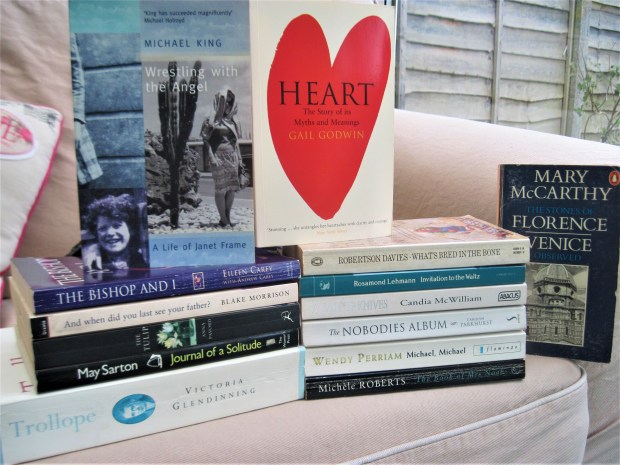
I also bought copies of two of my favorite memoirs, And When Did You Last See Your Father? and Journal of a Solitude (though I own a copy in America, I’d like it to be part of my rereading project this year). I now own two unread novels each by Candia McWilliam and Michèle Roberts and three by Rose Tremain, so I’ll need to be sure I read one from each author this year. I also have a bad habit of hoarding biographies but not reading them, so I want to at least read the Frame one before the year is out.
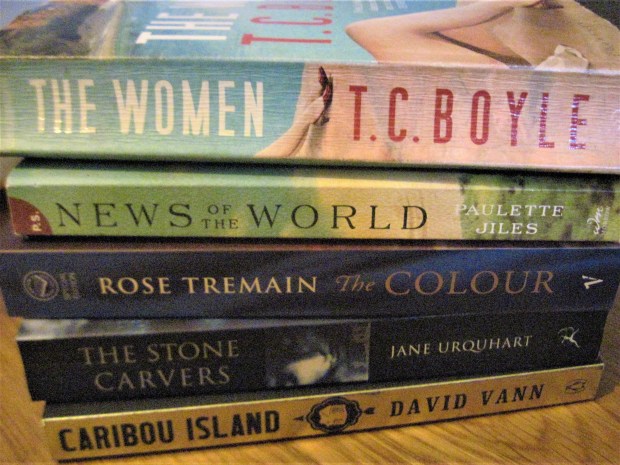
Between Bristol’s charity shops and Book-Cycle in Exeter, I bought another five novels during the weekend, including the Vann to reread and several by authors I want to increase my familiarity with. (Smug points for not buying the £2.50 copy of Boyle’s The Women at Bookbarn and then finding it at Book Cycle for 50 pence instead.) Total weekend spend on 19 books: £2.12.
 Bookish Beck = Rebecca Foster. American transplant to England. Freelance proofreader and book reviewer.
 Bookish Beck