#MARM2024: Life before Man and Interlunar by Margaret Atwood
Hard to believe, but it’s my seventh year participating in the annual Margaret Atwood Reading Month (#MARM) hosted by indomitable Canadian blogger Marcie of Buried in Print. In previous years, I’ve read Surfacing and The Edible Woman, The Robber Bride and Moral Disorder, Wilderness Tips, The Door, and Bodily Harm and Stone Mattress; and reread The Blind Assassin. I’m wishing a happy belated birthday to Atwood, who turned 85 earlier this month. Novembers are my excuse to catch up on her extensive back catalogue. In recent years, I’ve scoured the university library holdings to find works by her that I often had never heard of, as was the case with this early novel and mid-career poetry collection.
Life before Man (1979)
 Atwood’s fourth novel is from three rotating third-person POVs: Toronto museum curator Elizabeth, her toy-making husband Nate, and Lesje (pronounced “Lashia,” according to a note at the front), Elizabeth’s paleontologist colleague. The dated chapters span nearly two years, October 1976 to August 1978; often we visit with two or three protagonists on the same day. Elizabeth and Nate, parents to two daughters, have each had a string of lovers. Elizabeth’s most recent, Chris, has died by suicide. Nate disposes of his latest mistress, Martha, and replaces her with Lesje, who is initially confused by his interest in her. She’s more attracted to rocks and dinosaurs than to people, in a way that could be interpreted as consistent with neurodivergence.
It was neat to follow along seasonally with Halloween and Remembrance Day and so on, and see the Quebec independence movement simmering away in the background. To start with, I was engrossed in the characters’ perspectives and taken with Atwood’s witty descriptions and dialogue: “[Nate]’s heard Unitarianism called a featherbed for falling Christians” and (Lesje:) “Elizabeth needs support like a nun needs tits.” My favourite passage encapsulates a previous relationship of Lesje’s perfectly, in just the sort of no-nonsense language she would use:
The geologist had been fine; they could compromise on rock strata. They went on hikes with their little picks and kits, and chipped samples off cliffs; then they ate jelly sandwiches and copulated in a friendly way behind clumps of goldenrod and thistles. She found this pleasurable but not extremely so. She still has a collection of rock chips left over from this relationship; looking at it does not fill her with bitterness. He was a nice boy but she wasn’t in love with him.
Elizabeth’s formidable Auntie Muriel is a terrific secondary presence. But this really is just a novel about (repeated) adultery and its aftermath. The first line has Elizabeth thinking “I don’t know how I should live,” and after some complications, all three characters are trapped in a similar stasis by the end. By the halfway point I’d mostly lost interest and started skimming. The grief motif and museum setting weren’t the draws I’d expected them to be. Lesje is a promising character but, disappointingly, gets snared in clichéd circumstances. No doubt that is part of the point; “life before man” would have been better for her. (University library) 
This prophetic passage from Life before Man leads nicely into the themes of Interlunar:
The real question is: Does [Lesje] care whether the human race survives or not? She doesn’t know. The dinosaurs didn’t survive and it wasn’t the end of the world. In her bleaker moments, … she feels the human race has it coming. Nature will think up something else. Or not, as the case may be.
The posthuman prospect is echoed in Interlunar in the lines: “Which is the sound / the earth will make for itself / without us. A stone echoing a stone.”
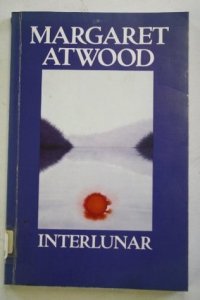
Interlunar (1984)
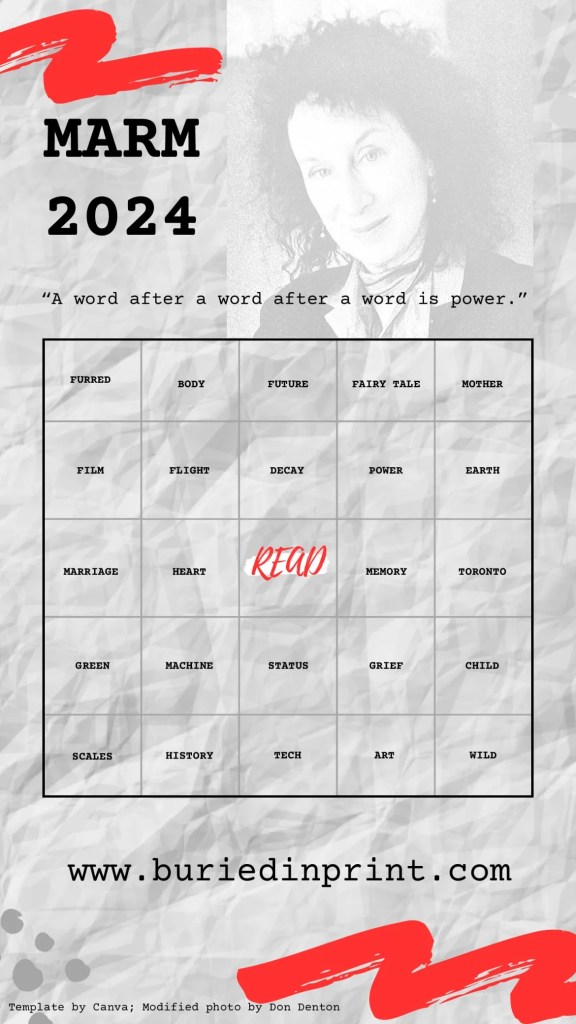
Some familiar Atwood elements in this volume, including death, mythology, nature, and stays at a lake house; you’ll even recognize a couple of her other works in poem titles “The Robber Bridegroom” and “The Burned House.” The opening set of “Snake Poems” got me the “green” and “scales” squares on Marcie’s Bingo card (in addition to various other scattered ones, I’m gonna say I’ve filled the whole right-hand column thanks to these two books).
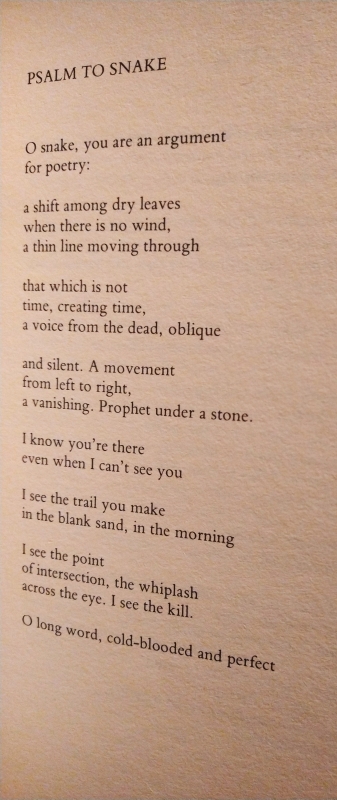
This one brilliantly likens the creature to the sinuous ways of language:
 “A Holiday” imagines a mother–daughter camping vacation presaging a postapocalyptic struggle for survival: “This could be where we / end up, learning the minimal / with maybe no tree, no rain, / no shelter, no roast carcasses / of animals to renew us … So far we do it / for fun.” As in her later collection The Door, portals and thresholds are of key importance. “Doorway” intones, “November is the month of entrance, / month of descent. Which has passed easily, / which has been lenient with me this year. / Nobody’s blood on the floor.” There are menace and melancholy here. But as “Orpheus (2)” suggests at its close, art can be an ongoing act of resistance: “To sing is either praise / or defiance. Praise is defiance.” I do recommend Atwood’s poetry if you haven’t tried it before, even if you’re not typically a poetry reader. Her poems are concrete and forceful, driven by imagery and voice; not as abstract as you might fear. Alas, I wasn’t sent a review copy of her collected poems, Paper Boat, as I’d hoped, but I will continue to enjoy encountering them piecemeal. (University library)
Carol Shields Prize Longlist Reading: The Future and Chrysalis
My first two dedicated reads for our informal Carol Shields Prize shadowing project exhibit one main way in which the prize is different from the Women’s Prize for Fiction: works in translation and short story collections are eligible. I have one of each to review today. Laura and I did a buddy read of an atmospheric dystopian novel translated from the French, and I caught up on a magical, erotic story collection I’d had on my Kindle for a long time. These were both very good, but my minor misgivings are such that I’d rate them the same: 
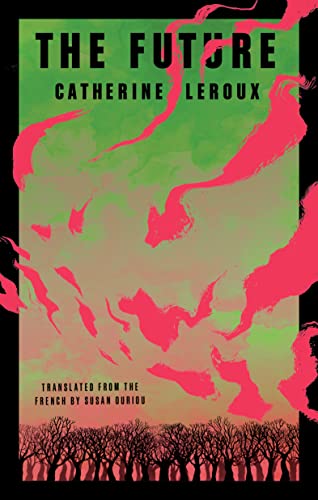
The Future by Catherine Leroux (2020; 2023)
[Translated from the French by Susan Ouriou]
For such a monolithic title, this has a limited stage: a few derelict districts of the ailing city we know as Detroit, Michigan – but in Leroux’s alternate version, it remained part of French Canada, with lingering Indigenous influence, and so is known as Fort Détroit. No doubt she was inspired by the many vacant properties that characterized Detroit in the 2010s; there’s even a ruins tour bus. In her Fort Détroit, a handful of determined adults cling on in their own homes, but the streets and parks have been abandoned to animals and to a gang of half-feral children who have developed their own nicknames (Adidas, Lego, Wolfpup), social hierarchy and vernacular. Worlds meet when Gloria determines to find her granddaughters Cassandra and Mathilda, who ran away after their addict mother Judith’s suspicious death. At the same time, her neighbour Eunice wants to find out who ran her father down in the street.
 Despite their fierce independence and acts of protest, the novel’s children still rely on the adult world. Ecosystems are awry and the river is toxic, but Gloria’s friend Solomon, a former jazz pianist, still manages to grow crops. He overlooks the children’s thefts from his greenhouse and eventually offers to help them grow their own food supply, and other adults volunteer to prepare a proper winter shelter to replace their shantytown. Puberty threatens their society, too: we learn that Fiji, the leader, has been binding her breasts to hide her age.
I expected to be reminded strongly of Station Eleven, and while there were elements that were reminiscent of Emily St John Mandel’s work, Leroux’s is a more consciously literary approach. The present-tense omniscient narration occupies many perspectives, including that of a dog, and the descriptions and musings are more lyrical than literal. Where another author would site high drama – sixtysomething Gloria’s night quest, a few children rafting down the river – Leroux moves on swiftly to other character interactions. What did bring Mandel to mind was the importance of art during societal collapse: the children spin nursery rhyme mash-ups and fairytales, Stutt rescues a makeshift library and insists on Huckleberry Finn going along on the river journey, and Solomon plays the piano again after decades.
The opening mysteries of death and disappearance are resolved before the end, but don’t seem to have been the point. The Future is more subtle and slippery than many dystopian novels I’ve read in that there’s not really a warning, or a message here. Instead, there’s an intriguing situation that opens out and alters slightly, but avoids resolution. It’s all about atmosphere and language – I was especially impressed by Ouriou’s rendering of Leroux’s made-up dialect via folksy slang (“She figgers she’s growed-up”). I loved the details and one-on-one moments more than the momentous scenes. On the whole, I found the story elegant but somewhat frustrating. You might be drawn to it if you enjoyed To Paradise or the MaddAddam books. (Read via Edelweiss; published by Biblioasis)
See also Laura’s review.
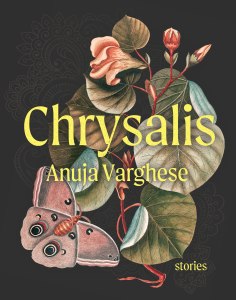
Chrysalis: Stories by Anuja Varghese (2023)
This debut collection of 15 stories brims with magic and horror, and teems with women of colour and queer people. Indeed, Varghese dedicates the book to “all the girls and women who don’t see themselves in most stories.” Most of the characters are of South Asian extraction. Adoption recurs in a couple of places. Two of the rarer realist stories, “Milk” and “Stories in the Language of the Fist,” have protagonists dealing with schoolgirl bullying and workplace microaggressions. More often, there are unexplained phenomena that position the players between life and death. “In the Bone Fields” focuses on the twin daughters of an Indian immigrant family on a Canadian farm. The house and the bone field behind are active and hungry, and only one twin will survive. (I got mild North Woods vibes.)
 In the title story, Radhika visits her mother’s grave and wonders whether her life is here in Montreal with her lover or back in Toronto with her husband. Fangs and wings symbolize her desire for independence. Elsewhere, watery metaphors alternately evoke fear of drowning or sexual fluidity. “Midnight at the Oasis” charts the transformation of a trans woman and “Cherry Blossom Fever,” one of my two favourites, bounces between several POVs. Marjan is in love with Talia, but she’s married to Sunil, who’s also in love with Silas. “People do it — open their relationships and negotiate rules and write themselves into polyamorous fairy tales … Other people. Not brown people,” Talia sighs. They are better off, at least, than they would be back in India, where homophobia can be deadly (“The Vetala’s Song”).
My other favourite was “Bhupati,” about a man who sets up multiple Lakshmi figures in the backyard, hoping devotion will earn him and his wife a better future. The statues keep being burned up by lightning; we learn his wife may be petitioning for different things. “Chitra” is a straightforward Cinderella retelling whose title character lives with two mean stepsisters and works in food service at the mall. A Shoe Chateau BOGO closing sale gives her the chance to get a bargain – and catch the manager’s eye. Despite a striking ending signalled by the story’s subtitle, all I could conclude about this one was “cute.” The three flash horror stories (a murder hotel, ghosts in a basement, werewolves) were much the weakest for me.
There’s a pretty even split of third- and first-person stories (nine versus six) here, and the genre shifts frequently. The quality wasn’t as consistent as I’d hoped, but it was an engaging read. The overall blend of feminism and horror had me thinking of Her Body and Other Parties by Carmen Maria Machado, but I’d be most likely to recommend this to fans of Julia Armfield, Violet Kupersmith and Vauhini Vara. (Read via Edelweiss; published by House of Anansi Press)
Both of these are worthwhile books and it’s great that readers outside of Canada can discover them. I wouldn’t personally shortlist either, but the judges may well be dazzled enough to do so. I don’t yet have a sense of where they’d fit for me in the rankings.
Up next:
Cocktail by Lisa Alward (short story collection from Edelweiss)
A Council of Dolls by Mona Susan Power (buddy read with Laura)
Land of Milk and Honey by C Pam Zhang (from library)

I’m aiming for one or two more batches of reviews before the shortlist is announced on 9 April.
20 Books of Summer, 17–20: Bennett, Davidson, Diffenbaugh, Kimmerer
As per usual, I’m squeezing in my final 20 Books of Summer reviews late on the very last day of the challenge. I’ll call it a throwback to the all-star procrastination of my high school and college years. This was a strong quartet to finish on: two novels, the one about (felling) trees and the other about communicating via flowers; and two nonfiction books about identifying trees and finding harmony with nature.
Tree-Spotting: A Simple Guide to Britain’s Trees by Ros Bennett; illus. Nell Bennett (2022)
Botanist Ros Bennett has designed this as a user-friendly guide that can be taken into the field to identify 52 of Britain’s most common trees. Most of these are native species, plus a few naturalized ones. “Walks in the countryside … take on a new dimension when you find yourself on familiar, first-name terms with the trees around you,” she encourages. She introduces tree families, basics of plant anatomy and chemistry, and the history of the country’s forests before moving into identification. Summer leaves make ID relatively easy with a three-step set of keys, explained in words as well as with impressively detailed black-and-white illustrations of representative species’ leaves (by her daughter, Nell Bennett).

Seasonality makes things trickier: “Identifying plants is not rocket science, though occasionally it does require lots of patience and a good hand lens. Identifying trees in winter is one of those occasions.” This involves a close look at details of the twigs and buds – a challenge I’ll be excited to take up on canalside walks later this year. The third section of the book gives individual profiles of each featured species, with additional drawings. I learned things I never realized I didn’t know (like how to pronounce family names, e.g., Rosaceae is “Rose-A-C”), and formalized other knowledge. For instance, I can recognize an ash tree by sight, but now I know you identify an ash by its 9–13 compound, opposite, serrated leaflets.

Some of the information was more academic than I needed (as with one of my earlier summer reads, The Ash Tree by Oliver Rackham), but it’s easy to skip any sections that don’t feel vital and come back to them another time. I most valued the approachable keys and their accompanying text, and will enjoy taking this compact naked hardback on autumn excursions. Bennett never dumbs anything down, and invites readers to delight in discovery. “So – go out, introduce yourself to your neighbouring trees and wonder at their beauty, ingenuity and variety.” 
With thanks to publicist Claire Morrison and Welbeck for the free copy for review.
Damnation Spring by Ash Davidson (2021)
When this would-be Great American Novel* arrived unsolicited through my letterbox last summer, I was surprised I’d not encountered the pre-publication buzz. The cover blurb is from Nickolas Butler, which gives you a pretty good sense of what you’re getting into: a gritty, working-class story set in what threatens to be an overwhelmingly male milieu. For generations, Rich Gundersen’s family has been involved in logging California’s redwoods. Davidson is from Arcata, California, and clearly did a lot of research to recreate an insider perspective and a late 1970s setting. There is some specialist vocabulary and slang (the loggers call the largest trees “big pumpkins”), but it’s easy enough to understand in context.
 What saves the novel from going too niche is the double billing of Rich and his wife, Colleen, who is an informal community midwife and has been trying to get pregnant again almost ever since their son Chub’s birth. She’s had multiple miscarriages, and their family and acquaintances have experienced alarming rates of infant loss and severe birth defects. Conservationists, including an old high school friend of Colleen’s, are attempting to stop the felling of redwoods and the spraying of toxic herbicides.
A major element, then, is people gradually waking up to the damage chemicals are doing to their waterways and, thereby, their bodies. The problem, for me, was that I realized this much earlier than any of the characters, and it felt like Davidson laid it on too thick with the many examples of human and animal deaths and deformities. This made the book feel longer and less subtle than, e.g., The Overstory. I started it as a buddy read with Marcie (Buried in Print) 11 months ago and quickly bailed, trying several more times to get back into the book before finally resorting to skimming to the end. Still, especially for a debut author, Davidson’s writing chops are impressive; I’ll look out for what she does next. 
*I just spotted that it’s been shortlisted for the $25,000 Mark Twain American Voice in Literature Award.
With thanks to Tinder Press for the proof copy for review.
The Language of Flowers by Vanessa Diffenbaugh (2011)
The cycle would continue. Promises and failures, mothers and daughters, indefinitely.
 The various covers make this look more like chick lit than it is. Basically, it’s solidly readable issues- and character-driven literary fiction, on the lighter side but of the caliber of any Oprah’s Book Club selection. It reminded me most of White Oleander by Janet Fitch, one of my 20 Books selections in 2018, because of the focus on the foster care system and a rebellious girl’s development in California, and the floral metaphors.
In Diffenbaugh’s debut, Victoria Jones ages out of foster care at 18 and leaves her group home for an uncertain future. She spends time homeless in San Francisco but her love of flowers, and particularly the Victorian meanings assigned to them, lands her work in a florist’s shop and reconnects her with figures from her past. Chapters alternate between her present day and the time she came closest to being adopted – by Elizabeth, who owned a vineyard and loved flowers, when she was nine. We see how estrangements and worries over adequate mothering recur, with Victoria almost a proto-‘Disaster Woman’ who keeps sabotaging herself. Throughout, flowers broker reconciliations.
I won’t say more about a plot that would be easy to spoil, but this was a delight and reminded me of a mini flower dictionary with a lilac cover and elaborate cursive script that I owned when I was a child. I loved the thought that flowers might have secret messages, as they do for the characters here. Whatever happened to that book?! (Charity shop)
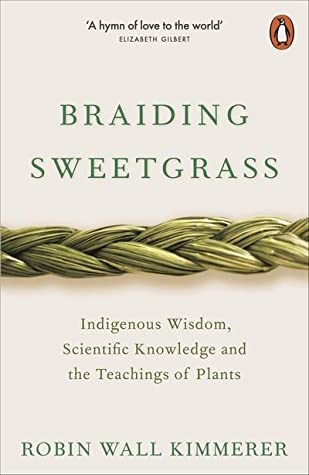
Braiding Sweetgrass: Indigenous Wisdom, Scientific Knowledge and the Teachings of Plants by Robin Wall Kimmerer (2013)
I’d heard Kimmerer recommended by just about every nature writer around, North American or British, and knew I needed this on my shelf. Before I ever managed to read it, I saw her interviewed over Zoom by Lucy Jones in July 2021 about her other popular science book, Gathering Moss, which was first published 18 years ago but only made it to the UK last year. So I knew what a kind and peaceful person she is: she just emanates warmth and wisdom, even over a computer screen.
And I did love Braiding Sweetgrass nearly as much as I expected to, with the caveat that the tiny-print 400 pages of my paperback edition make the essays feel very dense. I could only read a handful of pages in a sitting. Also, after about halfway, it started to feel a bit much, like maybe she had given enough examples from her life, Native American legend and botany. The same points about gratitude for the gifts of the Earth, kinship with other creatures, responsibility and reciprocity are made over and over.
 However, I feel like this is the spirituality the planet needs now, so I’ll excuse any repetition (and the basket-weaving essay I thought would never end). “In a world of scarcity, interconnection and mutual aid become critical for survival. So say the lichens.” (She’s funny, too, so you don’t have to worry about the contents getting worthy.) She effectively wields the myth of the Windigo as a metaphor for human greed, essential to a capitalist economy based on “emptiness” and “unmet desires.”
I most enjoyed the shorter essays that draw on her fieldwork or her experience of motherhood. “The Gift of Strawberries” – “An Offering” – “Asters and Goldenrod” make a stellar three-in-a-row, and “Collateral Damage” is an excellent later one about rescuing salamanders from the road, i.e. doing the small thing that we can do rather than being overwhelmed by the big picture of nature in crisis. “The Sound of Silverbells” is one of the most well-crafted individual pieces, about taking a group of students camping when she lived in the South. At first their religiosity (creationism and so on) grated, but when she heard them sing “Amazing Grace” she knew that they sensed the holiness of the Great Smoky Mountains.
But the pair I’d recommend most highly, the essays that made me weep, are “A Mother’s Work,” about her time restoring an algae-choked pond at her home in upstate New York, and its follow-up, “The Consolation of Water Lilies,” about finding herself with an empty nest. Her loving attention to the time-consuming task of bringing the pond back to life is in parallel to the challenges of single parenting, with a vision of the passing of time being something good rather than something to resist.
Here are just a few of the many profound lines:
For all of us, becoming indigenous to a place means living as if your children’s future mattered, to take care of the land as if our lives, both material and spiritual, depended on it.
I’m a plant scientist and I want to be clear, but I am also a poet and the world speaks to me in metaphor.
Ponds grow old, and though I will too, I like the ecological idea of aging as progressive enrichment, rather than progressive loss.
This will be a book to return to time and again. (Gift from my wish list several years ago)
I also had one DNF from this summer’s list:
Human Croquet by Kate Atkinson: This reminded me of a cross between The Crow Road by Iain Banks and The Heavens by Sandra Newman, what with the teenage narrator and a vague time travel plot with some Shakespearean references. I put it on the pile for this challenge because I’d read it had a forest setting. I haven’t had much luck with Atkinson in the past and this didn’t keep me reading past page 60. (Little Free Library)
A Look Back at My 20 Books of Summer 2022
Half of my reads are pictured here. The rest were e-books (represented by the Kindle) or have already had to go back to the library.

My fiction standout was The Language of Flowers, reviewed above. Nonfiction highlights included Forget Me Not and Braiding Sweetgrass, with Tree-Spotting the single most useful book overall. I also enjoyed reading a couple of my selections on location in the Outer Hebrides. The hands-down loser (my only 1-star rating of the year so far, I think?) was Bonsai. As always, there are many books I could have included and wished I’d found the time for, like (on my Kindle) A House among the Trees by Julia Glass, This Is Your Mind on Plants by Michael Pollan and Finding the Mother Tree by Suzanne Simard.
At the start, I was really excited about my flora theme and had lots of tempting options lined up, some of them literally about trees/flowers and others more tangentially related. As the summer went on, though, I wasn’t seeing enough progress so scrambled to substitute in other things I was reading from the library or for paid reviews. This isn’t a problem, per se, but my aim with this challenge has generally been to clear TBR reads from my own shelves. Maybe I didn’t come up with enough short and light options (just two novella-length works and a poetry collection; only the Diffenbaugh was what I’d call a page-turner); also, even with the variety I’d built in, having a few plant quest memoirs got a bit samey.

Next year…
I’m going to skip having a theme and set myself just one simple rule: any 20 print books from my shelves (NOT review copies). There will then be plenty of freedom to choose and substitute as I go along.
Recommended April Releases by Amy Bloom, Sarah Manguso & Sara Rauch
Just two weeks until moving day – we’ve got a long weekend ahead of us of sanding, painting, packing and gardening. As busy as I am with house stuff, I’m endeavouring to keep up with the new releases publishers have been so good as to send me. Today I review three short works: the story of accompanying a beloved husband to Switzerland for an assisted suicide, a coolly perceptive novella of American girlhood, and a vivid memoir of two momentous relationships. (April was a big month for new books: I have another 6–8 on the go that I’ll be catching up on in the future.) All:
In Love: A Memoir of Love and Loss by Amy Bloom
“We’re not here for a long time, we’re here for a good time.”
(Ameche family saying)
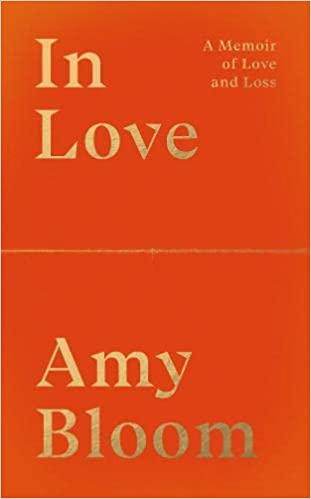
Given the psychological astuteness of her fiction, it’s no surprise that Bloom is a practicing psychotherapist. She treats her own life with the same compassionate understanding, and even though the main events covered in this brilliantly understated memoir only occurred two and a bit years ago, she has remarkable perspective and avoids self-pity and mawkishness. Her husband, Brian Ameche, was diagnosed with early-onset Alzheimer’s in his mid-60s, having exhibited mild cognitive impairment for several years. Brian quickly resolved to make a dignified exit while he still, mostly, had his faculties. But he needed Bloom’s help.
“I worry, sometimes, that a better wife, certainly a different wife, would have said no, would have insisted on keeping her husband in this world until his body gave out. It seems to me that I’m doing the right thing, in supporting Brian in his decision, but it would feel better and easier if he could make all the arrangements himself and I could just be a dutiful duckling, following in his wake. Of course, if he could make all the arrangements himself, he wouldn’t have Alzheimer’s”
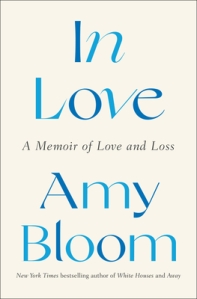
U.S. cover
She achieves the perfect tone, mixing black humour with teeth-gritted practicality. Research into acquiring sodium pentobarbital via doctor friends soon hit a dead end and they settled instead on flying to Switzerland for an assisted suicide through Dignitas – a proven but bureaucracy-ridden and expensive method. The first quarter of the book is a day-by-day diary of their January 2020 trip to Zurich as they perform the farce of a couple on vacation. A long central section surveys their relationship – a second chance for both of them in midlife – and how Brian, a strapping Yale sportsman and accomplished architect, gradually descended into confusion and dependence. The assisted suicide itself, and the aftermath as she returns to the USA and organizes a memorial service, fill a matter-of-fact 20 pages towards the close.
Hard as parts of this are to read, there are so many lovely moments of kindness (the letter her psychotherapist writes about Brian’s condition to clinch their place at Dignitas!) and laughter, despite it all (Brian’s endless fishing stories!). While Bloom doesn’t spare herself here, diligently documenting times when she was impatient and petty, she doesn’t come across as impossibly brave or stoic. She was just doing what she felt she had to, to show her love for Brian, and weeping all the way. An essential, compelling read.
With thanks to Granta for the free copy for review.
Very Cold People by Sarah Manguso
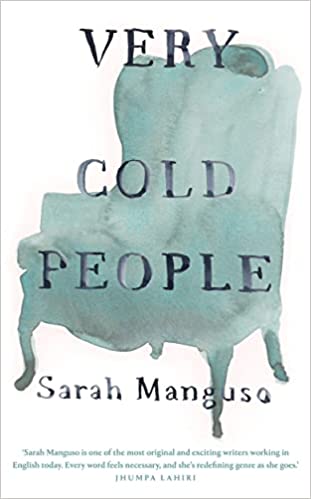
I’ve read Manguso’s four nonfiction works and especially love her Wellcome Book Prize-shortlisted medical memoir The Two Kinds of Decay. The aphoristic style she developed in her two previous books continues here as discrete paragraphs and brief vignettes build to a gloomy portrait of Ruthie’s archetypical affection-starved childhood in the fictional Massachusetts town of Waitsfield in the 1980s and 90s. She’s an only child whose parents no doubt were doing their best after emotionally stunted upbringings but never managed to make her feel unconditionally loved. Praise is always qualified and stingily administered. Ruthie feels like a burden and escapes into her imaginings of how local Brahmins – Cabots and Emersons and Lowells – lived. Her family is cash-poor compared to their neighbours and loves nothing more than a trip to the dump: “My parents weren’t after shiny things or even beautiful things; they simply liked getting things that stupid people threw away.”
The depiction of Ruthie’s narcissistic mother is especially acute. She has to make everything about her; any minor success of her daughter’s is a blow to her own ego. I marked out an excruciating passage that made me feel so sorry for this character. A European friend of the family visits and Ruthie’s mother serves corn muffins that he seems to appreciate.
My mother brought up her triumph for years. … She’d believed his praise was genuine. She hadn’t noticed that he’d pegged her as a person who would snatch up any compliment into the maw of her unloved, throbbing little heart.
U.S. cover
At school, as in her home life, Ruthie dissociates herself from every potentially traumatic situation. “My life felt unreal and I felt half-invested. I felt indistinct, like someone else’s dream.” Her friend circle is an abbreviated A–Z of girlhood: Amber, Bee, Charlie and Colleen. “Odd” men – meaning sexual predators – seem to be everywhere and these adolescent girls are horribly vulnerable. Molestation is such an open secret in the world of the novel that Ruthie assumes this is why her mother is the way she is.
While the #MeToo theme didn’t resonate with me personally, so much else did. Chemistry class, sleepovers, getting one’s first period, falling off a bike: this is the stuff of girlhood – if not universally, then certainly for the (largely pre-tech) American 1990s as I experienced them. I found myself inhabiting memories I hadn’t revisited for years, and a thought came that had perhaps never occurred to me before: for our time and area, my family was poor, too. I’m grateful for my ignorance: what scarred Ruthie passed me by; I was a purely happy child. But I think my sister, born seven years earlier, suffered more, in ways that she’d recognize here. This has something of the flavour of Eileen and My Name Is Lucy Barton and reads like autofiction even though it’s not presented as such. The style and contents may well be divisive. I’ll be curious to hear if other readers see themselves in its sketches of childhood.
With thanks to Picador for the proof copy for review.
XO by Sara Rauch
Sara Rauch won the Electric Book Award for her short story collection What Shines from It. This compact autobiographical parcel focuses on a point in her early thirties when she lived with a long-time female partner, “Piper”, and had an intense affair with “Liam”, a fellow writer she met at a residency.
“no one sets out in search of buried treasure when they’re content with life as it is”
“Longing isn’t cheating (of this I was certain), even when it brushes its whiskers against your cheek.”
 Adultery is among the most ancient human stories we have, a fact Rauch acknowledges by braiding through the narrative her musings on religion and storytelling by way of her Catholic upbringing and interest in myths and fairy tales. She’s looking for the patterns of her own experience and how endings make way for new life. The title has multiple meanings: embraces, crossroads and coming full circle. Like a spider’s web, her narrative pulls in many threads to make an ordered whole. All through, bisexuality is a baseline, not something that needs to be interrogated.
This reminded me of a number of books I’ve read about short-lived affairs – Tides, The Instant – and about renegotiating relationships in a queer life – The Fixed Stars, In the Dream House – but felt most like reading a May Sarton journal for how intimately it recreates daily routines of writing, cooking, caring for cats, and weighing up past, present and future. Lovely stuff.
With thanks to publicist Lori Hettler and Autofocus Books for the e-copy for review.
Will you seek out one or more of these books?
What other April releases can you recommend?
Reading Ireland Month 2019: Jess Kidd and Jane Urquhart
Last month I picked out this exchange from East of Eden by John Steinbeck:
“But the Irish are said to be a happy people, full of jokes.”
“They’re not. They’re a dark people with a gift for suffering way past their deserving. It’s said that without whisky to soak and soften the world, they’d kill themselves. But they tell jokes because it’s expected of them.”
There’s something about that mixture of darkness and humor, isn’t there? I also find that Irish art (music as well as literature) has a lot of heart. I only read two Ireland-related historical novels this month, but they both have that soulful blend of light and somber. Both:
Things in Jars by Jess Kidd (2019)
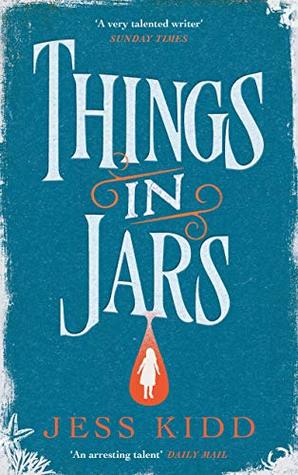
In the autumn of 1863 Bridie Devine, female detective extraordinaire, is tasked with finding the six-year-old daughter of a baronet. Problem is, this missing girl is no ordinary child, and collectors of medical curiosities and circus masters alike are interested in acquiring her.
In its early chapters this delightful Victorian pastiche reminded me of a cross between Sarah Waters’s Fingersmith and Neil Gaiman’s The Graveyard Book, and that comparison played out pretty well in the remainder. Kidd paints a convincingly gritty picture of Dickensian London, focusing on an underworld of criminals and circus freaks: when Bridie first arrived in London from Dublin, she worked as an assistant to a resurrectionist; her maid is a 7-foot-tall bearded lady; and her would-be love interest, if only death didn’t separate them, is the ghost of a heavily tattooed boxer.
Medicine (surgery – before and after anesthesia) and mythology (mermaids and selkies) are intriguing subplots woven through, such that this is likely to appeal to fans of The Way of All Flesh and The Mermaid and Mrs Hancock. Kidd’s prose is spry and amusing, particularly in her compact descriptions of people (but also in her more expansive musings on the dirty, bustling city): “a joyless string of a woman, thin and pristine with a halibut pout,” “In Dr Prudhoe’s countenance, refinement meets rogue,” and “People are no more than punctuation from above.”
I’ll definitely go back and read Kidd’s two previous novels, Himself and The Hoarder. I didn’t even realize she was Irish, so I’m grateful to Cathy for making me aware of that in her preview of upcoming Irish fiction. [Trigger warnings: violence against women and animals.] (Out from Canongate on April 4th.)
Away by Jane Urquhart (1993)
I was enraptured from the first line: “The women of this family leaned towards extremes” – starting with Mary, who falls in love with a sailor who washes up on the Irish coast in the 1840s amid the cabbages, silver teapots and whiskey barrels of a shipwreck and dies in her arms. Due to her continued communion with the dead man, people speak of her being “away with the fairies,” even after she marries the local schoolteacher, Brian O’Malley.
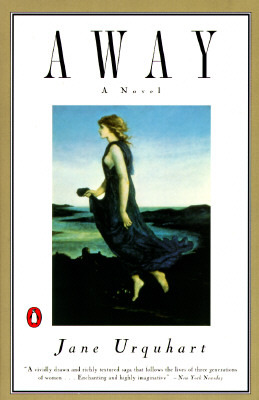 With their young son, Liam, they join the first wave of emigration to Canada during the Potato Famine, funded by their landlords, the Sedgewick brothers of Puffin Court (amateur naturalist Osbert and poet Granville). No sooner have the O’Malleys settled and had their second child, Eileen, than Mary disappears. As she grows, Eileen takes after her mother, mystically attuned to portents and prone to flightiness, while Liam is a happily rooted Great Lakes farmer. Like Mary, Eileen has her own forbidden romance, with a political revolutionary who dances like a dream.
I’ve been underwhelmed by other Urquhart novels, Sanctuary Line and The Whirlpool, but here she gets it just right, wrapping her unfailingly gorgeous language around an absorbing plot – which is what I felt was lacking in the others. The Ireland and Canada settings are equally strong, and the spirit of Ireland – the people, the stories, the folk music – is kept alive abroad. I recommend this to readers of historical fiction by Margaret Atwood, A.S. Byatt and Hannah Kent.
Some favorite lines:
Osbert says of Mary: “There’s this light in her, you see, and it must not be put out.”
“When summer was finished the family was visited by a series of overstated seasons. In September, they awakened after night frosts to a woods awash with floating gold leaves and a sky frantic with migrating birds – sometimes so great in number that they covered completely with their shadows the acre of light and air that Brian had managed to create.”
“There are five hundred and forty different kinds of weather out there, and I respect every one of them. White squalls, green fogs, black ice, and the dreaded yellow cyclone, just to mention a few.”
It’s my second time participating in Reading Ireland Month, run each March by Cathy of 746 Books and Niall of Raging Fluff.
 Bookish Beck = Rebecca Foster. American transplant to England. Freelance proofreader and book reviewer.
 Bookish Beck