Recommended May Releases: Adichie, Pavey and Unsworth
Three very different works of women’s life writing: heartfelt remarks on bereavement, a seasonal diary of stewarding four wooded acres in Somerset, and a look back at postnatal depression.
Notes on Grief by Chimamanda Ngozi Adichie
This slim hardback is an expanded version of an essay Adichie published in the New Yorker in the wake of her father’s death in June 2020. With her large family split across three continents and coronavirus lockdown precluding in-person get-togethers, they had a habit of frequent video calls. She had seen her father the day before on Zoom and knew he was feeling unwell and in need of rest, but the news of his death still came as a complete shock.
 Adichie anticipates all the unhelpful platitudes people could and did send her way: he lived to a ripe old age (he was 88), he had a full life and was well respected (he was Nigeria’s first statistics professor), he had a mercifully swift end (kidney failure). Her logical mind knows all of these facts, and her writer’s imagination has depicted grief many times. Still, this loss blindsided her.
She’d always been a daddy’s girl, but the anecdotes she tells confirm how special he was: wise and unassuming; a liberal Catholic suspicious of materialism and with a dry humour. I marvelled at one such story: in 2015 he was kidnapped and held in the boot of a car for three days, his captors demanding a ransom from his famous daughter. What did he do? Correct their pronunciation of her name, and contradict them when they said that clearly his children didn’t love him. “Grief has, as one of its many egregious components, the onset of doubt. No, I am not imagining it. Yes, my father truly was lovely.” With her love of fashion, one way she dealt with her grief was by designing T-shirts with her father’s initials and the Igbo words for “her father’s daughter” on them.
I’ve read many a full-length bereavement memoir, and one might think there’s nothing new to say, but Adichie writes with a novelist’s eye for telling details and individual personalities. She has rapidly become one of my favourite authors: I binged on most of her oeuvre last year and now have just one more to read, Purple Hibiscus, which will be one of my 20 Books of Summer. I love her richly evocative prose and compassionate outlook, no matter the subject. At £10, this 85-pager is pricey, but I was lucky to get it free with Waterstones loyalty points.
Favourite lines:
“In the face of this inferno that is sorrow, I am callow and unformed.”
“How is it that the world keeps going, breathing in and out unchanged, while in my soul there is a permanent scattering?”
Deeper Into the Wood by Ruth Pavey
 In 1999 Ruth Pavey bought four acres of scrubland at auction, happy to be returning to her family’s roots in the Somerset Levels and hoping to work alongside nature to restore some of her land to orchard and maintain the rest in good health. Her account of the first two decades of this ongoing project, A Wood of One’s Own, was published in 2017.
In this sequel, she gives peaceful snapshots of the wood throughout 2019, from first snowdrops to final apple pressing, but also faces up to the environmental degradation that is visible even in this pocket of the countryside. “I am sure there has been a falling off in numbers of insects, smaller birds and rabbits on my patch,” she insists. Without baseline data, it is hard to support this intuition, but she has botanical and bird surveys done, and invites an expert in to do a moth-trapping evening. The resulting species lists are included as appendices. In addition, Pavey weaves a backstory for her land. She meets a daffodil breeder, investigates the source of her groundwater, and visits the head gardener at the Bishop’s Palace in Wells, where her American black walnut sapling came from. She also researches the Sugg family, associated with the land (“Sugg’s Orchard” on the deed) from the 1720s.
 Pavey aims to treat this landscape holistically: using sheep to retain open areas instead of mowing the grass, and weighing up the benefits of the non-native species she has planted. She knows her efforts can only achieve so much; the pesticides standard to industrial-scale farming may still be reaching her trees on the wind, though she doesn’t apply them herself. “One sad aspect of worrying about the state of the natural world is that everything starts to look wrong,” she admits. Starting in that year’s abnormally warm January, it was easy for her to assume that the seasons can no longer be relied on.
Compared with her first memoir, this one is marked by its intellectual engagement with the principles and practicalities of rewilding. Clearly, her inner struggle is motivated less by the sense of ownership than by the call of stewardship. While this book is likely be of most interest to those with a local connection or a similar project underway, it offers a universal model of how to mitigate our environmental impact. Pavey’s black-and-white sketches of the flora and fauna on her patch, reminiscent of Quentin Blake, are a highlight.
With thanks to Duckworth for the proof copy for review. The book will be published tomorrow, the 27th of May.
After the Storm: Postnatal Depression and the Utter Weirdness of New Motherhood by Emma Jane Unsworth
The author’s son was born on the day Donald Trump won the U.S. presidential election. Six months later, she realized that she was deep into postnatal depression and finally agreed to get help. The breaking point came when, with her husband* away at a conference, she got frustrated with her son’s constant fussing and pushed him over on the bed. He was absolutely fine, but the guilty what-ifs proliferated, making this a wake-up call for her.
 In this succinct, wry and hard-hitting memoir, Unsworth exposes the conspiracies of silence that lead new mothers to lie and pretend that everything is fine. Since her son’s traumatic birth (which I first read about in Dodo Ink’s Trauma anthology), she hadn’t been able to write and was losing her sense of self. To add insult to injury, her baby had teeth at 16 weeks and bit her as he breastfed. She couldn’t even admit her struggles to her fellow mum friends. But “if a woman is in pain for long enough, and denied sleep for long enough, and at the same time feels as though she has to keep going and put a ‘brave’ face on, she’s going to crack.”
The book’s titled mini-essays give snapshots into the before and after, but particularly the agonizing middle of things. I especially liked the chapter “The Weirdest Thing I’ve Ever Done in a Hotel Room,” in which she writes about borrowing her American editor’s room to pump breastmilk. Therapy, antidepressants and hiring a baby nurse helped her to ease back into her old life and regain some part of the party girl persona she once exuded – enough so that she was willing to give it all another go (her daughter was born late last year).
While Unsworth mostly writes from experience, she also incorporates recent research and makes bold statements of how cultural norms need to change. “You are not monsters,” she writes to depressed mums. “You need more support. … Motherhood is seismic. It cracks open your life, your relationship, your identity, your body. It features the loss, grief and hardship of any big life change.” I can imagine this being hugely helpful to anyone going through PND (see also my Three on a Theme post on the topic), but I’m not a mother and still found plenty to appreciate (especially “We have to smash the dichotomy of mums/non-mums … being maternal has nothing to do with actually physically being a mother”).
I’m attending a Wellcome Collection online event with Unsworth and midwife Leah Hazard (author of Hard Pushed) this evening and look forward to hearing more from both authors.
*It took me no time at all to identify him from the bare facts: Brighton + doctor + graphic novelist = Ian Williams (author of The Lady Doctor)! I had no idea. What a fun connection.
With thanks to Profile Books/Wellcome Collection for the free copy for review.
What recent releases can you recommend?
The 2021 Dylan Thomas Prize Shortlist
The Swansea University International Dylan Thomas Prize recognizes the best published work in the English language written by an author aged 39 or under. All literary genres are eligible, so the longlist contained poetry collections as well as novels and short stories. Remaining on the shortlist are these six books (five novels and one short story collection; four of the works are debuts):
- Alligator and Other Stories by Dima Alzayat – Stories of the Syrian American experience.
- Kingdomtide by Rye Curtis – A novel about an elderly plane crash victim and the alcoholic park ranger who tries to find her. (See Annabel’s review.)
- The Death of Vivek Oji by Akwaeke Emezi – A coming-of-age story set in Nigeria.
- Pew by Catherine Lacey – A mysterious fable about a stranger showing up in a Southern town in the week before an annual ritual.
- Luster by Raven Leilani – A young Black woman and would-be painter negotiates a confusing romantic landscape and looks for meaning beyond dead-end jobs.
- My Dark Vanessa by Kate Elizabeth Russell – A nuanced look at the #MeToo phenomenon through the prism of one young woman’s relationship with her teacher.
It’s an American-dominated set this year, but, refreshingly, five of the six nominees are women or non-binary. I happen to have already read the last three of the novels on the list. I’m most keen to try Alligator and Other Stories and Kingdomtide and hope to still have a chance to read them. No review copies reached me in time, so today I’m giving an overview of the list.
This is never an easy prize to predict, but if I had to choose between the few that I’ve read, I would want Kate Elizabeth Russell to win for My Dark Vanessa.

(The remaining information in this post comes from the official Midas PR press release.)
The shortlist “was selected by a judging panel chaired by award-winning writer, publisher and co-director of the Jaipur Literature Festival Namita Gokhale, alongside founder and director of the Bradford Literature Festival Syima Aslam, poet Stephen Sexton, writer Joshua Ferris, and novelist and academic Francesca Rhydderch.
“This year’s winner will be revealed at a virtual ceremony on 13 May, the eve of International Dylan Thomas Day.”
Namita Gokhale, Chair of Judges, says: “We are thrilled to present this year’s extraordinary shortlist – it is truly a world-class writing showcase of the highest order from six exceptional young writers. I want to press each and every one of these bold, inventive and distinctive books into the hands of readers, and celebrate how they challenge preconceptions, ask new questions about how we define identity and our relationships, and how we live together in this world. Congratulations to these tremendously talented writers – they are master storytellers in every sense of the word.”
Francesca Rhydderch on Alligator and Other Stories by Dima Alzayat: “Dima Alzayat’s visceral, innovative Alligator & Other Stories marks the arrival of a major new talent. While the range of styles and stories is impressively broad, there is a unity of voice and tone here which must have been so very difficult to achieve, and a clear sense that all these disparate elements are part of an overriding, powerful examination of identity.”
Joshua Ferris on Kingdomtide by Rye Curtis: “Kingdomtide is a propulsively readable and frequently very funny book about the resources, personal and natural, necessary to survive a patently absurd world. The winning voice of Texas-native Cloris Waldrip artfully takes us through her eighty-eight-day ordeal in the wilds of Montana as the inimitable drunk and park ranger Debra Lewis searches for her. This fine novel combines the perfect modern yarn with something transcendent, lyrical and wise.”
Namita Gokhale on The Death of Vivek Oji by Akwaeke Emezi: “The Death of Vivek Oji by Akwaeke Emezi is a powerful novel that carries the authenticity of cultural and emotional context. The story unfolds brilliantly, with the prescient foreboding about Vivek Oji’s death already announced in the brief line that constitutes the opening chapter. Yet the suspense is paced and carefully maintained until the truth is finally communicated in the final chapter. A triumph of narrative craft.”


Francesca Rhydderch on Pew by Catherine Lacey: “In this brilliant novel Catherine Lacey shows herself to be completely unafraid as a writer, willing to tackle the uglier aspects of a fictional small town in America, where a stranger’s refusal to speak breeds paranoia and unease. Beautifully written, sharply observed, and sophisticated in its simplicity, Pew is a book I’m already thinking of as a modern classic.”
Syima Aslam on Luster by Raven Leilani: “Sharp and incisive, Luster speaks a fearless truth that takes no hostages. Leilani is unflinchingly observant about the realities of being a young, black woman in America today and revelatory when it comes to exploring unconventional family life and 21st-century adultery, in this darkly comic and strangely touching debut.”
Stephen Sexton on My Dark Vanessa by Kate Elizabeth Russell: “My Dark Vanessa is an articulate, uncompromising and compelling novel about abuse, its long trail of damage and its devastating iterations. In Vanessa, Russell introduces us to a character of immense complexity, whose rejection of victimhood—in favour of something more like love—is tragic and unforgettable. Timely, harrowing, of supreme emotional intelligence, My Dark Vanessa is the story of one girl; of many girls, and of the darknesses of Western literature.”
Some of My Most Anticipated Releases of 2021
Although 120+ books that will be published in 2021 are already on my radar, I’ve limited myself to the 20 I’m most excited about. The modest number is a cheat in that I’ve already read a couple of books from this period in advance (and I’m currently reading another two), and I haven’t listed any that I already own as proofs or finished copies (pictured here) or have been promised. With a couple of exceptions, these books are due out between January and June.
I’m also not counting these three forthcoming books that I’ve sponsored via Kickstarter (the Trauma anthology) or Unbound:


Two that I read as U.S. e-books but would recommend that UK-based readers look out for in 2021 are Memorial by Bryan Washington (Jan. 7, Atlantic) and Transcendent Kingdom by Yaa Gyasi (March 4, Penguin).


The following are in UK release date order, within sections by genre; the quoted descriptions are from the publisher blurbs on Goodreads. Much more fiction is catching my eye this time.
Fiction
 The Living Sea of Waking Dreams by Richard Flanagan [Jan. 14, Chatto & Windus / May 25, Knopf] “In a world of perennial fire and growing extinctions, Anna’s aged mother … increasingly escapes through her hospital window … When Anna’s finger vanishes and a few months later her knee disappears, Anna too feels the pull of the window. … A strangely beautiful novel about hope and love and orange-bellied parrots.” I’ve had mixed success with Flanagan, but the blurb draws me and I’ve read good early reviews so far. [Library hold]
 The Charmed Wife by Olga Grushin [Jan. 21, Hodder & Stoughton / Jan. 12, Putnam] “Cinderella married the man of her dreams – the perfect ending she deserved after diligently following all the fairy-tale rules. Yet now, two children and thirteen-and-a-half years later, things have gone badly wrong. One night, she sneaks out of the palace to get help from the Witch who, for a price, offers love potions to disgruntled housewives.” A feminist retelling. I loved Grushin’s previous novel, Forty Rooms. [Edelweiss download]
 The Prophets by Robert Jones Jr. [Jan. 21, Quercus / Jan. 5, G.P. Putnam’s Sons] “A singular and stunning debut novel about the forbidden union between two enslaved young men on a Deep South plantation, the refuge they find in each other, and a betrayal that threatens their existence.” Lots of hype about this one. I’m getting Days Without End vibes, and the mention of copious biblical references is a draw for me rather than a turn-off. The cover looks so much like the UK cover of The Vanishing Half! [Publisher request pending]
 Mrs Death Misses Death by Salena Godden [Jan. 28, Canongate] “Mrs Death has had enough. She is exhausted from spending eternity doing her job and now she seeks someone to unburden her conscience to. Wolf Willeford, a troubled young writer, is well acquainted with death, but until now hadn’t met Death in person – a black, working-class woman who shape-shifts and does her work unseen. Enthralled by her stories, Wolf becomes Mrs Death’s scribe, and begins to write her memoirs.” [NetGalley download / Library hold]
 No One Is Talking About This by Patricia Lockwood [Feb. 16, Bloomsbury / Riverhead] “A woman known for her viral social media posts travels the world speaking to her adoring fans … Suddenly, two texts from her mother pierce the fray … [and] the woman confronts a world that seems to contain both an abundance of proof that there is goodness, empathy and justice in the universe, and a deluge of evidence to the contrary.” Lockwood’s memoir, Priestdaddy, is an all-time favorite of mine. [NetGalley download / Publisher request pending]
 A Town Called Solace by Mary Lawson [Feb. 18, Chatto & Windus / Feb. 16, Knopf Canada] “It’s North Ontario in 1972, and seven-year-old Clara’s teenage sister Rose has just run away from home. At the same time, a strange man – Liam – drives up to the house next door, which he has just inherited from Mrs Orchard, a kindly old woman who was friendly to Clara … A beautiful portrait of a small town, a little girl and an exploration of childhood.” I’ve loved the two Lawson novels I’ve read. [Publisher request pending]
 Klara and the Sun by Kazuo Ishiguro [March 2, Faber & Faber / Knopf] Synopsis from Faber e-mail: “Klara and the Sun is the story of an ‘Artificial Friend’ who … is warned not to invest too much in the promises of humans. A luminous narrative about humanity, hope and the human heart.” I’m not an Ishiguro fan per se, but this looks set to be one of the biggest books of the year. I’m tempted to pre-order a signed copy as part of an early bird ticket to a Faber Members live-streamed event with him in early March.
 Hot Stew by Fiona Mozley [March 18, Hodder & Stoughton / April 20, Algonquin Books] “The Soho that Precious and Tabitha live and work in is barely recognizable anymore. … Billionaire-owner Agatha wants to kick the women out to build expensive restaurants and luxury flats. Men like Robert, who visit the brothel, will have to go elsewhere. … An insightful and ambitious novel about property, ownership, wealth and inheritance.” This sounds very different to Elmet, but I liked Mozley’s writing enough to give it a try.
 Libertie by Kaitlyn Greenidge [March 30, Algonquin Books; April 29, Serpent’s Tail] “Coming of age as a free-born Black girl in Reconstruction-era Brooklyn, Libertie Sampson” is expected to follow in her mother’s footsteps as a doctor. “When a young man from Haiti proposes, she accepts, only to discover that she is still subordinate to him and all men. … Inspired by the life of one of the first Black female doctors in the United States.” I loved Greenidge’s underappreciated debut, We Love You, Charlie Freeman. [Edelweiss download]
 An Ordinary Wonder by Buki Papillon [April 9, Dialogue Books] “Richly imagined with art, proverbs and folk tales, this moving and modern novel follows Oto through life at home and at boarding school in Nigeria, through the heartbreak of living as a boy despite their profound belief they are a girl, and through a hunger for freedom that only a new life in the United States can offer. … a powerful coming-of-age story that explores complex desires as well as challenges of family, identity, gender and culture, and what it means to feel whole.”
 Great Circle by Maggie Shipstead [May 4, Doubleday / Knopf] “In 1940s London, after a series of reckless romances and a spell flying to aid the war effort, Marian embarks on a treacherous, epic flight in search of the freedom she has always craved. She is never seen again. More than half a century later, Hadley Baxter, a troubled Hollywood starlet beset by scandal, is irresistibly drawn to play Marian Graves in her biopic.” I loved Seating Arrangements and have been waiting for a new Shipstead novel for seven years!
 The Anthill by Julianne Pachico [May 6, Faber & Faber; this has been out since May 2020 in the USA, but was pushed back a year in the UK] “Linda returns to Colombia after 20 years away. Sent to England after her mother’s death when she was eight, she’s searching for the person who can tell her what’s happened in the time that has passed. Matty – Lina’s childhood confidant, her best friend – now runs a refuge called The Anthill for the street kids of Medellín.” Pachico was our Young Writer of the Year shadow panel winner.
 Filthy Animals: Stories by Brandon Taylor [June 24, Daunt Books / June 21, Riverhead] “In the series of linked stories at the heart of Filthy Animals, set among young creatives in the American Midwest, a young man treads delicate emotional waters as he navigates a series of sexually fraught encounters with two dancers in an open relationship, forcing him to weigh his vulnerabilities against his loneliness.” Sounds like the perfect follow-up for those of us who loved his Booker-shortlisted debut novel, Real Life.
Saturday Night at the Lakeside Supper Club by J. Ryan Stradal [USA only? Pamela Dorman Books; no cover or exact date yet, just “Summer 2021”] “Combines the comedic pathos of John Irving with the brilliant generational storytelling of Jane Smiley and the wildly rich and quirky characters of fellow Minnesotan Anne Tyler … set on a lake in Northern Minnesota, about a beloved but dying family restaurant and whether it can be saved.” I was disappointed by Stradal’s latest, but love Kitchens of the Great Midwest enough to give him another try.
Matrix by Lauren Groff [Sept. 23, Cornerstone / Riverhead; no cover yet] “Cast out of the royal court by Eleanor of Aquitaine, … seventeen-year-old Marie de France is sent to England to be the new prioress of an impoverished abbey, its nuns on the brink of starvation and beset by disease. … a mesmerizing portrait of consuming passion, aberrant faith, and a woman that history moves both through and around.” Yuck to medieval history in general as a setting, but I love Groff’s work enough to get hold of this one anyway.
Nonfiction
 Islands of Abandonment: Nature Rebounding in the Post-Human Landscape by Cal Flyn [Jan. 21, William Collins; June 1, Viking] “A variety of wildlife not seen in many lifetimes has rebounded on the irradiated grounds of Chernobyl. A lush forest supports thousands of species that are extinct or endangered everywhere else on earth in the Korean peninsula’s narrow DMZ. … Islands of Abandonment is a tour through these new ecosystems … ultimately a story of redemption”. Good news about nature is always nice to find. [Publisher request pending]
 The Believer by Sarah Krasnostein [March 2, Text Publishing – might be Australia only; I’ll have an eagle eye out for news of a UK release] “This book is about ghosts and gods and flying saucers; certainty in the absence of knowledge; how the stories we tell ourselves to deal with the distance between the world as it is and as we’d like it to be can stunt us or save us.” Krasnostein was our Wellcome Book Prize shadow panel winner in 2019. She told us a bit about this work in progress at the prize ceremony and I was intrigued!
 A History of Scars: A Memoir by Laura Lee [March 2, Atria Books; no sign of a UK release] “In this stunning debut, Laura Lee weaves unforgettable and eye-opening essays on a variety of taboo topics. … Through the vivid imagery of mountain climbing, cooking, studying writing, and growing up Korean American, Lee explores the legacy of trauma on a young queer child of immigrants as she reconciles the disparate pieces of existence that make her whole.” I was drawn to this one by Roxane Gay’s high praise.
 Everybody: A Book about Freedom by Olivia Laing [April 29, Picador / May 4, W. W. Norton & Co.] “The body is a source of pleasure and of pain, at once hopelessly vulnerable and radiant with power. … Laing charts an electrifying course through the long struggle for bodily freedom, using the life of the renegade psychoanalyst Wilhelm Reich to explore gay rights and sexual liberation, feminism, and the civil rights movement.” Wellcome Prize fodder from the author of The Lonely City.
 Rooted: Life at the Crossroads of Science, Nature, and Spirit by Lyanda Lynn Haupt [May 4, Little, Brown Spark; no sign of a UK release] “Cutting-edge science supports a truth that poets, artists, mystics, and earth-based cultures across the world have proclaimed over millennia: life on this planet is radically interconnected. … In the tradition of Rachel Carson, Elizabeth Kolbert, and Mary Oliver, Haupt writes with urgency and grace, reminding us that at the crossroads of science, nature, and spirit we find true hope.” I’m a Haupt fan.
Which of these do you want to read, too?
What other upcoming 2021 titles are you looking forward to?
Short Stories in September, Part II: Adichie, Shanahan & More
Septembers are for making a bit of an effort to read short story collections, which otherwise tend to sit on my shelves unread. I reviewed three collections earlier in the month, and have gotten through another five since then.
Let’s start with the good stuff.
The Thing Around Your Neck by Chimamanda Ngozi Adichie (2009)
 My third by Adichie this year, and an ideal follow-up to Half of a Yellow Sun and Americanah because it reworks or anticipates themes and settings from both novels. For instance, the former was in my mind while reading “Ghosts,” in which a retired mathematics professor meets an old colleague he assumed had died during the Biafran War. “Cell One” and “A Private Experience” picture a Nigeria rife with violence and rioting. The missing are presumed dead and the imprisoned are in danger of being ‘disappeared’. I was reminded of Americanah while reading “Imitation” and “On Monday of Last Week,” in which Nigerian women in Philadelphia tire of submission to their husbands and make their own life changes.
Characters hope to win the visa lottery to the USA, adjust to an arranged marriage, fret over a plane crash back home, or dare to speak out about mistreatment of women. African-American women’s freedom is attractive by comparison. The final story, “The Headstrong Historian,” has the most expansive sense of time: it opens in what feels like an ancient tribal setting – before the next generation attended Anglican mission school. A third-generation character rescues her family’s story, reclaiming her African heritage while taking advantage of Western education. I was especially charmed by two stories in the second person, including the title story, which refers not to a necklace but to a burden of depression. There’s not a dud among the dozen here. Adichie has won me as a loyal fan. [From free bookshop] 
Carrying Fire and Water by Deirdre Shanahan (2020)
 “Why do people travel? … I suppose to lose part of themselves. Parts which trap us. Or maybe because it is possible, and it helps us believe there is a future.”
These sixteen stories, split fairly evenly between first- and third-person perspectives, focus on women’s lives after. After a breakup, a death, an affair, a miscarriage or sexual abuse, they have to assimilate the trauma and reevaluate life. Most of the characters are based in England or Ireland, but other places are frequent points of reference: a beach holiday in Turkey in “Grievous Bodily Harm,” memories of life in Tokyo in “Araiyakushimae,” and wanderings around the USA in “Lost Children.” This gives the collection a wide scope, while the overall air of melancholy lends tonal consistency.
There are no speech marks, so dialogue flows naturally into exposition. The similarity of the protagonists and the delicate writing threatened to make the stories blend into one in my mind, but one per sitting made a perfect dose. A few standouts: in “Foraged Things,” Lia meets a man searching for mushrooms in the wood; in “Breakfast with Rilke,” hitchhikers look for love and adventure in continental Europe; and in “The Stars Are Light Enough,” a substitute teaching King Lear is alarmed when a problem student goes missing. 
My thanks to Splice for the free copy for review.
But these next three, alas, were pretty lackluster reads for me. All: 
Your Duck Is My Duck by Deborah Eisenberg (2018)
 Who could resist such a title and cover?! Unfortunately, I didn’t warm to Eisenberg’s writing and got little out of these stories, especially “Merge,” the longest and only one of the six that hadn’t previously appeared in print. The title implies collective responsibility and is applied to a story of artists on a retreat in Europe. “The Third Tower” has a mental hospital setting. In “Recalculating,” a character only learns about an estranged uncle after his death. The two I liked most were “Taj Mahal,” about competing views of a filmmaker from the golden days of Hollywood, and “Cross Off and Move On,” about a family’s Holocaust history. But all are very murky in my head. (See Susan’s more positive review.) [Free from a neighbor]
Learning to Talk by Hilary Mantel (2003)
 Last year I loved reading Mantel’s collection The Assassination of Margaret Thatcher. In comparison, these six first-person stories felt like autobiographical castoffs. (They were individually published in various periodicals between 1987 and 2002 and then collected as a follow-up to her memoir, Giving Up the Ghost, an excerpt from which closes this book.) We get a child’s perspective on village life in the North of England with a lodger, a stepfather and a mean dog. My two favorites were the title story, about taking elocution lessons, and “Third Floor Rising,” about an 18-year-old’s first job in a department store. [Public library]
First Love, Last Rites by Ian McEwan (1975)
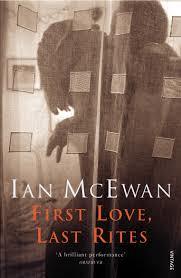 There’s a nastiness to these early McEwan stories that reminded me of Never Mind by Edward St. Aubyn. The teenage narrator of “Homemade” tells you right in the first paragraph that his will be a tale of incest. A little girl’s body is found in the canal in “Butterflies.” The voice in “Conversation with a Cupboard Man” is that of someone who has retreated into solitude after being treated cruelly at the workplace (“I hate going outside. I prefer it in my cupboard”). “Last Day of Summer” seems like a lovely story about a lodger being accepted as a member of the family … until the horrific last page. Only “Cocker at the Theatre” was pure comedy, of the raunchy variety (emphasis on “cock”). You get the sense of a talented writer whose mind you really wouldn’t want to spend time in; had this been my first exposure to McEwan, I would probably never have opened up another of his books. [Public library]
I’m still much more likely to gravitate towards novels rather than short stories because I find story collections so hit and miss; rarely do I find one that I enjoy all the way through.
Can you think of any short story authors I might like?
Book Serendipity in 2020: Part III
I call it Book Serendipity when two or more books that I read at the same time or in quick succession have something pretty bizarre in common. Because I have so many books on the go at once (usually around 20), I suppose I’m more prone to such incidents than some. I also list these occasional reading coincidences on a Twitter thread.
The following are in chronological order. (January to March’s incidents appeared in this post, and April to July’s here.)
- Reading two books whose covers feature Audubon bird paintings.
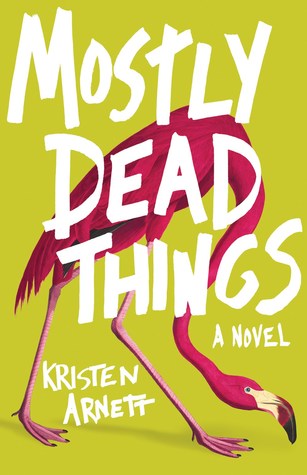
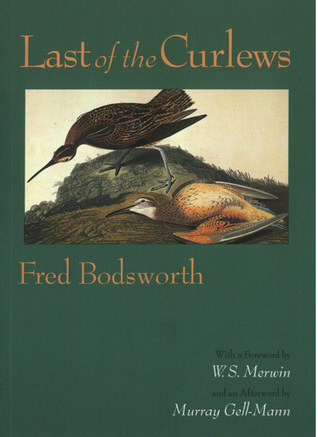
- A 19th-century female character inherits a house but knows it will pass instantly to her spouse in Property by Valerie Martin and Islands of Mercy by Rose Tremain.
- A bag/sack of potatoes as a metaphor in Other People’s Pets by R.L. Maizes and Redhead by the Side of the Road by Anne Tyler.
- Nipple rings get a mention in Addition by Toni Jordan and Other People’s Pets by R.L. Maizes.
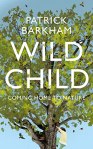
- Taxidermy is an element (most major in the first one) in Mostly Dead Things by Kristen Arnett, Wild Child by Patrick Barkham and Into the Tangled Bank by Lev Parikian.
- A discussion of bartenders’ habit of giving out free drinks to get big tips (a canny way of ‘stealing’ from the employer) in Kitchen Confidential by Anthony Bourdain and Other People’s Pets by R.L. Maizes.

- Characters named Seamus in Addition by Toni Jordan and Mother’s Milk by Edward St. Aubyn.
- Wild boar mentioned in Mostly Dead Things by Kristen Arnett, Other People’s Pets by R.L. Maizes and My Berlin Kitchen by Luisa Weiss.
- A fastidious bachelor who’s always cleaning his living space in Other People’s Pets by R.L. Maizes and Redhead by the Side of the Road by Anne Tyler.
- A character is a blogger in Americanah by Chimamanda Ngozi Adichie, Other People’s Pets by R.L. Maizes and My Berlin Kitchen by Luisa Weiss.
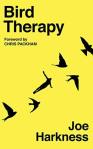
- Norfolk settings in Wild Child by Patrick Barkham and Bird Therapy by Joe Harkness (and both were on the Wainwright Prize longlist).
- A close aunt‒niece relationship in Mostly Dead Things by Kristen Arnett and Addition by Toni Jordan.
- A guy does dumb accents when talking about food, and specifically a French accent for “hamburger,” in Addition by Toni Jordan and Redhead by the Side of the Road by Anne Tyler.
- Recipes for a potato salad that is dressed with oil and vinegar rather than mayonnaise in Tender at the Bone by Ruth Reichl and My Berlin Kitchen by Luisa Weiss.
- Mentions of the Watergate hearings in A Crime in the Neighborhood by Suzanne Berne and Tender at the Bone by Ruth Reichl.
- Twins in Half of a Yellow Sun by Chimamanda Ngozi Adichie, A Crime in the Neighborhood by Suzanne Berne and The Yonahlossee Riding Camp for Girls by Anton DiSclafani.
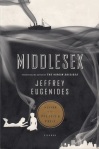
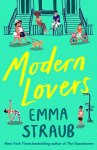
- Characters nicknamed “Lefty” in Middlesex by Jeffrey Eugenides and Modern Lovers by Emma Straub.
- Characters named Abir/Abeer in A Traveller at the Gates of Wisdom by John Boyne and Apeirogon by Colum McCann.
- Kayaking in Scotland in The Frayed Atlantic Edge by David Gange and Summerwater by Sarah Moss.
- The military coup in Nigeria features in Half of a Yellow Sun by Chimamanda Ngozi Adichie and The Shadow of the Sun by Ryszard Kapuściński.
- The song “White Christmas” is quoted in Mudbound by Hillary Jordan and Tales of the City by Armistead Maupin.
- The fact that fingerprints are formed by the fetus touching the uterine wall appears in Marrow by Elizabeth Lesser and You Will Never Be Forgotten by Mary South.
- Orkney as a setting in Close to Where the Heart Gives Out by Malcolm Alexander and The Frayed Atlantic Edge by David Gange. I’m hankering to go back!
- Teresa of Ávila is mentioned in Marrow by Elizabeth Lesser and You Will Never Be Forgotten by Mary South.
- A dog named Bingo in Half of a Yellow Sun by Chimamanda Ngozi Adichie and Modern Lovers by Emma Straub. (B-I-N-G-O!)
- Four sisters are given a joint name in A Crime in the Neighborhood by Suzanne Berne (Fran-Claire-Lois-Ada) and Marrow by Elizabeth Lesser (KaLiMaJo).
- The same Lilla Watson quote (“If you have come to help me, you are wasting your time. But if you have come because your liberation is bound up with mine, then let us work together”) appears in both The Gospel of Trees by Apricot Irving and Marrow by Elizabeth Lesser.
- An Irish author and Hong Kong setting for Exciting Times by Naoise Dolan and The Distance Between Us by Maggie O’Farrell.

- The Dorothy Parker quote “Men seldom make passes at girls who wear glasses” appears in both What Are You Going Through by Sigrid Nunez and First Time Ever by Peggy Seeger.
What’s the weirdest reading coincidence you’ve had lately?
Summery Reads, Part II: Sun and Summer Settings
Typically for the late August bank holiday, it’s turned chilly and windy here, with a fair bit of rain around. The past two weeks have felt more like autumn, but I’ve still been seeing out the season with a few summery reads.
What makes for good summer reading? I love reading with the seasons, picking up a book set during a heat wave just as the temperature is at a peak, but of course there can also be something delicious about escaping by reading about Arctic cold. Marcie of Buried in Print wrote here that she likes her summer books to offer just the right combination of the predictable and the unexpected, and that probably explains why I’m more likely to dip into genre fiction in the summer than at any other time of year. To her criteria I would also add addictiveness and a strong sense of place so as to be transporting – especially important this year when so many of us haven’t been able to have the vacations we might have planned on.
My best two summer binge reads this year were Rodham and Americanah; my two summery classics, though more subtle, were also perfect. Mostly Dead Things by Kristen Arnett, which I’m reading for a Shiny New Books review, has also felt apt for its swampy Florida setting. More recently, I picked up a couple of books with “sun” in the title, plus two novels set entirely in the course of one summer. Two of my selections are also towards my project of reading all of the Women’s Prize winners by November so I can vote on my all-time favorite.
Here comes the sun…
Half of a Yellow Sun by Chimamanda Ngozi Adichie (2006)
 Adichie filters an epic account of Nigeria’s civil war through the experience of twin sisters, Olanna and Kainene, and those closest to them. The wealthy chief’s daughters from Lagos drift apart: Olanna goes to live with Odenigbo, a math professor; Kainene is a canny businesswoman with a white lover, Richard Churchill, who is fascinated by Igbo art and plans to write a book about his experiences in Africa. Gradually, though, he realizes that the story of Biafra is not his to tell.
The novel alternates between the close third-person perspectives of Olanna, Richard and Ugwu, Odenigbo’s houseboy, and moves between the early 1960s and the late 1960s. These shifts underscore stark contrasts between village life and sophisticated cocktail parties, blithe prewar days and witnessed atrocities and starvation. Kainene runs a refugee camp, while Ugwu is conscripted into the Biafran army. Violent scenes come as if out of nowhere, as suddenly as they would have upturned real lives. A jump back in time reveals an act of betrayal by Odenigbo, and apparently simple characters like Ugwu are shown to have hidden depths.
In the endmatter of my paperback reissue, Adichie writes, “If fiction is indeed the soul of history, then I was equally committed to the fiction and the history, equally keen to be true to the spirit of the time as well as to my artistic vision of it.” Copious research must have gone into a book about events that occurred before her birth (both of her grandfathers died in the conflict), but its traces are light; this is primarily about storytelling and conveying emotional realities rather than ensuring readers grasp every detail of the Biafran War. This was my second attempt to read the novel, and while again I did not find it immediately engaging, by one-quarter through it had me gripped. I’m a firm Adichie fan now, and look forward to reading her other three new-to-me books sooner rather than later.
Orange Prize (now Women’s Prize) for Fiction winner, 2007
Source: Birthday gift from my wish list some years back
My rating:
The Shadow of the Sun: My African Life by Ryszard Kapuściński (1998)
[Translated from the Polish by Klara Glowczewska in 2001]
 Kapuściński was a foreign correspondent in Africa for 40 years and lent his name to an international prize for literary reportage. This book of essays spans several decades and lots of countries, yet feels like a cohesive narrative. The author sees many places right on the cusp of independence or in the midst of coup d’états – including Nigeria, a nice tie-in to the Adichie. Living among the people rather than removed in some white enclave, he develops a voice that is surprisingly undated and non-colonialist. While his presence as the observer is undeniable – especially when he falls ill with malaria and then tuberculosis – he lets the situation on the ground take precedence over the memoir aspect. I’m only halfway through, but I fully expect this to stand out as one of the best travel books I’ve ever read.
Evocative opening lines:
“More than anything, one is struck by the light. Light everywhere. Brightness everywhere. Everywhere, the sun.”
Source: Free bookshop
It happened one summer…
A Crime in the Neighborhood by Suzanne Berne (1997)
 Berne, something of a one-hit wonder, is not among the more respected Women’s Prize alumni – look at the writers she was up against in the shortlist and you have to marvel that she was considered worthier than Barbara Kingsolver (The Poisonwood Bible) and Toni Morrison (Paradise). However, I enjoyed this punchy tale. Marsha remembers the summer of 1972, when her father left her mother for Aunt Ada and news came of a young boy’s sexual assault and murder in the woods behind a mall. “If you hadn’t known what had happened in our neighborhood, the street would have looked like any other suburban street in America.”
Laid up with a broken ankle from falling out of a tree, 10-year-old Marsha stays out of the way of her snide older twin siblings and keeps a close eye on the street’s comings and goings. Like Harriet the Spy or Jimmy Stewart’s convalescent character in Rear Window, she vows to note anything relevant in her Book of Evidence to pass on to the police. Early on, her suspicion lands on Mr. Green, the bachelor who lives next door. Feeling abandoned by her father and underappreciated by the rest of her family, Marsha embellishes the facts to craft a more exciting story, not knowing or caring that she could ruin another person’s life.
The novel is set in Montgomery County, Maryland, where I grew up, and the descriptions of brutally humid days fit with my memory of the endless summer days of a childhood in the Washington, D.C. area. Although I usually avoid child narrators, I’ve always admired novels that can point to the dramatic irony between what a child experiences at the time and what a person can only understand about their situation when looking back. Stylish and rewarding.
Orange Prize (now Women’s Prize) for Fiction winner, 1999
Source: Free bookshop
My rating:
Modern Lovers by Emma Straub (2016)
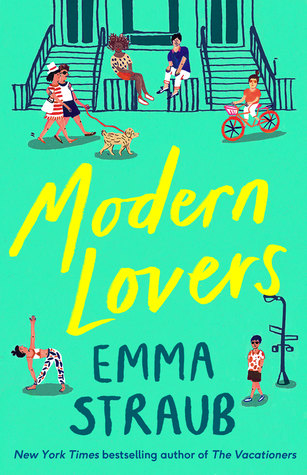 Just as the Berne is a coming-of-age story masquerading as a mystery, from the title and cover this looked like it would be chick lit, but – though it has an overall breezy tone – it’s actually pretty chewy New York City literary fiction that should please fans of The Nest and/or readers of Jennifer Egan and Ann Patchett.
Elizabeth Marx and Zoe Kahn-Bennett have been best friends ever since starting the student band Kitty’s Mustache at Oberlin. Now in their forties with a teenager each, they live half a block apart in Brooklyn. Zoe and her wife Jane run a neighborhood restaurant, Hyacinth; their daughter Ruby is dragging her feet about college and studying to retake the SAT over the summer. Elizabeth, a successful real estate agent, still keeps the musical flame alive; her husband Andrew, her college sweetheart from the band, is between jobs, not that his parents’ money isn’t enough to keep him afloat forever; their son, Harry, is in puppy love with Ruby.
Several things turn this one ordinary-seeming summer on its head. First, a biopic is being made about the Kitty’s Mustache singer turned solo star turned 27 Club member, Lydia, and the filmmaker needs the rest of the band on board – and especially for Elizabeth to okay their use of the hit song she wrote that launched Lydia’s brief career. Second, Andrew gets caught up in a new cult-like yoga studio run by a charismatic former actor. Third, the Kahn-Bennetts have marital and professional difficulties. Fourth, Harry and Ruby start sleeping together.
Short chapters flip between all the major characters’ perspectives, with Straub showing that she completely gets each one of them. The novel is about reassessing as one approaches adulthood or midlife, about reviving old dreams and shoring up flagging relationships. It’s nippy and funny and smart and sexy. I found so many lines that rang true:
Elizabeth was happy in her marriage, she really was. It was just that sometimes she thought about all the experiences she’d never gotten to have, and all the nights she’d listened to the sound of her husband’s snores, and wanted to jump out a window and go home with the first person who talked to her. Choices were easy to make until you realized how long life could be.
Andrew was always surprised by people’s ages now. When he was a teenager, anyone over the age of twenty looked like a grown-up, with boring clothes and a blurry face, only slightly more invisible than Charlie Brown’s teacher, but life had changed. Now everyone looked equally young, as if they could be twenty or thirty or even flirting with forty, and he couldn’t tell the difference. Maybe it was just that he was now staring in the opposite direction.
“I mean, it’s never too late to decide to do something else. Becoming an adult doesn’t mean that you suddenly have all the answers.”
I’ll definitely read more by Straub. I’d especially recommend picking this up if you enjoyed Writers & Lovers.
Source: Free bookshop
My rating:
What was your best summery read this year?
Doorstoppers of the Month: Americanah and Deerbrook
On one of my periodic trips back to the States, I saw Chimamanda Ngozi Adichie speak at a large Maryland library soon after Americanah (2013) was published. I didn’t retain much from her talk, except that her main character, Ifemelu, was a blogger about race issues and that Black hair also played a role. I was hugely impressed with Adichie in person: stylish and well-spoken, she has calm confidence and a mellifluous voice. In the “question” (comment) time I remember many young African and African American women saying how much her book meant to them, capturing the complexities of what it’s like to be Black in America.
Ironically, I have hoarded Adichie’s work over the years since then but not read it. I did read We Should All Be Feminists from the library for Novellas in November one year, but had accumulated copies of her other five books as gifts or from neighbors or the free bookshop. (Is there a tsundoku-type term for author-specific stockpiling?) Luckily, my first taste of her fiction exceeded my high expectations and whetted my appetite to read the rest.
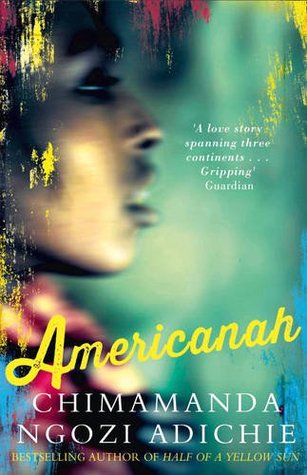
“You can’t write an honest novel about race in this country,” a secondary African American character declares at an evening salon Ifemelu attends. Adichie puts the lie to that statement: her slight outsider status allows her to cut through stereotypes and pretenses and get right to the heart of the issue. The novel may be seven years old (and hearkens back to the optimism of Barack Obama’s first election), but it feels utterly fresh and relevant at a time when we are newly aware of the insidiousness of racism. Again and again, I nodded in wry acknowledgment of the truth of Ifemelu’s cutting observations:
Job Vacancy in America—National Arbiter in Chief of ‘Who Is Racist’: In America, racism exists but racists are all gone. Racists belong to the past. Racists are the thin-lipped mean white people in the movies about the civil rights era. Here’s the thing: the manifestation of racism has changed but the language has not. So if you haven’t lynched somebody then you can’t be called a racist.
Through Ifemelu’s years of studying, working and blogging her way around the Eastern seaboard of the United States, Adichie explores the ways in which the experience of an African abroad differs from that of African Americans. These subtleties become especially clear through her relationships with Curt (white) and Blaine (African American), which involve a performative aspect and a slight tension that were absent with Obinze, her teenage sweetheart. Obinze, too, tries life in another country, moving to the UK illegally. Although they eventually earn financial success and good reputations – with Obinze a married property developer back in Nigeria – both characters initially have to do debasing work to get by.
Americanah is so wise about identity and perceptions, with many passages that resonated for me as an expat. When Ifemelu returns to Nigeria after 13 years, she doesn’t know if she or her country has changed: “She was no longer sure what was new in Lagos and what was new in herself … home was now a blurred place between here and there … there was something wrong with her. A hunger, a restlessness. An incomplete knowledge of herself.”
I loved Ifemelu’s close bond with her cousin, Dike, who is more like a little brother to her, and the way the narrative keeps revisiting a New Jersey hair salon where she is getting her hair braided. These scenes reminded me of Barber Shop Chronicles, a terrific play I saw with my book club last year. The prose is precise, insightful and evocative (“she would not unwrap from herself the pashmina of the wounded,” “There was something in him, lighter than ego but darker than insecurity, that needed constant buffing”).
On a sentence level as well as at a macro plot level, this was engrossing and rewarding – just what I want from a doorstopper. The question of whether Ifemelu and Obinze will get back together is one that will appeal to fans of Normal People – can these sustaining teenage relationships ever last? – but Ifemelu is such a strong, independent character that it’s merely icing on the cake. I’m moving on to her Women’s Prize winner, Half of a Yellow Sun, next.
Page count: 477 (but tiny type)
Source: Free bookshop
My rating: 
Deerbrook by Harriet Martineau (1839)
 This was meant to be a buddy read with Buried in Print, but I fell at the first hurdle and started skimming after 35 pages. I haven’t made it through a Victorian triple-decker in well over a decade; just since 2012, I’ve failed to get through three novels by Charles Dickens, whom I used to call my favorite author. I’m mildly disappointed in myself, but may have to accept the change in my reading tastes. In my early 20s, I loved chunky nineteenth-century novels and got my MA in Victorian Literature, but nowadays I look at one of these 500+-page classics and think, why wade through something so tortuously verbose over a matter of weeks when I could read three or more contemporary novels that will have more bearing on my life, for the same word count and time?
In any case, Deerbrook is interesting from a cultural history point of view, sitting between Austen and the Brontës or George Eliot in terms of timeline, style and themes. In the fictional Midlands village of Deerbrook, the Greys and Rowlands are neighbors engaged in a polite feud while sharing a summer house and a governess. Orphaned sisters Hester and Margaret Ibbotson, 21 and 20, come to live with the Greys, their distant cousins and known dissenters. Hester got “all the beauty,” so it’s no surprise that, after a visit from a local doctor, Edward Hope, everyone is pairing him with her in their minds. I liked an early passage voicing the thoughts of Maria Young, the crippled governess (“How I love to overlook people,—to watch them acting unconsciously, and speculate for them!”), but soon tired of the matchmaking and moralizing. A world in which everyone does their duty is boring indeed.

Martineau, though, seems like a fascinating figure I’d like to read more about. She wrote a two-volume Autobiography, which I would also skim if I could find it from a library. Just her one-page bio at the front of my Virago paperback contained many astonishing sentences: “her education was interrupted by advancing deafness, requiring her to use an ear trumpet in later life”; “Her fiancé, John Hugh Worthington, having gone insane also died”; [after writing Deerbrook] “She then collapsed into bed where she was to remain for the next five years. In 1845 Harriet Martineau was dramatically cured by mesmerism,” etc.
Page count: 523 (again, tiny type)
Source: A UK secondhand bookshop 15+ years ago
11 Days, 11 Books: 2020’s Reads, from Best to Worst
I happen to have finished 11 books so far this year – though a number of them were started in 2019 (one as far back as September) and several of them are novelty books and/or of novella length. Just for kicks, I’ve arranged them from best to worst. Here’s how my reading year has started off…
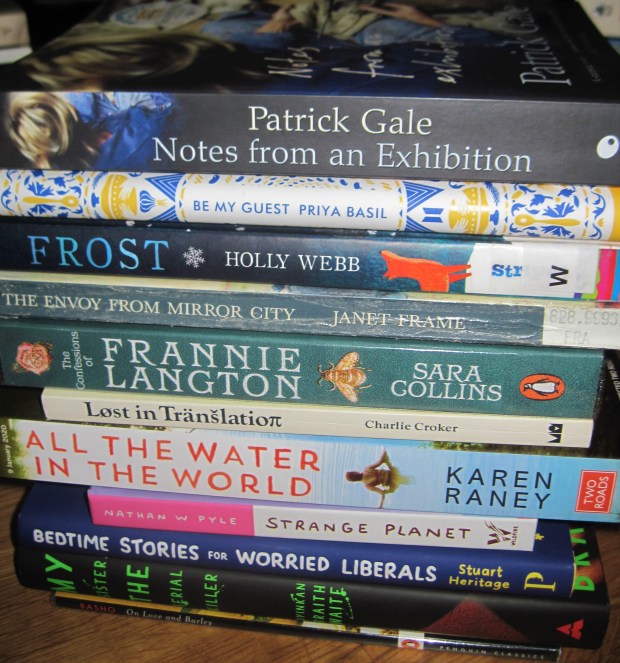
 Notes from an Exhibition by Patrick Gale – Nonlinear chapters give snapshots of the life of bipolar Cornwall artist Rachel Kelly and her interactions with her husband and four children, all of whom are desperate to earn her love. Quakerism, with its emphasis on silence and the inner light in everyone, sets up a calm and compassionate atmosphere, but also allows for family secrets to proliferate. There are two cameo appearances by an intimidating Dame Barbara Hepworth, and three wonderfully horrible scenes in which Rachel gives a child a birthday outing. The novel questions patterns of inheritance (e.g. of talent and mental illness) and whether happiness is possible in such a mixed-up family. (Our joint highest book club rating ever, with Red Dust Road. We all said we’d read more by Gale.)
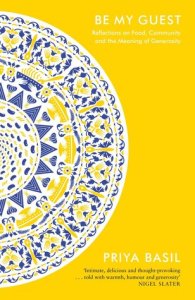 Be My Guest: Reflections on Food, Community and the Meaning of Generosity by Priya Basil – An extended essay whose overarching theme of hospitality stretches into many different topics. Part of an Indian family that has lived in Kenya and England, Basil is used to a culture of culinary abundance. Greed, especially for food, feels like her natural state, she acknowledges. However, living in Berlin has given her a greater awareness of the suffering of the Other – hundreds of thousands of refugees have entered the EU, often to be met with hostility. Yet the Sikhism she grew up in teaches unconditional kindness to strangers. She asks herself, and readers, how to cultivate the spirit of generosity. Clearly written and thought-provoking. (And typeset in Mrs Eaves, one of my favorite fonts.) See also Susan’s review, which convinced me to order a copy with my Christmas bookstore voucher.
 Frost by Holly Webb – Part of a winter animals series by a prolific children’s author, this combines historical fiction and fantasy in an utterly charming way. Cassie is a middle child who always feels left out of her big brother’s games, but befriending a fox cub who lives on scrubby ground near her London flat gives her a chance for adventures of her own. One winter night, Frost the fox leads Cassie down the road – and back in time to the Frost Fair of 1683 on the frozen Thames. I rarely read middle-grade fiction, but this was worth making an exception for. It’s probably intended for ages eight to 12, yet I enjoyed it at 36. My library copy smelled like strawberry lip gloss, which was somehow just right.
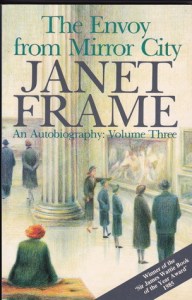 The Envoy from Mirror City by Janet Frame – This is the last and least enjoyable volume of Frame’s autobiography, but as a whole the trilogy is an impressive achievement. Never dwelling on unnecessary details, she conveys the essence of what it is to be (Book 1) a child, (2) a ‘mad’ person, and (3) a writer. After years in mental hospitals for presumed schizophrenia, Frame was awarded a travel fellowship to London and Ibiza. Her seven years away from New Zealand were a prolific period as, with the exception of breaks to go to films and galleries, and one obsessive relationship that nearly led to pregnancy out of wedlock, she did little else besides write. The title is her term for the imagination, which leads us to see Plato’s ideals of what might be.
 The Confessions of Frannie Langton by Sara Collins – Collins won the first novel category of the Costa Awards for this story of a black maid on trial in 1826 London for the murder of her employers, the Benhams. Margaret Atwood hit the nail on the head in a tweet describing the book as “Wide Sargasso Sea meets Beloved meets Alias Grace” (she’s such a legend she can get away with being self-referential). Back in Jamaica, Frances was a house slave and learned to read and write. This enabled her to assist Langton in recording his observations of Negro anatomy. Amateur medical experimentation and opium addiction were subplots that captivated me more than Frannie’s affair with Marguerite Benham and even the question of her guilt. However, time and place are conveyed convincingly, and the voice is strong.
(The next one is a book my husband received for Christmas, as are the Heritage and Pyle, further down, which were from me. Yes, I read them as well. What of it?)
 Lost in Translation by Charlie Croker – This has had us in tears of laughter. It lists examples of English being misused abroad, e.g. on signs, instructions and product marketing. China and Japan are the worst repeat offenders, but there are hilarious examples from around the world. Croker has divided the book into thematic chapters, so the weird translated phrases and downright gobbledygook are grouped around topics like food, hotels and medical advice. A lot of times you can see why mistakes came about, through the choice of almost-but-not-quite-right synonyms or literal interpretation of a saying, but sometimes the mind boggles. Two favorites: (in an Austrian hotel) “Not to perambulate the corridors in the hours of repose in the boots of ascension” and (on a menu in Macao) “Utmost of chicken fried in bother.”
 All the Water in the World by Karen Raney – Like The Fault in Our Stars (though not YA), this is about a teen with cancer. Sixteen-year-old Maddy is eager for everything life has to offer, so we see her having her first relationship – with Jack, her co-conspirator on an animation project to be used in an environmental protest – and contacting Antonio, the father she never met. Sections alternate narration between her and her mother, Eve. I loved the suburban D.C. setting and the e-mails between Maddy and Antonio. Maddy’s voice is sweet yet sharp, and, given that the main story is set in 2011, the environmentalism theme seems to anticipate last year’s flowering of youth participation. However, about halfway through there’s a ‘big reveal’ that fell flat for me because I’d guessed it from the beginning.
This was published on the 9th. My thanks to Two Roads for the proof copy for review.
 Strange Planet by Nathan W. Pyle – I love these simple cartoons about aliens and the sense they manage to make of Earth and its rituals. The humor mostly rests in their clinical synonyms for everyday objects and activities (parenting, exercise, emotions, birthdays, office life, etc.). Pyle definitely had fun with a thesaurus while putting these together. It’s also about gentle mockery of the things we think of as normal: consider them from one remove, and they can be awfully strange. My favorites are still about the cat. You can also see his work on Instagram.

 Bedtime Stories for Worried Liberals by Stuart Heritage – I bought this for my husband purely for the title, which couldn’t be more apt for him. The stories, a mix of adapted fairy tales and new setups, are mostly up-to-the-minute takes on US and UK politics, along with some digs at contemporary hipster culture and social media obsession. Heritage quite cleverly imitates the manner of speaking of both Boris Johnson and Donald Trump. By its nature, though, the book will only work for those who know the context (so I can’t see it succeeding outside the UK) and will have a short shelf life as the situations it mocks will eventually fade into collective memory. So, amusing but not built to last. I particularly liked “The Night Before Brexmas” and its all-too-recognizable picture of intergenerational strife.
 My Sister, the Serial Killer by Oyinkan Braithwaite – The Booker Prize longlist and the Women’s Prize shortlist? You must be kidding me! The plot is enjoyable enough: a Nigerian nurse named Korede finds herself complicit in covering up her gorgeous little sister Ayoola’s crimes – her boyfriends just seem to end up dead somehow; what a shame! – but things get complicated when Ayoola starts dating the doctor Korede has a crush on and the comatose patient to whom Korede had been pouring out her troubles wakes up. My issue was mostly with the jejune writing, which falls somewhere between high school literary magazine and television soap (e.g. “My hands are cold, so I rub them on my jeans” & “I have found that the best way to take your mind off something is to binge-watch TV shows”).
 On Love and Barley – Haiku of Basho [trans. from the Japanese by Lucien Stryk] – These hardly work in translation. Almost every poem requires a contextual note on Japan’s geography, flora and fauna, or traditions; as these were collected at the end but there were no footnote symbols, I didn’t know to look for them, so by the time I read them it was too late. However, here are two that resonated, with messages about Zen Buddhism and depression, respectively: “Skylark on moor – / sweet song / of non-attachment.” (#83) and “Muddy sake, black rice – sick of the cherry / sick of the world.” (#221; reminds me of Samuel Johnson’s “tired of London, tired of life” maxim). My favorite, for personal relevance, was “Now cat’s done / mewing, bedroom’s / touched by moonlight.” (#24)
Any of these you have read or would read?
Onwards with the 2020 reading!
Ake Book Festival: An Extract from Manchester Happened
Africa’s leading literary festival, Ake Book Festival in Lagos, Nigeria, is in its seventh year. Appearing this year are 100 authors including Ayobami Adebayo, Oyinkan Braithwaite, Reni Eddo-Lodge, Bernadine Evaristo, Jennifer Nansubuga Makumbi and Nnedi Okarafor. I was asked to take part in a blog tour celebrating the festival and the authors involved – specifically, to host an extract of Makumbi’s Manchester Happened, which I’ve been especially keen to read since hearing her in conversation with Evaristo last week.
This is the opening few pages of “Our Allies the Colonies,” the first story following the Prologue. I hope it whets your appetite to read the whole thing.
First he felt a rush of dizziness like life was leaving his body, then the world wobbled. Abbey stopped and held onto a bollard outside the Palace Theatre. He had not eaten all day. He considered nipping down to Maama Rose’s for fried dumplings and kidney beans, but the thought of eating brought nausea to his throat. He steered his mind away from food. He gave himself some time then let go of the bollard to test his steadiness. His head felt right, and his vision was back. He started to walk tentatively at first then steadily, down Oxford Road, past the Palace Hotel, under the train bridge, upwards, towards the Grosvenor Picture Palace.
Abbey was set to return to Uganda. He had already paid for the first leg of the journey – the passage from Southampton to Mombasa – and was due to travel within six months. For the second and third legs of the journey – Mombasa to Nairobi, then Nairobi to Kampala – he would pay at the ticket offices on arrival. He had saved enough to start a business either dealing in kitenge textiles from the Belgian Congo or importing manufactured goods from Mombasa. Compete with the Indians even. As a starter, he had bought rolls of fabric prints from Summer Mist Textiles for women’s dresses and for men’s suits, to take with him. All that commercial development in Uganda he had read about – increased use of commercial vehicles; the anticipated opening of the Owen Falls Dam, which would provide electricity for everyone; he had even heard that Entebbe had opened an airport back in 1951 – was beckoning.
But his plan was in jeopardy. It was his one-month-old baby, Moses. Abbey had just returned from Macclesfield Children’s Home, where the baby’s mother, Heather Newton, had given him up for adoption, but he had not seen his son. In fact, he did not know what the baby looked like: he never saw him in hospital when he was born. Abbey suspected that Heather feared that one day she might bump into him and Moses. But Heather was fearful for nothing. Abbey was taking Moses home, never to return.
Suppose the children’s home gave you the child, what then, hmm? the other side of his mind asked. What do you know about babies? The journey from Southampton to Mombasa is at least two weeks long on a cheap vessel. The bus ride from Mombasa to Nairobi would last up to two days. Then the following night you would catch the mail train from Nairobi to Kampala: who knows if it is still running? All those journeys with luggage and a six-month-old ankle-biter on your own. Yet Abbey knew that if he left Britain without his boy, that would be it. Moses would be adopted, given a new name and there would be no way of finding him. Then his son would be like those rootless Baitale children you heard of in Toro, whose Italian fathers left them behind.
He was now outside Manchester Museum, by the university. He was on his way to his second job, at the Princess Road bus depot, where he cleaned Manchester Corporation buses. His shift began at 9 p.m. It was almost 8 p.m., but the day was bright. He could not wait to get home and tell people how in Britain the sun had moods. It barely retired in summer yet in winter it could not be bothered to rise. He could not wait to tell them things about Britain. It was a shame he had stayed this long. But having a job and saving money made him feel like he was not wasting his youth away in a foreign land. His day job paid the bills while the evening job put savings away in his Post Office account. His mind turned on him again: Maybe Heather had a point – you don’t have a wife to look after Moses while you work. You still have five months before you set off; if the home gives him to you, how will you look after him? But then shame rose and reason was banished. Blood is blood, a child is better off with his father no matter what.
He reached Whitworth Park. It was packed with people sunning themselves, young men throwing and catching Frisbees, families picnicking. At the upper end, close to Whitworth Art Gallery, he caught sight of a group of Teddy boys who, despite the warm evening, wore suits, crêpe-soled shoes and sunglasses, their greased hair slicked back. They looked like malnourished dandies. Even though Teddy Boys tended to hunt blacks in the night, Abbey decided against crossing the park. Instead, he walked its width to Moss Lane East. The way the sun had defrosted British smiles. ‘Enjoy it while it lasts,’ strangers will tell you now.
Bernardine Evaristo and Jennifer Nansubuga Makumbi in Conversation
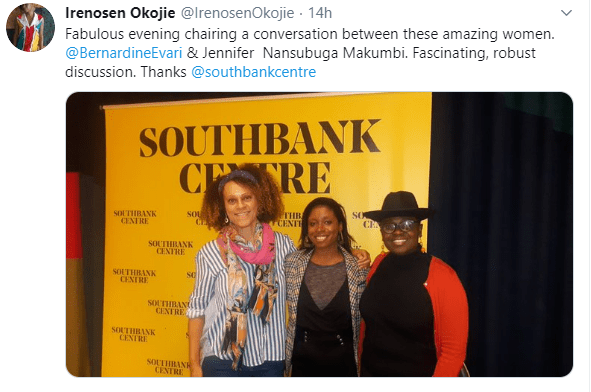
Through a giveaway on Eric’s blog, I won tickets to see Bernardine Evaristo and Jennifer Nansubuga Makumbi speak about their latest books at the London Literature Festival (this year’s theme: “Once Upon Our Times”) at the Southbank Centre yesterday. It was great to meet up with fellow bloggers Eric and Eleanor to hear these two black women writers read from their recent work and discuss feminism, the political landscape for writers of African descent, and their experiments with form.


Frustrated by the lack of black women in British literature, Evaristo started writing Girl, Woman, Other in 2013. She began with Carole (Anglo-Nigerian, like herself), who has to change to fit in, first at Oxford and then as a City banker. Next she moved on to the stories of Carole’s mother and school friend, and the book grew from there. All told, there are four mother–daughter pairs. Evaristo believes her background as an actress (in her twenties) allowed her to almost become these characters and write them from the inside, so that even though the chapters are written in the third person they feel like first-person narratives. The 12 flawed, complex main characters are “equal protagonists,” she insisted. Her aim was “to explore multiplicity to address our invisibility.” She characterizes the book’s style as “fusion fiction”: an accessible take on the experimental novel, with unorthodox, free-flowing language that allows readers to move easily between the different characters’ storylines.
Both Evaristo and Makumbi admitted to having a complicated relationship with feminism, Evaristo because the feminism of the 1980s did not seem to include black women and Makumbi because the fight for equality is still ongoing in patriarchal African societies like her native Uganda’s. Evaristo feels that feminism is now more inclusive and, also thanks to the #MeToo movement, there has been a place for her book that may not have been there five or 10 years ago. (The same goes for Makumbi, who has only now found a publisher for her very feminist first novel, which was rejected in the 2000s.) Both authors spoke of the ways in which people are made to feel “Other”: through sex, race and class. Makumbi pointed out that Africans experience a specific racism separate from other blacks in Britain. “I’m not racist, but I draw the line at Africans” is how she caricatured this view.
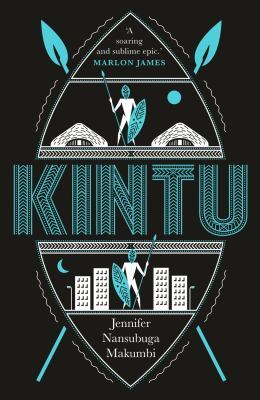 Makumbi’s novel Kintu is a sprawling family saga that has been compared to Roots, but she has recently released a collection of short stories that focus on Ugandan immigration to Britain between the 1950s and today. She envisioned Manchester Happened as “a letter back home” to tell people what it’s really like to settle in a new country, as well as a chance to reflect on the underrepresented East African immigration experience. Much of the book is drawn from her life, such as working as an airport security officer to fund her creative writing degree. Her mentor recommended that she start writing stories as a way to counterbalance the intensity of Kintu – a chance to see the beginning, middle and end as a simple arc. She assumed short stories would be easier than a novel, yet her first story took her four years to write. It is as if she can only look into her past for brief moments, anyway, she explained, so the story form has been perfect. She has deliberately avoided the negativity of many migration narratives, she said: Things have in fact gone well for her, and we’ve heard about things going wrong many times before.
I’m over halfway through Girl, Woman, Other now, and enjoying it very much – but wondering if its breadth sacrifices some depth. Evaristo acknowledged that she felt a bit less attached to these characters than she has in novels where she followed just one or two characters all the way through. Still, she feels that she knows and understands these women, even if she doesn’t like or approve of all of them. She read excerpts from the sections about Yazz, a feisty and opinionated young woman waiting for her mother’s play to start, and Hattie, a strong-willed 93-year-old from a Northumberland farming family. Makumbi read from two stories, one about a Ugandan couple arriving in Manchester in 1950 and the other set in the airport security area. In the latter the protagonist confiscates a whip from a priest, a funny moment that seems to represent Makumbi’s style – moderator Irenosen Okojie, a Nigerian author, mentioned another notable story from the perspective of a Ugandan street dog newly pampered in Britain.
I hope to read Manchester Happened soon, and should be featuring an extract from it next week as part of the Ake Book Festival blog tour. I’ll also finish the Evaristo this week and expect it to be on my Best of 2019 fiction list.
 Bookish Beck = Rebecca Foster. American transplant to England. Freelance proofreader and book reviewer.
 Bookish Beck