Third Blog Anniversary
Hard to believe, but I’ve only been blogging for three years as of today. It feels like something I’ve been doing forever, but at the same time I still consider myself a newbie. This is my 382nd post, so I’ve been keeping up an average of 2.5 posts a week.

By Joey Gannon from Pittsburgh, PA (Candles) [CC BY-SA 2.0 (http://creativecommons.org/licenses/by-sa/2.0)%5D, via Wikimedia Commons.
I’ve particularly enjoyed doing author Q&As and highlighting seasonal reads, novellas, books about cats, and physical book traits. I especially like writing up bookshop visits and other literary travels, and discussing literary prizes. My supply of graphic novels seems to have dried up; for new releases I focus on literary fiction, historical fiction and memoirs.
Straightforward book reviews have always been less popular than book lists and other more tangentially book-related posts. Library Checkout posts are consistently well-liked, as were the “Books in Brief” sets of five mini-reviews I used to do. As I’ve noted before, my posts on abandoned books are always perversely popular.
Some of my favorite posts from the past year were on World Kidney Day, Mother–Daughter Author Pairs, and Book Hoarding, and my review in verse of Jonathan Eig’s Ali: A Life.
The numbers of likes seem to be less than informative as they simply reflect a growing number of followers – many of my recent posts have averaged 20–25 likes – so I prefer to look at comments, as it means people are truly reading and engaging. In terms of numbers of comments, my top posts of all time appeared in the last year and were:
- Bibliotherapy appointment
- Books in Brief, May 2017 (featuring books by Sebastian Barry, Tracy Chevalier, Thomas H. Cook, Nicole Gulotta and Elizabeth Hay)
- (Tied for 3rd) Booker Longlist 2017 & Jacob’s Room Is Full of Books review
Thanks to everyone who has supported me this past year, and/or all three years, by visiting the site, commenting, re-tweeting, and so on. You’re the best!
November’s Novellas: A Wrap-Up
Yesterday was my husband’s birthday. Baking him the world’s most complicated cake on Wednesday evening and taking Thursday off for a birthday outing to Salisbury for the Terry Pratchett exhibit at the town’s museum and the Christmas-decorated rooms at Mompesson House are my collective excuse for not writing up the last of November’s novellas until now.


For the most part I had a great time reading novellas last month. However, there were three I abandoned: Mornings in Mexico by D.H Lawrence (p. 11), whose random, repetitive observations lead to no bigger picture; So Long, See You Tomorrow by William Maxwell (p. 28), which is understated to the point of nothing really happening; and Jaguars and Electric Eels by Alexander von Humboldt (p. 6), which has that dry old style that’s hard to engage with. (I’ll plan to encounter snatches of his writing via Andrea Wulf’s biography instead.)
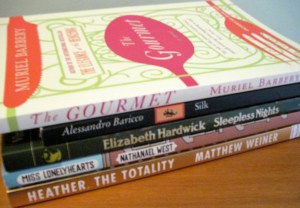 To my disappointment, I find I can’t make generalizations about the correlation between a book’s page count and its quality: a great book stands out no matter its length. But as Joe Hill (Stephen King’s son) said of his latest work, a set of four short novels, a novella should be “all killer, no filler.” Three of the five I review today definitely meet those criteria, impressing me with the literal and/or emotional ground covered.
Below are the novellas I didn’t manage to get to this past November. Perhaps they’ll hang around until next year, unless I get a burning urge to read one or more of them before then:
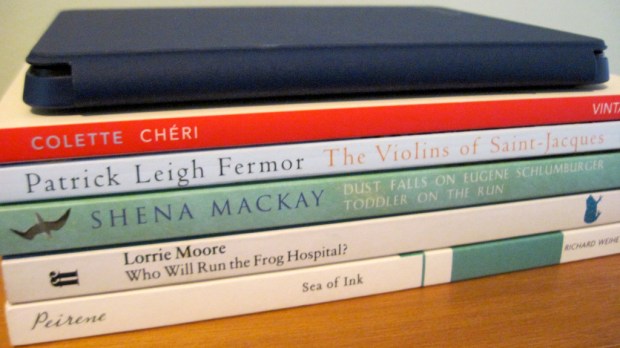
(On the Kindle: Record of a Night Too Brief by Hiromi Kawakami and Spring Garden by Tomoka Shibasaki.)
The Gourmet by Muriel Barbery
(translated from the French by Alison Anderson)
[112 pages]
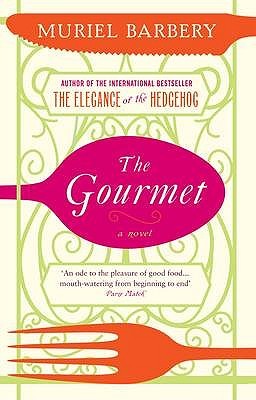 Pierre Arthens, France’s most formidable food critic, is on his deathbed reliving his most memorable meals and searching for one elusive flavor to experience again before he dies. He’s proud of his accomplishments – “I have covered the entire range of culinary art, for I am an encyclopedic esthete who is always one dish ahead of the game” – and expresses no remorse for his affairs and his coldness as a father. This takes place in the same apartment building as The Elegance of the Hedgehog and is in short first-person chapters narrated by various figures from Arthens’ life. His wife, his children and his doctor are expected, but we also hear from the building’s concierge, a homeless man he passed every day for ten years, and even a sculpture in his study. I liked Arthens’ grandiose style and the descriptions of over-the-top meals but, unlike the somewhat similar The Debt to Pleasure by John Lanchester, this doesn’t have much of a payoff.
A favorite passage:
“After decades of grub, deluges of wine and alcohol of every sort, after a life spent in butter, cream, sauce, and oil in constant, knowingly orchestrated and meticulously cajoled excess, my trustiest right-hand men, Sir Liver and his associate Stomach, are doing marvelously well and it is my heart that is giving out.”
Silk by Alessandro Baricco
(translated from the Italian by Guido Waldman)
[104 pages]
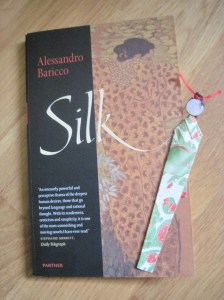 The main action is set between 1861 and 1874, as married French merchant Hervé Joncour makes four journeys to and from Japan to acquire silkworms. “This place, Japan, where precisely is it?” he asks before his first trip. “Just keep going. Right to the end of the world,” Baldabiou, the silk mill owner, replies. On his first journey, Joncour is instantly captivated by his Japanese advisor’s concubine, though they haven’t exchanged a single word, and from that moment on nothing in his life can make up for the lack of her. At first I found the book slightly repetitive and fable-like, but as it went on I grew more impressed with the seeds Baricco has planted that lead to a couple of major surprises. At the end I went back and reread a number of chapters to pick up on the clues. I’d had this book recommended from a variety of quarters, first by Karen Shepard when I interviewed her for Bookkaholic in 2013, so I’m glad I finally found a copy in a charity shop.
Sleepless Nights by Elizabeth Hardwick
[151 pages]
 Hardwick’s 1979 work is composed of (autobiographical?) fragments about the people and places that make up a woman’s remembered past. Elizabeth shares a New York City apartment with a gay man; lovers come and go; she mourns for Billie Holiday; there are brief interludes in Amsterdam and other foreign destinations. She sends letters to “Dearest M.” and back home to Kentucky, where her mother raised nine children. (“My mother’s femaleness was absolute, ancient, and there was a peculiar, helpless assertiveness about it. … This fateful fertility kept her for most of her life under the dominion of nature.”) There’s some astonishingly good writing here, but as was the case for me with Jenny Offill’s Dept. of Speculation, I couldn’t quite see how it was all meant to fit together.
Some favorite passages:
“The stain of place hangs on not as a birthright but as a sort of artifice, a bit of cosmetic.”
“The bright morning sky that day had a rare and blue fluffiness, as if a vacuum cleaner had raced across the heavens as a weekly, clarifying duty.”
“On the battered calendar of the past, the back-glancing flow of numbers, I had imagined there would be felicitous notations of entrapments and escapes, days in the South with their insinuating feline accent, and nights in the East, showing a restlessness as beguiling as the winds of Aeolus. And myself there, marking the day with an I.”
Miss Lonelyhearts by Nathanael West
[110 pages]
 West was a contemporary of F. Scott Fitzgerald; in fact, the story goes that when he died in a car accident at age 37, he had been rushing to Fitzgerald’s wake, and the friends were given adjoining rooms in a Los Angeles funeral home. Like The Great Gatsby, this is a very American tragedy and state-of-the-nation novel. “Miss Lonelyhearts” (never given any other name) is a male advice columnist for the New York Post-Dispatch. His letters come from a pitiable cross section of humanity: the abused, the downtrodden, the unloved. Not surprisingly, the secondhand woes start to get him down (“his heart remained a congealed lump of icy fat”), and he turns to drink and womanizing for escape. Indeed, I was startled by how explicit the language and sexual situations are; this doesn’t feel like a book from 1933. West’s picture of how beleaguered compassion can turn to indifference really struck me, and the last few chapters, in which a drastic change of life is proffered but then cruelly denied, are masterfully plotted. The 2014 Daunt Books reissue has been given a cartoon cover and a puff from Jonathan Lethem to emphasize how contemporary it feels.
Heather, the Totality by Matthew Weiner
[134 pages]
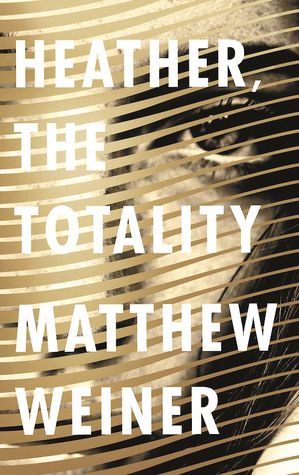 This was very nearly a one-sitting read for me: Clare gave me a copy at our Sunday Times Young Writer Award shadow panel decision meeting and I read all but a few pages on the train home from London. Famously, Matthew Weiner is the creator of Mad Men, but instead of 1960s stylishness this debut novella is full of all-too-believable creepiness and a crescendo of dubious decisions. Mark and Karen Breakstone have one beloved daughter, Heather. We follow them for years, getting little snapshots of a normal middle-class family. One summer, as their New York City apartment building is being renovated, the teenaged Heather catches the eye of a construction worker who has a criminal past – as we’ve learned through a parallel narrative about his life. I had no idea what I would conclude about this book until the last few pages; it was all going to be a matter of how Weiner brought things together. And he does so really satisfyingly, I think. It’s a subtle, Hitchcockian story, and that title is so sly: We never get the totality of anyone; we only see shards here and there – something the cover portrays very well – and make judgments we later have to rethink.
Have you read any of these novellas? Which one takes your fancy?
Nonfiction Novellas for November
Nonfiction novellas – that’s a thing, right? Lots of bloggers are doing Nonfiction November, but I feel like I pick up enough nonfiction naturally (at least 40% of my reading, I’d estimate) that I don’t need a special challenge related to it. I’ve read seven nonfiction works this month that aren’t much longer than 100 pages, or sometimes significantly shorter. For the most part these are nature books and memoirs. I’m finishing off a few more fiction novellas and will post a roundup of mini reviews before the end of the month, along with a list of the titles that didn’t take and some general thoughts on novellas.
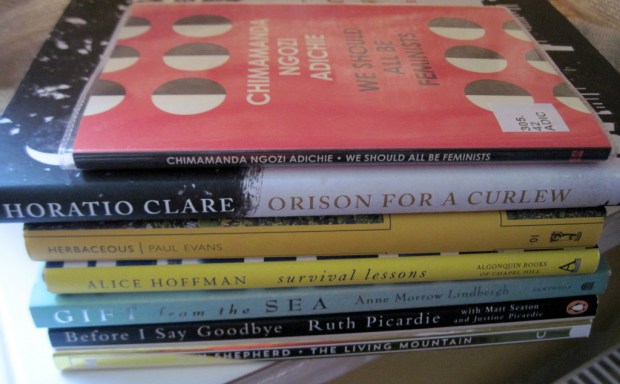
“We Should All Be Feminists” by Chimamanda Ngozi Adichie
[48 pages]
 This isn’t even a novella, but an essay published in pamphlet form, based on a TED talk Adichie gave as part of a conference on Africa. I appreciate and agree with everything she has to say, yet didn’t find it particularly groundbreaking. Her discussion of the various stereotypes associated with feminists and macho males is more applicable to a society like Lagos, though of course the pay gap and negative connotations placed on women managers are as relevant in the West.
Favorite line: “At some point I was a Happy African Feminist Who Does Not Hate Men And Who Likes To Wear Lip Gloss And High Heels For Herself And Not For Men.”
Orison for a Curlew: In search of a bird on the edge of extinction by Horatio Clare
[101 pages]
 Clare was commissioned to tell the story of the slender-billed curlew, a critically endangered marsh-dwelling bird that might be holding out in places like Siberia and Syria but is largely inaccessible to the European birding community. With little hope of finding a bird as good as extinct, he set out instead to speak to those in Greece, Romania and Bulgaria who had last seen the bird before its disappearance: conservationists, hunters, bird watchers and photographers. Clare writes well about nostalgia, hope and the difference individuals can make, but there’s no getting around the fact that this book doesn’t really do what it promises to. [Also, much as I hate to say it, this is atrociously edited. I know Little Toller is a small operation, but there are some shocking typos in here: “pilgrimmage,” “bridwatching,” “govenor,” “refinerey”; even the name of the author’s town, “Hebdon Bridge”!]
Some favorite lines:
“A huge cloud of black storks jump up like an ambush of Hussars in their red bills and leggings, white fronts and dark uniforms.”
“The wheels click-beat the rails as we follow a river valley north past dozy dolomitic scenery in ageing lemon sunlight”
Herbaceous by Paul Evans
[106 pages]
 This was Evans’s first book, and the first issued in the Little Toller monograph series. These are generally exceptionally produced nature books on niche subjects. Herbaceous is hard to categorize. In some ways it’s similar to Evans’s Guardian Country Diary columns: short pieces blending straightforward observations with poetic musings. However, some of them read more like short stories, and the language – appropriately for a book about flora? – can be florid. They probably work better read aloud as poems: I remember him reading “Skunk cabbage” at the New Networks for Nature conference some years back, for instance. Some lines are a little oversaturated with metaphor. But others are truly lovely.
A few favorite lines:
“The following morning the text of journeys appear[s] on snow: trident marks of pheasant, double slots of fallow deer, dabs of rabbit.”
“Bordello black and scarlet, six-spot burnet moths swing on the nodding idiot scabious flower through a lavender-blue sky and deep, deep under roots, the fossilised fury of the mollusc’s empire heaves.”
“A bed of pansies tilts flat blue faces to the sun like a deaf and dumb funeral.”
Survival Lessons by Alice Hoffman
[83 pages]
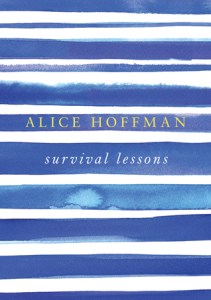 Hoffman wrote this 15 years after her own bout with breast cancer to encourage anyone going through a crisis. Each chapter title begins with the word “Choose” – a reminder that, even when you can’t choose your circumstances, you can choose your response. For instance, “Choose Whose Advice to Take” and “Choose to Enjoy Yourself.” This has been beautifully put together with blue-tinted watercolor-effect photographs and an overall yellow and blue theme (along with deckle edge pages – a personal favorite book trait). It’s a sweet little memoir with a self-help edge, and I think most people would appreciate being given a copy. The only element that felt out of place was the five-page knitting pattern for a hat. Though very similar to Cathy Rentzenbrink’s A Manual for Heartache, this is that tiny bit better.
Favorite lines:
“Make a list of what all you have loved in this unfair and beautiful world.”
“When I couldn’t write about characters that didn’t have cancer and worried I might never get past this single experience, my oncologist told me that cancer didn’t have to be my entire novel. It was just a chapter.”
Gift from the Sea by Anne Morrow Lindbergh
[130 pages]
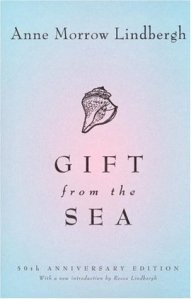 Though written in 1955 (I read a 50th anniversary edition copy), this still resonates and deserves to be read alongside feminist nonfiction by Virginia Woolf, May Sarton and Madeleine L’Engle. Solitude is essential for women’s creativity, Lindbergh writes, and this little book, written during a beach vacation in Florida, is about striving for balance in a midlife busy with family commitments. Like Joan Anderson, Lindbergh celebrates the pull of the sea and speaks of life, and especially marriage, as a fluid thing that ebbs and flows. Divided into short, meditative chapters named after different types of shells, this is a relatable work about the search for a simple, whole, purposeful life. The afterword from 1975 and her daughter Reeve’s introduction from 2005 testify to how lasting an influence the book has had.
Favorite lines:
“Patience, patience, patience, is what the sea teaches. Patience and faith.”
“The most exhausting thing in life, I have discovered, is being insincere.”
“I no longer pull out grey hairs or sweep down cobwebs.”
“It is fear, I think, that makes one cling nostalgically to the last moment or clutch greedily toward the next.”
Before I Say Goodbye by Ruth Picardie
[116 pages]
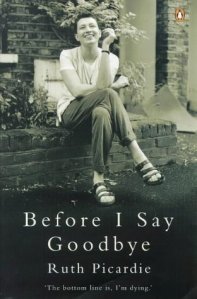 Ruth Picardie, an English freelance journalist and newspaper editor, was younger than I am now when she died of breast cancer in September 1997. The cancer had moved into her liver, lungs, bones and brain, and she only managed to write 6.5 weekly columns for Observer Life magazine, which her older sister, Justine Picardie, edited. Matt Seaton, Ruth’s widower, and Justine gathered a selection of e-mails exchanged with friends and letters sent by Observer readers and put them together with the columns to make a brief chronological record of Ruth’s final illness, ending with a 20-page epilogue by Seaton. Ruth comes across as down-to-earth and self-deprecating. All the rather Bridget Jones-ish fretting over her weight and complexion perhaps reflects that it felt easier to think about daily practicalities than about the people she was leaving behind. This is a poignant book, for sure, but feels fixed in time, not really reaching into Ruth’s earlier life or assessing her legacy. I’ve moved straight on to Justine’s bereavement memoir, If the Spirit Moves You, and hope it adds more context.
Favorite lines:
“You ram a non-organic carrot up the arse of the next person who advises you to start drinking homeopathic frogs’ urine.”
“Worse than the God botherers, though, are the road accident rubber-neckers, who seem to find terminal illness exciting, the secular Samaritans looking for glory.”
The Living Mountain by Nan Shepherd
[108 pages]
 This is something of a lost nature classic that has been championed by Robert Macfarlane (who contributes a 25-page introduction to this Canongate edition). Composed during the later years of World War II but only published in 1977, it’s Shepherd’s tribute to her beloved Cairngorms, a mountain region of Scotland. But it’s not a travel or nature book in the way you might usually think of those genres. It’s a subtle, meditative, even mystical look at the forces of nature, which are majestic but also menacing: “the most appalling quality of water is its strength. I love its flash and gleam, its music, its pliancy and grace, its slap against my body; but I fear its strength.” Shepherd dwells on the senses, the mountain flora and fauna, and the special quality of time and existence (what we’d today call mindfulness) achieved in a place of natural splendor and solitude: “Yet often the mountain gives itself most completely when I have no destination, when I reach nowhere in particular, but have gone out merely to be with the mountain as one visits a friend with no intention but to be with him.”
Have you read any of these novellas? Which one takes your fancy?
Novellas in November, Part 1
This is my second year of joining Laura (Reading in Bed) and others in reading mostly novellas in November. I’ve trawled my shelves and my current library pile for short books, limiting myself to ones of around 150 pages or fewer. First up: four short works of fiction. (I’m at work on various ‘nonfiction novellas’, too.) For the first two I give longer reviews as I got the books from the publishers; the other two are true minis.

Swallowing Mercury by Wioletta Greg
(translated from the Polish by Eliza Marciniak)
[146 pages]
I heard about this one via the Man Booker International Prize longlist. Quirkiness is particularly common in indie and translated books, I find, and while it’s often off-putting for me, I loved it here. Greg achieves an impressive balance between grim subject matter and simple enjoyment of remembered childhood activities. Her novella is, after all, set in Poland in the 1980s, the last decade of it being a Communist state in the Soviet Union.
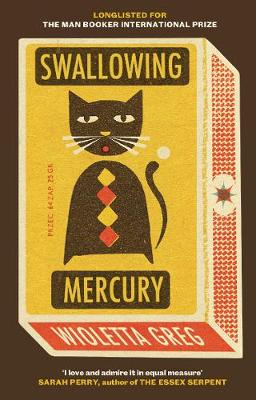 The narrator (and autobiographical stand-in?) is Wiolka Rogalówna, who lives with her parents in a moldering house in the fictional town of Hektary. Her father, one of the most striking characters, was arrested for deserting from the army two weeks before she was born, and now works for a paper mill and zealously pursues his hobbies of hunting, fishing, and taxidermy. The signs of their deprivation – really the whole country’s poverty – are subtle: Wiolka has to go selling hand-picked sour cherries with her grandmother at the market even though she’s embarrassed to run into her classmates; she goes out collecting scrap metal with a gang of boys; and she ties up her hair with a rubber band she cut from an inner tube.
Catholicism plays a major role in these characters’ lives: Wiolka wins a blessed figure in a church raffle, the Pope is rumored to be on his way, and a picture of the Black Madonna visits the town. A striking contrast is set up between the threat of molestation – Wiolka is always fending off unwanted advances, it seems – and lighthearted antics like school competitions and going to great lengths to get rare matchbox labels for her collection. This almost madcap element balances out some of the difficulty of her upbringing.
What I most appreciated was the way Greg depicts some universalities of childhood and adolescence, such as catching bugs, having eerie experiences in the dark, and getting one’s first period. This is a book of titled vignettes of just five to 10 pages, but it feels much more expansive than that, capturing the whole of early life. The Polish title translates as “Unripe,” which better reflects the coming-of-age theme; the English translator has gone for that quirk instead.
A favorite passage:
“Then I sat at the table, which was set with plates full of pasta, laid my head down on the surface and felt the pulsating of the wood. In its cracks and knots, christenings, wakes and name-day celebrations were in full swing, and woodworms were playing dodgeball using poppy seeds that had fallen from the crusts of freshly baked bread.”
Thanks to Portobello Books for the free copy for review.
A Field Guide to the North American Family by Garth Risk Hallberg
[126 pages]
 Written somewhat in the style of a bird field guide, this is essentially a set of flash fiction stories you have to put together in your mind to figure out what happens to two seemingly conventional middle-class families: the Harrisons and the Hungates, neighbors on Long Island. Frank Harrison dies suddenly in 2008, and the Hungates divorce soon after. Their son Gabe devotes much of his high school years to drug-taking before an accident lands him in a burn unit. Here he’s visited by his girlfriend, Lacey Harrison. Her little brother, Tommy, is a compulsive liar but knows a big secret his late father was keeping from his wife.
The chapters, each just a paragraph or two, are given alphabetical, cross-referenced headings and an apparently thematic photograph. For example, “Entertainment,” one of my favorite stand-alone pieces, opens “In the beginning was the Television. And the Television was large and paneled in plastic made to look like wood. It dwelled in a dim corner of the living room and came on for national news, Cosby, Saturday cartoons, and football.”
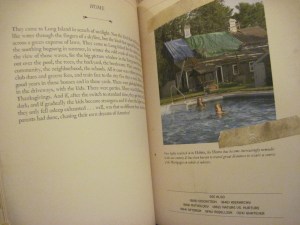 This is a Franzen-esque take on family dysfunction and, like City on Fire, is best devoured in large chunks at a time so you don’t lose momentum: as short as this is, I found it easy to forget who the characters were and had to keep referring to the (handy) family tree at the start. Ultimately I found the mixed-media format just a little silly, and the photos often seem to bear little relation to the text. It’s interesting to see how this idea evolved into the mixed-media sections of City on Fire, which is as epic as this is minimalist, though the story line of this novella is so thin as to be almost incidental.
Favorite lines:
“Depending on parent genotype, the crossbreeding of a Bad Habit and Boredom will result in either Chemistry or Entertainment.”
“Though hardly the most visible member of its kingdom, Love has never been as endangered as conservationists would have us believe, for without it, the Family would cease to function.”
Thanks to Vintage Books for the free copy for review.
The Comfort of Strangers by Ian McEwan
[100 pages]
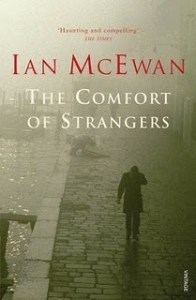 This is the earliest McEwan work I’ve read (1981). I could see the seeds of some of his classic themes: obsession, sexual and otherwise; the slow building of suspense and awareness until an inevitable short burst of violence. Mary and Colin are a vacationing couple in Venice. One evening they’ve spent so long in bed that by the time they get out all the local restaurants have shut, but a bar-owner takes pity and gives them sustenance, then a place to rest and wash when they get lost and fail to locate their hotel. Soon neighborly solicitude turns into a creepy level of attention. McEwan has a knack for presenting situations that are just odd enough to stand out but not odd enough to provoke an instant recoil, so along with the characters we keep thinking all will turn out benignly. This reminded me of Death in Venice and The Talented Mr. Ripley.
First Love by Gwendoline Riley
[167 pages – on the long side, but I had a library copy to read anyway]
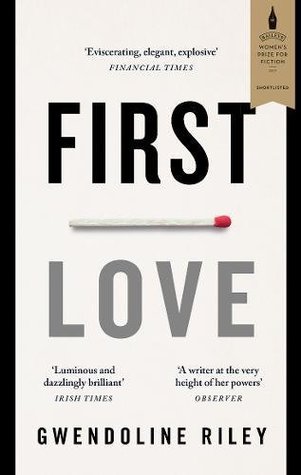 Neve tells us about her testy marriage with Edwyn, a Jekyll & Hyde type who sometimes earns our sympathy for his health problems and other times seems like a verbally abusive misogynist. But she also tells us about her past: her excess drinking, her unpleasant father, her moves between various cities in the north of England and Scotland, a previous relationship that broke down, her mother’s failed marriages, and so on. There’s a lot of very good dialogue in this book – I was reminded of Conversations with Friends – and Neve’s needy mum is a great character, but I wasn’t sure what this all amounts to. As best I can make out, we are meant to question Neve’s self-destructive habits, with Edwyn being just the latest example of a poor, masochistic decision. Every once in a while you get Riley waxing lyrical in a way that suggests she’s a really great author who got stuck with a somber, limited subject: “Outside the sunset abetted one last queer revival of light, so the outlook was torched; wet bus stop, wet shutters, all deep-dyed.”
Other favorite lines:
“An illusion of freedom: snap-twist getaways with no plans: nothing real. I’d given my freedom away. Time and again. As if I had contempt for it. Or was it hopelessness I felt, that I was so negligent? Or did it hardly matter, in fact? … Could I trust myself? Not to make my life a lair.”
Have you read any of these novellas? Which one takes your fancy?
The November Outlook
Normally I’d start the month off with a few recommendations for new books, but I’ve only finished one November book I can recommend (Skating on the Vertical, short stories by Jan English Leary; not yet reviewed); I DNFed another couple and skimmed one more. So instead I’ll give a quick survey of what the month holds.
- Young Writer of the Year reviews and events. I’ve read The Lauras; expect my review on Monday. I’m currently reading The Lucky Ones, Conversations with Friends, and the Steven Runciman biography, which will be my doorstopper for the month. There will be a shortlist event in London on the 18th, and on the 24th the shadow panel is meeting up to select a winner.

- I’ll be finishing up a brief climate change feature for Foreword Reviews magazine, consisting of mini-reviews of four upcoming books on an environmental theme.
- Review books I owe write-ups for: Jacob’s Room Is Full of Books by Susan Hill (released last month) and The Smell of Fresh Rain by Barney Shaw (out on the 14th). I’m fascinated by the science of smell and taste, so I’m intrigued to find out what Shaw has to say about a sense that often gets little attention.
- Blog tour for Celeste Ng’s new novel, Little Fires Everywhere, on the 14th. I haven’t started it yet but I’m looking forward to it immensely.
- You’d think with all those review books and library piles I wouldn’t be taking on any more projects…but I couldn’t resist agreeing to another “Book Wars” column (my third) for Stylist magazine, due on the 17th. I used to love reading Stylist when I worked in London; if you’re lucky enough to come across the magazine in your commuting, look out for my contribution to the Christmas-themed special.
- The Iris Murdoch Readalong begins with Under the Net. I’ll aim to squeeze it in before the end of the month. (Can I count it as my Classic?!)
- If I get a chance, I’ll also participate in German Literature Month by reading Bernhard Schlink’s The Woman on the Stairs on my Kindle.
- I’m revisiting some of my favorite Victorian pastiches for an article on neo-Victorian novels for Bookmarks magazine, due at the end of the month.
- Otherwise, I’ll be focusing on novellas for November, including some nonfiction novellas. I have a big pile of books set aside that are around 150 pages or shorter. I’ll get to as many of them as I can and summarize them in a roundup or two. They’re quick wins, true, often read in a single sitting (I read Alice Hoffman’s Survival Lessons this morning, for instance), but this doesn’t feel like a cheaty way to build up the book list because brevity is such an admirable skill.
How does November look for you?
Three Novellas in Translation
The Institute by Vincent Bijlo
[London’s Holland Park Press specializes in making classic and contemporary Dutch literature available in English translation.]
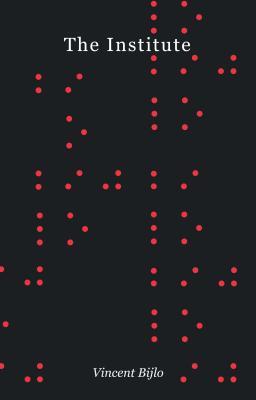 Otto Iking is a resident at the Institute, a boarding school for the blind. He characterizes his fellow students firstly according to their smell – “foul soap,” “piss” or “grated Swiss cheese” – only later adding in details about their speech and habits. It’s a zany sort of place, powered by pranks and strange decisions. Some stand-out scenes include hiding Harry’s glass eyes and a visit from the president of Surinam, a former Dutch colony. The slapstick humor works well (“When I walked into a lamppost, I said sorry. When I struck my head against a traffic sign, I said sorry. No one has ever apologised to street furniture as often as I did”), but some humor translates less well, seeming cruel or even offensive (“Tony was fat and deaf and black-skinned”).
Alongside the silliness is the matter of Otto’s coming of age. He has the first inklings of what sex is about and falls for Sonja, and also undergoes training to prepare him for the real world, things like reading and writing Braille, preparing and eating tricky meals (soup’s a killer). One day he hopes to go to a mainstream school and broadcast radio programs. The institutional setting and quirky cast reminded me of The Secret Diary of Hendrik Groen, 83¼ Years Old and Linda Grant’s The Dark Circle.
The Institute, originally from 1998, was published on April 27th. Translated from the Dutch by Susan Ridder. My thanks to Bernadette Jansen op de Haar for sending a free copy for review.
This is the first of three Otto Iking novels. Vincent Bijlo, a Dutch stand-up comedian, was born blind.
My rating:
Dance by the Canal by Kerstin Hensel
[Peirene Press issues its translated European novellas in trios. This is the final installment in the “East and West: Looking Both Ways” series; I’ve also reviewed the first two, The Last Summer by Ricarda Huch and The Orange Grove by Larry Tremblay.]
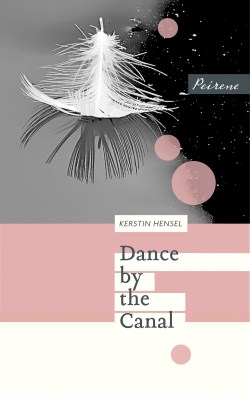 I don’t think I’ve ever read a novel narrated by a homeless person before. Gabriela von Haßlau has a noble name and a solid upper-middle-class background – her father was a surgeon and chief medical officer specializing in varicose veins; her mother was trained as a radiographer before becoming a housewife and society hostess – but her life took a turn for the worse at some point and she now lives in an encampment under a canal bridge in the town of Leibnitz (a fictional stand-in for Leipzig).
It’s July 1994 and she decides to write her life story on whatever scraps of paper she can get her hands on. She remembers being forced to play the violin as a child even though she was largely unmusical, enduring mockery at school for being one of the intelligentsia, playing hooky with her best friend Katka, and failing at a mechanical engineering apprenticeship. The narrative toggles between Gabriela’s memories and her present situation: getting blankets and food from a shelter and trying to avoid being sent to the mental hospital.
My unfamiliarity with German history, especially that relating to East Germany and reunification, means I probably missed some nuances of the plot; I found the ending quite sudden. What was most worthwhile about the book for me was experiencing homelessness with Gabriela and tracing some of the unfortunate events that led her to this situation. It’s also interesting to see how she shapes her life story in scenes and streams of consciousness.
Dance by the Canal, originally from 1994, was published on July 3rd. Translated from the German by Jen Calleja. With thanks to Peirene Press for the free copy for review.
My rating:
Hair Everywhere by Tea Tulić
[London’s Istros Books specializes in Balkans and South-Eastern European literature in translation.]
 How could I resist such a terrific title and cover image? This was Croatian novelist Tea Tulić’s first book. In brief, titled vignettes almost like flash fiction stories, she dramatizes how a cancer diagnosis affects three generations of women. The book is strong on place, sensual detail and scene-setting. The narrator’s mother is in the hospital, and all the specialists and medicinal plant extracts in the world don’t seem to be helping. In such a restrictive narrative format, a line or two of dialogue can reveal a lot about a character’s attitude. The grandmother is a weary pessimist – “I just need to help your mother get through this and then I can die” – while the narrator is quite the hypochondriac.
The tone ranges from poignant to cynical, as in the absurd two-page sequence in which the family cannot locate an on-duty doctor who can read the latest X-ray results for them. The deadpan language and mixture of black humor and pathos reminded me of Adios, Cowboy by Olja Savičevi, which coincidentally is the only other Croatian novel I’ve encountered, and was originally published in the same year, 2011.
A few favorite lines:
“One little cloud was urinating.”
“While I watch her lying in bed, I can feel the umbilical cord between us. Something I have tried to cut a thousand times already. And now I hold onto that invisible cord as though I were hanging from a bridge.”
“Patrick Swayze” in its entirety: “My brother is angry because the doctors say they cannot help Mum. I tell him Patrick Swayze had lots of money but he still died of cancer.”
Hair Everywhere was published on May 22nd. Translated from the Croatian by Coral Petkovich. My thanks to Susan Curtis for sending a free copy for review – and to TJ at My Book Strings for making me aware of this title during Women in Translation Month.
My rating: 
The Orange Grove by Larry Tremblay (Peirene)
Larry Tremblay is a Francophone writer, theatre director and actor based in Montreal. In addition to three novels, he has published a short story collection and many books of poetry and plays. The Orange Grove (2013), which was longlisted for the 2017 International Dublin (formerly IMPAC) literary award, is the fable-like story of one family in the war-torn Middle East and the way notions of justice and sacrifice drive them to make extreme choices.
Tamara and Zahed live with their twin sons, nine-year-old Aziz and Ahmed, alongside an orange grove planted by Zahed’s father. Soulayed, a militant elder from the next village, describes it thus:
Your father, Mounir, worked his whole life on this arid soil. It was desert here. With God’s help your father worked a miracle. Made oranges grow where there had been only sand and stones.
When Mounir and his wife Shahina are killed in a bombing, Soulayed stands among the ruins and counsels Zahed to seek revenge against their enemies by sending one of his sons to be a suicide bomber. There’s no doubt Soulayed is manipulating this grief-stricken family to his own ends, but he isn’t solely to blame when their culture at large romanticizes martyrdom.
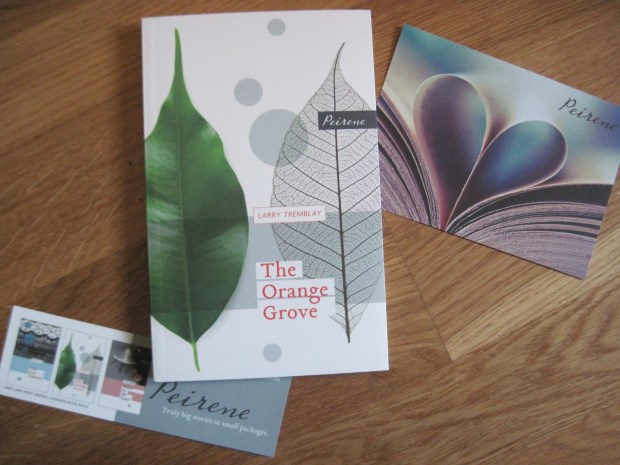
Zahed makes his choice, but Tamara won’t accept it. In a clever reprise of the Genesis story of Jacob and Esau, she helps the boys to make a switch right under their father’s nose. The last third of the book, like a coda, zooms ahead 11 years to show us the surviving brother, coming to the end of a four-year theatre training program in Montreal. He’s given a starring role in his teacher’s wartime play but the story line cuts a little too close to the bone, and for the first time he tells a stranger the story of two brothers: one who died and one who lived.
Peirene Press issues novellas in trios. This is the second in the “East and West: Looking Both Ways” series; I’ve also reviewed the first, The Last Summer by Ricarda Huch. Tremblay and Huch both tackle the theme of betrayal and the practice of choosing one person to die for the crimes of the many. The Orange Grove has a simple style that edges towards flatness but is saved by the occasional striking metaphor (e.g. “Minutes stretched out as if made of dough”). A book about suicide bombing could easily turn mawkish, but the restrained narration reins it in to create a tight and fairly engrossing tale of family ties and religious motivations.
[The third book in the series, Dance by the Canal by Kerstin Hensel, will be released later in 2017.]
The Orange Grove was published in the UK on May 1st. Translated from the French by Sheila Fischman. With thanks to James Tookey of Peirene Press for the free copy for review.
My rating:
The Last Summer by Ricarda Huch (Peirene)
Originally published in 1910, The Last Summer is a suspenseful epistolary novella by Ricarda Huch (1864–1947), one of the first German women to earn a PhD. She wrote widely across many fields – history, poetry, fiction, and religion – and had an asteroid named after her, earning Thomas Mann’s accolade of “the First Lady of Germany.” I’m grateful to Peirene for resurrecting this German classic as I have a special love for epistolary novels – traditionally told through nothing but letters. You have to be on the lookout for little clues dotted through the correspondence that will tell you who these characters are, how they’re connected to one another, what you need to know about their pasts, and what’s happening now.
 Set across one May to August in the early 1900s, the book joins the von Rasimkara family at their summer home. In response to student protests, patriarch Yegor, the governor of St. Petersburg, has shut down the university and left for the country. With him are his wife, Lusinya; their three twenty-something children, Velya, Jessika and Katya; and Yegor’s new secretary-cum-bodyguard, Lyu. What the family don’t know, but readers do from the first letter onward, is that Lyu is in league with the student revolutionaries and is in on a plot to assassinate the governor at his summer home.
This central dramatic irony is what fuels much of the book’s tension. All of the von Rasimkaras persist in believing the best about Lyu, even when the evidence seems to point to his deception. Both daughters fall in love with him, Velya calls him their “guardian angel,” and Lusinya is sure of his loyalty even after odd incidents she can’t explain, like finding him standing in their bedroom doorway in the middle of the night and a mysterious letter appearing under her pillow. “In case of doubt, one ought to hold back with one’s judgement,” Lusinya opines.
I wouldn’t go so far as to call this a “psychological thriller,” as the back cover blurb does, but I do think it’s a compelling picture of how different groups and ideologies can be fundamentally incompatible. In my favorite passage, Lyu describes the von Rasimkara family to his friend Konstantin:
My stay here is fascinating from a psychological viewpoint. The family has all the virtues and defects of its class. Perhaps one cannot even talk of defects; they merely have the one: belonging to an era that must pass and standing in the way of one that is emerging. When a beautiful old tree has to be felled to make way for a railway line, it’s painful to watch; you stand beside it like an old friend, gazing admiringly and in grief until it comes down. It is undeniably a shame about the governor, who is a splendid example of his kind, but I believe that he has already passed his peak.
As I sometimes feel about novellas, the plot is fairly thin and easily could have been spun out to fill a book of twice the length or more. But that is not what Peirene Press books are about. They’re meant to be quick reads that introduce European novellas in translation. This one has a terrific ending – which I certainly won’t spoil, though the title and cover could be read as clues – and is a perfectly enjoyable way to spend a winter evening.
[Peirene issues books in trios. This is the first of the three books in the “East and West: Looking Both Ways” series. The other two, The Orange Grove by Larry Tremblay and Dance by the Canal by Kerstin Hensel, will be released later in 2017.]
The Last Summer was published in the UK on February 1st. Translated from the German by Jamie Bulloch.
With thanks to James Tookey of Peirene Press for the free copy for review.
My rating: 
Other Peirene titles I’ve reviewed:
- Mr. Darwin’s Gardener by Kristina Carlson
- The Looking-Glass Sisters by Gøhril Gabrielsen
- Her Father’s Daughter by Marie Sizun
- The Man I Became by Peter Verhelst
Novellas in November
Taking a lead from Laura over at Reading in Bed, I’ve trawled my shelves and my current library pile for some blissfully short books. For this challenge I limited myself to books with fewer than 150 pages and came up with four fiction books and two ‘nonfiction novellas’.
The Library of Unrequited Love by Sophie Divry
[92 pages]
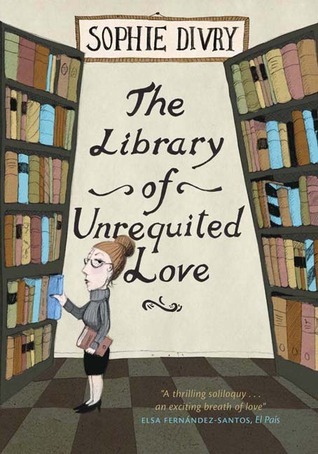 This one-sitting read is a monologue by an embittered librarian who arrives one morning to discover a patron has been locked into the basement overnight—a captive audience. Responsible for Geography, she hopes for a promotion to History, her favorite subject. Alas, no one seems to appreciate this library as a bastion of learning anymore; they only come for DVDs and a place to keep warm. That is, except for Martin, a young PhD researcher who’s caught her eye. But he doesn’t even seem to notice she exists. In one uninterrupted paragraph, this celebrates all that books do for us but suggests that they still can’t fix a broken heart.
My verdict: There are lots of great one-liners about the value of books (“You’re never alone if you live surrounded by books”), but overall it’s a somewhat aimless little experiment and not particularly well translated.
The All of It by Jeannette Haien
[145 pages]
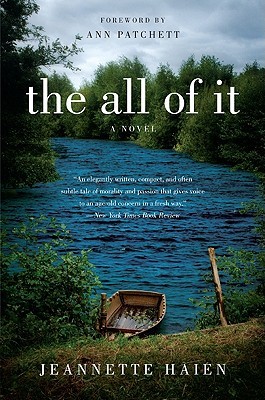 When this won the Sue Kaufman Prize for First Fiction in 1987, the author was in her sixties. It’s since been championed by Ann Patchett, who contributed a Foreword to this 2011 edition. Father Declan de Loughry, fishing for salmon, reflects on the recent death of parishioner Kevin Dennehy. Before he died, Kevin admitted that he and Enda were never properly married. Yet Enda begs the priest to approve a death notice calling Kevin her “beloved husband,” promising she’ll then explain “the all of it” – the very good reason they never married. As she tells her full story, which occupies the bulk of the novella, Father Declan tries to strike a balance between the moral high ground and human compassion.
My verdict: Enda’s initial confession on page 27 is explosive, but the rest of this quiet book doesn’t ever live up to it. I was reminded of Mary Costello’s Academy Street, a more successful short book about an Irish life.
Favorite passage: “One thing I’ve learned, Father—that in this life it’s best to keep the then and the now and the what’s-to-be as close together in your thoughts as you can. It’s when you let gaps creep in, when you separate out the intervals and dwell on them, that you can’t bear the sorrow.”
Thirteen Ways of Looking by Colum McCann
[143 pages]
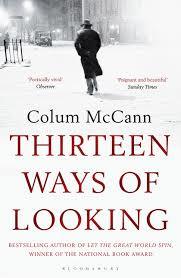 This starts off as the simple story of J. Mendelssohn, an octogenarian who wakes up on a snowy morning in his New York City apartment, contemplating his past – Lithuanian/Polish ancestry, work as a judge and marriage to Eileen, whom he met as a boy in Dublin – and planning to meet his son at a restaurant for lunch. But all of a sudden it turns into a murder mystery on page 24: “Later the homicide detectives will be surprised…” In 13 sections headed by epigraphs from the Wallace Stevens poem “Thirteen Ways of Looking at a Blackbird,” McCann flits through Mendelssohn’s thoughts and flips between the events preceding and immediately following the murder. A late interrogation scene is particularly strong – “unlike our poetry, we like our murders to be fully solved.”
My verdict: This is the first I’ve read from McCann, and it’s terrific. He stuffs so much plot and characterization into not many pages. Mendelssohn’s thought life is rich with allusions and wordplay. I was particularly intrigued to read about the autobiographical overlap in the Author’s Note. I haven’t yet read the short stories included in the volume, but for the novella on its own it’s  .
.
As We Are Now by May Sarton
[134 pages]
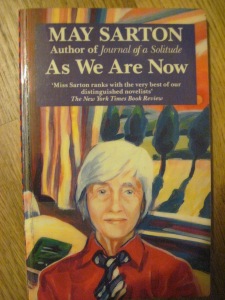 On the surface this is similar to a novel I reviewed earlier in the month, The Secret Diary of Hendrik Groen, 83¼ Years Old. But where spunky Hendrik determines to outwit his care home’s sullen staff, Sarton’s narrator, seventy-six-year-old Caroline Spencer, has given in. A retired high school math teacher, she’s landed in a New England old folks’ home because during her recovery from a heart attack she failed to get along with her brother’s younger wife. She finds kindred spirits in Standish Flint, a tough old farmer, and Reverend Thornhill, but her growing confusion and the home’s pretty appalling conditions drive her to despair.
My verdict: This is enjoyable for the unreliable narrator and the twist ending, but overall it struck me as rather melodramatic. However, I appreciated a lot of Caro’s sentiments.
Favorite passages: “Am I senile, I wonder? The trouble is that old age is not interesting until one gets there, a foreign country with an unknown language to the young, and even to the middle-aged. I wish now that I had found out more about it.” & “And what is left of you? A lapis lazuli pin, a faded rose petal, once pink, slipped into the pages of this copybook.”
And two short works of nonfiction:
Excerpts from a Family Medical Dictionary by Rebecca Brown
[113 pages]
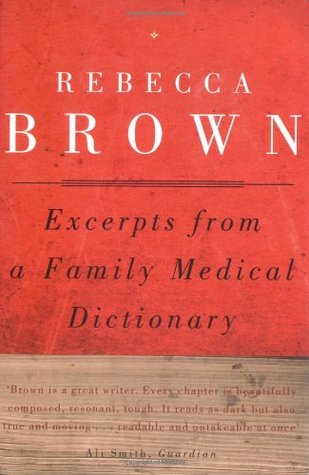 Brown is a novelist from Seattle. This is an account of her mother’s death from what sounds like stomach cancer. The disease progressed quickly and her mother died at home, under hospice care, in New Mexico in 1997. As the title suggests, the brief thematic chapters are arranged around vocabulary words like “anemia” and “metastasis.” My favorite chapters were about washing: her mother’s habit of reading while taking long baths, and the ways Brown and her sister tried to care for their mother’s disintegrating body, including a plan to prepare the corpse themselves. Clinical descriptions of vomiting alternate with magical thinking to accompany her mother’s hallucinations: “You’re packed, Mom, but all of us aren’t going, just you. But you’ve got everything you need.”
My verdict: Brown covers a lot of emotional ground in a very few pages, but I prefer my medical/bereavement memoirs to have more of a narrative and more detail than “when she died it was not peacefully or easy, it was hard.”
Ruined by Reading: A Life in Books by Lynne Sharon Schwartz
[119 pages]
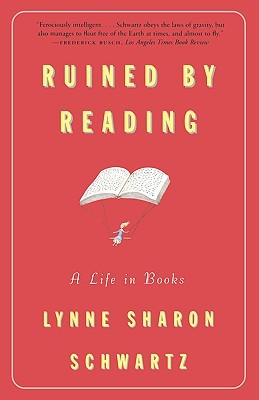 This 1996 memoir was sparked by reading a quote from a Chinese Buddhist in a New York Times article: he suggested that reading is dangerous as it imposes others’ ideas on you and doesn’t allow you to use your own mind freely. Schwartz, of course, begs to differ. As a novelist, reading has been her lifeline. She looks back at her childhood reading and her pretentious college student opinions on Franz Kafka and Henry James, and explains that she lets serendipity guide her reading choices nowadays, rather than a strict TBR list: “reading at random – letting desire lead – feels like the most faithful kind.”
My verdict: It’s a bibliomemoir; I should have loved it. Instead I thought it unstructured and thin. There are some great lines dotted through, but I wasn’t very interested in the examples she focuses on. Five pages about a children’s book by Eleanor Farjeon? Yawn!
Favorite passages: “Like the bodies of dancers or athletes, the minds of readers are genuinely happy and self-possessed only when cavorting around, doing their stretches and leaps and jumps to the tune of words.” & “How are we to spend our lives, anyway? That is the real question. We read to seek the answer, and the search itself – the task of a lifetime – becomes the answer.”
Have you read any of these? Which one takes your fancy?
How do you feel about novellas in general?
Three Cancer Patient Memoirs
There can’t be many of us whose lives haven’t been touched by cancer. Siddhartha Mukherjee, author of The Emperor of All Maladies, estimates that one in three of us will have cancer at some point in life, and that figure is steadily rising to one in two. Cancer hit home for me in late 2010 with my brother-in-law’s diagnosis of a brain tumor and his subsequent death in early 2015. Since then I have been reading cancer and bereavement memoirs almost compulsively, looking for clues to how we can deal with this near-universal phenomenon. Here are three personal stories of cancer that have stuck with me lately.
This Is Cancer: Everything You Need to Know, from the Waiting Room to the Bedroom
By Laura Holmes Haddad
 A stage IV inflammatory breast cancer survivor, Laura Holmes Haddad wrote the “What to Expect” guide she wishes she could have found at the time of her diagnosis in 2012. Throughout this comprehensive, well-structured book, she uses her own experience to set out practical advice for dealing with the everyday medical and emotional realities of cancer. On the technical side, she gives an alphabetical glossary of “Cancerspeak” vocabulary, as well as explanations of different types of scans, chemo drugs, radiation treatments, methods of coping with pain, and options for reconstruction surgery. But she also goes deep into the less obvious aspects of the disease, like hidden financial costs, little-known side effects, and complications that could affect your sleep and travel. Her tips range from the dead simple—bring your own pen for filling out hundreds of pages of forms; schedule little pick-me-ups like a mini-makeover—to major issues like marriage and parenting with cancer.
“Don’t be surprised if this thing—this cancer road trip—leads to places you never could have imagined,” Holmes Haddad writes. “I’m trying to pay it forward to other patients, to help ease some angst, to comfort.” You might be surprised to learn that this is a very pleasant read. It fluidly mixes anecdote with facts and maintains an appropriate tone: forthright and reassuring yet wry, as in the ‘Devil’s Dictionary’ type translations (“DOCTOR: ‘You might feel some discomfort.’ MEANING: ‘This will hurt like hell.’”).
No cancer patient should be without this book. That statement needs no qualifying. Yes, it might be geared more towards women, specifically breast cancer patients, and there’s some U.S.-specific information about health insurance, but much of the guidance is universally applicable. Whether for yourself or to help a family member or friend, you’ll want a copy.
My thanks to publicist Eva Zimmerman for the free e-copy for review. This Is Cancer will be released by Seal Press on Tuesday.
My rating: 
Late Fragments: Everything I Want to Tell You (About This Magnificent Life)
By Kate Gross
 By the end of this charming memoir, I felt I knew Kate Gross as a friend. A high-flying British civil servant who helped Tony Blair found an NGO in Africa, she was shocked to learn in her early thirties that her occasional ‘bottom trouble’ was end-stage colon cancer with liver metastases. “I’m a golden girl, a people-pleaser, something who is used to graft and a pleasant smile being rewarded,” she writes, yet here was a situation she could not control. She died at age 36 in 2014.
In this short, clear-eyed book, she balances a brief recounting of her life with observations about terminal illness and trying to ensure a good future for her five-year-old twin sons. Memoirs by people facing death can often skirt close to cliché, but I felt Gross had fresh things to tell me about many subjects:
Cultivating “bitter gratitude”: “How strange, how brilliant it is that this awareness of wonder, this sense of the sublime, has been so closely intertwined with my illness as it has progressed.”
The value of literature: “Reading is an experience by which we connect ourselves to what we are, to this magnificent, awful life, in which the same grooves are being scored over and over again in different times and tongues.”
How to act around the dying: “we don’t expect great words of wisdom or solace. I just want this shit to be acknowledged”
Gross doesn’t believe in an afterlife beyond her children’s memory and this book—“nothingness-with-benefits.” I could sympathize with her picture of death, “me in the back of a black taxi, leaving an awesome party before the end, just when everyone else was starting to have real fun.” I wish she’d had longer at the party, but I’m glad she left these thoughts behind.
My rating: 
Haematemesis: How One Man Overcame a Fear of Things Medical and Learned to Navigate His Way Around Hospital
By Henry G. Sheppard
 This is a mordantly funny account of one Australian man’s experience with recurrent cancer. In remission since 2007, Sheppard discovered in 2015 that he was once more riddled—that awful word—with leukemia. Having vowed never to go through chemo again, he learned that it had somewhat improved in the intervening years, with the drip treatments now partially replaced by tablets. This time around he ran into a lot of what he calls “Big Hospital Attitude”: scheduling issues with his bone marrow biopsy, nurses who didn’t think he could manage his own insulin treatments, and constant problems with finding veins for his many injections. Was this the much-touted “Patient-Centered Care”? Would he be better off with the “quick and relatively-painless death offered when one is mauled by a pack of wild dogs”?
“Haematemesis” means vomiting blood, and be warned: there is a lot of blood here; if you’re squeamish about needles you may struggle. There is also plenty of scatological humor. But in general I found the tone to be reminiscent of Bill Bryson in a hospital gown, especially when he’s describing squeezing his belly into a CT scanner or recounting his flatulence.
My main complaint is that at 80 pages this feels incomplete, like it’s telling just part of the story. What about his first bout with leukemia, or his earlier life (which, from a look at his Goodreads biography, seems very eventful indeed)? I understand that Sheppard wanted to get this book released while he was still able. I wish him well and hope for a sequel.
My thanks to the author for the free e-copy for review.
My rating: 
 Bookish Beck = Rebecca Foster. American transplant to England. Freelance proofreader and book reviewer.
 Bookish Beck