#ReadIndies Nonfiction Catch-Up: Ansell, Farrier, Febos, Hoffman, Orlean and Stacey
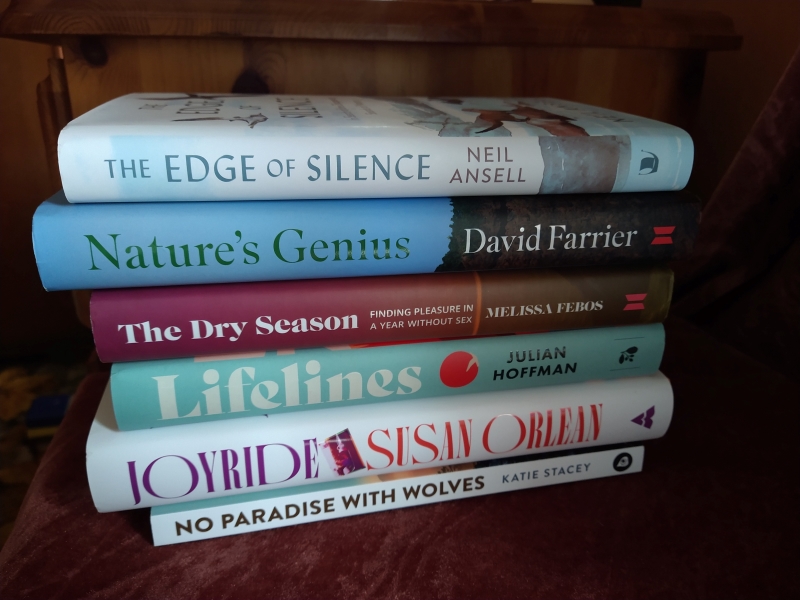
These are all 2025 releases; for some, it’s approaching a year since I was sent a review copy or read the book. Silly me. At last, I’ve caught up. Reading Indies month, hosted by Kaggsy in memory of her late co-host Lizzy Siddal, is the perfect time to feature books from five independent publishers. I have four works that might broadly be classed as nature writing – though their topics range from birdsong and technology to living in Greece and rewilding a plot in northern Spain – and explorations of celibacy and the writer’s profession.
The Edge of Silence: In Search of the Disappearing Sounds of Nature by Neil Ansell
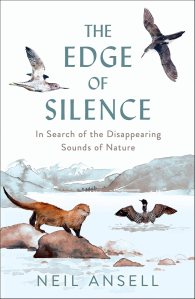 Ansell draws parallels between his advancing hearing loss and the biodiversity crisis. He puts together a wish list of species – mostly seabirds (divers, grebes), but also inland birds (nightjars) and a couple of non-avian representatives (otters) – that he wants to hear and sets off on public transport adventures to find them. “I must find beauty where I can, and while I still can,” he vows. From his home on the western coast of Scotland near the Highlands, this involves trains or buses that never align with the ferry timetables. Furthest afield for him are two nature reserves in northern England where his mission is to hear bitterns “booming” and natterjack toads croaking at night. There are also mountain excursions to locate ptarmigan, greenshank, and black grouse. His island quarry includes Manx shearwaters (Rum), corncrakes (Coll), puffins (Sanday), and storm petrels (Shetland).
Camping in a tent means cold nights, interrupted sleep, and clouds of midges, but it’s all worth it to have unrepeatable wildlife experiences. He has a very high hit rate for (seeing and) hearing what he intends to, even when they’re just on the verge of what he can decipher with his hearing aids. On the rare occasions when he misses out, he consoles himself with earlier encounters. “I shall settle for the memory, for it feels unimprovable, like a spell that I do not want to break.” I’ve read all of Ansell’s nature memoirs and consider him one of the UK’s top writers on the natural world. His accounts of his low-carbon travels are entertaining, and the tug-of-war between resisting and coming to terms with his disability is heartening. “I have spent this year in defiance of a relentless, unstoppable countdown,” he reflects. What makes this book more universal than niche is the deadline: we and all of these creatures face extinction. Whether it’s sooner or later depends on how we act to address the environmental polycrisis.
With thanks to Birlinn for the free copy for review.
Nature’s Genius: Evolution’s Lessons for a Changing Planet by David Farrier
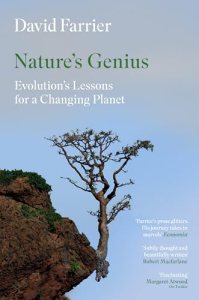 Farrier’s Footprints, which tells the story of the human impact on the Earth, was one of my favourite books of 2020. This contains a similar blend of history, science, and literary points of reference (Farrier is a professor of literature and the environment at the University of Edinburgh), with past changes offering a template for how the future might look different. “We are forcing nature to reimagine itself, and to avert calamity we need to do the same,” he writes. Cliff swallows have evolved blunter wings to better evade cars; captive breeding led foxes to develop the domesticated traits of pet dogs.
It’s not just other species that experience current evolution. Thanks to food abundance and a sedentary lifestyle, humans show a “consumer phenotype,” which superseded the Palaeolithic (95% of human history) and tends toward earlier puberty, autoimmune diseases, and obesity. Farrier also looks at notions of intelligence, language, and time in nature. Sustainable cities will have to cleverly reuse materials. For instance, The Waste House in Brighton is 90% rubbish. (This I have to see!)
There are many interesting nuggets here, and statements that are difficult to argue with, but I struggled to find an overall thread. Cool to see my husband’s old housemate mentioned, though. (Duncan Geere, for collaborating on a hybrid science–art project turning climate data into techno music.)
With thanks to Canongate for the free copy for review.
The Dry Season: Finding Pleasure in a Year without Sex by Melissa Febos
Febos considers but rejects the term “sex addiction” for the years in which she had compulsive casual sex (with “the Last Man,” yes, but mostly with women). Since her early teen years, she’d never not been tied to someone. Brief liaisons alternated with long-term relationships: three years with “the Best Ex”; two years that were so emotionally tumultuous that she refers to the woman as “the Maelstrom.” It was the implosion of the latter affair that led to Febos deciding to experiment with celibacy, first for three months, then for a whole year. “I felt feral and sad and couldn’t explain it, but I knew that something had to change.”
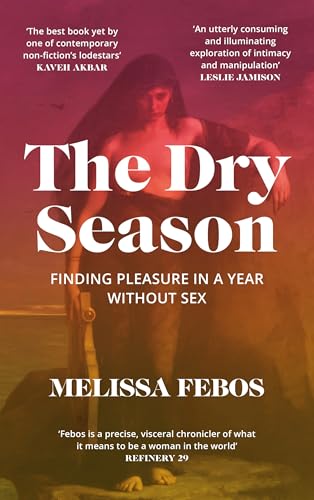 The quest involved some research into celibate movements in history, but was largely an internal investigation of her past and psyche. Febos found that she was less attuned to the male gaze. Having worn high heels almost daily for 20 years, she discovered she’s more of a trainers person. Although she was still tempted to flirt with attractive women, e.g. on an airplane, she consciously resisted the impulse to spin random meetings into one-night stands. (A therapist had stopped her short with the blunt observation, “you use people.”) With a new focus on the life of the mind, she insists, “My life was empty of lovers and more full than it had ever been.” (This reminded me of Audre Lorde’s writing on the erotic.) As Silvana Panciera, an Italian scholar on the beguines (a secular nun-like sisterhood), told her: “When you don’t belong to anyone, you belong to everyone. You feel able to love without limits.”
Intriguing that this is all a retrospective, reflecting on her thirties; Febos is now in her mid-forties and married to a woman (poet Donika Kelly). Clearly she felt that it was an important enough year – with landmark epiphanies that changed her and have the potential to help others – to form the basis for a book. For me, she didn’t have much new to offer about celibacy, though it was interesting to read about the topic from an areligious perspective. But I admire the depth of her self-knowledge, and particularly her ability to recreate her mindset at different times. This is another one, like her Girlhood, to keep on the shelf as a model.
With thanks to Canongate for the free copy for review.
Lifelines: Searching for Home in the Mountains of Greece by Julian Hoffman
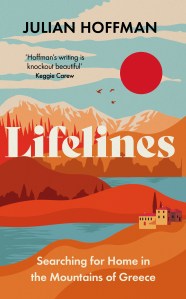 Hoffman’s Irreplaceable was my nonfiction book of 2019. Whereas that was a work with a global environmentalist perspective, Lifelines is more personal in scope. It tracks the author’s unexpected route from Canada via the UK to Prespa, a remote area of northern Greece that’s at the crossroads with Albania and North Macedonia. He and his wife, Julia, encountered Prespa in a book and, longing for respite from the breakneck pace of life in London, moved there in 2000. “Like the rivers that spill into these shared lakes, lifelines rarely flow straight. Instead, they contain bends, meanders and loops; they hold, at times, turns of extraordinary surprise.” Birdwatching, which Hoffman suggests is as “a way of cultivating attention,” had been their gateway into a love for nature developed over the next quarter-century and more, and in Greece they delighted in seeing great white and Dalmatian pelicans (which feature on the splendid U.S. cover. It would be lovely to have an illustrated edition of this.)
 One strand of this warm and fluent memoir is about making a home in Greece: buying and renovating a semi-derelict property, experiencing xenophobia and hospitality from different quarters, and finding a sense of belonging. They’re happy to share their home with nesting wrens, who recur across the book and connect to the tagline of “a story of shelter shared.” In probing the history of his adopted country, Hoffman comes to realise the false, arbitrary nature of borders – wildlife such as brown bears and wolves pay these no heed. Everything is connected and questions of justice are always intersectional. The Covid pandemic and avian influenza (which devastated the region’s pelicans) are setbacks that Hoffman addresses honestly. But the lingering message is a valuable one of bridging divisions and learning how to live in harmony with other people – and with other species.
With thanks to Elliott & Thompson for the free copy for review.
Joyride by Susan Orlean
As a long-time staff writer for The New Yorker, Orlean has had the good fortune to be able to follow her curiosity wherever it leads, chasing the subjects that interest her and drawing readers in with her infectious enthusiasm. She grew up in suburban Ohio, attended college in Michigan, and lived in Portland, Oregon and Boston before moving to New York City. Her trajectory was from local and alternative papers to the most enviable of national magazines: Esquire, Rolling Stone and Vogue. Orlean gives behind-the-scenes information on lots of her early stories, some of which are reprinted in an appendix. “If you’re truly open, it’s easy to fall in love with your subject,” she writes; maintaining objectivity could be difficult, as when she profiled an Indian spiritual leader with a cult following; and fended off an interviewee’s attachment when she went on the road with a Black gospel choir.
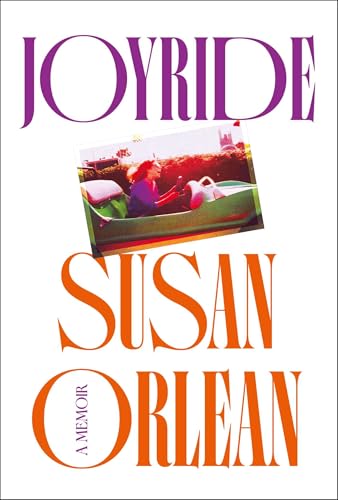 Her personal life takes a backseat to her career, though she is frank about the breakdown of her first marriage, her second chance at love and late motherhood, and a surprise bout with lung cancer. The chronological approach proceeds book by book, delving into her inspirations, research process and publication journeys. Her first book was about Saturday night as experienced across America. It was a more innocent time, when subjects were more trusting. Orlean and her second husband had farms in the Hudson Valley of New York and in greater Los Angeles, and she ended up writing a lot about animals, with books on Rin Tin Tin and one collecting her animal pieces. There was also, of course, The Library Book, about the wild history of the main Los Angeles public library. But it’s her The Orchid Thief – and the movie (not) based on it, Adaptation – that’s among my favourites, so the long section on that was the biggest thrill for me. There are also black-and-white images scattered through.
It was slightly unfortunate that I read this at the same time as Book of Lives – who could compete with Margaret Atwood? – but it is, yes, a joy to read about Orlean’s writing life. She’s full of enthusiasm and good sense, depicting the vocation as part toil and part magic:
“I find superhuman self-confidence when I’m working on a story. The bashfulness and vulnerability that I might otherwise experience in a new setting melt away, and my desire to connect, to observe, to understand, powers me through.”
“I like to do a gut check any time I dismiss or deplore something I don’t know anything about. That feels like reason enough to learn about it.”
“anything at all is worth writing about if you care about it and it makes you curious and makes you want to holler about it to other people”
With thanks to Atlantic Books for the free copy for review.
No Paradise with Wolves: A Journey of Rewilding and Resilience by Katie Stacey
I had the good fortune to visit Wild Finca, Luke Massey and Katie Stacey’s rewilding site in Asturias, while on holiday in northern Spain in May 2022, and was intrigued to learn more about their strategy and experiences. This detailed account of the first four years begins with their search for a property in 2018 and traces the steps of their “agriwilding” of a derelict farm: creating a vegetable garden and tending to fruit trees, but also digging ponds, training up hedgerows, and setting up rotational grazing. Their every decision went against the grain. Others focussed on one crop or type of livestock while they encouraged unruly variety, keeping chickens, ducks, goats, horses and sheep. Their neighbours removed brush in the name of tidiness; they left the bramble and gorse to welcome in migrant birds. New species turned up all the time, from butterflies and newts to owls and a golden fox.
Luke is a wildlife guide and photographer. He and Katie are conservation storytellers, trying to get people to think differently about land management. The title is a Spanish farmers’ and hunters’ slogan about the Iberian wolf. Fear of wolves runs deep in the region. Initially, filming wolves was one of the couple’s major goals, but they had to step back because staking out the animals’ haunts felt risky; better to let them alone and not attract the wrong attention. (Wolf hunting was banned across Spain in 2021.) There’s a parallel to be found here between seeing wolves as a threat and the mild xenophobia the couple experienced. Other challenges included incompetent house-sitters, off-lead dogs killing livestock, the pandemic, wildfires, and hunters passing through weekly (as in France – as we discovered at Le Moulin de Pensol in 2024 – hunters have the right to traverse private land in Spain).
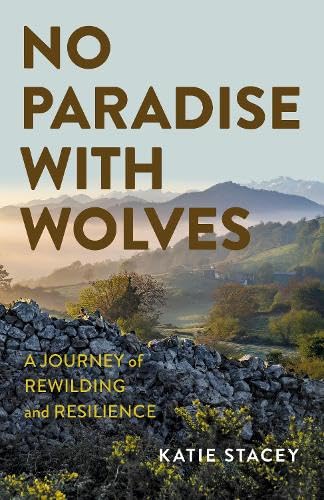
Luke and Katie hope to model new ways of living harmoniously with nature – even bears and wolves, which haven’t made it to their land yet, but might in the future – for the region’s traditional farmers. They’re approaching self-sufficiency – for fruit and vegetables, anyway – and raising their sons, Roan and Albus, to love the wild. We had a great day at Wild Finca: a long tour and badger-watching vigil (no luck that time) led by Luke; nettle lemonade and sponge cake with strawberries served by Katie and the boys. I was clear how much hard work has gone into the land and the low-impact buildings on it. With the exception of some Workaway volunteers, they’ve done it all themselves.
Katie Stacey’s storytelling is effortless and conversational, making this impassioned memoir a pleasure to read. It chimed perfectly with Hoffman’s writing (above) about the fear of bears and wolves, and reparation policies for farmers, in Europe. I’d love to see the book get a bigger-budget release complete with illustrations, a less misleading title, the thorough line editing it deserves, and more developmental work to enhance the literary technique – as in the beautiful final chapter, a present-tense recreation of a typical walk along The Loop. All this would help to get the message the wider reach that authors like Isabella Tree have found. “I want to be remembered for the wild spaces I leave behind,” Katie writes in the book’s final pages. “I want to be remembered as someone who inspired people to seek a deeper connection to nature.” You can’t help but be impressed by how much of a difference two people seeking to live differently have achieved in just a handful of years. We can all rewild the spaces available to us (see also Kate Bradbury’s One Garden against the World), too.
With thanks to Earth Books (Collective Ink) for the free copy for review.

Which of these do you fancy reading?
A Return to the Outer Hebrides & What I Read (Including 20 Books of Summer, 4–5)
Three summers ago, we first explored the Outer Hebrides, moving south from Lewis through Harris to North Uist and Benbecula. It took longer than expected to make it back to the Western Isles. (It’s also taken longer than expected to write up a trip we took in late June. My excuse is we’ve been having work done in the house for a couple of weeks and it’s thrown off routines, plus we’re now away again on a short break.) We kept our word and completed the southern half of the chain this year, staying on South Uist and journeying via Eriskay to Barra and Vatersay. As last time, we combined public transport and car rental. Unlike last time, we had no major transport disasters. We took the train up to Edinburgh, where we rented a car and headed first of all to the edge of the Cairngorms. The village had little to offer apart from riverside scenery, so while my husband did beetle-collecting fieldwork nearby, I spent my time reading in the idyllic B&B grounds. Here the wildlife came to me: seven stags and a red squirrel! I’ve substituted in two of my relevant trip reads to my 20 Books of Summer roster.
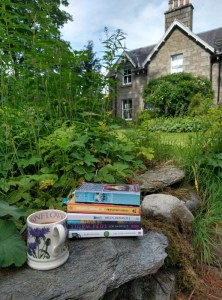
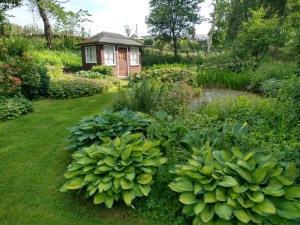
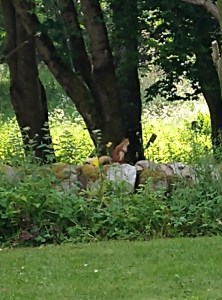
20 Books of Summer, #4
The Cone-Gatherers by Robin Jenkins (1955)
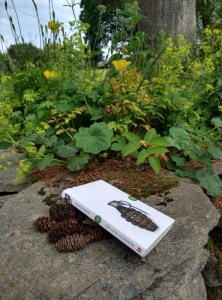
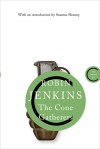 Rightly likened to Of Mice and Men, this is an engrossing short novel about two brothers, Neil and Calum, tasked with climbing trees and gathering the pinecones of a wealthy Scottish estate. They will be used to replant the many woodlands being cut down to fuel the war effort. Calum, the younger brother, is physically and intellectually disabled but has a deep well of compassion for living creatures. He has unwittingly made an enemy of the estate’s gamekeeper, Duror, by releasing wounded rabbits from his traps. Much of the story is taken up with Duror’s seemingly baseless feud against the brothers – though we’re meant to understand that his bedbound wife’s obesity and his subsequent sexual frustration may have something to do with it – as well as with Lady Runcie-Campbell’s class prejudice. Her son, Roderick, is an unexpected would-be hero and voice of pure empathy. I read this quickly, with grim fascination, knowing tragedy was coming but not quite how things would play out. The introduction to Canongate’s Canons Collection edition is by actor Paul Giamatti, of all people. (Secondhand – Community Furniture Project, Newbury)
Then it was a several-hour drive to Oban to take our rescheduled ferry over to Lochboisdale in South Uist for the holiday proper to begin. With a six-night Airbnb stay booked in the home of a local woman, we relaxed into an unhurried pace of life. It’s more about the landscape than any particular indoor attractions here; during rainy spells we toured the excellent museum, tasted gin and rum at the North Uist (Downpour) and Benbecula (MacMillan Spirits) distilleries, took advantage of 5 for £1 books and CDs at the Benbecula thrift shop, and tried a couple of cafes, but for the most part we just made a few short excursions per day.


-
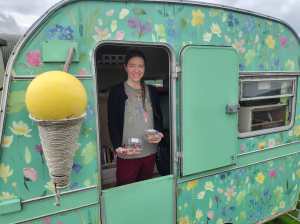
- Honesty box with cakes
-
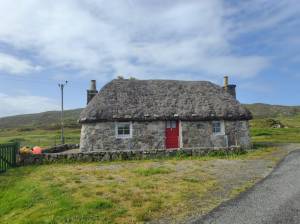
- Photos by Chris Foster
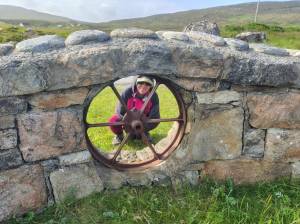
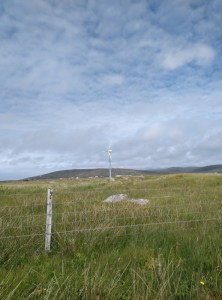
We saw acres of machair (wildflower-rich fields), sand dunes undermined by an empire of rabbits, deserted beaches, and rare patches of woodland. We successfully staked out white-tailed sea eagles, red-throated divers, and a red-necked phalarope; watched cuckoos and short-eared owls (who are active in the daytime) as much as possible; and stared at every likely sea loch but failed to find an otter. Each evening we’d heat up a simple supper – pouches of curry and rice; ravioli with tomato sauce – using the microwave and hob. In quite a contrast to the heatwave-mired south of England, we had 12–16 degrees C (54–61 degrees F) most days, with light rain and high winds. The radiators and Rayburn (a big stove like an Aga) were on most of the time.


20 Books of Summer, #5
The Inn at the Edge of the World by Alice Thomas Ellis (1990)
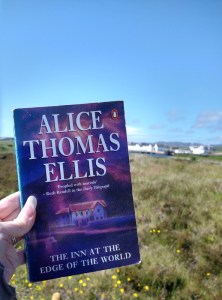 Eric and Mabel moved from the Midlands to run a hotel on a remote Scottish island. He places an advertisement in select London periodicals to lure in some Christmas-haters for the holidays and attracts a motley group: a bereaved former soldier writing a biography of General Gordon, a pair of actors known only for commercials, a psychoanalyst, and a department store buyer looking for a novel sweater pattern. Mabel decides she’s had enough and flees the island just as the guests start arriving. One guest is stalking another; one has history on the island. And all along, there are hints that this is a site of major selkie activity. I found it jarring how the novella moved from Shena Mackay-like social comedy into magic realism and doubt I’ll read more by Ellis (I’d already read one volume of Home Life), though this was light and enjoyable enough. (Secondhand – Awesomebooks.com)
I was pleased that I managed to find two relevant hyperlocal reads. It was so neat to encounter the same place names out the car window and in my books:
To the Edge of the Sea: Schooldays of a Crofter’s Child by Christina Hall (1995)
Hall’s father inherited a South Uist croft and the family struggled so much financially that she was sent to live with her schoolteacher aunts on Benbecula and then Barra. Some things haven’t changed on the islands, such as the rabbits on the machair and the notoriously choppy ferry rides back to the mainland, where she attended a convent school at Fort William. There are some enjoyable pen portraits, such as of an Irish peddler. The most memorable incident was when she ran away from the aunts’ to attend a family wedding on Benbecula. The tone is pleasant, reminiscent of early Diana Athill and Doreen Tovey, but this isn’t one to pick up unless you have a particular interest in the places described. (Public library)
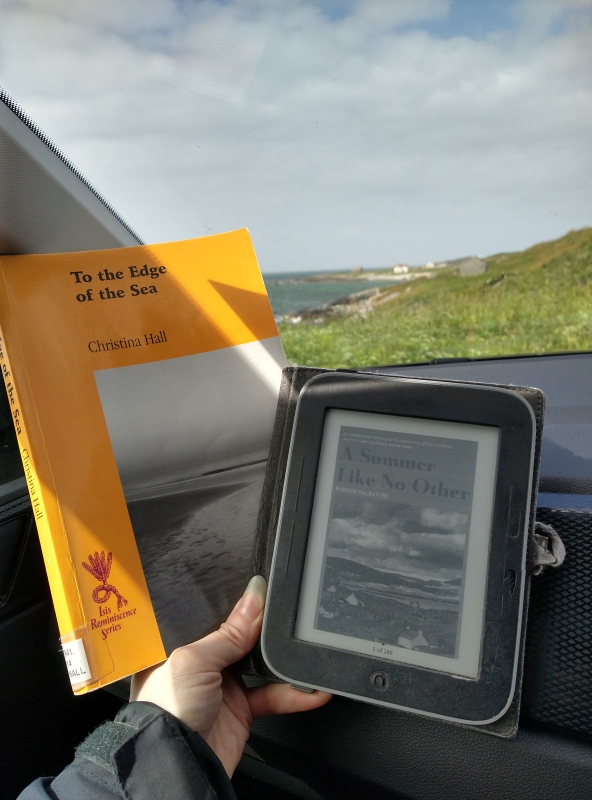
A Summer Like No Other by Martin MacIntyre (2018; 2025)
As World Cup fever ramps up in the summer of 1978, aimless 20-year-old Colin Quinn breaks from his university studies to shadow his uncle, Dr. Ruairidh Gillies, during his locum on South Uist. Between the home medical visits and recording folktales and songs by an eighty-something bard and several other members of the community, Colin gets to know almost everyone – but the person he knows the least well is himself. His involvement with the bard’s great-niece and her abusive husband will change the tenor of the summer for him, and have lasting consequences that only become clear decades later.
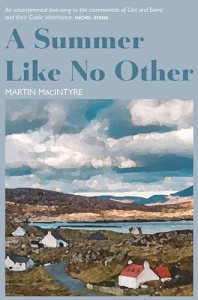 The many Gaelic phrases, defined in footnotes, help to create the atmosphere. The chapter epigraphs from the legend of Oisín (son of Fionn Mac Cumhaill) and Tír Na nÓg, the land of eternal youth, heighten the contrast between Colin’s idealism and the reality of this life-changing season. I think this is the first book I’ve read that was originally published in Gaelic and I hope it will find readers far beyond its island niche. (BookSirens)
There’s Something about Mary
My husband would like it known that he was the clever clogs who spotted a theme to our trip: Mary.
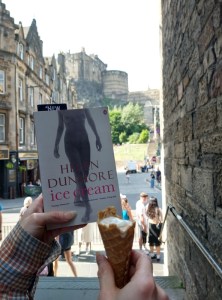 1) Our transit through Edinburgh was brief and muggy, but we made sure to leave just enough time to queue for cones at Mary’s Milk Bar, which has the most interesting flavours you’ll find anywhere. Pictured, though half eaten, are my one scoop of Earl Grey and peach sorbet and one scoop of fig and cardamom ice cream. When we returned to Edinburgh to return the car at the end of our trip, I took the train home by myself but C stayed on for a conference, during which he treated himself to another round at Mary’s.
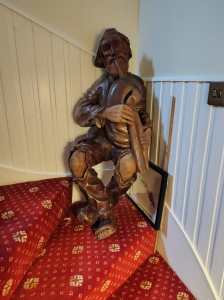
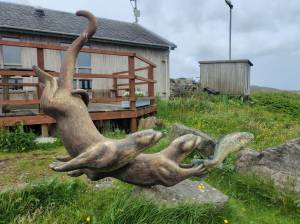
A piper statue at the Airbnb that continually frightened us on the stairs.
2) Our South Uist host was Mary MacInnes, a major mover and shaker in the local Gaelic-speaking community. (Her Alexa even obeyed Gaelic commands.) She is a retired head teacher of one of the schools and had various grandchildren popping in and out. Thanks to her heads-up, we had a unique cultural experience: a local arts venue’s lunchtime ceilidh of live music that was being filmed for BBC Scotland. Between her and others, we heard a lot of spoken Gaelic and got further into the mood by finding Julie Fowlis’s Gaelic-language albums online and playing them in our rental car. Each morning, Mary served us breakfast. We made the mistake of answering “Yes” to the question “D’ye take porridge?” on the first morning and had to slog through a stodgy bowl for five of the next six days. However, she also produced fresh-baked scones on two days and that made up for it. Triangular and baked in a cast-iron skillet, they tasted more like soda bread and were a perfect snack with jam.
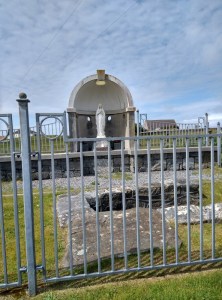
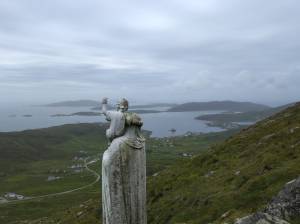
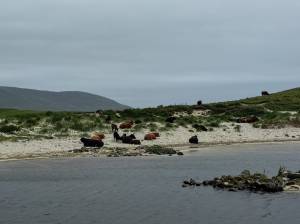
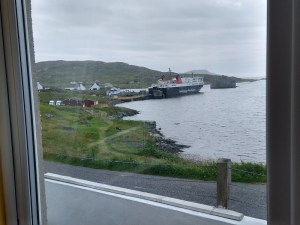
3) The final full day of our trip was spent on Barra, a quick hop from South Uist. Whereas Lewis and Harris are staunchly Protestant, the southern islands are Catholic. We’d found a roadside shrine on South Uist, and on this late June day we devoted a couple of hours to climbing up Heaval, Barra’s highest hill as far as the statue of Mary, Star of the Sea. We were taken with this round, rugged island of secluded coves and beach-lounging cows; I can imagine going back to spend more time there. (I’d also like to see a bit more of Eriskay, from which our ferry departed and where the shipwreck that inspired Whisky Galore – one to read next time – took place.) Our hostel room overlooked the harbour where our ferry for the mainland was docked, which was handy as we had to be in the queue by 6:10 the next morning.
My additional reasonably local or otherwise relevant reading:
Four Ducks on a Pond: A Highland Memory by Nicholas the Cat with Annabel Carothers (2010)
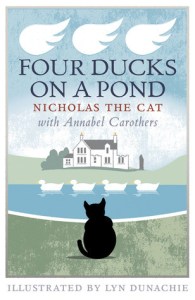 A quaint short memoir set in the 1950s on the island of Mull (which we sailed past on our way to and from the Outer Hebrides). It’s narrated in tongue-in-cheek fashion by Nicholas the Cat, who pals around with the farm’s dogs, horse and goats and comments on the doings of its human inhabitants, such as “Puddy” (Carothers), a war widow, and her daughter Fionna, who goes away to school. “We understand so much about them, yet they understand so little about us,” he opines. Indeed, the animals are all observant and can communicate with each other. Corrieshellach is a fine horse taken to compete in shows. The goats are lucky to escape with their lives after a local outbreak of foot-and-mouth disease among livestock. Nicholas grows fat on rabbits and fathers several litters. He voices some traditional views (the Clearances: bad but the Empire: good; crows: bad); then again, cats would certainly be C/conservatives. A sweet Blyton-esque read for precocious children or sentimental adults, this passed the time nicely on a long drive. It could do with a better title, though; the ducks only play a tiny role. (Favourite aside: “that beverage which humans find so comforting when things aren’t right. Tea.”) (Secondhand – Benbecula thrift shop)
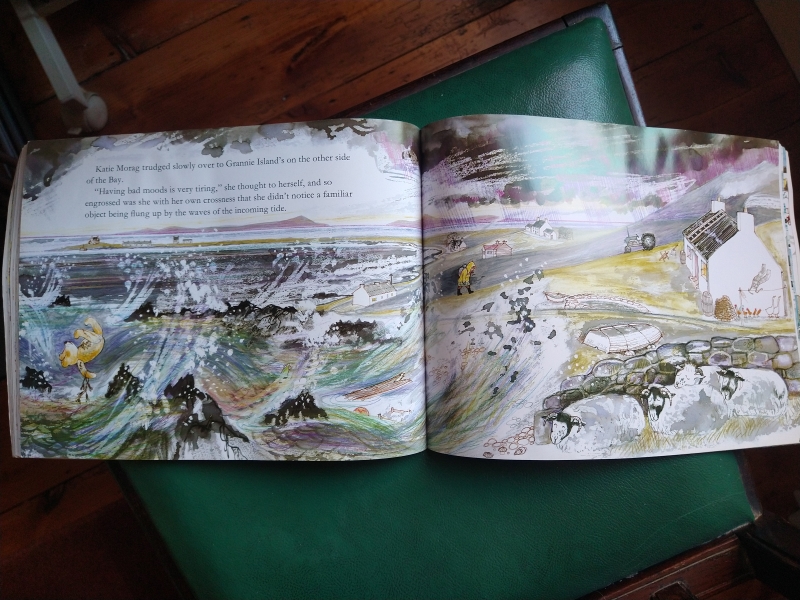
Katie Morag’s Island Stories by Mairi Hedderwick (1995)
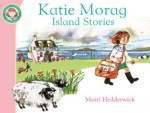 I read half of this large-format paperback before our trip and the rest afterward. It collects four of Hedderwick’s picture books, which are all set on the Isle of Struay, a kind of Hebridean composite that reproduces the islands’ wildlife and scenery beautifully. Katie Morag’s parents run the shop and post office and her mother always seems to be producing another little brother. In Katie Morag Delivers the Mail, the little red-haired girl causes chaos by delivering parcels at random. Sophisticated Granma Mainland and practical Grannie Island are the stars of Katie Morag and the Two Grandmothers. Katie Morag learns to deal with her anger and with being punished, respectively, in …and the Tiresome Ted and …and the Big Boy Cousins. Cute stories with useful lessons, but the illustrations are the main attraction. I’ll get the rest of the books out from the library. (Little Free Library)
Island Calling by Francesca Segal (2025)
The sequel to Welcome to Glorious Tuga, which I reviewed for Shelf Awareness last year. Charlotte Walker is a tortoise researcher who becomes the default veterinarian on this remote South Atlantic island that combines a 1950s English ethos with a cosmopolitan heritage from sailors and settlers. In this volume, Charlotte resolves her troubled love triangle and cements her understanding of her father’s identity. But the main thing that happens is that her posh and entitled mother, Lucinda Compton-Neville, takes a break from her busy job as a QC to travel to the island and demand that Charlotte return to London with her. Motherhood is a strong theme throughout: Natalie Lindo, already a mother of four, has to decide what to do about a high-risk pregnancy; half-feral Annie Goss rejects her mother’s affection, and so on. Some of the characters are lovably quirky, but overall I find the cliché-laden series lackluster, a pointless and indulgent side-track and thus a real waste of talent by Segal (after The Innocents and Mother Ship, especially). If you enjoy romance novels or escapist beach reads, you might feel differently. But I won’t bother reading the third volume.
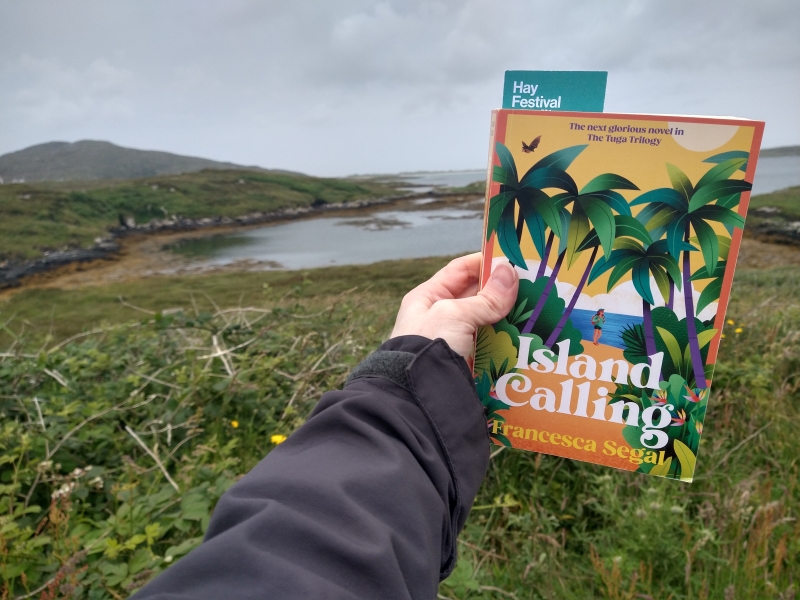
With thanks to Chatto & Windus (Penguin) for the proof copy for review.
I also made good progress on Storm Pegs by Jen Hadfield, a memoir of life in Shetland – different islands with their own character, but still fitting the hardy Scottish spirit.
I’d finished my first 7 Books of Summer by the end of June, so I was on track as of then. (Reviews of two more coming up on Friday.) I’m in the middle of some designated reads, but it’ll be ages before I finish any. I’ll hope to review another batch by the end of July.
Book Serendipity, Mid-April to Mid-June
I call it “Book Serendipity” when two or more books that I read at the same time or in quick succession have something in common – the more bizarre, the better. This is a regular feature of mine every couple of months. Because I usually have 20–30 books on the go at once, I suppose I’m more prone to such incidents. People frequently ask how I remember all of these coincidences. The answer is: I jot them down on scraps of paper or input them immediately into a file on my PC desktop; otherwise, they would flit away!
The following are in roughly chronological order.
- Raising a wild animal but (mostly) calling it by its species rather than by a pet name (so “Pigeon” and “the leveret/hare”) in We Should All Be Birds by Brian Buckbee and Raising Hare by Chloe Dalton.
- Eating hash cookies in New York City in Women by Chloe Caldwell and How to Be Somebody Else by Miranda Pountney.
- A woman worries she’s left underclothes strewn about a room she’s about to show someone in one story of Single, Carefree, Mellow by Katherine Heiny and Days of Light by Megan Hunter.
 The dialogue is italicized in Women by Chloe Caldwell and Days of Light by Megan Hunter.
- The ‘you know it when you see it’ definition (originally for pornography) is cited in Moderation by Elaine Castillo and Bookish by Lucy Mangan.
- Women (including the protagonist) weightlifting in a gym in Moderation by Elaine Castillo and All Fours by Miranda July.
- Miranda July, whose All Fours I was also reading at the time, was mentioned in Chinese Parents Don’t Say I Love You by Candice Chung.
- A sibling story and a mystical light: late last year into early 2025 I read The Snow Queen by Michael Cunningham, and then I recognized this type of moment in Days of Light by Megan Hunter.
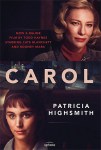
- A lesbian couple with a furniture store in Carol [The Price of Salt] by Patricia Highsmith and one story of Are You Happy? by Lori Ostlund.

- Not being able to see the stars in Las Vegas because of light pollution was mentioned in The Wild Dark by Craig Childs, then in Moderation by Elaine Castillo.
- A gynaecology appointment scene in All Fours by Miranda July and How to Be Somebody Else by Miranda Pountney.
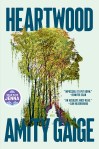
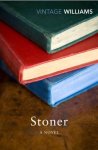
- An awkwardly tall woman in Heartwood by Amity Gaige, How to Be Somebody Else by Miranda Pountney, and Stoner by John Williams.
- The 9/11 memorial lights’ disastrous effect on birds is mentioned in The Wild Dark by Craig Childs and How to Be Somebody Else by Miranda Pountney.
- A car accident precipitated by an encounter with wildlife is key to the denouement in the novellas Women by Chloe Caldwell and Wild Boar by Hannah Lutz.
- The plot is set in motion by the death of an older brother by drowning, and pork chops are served to an unexpected dinner guest, in Bug Hollow by Michelle Huneven and Days of Light by Megan Hunter, both of which I was reading for Shelf Awareness review.
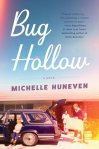
- Kids running around basically feral in a 1970s summer, and driving a box of human ashes around in Case Histories by Kate Atkinson and Bug Hollow by Michelle Huneven.
- A character becomes a nun in Case Histories by Kate Atkinson and Days of Light by Megan Hunter.
- Wrens nesting just outside one’s front door in Lifelines by Julian Hoffman and Little Mercy by Robin Walter.

- ‘The female Woody Allen’ is the name given to a character in Women by Chloe Caldwell and then a description (in a blurb) of French author Nolwenn Le Blevennec.
- A children’s birthday party scene in Single, Carefree, Mellow by Katherine Heiny and Friends and Lovers by Nolwenn Le Blevennec. A children’s party is also mentioned in Case Histories by Kate Atkinson and A Family Matter by Claire Lynch.
- A man who changes his child’s nappies, unlike his father – evidence of different notions of masculinity in different generations, in Case Histories by Kate Atkinson, What My Father and I Don’t Talk About, edited by Michele Filgate, and one piece in Beyond Touch Sites, edited by Wendy McGrath.
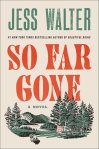
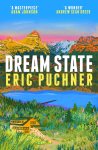
- What’s in a name? Repeated names I came across included Pansy (Case Histories by Kate Atkinson and Days of Light by Megan Hunter), Olivia (Case Histories by Kate Atkinson and A Family Matter by Claire Lynch), Jackson (Case Histories by Kate Atkinson and So Far Gone by Jess Walter), and Elias (Good Girl by Aria Aber and Dream State by Eric Puchner).
- The old wives’ tale that you should run in zigzags to avoid an alligator appeared in Alligator Tears by Edgar Gomez and then in The Girls Who Grow Big by Leila Mottley, both initially set in Florida.
- A teenage girl is groped in a nightclub in Good Girl by Aria Aber and Girl, 1983 by Linn Ullmann.
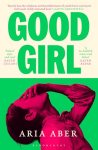
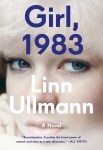
- Discussion of the extinction of human and animal cultures and languages in both Nature’s Genius by David Farrier and Lifelines by Julian Hoffman, two May 2025 releases I was reading at the same time.
- In Body: My Life in Parts by Nina B. Lichtenstein, she mentions Linn Ullmann – who lived on her street in Oslo and went to the same school (not favourably – the latter ‘stole’ her best friend!); at the same time, I was reading Linn Ullmann’s Girl, 1983! And then, in both books, the narrator recalls getting a severe sunburn.
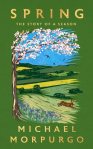 On the same day, I read about otter sightings in Lifelines by Julian Hoffman and Spring by Michael Morpurgo. The next day, I read about nesting swallows in both books.
- The Salish people (Indigenous to North America) are mentioned in Lifelines by Julian Hoffman, Dream State by Eric Puchner (where Salish, the town in Montana, is also a setting), and So Far Gone by Jess Walter.
- Driving into a compound of extremists, and then the car being driven away by someone who’s not the owner, in Dream State by Eric Puchner and So Far Gone by Jess Walter.
- A woman worries about her (neurodivergent) husband saying weird things at a party in The Honesty Box by Lucy Brazier and Normally Weird and Weirdly Normal by Robin Ince.
- Shooting raccoons in Ginseng Roots by Craig Thompson and So Far Gone by Jess Walter. (Raccoons also feature in Dream State by Eric Puchner.)
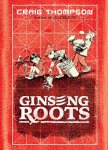
- A graphic novelist has Hollywood types adding (or at least threatening to add) wholly unsuitable supernatural elements to their plots in Spent by Alison Bechdel and Ginseng Roots by Craig Thompson.
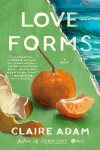
- A novel in which a character named Dawn has to give up her daughter in the early 1980s, one right after the other: A Family Matter by Claire Lynch, followed by Love Forms by Claire Adam.
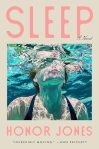
- A girl barricades her bedroom door for fear of her older brother in Love Forms by Claire Adam and Sleep by Honor Jones.
- A scene of an only child learning that her mother had a hysterectomy and so couldn’t have any more children in Dream Count by Chimamanda Ngozi Adichie and Other People’s Mothers by Julie Marie Wade.
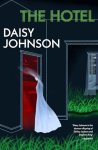
- An African hotel cleaner features in Dream Count by Chimamanda Ngozi Adichie and The Hotel by Daisy Johnson.

- Annie Dillard’s essay “Living Like Weasels” is mentioned in Nature’s Genius by David Farrier and The Dry Season by Melissa Febos.
- A woman assembles an inventory of her former lovers in Dream Count by Chimamanda Ngozi Adichie and The Dry Season by Melissa Febos.
What’s the weirdest reading coincidence you’ve had lately?
Adventuring (and Reading) in the Outer Hebrides
Islands are irresistible for the unique identities they develop through isolation, and the extra effort that it often takes to reach them. Over the years, my husband and I have developed a special fondness for Britain’s islands – the smaller and more remote the better. After exploring the Inner Hebrides in 2005 and Orkney and Shetland in 2006, we always intended to see more of Scotland’s islands; why ever did we leave it this long?

From Wikimedia Commons. By Kelisi.
Rail strikes and cancelled trains threatened our itinerary more than once, so it was a relief that we were able to go, even at extra cost. Our back-up plan left us with a spare day in Inverness, which we filled with coffee and pastries outside the cathedral, browsing at Leakey’s bookshop, walking along the River Ness and in the botanical gardens, and a meal overlooking the 19th-century castle.


Then it was on to the Outer Hebrides at last, via a bus ride and then a ferry to Stornoway in Lewis, the largest settlement in the Western Isles. Here we rented a car for a week to allow us to explore the islands at will. We were surprised at how major a town Stornoway is, with a big supermarket and slight suburban sprawl – yet it was dead on the Saturday morning we went in to walk around; not until 11:30 was there anything like the bustle we expected.
We’d booked three nights in a tiny Airbnb house 15 minutes from the capital. First up on our tourist agenda was Callanish stone circle, which we had to ourselves (once the German coach party left). Unlike at Stonehenge, you can walk in among the standing stones. The rest of our time on Lewis went to futile whale watching, the castle grounds, and beach walks.


This post threatens to become a boring rundown, so I’ll organize the rest thematically, introduced by songs by Scottish artists.
“I’ll Always Leave the Light On” by Kris Drever
Long days: The daylight lasts longer so far north, so each day we could plan activities not just for the morning and afternoon but late into the evening. At our second stop – three nights in another Airbnb on North Uist – we took walks after dinner, often not coming back until 10 p.m., at which point there was still another half-hour until sunset.
“Why Does It Always Rain on Me?” by Travis
Weather: We got a mixture of sun and clouds. It rained at least a bit on most days, and we got drenched twice, walking out to an eagle observatory on Harris (where we saw no eagles, as they are too sensible to fly in the rain) and dashing back to the car from a coastal excursion. I was doomed to wearing plastic bags around my feet inside my disintegrating hiking boots for the rest of the trip. There was also a strong wind much of the time, which made it feel colder than the temperature suggested – I often wore my fleece and winter hat.

A witty approach to weather forecasting. (Outside the shop/bistro on Berneray.)
“St Kilda Wren” by Julie Fowlis
 Music and language: Julie Fowlis is a singer from North Uist who records in English and Gaelic. (This particular song is in Gaelic, but the whole Spell Songs album was perfect listening on our drives because of the several Scottish artists involved and the British plants and animals sung about.) There is a strong Gaelic-speaking tradition in the Western Isles. We heard a handful of people speaking it, all road signs give place names in Gaelic before the English translation, and there were several Gaelic pages in the free newspaper we picked up.
Wildlife: The Outer Hebrides is a bastion for some rare birds: the corncrake, the red-necked phalarope, and both golden and white-tailed eagles. Thanks to intel gleaned from Twitter, my husband easily found a phalarope swimming in a small roadside loch. Corncrakes hide so well they are virtually impossible to see, but you will surely hear their rasping calls from the long grass. Balranald is the westernmost RSPB reserve and a wonderful place to hear corncrakes and see seabirds flying above the machair (wildflower-rich coastal grassland). No golden eagles, but we did see a white-tailed eagle flying over our accommodation on our last day, and short-eared owls were seemingly a dime a dozen. We were worried we might see lots of dead birds on our trip due to the avian flu raging, but there were only five – four gannets and an eider – and a couple looked long dead. Still, it’s a distressing situation.


We also attended an RSPB guided walk to look for otters and did indeed spot one on a sea loch. It happened to be the Outer Hebrides Wildlife Festival week. Our guide was knowledgeable about the geography and history of the islands as well.

Badges make great, cheap souvenirs!
St. Kilda: This uninhabited island really takes hold of the imagination. It can still be visited, but only via a small boat through famously rough seas. We didn’t chance it this time. I might never get there, but I enjoy reading about it. There’s a viewing point on North Uist where one can see out to St. Kilda, but it was only the vaguest of outlines on the hazy day we stopped.
“Traiveller’s Joy” by Emily Smith
Additional highlights:
- An extended late afternoon tea at Mollans rainbow takeaway shed on Lewis. Many of the other eateries we’d eyed up in the guidebook were closed, either temporarily or for good – perhaps an effect of Covid, which hit just after the latest edition was published.


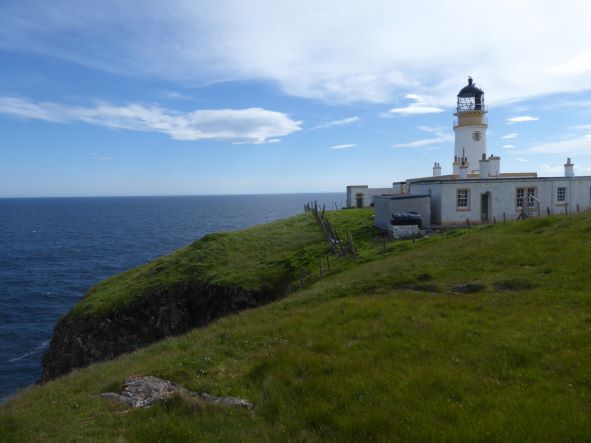
- A long reading session with a view by the Butt of Lewis, which has a Stevenson lighthouse.
- Watching mum and baby seals playing by the spit outside our B&B window on Berneray.
- Peat smoked salmon. As much of it as I could get.
- A G&T with Harris gin (made with kelp).
“Dear Prudence” (Beatles cover) by Lau
Surprises:
- Gorgeous, deserted beaches. This is Luskentyre on Harris.

- No midges to speak of. The Highlands are notorious for these biting insects, but the wind kept them away most of the time we were on the islands. We only noticed them in the air on one still evening, but they weren’t even bad enough to deploy the Avon Skin So Soft we borrowed from a neighbour.
- People still cut and burn peats for fuel. Indeed, when we stepped into the Harris gin distillery for a look around, I was so cold and wet that I warmed my hands by a peat fire! Even into the 1960s, people lived in primitive blackhouses, some of which have now been restored as holiday rentals. The one below is run as a museum.

- Not far outside Stornoway is the tiny town of Tong. We passed through it each day. Here Mary Anne MacLeod was born in 1912. If only she’d stayed on Lewis instead of emigrating to New York City, where she met Fred Trump and had, among other children, a son named Donald…
- Lord Leverhulme, founder of Unilever, bought Lewis in 1918 and part of Harris the next year. He tried to get crofters to work in his businesses, but all his plans met with resistance and his time there was a failure, as symbolized by this “bridge to nowhere” (Garry Bridge). His legacy is portrayed very differently here compared to in Port Sunlight, the factory workers’ town he set up in Merseyside.

- The most far-flung Little Free Library I’ve ever visited (on Lewis).

- Visits from Lulu the cat at our North Uist Airbnb.

“Wrapped Up in Books” by Belle and Sebastian
What I read: I aimed for lots of relevant on-location reads. I can’t claim Book Serendipity: reading multiple novels set on Scottish islands, it’s no surprise if isolation, the history of the Clearances, boat rides, selkies and seabirds recur. However, the coincidences were notable for one pair, Secrets of the Sea House by Elisabeth Gifford and Night Waking by Sarah Moss, a reread for me. I’ll review these two together, as well as The Summer of the Bear by Bella Pollen (inspired by a real incident that occurred on North Uist in 1980), in full later this week.

I also read about half of Sightlines by Kathleen Jamie, a reread for me; its essays on gannets and St. Kilda chimed with the rest of my reading. Marram, Leonie Charlton’s memoir of pony trekking through the Outer Hebrides, will form part of a later 20 Books of Summer post thanks to the flora connection, as will Jon Dunn’s Orchid Summer, one chapter of which involves a jaunt to North Uist to find a rare species.


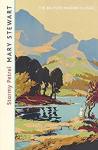 Stormy Petrel by Mary Stewart: My selection for the train journey up. I got Daphne du Maurier vibes from this short novel about a holiday Dr Rose Fenemore, an English tutor at Cambridge, takes to Moila, a (fictional) small island off of Mull in the Inner Hebrides. It’s a writing retreat for her: she’s working on a book of poetry, but also on the science fiction she publishes under a pseudonym. Waiting for her brother to join her, she gets caught up in mild intrigue when two mysterious men enter her holiday cottage late one stormy night. Each has a good excuse cooked up, but who can she trust? I enjoyed the details of the setting but found the plot thin, predictable and slightly silly (“I may be a dish, but I am also a don”). This feels like it’s from the 1950s, but was actually published in 1991. I might try another of Stewart’s.
I also acquired four books on the trip: one from the Little Free Library and three from Inverness charity shops.

I started reading all three in the bottom pile, and read a few more books on my Kindle, two of them for upcoming paid reviews. The third was:
 Tracy Flick Can’t Win by Tom Perrotta: A sequel to Election, which you might remember as a late-1990s Reese Witherspoon film even if you don’t know Perrotta’s fiction. Tracy Flick was the goody two-shoes student who ran for school president and had her campaign tampered with. Now in her forties, she’s an assistant principal at a high school and a single mother. Missing her late mother and wishing she’d completed law school, she fears she’ll be passed over for the top job when the principal retires. This is something of an attempt to update the author’s laddish style for the #MeToo era. Interspersed with the third-person narration are snappy first-person testimonials from Tracy, the principal, a couple of students, and the washed-up football star the school chooses to launch its new Hall of Fame. I can’t think of any specific objections, but nor can I think of any reason why you should read this.
On my recommendation, my husband read Love of Country by Madeleine Bunting and The Frayed Atlantic Edge by David Gange, two excellent nonfiction books about Britain’s islands and coastline.
“Other Side of the World” by KT Tunstall
General impressions: We weren’t so taken with Lewis on the whole, but absolutely loved what we saw of Harris on our drive to the ferry to Berneray and wished we’d allotted it more time. While we only had one night on Berneray and mostly saw it in the rain, we thought it a lovely little place. It only has the one shop, which doubles as the bistro in the evenings – warned by the guidebook that this is the only place to eat on the island, we made our dinner reservation many weeks in advance. The following morning, as we ate our full Scottish cooked breakfast, I asked the B&B owner what led him to move from England to “the ends of the earth.” He took mild objection to my tossed-off remark and replied that the islands are more like “the heart of it all.” Thanks to fast Internet service, remote working is no issue.


We are more than half serious when we talk about moving to Scotland one day. We love Edinburgh, though the tourists might drive us mad, and enjoyed our time in Wigtown four years ago. I’d like to think we could even cope with island life in Orkney or the Hebrides. We imagine them having warm, tight-knit communities, but would newcomers feel welcome? With only one major supermarket in the whole Western Isles, would we find enough fresh fruit and veg? And however would one survive the bleakness of the winters?
North Uist captivated us right away, though. Within 15 minutes of driving onto the island via a causeway, we’d seen three short-eared owls and three red deer stags, and we got great views of hen harriers and other raptors. One evening we found ourselves under what seemed to be a raven highway. It felt unlike anywhere else we’d been: pleasingly empty of humans, and thus a wildlife haven.
The long journey home: The public transport nightmares of our return trip put something of a damper on the end of the holiday. We left the islands via a ferry to Skye, where we caught a bus. So far, so good. Our second bus, however, broke down in the middle of nowhere in the Highlands and the driver plus we five passengers were stuck for 3.5 hours awaiting a taxi we thought would never come. When it did, it drove the winding road at terrifying speed through the pitch black.
Grateful to be alive, we spent the following half-day in Edinburgh, bravely finding brunch, the botanic gardens and ice cream with our heavy luggage in tow. The final leg home, alas, was also disrupted when our overcrowded train to Reading was delayed and we missed the final connection to Newbury, necessitating another taxi – luckily, both were covered by the transport operators, and we’ll also reclaim for our tickets. Much as we believe in public transport and want to support it, this experience gave us pause. Getting to and around Spain by car was so much easier, and that trip ended up a lot cheaper, too. Ironic!

Guarding the bags in Edinburgh
“Take Me Back to the Islands” by Idlewild
Next time: On this occasion we only got as far south as Benbecula (which, pleasingly, is pronounced Ben-BECK-you-luh). In the future we’d think about starting at the southern tip and seeing Barra, Eriskay and South Uist before travelling up to Harris. We’ve heard that these all have their own personalities. Now, will we get back before many more years pass?
Short Nature Books for #NovNov by John Burnside, Jim Crumley and Aimee Nezhukumatathil
#NovNov meets #NonfictionNovember as nonfiction week of Novellas in November continues!
Tomorrow I’ll post my review of our buddy read for the week, The Story of My Life by Helen Keller (free from Project Gutenberg, here).
Today I review four nature books that celebrate marvelous but threatened creatures and ponder our place in relation to them.
Aurochs and Auks: Essays on Mortality and Extinction by John Burnside (2021)
[127 pages]
 I’ve read a novel, a memoir, and several poetry collections by Burnside. He’s a multitalented author who’s written in many different genres. These four essays are rich with allusions and chewy with philosophical questions. “Aurochs” traces ancient bulls from the classical world onward and notes the impossibility of entering others’ subjectivity – true for other humans, so how much more so for extinct animals. Imagination and empathy are required. Burnside recounts an incident from when he went to visit his former partner’s family cattle farm in Gloucestershire and a poorly cow fell against his legs. Sad as he felt for her, he couldn’t help.
“Auks” tells the story of how we drove the Great Auk to extinction and likens it to whaling, two tragic cases of exploiting species for our own ends. The second and fourth essays stood out most to me. “The hint half guessed, the gift half understood” links literal species extinction with the loss of a sense of place. The notion of ‘property’ means that land becomes a space to be filled. Contrast this with places devoid of time and ownership, like Chernobyl. Although I appreciated the discussion of solastalgia and ecological grief, much of the material here felt a rehashing of my other reading, such as Footprints, Islands of Abandonment, Irreplaceable, Losing Eden and Notes from an Apocalypse. Some Covid references date this one in an unfortunate way, while the final essay, “Blossom Ruins,” has a good reason for mentioning Covid-19: Burnside was hospitalized for it in April 2020, his near-death experience a further spur to contemplate extinction and false hope.
The academic register and frequent long quotations from other thinkers may give other readers pause. Those less familiar with current environmental nonfiction will probably get more out of these essays than I did, though overall I found them worth engaging with.
With thanks to Little Toller Books for the proof copy for review.
Kingfisher and Otter by Jim Crumley (2018)
[59 pages each]
Part of Crumley’s “Encounters in the Wild” series for the publisher Saraband, these are attractive wee hardbacks with covers by Carry Akroyd. (I’ve previously reviewed his The Company of Swans.) Each is based on the Scottish nature writer’s observations and serendipitous meetings, while an afterword gives additional information on the animal and its appearances in legend and literature.


An unexpected link between these two volumes was beavers, now thriving in Scotland after a recent reintroduction. Crumley marvels that, 400 years after their kind could last have interacted with beavers, otters have quickly gotten used to sharing rivers – to him this “suggests that race memory is indestructible.” Likewise, kingfishers gravitate to where beaver dams have created fish-filled ponds.
Kingfisher was, marginally, my preferred title from the pair. It sticks close to one spot, a particular “bend in the river” where the author watches faithfully and is occasionally rewarded by the sight of one or two kingfishers. As the book opens, he sees what at first looks like a small brown bird flying straight at him, until the head-on view becomes a profile that reveals a flash of electric blue. As the Gerard Manley Hopkins line has it (borrowed for the title of Alex Preston’s book on birdwatching), kingfishers “catch fire.” Lyrical writing and self-deprecating honesty about the necessity of waiting (perhaps in the soaking rain) for moments of magic made this a lovely read. “Colour is to kingfishers what slipperiness is to eels. … Vanishing and theory-shattering are what kingfishers do best.”
In Otter, Crumley ranges a bit more widely, prioritizing outlying Scottish islands from Shetland to Skye. It’s on Mull that he has the best views, seeing four otters in one day, though “no encounter is less than unforgettable.” He watches them playing with objects and tries to talk back to them by repeating their “Haah?” sound. “Everything I gather from familiar landscapes is more precious as a beholder, as a nature writer, because my own constant presence in that landscape is also a part of the pattern, and I reclaim the ancient right of my own species to be part of nature myself.”
From time to time we see a kingfisher flying down the canal. Some of our neighbors have also seen an otter swimming across from the end of the gardens, but despite our dusk vigils we haven’t been so lucky as to see one yet. I’ve only seen a wild otter once, at Ham Wall Nature Reserve in Somerset. One day, maybe there will be one right here in my backyard. (Public library)
World of Wonders: In Praise of Fireflies, Whale Sharks and Other Astonishments by Aimee Nezhukumatathil (2020)
[160 pages]
 Nezhukumatathil, a professor of English and creative writing at the University of Mississippi, published four poetry collections before she made a splash with this beautifully illustrated collection of brief musings on species and the self – this was shortlisted for the Kirkus Prize. Some of the 28 pieces spotlight an animal simply for how head-shakingly wondrous it is, like the dancing frog or the cassowary. More often, though, a creature or plant is a figurative vehicle for uncovering an aspect of her past. An example: “A catalpa can give two brown girls in western Kansas a green umbrella from the sun. Don’t get too dark … our mother would remind us as we ambled out into the relentless midwestern light.”
The author’s Indian/Filipina family moved frequently for her mother’s medical jobs, and sometimes they were the only brown people around. Loneliness, the search for belonging and a compulsion to blend in are thus recurrent themes. As an adult, traveling for poetry residencies and sabbaticals exposes her to new species like whale sharks. Childhood trips back to India allowed her to spend time among peacocks, her favorite animal. In the American melting pot, her elementary school drawing of a peacock was considered unacceptable, but when she featured a bald eagle and flag instead she won a prize.
These pinpricks of the BIPOC experience struck me more powerfully than the actual nature writing, which can be shallow and twee. Talking to birds, praising the axolotl’s “smile,” directly addressing the reader – it’s all very nice, but somewhat uninformed; while she does admit to sadness and worry about what we are losing, her sunny outlook seemed out of touch at times. On the one hand, it’s great that she wanted to structure her fragments of memoir around amazing animals; on the other, I suspect that it cheapens a species to only consider it as a metaphor for the self (a vampire squid or potoo = her desire to camouflage herself in high school; flamingos = herself and other fragile long-legged college students; a bird of paradise = the guests dancing the Macarena at her wedding reception).

My favorite pieces were one on the corpse flower and the bookend duo on fireflies – she hits just the right note of nostalgia and warning: “I know I will search for fireflies all the rest of my days, even though they dwindle a little bit more each year. I can’t help it. They blink on and off, a lime glow to the summer night air, as if to say, I am still here, you are still here.”
With thanks to Souvenir Press for the free copy for review.
Any nature books on your reading pile?
Local Resistance: On Gallows Down by Nicola Chester
It’s mostly by accident that we came to live in Newbury: five years ago, when a previous landlord served us notice, we viewed a couple of rental houses in the area to compare with what was available in Reading and discovered that our money got us more that little bit further out from London. We’ve come to love this part of West Berkshire and the community we’ve found. It may not be flashy or particularly famous, but it has natural wonders worth celebrating and a rich history of rebellion that Nicola Chester plumbs in On Gallows Down. A hymn-like memoir of place as much as of one person’s life, her book posits that the quiet moments of connection with nature and the rights of ordinary people are worth fighting for.
So many layers of history mingle here: from the English Civil War onward, Newbury has been a locus of resistance for centuries. Nicola* has personal memories of the long-running women’s peace camps at Greenham Common, once a U.S. military base and cruise missile storage site – to go with the Atomic Weapons Establishment down the road at Aldermaston. As a teenager and young woman, she took part in symbolic protests against the Twyford Down and Newbury Bypass road-building projects, which went ahead and destroyed much sensitive habitat and many thousands of trees. Today, through local and national newspaper and magazine columns on wildlife, and through her winsome nagging of the managers of the Estate she lives on, she bears witness to damaging countryside management and points to a better way.

While there is a loose chronological through line, the book is principally arranged by theme, with experiences linked back to historical or literary precedents. An account of John Clare and the history of enclosure undergirds her feeling of the precarity of rural working-class life: as an Estate tenant, she knows she doesn’t own anything, has no real say in how things are done, and couldn’t afford to move elsewhere. Nicola is a school librarian and has always turned to books and writing to understand the world. I particularly loved Chapter 6, about how she grounds herself via the literature of this area: Kenneth Grahame’s The Wind in the Willows, Adam Thorpe’s Ulverton, and especially Richard Adams’s Watership Down.
Whatever life throws at her – her husband being called up to fight in Iraq, struggling to make ends meet with small children, a miscarriage, her father’s unexpected death – nature is her solace. She describes places and creatures with a rare intimacy borne out of deep knowledge. To research a book on otters for the RSPB, she seeks out every bridge over every stream. She goes out “lamping” with the local gamekeeper after dark and garners priceless nighttime sightings. Passing on her passion to her children, she gets them excited about badger watching, fossil collecting, and curating shelves of natural history treasures like skulls and feathers. She also serves as a voluntary wildlife advocate on her Estate. For every victory, like the re-establishment of the red kite population in Berkshire and regained public access to Greenham Common, there are multiple setbacks, but she continues to be a hopeful activist, her lyrical writing a means of defiance.
We are writing for our very lives and for those wild lives we share this one, lonely planet with. Writing was also a way to channel the wildness; to investigate and interpret it, to give it a voice and defend it. But it was also a connection between home and action; a plank bridge between a domestic and wild sense. A way both to home and resist.
You know that moment when you’re reading a book and spot a place you’ve been or a landmark you know well, and give a little cheer? Well, every site in this book was familiar to me from our daily lives and countryside wanderings – what a treat! As I was reading, I kept thinking how lucky we are to have such an accomplished nature writer to commemorate the uniqueness of this area. Even though I was born thousands of miles away and have moved more than a dozen times since I settled in England in 2007, I feel the same sense of belonging that Nicola attests to. She explicitly addresses this question of where we ‘come from’ versus where we fit in, and concludes that nature is always the key. There is no exclusion here. “Anyone could make a place their home by engaging with its nature.”
*I normally refer to the author by surname in a book review, but I’m friendly with Nicola from Twitter and have met her several times (and she’s one of the loveliest people you’ll ever meet), so somehow can’t bring myself to be that detached!
On Gallows Down was released by Chelsea Green Publishing on October 7th. My thanks to the author and publisher for arranging a proof copy for review.
My husband and I attended the book launch event for On Gallows Down in Hungerford on Saturday evening. Nicola was introduced by Hungerford Bookshop owner Emma Milne-White and interviewed by Claire Fuller, whose Women’s Prize-shortlisted novel Unsettled Ground is set in a fictional version of the village where Nicola lives.
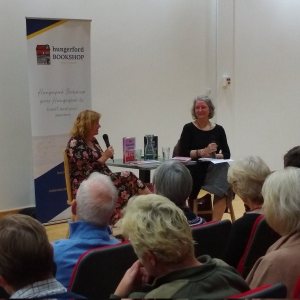
Nicola Chester and Claire Fuller. Photo by Chris Foster.
Nicola dated the book’s genesis to the moment when, 25 years ago, she queued up to talk to a TV news reporter about Newbury Bypass and froze. She went home and cried, and realized she’d have to write her feelings down instead. Words generally come to her at the time of a sighting, as she thinks about how she would tell someone how amazing it was.
Her memories are tied up with seasons and language, especially poetry, she said, and she has recently tried her hand at poetry herself. Asked about her favourite season, she chose two, the in-between seasons – spring for its abundance and autumn for its nostalgia and distinctive smells like tar spot fungus on sycamore leaves and ivy flowers.


A bonus related read:
Anarchipelago by Jay Griffiths (2007)
This limited edition 57-page pamphlet from Glastonbury-based Wooden Books caught my eye from the library’s backroom rolling stacks. Griffiths wrote her impish story of Newbury Bypass resistance in response to her time among the protesters’ encampments and treehouses. Young Roddy finds a purpose for his rebellious attitude wider than his “McTypical McSuburb” by joining other oddballs in solidarity against aggressive policemen and detectives.
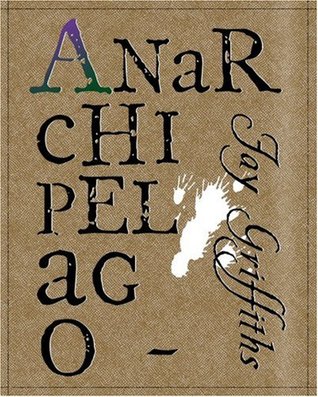
There are echoes of Ali Smith in the wordplay and rendering of accents.
“When I think of the road, I think of more and more monoculture of more and more suburbia. What I do, I do in defiance of the Louis Queasy Chintzy, the sickly stale air of suburban car culture. I want the fresh air of nature, the lifefull wind of the French revolution.”
In a nice spot of Book Serendipity, both this and On Gallows Down recount the moment when nature ‘fought back’ as a tree fell on a police cherry-picker. Plus Roddy is kin to the tree-sitting protesters in The Overstory by Richard Powers as well as another big novel I’m reading now, Damnation Spring by Ash Davidson.
 Bookish Beck = Rebecca Foster. American transplant to England. Freelance proofreader and book reviewer.
 Bookish Beck