Late Summer Novels (Bamford, Ellis, Hornak, King) & Poetry Collections for the Transition into Autumn (Hurst, McNish, Plath)
It’s been feeling autumnal for a few weeks now with the drizzle, chilly mornings and evenings, honking of geese overhead, and harvesting our last garden apples – though it remains warm and summer only officially ended on Monday. I’ve recently finished off a summer-titled trilogy and the second entry in a seasonal quartet. I’m also throwing in a couple fun novels I bought earlier in the year.
Before and after Tuesday’s autumn equinox, a few poetry collections have been my fitting companions for the start of a new season.
Idle Grounds by Krystelle Bamford (2025)
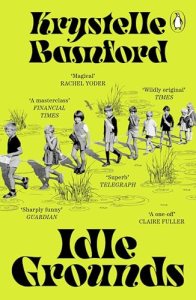 “The following is an account of an afternoon in June in which we sallied forth, and then, for the most part, back.” I was drawn in by the mock-heroic first-person plural voice of a gaggle of cousins at a New England family get-together. It’s 1989 and they’re here for one of the adults’ birthdays, but that’s of no concern to the kids, who are a world unto themselves. In the first chapter, three-year-old Abi goes missing and the rest set out on a quest to rescue her. The shed, the woods, a driveway full of cars, the river: every setting seems to offer adventure, but maybe also danger. And then the oldest boy cousin, Travis, vanishes too. “Intermezzo” chapters offer snippets of family lore – about their grandmother Beezy’s awful novel, The Lilac Swing, and so on – that don’t add much of interest to this meandering novella. To deliver on the promise of the narrative voice, Bamford needed to give her debut a little more: more intrigue, more pivotal scenes, more closeness to a few characters rather than surface descriptions of a bunch, maybe more pages to make something of the not-so-momentous family secrets. As it is, I had to agree with this tongue-in-cheek line on p. 136: “in our depleted state, we thought the very thought you’re thinking now, which is enough already.” (New purchase with voucher – Hungerford Bookshop)
Book 3 of The Summerhouse Trilogy
The Fly in the Ointment by Alice Thomas Ellis (1989)
{BEWARE SPOILERS!}
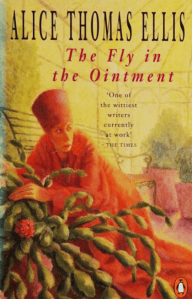 Following The Clothes in the Wardrobe (1987) and The Skeleton in the Cupboard (1988), this novella revisits the run-up to Margaret and Syl’s wedding from Lili’s perspective. It’s the shortest of the three books and adds no new plot details or real character insight, but Lili’s voice is alluring all the same. She’s an incorrigible flirt, or perhaps what we would now call a love (not necessarily sex) addict: “Sometimes I felt I would disappear if I couldn’t see the person opposite falling in love with me. I just wouldn’t be there.” Lili is pivotal to the narrative because of her well-meaning interventions: first, she falsely portrays the coming union as blessed by creating a fake (tissue paper) bloom for the cactus in the summerhouse; then, in agreement with other characters such as Mrs Monro that there shouldn’t be a wedding after all, she decides to sabotage it by ensuring that she and Syl be caught in flagrante in the summerhouse. While this was an interesting project for Ellis to undertake, the first volume was by far my favourite and I didn’t think the second and third wholly necessary. (Secondhand – Regent Books, Wantage)
So Good to See You by Francesca Hornak (2025)
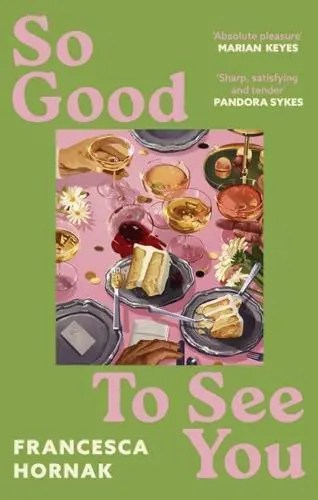 Daniel, Rosie and Serge were good friends at Oxford but since their graduation in 2004 they’ve drifted into indifference and resentment. Daniel is a Hollywood star but still can’t forgive filmmaker Serge for stealing his idea for a biopic of a working-class lad. Serge is on a break from his relationship with Isla, a younger movie makeup artist with whom he has twins. Rosie regrets that her on-again, off-again relationship with Serge meant she wasted prime years. In August 2019, they’re all brought together for Serge’s cousin Caspar’s big gay wedding in Provence. The Campbell cousins come from inherited wealth, but no one knows Serge’s production company is heavily in debt. As best man and “best woman,” Serge and Rosie have to write a joint speech; Daniel has to hide his dependency on alcohol and drugs.
This is a light, Taylor Jenkins Reid-esque soap opera that I swallowed in big gulps. I’d enjoyed Hornak’s Christmas-set debut, Seven Days of Us (2017), but when I looked back at it I realised how identikit the two are: set mostly over a matter of days, with each chapter marked by a precise place and time stamp. I guess she hit on a winning formula and decided to repeat it, but I was disappointed to notice the similarity. In this case, zooming in slows the action and makes the book feel overlong, though it’s perceptive about class, privilege, disappointment, the longing for parenthood, and loyalty among family and friends. (Her previous novel now seems almost prescient with its depiction of a Christmas in quarantine! Perhaps I’ll reread it.) (New purchase with voucher – Hungerford Bookshop) 
Apt Pupil by Stephen King (1982)
(Novella published in Different Seasons under the heading “Summer of Corruption”)
{BEWARE SPOILERS!}
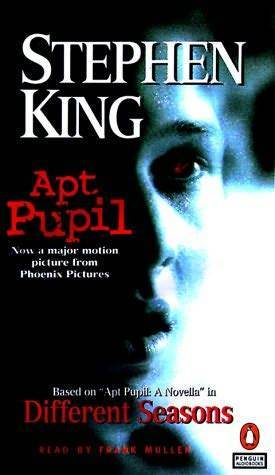 Thirteen-year-old Todd Bowden becomes obsessed with his elderly neighbour, whom he has identified as German concentration camp officer Kurt Dussander, in the summer of 1974. His parents think that he goes over to read to “Mr. Denker,” but in fact he’s extorting sordid war stories out of the old man. When Todd’s grades nosedive, Dussander agrees to impersonate his grandfather at a conference with the school counsellor so his parents remain oblivious. Now each has dirt on the other; blackmail goes both ways. The book suggests Dussander’s ongoing sadism sparks something inexorable in the young man, and both engage in further senseless carnage. I wasn’t sure if it was respectful of King to treat the Holocaust like a contagious sin. As Todd’s (real) grandfather says, “Sometimes the past don’t rest so easy. Why else do people study history?” I don’t think an editor would have let the story stand today. This is not as full-on horror as others I’ve read by King (Misery and Pet Sematary), but still gruesome and – for an animal lover like me – Dussander’s torture of cats and dogs was harder to read about than the murders of unhoused people. A neat connection back to Rita Hayworth and Shawshank Redemption, which I read back in the spring: Dussander mentions that “The banker who bought [the stocks] for me went to jail for murdering his wife a year” later in Maine. (Little Free Library)
Three on a Theme: Autumnal Poetry
Keats described autumn as the season of “mellow fruitfulness,” as I was reminded by Kate Mosse’s Autumn. Fruit and feminism are themes that link these three collections. All:
The Fox’s Wedding by Rebecca Hurst (2022)
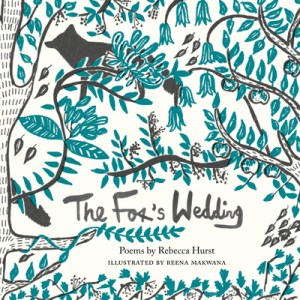 I’ve read Hurst’s debut full-length collection, The Iron Bridge, and jumped at the chance to catch up on her previous chapbook. Its hint of fairy tale menace feels appropriate for early spooky season. A witch turns into a hare and flees in “Familiar.” The girl who will win the hand of “The Frog Prince” spends her evenings “squashing worms and slugs and snails beneath / the crêpe soles of her black school shoes.” Needlecraft recurs: “Once there was a child/ who woke alone in the forest. … S/he took the path of needles / to ask needle-sharp questions.” There are folktale rhythms to “Brothers,” which also mentions gingerbread men. The woods morph with the advance of the year (“let the seasons pleat / folding one year to the next”) and hide creatures real and imagined. “Now it is Michaelmas: the land sun-warm, / fields shorn, blackberries ripe to bursting.” The atmosphere of this pamphlet – defiant, magical, mischievous – casts a spell. (New purchase from The Emma Press)
Plum by Hollie McNish (2017)
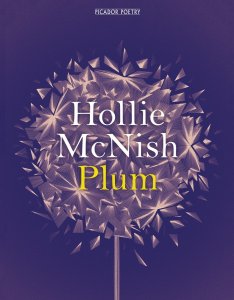 A late tree-shaped poem captures a treasured ritual with her daughter. But if I tell you that “plum” is also the last in a long string of euphemisms for female genitalia in “Voldemort,” that will give a better sense of McNish’s tone, which is often cheeky and snarky. She includes poems she wrote as a child and teenager but also remembers her adolescence from adulthood, pinpointing moments of peer pressure and misogyny that she experienced. She wishes she and her friends had been less obsessed with what boys thought of them and hopes to teach her daughter to stand firm in her own identity. McNish has local roots and is known for her conversational memoirs and her spoken word poetry. Like Harry Baker, Jay Bernard and Kae Tempest’s works, it’s probably not best encountered in print. In performance, fairly simple and repetitive phrasing can come to life. (Secondhand – Library book sale)
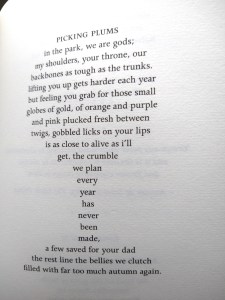
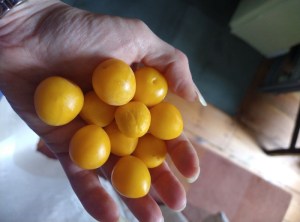
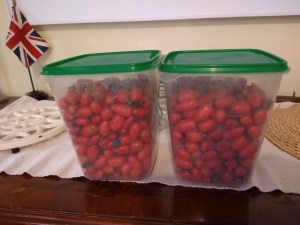
I spend the summer months watching like a hawk for when wild and waste-ground plums ripen and fall so I can scurry around gathering them to eat or freeze for autumn and winter desserts. Our cherry plum tree produced its first fruits this year, too (below).
Crossing the Water by Sylvia Plath (1971)
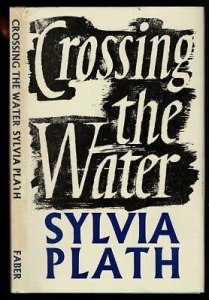 I got less out of this posthumous collection than I did from Ariel and Winter Trees, but there are still striking turns of phrase: “The future is a grey seagull / Tattling in its cat-voice of departure, departure” (from “A Life”) and “At our feet, the weed-moustachioed sea / Exhibits its glaucous silks” (from “Whitsun”). Canada, age, sleep, surgery: the imagery feels a little all over the place. The stand-out poems for me were “Small Hours,” in which marble statues metaphorically watch over the speaker’s troubled insomnia, and “Mirror,” which reflects the unstoppable advance of age and contrasts true self with appearances. Most redolent of autumn were a poem about pheasant hunting and “Blackberrying”:
Nobody in the lane, and nothing, nothing but blackberries,
Blackberries on either side, …
A blackberry alley, going down in hooks, and a sea
Somewhere at the end of it, heaving. Blackberries
Big as the ball of my thumb
The Devon lanes aren’t so empty these days, I can attest! A line from “Last Words” ties in perfectly and is a good resolution for us all: “I should sugar and preserve my days like fruit!” (University library)
I started my preserving late and will not do as much as I have in other years. So far I’ve made apple and tomato chutney and set some rosehip cordial steeping. This afternoon I’m going to attempt rosehip curd – we found a jar of “hagebutten” in a Berlin supermarket this time last year and it was so delicious that we’re going to try to recreate it, though it requires laborious deseeding and mincing plus two boiling stages. More Vitamin C than orange juice, apparently!
Rosehips ready for preserving!
Book Serendipity, March to April 2024
I call it “Book Serendipity” when two or more books that I read at the same time or in quick succession have something in common – the more bizarre, the better. This is a regular feature of mine every couple of months. Because I usually have 20–30 books on the go at once, I suppose I’m more prone to such incidents. The following are in roughly chronological order.
- I encountered quotes from “The Second Coming” by W.B. Yeats on the same day in Immanuel by Matthew McNaught and Waiting for the Monsoon by Rod Nordland. A week or so later, I found another allusion to it – a “rough _________ slouching toward ________” – in Mothership by Greg Wrenn.
- Reading my second memoir this year in which the author’s mother bathed them until they were age 17 (in other words, way past when it ceased to be appropriate): I’m Glad My Mom Died by Jennette McCurdy was followed by Mothership by Greg Wrenn.
- Quoting a poem with the word “riven” in it (by Christian Wiman) in Places I’ve Taken My Body by Molly McCully Brown and (by a character in the novel) in Bright and Tender Dark by Joanna Pearson. The word “riven” (which is really not a very common one, is it?) also showed up in Sleepless by Annabel Abbs. And then “riving” in one of the poems in The Intimacy of Spoons by Jim Minick.
- East Timor as a destination in Waiting for the Monsoon by Rod Nordland and Mothership by Greg Wrenn.
- Quoting John Donne in Places I’ve Taken My Body by Molly McCully Brown and The Bee Sting by Paul Murray (to which a Donne line is the epigraph); mimicking Donne in one poem of Fields Away by Sarah Wardle.
- “Who do you think you are?” as a question an abusive adult asks of a child in The Beggar Maid (aka Who Do You Think You Are?) by Alice Munro and Mothership by Greg Wrenn.
- Sylvia Plath is mentioned in Sleepless by Annabel Abbs and The Bee Sting by Paul Murray … and Katherine Mansfield in Sleepless by Annabel Abbs and The Beggar Maid by Alice Munro.
- Mosquitoes are mentioned in a poem in Rapture’s Road by Seán Hewitt and Divisible by Itself and One by Kae Tempest.

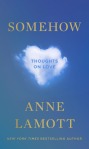
- Reading two memoirs that quote a Rumi poem (and that released on 9 April and that I reviewed for Shelf Awareness): Fi: A Memoir of My Son by Alexandra Fuller and Somehow: Thoughts on Love by Anne Lamott. (Rumi was also quoted as an epigraph in Viv Fogel’s poetry collection Imperfect Beginnings.)
- Bereavement memoirs that seek significance in eagle sightings (i.e. as visitations from the dead): Sleepless by Annabel Abbs and Fi: A Memoir of My Son by Alexandra Fuller.
- Snyder’s pretzels as a snack in Somehow: Thoughts on Love by Anne Lamott and Come and Get It by Kiley Reid.

- Reading two C-PTSD memoirs at the same time: A Flat Place by Noreen Masud and Mothership by Greg Wrenn.
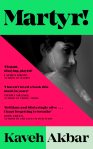 Information about coral reefs dying in Martyr! by Kaveh Akbar and Mothership by Greg Wrenn.
- The gay slang term “twink” appears in The Bee Sting by Paul Murray and Mothership by Greg Wrenn.
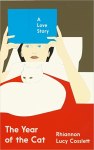
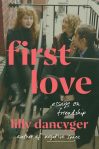
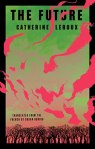
- Assisting a mother who reads tarot cards in Intervals by Marianne Brooker and The Year of the Cat by Rhiannon Lucy Cosslett. (Tarot is also read in First Love by Lilly Dancyger and The Future by Catherine Leroux.)

- An Asian American character who plays poker in a graphic novel: Advocate by Eddie Ahn and Lunar New Year Love Story by Gene Luen Yang.
- Vivian Gornick’s Fierce Attachments, which I was also reading at the time, is mentioned in Intervals by Marianne Brooker.
 An Uncle Frank in an Irish novel with no speech marks: Trespasses by Louise Kennedy and The Bee Sting by Paul Murray.
- Martin Luther King’s “I Have a Dream” speech is quoted in Some Kids I Taught & What They Taught Me by Kate Clanchy and How to Raise a Viking by Helen Russell.
- Using quarters for laundry in Come and Get It by Kiley Reid and one story from Dressing Up for the Carnival by Carol Shields.

- A scene of someone watching from a lawn chair as someone else splits wood in Martyr! by Kaveh Akbar and Becoming Little Shell by Chris La Tray.
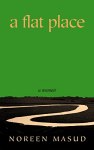 Quotes from cultural theorist Sara Ahmed in Intervals by Marianne Brooker and A Flat Place by Noreen Masud.
- I read about windows being blocked up because of high taxes on the same evening in Trespasses by Louise Kennedy and one story from Dressing Up for the Carnival by Carol Shields.
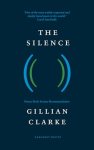
- I saw Quink ink mentioned in The Silence by Gillian Clarke and Trespasses by Louise Kennedy on the same evening.
- The song “It’s a Long Way to Tipperary” is mentioned in You’re on Your Own, Snoopy by Charles M. Schulz and Welcome to Glorious Tuga by Francesca Segal.
- A pet magpie in George by Frieda Hughes and A Council of Dolls by Mona Susan Power.

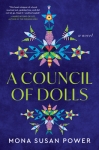
- A character tests to see what will happen (will God strike them down?) when they mess with the Host (by stealing the ciborium or dropping a wafer on the floor, respectively) in A Council of Dolls by Mona Susan Power and one story from Dressing Up for the Carnival by Carol Shields.
- Marrying the ‘wrong’ brother in The Bee Sting by Paul Murray and A Council of Dolls by Mona Susan Power.
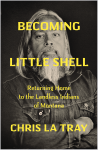 Indigenous author, Native versus Catholic religion, and descriptions of abuse and cultural suppression at residential schools in Becoming Little Shell by Chris La Tray and A Council of Dolls by Mona Susan Power.
- Teen girls obsessed with ‘sad girl’ poetry, especially by Sylvia Plath, in First Love by Lilly Dancyger and The Bee Sting by Paul Murray.
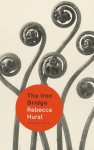
- “Hyacinth” is a poem in Solutions for the Problem of Bodies in Space by Catherine Barnett, and “Hyacinth Girl” a story in Cocktail by Lisa Alward. (Hyacinths are also mentioned in a poem in The Iron Bridge by Rebecca Hurst.)


- A character named Sissy in A Council of Dolls by Mona Susan Power and Stone Yard Devotional by Charlotte Wood.
- Harming amphibians, whether deliberately or accidentally, in a story in Barcelona by Mary Costello, a poem in Baby Schema by Isabel Galleymore, and Mothership by Greg Wrenn.
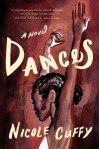
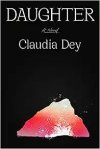
- A significant character called Paul in Dances by Nicole Cuffy, Daughter by Claudia Dey (those two were both longlisted for the Carol Shields Prize), and Moral Injuries by Christie Watson.

- Out of Africa (the film and then the book), which I was looking through for the #1937Club, is mentioned in The Whole Staggering Mystery by Sylvia Brownrigg – her writer grandfather lived in Nairobi’s “Happy Valley” in the 1930s.
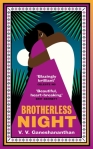
- Reading two novels at the same time in which a teen girl’s plans to study medicine are derailed by war: Brotherless Night by V.V. Ganeshananthan and The Snow Hare by Paula Lichtarowicz.

What’s the weirdest reading coincidence you’ve had lately?
Recent Poetry Releases by Clarke, Galleymore, Hurst, and Minick
All caught up on March releases now. There’s a lot of nature and environmental awareness in these four poetry collections, but also pandemic lockdown experiences, folklore, travel, and an impasse over whether to have children. Three are from Carcanet Press, my UK poetry mainstay; one was my introduction to Madville Publishing (based in Lake Dallas, Texas). After my thoughts, I’ll give one sample poem from each book.
The Silence by Gillian Clarke
Clarke was the National Poet of Wales from 2008 to 2016. I ‘discovered’ her just last year through Making the Beds for the Dead, which shares with this eleventh collection a plague theme: there, the UK’s foot and mouth disease outbreak of 2001; here, Covid-19. Forced into stillness and attention to the wonders near home, the poet tracks nature through the seasons and hymns trees, sunsets and birds. Many poems are titled after months or calendar points such as Midsummer and Christmas Eve. She also commemorates Welsh landmarks and remembers her mother, a nurse.

The verse is full of colours and names of flora:
May-gold’s gone to seed, yellows fallen –
primrose, laburnum, Welsh poppy.
June is rose, magenta, purple,
pink clematis, mopheads of chives,
cranesbill flowering where it will,
a migration of foxgloves crossing the field.
(from “Late June”)
Even as she revels in beauty, though, she bears in mind suffering elsewhere:
There is time and silence
to tell the names of the dying, the dead,
under empty skies unscarred
by transatlantic planes.
(from “Spring Equinox, 2020”)
I noted alliteration (“At the tip of every twig, / a water-bead with the world in it”) and end rhymes (“After long isolation, in times like these, / in the world’s darkness, let us love like trees.”). All told, I found this collection lovely but samey and lacking bite. But Clarke is in her late eighties and has a large back catalogue for me to explore.

With thanks to Carcanet Press for the free copy for review.
Baby Schema by Isabel Galleymore
 I knew Galleymore’s name from her appearance at the New Networks for Nature conference in 2018. The University of Birmingham lecturer’s second collection is a slant-wise look at environmental crisis and an impending decision about motherhood. The title comes from Konrad Lorenz’s identification of features that invite nurture. Galleymore edges towards the satirical fantasies of Caroline Bird or Patricia Lockwood as she imagines alternative scenarios of caregiving and contrasts sentimentality with indifference.
What is worthy of maternal concern? There are poems about a houseplant, a childhood doll, a soft toy glimpsed through a car window. A research visit to Disneyland Paris in the centenary year of the Walt Disney Company leads to marvelling at the surreality of consumerism. Does cuteness merit survival?
Because rhinos haven’t adopted the small
muscle responsible for puppy dog eyes,
the species goes bankrupt.
Its regional stores close down.
(from “The Pitch”)
The speaker acknowledges how gooey she goes over dogs (“Morning”) and kittens (“So Adorable”). But “Mothers” and “Chosen” voice ambivalence or even suspicion about offspring, and “Fable” spins a mild nightmare of infants taking over (“babies nesting in other babies / of cliff and reef and briar”). By the time, in “More and More,” she pictures a son, “a sticky-fingered, pint-sized / version of myself toddling through the aisles,” she concludes that we live in a depleted “world better off without him.”
Extinction and eco-grief on the one hand, yes, but the implacability of biological cycles on the other:
That night, when I got home, I learnt
a tree frog species had been lost
and my body was releasing its usual sum of blood.
I only had a few years left, my mother
often warned
(from “Release”)
Sardonic yet humane, and reassuringly indecisive, this is a poetry highlight of the year so far for me. I’ll go back and find her debut, Significant Other, too.

With thanks to Carcanet Press for the free e-copy for review.
The Iron Bridge by Rebecca Hurst
Manchester-based Hurst’s debut full-length collection struck me first for its gorgeous nature poetry arising from a series of walks. Most of these are set in Southern England in the current century, but date and location stamps widen the view as far as 1976 in the one case and Massachusetts in the other. The second section entices with its titles drawn from folklore and mythology: “How the Fox Lost His Brush,” “The Animal Bridegroom,” “The Needle Prince,” “And then we saw the daughter of the minotaur.”

An unexpected favourite, for its alliteration, assonance and book metaphors in the first stanza, was “Cabbage”:
Slung from a trug it rumbles across
the kitchen table, this flabby magenta fist
of stalk and leaf, this bundle of pages
flopping loose from their binding
this globe cleaved with a grunt leaning hard
on the blade
Part III, “Night Journeys,” has more nature verse and introduces a fascination with Russia that continues through the rest of the book. I loved the mischievous quartet of “Field Notes” prose poems about “The careless lover,” “The theatrical lover,” “The corresponding lover,” and “The satisfying lover” – three of them male and one female. The final section, “An Explorer’s Handbook,” includes found poems adapted from the published work of travel writers contemporary (Christina Dodwell) and Victorian (nurse Kate Marsden). Another series, “The Emotional Lives of Soviet Objects,” gives surprising power to a doily, a slipper and a potato peeler.
There’s a huge range of form and subject matter here, but the language is unfailingly stunning. Another standout from 2024 and a poet to watch. From my other Carcanet reading, I’d liken this most to work by Laura Scott and Helen Tookey.

With thanks to Carcanet Press for the free e-copy for review.
The Intimacy of Spoons by Jim Minick
 A new publisher and author for me. Minick has also published fiction and nonfiction; this is his third poetry collection. Between the opener, “To Spoon,” and the title piece that closes the book, there are five more spoon-themed poems that create a pleasing thematic throughline. Why spoons? Unlike potentially violent knives and forks, which cut and spear, spoons are gentle. They’re also reflective surfaces, and because of their concavity, they can hold things and nestle together. In “The Oldest Spoon,” they even bring to mind a guiding constellation.
The rest of the book is full of North American woodland and coastal scenes and wildlife. Minick displays genuine affection for and familiarity with birds. He is also realistic in noting all that is lost with habitat destruction and dwindling populations. “Lasts” describes the bittersweet sensation of loving what is disappearing: “Goodbye, we always say too late, / or we never get a chance to say at all.” He wrestles with human mortality, too, through elegies and minor concerns about his own ageing body. I loved the seasonal imagery and alliteration in “Spangled” and the Rolling Stones refrain to “Gas,” about boat-tailed grackles encountered in the parking lot at a Georgia truck stop.
Why not embrace all that is ugly
& holy & here—the grackle’s song
that isn’t a song, a breadcrumb dropped,
the shiny ribbon of gasoline
that will get me closer to home.
For something a bit different, I appreciated the true-crime monologue of “Tim Slack, the Fix-It Man.” With playfulness and variety, Minick gives us new views on the everyday – which is exactly why it is worth reading poetry.

With thanks to Madville Publishing for the free e-copy for review.
 Bookish Beck = Rebecca Foster. American transplant to England. Freelance proofreader and book reviewer.
