Seasons Readings: Winter, The Robin, & An Almost Perfect Christmas
I’m marking Christmas Eve with cosy reflections on the season, a biography of Britons’ favourite bird (and a bonus seasonal fairy tale), and a mixed bag of essays and stories about the obligations and annoyances of the holidays.
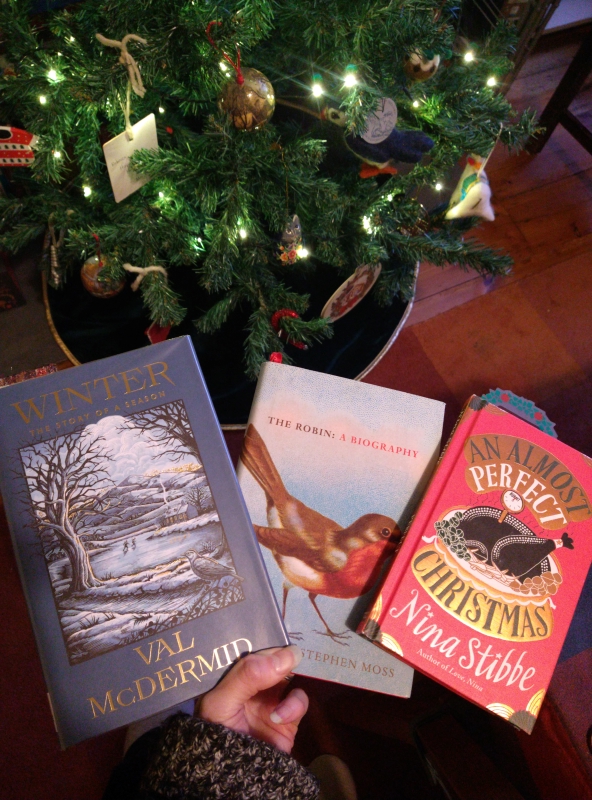
Winter by Val McDermid (2025)
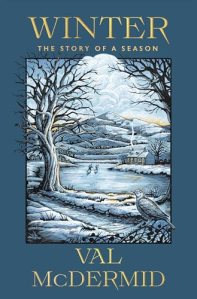 I didn’t realize that Michael Morpurgo’s Spring was the launch of a series of short nonfiction books on the seasons. McDermid writes a book a year, always starting it in early January. She evokes the Scottish winter’s “Janus-faced” character: cosy but increasingly storm-tossed. In few-page essays, she looks for nature’s clues, delves into childhood memories, and traverses the season through traditional celebrations as she has experienced them in Edinburgh and Fife: Hallowe’en, Bonfire Night, Christmas, and New Year’s Eve. The festivities are a collective way of taking the mind off of the season’s hardships, she suggests. I was amused by her mother’s recipe for soup, which she described as more of a “rummage” for whatever vegetables you have in the fridge. It was my first time reading McDermid and, while I don’t know that I will ever pick up one of her crime novels, this was pleasant. I reckon I’d read Bernardine Evaristo on summer and Kate Mosse on autumn, too. (Public library)
The Robin: A Biography – A Year in the Life of Britain’s Favourite Bird by Stephen Moss (2017)
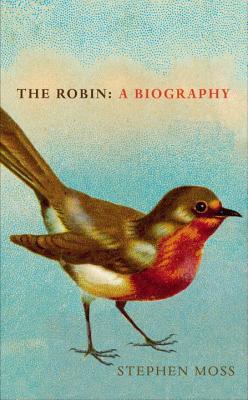 I’ve also read Moss’s most recent bird monograph, The Starling. Both provide a thorough yet accessible introduction to a beloved species’ history, behaviour, and cultural importance. The month-by-month structure works well here: Moss’s observations in his garden and on his local patch lead into discussions of what birds are preoccupied with at certain times of year. Such a narrative approach makes the details less tedious. European robins are known for singing pretty much year-round, and because hardly any migrate – only 5%, it’s thought – they feel like constant companions. They are inquisitive garden guests, visiting feeders and hanging around to see if we monkey-pigs might dig up some juicy worms for them.
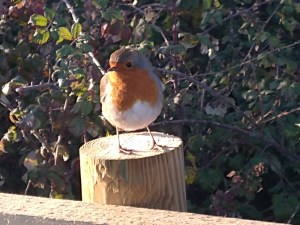
(Last month, this friendly chap at an RSPB bird reserve near Exeter wondered if we might have a snack to share.)
Although we like to think we see the same robins year after year, that’s very unlikely. One in four robins found dead has been killed by a domestic cat; most die of old age and/or starvation within a year. Robin pairs raise one or two broods per year and may attempt a third if the weather allows, but that high annual mortality rate (62%) means we’re not overrun. Compared to other notable species, then, they’re doing well. There are loads of poems and vintage illustrations and, what with robins’ associations with Christmas, this felt like a seasonally appropriate read. At Christmas 2022 I read the very similar Robin by Helen F. Wilson, but this was more engaging. (Free from C’s former colleague)
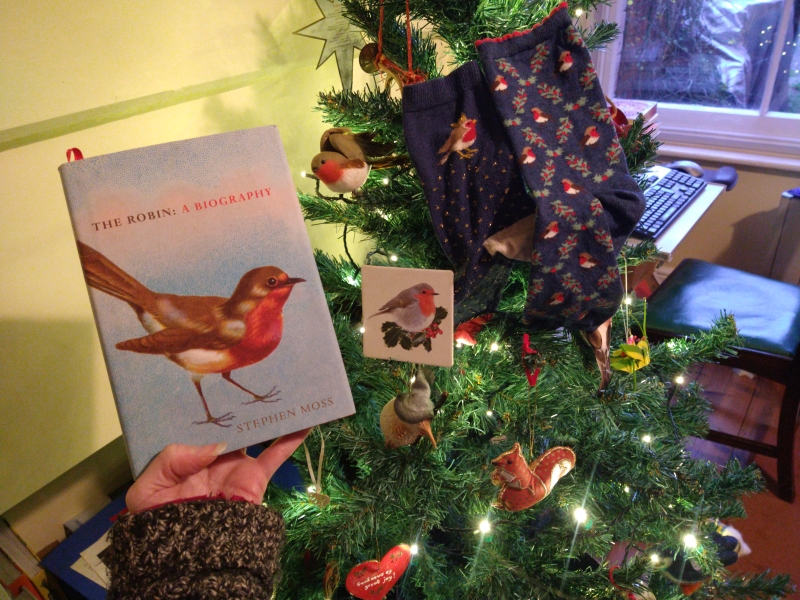
Our small collection of Christmas robin paraphernalia.
&
The Robin & the Fir Tree by Jason Jameson (2020)
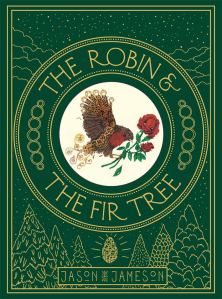 Based on a Hans Christian Andersen fairy tale, this lushly illustrated children’s book stars a restless tree and a faithful robin. The tree resents being stuck in one place and envies his kin who have been made into ships to sail the world. Although his friend the robin describes everything and brings souvenirs, he can’t see the funfair and the flora of other landscapes for himself. “Every season will be just the same. How I long for something different to happen!” he cries. Cue a careful-what-you-wish-for message. When men with axes come to chop down the fir tree and display him in the town square, he feels a combination of trepidation and privilege. Human carelessness turns his sacrifice to waste, and only the robin knows how to make something good out of the wreckage. The art somewhat outshines the story but this is still a lovely hardback I’d recommend to adults and older children. (Public library)
An Almost Perfect Christmas by Nina Stibbe (2017)
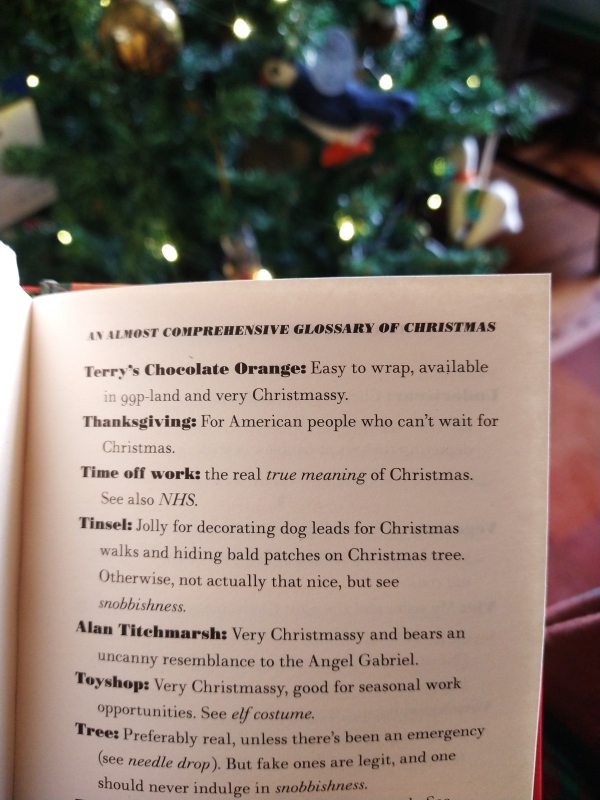
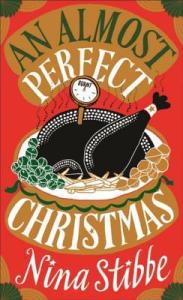 I reviewed this for Stylist magazine when it first came out and had fond memories of a witty collection I expected to dip into again and again. This time, though, Stibbe’s grumpy rants about turkey, family, choosing a tree and compiling the perfect Christmas party playlist fell flat with me. The four short stories felt particularly weak. I most recognized and enjoyed the sentiments in “Christmas Correspondence,” which is about the etiquette for round-robin letters and thank-you notes. The tongue-in-cheek glossary that closes the book is also amusing. But this has served its time in my collection and it’s off to the Little Free Library with it to, I hope, give someone else a chuckle on Christmas day. (Review copy)
My original rating (2017):
My rating now: 
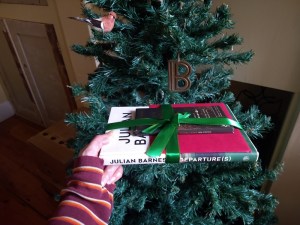
It’s taken me a long time to feel festive this year, but after a couple of book club gatherings and a load of brief community events for the Newbury Living Advent Calendar plus the neighbourhood carol walk, I think I’m finally ready for Christmas. (Not that I’ve wrapped anything yet.) I had a couple of unexpected bookish gifts arrive earlier in December. First, I won the 21st birthday quiz on Kim’s blog and she sent a lovely parcel of Australian books and an apt tote bag. Then, I was sent an early finished copy of Julian Barnes’s upcoming (final) novel, Departure(s). We didn’t trust Benny to be sensible around a real tree so got an artificial one free from a neighbour to festoon with non-breakable ornaments. He discovered the world’s comfiest blanket and spends a lot of time sleeping on it, which has been helpful.


Merry Christmas, everyone! I have a bunch of year-end posts in preparation. It’ll be a day off tomorrow, of course, but here’s what to expect thereafter:
Friday 26th: Reporting back on Most Anticipated Reads of 2025
Saturday 27th: Reading Superlatives
Sunday 28th: Best Backlist Reads
Monday 29th: Love Your Library
Tuesday 30th: Runners-Up
Wednesday 31st: Best Books of 2025
Thursday 1st: Final Statistics for 2025
Friday 2nd: Early Recommendations for 2026
Monday 5th: Most Anticipated Titles of 2026
The End of the Year Book Tag
I’ve been feeling a little burnt out after Novellas in November, so when I spotted this on Laura’s blog I thought it might be just the thing to help me sort through my December reading plans while I wait to get my reviewing mojo back.
- Is there a book that you started that you still need to finish by the end of the year?
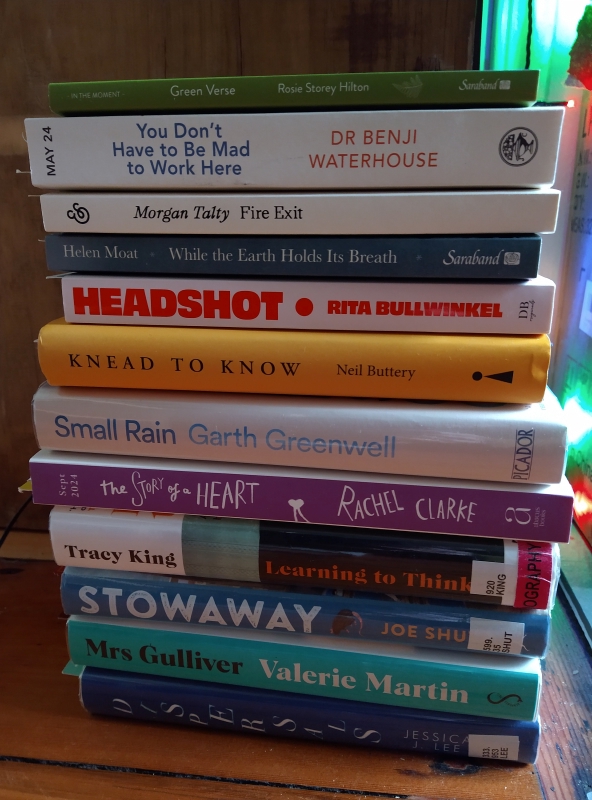
Yes … too many. Pictured are a dozen 2024 releases, a mixture of review copies and library books, that I still hope to get through. Some of them I’m a good way into; others I’ve barely started. (Not shown: All Fours by Miranda July, from NetGalley on my Kindle; and Nine Minds by Daniel Tammet, which I’ll be assessing for Foreword Reviews.)
- Do you have an autumnal book to transition to the end of the year?
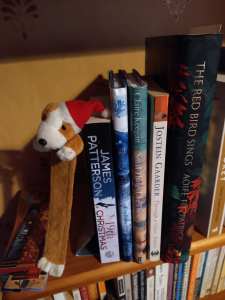
Autumn is the hardest season for me to assign reads to. I’m already in winter mode, so it’s more likely that I’ll pick up one or a few of these wintry or Christmassy books.
-
 Is there a release you are still waiting for?
Published last week and on my Kindle from Edelweiss: the poetry collection Constructing a Witch by Helen Ivory. Otherwise, it’s on to January and February releases for my paid reviewing gigs.
- Name three books you want to read by the end of the year.
From the stack above, I haven’t properly started Headshot by Rita Bullwinkel or opened Fire Exit by Morgan Talty, and I’m still hoping to read those two review copies in their entirety. I will also try to squeeze in at least one more McKitterick Prize novel entry.
But I also have up to five 2025 releases to read for paid reviews that would be due early in January.
Over the holidays, I fancy dipping into some lighter fiction, cosy and engaging creative nonfiction, and thought-provoking but readable science and theology stuff. Here are some options I pulled off of my bedside table shelves.
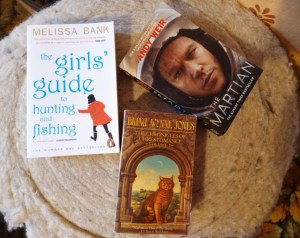
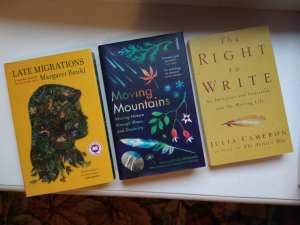
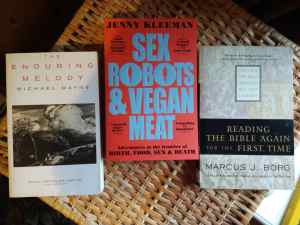
- Is there a book that could still shock you and become your favourite of the year?
Small Rain by Garth Greenwell and Dispersals by Jessica J. Lee are both very promising. I’m nearly 1/3 into the Greenwell (it’s my first time reading him) and I’m so impressed: this is patently autofiction about a medical crisis he had during the pandemic, but there is such clarity and granular detail that it feels absolutely true to the record yet soars above any memoir he might have written about the same events. He’s both back in the moment and understanding everything omnisciently. Greenwell has also written poetry, and I was reminded of the Wordsworth quote “Poetry is the spontaneous overflow of powerful feelings: it takes its origin from emotion recollected in tranquillity.”
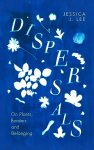
I’ve only read the first chapter of the Lee so far, but I’m a real fan of her hybrid nature memoirs and I think the metaphorical links between her life and plants will really work.
- Have you already started making reading plans for 2025?
So far I’ve read something like 11 books with 2025 publication dates, most of them for paid reviews. I will feature some of those soon. I’ve also compiled a list of my 20 Most Anticipated releases of 2025 and will post that early in January.
Apart from that, I expect it will be the usual pairs of contradictory goals: reading ahead (2025 stuff) versus catching up (backlist and my preposterous set-aside shelf); failing to resist review copies and library holds versus trying to read more from my own shelves; reading to challenges and themes versus preserving the freedom to pick up books as the whim takes me.


Speaking of themes, I fancy doing a deep dive into the senses, especially the sense of smell, which particularly intrigues me. (I’ll make it a trio with The Forgotten Sense: The New Science of Smell—and the Extraordinary Power of the Nose by Jonas Olofsson, which will be published on 7 January and is on order for me at the library.)
Recent Poetry Releases by Clarke, Galleymore, Hurst, and Minick
All caught up on March releases now. There’s a lot of nature and environmental awareness in these four poetry collections, but also pandemic lockdown experiences, folklore, travel, and an impasse over whether to have children. Three are from Carcanet Press, my UK poetry mainstay; one was my introduction to Madville Publishing (based in Lake Dallas, Texas). After my thoughts, I’ll give one sample poem from each book.
The Silence by Gillian Clarke
Clarke was the National Poet of Wales from 2008 to 2016. I ‘discovered’ her just last year through Making the Beds for the Dead, which shares with this eleventh collection a plague theme: there, the UK’s foot and mouth disease outbreak of 2001; here, Covid-19. Forced into stillness and attention to the wonders near home, the poet tracks nature through the seasons and hymns trees, sunsets and birds. Many poems are titled after months or calendar points such as Midsummer and Christmas Eve. She also commemorates Welsh landmarks and remembers her mother, a nurse.

The verse is full of colours and names of flora:
May-gold’s gone to seed, yellows fallen –
primrose, laburnum, Welsh poppy.
June is rose, magenta, purple,
pink clematis, mopheads of chives,
cranesbill flowering where it will,
a migration of foxgloves crossing the field.
(from “Late June”)
Even as she revels in beauty, though, she bears in mind suffering elsewhere:
There is time and silence
to tell the names of the dying, the dead,
under empty skies unscarred
by transatlantic planes.
(from “Spring Equinox, 2020”)
I noted alliteration (“At the tip of every twig, / a water-bead with the world in it”) and end rhymes (“After long isolation, in times like these, / in the world’s darkness, let us love like trees.”). All told, I found this collection lovely but samey and lacking bite. But Clarke is in her late eighties and has a large back catalogue for me to explore.

With thanks to Carcanet Press for the free copy for review.
Baby Schema by Isabel Galleymore
 I knew Galleymore’s name from her appearance at the New Networks for Nature conference in 2018. The University of Birmingham lecturer’s second collection is a slant-wise look at environmental crisis and an impending decision about motherhood. The title comes from Konrad Lorenz’s identification of features that invite nurture. Galleymore edges towards the satirical fantasies of Caroline Bird or Patricia Lockwood as she imagines alternative scenarios of caregiving and contrasts sentimentality with indifference.
What is worthy of maternal concern? There are poems about a houseplant, a childhood doll, a soft toy glimpsed through a car window. A research visit to Disneyland Paris in the centenary year of the Walt Disney Company leads to marvelling at the surreality of consumerism. Does cuteness merit survival?
Because rhinos haven’t adopted the small
muscle responsible for puppy dog eyes,
the species goes bankrupt.
Its regional stores close down.
(from “The Pitch”)
The speaker acknowledges how gooey she goes over dogs (“Morning”) and kittens (“So Adorable”). But “Mothers” and “Chosen” voice ambivalence or even suspicion about offspring, and “Fable” spins a mild nightmare of infants taking over (“babies nesting in other babies / of cliff and reef and briar”). By the time, in “More and More,” she pictures a son, “a sticky-fingered, pint-sized / version of myself toddling through the aisles,” she concludes that we live in a depleted “world better off without him.”
Extinction and eco-grief on the one hand, yes, but the implacability of biological cycles on the other:
That night, when I got home, I learnt
a tree frog species had been lost
and my body was releasing its usual sum of blood.
I only had a few years left, my mother
often warned
(from “Release”)
Sardonic yet humane, and reassuringly indecisive, this is a poetry highlight of the year so far for me. I’ll go back and find her debut, Significant Other, too.

With thanks to Carcanet Press for the free e-copy for review.
The Iron Bridge by Rebecca Hurst
Manchester-based Hurst’s debut full-length collection struck me first for its gorgeous nature poetry arising from a series of walks. Most of these are set in Southern England in the current century, but date and location stamps widen the view as far as 1976 in the one case and Massachusetts in the other. The second section entices with its titles drawn from folklore and mythology: “How the Fox Lost His Brush,” “The Animal Bridegroom,” “The Needle Prince,” “And then we saw the daughter of the minotaur.”

An unexpected favourite, for its alliteration, assonance and book metaphors in the first stanza, was “Cabbage”:
Slung from a trug it rumbles across
the kitchen table, this flabby magenta fist
of stalk and leaf, this bundle of pages
flopping loose from their binding
this globe cleaved with a grunt leaning hard
on the blade
Part III, “Night Journeys,” has more nature verse and introduces a fascination with Russia that continues through the rest of the book. I loved the mischievous quartet of “Field Notes” prose poems about “The careless lover,” “The theatrical lover,” “The corresponding lover,” and “The satisfying lover” – three of them male and one female. The final section, “An Explorer’s Handbook,” includes found poems adapted from the published work of travel writers contemporary (Christina Dodwell) and Victorian (nurse Kate Marsden). Another series, “The Emotional Lives of Soviet Objects,” gives surprising power to a doily, a slipper and a potato peeler.
There’s a huge range of form and subject matter here, but the language is unfailingly stunning. Another standout from 2024 and a poet to watch. From my other Carcanet reading, I’d liken this most to work by Laura Scott and Helen Tookey.

With thanks to Carcanet Press for the free e-copy for review.
The Intimacy of Spoons by Jim Minick
 A new publisher and author for me. Minick has also published fiction and nonfiction; this is his third poetry collection. Between the opener, “To Spoon,” and the title piece that closes the book, there are five more spoon-themed poems that create a pleasing thematic throughline. Why spoons? Unlike potentially violent knives and forks, which cut and spear, spoons are gentle. They’re also reflective surfaces, and because of their concavity, they can hold things and nestle together. In “The Oldest Spoon,” they even bring to mind a guiding constellation.
The rest of the book is full of North American woodland and coastal scenes and wildlife. Minick displays genuine affection for and familiarity with birds. He is also realistic in noting all that is lost with habitat destruction and dwindling populations. “Lasts” describes the bittersweet sensation of loving what is disappearing: “Goodbye, we always say too late, / or we never get a chance to say at all.” He wrestles with human mortality, too, through elegies and minor concerns about his own ageing body. I loved the seasonal imagery and alliteration in “Spangled” and the Rolling Stones refrain to “Gas,” about boat-tailed grackles encountered in the parking lot at a Georgia truck stop.
Why not embrace all that is ugly
& holy & here—the grackle’s song
that isn’t a song, a breadcrumb dropped,
the shiny ribbon of gasoline
that will get me closer to home.
For something a bit different, I appreciated the true-crime monologue of “Tim Slack, the Fix-It Man.” With playfulness and variety, Minick gives us new views on the everyday – which is exactly why it is worth reading poetry.

With thanks to Madville Publishing for the free e-copy for review.
The Beginning of Spring with Penelope Fitzgerald & Karl Ove Knausgaard
(From To Star the Dark by Doireann Ní Ghríofa)
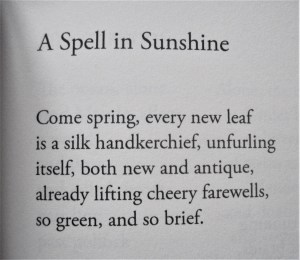
Reading with the seasons is one way I mark time. This is the first of two, or maybe three, batches of spring reading for me this year. The daffodils have already gone over; bluebells and peonies are coming out; and all the trees, including the two wee apple trees we’ve planted at our new house, are sprouting hopeful buds.
The Beginning of Spring by Penelope Fitzgerald (1988)
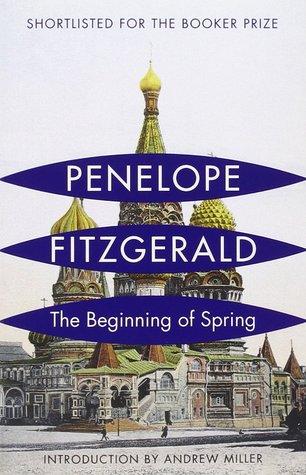 My fourth from Fitzgerald. One of her later novels, this was shortlisted for the Booker Prize. Its pre-war Moscow setting seemed to take on extra significance as I read it during the early weeks of the Russian occupation of Ukraine. Its title is both literal, referring to the March days in 1913 when “there was the smell of green grass and leaves, inconceivable for the last five months” and the expatriate Reid family can go to their dacha once again, and metaphorical. For what seems to printer Frank Reid – whose wife Nellie has taken a train back to England and left him to raise their three children alone – like an ending may actually presage new possibilities when his accountant, Selwyn, hires a new nanny for the children.
I have previously found Fitzgerald’s work slight, subtle to the point of sailing over my consciousness without leaving a ripple. While her characters and scenes still underwhelm – I always want to go deeper – I liked this better than the others I’ve read (The Bookshop, Offshore, and The Blue Flower), perhaps simply because it’s not a novella so is that little bit more expansive. And though she’s not an author you’d turn to for plot, more does actually happen here, including a gunshot. Frank is a genial Everyman, fond of Russia yet exasperated with its bureaucracy and corruption – this “magnificent and ramshackle country.” He knows how things work and isn’t above giving a bribe when it’s expedient for his business:
He took an envelope out of his drawer, and, conscious of taking only a mild risk, since the whole unwieldy administration of All the Russias, which kept working, even if only just, depended on the passing of countless numbers of such envelopes, he slid it across the top of the desk. The inspector opened it without embarrassment, counted out the three hundred roubles it contained and transferred them to a leather container, half way between a wallet and a purse, which he kept for ‘innocent income’.
I particularly liked Uncle Charlie’s visit, the glimpses of Orthodox Easter rituals, and a strangely mystical moment of communion with some birch trees. A part of me did wonder if the setting was neither here nor there, if a few plastered-on descriptions of Moscow were truly enough to constitute convincing historical fiction. That’s a question for those more familiar with Russia and its literature to answer, but I enjoyed the seasonal awakening. (Secondhand, charity shop in Bath) 
Spring by Karl Ove Knausgaard (2016; 2018)
[Translated from the Norwegian by Ingvild Burkey; illustrated by Anna Bjerger]
 Knausgaard is a repeat presence in my seasonal posts: I’ve also reviewed Autumn, Winter and Summer. I read his quartet out of order, finishing with the one that was published third. The project was conceived as a way to welcome his fourth child, Anna, into the world. Whereas the other books prioritize didactic essays on seasonal experiences, this is closer in format to Knausgaard’s granular autofiction: the throughline is a journey through an average day with his baby girl, from when she wakes him before 6 a.m. to a Walpurgis night celebration (“the evening when spring is welcomed in with song in Sweden”). They see the other kids off to school, then make a disastrous visit to a mental hospital – he forgets his bank card and ID, the baby’s bottle, everything, and has to beg cash from his bank to buy petrol to get home.
Looming over the circadian narrative is his wife’s mental health crisis the summer before (his ex-wife Linda Boström Knausgård, a writer in her own right, has bipolar disorder), while she was pregnant with Anna, and the repercussions it has had for their family. Other elements echo those of the previous books: the formation of memories, to what extent his personality is fixed, whether he’s fated to turn into his father, minor health concerns, and so on. Although this volume is less aphoristic than the previous books, there are still moments when he muses on life and gives general advice:
Self-deception is perhaps the most human thing of all. … And perhaps the following is nothing but self-deception: the easy life is nothing to aspire to, the easy choice is never the worthiest solution, only the difficult life is a life worth living. I don’t know. But I think that’s how it is. What would seem to contradict this, is that I wish you and your siblings simple, easy, long and happy lives. … The advantage of having siblings is that it is a lifelong attachment, and that nothing can break it.
All in all, this was the highlight of the series for me. Each of the four is illustrated by a different contemporary artist. Bjerger is less abstract than some of the others, which I count as a plus. (New bargain/remainder copy, Minster Gate Bookshop, York) 

This daffodil bookmark was embroidered by local textile artist Christine Highnett. My mother bought it for me from Sandham Memorial Chapel’s gift shop last summer.
A favourite random moment: A creeper coming through the tile roof of his office pushes a book off the shelf. It’s American Psycho. “I still found it incredible. And a little frightening, the blind force of growth”.
Speaking of meaningful, or perhaps ironic, timing: He records a conversation with his neighbour, who was mansplaining about Russian aggression and the place of Ukraine: “Kiev was the first great city in what became the Russian empire. … The Ukraine and Russia are like twins. … They belong together. At least the Russians see it that way. … The very idea of Russia is imperialistic.”
Any spring reads on your plate?
March Releases by Rebecca Brown, Luis Carrasco, A.J. Lees et al.
As busy as I am with house stuff, I’m endeavouring to keep up with the new releases publishers have been kind enough to send. Today I have a collection of essays on the seasons and mental health, a novella inhabiting a homeless girl’s situation, and a memoir about how skills of observation have been invaluable to a neurologist’s career. (I also mention a few other March releases that I have written about elsewhere or will be reviewing soon.)
You Tell the Stories You Need to Believe: On the four seasons, time and love, death and growing up by Rebecca Brown
 Brown has shown up twice now in my November novella reading (Excerpts from a Family Medical Dictionary in 2016 and the excellent The Gifts of the Body in 2018). I was delighted to learn from a recent Shelf Awareness newsletter that she had a new book, and its Didion-esque title intrigued me. These four essays, which were originally commissioned for The Stranger, Seattle’s alternative weekly, and appeared in print between 2014 and 2016, move methodically through the four seasons and through the weather of the heart, which doesn’t always follow nature’s cues. Depression can linger and mock by contrast the external signs of growth and happiness; it’s no wonder that spring is dubbed the “suicide season.”
The relaxed collages of experience and research blend stories from childhood and later life with references to etymology, literature, music, mythology and poetry. Spring brings to mind the Persephone legend and Vivaldi’s compositions. Summer makes her think of riding bikes on dusty roads and a pregnant dog that turned up just before a storm. Autumn has always been for falling in or out of love. Winter is hard to trudge through, but offers compensatory blessings: “You stand inside the house of your friends and feel and see and everyone is in love and alive and you get to be here, grateful, too, however long, this time, the winter lasts.”
A danger with seasonal books is that, with nostalgia tingeing everything, you end up with twee, obvious reflections. Here, the presence of grief and mental health struggles creates a balanced tone, and while the book as a whole feels a little evanescent, it’s a lovely read.
Another favorite passage:
Maybe like how in the winter it’s hard to imagine spring, I forgot there was anything else besides despair. I needed—I need—to remember the seasons change. I need to remember the dark abates, that light and life return. This is a story I need to believe.
With thanks to Chatwin Books for the e-copy for review.
Ghosts of Spring by Luis Carrasco
Carrasco’s second novella (after 2018’s El Hacho) takes an intimate journey with a young woman who sleeps rough on the streets of a city in the west of England (Cheltenham? Gloucester?). Elemental concerns guide her existence: where can she shelter for the night? Where can she store her meagre belongings during the day? Does she have enough coins to buy a cup of tea from a café, and how long can she stretch out one drink so she can stay in the warm? The creeping advance of the winter (and the holiday season) sets up an updated Christmas Carol type of scenario where the have-nots are mostly invisible to the haves but rely on their charity:
 Hidden in plain sight amongst them, in nooks and doorways and sitting with heads hanging against cold stone walls are huddled shapes, blanketed and inert, with faces of indifferent boredom. Too cold to fish for cash and pity[,] they sit with their faces wrapped in dirty scarves and stolen hats, working the empty corners of tobacco pouches and sucking cold coffee from yesterday’s cups. Ghosts of flesh, they are here and everywhere and nobody sees a thing.
With no speech marks, the narrative flows easily between dialogue and a third-person limited point of view. The protagonist, generally just called “the girl,” is friends with a group of prostitutes and tries out a night in a homeless hostel and sleeping in an allotment shed when she takes a bus to the suburbs. Carrasco is attentive to the everyday challenges she faces, such as while menstruating. We get hints of the family issues that drove her away, but also follow her into a new opportunity.
The book has an eye to her promising future but also bears in mind the worst that can happen to those who don’t escape poverty and abuse. At times underpowered, at others overwritten (as I found for my only other époque press read, What Willow Says), this succeeds as a compassionate portrait of extreme circumstances, something I always appreciate in fiction, and would make a good pairing with another story of homelessness, Kerstin Hensel’s Dance by the Canal from Peirene Press.
With thanks to époque press for the proof copy for review.
Brainspotting: Adventures in Neurology by A.J. Lees
 Dr Andrew Lees is a professor of neurology at the National Hospital in London and a world-renowned Parkinson’s disease researcher. The essays in this short autobiographical volume emphasize the importance of listening and noticing. The opening piece, in fact, is about birdwatching, a boyhood hobby that first helped him develop this observational ability. In further chapters he looks back to his medical education and early practice in London’s East End and in Paris in the 1960s and 1970s. He profiles the hospitals he has known over the last five decades, and the neurologists who paved the way for the modern science, such as Jean-Martin Charcot and François Lhermitte.
The professors whose lessons have most stuck with him are those who insisted on weaving patient histories and symptoms into a story. Lees likens the neurologist’s work to Sherlock Holmes’s deductions – even the smallest signs can mean so much. Indeed, Arthur Conan Doyle, himself a doctor, is known to have modelled Holmes on Joseph Bell, a Scottish surgeon. I particularly liked the essay “The Lost Soul of Neurology,” about science versus spirituality. As a whole, this didn’t particularly stand out for me compared to many of my other medical reads, but I’d still liken it to the works of Gavin Francis and Henry Marsh.
With thanks to Notting Hill Editions for the free copy for review.
Plus a few more March releases I’ve read recently:
Reviewed for BookBrowse:
Booth by Karen Joy Fowler
 In an epic fictional sweep from 1822 to nearly the close of the century, Fowler surveys the Booth family’s triumphs and tragedies. Short asides chronicle Lincoln’s rise in parallel. The foreshadowing is sometimes heavy-handed, and the extended timeline means there is also some skating over of long periods. Booth is low on scenes and dialogue, with Fowler conveying a lot of information through exposition. Luckily, the present-tense narration goes a long way toward making this less of a dull group biography and more of an unfolding story. I also appreciated that the Booth sisters are given major roles as point-of-view characters. The issues considered, like racial equality, political divisions and mistrust of the government, are just as important in our own day. Recommended to fans of March and Hamnet. (I also wrote a related article on the Booth family actors and Shakespeare in performance in the 19th-century USA.)
With thanks to Serpent’s Tail for the proof copy for review.
To review for BookBrowse soon: Groundskeeping by Lee Cole, one of my favourite 2022 releases so far; just the sort of incisive contemporary American novel I love. Big questions of class, family, fate and politics are bound up in a campus-set love story between a drifting manual labourer with literary ambitions and a visiting writer. (Faber)
And coming up tomorrow in my Reading Ireland Month roundup: Vinegar Hill, Colm Tóibín’s terrific debut collection of poems about current events, religion and travels. (Carcanet Press)
Do any of these books appeal to you?
Reading Across the Seasons: England in All Weathers
Recently, I toured multiple seasons via these three pleasantly meandering books for Anglophiles. All: 
Orchard by Benedict Macdonald and Nicholas Gates (2020)
 Bristol friends and BBC colleagues Ben Macdonald and Nick Gates set out to chronicle a year in the life of a traditional Herefordshire orchard that has been managed differently from the industrial norm. Operations are designed to maximize wildlife as well as production, so the orchard has become a bastion for birds and insects. After a brief history of apple cultivation and orchard design, it’s straight into a month-by-month rundown of what can be seen and heard on this particular patch. For the most part, the co-authors trade off chapters. They observe and describe the kinds of behaviours that most of us never get to see. A central section of remarkable photographs, some of them by the authors, illustrates the year as vividly as the passionate prose. (See my full review at Shiny New Books.)
With thanks to William Collins for the free copy for review.
Light Rains Sometimes Fall by Lev Parikian (2021)
It was only 2018 that I read Why Do Birds Suddenly Disappear? but since then we’ve had another three books from Lev Parikian. It’s now hard to imagine a year without one of his genial nature books. Here he adapts Japan’s famous 72 microseasons to an English year, with every five days or so taking on a slightly different character and welcoming in the subtle changes that add up to big ones. Given the Japanese inspiration, it’s appropriate that his entries sometimes read like haikus. Here’s one from the start of 2–7 September: “The streets. Rumble of traffic. Gentle wind in trees. Soft chrrr of blue tit. Furious cawing, stage left.”
 Parikian’s patch is South London, specifically his local cemetery – which, since the book starts in February 2020, was closed off to him for a short time a month later when the first UK lockdown hit. This only served to increase his appreciation for the place when it reopened. (Cemeteries are amazing places for wildlife in general, especially the more park-like ones: I can remember seeing muntjac at Cemetery Junction in Reading, and red-tailed hawks perched in the trees in Mount Auburn Cemetery in Cambridge, Massachusetts.) Here, his star sighting was an occasional peregrine on the church tower.
The idea behind this book of mini nature essays is to try to see things again as if for the first time. In the pandemic year, he finds that time is elastic: it seems both fast and slow, and paying close attention is a way of valuing nature and experience. After all, as Parikian quotes from Confucius, “Everything has beauty, but not everyone can see it.” This reminded me particularly of Birdsong in a Time of Silence, but the tone is refreshingly light, as readers will have come to expect of Parikian.
Controversially, because I picked this up in September, I started reading it from the first September chapter, carried on to the end and then began again at the beginning and caught myself up, a strategy I have only ever taken with Mark Cocker’s Claxton (another month-by-month nature diary-type narrative) before. Initially, it was a nice way of following along with the seasons. I kept this as a bedside book and would read a chapter before bed. Most of us live in cities or suburbs, so I particularly appreciated the enthusiastic advocacy for the value of urban spaces for nature. I recommend this one for reading your way slowly and attentively through the seasons.
With thanks to Elliott & Thompson for the proof copy for review.
England for All Seasons by Susan Allen Toth (1997)
A reread. As I was getting ready to go overseas for the first time in the summer of 2003, Toth’s trilogy of memoirs whetted my appetite for travel in Britain. (They’re on my Landmark Books in My Life, Part II list.) I loved how warmly she invites readers to join her itineraries and shares tips for lesser-known destinations.
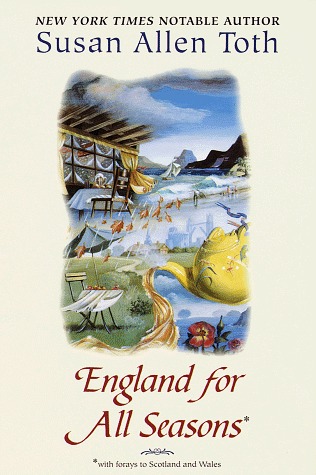 This was her third set of England essays, prompted by a question she frequently got from friends and readers: when is the best time to go? Her answer would be to go whenever you can, as often as you can, because rain can be delightful and in the off season you’ll have special places to yourself. I can see that I have this book to thank for the memorable Cornwall vacation I had with my mom and sister in April 2004, midway through my study abroad year: two of the sites she highlights here, St. Ives and the seal sanctuary at Gweek (part of the “Touring England’s Ark” chapter) were among our chosen stops.
Toth is a particular fan of gardens and literary sites, but loves London museums and theatres as much as windswept coastal and island scenery. When in England she lets herself sample multiple desserts from the sweet trolley, fill her suitcase with secondhand books, and pepper her speech with exclamations of “Lovely!” and “Brilliant!” I was relieved to be reminded of her suggested one-hour time limit for any museum – “depart without guilt, as soon as your eyes droop or your feet hurt or your heavy shoulder bag sinks to the floor. When you begin wondering if it is too early for lunch, head for the door.” (I poop out at museums very quickly.) The practical information she includes at the end of each chapter is probably entirely out of date, but her ideas are solid, and a quick web search will update any details.
The final essay, “Travel Time,” perfectly captures the holiday spirit: “Because our travel time is so densely filled, with intense if often quiet experiences, I am always astonished at what has happened—or rather, what has not happened—when we return home. After two weeks of living so vividly, newness in each hour, I feel as if I must have changed in significant ways.” (Free from The Book Thing of Baltimore)
December Reading Plans
Blogging, and especially hosting Novellas in November – which was a roaring success, for which I am grateful! – has felt like a full-time job at points over the past month.
It was a record-breaking month in terms of my reading total, and I also wrote 24 blog posts. What with all the novellas, a focus on nonfiction review books, and a few rereads, I was able to contribute to several challenges in addition to #NovNov, such as Nonfiction November, German Literature Month, and Margaret Atwood Reading Month.
November was extra stressful for me because of trying to buy a house, starting my McKitterick Prize judging, and my mother being in and out of hospital since September. I know I’m not the only one feeling burnt out after a busy month. I now need to focus on paid work so I can take my upcoming two weeks in the USA off.
So, for December’s reading, the plan is mostly to finish a good number of 2021 releases and review copies currently on the go. Here’s my planned set:
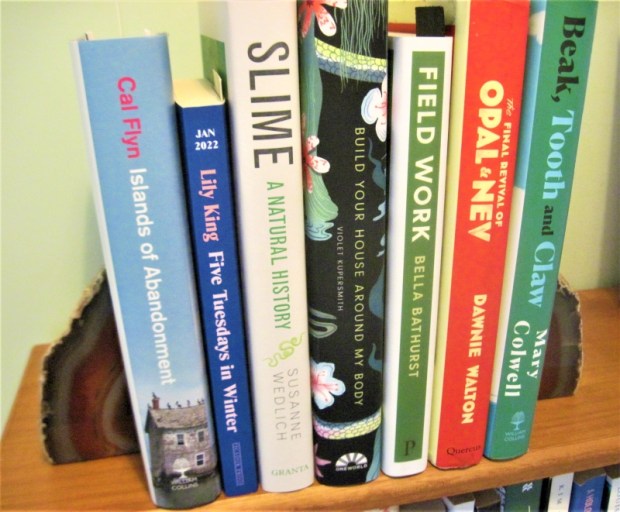
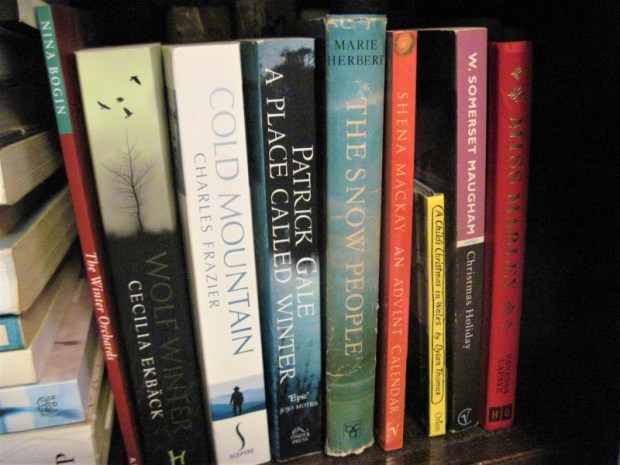
I will also likely slip in a few novella-length Christmas or winter books; my first is An Advent Calendar by Shena Mackay.
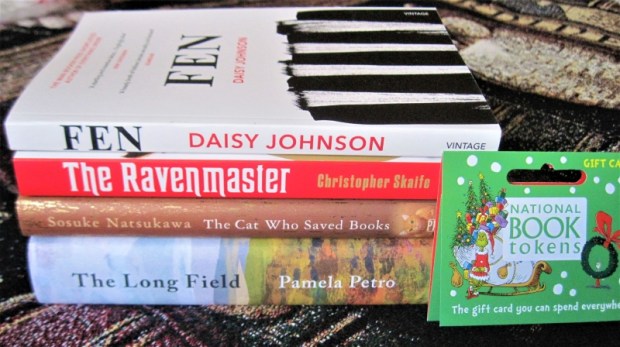
Meanwhile, the books keep coming in. This was my belated birthday and early Christmas haul from a holiday get-together with family over here:
I actually contemplated taking a complete break from blogging in December, but I still have a number of review copies I owe feedback on, as well as other ideas for themed posts that I want to fit in. Plus drawing up the Best-of lists and statistics is my favourite task of the blogging year, so I wouldn’t want to miss out on the fun. But I will definitely be scaling back this month, especially during our time in the States.
In other news, today it’s off to London for my first time since December 2019 (and only my second time on a train since then). We will have a nice chilly walk along the river from Richmond to Ham House and then grab a meal at a vegan diner before at last getting to go to our several-times-delayed Bell X1 gig at Union Chapel.
Lots of other good stuff coming up in the next week and a half, too, including a few Christmas concerts, a book club get-together, and the Barbellion Prize longlist, which is due out on the 13th.
Happy December reading!
Autumnal Children’s and YA Books
Browsing through old magazines, I found a fun BookPage reading list from October 2019 entitled “Pumpkin spice latte literature.” It asks, “what if autumn were distilled into a book? The mixture of crispness and warmth, the thrill of possibility, the bittersweetness of change—these books are pure pumpkin spice.” I love the lateral thinking that came up with
 The Art of Fielding by Chad Harbach (back to school in the Midwest)
- I Remember Nothing by Nora Ephron (wry reflections from the autumn of a life)
- Possession by A.S. Byatt (bookish geeking out)
- Calling a Wolf a Wolf by Kaveh Akbar (taking comfort from a vision of recovery from alcoholism)
- An Enchantment of Ravens by Margaret Rogerson (wit and magic)
I’ve read the first three, and am keen to catch up on Akbar’s debut poetry collection after loving Pilgrim Bell this summer. I’m only unlikely to pick up Rogerson’s fantasy. In any case, I enjoyed seeing how the editors came up with their selections.
I tend to be rather more literal with my seasonal reading recommendations. Does it have autumn in the title or as a setting?! Is it about pumpkins or Halloween?
This year I happen to have amassed all children’s and YA selections.
October, October by Katya Balen (2020)
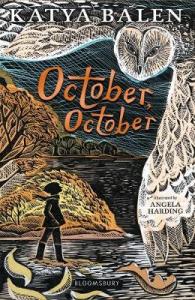 I’ll admit it: it was Angela Harding’s gorgeous cover illustration that drew me to this one. But I found a story that lived up to it, too. October, who has just turned 11 and is named after her birth month, lives in the woods with her father. Their shelter and their ways are fairly primitive, but it’s what October knows and loves. When her father has an accident and she’s forced into joining her mother’s London life, her only consolations are her rescued barn owl chick, Stig, and the mudlarking hobby she takes up with her new friend, Yusuf.
The child’s perspective is well rendered through artful run-on sentences. Balen is careful to show the consequences of October’s decisions and to present advantages as well as disadvantages so it’s not just countryside = good, city = bad. I thought the father’s recovery a bit too quick, but overall, this middle grade novel was a great read for any age, as well as one to get kids thinking about illness and loss. And how about these heart-tugging last lines? “There are stories everywhere and I want to tell them all. And all the world is wild and waiting for me.” (Public library)
Autumn Story by Jill Barklem (1980)
 The second in the quartet of seasonal “Brambly Hedge” stories. Autumn is a time for stocking the pantry shelves with preserves, so the mice are out gathering berries, fruit and mushrooms. Young Primrose wanders off, inadvertently causing alarm – though all she does is meet a pair of elderly harvest mice and stay for tea and cake in their round nest amid the cornstalks. I love all the little touches in the illustrations: the patchwork tea cosy matches the quilt on the bed one floor up, and nearly every page is adorned with flowers and other foliage. After we get past the mild peril that seems to be de rigueur for any children’s book, all is returned to a comforting normal. Time to get the Winter volume out from the library. (Public library)
Une Chanson d’ours by Benjamin Chaud (2011)
 The first whole book I’ve read in French in many a year. I just about coped, given that it’s a picture book with not all that many words on a page; any vocabulary I didn’t know offhand, I could understand in context. It’s late into the autumn and Papa Bear is ready to start hibernating for the year, but Little Bear spies a late-flying bee and follows it out of the woods and all the way to the big city. Papa Bear, realizing his lad isn’t beside him in the cave, sets out in pursuit and bee, cub and bear all end up at the opera hall, to the great surprise of the audience. What will Papa do with his moment in the spotlight? This is a lovely book that, despite the whimsy, still teaches about the seasons and parent–child bonds as it offers a vision of how humans and animals could coexist. I’ve since found out that this was made into a series of four books, all available in English translation. (Little Free Library)
Pumpkinheads by Rainbow Rowell; illus. Faith Erin Hicks (2019)
 This YA graphic novel is set on a Nebraska pumpkin patch that’s more like Disney World than a simple field down the road. Josiah and Deja have worked together at the Succotash Hut for the last three autumns. Today they’re aware that it’s their final Halloween before leaving for college. Deja’s goal is to try every culinary delicacy the patch has to offer – a smorgasbord of foodstuffs that are likely to be utterly baffling to non-American readers: candy apples, Frito pie (even I hadn’t heard of this one), kettle corn, s’mores, and plenty of other saccharine confections.
Josiah’s goal, by contrast, is to catch the eye of Marcy, the beauty who works at the fudge stand. Deja convinces him to desert the Succotash Hut and go in pursuit of Marcy via as many food stands as possible. She’s willing to indulge his unrealistic fantasy even though, as a bisexual who’s dated just about everyone at the patch, she knows romance is sometimes not all it’s cracked up to be. Meanwhile, there’s an angry billy goat on the loose.
This is a fun and quick romp, and the ending genuinely surprised me. I liked the story better than the art, though – my main problem was that these teen characters look more like they’re 30 (Josiah, especially, looks almost haggard what with the sharp lines down the sides of his face – I guess they’re to give him a ‘chiselled’ jaw?), similar to that weird phenomenon of much older actors playing high schoolers. So, I laughed to see in an afterword conversation between Rowell and Hicks that one of the major things they changed from early mock-ups was making the protagonists look older. (Public library) 
Pick a Pumpkin by Patricia Toht; illus. Jarvis (2019)
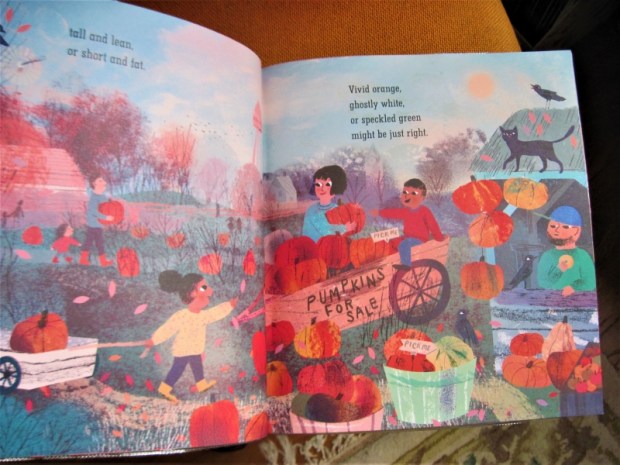
 From picking the best pumpkin at the patch to going out trick-or-treating, this is a great introduction to Halloween traditions. It even gives step-by-step instructions for carving a jack-o’-lantern. The drawing style – generally 2D, and looking like it could be part cut paper collages, with some sponge painting – reminds me of Ezra Jack Keats and most of the characters are not white, which is refreshing. There are lots of little autumnal details to pick out in the two-page spreads, with a black cat and crows on most pages and a set of twins and a mouse on some others. The rhymes are either in couplets or ABCB patterns. Perfect October reading. (Public library)
 Any super-autumnal reading for you this year?
Do you read children’s picture books and YA novels even if you (and any children) are well past that age – or is it just me?
Local Resistance: On Gallows Down by Nicola Chester
It’s mostly by accident that we came to live in Newbury: five years ago, when a previous landlord served us notice, we viewed a couple of rental houses in the area to compare with what was available in Reading and discovered that our money got us more that little bit further out from London. We’ve come to love this part of West Berkshire and the community we’ve found. It may not be flashy or particularly famous, but it has natural wonders worth celebrating and a rich history of rebellion that Nicola Chester plumbs in On Gallows Down. A hymn-like memoir of place as much as of one person’s life, her book posits that the quiet moments of connection with nature and the rights of ordinary people are worth fighting for.
So many layers of history mingle here: from the English Civil War onward, Newbury has been a locus of resistance for centuries. Nicola* has personal memories of the long-running women’s peace camps at Greenham Common, once a U.S. military base and cruise missile storage site – to go with the Atomic Weapons Establishment down the road at Aldermaston. As a teenager and young woman, she took part in symbolic protests against the Twyford Down and Newbury Bypass road-building projects, which went ahead and destroyed much sensitive habitat and many thousands of trees. Today, through local and national newspaper and magazine columns on wildlife, and through her winsome nagging of the managers of the Estate she lives on, she bears witness to damaging countryside management and points to a better way.

While there is a loose chronological through line, the book is principally arranged by theme, with experiences linked back to historical or literary precedents. An account of John Clare and the history of enclosure undergirds her feeling of the precarity of rural working-class life: as an Estate tenant, she knows she doesn’t own anything, has no real say in how things are done, and couldn’t afford to move elsewhere. Nicola is a school librarian and has always turned to books and writing to understand the world. I particularly loved Chapter 6, about how she grounds herself via the literature of this area: Kenneth Grahame’s The Wind in the Willows, Adam Thorpe’s Ulverton, and especially Richard Adams’s Watership Down.
Whatever life throws at her – her husband being called up to fight in Iraq, struggling to make ends meet with small children, a miscarriage, her father’s unexpected death – nature is her solace. She describes places and creatures with a rare intimacy borne out of deep knowledge. To research a book on otters for the RSPB, she seeks out every bridge over every stream. She goes out “lamping” with the local gamekeeper after dark and garners priceless nighttime sightings. Passing on her passion to her children, she gets them excited about badger watching, fossil collecting, and curating shelves of natural history treasures like skulls and feathers. She also serves as a voluntary wildlife advocate on her Estate. For every victory, like the re-establishment of the red kite population in Berkshire and regained public access to Greenham Common, there are multiple setbacks, but she continues to be a hopeful activist, her lyrical writing a means of defiance.
We are writing for our very lives and for those wild lives we share this one, lonely planet with. Writing was also a way to channel the wildness; to investigate and interpret it, to give it a voice and defend it. But it was also a connection between home and action; a plank bridge between a domestic and wild sense. A way both to home and resist.
You know that moment when you’re reading a book and spot a place you’ve been or a landmark you know well, and give a little cheer? Well, every site in this book was familiar to me from our daily lives and countryside wanderings – what a treat! As I was reading, I kept thinking how lucky we are to have such an accomplished nature writer to commemorate the uniqueness of this area. Even though I was born thousands of miles away and have moved more than a dozen times since I settled in England in 2007, I feel the same sense of belonging that Nicola attests to. She explicitly addresses this question of where we ‘come from’ versus where we fit in, and concludes that nature is always the key. There is no exclusion here. “Anyone could make a place their home by engaging with its nature.”
*I normally refer to the author by surname in a book review, but I’m friendly with Nicola from Twitter and have met her several times (and she’s one of the loveliest people you’ll ever meet), so somehow can’t bring myself to be that detached!
On Gallows Down was released by Chelsea Green Publishing on October 7th. My thanks to the author and publisher for arranging a proof copy for review.
My husband and I attended the book launch event for On Gallows Down in Hungerford on Saturday evening. Nicola was introduced by Hungerford Bookshop owner Emma Milne-White and interviewed by Claire Fuller, whose Women’s Prize-shortlisted novel Unsettled Ground is set in a fictional version of the village where Nicola lives.
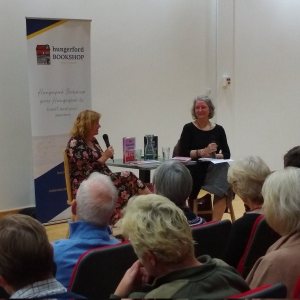
Nicola Chester and Claire Fuller. Photo by Chris Foster.
Nicola dated the book’s genesis to the moment when, 25 years ago, she queued up to talk to a TV news reporter about Newbury Bypass and froze. She went home and cried, and realized she’d have to write her feelings down instead. Words generally come to her at the time of a sighting, as she thinks about how she would tell someone how amazing it was.
Her memories are tied up with seasons and language, especially poetry, she said, and she has recently tried her hand at poetry herself. Asked about her favourite season, she chose two, the in-between seasons – spring for its abundance and autumn for its nostalgia and distinctive smells like tar spot fungus on sycamore leaves and ivy flowers.


A bonus related read:
Anarchipelago by Jay Griffiths (2007)
This limited edition 57-page pamphlet from Glastonbury-based Wooden Books caught my eye from the library’s backroom rolling stacks. Griffiths wrote her impish story of Newbury Bypass resistance in response to her time among the protesters’ encampments and treehouses. Young Roddy finds a purpose for his rebellious attitude wider than his “McTypical McSuburb” by joining other oddballs in solidarity against aggressive policemen and detectives.
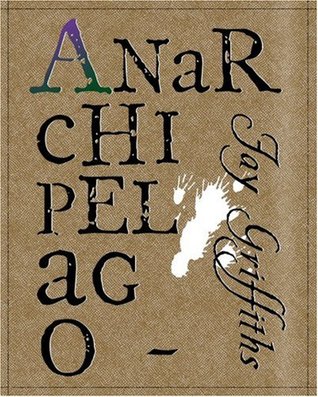
There are echoes of Ali Smith in the wordplay and rendering of accents.
“When I think of the road, I think of more and more monoculture of more and more suburbia. What I do, I do in defiance of the Louis Queasy Chintzy, the sickly stale air of suburban car culture. I want the fresh air of nature, the lifefull wind of the French revolution.”
In a nice spot of Book Serendipity, both this and On Gallows Down recount the moment when nature ‘fought back’ as a tree fell on a police cherry-picker. Plus Roddy is kin to the tree-sitting protesters in The Overstory by Richard Powers as well as another big novel I’m reading now, Damnation Spring by Ash Davidson.
October Reading Plans and Books to Catch Up On
My plans for this month’s reading include:
Autumn-appropriate titles & R.I.P. selections, pictured below.


 October releases, including some poetry and the debut memoir by local nature writer Nicola Chester – some of us are going on a book club field trip to see her speak about it in Hungerford on Saturday.
A review book backlog dating back to July. Something like 18 books, I think? A number of them also fall into the set-aside category, below.
An alarming number of doorstoppers:
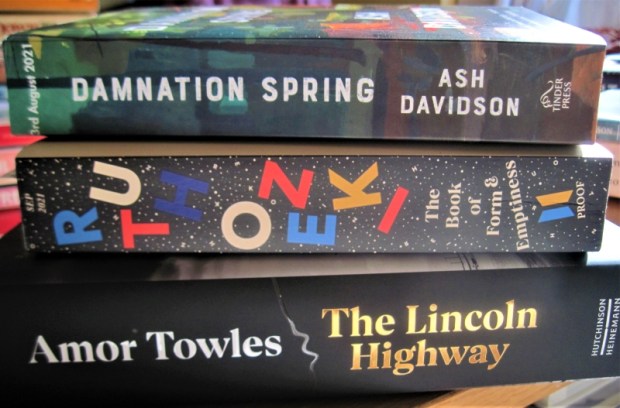
- Damnation Spring by Ash Davidson (a buddy read underway with Marcie of Buried in Print; technically it’s 442 pages, but the print is so danged small that I’m calling it a doorstopper even though my usual minimum is 500 pages)
- The Book of Form and Emptiness by Ruth Ozeki (in progress for blog review)
- Great Circle by Maggie Shipstead (a library hold on its way to me to try again now that it’s on the Booker Prize shortlist)
- The Lincoln Highway by Amor Towles (in progress for BookBrowse review)
Also, I’m aware that we’re now into the last quarter of the year, and my “set aside temporarily” shelf – which is the literal top shelf of my dining room bookcase, as well as a virtual Goodreads shelf – is groaning with books that I started earlier in the year (or, in some cases, even late last year) and for whatever reason haven’t finished yet.
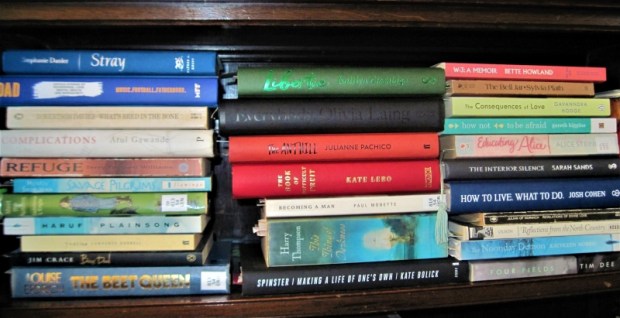
Setting books aside is a dangerous habit of mine, because new arrivals, such as from the library or from publishers, and more timely-seeming books always edge them out. The only way I have a hope of finishing these before the end of the year is to a) include them in challenges wherever possible (so a few long-languishing books have gone up to join my novella stacks in advance of November) and b) reintroduce a certain number to my current stacks at regular intervals. With just 13 weeks or so remaining, two per week seems like the necessary rate.
Do you have realistic reading goals for the final quarter of the year? (Or no goals at all?)
 Bookish Beck = Rebecca Foster. American transplant to England. Freelance proofreader and book reviewer.
 Bookish Beck