#WITMonth, Part I: de Beauvoir, Jansson, NDiaye
My first four reads for Women in Translation month were quite a varied selection: a sobering autobiographical essay about the loss of a mother, a characteristically impish children’s novel, a confoundingly elliptical family memoir, and a preview of a forthcoming Mexican novel about women’s friendships and handicraft. Another four coming up later in August.
A Very Easy Death by Simone de Beauvoir (1964; 1965)
[Translated from the French by Patrick O’Brian]
“When someone you love dies you pay for the sin of outliving her with a thousand piercing regrets.”
I’d read a lot about Simone de Beauvoir but not one of her own works until this reissue came my way. It was right up my street as a miniature bereavement memoir (just 84 pages) that doesn’t shy away from the physical details of decline or the emotional complications of a fraught mother–daughter relationship.
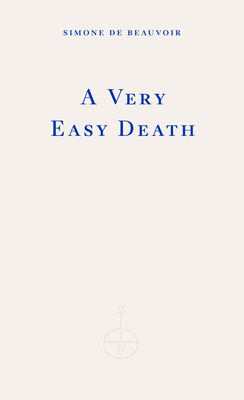 In October 1963, de Beauvoir was in Rome when she got a call informing her that her mother had had an accident. Expecting the worst, she was relieved – if only temporarily – to hear that it was a fall at home, resulting in a broken femur. But when Françoise de Beauvoir got to the hospital, what at first looked like peritonitis was diagnosed as stomach cancer with an intestinal obstruction. Her daughters knew that she was dying, but she had no idea (from what I’ve read, this paternalistic notion that patients must be treated like children and kept ignorant of their prognosis is more common on the Continent, and continues even today).
Over the next month, de Beauvoir and her sister Poupette took turns visiting. Initially alarmed by their mother’s condition, they soon grew used to the deterioration. “I was not worried by her nakedness any more: it was no longer my mother, but a poor tormented body.” They found her in varying states of awareness and discomfort. “In this race between pain and death we most earnestly hoped that death would come first.” Some nurses were better than others. De Beauvoir makes tantalizing references to the standoff between her and her mother about the Catholic faith Simone left behind. (I’ll need to read Memoirs of a Dutiful Daughter for more on that.) Even the hope of heaven didn’t fully neutralize self-pity and physical suffering for the dying woman because she feared her daughters wouldn’t be joining her.
The title is what a nurse told the grieving daughters: that their mother’s had been a very easy death in the end (and an upper-class one, de Beauvoir adds). The word used in French for easy, douce, can also be translated as “gentle,” a tie-in to the epigraph from Dylan Thomas’s “Do not go gentle into that good night.” Is it better for a loved one to die suddenly, or protractedly? I’ve debated this with myself and a few others since my mother’s death from a stroke in October. Ultimately, it’s pointless to ask; any death is an affront, hard to accept and adjust to no matter how much warning is given. I appreciated how matter-of-factly and concisely de Beauvoir’s essay encapsulates the duties and feelings surrounding a death. Frank and unshowy yet potent, this is a classic of the subgenre. 
Published as Fitzcarraldo Editions Classics No. 2 in June. With thanks to the publisher for the free copy for review.
(Books of Summer, #10)
Finn Family Moomintroll by Tove Jansson (1948; 1950)
[Translated from the Swedish by Elizabeth Portch]
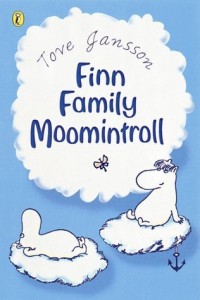 My sixth Moomins book, and ninth by Jansson overall. The novella’s gentle peril is set in motion by the discovery of the Hobgoblin’s Hat, which transforms anything placed within it. As spring moves into summer, this causes all kind of mild mischief until Thingumy and Bob, who speak in spoonerisms, show up with a suitcase containing something desired by both the Groke and the Hobgoblin, and make a deal that stops the disruptions.
As always, the creatures and events, conveyed by Jansson’s black-and-white drawings as much as by her words, are inventive and whimsical. There’s a cosy charm to the seasonal rituals, like the end-of-summer pancake party here. But what I value even more is the pointed accounts of the secondary characters’ neuroses. The Moomins are generally on a pretty even keel, though there is mention of Moominpappa’s sense of being hard done by because of childhood bullying and an enduring lack of respect. However, characters like the Muskrat and the Hemulen get a wry smile and shake of the head from me because their predicaments are so familiar: The Muskrat, terrified of mortifying situations, decides the life of a hermit might be preferable; the Hemulen gives up stamp collecting and switches to botanizing because there’s no joy in a finished quest, only in an ongoing search. The Moomins books offer the perfect combination of the familial and routine with the novel and adventurous. Even staid adults should give them a try. (Little Free Library)
Self-Portrait in Green by Marie NDiaye (2005; 2015)
[Translated from the French by Jordan Stump]
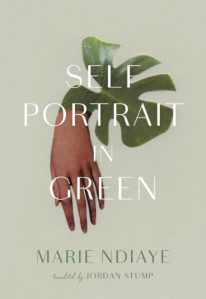 I tend to love a memoir that tries something new or experimental with the form (such as Constructing a Nervous System or In the Dream House), but this was a step too far for me; the self referred to in the title is almost wholly absent. NDiaye, a French–Senegalese author, opens in 2003 with the expected flooding of the Garonne in southwest France. Fragments of narrative from 2000–2003 chart her encounters with various women dressed in green, starting with one she thinks she sees under a banana tree (though her four children see nothing). Then there’s Katia Depetiteville, dead 10 years … NDiaye’s stepmother, once her childhood best friend; her friend Jenny’s rival for Ivan’s affection; and her mother, who now has a new family. What is a ‘woman in green’? The author explicitly associates the colour with cruelty, with presumably the usual connotation of jealousy as well. But it still feels arbitrary.
It’s all rather dreamlike, with poetic repetition, rhetorical questions and black-and-white photos that seem marginally relevant. “I’m saying to myself: Is all this really real?” NDiaye writes, and the reader will surely be asking the same. “I’m always interested in stories,” she adds, and while I’d agree, I need to know that they’re being told to build to some greater meaning. It was only in the last fifth of the book, when the author goes to a literary symposium in Ouagadougou and visits her father (a many-times-married former restaurateur and amateur architect now suffering from cataracts) and stepmother that I felt like there was a purpose: a bringing together of past and present for psychological clarity. I was relieved that this was only 112 pages. (Edelweiss) 
The 10th anniversary edition is being reissued by Two Lines Press next month.
And a bonus preview:
Cross-Stitch by Jazmina Barrera (2021; 2023)
[Translated from the Spanish by Christina MacSweeney]
 In the inventive debut novel by Mexican author Jazmina Barrera, a sudden death provokes an intricate examination of three young women’s years of shifting friendship. Their shared hobby of embroidery occasions a history of women’s handiwork, woven into a relationship study that will remind readers of works by Elena Ferrante and Deborah Levy. Citlali, Dalia, and Mila had been best friends since middle school. Mila, a writer with a young daughter, is blindsided by news that Citlali has drowned off Senegal. While waiting to be reunited with Dalia for Citlali’s memorial service, she browses her journal to revisit key moments from their friendship, especially travels in Europe and to a Mexican village. Cross-stitch becomes its own metaphorical language, passed on by female ancestors and transmitted across social classes. Reminiscent of Still Born and A Ghost in the Throat. (Edelweiss)
Coming out on 7 November from Two Lines Press. My full review for Shelf Awareness is pending.
Three for Novellas in November: Bythell, Carey and Diop
I started my reading for Novellas in November early with these three review books, one nonfiction and two fiction. They have in common the fact that they are published today –although I believe two were released early to beat the lockdown. Don’t worry, though; there are still plenty of ways of getting hold of new books: most publishers and bookshops are still filling orders, or you can use the UK’s newly launched Bookshop.org site and support your local indie.
Seven Kinds of People You Find in Bookshops by Shaun Bythell
[137 pages]
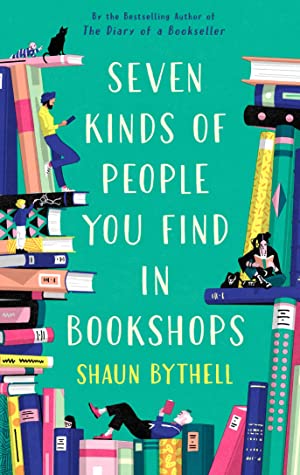 Cheerfully colored and sized to fit into a Christmas stocking, this is a fun follow-up to Bythell’s accounts of life at The Bookshop in Wigtown, The Diary of a Bookseller and Confessions of a Bookseller. Within his seven categories are multiple subcategories, all given tongue-in-cheek Latin names as if naming species. When I saw him chat with Lee Randall at the opening event of the Wigtown Book Festival, he introduced a few, such as the autodidact who knows more than you and will tell you all about their pet subject (the Homo odiosus, or bore). This is not the same, though, as the expert who shares genuinely useful knowledge – of a rare cover version on a crime paperback, for instance (Homo utilis, a helpful person).
There’s also the occultists, the erotica browsers, the local historians, the self-published authors, the bearded pensioners (Senex cum barba) holidaying in their caravans, and the young families – now that he has one of his own, he’s become a bit more tolerant. Setting aside the good-natured complaints, who are his favorite customers? Those who revel in the love of books and don’t quibble about the cost. Generally, these are not antiquarian book experts looking for a bargain, but everyday shoppers who keep a low-key collection of fiction or maybe specifically sci-fi and graphic novels, which fly off the shelves for good prices.
So which type am I? Well, occasionally I’m a farter (Crepans), but you won’t hold that against me, will you? I’d like to think I fit squarely into the normal people category (Homines normales) when I visited Wigtown in April 2018: we went in not knowing what we wanted but ended up purchasing a decent stack and even had a pleasant conversation with the man himself at the till – he’s much less of a curmudgeon in person than in his books. I do recommend this to those who have read and loved his other work.
With thanks to Profile Books for the free copy for review.
The Swallowed Man by Edward Carey
[160 pages]
 Carey’s historical novel Little was one of my highlights of 2018, so I jumped at the chance to read his new book. Interestingly, this riff on the Pinocchio story, narrated by Geppetto from the belly of a giant shark, originally appeared in Italian to accompany an exhibition hosted by the Fondazione Nazionale Carlo Collodi at the Parco di Pinocchio in Collodi. Geppetto came from a pottery-painting family but turned to wood when creating a little companion for his loneliness, the wooden boy who astounded him by coming to life. Now a son rather than a mere block of wood, Pinocchio sets off for school but never comes home. When he gets word that a troublesome automaton has been thrown into the sea, Geppetto sets out in a dinghy to find his son but is swallowed by the enormous fish that has been seen off the coast.
The picture of this new world-within-a-world is enthralling. Geppetto finds himself inside a swallowed ship, the Danish schooner Maria. Within the vessel is all he needs to occupy himself, at least for now: wood on which to paint the women he has loved; candle wax and hardtack for sculpting figures. Seaweed to cover his bald spot. Squid ink for his pen so he can write this notebook. A crab that lives in his beard. Relics of the captain’s life to intrigue him.
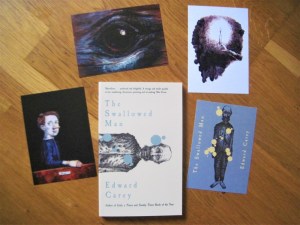
As a narrator, Geppetto is funny and gifted at wordplay (“This tome is my tomb”; “I unobjected him. Can you object to that?”), yet haunted by his decisions. Carey deftly traces Geppetto’s state of mind as he muses on his loss and imprisonment. The Afterword adds a sly pseudohistorical note to the fantasy. There are black-and-white illustrations throughout, as well as photos of the objects described in the text (and, presumably, featured in the exhibition). For me this didn’t live up to Little, but it would be a great introduction to Carey’s work.
With thanks to Gallic Books for the free copy for review.
At Night All Blood Is Black by David Diop
[145 pages; translated from the French by Anna Moschovakis]
 I had no idea that Africans (“Chocolat soldiers”) fought for France in World War I. Diop’s second novel, which has already won several major European prizes, is about two Senegalese brothers-in-arms caught up in trench warfare. Alfa Ndaiye, aged 20, considers Mademba Diop his blood brother or “more-than-brother” (the novel’s French title is “Soul Brother”). From the start we know that Mademba has died. Gravely injured in battle, entrails spilling out, he begged Alfa to end his misery; three times Alfa refused. Having watched his friend die in agony, he knows he did the wrong thing. Slitting the man’s throat would have been the compassionate choice. From now on, Alfa will atone by brutally wreaking Mademba’s method of death on Germans. “The captain’s France needs our savagery, and because we are obedient, myself and the others, we play the savage.” Alas, I thought this bleak exploration of (in)humanity was marred by the repetitive language and unpleasantly sexualized metaphors.
With thanks to Pushkin Press for the proof copy for review.
 Bookish Beck = Rebecca Foster. American transplant to England. Freelance proofreader and book reviewer.
 Bookish Beck