Young Writer of the Year Award: Shortlist Reviews and Predictions
Being on the shadow panel for the Sunday Times Young Writer of the Year Award was a bookish highlight of 2017 for me. I’m pleased for this year’s shadow panelists, a couple of whom are blogging friends (one I’ve met IRL), to have had the same opportunity, and I look forward to attending the prize ceremony at the London Library on December 5th.
I happened to have already read two of the shortlisted titles, the poetry collection The Perseverance by Raymond Antrobus and the debut novel Stubborn Archivist by Yara Rodrigues Fowler, which was one of my specific wishes/predictions. The kind folk of FMcM Associates sent me the other two shortlisted books, a short story collection and another debut novel, for blog reviews so that I could follow along with the shadow panel’s deliberations.
Salt Slow by Julia Armfield (2019)
These nine short stories are steeped in myth and magic, but often have a realistic shell. Only gradually do the fantastical or dystopian elements emerge, with the final paragraph delivering a delicious surprise. For instance, the narrator of “Mantis” attends a Catholic girls’ school and is caught up in a typical cycle of self-loathing and obsessing over boys. It’s only at the very end that we realize her extreme skin condition is actually a metamorphosis that enables her to protect herself. The settings are split between the city and the seaside; the perspective is divided almost perfectly down the middle between the first and third person. The body is a site of transformation, or a source of grotesque relics, as in “The Collectables,” in which a PhD student starts amassing body parts she could only have acquired via grave-robbing.
 Two favorites for me were “Formerly Feral,” in which a 13-year-old girl acquires a wolf as a stepsister and increasingly starts to resemble her; and the final, title story, a post-apocalyptic one in which a man and a pregnant woman are alone in a fishing boat, floating above a drowned world and living as if outside of time. This one is really rather terrifying. I also liked “Cassandra After,” in which a dead girlfriend comes back – it reminded me of Margaret Atwood’s The Robber Bride, which I’m currently reading for #MARM. “Stop Your Women’s Ears with Wax,” about a girl group experiencing Beatles-level fandom on a tour of the UK, felt like the odd one out to me in this collection.
Armfield’s prose is punchy, with invented verbs and condensed descriptions that just plain work: “Jenny had taken to poltergeisting round the house”; “skin like fork-clawed cottage cheese,” “the lobster shells gleam a slick vermilion” and “The sky is gory with stars.” There’s no shortage of feminist fantasy stories out there nowadays – Aimee Bender, Kelly Link, Carmen Maria Machado and Karen Russell are just a few others working in this vein – but the writing in Salt Slow really grabbed me even when the plots didn’t. I’ll be following Armfield’s career with interest.
Testament by Kim Sherwood (2018)
Eva Butler is a 24-year-old MA student specializing in documentary filmmaking. She is a live-in carer for her grandfather, the painter Joseph Silk (real name: József Zyyad), in his Fitzroy Park home. When Silk dies early on in the book, she realizes that she knows next to nothing about his past in Hungary. Learning that he wrote a testament about his Second World War experiences for the Jewish Museum in Berlin, she goes at once to read it and is distressed at what she finds. With the help of Felix, the museum’s curator, who did his PhD on Silk’s work, she travels to Budapest to track down the truth about her family.
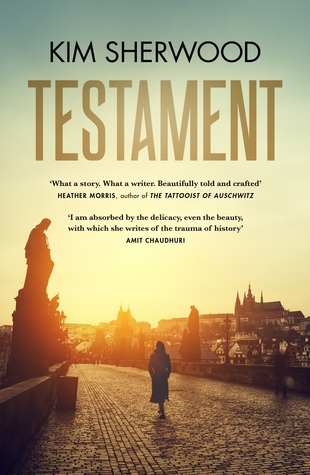 Sherwood alternates between Eva’s quest and a recreation of József’s time in wartorn Europe. Cleverly, she renders the past sections more immediate by writing them in the present tense, whereas Eva’s first-person narrative is in the past tense. Although József escaped the worst of the Holocaust by being sentenced to forced labor instead of going to a concentration camp, his brother László and their friend Zuzka were in Theresienstadt, so readers get a more complete picture of the Jewish experience at the time. All three wind up in the Lake District after the war, rebuilding their lives and making decisions that will affect future generations.
It’s almost impossible to write anything new about the Holocaust these days, and overfamiliarity was certainly a roadblock for me here. I was especially reminded of Julie Orringer’s The Invisible Bridge, what with its focus on the Hungarian Jewish experience. However, I did appreciate the way Sherwood draws on her family history – her grandmother is a Hungarian Holocaust survivor – to consider how trauma still affects the second and third generation. This certainly doesn’t feel like a debut novel. It’s highly readable, and the emotional power of the story cannot be denied. The Young Writer of the Year Award is great for highlighting books that risk being overlooked: in a year dominated by The Testaments, poor Testament was otherwise likely to sink without notice.
Note: “Testament” is also the title of the poem written by Sherwood’s great-grandfather that she recited at her grandfather’s funeral – just as Eva does in the novel. It opens this Telegraph essay (paywalled, but reprinted in the paperback of Testament) that Sherwood wrote about her family history.
General thoughts and predictions:
Any of these books would be a worthy winner. However, as Raymond Antrobus has already won this year’s £30,000 Rathbones Folio Prize as well as the 2018 Geoffrey Dearmer Award from the Poetry Society, The Perseverance has had sufficient recognition – plus it’s a woman’s turn. Testament is accomplished, and likely to hold the widest appeal, but it strikes me as the safe choice. Salt Slow would be an edgier selection, and feels quite timely and fresh. But Stubborn Archivist has stuck with me since I reviewed it in March. I called it “Knausgaard for the Sally Rooney generation” and wrote that “the last book to have struck me as truly ‘novel’ in the same way was Lincoln in the Bardo.” From a glance at the shadow panel’s reviews thus far, I fear it may prove too divisive for them, though.
Based on my gut instincts and a bit of canny thinking about the shadow panelists and judges, here are my predictions:
Shadow Panel:
- What they will pick: Testament [but they might surprise me and go with Salt Slow or Stubborn Archivist]
- What they should pick: Salt Slow
Official Judging Panel:
- What they will pick: Stubborn Archivist [but they might surprise me and go with Salt Slow]
- What they should pick: Stubborn Archivist
I understand that the shadow panel is meeting today for their in-person deliberations. I wish them luck! Their pick will be announced on the 28th. I’ll be intrigued to see which book they select, and how it compares with the official winner on December 5th.
Have you read anything from this year’s shortlist?
Wellcome Book Prize 2019: Our Shadow Panel Winner Is…
The Trauma Cleaner: One Woman’s Extraordinary Life in Death, Decay and Disaster by Sarah Krasnostein
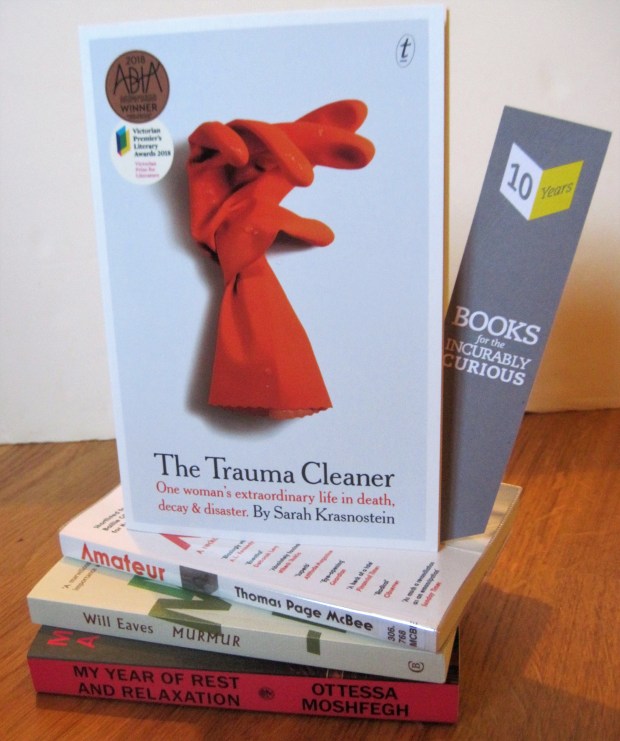
This year there was no clear favourite among the shadow panel. Two of us picked one book as our favourite, two picked another, and a third picked yet another book! However, by each person assigning each book a point value from 1 to 6, we were able to decide based on the one that got the most points in total. (Though there was only 1 point separating our first place from our runner-up!)
Here’s what the shadow panel have to say about our pick:
Annabel: “I was glad to have read this book. It was an easy read despite its oft grim subject matter, fascinating and very sympathetic too.”
Clare: “The structure of the book reveals the many layers and contradictions of Sandra gradually … even though it’s one of the least objective biographies I’ve read in a very long time, it is also one of the most memorable and fascinating.”
Laura: “The Trauma Cleaner is a book it will be difficult to forget in a hurry. … Krasnostein is rightly impressed by Sandra’s resilience, and, in telling her story, she makes the right choice, I think, to remain as a largely invisible presence.”
Paul: “Pankhurst is one remarkable lady, even after a horrendous childhood and working in the prostitution trade, she has an amazing amount of empathy for all of her clients. … if you want to have a no-holds-barred look at a part of society that almost everyone will be unaware of then this is one to read.”
Rebecca: “I guarantee you’ve never read a biography quite like this one. … It’s part journalistic exposé and part ‘love letter’; it’s part true crime and part ordinary life story. It considers gender, mental health, addiction, trauma and death. It’s also simply a terrific read that should draw in lots of people who wouldn’t normally pick up nonfiction.”
Photo by Annabel Gaskell.
On Wednesday, at an evening ceremony at the Wellcome Collection, we will find out which book the official judges have chosen as the winner of the 10th anniversary prize. I have no idea who it will be!
Who are you rooting for?
Wellcome Book Prize 2019: Announcing Our Shadow Panel Shortlist
Here’s a recap of what’s on the Wellcome Book Prize longlist, with links to all the reviews that have gone up on our blogs so far:

Amateur: A true story about what makes a man by Thomas Page McBee
Astroturf by Matthew Sperling
Educated by Tara Westover
Freshwater by Akwaeke Emezi
Heart: A history by Sandeep Jauhar
Mind on Fire: A memoir of madness and recovery by Arnold Thomas Fanning
Murmur by Will Eaves
My Year of Rest and Relaxation by Ottessa Moshfegh
Polio: The odyssey of eradication by Thomas Abraham
Sight by Jessie Greengrass
The Trauma Cleaner: One woman’s extraordinary life in death, decay and disaster by Sarah Krasnostein
This Really Isn’t About You by Jean Hannah Edelstein
Together we have chosen the six* books we would like to see advance to the shortlist. This is based on our own reading and interest, but also on what we think best fits the prize’s aim, as stated on the website:
To be eligible for entry, a book should have a central theme that engages with some aspect of medicine, health or illness. At some point, medicine touches all our lives. Books that find stories in those brushes with medicine are ones that add new meaning to what it means to be human. The subjects these books grapple with might include birth and beginnings, illness and loss, pain, memory, and identity. In keeping with its vision and goals, the Wellcome Book Prize aims to excite public interest and encourage debate around these topics.
Here are the books (*seven of them, actually) that we’ll be rooting for – we had a tie on a couple:

Amateur: A true story about what makes a man by Thomas Page McBee
Educated by Tara Westover
Heart: A history by Sandeep Jauhar
Murmur by Will Eaves
Sight by Jessie Greengrass
The Trauma Cleaner by Sarah Krasnostein
This Really Isn’t About You by Jean Hannah Edelstein
The official Wellcome Book Prize shortlist will be announced on Tuesday the 19th. I’ll check back in on Wednesday with our reactions to the shortlist and the plan for covering the rest of the books we haven’t already read.
The Wellcome Book Prize 2019 Longlist: Reactions & Shadow Panel Reading Strategy
The 2019 Wellcome Book Prize longlist was announced on Tuesday. From the prize’s website, you can click on any of these 12 books’ covers, titles or authors to get more information about them.
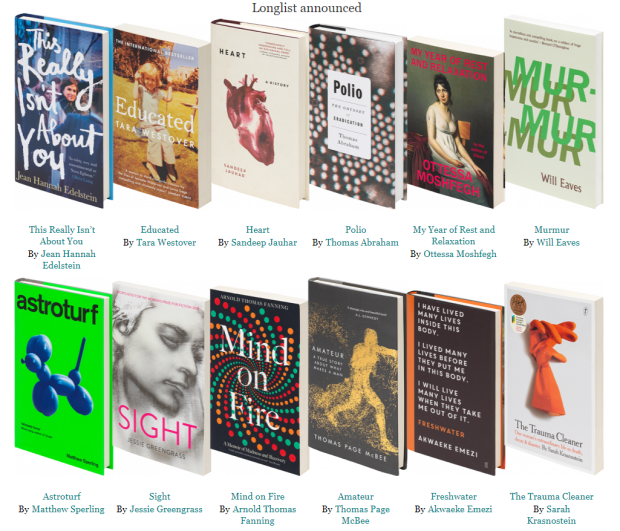
This year marks the 10th anniversary of the prize. As always, it’s a strong and varied set of nominees, with an overall focus on gender and mental health. Here are some initial thoughts (see also Laura’s thorough rundown of the 12 nominees):

- I correctly predicted just two, Sight by Jessie Greengrass and Heart: A History by Sandeep Jauhar, but had read another three: This Really Isn’t About You by Jean Hannah Edelstein, Amateur by Thomas Page McBee, and Educated by Tara Westover (reviewed for BookBrowse).
- I’m particularly delighted to see Edelstein on the longlist as her book was one of my runners-up from last year and deserves more attention.
- I’m not personally a huge fan of the Greengrass or McBee books, but can certainly see why the judges thought them worthy of inclusion.
- Though it’s a brilliant memoir, I never would have thought to put Educated on my potential Wellcome list. However, the more I think about it, the more health elements it has: her father’s possible bipolar disorder, her brother’s brain damage, her survivalist family’s rejection of modern medicine, her mother’s career in midwifery and herbalism, and her own mental breakdown at Cambridge.
- Books I knew about and was keen to read but hadn’t thought of in conjunction with the prize: The Trauma Cleaner by Sarah Krasnostein and My Year of Rest and Relaxation by Ottessa Moshfegh.
- Novels I had heard of but wasn’t necessarily interested in beforehand: Murmur by Will Eaves and Freshwater by Akwaeke Emezi. I went to get Freshwater from the library the afternoon of the longlist announcement and am now 60 pages in. I’d be tempted to call it this year’s Stay with Me except that the magic realist elements are much stronger here, reminding me of what I know about work by Chigozie Obioma and Ben Okri. The novel is narrated in the first person plural by a pair of (gods? demons? spirits?) inhabiting Ada’s head.
- And lastly, there are a few books I had never even heard of: Polio: The Odyssey of Eradication by Thomas Abraham, Mind on Fire: A Memoir of Madness and Recovery by Arnold Thomas Fanning, and Astroturf by Matthew Sperling. I’m keen on the Fanning but not so much on the other two. Polio will likely make it to the shortlist as this year’s answer to The Vaccine Race; if it does, I’ll read it then.

Some statistics on this year’s longlist, courtesy of a press release sent by Midas PR:
- Five novels (two more than last year – I think we can see the influence of novelist Elif Shafak), five memoirs, one biography, and one further nonfiction title
- Six debut authors
- Six titles from independent publishers (Canongate, CB Editions, Faber & Faber, Oneworld, Hurst Publishers, and The Text Publishing Company)
- Most of the authors are British or American, while Fanning is Irish (Emezi is Nigerian-American, Jauhar is Indian-American, and Krasnostein is Australian-American).
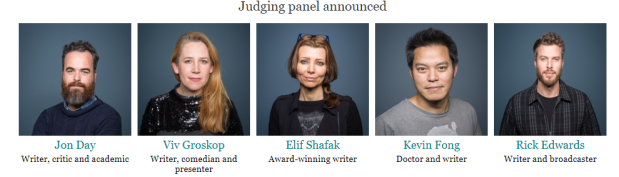
Chair of judges Elif Shafak writes: “In a world that remains sadly divided into echo chambers and mental ghettoes, this prize is unique in its ability to connect various disciplines: medicine, health, literature, art and science. Reading and discussing at length all the books on our list has been fascinating from the very start. We now have a wonderful longlist, of which we are all very proud. Although it sure won’t be easy to choose the shortlist, and then, finally, the winner, I am thrilled about and truly grateful for this fascinating journey through stories, ideas, ground-breaking research and revolutionary knowledge.”
We of the shadow panel have divided up the longlist titles between us as follows (though we may well each get hold of and read more of the books, simply out of personal interest) and will post reviews on our blogs within the next five weeks.
Amateur: A true story about what makes a man by Thomas Page McBee – LAURA
Astroturf by Matthew Sperling – PAUL
Educated by Tara Westover – CLARE
Freshwater by Akwaeke Emezi – REBECCA
Heart: A history by Sandeep Jauhar – LAURA
Mind on Fire: A memoir of madness and recovery by Arnold Thomas Fanning – REBECCA
Murmur by Will Eaves – PAUL
My Year of Rest and Relaxation by Ottessa Moshfegh – CLARE
Polio: The odyssey of eradication by Thomas Abraham – ANNABEL
[Sight by Jessie Greengrass – 4 of us have read this; I’ll post a composite of our thoughts]
The Trauma Cleaner: One woman’s extraordinary life in death, decay and disaster by Sarah Krasnostein – ANNABEL
This Really Isn’t About You by Jean Hannah Edelstein – LAURA
The Wellcome Book Prize shortlist will be announced on Tuesday, March 19th, and the winner will be revealed on Wednesday, May 1st.
We plan to choose our own shortlist to announce on Friday, March 15th. Follow along here and on Halfman, Halfbook, Annabookbel, A Little Blog of Books, and Dr. Laura Tisdall for reviews and predictions.
Are there any books on here that you’d like to read?
The 2019 Wellcome Book Prize: Shadow Panel and Wish List
On Tuesday the longlist for the 2019 Wellcome Book Prize will be announced. For the third year in a row I’m running a shadow panel, and it’s composed of the same four wonderful book bloggers who joined me last year: Paul Cheney of Halfman, Halfbook, Annabel Gaskell of Annabookbel, Clare Rowland of A Little Blog of Books, and Dr. Laura Tisdall.
This year we’re going to do things slightly differently: we plan to split up the longlist, taking two to three titles each, so that between us we will have read them all and can announce our own preferred shortlist before the official shortlist is announced in March. At that point we’ll catch up by (re)reading the six shortlisted books, each reviewing the ones we haven’t already. Essentially, I’m adding an extra stage of shadow panel judging, simply because I can. I hope it will be fun – and also less onerous, in that we should get a leg-up on the shortlist and not have to read all six books in March‒April, which has proved to be a challenge in the past.
My Wellcome Prize hopefuls are all the fiction or nonfiction titles I’ve read on a medical theme that were published in the UK in calendar year 2018. I have put asterisks beside the 12 books in this post that I predict for the longlist. (The combination of wishful thinking and likelihood means that these are not exclusively my personal favorites.)

Below is a list of the books I’ve already featured on the blog in some way, with links to my coverage and a few-word summary of their relevance.
Nonfiction
Gross Anatomy by Mara Altman: Female body woes
*Beneath the Skin: Great Writers on the Body: Essays on organs
*All that Remains by Sue Black: Forensic anthropology
Everything Happens for a Reason by Kate Bowler: Living with advanced cancer
Heal Me by Julia Buckley: Tackling chronic pain
*The Unmapped Mind by Christian Donlan: Adjusting to life with MS
From Here to Eternity by Caitlin Doughty: Funerary rites around the world
This Really Isn’t About You by Jean Hannah Edelstein: A genetic disease in the family
Natural Causes by Barbara Ehrenreich: Questioning the wellness culture
On Smaller Dogs and Larger Life Questions by Kate Figes: Pondering breast cancer
Shapeshifters by Gavin Francis: Instances of bodily change
The Reading Cure by Laura Freeman: Healing from an eating disorder
Nine Pints by Rose George: The story of blood
Waiting for the Last Bus by Richard Holloway: Ageing and death
*Heart: A History by Sandeep Jauhar: Heart disease and treatments
Sick by Porochista Khakpour: Chronic Lyme disease
Human Errors by Nathan Lents: Flawed bodies; evolutionary adaptations
Skybound by Rebecca Loncraine: Breast cancer; flying lessons
Amateur by Thomas Page McBee: Memoir of F2M transformation
*Face to Face by Jim McCaul: Tales of facial surgery
*Somebody I Used to Know by Wendy Mitchell: A firsthand account of early Alzheimer’s
*That Was When People Started to Worry by Nancy Tucker: Mental illness from the inside
*The Language of Kindness by Christie Watson: Nursing as a vocation
Fiction
Little by Edward Carey: Anatomical models in wax (thanks to Clare for the reminder!)
Orchid & the Wasp by Caoilinn Hughes: Non-epileptic seizures
*The Winter Soldier by Daniel Mason: Neurology, surgery during WWI
The Way of All Flesh by Ambrose Parry: Medicine in 1840s Edinburgh
Other eligible books that I have read but not happened to mention on the blog:
 In Shock by Rana Awdish: The doctor became the patient when Awdish, seven months pregnant, was rushed into emergency surgery with excruciating pain due to severe hemorrhaging into the space around her liver, later explained by a ruptured tumor. Having experienced brusque, cursory treatment, even from colleagues at her Detroit-area hospital, she was convinced that doctors needed to do better. This memoir is a gripping story of her own medical journey and a fervent plea for compassion from medical professionals.
 Doctor by Andrew Bomback: Part of the Bloomsbury Object Lessons series, this is a wide-ranging look at what it’s like to be a doctor. Bomback is a kidney specialist; his wife is also a doctor, and his father, fast approaching retirement, is the kind of old-fashioned, reassuring pediatrician who knows everything. Even the author’s young daughter likes playing with a stethoscope and deciding what’s wrong with her dolls. In a sense, then, Bomback uses fragments of family memoir to compare the past, present and likely future of medicine.
 A Moment of Grace by Patrick Dillon [skimmed]: A touching short memoir of the last year of his wife Nicola Thorold’s life, in which she battled acute myeloid leukemia. Dillon doesn’t shy away from the pain and difficulties, but is also able to summon up some gratitude.
 Get Well Soon: Adventures in Alternative Healthcare by Nick Duerden: British journalist Nick Duerden had severe post-viral fatigue after a run-in with possible avian flu in 2009 and was falsely diagnosed with ME / CFS. He spent a year wholeheartedly investigating alternative therapies, including yoga, massage, mindfulness and meditation, visualization, talk therapy and more. He never comes across as bitter or sorry for himself. Instead, he considered fatigue a fact of his new life and asked what he could do about it. So this ends up being quite a pleasant amble through the options, some of them more bizarre than others.
 *Sight by Jessie Greengrass [skimmed]: I wanted to enjoy this, but ended up frustrated. As a set of themes (losing a parent, choosing motherhood, the ways in which medical science has learned to look into human bodies and minds), it’s appealing; as a novel, it’s off-putting. Had this been presented as a set of autobiographical essays, perhaps I would have loved it. But instead it’s in the coy autofiction mold where you know the author has pulled some observations straight from life, gussied up others, and then, in this case, thrown in a bunch of irrelevant medical material dredged up during research at the Wellcome Library.
 *Brainstorm: Detective Stories From the World of Neurology by Suzanne O’Sullivan: Epilepsy affects 600,000 people in the UK and 50 million worldwide, so it’s an important condition to know about. It is fascinating to see the range of behaviors seizures can be associated with. The guesswork is in determining precisely what is going wrong in the brain, and where, as well as how medicines or surgery could address the fault. “There are still far more unknowns than knowns where the brain is concerned,” O’Sullivan writes; “The brain has a mind of its own,” she wryly adds later on. (O’Sullivan won the Prize in 2016 for It’s All in Your Head.)
 I’m also currently reading and enjoying two witty medical books, The Mystery of the Exploding Teeth and Other Curiosities from the History of Medicine by Thomas Morris, and Chicken Unga Fever by Phil Whitaker, his collected New Statesman columns on being a GP.
Four additional books I have not read but think might have a chance of making the longlist:
Primate Change: How the World We Made Is Remaking Us by Vybarr Cregan-Reid
 The Beautiful Cure: Harnessing Your Body’s Natural Defences by Daniel M. Davis
Because I Come from a Crazy Family: The Making of a Psychiatrist by Edward M. Hallowell
*She Has Her Mother’s Laugh: The Powers, Perversions, and Potential of Heredity by Carl Zimmer
Look out for the announcement of the longlist on Tuesday afternoon! I’ll report back, perhaps on Wednesday, with some reactions and the shadow panel’s reviewing strategy.
Have you read, or are you interested in, any of these books?
Can you think of other 2018 releases that might be eligible for the Wellcome Book Prize?
My Patchy Experience with Book Clubs
I know that a number of you have long-term, faithful book clubs. Boy, am I envious! You might find it surprising that I’ve only ever been in one traditional book club, and it wasn’t a resounding success. Partway through my time working for King’s College, London, an acquaintance from another library branch started the club. A group of five to eight of us from Library Services aimed to meet after work one evening a month at a Southbank venue or a staff room to discuss our latest pick. By poring over old e-mails and my Goodreads library, I’ve managed to remember 10 of the books we read between November 2011 and June 2013:
- Do Androids Dream of Electric Sheep?, Philip K. Dick [classic science fiction]
- The Little Shadows, Marina Endicott [Canadian historical fiction]
- A Spot of Bother, Mark Haddon [contemporary fiction]
- The Talented Mr. Ripley, Patricia Highsmith [classic suspense]
- The Vintner’s Luck, Elizabeth Knox [bizarre historical fiction/magic realism]
- What Was Lost, Catherine O’Flynn [contemporary fiction]
- Franny and Zooey, J.D. Salinger [classic short fiction]
- The Rabbi’s Cat, Joann Sfar [graphic novel in translation]
- Girl Meets Boy, Ali Smith [an update of Greek myth]
- Angel, Elizabeth Taylor [an obscure English classic]
That may well be the complete list. Although I was a member for 20 months until I quit to go freelance, we often only managed to meet every other month because we couldn’t find a mutually convenient free evening or no one had read the book in time. I was consistently frustrated that – even when our selections were only about 200 pages long – I was often one of the only people to have read the whole book.
Overall, the quality of books we chose struck me as mediocre: I rated half of these books 2 stars, and the rest 3 stars. (I think I was a harsher rater then, but it’s not a good sign, is it?) Perhaps this is part of the inevitable compromising that goes with book clubs, though: You humor other people in their choices and hope they’ll be kind about yours? My suggestion, for the record, was the pretty dismal Little Shadows, for which I got a free set of book club copies to review for Booktime magazine. But I also voted in favor of most of the above list.
Looking back, I am at least impressed by how varied our selections were. People were interested in trying out different genres, so we ranged from historical fiction to sci-fi, and even managed a graphic novel. But when we did get together for discussion there was far too much gossipy chat about work, and when we finally got around to the book itself the examination rarely went deeper than “I liked it” or “I hated all the characters.”
If it was profound analysis I was after, I got that during the years I volunteered at Greenbelt, an annual summer arts festival with a progressive Christian slant. I eagerly read the eclectic set of three books the literature coordinator chose for book club meetings in 2010 – Star of the Morning: The Extraordinary Life of Lady Hester Stanhope by Kirsten Ellis, The First Person and Other Stories by Ali Smith, and The Bridge of San Luis Rey by Thornton Wilder – and then as a literature volunteer for the next three years I read and prepared copious notes and questions about our festival “Big Read.” We did Exile by Richard North Patterson in 2011, Dark Eden by Chris Beckett in 2012 and So Many Ways to Begin by Chris Beckett in 2013, and each time I offered to chair the book club meetings.
Unfortunately, due at least in part to logistical considerations, these were run in the way many festival events are: a panel of two to five talking heads with microphones was at the front of the tent, sometimes on a raised dais, while the audience of whatever size sat towards the back. This created a disconnect between the “experts” and the participants, and with the exception of the McGregor meeting I don’t recall much audience input. I’ve mostly blanked out the events – as I tend to for anything that entails public speaking and nervous preparation for something you can’t control – but I was pleased to be involved and I should probably make more of this on my CV. It wasn’t your average book club setting, that’s for sure.
In recent years the closest thing I’ve had to a book club has been online buddy reading. The shadow panels for the Wellcome Book Prize and Sunday Times Young Writer of the Year Award fall into this category, as do online readalongs I’ve done for several Iris Murdoch novels and for C.S. Lewis’s Mere Christianity with various female family members. A few of us book bloggers chatted about Andrea Levy’s Small Island in an online document earlier this year, and my mom and I e-mailed back and forth while reading W. Somerset Maugham’s The Painted Veil in May. I’m also doing my last three of the #20BooksofSummer as online buddy reads, checking in occasionally on Twitter.
Of course, there are some inherent limitations to this kind of discussion – people read at different paces and don’t want to spoil the plot for others, and at some point the back-and-forth fizzles out – but it’s always been easier for me to organize my thoughts in writing, so I likely feel more comfortable contributing than I might in an in-person meeting.
This is all context for my decision to join my neighborhood book club next month. The club arose some months back out of our community’s Facebook group, a helpful resource run by a go-getting lady a few doors down from us. So far it’s turning out to be a small group of thirty- and fortysomething women who alternate meetings at each other’s houses, and the name they’ve chosen gives an idea of the tone: “Books, Booze and Banter.”
I made the mistake of not getting involved right at the start; I wanted to hang back and see what kind of books they’d choose. This means I wasn’t part of the early process of putting titles in a hat, so I’ve looked on snobbishly for several months as they lurched between crime and women’s fiction, genres I generally avoid. (Still, there were actually a couple books I might have joined them for had I not been in America and had they been readily available at the public library.) For many people a book club selection will be the only book they get through that month, so I can understand how they’d want it to be something ‘readable’ that they’d be happy to pick up anyway. Even though statistically I read 27 books a month, I’m still jealously protective of my reading time; I want everything I read to be worthwhile.
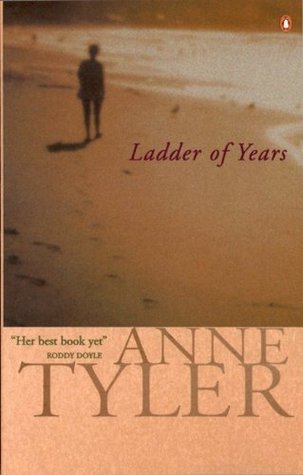 So for September I managed to steer the group away from a poorly received historical novel of over 400 pages and the new Joël Dicker and onto Ladder of Years by Anne Tyler, which the bookstore chain Waterstones has been promoting heavily as one of their books of the month. I already had a charity shop copy in hand and the others liked the sound of it, so we’re all set for September 12th! Future months’ literary fiction choices look promising, too, so provided I enjoy the discussion and the camaraderie I plan to stick with it: a backlist Pat Barker novel I’ve not read, and Kirsty Logan and Jonathan Coe novels I’ve read before and won’t reread but will remind myself about briefly before the meetings.
I’m out of practice with this book club thing. My mother tells me that I have a lot to contribute but that I must also be open to what I’ll learn from other people – even if I don’t expect to. So I don’t want to set myself up as some kind of expert. In fact, I probably won’t even mention that I’m a freelance book reviewer and book blogger. Mostly I’m hoping to find some friendly faces around the neighborhood, because even though we’ve lived here just over two years I still only know a handful of names and keep myself to myself as I work from home. Even if I have to read books I wouldn’t normally, it’ll be worth it to meet more people.
What has your experience with book clubs (in person and online) been?
Wellcome Book Prize Shadow Panel Decision
Addiction, death, infertility, surgery, transhumanism and vaccines: It’s been quite the varied reading list for the five of us this spring! Lots of science, lots of medicine, but also a lot of stories and imagination.
After some conferring and voting, we have arrived at our shadow panel winner for the Wellcome Book Prize 2018: To Be a Machine by Mark O’Connell.
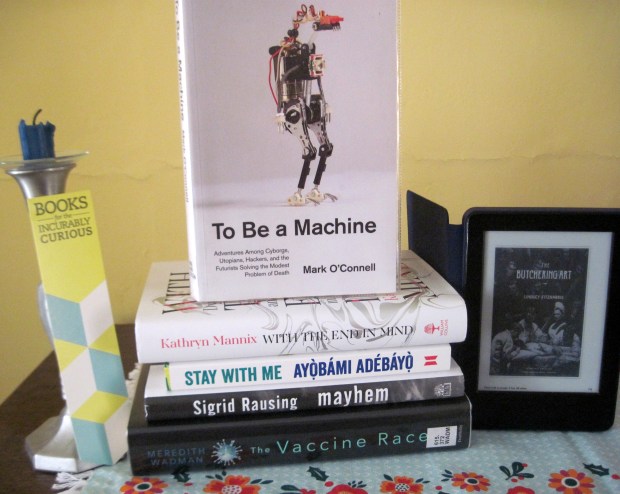
Rarely have I been so surprised to love a book. It’s a delight to read, and no matter what your background or beliefs are, it will give you plenty to think about. It goes deep down, beneath our health and ultimately our mortality, to ask what the essence of being human is.
Here’s what the rest of the shadow panel has to say about our pick:
Annabel: “O’Connell, as a journalist and outsider in the surprisingly diverse field of transhumanism, treats everyone with respect: asking the questions, but not judging, to get to the heart of the transhumanists’ beliefs. For a subject based in technology, To Be a Machine is a profoundly human story.”
Clare: “The concept of transhumanism may not be widely known or understood yet, but O’Connell’s engaging and fascinating book explains the significance of the movement and its possible implications both in the distant future and how we live now.”
Laura: “My brain feels like it’s been wired slightly differently since reading To Be a Machine. It’s not just about weird science and weird scientists, but how we come to terms with the fact that even the luckiest of us live lives that are so brief.”
Paul: “An interesting book that hopefully will provoke further discussion as we embrace technology and it envelops us.”

On Monday we’ll find out which book the official judges have chosen. I could see three or four of these as potential winners, so it’s very hard to say who will take home the £30,000.
Who are you rooting for?
Wellcome Book Prize: Shortlist Recap
Tomorrow morning we will announce our Wellcome Book Prize 2018 shadow panel winner. Beforehand I wanted to do a quick recap of my reviews, especially for the two books that I read before the shortlist announcement. My full reviews are here:
Stay with Me by Ayobami Adebayo
To Be a Machine by Mark O’Connell
Mayhem by Sigrid Rausing
The Vaccine Race by Meredith Wadman
I give some extra thoughts on and favorite quotes from the other two below:
The Butchering Art by Lindsey Fitzharris
 This is a great blend of medical history and popular science that should draw in readers who wouldn’t normally gravitate to either topic – provided they aren’t too squeamish. Fitzharris has recently returned to Oxford as a visiting academic, and this has also been nominated for the Wolfson History Prize. Follow her on Instagram (@drlindseyfitzharris) for a steady stream of gruesomely fascinating photos (I wish The Butchering Art had been illustrated!). Her next book will be much of a muchness, it seems, documenting the early years of plastic surgery after World War I through the story of pioneering surgeon Harold Gillies.
In the days before Joseph Lister…
“Operating theaters were gateways to death. It was safer to have an operation at home than in a hospital, where mortality rates were three to five times higher than they were in domestic settings.”
“The surgeon was very much viewed as a manual labourer who used his hands to make his living, much like a key cutter or plumber today.”
See what the rest of the shadow panel has to say about this book:
Annabel’s review: “[A]n extremely readable account of a ground-breaking career which led to real advances in hospital medicine. I enjoyed the whole, but particularly the grisly bits!”
Laura’s review: “It’s easy for me to feel a bit impatient with popular histories of periods or subjects that I know well, but Fitzharris strikes exactly the right note, writing clearly and accessibly with no dumbing down.”
Paul’s review: “It is one of the better books that I have read on medical history[;] Fitzharris writes in an engaging way on a subject that is not going to appeal to everyone, but in amongst all the blood is the fascinating story of Joseph Lister.”
With the End in Mind by Kathryn Mannix
 “It’s time to talk about dying. This is my way of promoting the conversation,” Mannix writes in her introduction to this accessible and reassuring book about death. She believes we are afraid of death because of our misconception that it is inevitably painful and undignified. In her decades of working in hospice care, this has rarely been the case. (Thank goodness that, compared to the earlier nineteenth-century situation Fitzharris surveys, we have reliable pain control options.) Mannix sees the role of the hospice worker as being like a midwife for the dying, a helpful idea I first encountered in Henry Fersko-Weiss’s Caring for the Dying: The Doula Approach to a Meaningful Death.
Many of the stories in this book are of peaceful deaths the patient and family had time to prepare for. Others are sad stories of denial. One, though, is quite gruesome, yet magnificently described. Alex, a young man with testicular teratoma, has a massive GI bleed:
“Alex’s head is thrown back, almost as though it is a voluntary movement. A huge, dark-red python slithers rapidly out of his mouth, pushing his head backwards as it coils itself onto the pillow beside him; the python is wet and gleaming and begins to stain the pillowcase and sheets with its red essence as Alex takes one snoring breath, and then stops breathing. His mother screams as he realises that the python is Alex’s blood. Probably all of his blood.”
See what the rest of the shadow panel has to say about this book:
Annabel’s review: “[I]t is helping patients, and their families and loved ones, to understand the process of dying, and dispelling the taboos around it that make this book such a valuable and compelling read. I wish I’d read something like this book before my mum died.”
Clare’s review: “For me, this enlightening book is a strong potential winner for the Wellcome Book Prize and I hope it brings comfort and guidance for those who need it.”
Laura’s review: “[The book is] written from her own experiences as a specialist in palliative care, and this proved, for me, both its strength and its downfall. … Mannix writes particularly well on the characteristic patterns of somebody who is entering a gradual decline.”
Paul’s review: “Can highly recommend this moving book and I think it should be essential reading for anyone who has any concerns about death.”
I wouldn’t be at all surprised to see either of these win the Wellcome Book Prize on Monday. Stay tuned for tomorrow’s shadow panel winner announcement, and Sunday’s write-up of a shortlist event I’m attending in London.
Quick Reactions to the Wellcome Book Prize Shortlist
From 12, we are now down to six. The 2018 Wellcome Book Prize shortlist is here!

Some quick thoughts:
I sort-of predicted three out of the six in yesterday’s post: The Butchering Art by Lindsey Fitzharris, With the End in Mind by Kathryn Mannix, and To Be a Machine by Mark O’Connell.
I’m relieved that I’d already gotten to two of the shortlisted titles (Fitzharris and Mannix), so I can focus on reading the other four over the next 5+ weeks, and will briefly revisit those first two on my Kindle when it’s decision time.
I am pretty shocked that Maggie O’Farrell’s I Am, I Am, I Am did not advance to the shortlist. Mayhem will have to be a truly amazing memoir to outdo it; I wanted to read it anyway, but now I’m particularly keen – it would be a good one for me to feature on the official blog tour if that happens to work out.
I’m not feeling very cheerful about having to start Stay with Me again (I DNFed it last year), but I’ll try to approach it with an open mind.
To Be a Machine is currently on shelf at my local library (fingers crossed that it’s still there when I go on Friday) and I’ve reserved The Vaccine Race from another branch. I’ll start with one of those.
I’ve also been promised two review copies at random in the post – let’s hope it’s not the two I’ve already read!
(See also Laura’s initial thoughts.)
Feel like joining the shadow panel in reading one or more of these six books?
Wellcome Book Prize Shadow Panel & Two Longlist Reviews
I’m delighted to announce the other book bloggers on my Wellcome Book Prize 2018 shadow panel: Paul Cheney of Halfman, Halfbook, Annabel Gaskell of Annabookbel, Clare Rowland of A Little Blog of Books, and Dr. Laura Tisdall. Once the shortlist is announced on Tuesday the 20th, we’ll be reading through the six nominees and sharing our thoughts. Before the official winner is announced at the end of April we will choose our own shadow winner.
I’ve been working my way through some of the longlisted titles I was able to access via the public library and NetGalley. Here’s my latest two (both  ):
):
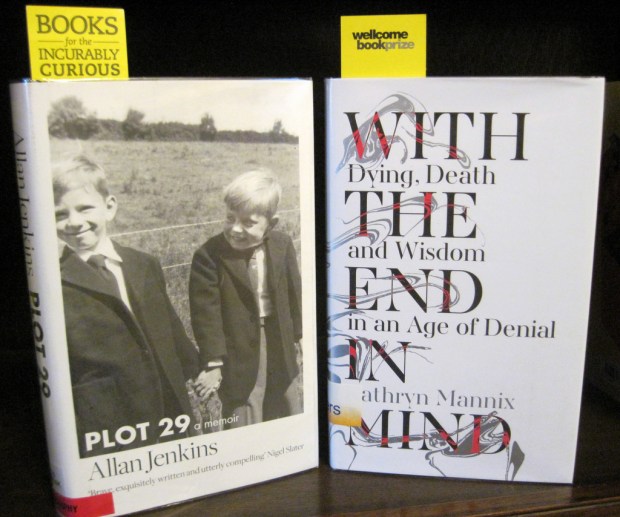
Plot 29: A Memoir by Allan Jenkins
This is an unusual hybrid memoir: it’s a meditative tour through the gardening year, on a plot in London and at his second home in his wife’s native Denmark. But it’s also the story of how Jenkins, editor of the Observer Food Monthly, investigated his early life. Handed over to a Barnardo’s home at a few months of age, he was passed between various family members and a stepfather (with some degree of neglect: his notes show scabies, rickets and TB) and then raised by strict foster parents in Devon with his beloved older half-brother, Christopher. It’s interesting to read that initially Jenkins intended to write a simple gardening diary, with a bit of personal stuff thrown in. But as he got further into the project, it started to morph.

This cover image is so sweet. It’s a photograph from Summer 1959 of Christopher and Allan (on the right, aged five), just after they were taken in by their foster parents in Devon.
The book has a complicated chronology: though arranged by month, within chapters its fragments jump around in time, a year or a date at the start helping the reader to orient herself between flashbacks and the contemporary story line. Sections are often just a paragraph long; sometimes up to a page or two. I suspect some will find the structure difficult and distancing. It certainly made me read the book slowly, which I think was the right way. You take your time adjusting to the gradual personal unveiling just as you do to the slow turn of the seasons. When major things do happen – meeting his mother in his 30s; learning who his father was in his 60s – they’re almost anticlimactic, perhaps because of the rather flat style. It’s the process that has mattered, and gardening has granted solace along the way.
I’m grateful to the longlist for making me aware of a book I otherwise might never have heard about. I don’t think the book’s mental health theme is strong enough for it to make the shortlist, but I enjoyed reading it and I’ll also take a look at Jenkins’s upcoming book, Morning, about the joys of being an early riser. (Ironic after my recent revelations about my own sleep patterns!)
Favorite lines:
“Solitude plus community, the constant I search for, the same as the allotment”
“The last element to be released from Pandora’s box, they say, was hope. So I will mourn the children we once were and I will sow chicory for bitterness. I will plant spring beans and alliums. I’ll look after them.”
“As a journalist, I have learned the five Ws – who, what, where, when, why. They are all needed to tell a story, we are taught, but too many are missing in my tale.”
With the End in Mind: Dying, Death and Wisdom in an Age of Denial by Kathryn Mannix
This is an excellent all-round guide to preparation for death. It’s based around relatable stories of the patients Mannix met in her decades working in the fields of cancer treatment and hospice care. She has a particular interest in combining CBT with palliative care to help the dying approach their remaining time with realism rather than pessimism. In many cases this involves talking patients and their loved ones through the steps of dying and explaining the patterns – decreased energy, increased time spent asleep, a change in breathing just before the end – as well as being clear about how suffering can be eased.
I read the first 20% on my Kindle and then skimmed the rest in a library copy. This was not because I wasn’t enjoying it, but because it was a two-week loan and I was conscious of needing to move on to other longlist books. It may also be because I have read quite a number of books with similar themes and scope – including Caitlin Doughty’s two books on death, Caring for the Dying by Henry Fersko-Weiss, Being Mortal by Atul Gawande, and Waiting for the Last Bus by Richard Holloway. Really this is the kind of book I would like to own a copy of and read steadily, just a chapter a week. Mannix’s introductions to each section and chapter, and the Pause for Thought pages at the end of each chapter, mean the book lends itself to being read as a handbook, perhaps in tandem with an ill relative.
The book is unique in giving a doctor’s perspective but telling the stories of patients and their families, so we see a whole range of emotions and attitudes: denial, anger, regret, fear and so on. Tears were never far from my eyes as I read about a head teacher with motor neurone disease; a pair of women with metastatic breast cancer who broke their hips and ended up as hospice roommates; a beautiful young woman who didn’t want to stop wearing her skinny jeans even though they were exacerbating her nerve pain, as then she’d feel like she’d given up; and a husband and wife who each thought the other didn’t know she was dying of cancer.
Mannix believes there’s something special about people who are approaching the end of their life. There’s wisdom, dignity, even holiness surrounding them. It’s clear she feels she’s been honored to work with the dying, and she’s helped to propagate a healthy approach to death. As her children told her when they visited her dying godmother, “you and Dad [a pathologist] have spent a lifetime preparing us for this. No one else at school ever talked about death. It was just a Thing in our house. And now look – it’s OK. We know what to expect. We don’t feel frightened. We can do it. This is what you wanted for us, not to be afraid.”
I would be happy to see this advance to the shortlist.
Favorite lines:
“‘So, how long has she got?’ I hate this question. It’s almost impossible to answer, yet people ask as though it’s a calculation of change from a pound. It’s not a number – it’s a direction of travel, a movement over time, a tiptoe journey towards a tipping point. I give my most honest, most direct answer: I don’t know exactly. But I can tell you how I estimate, and then we can guesstimate together.”
“we are privileged to accompany people through moments of enormous meaning and power; moments to be remembered and retold as family legends and, if we get the care right, to reassure and encourage future generations as they face these great events themselves.”
Longlist strategy:
Currently reading: The Butchering Art by Lindsey Fitzharris: a history of early surgery and the fight against hospital infection, with a focus on the life and work of Joseph Lister.
Up next: I’ve requested review copies of The White Book by Han Kang and Mayhem by Sigrid Rausing, but if they don’t make it to the shortlist they’ll slip down the list of priorities.
 Bookish Beck = Rebecca Foster. American transplant to England. Freelance proofreader and book reviewer.
 Bookish Beck