Finishing Off the Barbellion Prize Shortlist: Sam Mills and Dr Amit Patel
The Barbellion Prize 2020 will be awarded tomorrow “to an author whose work has best represented the experience of chronic illness and/or disability.” (See also my reviews of Golem Girl by Riva Lehrer and Sanatorium by Abi Palmer.)
These two memoirs, though very different outwardly, both draw attention to the practical and emotional challenges of life with disability or a mental illness, and call for compassion from individuals and a commitment to help from governing bodies.
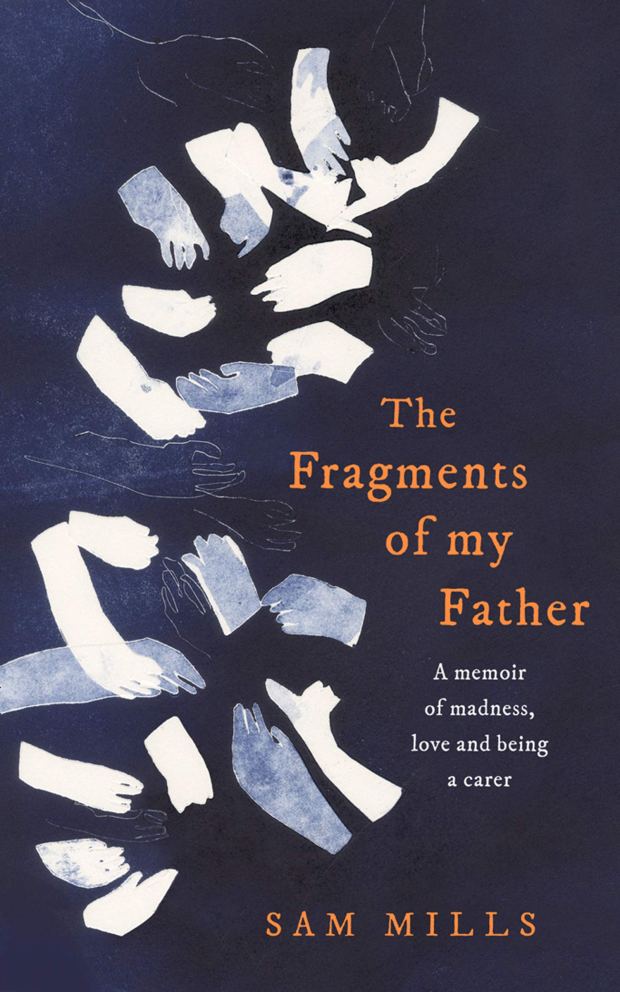
The Fragments of My Father: A memoir of madness, love and being a carer by Sam Mills
One in eight people in the UK cares for an ill or disabled relative. Sam Mills has been a carer for a parent – not once, but twice. The first time was for her mother, who had kidney cancer that spread to her lungs and died one Christmas. A few years later, Mills’s father, Edward, who has paranoid schizophrenia, started having catatonic episodes, as with the incident she opens her memoir on. In 2016, on what would have been her mother’s 70th birthday, Edward locked himself in the toilet of the family home in Surrey. Her brother had to break in with a screwdriver and ambulance staff took him away to a hospital. It wasn’t the first time he’d been institutionalized for a mental health crisis, nor would it be the last. It was always excruciating to decide whether he was better off at home or sectioned on a ward.
Mills darts between past and present as she contrasts her father’s recent condition with earlier points in their family life. She only learned about his diagnosis from her mother when, at age 14, she saw him walk down the stairs naked and then cry when he burned the chips. While schizophrenia can have a genetic element, relatives of a schizophrenic are also more likely to be high achievers. So, although Mills went through a time of suicidal depression as a teenager, meditation got her through and she exhibits more of the positive traits: An author of six books and founder of the small press Dodo Ink, she is creative and driven. Still, being her father’s full-time carer with few breaks often leaves her exhausted and overwhelmed.
The book’s two main points of reference are Leonard Woolf and F. Scott Fitzgerald, who cared for mentally ill wives and had to make difficult choices about their treatment and housing. In a nutshell, Mills concludes that Woolf was a good carer while Fitzgerald was a terrible one. Leonard was excused World War I service due to his nervous exhaustion from being a carer, and he gave up on the idea of children when doctors said that motherhood would be disastrous for Virginia. Virginia herself absolved Leonard in her suicide note, reassuring him that no couple could have been happier and that no one could have looked after her better. Scott, on the other hand, couldn’t cope with Zelda’s unpredictable behaviour – not least because of his own alcoholism – so had her locked up in expensive yet neglectful institutions and censored her work when it came too close to overlapping with his own plots.
The Fragments of My Father brings together a lot of my favourite topics to read about: grief, physical and mental illness, and literary biography. It had already been on my wish list since I first heard about it last year, but I’m glad the Barbellion Prize shortlisting gave me a chance to read it. It helps to have an interest in the Fitzgeralds and Woolfs – though in my case I had read a bit too extensively about them for this strand to feel fully fresh. (I also had a ‘TMI’ response to some revelations about the author’s relationships and sex life.)
Ultimately, I most appreciated the information on being a carer, including the mental burden and the financial and social resources available. (Although there is a government allowance for carers, Mills wasn’t eligible because of her freelance earnings, so she had to apply for Society of Authors grants instead.) With caring so common, especially for women, we need a safety net in place for all whose earnings and relationships will be affected by family duties. I read this with an eye to the future, knowing there’s every possibility that one day I’ll be a carer for a parent(-in-law) or spouse.
Readalikes I have also reviewed:
- Labours of Love: The Crisis of Care by Madeleine Bunting
- All the Lives We Ever Lived: Seeking Solace in Virginia Woolf by Katharine Smyth
Favorite lines:
“had I ever made a conscious choice? Caring felt like something that was happening to me, as though my father’s illness had been an eruption that had flowed like lava over my life. … I can’t think of any other job where someone defines your role by conferring its title on you, as though they are holding out a mould that you must fill.”
“caring is rarely simple because its nature is not static. It creates routines, crafts the days into set shapes, lulls you into states of false security, and then mutates, slaps you with fresh challenges, leaves you lost just when you feel you have gained wisdom.”
With thanks to Fourth Estate for the free copy for review.
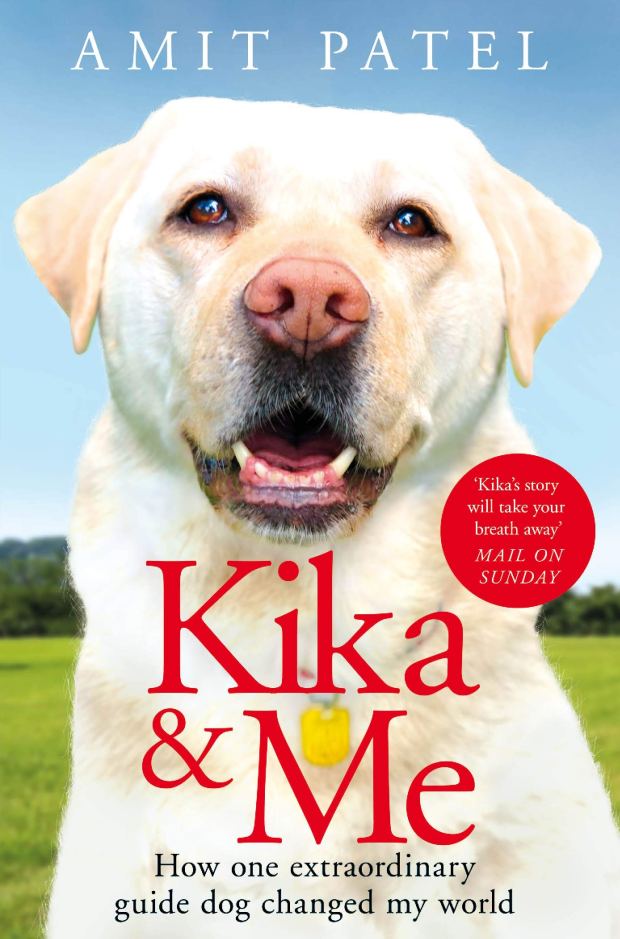
Kika & Me: How one extraordinary guide dog changed my world by Dr Amit Patel with Chris Manby
Dr Patel grew up in Guildford, studied medicine at Cambridge, and specialised in trauma medicine as a junior doctor in London. Diagnosed with keratocornus, which changes the shape of the cornea (it affects 1 in 450), he required first special contact lenses and then a series of cornea transplants. By the time of his eighth transplant, he’d remortgaged his house to pay an American specialist. Meeting and marrying Seema was a time of brightness before, in November 2013, he completely lost his vision within 36 hours. Blindness meant that he could no longer do his job, and constant eye pain and inactivity exacerbated his depression. While white cane and Braille training, plus the Royal National Institute of Blind People’s “Living with Sight Loss” course, started to boost his independence, it was being paired with his guide dog, Kika the Labrador, in 2015 that truly gave Patel his life back.
Trying out guide dogs sounds a little bit like speed dating. The Guide Dogs for the Blind Association (founded in the UK in 1931) warned that Kika was a “Marmite dog,” moody and likely to push boundaries; there was no guarantee she and Patel would get along. But from the start Kika was just right for him. More than once, what seemed like her pure stubbornness – lying on his feet and refusing to move – kept him from dangerous situations, like getting trapped between a busy road and a building site on an unfamiliar route. After a 10-day core skills training course, during which man and dog stayed at a hotel together, Kika was ready to join them at home. In the days to come, she would learn all Patel’s usual routes around their neighbourhood and into the City – with the help of smears of mackerel pâté.
If you’re like me, you’ll be most curious to learn about the nitty-gritty of life for a visually impaired person. I loved hearing about how Patel practiced his Braille letters with an egg container and ping pong balls. Since he went blind, he and his wife have had two children, and with Kika’s help manoeuvring a baby buggy is no problem. Guide dogs are trained to be predictable, e.g., doing their business in the same spot at the same times so it’s much easier to find and clean up. Some dog training tricks also worked for children, like putting a bell on a Labrador or a toddler to know when they wandered off!
Patel has had some unfortunate experiences since he went blind, particularly on the London Underground: teenagers picking him up and spinning him around on a train platform, busy commuters barging past him and Kika on an escalator, and an impatient woman hitting Kika with her handbag. While Patel doesn’t like being negative on social media, he finds that posting video clips of these incidents raises awareness of the challenges VIPs face. Every time he hits a setback, he uses it as an opportunity. For instance, one Diwali he was excited to visit Neasden Temple, only to be dismayed that they wouldn’t allow Kika inside. Since then, he has worked with temples around the world to improve disability services. He is also involved in London’s “Transport for All” work, and advises companies on access issues.
More so than the rest of the shortlist, Kika & Me is illuminating about daily life with a disability and has a campaigning focus. It’s an easy read, and not just for animal lovers. Judging the book by the cover, I might not have picked it up otherwise, so I’m grateful that the Barbellion put it on my radar. I’m deeply impressed by what Patel has achieved and the positive attitude he maintains. (Kika has her own Twitter account! @Kika_GuideDog)
With thanks to Pan Macmillan for the free copy for review.
(Fellow bloggers John Fish and Jackie Law have also been reading along with the Barbellion Prize shortlist. See their reviews thus far: John—Mills and Palmer; Jackie—Mills and Palmer.)
Next year the Barbellion Prize hopes to award more money, including to all nominated authors. They are accepting submissions for 2021, and are grateful for any Paypal donations via their website (see the page footer). I’ve donated to the cause. Can you help, too?
Booker Prize 2020: Two More Shortlist Reviews and a Prediction
The 2020 Booker Prize will be announced on Thursday the 19th. (Delayed from the 17th, the date on my commemorative bookmark, so as not to be overshadowed by the release of the first volume of Barack Obama’s presidential memoirs.) After I reviewed Burnt Sugar and correctly predicted half of the shortlist in this post, I’ve managed to finish another two of the novels on the shortlist, along with two more from the longlist. As sometimes happens with prize lists – thinking also of the Women’s Prize race in 2019 – this year’s shortlist fell into rough pairs: two stark mother–daughter narratives, two novels set in Africa, and two gay coming-of-age stories.

The New Wilderness by Diane Cook
In a striking opening to a patchy novel, Bea goes off to the woods to give birth alone to a stillborn daughter. It’s such a different experience to when she birthed Agnes in a hospital eight years ago. Now, with coyotes and buzzards already circling, there’s no time for sentimentality; she turns her back on the baby and returns to the group. Bea is part of a wilderness living experiment that started out with 20 volunteers, but illness and accidents have since reduced their number.
 Back in the toxic, overcrowded City, Bea was an interior decorator and her partner a professor of anthropology. Bea left to give Agnes a better chance at life; like so many other children, she had become ill from her polluted surroundings. Now she is a bright, precocious leader in the making, fully participating in the community’s daily chores. Settlement tempts them, but the Rangers enforce nomadism. Newcomers soon swell their numbers, and there are rumors of other groups, too. Is it even a wilderness anymore if so many people live in it?
The cycles of seasons and treks between outposts make it difficult to get a handle on time’s passing. It’s a jolt to realize Agnes is now of childbearing age. Only when motherhood is a possibility can she fully understand her own mother’s decisions, even if she determines to not repeat the history of abandonment. The blurb promised a complex mother–daughter relationship, but this element of the story felt buried under the rigor of day-to-day survival.
It is as if Cook’s primary interest was in how humans would react to being returned to primitive hunter–gatherer conditions – she did a lot of research into Native American practices, for instance, and she explores the dynamics of sex and power and how legends arise. As a child I was fascinated by Native cultures and back-to-the-land stories, so I enjoyed the details of packing lists, habits, and early rituals that form around a porcelain teacup.
But for me some nuts and bolts of storytelling were lacking here: a propulsive plot, a solid backstory, secondary characters that are worthwhile in their own right and not just stereotypes and generic roles. The appealing description induced me to overcome my usual wariness about dystopian novels, but a plodding pace meant it took me months to read. A lovely short epilogue narrated by Agnes made me wonder how much less tedious this chronicle might have been if told in the first person by Bea and Agnes in turn. I’ll try Cook’s story collection, Man V. Nature, to see if her gifts are more evident in short form.
My rating: 
My thanks to Oneworld for the free copy for review.
Real Life by Brandon Taylor
 Over the course of one late summer weekend, Wallace questions everything about the life he has built. As a gay African American, he has always been an outsider at the Midwestern university where he’s a graduate student in biochemistry. Though they vary in background and include several homosexuals, some partnered and some unattached, most of his friends are white, and he’s been so busy that he’s largely missed out on evening socializing by the lake – and skipped his father’s funeral (though there are other reasons for that as well).
Tacit prejudice comes out into the open in ugly ways in these few days. When he finds his nematode experiments sabotaged, a female colleague at his lab accuses him of misogyny, brandishing his identity as a weapon against him: “you think that you get to walk around because you’re gay and black and act like you can do no wrong.” Then, in a deliciously awkward dinner party scene, an acquaintance brings up Wallace’s underprivileged Alabama upbringing as if it explains why he’s struggling to cope in his academic career.
Meanwhile, Wallace has hooked up with a male – and erstwhile straight – friend, and though there is unwonted tenderness in this relationship, there is also a hint of menace. The linking of sexuality and violence echoes the memories of abuse from Wallace’s childhood, which tumble out in the first-person stream of consciousness of Chapter 5. Other male friends, too, are getting together or breaking apart over mismatched expectations. Kindness is possible, but built-in injustice and cruelty, whether vengeful or motiveless, too often take hold.
There are moments when Wallace seems too passive or self-pitying, but the omniscient narration emphasizes that all of the characters have hidden depths and that emotions ebb and flow. What looks like despair on Saturday night might feel like no big deal come Monday morning. I so admired how this novel was constructed: the condensed timeframe, the first and last chapters in the past tense (versus the rest in the present tense), the contrast between the cerebral and the bodily, and the thematic and linguistic nods to Virginia Woolf. A very fine debut indeed.
My rating: 
I also read two more of the longlisted novels from the library:
Such a Fun Age by Kiley Reid
 Such a fun book! I’d read the first chapter earlier in the year and set it aside, thinking it was too hip for me. I’m glad I decided to try again – it was a great read, so assured and contemporary. Once I got past a slightly contrived first chapter, I found it completely addictive. The laser-precision plotting and characterization reminded me of Jennifer Egan, Jonathan Franzen and Zadie Smith at their peak, but the sassy voice is all Reid’s own. There are no clear villains here; Alix Chamberlain could easily have filled that role, but I felt for her and for Kelley as much as I did for Emira. The fact that I didn’t think anyone was completely wrong shows how much nuance Reid worked in. The question of privilege is as much about money as it is about race, and these are inextricably intertwined.
Love and Other Thought Experiments by Sophie Ward
 An intriguing set of linked short stories that combine philosophy and science fiction. Rachel and Eliza are preparing to have a baby together when an ant crawls into Rachel’s eye and she falls ill. Eliza wants to believe her partner but, as a scientist, can’t affirm something that doesn’t make sense (“We don’t need to resort to the mystical to describe physical processes,” she says). Other chapters travel to Turkey, Brazil and Texas – and even into space. It takes 60+ pages to figure out, but you can trust all the threads will converge around Rachel and her son, Arthur, who becomes an astronaut. I was particularly taken by a chapter narrated by the ant (yes, really) as it explores Rachel’s brain. Each section is headed by a potted explanation of a thought experiment from philosophy. I wasn’t entirely sure what to make of the alternative future of the two final chapters. Still, I was impressed with the book’s risk-taking and verve. It’s well worth making a rare dip into sci-fi for this one.
Back in September I still thought Hilary Mantel would win the whole thing, but since her surprise omission from the shortlist I’ve assumed the prize will go to Shuggie Bain by Douglas Stuart. This was a DNF for me, but I’ll try it again next year in case it was just a matter of bad timing (like the Reid and The Go-Between – two books I attempted a second time this year and ended up loving). Given that it was my favorite of the ones I read, I would be delighted to see Real Life win, but I think it unlikely. My back-up prediction is The Shadow King by Maaza Mengiste, which I would consider reserving from the library if it wins.

Have you read anything from the Booker shortlist?
Which book do you expect to win?
Adventures in Rereading: The Sixteenth of June by Maya Lang
Last year I reviewed Tenth of December by George Saunders on its title date; this year I couldn’t resist rereading one of my favorites from 2014 for today’s date (which just so happens to be Bloomsday, made famous by James Joyce’s Ulysses), The Sixteenth of June.
I responded to the novel at length when it first came out. No point in reinventing the wheel, so here are mildly edited paragraphs of synopsis from my review for The Bookbag:
 Maya Lang’s playful and exquisitely accomplished debut novel, set on the centenary of the original Bloomsday, transplants many characters and set pieces from Ulysses to near-contemporary Philadelphia. Don’t fret, though – even if, like me, you haven’t read Ulysses, you’ll have no trouble following the thread. In fact, Lang dedicates her book to “all the readers who never made it through Ulysses (or haven’t wanted to try).” (Though if you wish to spot parallels, pull up any online summary of Ulysses; there is also a page on Lang’s website listing her direct quotations from Joyce.)
On June 16, 2004, brothers Leopold and Stephen Portman have two major commitments: their grandmother Hannah’s funeral is happening at the local synagogue in the morning; and their parents’ annual Bloomsday party will take place at their opulent Delancey Street home in the evening. Around those two thematic poles – the genuine emotions of grief and regret on the one hand, and the realm of superficial entertainment on the other – the novel expands outward to provide a nuanced picture of three ambivalent twenty-something lives.
The third side of this atypical love triangle is Nora, Stephen’s best friend from Yale – and Leo’s fiancée. Nora, a trained opera singer, is still reeling from her mother’s death from cancer one year ago. She’s been engaging in self-harming behavior, and Leo – a macho, literal-minded IT consultant – just wants to fix her. Nora and Stephen, by contrast, are sensitive, artistic souls who seem better suited to each other. Stephen, too, is struggling to find a meaning in death, but also to finish his languishing dissertation on Virginia Woolf.
Literature is almost as potent a marker of upper-class status as money here: some of the Portmans might not have even read Joyce’s masterpiece, but that doesn’t stop them name-dropping and maintaining the pretense of being well-read. While Lang might not mimic the extremes of Joyce’s stream-of-consciousness style, she prioritizes interiority over external action by using a close third-person voice that shifts between her main characters’ points of view. Their histories and thoughts are revealed mostly through interior monologues and conversations. Lang’s writing is full of mordant shards of humor; one of my favorite lines was “No one in a eulogy ever said, She watched TV with the volume on too loud.”
During my rereading, I was captivated more by the portraits of grief than by the subtle intellectual and class differences. I appreciated the characterization and the Joycean peekaboo, and the dialogue and shifts between perspectives still felt fresh and effortless. I could relate to Stephen and Nora’s feelings of being stuck and unsure how to move on in life. And the ending, which I’d completely forgotten, was perfect. I didn’t enjoy this quite as much the second time around, but it’s still a treasured signed copy on my shelf.
My original rating (June 2014): 
My rating now: 
Readalikes: Writers & Lovers by Lily King and The Emperor’s Children by Claire Messud (my upcoming Doorstopper of the Month).
(See also my review of Lang’s recent memoir, What We Carry.)
Alas, I’ve also had a couple of failed rereading attempts recently…
Everything Is Illuminated by Jonathan Safran Foer (2002)
 I remembered this as a zany family history quest turned into fiction. A Jewish-American character named Jonathan Safran Foer travels to (fictional) Trachimbrod, Ukraine to find the traces of his ancestors and, specifically, the woman who hid his grandfather from the Nazis. I had totally forgotten about the comic narration via letters from Jonathan’s translator/tour guide, Alexander, who fancies himself a ladies’ man and whose English is full of comic thesaurus use (e.g. “Do not dub me that,” “Guilelessly yours”). This was amusing, but got to be a bit much. I’d also forgotten about the dense magic realism of the historical sections. As with A Visit from the Goon Squad, what felt dazzlingly clever on a first read (in January 2011) failed to capture me a second time. [35 pages]
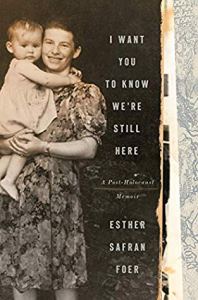 Interestingly, Foer’s mother, Esther, released a memoir earlier this year, I Want You to Know We’re Still Here. It’s about the family history her son turned into quirky autofiction: a largely fruitless trip he took to Ukraine to research his maternal grandfather’s life for his Princeton thesis, and a more productive follow-up trip she took with her older son in 2009. Esther Safran Foer was born in Poland and lived in a German displaced persons camp until she and her parents emigrated to Washington, D.C. in 1949. Her father committed suicide in 1954, making him almost a belated victim of the Holocaust. The stories she hears in Ukraine – of the slaughter of entire communities; of moments of good luck that allowed her parents to, separately, survive and find each other – are remarkable, but the book’s prose, while capable, never sings. Plus, she references her son’s novel so often that I wondered why someone would read her book when they could read his instead.
On Beauty by Zadie Smith (2005)
 This was an all-time favorite when it first came out. I remembered a sophisticated homage to E.M. Forster’s Howards End, featuring a biracial family in Cambridge, Mass. I remembered no specifics beyond a giant music store and (embarrassingly) an awkward sex scene. Howard Belsey’s long-distance rivalry with a fellow Rembrandt scholar gets personal when the Kipps family relocates from London to the Boston suburbs for Monty to be the new celebrity lecturer at the same college. Howard is in the doghouse with his African-American wife, Kiki, after having an affair. The Belsey boy and Kipps girl have an awkward romantic history. Zora Belsey is smitten with a lower-class spoken word poet she meets after a classical concert in the park when they pick up each other’s Discmans by accident (so dated!). All of the portraits felt like stereotypes to me, and there was so much telling, so much backstory, so many unnecessary secondary characters. Before I would have said this was my obvious Women’s Prize winner of winners, but now I have no idea what I’ll vote for. [107 pages]
Currently rereading: Watership Down by Richard Adams, Ella Minnow Pea by Mark Dunn, Dreams from My Father by Barack Obama
To reread soon: Heaven’s Coast by Mark Doty & Animal, Vegetable, Miracle by Barbara Kingsolver
Done any rereading lately?
New Reading Projects! (Join Me?)
It’s only one week since we announced the Not the Wellcome Prize winner, the culmination of a month-long project that was months more in the planning. I don’t think I’ll be coordinating another blog tour anytime soon, as it was a lot of work finding participants, working out a schedule and keeping on top of the publicizing via social media. Still, it was a lot of fun, and already I’m missing the buzz and ready to get stuck into more projects.
I’d love it if you joined me for one or more of these. Some could be combined with your 20 Books of Summer or other challenges, too.
Ongoing buddy reads
 It would have been Richard Adams’s 100th birthday on the 9th. That night I started rereading his classic tale of rabbits in peril, Watership Down, which was my favorite book from childhood even though I only read it the once at age nine. I’m 80 pages in and enjoying all the local place names. Who would ever have predicted that that mousy tomboy from Silver Spring, Maryland would one day live just 6.5 miles from the real Watership Down?!
 My husband is joining me for the Watership Down read (he’s not sure he ever read it before), and we’re also doing a buddy read of Arctic Dreams by Barry Lopez. In that case, we ended up with two free copies, one from the bookshop where I volunteer and the other from The Book Thing of Baltimore, so we each have a copy on the go. Lopez’s style, like Peter Matthiessen’s, lends itself to slower, reflective reading, so I’m only two chapters in. It’s novel to journey to the Arctic, especially as we approach the summer.
I plan to take my time over these two, so tell me if you have a copy of either and feel like picking it up at any point over the next few months.
Bibliotherapy self-prescriptions
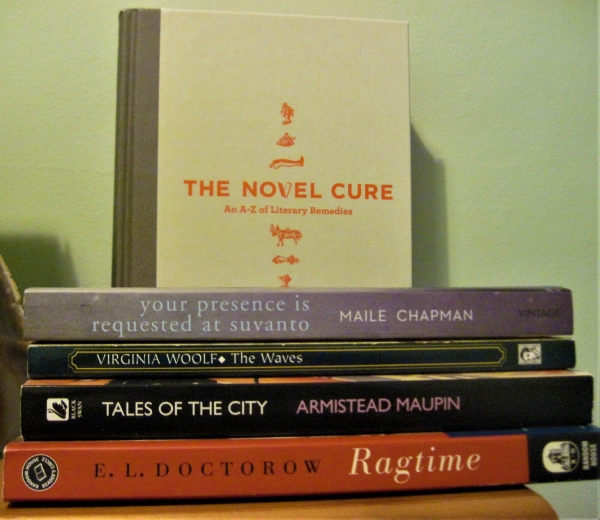
The other day I got out my copy of The Novel Cure by School of Life bibliotherapists Ella Berthoud and Susan Elderkin and browsed through the categories for some prescriptions that might feel relevant to the current situation. I found four books I own that fit the bill:
From the list of “The Ten Best Novels to Lower Your Blood Pressure”: Your Presence Is Requested at Suvanto by Maile Chapman & The Waves by Virginia Woolf (and I’ve read another three of them, including, recently, Crossing to Safety).
One of several prescriptions for Loneliness: Tales of the City by Armistead Maupin.
The cure for Zestlessness: Ragtime by E. L. Doctorow.
If you have access to one of these, or have a copy of The Novel Cure and are keen on following up on another of the prescriptions, let me know.
And now for two memes that I (think I) have created. Although I’m sure something similar has been done in the past, I couldn’t find any specific blogs about them. I don’t know about you, but I always need encouragement to pick up books from my own shelves – even though libraries are currently closed, I’m still working my way through a library stack, and I’m tempted to make another order of new books from Hungerford Bookshop. It’s great to support libraries and independent bookstores, of course, but there could be no better time to mine your own bookshelves for treasures you bought ages ago but still have never read.
Journey through the Day with Books
I enjoyed picking out 18 books from my shelves that refer to particular times of day or meals or activities associated therewith. Four of these are books I’ve already read and four are ones I’m currently reading. You can piggyback on my selections if you wish, or find your own set.
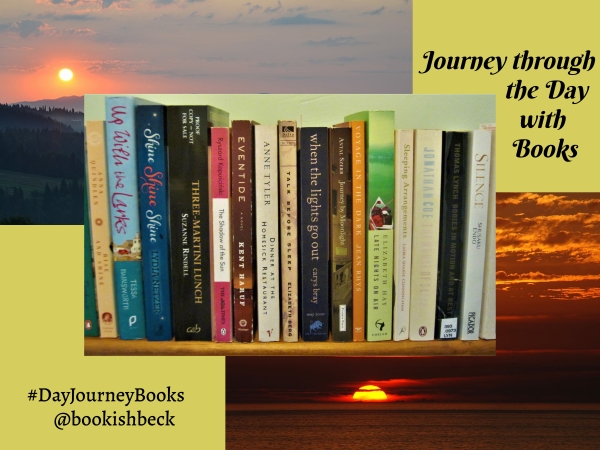
Here’s my full list:
Zennor in Darkness by Helen Dunmore
Rise and Shine by Anna Quindlen
Up with the Larks by Tessa Hainsworth
Shine Shine Shine by Lydia Netzer
Three-Martini Lunch by Suzanne Rindell
The Shadow of the Sun by Ryszard Kapuściński
Eventide by Kent Haruf
Dinner at the Homesick Restaurant by Anne Tyler
Talk before Sleep by Elizabeth Berg
When the Lights Go Out by Carys Bray
Journey by Moonlight by Antal Szerb
Voyage in the Dark by Jean Rhys
Late Nights on Air by Elizabeth Hay
Sleeping Arrangements by Laura Shaine Cunningham
The House of Sleep by Jonathan Coe
Bodies in Motion and at Rest by Thomas Lynch
Silence by Shūsaku Endō
Arctic Dreams by Barry Lopez
The Four in a Row Challenge
I’ve been contemplating this one for quite a while. It’s inspired by Phyllis Rose’s The Shelf –from LEQ to LES: Adventures in Extreme Reading (one of Simon’s favourite books – see his review), for which she picked a shelf of the New York Society Library, eliminated duplicates and repeat entries from the same author, and read the remainder – whether she’d heard of them or not; whether they were awful or not. (“Hands down the worst book on the shelf is Le Queux’s Three Knots, a mystery that reads as if it were written by an eight-year-old on Percocet.”)

This is a variation in that you’re looking at your own TBR shelves and picking a set of four books in a row. For many, that will be four novels whose authors’ surnames all start with the same letter. But if you organize your books differently (especially within nonfiction), you may find that the set of four is more arbitrary. You never know what they might have in common, though (book serendipity!).
I’m no strict challenge host, so if you want to engineer your shelf order, or if you decide to swap a book in later on, that is no problem at all. My one firm rule is only one book per author.
I’ve picked out a few appealing sets, all from my fiction shelves. F, G, L and M had particularly rich pickings. I’ll report back as I finish each set, while the “Journey through a Day” may well take me the whole rest of the year.
Still ongoing (more here): Projects to read as many Bellwether Prize, Wellcome Book Prize and Women’s Prize winners as possible, as well as Wellcome long- and shortlistees.
Can I tempt you to take part in any of these reading projects?
[Journey through the Day: Sunrise in Pieniny, Poland (Pudelek / CC BY-SA (https://creativecommons.org/licenses/by-sa/4.0)) / Sunset (Alvesgaspar / CC BY-SA (https://creativecommons.org/licenses/by-sa/3.0))
Four in a Row: Four pelicans in a row (Sheba_Also 43,000 photos / CC BY-SA (https://creativecommons.org/licenses/by-sa/2.0)) / Phone boxes, Market Place, Ripon (Tim Green from Bradford / CC BY (https://creativecommons.org/licenses/by/2.0))]
Spring Reading 2020, Part II
According to the Sámi reindeer herders, there are actually eight seasons; we’d now be in “Spring-summer” (gidágiesse), which runs from May to June.
In recent weeks I’ve read some more books that engage with the spring and/or its metaphors of planting and resurrection. (The first installment was here.) Two fiction and two nonfiction selections this time.
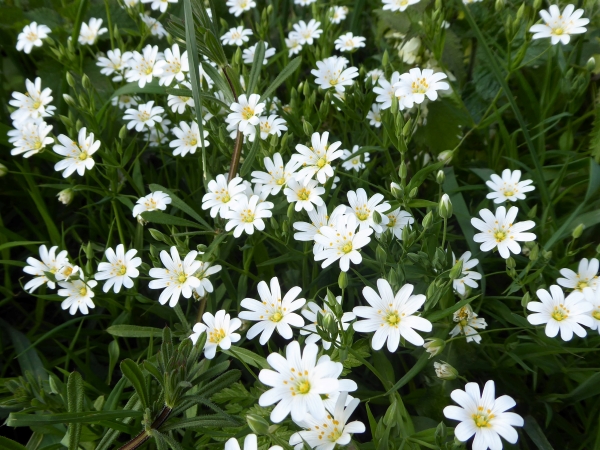
Stitchwort beside a nearby lane. Photo by Chris Foster.
The White Garden: A Novel of Virginia Woolf by Stephanie Barron (2009)
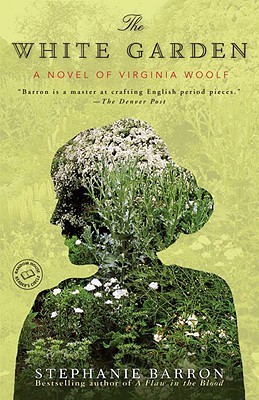 Barron is best known for her Jane Austen Mysteries series. Here she takes up the relationship between Virginia Woolf and Vita Sackville-West and crafts a conspiracy theory / alternative history in which Virginia did not commit suicide upon her disappearance in March 1941 but hid with Vita at Sissinghurst, her Kent home with the famous gardens. Investigating this in the autumn of 2008 are Jo Bellamy, an American garden designer who has been tasked with recreating Sackville-West’s famous White Garden at her wealthy client’s upstate New York estate, and Peter Llewelyn, a Sotheby’s employee who helps Jo authenticate a journal she finds hidden in a gardener’s shed at Sissinghurst.
Jo has a secret connection: her grandfather, Jock, who recently committed suicide, was a gardener here at the time of Woolf’s visit, and she believes the notebook may shed light on Virginia’s true fate and what led Jock to kill himself. Romantic complications ensue. This is fun escapism for Americans after an armchair trip to England (including Oxford and Cambridge for research), but so obviously written by an outsider. I had to correct what felt like dozens of errors (e.g. the indoor smoking ban came into effect in July 2007, so the hotel dining room wouldn’t have been filled with cigarette smoke; “pulling a few” is not slang for having a few drinks – rather, “pulling” has the connotation of making a romantic conquest).
I’ve visited Sissinghurst and Knole and had enough of an interest in the historical figures involved to keep me going through a slightly silly, frothy novel. 
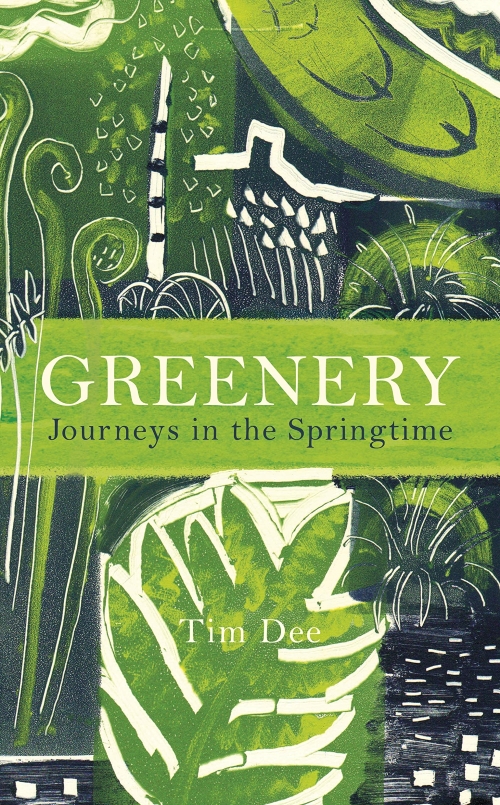
Greenery: Journeys in Springtime by Tim Dee (2020)
From the Cape of Good Hope to the Arctic Circle, Dee tracks the spring as it travels north. From first glimpse to last gasp, moving between his homes in two hemispheres, he makes the season last nearly half the year. His harbingers are chiefly migrating birds – starting with swallows. Here’s how he states his aim:
Knowing those annually recurring gifts of nature, and registering them alongside our own one-way journey through life, why not try to travel with the season and be in springtime for as long as possible, why not try to start where the season starts, and then to keep up with it, in step, walking a moving green room, travelling under the sun, like swallows out of Africa?
Starting in February in the Sahara Desert, he sees an abundance of the songbirds and raptors he’s used to finding in Europe, as well as more exotic species endemic to Africa. Any fear that this will turn out to be some plodding ‘I went here and saw this, then there and saw that’ nature/travel narrative dissipates instantly; although the book has a strong geographical and chronological through line, it flits between times and places as effortlessly as any bird, with the poetic quality of Dee’s observations lifting mundane moments into sharp focus. For instance, at their Ethiopian hotel, a wedding photography mecca, “a waiting wedding dress collapsed on a black cane chair, like an ostrich suicide.” A nightjar startled in the New Forest is “a bandaged balsa-wood model: a great moth’s head with the wings of a dark dragonfly.”
Dee’s wanderings take him from Scandinavia to central Europe and back. Wherever he happens to be, he is fully present, alive to a place and to all its echoes in memory and literature. He recalls a lonely year spent in Budapest studying Hungarian poetry in the 1980s, and how the sight and sound of birds like black woodpeckers and eagle owls revived him. Visits to migration hotspots like Gibraltar and Heligoland alternate with everyday jaunts in Ireland or the Bristol and Cambridgeshire environs he knows best.
Each vignette is headed with a place name and latitude, but many are undated, recalling springs from decades past or from the work of admired writers. Some of his walking companions and mentioned friends are celebrated nature or travel writers in their own right (like Julia Blackburn, Mark Cocker, Patrick McGuinness and Adam Nicolson; there’s also his cousin, fiction writer Tessa Hadley), while Samuel Taylor Coleridge, Seamus Heaney, D. H. Lawrence and Gilbert White are some of the book’s presiding spirits.
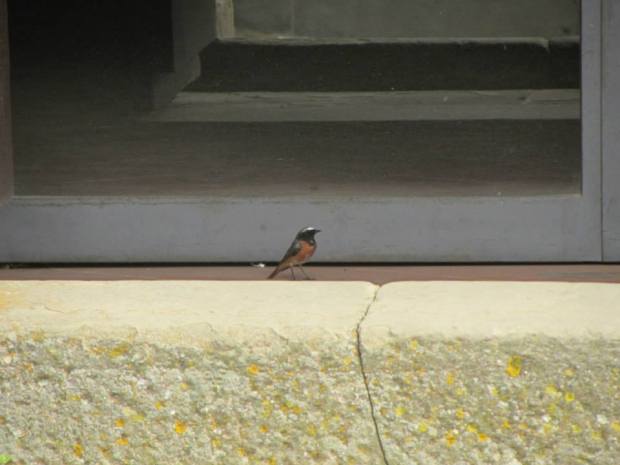
A redstart on some church steps in Tuscany, April 2014. Not the best view, but this is Dee’s favourite bird. Photo by Chris Foster.
Greenery is steeped in allusions and profound thinking about deep time and what it means to be alive in an era when nature’s rhythms are becoming distorted. It is so gorgeously literary, so far from nature and travel writing as usual, that it should attract readers who wouldn’t normally dip into those genres. While Dee’s writing reminds me somewhat of Barry Lopez’s, closer comparisons could be made with Helen Macdonald’s H Is for Hawk and Peter Matthiessen’s The Snow Leopard: quest narratives that nestle their nature writing within a substrate of memoir and philosophy. The last few pages, in which Dee, now in his late fifties, loses a close friend (Greg Poole, who painted the book’s cover) and receives a diagnosis of Parkinson’s disease but also learns he is to become a father again, are achingly beautiful.
I find I’ve written more about this book than I intended to in a reviews roundup, but it’s so extraordinary it deserves this much and more. It’s not just one of the few best nonfiction books of the year, but a fresh, masterful model of how to write about nature.
In the Springtime of the Year by Susan Hill (1975)
 This is my favorite of the six books I’ve now read by Hill. Early one spring, Ruth Bryce’s husband, Ben, dies in a forestry accident. They had been only married a year and now here she is, aged 20 and a widow. Ben’s little brother, 14-year-old Jo, is a faithful visitor, but after the funeral many simply leave Ruth alone. Ben’s death is a “stone cast into still water,” whose ripples spread out beyond his immediate family.
There is little plot as such, yet this is a lovely, quiet meditation on grief and solitude amid the rhythms of country life. Ruth vacillates between suicidal despair and epiphanies of exaltation at how all of life is connected. Religious imagery coinciding with Easter describes a cycle of death and renewal. Very late on in the book, as winter comes round again, she has the chance to be of help to another local family that has suffered a loss, and to a member of Ben’s remaining family.
It took me two whole springs to read this. For those who think of Hill as a writer of crime novels (the Simon Serrailler series) and compact thrillers (The Woman in Black et al.), this may seem very low on action in comparison, but there is something hypnotic about the oddly punctuated prose and the ebb and flow of emotions. 
Plant Dreaming Deep by May Sarton (1968)
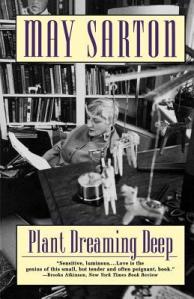 This serves as a prelude to the eight journals for which Sarton would become famous. It’s a low-key memoir about setting up home in the tiny town of Nelson, New Hampshire, making a garden and meeting the salt-of-the-earth locals who provided her support system and are immortalized in fictional form in the novel she published two years later, Kinds of Love. At the time of publication, she’d been in Nelson for 10 years; she would live there for 15 years in all, and (after seeing out her days in a rented house by the coast in Maine) be buried there.
Sarton was nearing 50 by the time she bought this, her first home, and for her it represented many things: a retreat from the world; a place for silence and solitude; and somewhere she could bring together the many aspects of herself, even if just by displaying her parents’ furniture, long in storage, and the souvenirs from her travels – “all the threads I hold in my hands have at last been woven together into a whole—the threads of the English and Belgian families from which I spring … the threads of my own wanderings”.
Nelson feels like a place outside of time. It holds annual Town Meetings, as it has for nearly two centuries. Her man-of-all-work, Perley Cole, still cuts the meadow with a scythe. After years of drought, she has to have water-drillers come and find her a new source. An ancient maple tree has to be cut down, reminding her of other deaths close to home. Through it all, her beloved garden is a reminder that new life floods back every year and the routines of hard work will be rewarded.
Some favorite lines:
“Experience is the fuel; I would live my life burning it up as I go along, so that at the end nothing is left unused, so that every piece of it has been consumed in the work.”
“gardening is one of the late joys, for youth is too impatient, too self-absorbed, and usually not rooted deeply enough to create a garden. Gardening is one of the rewards of middle age, when one is ready for an impersonal passion, a passion that demands patience, acute awareness of a world outside oneself, and the power to keep on growing through all the times of drought, through the cold snows, toward those moments of pure joy when all failures are forgotten and the plum tree flowers.”
Note: I discovered I’ve always misunderstood this title, thinking it whimsically imagined a plant having dreams; instead, “plant” is an imperative verb, as in Sarton’s adaptation of Joachim du Bellay: “Happy the man who can long roaming reap, / Like old Ulysses when he shaped his course / Homeward at last toward the native source, / Seasoned and stretched to plant his dreaming deep.” It’s about a place where one can root one’s work and intentions.
Have you been reading anything springlike this year?
Six Degrees of Separation: From Stasiland to The End of the Point
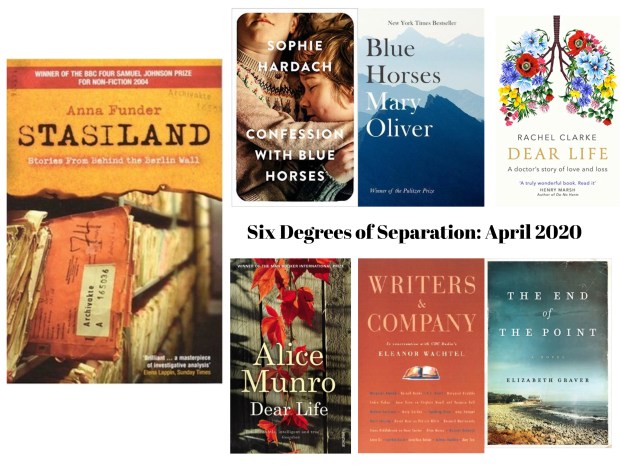
It’s my third time participating in Kate’s Six Degrees of Separation meme (see her introductory post). The challenge starts with Stasiland (2003) by Anna Funder, which I also happened to read recently. While working part-time for an overseas television service in what was once West Berlin, Funder started gathering stories of how ordinary people were put under surveillance and psychologically terrorized by the Stasi, the East German secret police. She molds her travels and her interviewees’ testimonies into riveting stories – though this won the Samuel Johnson Prize for nonfiction in 2004, it’s as character-driven as any novel.
#1 My interest in Stasiland was piqued by reading Sophie Hardach’s Costa Prize-shortlisted novel Confession with Blue Horses (2019). When Ella’s parents, East German art historians under Stasi surveillance, were caught trying to defect during a ‘vacation’ to Hungary in 1987, their three children were taken from them and only two were returned. Ella is determined to find her brother, whom they’ve had no word of since, via a correspondence with the Stasi archive. It’s an emotionally involving story of one ordinary family’s losses and reconstruction.

 #2 Blue Horses (2014) is one of Mary Oliver’s lesser poetry collections. I found it to be a desperately earnest and somewhat overbaked set of nature observations and pat spiritual realizations. There are a few poems worth reading (e.g., “After Reading Lucretius, I Go to the Pond” and Part 3 of “The Fourth Sign of the Zodiac”), and lines here and there fit for saving, but overall this is so weak that I’d direct readers to Oliver’s landmark 1980s work instead.
#3 Oliver’s poetry, especially “Wild Geese” and “The Summer Day,” gets quoted everywhere. The latter’s most famous lines, “Tell me, what is it you plan to do / with your one wild and precious life?” appears in Dear Life by Rachel Clarke, my book of 2020 so far. Clarke specializes in palliative medicine and alternates her patients’ stories with her own in a completely natural way. A major theme is her relationship with her late father, also a doctor, and his lessons of empathy and dedication. A passionate yet practical book, this aims to get people talking about end-of-life issues.
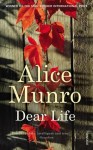
#4 I have meant to read Dear Life by Alice Munro (2012) since before she won the Nobel Prize. I was sent a free paperback copy for a Nudge review, but as the site already had a review of the book up, I let it slip and never followed through. More than once I’ve put this short story collection onto a reading stack, but I have never quite gotten past the first page or two. At some point this must be rectified.
#5 Alice Munro is one of the authors featured in Writers & Co. by Eleanor Wachtel (1993), a terrific collection of interviews from Wachtel’s weekly Canadian Broadcasting Corporation radio program. Whether I’d read anything by these authors (or even heard of them) or not, I found each Q&A chock-full of priceless nuggets of wisdom about creativity, mothers and daughters, drawing on autobiographical material, the writing process, and much more.

#6 My first-ever author Q&A, for Bookkaholic in 2013, was related to The End of the Point by Elizabeth Graver. (Alas that the site is now defunct, so the interview only exists as a file on my computer.) In an astonishing historical sweep, from Massachusetts’s first colonial settlers through the cultural upheavals of the twentieth century, Graver’s family saga with a difference questions parent‒child ties, environmental responsibility, and the dictates of wealth and class. Her complex, elegiac tale, reminiscent of Virginia Woolf’s To the Lighthouse and Liza Klaussmann’s Tigers in Red Weather, offers multiple points of view in a sympathetic gaze at a vanishing way of life – but an enduring sense of place.
Join us for #6Degrees of Separation if you haven’t already!
Have you read any of my selections? Are you tempted by any you didn’t know before?
Four February Releases: Napolitano, Offill, Smyth, Sprackland
Much as I’d like to review books in advance of their release dates, that doesn’t seem to be how things are going this year. I hope readers will find it useful to learn about recent releases they might have missed. This month I’m featuring a post-plane crash scenario, a reflection on modern anxieties, an essay about the human–birds relationship, and a meditation on graveyards.
Dear Edward by Ann Napolitano
(Published by Penguin/Viking on the 20th; came out in USA from Dial Press last month)
 June 2013: a plane leaves Newark Airport for Los Angeles, carrying 192 passengers. Five hours after takeoff, it crashes in the flatlands of northern Colorado, a victim to stormy weather and pilot error. Only 12-year-old Edward Adler is found alive in the wreckage. In alternating storylines, Napolitano follows a select set of passengers (the relocating Adler family, an ailing tycoon, a Wall Street playboy, an Afghanistan veteran, a Filipina clairvoyant, a pregnant woman visiting her boyfriend) in their final hours, probing their backstories to give their soon-to-end lives context (and meaning?), and traces the first six years of the crash’s aftermath for Edward.
While this is an expansive and compassionate novel that takes seriously the effects of trauma and the difficulty of accepting random suffering, I found that I dreaded returning to the plane every other chapter – I have to take regular long-haul flights to see my family, and while I don’t fear flying, I also don’t need anything that elicits catastrophist thinking. I would read something else by Napolitano (she’s written a novel about Flannery O’Connor, for instance), but I can’t imagine ever wanting to open this up again.
I picked up a proof copy at a Penguin Influencers event.
Weather by Jenny Offill
(Published by Knopf [USA] on the 11th and Granta [UK] on the 13th)
 Could there be a more perfect book for 2020? A blunt, unromanticized but wickedly funny novel about how eco-anxiety permeates everyday life, Weather is written in the same aphoristic style as Offill’s Dept. of Speculation but has a more substantial story to tell. Lizzie Benson is married with a young son and works in a New York City university library. She takes on an informal second job as PA to Sylvia, her former professor, who runs a podcast on environmental issues and travels to speaking engagements.
Set either side of Trump’s election, the novel amplifies many voices prophesying doom, from environmentalists to Bible-thumpers (like Lizzie’s mother) to those who aren’t sure they’ll even make it past tomorrow (like her brother, a highly unstable ex-addict who’s having a baby with his girlfriend). It’s a wonder it doesn’t end up feeling depressing. Lizzie’s sardonic narration is an ideal way of capturing relatable feelings of anger and helplessness, cringing fear and desperate hope. Don’t expect to come away with your worries soothed, though there is some comfort to be found in the feeling that we’re all in this together.
Favorite lines:
“Young person worry: What if nothing I do matters? Old person worry: What if everything I do does?”
“Once sadness was considered one of the deadly sins, but this was later changed to sloth. (Two strikes then.)”
“My husband is reading the Stoics before breakfast. That can’t be good, can it?”
I read an e-ARC via Edelweiss.
An Indifference of Birds by Richard Smyth
(Published by Uniformbooks on the 14th)
 Birds have witnessed the whole of human history, sometimes profiting from our behavior – our waste products provide them with food, our buildings can be handy nesting and hunting platforms, and our unintentional wastelands and demilitarized zones turn into nature reserves – but more often suffering incidental damage. That’s not even considering our misguided species introductions and the extinctions we’ve precipitated. Eighty percent of bird species are now endangered. For as minimal as the human fossil record will be, we have a lot to answer for.
From past to future, archaeology to reintroduction and de-extinction projects, this is a wide-ranging essay that still comes in at under 100 pages. It’s a valuable shift in perspective from human-centric to bird’s-eye view. The prose is not at all what I’ve come to expect from nature writing (earnest, deliberately lyrical); it’s more rhetorical and inventive, a bit arch but still passionate – David Foster Wallace meets Virginia Woolf? The last six paragraphs, especially, soar into sublimity. A niche book, but definitely recommended for bird-lovers.
Favorite lines:
“They must see us, watch us, from the same calculating perspective as they did two million years ago. We’re still galumphing heavy-footed through the edgelands, causing havoc, small life scattering wherever we tread.”
“Wild things lease these places from a capricious landlord. They’re yours, we say, until we need them back.”
I pre-ordered my copy directly from the publisher.
These Silent Mansions: A life in graveyards by Jean Sprackland
(Published by Jonathan Cape on the 6th)
 I’m a big fan of Sprackland’s beachcombing memoir, Strands, and have also read some of her poetry. Familiarity with her previous work plus a love for graveyards induced me to request a copy of her new book. In it she returns to the towns and cities she has known, wanders through their graveyards, and researches and imagines her way into the stories of the dead. For instance, she finds the secret burial place of persecuted Catholics in Lancashire, learns about a wrecked slave ship in a Devon cove, and laments two dead children whose bodies were sold for dissections in 1890s Oxford. She also remarks on the shifts in her own life, including the fact that she now attends more funerals than weddings, and the displacement involved in cremation – there is no site she can visit to commune with her late mother.
I most enjoyed the book’s general observations: granite is the most prized headstone material, most graves go unvisited after 15 years, and a third of Britons believe in angels despite the country’s overall decline in religious belief. I also liked Sprackland’s list of graveyard charms she has seen. While I applaud any book that aims to get people thinking and talking about death, I got rather lost in the historical particulars of this one.
Favorite lines:
“This is the paradox at the heart of our human efforts to remember and memorialise: the wish to last forever, and the knowledge that we are doomed to fail.”
“Life, under such a conscious effort of remembering, sometimes resembles a series of clumsy jump-cuts rather than one continuous narrative.”
My thanks to the publisher for the free copy for review.
What recent releases can you recommend?
Classic of the Month: Period Piece by Gwen Raverat (1952)
Later today we’re making a pilgrimage to Bookbarn International,* one of my favorite secondhand bookshops in the UK, on the way (ish) to seeing friends in Bristol and Exeter for the weekend. In the past we’ve managed to drop in to Bookbarn annually, but it’s been nearly 2.5 years since our last visit. At that special Harvest Supper and Scrabble** tournament in October 2017 (which I wrote about here), I got to meet William Pryor, the chairman of Bookbarn, and he gave me a copy of his grandmother Gwen Raverat’s memoir, Period Piece.
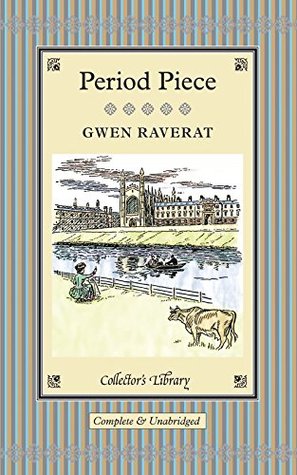 Raverat was a granddaughter of Charles Darwin (the first child of his son George) but never got to meet him as he died three years before her birth. Her book has the subtitle “A Cambridge Childhood,” which perfectly conveys the aim. This is not a comprehensive family history or autobiography, but a portrait of what it was like to grow up in a particular time and place. Raverat was born in 1885, but she begins two years earlier, when her American mother, Maud Du Puy, was 21 and in England for the first time to spend a summer with her great-aunt and -uncle. She had three suitors during that time, all of them Fellows of Trinity College. The rules had only just been changed to allow Fellows to marry, so George Darwin would be among the first married members, and Gwen was in the first batch of offspring.
Period Piece is a charming, witty look at daily life from the 1880s through about 1909 – ending with the marriage of her cousin Frances, which seemed to signal a definitive end to their collective youth. Raverat focuses on everyday sights and sounds but also points out life’s little absurdities. She proceeds thematically rather than chronologically, taking up topics like her mother’s parenting theories; her boarding school education and budding love of art; visits to Grandmamma at Down House, Kent; childhood fears and ghost stories; the five Darwin uncles; religion; sports and games; clothing; and social events such as dances.

Raverat’s childhood home in Cambridge, now part of Darwin College, University of Cambridge. CC BY-SA (https://creativecommons.org/licenses/by-sa/2.5).
Writing towards the end of her life and in the middle of the twentieth century, Raverat neatly draws contrasts between old-fashioned propriety and modern mores. For example, as a child she was often called upon to act as a chaperone to courting couples, and when ladies boated past a watering hole where boys swam naked, they would cover their faces with parasols. She herself managed to avoid the matter of sex entirely until she was an adult, though she does remember looking to an encyclopedia to find out where babies come from.
The utter reliance on servants, a profusion of buttons on every garment, and forced trips to church are a few elements that might strike today’s readers as alien. One incident felt eerily contemporary to me, though: once, walking home alone at around 10 p.m., Gwen saw a gang of dodgy-looking undergraduates carrying a drunk or dead young woman down the street and into a pub. After much internal debate, she decided not to say a word about it to her parents.
I often wonder how novelists and filmmakers get a historical setting just right. The answer is, probably by reading books like this one that so clearly convey quotidian details most people would leave out, e.g. a list of every piece of clothing a lady wore or a rundown of the steps to getting her mother out the door to catch the 8:30 train for a day out in London. Those who have visited or lived in Cambridge will no doubt enjoy spotting familiar locations. There are also amusing cameo appearances from Virginia Stephen (Woolf) and E.M. Forster.
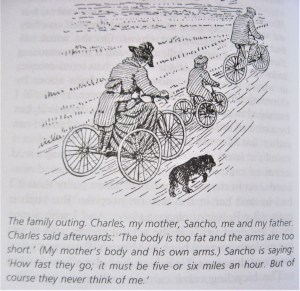 Raverat, a wood engraver, peppered Period Piece with her own illustrations (I have photographed one favorite, at left, but you can see them all in the archive here) – a lovely supplement to the highly visual text. Not just an invaluable record of domestic history, this is a very funny and impressively thorough memoir that could be used by anyone as a model for how to capture childhood. It has never been out of print, and still deserves to be widely read.
*They’ve recently had a renovation that I helped to crowdfund; I’m looking forward to seeing the results. I’ll also be sure to report back on my book haul.
**I was especially delighted to see that the Darwin family had a favorite word-making game, described in the middle of the “Sport” chapter, that sounds a fair bit like Scrabble – except that you only added one letter at a time and could scramble the letters to change the meaning.
Some favorite lines:
(describing one of her mother’s early letters home to America) “They got [rooms for the night] at last at ‘the St Pancreas Hotel’. I was delighted to find this spelling so early, as, to the end of her days, my mother always considered the saint and the internal organ as identical.”
(of their French nurserymaids) “By a provision of Providence they were always called Eugenie, so that when a new one came she could be called Newgenie.”
“The faint flavour of the ghost of my grandfather hung in a friendly way about the whole place [Down] – house, garden and all. … In fact, he was obviously in the same category as God and Father Christmas.”
My rating:
I read the 2014 Collector’s Library edition, an attractive pocket-sized book with gilt edging and a built-in red ribbon bookmark.

Imitation Is the Sincerest Form of Flattery: Costello, O’Shaughnessy & Smyth
These three books – two novels and a memoir – pay loving tribute to a particular nineteenth- or twentieth-century writer. In each case, the author incorporates passages of pastiche, moving beyond thematic similarity to make their language an additional homage.
Although I enjoyed the three books very much, they differ in terms of how familiar you should be with the source material before embarkation. So while they were all reads for me, I have added a note below each review to indicate the level of prior knowledge needed.
The River Capture by Mary Costello
 Luke O’Brien has taken a long sabbatical from his teaching job in Dublin and is back living at the family farm beside the river in Waterford. Though only in his mid-thirties, he seems like a man of sorrows, often dwelling on the loss of parents, aunts and romantic relationships with both men and women. He takes quiet pleasure in food, the company of pets, and books, including his extensive collection on James Joyce, about whom he’d like to write a tome of his own. The novel’s very gentle crisis comes when Luke falls for Ruth and it emerges that her late father ruined his beloved Aunt Ellen’s reputation.
At this point a troubled Luke is driven into 100+ pages of sinuous contemplation, a bravura section of short fragments headed by questions. Rather like a catechism, it’s a playful way of organizing his thoughts and likely more than a little Joycean in approach – I’ve read Portrait of the Artist and Dubliners but not Ulysses or Finnegans Wake, so I feel less than able to comment on the literary ventriloquism, but I found this a pleasingly over-the-top stream-of-consciousness that ranges from the profound (“What fear suddenly assails him? The arrival of the noonday demon”) to the scatological (“At what point does he urinate? At approximately three-quarters of the way up the avenue”).
While this doesn’t quite match Costello’s near-perfect novella, Academy Street, it’s an impressive experiment in voice and style, and the treatment of Luke’s bisexuality struck me as sensitive – an apt metaphorical manifestation of the novel’s focus on fluidity. (See also Susan’s excellent review.)
Why Joyce? “integrity … commitment to the quotidian … refusal to take conventions for granted”
Familiarity required: Moderate
Also recommended: The Sixteenth of June by Maya Lang
With thanks to Canongate for the free copy for review.
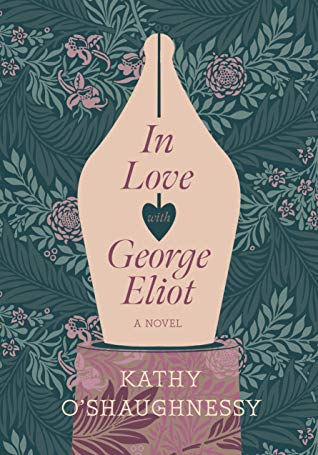
In Love with George Eliot by Kathy O’Shaughnessy
Many characters, fictional and historical, are in love with George Eliot over the course of this debut novel by a literary editor. The whole thing is a book within a book – fiction being written by Kate, an academic at London’s Queen Elizabeth College who’s preparing for two conferences on Eliot and a new co-taught course on life writing at the same time as she completes her novel, which blends biographical information and imagined scenes.
 1857: Eliot is living with George Henry Lewes, her common-law husband, and working on Adam Bede, which becomes a runaway success, not least because of speculation about its anonymous author. 1880: The great author’s death leaves behind a mentally unstable widower 20 years her junior, John Walter Cross, once such a close family friend that she and Lewes called him “Nephew.”
Between these points are intriguing vignettes from Eliot’s life with her two great loves, and insight into her scandalous position in Victorian society. Her estrangement from her dear brother (the model for Tom in The Mill on the Floss) is a plangent refrain, while interactions with female friends who have accepted the norms of marriage and motherhood reveal just how transgressive her life is perceived to be.
In the historical sections O’Shaughnessy mimics Victorian prose ably, yet avoids the convoluted syntax that can make Eliot challenging. I might have liked a bit more of the contemporary story line, in which Kate and an alluring colleague make their way to Venice (the site of Eliot’s legendarily disastrous honeymoon trip with Cross), but by making this a minor thread O’Shaughnessy ensures that the spotlight remains on Eliot throughout.
Highlights: A cameo appearance by Henry James; a surprisingly sexy passage in which Cross and Eliot read Dante aloud to each other and share their first kiss.
Why Eliot? “As an artist, this was her task, to move the reader to see people in the round.”
Familiarity required: Low
Also recommended: 142 Strand by Rosemary Ashton, Sophie and the Sibyl by Patricia Duncker, and My Life in Middlemarch by Rebecca Mead
With thanks to Scribe UK for the free copy for review.
All the Lives We Ever Lived: Seeking Solace in Virginia Woolf by Katharine Smyth
 Smyth first read To the Lighthouse in Christmas 2001, during her junior year abroad at Oxford. Shortly thereafter her father had surgery in Boston to remove his bladder, one of many operations he’d had during a decade battling cancer. But even this new health scare wasn’t enough to keep him from returning to his habitual three bottles of wine a day. Woolf was there for Smyth during this crisis and all the time leading up to her father’s death, with Lighthouse and Woolf’s own life reflecting Smyth’s experience in unanticipated ways. The Smyths’ Rhode Island beach house, for instance, was reminiscent of the Stephens’ home in Cornwall. Woolf’s mother’s death was an end to the summer visits, and to her childhood; Lighthouse would become her elegy to those bygone days.
Often a short passage by or about Woolf is enough to launch Smyth back into her memories. As an only child, she envied the busy family life of the Ramsays in Lighthouse. She delves into the mystery of her parents’ marriage and her father’s faltering architecture career. She also undertakes Woolf tourism, including the Cornwall cottage, Knole, Charleston and Monk’s House (where Woolf wrote most of Lighthouse). Her writing is dreamy, mingling past and present as she muses on time and grief. The passages of Woolf pastiche are obvious but short enough not to overstay their welcome; as in the Costello, they tend to feature water imagery. It’s a most unusual book in the conception, but for Woolf fans especially, it works. However, I wished I had read Lighthouse more recently than 16.5 years ago – it’s one to reread.
Why Woolf? “I think it’s Woolf’s mastery of moments like these—moments that hold up a mirror to our private tumult while also revealing how much we as humans share—that most draws me to her.”
Undergraduate wisdom: “Woolf’s technique: taking a very complex (usually female) character and using her mind as an emblem of all minds” [copied from notes I took during a lecture on To the Lighthouse in a “Modern Wasteland” course during my sophomore year of college]
Familiarity required: High
Also recommended: Virginia Woolf in Manhattan by Maggie Gee, Vanessa and Her Sister by Priya Parmar, and Adeline by Norah Vincent
With thanks to Atlantic Books for the free copy for review.
Five Nonfiction Review Books: Hammond, Iorio, Rault, Riley & Rutt
A diagnosis of motor neurone disease; a father’s dispiriting experience of censorship trials. An illustrated history of fonts; an essay on grief; a cold weather-appropriate record of geese-watching. I gear up for Nonfiction November by catching up on five nonfiction review books I’ve been sent over the last couple of months. You can’t say that I don’t read a variety, even within nonfiction! See if one or more of these tempts you.
A Short History of Falling: Everything I Observed about Love whilst Dying by Joe Hammond
 Hammond, a playwright, takes a wry, clear-eyed approach to his diagnosis of motor neurone disease (ALS) and the knowledge that his physical capacities will only deteriorate from here on out. “New items arrive almost daily and I am unexpectedly becoming the curator of the Museum of my own Decline.” Yet he also freezes funnier moments, like blowing his nose on a slice of bread because he couldn’t reach a tissue box, or spending “six hours of my fiftieth birthday sat on this hospice toilet, with a bottle of good Scotch wedged between my knees.”
Still, Hammond regrets that he’s become like a third small child for his wife Gill to look after, joining his sons Tom and Jimmy, and that he won’t see his boys grow up. (This book arose from an article he wrote for the Guardian in 2018 about making 33 birthday cards for his sons to open in the years after his death.) Although I wasn’t as interested in the details of Hammond’s earlier life, or his relationship with his narcissistic father, I appreciated his quiet acceptance of disability, help and impending death.
Favorite lines:
“I’ve waited all my life to know this peace. To know that I am nothing more than this body.”
“my place in all of this is becoming smaller, historic and just the right size of important.”
With thanks to 4th Estate for the free copy for review.
An Author on Trial: The Story of a Forgotten Writer by Luciano Iorio
 The author’s father, Giuseppe Jorio, was a journalist and schoolteacher who wrote an infamous novel based on an affair he had in the 1930s. Using italicized passages from his father’s diary and letters to Tina, who was 19 when their affair started, Iorio reconstructs the sordid events and unexpected aftermath in fairly vivid detail. Tina fell pregnant and decided to abort the baby. Meanwhile, Giuseppe’s wife, Bruna, got the truth out of him and responded with more grace than might be expected. Giuseppe was devastated at the loss of his potential offspring, and realized he wanted to have a child with Bruna. He bid Tina farewell and the family moved to Rome, where the author was born in 1937.
Giuseppe’s novel inspired by the affair, Il Fuoco del Mondo (The Fire of the World) was rejected by all major publishers and accused of obscenity in a series of five trials that threatened his reputation and morale. It’s a less familiar echo of the Lady Chatterley’s Lover trial, and a poignant portrait of a man who felt he never lived up to his potential because of bad luck and societal disapproval. I enjoyed learning a bit about Italian literature. However, inconsistent use of tenses and shaky colloquial English (preposition issues, etc.) suggest that a co-writer or translator was needed to bring this self-published work up to scratch.
With thanks to the publicist for the free copy to review as part of a blog tour.
ABC of Typography by David Rault
[Translated from the French by Edward Gauvin]
 From cuneiform to Gutenberg to Comic Sans, this history of typography is delightful. Graphic designer David Rault wrote the whole thing, but each chapter has a different illustrator, so the resulting book is like a taster course in comics styles. As such, I would highly recommend it to those who are fairly new to graphic novels and want to see whose work appeals to them, as well as to anyone who enjoyed Simon Garfield’s book about fonts, Just My Type.
I found it fascinating to explore the technical characteristics (serif vs. sans serif, etc.) and aesthetic associations of various fonts. For instance, I didn’t realize that my mainstay – Times New Roman – is now seen as a staid choice: “Highly readable, but overexposed in the early days of the Internet, it took on a reputation for drabness that it hasn’t shed since the ’90s.” Nowadays, some newspapers and brands pay typeface creators to make a font for their exclusive use. Can you name the typeface that is used on German road signs, or in Barack Obama’s campaign materials? (You’ll be able to after you read this.)


With thanks to SelfMadeHero for the free copy for review.
Time Lived, Without Its Flow by Denise Riley
 What Virginia Woolf’s essay “On Being Ill” does for sickness, this does for bereavement. Specifically, Riley, whose son Jake died suddenly of a heart condition, examines how the experience of time changes during grief. “I’ll not be writing about death, but about an altered condition of life,” she opens. In short vignettes written from two weeks to three years after her son’s death, she reflects on how her thinking and feelings have morphed over time. She never rests with an easy answer when a mystery will do instead. “What if” questions and “as if” imaginings proliferate. Poetry – she has also written an exquisite book of poems, Say Something Back, responding to the loss of Jake – has a role to play in the acceptance of this new reality: “rhyme may do its minute work of holding time together.”
Max Porter provides a fulsome introduction to this expanded version of Riley’s essay, which first appeared in 2012. This small volume meant a lot more to him than it did to me; I preferred Riley’s poetic take on the same events. Still, this is sure to be a comfort for the bereaved.
Favorite passages:
“I’ll try to incorporate J’s best qualities of easy friendliness, warmth, and stoicism, and I shall carry him on in that way. Which is the only kind of resurrection of the dead that I know about.”
“I don’t experience him as in the least dead, but simply as ‘away’. Even if he’ll be away for my remaining lifetime. My best hope’s to have a hallucination of his presence when I’m dying myself.”
With thanks to Picador for the free copy for review.
Wintering: A Season with Geese by Stephen Rutt
 Rutt’s The Seafarers: A Journey among Birds, one of my favorite recent nature/travel books, came out in May. What have we done to deserve another publication from this talented young author just four months later?! I didn’t enjoy this as much as The Seafarers, yet it does a lot of the same things well: it provides stunning word portraits of individual bird species, explores the interaction between nature and one’s mental state, and gathers evidence of the cultural importance of birds through legends and classical writings.
Here the focus is on geese, which the author had mostly overlooked until the year he moved to southern Scotland. Suddenly they were impossible to ignore, and as he became accustomed to his new home these geese sightings were a way of marking the seasons’ turn. Ethical issues like hunting, foie gras and down production come into play, and, perhaps ironically, the author eats goose for Christmas dinner!
Rutt’s points of reference include Paul Gallico (beware plot spoilers!), Aldo Leopold, Mary Oliver and Peter Scott. The writing in this short book reminded me most of Horatio Clare (especially The Light in the Dark) and Jim Crumley (who’s written many short seasonal and single-species nature books) this time around.
A favorite passage (I sympathize with the feelings of nomadism and dislocation):
“I envy the geese their certainty, their habits of home. I am forever torn between multiple places that feel like home. Scotland where I live or Suffolk, Essex, Norfolk: the flatlands of golden evenings and reeds, mud and water and sand. The distant horizon and all the space in between I grew up with, which seems to lurk somewhere, subconsciously calling me back.”
[Neat aside: My husband and I both got quotes (about The Seafarers) on the press release for this book!]

With thanks to Elliott & Thompson for the free copy.
 Bookish Beck = Rebecca Foster. American transplant to England. Freelance proofreader and book reviewer.


.jpg)
.jpg)