Reviews for Shiny New Books & TLS, Plus Simon’s “My Life in Books”
I recently participated in the one-week “My Life in Books” extravaganza hosted by Simon Thomas (Stuck in a Book), where he asks bloggers to choose five books that have been important to them at different points in their reading lives. The neat twist is that he puts the bloggers in pairs and asks them to comment anonymously on their partner’s reading choices and even come up with an apt book recommendation or two. A few of my selections will be familiar from the two Landmark Books posts I wrote in 2016 (here and here), but a couple are new, and it was fun to think about what’s changed versus what’s endured in my reading taste.
Shiny New Books
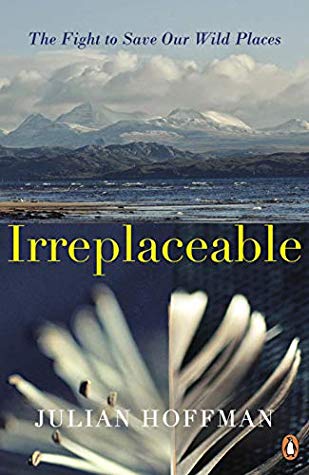 Irreplaceable by Julian Hoffman: If you read one 2019 release, make it this one. (It’s too important a book to dilute that statement with qualifiers.) Species and habitat loss are hard to comprehend even when we know the facts. This book is a way of taking stock, taking responsibility, and going beyond the numbers to tell the stories of front-line conservation work. From the Kent marshes to the Coral Triangle off Indonesia, Hoffman discovers the situation on the ground and talks to the people involved in protecting places at risk of destruction. Reassuringly, these aren’t usually genius scientists or well-funded heroes, but ordinary citizens who are concerned about preserving nearby sites that mean something to them. Irreplaceable is an elegy of sorts, but, more importantly, it’s a call to arms. It places environmentalism in the hands of laypeople and offers hope that in working together in the spirit of defiance we can achieve great things. It takes local concerns seriously, yet its scope is international. But what truly lifts Hoffman’s work above most recent nature books is the exquisite prose.
Times Literary Supplement
These three reviews are forthcoming.
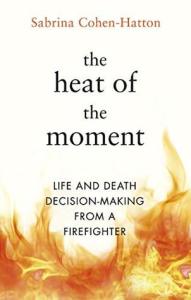 The Heat of the Moment: Life and Death Decision-Making from a Firefighter by Sabrina Cohen-Hatton: Cohen-Hatton is one of the UK’s highest-ranking female firefighters. A few perilous situations inspired her to investigate how people make decisions under pressure. For a PhD in Psychology from Cardiff University, she delved into the neurology of decision-making. Although there is jargon in the book, she explains the terms well and uses relatable metaphors. However, the context about her research can be repetitive and basic, as if dumbed down for a general reader. The book shines when giving blow-by-blow accounts of real-life or composite incidents. Potential readers should bear in mind, though, that this is ultimately more of a management psychology book than a memoir.
Henry David Thoreau’s Walden (1854), a record of his two-year experiment living alone in a cabin near a Massachusetts pond, has inspired innumerable back-to-nature adventures, including these two books I discuss together in a longer article.
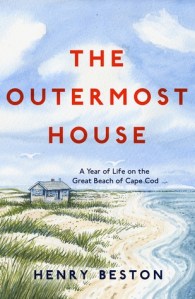 The Outermost House: A Year of Life on the Great Beach of Cape Cod by Henry Beston: Beston had a two-room wooden shack built at Cape Cod in 1925. Although he only intended to spend a fortnight of the following summer in the sixteen-by-twenty-foot dwelling, he stayed a year. The chronicle of that year, The Outermost House (originally published in 1928 and previously out of print in the UK), is a charming meditation on the turning of the seasons and the sometimes terrifying power of the sea. The writing is often poetic, with sibilance conjuring the sound of the ocean. Beston will be remembered for his statement of the proper relationship between humans and the natural world. “We need another and a wiser and perhaps a more mystical concept of animals,” he declares; “they are not underlings; they are other nations.” One word stands out in The Outermost House: “elemental” appears a dozen times, evoking the grandeur of nature and the necessity of getting back to life’s basics.
(See also Susan’s review of this one.)
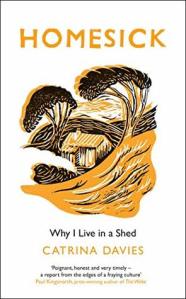 Homesick: Why I Live in a Shed by Catrina Davies: Davies crosses Thoreauvian language – many chapter titles and epigraphs are borrowed from Walden – with a Woolfian search for a room of her own. Penniless during an ongoing housing crisis and reeling from a series of precarious living situations, she moved into the shed near Land’s End that had served as her father’s architecture office until he went bankrupt. Like Raynor Winn’s The Salt Path, this intimate, engaging memoir is a sobering reminder that homelessness is not so remote, and education is no guarantee of success. There is, understandably, a sense of righteous indignation here against a land-owning class – including the lord who owns much of the area where she lives and works – and government policies that favour the wealthy.
Too Male! (A Few Recent Reviews for Shiny New Books and TLS)
I tend to wear my feminism lightly; you won’t ever hear me railing about the patriarchy or the male gaze. But there have been five reads so far this year that had me shaking my head and muttering, “too male!” While aspects of these books were interesting, the macho attitude or near-complete dearth of women irked me. Two of them I’ve already written about here: Ernest Hemingway’s The Garden of Eden was a previous month’s classic and book club selection, while Chip Cheek’s Cape May was part of my reading in America. The other three I reviewed for Shiny New Books or the Times Literary Supplement; I give excerpts below, with links to visit the full reviews in two cases, plus ideas for a book or two by a woman that should help neutralize the bad taste these might leave.
Shiny New Books
The Way Home: Tales from a Life without Technology by Mark Boyle
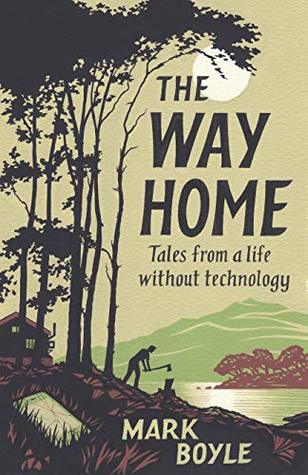 Boyle lives without electricity in a wooden cabin on a smallholding in County Galway, Ireland. He speaks of technology as an addiction and letting go of it as a detoxification process. For him it was a gradual shift that took place at the same time as he was moving away from modern conveniences. The Way Home is split into seasonal sections in which the author’s past and present intermingle. The writing consciously echoes Henry David Thoreau’s. Without even considering the privilege that got Boyle to the point where he could undertake this experiment, though, there are a couple of problems with this particular back-to-nature model. One is that it is a very male enterprise. Another is that Boyle doesn’t really have the literary chops to add much to the canon. Few of us could do what he has done, whether because of medical challenges, a lack of hands-on skills or family commitments. Still, the book is worth engaging with. It forces you to question your reliance on technology and ask whether making life easier is really a valuable goal.
 The Remedy: Homesick: Why I Live in a Shed by Catrina Davies, which I’m currently reading for a TLS review. Davies crosses Boyle’s Thoreauvian language about solitude and a place in nature with a Woolfian search for a room of her own. Penniless during the ongoing housing crisis, she moves into the shed near Land’s End that once served as her father’s architecture office and embarks on turning it into a home.
Doggerland by Ben Smith
 This debut novel has just two main characters: ‘the old man’ and ‘the boy’ (who’s not really a boy anymore), who are stationed on an enormous offshore wind farm. The distance from the present day is indicated in slyly throwaway comments like “The boy didn’t know what potatoes were.” Smith poses questions about responsibility and sacrifice, and comments on modern addictions and a culture of disposability. He has certainly captured something of the British literary zeitgeist. From page to page, though, Doggerland grew tiresome for me. There is a lot of maritime vocabulary and technical detail about supplies and maintenance. The location is vague and claustrophobic, the pace is usually slow, and there are repetitive scenes and few conversations. To an extent, this comes with the territory. But it cannot be ignored that this is an entirely male world. Fans of the themes and style of The Old Man and the Sea and The Road will get on best with Smith’s writing. I most appreciated the moments of Beckettian humor in the dialogue and the poetic interludes that represent human history as a blip in the grand scheme of things.
 The Remedy: I’m not a big fan of dystopian or post-apocalyptic fiction in general, but a couple of the best such novels that I’ve read by women are Station Eleven by Emily St. John Mandel and Gold Fame Citrus by Claire Vaye Watkins.
Times Literary Supplement
The Knife’s Edge: The Heart and Mind of a Cardiac Surgeon by Stephen Westaby
 In this somewhat tepid follow-up to Fragile Lives, Westaby’s bravado leaves a bad taste and dilutes the work’s ostensibly confessional nature. He has a good excuse, he argues: a head injury incurred while playing rugby in medical school transformed him into a risk taker. It’s widely accepted that such boldness may be a boon in a discipline that requires quick thinking and decisive action. So perhaps it’s no great problem to have a psychopath as your surgeon. But how about a sexist? Westaby’s persistent references to women staff as “lady GP” and “registrar lady” don’t mitigate surgeons’ macho reputation. It’s a shame to observe such casual sexism, because it’s clear Westaby felt deeply for his patients of any gender. And yet any talk of empathy earns his derision. It seems the specific language of compassion is a roadblock for him. The book is strongest when the author recreates dramatic sequences based on several risky surgeries. Alas, at its close he sounds bitter, and the NHS bears the brunt of his anger. Compared to Fragile Lives, one of my favorite books of 2017, this gives the superhero surgeon feet of clay. But it’s a lot less pleasing to read. (Forthcoming in TLS.)
 The Remedy: I’m keen to read Direct Red by Gabriel Weston, a memoir by a female surgeon.
(Crikey! This was my 600th blog post.)
One Book Leads to Another (Including Shepherds’ Memoirs)
Reading about a particular topic, time period or type of character often leads me to want to read more about the same thing. This isn’t the same as what I call “book serendipity,” when such connections happen purely coincidentally; instead, it’s a deliberate way of following a thread of interest further. I keep meaning to read more about lighthouses, butterflies and Virginia Woolf, for instance. Some attempts are more successful than others, though.
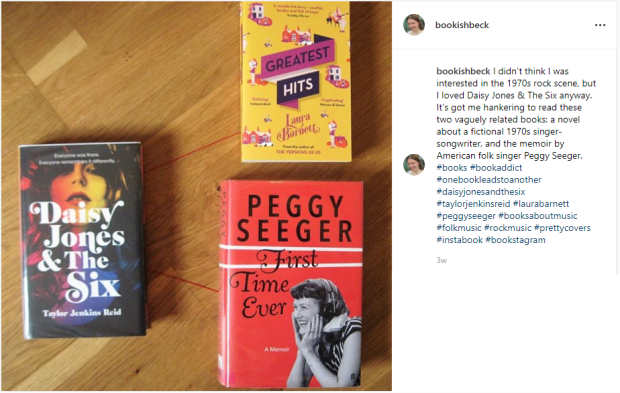
Alas, I had to return the Peggy Seeger memoir to the library unread because it was requested after me, and I haven’t found the immediate spur to pick up Greatest Hits yet.
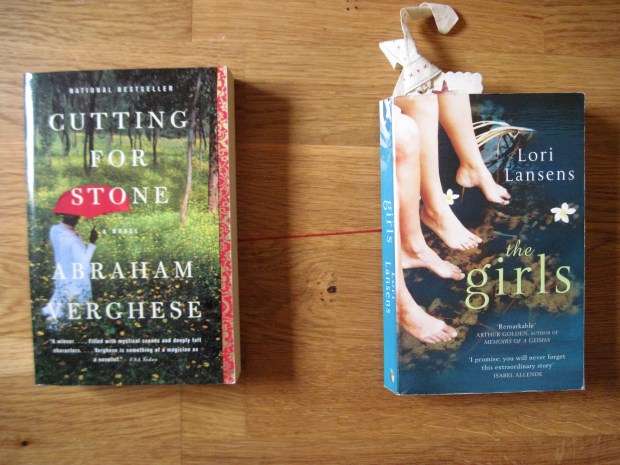
However, soon after I finished one novel about conjoined twins, Abraham Verghese’s Cutting for Stone, I launched straight into another one, Lori Lansens’ The Girls. I’m halfway through and it’s great so far. (Another I’d recommend is Chang and Eng by Darin Strauss, about the original “Siamese twins.”)
This spring I realized that I’d read four and a bit shepherds’ memoirs in 17 months, which is quite the concentration considering I’m not a countryside gal. Here’s how I’d rank the five:
#1: A Farmer’s Diary: A Year at High House Farm by Sally Urwin
 Urwin is a charming guide to a year in the life of her working farm in Northumberland. Just don’t make the mistake of dismissing her as “the farmer’s wife.” She may only be 4 foot 10 (her Twitter handle is @pintsizedfarmer and her biography describes her as “(probably) the shortest farmer in England”), but her struggles to find attractive waterproofs don’t stop her from putting in hard labor to tend to the daily needs of a 200-strong flock of sheep.
From mating the ewes to preparing the next year’s lambs for market, we see the whole cycle once through and about to start again. Lambing is a fraught couple of months that form the heart of the book, but there are plenty of other challenges, including stolen sheep, fallen trees, and constant financial concerns that lead to a petition to the Royal Agricultural Benevolent Institution for help paying the gas bill and keeping food on the table for their two kids.
Despite the year’s setbacks, Urwin has an indomitable spirit and writes in a chatty, chin-up style that reflects the book’s origin in blog posts from 2017 to 2018. She gets a lot of comic mileage out of her yo-yo dieting, the many escapades of Candy the fat pony, and quirky English traditions like the village fete. I enjoy reading about people’s daily habits through a diary, and all the better when it’s a lifestyle that’s totally foreign to me.
#2: The Sheep Stell by Janet White
 First published in 1991, The Sheep Stell taps into a widespread feeling that we have become cut off from the natural world and that existing in communion with animals is a healthier lifestyle. White’s pleasantly nostalgic memoir tells of finding contentment in the countryside, first on her own and later with a dearly loved family. It is both an evocative picture of a life adapted to seasonal rhythms and an arresting account of the casual sexism – and even violence – White experienced in a traditionally male vocation when she emigrated to New Zealand in 1953. From solitary youthful adventures that recall Gerald Durrell’s and Patrick Leigh Fermor’s to a more settled domestic life with animals reminiscent of the writings of James Herriot and Doreen Tovey, White’s story is unfailingly enjoyable. (I reviewed it for the Times Literary Supplement last year.)
#3: On Sheep: Diary of a Swedish Shepherd by Axel Lindén
(translated from the Swedish by Frank Perry)
 Axel Lindén left his hipster Stockholm existence behind to take on his parents’ rural collective. On Sheep documents two years in his life as a shepherd aspiring to self-sufficiency and a small-scale model of food production. The diary entries range from a couple of words (“Silage; wet”) to several pages, and tend to cluster around busy times on the farm. The author expresses genuine concern for the sheep’s wellbeing. However, he cannily avoids anthropomorphism, insisting that his loyalty must be to the whole flock rather than to individual animals. The brevity and selectiveness of the diary keep the everyday tasks from becoming tiresome. Instead, the rural routines are comforting, even humbling.
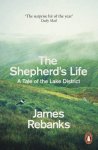 #4: The Shepherd’s Life by James Rebanks
My husband valued this more as a memoir than as a cultural document; the opposite was true for me. As a memoir it’s fairly unexceptional, but it’s valuable as a picture of a rare and dwindling way of life in the British countryside.
#5: Heida: A Shepherd at the Edge of the World by Steinunn Sigurðardóttir
(translated from the Icelandic by Philip Roughton)
 DNF after 53 pages. I was offered a proof copy by the publisher on Twitter. I thought it would be interesting to hear about a female Icelandic shepherd who was a model before taking over her family farm and then reluctantly went into politics to try to block a hydroelectric power station on her land. Unfortunately, though, the book is scattered and barely competently written. It doesn’t help that the proof is error-strewn. [This mini-review has been corrected to reflect the fact that, unlike what is printed on the proof copy, the sole author is Steinunn Sigurðardóttir, who has written the book as if from Heiða Ásgeirsdóttir’s perspective.]
What’s the last major reading theme you’ve had?
Can I tempt you with a sheep-herding memoir?
We’re off to America tomorrow for two weeks for a holiday plus family time and a college friend’s wedding. While I won’t be particularly communicative on others’ blogs or social media, I’m scheduling a few blogs per week that we’re away. Back on June 3rd – just in time for the start of 20 Books of Summer!

Here’s the stack of books I’ve packed – with plenty more waiting for me over there and my Kindle providing some 400 backups.
Fun with Titles
I’m certainly not the first to notice these rather similar titles – both of which appear on this year’s Folio Prize and Women’s Prize longlists. I preferred Diana Evans’s Ordinary People (), which I just finished earlier this week, to Sally Rooney’s Normal People (). The two novels look at fairly average situations – two Black couples with children in South London and the Surrey suburbs; a pair of university students in Ireland – and probe the emotional intricacies.


Michelle Obama’s Becoming is now set to become the bestselling memoir of all time. I enjoyed it as much as any memoir-loving fan of the Obamas would (), but after I found out that it was ghostwritten I couldn’t get that little fact out of my mind. By contrast, Anuradha Bhagwati’s Unbecoming is the memoir of a bisexual U.S. Marine captain and tells of the racism and sexism she experienced. It came out last week and has only six ratings on Goodreads, so it’s as under-the-radar as Becoming is overexposed.


Just one letter separates the titles of these two books. I’ve been slowly making my way through All the Lives We Ever Lived, Katharine Smyth’s elegant bibliomemoir about her father’s death and the comfort she found in rereading To the Lighthouse. I don’t know much about All the Lives We Never Lived by Anuradha Roy, just that it’s set in 1930s India and Bali and has been longlisted for the Walter Scott Prize for historical fiction. Her previous novel, Sleeping on Jupiter (2015), was shortlisted for the Man Booker Prize.


Which of the books from these pairs would tempt you?
20 Books of Summer 2018
This is my first year joining in with the 20 Books of Summer challenge run by Cathy of 746 Books. I’ve decided to put two twists on it. One: I’ve only included books that I own in print, to work on tackling my mountain of unread books (300+ in the house at last count). As I was pulling out the books that I was most excited to read soon, I noticed that most of them happened to be by women. So for my second twist, all 20 books are by women. Why not? I’ve picked roughly half fiction and half life writing, so over the next 12 weeks I just need to pick one or two from the below list per week, perhaps alternating fiction and non-. I’m going to focus more on the reading than the reviewing, but I might do a few mini roundup posts.
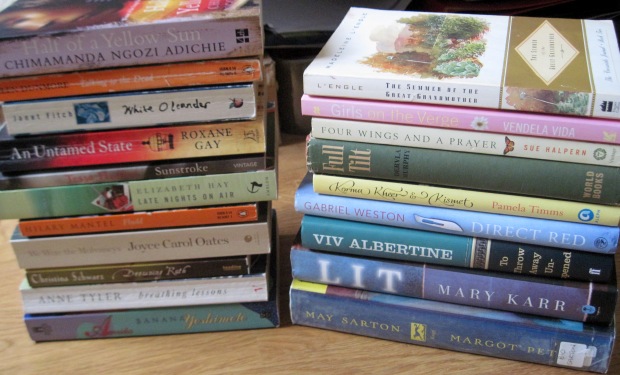
I’m doing abysmally with the goal I set myself at the start of the year to read lots of travel classics and biographies, so I’ve chosen one of each for this summer, but in general my criteria were simply that I was keen to read a book soon, and that it mustn’t feel like hard work. (So, alas, that ruled out novels by Elizabeth Bowen, Ursula K. LeGuin and Virginia Woolf.) I don’t insist on “beach reads” – the last two books I read on a beach were When Breath Becomes Air by Paul Kalanithi and Grief Cottage by Gail Godwin, after all – but I do hope that all the books I’ve chosen will be compelling and satisfying reads.
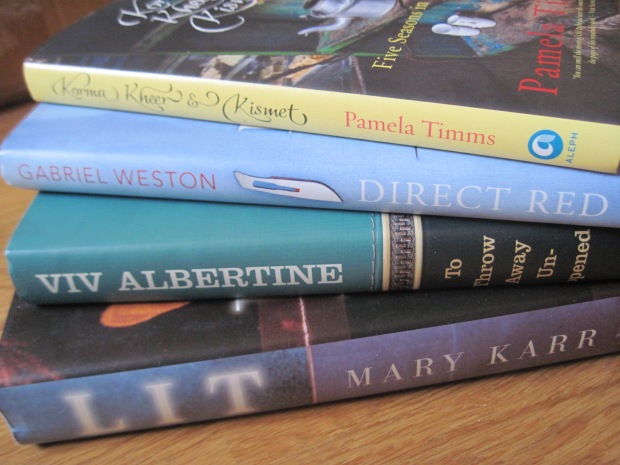
- To Throw Away Unopened by Viv Albertine – I picked up a copy from the Faber Spring Party, having no idea who Albertine was (guitarist of the all-female punk band The Slits). Everyone I know who has read this memoir has raved about it.
- Lit by Mary Karr – I’ve read Karr’s book about memoir, but not any of her three acclaimed memoirs. This, her second, is about alcoholism and motherhood.
- Korma, Kheer and Kismet: Five Seasons in Old Delhi by Pamela Timms – I bought a bargain copy at the Wigtown Festival shop earlier in the year. Timms is a Scottish journalist who now lives in India. This should be a fun combination of foodie memoir and travel book.
- Direct Red: A Surgeon’s Story by Gabriel Weston (a woman, honest!) – Indulging my love of medical memoirs here. I bought a copy at Oxfam Books earlier this year.
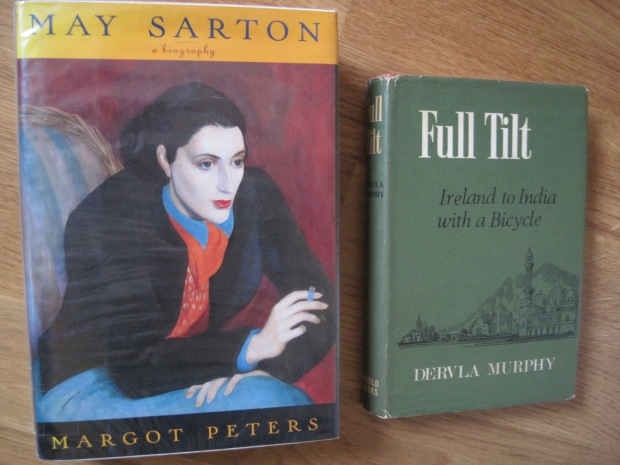 5. May Sarton by Margot Peters – I’ve been on a big May Sarton kick in recent years, so have been eager to read this 1997 biography, which apparently is not particularly favorable.
6. Full Tilt: Ireland to India with a Bicycle by Dervla Murphy – I bought this 1960s hardback from a charity shop in Cambridge a couple of years ago. It will at least be a start on that travel classics challenge.
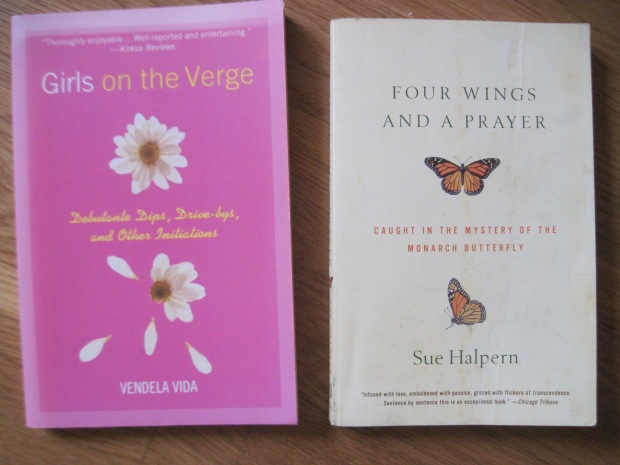
7. Girls on the Verge: Debutante Dips, Drive-bys, and Other Initiations by Vendela Vida – This was Vida’s first book. It’s about coming-of-age rituals for young women in America.
8. Four Wings and a Prayer: Caught in the Mystery of the Monarch Butterfly by Sue Halpern – Should fall somewhere between science and nature writing, with a travel element.
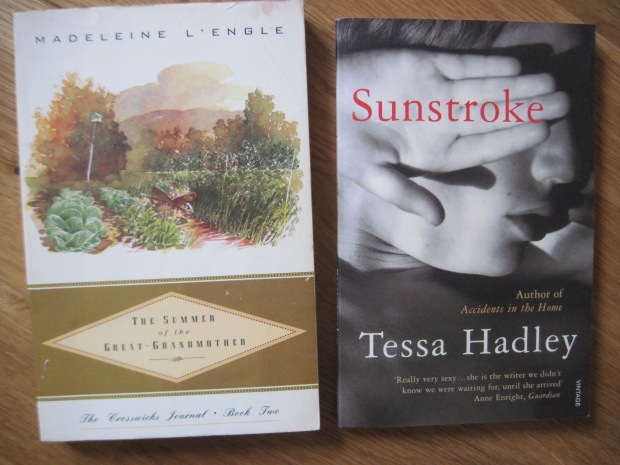
9. The Summer of the Great-Grandmother by Madeleine L’Engle – L’Engle is better known for children’s books, but she wrote tons for adults, too: fiction, memoirs and theology. I read the stellar first volume of the Crosswicks Journal, A Circle of Quiet, in September 2015 and have meant to continue the series ever since.
10. Sunstroke by Tessa Hadley – You know how I love reading with the seasons when I can. This slim 2007 volume of stories is sure to be a winner. Seven of the 10 originally appeared in the New Yorker or Granta.
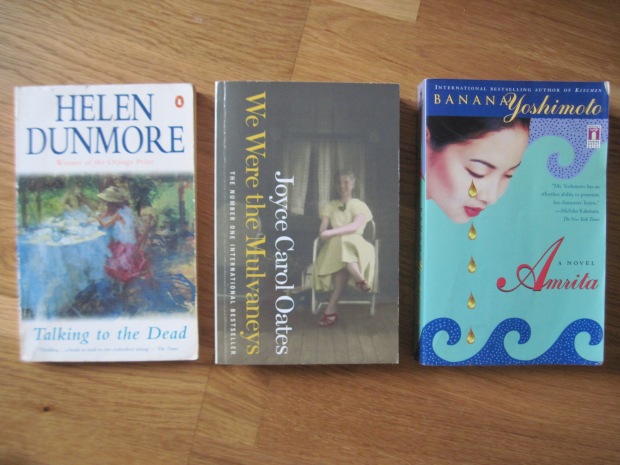
11. Talking to the Dead by Helen Dunmore – I’ve only ever read Dunmore’s poetry. It’s long past time to try her fiction. This one comes highly recommended by Susan of A life in books.
12. We Were the Mulvaneys by Joyce Carol Oates – Oates is intimidatingly prolific, but I’m finally going to jump in and give her a try.
13. Amrita by Banana Yoshimoto – A token lit in translation selection. “This is the story of [a] remarkable expedition through grief, dreams, and shadows to a place of transformation.” (Is it unimaginative to say that sounds like Murakami?)
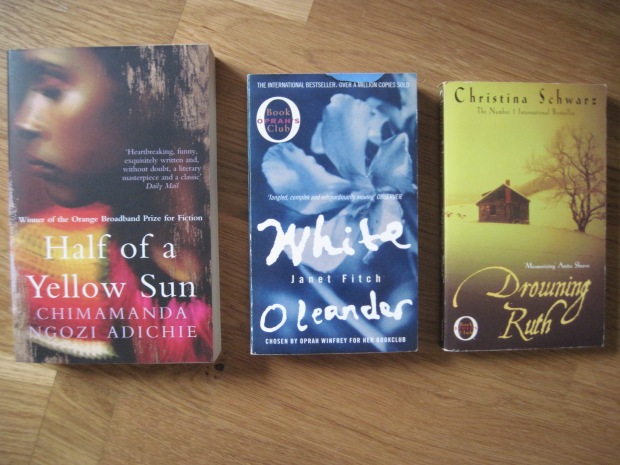
14. Half of a Yellow Sun by Chimamanda Ngozi Adichie – How have I not read any of her fiction yet?! This has been sitting on my shelf for years. I only vaguely remember the story line from the film, so it should be fairly fresh for me.
15. White Oleander by Janet Fitch – An Oprah’s Book Club selection from 1999. I reckon this would make a good beach or road trip read.
16. Drowning Ruth by Christina Schwarz – Another Oprah’s Book Club favorite from 2000. Set in Wisconsin in the years after World War I.
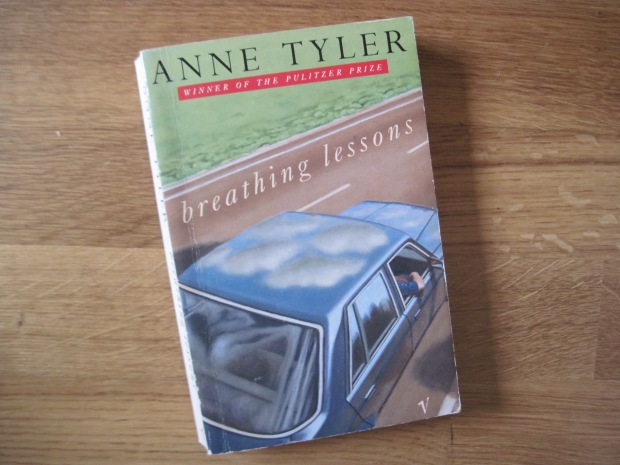
- Breathing Lessons by Anne Tyler – Tyler novels are a tonic. I have six unread on the shelf; the blurb on this one appealed to me the most. This summer actually brings two Tylers as Clock Dance comes out on July 12th – I’ll either substitute that one in, or read both!
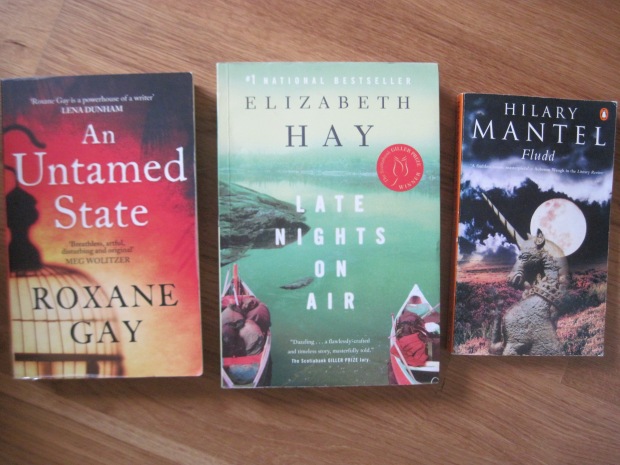
18. An Untamed State by Roxane Gay – I’ve only read Gay’s memoir, Hunger. She’s an important cultural figure; it feels essential to read all her books. I expect this to be rough.
19. Late Nights on Air by Elizabeth Hay – This has been on my radar for such a long time. After loving my first Hay novel (A Student of Weather) last year, what am I waiting for?
20. Fludd by Hilary Mantel – I haven’t read any Mantel in years, not since Bring Up the Bodies first came out. While we all await the third Cromwell book, I reckon this short novel about a curate arriving in a fictional town in the 1950s should hit the spot.
I’ll still be keeping up with my review books (paid and unpaid), blog tours, advance reads and library books over the summer. The aim of this challenge, though, is to make inroads into the physical TBR. Hopefully the habit will stick and I’ll keep on plucking reads from my shelves during the rest of the year.
Where shall I start? If I was going to sensibly move from darkest to lightest, I’d probably start with An Untamed State and/or Lit. Or I might try to lure in the summer weather by reading the two summery ones…
Which of these books have you read? Which ones appeal?
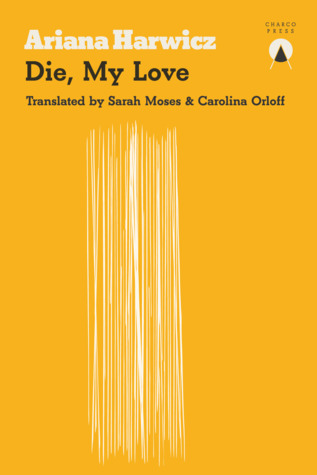
Die, My Love by Ariana Harwicz
This intense Argentinian novella, originally published in 2012 and nominated for this year’s Republic of Consciousness and Man Booker International Prizes, is an inside look at postpartum depression as it shades into what looks like full-blown psychosis. We never learn the name of our narrator, just that she’s a foreigner living in France (like Harwicz herself) and has a husband and young son. The stream-of-consciousness chapters are each composed of a single paragraph that stretches over two or more pages. From the first page onwards, we get the sense that this character is on the edge: as she’s hanging laundry outside, she imagines a sun shaft as a knife in her hand. But for now she’s still in control. “I wasn’t going to kill them. I dropped the knife and went to hang out the washing like nothing had happened.”
 Not a lot happens over the course of the book; what’s more important is to be immersed in this character’s bitter and perhaps suicidal or sadistic outlook. But there are a handful of concrete events. Her father-in-law has recently died, so she tells of his funeral and what she perceives as his sad little life. Her husband brings home a stray dog that comes to a bad end. Their son attends a children’s party and they take along a box of pastries that melt in the heat.
The only escape from this woman’s mind is a chapter from the point of view of a neighbor, a married radiologist with a disabled daughter who passes her each day on his motorcycle and desires her. With such an unreliable narrator, though, it’s hard to know whether the relationship they strike up is real. This woman is racked by sexual fantasies, but doesn’t seem to be having much sex; when she does, it’s described in disturbing terms: “He opened my legs. He poked around with his calloused hands. Desire is the last thing there is in my cries.”
The language is jolting and in-your-face, but often very imaginative as well. Harwicz has achieved the remarkable feat of showing a mind in the process of cracking up. It’s all very strange and unnerving, and I found that the reading experience required steady concentration. But if you find the passages below intriguing, you’ll want to seek out this top-class translation from new Edinburgh-based publisher Charco Press. It’s the first book in what Harwicz calls “an involuntary trilogy” and has earned her comparisons to Virginia Woolf.
“My mind is somewhere else, like I’ve been startled awake by a nightmare. I want to drive down the road and not stop when I reach the irrigation ditch.”
“I take off my sleep costume, my poisonous skin. I recover my sense of smell and my eyelashes, go back to pronouncing words and swallowing. I look at myself in the mirror and see a different person to yesterday. I’m not a mother.”
“The look I’m going for is Zelda Fitzgerald en route to Switzerland, and not for the chocolate or watches, either.”
My rating:
Translated from the Spanish by Sarah Moses and Carolina Orloff. My thanks to the publisher for the free copy for review.
The Reading Cure: How Books Restored My Appetite by Laura Freeman
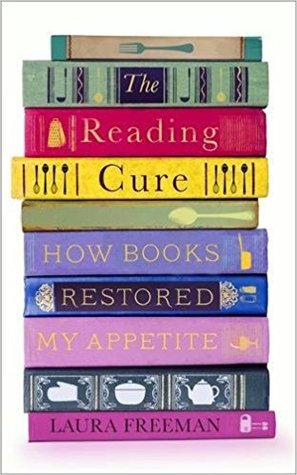 A debut memoir with food, medical and literary themes and a bibliotherapy-affirming title – this book ticks a whole lot of boxes for me. The very day I saw it mentioned on Twitter I requested a copy, and it was a warming, cozy read for the dark days of late December. As a teenager, freelance journalist Laura Freeman suffered from anorexia, and ever since she has struggled to regain a healthy relationship with food. This is decidedly not an anorexia memoir; if that’s what you’re looking for, you’ll want to pick up Nancy Tucker’s grueling but inventive The Time in Between. Instead, it’s about the lifelong joy of reading and how books have helped Freeman in the years that she has been haltingly recovering a joy of eating.
If asked to name a favorite food, Freeman writes that it would be porridge – or, if she was really pressed, perhaps her mother’s roast chicken dinner. But it’s been so long since she’s thought of food in terms of pleasure that written accounts of feasting from the likes of M.F.K. Fisher or Parson Woodforde might as well be written in a foreign language. When in 2012 she decided to read the whole of Charles Dickens’s oeuvre in his bicentenary year, she was struck afresh by the delight his characters take in meals.
While I was reading Dickens something changed. I didn’t want to be on the outside, looking at pictures, tasting recipes at one remove, seeing the last muffin go to someone else. I began to want to want food. To share it, savour it, to have it without guilt.
This nascent desire for a broader and more sumptuous food repertoire fuels the author through her voracious reading: of war writers like Siegfried Sassoon and Robert Graves with their boiled eggs and cocoa; of travel writers Laurie Lee and Patrick Leigh Fermor and their enthusiastic acceptance of whatever food came their way on treks; and of rediscovered favorite children’s books from The Secret Garden through the Harry Potter series with the characters’ greedy appetite for sweets. Other chapters are devoted to Virginia Woolf, whose depression and food issues especially resonate for Freeman; food writers; famous gluttons; and the specific challenge of chocolate, which she can’t yet bring herself to sample because it’s “so tangled up in my mind with ideas of sin, greed and loss of control.”
It’s these psychological and emotional aspects of food that Freeman is so good at capturing. She recognizes a tendency to all-or-nothing thinking that makes her prey to clean eating fads and exclusion diets. Today she still works to stifle the voices that tell her she’ll never be well and she doesn’t deserve to eat; she also tries to block out society’s contradictory messages about fat versus thin, healthy versus unhealthy, this diet versus that one. Channeling Dickens, she advises, “Don’t make a Marshalsea prison of rules for yourself – no biscuits at tea, no meat in the week, no pudding, not ever. Don’t trap yourself in lonely habits.”
Freeman’s taste in both food and literature seems a trifle old-fashioned, leaning towards jolly ol’ English stuff, but that’s because this is about comfort reading as much as it is about rediscovering comfort eating. Her memoir delicately balances optimism with reality, and encourages us to take another look at the books we love and really notice all those food scenes. Maybe our favorite writers have been teaching us how to eat well all along.
My rating:
The Reading Cure: How Books Restored My Appetite is published in the UK by Weidenfeld & Nicolson. My thanks to Virginia Woolstencroft for the review copy.
Nonfiction Novellas for November
Nonfiction novellas – that’s a thing, right? Lots of bloggers are doing Nonfiction November, but I feel like I pick up enough nonfiction naturally (at least 40% of my reading, I’d estimate) that I don’t need a special challenge related to it. I’ve read seven nonfiction works this month that aren’t much longer than 100 pages, or sometimes significantly shorter. For the most part these are nature books and memoirs. I’m finishing off a few more fiction novellas and will post a roundup of mini reviews before the end of the month, along with a list of the titles that didn’t take and some general thoughts on novellas.
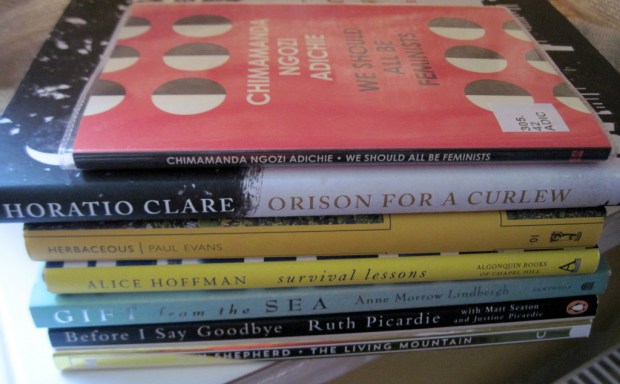
“We Should All Be Feminists” by Chimamanda Ngozi Adichie
[48 pages]
 This isn’t even a novella, but an essay published in pamphlet form, based on a TED talk Adichie gave as part of a conference on Africa. I appreciate and agree with everything she has to say, yet didn’t find it particularly groundbreaking. Her discussion of the various stereotypes associated with feminists and macho males is more applicable to a society like Lagos, though of course the pay gap and negative connotations placed on women managers are as relevant in the West.
Favorite line: “At some point I was a Happy African Feminist Who Does Not Hate Men And Who Likes To Wear Lip Gloss And High Heels For Herself And Not For Men.”
Orison for a Curlew: In search of a bird on the edge of extinction by Horatio Clare
[101 pages]
 Clare was commissioned to tell the story of the slender-billed curlew, a critically endangered marsh-dwelling bird that might be holding out in places like Siberia and Syria but is largely inaccessible to the European birding community. With little hope of finding a bird as good as extinct, he set out instead to speak to those in Greece, Romania and Bulgaria who had last seen the bird before its disappearance: conservationists, hunters, bird watchers and photographers. Clare writes well about nostalgia, hope and the difference individuals can make, but there’s no getting around the fact that this book doesn’t really do what it promises to. [Also, much as I hate to say it, this is atrociously edited. I know Little Toller is a small operation, but there are some shocking typos in here: “pilgrimmage,” “bridwatching,” “govenor,” “refinerey”; even the name of the author’s town, “Hebdon Bridge”!]
Some favorite lines:
“A huge cloud of black storks jump up like an ambush of Hussars in their red bills and leggings, white fronts and dark uniforms.”
“The wheels click-beat the rails as we follow a river valley north past dozy dolomitic scenery in ageing lemon sunlight”
Herbaceous by Paul Evans
[106 pages]
 This was Evans’s first book, and the first issued in the Little Toller monograph series. These are generally exceptionally produced nature books on niche subjects. Herbaceous is hard to categorize. In some ways it’s similar to Evans’s Guardian Country Diary columns: short pieces blending straightforward observations with poetic musings. However, some of them read more like short stories, and the language – appropriately for a book about flora? – can be florid. They probably work better read aloud as poems: I remember him reading “Skunk cabbage” at the New Networks for Nature conference some years back, for instance. Some lines are a little oversaturated with metaphor. But others are truly lovely.
A few favorite lines:
“The following morning the text of journeys appear[s] on snow: trident marks of pheasant, double slots of fallow deer, dabs of rabbit.”
“Bordello black and scarlet, six-spot burnet moths swing on the nodding idiot scabious flower through a lavender-blue sky and deep, deep under roots, the fossilised fury of the mollusc’s empire heaves.”
“A bed of pansies tilts flat blue faces to the sun like a deaf and dumb funeral.”
Survival Lessons by Alice Hoffman
[83 pages]
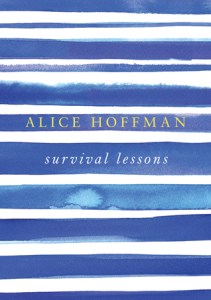 Hoffman wrote this 15 years after her own bout with breast cancer to encourage anyone going through a crisis. Each chapter title begins with the word “Choose” – a reminder that, even when you can’t choose your circumstances, you can choose your response. For instance, “Choose Whose Advice to Take” and “Choose to Enjoy Yourself.” This has been beautifully put together with blue-tinted watercolor-effect photographs and an overall yellow and blue theme (along with deckle edge pages – a personal favorite book trait). It’s a sweet little memoir with a self-help edge, and I think most people would appreciate being given a copy. The only element that felt out of place was the five-page knitting pattern for a hat. Though very similar to Cathy Rentzenbrink’s A Manual for Heartache, this is that tiny bit better.
Favorite lines:
“Make a list of what all you have loved in this unfair and beautiful world.”
“When I couldn’t write about characters that didn’t have cancer and worried I might never get past this single experience, my oncologist told me that cancer didn’t have to be my entire novel. It was just a chapter.”
Gift from the Sea by Anne Morrow Lindbergh
[130 pages]
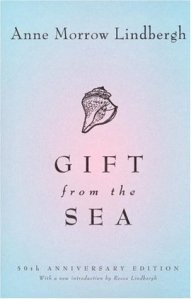 Though written in 1955 (I read a 50th anniversary edition copy), this still resonates and deserves to be read alongside feminist nonfiction by Virginia Woolf, May Sarton and Madeleine L’Engle. Solitude is essential for women’s creativity, Lindbergh writes, and this little book, written during a beach vacation in Florida, is about striving for balance in a midlife busy with family commitments. Like Joan Anderson, Lindbergh celebrates the pull of the sea and speaks of life, and especially marriage, as a fluid thing that ebbs and flows. Divided into short, meditative chapters named after different types of shells, this is a relatable work about the search for a simple, whole, purposeful life. The afterword from 1975 and her daughter Reeve’s introduction from 2005 testify to how lasting an influence the book has had.
Favorite lines:
“Patience, patience, patience, is what the sea teaches. Patience and faith.”
“The most exhausting thing in life, I have discovered, is being insincere.”
“I no longer pull out grey hairs or sweep down cobwebs.”
“It is fear, I think, that makes one cling nostalgically to the last moment or clutch greedily toward the next.”
Before I Say Goodbye by Ruth Picardie
[116 pages]
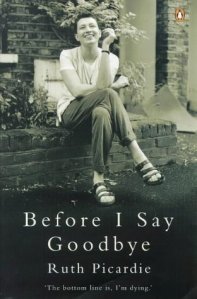 Ruth Picardie, an English freelance journalist and newspaper editor, was younger than I am now when she died of breast cancer in September 1997. The cancer had moved into her liver, lungs, bones and brain, and she only managed to write 6.5 weekly columns for Observer Life magazine, which her older sister, Justine Picardie, edited. Matt Seaton, Ruth’s widower, and Justine gathered a selection of e-mails exchanged with friends and letters sent by Observer readers and put them together with the columns to make a brief chronological record of Ruth’s final illness, ending with a 20-page epilogue by Seaton. Ruth comes across as down-to-earth and self-deprecating. All the rather Bridget Jones-ish fretting over her weight and complexion perhaps reflects that it felt easier to think about daily practicalities than about the people she was leaving behind. This is a poignant book, for sure, but feels fixed in time, not really reaching into Ruth’s earlier life or assessing her legacy. I’ve moved straight on to Justine’s bereavement memoir, If the Spirit Moves You, and hope it adds more context.
Favorite lines:
“You ram a non-organic carrot up the arse of the next person who advises you to start drinking homeopathic frogs’ urine.”
“Worse than the God botherers, though, are the road accident rubber-neckers, who seem to find terminal illness exciting, the secular Samaritans looking for glory.”
The Living Mountain by Nan Shepherd
[108 pages]
 This is something of a lost nature classic that has been championed by Robert Macfarlane (who contributes a 25-page introduction to this Canongate edition). Composed during the later years of World War II but only published in 1977, it’s Shepherd’s tribute to her beloved Cairngorms, a mountain region of Scotland. But it’s not a travel or nature book in the way you might usually think of those genres. It’s a subtle, meditative, even mystical look at the forces of nature, which are majestic but also menacing: “the most appalling quality of water is its strength. I love its flash and gleam, its music, its pliancy and grace, its slap against my body; but I fear its strength.” Shepherd dwells on the senses, the mountain flora and fauna, and the special quality of time and existence (what we’d today call mindfulness) achieved in a place of natural splendor and solitude: “Yet often the mountain gives itself most completely when I have no destination, when I reach nowhere in particular, but have gone out merely to be with the mountain as one visits a friend with no intention but to be with him.”
Have you read any of these novellas? Which one takes your fancy?
Jacob’s Room Is Full of Books by Susan Hill
Susan Hill has published dozens of books in multiple genres, but is probably best known for her perennially popular ghost story, The Woman in Black (1983). Apart from that and two suspense novellas, the only book I’d read by her before is Howards End Is on the Landing (2009), a sort of prequel to this work. Both are bookish memoirs animated by the specific challenge to spend more time reading from her shelves and revisiting the books that have meant the most to her in the past. Though not quite a journal, this is set up chronologically and also incorporates notes on the weather, family events and travels, and natural phenomena encountered near her home in Norfolk.
The Virginia Woolf reference in the title is fitting, as Hill realizes she has four shelves’ worth of books about Woolf and her Bloomsbury set. It’s just one of many mini-collections she discovers in her library on regular “de-stocking” drives when she tries to be realistic about what, at age 75, she’s likely to reread or reference in the future. “A book that cannot be returned to again and again, and still yield fresh entertainment and insights, is only half a book,” Hill contends. Some authors who merit frequent rereading for her are Edith Wharton, Muriel Spark, W. Somerset Maugham and Olivia Manning, while other passions had a time limit: she’s gone off E.F. Benson, and no longer reads about Antarctica or medieval theology.
 Hill is unashamedly opinionated, though she at least has the humility to ask what individual taste matters. Her substantial list of no-nos includes fairy tales, science fiction, Ethan Frome, Patricia Highsmith and e-readers, and she seems strangely proud of never having read Jane Eyre. She’s ambivalent about literary festivals and especially about literary prizes: they were a boon to her as a young author, but she was also on the infamous 2011 Booker Prize judging panel, and disapproves of that prize being opened up to American entries.
As well as grumpy pronouncements, this book is full of what seems like name-dropping: encounters with Iris Murdoch, J.B. Priestley, Susan Sontag and the like. (To be fair, the stories about Murdoch and Sontag are rather lovely.) Although aspects of this book rubbed me the wrong way, I appreciated it as a meditation on how books are woven into our lives. I took note of quite a few books I want to look up, and Hill ponders intriguing questions that book clubs might like to think about: Can we ever enjoy books as purely as adults as we did as children, now that we have to “do something” with our reading (e.g. discussing or reviewing)? Is it a lesser achievement to turn one’s own life experiences into fiction than to imagine incidents out of thin air? Will an author unconsciously “catch the style” of any writer they are reading at the time of their own compositions? Is it better to come to a book blind, without having read the blurb or anything else about it?
You’ll applaud; you’ll be tempted to throw the book at the wall (this was me with the early page disparaging May Sarton). Perhaps on consecutive pages. But you certainly won’t be indifferent. And a book that provokes a reaction is a fine thing.
Some favorite lines:
“Cold room, warm bed, good book.”
“I have had fifty-five years of experience but still every book is like walking a tightrope. I might fall off.”
“People say they can never part with a book. I can. As fast as I get one out of the back door, two new ones come in through the front anyway.”
“How many people are there living in the books here? Only take the complete novels of Dickens and add up all the characters in each one and then multiply by … and I already need to lie down. Overall, there must be thousands of imaginary people sharing this house with us.”
“One of the best presents anyone can give you is the name of a writer whose books they believe will be ‘you’ – and they are. Someone you would almost certainly never have found for yourself.”
My rating:
Jacob’s Room Is Full of Books was released in the UK on October 5th. My thanks to Profile Books for the free copy for review.
A Wood of One’s Own by Ruth Pavey
In 1999 Ruth Pavey bought four acres of Somerset scrubland at a land auction. It wasn’t exactly what she’d set out to acquire: it wasn’t a “pretty” field, and traffic was audible from it. But she was pleased to return to her family’s roots in the Somerset Levels area – this “silted place of slow waters, eels, reeds, drainage engineers, buttercups, church towers, quiet” that her father came from, and where she was born – and she fancied planting some trees.
There never was a master plan […] I wanted to open up enough room for trees that might live for centuries […] I also wanted to keep areas of wilderness for the creatures […] And I wanted it to be beautiful. Not immaculate, that was too much to hope for, but, in its own ragged, benign way, beautiful.
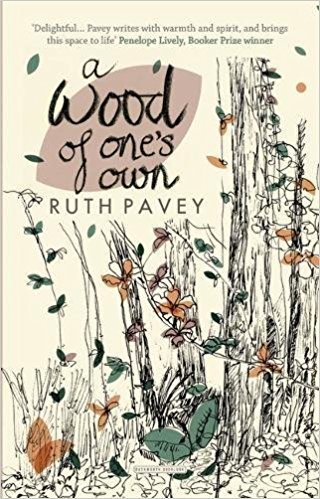 This pleasantly meandering memoir, Pavey’s first book, is an account of nearly two decades spent working alongside nature to restore some of her land to orchard and maintain the rest in good health. The first steps were clear: she had to deal with some fallen willows, find a water source and plan a temporary shelter. Rather than a shed, which would be taken as evidence of permanent residency, she resorted to a “Rollalong,” a mobile metal cabin she could heat just enough to survive nights spent on site. Before long, though, she bought a nearby cottage to serve as her base when she left her London teaching job behind on weekends.
Then came the hard work: after buying trees from nurseries and ordering apple varieties that would fruit quickly, Pavey had to plant it all and pick up enough knowledge about pruning, grafting, squirrel management, canker and so on to keep everything alive. There was always something new to learn, and plenty of surprises – such as the stray llama that visited her neighbor’s orchard. Local history weaves through this story, too: everything from the English Civil War to Cecil Sharp’s collecting of folk songs.
Britain has seen a recent flourishing of hybrid memoirs–nature books by the likes of Helen Macdonald, Mallachy Tallack and Clover Stroud. By comparison, Pavey is not as confiding about her personal life as you might expect. She reveals precious little about herself: she tells us that her mother died when she was young and she was mostly raised by an aunt; she hints at some failed love affairs; in the acknowledgments she mentions a son; from the jacket copy I know she’s the gardening correspondent for the Hampstead & Highgate Express. But that’s it. This really is all about the wood, and apart from serving as an apt Woolf reference the use of “one” in the title is in deliberate opposition to the confessional connotations of “my”.
 Still, I think this book will appeal to readers of modern nature writers like Paul Evans and Mark Cocker – these two are Guardian Country Diarists, and Pavey develops the same healthy habit of sticking to one patch and lovingly monitoring its every development. I was also reminded of Peri McQuay’s memoir of building a home in the woods of Canada.
What struck me most was how this undertaking encourages the long view: “being finished, in the sense of being brought to a satisfactory conclusion, is not something that happens in a garden, an orchard or a wood, however well planned or cultivated,” she writes. It’s an ongoing project, and she avoids nostalgia and melodrama in planning for its future after she’s gone; “I am only there for a while, a twinkling. But [the trees and creatures] … will remain.” This would make a good Christmas present for the dedicated gardener in your life, not least because of the inclusion of Pavey’s lovely black-and-white line drawings.
A Wood of One’s Own was published on September 21st by Duckworth Overlook. My thanks to the publisher for a free copy for review.
My rating:
 Bookish Beck = Rebecca Foster. American transplant to England. Freelance proofreader and book reviewer.
