Chase of the Wild Goose by Mary Louisa Gordon: A Lurid Editions Reprint
 Chase of the Wild Goose, a playful, offbeat biographical novel about the Ladies of Llangollen, was first published by Leonard and Virginia Woolf’s Hogarth Press in 1936. I was delighted to be invited to take part in an informal blog tour celebrating the book’s return to print (today, 1 February) as the inaugural publication of Lurid Editions, which will focus on reprinting lesser-known and trailblazing 20th-century classics.
Mary Louisa Gordon was a medical doctor and early graduate of the London School of Medicine for Women. She also served as a prison inspector and had a special concern for the plight of female prisoners; another of her works was Penal Discipline (1922). Chase of the Wild Goose was published when she was 75. She underwrote the book to keep it in print until her death in 1941. A word-of-mouth success, it sold reasonably well in those first years.
I’d encountered the Ladies of Llangollen a couple of times before, in nonfiction: in The Art of the Wasted Day by Patricia Hampl, where they are among her exemplars of solitary, introspective living; and in Sign Here If You Exist and Other Essays by Jill Sisson Quinn, where, in the way that they blur the lines between romance and friendship, they presage her experience with an intimate female friend. This was a different way to explore their story.

Portrait of The Rt. Honble. Lady Eleanor Butler & Miss Ponsonby ‘The Ladies of Llangollen’. By James Henry Lynch, Public domain, via Wikimedia Commons. (Wearing their customary plain riding habits and top hats.)
“The two heroines of this story, the Lady Eleanor Butler and Miss Sarah Ponsonby, have a remarkable history. They achieved fame at a stroke. They made a noise in the world which has never since died out, and which we, their spiritual descendants, continue to echo.”
These are the opening lines of what, in its first half, is a fairly straightforward chronological account of the protagonists’ lives, from their first meeting to when they flee to Wales to set up house together at Plas Newydd. They grow up in Ireland and, although their prospects differ – EB has a wealthy upbringing at Kilkenny Castle, whereas teenage SP has recently lost her mother and is being passed around relatives and acquaintances – both are often told that marriage is the only viable option. The eccentric spinster stereotype is an unkind one, but one EB is willing to risk. In one terrific scene, she shames her archbishop great-uncle for being just like everyone else and threatening to sell her to the highest bidder in matrimony. Still, the notion persists that if only the right man comes courting, they’ll change their tune.
At their first meeting EB and SP engage in an intense discussion of the possibilities for women, and within two weeks they’re already pledging to be together forever: “I think that nothing cheap, or second-rate, or faute de mieux, will ever do for you or me … We think—you and I—that we want something strange and exceptional, but something different may be ordained for us,” Eleanor says to Sarah. “From now onwards I… won’t you keep me… in your heart?” Sarah asks in parting. Eleanor replies, “I think you have been in it since before we were born.”
The strength of that romantic conviction that they are fated for each other keeps them going despite difficulties – EB’s father disowns her and cuts her off, which has inevitable financial implications, though she had already bought Plas Newydd outright; and for both of them, leaving Ireland is a wrench because they feel certain that they can never go back.

Plas Newydd. Photo by Wolfgang Sauber, CC BY-SA 3.0 , via Wikimedia Commons.
By Part II, the erstwhile fugitives, settled into local life in North Wales, enter into a sedate middle age of visitors and correspondence. Much of the material for this section is drawn from the journal EB kept. Part III is where things get really interesting: in a metafictional twist, Gordon herself enters the narrative as she meets and converses with the long-dead Ladies at their house, reflecting on the social changes that have occurred since their time.
As the Afterword by Dr Nicola Wilson notes, Chase of the Wild Goose is creative nonfiction in the same vein as Orlando, building on real-life figures and relationships in a way that must have seemed ahead of its age, not least for how it looks back to venerate queer foremothers. Although there are long stretches of the book that are tedious with biographical detail and melodramatic speeches, there is enough in the way of convincing dialogue and scenes to make up for that. While I feel the novel probably has more to offer to academics and those with a particular interest in its subjects than to general readers, I was pleased to be able to experience a rediscovered classic. I marvelled every time I reminded myself that this largely takes place in the late eighteenth to early nineteenth century. Gordon ably reproduces the diction and mores of the Ladies’ time, but her modernist intrusion takes it beyond pastiche.
As for the title, I’m most accustomed to the wild goose as a metaphor for the Holy Spirit in Celtic Christian iconography, but of course it is also a pun on the proverbial wild-goose chase. Gordon nods to both connotations; the phrase appears several times in the text and is the protagonists’ private term for their search for a life together – for liberty and for love. You have to cheer for them, achieving what so few could in their time. Here’s to you, Ladies!
With thanks to D-M Withers and Lurid Editions for the free copy for review.
A first read for Karen and Lizzys #ReadIndies challenge. I will hope to add many more before the end of the month!

Liz has also reviewed the novel.
For more information, do also read this fascinating Guardian article.
Winter Reads, Part I: Patrick Gale & Tove Jansson (#NordicFINDS23)
This winter has been a disappointment: it’s bloody cold, but with no snow. It’s impossible to keep our house warm, even with extra loft insulation and new double-glazed windows (home ownership is boring and overrated), so I’m ready for signs of spring. Maybe by the time I review a second batch of seasonal reads in February, winter will truly be on its way out.
A Place Called Winter by Patrick Gale (2015)
 This was our January book club read. We’d had good luck with Gale before: his Notes from an Exhibition received our joint highest rating ever. As he’s often done in his fiction, he took inspiration from family history: here, the story of his great-grandfather Harry Cane, who emigrated to the Canadian prairies to farm in the most challenging of conditions. Because there is some uncertainty as to what precipitated his ancestor’s resettlement, Gale has chosen to imagine that Harry, though married and the father of a daughter, was in fact gay and left England to escape blackmailing and disgrace after his affair with a man was discovered.
There are very evocative descriptions of the pioneer life, lightened for Harry by his relationship with his closest neighbours, siblings Petra and Paul. The novel covers the First World War and the start of the Spanish flu epidemic, which provide much fodder for melodrama, but somehow I don’t mind it from Gale. Harry himself is so diffident as to seem blank, but that means he is free to become someone else in a new land. My other main criticism would be that the villain is implausibly evil. Some of our book club members also thought there were too many coincidences. Gale really makes you feel for these characters and their suffering, though. Sexuality and mental health, both so misunderstood at that time, are the two main themes and he explores them beautifully. In that both are historical fiction where homosexuality is simply a fact of life, not a titillating novelty, this reminded me a lot of Days Without End by Sebastian Barry. (Free from mall bookshop) 
A Winter Book: Selected Stories by Tove Jansson (2006)
[Translated from the Swedish by Silvester Mazzarella, David McDuff and Kingsley Hart]
 A brief second review for Nordic FINDS. It’s the third time I’ve encountered some of these autofiction stories: this was a reread for me, and 13 of the pieces are also in Sculptor’s Daughter, which I skimmed from the library a few years ago. And yet I remembered nothing; not a single one was memorable. Most of the pieces are impressionistic first-person fragments of childhood, with family photographs interspersed. In later sections, the protagonist is an older woman, Jansson herself or a stand-in. I most enjoyed “Messages” and “Correspondence,” round-ups of bizarre comments and requests she received from readers. Of the proper stories, “The Iceberg” was the best. It’s a literal object the speaker alternately covets and fears, and no doubt a metaphor for much else. This one had the kind of profound lines Jansson slips into her children’s fiction: “Now I had to make up my mind. And that’s an awful thing to have to do” and “if one doesn’t dare to do something immediately, then one never does it.” A shame this wasn’t a patch on The Summer Book. (Free from a neighbour)

Original rating in 2012: 
Rating now: 
Averaged rating: 
And a DNF:
Winter’s Tale by Mark Helprin (1983)
 Laila (Big Reading Life) and I attempted this as a buddy read, but we both gave up on it. I got as far as page 53 (in the 600+-page pocket paperback). The premise was alluring, with a magical white horse swooping in to rescue Peter Lake from a violent gang. I also appreciated the NYC immigration backstory, but not the adjective-heavy wordiness, the anachronistic exclamations (“Crap!” and “Outta my way, you crazy midget” – this is presumably set some time between the 1900s and 1920s) or the meandering plot. It was also disturbing to hear about Peter’s sex life when he was 12. From a Little Free Library (at Philadelphia airport) it came, and to a LFL (at the Bar Convent in York) it returned. Laila read a little further than me, enough to tell the library patron who recommended it to her that she’d given it a fair try.
Any snowy or icy reading (or weather) for you lately?
Three on a Theme: Frost Fairs Books
Here in southern England, we’ve just had a couple of weeks of hard frost. The local canal froze over for a time; the other day when I thought it had all thawed, a pair of mallard ducks surprised me by appearing to walk on water. In previous centuries, the entire Thames has been known to freeze through central London. (I’d like to revisit Virginia Woolf’s Orlando for a 17th-century scene of that.) This thematic trio of a children’s book, a historical novel, and a poetry collection came together rather by accident: I already had the poetry collection on my shelf, then saw frost fairs referenced in the blurb of the novel, and later spotted the third book while shelving in the children’s section of the library.
A Night at the Frost Fair by Emma Carroll (2021)
 Maya’s mum is visiting family in India; Maya and her dad and sister have just settled Gran into a clinical care home. Christmas is coming, and Gran handed out peculiarly mismatched presents: Maya’s older sister got a lovely brooch, while her own present was a weird brick-shaped brown object Gran says belonged to “Edmund”. Now the family is in a taxi home, crossing London Bridge, when Maya notices snow falling faster than seems possible and finds herself on a busy street of horse-drawn carriages, overlooking booths and hordes of people on the frozen river.
A sickly little boy named Eddie is her tour guide to the games, rides and snacks on offer here in 1788, but there’s a man around who wants to keep him from enjoying the fair. Maya hopes to help Eddie, and Gran, all while figuring out what the gift parcel means. A low page count meant this felt pretty thin, with everything wrapped up too soon. The problem, really, was that – believe it or not – this isn’t the first middle-grade time-slip historical fantasy novel about frost fairs that I’ve read; the other, Frost by Holly Webb, was better. Sam Usher’s Quentin Blake-like illustrations are a bonus, though. (Public library) 
The Weather Woman by Sally Gardner (2022)
This has been catalogued as science fiction by my library system, but I’d be more likely to describe it as historical fiction with a touch of magic realism, similar to The Mermaid and Mrs Hancock or Things in Jars. I loved the way the action is bookended by the frost fairs of 1789 and 1814. There’s a whiff of the fairy tale in the setup: when we meet Neva, she’s a little girl whose parents operate one of the fair’s attractions, a chess-playing bear. She knows, like no one else seems to, that the ice is shifting and it’s not safe to stay by the Thames. When the predicted tragedy comes, she’s left an orphan and adopted by Victor Friezland, a clockmaker who shares her Russian heritage. He lives in a wonderfully peculiar house made out of ship parts and, between him, Neva, the housekeeper Elise, and other servants, friends and neighbours, they form a delightful makeshift family.
Neva predicts the weather faultlessly, even years ahead. It’s somewhere between synaesthetic and mystical, this ability to hear the ice speaking and see what the clouds hold. While others in their London circle engage in early meteorological prediction, her talent is different. Victor decides to harness it as an attraction, developing “The Weather Woman” as first an automaton and then a magic lantern show, both with Neva behind the scenes giving unerring forecasts. At the same time, Neva brings her childhood imaginary friend to life, dressing in men’s clothing and appearing as Victor’s business partner, Eugene Jonas, in public.

These various disguises are presented as the only way that a woman could be taken seriously in the early 19th century. Gardner is careful to note that Neva does not believe she is, or seek to become, a man; “She thinks she’s been born into the wrong time, not necessarily the wrong sex. As for her mind, that belongs to a different world altogether.” (Whereas there is a trans character and a couple of queer ones; it would also have been interesting for Gardner to take further the male lead’s attraction to Eugene Jonas.) From her early teens on, she’s declared that she doesn’t intend to marry or have children, but in what I suspect is a trope of romance fiction, she changes her tune when she meets the right man. This was slightly disappointing, yet just one of several satisfying matches made over the course of this rollicking story.
London charms here despite its Dickensian (avant la lettre) grime – mudlarks and body snatchers, gambling and trickery, gloomy pubs and shipwrecks, weaselly lawyers and high-society soirees. The plot moves quickly and holds a lot of surprises and diverting secondary characters. While the novel could have done with some trimming – something I’d probably say about the majority of 450-pagers – I remained hooked and found it fun and racy. You’ll want to stick around for a terrific late set-piece on the ice. Gardner had a career in theatre costume design before writing children’s books. I’ll also try her teen novel, I, Coriander. (Public library)
[Two potential anachronisms: “Hold your horses” (p. 202) and calling someone “a card” (p. 209) – both slang uses that more likely date from the 1830s or 1840s.]
The Frost Fairs by John McCullough (2010)
 I knew McCullough’s name from his superb 2019 collection Reckless Paper Birds, which was shortlisted for a Costa Prize. This was his debut collection, for which he won a Polari Prize. Appropriately, one poem, “Georgie, Belladonna, Sid,” is crammed full of “Polari words” – “the English homosexual and theatrical slang prevalent in the early to mid 20th century.” The book leans heavily on historical scenes and seaside scenery. “The Other Side of Winter” is the source of the title and the cover image:
Overnight the Thames begins to move again.
The ice beneath the frost fair cracks. Tents,
merry-go-rounds and bookstalls glide about
On islands given up for lost. They race,
switch places, touch—the printing press nuzzling
the swings—then part, slip quietly under.
I also liked the wordplay of “The Dictionary Man,” the alliteration and English summer setting of “Miss Fothergill Observes a Snail,” and the sibilance versus jarringly violent imagery of “Severance.” However, it was hard to detect links that would create overall cohesion in the book. (Purchased directly from Salt Publishing)
11 Days, 11 Books: 2023’s Reading So Far
I realized that, as in 2020, I happen to have finished 11 books so far this year (including a Patrick Gale again). Some of the below I’ll be reviewing in full for other themes or challenges coming up, and others have paid reviews pending that I can’t share yet, but I’ve written a little bit about each of the others. Here’s how my reading year has started off…


A children’s book
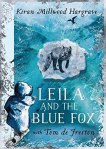 Leila and the Blue Fox by Kiran Millwood Hargrave – Similar in strategy to Hargrave’s previous book (also illustrated by her husband Tom de Freston), Julia and the Shark, one of my favourite reads of last year – both focus on the adventures of a girl who has trouble relating to her mother, a scientific researcher obsessed with a particular species. Leila, a Syrian refugee, lives with family in London and is visiting her mother in the far north of Norway. She joins her in tracking an Arctic fox on an epic journey, and helps the expedition out with social media. Migration for survival is the obvious link. There’s a lovely teal and black colour scheme, but I found this unsubtle. It crams too much together that doesn’t fit.
Celebrity autobiographies
A genre that pretty much never makes it onto my stacks, but I read these two despite knowing little to nothing about the authors; instead, I was drawn in by their particular stories.
 A Heart that Works by Rob Delaney – Delaney is an American actor who was living in London for TV filming in 2016 when his third son, baby Henry, was diagnosed with a brain tumour. He died before the age of three. The details of disabling illness and brutal treatment could not be other than wrenching, but the tone is a delicate balance between humour, rage, and tenderness. The tribute to his son may be short in terms of number of words, yet includes so much emotional range and a lot of before and after to create a vivid picture of the wider family. People who have never picked up a bereavement memoir will warm to this one.
 Born a Crime: Stories from a South African Childhood by Trevor Noah – Again, I was not familiar with the author’s work in TV/comedy, but had heard good things so gave this a try. It reminded me of Barack Obama’s Dreams from My Father what with the African connection, the absent father, the close relationship with his mother, and the reflections on race and politics. I especially loved his stories of being dragged to church multiple times every Sunday. He writes a lot about her tough love, and the difficulty of leaving hood life behind once you’ve been sucked into it. The final chapter is exceptional. Noah does a fine job of creating scenes and dialogue; I’d happily read another book of his.
Novels
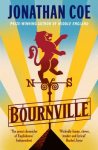 Bournville by Jonathan Coe – Coe does a good line in witty state-of-the-nation novels. Patriotism versus xenophobia is the overarching dichotomy in this one, as captured through a family’s response to seven key events from English history over the last 75+ years, several of them connected with the royals. Mary Lamb, the matriarch, is an Everywoman whose happy life still harboured unfulfilled longings. Coe mixes things up by including monologues, diary entries, and so on. In some sections he cuts between the main action and a transcript of a speech, TV commentary, or set of regulations. Covid informs his prologue and the highly autobiographical final chapter, and it’s clear he’s furious with the government’s handling.
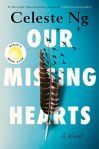 Our Missing Hearts by Celeste Ng – Disappointing compared to her two previous novels. I’d read too much about the premise while writing a synopsis for Bookmarks magazine, so there were no surprises remaining. The political commentary, though necessary, is fairly obvious. The structure, which recounts some events first from Bird’s perspective and then from his mother Margaret Miu’s, makes parts of the second half feel redundant. Still, impossible not to find the plight of children separated from their parents heart-rending, or to disagree with the importance of drawing attention to race-based violence. It’s also appealing to think about the power of individual stories and how literature and libraries might be part of an underground protest movement.
And a memoir in miniature
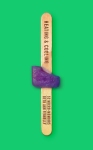 Heating & Cooling: 52 Micro-Memoirs by Beth Ann Fennelly – I love memoirs-in-essays. Fennelly goes for the same minimalist approach as Abigail Thomas’s Safekeeping. Pieces range from one line to six pages and mostly pull out moments of note from the everyday of marriage, motherhood and house maintenance. I tended to get more out of the ones where she reinhabits earlier life, like “Goner” (growing up in the Catholic church); “Nine Months in Madison” (poetry fellowship in Wisconsin, running around the lake where Otis Redding died in a plane crash); and “Emulsionar,” (age 23 and in Barcelona: sexy encounter, immediately followed by scary scene). Two about grief, anticipatory for her mother (“I’ll be alone, curator of the archives”) and realized for her sister (“She threaded her arms into the sleeves of grief” – you can tell Fennelly started off as a poet), hit me hardest. Sassy and poignant.
The best so far? Probably Born a Crime, followed by Bournville.
Any of these you have read or would read?
Three on a Theme: “Birds” Short Story Collections
I read these three collections one at a time over three and a half months of last year, initially intending to write them up as part of my short story focus in September but ultimately deciding to spend more time with the latter two (and then falling ill with Covid before I could write them all up in 2022). They topped my Best Backlist Reads.
The word from the title is incidental, really; the books do have a lot in common in terms of theme and tone, though. The environment, fidelity and motherhood are recurring elements. The warmth and psychological depth are palpable. Each story feels fleshed out enough that I could happily read an entire novel set in its realm, but also complete unto itself.
Birds of a Lesser Paradise by Megan Mayhew Bergman (2012)
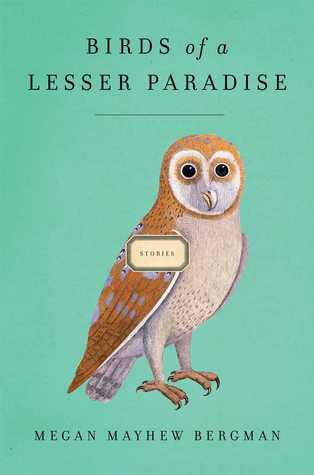 I knew Bergman from her second of three collections, Almost Famous Women; this was her debut. As is common for a first book, it incorporates autobiographical characteristics: North Carolina settings, a preponderance of animals (her husband is a vet), and pregnancy and early motherhood. Eleven of the 12 stories are in the first person, there are no speech marks, and the protagonists are generally women in their twenties or thirties coping with young children, crumbling households, ageing parents, and ethical dilemmas at work.
Creatures are companions or catalysts here. In “Housewifely Arts,” a single mother and her son embark on a road trip to rescue her late mother’s African gray parrot. In the title story, Mae accompanies her father and her new beau on a search for the ivory-billed woodpecker. Fear grapples with openness to change for many of these characters, as expressed in the final lines: “I wished for things to stay the same. I wished for stillness everywhere, but I opened up the rest of the bedroom windows and let the world in.”
Environmental threat blares in the background, but usually fades in comparison to everyday concerns; the 2050-set “The Artificial Heart” is more alarmed about her aged father’s bionic existence than about a dying planet. In “Yesterday’s Whales,” the overall standout for me, ambivalence about motherhood meets climate catastrophism. The narrator’s boyfriend, Malachi, founded a nonprofit called Enough with Us, which asks members to vow not to reproduce so the human race can die out and nature can take over. Embarrassing, then, that she finds herself pregnant and unwilling to tread the hard line he’s drawn. This one is funny and poignant, capturing so many of my own feelings, and seems 10 years ahead of its time.
When someone’s ideal is the absence of all human life, romance is kind of a joke.
I wanted, then, to become what I most admired, what now seemed most real to me. I wanted to be that exalted, complicated presence in someone’s life, the familiar body, the source of another’s existence. But I knew what I wanted was not always what I needed.
I envied my mother’s childhood, the awe with which she’d turned to her country and the world, the confidence she’d had in her right to exist and bear children. The world and mothers alike, I knew, had lost a little freshness.
(Secondhand, a gift from my wish list a couple of years ago)
Delicate Edible Birds by Lauren Groff (2009)
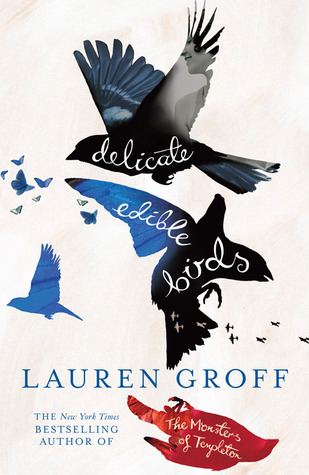 What a clever decision to open with “Lucky Chow Fun,” a story set in Templeton, the location of Groff’s debut novel – it forms a thread of continuity between her first book and her second. Elizabeth, the only girl on the varsity swim team, comes to a number of realizations about her family and her community, including that the title Chinese restaurant is a front for a brothel that exploits trafficked women. The story becomes a wider parable about appearances and suspicion. “In these dark days, there is so much distrust in this town. … You never know quite what to think about people”. And what a brilliant last line: “I like to think it’s a happy ending, though it is the middle that haunts me.”
“L. DeBard and Aliette” recasts in the notorious Héloïse and Abelard romance an Olympic swimmer and a schoolgirl in Spanish flu-plagued New York City. The other seven stories alternate between historical fiction and contemporary, the USA and abroad, first person and third person, speech marks or none. Desire and boundaries, accomplishment and escape, fear and risk are contradictory pulls. While the details have faded for me, I remember that, while I was reading them, each of these stories enveloped me in a particular world – 30 pages seems like the ideal length here to fully explore a set of characters and a situation. If I had to choose a favourite, it would be “Blythe,” about a woman who feels responsible for her alcoholic best friend. (From my birthday book haul last year)
Birds of America by Lorrie Moore (1998)
Life: what an absurd little story it always made.
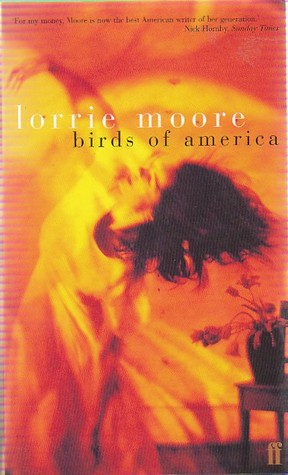 I’d read a few of Moore’s works before (A Gate at the Stairs, Bark, Who Will Run the Frog Hospital?) and not grasped what the fuss is about; turns out I’d just chosen the wrong ones to read. This collection is every bit as good as everyone has been saying for the last 25 years. Amy Bloom, Carol Shields and Helen Simpson are a few other authors who struck me as having a similar tone and themes. Rich with psychological understanding of her characters – many of them women passing from youth to midlife, contemplating or being affected by adultery – and their relationships, the stories are sometimes wry and sometimes wrenching (that setup to “Terrific Mother”!). There were even two dysfunctional-family-at-the-holidays ones (“Charades” and “Four Calling Birds, Three French Hens”) for me to read in December.
I’ll single out four of the 12 as favourites, though, really, any or all would be worthy of anthologizing in a volume epitomizing the art of the short story. “Which Is More than I Can Say about Some People” has a mother and daughter learning new things about each other on a vacation to Ireland. “What You Want to Do Fine,” another road trip narrative, stars an unlikely gay couple, one half of which is the flamboyant (and blind) Quilty. “People Like That Are the Only People Here” is so vivid on the plight of parents with a child in the paediatric oncology ward that I feel I should check whether Moore lived through that too. And the best of the best: “Real Estate” (not least because she dared to print two full pages of laughter: “Ha!”), which turns gently surreal as Ruth and her philandering husband move into a house that turns out to be a wreck, infested by both animal and human pests.
Moore is as great at the sentence level as she is at overarching plots. Here are a few out-of-context lines I saved to go back to:
She was starting to have two speeds: Coma and Hysteria.
In general, people were not road maps. People were not hieroglyphs or books. They were not stories. A person was a collection of accidents. A person was an infinite pile of rocks with things growing underneath.
Never a temple, her body had gone from being a home, to being a house, to being a phone booth, to being a kite. Nothing about it gave her proper shelter.
(From Oxfam Books, Hexham – a stop on our Northumberland trip last year)
Two of these writers are best known for their short stories; the third (Groff), to my mind, should be. Unusual for me to fall so wholeheartedly for short stories – these all earned my rarest rating: 
The 2023 Releases I’ve Read So Far
Some reviewers and book bloggers are constantly reading three to six months ahead of what’s out on the shelves, but I tend to get behind on proof copies and read from the library instead. (Who am I kidding? I’m no influencer.)
In any case, I happen to have read a number of pre-release books, generally for paid review for Foreword, Shelf Awareness, etc. Most of my reviews haven’t been published yet; I’ll give very brief excerpts and ratings here to pique the interest.
Early in January I’ll follow up with my 20 Most Anticipated titles of the coming year.
My top recommendations so far:
(In alphabetical order)
 Shoot the Horses First by Leah Angstman [Feb. 28, Kernpunkt Press]: Sixteen sumptuous historical stories ranging from flash to novella length depict outsiders and pioneers who face disability and prejudice with poise.
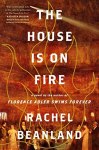 The House Is on Fire by Rachel Beanland [April 4, Simon & Schuster]: Four characters – two men and two women; two white people and two Black slaves – are caught up in the Richmond Theater Fire of 1811. Painstakingly researched and a propulsive read.
 Tell the Rest by Lucy Jane Bledsoe [March 7, Akashic Books]: A high school girl’s basketball coach and a Black poet, both survivors of a conversion therapy camp in Oregon, return to the site of their spiritual abuse, looking for redemption.
 All of Us Together in the End by Matthew Vollmer [April 4, Hub City Press]: A pensive memoir investigates the blinking lights that appeared in his family’s woods soon after his mother’s death from complications of Alzheimer’s and Parkinson’s in 2019.
Other 2023 releases I’ve read:
(In publication date order; links to the few reviews that are already available online)
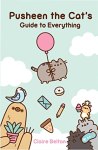 Pusheen the Cat’s Guide to Everything by Claire Belton [Jan. 10, Gallery Books]: Good-natured and whimsical comic scenes delight in the endearing quirks of Pusheen, everyone’s favorite cartoon cat since Garfield. Belton creates a family and pals for her, too.
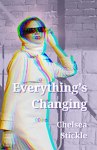 Everything’s Changing by Chelsea Stickle [Jan. 13, Thirty West]: The 20 weird flash fiction stories in this chapbook are like prizes from a claw machine: you never know whether you’ll pluck a drunk raccoon or a red onion the perfect size to replace a broken heart.
 Decade of the Brain by Janine Joseph [Jan. 17, Alice James Books]: With formal variety and thematic intensity, this second collection by the Philippines-born poet ruminates on her protracted recovery from a traumatic car accident and her journey to U.S. citizenship.
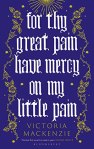 For Thy Great Pain Have Mercy on My Little Pain by Victoria Mackenzie [Jan. 19, Bloomsbury]: Two female medieval mystics, Julian of Norwich and Margery Kempe, are the twin protagonists of Mackenzie’s debut. She allows each to tell her life story through alternating first-person strands that only braid together very late on.
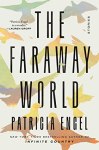 The Faraway World by Patricia Engel [Jan. 24, Simon & Schuster]: These 10 short stories contrast dreams and reality. Money and religion are opposing pulls for Latinx characters as they ponder whether life will be better at home or elsewhere.
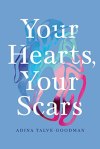 Your Hearts, Your Scars by Adina Talve-Goodman [Jan. 24, Bellevue Literary Press]: The author grew up a daughter of rabbis in St. Louis and had a heart transplant at age 19. This posthumous collection gathers seven poignant autobiographical essays about living joyfully and looking for love in spite of chronic illness.
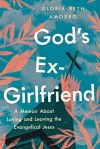 God’s Ex-Girlfriend: A Memoir About Loving and Leaving the Evangelical Jesus by Gloria Beth Amodeo [Feb. 21, Ig Publishing]: In a candid memoir, Amodeo traces how she was drawn into Evangelical Christianity in college before coming to see it as a “common American cult” involving unhealthy relationship dynamics and repressed sexuality.
 Zig-Zag Boy: A Memoir of Madness and Motherhood by Tanya Frank [Feb. 28, W. W. Norton]: A wrenching debut memoir ranges between California and England and draws in metaphors of the natural world as it recounts a decade-long search to help her mentally ill son.
 The Distance from Slaughter County by Steven Moore [March 7, The University of North Carolina Press]: An Iowan now based in Oregon, Moore balances nostalgia and critique to craft nuanced, hypnotic autobiographical essays about growing up in the Midwest. The piece on Shania Twain is a highlight.
Currently reading:
(In release date order)
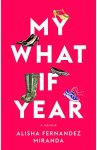 My What If Year: A Memoir by Alisha Fernandez Miranda [Feb. 7, Zibby Books]: “On the cusp of turning forty, Alisha Fernandez Miranda … decides to give herself a break, temporarily pausing her stressful career as the CEO of her own consulting firm … she leaves her home in London to spend one year exploring the dream jobs of her youth.”
 Sea Change by Gina Chung [April 11, Vintage]: “With her best friend pulling away to focus on her upcoming wedding, Ro’s only companion is Dolores, a giant Pacific octopus who also happens to be Ro’s last remaining link to her father, a marine biologist who disappeared while on an expedition when Ro was a teenager.”
Additional pre-release books on my shelf:
(In release date order)

Will you look out for one or more of these?
Any 2023 reads you can recommend already?
This Year’s Pre-Christmas Reading
My household has been struck down by flu Covid this week, so we’ve had to cancel some all of our holiday plans and I haven’t had as much energy or festive good cheer as I would like. This is my favourite time of the blogging year what with everyone’s best-of lists appearing, so I hope that come Boxing Day I will be feeling up for starting my own countdown of superlatives and catching up on everything you all have posted recently.
Two of my recent reads were appropriate Yuletide choices:
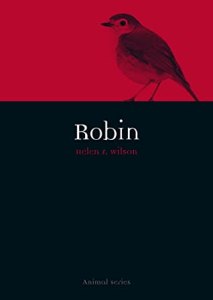 Robin by Helen F. Wilson: The most recent release from the “Animal” series issued by the British indie publisher Reaktion. (I’d previously read Seal.) Wilson introduces the breadth of international bird species that are known by the name “robin.” (The European robin, the protagonist of this monograph, is the only bird in its genus and is not as closely related to the American robin (a thrush) as to the bluebird; the name simply referenced the red breast. There are also magpie-robins in Southeast Asia.) Like another strikingly red bird, the cardinal in North America, the robin has long been associated with a) death and b) Christmas. They might be a portent of death, or an embodiment of the soul of the departed. For instance, the legend has it that a robin spent days in Westminster Abbey while Queen Mary II lay in state. Robins are the UK’s official favourite bird because they look cute and act endearing and sing sweetly, but they are violently territorial. (The old nursery rhyme “Who Killed Cock Robin?” also set up a weird and false vendetta between sparrows and robins.) This was a pleasant wander through biological and cultural information. I particularly loved the photos and other illustrations.
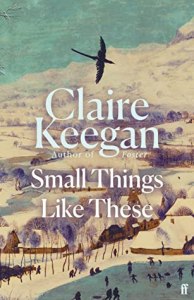 Small Things Like These by Claire Keegan: I read this last year but reread it earlier this month for book club. A year ago, I called it a predictable narrative and thought the evil nuns were a stereotype. This time, Keegan really got me in the feels, just as she had with Foster a couple of months before. The Church-sanctioned abuse that was the Magdalen Laundries must have seemed like a system too big to tackle, but take a look at the title. One good man’s small act of rebellion was a way of standing up to the injustice and saying that these girls were of worth (indeed, this won the Orwell Prize for political fiction). This time around, I was especially impressed by how much Keegan fits into so few pages, including Bill working out who his father was. We also get a strong sense of a man in the middle of his life: privileged enough, happy enough, but wondering if this is all there is to it; if there is something more on offer. Like Foster, this is set in the 1980s but feels timeless, and seems to effortlessly encompass so much of what it means to be human. Absolutely beautiful.


Merry Christmas, all!
Review Catch-up: Lost & Found and Briefly, A Delicious Life
Picador has become one of the most reliable publishers for me, whether it’s fiction or nonfiction. My ever more preposterous backlog won’t be diminishing much before the end of the year, but here are two 2022 Picador releases from my Most Anticipated list that I picked back up recently and enjoyed: a bereavement memoir turned love story, and a historical novel about a real writer–musician pair as observed by a centuries-dead ghost.
Lost & Found: A Memoir by Kathryn Schulz
Schulz is a staff writer for the New Yorker, and her 2010 book Being Wrong was my favourite kind of nonfiction: wide-ranging, erudite and uncategorizable. When I heard she’d written a bereavement memoir, I was beyond eager to read it. Her father, Isaac, was a scholarly and opinionated Polish Jew whose family emigrated from Israel via Germany to the USA in the early 1950s. Schulz grew up in the Cleveland suburbs of Ohio. Her father died at 74 after a decade of poor health. I read part of this book on the transatlantic flight to my mother’s funeral, and found the thoughts on grief so wise and true. “One of the many ways that loss instructs us is by correcting our sense of scale, showing us the world as it really is: so enormous, complex, and mysterious that there is nothing too large to be lost.”

But loss is not the end of this story; it overlaps with and is in some sense superseded by an unexpected romance. Introduced by mutual friends 18 months before her father’s death, Schulz and “C.” (fellow New Yorker writer Casey Cep) quickly fell in love and fashioned a life together on the Eastern Shore of Maryland, despite some significant differences in temperament and background – for instance, C. is a devout Lutheran while Schulz is a largely non-practicing Jew. She manages to braid this together with bereavement: “Love, like grief, has the properties of a fluid: it flows everywhere, fills any container, saturates everything.” My only slight frustration with the book was the amount of generic material on losing and finding and what other thinkers have had to say about these universal experiences – I tended to skip past it to get back to the narrative of her developing relationship with C.
Briefly, A Delicious Life by Nell Stevens
This is Stevens’s third book but her first novel; her previous books (Bleaker House and Mrs Gaskell & Me) were autofiction-ish but have tended to be classified as memoirs. That same playfulness with genre is here, turning what could have been a straightforward biographical novel about George Sand – in the vein of the underwhelming The Dream Lover by Elizabeth Berg – into something cheeky and magical.
George Sand spent the winter of 1838–9 on Mallorca with her children, Solange and Maurice, and her lover, composer Frédéric Chopin. Stevens imagines that the monastery where they stay is still haunted by Blanca, a teenager who died in childbirth (having been impregnated by one of the trainee monks) there in 1473. Sand and Chopin – between them “Godless foreign odd consumptive cross-dressers … strangers and strange and strangely insouciant about their strangeness” – are instantly unpopular with the locals.
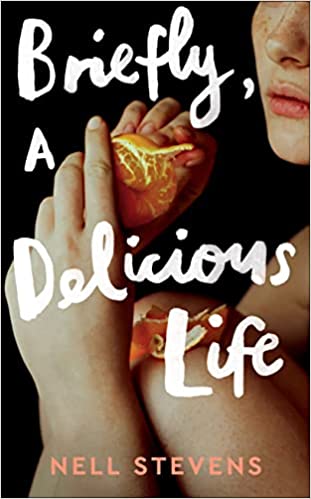
Blanca draws readers along on a tour of own past and George’s. Like any benevolent ghost, she’s a fan of pranks, but also hopes that she might use her power of omniscience to reverse tragic trajectories. A lover of men in her lifetime, she’s now enamoured with women in the hereafter, and outraged at how, even centuries later, women’s rights and desire are still being ignored. This is an earthy, impish, sexy read. Though it starts to wear a little thin before the end, it’s still well worth the ride.
With thanks to Picador for the proof copies for review.
Would you be interested in reading one or both of these? Do you have go-to/favourite publishers?
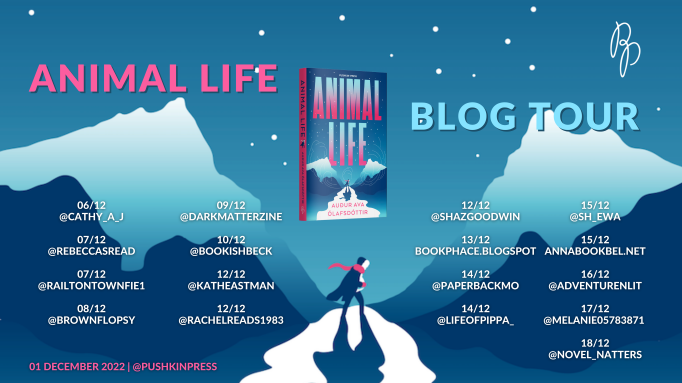
Animal Life by Auður Ava Ólafsdóttir
Icelandic author Auður Ava Ólafsdóttir was familiar to me from Butterflies in November (2013), a whimsical, feminist road trip novel I reviewed for For Books’ Sake. Dómhildur or “Dýja” is, like her grandaunt before her, a midwife – a word that was once voted Iceland’s most beautiful: ljósmóðir combines the words for light and mother, so it connotes “mother of light.” On the other side of the family, Dýja’s relatives are undertakers, a neat setup that sees her clan “handling people at their points of entry and exit.”
 Along with her profession, Dýja inherited her great-aunt’s apartment, nine bottles of sherry, pen pal letters to a Welsh midwife and a box containing several discursive manuscripts of philosophical musings, one of them entitled Animal Life. In fragments from this book within the book, we see how her grandaunt recorded philosophical musings about coincidences and humanity in relation to other species, vacillating between the poetic and the scientific.
As Christmas – and an unprecedented storm prophesied by her meteorologist sister – approaches, Dýja starts to make the apartment less of a mausoleum and more her own home, trading lots of the fusty furniture for a colleague’s help with painting and decorating, and flirting with an Australian tourist who’s staying in the apartment upstairs. Outside of work she has never had much of a personal life, so she’s finally finding a better balance.
I really warmed to the grandaunt character and enjoyed the peppering of her aphorisms. As in novels like The Birth House and A Ghost in the Throat, it feels like this is a female wisdom, somewhat forbidden and witchy. The idea of it being passed down through the generations is appealing. We get less of a sense of Dýja overall, only late on finding that she has her own traumatic backstory. For a first-person narrator, she’s lacking the expected interiority. Mostly, we see her interactions with a random selection of minor characters such as an electrician whose wife is experiencing postpartum depression.
I felt there were a few too many disparate elements here, not all joined but just left on the page as a quirky smorgasbord. Still, it’s fun to try fiction in translation sometimes, especially when it’s of novella length. This also reminded me a bit of Weather and Brood.
Translated by Brian FitzGibbon. With thanks to Pushkin Press for my free copy for review.
I was delighted to be part of the blog tour for Animal Life. See below for details of where other reviews have appeared or will be appearing soon.
Literary Wives Club: State of the Union by Nick Hornby
This was my third read for the Literary Wives online book club. The other members will also be posting their thoughts this week.
Kay at What Me Read
Lynn at Smoke & Mirrors
Naomi at Consumed by Ink
I first read State of the Union nearly three years ago (my original review). Nick Hornby is a reliable author for me; I’ve read almost his entire oeuvre now. This is an enjoyable novella that feels more like a screenplay – it basically is the script for the TV series – and is based around 10 dialogues between Tom and Louise, a couple meeting up at a pub for a drink before each marriage counselling session with Kenyon. Louise is an NHS gerontologist; Tom is an unemployed music journalist. When they stopped having sex, she had an affair. It was a short-lived thing, but it crushed Tom’s self-esteem and he moved out. The fact that one of them voted for Brexit and the other did not is an additional barrier. Though they have two children, we learn basically nothing about them. Tom and Louise talk about their relationship, but also everything else. They speculate about Kenyon’s other clients, and their own future.

The central question we ask about the books we read for Literary Wives is:
What does this book say about wives or about the experience of being a wife?
“How are new starts possible?” Louise says. “When you’ve been together for a long time, and you have kids, and you’ve spent years and years being irritated by the other person?”
I remember finding the book funny, though also on the nose, the first time I read it; this time it seemed more depressing. It could be something about the ebb and flow of all marriages, mine and the fictional one depicted.
What stood out to me most was that the main characters don’t appear to have much in common. They met at a party in their twenties and, when Louise asks if in an alternate life where they didn’t have a sexual connection (and thus, no kids together) they would be friends, they conclude that they wouldn’t. I’ve always thought that, at its heart, a marriage is a friendship. You should truly enjoy each other’s company and have at least a few common interests. Having other friends and separate hobbies is fine, of course, but for the one person you’re going to spend most of your time with to be very different from you strikes me as odd. Opposites attract is all well and good as a basis for lust, but not for a lasting partnership.
Tom and Louise are in danger of ‘staying together for the kids’ – is co-parenting all that’s keeping them together? – unless they rediscover a sexual spark. I’d forgotten the ending of the book. It seems like a fitting one for a TV miniseries and for a comic author.
My original rating (2019):
My rating now:
Next book: His Only Wife by Peace Adzo Medie (March 2023)
 Bookish Beck = Rebecca Foster. American transplant to England. Freelance proofreader and book reviewer.
