For Thy Great Pain… and Ti Amo for #NovNov22
On Friday evening we went to see Aqualung give his first London show in 12 years. (Here’s his lovely new song “November.”) I like travel days because I tend to get loads of reading done on my Kindle, and this was no exception: I read both of the below novellas, plus two-thirds of a poetry collection. Novellas aren’t always quick reads, but these were.
For Thy Great Pain Have Mercy on My Little Pain by Victoria Mackenzie (2023)
 Two female medieval mystics, Julian of Norwich and Margery Kempe, are the twin protagonists of Mackenzie’s debut. She allows each to tell her life story through alternating first-person strands that only braid together very late on when she posits that Margery visited Julian in her cell and took into safekeeping the manuscript of her “shewings.” I finished reading Julian’s Revelations of Divine Love earlier this year and, apart from a couple of biographical details (she lost her husband and baby daughter to an outbreak of plague, and didn’t leave her cell in Norwich for 23 years), this added little to my experience of her work.
I didn’t know Margery’s story, so found her sections a little more interesting. A married mother of 14, she earned scorn for preaching, prophesying and weeping in public. Again and again, she was told to know her place and not dare to speak on behalf of God or question the clergy. She was a bold and passionate woman, and the accusations of heresy were no doubt motivated by a wish to see her humiliated for claiming spiritual authority. But nowadays, we would doubtless question her mental health – likewise for Julian when you learn that her shewings arose from a time of fevered hallucination. If you’re new to these figures, you might be captivated by their bizarre life stories and religious obsession, but I thought the bare telling was somewhat lacking in literary interest. (Read via NetGalley) [176 pages] 
Coming out on January 19th from Bloomsbury.
Ti Amo by Hanne Ørstavik (2020; 2022)
[Translated from the Norwegian by Martin Aitken; Archipelago Books]
 Ørstavik wrote this in the early months of 2020 while she was living in Milan with her husband, Luigi Spagnol, who was her Italian publisher as well as a painter. They had only been together for four years and he’d been ill for half of that. The average life expectancy for someone who had undergone his particular type of pancreatic cancer surgery was 15–20 months; “We’re at fifteen months now.” Indeed, Spagnol would die in June 2020. But Ørstavik writes from that delicate in-between time when the outcome is clear but hasn’t yet arrived:
What’s real is that you’re still here, and at the same time, as if embedded in that, the fact that soon you’re going to die. Often I don’t feel a thing.
She knows, having heard it straight from his doctor’s lips, that her husband is going to die in a matter of months, but he doesn’t know. And now he wants to host a New Year’s Eve party, as is their annual tradition. Ørstavik skips between the present, the couple’s shared past, and an incident from her recent past that she hasn’t yet told anyone else: not long ago, while in Mexico for a literary festival, she fell in love with A., her handler. And while she hasn’t acted on that, beyond a kiss on the cheek, it’s smouldering inside her, a secret from the husband she still loves and can’t bear to hurt. Novels are where she can be most truthful, and she knows the one she needs to write will be healing.
There are many wrenching scenes and moments here, but it’s all delivered in a fairly flat style that left little impression on me. I wonder if I’d appreciate her fiction more. (Read via Edelweiss) [124 pages] 

Miscellaneous Novellas: Jungle Nama, The Magic Pudding, Tree Glee (#NovNov22)
Here’s a random trio of short books I read earlier and haven’t managed to review until now. Novellas in November is a deliberately wide-ranging challenge, taking in almost any genre you care to read – here I have a retold fable, a bizarre children’s classic, and a self-help work celebrating our connection with trees. I’ll do a couple more of these miscellaneous round-ups before the end of the month.
Jungle Nama: A Story of the Sunderban by Amitav Ghosh (2021)
 My first from Ghosh. It’s a retelling in verse of a local Indian legend about Dhona, a greedy merchant who arrives in the mangrove swamps to exploit their resources. To gain wealth he is willing to sacrifice his destitute cousin, Dhukey, to placate Dokkhin Rai, a jungle-dwelling demon that takes the form of a man-eating tiger.
However, Dhukey’s mother, distrustful of their cousin, prepared her son for trouble, telling him that if he calls on the goddess Bon Bibi in dwipodi-poyar (rhyming couplets of 24 syllables), she will rescue him. I loved this idea of poetry itself saving the day.
The legend is told, then, in that very Bengali verse style. The insistence on rhyme sometimes necessitates slightly silly word choices, but the text feels very musical. Beyond the fairly obvious messages of forgiveness—
But you must forgive him, rascal though he is;
to hate forever is to fall into an abyss.
—and not grasping for more than you need—
All you need do, is be content with what you’ve got;
to be always craving more, is a demon’s lot.
—I appreciated the idea of ordered verse replicating, or even creating, the order of nature:
Thus did Bon Bibi create a dispensation,
that brought peace to the beings of the Sundarban;
every creature had a place, every want was met,
all needs were balanced, like the lines of a couplet.
With illustrations by Salman Toor. (Public library) [79 pages]
The Magic Pudding by Norman Lindsay (1918)
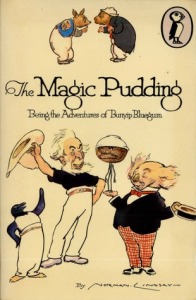 This is one of the stranger books I’ve ever read. I happened to see it on Project Gutenberg and downloaded it pretty much for the title alone, without knowing anything about it. It’s an obscure Australian children’s chapter book peopled largely by talking animals. Bill Barnacle (a human), Bunyip Bluegum (a koala bear) and Sam Sawnoff (a penguin) come into possession of a magical pudding by the name of Albert. Cut into the puddin’ as often as you like for servings of steak and kidney pudding and apple dumpling – or your choice from a limited range of other comforting savoury and sweet dishes – and he simply regenerates.
Naturally, others want to get their hands on this handy source of bounteous food, and the characters have to fend off would-be puddin’-snatchers such as a possum and a wombat and even take their case before a judge. The four chapters are called “Slices,” there are lots of songs reminiscent of Edward Lear, and the dialogue often veers into the farcical:
“‘You can’t wear hats that high, without there’s puddin’s under them,’ said Bill. ‘That’s not puddin’s,’ said the Possum; ‘that’s ventilation. He wears his hat like that to keep his brain cool.’”

I did find it all amusing, but also inane, such that I don’t necessarily think it earns its place as a rediscovered classic. It didn’t help that I then borrowed a copy of the book from the library and found that it was a terribly reproduced “Alpha Editions” version in Comic Sans with distorted illustrations and no line breaks in the songs. (Public library) [169 pages]
Tree Glee: How and Why Trees Make Us Feel Better by Cheryl Rickman (2022)
 This is a small-format coffee table self-help book for nature lovers. It affirms something that many of us know intuitively: being around trees improves our mood and our health. Rickman looks at this from a psychological and a cultural perspective, and talks about her own love of trees and how it helped her get through difficult times in life such as when she lost her mum when she was a teenager. She includes some practical ideas for how to spend more time in nature and how we can fight to preserve trees. Unfortunately, a lot of the information was very familiar to me from books such as Rooted by Lyanda Lynn Haupt and Losing Eden by Lucy Jones – for a long time, forest bathing was one of the themes that kept recurring across my reading – such that this felt like an unnecessary rehashing, illustrated with stock photographs that are nice enough to look at but don’t add anything. [182 pages]
With thanks to Welbeck for the free copy for review.
Letters and Papers from Prison by Dietrich Bonhoeffer (#NovNov22 and #GermanLitMonth)
I’m rounding out our nonfiction week of Novellas in November with a review that also counts towards German Literature Month, hosted by Lizzy Siddal.

Dietrich Bonhoeffer, a German pastor and theologian, was hanged at a Nazi concentration camp in 1945 for his role in the Resistance and in planning a failed 1944 assassination attempt on Adolf Hitler.
 The version I read (a 1959 Fontana reprint of the 1953 SCM Press edition) is certainly only a selection, as Bonhoeffer’s papers from prison in his Collected Works now run to 800 pages. After some letters to his parents, the largest section here is made up of “Letters to a Friend,” who I take it was the book’s editor, Eberhard Bethge, a seminary student of Bonhoeffer’s and his literary executor as well as his nephew by marriage.
Bonhoeffer comes across as steadfast and cheerful. He is grateful for his parents’ care packages, which included his latest philosophy and theology book requests as well as edible treats, and for news of family and acquaintances. To Bethge he expresses concern over the latter’s military service in Italy and delight at his marriage and the birth of a son named Dietrich in his honour. (Among the miscellaneous papers included at the end of this volume are a wedding sermon and thoughts on baptism to tie into those occasions.)
Maintaining a vigorous life of the mind sustained Bonhoeffer through his two years in prison. He downplays the physical challenges of his imprisonment, such as poor food and stifling heat during the summer, acknowledging that the mental toll is more difficult. The rhythm of the Church year is a constant support for him. In his first November there he writes that prison life is like Advent: all one can do is wait and hope. I noted many lines about endurance through suffering and striking a balance between defiance and acceptance:
Resistance and submission are both equally necessary at different times.
It is not some religious act which makes a Christian what he is, but participation in the suffering of God in the life of the world.
not only action, but also suffering is a way to freedom.
Bonhoeffer won over wardens who were happy to smuggle out his letters and papers, most of which have survived apart from a small, late selection that were burned so as not to be incriminating. Any references to the Resistance and the plot to kill Hitler were in code; there are footnotes here to identify them.
The additional non-epistolary material – aphorisms, poems and the abovementioned sermons – is a bit harder going. Although there is plenty of theological content in the letters to Bethge, much of it is comprehensible in context and one could always skip the couple of passages where he goes into more depth.
Reading the foreword and some additional information online gave me an even greater appreciation for Bonhoeffer’s bravery. After a lecture tour of the States in 1939, American friends urged him to stay in the country and not return to Germany. He didn’t take that easier path, nor did he allow a prison guard to help him escape. For as often as he states in his letters the hope that he will be reunited with his parents and friends, he must have known what was coming for him as a vocal opponent of the regime, and he faced it courageously. It blows my mind to think that he died at 39 (my age), and left so much written material behind. His posthumous legacy has been immense.
[Translated from the German by Reginald H. Fuller]
(Free from a fellow church member)
[187 pages]

Two for #NovNov22 and #NonFicNov: Recipe and Shameless
Contrary to my usual habit of leaving new books on the shelf for years before actually reading them, these two are ones I just got as birthday gifts last month. They were great choices from my wish list from my best friend and reflect our mutual interests (foodie lit) and experiences (ex-Evangelicals raised in the Church).
Recipe by Lynn Z. Bloom (2022)
This is part of the Bloomsbury Object Lessons series of short nonfiction works (I’ve only read a few of the other releases, but I’d also recommend Fat by Hanne Blank). Bloom, an esteemed academic based in Connecticut, envisions a recipe as being like a jazz piece: it arises from a clear tradition, yet offers a lot of scope for creativity and improvisation.
A recipe is a paradoxical construct, a set of directions that specify precision but—baking excepted—anticipate latitude. A recipe is an introduction to the logic of a dish, a scaffold bringing order to the often casual process of making it.
A recipe supplies the bridge between hope and fulfilment, for a recipe offers innumerable opportunities to review, revise, adapt, and improve, to make the dish the cook’s and eater’s own.
 She considers the typical recipe template, the spread of international dishes, how particular chefs incorporate stories in their cookbooks, and the role that food plays in celebrations. To illustrate her points, she traces patterns via various go-to recipes: for chicken noodle soup, crepes, green salad, mac and cheese, porridge, and melting-middle chocolate pots.
I most enjoyed the sections on comfort food (“a platterful of stability in a turbulent, ever-changing world beset by traumas and tribulations”) and Thanksgiving – coming up on Thursday for Americans. Best piece of trivia: in 1909, President Taft, known for being a big guy, served a 26-pound opossum as well as a 30-pound turkey for the White House holiday dinner. (Who knew possums came that big?!)
Bloom also has a social conscience: in Chapters 5 and 6, she writes about the issues of food insecurity, and child labour in the chocolate production process. As important as these are to draw attention to, it did feel like these sections take away from the main focus of the book. Recipe also feels like it was hurriedly put together – with more typos than I’m used to seeing in a published work. Still, it was an engaging read. [136 pages] 
Shameless: A Sexual Reformation by Nadia Bolz-Weber (2019)
“Shame is the lie someone told you about yourself.” ~Anaïs Nin
Bolz-Weber, founding Lutheran pastor of House for All Sinners and Saints in Denver, Colorado, was a mainstay on the speaker programme at Greenbelt Festival in the years I attended. Her main arguments here: people matter more than doctrines, sex (like alcohol, food, work, and anything else that can become the object of addiction) is morally neutral, and Evangelical/Religious Right teachings on sexuality are not biblical.
 She believes that purity culture – familiar to any Church kid of my era – did a whole generation a disservice; that teaching young people to view sex as amazing-but-deadly unless you’re a) cis-het and b) married led instead to “a culture of secrecy, hypocrisy, and double standards.”
Purity most often leads to pride or to despair, not to holiness. … Holiness happens when we are integrated as physical, spiritual, sexual, emotional, and political beings.
A number of chapters are built around anecdotes about her parishioners, many of them queer or trans, and about her own life. “The Rocking Chair” is an excellent essay about her experience of pregnancy and parenthood, which includes having an abortion at age 24 before later becoming a mother of two. She knows she would have loved that baby, yet she doesn’t regret her choice at all. She was not ready.
This chapter is followed by an explanation of how abortion became the issue for the political right wing in the USA. Spoiler alert: it had nothing to do with morality; it was all about increasing the voter base. In most Judeo-Christian theology prior to the 1970s, by contrast, it was believed that life started with breath (i.e., at birth, rather than at conception, as the pro-life lobby contends). In other between-chapter asides, she retells the Creation story and proffers an alternative to the Nashville Statement on marriage and gender roles.
Bolz-Weber is a real badass, but it’s not just bravado: she has the scriptures to back it all up. This was a beautiful and freeing book. [198 pages]
Nonfiction November “Stranger than Fiction”: The Boys in the Boat
I’m taking a quick break from novellas coverage but keeping up the nonfiction focus with this week’s Nonfiction November prompt, “Stranger than Fiction,” hosted by Christopher at Plucked from the Stacks: “This week we’re focusing on all the great nonfiction books that almost don’t seem real. A sports biography involving overcoming massive obstacles, a profile on a bizarre scam, a look into the natural wonders in our world—basically, if it makes your jaw drop, you can highlight it for this week’s topic.” I would also interpret this brief to refer to nonfiction that reads as fluently as a novel, and on both counts this book stands out.
The Boys in the Boat: Nine Americans and Their Epic Quest for Gold at the 1936 Berlin Olympics by Daniel James Brown (2013)
We read this for my book club a couple of months ago, on the recommendation of one of our members’ spouses. I was dubious because I don’t read history books, and don’t enjoy playing or watching sports, so a sport + history book sounded like a real snoozefest, but that couldn’t have been further from the truth.

Brown focuses on one of the University of Washington rowers, Joe Rantz, in effect making him the protagonist of a classic underdog story. The college team in general, and Rantz in particular, were unlikely champions. Rantz lost his mother young and, abandoned by his father multiple times, had to make a living by his wits in the Seattle area, sometimes resorting to illegal schemes like poaching and selling liquor during Prohibition, but also logging and working in dam construction. Even among the teammates who became his de facto family, he was bullied for coming from poverty and for his enthusiasm for folksy music. That we come to know and care deeply for Rantz testifies to how well Brown recreates his life story – largely via Rantz’s daughter’s reminiscences, though Brown did meet Rantz before his death.
Another central character is world-renowned boat designer George Pocock, an Englishman who set up shop on the Washington campus. Boatbuilding and rowing both come across as admirable skills involving hard physical labour, scientific precision and an artist’s mind. I was surprised by how much I enjoyed reading about the technical details of woodworking and rowing. Brown emphasizes the psychological as well as the physical challenges of rowing – “mind in boat” is a catchphrase reminding rowers to give their total attention for there to be harmony between teammates. Individual talent is only useful insomuch as it boosts collective performance, and there has to be a perfect balance between speed, power and technique. Often, it means going past the pain barrier: “Competitive rowing is an undertaking of extraordinary beauty preceded by brutal punishment,” as the author sums it up.
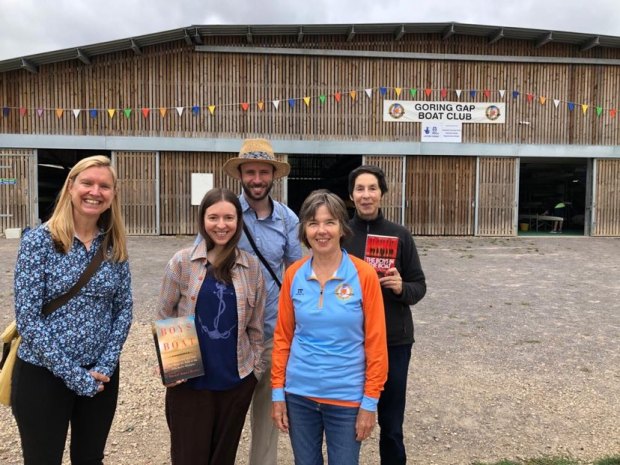
(After reading the book, some of us went on a fieldtrip to see the boating club where the woman who recommended the book rows as an amateur. It wasn’t until I saw the rowers out on the Thames that I realized that only the coxswain – the one who sits at the back of the boat and calls out the orders – faces forward, while all the other rowers are facing backwards. That feels metaphorically significant, like you have to trust where the journey is taking you all together rather than relying on your own sight.)
All along, Brown subtly weaves in the historical background: Depression-era Seattle with its shantytowns, and the rise of Hitler in Germany. Joseph Goebbels and Leni Riefenstahl were key propagandists, whitewashing the city in advance of the Olympics to make a good impression on foreign visitors. Some atrocities had already been committed, and purification policies were in place, yet the Nazis fooled many with a façade of efficiency and cleanliness.
I have deep admiration for books, fiction or non-, that can maintain suspense even though you know the outcome. The pacing really works here. Most of the action is pre-Berlin, which keeps the tension high. (The only times when my attention waned was in the blow-by-blow accounts of preliminary races.) There were so many mishaps associated with the Olympic race that it truly is amazing that the U.S. team pulled through to win – I’ll leave the specifics for future readers to discover. But there are a couple ‘stranger than fiction’ details of the book that I do want to pull out: Joe’s father and brother each married one sister from a set of twins; and actor Hugh Laurie’s father was on the Great Britain rowing team at the 1936 Olympics.
The fires and heatwave of 1936 felt familiar, as did the hairstyles and fashions in the black-and-white photos (but the ‘boys’ themselves look more like 35-year-olds than modern college students). In some ways it seemed that little has changed, but then other facts feel impossibly outdated – e.g., sperm whale oil was used to oil the boats.
This might seem like a ‘dad book’ – indeed, several of us passed the book on to our fathers/-in-law after reading – but in fact it has very broad appeal and is one I’d be likely to recommend to any big readers, even if they’re not keen on nonfiction. It’s one of my most memorable reads of the year so far. And whether you fancy reading the book or not, you may want to look out for the George Clooney-directed film, coming out next year. (Secondhand purchase) 
The Heart of Things by Richard Holloway (#NovNov22 Nonfiction Week)
This was my sixth book by Holloway, a retired Bishop of Edinburgh whose perspective is maybe not what you would expect from a churchman – he focuses on this life and on practical and emotional needs rather than on the supernatural or abstruse points of theology. His recent work, such as Waiting for the Last Bus, also embraces melancholy in a way that many on the more evangelical end of Christianity might deem shamefully negative.
 Being a pessimist myself, though, I find that his outlook resonates. The title of this 2021 release, originally subtitled “An Anthology of Memory and Regret,” comes from Virgil’s Aeneid (“there are tears at the heart of things [sunt lacrimae rerum]”), and that context makes it clearer where he’s coming from. In the same paragraph in which he reveals that source, he defines melancholia as “sorrowing empathy for the constant defeats of the human condition.”
The book is in six thematic essays that plait Holloway’s own thoughts with lengthy quotations, especially from 19th- and 20th-century poetry: Passing – Mourning – Warring – Ruining – Regretting – Forgiving. The war chapter, though appropriate for it having just been Remembrance Day, engaged me the least, while the section on ruin sticks closely to the author’s Glasgow childhood and so seems to offer less universal value than the rest. I most appreciated the first two chapters and the one on regret, which features musings on Nietzsche’s “amor fati” and extended quotes from Borges, Housman and MacNeice.
We melancholics are prone to looking backwards, even when we know it’s not good for us; to dwelling on our losses and failures. The final chapter, then, is key, insisting on self-forgiveness because of the forgiveness modelled by Christ (in whatever way you understand that). Holloway believes in the edifying wisdom of poetry, which he calls “greater than the intention of its makers and [continuing] to reveal new meanings long after they are gone.” He’s created an unusual and pensive collection that will perform the same role.
[147 pages]
With thanks to Canongate for the free copy for review.
#NovNov22 Nonfiction Week Begins! with Strangers on a Pier by Tash Aw
Short nonfiction week of Novellas in November is (not so) secretly my favourite theme of this annual challenge. About 40% of my reading is nonfiction, and I love finding books that illuminate a topic or a slice of life in well under 200 pages. I’ll see if I can review one per day this week.
Back in 2013 I read Tash Aw’s Booker-longlisted Five Star Billionaire and thought it was a fantastic novel about strangers thrown together in contemporary Shanghai. I don’t know why it hadn’t occurred to me to find something else by him in the meantime, but when I spotted this slim volume up in the library’s biography section, I knew it had to come home with me.
 Originally published in the USA as The Face in 2016, this is a brief family memoir reflecting on migration and belonging. Aw was born in Taiwan and grew up in Malaysia in an ethnically Chinese family; wherever he goes, he can pass as any number of Asian ethnicities. Both of his grandfathers were Chinese immigrants to Malaysia, but from different regions and speaking separate dialects. (This is something those of us in the West unfamiliar with China can struggle to understand: it has no monolithic identity or language. The food and culture might vary as much by region as they do in, say, different countries of Europe.)
Aw imagines his ancestors’ arrival and the disorientation they must have known as they made their way to an address on a piece of paper. His family members never spoke about their experiences, but the sense of being an outsider, a minority is something that has recurred through their history. Aw himself felt it keenly as a university student in Britain.
After the first long essay, “The Face,” comes a second, “Swee Ee, or Eternity,” addressed in the second person to his late grandmother, about whom, despite having worked in her shop as a boy, he knew next to nothing before he spent time with her as she was dying of cancer.
When is short nonfiction too short? Well, I feel that what I just read was actually two extended magazine articles rather than a complete book – that I read a couple of stories rather than the whole story. Perhaps that is inevitable for such a short autobiographical work, though I can think of two previous memoirs from last year alone that managed to be comprehensive, self-contained and concise: The Story of My Life by Helen Keller and The Cost of Living by Deborah Levy. (Public library)
[91 pages]
Seven Cats I Have Loved by Anat Levit (Translated by Yardenne Greenspan) for #NovNov22
“Most of the cats I come across must be able to sense right away that I am nothing but a cat in human clothes.”
 This short memoir could have fit next week’s nonfiction focus, but because it is translated from the Hebrew I’ve chosen to use it to round off our literature in translation week. Poet Anat Levit didn’t start off as a cat lady, yet in the year following her divorce she adopted five kittens. The first, Shelly, was a present for her small daughters, Daphna and Shlomit, and then another four fluffballs tempted her at the pet store: Afro, Lady, Mocha and Jesse. Add on Cleo, a beautiful Siamese she bought on impulse from a neighbour, and Mishely, a local stray she started to look after, and there you have it: the seven cats who took over her life.
This is a loose narrative filled with little observations on the differences in her cats’ appetites, mannerisms, and relationships to each other and to the author. As much as she loves them, Levit seems to find the animals a heavy emotional burden: she constantly wonders if she’s doing her best for them, treating them all the same (better than her children?), and so on.
Unfortunately, I felt the most attention is paid to the cats’ various illnesses and vet visits, and especially the periods of decline leading to each one’s death. Pets only live a fraction as long as humans, so books about loving them often incorporate death, and some might argue that it’s an essential part of the story: that your care for an animal companion encompasses their whole life and includes the duty to ease their death. Fair enough. But it can be a downer to read about. So, cat lovers, think carefully about whether you can handle the content; if you’re after sweet anecdotes and antics, this is not that book. Something about either the writing or the translation meant that I found the tone either too matter-of-fact (recounting the physical facts of deterioration) or melodramatic, e.g.,
That evening, it dawned on me that I had to hurry up and release Cleo from the relics of existence that survived in his body. Sometimes, death dawdles for no reason. On the threshold of my cats’ demise, it prescribed the kind of suffering that seemed to have erased the sweetness of all their previous years at once.
– and not often finding a balance. Still, there are some sweet moments that pet owners will appreciate. (A similar read from last year: The Writer’s Cats by Muriel Barbery.)
[133 pages]
With thanks to Serpent’s Tail for the free copy for review.
Fair Play by Tove Jansson (#NovNov22 Translated Week)
Apart from A Winter Book and The Summer Book, I’m still new to Tove Jansson’s writing for adults, having become most familiar with her Moomins series over the last 11 years. This is a late work, first published in 1989 but not available in English translation (by Thomas Teal; published by Sort Of Books, with an introduction by Ali Smith) until 2007.
 Rather like a linked short story collection, it presents vignettes from the lives of two female artists – Mari, a writer and illustrator; and Jonna, a visual artist and filmmaker – who are long-term, devoted partners. Of course, this cannot be read as other than autobiographical of Jansson and her partner of 45 years, Tuulikki Pietilä. There are other specific details drawn from life, too.
What the book does beautifully is recreate the rhythm of life lived alongside another person. The two women have studio space at either end of a large apartment building and meet to watch films (the subject of “Videomania”) and go on trips. Each other’s work is a background hum if no longer a daily keeping-to-task.
Not a lot happens, so not too much stood out; a couple of other favourite stories were “Wladyslaw,” about welcoming a Polish refugee friend, and “In the Great City of Phoenix,” about a stop at an Arizona hotel. The final piece, “The Letter,” however, does present an imminent change: one of the partners is invited on a foreign fellowship and love means a temporary letting go. (Public library)
[127 pages]
I also recently read a forthcoming artistic/biographical study of Tove Jansson for Shelf Awareness, to be released by Thames & Hudson on December 6th. As it is also novella-length, it’s a good link between our literature in translation week and next week’s nonfiction focus. Here’s an excerpt from my review:
Tove Jansson: The Illustrators by Paul Gravett
 This potted biography of the author best known for the Moomins showcases the development of her artistic style and literary themes. Born at the start of World War I into a family of artists (her father a sculptor, her mother a graphic designer, her brother Lars a collaborator on her comics), Jansson wanted to paint but had limited opportunities as a woman. The book contains a wealth of illustrations – over 100, so nearly one per page – including photographs and high-quality reproductions, many in color and some in black and white, of Jansson’s comics, paintings and book covers. Gravett also probes the autobiographical influences on Jansson’s work, which are particularly clear in her 15 books for adults. A sensitive portrayal of Finland’s most widely translated author, this is itself a work of art.
[112 pages]
Three on a Theme: Raven Books for Halloween
It’s been a while since I’ve done a Three on a Theme post (over eight months, in fact). I thought it would be fun to round up a few nonfiction books about ravens that I’ve read over the last year or so – I just finished the Skaife last night.
I tend to associate ravens with Halloween because of Edgar Allan Poe’s eerie poem “The Raven.” In eighth grade English class we had the challenge of memorizing as much of this multi-stanza poem as possible. A friend and I took this very seriously and recited the whole thing, I think (or at least enough to be obnoxious), in front of the class. I can still conjure up big chunks of it in my memory: “Once upon a midnight dreary / while I pondered, weak and weary / over many a quaint and curious volume of forgotten lore…” The rhymes and alliteration make it a real earworm.
The Book of the Raven: Corvids in Art and Legend by Angus Hyland and Caroline Roberts (2021)
 I loved the art, which ranges from the well-known (Van Gogh) to the recent and obscure and includes etchings, paintings and photographs, and wood carvings. The text was less illuminating, relying on some very familiar points of reference like Aesop’s fables, Norse myths, Poe’s “The Raven,” and so on. It’s slightly confusing that the authors decided to lump all corvids together as it suits them, so they include legends and poems associated with crows and magpies as well as ravens.
Most pieces are only one page and have an image facing, as well as at least two pages of wordless spreads between them. There are also shorter quotations embedded in some of the illustrations. Gothic font abounds and there is an overall black, white and red colour scheme. I was glad to be reminded that Charles Dickens’s pet raven, Grip III, was stuffed and is now in display in the Free Library of Philadelphia – that will be a sight to seek out on my next trip there. I also enjoyed learning about Jimmy, a Hollywood raven who appeared in over 1,000 films between 1938 and 1954, including It’s a Wonderful Life. This was a surprise Christmas gift, and a fun enough coffee table read.
A Shadow Above: The Fall and Rise of the Raven by Joe Shute (2018)
 Ravens are freighted with such symbolism that people attribute special significance to their presence or absence. In parts of Britain, they were persecuted to the point of extirpation, but in recent years they have been finding new strongholds everywhere from sea cliffs and abandoned quarries to the New Forest and city centres. Travelling around the country, Shute learns how mythology reflects humans’ historical relationships with the birds and meets with those who hate and shoot ravens (farmers whose lambs and piglets they gang up to kill) as well as those who rehabilitate them or live with them as companions. It’s a balanced and well informed book, if a little by-the-numbers in its approach.
A terrific final paragraph: “Watching the birds dive under the fizzing pylon wires, I also realise just how much we need them close by. To provide us with a glimpse of wildness in a world hell-bent on civilising its furthest reaches, while at the same time inching closer towards the abyss. The raven will always continue to represent our own projections. This modern omen remains as yet ill-defined; our shared futures unresolved.” (Public library)
The Ravenmaster by Christopher Skaife (2018)
A newspaper/magazine feature I enjoy is when a journalist interviews someone with a really random job – you know, like a cat food taste tester or the guy who cleans the Tube tunnels in London or empties the loos after Glastonbury Festival. This memoir was moderately interesting in the same sort of way.
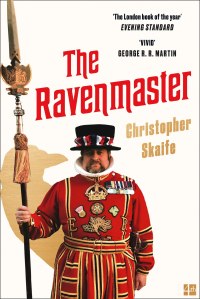 How does one get to be raven keeper at the Tower of London? In Skaife’s case, via the military. He was an indifferent student so joined the Army young and served for 24 years, including as a Drum Major and in Northern Ireland, before becoming a Yeoman Warder. He’s the sixth Ravenmaster (a new title after 1946), in post since 2011. He was always interested in history and as a mature student took a degree in archaeology, so he’s well suited to introducing the Tower to visitors. I appreciated his description of the challenge of making the experience fresh each time even though for him it’s become daily drudgery: “Doing a really great tour is like being a jazz musician: a moment’s improvisation based on a lifetime’s experience.”
Seeing to seven resident ravens’ needs is also repetitive and has to be done in the same way, on time, every day if he doesn’t want revolt – when he once tried to put them to bed in their cages in a different order, Merlina (who also plays dead and engages in hide-and-seek) led him a merry dance and he ended up falling into the moat. He’s sometimes learned the hard way, as when a raven died when it hid in scaffolding and then plunged to the ground – he realized he’d clipped its wings too severely. Other birds have been lost to foxes, so he’s gotten in the habit of feeding foxes in one spot so they’ll stay away from the raven enclosure.
It’s a good-natured, anecdotal book, but didn’t teach me anything I didn’t already know about ravens from various other books; it reports pretty entry-level information on bird intelligence, communication, and representations in popular culture. I most liked hearing about the ravens’ individual personalities and the little mishaps and surprises he’s experienced in dealing with them. But many chapters feel thrown together in an arbitrary order, and Skaife’s writing about his life before the Tower doesn’t add anything. So while I envy him living in such a history-saturated place and would probably like to tour the Tower one day, the book wasn’t the intriguing insider’s account I was looking for. A ghostwriter or extra helping editorial hand wouldn’t have gone amiss, honestly. (A gift from my wish list a couple of Christmases ago)
If you read just one … A Shadow Above by Joe Shute was the stand-out for me.
My next raven-themed read will be: Ravens in Winter by Bernd Heinrich.
 Bookish Beck = Rebecca Foster. American transplant to England. Freelance proofreader and book reviewer.
 Bookish Beck