Books of Summer #18–20: Alan Garner, Peter Matthiessen, Lorrie Moore
I’m sneaking in just in time here, on the very last day of the #20BooksofSummer challenge, with my final three reviews: two novellas, one of them a work of children’s fantasy; and a nature/travel classic that turns into something more like a spiritual memoir.
The Owl Service by Alan Garner (1967)
 I’d heard of Garner, a British writer of classic children’s fantasy novels, but never read any of his work until I picked this up from the free bookshop where I volunteer on a Friday. My husband remembers reading Elidor (also a 1990s TV series) as a boy, but I’m not sure Garner was ever well known in America. Perhaps if I’d discovered this right after the Narnia series when I was a young child, I would have been captivated. I did enjoy the rural Welsh setting, and to start with I was intrigued by the setup: curious about knocking and scratching overhead, Alison and her stepbrother Roger find a complete dinner service up in the attic of this house Alison inherited from her late father. Alison becomes obsessed with tracing out the plates’ owl pattern – which disappears when anyone else, like Nancy the cook, looks at them.
I gather that Garner frequently draws on ancient legend for his plots. Here he takes inspiration from Welsh myths, but the background was so complex and unfamiliar that I could barely follow along. This meant that the climactic ‘spooky’ scenes failed to move me. Instead, I mostly noted the period slang and the class difference between the English children and Gwyn, Nancy’s son, who’s forbidden from speaking Welsh (Nancy says, “I’ve not struggled all these years in Aber to have you talk like a labourer”) and secretly takes elocution lessons to sound less ‘common’.
Can someone recommend a Garner book I might get on with better?
My rating: 
The Snow Leopard by Peter Matthiessen (1978)
 For two months of 1973, from late September to late November, Matthiessen joined zoologist George Schaller on a journey from the Nepalese Himalayas to the Tibetan Plateau to study Himalayan blue sheep. Both also harbored a hope of spotting the elusive snow leopard.
Matthiessen had recently lost his partner, Deborah Love, to cancer, and left their children behind – at residential schools or with family friends – to go on this spirit-healing quest. Though he occasionally feels guilty, especially about the eight-year-old, his thoughts are usually on the practicalities of the mountain trek. They have sherpas to carry their gear, and they stop in at monasteries but also meet ordinary people. More memorable than the human encounters, though, are those with the natural world. Matthiessen watches foxes hunting and griffons soaring overhead; he marvels at alpine birds and flora.
The writing is stunning. No wonder this won a 1979 National Book Award (in the short-lived “Contemporary Thought” category, which has since been replaced by a general nonfiction award). It’s a nature and travel writing classic. However, it took me nearly EIGHTEEN MONTHS to read, in all kinds of fits and starts (see below), because I could rarely read more than part of one daily entry at a time. I struggle with travel narratives in general – perhaps I think it’s unfair to read them faster than the author lived through them? – but there’s also an aphoristic density to the book that requires unhurried, meditative engagement.

The mountains in their monolithic permanence remind the author that he will die. The question of whether he will ever see a snow leopard comes to matter less and less as he uses his Buddhist training to remind himself of tenets of acceptance (“not fatalism but a deep trust in life”) and transience: “In worrying about the future, I despoil the present”; what is this “forever getting-ready-for-life instead of living it each day”? I’m fascinated by Buddhism, but anyone who ponders life’s deep questions should get something out of this.
My rating: 
Who Will Run the Frog Hospital? by Lorrie Moore (1994)
Thanks to Cathy for reminding me about this one – I had intended to make it one of my novellas for November, but as I was scrambling around to find a last couple of short books to make up my 20 I thought, “Frog! hey, that fits”* and picked it up.
 Oddly, given that Moore is so well known for short stories, I’ve only ever read two of her novels (the other was A Gate at the Stairs). Berie Carr lives just over the border from Quebec in Horsehearts, a fictional town in upstate New York. She and her best friend Sils are teenagers at the tail end of the Vietnam War, and work at Storyland amusement park on the weekends and during the summer. When Sils gets into trouble, Berie starts pocketing money from the cash register to help her out, but it will only be so long until she gets caught and the course of her life changes.
Berie is recounting these pivotal events from adulthood, when she’s traveling in Paris with her husband, Daniel. There are some troubling aspects to their relationship that don’t get fully explored, but that seems to be part of the point: we are always works in progress, and never as psychologically well as we try to appear. I most enjoyed the book’s tone of gentle nostalgia: “Despite all my curatorial impulses and training, my priestly harborings and professional, courtly suit of the past, I never knew what to do with all those years of one’s life: trot around in them forever like old boots – or sever them, let them fly free?”
Moore’s voice here reminds me of Amy Bloom’s and Elizabeth McCracken’s, though I’ve generally enjoyed those writers more.
*There are a few literal references to frogs (as well as the understood slang for French people). The title phrase comes from a drawing Sils makes about their mission to find and mend all the swamp frogs that boys shoot with BB guns. Berie also remarks on the sound of a frog chorus, and notes that two decades later frogs seem to be disappearing from the earth. In both these cases frogs are metaphors for a lost innocence. “She has eaten the frog” is also, in French, a slang term for taking from the cash box.
(I can’t resist mentioning Berie and Sils’ usual snack: raw, peeled potatoes cut into quarters and spread with margarine and salt!)
My rating: 
A recap of my 20 Books of Summer:
- I enjoyed my animal theme, which was broad enough to encompass straightforward nature books but also a wide variety of memoirs and fiction. In most cases there was a literal connection between the animal in the title and the book’s subject.
- I read just nine of my original choices, plus two of the back-ups. The rest were a mixture of: books I brought back from America, review copies, books I’d started last year and set aside for ages, and ones I had lying around and had forgotten were relevant.
- I accidentally split the total evenly between fiction and nonfiction: 10 of each.
- I happened to read three novels by Canadian authors. The remainder were your usual British and American suspects.
- The clear stand-out of the 20 was Crow Planet by Lyanda Lynn Haupt, followed closely by The Snow Leopard (see above) and The Seafarers by Stephen Rutt – all nonfiction!
- In my second tier of favorites were three novels: Fifteen Dogs, The Unchangeable Spots of Leopards, and Crow Lake.

I also had three DNFs that I managed to replace in time.
Hollow Kingdom by Kira Jane Buxton [a review copy – and one of my Most Anticipated titles]
(I managed the first 36 pages.) Do you have a friend who’s intimidatingly sharp, whose every spoken or written line leaps from wordplay to a joke to an allusion to a pun? That’s how I felt about Hollow Kingdom. It’s so clever it’s exhausting.
 I wanted to read this because I’d heard it’s narrated by a crow. S.T. (Shit Turd) is an American Crow who lives with an electrician, Big Jim, in Seattle, along with Dennis the dumb bloodhound. One day Jim’s eyeball pops out and he starts acting crazy and spending all his time in the basement. On reconnaissance flights through the neighborhood, S.T. realizes that all the humans (aka “MoFos” or “Hollows”) are similarly deranged. He runs into a gang of zombies when he goes to the Walgreens pharmacy to loot medications. Some are even starting to eat their pets. (Uh oh.)
We get brief introductions to other animal narrators, including Winnie the Poodle and Genghis Cat. An Internet-like “Aura” allows animals of various species to communicate with each other about the crisis. I struggle with dystopian and zombie stuff, but I think I could make an exception for this. Although I do think it’s overwritten (one adverb and four adjectives in one sentence: “We left slowly to the gentle song of lugubrious paw pads and the viscous beat of crestfallen wings”), I’ll try it again someday.
 Gould’s Book of Fish: A Novel in Twelve Fish by Richard Flanagan: I read the first 164 pages last year before stalling; alas, I could make no more headway this summer. It’s an amusing historical pastiche in the voice of a notorious forger and counterfeiter who’s sentenced to 14 years in Van Diemen’s Land. I could bear only so much of this wordy brilliance, and no more.
 Tisala by Richard Seward Newton: I guess I read the blurb and thought this was unmissable, but I should have tried to read a sample or some more reviews of it. I got to page 6 and found it so undistinguished and overblown that I couldn’t imagine reading another 560+ pages about a whale.
For next year, I’m toying with the idea of a food and drink theme. Once again, this would include fiction and nonfiction that is specifically about food but also slightly more cheaty selections that happen to have the word “eats” or “ate” or a potential foodstuff in the title, or have an author whose name brings food to mind. I perused my shelf and found exactly 20 suitable books, so that seems like a sign! (The eagle-eyed among you may note that two of these were on my piles of potential reads for this summer, and two others on last summer’s. When will they ever actually get read?!)
Alternatively, I could just let myself have completely free choice from my shelves. My only non-negotiable criterion is that all 20 books must be ones that I own, to force me to get through more from my shelves (even if that includes review copies).


How did you fare with your summer reading?
September Recommendations: Boyer, Doughty, Jamie, Patchett
For this second half of the year I chose just 15 of the new releases I was most excited about. Limiting myself in that way has been helpful for focusing the mind: I’ve already read six of my most anticipated books, I’m currently reading another, and I have several more awaiting me. Had I chosen 30 or more titles, I would likely be feeling overwhelmed by now, but as it is I have a good chance of actually getting to all these books before the end of the year. These September releases, while very different – their topics range from cancer and dead bodies to archaeological digs and family inheritance – all lived up to my expectations: 
The Undying: Pain, Vulnerability, Mortality, Medicine, Art, Time, Dreams, Data, Exhaustion, Cancer, and Care by Anne Boyer
(Coming from Farrar, Straus and Giroux [USA] on the 17th and Allen Lane [UK] on October 3rd)
In 2014, Boyer, then a 41-year-old poet and professor at the Kansas City Art Institute (and a single mother) was diagnosed with triple-negative breast cancer. The book’s subtitle gives you clues to the sort of practical and emotional territory that’s covered here. Although she survived this highly aggressive cancer, she was not unscathed: the chemotherapy she had is so toxic it leads to lasting nerve damage and a brain fog that hasn’t completely lifted.
 All the more impressive, then, that Boyer has been able to put together this ferociously intellectual response to American cancer culture. Her frame of reference ranges from ancient Greece – Aelius Aristides, who lived in a temple, hoping the gods would reveal the cure to his wasting illness via dreams, becomes an offbeat hero for her – to recent breast cancer vloggers. She is scathing on vapid pink-ribbon cheerleading that doesn’t substantially improve breast cancer patients’ lives, and on profit-making healthcare schemes that inevitably discriminate against poor women of color and send people home from the hospital within a day or two of a double mastectomy. Through her own experience, she reflects on the pressure women are under to be brave, to be optimistic, to go to work as normal, and to look as beautiful as ever when they are in excruciating pain and beyond exhaustion.
Impossible to avoid comparisons to Susan Sontag’s Illness as Metaphor, but this book has a personal power I don’t remember finding in Sontag’s more detached, academic-level work. Boyer sees herself as one in a long lineage of women writing about their cancer – from Fanny Burney to Audre Lorde – and probes the limits of language when describing pain. I was reminded of another terrific, adjacent book from this year, Constellations by Sinéad Gleeson, especially where Boyer describes her imagined 10-part pain scale (Gleeson has a set of 20 poems based on the McGill Pain Index).
I could quote excellent passages all day, but here are a few that stood out to me:
“People with breast cancer are supposed to be ourselves as we were before, but also better and stronger and at the same time heart-wrenchingly worse. We are supposed to keep our unhappiness to ourselves but donate our courage to everyone.”
“The moral failure of breast cancer is not in the people who die: it is in the world that makes them sick, bankrupts them for a cure that also makes them sick, then blames them for their own deaths.”
“If suffering is like a poem, I want mine to be lurid, righteous, and goth.”
My thanks to FSG for the proof copy for review.
Will My Cat Eat My Eyeballs?: Big Questions from Tiny Mortals about Death by Caitlin Doughty
(Coming from W.W. Norton [USA] on the 10th and W&N [UK] on the 19th)
 This is the third book by the millennial mortician, and I’ve taken perverse glee in reading them all. Smoke Gets in Your Eyes explains cremation and combats misconceptions about death; From Here to Eternity surveys death rituals from around the world. This new book seems to be aimed at (morbid) children, but for me it was more like one of those New Scientist books (Why Don’t Penguins’ Feet Freeze?) or Why Do Men Have Nipples?
Some of the questions are more serious than others, but with her usual punning wit and pop culture references Doughty gives biologically sound answers to them all. For instance, she explains what might happen to a corpse in space, why the hair and fingernails of a cadaver appear to keep growing, and why the quantity of ashes from a cremation is about the same no matter the dead person’s girth (all the fat burns away; what would make your ashes weigh more is being taller and thus having longer bones). I was most interested in the chapter on why conjoined twins generally die at roughly the same time.
 Doughty also discusses laws relating to the dead, such as “abuse of corpse” regulations and whether or not deaths at a property have to be reported to potential buyers (it depends on what state or country you live in); and what happens in countries that are literally running out of space for burials. In highly population-dense places like Singapore, but also in countries such as Germany, one is considered to ‘rent’ grave space, which is then recycled after 15 years and the previous set of remains cremated. Or graves might get stacked vertically.
This is good fun, and features lots of cartoonishly gruesome black-and-white illustrations by Dianné Ruz. If you’ve got a particularly curious niece or nephew who might appreciate a dark sense of humor, this would make a good Christmas gift for one who is an older child or young teen.
My thanks to W&N for the free copy for review.
Surfacing by Kathleen Jamie
(Coming from Sort Of Books [UK] on the 19th and Penguin Books [USA] on the 24th)
I’m a big fan of Kathleen Jamie’s work, prose and poetry. Like her two previous essay collections, Sightlines and Findings, both of which I read in 2012, this fuses autobiography with nature and travel writing – two genres that are too often dominated by males. Jamie has a particular interest in birds, islands, archaeology and the oddities of the human body, all subjects that intrigue me, too.
 The bulk of Surfacing is given over to three long pieces set in Alaska, Orkney and Tibet. She was drawn to Quinhagak, Alaska, a village that’s about the farthest you can go before crossing the Bering Sea into Russia, by her fascination with the whaling artifacts found along the UK’s east coast. Here she helped out on a summer archaeological dig and learned about the language and culture of the Yup’ik people. Alarmingly, the ground here should have been frozen most of the way to the surface, forcing the crew to wear thermals; instead, the ice was a half-meter down, and Jamie found that she never needed her cold-weather gear.
On Westray, Orkney (hey, I’ve been there!), there was also evidence of environmental degradation in the form of rapid erosion. This Neolithic site, comparable to the better-known Skara Brae, leads Jamie to think about deep time and whether we’re actually much better off than people in the Bronze Age were. Prehistory fits the zeitgeist, as seen in two entries from the recent Wainwright Prize shortlist: Time Song by Julia Blackburn and Underland by Robert Macfarlane. It’s a necessary corrective to the kind of short-term thinking that has gotten us into environmental crisis.
A cancer biopsy coincides with a dream memory of being bitten by a Tibetan dog, prompting Jamie to get out her notebook from a trip to China/Tibet some 30 years ago. Xiahe was technically in China but ethnically and culturally Tibetan, and so the best they could manage at that time since Tibet was closed to foreigners. There’s an amazing amount of detail in this essay given how much time has passed, but her photos as well as her notebook must have helped with the reconstruction.
The depth and engagement of the long essays are admirable, yet I often connected more with the few-page pieces on experiencing a cave, spotting an eagle or getting lost in a forest. Jamie has made the interesting choice of delivering a lot of the memoir fragments in the second person. My favorite piece of all is “Elders,” which in just five pages charts her father’s decline and death and marks her own passage into unknown territory: grown children and no parents; what might her life look like now?
There is beautiful nature writing to be found in this volume, as you might expect, but also relatable words on the human condition:
What are you doing here anyway, in the woods? … You wanted to think about all the horror. The everyday news … No, not to think about it exactly but consider what to do with the weight of it all, the knowing … You are not lost, just melodramatic. The path is at your feet, see? Now carry on.
My thanks to Sort Of Books for the free copy for review.
The Dutch House by Ann Patchett
(Coming from Bloomsbury [UK] and Harper [USA] on the 24th)
Maeve and Danny Conroy are an inseparable brother-and-sister pair. Their mother left when Danny was little, so his older sister played a maternal role, too. And when their father dies, they become like Hansel and Gretel (or Cinderella and her little brother): cast out into the wilds by an evil stepmother who takes possession of the only home they’ve ever known, a suburban Philadelphia mansion built on the proceeds of the VanHoebeeks’ cigarette empire.
 It’s interesting to see Patchett take on a male perspective in this novel; she does it utterly convincingly. I also loved the medical threads running through: Maeve is diagnosed with diabetes as a teenager, and Danny spends many years in medical training even though his only ambition is to follow in his father’s footsteps as a property developer. There was a stretch in the middle of the book – something like 46% to 58% – when I was really bored with Danny’s dithering (‘but I don’t want to be a doctor … but I don’t want to marry Celeste’), and the chronology is unnecessarily complicated by flashbacks, though this is, I think, meant to convey Danny’s desultory composition of his memoirs.
In the end I didn’t like this quite as much as Commonwealth, but it’s a memorable exploration of family secrets and memories. As the decades pass you see how what happened to Maeve and Danny has been turned into myth: a story they repeat to themselves about how they were usurped, until this narrative has more power than the reality. Readers, meanwhile, are invited to question the people and places we base our security on, and to imagine what it would mean to forgive and forget and start living in a different way.
Patchett is always so good on the psychology of complicated families, and her sharp prose never fails to hit the nail on the head. The Goldfinch comes to mind as a readalike – not least because of the significance of a piece of art: the cover depicts a painting made of Maeve when she was 10 – as well as Nick Hornby’s How to Be Good.
I read an electronic proof copy via Edelweiss.
Have you read any September releases that you would recommend? Which of these tempt you?
20 Books of Summer, #16–17: Classics by R.L. Stevenson and N. West
Doing double duty this month as my classics and two of my last few animal-themed summer reading choices are a record of a trek in France and a sleazy novella set in 1930s Hollywood.
Travels with a Donkey in the Cévennes by Robert Louis Stevenson (1879)
 I think I decided this was a must-read because I so love Christopher Rush’s recreation of the journey in To Travel Hopefully. The problem with the original is that there doesn’t seem to have been any particular reason for walking 120 miles in 12 days with a donkey as one’s pack animal and traveling companion. “I have been after an adventure all my life, a pure dispassionate adventurer, such as befell early and heroic voyagers,” Stevenson writes, but of all the options before him this must surely have been one of the safer choices.
As autumn comes on, Stevenson keeps being mistaken for a peddler and meeting religious extremists of various stripes, from Trappist monks to a Plymouth Brother. He stays in shared inn rooms or sleeps outdoors. He learns about the history of religious wars and martyrdom in the region. It’s the sort of material that might have inspired Guy Stagg in writing The Crossway, his account of a secular pilgrimage from Canterbury to Jerusalem. But it’s, for the most part, awfully boring. Rush at least had a good reason for undertaking his journey: after his wife’s death from breast cancer he needed a quest to take his mind off his grief.
But anyway, the donkey. Stevenson buys Modestine for 65 francs and she quickly proves to be a typical stubborn-as creature. Passersby encourage him to find an effective goad and show the beast who’s in charge.
They told me when I left, and I was ready to believe it, that before a few days I should come to love Modestine like a dog. Three days had passed, we had shared some misadventures, and my heart was still as cold as a potato towards my beast of burden. She was pretty enough to look at; but then she had given proof of dead stupidity
Between the early entries and the final ones, though, she is mostly invisible. And, regretfully, Stevenson then has to sell the poor beast again – and for only 35 francs with her saddle. That represents quite a financial loss after less than two weeks!
Ultimately, I prefer reading about Stevenson to reading his actual work. (Other examples: Nancy Horan’s novel Under the Wide and Starry Sky; the chapter of Richard Holmes’s Footsteps: Adventures of a Romantic Biographer in which he recreates the Cévennes trek.) My next Stevenson-themed reading will be The Lighthouse Stevensons by Bella Bathurst.
A lovely line: “to love is the great amulet which makes the world a garden”
Wigtown gets a random mention! As he’s musing on the controversial religious history of the area: “If you met a mixed company in the King’s Arms at Wigton, it is not likely that the talk would run on Covenanters.”
(The e-book is available as a free download from Project Gutenberg, though I read a secondhand copy I’d had for ages.)
See also Kaggsy’s review: it’s more positive and includes helpful background information.
My rating:
The Day of the Locust by Nathanael West (1939)
Boy oh boy, this is one weird and sordid little book. Like The Great Gatsby, which had been published 14 years before, it shows the seamy underbelly of a glittering American city. Here the setting is Hollywood, where Tod Hackett is a set and costume designer. He’s smitten with his neighbor, Faye Greener, a 17-year-old aspiring actress (“taut and vibrant … shiny as a new spoon”) who’s not above taking a few shifts at the brothel to make ends meet.
 Tod is not the only one obsessed with Faye, though; her other suitors include Homer Simpson (so hard to take him seriously because of that name!), a sad sack from Iowa who moved to the California desert for his respiratory health; Earle Shoop the cowboy; and Miguel, a Mexican cock-fighter. Comic relief is provided by Abe Kusich, a gambling dwarf whose slang includes “lard-ass” and “punkola.” The novella opens and ends with mob scenes, but while the first takes place on a studio lot the last is dangerously real.
There are some fairly disturbing elements here. The casual racism is probably to be expected, but the violence of Tod’s fantasies about Faye startled me: “If only he had the courage to wait for her some night and hit her with a bottle and rape her.” But like Daisy Buchanan in Gatsby, Faye is the sort of careless person who will always come out on top – “Nothing could hurt her. She was like a cork.”
West portrays Hollywood as a wasteland of broken dreams: “the dump grew continually, for there wasn’t a dream afloat somewhere which wouldn’t sooner or later turn upon it, having first been made photographic by plaster, canvas, lath, and paint.” This was his final work before he died in a car accident in 1940. I got more out of Miss Lonelyhearts, but I’m still glad I read this Wigtown purchase. I have no idea what the title refers to, though it sounds like it might be a biblical reference.
My rating: 
I’m still plugging away at my last few #20BooksofSummer and plan to write them up for the last day, September 3rd.
20 Books of Summer, #14–15: Mary Lawson and Stephen Moss
Approaching the home straight with these two: another novel that happens to have an animal in the title, and a pleasant work of modern nature writing set in an English village. My rating for both:
Crow Lake by Mary Lawson (2002)
I’ve meant to read more by Lawson ever since I reviewed her latest book, Road Ends, for Nudge in May 2015. All three of her novels draw on the same fictional setting: Struan, Ontario. Lawson grew up in a similar Canadian farming community before moving to England in the late 1960s. After an invitation arrives for her nephew’s birthday party, narrator Kate Morrison looks 20 years into the past to remember the climactic events of the year that she was seven. When she and her siblings were suddenly orphaned, her teenage brothers, Luke and Matt, had to cobble together local employment that allowed them to look after their little sisters at home. With the help of relatives and neighbors, they kept their family of four together. All along, though, their lives were becoming increasingly entwined with those of the Pyes, a troubled local farming family.
 Matt inspired Kate’s love of pond life – she’s now an assistant professor of invertebrate ecology – but never got to go to college himself. Theirs was a family that prized schooling above all else (legend has it that Great-Grandmother installed a book rest on her spinning wheel so she could read while her hands were busy*) and eschewed emotion. “It was the Eleventh Commandment,” Kate recalls: “Thou Shalt Not Emote.”
This is a slow burner for sure, but it’s a winning picture of a family that stuck together despite the odds, as well as an appeal to recognize that emotional intelligence is just as important as book learning. The novel reminded me a lot of Surfacing by Margaret Atwood and The Girls by Lori Lansens, and I’d also recommend it to readers of Elizabeth Hay and Jane Urquhart.
*Delightfully, this detail was autobiographical for Lawson.
Wild Hares and Hummingbirds: The Natural History of an English Village by Stephen Moss (2011)
 England doesn’t have any hummingbirds, but it does have hummingbird hawkmoths, which explains the title. In the tradition of Gilbert White, Moss writes a month-by-month tribute to what he regularly sees on his home turf of Mark, Somerset. As I did with Mark Cocker’s Claxton, I picked up the book partway – at the month in which I started reading it – and when I reached the end, returned to the beginning and read up to my starting point. Controversial, I know, but that July to June timeline worked fine: it gave me familiar glimpses of what’s going on with English nature now, followed by an accelerated preview of what I have to look forward to in the coming months.
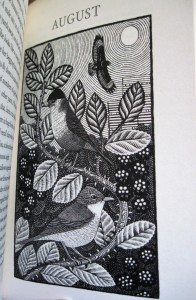 Moss is primarily a birder, so he focuses on bird life, but also notes what’s happening with weather, trees, fungi, and so on. In the central and probably best chapter, on June, he maximizes wildlife-watching opportunities: going eel fishing, running a moth trap, listening for bats, and looking out for unfamiliar plants. My minor annoyances with the book were the too-frequent references to “the parish,” which makes the book’s concerns seem parochial rather than microcosmic, and the common use of semicolons where commas and dashes would be preferable. But if you’re fond of modern nature writing, and have some familiarity with (or at least interest in) the English countryside, I highly recommend this as a peaceful, observant read. Plus, Harry Brockway’s black-and-white engravings heading each chapter are exquisite.
Favorite lines:
“Being in one place is also the best way to understand the passing of the seasons: not the great shifts between winter and spring, summer and autumn, which we all notice; but the tiny, subtle changes that occur almost imperceptibly, from week to week, and day to day, throughout the year.”
“For me, one of the greatest pleasures of living in the English countryside is the way we ourselves become part of the natural cycle of the seasons.”
This Year’s Summer-Themed Reading: Lippman, Lively, Nicholls & More
Sun, warmth and rival feelings of endlessness and evanescence: here were three reads that were perfect fits for the summer setting.
Sunburn by Laura Lippman (2018)
 While on a beach vacation in 1995, a woman walks away from her husband and daughter and into a new life as an unattached waitress in Belleville, Delaware. Polly has been known by many names, and this isn’t the first time she’s left a family and started over. She’s the (literal) femme fatale of this film noir-inspired piece, as bound by her secrets as is Adam Bosk, the investigator sent to trail her. He takes a job as a chef at the diner where Polly works, and falls in love with her even though he may never fully trust her. Insurance scams and arson emerge as major themes.
I liked the fact that I recognized many of the Maryland/Delaware settings, and that the setup is a tip of the hat to Anne Tyler’s excellent Ladder of Years, which was published in the year this is set. It is a quick and enjoyable summer read that surprised me with its ending, but I generally don’t find mysteries a particularly worthwhile use of my reading time. Put it down to personal taste and/or literary snobbery.
Heat Wave by Penelope Lively (1996)
 My fourth Lively book, and the most enjoyable thus far. Pauline, a freelance copyeditor (“Putting commas into a novel about unicorns”) in her fifties, has escaped from London to spend a hot summer at World’s End, the Midlands holiday cottage complex she shares with her daughter Teresa, Teresa’s husband Maurice, and their baby son Luke. Maurice is writing a history of English tourism and regularly goes back to London for meetings or receives visits from his publishers, James and Carol. Pauline, divorced from a philandering husband, recognizes the signs of Maurice’s adultery long before Teresa does, and uneasily ponders how much to hint and how much to say outright.
The last line of the first chapter coyly promises an “agreeable summer of industry and companionship,” but the increasing atmospheric threats (drought or storms; combine harvesters coming ever nearer) match the tensions in the household. I expected this to be one of those subtle relationship studies where ultimately nothing happens. That’s not the case, though; if you’ve been paying good attention to the foreshadowing you’ll see that the ending has been on the cards.
I loved the city versus country setup of the novel, especially the almost Van Gogh-like descriptions of the blue sky and the golden wheat, and recognized myself in Pauline’s freelancer routines. Her friendships with bookseller Hugh and her client, novelist Chris Rogers, might be inconsequential to the plot but give Pauline a life wider than the confines of the cottage, and the frequent flashbacks to her marriage to Harry show what she had to overcome to earn a life of her own.
This was a compulsive read that was perfect for reading during the hottest week of our English summer. I’d recommend it to fans of Tessa Hadley, Susan Hill and Polly Sansom.
Sweet Sorrow by David Nicholls (2019)
 The title is a snippet from Romeo and Juliet, which provides the setup and subject matter for this novel about first love during the golden summer of 1997, when Charlie Lewis and Fran Fisher are 16. Charlie thinks he’s way too cool for the thespians, but if he wants to keep seeing Fran he has to join the Full Fathom Five Theatre Co-operative for the five weeks of rehearsals leading up to performances. Besides, he doesn’t have anything better to do – besides watching his dad get drunk on the couch and scamming the petrol station where he works nights. Charlie starts off as the most robotic Benvolio imaginable, but Fran helps bring him up to scratch with her private tutoring (which is literal as well as a euphemism).
Glimpses of the present day are an opportunity for nostalgia and regret, as Charlie/Nicholls coyly insists that first love means nothing: “love is boring. Love is familiar and commonplace for anyone not taking part, and first love is just a gangling, glandular incarnation of the same. … first love wasn’t real love anyway, just a fraught and feverish, juvenile imitation of it.” I enjoyed the teenage boy perspective and the theatre company shenanigans well enough, but was bored with the endless back story about Charlie’s family: his father’s record shops went bankrupt; his mother left him for another golf club colleague and took his sister; he and his depressed father are slobby roommates subsisting on takeaways and booze; blah blah blah.
It’s possible that had I read or seen R&J more recently, I would have spotted some clever parallels. Honestly? I’d cut 100+ pages (it should really be closer to 300 pages than 400) and repackage this as YA fiction. If you’re looking for lite summer fare reminiscent of Rachel Joyce and, yes, One Day, this will slip down easily, but I feel like I need to get better about curating my library stack and weeding out new releases that will be readable but forgettable. I really liked Us, which explains why I was willing to take another chance on Nicholls.
Note: There is a pretty bad anachronism here: a reference to watching The Matrix, which wasn’t released until 1999 (p. 113, “Cinnamon” chapter). Also a reference to Hobby Lobby, which as far as I know doesn’t exist in the UK (here it’s Hobbycraft) (p. 205, “Masks” chapter). I guess someone jumped the gun trying to get this ready for its U.S. release.
Favorite summery passage: “This summer’s a bastard, isn’t it? Sun comes out, sky’s blue if you’re lucky and suddenly there are all these preconceived ideas of what you should be doing, lying on a beach or jumping off a rope swing into the river or having a picnic with all your amazing mates, sitting on a blanket in a meadow and eating strawberries and laughing in that mad way, like in the adverts. It’s never like that, it’s just six weeks of feeling like you’re in the wrong place … and you’re missing out. That’s why summer’s so sad – because you’re meant to be so happy. Personally, I can’t wait to get my tights back on, turn the central heating up. At least in winter you’re allowed to be miserable” (Fran)
Plus a couple of skims:
The Sun Does Shine: How I Found Life and Freedom on Death Row by Anthony Ray Hinton with Lara Love Hardin (2018)
 I’d heard about Hinton’s case: he spent nearly 30 years on death row in Alabama for crimes he didn’t commit. In 1985 he was convicted of two counts of robbery and murder, even though he’d been working in a locked warehouse 15 miles away at the time the restaurant managers were shot. His mother’s gun served as the chief piece of evidence, even though it didn’t match the bullets found at the crime scenes. “My only crime was … being born black in Alabama,” Hinton concludes. He was a convenient fall guy, and his every appeal failed until Bryan Stevenson of the Equal Justice Initiative (and author of Just Mercy, which I’d like to read) took on his case.
It took another 16 years and an appeal to the U.S. Supreme Court, but Hinton was finally released and now speaks out whenever he can about justice for those on death row, guilty or innocent. Almost the most heartbreaking thing about the book is that his mother, who kept the faith for so many years, died in 2012 and didn’t get to see her son walk free. I love the role that literature played: Hinton started a prison book club in which the men read Go Tell It on the Mountain and To Kill a Mockingbird and discussed issues of race and injustice. Although he doesn’t say very much about his life post-prison, I did note how big of an adjustment 30 years’ worth of technology was for him.
I don’t set a lot of stock by ghostwritten or co-written books, and found the story much more interesting than the writing here (though Hardin does a fine job of recreating the way a black man from the South speaks), so I just skimmed the book for the basics. I was impressed by how Hinton avoided bitterness and, from the very beginning, chose to forgive those who falsely accused him and worked to keep him in prison. “I was afraid every single day on death row. And I also found a way to find joy every single day. I learned that fear and joy are both a choice.” The book ends with a sobering list of all those currently on death row in the United States: single-spaced, in three columns, it fills nine pages. Lord, have mercy.
The Last Supper: A Summer in Italy by Rachel Cusk (2009)
 Having moved away from Bristol, Cusk and her family (a husband and two children) decided to spend a summer in Italy before deciding where to go next. They took the boat to France then drove, made a stop in Lucca, and settled into a rented house on the eastern edge of Tuscany. It proceeded to rain for 10 days. Cusk learns to speak the vernacular of football and Catholicism – but Italian eludes her: “I too feel humbled, feel childlike and impotent. It is hard to feel so primitive, so stupid.” They glory in the food, elemental and unpretentious; they try a whole spectrum of gelato flavors. And they experience as much culture as they can: “we will learn to fillet an Italian city of its artworks with the ruthless efficiency of an English aristocrat de-boning a Dover sole.” A number of these masterpieces are reproduced in the text in black and white. In the grip of a heatwave, they move on to Rome, Naples and Capri.
If I’d been able to get hold of this for my trip to Milan (it was on loan at the time), I might have enjoyed it enough to read the whole thing. As it is, I just had a quick skim through. Cusk can write evocatively when she wishes to (“We came here over the white Apuan mountains, leaving behind the rose-coloured light of the coast … up and up into regions of dazzling ferocity where we wound among deathly white peaks scarred with marble quarries, along glittering chasms where the road fell away into nothingness and we clung to our seats in terror”), but more often resorts to flat descriptions of where they went and what they did. I’m pretty sure Transit was a one-off and I’ll never warm to another Cusk book.
DNFs: Alas, One Summer: America, 1927 by Bill Bryson and The Go-Between by L. P. Hartley were total non-starters. Maybe some other day (make that year).
See also my 2017 and 2018 “summer” reads, all linked by the season appearing in the title.
Have you read any summer-appropriate books lately?
20 Books of Summer, #11–13: Harrison, Pym, Russell
It’s cats and butterflies in the spotlight this time, adding in a gazelle as a metaphor for Freddie Mercury’s somebody to love.
Travelling Cat: A Journey round Britain with Pugwash by Frederick Harrison (1988)
If Tom Cox had been born 20 years earlier, this is the sort of book he might have written. In 1987, saddened more by his cat Podey being run over than by the end of his marriage, Harrison set out from South London in his Ford Transit van for a seven-month drive around the country. He decided to take Pugwash, one of his local (presumably ownerless) cats, along as a companion.
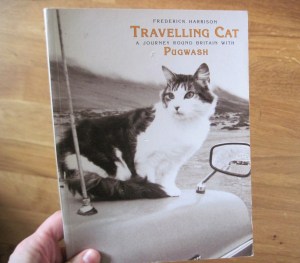 They encountered Morris dancers, gypsies, hippies at Stonehenge for the Summer Solstice, sisters having a double wedding, and magic mushroom collectors. They went to a county fair and beaches in Suffolk and East Yorkshire, and briefly to Hay-on-Wye. And on the way back they collected Podey, whom he’d had stuffed. Harrison muses on the English “vice” of nostalgia for a past that probably never existed; Pugwash does what cats do, and very well.
It’s all a bit silly and dated and lightweight, but enjoyable nonetheless. Plus there are tons of black-and-white photos of “Pugs” and other feline friends. This was a secondhand purchase from The Bookshop, Wigtown.
Favorite lines:
“Cats hate to make prats of themselves. But then, don’t we all?”
(last lines) “Warm, fed, contented, unemployable, and entirely at peace with the world. Yes indeed. Cats certainly know something we don’t.”
Some Tame Gazelle by Barbara Pym (1950)
(An example of a book that just happens to have an animal in the title.) I’d only read one other Pym novel, Quartet in Autumn, a late and fairly melancholy story of four lonely older people. With her first novel I’m in more typical territory, I take it. The middle-aged Bede sisters are pillars of the church in their English village. Harriet takes each new curate under her wing, making of them a sort of collection, and fends off frequent marriage proposals from the likes of a celebrity librarian and an Italian count.
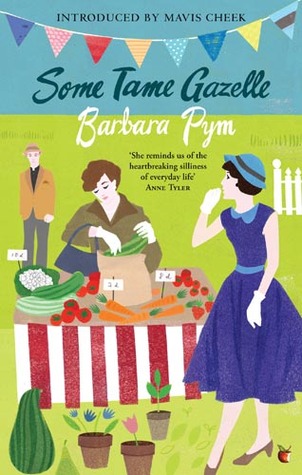 Belinda, on the other hand, only has eyes for one man: Archdeacon Hochleve, whom she’s known and loved for 30 years. They share a fondness for quoting poetry, the more obscure the better (like the title phrase, taken from “Some tame gazelle, or some gentle dove: / Something to love, oh, something to love!” by Thomas Haynes Bayly). The only problem is that the archdeacon is happily married. So single-minded is Belinda that she barely notices her own marriage proposal when it comes: a scene that reminded me of Mr. Collins’s proposal to Lizzie in Pride and Prejudice. Indeed, Pym is widely recognized as an heir to Jane Austen, what with her arch studies of relationships in a closed community.
There were a handful of moments that made me laugh, like when the seamstress finds a caterpillar in her cauliflower cheese and has to wipe with a Church Times newspaper when the Bedes run out of toilet paper (such mild sacrilege!). This is enjoyable, if fluffy; it was probably a mistake to have read one of Pym’s more serious books first: I expected too much of this one. If you’re looking for a quick, gentle and escapist read in which nothing awful will happen, though, it would make a good choice. Knowing most of her books are of a piece, I wouldn’t read more than one of the remainder – it’ll most likely be Excellent Women.
An Obsession with Butterflies: Our Long Love Affair with a Singular Insect by Sharman Apt Russell (2003)
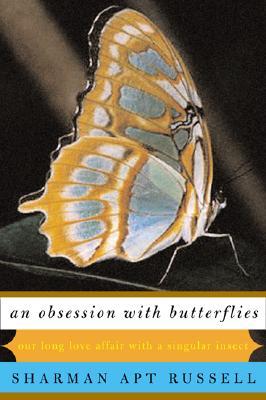 This compact and fairly rollicking book is a natural history of butterflies and of the scientists and collectors who have made them their life’s work. There are some 18,000 species and, unlike, say, beetles, they are generally pretty easy to tell apart because of their bold, colorful markings. Moth and butterfly diversity may well be a synecdoche for overall diversity, making them invaluable indicator species. Although the history of butterfly collecting was fairly familiar to me from Peter Marren’s Rainbow Dust, I still learned or was reminded of a lot, such as the ways you can tell moths and butterflies apart (and it’s not just about whether they fly in the night or the day). And who knew that butterfly rape is a thing?
The final third of the book was strongest for me, including a trip to London’s Natural History Museum; another to Costa Rica’s butterfly ranches, an example of successful ecotourism; and a nicely done case study of the El Segundo Blue butterfly, which was brought back from the brink of extinction by restoration of its southern California dunes habitat. Russell, a New Mexico-based author of novels and nonfiction, also writes about butterflies’ cultural importance: “No matter our religious beliefs, we accept the miracle of metamorphosis. One thing becomes another. … Butterflies wake us up.”
 I also recently read the excellent title story from John Murray’s 2003 collection A Few Short Notes on Tropical Butterflies. Married surgeons reflect on their losses, including the narrator’s sister in a childhood accident and his wife Maya’s father to brain cancer. In the late 1800s, the narrator’s grandfather, an amateur naturalist in the same vein as Darwin, travelled to Papua New Guinea to collect butterflies. The legends from his time, and from family trips to Cape May to count monarchs on migration in the 1930s, still resonate in the present day for these characters. The treatment of themes like science, grief and family inheritance, and the interweaving of past and present, reminded me of work by Andrea Barrett and A.S. Byatt.
(I’ve put the book aside for now but will go back to it in September as I focus on short stories.)
Other butterfly-themed books I have reviewed:
- Four Wings and a Prayer: Caught in the Mystery of the Monarch Butterfly by Sue Halpern (one of last year’s 20 Books of Summer)
- Ruins by Peter Kuper (a graphic novel set in Mexico, this also picks up on monarch migration)
- Magdalena Mountain by Robert Michael Pyle (a novel about butterfly researchers in Colorado)
Women in Translation Month 2019, Part I: Ernaux and Poschmann
Two rather different books to start off #WITMonth: a brief (c. 70 pp.) account of a mother’s decline with dementia; and a haiku-inspired novel of the quest for life and death in disorienting modern Japan. Both are admirable but detached – a judgment I seem more likely to make about work in translation – so don’t earn my wholehearted recommendation. My rating for both:
I Remain in Darkness by Annie Ernaux (1997; English translation, 1999)
[Translated from the French by Tanya Leslie]
 This is the second short, somewhat harrowing autobiographical work I’ve read by Ernaux this year (after Happening, her account of her abortion, in March). A collection of mostly present-tense fragments, it’s drawn from the journal she kept during her mother’s final years, 1983–6. “I Remain in Darkness” were the last words her mother wrote, in a letter to a friend (“Je ne suis pas sortie de ma nuit,” which more literally means “I have not left my night,” strikes me as cryptic and poetic, though maybe I’m missing a colloquialism). Slipping into Alzheimer’s, her mother spent these years in a long-term hospital geriatric ward. Ernaux could see her mother becoming like a child again:
This morning she got up and, in a timid voice, said: ‘I wet the bed. I couldn’t help it.’ The same words I would use when I was a child.
Now her room is on the third floor. A bunch of women circle us, addressing my mother with the familiar tu form: ‘You’re going to be in our group?’ They are like kids talking to the ‘new girl’ at school. When I take leave of her, she looks at me in panic and confusion: ‘You’re not leaving, are you?’
—and herself becoming like her mother: “It’s crystal-clear: she is me in old age and I can see the deterioration of her body threatening to take hold of me – the wrinkles on her legs, the creases in her neck”. Ernaux vacillates between guilt, fear and cruelty in how she approaches her mother. She tenderly shaves the older woman’s face every week when she visits, and buys her all manner of sweets. Food is one of her mother’s last remaining pleasures, though she often misses her mouth when she tries to eat the cakes her daughter brings.
Superficially, this is very similar to another book I’ve reviewed this year, Be With by Mike Barnes, a series of short letters written during his time as a caregiver to his mother, who also has Alzheimer’s. But where Barnes is reassuring and even humorous at times, Ernaux refuses to give any comfort, false or otherwise. This hospital is a bleak place that reeks of urine and is hiding excrement everywhere (really). A lazier reviewer than I generally try to be would brandish the word “unflinching.”
The entries from a few days after her mother’s death explain what the author is trying to do with her work, whether memoir or autofiction: “I am incapable of producing books that are not precisely that – an attempt to salvage part of our lives, to understand, but first to salvage … I’ll have to tell her story in order to ‘distance myself from it’.” That dual purpose, saving and distancing, makes her work honest yet unemotional, such that I have trouble warming to it.
This is easily read in a sitting. I may try again to get into Ernaux’s novel The Years, which, like the Poschmann (below), was on this past year’s Man Booker International Prize shortlist.
I Remain in Darkness will be released on September 18th. With thanks to Fitzcarraldo Editions for the free copy for review.
The Pine Islands by Marion Poschmann (2017; English translation, 2018)
[Translated from the German by Jen Calleja]
(Though I read this mostly in July, I finished it on August 1st, so I’m including it in my WIT Month coverage. It’s the first of the author’s books to be made available in English.)
 A man wakes up from a dream convinced that his wife is cheating on him, and sets off for Tokyo on a whim, where he embarks on a Bashō-inspired pilgrimage to the pine islands of Matsushima. This Gilbert Silvester, a beard historian, acquires an unlikely companion: a young man named Yosa, who’s looking for the best place to kill himself and takes Gilbert along to cliffs and forests famous for their suicide rates. Although there are still cherry blossoms and kabuki theatre, Gilbert soon learns that this isn’t Bashō’s Japan anymore.
From the haikus he composes and the letters he writes to Mathilda back home, we track his inward journey as it contrasts with the outward ones he undertakes. I enjoyed the surreal touches – Yosa says he once dated a woman who was actually a fox – and the Murakami setup (the wife’s adultery and the hair patterns are reminiscent of The Wind-Up Bird Chronicle).
Somehow, though, for me this is a book that succeeds more in its ideas (searching for the essence of a place but only finding the clichés; coniferous versus deciduous trees as a metaphor for what lasts in life versus what fades) than in its actual execution. It never all quite comes together, and the inconclusive ending makes you question how much of this has been a dream or a fantasy. It’s ambitious and intellectually impressive, but something about its dignified aloofness is hard to be enthusiastic about.
Do watch Lost in Translation, one of my favorite films, afterwards…
And a DNF: The Days of Abandonment by Elena Ferrante. The time has come to admit that I simply do not appreciate Ferrante’s work. I could only make it 25 pages into this one; I’ve read a different short novel of hers (The Lost Daughter), and skimmed another (My Brilliant Friend). While I enjoyed the narrator’s voice well enough, and loved the scene in which her errant husband finds broken glass in his dinner, I found that I had no interest in how this seemingly predictable story of the end of a marriage might play out.
Up next for Part II: The Wind that Lays Waste by Selva Almada, on its way from Charco Press, and The Awakening of Miss Prim by Natalia Sanmarin Fenollera.
Are you doing any special reading for Women in Translation month this year?
20 Books of Summer, #7–10: Auster, Darlington, Durrell, Jansma
Owls and leopards and dogs – oh my! My animal-themed reading project continues. I’m more than halfway through in that I’m in the middle of quite a few more books, but finishing and reviewing them all before the 3rd of September may still prove to be a challenge.
Timbuktu by Paul Auster (1999)
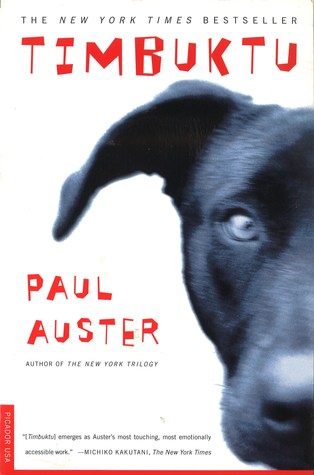 My first from Auster – and not, I take it, representative of his work in general. Never mind, though; I enjoyed it, and it was a good follow-up to Fifteen Dogs. Like the Alexis novel, this gives an intimately imagined dog’s perspective, taking seriously the creature’s whole life story. The canine protagonist is Mr. Bones, who’s accompanied his mentally unstable writer owner, Willy G. Christmas, from New York City down to Baltimore, where, one August Sunday, Willy wants to find his old high school English teacher before he dies.
What took me by surprise is that Auster doesn’t stick with Willy, but has Mr. Bones move on to two more living situations: first he’s the secret friend of 10-year-old Henry Chow, whose parents run a Chinese restaurant, then he’s a family pet in suburban Virginia. Although his English comprehension is advanced, he isn’t able to reproduce its sounds like some of the dogs in Fifteen Dogs can, so he can’t tell these new owners his real name and has to accept being called first “Cal” and then “Sparky.” In dreams he still hears Willy’s voice. He assumes Willy is now in the afterlife (“Timbuktu”), and longs to rejoin him.
The novel is tender as well as playful and funny – I loved the passage where Mr. Bones wakes up to pain but doesn’t realize he’s been castrated:
How was he to know that those missing parts had been responsible for turning him into a father many times over? Except for his ten-day affair with Greta, the malamute from Iowa City, his romances had always been brief—impetuous couplings, impromptu flings, frantic rolls in the hay—and he had never seen any of the pups he had sired. And even if he had, how would he have been able to make the connection? Dick Jones had turned him into a eunuch, but in his own eyes he was still the prince of love, the lord of the canine Romeos, and he would go on courting the ladies until his last, dying breath. For once, the tragic dimension of his own life eluded him.

Owl Sense by Miriam Darlington (2018)
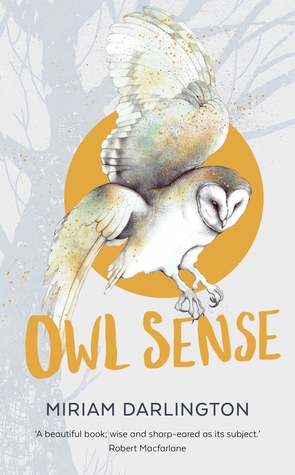 Initially the idea was to see all of Britain’s resident owls, but as often happens, the project expanded until Darlington was also taking trips to Serbia to find a Long-Eared Owl, Finland for a Eurasian Eagle Owl, and France for a Pygmy Owl; and going on a fruitless twitch to see a vagrant Snowy Owl in Cornwall. Each chapter considers a different species and includes information on its anatomy, geographical distribution, conservation status, and any associated myths and anecdotes (The Secret Life of the Owl by John Lewis-Stempel does much the same thing, but with less richness). She has closer encounters with some than with others: when volunteering with the Barn Owl Trust, she gets to ring chicks and collects pellets for dissection. But even the most fleeting sightings can be magical.
The book also subtly weaves in what was happening in Darlington’s life at the time, especially her son Benji’s struggles. On the autistic spectrum, he suddenly started having physical problems that were eventually explained by non-epileptic seizures. I would have welcomed more personal material, but that just speaks to my love of memoir. This feels slightly hurried and not quite as editorially polished as her master work, Otter Country, but it’s still well worth reading if you have any interest in birds or nature conservation. (I’ve only seen two owls in the wild: Barn and Tawny.)
Fillets of Plaice by Gerald Durrell (1971)
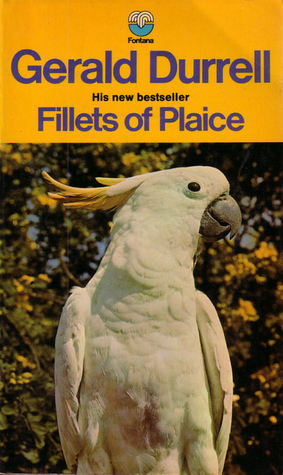 This is a pleasant miscellany of leftover essays that didn’t make it into any of Durrell’s other books. The best is “The Birthday Party,” about an incident from the Corfu years: Larry insisted on taking the fridge along on Mother’s birthday outing to an island, and their boat ran out of petrol. In “A Transport of Terrapins,” teenage Gerry works as a lowly pet shop assistant in London even though he knows twice as much as his boss; and meets other eccentric fellows, such as a bird collector and a retired colonel who has a house full of model figures for war gaming.
“A Question of Promotion” is set on one of the animal-collecting expeditions to Cameroon and turned me off a little with its colonial attitude: Durrell talks to the natives in condescending pidgin as he helps prepare a feast for the District Commissioner’s visit. In “A Question of Degrees” he visits two hospitals for a cataclysmic nosebleed, while “Ursula” is about a girlfriend who couldn’t open her mouth without uttering a malapropism. Entertaining scraps for diehard fans; if you’re new to Durrell, though, start with My Family and Other Animals and Menagerie Manor.
The Unchangeable Spots of Leopards by Kristopher Jansma (2013)
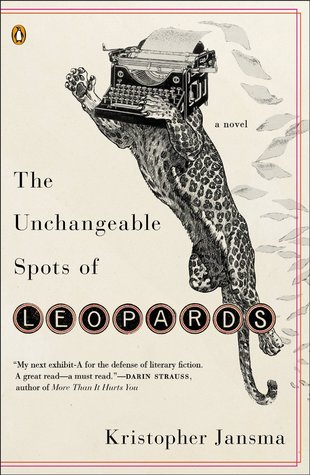 I’d meant to read Jansma’s debut ever since Why We Came to the City, his terrific novel about five university friends negotiating life in New York City during the recession, came out in 2016. I assumed the leopards of the title would be purely metaphorical – a reference to people not being able to change their inborn nature – and they are, but they’re also surprisingly literal in the one chapter set in Africa.
Jansma’s deliciously unreliable narrator, never named but taking on various aliases in these linked short stories, is a trickster, constantly reworking his life into fiction. He longs to be a successful novelist, but keeps losing his works in progress. We think we know the basics of his identity – he’s the son of a single mother who worked as a flight attendant; he grew up in North Carolina emulating the country club and debutante class; at Berkshire College he met his best friend and rival Julian McGann in creative writing class and fell for Julian’s friend Evelyn, the great unrequited love of his life – but Part II introduces doubt by calling the characters different names. Are these the ‘real’ people, or the narrator’s fictionalized versions?
The characters go on a bizarre odyssey that moves the setting from New York City to Nevada to Dubai to Sri Lanka to Ghana to Iceland to Luxembourg, finally ending up back in the very airport terminal where it started. As I remembered from Why We Came to the City, Jansma interleaves Greek mythology and allusions to other writers, especially F. Scott Fitzgerald. The coy way in which he layers fiction on fiction reminded me of work by John Boyne and Tom Rachman; other recommended readalikes are The Goldfinch and Orchid & the Wasp.
This Is Not a Drill: An Extinction Rebellion Handbook
“There is no planet B. This is where we will live, or go extinct as a species.”
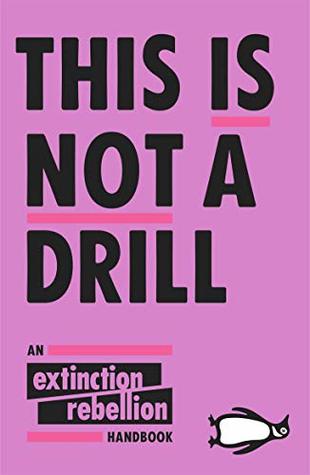 I’m periodically prone to melancholy musings on the impending end of the world (like here). Reading this punchy collection of 35 essays was a way of taking those feelings seriously and putting them to constructive use. You’ve likely heard of Extinction Rebellion: a peaceful environmental activism movement that began in the UK and has now spread worldwide, it demands that governments face the facts about the climate crisis and do something about it, now. Fittingly, the book is divided into two sections: “Tell the Truth” plainly sets out the basics of climate breakdown and the effects we expect to see, including the disproportionate toll it will have on the poor and marginalized, and on island nations like the Maldives; “Act Now” is a practical call to arms with pieces by politicians, economists and protest organizers.
Not surprisingly, experts are calling for radical societal change: we must move away from the car culture; we cannot continue to equate success with economic growth; we must reorganize how cities function. “We are not looking at adjustments any more. It’s a complete overhaul,” Leeds University’s Professor of Urban Futures, Paul Chatterton, writes. But what did surprise me about reading This Is Not a Drill is that it’s not depressing. It’s actually rather exciting to see how many great minds and ordinary folk are aware of the climate crisis and working to mitigate it. We might not have political will at the highest levels, but grassroots movements involving just 3% of the citizenry have been shown to effect social change. I want to be part of that 3%. After I finished reading I signed up to ER’s mailing list, and though it’s not at all in my comfort zone, I’m going to consider taking part in their next public disruption.
 I came away from this book with a feeling of camaraderie: we’re all in this together, and so we can only tackle it together. Post-apocalyptic fiction envisions violent, everyone-for-themselves scenarios, but it doesn’t have to be that way. ER demonstrations are said to be characterized by energy, music, laughter and good food. One word keeps appearing throughout the essays: “love.” There is righteous anger here, yes, but that’s outweighed by love – love of our planet, our only home, and the creatures it nurtures; love of the human race, the family that encompasses us all. While the authors are not unanimously optimistic, there is a sense that there is dignity in working towards positive change, whether or not we ultimately succeed. Plus, “It might just work,” former Archbishop of Canterbury Rowan Williams concludes in his afterword.
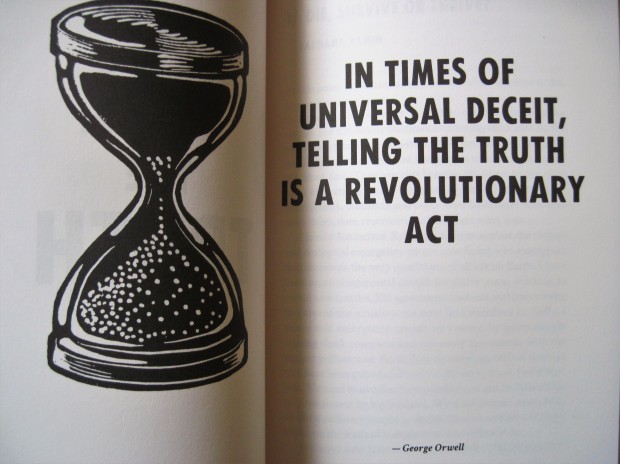
If you feel hopeless when you think about the state of the environment, I encourage you to pick this up, even if you only skim through and read a handful of the essays. The handbook achieves a fine balance between academics and laypeople; forthright assertions and creative ideas; grief and enthusiasm. It’s also strikingly designed, with the pink cover matching the ER boat and heavy use of the sorts of recurring icons and slogans you might recognize from their banners: skulls and hourglasses share space with bees, birds, butterflies and a Tree of Life. My only real quibble is that I would have liked a short bio of each contributor, either at the close of each essay or in an appendix, because while a few of these authors are household names, many are not, and it would be useful to know their bona fides.
Don’t miss these pieces: “Climate Sorrow” by psychotherapist Susie Orbach, “A Political View” by Green Party MP Caroline Lucas, “A New Economics” by Oxbridge economist Kate Raworth, and “The Civil Resistance Model” by Roger Hallam of Extinction Rebellion.
Some favorite lines:
“Being human is not about individual survival or escape. It’s a team sport. Whatever future humans have, it will be together.” (from “Survival of the Fittest,” by American media theorist Douglas Rushkoff)
“It’s interesting and important to note that the people who are most effective are often the least attached to the effectiveness of their actions. Being detached from the outcome, and in love with the principles and the process, can help mitigate against burn-out.” (from “The Civil Resistance Model” by Roger Hallam)
“We may or may not escape a breakdown. But we can escape the toxicity of the mindset that has brought us here. And in so doing we can recover a humanity that is capable of real resilience.” (from the Afterword by Rowan Williams)
“if you are alive at this moment in history, it is because you are here to do a job. So what is your place in these times?” (from “What Is Your Place in These Times?” by Gail Bradbrook, co-founder of Extinction Rebellion)
My rating:
This Is Not a Drill was published on June 13th. My thanks to Penguin Random House for the free copy for review.
Too Male! (A Few Recent Reviews for Shiny New Books and TLS)
I tend to wear my feminism lightly; you won’t ever hear me railing about the patriarchy or the male gaze. But there have been five reads so far this year that had me shaking my head and muttering, “too male!” While aspects of these books were interesting, the macho attitude or near-complete dearth of women irked me. Two of them I’ve already written about here: Ernest Hemingway’s The Garden of Eden was a previous month’s classic and book club selection, while Chip Cheek’s Cape May was part of my reading in America. The other three I reviewed for Shiny New Books or the Times Literary Supplement; I give excerpts below, with links to visit the full reviews in two cases, plus ideas for a book or two by a woman that should help neutralize the bad taste these might leave.
Shiny New Books
The Way Home: Tales from a Life without Technology by Mark Boyle
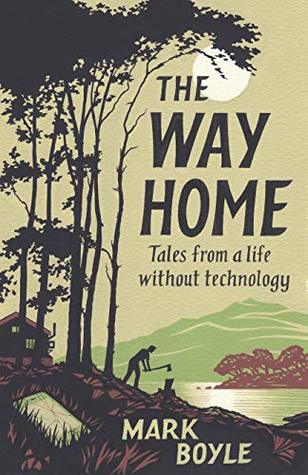 Boyle lives without electricity in a wooden cabin on a smallholding in County Galway, Ireland. He speaks of technology as an addiction and letting go of it as a detoxification process. For him it was a gradual shift that took place at the same time as he was moving away from modern conveniences. The Way Home is split into seasonal sections in which the author’s past and present intermingle. The writing consciously echoes Henry David Thoreau’s. Without even considering the privilege that got Boyle to the point where he could undertake this experiment, though, there are a couple of problems with this particular back-to-nature model. One is that it is a very male enterprise. Another is that Boyle doesn’t really have the literary chops to add much to the canon. Few of us could do what he has done, whether because of medical challenges, a lack of hands-on skills or family commitments. Still, the book is worth engaging with. It forces you to question your reliance on technology and ask whether making life easier is really a valuable goal.
 The Remedy: Homesick: Why I Live in a Shed by Catrina Davies, which I’m currently reading for a TLS review. Davies crosses Boyle’s Thoreauvian language about solitude and a place in nature with a Woolfian search for a room of her own. Penniless during the ongoing housing crisis, she moves into the shed near Land’s End that once served as her father’s architecture office and embarks on turning it into a home.
Doggerland by Ben Smith
 This debut novel has just two main characters: ‘the old man’ and ‘the boy’ (who’s not really a boy anymore), who are stationed on an enormous offshore wind farm. The distance from the present day is indicated in slyly throwaway comments like “The boy didn’t know what potatoes were.” Smith poses questions about responsibility and sacrifice, and comments on modern addictions and a culture of disposability. He has certainly captured something of the British literary zeitgeist. From page to page, though, Doggerland grew tiresome for me. There is a lot of maritime vocabulary and technical detail about supplies and maintenance. The location is vague and claustrophobic, the pace is usually slow, and there are repetitive scenes and few conversations. To an extent, this comes with the territory. But it cannot be ignored that this is an entirely male world. Fans of the themes and style of The Old Man and the Sea and The Road will get on best with Smith’s writing. I most appreciated the moments of Beckettian humor in the dialogue and the poetic interludes that represent human history as a blip in the grand scheme of things.
 The Remedy: I’m not a big fan of dystopian or post-apocalyptic fiction in general, but a couple of the best such novels that I’ve read by women are Station Eleven by Emily St. John Mandel and Gold Fame Citrus by Claire Vaye Watkins.
Times Literary Supplement
The Knife’s Edge: The Heart and Mind of a Cardiac Surgeon by Stephen Westaby
 In this somewhat tepid follow-up to Fragile Lives, Westaby’s bravado leaves a bad taste and dilutes the work’s ostensibly confessional nature. He has a good excuse, he argues: a head injury incurred while playing rugby in medical school transformed him into a risk taker. It’s widely accepted that such boldness may be a boon in a discipline that requires quick thinking and decisive action. So perhaps it’s no great problem to have a psychopath as your surgeon. But how about a sexist? Westaby’s persistent references to women staff as “lady GP” and “registrar lady” don’t mitigate surgeons’ macho reputation. It’s a shame to observe such casual sexism, because it’s clear Westaby felt deeply for his patients of any gender. And yet any talk of empathy earns his derision. It seems the specific language of compassion is a roadblock for him. The book is strongest when the author recreates dramatic sequences based on several risky surgeries. Alas, at its close he sounds bitter, and the NHS bears the brunt of his anger. Compared to Fragile Lives, one of my favorite books of 2017, this gives the superhero surgeon feet of clay. But it’s a lot less pleasing to read. (Forthcoming in TLS.)
 The Remedy: I’m keen to read Direct Red by Gabriel Weston, a memoir by a female surgeon.
(Crikey! This was my 600th blog post.)
 Bookish Beck = Rebecca Foster. American transplant to England. Freelance proofreader and book reviewer.
