Help Me! by Marianne Power: A Self-Help Quest
 Outwardly Marianne Power’s life was fine, but deep down she felt unhappy and unfulfilled. An Irish freelance journalist living in London, she was 36 and single. “There has to be more than just working and paying bills and buying crap we don’t need,” she felt. She’d been an obsessive reader of self-help books for years – Feel the Fear and Do It Anyway inspired her to leave her temp job at age 24 – but she realized that she’d never implemented most of the books’ lessons. So instead of just reading self-help, she set out to do self-help, one book per month, for a year (though it ended up being longer) to see if she could truly change her life.
January was a baptism of fire. Jumping in with that old favorite, Jeffers’s Feel the Fear, Power listed things she was afraid of and then did one per day: an outdoor swim on New Year’s Day, nude modeling for an art class, parallel parking, standup comedy, and skydiving. In subsequent months she tackled her disastrous finances (Money, A Love Story), tested out the law of attraction (The Secret), practiced lots of rejection therapy, worked on relinquishing control (F**k It), attended a Tony Robbins “Unleash the Power Within” seminar, and imagined what she’d want said at her funeral (The Seven Habits of Highly Effective People).
There came a point in the year when Power had to admit she was physically rundown and emotionally shattered. Months spent focusing on herself had alienated her from friends and family – even her mum, a wonderfully matter-of-fact character who believes in just getting on with life instead of moaning about it. A trio of truly useful books (The Power of Now by Eckhart Tolle, Daring Greatly by Brené Brown and You Can Heal Your Life by Louise Hay) started to turn the tide, helping Power counter negative thoughts with positive affirmations and reminding her that self-help is futile because you can never go it alone. Being with other people who understand you, volunteering and exercise: these are the things that really help.
I have a particular weakness for year-challenge books, and Power’s is written in an easy, chatty style, as if Bridget Jones had given over her diary to testing self-help books for 16 months (“Do a budget, make a plan. Two phrases that made me break into a cold sweat”). If I have one tiny complaint, it’s that I might have liked a little more context on the books she chose. Help Me! is self-deprecating and relatable, with some sweary Irish swagger thrown in. I can recommend it to self-help junkies and skeptics alike.
My rating: 
Favorite passage:
“The dangerous expectation that can be created by self-help books is that if you’re not walking around like a cross between Mary Poppins, Buddha and Jesus every day you’re doing it wrong. You must try harder. … The higher I was setting my standards the more I was feeling like a failure.”
(I also loved the pep talk from a taxi driver who got depressed when doing a PhD on Thomas Hardy!)
Full disclosure: Marianne and I are Facebook friends and she arranged for me to be sent a proof copy of Help Me! The finished book was released by Picador on September 6th.
Roald Dahl Day Blog Tour: “Boy” & More
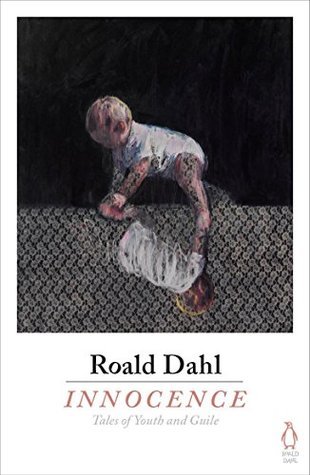 Like so many children on both sides of the Atlantic, I grew up with Roald Dahl’s classic tales: James and the Giant Peach, Charlie and the Chocolate Factory, and Matilda. I was aware that he had published work for adults, too, but hadn’t experienced any of it until I was asked to join this blog tour in advance of Roald Dahl Day on September 13th.
Last year Penguin brought out an eight-volume paperback set of Dahl’s short stories, grouped thematically. I focused on Innocence: Tales of Youth and Guile, which opens with a reprint of Boy (1984), the closest thing to an autobiography that Dahl wrote. That’s in spite of his prefatory disclaimer:
An autobiography is a book a person writes about his own life and it is usually full of all sorts of boring details. This is not an autobiography. … throughout my young days at school and just afterwards a number of things happened to me that I have never forgotten. … Some are funny. Some are painful. … All are true.
Dahl’s father was a one-armed shipbroker who’d moved from Norway to Wales for the coal. His mother, Harald’s second wife, was also from Norway, so Dahl was a full-blooded Norwegian. After his father’s early death he attended Llandaff Cathedral School and then boarding school and public school in England. Sofie Dahl, quietly tough, tended her brood of six children and stepchildren, giving them magical summers on a Norwegian island and keeping her cool during the car accident in which Dahl’s nose was almost severed.
Any time they were separated, Dahl wrote to his mother once a week, without fail. The book includes facsimile excerpts from some of these letters, along with black-and-white family photographs and drawings. This is more of a scrapbook than a straightforward chronological memoir, especially in the way that it moves between playful and disturbing vignettes from Dahl’s school days. It’s particularly delightful to spot incidents that inspired his children’s books, such as a plot to plant a dead mouse in the mean sweet shop lady’s gobstopper jar and the boxes of new-recipe Cadbury’s chocolates that would arrive at Repton School for testing by eager boys.
Pranks and larks and holidays: these are all here. But so is crushing homesickness and a bitter sense of injustice at being at the mercy of sadistic adults. Dahl had his adenoids removed without anesthesia, and at school he received and witnessed many a vicious caning. Aware that such scenes are accumulating uncomfortably, he addresses the topic directly:
By now I am sure you will be wondering why I lay so much emphasis upon school beatings in these pages. The answer is that I cannot help it. All through my school life I was appalled by the fact that masters and senior boys were allowed literally to wound other boys, and sometimes quite severely. I couldn’t get over it. I never have got over it.
When he graduated, instead of going to Oxford or Cambridge, he wanted to see the world and have adventures, so he spent the summer of 1934 exploring Newfoundland and joined the Shell Company at age 18. His first placement was to East Africa for three years; soon afterwards he would become a fighter pilot in the Second World War. In the short years he spent as a London commuter, he realized how easy a 9-to-5 office job is compared to making a living as a writer. (I could sympathize.)
The life of a writer is absolute hell compared with the life of a businessman. The writer has to force himself to work. He has to make his own hours and if he doesn’t go to his desk at all there is nobody to scold him. If he is a writer of fiction he lives in a world of fear. Each new day demands new ideas and he can never be sure whether he is going to come up with them or not. … A person is a fool to become a writer. His only compensation is absolute freedom. He has no master except his own soul.
I don’t often like reading books from a child’s perspective (particularly novels with a child narrator) because I find that the voice can ring false. Not so here. Nearly 60 years later, Dahl could use memory and imagination to fully inhabit his childhood self and give a charming survey of the notable events of his life up to age 20. I’d highly recommend Boy to fiction and nonfiction readers alike.
My rating: 
 I also dipped into Trickery: Tales of Deceit and Cunning and particularly liked “The Wish,” in which a boy imagines a carpet is a snakepit and then falls into it, and “Princess Mammalia,” a Princess Bride-style black comedy about a royal who decides to wrest power from her father but gets her mischief turned right back on her. I’ll also pick up Fear, Dahl’s curated set of ghost stories by other authors, during October for the R.I.P. challenge.
My thanks to the publisher for free copies of four volumes of the tales.
Ladders to Heaven: The Secret History of Fig Trees
 A whole book about fig trees? That’s right! If you’re a voracious nonfiction reader like me, you’ll find freelance journalist Mike Shanahan’s history of fig trees unexpectedly fascinating. It opens with him atop a series of ladders in a national park in Borneo, reaching past a venomous snake to pick some figs. He did many such exciting things in his research towards a PhD in rainforest ecology, but that 1998 encounter was significantly more intrepid than his earliest experience with the genus: he remembers a potted weeping fig in the hallway of his childhood home.
From that little tree to the largest banyans, Ficus encompasses 750+ species and has had a major place in human culture for millennia. Fig trees turn up in Greek origin myths and are sacred to Hindus. Romulus and Remus were rescued from drowning in the Tiber by fig tree roots. The tree the Buddha sat under to meditate? A fig. The fruit Adam and Eve ate in the Garden of Eden? More likely a fig than an apple given the Middle Eastern climate and the fact that they then sew fig leaves together to cover their nakedness. (The confusion may have come about because in Latin malum means either “apple” or “evil”.)
Figs offer some biological surprises. For one thing, the plants have no apparent flowers. That’s because the flowers are internal: a fig is not technically a fruit but a hollow ball lined with tiny flowers that must be pollinated by two-millimeter-long fig-wasps. Strangler figs colonize a host tree, starting as a seed in the canopy and enveloping it in long tangled roots. Many tropical birds and mammals rely on figs, including monkeys and hornbills. Figs were, Shanahan writes, the “original superfood” for our primate ancestors.
The habitats where fig trees thrive face severe challenges, including drought, forest fires and poaching. However, history offers encouraging examples of how fig species can be key to tropical forest restoration. After a volcano erupted on Papua New Guinea in 1660, for example, the razed land was fairly quickly recolonized by Ficus species from seeds dropped by birds and bats – a prerequisite for wildlife returning. Similarly, fig trees were all that remained of the forest on Krakatoa after its famous volcanic eruption in 1883.
Building on this precedent, the Forest Restoration Research Unit, based in Thailand, now uses fig species to kickstart the restitution of tropical landscapes; one in every five of their plantings is a fig. Likewise, figs can be used to restore post-mining landscapes and lock up carbon. Researchers are looking into using drones to collect and deposit the seeds.
I’d never realized how often figs show up in the historical record, or how dependent on them we and other creatures have been. “Look after fig trees and they will look after you. It’s a lesson we have all but forgotten, but one we could learn again,” Shanahan concludes. Have a look at the bibliography and you’ll see just how much information is synthesized into this short, engaging book. It’s another gorgeous design from Unbound, too: the colorful cover was what first attracted me, and the author’s black-and-white pointillist illustrations adorn the text.

Nowadays I tend to think of figs as an exotic, luxury food. Every year we add some dried figs to our Christmas cake, creating caramel bursts of crunchy seeds. When my husband and I lived in Reading, we briefly had a LandShare arrangement to look after an established garden. Hidden behind a suburban fence, it was a secret paradise overflowing with fruit: plum, greengage and apple trees plus a fruit cage containing berries, currants, and – in one corner – a small fig. I remember one glorious late summer when we were inundated with more ripe figs than I’d ever seen before. We would heat them in the oven and serve them split open and oozing with goat’s cheese and runny honey. Our very own taste of Eden.
My rating:
Ladders to Heaven was first published by Unbound in 2016 and releases in paperback today, September 6th. My thanks to the publisher for the free copy for review.
Polishing off My 20 Books of Summer with Hay, Jones & Markham
I finished off strong with a few books I’ve been meaning to read for months or years.
Late Nights on Air by Elizabeth Hay (2007)
 (This was a Twitter buddy read with Naomi of Consumed by Ink and Penny of Literary Hoarders.) I read my first novel by Hay, A Student of Weather, last year. It was wonderfully rewarding even though it took me a month to read. By contrast, I read the Giller Prize-winning Late Nights on Air in half that time. Most of it is set in 1975–7 in Yellowknife, a small city in Canada’s Northwest Territories. Here winter lasts for eight months and you can still meet with snow and frozen lakes in early July. A tight-knit cast gathers around the local radio station: Harry and Gwen, refugees from Ontario starting new lives; Dido, an alluring Dutch newsreader; Ralph, the freelance book reviewer; menacing Eddie; and pious Eleanor.
Everyone is in love with everyone else, so you get these layers of unrequited romance and a sense of exposure: not just to the elements, but to the vulnerabilities of admitting one’s feelings and risking professional failure. The novel is also about appearances and assumptions – “You don’t look anything like how you sound,” Gwen says to Harry – and the dangers of obsession. Four of the station employees set out one summer to recreate the six-week journey of Arctic explorer John Hornby, a trip that ends up being as wondrous as it is fraught. Hay’s foreshadowing is a bit heavy-handed, and I found the final chapters after the expedition a slight letdown, but overall this is a marvellous story of quiet striving and dislocation. I saw bits of myself in each of the characters, and I loved the extreme setting, both mosquito-ridden summer and bitter winter. I need to read the rest of Hay’s oeuvre stat.
Favorite passages:
Harry’s professional advice to Gwen: “Radio was like poetry, he told her. At its best it could be, while television was like a blockbuster novel: one made you think and feel, the other dulled your mind. … ‘To be any good you have to believe it’s hard. It’s called creative tension. … And you won’t be any good until you’re dedicated to something outside yourself.’ … I learned that a mistake is just something you go on from.”
“Something blossoms in an unlikely place. An oasis of trees miles above the treeline. An arctic river warmer than any other water they’d come upon. The four of them bathed in the waters of the Thelon, wading out into it, almost swimming. On shore they towelled themselves dry and dressed, and there was no feeling to equal the splendour of warm clothes on river-cold skin.”
My rating: 
I ran out of time for Half of a Yellow Sun by Chimamanda Ngozi Adichie so substituted in…
An American Marriage by Tayari Jones (2018)
(If it’s good enough for Barack Obama and Oprah Winfrey, it’s good enough for me!)
 The title feels like an echo of An American Tragedy. It’s both monolithic and generic, as if saying: Here’s a marriage; make of it what you will. Is it representative of the average American situation, or is it exceptional? Roy and Celestial only get a year of happy marriage before he’s falsely accused of rape and sentenced to 12 years in prison in Louisiana. Through their alternating first-person narration and their letters back and forth while Roy is incarcerated, we learn more about this couple: how their family circumstances shaped them, how they met, and how they drift apart as Celestial turns to her childhood friend, Andre, for companionship. When Roy is granted early release, he returns to Georgia to find Celestial and see what might remain of their marriage. I ached for all three main characters: It’s an impossible situation. The novel ends probably the only way it could, on a realistic yet gently optimistic note. Life goes on, if not how you expect, and there will be joys still to come.
This would make a great book club pick: there’s a lot to probe about the characters’ personalities and motivations, and about how they reveal or disguise themselves through their narration. I found it remarkable how the letters, which together make up not even one-fifth of the text, enhance the raw honesty of the book. There are other marriages on display besides Roy and Celestial’s, their range providing a snapshot of African-American lower-middle- and upper-middle-class life in the South. I especially liked the use of two totem objects, Roy’s tooth and the hickory tree outside Celestial’s childhood home (what you see on the cover).
Favorite lines:
Celestial: “I believed that our marriage was a fine-spun tapestry, fragile but fixable. We tore it often and mended it, always with a silken thread, lovely but sure to give way.”
Andre: “I don’t believe that blood makes a family; kin is the circle you create, hands held tight.”
Celestial: “Our marriage was a sapling graft that didn’t have time to take.”
Roy: “mostly my life is good, only it’s a different type of good from what I figured on.”
My rating:
An American Marriage was published in the UK by Oneworld on April 5th. My thanks to the publisher for the free copy for review.
West With the Night by Beryl Markham (1942)
 (Another Twitter buddy read, with Laila of Big Reading Life.) I’ve meant to pick this up ever since I read Paula McLain’s fantastic novel about Beryl Markham, Circling the Sun. I loved Markham’s memoir even more. She writes so vividly about the many adventures of her life in Africa: hunting lions, training race horses, and becoming one of the continent’s first freelance pilots, delivering mail and locating elephant herds.
It took me a while to get used to the structure – this is a set of discrete stories rather than a chronological narrative – but whether she’s reflecting on the many faces of Africa or the peculiar solitude of night flights, the prose is just stellar. Ernest Hemingway once asserted in a letter that Markham could “write rings around all of us who consider ourselves as writers,” and I certainly enjoyed this more than anything I’ve read by Hemingway.
The text is bookended by two momentous flights: it opens with Markham scrambling to deliver oxygen to an injured miner, and ends with her completing the first east–west solo flight across the Atlantic in 1936. Her engine cut out multiple times; it’s no less than a miracle that she survived to crash land in Nova Scotia. Laila and I agree that Markham’s life is so exciting it’s crying out for a movie version. In the meantime, I’d like to read some more about her circle – Denys Finch Hatton; and Baron von Blixen and his wife Karen (aka Danish writer Isak Dinesen, famous for Out of Africa). In my Circling the Sun review for BookTrib, I wrote that “Markham was the kind of real-life action adventure heroine you expect to find in Indiana Jones movies,” and that sense was only confirmed by her own account.
Favorite passages:
“to fly in unbroken darkness without even the cold companionship of a pair of ear-phones or the knowledge that somewhere ahead are lights and life and a well-marked airport is something more than just lonely. It is at times unreal to the point where the existence of other people seems not even a reasonable possibility. The hills, the forests, the rocks, and the plains are one with the darkness, and the darkness is infinite. The earth is no more your planet than is a distant star—if a star is shining; the plane is your planet and you are its sole inhabitant.”
“I saw how a man can be master of a craft, and how a craft can be master of an element. I saw the alchemy of perspective reduce my world, and all my other life, to grains in a cup. I learned to watch, to put my trust in other hands than mine. And I learned to wander. I learned what every dreaming child needs to know—that no horizon is so far that you cannot get above it or beyond it.”
My rating:
So how did I do on my first-ever #20BooksofSummer challenge? In that I read and reviewed (more than) 20 books by women that I owned in print, it was a smashing success. However, I only read 7 of the books I’d intended to, substituting in the rest from my review pile, books I owned in America, and others that grabbed my attention more than those I’d picked out in early June. Looks like I’m not great at sticking with the specific reading plans I set!
At any rate, as bonuses, here are the additional books by women that I read in print from my own shelves over the summer, not counting ones already reviewed on the blog (in chronological order, with ratings and links to any Goodreads reviews):
- Blue Horses, Mary Oliver

- The Egg and I, Betty Macdonald
- Eye of the Shoal: A Fish-watcher’s Guide to Life, the Ocean and Everything, Helen Scales
- The Partly Cloudy Patriot, Sarah Vowell

- Talk before Sleep, Elizabeth Berg
- The Incendiaries, R.O. Kwon [blog tour review coming on Monday]

- The Artist’s Way: A Spiritual Path to Higher Creativity, Julia Cameron
- Gross Anatomy: My Curious Relationship with the Female Body (The Top Half and the Bottom Half), Mara Altman [Glamour UK review coming soon]
- Questions of Travel, Elizabeth Bishop
- Writers & Company, Eleanor Wachtel

- Help Me!: One woman’s quest to find out if self-help really can change her life, Marianne Power
- Mrs Gaskell & Me: Two Women, Two Love Stories, Two Centuries Apart, Nell Stevens
I’d call that a result!
What have been the best books of the summer? Of the final 20, The Invisible Bridge by Julie Orringer was the winner, followed closely by The Life and Loves of Lena Gaunt by Tracy Farr, Late Nights on Air by Elizabeth Hay, and West With the Night by Beryl Markham. There were no real duds. I’m still very interested in all but one of the books I chose back in June, so I’ll see how many of the rest I can fit into this autumn and winter’s reading.
How was your summer of reading? Did you meet any goals you set?
Three Reads for Women in Translation Month 2018
An offer of the latest Latin American import from Charco Press prompted me to scour my shelves and see what other books I might add for #WITMonth. I dug out two novella-length books I’d bought secondhand over the past year to make it a trio. My rating for all: 
The Lost Daughter by Elena Ferrante
[Translated from the Italian by Ann Goldstein]
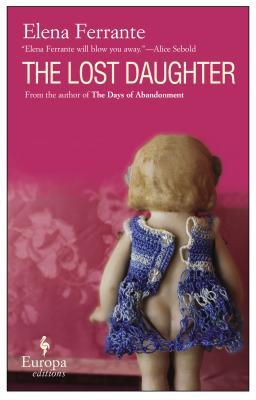 Leda is a 47-year-old teacher on holiday in southern Italy. She mostly sits on the beach, minding her own business, but still gets drawn into the minor daily dramas of a large Neapolitan family. One woman is pregnant; another has a small child named Elena who is devastated at losing her doll. Their mother–daughter dynamic takes Leda back to the time when she abandoned her own daughters and didn’t see them for three years. She temporarily found it impossible to reconcile motherhood with her career and her general sense of herself. Leda sees herself as part of a “chain of mute or angry women” – “I seemed to be falling backward toward my mother, my grandmother.”
I was definitely on board for the memories of motherly guilt. Where Ferrante lost me was when Leda steals the doll the child left behind and takes it up to her room to care for it – washing it, buying it new clothes, etc. Every time she sets out to give the doll back or at least leave it somewhere it will be found, she finds another excuse to put it off. Leda herself is unsure why she’s fixated on the doll; “The hardest things to talk about are the ones we ourselves can’t understand,” she says early on.
Most likely the doll could be interpreted as a symbol of Leda’s desire to be part of a functional family, to get a second chance at perfection with her daughters. But the book was a little too strange for me, and I never really engaged with the Neapolitan characters. After this and a skim of My Brilliant Friend a couple years back, I doubt I’ll pick up anything else by Ferrante. The themes and style of this one reminded me of Rachel Cusk’s Outline trilogy, A Separation by Katie Kitamura, and Hot Milk by Deborah Levy.
Favorite passage:
“Life can have an ironic geometry. Starting from the age of thirteen or fourteen I had aspired to a bourgeois decorum, proper Italian, a good life, cultured and reflective. Naples had seemed a wave that would drown me. I didn’t think the city could contain life forms different from those I had known as a child, violent or sensually lazy, tinged with sentimental vulgarity or obtusely fortified in defense of their own wretched degradation. I didn’t even look for them, those forms, in the past or in a possible future. I had run away like a burn victim who, screaming, tears off the burned skin, believing that she is tearing off the burning itself.”
Fish Soup by Margarita García Robayo
[Translated from the Spanish by Charlotte Coombe]
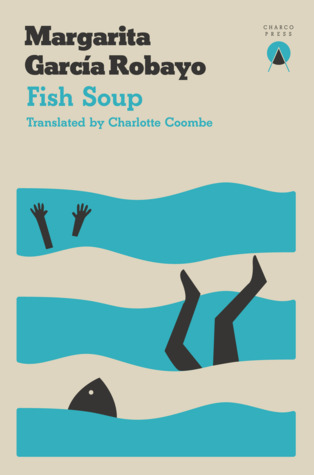 Fish Soup contains two novellas (one of them, Sexual Education, was previously unpublished) separated by a set of seven short stories, and marks the first time the Colombian author Margarita García Robayo’s work has appeared in English. I especially liked the title story, in which a widower starts to smell his dead wife Helena’s fish soup in the bar that he owns and goes to investigate, all the while mixing up his dreams and memories with what’s really happening.
My other favorite piece was the opening novella, Waiting for a Hurricane, in which the narrator longs for escape from her seaside home, wanting nothing more than to be a “foreigner.” She starts a law degree but gives it up to become an air hostess, making flights to and from Miami and elsewhere. From her childhood onward, Gustavo has been a major presence in her life, teaching her to prepare fish and telling her stories, but there’s an uncomfortable element to their relationship that’s never really addressed. The mixture of quirky happenings and darker material reminded me of Swallowing Mercury, while the cancer theme of the story “Like a Pariah” recalls Hair Everywhere.
One of my frequent issues with short fiction is a preponderance of inconclusive endings that make you wonder what the point could be. I experienced that a few times with this collection, especially at the close of Waiting for a Hurricane. Judging by the title, though, the main message I drew from the novella is that you can’t just go around waiting for momentous things to happen to you, for your ‘real’ life to start; you have to recognize that this is life, here and now: in storytelling, in spicy stews, in everyday moments with friends and family.
With thanks to Charco Press for the free copy for review.
Sky Burial: An Epic Love Story of Tibet by Xinran
[Translated from the Chinese by Julia Lovell and Esther Tyldesley]
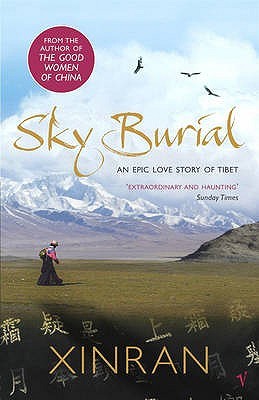 In 1994 Xinran, a Chinese journalist who later moved to London, met a woman whose story captured her imagination. Shu Wen received word that her husband, Kejun, had died just months into their marriage. A doctor in the People’s Liberation Army, he’d been sent into Tibet in the 1960s after its ‘liberation’. With no details or body to confirm his demise, though, Wen refused to believe Kejun was gone, and traveled to Tibet to find him. She stayed there for over 30 years – more than half her life – living with a Tibetan family and adjusting to their culture and rituals as she sought word of her husband. The gender roles surprised her: men did the sewing and women had multiple husbands. It was a land of lamas and temples; “the whole of Tibet was one great monastery,” she felt.
Wen does eventually learn the truth of what happened to her husband (whew!), and after decades of living as a superstitious Buddhist in primitive conditions has to readjust to life in a new China, having completely missed the Cultural Revolution. She clings to words of wisdom from a military official: “Whatever happens, remember one thing: just staying alive is a victory” and “Writing can be a source of strength.” He then gave her a diary that she filled with letters to Kejun over the years.
It’s a pleasant, short book made up of layers of tales: the legends and history lessons Wen hears from Tibetans; what she conveys to Xinran during their two intense days together; and the resulting narrative Xinran spent nearly a decade imagining herself into. Kejun’s fate is worth waiting around to hear about (but if you know what the title refers to you might consider it a spoiler), though this is something of a thin story overall. I’ve seen it referred to as a novel, though I consider it more of a stylized biography.
Did you do any special reading for Women in Translation month this year?
Two “Summer” Reads: Knausgaard and Trevor
Last year at about this time I reviewed Jonathan Smith’s Summer in February and Elizabeth Taylor’s In a Summer Season, two charming English novels about how love can upend ordinary life. This month I read my first William Trevor novel, Love and Summer, which is very much in that vein. My other selection, Karl Ove Knausgaard’s last of four seasonal installments written for his young daughter, is a mostly nonfiction hybrid.
Summer by Karl Ove Knausgaard (2016; English translation, 2018)

Illustrated by German artist Anselm Kiefer.
I’ve now read three volumes from the Seasons Quartet – all but Spring. The series started with Knausgaard addressing his fourth child in utero. By now she’s two years old but still the recipient of his nostalgic, slightly didactic essays on seasonal topics, as well as the “you” some of his journal entries are written to. I wasn’t so keen on Autumn, but Winter and Summer are both brilliant for how they move from tangibles – ice cream cones, camping, fruit flies, seagulls, butterflies and the circus – into abstract notions of thought, memory, identity and meaning. That fluidity is especially notable here when Knausgaard drifts in and out of the imagined experience of an elderly woman of his grandfather’s acquaintance who fell in love with an Austrian soldier and abandoned her children during World War II.
I especially enjoyed two stories: traveling with his son to Brazil for a literary festival where he ran into English surgeon Henry Marsh, and fainting at an overcrowded publisher party in London. He’s always highly aware of himself (he never gives open-mouthed smiles because of his awful teeth) and of others (this woman at the party is desperate to appear young). But more so than these stand-out events and his memories of childhood, he gives pride of place to everyday life, things like chauffeuring his three older children to their various activities and shopping at the supermarket for barbecue food. “By writing it I reveal that not only do I think about it, I attach importance to it. … I love repetition. Repetitions turn time into a place, turn the days into a house.” I highlighted dozens of passages in the Kindle book. I’ll need to catch up on Spring, and then perhaps return to the My Struggle books; I only ever read the first.
My rating: 
Love and Summer by William Trevor (2009)
 Trevor (1928–2016) was considered a writer’s writer and a critic’s dream for the simple profundity of his prose. I had long meant to try his work. This short novel is set over the course of one summer in a small Irish town in the 1950s, and opens on the day of the funeral of old Mrs. Connulty. A stranger is seen taking photographs around town, and there is much murmuring about who he might be. He is Florian Kilderry, who recently inherited his Anglo-Italian artist parents’ crumbling country house. It’s impossible to pay the debts and keep the house going, so he plans to sell it and its contents as soon as possible and move abroad, perhaps to Scandinavia.
But he hasn’t passed through Rathmoye without leaving ripples. Ellie Dillahan, a young farmer’s wife who was raised by nuns and initially moved to Dillahan’s as his housekeeper, falls in love with the stranger almost before she meets him, and they embark on a short-lived liaison. Blink and you’ll miss that the relationship is actually sexual; Trevor only uses the word “embraced” twice, I think. That reticence keeps it from being a torrid affair, yet we do get a sense of how wrenching the thought of Florian leaving becomes for Ellie. Trevor often moves from descriptions of nature or farm chores straight into Ellie’s thoughts, or vice versa.
“In the crab-apple orchard she scattered grain and the hens came rushing to her. She hadn’t been aware that she didn’t love her husband. Love hadn’t come into it”
“He [Florian] would be gone, as the dead are gone, and that would be there all day, in the kitchen and in the yard, when she brought in anthracite for the Rayburn, when she scalded the churns, while she fed the hens and stacked the turf.”
This is quietly beautiful writing – perhaps too quiet for me, despite the quirky secondary characters around the town (including the busybody Connulty daughter and the madman Orpen Wren) – but I would recommend Trevor to readers of Mary Costello and Colm Tóibín. I would also like to try Trevor’s short stories, for which he was particularly known; I think in small doses his subtle relationship studies and gentle writing would truly shine.
My rating:
Summery reading options for next year: The Heat of the Day by Elizabeth Bowen, One Summer: America, 1927 by Bill Bryson, and The Go-Between by L. P. Hartley (set over a long, hot summer). I may also get Sunburn by Laura Lippman and Heat Wave by Penelope Lively out from the library.
Have you read any “Summer” books lately?
Recent Nonfiction Reads, in 200 Words Each: Black, Fee, Gaw
I’ve let months pass between receiving these books from the kindly publishers and following through with a review, so in an attempt to clear the decks I’m putting up just a short response to each, along with some favorite quotes.
All that Remains: A Life in Death by Sue Black
 Black, a world-leading forensic anthropologist, was part of the war crimes investigation in Kosovo and the recovery effort in Thailand after the 2004 tsunami. She is frequently called into trials to give evidence, has advised the U.K. government on disaster preparedness, and is a co-author of the textbook Developmental Juvenile Osteology (2000). Whether working in a butcher’s shop as a teenager or exploring a cadaver for an anatomy class at the University of Aberdeen, she’s always been comfortable with death. “I never had any desire to work with the living,” she confesses; “The dead are much more predictable and co-operative.”
The book considers death in its clinical and personal aspects: the seven stages of postmortem alteration and the challenges of identifying the sex and age of remains; versus her own experiences with losing her grandmother, uncle and parents. Black wants her skeleton to go to Dundee University’s teaching collection. It doesn’t creep her out to think of that, no more than it did to meet her future cadaver, a matter-of-fact, curious elderly gentleman named Arthur. My favorite chapter was on Kosovo; elsewhere I found the mixture of science and memoir slightly off, and the voice never fully drew me in.
Favorite line: “Perhaps forensic anthropologists are the sin-eaters of our day, addressing the unpleasant and unimaginable so that others don’t have to.”
My rating:
All that Remains was published by Doubleday on April 19th. My thanks to the publisher for the free copy for review.
Places I Stopped on the Way Home: A Memoir of Chaos and Grace by Meg Fee
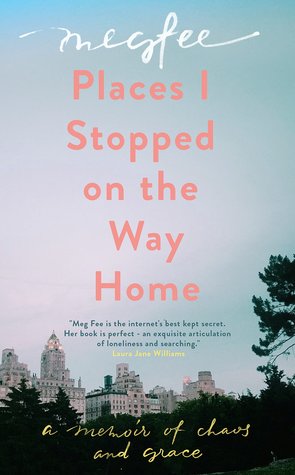 Fee came to New York City to study drama at Julliard. Her short essays, most of them titled after New York locations (plus a few set further afield), are about the uncertainty of her twenties: falling in and out of love, having an eating disorder, and searching for her purpose. She calls herself “a mess of disparate wants, a small universe in bloom.” New York is where she has an awful job she hates, can’t get the man she’s in love with to really notice her, and hops between terrible apartments – including one with bedbugs, the subject of my favorite essay – and yet the City continues to lure her with its endless opportunities.
I think this book could mean a lot to women who are younger than me or have had experiences similar to the author’s. I found the essays slightly repetitive, and rather unkindly wondered what this privileged young woman had to whine about. It’s got the same American, generically spiritual self-help vibe that you get from authors like Brené Brown and Elizabeth Gilbert. Despite her loneliness, Fee retains a romantic view of things, and the way she writes about her crushes and boyfriends never truly connected with me.
Some favorite lines:
“Writing felt like wrangling storm clouds, which is to say, impossible. But so did life. Writing became a way to make peace with that which was flawed.”
“I have let go of the idea of permanency and roots and What Comes Next.”
My rating:
Places I Stopped on the Way Home was published by Icon Books on May 3rd. My thanks to the publisher for the free copy for review.
The Pull of the River: A journey into the wild and watery heart of Britain by Matt Gaw
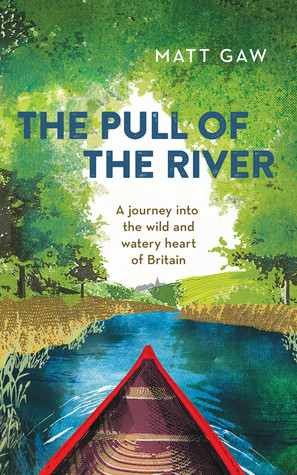 A watery travelogue in the same vein as works by Roger Deakin and Alys Fowler, this jolly yet reflective book traces Gaw’s canoe trips down Britain’s rivers. His vessel was “the Pipe,” a red canoe built by his friend James Treadaway, who also served as his companion for many of the jaunts. Starting with his local river, the Waveney in East Anglia, and finishing with Scotland’s Great Glen Way, the quest was a way of (re)discovering his country by sensing the currents of history and escaping to the edge of danger.
Access issues, outdoor toileting, getting stuck on mudflats, and going under in the winter – it wasn’t always a comfortable method of travel. But Gaw’s expressive writing renders even rubbish- and sewage-strewn landscapes beautiful in their own way: “grim bunting made from discarded bags of dog poo,” “a savannah of quivering, moussey mud” and “cormorants hunched together like sinister penguins, some holding ragged wings to the wind in taxidermic poses.”
My favorite chapters were about pollution and invasive species, as seen at the Lark, and about the beaver reintroduction project in Devon (we have friends who live near it). I’m rooting for this to make next year’s Wainwright Prize longlist.
A favorite passage:
“I feel like I’ve shed the rust gathered from being landlocked and lazy. The habits and responsibilities of modern life can be hard to shake off, the white noise difficult to muffle. But the water has returned me to my senses. I’ve been reborn in a baptism of the Waveney [et al.]”
My rating:
The Pull of the River was published by Elliott & Thompson on April 5th. My thanks to the publisher for the free copy for review.
Have you read any stand-out nonfiction recently?
Two Records of Bodily Transformation: Amateur and Shapeshifters
Amateur: A True Story about What Makes a Man, Thomas Page McBee
 Thomas Page McBee was the first transgender man to box at Madison Square Garden. In his second memoir, which arose from a Quartz article entitled “Why Men Fight,” he recounts the training leading up to his charity match and ponders whether aggression is a natural male trait. McBee grew up in a small town outside Pittsburgh with a stepfather who sexually abused him from age four. In 2011 he started the testosterone injections that would begin his gender transformation. During the years that followed, other men seemed to pick fights with him fairly often, and he was unsure what to do about it. Finally, in 2015, the Manhattan editor decided to confront the belligerent male stereotype by starting boxing training.
What I most appreciated were the author’s observations of how others have related to him since his transition. He notices that he’s taken more seriously at work as a man, and that he can be an object of fear – when jogging behind a woman at night, for instance. One of the most eye-opening moments of the book is when he realizes that he’s been talking over his own sister. Thankfully, McBee is sensitive enough to stop and change, recognizing that kindness and vulnerability are not faults but attributes any person should be proud of.
I have a feeling I would have preferred his previous memoir, Man Alive, which sounds like it has more about the transition itself. Jonathan Eig’s biography of Muhammad Ali is one of the best books I’ve read this year, and in comparison I didn’t find the boxing writing here very interesting. Likewise, this pales beside two similar but more perceptive books I’ve read that have been hugely influential on my own understanding of gender identity: Conundrum by Jan Morris and The Argonauts by Maggie Nelson.
My rating:
Amateur was published in the UK by Canongate on August 2nd. My thanks to the publisher for the free copy for review.
Shapeshifters: On Medicine and Human Change by Gavin Francis
 Gavin Francis is a physician with a practice near Edinburgh. His latest book is like a taster course in medical topics. The overarching theme is the modifications the body undergoes, so there are chapters on, for example, body-building, tattoos, puberty, prosthetic limbs, dementia and menopause. Over his years in general practice Francis has gotten to know his patients’ stories and seen them change, for better or worse. These anecdotes of transformation are one source for his book, but he also applies insight from history, mythology, literature, etymology and more. So in a chapter on conception he discusses the Virgin Mary myth, Leonardo da Vinci’s fetal diagrams, the physiological changes pregnant women experience, and the case of a patient, Hannah, who had three difficult, surprise pregnancies in quick succession.
We are all in the process of various transformations, Francis argues, whether by choice or involuntarily. (I decided on the link with McBee because of a chapter on sex changes.) I was less convinced by the author’s inclusion of temporary, reversible changes such as sleep, hallucinations, jet lag and laughter. And while each chapter is finely wrought, I felt some sort of chronological or anatomical order was necessary to give the book more focus. All the same, I suspect this will be a strong contender for next year’s Wellcome Book Prize because of its broad relevance to human health and its compassionate picture of bodies in flux.
My rating: 
Shapeshifters was published by the Wellcome Collection/Profile Books on May 2nd. My thanks to the publisher for the proof copy for review.
20 Books of Summer #9–14: Alden, Colwin, Danticat, Kimmel, Lipman & Steinbach
I fly back to the UK later today after a fairly busy few weeks of packing, unpacking, and more packing as I got my mom settled into her new home and dealt with the substantial amount of stuff I still had in storage with my parents. I’ll post later in the week about book culling versus acquisitions. For now, here’s a quick look at the books by women I’ve been reading in print towards my summer challenge: everything from a memoir of infertility to a perfectly summery novel set at a Vermont lake resort.
Crossing the Moon by Paulette Bates Alden (1998)
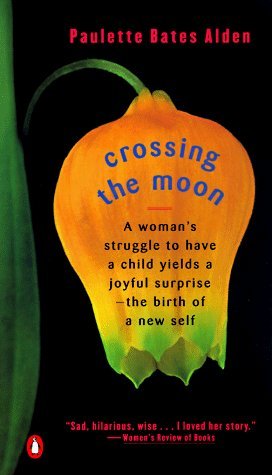 I first read this nearly four years ago (you can find my initial review in an early blog post that rounds up three of Alden’s works), and was moved to reread it this summer as a follow-up to Sheila Heti’s Motherhood. The book focuses on Alden’s uncertainty about having children all the way up to her late thirties, when she underwent three years of somewhat desperate, and ultimately unsuccessful, infertility treatment. “From the very start, I had seen writing and motherhood as mutually exclusive,” she writes, an attitude very similar to Heti’s. Yet she feared missing out on the meaning and love a child could bring to her life.
More broadly, the memoir is about the search to integrate the different aspects of a life – including family history and the fateful decisions that seem to have been made for you – into a realistic vision of the future. I didn’t find the book quite as profound this time around, but I noticed that I marked many of the same passages I did four years ago, about the dearth of childless role models and the struggle to accept the life that has become yours, even if it’s not what you predicted for yourself. That proves how influential and comforting it’s been for me.
Favorite lines:
“About the closest I can come to imagining what it would be like to have a child is with our cat, Cecil. For Cecil I feel the most delicious love, but also the most anxious responsibility.”
“It came to me that it really was a choice between two good things—having a child and not having a child. Our life without a child seemed good to me. I caught a glimpse that it was what was right for us, for the best. But who can say what is ‘best’? Maybe it’s possible to get to a place where what is best is simply what is.”
My rating:
Passion and Affect by Laurie Colwin (1974)
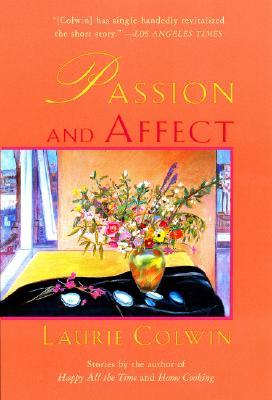 I mostly know Colwin as a food writer, but she also published fiction. This subtle story collection turns on quiet, mostly domestic dramas: people falling in and out of love, stepping out on their spouses and trying to protect their families. I didn’t particularly engage with the central two stories about cousins Vincent and Guido (characters from her novel Happy All the Time, which I abandoned a few years back), but the rest more than made up for them.
Several stories reveal the hidden depths of a character who’s only been a bit player in a protagonist’s life: a family friend who suddenly commits suicide, a Hispanic cook who has a rich boyfriend, a widowed piano teacher whose young student’s accomplishments buoy him up, and a supermarket employee whose ordinary life doesn’t live up to the fantasy background her manager, an art history PhD student, dreams up for her. In “The Water Rats” and “Wet,” water symbolizes all that we can’t control and understand, whether that’s our family’s safety or the inner life of a spouse.
Colwin writes funny, sharp descriptions, like “he was greeted by a young man wearing his hair in the manner of John Donne, a three-piece suit, and cowboy boots” and “she windowshopped, staring with rapt depression at rows of mannikins in glossy trousers.”
Favorite lines:
“She was three years married and when she looked at herself in the mirror, she did not see that she had become any more serious, any less young and heedless, or any more willing to get down to what Richard called ‘the things of life.’ He was right when he said that she had not made up her mind about anything.”
“He looked at his dissertation, or the heap that was to become his dissertation, and sighed again. He was of two minds about this Vermeer business, and he was of two minds about this supermarket business. That accounted for four minds in all, and it made life painful for him.”
My rating:
Breath, Eyes, Memory by Edwidge Danticat (1994)
 Like her protagonist, Sophie Caco, Danticat was raised by her aunt in Haiti and reunited with her parents in the USA at age 12. As Sophie grows up and falls in love with an older musician, she and her mother are both haunted by sexual trauma that nothing – not motherhood, not a long-awaited return to Haiti – seems to heal. I loved the descriptions of Haiti (“The sun, which was once god to my ancestors, slapped my face as though I had done something wrong. The fragrance of crushed mint leaves and stagnant pee alternated in the breeze” and “The stars fell as though the glue that held them together had come loose”), and the novel gives a powerful picture of a maternal line marred by guilt and an obsession with sexual purity. However, compared to Danticat’s later novel, Claire of the Sea Light, I found the narration a bit flat and the story interrupted – thinking particularly of the gap between ages 12 and 18 for Sophie. (Another Oprah’s Book Club selection.)
Favorite lines:
“She cannot stay out of duty. The things one does, one should do out of love.”
“I knew my hurt and hers were links in a long chain and if she hurt me, it was because she was hurt, too.”
My rating:
A Girl Named Zippy by Haven Kimmel (2001)
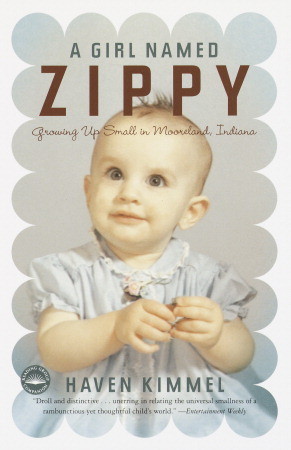 Maybe you grew up in or near a town like Mooreland, Indiana (population 300). Born in 1965 when her brother and sister were 13 and 10, Kimmel was affectionately referred to as an “Afterthought” and nicknamed “Zippy” for her boundless energy. Gawky and stubborn, she pulled every trick in the book to try to get out of going to Quaker meetings three times a week, preferring to go fishing with her father. The short chapters, headed by family or period photos, are sets of thematic childhood anecdotes about particular neighbors, school friends and pets. I especially loved her parents: her mother reading approximately 40,000 science fiction novels while wearing a groove into the couch, and her father’s love of the woods (which he called his “church”) and elaborate preparations for camping trips an hour away.
The tone is light-hearted despite hints of unpleasantness around town: open hostility towards people of color, a lecherous music teacher and a kid who abused animals. The more exaggerated stories are reminiscent of David Sedaris’s work – did she really cut hippies’ hair in exchange for an Irish Setter puppy?! Mostly, the book made me think about my mother’s small-town childhood versus my own suburban one, and how I would try to put all my early experiences together in a funny, nostalgic but honest way. It wouldn’t be easy at all, which makes Kimmel’s a noteworthy achievement.
Favorite lines:
“I figure heaven will be a scratch-and-sniff sort of place … I will ask for the smell of my dad’s truck, which was a combination of basic truck (nearly universal), plus his cologne (Old Spice), unfiltered Lucky Strikes, and when I was very lucky, leaded gasoline.”
“Mom used to say that my dad was a mountain man, which was obviously just a figure of speech, since most of Indiana is flat as a pancake. Her point was that Dad is a wild man, which was certainly true.”
My rating:
The Inn at Lake Devine by Elinor Lipman (1998)
 This was a breezy, delightful novel perfect for summer reading. In 1962 Natalie Marx’s family is looking for a vacation destination and sends query letters to various Vermont establishments. Their reply from the Inn at Lake Devine (proprietress: Ingrid Berry) tactfully but firmly states that the inn’s regular guests are Gentiles. In other words, no Jews allowed. The adolescent Natalie is outraged, and when the chance comes for her to infiltrate the Inn as the guest of one of her summer camp roommates, she sees it as a secret act of revenge.
In fact, in the years to come, after she trains as a chef, Natalie will become further entwined in the inn’s life, helping the family recover from a tragedy, falling in love with one of the Berry sons, and unwittingly contributing to a livelihood-threatening accident. Natalie’s voice drew me in right from the start. Lipman’s comedies of manners have been compared to Jane Austen’s, and you can see that likeness in the witty dialogue. I’ll certainly read more by her.
My rating:
Without Reservations: The Travels of an Independent Woman by Alice Steinbach (2000)
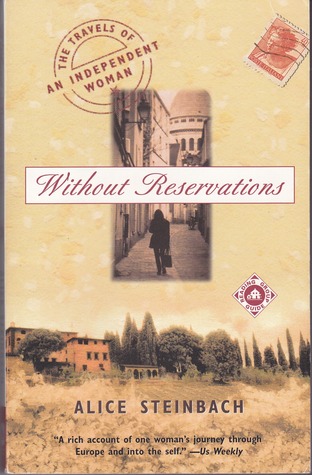 In 1993 Steinbach, then in her fifties, took a sabbatical from her job as a Baltimore Sun journalist to travel for nine months straight in Paris, England and Italy. As a divorcee with two grown sons, she no longer felt shackled to her Maryland home and wanted to see if she could recover a more spontaneous and adventurous version of herself and not be defined exclusively by her career. Her innate curiosity and experience as a reporter helped her to quickly form relationships with other English-speaking tourists, which was an essential for someone traveling alone.
I enjoyed spotting familiar sites I’ve visited, but I don’t think you need to know these countries or even have a particular interest in them to appreciate the book. Whether she’s attending a swanky party or nearly getting mugged, Steinbach is an entertaining and unpretentious tour guide. Her attitude is impressive, too: “I had surprised myself this year by jumping in to reshape my life before life stepped in to reshape it for me.” You might not be willing to give up your normal existence for nine months, but I suspect that this travel memoir might make you consider how you could be more daring in your daily life.
My rating:
20 Books of Summer, #5–8: Anderson, Cusk, Fitch & L’Engle
I’ve been reading a feminist memoir set on Cape Cod, a subtle novel about the inner life and outward experiences of a writer, a soapy literary thriller about a troubled mother and teen daughter, and a slightly melancholy reminiscence of an aged mother succumbing to dementia.
A Walk on the Beach: Tales of Wisdom from an Unconventional Woman by Joan Anderson (2004)
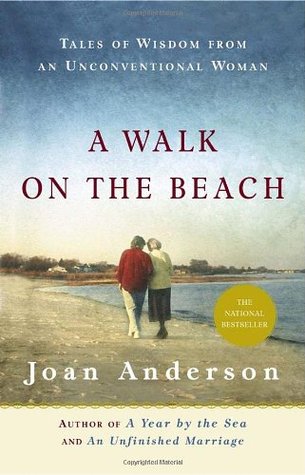 This is the third volume in a loose autobiographical trilogy about Anderson’s experiment with taking a break from her marriage and living alone in a Cape Cod cottage to figure out what she really wanted from the rest of her life. Specifically, this book is about the inspirational relationship she formed with Joan Erikson, who moved to the area in her eighties when her husband, the famous psychologist Erik Erikson, was admitted to a care home. Joanie was a thinker and author in her own right, publishing books on life’s stages, especially those of older age. She encouraged Anderson to have the confidence to write her own story, and to take up challenges like a trip to Peru and learning to weave on a loom. Joanie’s aphoristic advice is valuable, but there’s a fair bit of overlap between this book and A Year by the Sea, which I would recommend over this.
My rating:
Some of Joan Erikson’s words of wisdom:
“Doing something with your hands, rather than your head, is often the best route to clarity.”
“wisdom comes from life’s experiences well digested. Stop relying so much on your mind and get in touch with experience.”
“The struggle is to try and obtain a sense of participation in your life the whole way through. We must treasure old age, but not wallow in nostalgia.”
Transit by Rachel Cusk (2016)
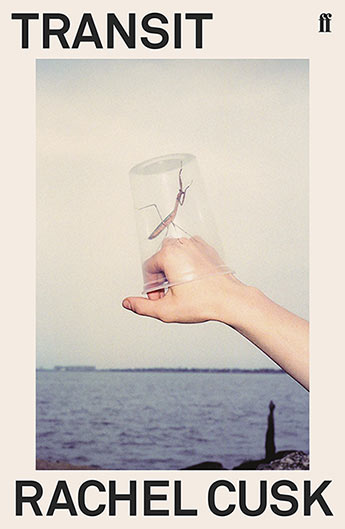 I finally made it through a Rachel Cusk book! (This was my third attempt; I made it just a few pages into Aftermath and 60 pages through Outline.) I suspected this would make a good plane read, and thankfully I was right. Each chapter is a perfectly formed short story, a snapshot of one aspect of Faye’s life and the relationships that have shaped her: a former lover she bumps into in London, a builder who tells her the flat she’s bought is a lost cause, the awful downstairs neighbors who hate her with a passion, the fellow writers (based on Edmund White and Karl Ove Knausgaard?) at a literary festival event who hog most of the time, the jolly Eastern European construction workers who undertake her renovations, a childless friend who works in fashion design, and a country cousin who’s struggling with his new blended family.
Like in Outline, the novel is based largely on the conversations Faye overhears or participates in (“I had found out more, I said, by listening than I had ever thought possible”), but I sensed more of her personality this time, and could relate to her questioning: Why do her neighbors hate her so? How much of her life is fated, and how much has she chosen? I doubt I’ll read another book by Cusk, but I ended up surprisingly grateful to have gotten hold of this one as a free proof copy of the new paperback edition from the Faber Spring Party.
My rating:
Some favorite lines:
“we examine least what has formed us the most, and instead find ourselves driven blindly to re-enact it.”
“Without children or partner, without meaningful family or a home, a day can last an eternity: a life without those things is a life without a story, a life in which there is nothing – no narrative flights, no plot developments, no immersive human dramas – to alleviate the cruelly meticulous passing of time.”
White Oleander by Janet Fitch (1999)
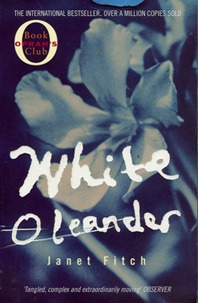 Man, that Oprah knows how to pick ’em! This was a terrific read; I’m not sure why I’d never gotten to it before. I read huge chunks during my travel to the States and then slowed down quite a bit, which was a shame because it meant I felt less connected to Astrid’s later struggles in the foster care system. It’s an atmospheric novel full of oppressive Los Angeles heat and a classic noir flavor that shades into gritty realism as it goes on, taking us from when Astrid is 12 to when she’s a young woman out in the world on her own.
Astrid’s mother Ingrid, an elitist poet, becomes obsessed with a lover who spurned her and goes to jail for his murder. Bouncing between foster homes and children’s institutions, Astrid is plunged into a world of sex, drugs, violence and short-lived piety. “Like a limpet I attached to anything, anyone who showed me the least attention,” she writes. Her role models change over the years, but always in the background is the icy influence of her mother, through letters and visits.
Fitch’s writing is sumptuous, as in a house “the color of a tropical lagoon on a postcard thirty years out of date, a Gauguin syphilitic nightmare.” I might have liked a tiny bit more of Ingrid in the book, but I can still recommend this one wholeheartedly as summer reading.
My rating:
Some favorite lines:
The knock-out opening two lines: “The Santa Anas blew in hot from the desert, shriveling the last of the spring grass into whiskers of pale straw. Only the oleanders thrived, their delicate poisonous blossoms, their dagger green leaves.”
“I couldn’t imagine my mother in prison. She didn’t smoke or chew on toothpicks. She didn’t say ‘bitch’ or ‘fuck.’ She spoke four languages, quoted T. S. Eliot and Dylan Thomas, drank Lapsang souchong out of a porcelain cup. She had never been inside a McDonald’s. She had lived in Paris and Amsterdam. Freiburg and Martinique. How could she be in prison?”
The Summer of the Great-Grandmother by Madeleine L’Engle (1974)
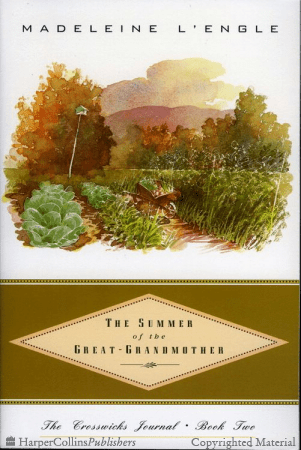 L’Engle is better known for children’s books, but wrote tons for adults, too. In this second volume of The Crosswicks Journal, she recounts her family history as a way of remembering on behalf of her mother, who at age 90 was slipping into dementia in her final summer. “I talked awhile, earlier this summer, about wanting my mother to have a dignified death. But there is nothing dignified about incontinence and senility.” L’Engle found herself in the unwanted position of being like her mother’s mother, and had to accept that she had no control over the situation. “This summer is practice in dying for me as well as for my mother.”
One of the reasons L’Engle was driven to write science fiction was because she couldn’t reconcile the idea of permanent human extinction with her Christian faith, but nor could she honestly affirm every word of the Creed. Hers is a more broad-minded, mystical spirituality that really appeals to me. (Her early life reminds me of May Sarton’s, as recounted in I Knew a Phoenix: both were born right around World War I, raised partially in Europe and sent to boarding school; a frequent theme in their nonfiction is the regenerative power of solitude and of the writing process itself.)
My rating:
Some favorite lines:
“I said [in a lecture] that the artist’s response to the irrationality of the world is to paint or sing or write, not to impose restrictive rules but to rejoice in pattern and meaning, for there is something in all artists which rejects coincidence and accident. And I went on to say that we must meet the precariousness of the universe without self-pity, and with dignity and courage.”
“Our lives are given a certain dignity by their very evanescence. If there were never to be an end to my quiet moments at the brook, if I could sit on the rock forever, I would not treasure these minutes so much. If our associations with the people we love were to have no termination, we would not value them as much as we do.”
 Bookish Beck = Rebecca Foster. American transplant to England. Freelance proofreader and book reviewer.
