Review: Extinctions by Josephine Wilson
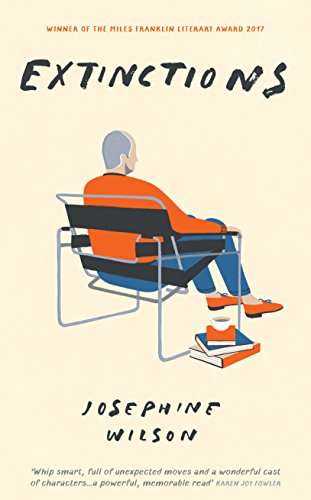 I don’t often get a chance to read the wonderful-sounding Australian books I see on prize shortlists or on Kate’s blog, so I was delighted when Extinctions, which won the 2017 Miles Franklin Literary Award, was published in the UK last year. It may just be my mind making easy associations, but Josephine Wilson’s second novel indeed reminded me of other Australian fiction I’ve enjoyed, including The Life and Loves of Lena Gaunt by Tracy Farr, Salt Creek by Lucy Treloar, and The Singing Ship by Rebecca Winterer. I can’t quite put my finger on what these novels have in common despite their disparate time settings. A hot and forbidding landscape? An enduring sense of pioneer spirit, of survival against the odds? All four, to an extent, pit an explorer’s impetus against family trauma and/or racial difference.
The antihero of Extinctions is widower Frederick Lothian, who at age 69 is a reluctant resident of St Sylvan’s Estate retirement village. It’s January 2006, the middle of a blistering Australian summer, and amid his usual morbid activities of reading the newspaper obituaries and watching his elderly co-residents fall over outside his air-conditioned unit, he has plenty of time to drift back over his life. A retired engineer, he’s an expert on concrete construction as well as a noted collector of modernist furniture. But he’s been much less successful in his personal life. His son is in a care home after a devastating accident, and his adopted daughter Caroline, who is part Aborigine, blames and avoids Fred. A run-in with a nosy neighbor, Jan, forces him to face the world – and his past – again.
Meanwhile, Caroline is traveling in the UK to secure specimens for a museum exhibit on extinct species, and the idea of feeling utterly lonesome, like the last of one’s kind, recurs: Frederick sits stubbornly on his own at St Sylvan’s, pondering the inevitability of death; Caroline and Jan, both adopted, don’t have the comfort of a family lineage; and the museum specimens whose photographs are dotted through the novel (including the last passenger pigeon, Martha, which also – not coincidentally, I’m sure – was Fred’s wife’s name) represent the end of the line.
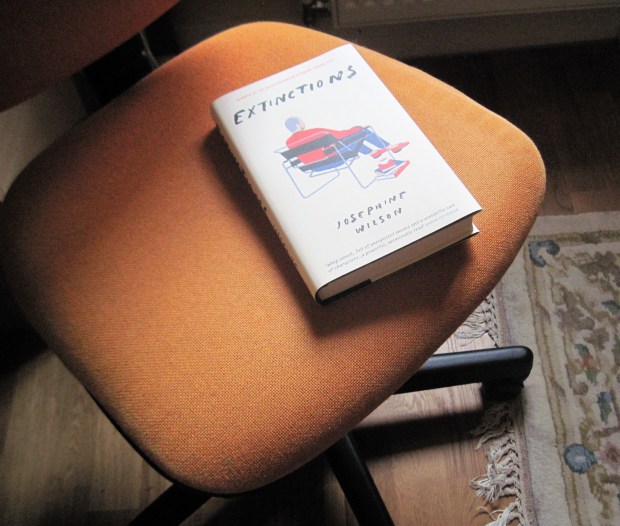
A famous modernist chair features in the book. This is just my office chair.
I loved pretty much everything about this book: the thematic connections, the gentle sense of humor (especially during Fred and Jan’s expensive restaurant dégustation), the chance for a curmudgeonly protagonist to redeem himself, and the spot-on writing. Highly recommended.
My rating:
A favorite passage:
“Like many educated people, Frederick had his opinions, most of which were set in concrete so as to render them more akin to truths, but in reality politics and modern history were his weak points – along with poetry. Where poetry and politics were concerned he feared a lack of foundation, which left him vulnerable to challenge. Deep down he knew that opinion – like concrete – was most resilient when well founded and reinforced.”
Other readalikes: Darke by Rick Gekoski & Ok, Mr Field by Katharine Kilalea
With thanks to Serpent’s Tail for the free copy for review.
Memoirs by Casey Gerald and Catherine Simpson
These two memoirs may be very different in terms of the setting (Texas and Yale versus rural Lancashire) and particulars, but I’m reviewing them together because they are both about dysfunctional families and the extent to which external circumstances determine how others see us – and how we view ourselves.
There Will Be No Miracles Here: A Memoir from the Dark Side of the American Dream by Casey Gerald (2018)
The title comes from a seventeenth-century sign in a French village that was intended to get the God-dazzled peasants back to work. For Gerald it’s a somewhat tongue-in-cheek reminder that his life, even if he has made good after an unpromising beginning, is not some American dream or fairytale. It’s more complicated than that. Still, there’s no sugar-coating his family issues. His father missed his tenth birthday party because he was next door with dope fiends; his bipolar mother was in the psych ward while his father was in jail, and then disappeared for several years. Gerald and his older sister, a college dropout, got an apartment and set their own lax rules. In the meantime, he was coming to terms with the fact that he was gay and trying to reconcile his newfound sexual identity with his Christian faith.
 In spite of it all, Gerald shone academically and athletically. He was his Texas high school’s valedictorian and followed his father into a thriving college football career – at Yale, where he accidentally fell into leadership via a Men of Color council across the Ivy League schools. It wasn’t until he got to Yale that it even occurred to him that he was poor. (I was reminded of the moment in Michelle Obama’s memoir when she got to Princeton and experienced being a minority for the first time.) As he neared graduation, he decided to go into investment banking “simply because I did not have any money and none of my people had any money.” Back in Texas after a year in a Washington, D.C. think tank, he even considered a run for Congress under the slogan “We can dream again.”
I loved the prologue, which has the 12-year-old Gerald cowering with his church congregation on the last night of 1999, in fear of being left behind at the end of the world. I think I expected religion to continue as a stronger theme throughout the book. The style wasn’t really what I imagined either: it’s a coy combination of reader address, stream-of-consciousness memories, and remembered speech in italics that often set me skimming. Whereas landmark events like his mother’s departure are left impressionistic, football games and the inner workings of Yale’s societies are described in great detail. Scenes in the classroom and with boyfriends, though still occasionally tedious, at least feel more relevant.
Gerald proudly calls himself a “faggot” and is going for a kind of sassy, folksy charm here. For me the tone only landed sometimes. Mostly I appreciated his alertness to how others (often wrongly) perceived him – a great instance of this is when he meets George W. Bush in 2007 and tells him the bare bones of his story, only for Dubya to later twist it into an example in a speech. The memoir tails off into a rather odd and sudden ending, and overall I wasn’t sure it had enough to say to fill close to 400 pages. Perhaps Gerald could have waited another 10 years? As a more successful take on similar themes, I’d recommend the memoir-in-essays Live Through This: Surviving the Intersections of Sexuality, God, and Race by Clay Cane.
My rating: 
There Will Be No Miracles Here was hand-picked by Colm Tóibín for publication by Tuskar Rock Press, a new imprint of Serpent’s Tail, on January 10th. It was published in the USA by Riverhead Books in October 2018. My thanks to the UK publisher for the free copy for review.
When I Had a Little Sister: The Story of a Farming Family that Never Spoke by Catherine Simpson (2019)
On December 7, 2013, Simpson’s younger sister, Tricia, was found dead by their 87-year-old father at the family farmhouse where she lived in Lancashire. She was 46 and had been receiving daily mental health visits for her bipolar disorder, but the family had never been notified about a previous suicide attempt just three weeks before. Simpson excavates her family history to ask how things could have gotten so bad that they didn’t realize that Tricia’s depression had reached suicidal levels.
Simpson’s grandparents – her grandfather a World War I veteran – moved into the property in 1925, so by this time there was literally generations’ worth of stuff to clear out. “I ask myself now: is it possible to dispose of a person’s effects with dignity?” Simpson frets. As she and her father sifted through antique furniture, gadgets and craft supplies, she recalls the previous death in the family: her mother’s from non-Hodgkin’s lymphoma seven years before. Growing up on a cattle farm in the 1970s, the three daughters were expected to be practical and unsentimental; there was never any discussion of emotions, and they got the sense that their overworked, unfulfilled mother would rather they weren’t around at all. In this context, it was hard for Tricia to cope with everyday challenges like struggling with schoolwork and the death of a beloved cousin. She started smoking at 12 and went on antidepressants at 19.
 Simpson started writing this family memoir on a fellowship at Hawthornden Castle in February 2016. The first step of her project was to read all of Tricia’s diaries, from age 14 on. There were happy experiences, like six months as a nanny in Vienna and a travel grant to a kibbutz in Israel. There were also unwelcome surprises, like a 1981 suicide note – from when Tricia was just 15. Simpson had never realized just how prone her little sister was to all-or-nothing thinking. She dove headlong into short-lived relationships and, when they failed, feared she would never find love again. Over the years Tricia grew increasingly paranoid, believing she was being watched on the farm and her sisters were plotting to sell the property and leave her with nothing. One time she even locked her parents in to keep them safe.
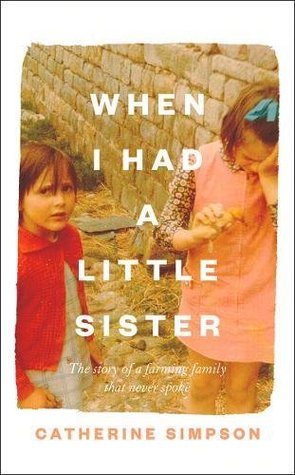
Although the subtitle is melodramatic, it conveys all that went unsaid in this family: not just sadness, but also love and tenderness. The cover image shows Simpson crying over a dead duckling; Tricia is at the left, her look of consternation startlingly intense for a three-year-old. “It’s only a duck. There’s plenty more where that came from” was their father’s hardhearted response. There are many other family photographs printed in black and white throughout the text; Tricia loved fashion, and is stunning in her glamour shots. While the book is probably overlong, I was absorbed in the family’s story, keen to see how Simpson would reconstruct events through objects, photographs and journals. (My sister is a Tricia, too.) Recommended to readers of Jill Bialosky’s History of a Suicide and Clover Stroud’s The Wild Other.
My rating: 
When I Had a Little Sister will be published by Fourth Estate on February 7th. My thanks to the publisher for an early proof copy for review.
The 2019 Wellcome Book Prize: Shadow Panel and Wish List
On Tuesday the longlist for the 2019 Wellcome Book Prize will be announced. For the third year in a row I’m running a shadow panel, and it’s composed of the same four wonderful book bloggers who joined me last year: Paul Cheney of Halfman, Halfbook, Annabel Gaskell of Annabookbel, Clare Rowland of A Little Blog of Books, and Dr. Laura Tisdall.
This year we’re going to do things slightly differently: we plan to split up the longlist, taking two to three titles each, so that between us we will have read them all and can announce our own preferred shortlist before the official shortlist is announced in March. At that point we’ll catch up by (re)reading the six shortlisted books, each reviewing the ones we haven’t already. Essentially, I’m adding an extra stage of shadow panel judging, simply because I can. I hope it will be fun – and also less onerous, in that we should get a leg-up on the shortlist and not have to read all six books in March‒April, which has proved to be a challenge in the past.
My Wellcome Prize hopefuls are all the fiction or nonfiction titles I’ve read on a medical theme that were published in the UK in calendar year 2018. I have put asterisks beside the 12 books in this post that I predict for the longlist. (The combination of wishful thinking and likelihood means that these are not exclusively my personal favorites.)

Below is a list of the books I’ve already featured on the blog in some way, with links to my coverage and a few-word summary of their relevance.
Nonfiction
Gross Anatomy by Mara Altman: Female body woes
*Beneath the Skin: Great Writers on the Body: Essays on organs
*All that Remains by Sue Black: Forensic anthropology
Everything Happens for a Reason by Kate Bowler: Living with advanced cancer
Heal Me by Julia Buckley: Tackling chronic pain
*The Unmapped Mind by Christian Donlan: Adjusting to life with MS
From Here to Eternity by Caitlin Doughty: Funerary rites around the world
This Really Isn’t About You by Jean Hannah Edelstein: A genetic disease in the family
Natural Causes by Barbara Ehrenreich: Questioning the wellness culture
On Smaller Dogs and Larger Life Questions by Kate Figes: Pondering breast cancer
Shapeshifters by Gavin Francis: Instances of bodily change
The Reading Cure by Laura Freeman: Healing from an eating disorder
Nine Pints by Rose George: The story of blood
Waiting for the Last Bus by Richard Holloway: Ageing and death
*Heart: A History by Sandeep Jauhar: Heart disease and treatments
Sick by Porochista Khakpour: Chronic Lyme disease
Human Errors by Nathan Lents: Flawed bodies; evolutionary adaptations
Skybound by Rebecca Loncraine: Breast cancer; flying lessons
Amateur by Thomas Page McBee: Memoir of F2M transformation
*Face to Face by Jim McCaul: Tales of facial surgery
*Somebody I Used to Know by Wendy Mitchell: A firsthand account of early Alzheimer’s
*That Was When People Started to Worry by Nancy Tucker: Mental illness from the inside
*The Language of Kindness by Christie Watson: Nursing as a vocation
Fiction
Little by Edward Carey: Anatomical models in wax (thanks to Clare for the reminder!)
Orchid & the Wasp by Caoilinn Hughes: Non-epileptic seizures
*The Winter Soldier by Daniel Mason: Neurology, surgery during WWI
The Way of All Flesh by Ambrose Parry: Medicine in 1840s Edinburgh
Other eligible books that I have read but not happened to mention on the blog:
 In Shock by Rana Awdish: The doctor became the patient when Awdish, seven months pregnant, was rushed into emergency surgery with excruciating pain due to severe hemorrhaging into the space around her liver, later explained by a ruptured tumor. Having experienced brusque, cursory treatment, even from colleagues at her Detroit-area hospital, she was convinced that doctors needed to do better. This memoir is a gripping story of her own medical journey and a fervent plea for compassion from medical professionals.
 Doctor by Andrew Bomback: Part of the Bloomsbury Object Lessons series, this is a wide-ranging look at what it’s like to be a doctor. Bomback is a kidney specialist; his wife is also a doctor, and his father, fast approaching retirement, is the kind of old-fashioned, reassuring pediatrician who knows everything. Even the author’s young daughter likes playing with a stethoscope and deciding what’s wrong with her dolls. In a sense, then, Bomback uses fragments of family memoir to compare the past, present and likely future of medicine.
 A Moment of Grace by Patrick Dillon [skimmed]: A touching short memoir of the last year of his wife Nicola Thorold’s life, in which she battled acute myeloid leukemia. Dillon doesn’t shy away from the pain and difficulties, but is also able to summon up some gratitude.
 Get Well Soon: Adventures in Alternative Healthcare by Nick Duerden: British journalist Nick Duerden had severe post-viral fatigue after a run-in with possible avian flu in 2009 and was falsely diagnosed with ME / CFS. He spent a year wholeheartedly investigating alternative therapies, including yoga, massage, mindfulness and meditation, visualization, talk therapy and more. He never comes across as bitter or sorry for himself. Instead, he considered fatigue a fact of his new life and asked what he could do about it. So this ends up being quite a pleasant amble through the options, some of them more bizarre than others.
 *Sight by Jessie Greengrass [skimmed]: I wanted to enjoy this, but ended up frustrated. As a set of themes (losing a parent, choosing motherhood, the ways in which medical science has learned to look into human bodies and minds), it’s appealing; as a novel, it’s off-putting. Had this been presented as a set of autobiographical essays, perhaps I would have loved it. But instead it’s in the coy autofiction mold where you know the author has pulled some observations straight from life, gussied up others, and then, in this case, thrown in a bunch of irrelevant medical material dredged up during research at the Wellcome Library.
 *Brainstorm: Detective Stories From the World of Neurology by Suzanne O’Sullivan: Epilepsy affects 600,000 people in the UK and 50 million worldwide, so it’s an important condition to know about. It is fascinating to see the range of behaviors seizures can be associated with. The guesswork is in determining precisely what is going wrong in the brain, and where, as well as how medicines or surgery could address the fault. “There are still far more unknowns than knowns where the brain is concerned,” O’Sullivan writes; “The brain has a mind of its own,” she wryly adds later on. (O’Sullivan won the Prize in 2016 for It’s All in Your Head.)
 I’m also currently reading and enjoying two witty medical books, The Mystery of the Exploding Teeth and Other Curiosities from the History of Medicine by Thomas Morris, and Chicken Unga Fever by Phil Whitaker, his collected New Statesman columns on being a GP.
Four additional books I have not read but think might have a chance of making the longlist:
Primate Change: How the World We Made Is Remaking Us by Vybarr Cregan-Reid
 The Beautiful Cure: Harnessing Your Body’s Natural Defences by Daniel M. Davis
Because I Come from a Crazy Family: The Making of a Psychiatrist by Edward M. Hallowell
*She Has Her Mother’s Laugh: The Powers, Perversions, and Potential of Heredity by Carl Zimmer
Look out for the announcement of the longlist on Tuesday afternoon! I’ll report back, perhaps on Wednesday, with some reactions and the shadow panel’s reviewing strategy.
Have you read, or are you interested in, any of these books?
Can you think of other 2018 releases that might be eligible for the Wellcome Book Prize?
No Place to Lay One’s Head by Françoise Frenkel (1945)
Fittingly, I finished reading this on Sunday, which was International Holocaust Remembrance Day. Even after seven decades, we’re still unearthing new Holocaust narratives, such as this one: rediscovered in a flea market in 2010, it was republished in French in 2015 and first became available in English translation in 2017.
 Born Frymeta Idesa Frenkel in Poland, the author (1889–1975) was a Jew who opened the first French-language bookstore in Berlin in 1921. After Kristallnacht and the seizure of her stock and furniture, she left for France and a succession of makeshift situations, mostly in Avignon and Nice. She lived in a hotel, a chateau, and the spare room of a sewing machinist whose four cats generously shared their fleas. All along, the Mariuses, a pair of hairdressers, were like guardian angels she could go back to between emergency placements.
This memoir showcases the familiar continuum of uneasiness blooming into downright horror as people realized what was going on in Europe. To start with one could downplay the inconveniences of having belongings confiscated and work permits denied, of squeezing onto packed trains and being turned back at closed borders. Only gradually, as rumors spread of what was happening to deported Jews, did Frenkel understand how much danger she was in.
The second half of the book is more exciting than the first, especially after Frenkel is arrested at the Swiss border. (Even though you know she makes it out alive.) Her pen portraits of her fellow detainees show real empathy as well as writing talent. Strangely, Frenkel never mentions her husband, who went into exile in France in 1933 and died in Auschwitz in 1942. I would also have liked to hear more about her 17 years of normal bookselling life before everything kicked off. Still, this is a valuable glimpse into the events of the time, and a comparable read to Władysław Szpilman’s The Pianist.
My rating: 
No Place to Lay One’s Head (translated from the French by Stephanie Smee) is issued in paperback today, January 31st, by Pushkin Press. This edition includes a preface by Patrick Modiano and a dossier of documents and photos relating to Frenkel’s life. My thanks to the publisher for the free copy for review.
Doorstopper(s) of the Month: Julia Glass (& Umberto Eco)
The Whole World Over by Julia Glass (2006)
When I plucked this from the sidewalk clearance area of my favorite U.S. bookstore, all I knew about it was that it featured a chef and was set in New York City and New Mexico. Those facts were enough to get me interested, and my first taste of Julia Glass’s fiction did not disappoint. I started reading it in the States at the very end of December and finished it in the middle of this month, gobbling up the last 250 pages or so all in one weekend.
 Charlotte “Greenie” Duquette is happy enough with her life: a successful bakery in Greenwich Village, her psychiatrist husband Alan, and their young son George. But one February 29th – that anomalous day when anything might happen – she gets a call from the office of the governor of New Mexico, who tasted her famous coconut cake (sandwiched with lemon curd and glazed in brown sugar) at her friend Walter’s tavern and wants her to audition for a job as his personal chef at the governor’s mansion in Santa Fe. It’s just the right offer to shake up her stagnating career and marriage.
One thing you can count on from a doorstopper, from Dickens onward, is that most of the many characters will be connected (“a collection of invisibly layered lives” is how Glass puts it). So: Walter’s lover is one of Alan’s patients; Fenno, the owner of a local bookstore, befriends both Alan and Saga, a possibly homeless young woman with brain damage who volunteers in animal rescue – along with Walter’s dog-walker, who’s dating his nephew; and so on. The title refers to how migrating birds circumnavigate the globe but always find their way home, and the same is true of these characters: no matter how far they stray – even as Greenie and Alan separately reopen past romances – the City always pulls them back.
My only real complaint about the novel is that it’s almost overstuffed: with great characters and their backstories, enticing subplots, and elements that seemed custom-made to appeal to me – baking, a restaurant, brain injury, the relatively recent history of the AIDS crisis, a secondhand bookstore, rescue dogs and cats, and much more. I especially loved the descriptions of multi-course meals and baking projects. Glass spins warm, effortless prose reminiscent of what I’ve read by Louise Miller and Carolyn Parkhurst. I will certainly read her first, best-known book, Three Junes, which won the National Book Award. I was also delighted to recall that I have her latest on my Kindle: A House Among the Trees, based on the life of Maurice Sendak.
All told, this was quite the bargain entertainment at 95 cents! Two small warnings: 1) if you haven’t read Three Junes, try not to learn too much about it – Glass likes to use recurring characters, and even a brief blurb (like what’s on the final page of my paperback; luckily, I didn’t come across it until the end) includes a spoiler about one character. 2) Glass is deliberately coy about when her book is set, and it’s important to not know for as long as possible. So don’t glance at the Library of Congress catalog record, which gives it away.
Page count: 560
My rating:
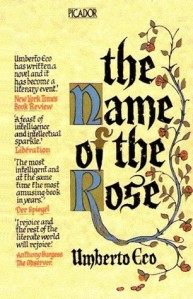 I started Umberto Eco’s The Name of the Rose (1983) with the best intentions of keeping up with Annabel’s buddy read. The first 50–100 pages really flew by and drew me into the mystery of a medieval abbey where monks keep getting murdered in hideous ways. I loved the Sherlockian shrewdness and tenacity of Brother William; the dutiful recording of his sidekick, narrator Adso of Melk; and the intertextual references to Borges’s idea of a library as a labyrinth. But at some point the historical and theological asides and the untranslated snippets of other languages (mostly Latin) began to defeat me, and I ended up just skimming most of the book. I’d recommend this if you liked Samantha Harvey’s The Western Wind, or if you fancy an astronomically more intelligent version of The Da Vinci Code.
A favorite passage: “Books are not made to be believed, but to be subjected to inquiry. When we consider a book, we mustn’t ask ourselves what it says but what it means”
My rating:
“Graphic Medicine”: The Lady Doctor by Ian Williams
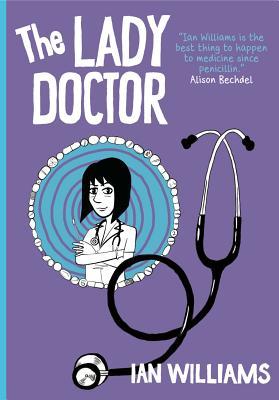 This sequel to Ian Williams’s 2014 graphic novel The Bad Doctor returns to a medical practice in small-town Wales. This time, though, the focus is on Iwan James’s colleague, Dr. Lois Pritchard, who also puts in two days a week treating embarrassing ailments at the local hospital’s genitourinary medicine clinic. At nearly 40, Lois is a divorcee with no children, just a dog. She enjoys nights out drinking with her best friend, Geeta, but her carefree life is soon beset by complications: she has to decide whether she wants to join the health center as a full partner, a tryst with her new fella goes horribly wrong, and her estranged mother suddenly reappears in her life, hoping Lois will give her a liver transplant. And that’s not to mention all the drug addicts and VD-ridden lotharios hanging about.
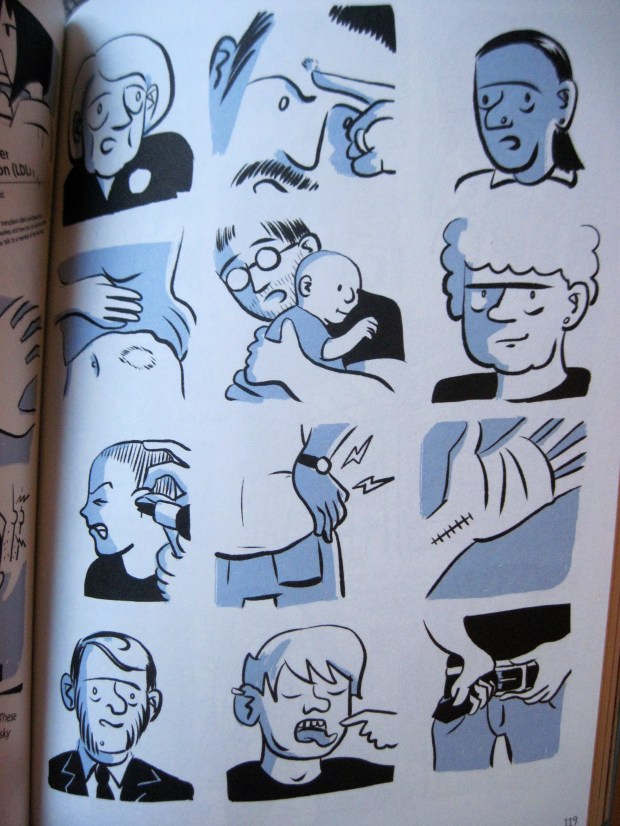
Williams was a GP in North Wales for 20 years; no doubt his experiences have inspired his comics. His tone is wonderfully balanced: there are plenty of hilarious, somewhat raunchy scenes, but also a lot of heartfelt moments as Lois learns that a doctor is never completely off duty and you have no idea what medical or personal challenge will crop up next. The drawing style reminds me of Alison Bechdel’s (and in the cover blurb she says, “Ian Williams is the best thing to happen to medicine since penicillin”), with single colors from pink to olive alternating as the background. I especially loved the pages where each panel depicts a different patient to show the breadth of people and complaints a doctor might see in a day.
This review is on the short side for me, but I don’t want to resort to spoilers, so will just say that if you’re a fan of Bechdel and Posy Simmonds, or if you are unfamiliar with graphic novels and fancy trying one, do seek this out. The medical theme made it a must for me. In fact, Myriad Editions have a whole “Graphic Medicine” series that I’ll be keen to explore.
My rating:
The Lady Doctor will be published in the UK by Myriad Editions on January 31st and in the USA by Penn State University Press on February 18th. My thanks to the publisher and publicist Emma Dowson for the free copy for review.
Recent Poetry Reads
I love interspersing poetry with my other reading, and this year it seems like I’m getting to more of it than ever. Although I try to have a poetry collection on the go at all times, I still consider myself a novice and enjoy discovering new-to-me poets. However, I know many readers who totally avoid poetry because they assume they won’t understand it or it would feel too much like hard work.
Sinking into poems is certainly a very different experience from opening up a novel or a nonfiction narrative. Often I read parts of a poem two or three times – to make sure I’ve taken it in properly, or just to savor the language. I try to hear the lines aloud in my head so I can appreciate the sonic techniques at work, whether rhyming or alliteration. Reading or listening to poetry engages a different part of the brain, and it may be best to experience it in something of a dreamlike state.
I hope you’ll find a book or two that appeals from the selection below.
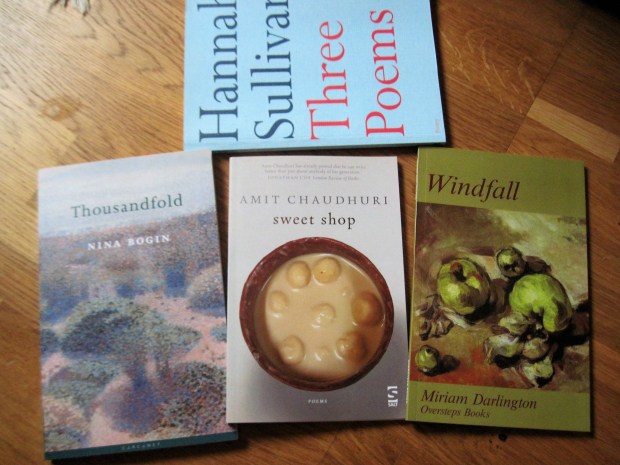
Thousandfold by Nina Bogin (2019)
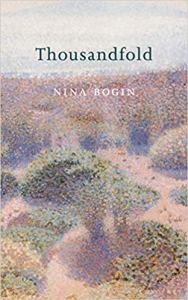 This is a lovely collection whose poems devote equal time to interactions with nature and encounters with friends and family. Birds – along with their eggs and feathers – are a frequent presence. Often a particular object will serve as a totem as the poet remembers the most important people in her life: her father’s sheepskin coat, her grandmother’s pink bathrobe, and the slippers her late husband shuffled around in – a sign of how diminished he’d become due to dementia. Elsewhere Bogin greets a new granddaughter and gives thanks for the comforting presence of her cat. Gentle rhymes and half-rhymes lend a playful or incantatory nature. I’d recommend this to fans of Linda Pastan.
My rating:
Thousandfold will be published by Carcanet Press on January 31st. My thanks to the publisher for the free copy for review.
Sweet Shop by Amit Chaudhuri (2019)
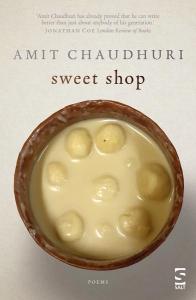 I was previously unfamiliar with Chaudhuri’s work, and unfortunately this insubstantial book about his beloved Indian places and foods hasn’t lured me into trying any more. The one poem I liked best was “Creek Row,” about a Calcutta lane used as a shortcut: “you are a thin, short-lived, / decaying corridor” and an “oesophageal aperture”. I also liked, as stand-alone lines go, “Refugees are periodic / like daffodils.” Nothing else stood out for me in terms of language, sound or theme. Poetry is so subjective; all I can say is that some poets will click with you and others don’t. In any case, the atmosphere is similar to what I found in Korma, Kheer and Kismet: Five Seasons in Old Delhi by Pamela Timms.
My rating: 
My thanks to Salt Publishing for the free copy for review.
Windfall by Miriam Darlington (2008)
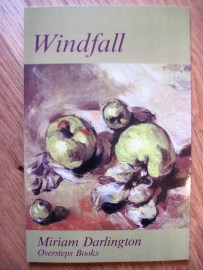 Before I picked this up from the bookstall at the New Networks for Nature conference in November, I had no idea that Darlington had written poetry before she turned to nature writing (Otter Country and Owl Sense). These poems are rooted in the everyday: flipping pancakes, sitting down to coffee, tending a garden, smiling at a dog. Multiple poems link food and erotic pleasure; others make nature the source of exaltation. I loved her descriptions of a heron (“a standing stone / perched in silt / a wrap of grey plumage”) and a blackbird (“the first bird / a glockenspiel in C / an improvisation on morning / a blue string of notes”), Lots of allusions and delicious alliteration. Pick this up if you’re missing Mary Oliver.
My rating:
A Responsibility to Awe by Rebecca Elson (2018)
 Elson, an astronomer who worked on the Hubble Space Telescope, died of breast cancer; this is a reprint of her posthumous 2001 publication. Along with a set of completed poems, the volume includes an autobiographical essay and extracts from her notebooks. Her impending mortality has a subtle presence in the book. I focused on the finished poems, which take their metaphors from physics (“Dark Matter”), mathematics (“Inventing Zero”) and evolution (indeed, “Evolution” was my favorite). In the essay that closes the book, Elson remembers long summers of fieldwork and road trips across Canada with her geologist father (I was reminded of Margaret Atwood’s Cat’s Eye), and traces her academic career as she bounced between the United States and Great Britain.
My rating:
My thanks to Carcanet Press for the free copy for review.
These next two were on the Costa Prize for Poetry shortlist, along with Hannah Sullivan’s Three Poems, which was one of my top poetry collections of 2018 and recently won the T. S. Eliot Prize. I first encountered the work of all three poets at last year’s Faber Spring Party.
Us by Zaffar Kunial (2018)
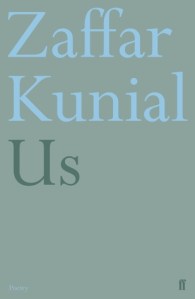 Many of these poems are about split loyalties and a composite identity – Kunial’s father was Kashmiri and his mother English – and what the languages we use say about us. He also writes about unexpectedly developing a love for literature, and devotes one poem to Jane Austen and another to Shakespeare. My favorites were “Self Portrait as Bottom,” about doing a DNA test (“O I am translated. / The speech of numbers. / Here’s me in them / and them in me. … What could be more prosaic? / I am split. 50% Europe. / 50% Asia.”), and the title poem, a plea for understanding and common ground.
My rating:
Soho by Richard Scott (2018)
 When I saw him live, Scott read two of the amazingly intimate poems from this upcoming collection. One, “cover-boys,” is about top-shelf gay porn and what became of the models; the other, “museum,” is, on the face of it, about mutilated sculptures of male bodies in the Athens archaeological museum, but also, more generally, about “the vulnerability of / queer bodies.” If you appreciate the erotic verse of Mark Doty and Andrew McMillan, you need to pick this one up immediately. Scott channels Verlaine in a central section of gritty love poems and Whitman in the final, multi-part “Oh My Soho!”
My rating:
Don’t Call Us Dead by Danez Smith (2017)
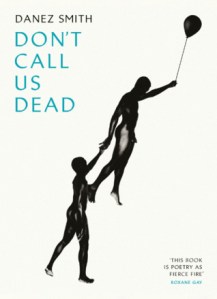 Like Claudia Rankine’s Citizen, this is a book whose aims I can admire even though I didn’t particularly enjoy reading it. It’s about being black and queer in an America where both those identifiers are dangerous, where guns and HIV are omnipresent threats. “reader, what does it / feel like to be safe? white?” Smith asks. “when i was born, i was born a bull’s-eye.” The narrator and many of the other characters are bruised and bloody, with blood used literally but also metaphorically for kinship and sexual encounters. By turns tender and biting, exultant and uncomfortable, these poems are undeniably striking, and a necessary wake-up call for readers who may never have considered the author’s perspective.
My rating:
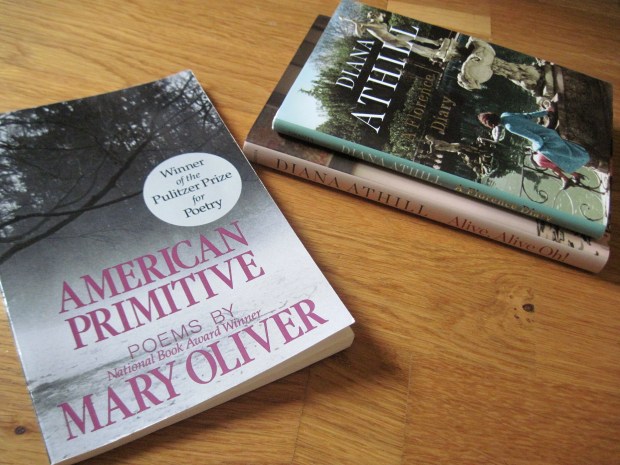
Up next: This Pulitzer-winning collection from the late Mary Oliver, whose work I’ve had mixed success with before (Dream Work is by far her best that I’ve read so far). We lost two great authors within a week! RIP Diana Athill, too, who was 101.
Any recent poetry reads you can recommend to me?
Live Happy by Bridget Grenville-Cleave and Ilona Boniwell: Review & Giveaway
Today is apparently what’s known as “Blue Monday,” the saddest day of the year. It can be hard to find reasons to be cheerful in mid-January, especially given the state of Anglo-American politics. All too often I give in to melancholy on these dark mornings. However, I aim to do better. Gretchen Rubin’s The Happiness Project was one of the most memorable books I read in the second half of last year. What I appreciated most about it was that her approach is not about undertaking extreme actions to try to achieve happiness, but about finding contentment with the life you already have by adding or tweaking small habits.
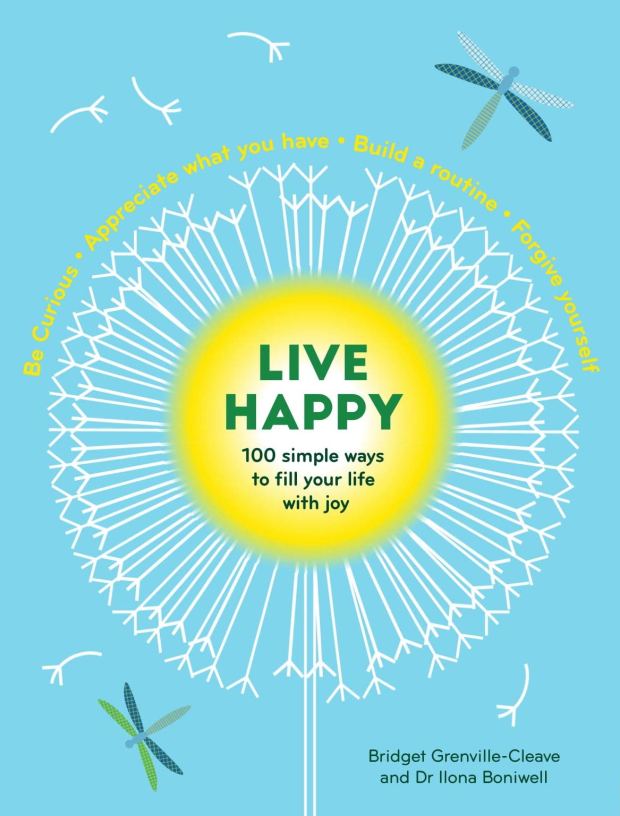
I was keen to see what additional tips I could glean from Live Happy: 100 Simple Ways to Fill Your Life with Joy by positive psychologists Bridget Grenville-Cleave and Ilona Boniwell. They explain that about 50% of the capacity for happiness is genetic, while 10% is related to your current situation. That means that individuals are able to boost their happiness by up to 40% through their attitude and choices.
The key is to focus on what you can influence for the better. The book includes in this category things like luck, health and confidence. I found it difficult to accept the idea that I could choose to have good luck and high energy. It’s just such a foreign concept to me. But according to Grenville-Cleave and Boniwell, perceived control of one’s life course is extremely important.
Live Happy contains good generic advice on diet, use of time, relationships and forming positive habits, though the 100-item format leads to some repetition. In a few cases examples of practical application are necessary; otherwise what we have is just sound bites. For instance, “Try adopting extrovert behaviours such as assertiveness and engaging with others” and “you can also try to face problems head on, rather than simply giving up; you’ll find it easier to bounce back after misfortune.”
On the other hand, I did find specific suggestions that I plan to put into practice. A tip for being more optimistic is to wear a rubber band around your wrist and snap yourself every time you experience an Automatic Negative Thought. I also appreciated these words about making choices: “For unimportant decisions try to be satisfied with an option that is merely good enough, rather than trying to make absolutely the best choice. Lower your expectations – do not expect perfection.”
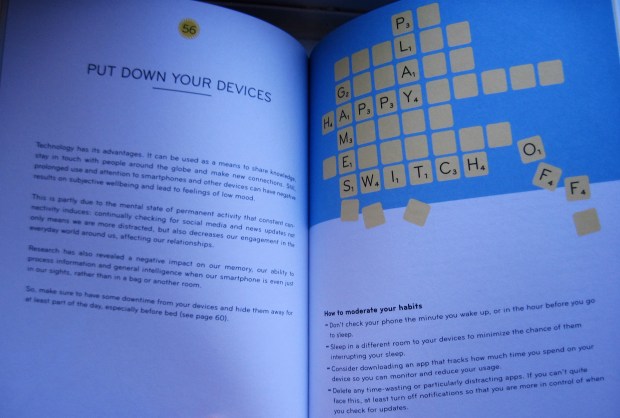
This is an attractive book, with each page containing pull quotes or whimsical drawings that tie into the blue-yellow-green palette. I would recommend it to readers of The Artist’s Way by Julia Cameron, A Manual for Heartache by Cathy Rentzenbrink and Option B by Sheryl Sandberg. It could also make an ideal bedside book for people who aren’t big readers but are interested in injecting a little more happiness into their everyday life.
My rating:
Live Happy was published by Modern Books on January 17th. My thanks to Alison Menzies for arranging my free copy for review.
GIVEAWAY!
If you would be interested in winning a copy of Live Happy, please comment to that effect below and I will choose one winner at random on Monday the 28th (UK only, sorry!).
Wellcome Book Prize 10th Anniversary Blog Tour: Teach Us to Sit Still by Tim Parks (2010)
“Launched in 2009, the Wellcome Book Prize, worth £30,000, celebrates the best new books that engage with an aspect of medicine, health or illness, showcasing the breadth and depth of our encounters with medicine through exceptional works of fiction and non-fiction.” I was delighted to be asked to participate in the official Wellcome Book Prize 10th anniversary blog tour. For this stop on the tour I’m highlighting a shortlisted title from 2010, a very strong year. The winning book, Rebecca Skloot’s The Immortal Life of Henrietta Lacks, along with Siddhartha Mukherjee’s The Emperor of All Maladies, turned me on to health-themed reading and remains one of my most memorable reads of the past decade.
Teach Us to Sit Still: A Sceptic’s Search for Health and Healing by Tim Parks
 Tim Parks, an Englishman, has lived and worked in Italy for over 30 years. He teaches translation at the university in Milan, and is also a novelist and a frequent newspaper columnist on literary topics. Starting in his forties, Parks was plagued by urinary problems and abdominal pain. Each night he had to get up five or six times to urinate, and when he didn’t have fiery pangs shooting through his pelvic area he had a dull ache. Doctors assessed his prostate and bladder in tests that seemed more like torture sessions, but ultimately found nothing wrong. While he was relieved that his worst fears of cancer were allayed, he was left with a dilemma: constant, unexplained discomfort and no medical strategy for treating it.
When conventional medicine failed him, Parks asked himself probing questions: Had he in some way brought this pain on himself through his restless, uptight and pessimistic ways? Had he ever made peace with his minister father’s evangelical Christianity after leaving it for a life based on reason? Was his obsession with transmuting experience into words keeping him from living authentically? During a translation conference in Delhi, he consulted an ayurvedic doctor on a whim and heard words that haunted him: “This is a problem you will never get over, Mr Parks, until you confront the profound contradiction in your character.”
The good news is: some things helped. One was the book A Headache in the Pelvis, which teaches a paradoxical relaxation technique that Parks used for up to an hour a day, lying on a yoga mat in his study. Another was exercise, especially running and kayaking – a way of challenging himself and seeking thrills in a controlled manner. He also started shiatsu therapy. And finally, Vipassana meditation retreats helped him shift his focus off the mind’s experience of pain and onto bodily wholeness. Vipassana is all about “seeing things as they really are,” so the retreats were for him a “showdown with this tangled self” and a chance to face the inevitability of death. Considering he couldn’t take notes at the time, I was impressed by the level of detail with which Parks describes his breakthroughs during meditation.
Though I was uneasy reading about a middle-aged man’s plumbing issues and didn’t always follow the author on his digressions into literary history (Coleridge et al.), I found this to be an absorbing and surprising quest narrative. If not with the particulars, I could sympathize with the broader strokes of Parks’s self-interrogation. He wonders whether sitting at a desk, tense and with poor posture, and wandering around with eyes on the ground and mind on knots of words for years contributed to his medical crisis. Borrowing the title phrase from T.S. Eliot, he’s charted an unlikely journey towards mindfulness in a thorough, bracingly honest, and diverting book that won’t put off those suspicious of New Age woo-woo.
My rating: 
With thanks to Midas PR for the free copy for review.
Wellcome Book Prize 2010
Winner: The Immortal Life of Henrietta Lacks by Rebecca Skloot
Shortlist: Angel of Death by Gareth Williams; Grace Williams Says It Loud by Emma Henderson; So Much for That by Lionel Shriver; Medic by John Nicols and Tony Rennell; Teach Us to Sit Still by Tim Parks
Judges: Comedy writer and television presenter Clive Anderson (chair); novelist and academic Maggie Gee; academic and writer Michael Neve; television presenter and author Alice Roberts; academic and writer A.C. Grayling
The 2019 Wellcome Book Prize longlist will be announced in February. I’m already looking forward to it, of course, and I’m planning to run a shadow panel once again.
Elif Shafak, award-winning author, is the chair of this year’s judges and is joined on the panel by Kevin Fong, consultant anaesthetist at University College London Hospitals; Viv Groskop, writer, broadcaster and stand-up comedian; Jon Day, writer, critic, and academic; and Rick Edwards, broadcaster and author.
See below for details of where other reviews have appeared or will be appearing soon as part of the Wellcome Book Prize 10th anniversary blog tour.

Classic of the Month: Agnes Grey by Anne Brontë
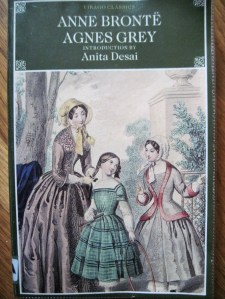 This was my neighborhood book club’s selection for January – a good excuse to also use it for relaunching my Classic of the Month feature. It was 22 months ago (how?!) that I featured Anne Brontë’s The Tenant of Wildfell Hall (1848) as my monthly classic; ever since, I’ve meant to read Anne’s only other novel, Agnes Grey (1847). I’ve now read all the Brontë sisters’ works apart from Shirley, an obscure one by Charlotte. I’d recommend Agnes Grey as a short, accessible classic that echoes Jane Austen with its realistic picture of money/class and romance in nineteenth-century England.
The first-person narrative tells the highly autobiographical tale of a young woman who becomes a governess to support her impoverished family. Agnes is the daughter of a clergyman who makes a poor investment and loses everything, then falls ill. Her sister Mary can make money from her paintings, but with no particular skills and no other choice Agnes sets out to be a governess, first for the Bloomfield family at Wellwood House. The master is exacting and difficult to please, and her four charges are all unruly and obstinate. Worst of all is Tom, who seems almost autistic – he goes into rages and has to be held to calm him down. But the way Agnes writes about these children, it’s as if she thinks they’re not just naughty, but evil. Tom’s wanton cruelty to animals is wielded as a surefire sign of his badness.

It was originally published under a male pseudonym and tacked onto Wuthering Heights. TC Newby, 1847 [Public domain], via Wikimedia Commons.
Here her main charge is the vain, supercilious teenager Rosalie, who, once she realizes Agnes admires the curate, Edward Weston, sets about sidelining Agnes and making him fall for her instead. Agnes is up front with the reader about her feelings for Weston, as in the chapter entitled “Confessions,” and she understands what’s going on with Rosalie’s scheming, but does nothing to combat it, just meekly steps back and lets things play out. Only internally does she allow herself to cry out at the unfairness of it all: “I have lived nearly three-and-twenty years, and I have suffered much, and tasted little pleasure yet: is it likely my life all through will be so clouded?” The Brontës all led fairly sad and small lives. Without giving specific spoilers, I’ll say that Agnes Grey gives Anne the happy ending she didn’t get in life.

Anne Brontë c. 1834, painted by Patrick Branwell Brontë [Public domain], via Wikimedia Commons (restored version).
My rating:
Next month: Doing double duty as my classic and doorstopper will be East of Eden by John Steinbeck, which I’m doing as a buddy read with my mother – we’ll exchange thoughts via e-mail.
 Bookish Beck = Rebecca Foster. American transplant to England. Freelance proofreader and book reviewer.
