The Best Books from the First Half of 2020
My top 10 releases of 2020 thus far, in alphabetical order within genre (nonfiction is dominating the year for me!), are:
Fiction
 The Vanishing Half by Brit Bennett: Like some lost mid-career gem from Toni Morrison, this novel is meaty with questions of racial and sexual identity. Light-skinned African American twins Stella and Desiree Vignes’ paths divide in 1954, with Stella passing as white. Both are desperate to escape from Mallard, Louisiana. The twins’ decisions affect the next generation, too. It’s perceptive and beautifully written, with characters whose struggles feel genuine and pertinent. The themes of self-reinvention and running from one’s past resonate.
 Writers & Lovers by Lily King: Following a breakup and her mother’s sudden death, Casey Peabody is drowning in grief and debt. Between waitressing shifts, she chips away at the novel she’s been writing for six years. Life gets complicated, especially when two love interests appear. We see this character at rock bottom but also when things start to go well at long last. I felt I knew Casey through and through, and I cheered for her. An older, sadder Sweetbitter, perhaps as written by Elizabeth Strout. It gives you all the feels, as they say.
 Weather by Jenny Offill: A blunt, unromanticized, wickedly funny novel about how eco-anxiety permeates everyday life, Weather is in the same aphoristic style as Offill’s Dept. of Speculation. Lizzie is married with a young son and works in a NYC university library. She takes on a second job as PA to her former professor, who runs a podcast on environmental issues. Set either side of Trump’s election, the novel amplifies many voices prophesying doom. Offill’s observations are spot on. Could there be a more perfect book for 2020?
 The Bass Rock by Evie Wyld: There’s no avoiding violence for the women and children of this novel. It’s a sobering theme, certainly, but Wyld convinced me that hers is an accurate vision and a necessary mission. The novel cycles through its three strands in an ebb and flow pattern that seems appropriate to the coastal setting and creates a sense of time’s fluidity. Themes and elements keep coming back, stinging a little more each time. An elegant, time-blending structure and an unrelenting course – that indifferent monolith is the perfect symbol.
Nonfiction
 Dear Life: A Doctor’s Story of Love and Loss by Rachel Clarke: I’ve read so many doctors’ memoirs and books about death and dying; it takes a truly special one like this to stand out. Clarke specializes in palliative medicine and alternates her patients’ stories with her own in a very natural way. A major theme is her relationship with her father, who was also a doctor, and how she absorbed his lessons of empathy and dedication. A passionate and practical book, encouraging readers to be sure they and older relatives have formalized their wishes.
 The Lost Family: How DNA Testing Is Upending Who We Are by Libby Copeland: Gone are the days when people interested in family history had to trawl through microfilm and wait months to learn anything new; nowadays a DNA test can find missing relatives within days. But there are troubling aspects to this new industry, including privacy concerns, notions of racial identity, and criminal databases. Copeland spoke to scientists and 400 laypeople who sent off saliva samples. A thought-provoking book with all the verve and suspense of fiction.
 Greenery: Journeys in Springtime by Tim Dee: From the Cape of Good Hope to the Arctic Circle, Dee tracks the spring as it travels north. From first glimpse to last gasp, moving between his homes in two hemispheres, he makes the season last nearly half the year. His main harbingers are migrating birds, starting with swallows. The book is steeped in allusions and profound thinking about deep time and what it means to be alive in an era when nature’s rhythms are becoming distorted. A fresh, masterful model of how to write about nature.
 Footprints: In Search of Future Fossils by David Farrier: Blending human and planetary history, environmental realism and literary echoes, Farrier, a lecturer in English literature, tells the story of the human impact on the Earth. Each chapter is an intricate blend of fact, experience and story. We’ll leave behind massive road networks, remnants of coastal megacities, plastics, carbon and methane in the permafrost, the fossilized Great Barrier Reef, nuclear waste, and jellyfish-dominated oceans. An invaluable window onto the deep future.
 Losing Eden: Why Our Minds Need the Wild by Lucy Jones: While nature’s positive effect on human mental health is something we know intuitively and can explain anecdotally, Jones wanted to investigate the scientific mechanism behind it. She makes an empirical enquiry but also attests to the personal benefits nature has. Losing Eden is full of common sense and passion, cramming masses of information into 200 pages yet never losing sight of the big picture. Like Silent Spring, on which it is patterned, I can see this leading to real change.
 Diary of a Young Naturalist by Dara McAnulty: McAnulty is the UK’s answer to Greta Thunberg: a leader in the youth environmental movement and an impassioned speaker on the love of nature. This is a wonderfully observant and introspective account of his fifteenth year: of disruptions – moving house and school, of outrage at the state of the world and at individual and political indifference, of the complications of being autistic, but also of the joys of everyday encounters with wildlife. Impressive perspective and lyricism.

The ones I own in print (not pictured: 2 read on Kindle; 1 read via the library).
 The 4.5- or 5-star backlist books that I’ve read this year but haven’t yet written about on here in some way are:
- Kindred by Octavia E. Butler
- Love Medicine by Louise Erdrich
- Small Ceremonies by Carol Shields
What are some of the best books you’ve read so far this year?
What 2020 releases do I need to catch up on right away?
Four June Releases (Fiction & Poetry): Bennett, Gabrielsen, Kwek and Watts
(A rare second post in a day from me, to make way for tomorrow’s list of the best books of the first half of the year.) My four new releases for June are a novel about the complications of race and sexuality in 1950s–80s America, a novella in translation about a seabird researcher struggling through a time of isolation, and two new poetry books from Carcanet Press. As a bonus just in time for Pride Month, I finish with a mini write-up of The Book of Queer Prophets, an anthology of autobiographical essays that was published late last month.
The Vanishing Half by Brit Bennett
 Like some lost mid-career gem from Toni Morrison, this novel is meaty with questions of racial and sexual identity and seems sure to follow in the footsteps of Ruby and An American Marriage with a spot in Oprah’s book club and on Barack Obama’s summer reading list.
It’s the story of light-skinned African American twins Stella and Desiree Vignes, and how their paths divide in 1954. Both are desperate to escape from Mallard, Louisiana, where their father was lynched and their mother cleans white people’s houses. Desiree works in fingerprinting for the FBI in Washington, D.C., but in 1968 leaves an abusive marriage to return to Mallard with her dark-skinned daughter, Jude Winston. Stella, on the other hand, has been passing as white for over a decade. She was a secretary for the man who became her husband, Blake Sanders, and now lives a life of comfort in a Los Angeles subdivision.
The twins’ decisions affect the next generation, too. Both have one daughter. Jude goes to college in L.A., where she meets and falls in love with photographer Reese (born Therese), who is, in a different sense, “passing” until he can afford the surgery that will align his body with his gender. In a coincidence that slightly strains belief, Jude runs into Stella’s daughter, Kennedy, and over the next seven years the cousins – one a medical student; the other an actress – continue to meet occasionally, marvelling at how two family lines that started in Mallard, a tiny town that doesn’t even exist anymore, could have diverged so dramatically.
This is Bennett’s second novel, after The Mothers, which I’m keen to read. It’s perceptive and beautifully written, with characters whose struggles feel genuine and pertinent. Though its story line ends in the late 1980s, it doesn’t feel passé at all. The themes of self-reinvention and running from one’s past resonate. I expected certain characters to be forced into moments of reckoning, but the plot is a little messier than that – and that’s more like real life. A shoo-in for next year’s Women’s Prize list.
My rating: 
My thanks to Dialogue Books for the free copy for review.
Ankomst by Gøhril Gabrielsen (2017)
[Translated from the Norwegian by Deborah Dawkin]
 The unnamed narrator of Gabrielsen’s fifth novel is a 36-year-old researcher working towards a PhD on the climate’s effects on populations of seabirds, especially guillemots. During this seven-week winter spell in the far north of Norway, she’s left her three-year-old daughter behind with her ex, S, and hopes to receive a visit from her lover, Jo, even if it involves him leaving his daughter temporarily. In the meantime, they connect via Skype when signal allows. Apart from that and a sea captain bringing her supplies, she has no human contact.
Daily weather measurements and bird observations still leave too much time alone in a cramped cabin, and this starts to tell in the protagonist’s mental state: she’s tormented by sexual fantasies, by memories of her life with S, and by the thought of a local family, the Berthelsens, who experienced a disastrous house fire in 1870. More and more frequently, she finds herself imagining what happened to Olaf and Borghild Berthelsen. Solitude and this growing obsession with ghosts of the past make her start to lose her grip on reality.
I’d encountered an unreliable narrator and claustrophobic setting before from Gabrielsen with her second novel, The Looking-Glass Sisters. Extreme weather and isolation account for this being paired with Snow, Dog, Foot by Claudio Morandini as the first two books in Peirene’s 2020 “Closed Universe” trilogy. I was also reminded of Sarah Moss’s Night Waking. However, I found this novella’s metaphorical links – how seabirds and humans care for their young; physical and emotional threats; lowering weather and existential doom – too obvious.
My rating: 
My thanks to Peirene Press for the free copy for review.
Moving House by Theophilus Kwek
 This is the first collection of the Chinese Singaporean poet’s work to be published in the UK. Infused with Asian history, his elegant verse ranges from elegiac to romantic in tone. Many of the poems are inspired by historical figures and real headlines. There are tributes to soldiers killed in peacetime training and accounts of high-profile car accidents; “The Passenger” is about the ghosts left behind after a tsunami. But there are also poems about the language and experience of love. I also enjoyed the touches of art and legend: “Monologues for Noh Masks” is about the Pitt-Rivers Museum collection, while “Notes on a Landscape” is about Iceland’s geology and folk tales. In most places alliteration and enjambment produce the sonic effects, but there are also a handful of rhymes and half-rhymes, some internal.
My individual favorite poems included “Prognosis,” “Sophia” (made up of two letters Sir Thomas Stamford Raffles writes home to his wife while surveying in Singapore), and “Operation Thunderstorm.” As an expat and something of a nomad, I especially loved the title poem, which comes last and explains the cover image: “every house has a skeleton – / while the body learns it must carry less / from place to place, a kind of tidiness / that builds, hardens. Some call it fear, // of change, or losing what we cannot keep. / Others, experience.” Recommended to fans of Mary Jean Chan, Nausheen Eusuf, Kei Miller and Ocean Vuong.
My rating:
My thanks to Carcanet Press for the PDF copy for review.
Red Gloves by Rebecca Watts
 I noted the recurring comparison of natural and manmade spaces; outdoors (flowers, blackbirds, birds of prey, the sea) versus indoors (corridors, office life, even Emily Dickinson’s house in Massachusetts). The style shifts from page to page, ranging from prose paragraphs to fragments strewn across the layout. Most of the poems are in recognizable stanzas, though these vary in terms of length and punctuation. Alliteration and repetition (see, as an example of the latter, her poem “The Studio” on the TLS website) take priority over rhymes. I was reminded of Elizabeth Bishop in places, while “Whereas” had me thinking of Stephen Dunn’s collection of that name (Layli Long Soldier also has a poetry book of the same title). A few of my individual favorite poems were “Surveillance,” “Building” and “Admission” (on a medical theme: “What am I afraid of? / The breaching of skin. / Violation of laws that / separate outside from in. / Liquidation of the thing / I call me.”).
My rating: 
My thanks to Carcanet Press for the PDF copy for review.
And a bonus for Pride Month:
The Book of Queer Prophets: 24 Writers on Sexuality and Religion, edited by Ruth Hunt
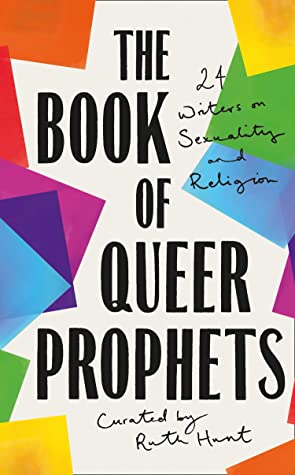 There isn’t, or needn’t be, a contradiction between faith and queerness, as the authors included in this anthology would agree. Many of them are stalwarts at Greenbelt, a progressive Christian summer festival – Church of Scotland minister John L. Bell even came out there, in his late sixties, in 2017. I’m a lapsed regular attendee, so a lot of the names were familiar to me, including those of poets Rachel Mann and Padraig O’Tuama.
Most of the contributors are Christian, then, including ordained priests like Desmond Tutu’s daughter, Mpho, and LGBT ally Kate Bottley, but we also hear from Michael Segalov, a gay Jewish man in London, and from Amrou Al-Kahdi (author of Unicorn: The Memoir of a Muslim Drag Queen), who describes the affirmation they found in the Sufi tradition. Dustin Lance Black tells of the exclusion LGBT Mormons still encounter.
Jarel Robinson-Brown addresses his lament on mistreatment to his nephew, as James Baldwin did in “My Dungeon Shook” (in The Fire Next Time). Tamsin Omond recounts getting married to Melissa on a London bridge in the middle of an Extinction Rebellion protest. Erin Clark, though bisexual, knows she can pass as straight because she’s marrying a man – so is she ‘gay enough?’ Two trans poets write of the way cathedrals drew them into faith. The only weaker pieces are by Jeanette Winterson (there’s nothing new if you’ve read her memoir) and Juno Dawson (entirely throwaway; ‘I’m an atheist, but it’s okay to be religious, too’).
Again and again, these writers voice the certainty that they are who God means them to be. A few of them engage with particular passages from the Bible, offering contextual critiques or new interpretations, but most turn to scripture for its overall message of love and justice. Self-knowledge is a key component of their search for truth. And the truth sets people free.
My rating:
I read an e-copy via NetGalley.
What recent releases can you recommend?
Library Checkout: June 2020
It looks like my public library system may still be partially closed into July, although there are rumors of an order and collection service starting soon. I’ve signed up to be a library volunteer, so hopefully I can be a part of it.
Will I be able to stock up again next month? I do hope so, as I have a list of 14 books that I plan to borrow and another 21 that I plan to reserve just as soon as the building and catalogue are up and running again. Stay tuned to find out…

Are you out of library books, or have you been able to borrow more lately, perhaps via curbside pickup? Feel free to use the image above and leave a link to your blog in the comments if you’ve taken part in Library Checkout (which runs on the last Monday of every month), and/or tag me on Twitter (@bookishbeck / #TheLibraryCheckout).
READ
- The Trick Is to Keep Breathing by Janice Galloway (a buddy read with Buried in Print)
CURRENTLY READING
- Reading with Patrick: A teacher, a student and the life-changing power of books by Michelle Kuo
- Meet the Austins by Madeleine L’Engle [set aside temporarily]
- Property by Valerie Martin
CURRENTLY SKIMMING
- My Own Country by Abraham Verghese
CHECKED OUT, TO BE READ
- The Song of the Lark by Willa Cather
- Owls Do Cry by Janet Frame
- When I Lived in Modern Times by Linda Grant
- Becoming a Man by Paul Monette
- Woman on the Edge of Time by Marge Piercy
- Golden Boy by Abigail Tarttelin
ON HOLD, TO BE PICKED UP
- The Girl with the Louding Voice by Abi Daré
IN THE RESERVATION QUEUE
- Queenie by Candice Carty-Williams
- Can You Hear Me? A Paramedic’s Encounters with Life and Death by Jake Jones
- The Accidental Countryside by Stephen Moss
- Redhead by the Side of the Road by Anne Tyler
TO RETURN UNFINISHED
- The Mirror and the Light by Hilary Mantel
TO RETURN UNREAD
- What Are We Doing Here?: Essays by Marilynne Robinson
- Feel Free: Essays by Zadie Smith
What appeals from my stacks?
Doorstopper of the Month: The Emperor’s Children by Claire Messud (2006)
My impression of Claire Messud is that she’s admired by critics but unpopular with ordinary readers (e.g. this novel has a catastrophically low average rating on Goodreads, probably because of that “unlikable characters” chestnut). I fit into both categories, so was curious to see where I would fall on the appreciation spectrum. Doubly intrigued by Susan’s inclusion of The Emperor’s Children on her list of top New York novels, I finally picked up the copy I’d gotten from the free mall bookshop where I volunteered weekly in ordinary times.
 I don’t think it’s a spoiler to tell you that this is a 9/11 novel. It opens in March 2001 and covers the next eight months, with “the towers” first getting a mention at the halfway point. There’s heavy irony in one character commenting to another in the first week of September, “Whatever else they may be, our times are almost criminally uninteresting. The dullest times ever.” As in a couple of novels I read last year (not naming them in case that is a spoiler), the terrorist attacks wake the main characters up from a stupor of entitlement and apathy.
The trio of protagonists, all would-be journalists aged 30, have never really had to grow up. Marina still lives with her parents, social worker Annabel and respected cultural pundit Murray Thwaite. She got an advance to write a book on children’s fashions, but the project has languished for years. Her best friend Danielle is a documentary maker mired in an affair with an older man. Their other close pal is half-Vietnamese Julius, whose new boyfriend keeps him in the luxurious lifestyle to which he’s become accustomed.
The arrival of two young men sets the plot in motion. Through Danielle, Marina meets Ludovic Seeley, who has moved from Australia to New York City to launch a magazine, The Monitor, for which he is soliciting cutting-edge cultural exposés. Meanwhile, Murray’s nephew, college dropout Frederick Tubb, who has the unfortunate nickname of “Bootie,” has moved to the City to seek his fortune. Murray offers him a job as his amanuensis, but what Bootie learns leads him to wish he could expose his idolized uncle as an intellectual fraud.
For these characters, leaving an extended childhood behind means getting out from under the shadow of a previous generation and reassessing what is admirable and who is expendable. As Marina’s book title (The Emperor’s Children Have No Clothes) indicates, appearance and substance do not always match. I won’t give away what 9/11 means for this fictional world, though I’d be interested in discussing it in the comments with anyone who’s read the book. Bootie was my favorite, and what happens with him is particularly interesting.
This was thoroughly engrossing: richly textured and intellectually satisfying in a way that might call to mind George Eliot and Edith Wharton – or, more recently, Jennifer Egan and Zadie Smith. Great American Novel territory, for sure. I’ll be keen to read more by Messud.
Page count: 581
My rating: 
Reading Statistics for the First Half of 2020, Including Where My Books Came From
Almost halfway through the year: how am I doing on the reading goals I set for myself? Pretty well!
- It might not look like it from the statistics below, but I have drastically cut down on the number of review copies I’m requesting or accepting from publishers. (This time last year they made up 43% of my reading.)
- I’ve reread nine books so far, which is more than I can remember doing in any other year – and I intend to continue prioritizing rereads in the remaining months.
- Thanks to COVID-19, over the past few months I have been reading a lot less from the libraries I use and, consequently, more from my own shelves. This might continue into next month but thereafter, when libraries reopen, my borrowing will increase.
- I’ve also bought many more new books than is usual for me, to directly support authors and independent bookshops.
- I’m not managing one doorstopper per month (I’ve only done May so far, though I have a few lined up for June‒August), but I am averaging at least one classic per month (I only missed January, but made up for it with multiple in two other months).
- On literature in translation, I’m doing better: it’s made up 9.7% of my reading, versus 8.1% in 2019.
The breakdown:
Fiction: 57.6%
Nonfiction: 36.3%
Poetry: 6.1%
(This time last year I’d read exactly equal numbers of fiction and nonfiction books. Fiction seems to be winning this year. Poetry is down massively: last June it was at 15.4%.)
Male author: 34.7%
Female author: 63.5%
Anthologies with pieces by authors of multiple genders: 1.8%
(No non-binary authors so far this year. Even more female-dominated than last year.)
E-books: 12.7%
Print books: 87.3%
(E-books have crept up a bit since last year due to some publishers only offering PDF review copies during the pandemic, but I have still been picking up many more print books.)
I always find it interesting to look back at where my books come from. Here are the statistics for the year so far, in percentages (not including the books I’m currently reading, DNFs or books I only skimmed):
- Free print or e-copy from the publisher: 25.5%
- Public library: 21.2%
- Free, e.g. from Book Thing of Baltimore, local swap shop or free mall bookshop: 16.4%
- Secondhand purchase: 10.3%
- Downloaded from NetGalley or Edelweiss: 8.5%
- New purchase: 7.3%
- Gifts: 5.4%
- University library: 5.4%
How are you doing on any reading goals you set for yourself?
Where do you get most of your books from?
All the Books I’ve Abandoned So Far This Year
Hard to believe, especially with the bizarre few months we’ve been having, but it’s mid-year review time already. I’ll do two more posts this month rounding up my reading from the first half of 2020: where my books came from, and the best releases so far. But first, let’s get this out of the way.
I encourage readers to give up on books they are not enjoying, at any time and for any reason (tone, voice, writing style, distressing subject matter, similarity to other things you’ve read, whatever). I’ve DNFed 27 books so far this year, equating to roughly 15% of what I started. That’s my usual average, so not a particular problem as far as I’m concerned.
To keep it short and sweet, especially as I have mentioned a number of these before, e.g. in a Library Checkout or Six Degrees post, I’m listing the pages or percentage read and dispatching each book with a two-word summary using the template “Too ______”. (I am aware of how reductive and unfair this is.) These are in rough chronological order of my attempted reading. Asterisks denote the books I intend to try again someday.
*The Street by Ann Petry: 32 pages. Too dated.
Short Short Stories by Dave Eggers: 22 pages. Too raunchy.
The Year without Summer by Guinevere Glasfurd: 21 pages. Too dull.
When All Is Said by Anne Griffin: 60 pages. Too sentimental.
The Tenderness of Wolves by Stef Penney: 162 pages. Too plodding.
Running the Rift by Naomi Benaron: 25 pages. Too self-aware.
The Story of a Marriage by Andrew Sean Greer: 93 pages. Too obvious.
Journalism by Joe Sacco: 21 pages. Too gritty.
Run by Ann Patchett: 80 pages. Too contrived.
*Jazz by Toni Morrison: 100 pages. Too dense.
On Turpentine Lane by Elinor Lipman: 30 pages. Too false.
Things We Say in the Dark by Kirsty Logan: 20-something pages. Too weird.
*Norwegian Wood by Haruki Murakami: 20 pages. Too normal.
*The Warlow Experiment by Alix Nathan: 20 pages. Too ponderous.
*Such a Fun Age by Kiley Reid: 15 pages. Too hip.
Djinn Patrol on the Purple Line by Deepa Anappara: 3 pages. Too precocious.
The Night Brother by Rosie Garland: 5 pages. Too unremarkable.
The Giver of Stars by Jojo Moyes: 4 pages. Too bland.
My Wild, Sleepless Nights: A Mother’s Story by Clover Stroud: 5 pages. Too (m)othering.
Godshot by Chelsea Bieker: 30%. Too Handmaid’s.
The Cruellest Month by Louise Penny: 34 pages. Too undistinguished.
On Beauty by Zadie Smith [an attempted reread]: 107 pages. Too stereotyping.
*Everything Is Illuminated by Jonathan Safran Foer [an attempted reread]: 35 pages. Too quirky.
The Bumblebee Flies Anyway: A year of gardening and (wild)life by Kate Bradbury: 24 pages. Too middling.
The Animals at Lockwood Manor by Jane Healey: 11%. Too familiar.
The Paris Library by Janet Skeslien Charles: 18 pages. Too twee.
Up with the Larks: Starting Again in Cornwall: My First Year as a Seaside Postie by Tessa Hainsworth: 80 pages. Too lite.
Any DNFs for you this year?
20 Books of Summer, #3–4: Ella Minnow Pea & Eating for England
June hasn’t seen much progress on this project – though I’m currently on my fifth read, Kitchen Confidential by Anthony Bourdain, and enjoying it a lot – so July and August will need to include eight food- and drink-themed books each.
Today I have a reread of a funny (yet more serious than I remembered) favorite and a light collection of mini-essays on the English love affair with particular foodstuffs.
Ella Minnow Pea by Mark Dunn (2001)
From my original Bookkaholic review from 2013:
Dunn’s debut is a book of letters – in more senses than one. It is a fairly traditional epistolary novel, but also toys with the letters of the alphabet: the wordy citizens of the island nation of Nollop are zealously engaged in creating pangrams (pithy sentences that contain each letter of the alphabet) in tribute to their founder, Nevin Nollop, who authored “The quick brown fox jumps over the lazy dog,” the original pangram displayed in ceramic tiles on his statue in the public square. But things go awry when particular letters start falling off the monument.
A superstitious lot, the Nollop Council decide that the fallen letters can no longer be used, and the characters’ missives become increasingly constrained as they have to avoid certain vowels and consonants. Their writing grows exponentially avant-garde and hilarious as they resort to circumlocutions and phonetic spellings. Before long only L, M, N, O, and P can be used – which, handily, still allows for an approximation of the title character’s name. A madcap journey through the English language and its use in literature: enjoy the ride.
On this rereading…
 I engaged more with the individual characters: Ella and her parents, aunt and cousin; other members of the community; and a few off-island visitors who lead the research into what’s happening with the letters. I was also struck much more by the political satire: freedom of speech is endangered in a repressive society slavishly devoted to a sacred text. Those who continue to use forbidden letters are turned in by their neighbors or enemies and get 1) a warning, 2) a flogging or time in the headstocks, and 3) banishment. The council members see themselves as interpreting the will of Nollop, and believe the pangram to be a miraculous sentence that can never be bettered – but the citizens prove them wrong by creating a superior example (using only 32 letters, versus the fox’s 35) purely by accident.
A remembered favorite line that my husband and I often quote to each other – “No mo Nollop poop!” – doesn’t exist (it’s actually “No mo Nollop pomp! No mo Nollop poo poo!”). My favorite alternative phrase is “terminal-cot” for deathbed once D is disallowed. I also love the new days of the week: Sunshine, Monty, Toes, Wetty, Thurby, Fribs and Satto-Gatto.
Laugh-out-loud silliness plus a sly message about science and reason over superstition: a rare combination that makes this an enduring favorite. I also recommend Dunn’s Ibid: A Life (2004), which is told entirely through the footnotes of a biography, taking “reading between the lines” to a whole new level. I haven’t enjoyed his other novels as much as these two.
Source: Salvation Army store, Cambridge (September 2016)
My original rating (Borrowed from a friend – in 2007?):
My rating now:
Eating for England by Nigel Slater (2007)
 Nigel Slater is a foodie known in the UK for his television programs and newspaper columns. Not as edgy as Gordon Ramsay, as matey as Jamie Oliver, or as ethically clued-in as Hugh Fearnley-Whittingstall, he doesn’t have a particular shtick. A middle-of-the road, middle-class type, he’s all about simple comfort food. We have a few of his cookbooks.
As in his memoir, Toast (2004), food links in to nostalgia for childhood. In 200 or so essays that range from a paragraph to a few pages in length, Slater extols everything from marmalade to Brussels sprouts. He devotes by far the most time to the sweet stuff, though, considering the respective merits of every type of biscuit, candy, chocolate bar and pudding. There’s a clear love here for teatime treats (“Afternoon tea may be the only meal we take that is purely and utterly for pleasure”) and for stodge (“Is there something in our demeanour, our national psyche, which makes heavy, rather bland food sit so comfortably with us?”).
This was all pleasant, if inconsequential. I enjoy ‘observing the English’-type books because I’m familiar enough to recognize everything but still foreign enough to enjoy the quaintness and contradictions. What rubbed me the wrong way, though, were the arch portraits of kinds of cooks. I don’t often write in my books, but I found myself leaving corrective comments in the margins in a few places, especially on “The Slightly Grubby Wholemeal Cook,” an unhelpful stereotype of the “dirty hippie.” His ideas about hygiene and political correctness are a little off in this one. I also objected to his annoyance at people who won’t simply split the bill after a meal out (I’ll pay for what I ordered, thank you), and his defense of the gollywog used in Robertson’s advertising seems particularly ill judged at the current moment.
Source: Charity shop in Newton Stewart (Wigtown trip, April 2018)
My rating:
Classic of the Month: Cider with Rosie by Laurie Lee (1959)
 (20 Books of Summer #2) Lee’s quaint family memoir is set in the years immediately after World War I. He was born in 1914 and his childhood unfolded in Stroud, Gloucestershire and nearby village Slad. I started reading Cider with Rosie in April 2019 when we stopped in Stroud for a night on the way back from a holiday in Devon. I got through the first 100 pages quickly, with the voice reminding me slightly of Gerald Durrell’s in his autobiographical trilogy, but then set the book aside for over a year before picking it back up for this summer’s food- and drink-themed reading. Taking such a long break wasn’t a major problem because the book’s vignettes are thematically arranged, so there was no plot as such to lose track of.
Lee was part of his father’s second brood, born out of the widower’s remarriage to his housekeeper. His father left his new family after just a few years, and for the next three decades Lee’s mother dutifully waited for a return that never came. Lee was a sickly child, doted on by his older half-sisters. He was surrounded by a large wider family of brothers, eccentric war-veteran uncles and duelling elderly neighbors who lived one upstairs and one downstairs in a sort of granny annex attached to their untidy, rambling 17th-century stone house. The book depicts a village on the cusp of modernization: everything was still done with wagons and horses, but that was soon to change.
It’s a nostalgic, evocative look at a country childhood. Lee captures a bygone era, portraying himself as similarly on the precipice of losing innocence. The title comes from a late moment when Rosie Burdock tempts the adolescent Lee with alcoholic cider and kisses underneath a hay wagon. This penultimate chapter on the lust of the flesh takes an alarming turn as he describes the village boys’ planned gang rape of a religious 16-year-old, Lizzy. Lee was among the boys who followed her into the woods one Sunday after church. Luckily, they lost their nerve and nothing happened, but Lee’s blasé recounting felt out of keeping and somehow more dated than the rest of his material. It left a sourness I couldn’t get over.
Quintessentially English but not as purely delightful as I expected, this was still a book I valued for its characterization and its description of golden moments in memory.
Some favorite passages:
“Summer, June summer, with the green back on earth and the whole world unlocked and seething – like winter, it came suddenly and one knew it in bed, almost before waking up; with cuckoos and pigeons hollowing the woods since daylight and the chipping of tits in the pear-blossom.”
“Myself, my family, my generation, were born in a world of silence; a world of hard work and necessary patience, of backs bent to the ground, hands massaging the crops, of waiting on weather and growth; of villages like ships in the empty landscapes and the long walking distances between them; … [The horse’s] eight miles an hour was the limit of our movements, as it had been since the days of the Romans. That eight miles an hour was life and death, the size of our world, our prison.”
Source: Free bookshop
My rating:
Ten more childhood memoirs:
A few I’ve written about here and prefer:
- Boy by Roald Dahl
- To the Is-land by Janet Frame
- Don’t Let’s Go to the Dogs Tonight by Alexandra Fuller
- Bookworm by Lucy Mangan
- Period Piece by Gwen Raverat
A couple of favorites I’ve never written up:
- Oleander, Jacaranda by Penelope Lively
- Hellfire and Herring by Christopher Rush
Plus a few that I haven’t liked quite as much:
- Maggie & Me by Damian Barr
- Childhood by Tove Ditlevsen
- Rosie by Rose Tremain
Three Out-of-the-Ordinary Memoirs: Kalb, Machado, McGuinness
Recently I have found myself drawn to memoirs that experiment with form. I’ve read so many autobiographical narratives at this point that, if it’s to stand out for me, a book has to offer something different, such as a second-person point-of-view or a structure of linked essays. Here are a few such that I’ve read this year but not written about yet. All have strong themes of memory and the creation of the self or the family.
Nobody Will Tell You This But Me: A True (As Told to Me) Story by Bess Kalb (2020)
 You know from the jokes: Jewish (grand)mothers are renowned for their fiercely protective, unconditional love, but also for their tendency to nag. Both sides of a stereotypical matriarch are on display in this funny and heartfelt family memoir, narrated in the second person – as if straight to Kalb from beyond the grave – by her late grandmother, Barbara “Bobby” Bell.
Bobby gives her beloved Bessie a tour through four generations of strong women, starting with her own mother, Rose, and her lucky escape from a Belarus shtetl. The formidable émigré ended up in a tiny Brooklyn apartment, where she gave birth to five children on the dining room table. Bobby and her husband, a real estate entrepreneur and professor, had one daughter, Robin, who in turn had one daughter, Bess. Bobby and Robin had a fraught relationship, but Bess’s birth seemed to reset the clock. Grandmother and granddaughter had a special bond: Bobby was the one to take her to preschool and wait outside the door until she was sure she’d be okay, and always the one to pick her up from sleepovers gone wrong.
Kalb is a Los Angeles-based writer for Jimmy Kimmel Live! With her vivid scene-setting and comic timing, you can see why she’s earned a Writers Guild Award and an Emmy nomination. But she also had great material to work with: Bobby’s e-mails and verbatim voicemail messages are hilarious. Kalb dots in family photographs and recreates in-person and phone conversations, with her grandmother forthrightly questioning her fashion choices and non-Jewish boyfriend. As the title phrase shows, Bobby felt she was the only one who would come forward with all this (unwanted but) necessary advice. Kalb keeps things snappy, alternating between narrative chapters and the conversations and covering a huge amount of family history in just 200 pages. It gets a little sentimental towards the end, but with her grandmother’s death still fresh you can forgive her that. This was a real delight.
My rating:
My thanks to Zoe Hood and Kimberley Nyamhondera of Little, Brown (Virago) for the free PDF copy for review.
In the Dream House: A Memoir by Carmen Maria Machado (2019)
I’m stingy with 5-star ratings because, for me, giving a book top marks means a) it’s a masterpiece, b) it’s a game/mind/life changer, and/or c) it expands the possibilities of its particular genre. In the Dream House fits all three criteria. (Somewhat to my surprise, given that I couldn’t get through more than half of Machado’s acclaimed story collection, Her Body and Other Parties, and only enjoyed it in parts.)
Much has been written about this memoir of an abusive same-sex relationship since its U.S. release in November. I feel I have little to add to the conversation beyond my deepest admiration for how it prioritizes voice, theme and scenes; gleefully does away with the chronology and (not directly relevant) backstory – in other words, the boring bits – that most writers would so slavishly detail; and engages with history, critical theory and the tropes of folk tales to constantly interrogate her experiences and perceptions.
 Most of the book is, like the Kalb, in the second person, but in this case the narration is not addressing a specific other person; instead, it’s looking back at the self that was caught in this situation (“If, one day, a milky portal had opened up in your bedroom and an older version of yourself had stepped out and told you what you know now, would you have listened?”), as well as – what the second person does best – putting the reader right into the narrative.
The “Dream House” is the Victorian house where Machado lived with her ex-girlfriend in Bloomington, Indiana for two years while she started an MFA course. It was a paradise until it wasn’t; it was a perfect relationship until it wasn’t. No one, least of all her, would have believed the perky little blonde writer she fell for would turn sadistic. A lot of it was emotional manipulation and verbal and psychological abuse, but there was definitely a physical element as well. Fear and self-doubt kept her trapped in a fairy tale that had long since turned into a nightmare. Writing it all out seven years later, the trauma was still there. Yet there was no tangible evidence (a police report, a restraining order, photos of bruises) to site her abuse anywhere outside of her memory. How fleeting, yet indelible, it had all been.
The book is in relatively short sections headed “Dream House as _________” (fill in the blank with everything from “Time Travel” to “Confession”), and the way that she pecks at her memories from different angles is perfect for recreating the spiral of confusion and despair. She also examines the history of our understanding of queer domestic violence: lesbian domestic violence, specifically, wasn’t known about until 30-some years ago.
The story has a happy ending in that Machado is now happily married. The bizarre twist, though, is that her wife, YA author Val Howlett, was the girlfriend of the woman in the Dream House when they first met. To start with, it was an “open relationship” (or at least the blonde told her so) that Machado reluctantly got in the middle of, before Val drifted away. That the two of them managed to reconnect, and got past their mutual ex, is truly astonishing. (See some super-cute photos from their wedding here.)
Some favorite lines:
“Clarity is an intoxicating drug, and you spent almost two years without it, believing you were losing your mind”
“That there’s a real ending to anything is, I’m pretty sure, the lie of all autobiographical writing. You have to choose to stop somewhere. You have to let the reader go.”
My rating: 
I read an e-copy via NetGalley.
Other People’s Countries: A Journey into Memory by Patrick McGuinness (2014)
This is a wonderfully atmospheric tribute to Bouillon, Belgium, a Wallonian border town with its own patois. However, it’s chiefly a memoir about the maternal side of the author’s family, which had lived there for generations. McGuinness grew up spending summers in Bouillon with his grandparents and aunt. Returning to the place as an adult, he finds it half-derelict but still storing memories around every corner.
 It is as much a tour through memory as through a town, reflecting on how our memories are bound up with particular sites and objects – to the extent that I don’t think I would find McGuinness’s Bouillon even if I went back to Belgium. “When I’m asked about events in my childhood, about my childhood at all, I think mostly of rooms. I think of times as places, with walls and windows and doors,” he writes. The book is also about the nature of time: Bouillon seems like a place where time stands still or moves more slowly, allowing its residents (including his grandfather, and Paprika, “Bouillon’s laziest man, who held a party to celebrate sixty years on the dole”) a position of smug idleness.
The book is in short vignettes, some as short as a paragraph; each is a separate piece with a title that remembers a particular place, event or local character. Some are poems, and there are also recipes and an inventory. The whole is illustrated with frequent period or contemporary black-and-white photographs. It’s an altogether lovely book that overcomes its narrow local interest to say something about how the past remains alive for us.
Some favorite lines:
“that hybrid long-finished but real-time-unfolding present tense … reflects the inside of our lives far better than those three stooges, the past, present and future”
a fantastic last line: “What I want to say is: I misremember all this so vividly it’s as if it only happened yesterday.”
My rating:
I read a public library copy.
Other unusual memoirs I’ve loved and reviewed here:
 Notes Made while Falling by Jenn Ashworth (essays, experimental structures)
Winter Journal by Paul Auster (second person)
This Really Isn’t about You by Jean Hannah Edelstein (nonchronological)
Traveling with Ghosts by Shannon Leone Fowler (short sections and time shifts)
The Lost Properties of Love by Sophie Ratcliffe (nonchronological essays)
Any offbeat memoirs you can recommend?
Adventures in Rereading: The Sixteenth of June by Maya Lang
Last year I reviewed Tenth of December by George Saunders on its title date; this year I couldn’t resist rereading one of my favorites from 2014 for today’s date (which just so happens to be Bloomsday, made famous by James Joyce’s Ulysses), The Sixteenth of June.
I responded to the novel at length when it first came out. No point in reinventing the wheel, so here are mildly edited paragraphs of synopsis from my review for The Bookbag:
 Maya Lang’s playful and exquisitely accomplished debut novel, set on the centenary of the original Bloomsday, transplants many characters and set pieces from Ulysses to near-contemporary Philadelphia. Don’t fret, though – even if, like me, you haven’t read Ulysses, you’ll have no trouble following the thread. In fact, Lang dedicates her book to “all the readers who never made it through Ulysses (or haven’t wanted to try).” (Though if you wish to spot parallels, pull up any online summary of Ulysses; there is also a page on Lang’s website listing her direct quotations from Joyce.)
On June 16, 2004, brothers Leopold and Stephen Portman have two major commitments: their grandmother Hannah’s funeral is happening at the local synagogue in the morning; and their parents’ annual Bloomsday party will take place at their opulent Delancey Street home in the evening. Around those two thematic poles – the genuine emotions of grief and regret on the one hand, and the realm of superficial entertainment on the other – the novel expands outward to provide a nuanced picture of three ambivalent twenty-something lives.
The third side of this atypical love triangle is Nora, Stephen’s best friend from Yale – and Leo’s fiancée. Nora, a trained opera singer, is still reeling from her mother’s death from cancer one year ago. She’s been engaging in self-harming behavior, and Leo – a macho, literal-minded IT consultant – just wants to fix her. Nora and Stephen, by contrast, are sensitive, artistic souls who seem better suited to each other. Stephen, too, is struggling to find a meaning in death, but also to finish his languishing dissertation on Virginia Woolf.
Literature is almost as potent a marker of upper-class status as money here: some of the Portmans might not have even read Joyce’s masterpiece, but that doesn’t stop them name-dropping and maintaining the pretense of being well-read. While Lang might not mimic the extremes of Joyce’s stream-of-consciousness style, she prioritizes interiority over external action by using a close third-person voice that shifts between her main characters’ points of view. Their histories and thoughts are revealed mostly through interior monologues and conversations. Lang’s writing is full of mordant shards of humor; one of my favorite lines was “No one in a eulogy ever said, She watched TV with the volume on too loud.”
During my rereading, I was captivated more by the portraits of grief than by the subtle intellectual and class differences. I appreciated the characterization and the Joycean peekaboo, and the dialogue and shifts between perspectives still felt fresh and effortless. I could relate to Stephen and Nora’s feelings of being stuck and unsure how to move on in life. And the ending, which I’d completely forgotten, was perfect. I didn’t enjoy this quite as much the second time around, but it’s still a treasured signed copy on my shelf.
My original rating (June 2014):
My rating now:
Readalikes: Writers & Lovers by Lily King and The Emperor’s Children by Claire Messud (my upcoming Doorstopper of the Month).
(See also my review of Lang’s recent memoir, What We Carry.)
Alas, I’ve also had a couple of failed rereading attempts recently…
Everything Is Illuminated by Jonathan Safran Foer (2002)
 I remembered this as a zany family history quest turned into fiction. A Jewish-American character named Jonathan Safran Foer travels to (fictional) Trachimbrod, Ukraine to find the traces of his ancestors and, specifically, the woman who hid his grandfather from the Nazis. I had totally forgotten about the comic narration via letters from Jonathan’s translator/tour guide, Alexander, who fancies himself a ladies’ man and whose English is full of comic thesaurus use (e.g. “Do not dub me that,” “Guilelessly yours”). This was amusing, but got to be a bit much. I’d also forgotten about the dense magic realism of the historical sections. As with A Visit from the Goon Squad, what felt dazzlingly clever on a first read (in January 2011) failed to capture me a second time. [35 pages]
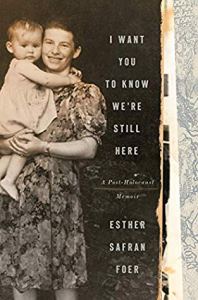 Interestingly, Foer’s mother, Esther, released a memoir earlier this year, I Want You to Know We’re Still Here. It’s about the family history her son turned into quirky autofiction: a largely fruitless trip he took to Ukraine to research his maternal grandfather’s life for his Princeton thesis, and a more productive follow-up trip she took with her older son in 2009. Esther Safran Foer was born in Poland and lived in a German displaced persons camp until she and her parents emigrated to Washington, D.C. in 1949. Her father committed suicide in 1954, making him almost a belated victim of the Holocaust. The stories she hears in Ukraine – of the slaughter of entire communities; of moments of good luck that allowed her parents to, separately, survive and find each other – are remarkable, but the book’s prose, while capable, never sings. Plus, she references her son’s novel so often that I wondered why someone would read her book when they could read his instead.
On Beauty by Zadie Smith (2005)
 This was an all-time favorite when it first came out. I remembered a sophisticated homage to E.M. Forster’s Howards End, featuring a biracial family in Cambridge, Mass. I remembered no specifics beyond a giant music store and (embarrassingly) an awkward sex scene. Howard Belsey’s long-distance rivalry with a fellow Rembrandt scholar gets personal when the Kipps family relocates from London to the Boston suburbs for Monty to be the new celebrity lecturer at the same college. Howard is in the doghouse with his African-American wife, Kiki, after having an affair. The Belsey boy and Kipps girl have an awkward romantic history. Zora Belsey is smitten with a lower-class spoken word poet she meets after a classical concert in the park when they pick up each other’s Discmans by accident (so dated!). All of the portraits felt like stereotypes to me, and there was so much telling, so much backstory, so many unnecessary secondary characters. Before I would have said this was my obvious Women’s Prize winner of winners, but now I have no idea what I’ll vote for. [107 pages]
Currently rereading: Watership Down by Richard Adams, Ella Minnow Pea by Mark Dunn, Dreams from My Father by Barack Obama
To reread soon: Heaven’s Coast by Mark Doty & Animal, Vegetable, Miracle by Barbara Kingsolver
 Bookish Beck = Rebecca Foster. American transplant to England. Freelance proofreader and book reviewer.
 Bookish Beck