Poetry Review Catch-up: Burch, Carrick-Varty, Davidson, Marya, Parsons (#ReadIndies)
As Read Indies month continues, I’m catching up on poetry collections I’ve been sent by three independent publishers: the UK’s Carcanet Press, and Alice James Books and Terrapin Press, both based in the USA. Various as these five are in style and technique, nature and family ties are linking themes. From each I’ve chosen one short poem as a representative.

Leave Me a Little Want by Beverly Burch (2022)
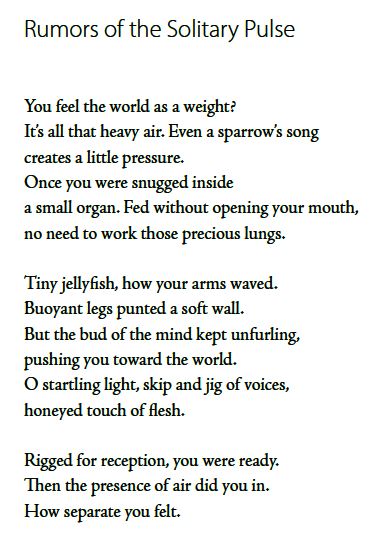
 Burch’s fourth collection juxtaposes the cosmic and the mundane, marvelling at the behind-the-scenes magic that goes into one human being born but also making poetry of an impatient wait in a long post office queue. We find weather and travel; smell as well as sight and sound; alliteration and internal rhyme. Beset by environmental anxiety and the scale of bad news during the pandemic, she pauses in appreciation of the small and gradual. Often nature teaches these lessons. “Practice slow. Days for a seed to unfurl a shoot, / yawn out true leaves. Stems creep upward like prayers. / Weeks to make a flower, more to shape fruit.” Burch expresses gratitude for what is and what has been: a man carrying an infant outside her kitchen window gives her a pang for the baby days, but when she puts her hunting cat on house arrest she realizes how glad she is that impulsivity is past: “Intensity. More subtle than passion. / Odd to be grateful so much of my life is over.” Each section contains multiple unrhymed sonnets, as well as an “incantation” and/or an exploration of “Ars Poetica”.
With thanks to Terrapin Books for the free e-copy for review.
More Sky by Joe Carrick-Varty (2023)
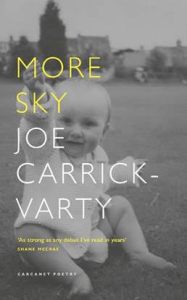 In this debut collection by an Eric Gregory Award-winning poet, his father’s suicide is ever-present – and not just in poems like “54 Questions for the Man Who Sold a Shotgun to My Father” but in seemingly unrelated pieces that start off being about something else. Everything comes around to the reality of a neglectful, alcoholic father and the sordid flat he inhabited before his death. Carrick-Varty alternates between an intimate “you” address and third-person scenarios, auditioning coping mechanisms. His frame of reference is wide: football, rappers, Buddhist cosmology. Some poems are printed sideways up the page; there are stanzas, paragraphs and columns. The word “suicide” itself is repeated to the point where it loses meaning, becoming just a sibilant collection of syllables (as in “From the Perspective of Coral,” where “suicide” is substituted for sea creatures, or the long culminating poem, “sky doc,” in which every stanza opens with “Once upon a time when suicide was…”) The tone is often bitter, as is to be expected, but there is joy in the deft use of language.

With thanks to Carcanet Press for the free e-copy for review.
Arctic Elegies by Peter Davidson (2022)
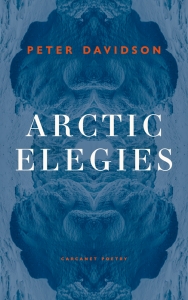 Much of the verse in Davidson’s second collection draws on British religious history and liturgy. Some is also in conversation with art, music or other poetry. In all of these cases, I found the Notes at the end of the volume invaluable for understanding the context and inspiration. While most are in stanzas, some employing traditional forms (e.g., “Sonnet for Trinity Sunday”), a few of the poems are in paragraphs and feel more like essays, such as “Secret Theatres of Scotland.” As the title heralds, an elegiac tone runs throughout, with “Arctic Elegy” (taking material from an oratorio he wrote for performance in St Andrew’s Cathedral in 2015) dedicated to the ill-fated Franklin Expedition of 1845–8:
Wonderful is the patience of the snow
And glorious the violence of the cold.
How lovely is the power of the dark pole
To draw the iron and move the compass rose.
As cold as loss as cold as freezing steel
In this same vein, I also appreciated the wry “The Museum of Loss” and the ornate “The Mourning Virtuoso.” There’s a bit of an Auden flavour here, but the niche topics didn’t always hold my attention. 

With thanks to Carcanet Press for the free copy for review.
Sugar Work by Katie Marya (2022)
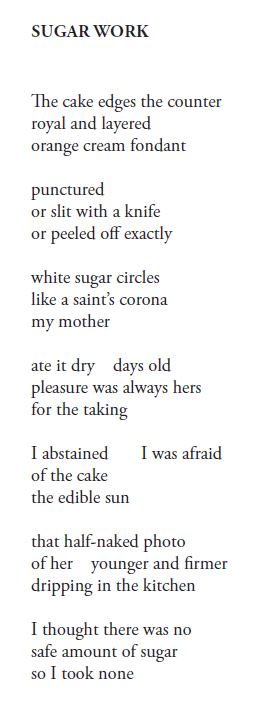
 Marya’s debut collection contains frank autobiographical poems about growing up in Atlanta and Las Vegas with a single mother who was a sex worker and an absentee father. As the pages turn, she gets her first period, loses her virginity, marries and divorces. Her childhood persists in photographs, and the details of places, foods and pop culture form the recognizable texture of American suburbia. Social media haunts or taunts: that photo her addict father posts every year on Facebook of him holding her, aged three, on a beach; the Instagram perfection she wishes she could attain. Marya’s phrasing is carnal, unsentimental and in-your-face (viz. “Valentine’s Day: “Do you think love only exists / because death exists? / I do not want to marry you. // But I do want explosions / of white taffeta and a cake / propped up in my mouth // with your hand for a photo. / Skin is a casing and I hook / mine to yours with a needle.”) There is also a feminist determination to see justice for women who are abused and accused.
With thanks to Alyson Sinclair PR for the free e-copy for review.
The Mayapple Forest by Kim Ports Parsons (2022)
 Parts of this alliteration-rich debut collection respond to the pandemic’s gifts of time and attention. Gardening and baking, two of the activities that sustained so many people during lockdowns, appear as acts of faith – planting seeds and waiting to see what becomes of them – and acts of remembrance (in “The Poetry of Pie,” she’s a child making peach pie with her mother). There is a fresh awareness of nature, especially birds: starlings, a bluebird nest, the lovely portrait in “Barn Owl.” From the forest floor to the stars, this world is full of wonders. Human stories thread through, too: dancing to soul music, fixing an elderly woman’s hair, the layers of history uncovered during a renovation of her childhood home. Contrasting with her temporary residence in the Midwest is her nostalgia for Baltimore. Parsons reflects on the sudden loss of her father (“A quick death’s a blessing / for the one who dies”) and the still-tender absence of her mother, the book’s dedicatee.

With thanks to Terrapin Books for the free e-copy for review.
Read any good poetry recently?
Recent Writing for Bookmarks, Foreword and Shelf Awareness
I’ve been writing for U.S. print magazine Bookmarks for an astonishing 9.5 years now, and have the title of associate editor. The upcoming November/December issue is their first to be released in digital format as well, and as a promo it’s available to read for free here. My contributions to the issue are an article on fiction and nonfiction about women in STEM (starts on p. 23), and various of the anonymous synopses/critical summaries in the New Books Guide. Each issue has one or more author profiles, one or more thematic features, reader recommendations, a book group bio, and news on prizes and upcoming releases.
Here are excerpts from a few recent or upcoming reviews of October releases that I’ve contributed elsewhere. I link to the full text where available.
Foreword Reviews
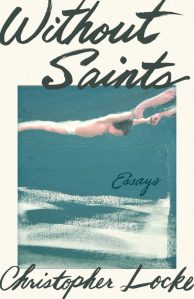 Without Saints: Essays by Christopher Locke: Fifteen flash essays present shards of a life story. Growing up in New Hampshire, Locke encountered abusive schoolteachers and Pentecostal church elders who attributed his stuttering to demon possession and performed an exorcism. By age 16, small acts of rebellion had ceded to self-harm, and his addictions persisted into adulthood. Later, teaching poetry to prisoners, he realized that he might have been in their situation had he been caught with drugs. The complexity of the essays advances alongside the chronology. Weakness of body and will is a recurrent element.
Shelf Awareness
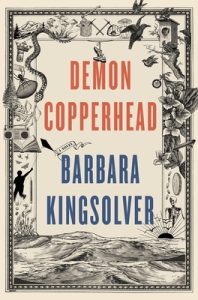 Demon Copperhead by Barbara Kingsolver: Her bighearted ninth novel follows the contours of Charles Dickens’s David Copperfield, transplanting the plot to 1990s southwest Virginia to uncover the perils of opiate addiction. Ten-year-old Damon Fields lives in a trailer home with his addict mother, who is employed at Walmart, and his new stepfather, Stoner, a mean trucker. Tragedy strikes and Damon moves between several foster homes before running away. “A kid is a terrible thing to be, in charge of nothing,” he remarks, looking back. His irrepressible, sassy voice is reminiscent of Holden Caulfield’s in this Appalachian cousin to Shuggie Bain.
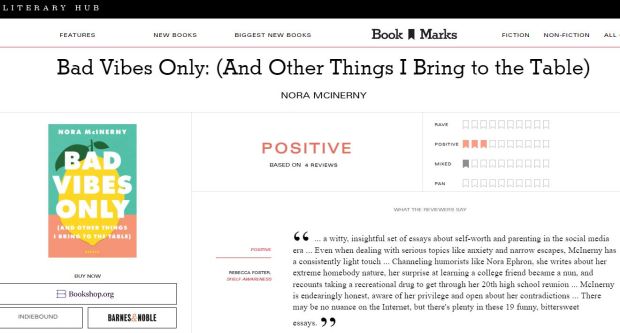
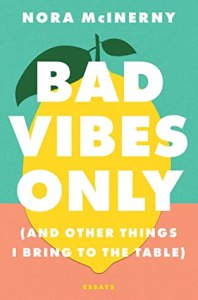 Bad Vibes Only by Nora McInerny: McInerny’s fifth book is a witty, insightful set of essays about self-worth and parenting in the social media era. Those familiar with the author’s previous autobiographical works will remember that within a few weeks in 2014, her father and first husband, Aaron, both died of cancer. After several years as a single mother, she married Matthew and they blended their families. Even when dealing with serious topics like anxiety and narrow escapes, McInerny has a light touch. She is endearingly honest, aware of her privilege and open about her contradictions. The then-and-now focus compares pre-Internet childhood with the challenges of raising kids with a constant online presence.
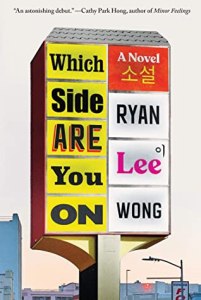 Which Side Are You On by Ryan Lee Wong: In Wong’s dynamite debut novel – set in Los Angeles, with its history of race riots – an Asian American college student committed to social justice rethinks how best to live out his ideals in the real world. Wong probes the generational gap between Reed and his parents through snappy dialogue and enjoyable scenes that constitute an incidental tour of multi-ethnic L.A. Full of vibrant characters, this punchy story offers no simple answers to ongoing racial conflicts. The portrait of a sanctimonious young man who wakes up to the reality of generational trauma and well-meaning failure is spot-on. Truly, a book for the contemporary moment.
It’s always a thrill to see my words quoted as authoritative: excerpts from my Bad Vibes Only review appear on Bookshop.org and on Lit Hub’s Bookmarks page (see below), and there’s an unattributed quote from my Which Side Are You On review on the book’s Amazon page.
Do any of these books interest you?
Acts of Desperation by Megan Nolan
I read this after its shortlisting for the Charlotte Aitken Trust/Sunday Times Young Writer of the Year Award, as well as its longlisting for the Dylan Thomas Prize. It is a truth universally acknowledged that any novel by a young Irish woman will only and ever be compared to Sally Rooney … but that works in Nolan’s favour. I would certainly call this a readalike to Rooney’s first two books, but there’s an added psychological intensity here.
 A young woman reflects on an obsessive affair that she began in Dublin in April 2012. Was it love at first sight for her with Ciaran? No, actually, it was more like pity: “The first time I saw him, I pitied him terribly,” the novel opens. “I stood in that gallery and felt not only sexual attraction (which I was aware of, dimly, as background noise) but what I can only describe as grave and troubling pity.” That doesn’t bode well now, does it?
Ciaran is an insecure, hot-tempered magazine writer. He’s also still half in love with his ex-girlfriend, Freja, whom he left behind in Copenhagen, and our narrator (an underemployed would-be writer) feels she has to fight for his attention and affections. She has body issues and drinks too much, but she’s addicted to love, and sex specifically, as much as to alcohol.
A central on-again, off-again relationship is hardly a new subject for fiction, but I admired Nolan’s work for its sharp insights into the psyche of an emotionally fragile young woman whose frantic search for someone to value her leads her into masochistic behaviours. Brief looks back at the events of 2012–14 from a present storyline set in Athens in 2019 create helpful hindsight yet reveal how much she still struggles to affirm her self-worth.
The short chapters are like freeze-frames, concentrated bursts of passion that will resonate even if the characters’ specific situations do not. And it’s not all despair and damage; there are beautiful moments here, too, like the sweet habit they had of buying an apple each and then just walking around town for a cheap outing – the source of the cover image. I marked passage after passage, but will share just a couple:
How impoverished my internal life had become, the scrabbling for a token of love from somebody who didn’t want to offer it.
I was taking away his ability to live without me easily. I subbed his rent, I cooked his food, I cleaned his clothes, so that one day soon there would come a time when he could no longer remember how he had ever done without me, and could not imagine doing so ever again.
Even if you’re burnt out on what pace amore libri blogger Rachel dubs “disaster woman” books, make an exception for this potent story of self-sabotage and -recovery. Especially if you’re a fan of Emma Jane Unsworth, The Inland Sea by Madeleine Watts, and, yes, Sally Rooney. (Also reviewed by Annabel.)
My rating: 
With thanks to FMcM Associates and Jonathan Cape for the free copy for review.
The rest of the shortlist:
After about 50 pages I DNFed Here Comes the Miracle by Anna Beecher, which had MA-course writing-by-numbers and seemed to be building towards When God Was a Rabbit mawkishness (how on earth did it get shortlisted?!).
See my mini reviews of the other three nominees here.
I am still rooting for Cal Flyn to win for her excellent and perennially relevant travel book, Islands of Abandonment.
Tonight there’s a shortlist readings event taking place in London. If anyone goes, do share photos! The award will be given tomorrow, the 24th. I’ll look out for the announcement.
Three on a Theme for Valentine’s Day: “Love” Books by Natalie Diaz, Maile Meloy and Jane Smiley
This post is an annual tradition for me, somehow.* Love, whether erotic, romantic or familial, turns up in the titles of these three works by women writers: poems, short stories and a novella.
Postcolonial Love Poem by Natalie Diaz (2020)
Diaz, raised on a Mojave reservation in California, won a Pulitzer Prize for this honey-thick exploration of queer Native American identity. There are lustful moments aplenty here—
My lover comes to me like darkfall—long,
and through my open window. Mullion, transom. […]
I keep time on the hematite clocks of her shoulders.
(from “Like Church”)
 —but the mineral-heavy imagery (“the agate cups of your palms …the bronzed lamp of my breast”) is so weirdly archaic and the vocabulary so technical that I kept thinking of the Song of Solomon. Not that there’s anything wrong with that; it’s just not the model I expected to find.
So I ended up preferring the forthright political poems about contemporary Native American life. Police shootings, pipeline protests: it’s a fact that her people are disproportionately persecuted (see “American Arithmetic”). Her brother’s drug abuse and mental illness also form a repeating subject (e.g., “It Was the Animals”).
The collection is as much of a love poem to land as it is to a woman, with water bodies described as affectionately as female bodies. “The Colorado River is the most endangered river in the United States—also, it is a part of my body” is the opening line of “The First Water Is the Body”; see also “exhibits from the American Water Museum.”
My favourite single poem, “If I Should Come Upon Your House Lonely in the West Texas Desert,” is sexy but also, charmingly, features echoes of “Goldilocks and the Three Bears”:
I will swing my lasso of headlights
across your front porch,
let it drop like a rope of knotted light
at your feet.
While I put the car in park,
you will tie and tighten the loop
of light around your waist—
and I will be there with the other end
wrapped three times
around my hips horned with loneliness.
[…]
I will lie down in you.
Eat my meals at the red table of your heart.
Each steaming bowl will be, Just right.
I will eat it all up,
break all your chairs to pieces.
(New purchase, Awesomebooks.com)
Half in Love by Maile Meloy (2002)
Meloy’s was a new name for me when I picked this up as part of a bargain secondhand book haul last year, but she’s actually published 10 books and is esteemed in literary circles; Ann Patchett even dedicated her latest release, These Precious Days, to her.
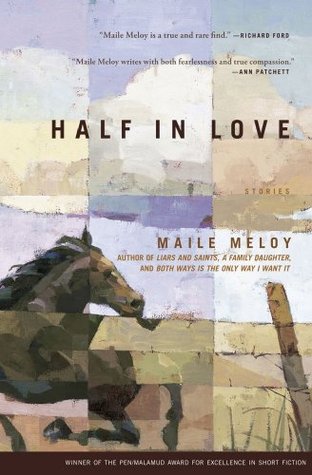 Meloy is from Montana and most of the 14 stories in this, her debut collection, are set in the contemporary American West among those who make their living from the outdoors, diving to work on hydroelectric dams or keeping cattle and horses. However, one of the more memorable stories, “Aqua Boulevard,” is set in Paris, where a geriatric father can’t tamp down his worries for his offspring.
The few historical stories have a melancholy air, with protagonists whose star has faded. There’s the brief, touching portrait of an outmoded career in “The Ice Harvester” and the secondhand reminiscences of being in late-colonial diplomatic service in the Middle East in “Last of the White Slaves”; “Red” is about an American soldier stationed in London during the Second World War.
Crime and its consequences recur. I loved the opening story, “Tome,” about a lawyer whose client wants her to keep in touch after he goes to jail. Teenage girls are the title characters in a couple of stories; “Ranch Girl” is in the second person. “Kite Whistler Aquamarine” is a heartbreaker about a filly born premature one winter. “Paint” was the standout for me: it’s pretty terrifying what a wife’s temporary attitude of neglect leads to when her luckless husband undertakes some DIY.
As is usual with a collection, a few of the stories left little impression on me. But there’s sufficient range and depth here to induce me to seek out more of Meloy’s work. I can recommend this to readers of Claire Boyles, David Guterson, Lily King, Jane Smiley (see below!) and David Vann. (Secondhand purchase, 2nd & Charles) 
Favourite passages:
“Be interesting in your twenties,” Suzy says. “Otherwise you’ll want to do it in your thirties or forties, when it wreaks all kinds of havoc, and you’ve got a husband and kids.”
Eugénie invited my husband to Greece every summer because she wanted him to publish her memoir. She had lived a remarkable life but didn’t have a remarkable book, and it dragged through slow ghostwritten revisions. Every year, at work in the hot city, I thought of blue water and white bougainvillea and forgot how exhausting it was to be her guest, to stay in favor and say the right things. So each summer we would arrive, look at the new draft, give careful suggestions that would not be taken, and find ourselves on the terrace waiting for her to trip mercifully off to bed.
Ordinary Love by Jane Smiley (1990)
 This is one of Smiley’s earlier works and feels a little generic, like she hadn’t yet developed a signature voice or themes. One summer, a 52-year-old mother of five prepares for her adult son Michael’s return from India after two years of teaching. His twin brother, Joe, will pick him up from the airport later on. Through conversations over dinner and a picnic in the park, the rest of the family try to work out how Michael has changed during his time away. “I try to accept the mystery of my children, of the inexplicable ways they diverge from parental expectations, of how, however much you know or remember of them, they don’t quite add up.” The narrator recalls her marriage-ending affair and how she coped afterwards. Michael drops a bombshell towards the end of the 91-page novella. Readable yet instantly forgettable, alas. I bought it as part of a dual volume with Good Will, which I don’t expect I’ll read. (Secondhand purchase, Bookbarn International)
If you read just one … It’s got to be Postcolonial Love Poem, the most Eros-appropriate of the three by far.
*I’m really not a Valentine’s Day person, yet this is the sixth year in a row that I’ve put together a themed post featuring books that have “Love” or a similar word in the title in the run-up to mid-February (2017, 2018, 2019, 2020, and 2021).
Read any books about love lately?
#NonFicNov Review Book Catch-Up: Cohen, Gilbert, Hodge, Piesse, Royle
I have a big backlog of review books piled beside my composition station (a corner of the lounge by the front window; an ancient PC inherited from my mother-in-law and not connected to the Internet; a wooden chair with leather seat that had been left behind in a previous rental house’s garage). Nonfiction November is the excuse I need to finally get around to writing about lots of them; at least one more catch-up will be coming later this month. My apologies to the publishers for the brief reviews.
Today I have a therapist’s take on classic literature, an optimist’s research on data use, a journalist’s response to her sister’s and father’s deaths, a professor’s search for the remnants of Charles Darwin at his family home, and a bibliophile’s tales of book-collecting exploits.
How to Live. What to Do.: In Search of Ourselves in Life and Literature by Josh Cohen
“Literature and psychoanalysis are both efforts to make sense of the world through stories, to discover the recurring problems and patterns and themes of life. Read and listen enough, and we soon come to notice how insistently the same struggles, anxieties and hopes repeat themselves down the ages and across the world.”
 This is the premise for Cohen’s work life, and for this book. Moving through the human experience from youth to old age, he examines anonymous case studies and works of literature that speak to the sorts of situations encountered in that stage. For instance, he recommends Alice in Wonderland as a tonic for the feeling of being stuck – Lewis Carroll’s “let’s pretend” attitude can help someone return to the playfulness and openness of childhood. William Maxwell’s They Came Like Swallows, set during the Spanish flu, takes on new significance for Cohen in the days of Covid as his appointments all move online; he also takes from it the importance of a mother for providing emotional security. A bibliotherapy theme would normally be catnip for me, but I often found the examples too obvious and the discussion too detailed (and thus involving spoilers). Not a patch on The Novel Cure.
(Ebury Press, February 2021.) With thanks to the publicist for the free copy for review.
Good Data: An Optimist’s Guide to Our Digital Future by Sam Gilbert
 Gilbert worked for Experian before going back to university to study politics; he is now a researcher at the Bennett Institute for Public Policy at the University of Cambridge. At a time of much anxiety about “surveillance capitalism,” he seeks to provide reassurance. He explains that Facebook and the like, with their ad-based business models, use profile data and behavioural data to make inferences about you. This is not the same as “listening in,” he is careful to assert. Gilbert contrasts broad targeting and micro-targeting, and runs through trends in search data. He highlights instances where social media and data mining have been beneficial, such as in creating jobs, increasing knowledge, or aiding communication during democratic protests. I have to confess that a lot of this went over my head; I’d overestimated my interest in a full book on technology, having reviewed Born Digital earlier in the year.
(Welbeck, April 2021.) With thanks to the publisher for the proof copy for review.
The Consequences of Love by Gavanndra Hodge (2020)
 In 1989, Hodge’s younger sister Candy died on a family holiday in Tunisia when a rare virus brought on rapid organ failure. The rest of the family exhibited three very different responses to grief: her father retreated into existing addictions, her mother found religion, and she went numb and forgot her sister as much as possible – despite having a photographic memory in general. After her father’s death, Hodge finally found the courage to look back to her early life and the effect of Candy’s death. Hers was no ordinary upbringing; her father was a drug dealer who constantly disappointed her and from her teens on roped her into his substance abuse evenings. Often she was the closest thing to a sober and rational adult in the drug den their home had become. This is a very fluidly written bereavement memoir and a powerful exploration of memory and trauma. It was unfortunate that it felt that little bit too similar to a couple of other books I’ve read in recent years: When I Had a Little Sister by Catherine Simpson and especially Featherhood by Charlie Gilmour.
(Paperback: Penguin, July 2021.) With thanks to the publicist for the free copy for review.
The Ghost in the Garden: In Search of Darwin’s Lost Garden by Jude Piesse
 When Piesse’s academic career took her back to her home county of Shropshire, she became fascinated by the Darwin family home in Shrewsbury, The Mount. A Victorian specialist, she threw herself into research on the family and particularly on the traces of the garden. Her thesis is that here, and on long walks through the surrounding countryside, Darwin developed the field methods and careful attention that would serve him well as the naturalist on board the Beagle. Piesse believes the habit of looking closely was shared by Darwin and his mother, Susannah. The author contrasts Susannah’s experience of childrearing with her own – she has two young daughters when she returns to Shropshire, and has to work out a balance between work and motherhood. I noted that Darwin lost his mother early – early parent loss is considered a predictor of high achievement (it links one-third of U.S. presidents, for instance).
I think what Piesse was attempting here was something like Rebecca Mead’s wonderful My Life in Middlemarch, but the links just aren’t strong enough: There aren’t that many remnants of the garden or the Darwins here (all the family artefacts are at Down House in Kent), and Piesse doesn’t even step foot into The Mount itself until page 217. I enjoyed her writing about her domestic life and her desire to create a green space, however small, for her daughters, but this doesn’t connect to the Darwin material. Despite my fondness for Victoriana, I was left asking myself what the point of this project was.
(Scribe, May 2021.) With thanks to the publisher for the free copy for review.
White Spines: Confessions of a Book Collector by Nicholas Royle
 From the 1970s to 1990s, Picador released over 1,000 paperback volumes with the same clean white-spined design. Royle has acquired most of them – no matter the author, genre or topic; no worries if he has duplicate copies. To build this impressive collection, he has spent years haunting charity shops and secondhand bookshops in between his teaching and writing commitments. He knows where you can get a good bargain, but he’s also willing to pay a little more for a rarer find. In this meandering memoir-of-sorts, he ponders the art of cover design, delights in ephemera and inscriptions found in his purchases (he groups these together as “inclusions”), investigates some previous owners and the provenance of his signed copies, interviews Picador staff and authors, and muses on the few most ubiquitous titles to be found in charity shops (Once in a House on Fire by Andrea Ashworth, Bridget Jones’s Diary by Helen Fielding, anything by Kathy Lette, and Last Orders by Graham Swift). And he does actually read some of what he buys, though of course not all, and finds some hidden gems.
In 2013 I read Royle’s First Novel, which also features Picador spines on its cover and a protagonist obsessed with them. I’d read enthusiastic reviews by fellow bibliophiles – Paul, Simon, Susan – so couldn’t resist requesting White Spines. While I enjoyed the conversational writing, ultimately I thought it quite an indulgent undertaking (especially the records of his dreams!), not dissimilar to a series of book haul posts. The details of shopping trips aren’t of much interest because he’s solely focused on his own quest, not on giving any insight into the wider offerings of a shop or town, e.g., Hay-on-Wye and Barter Books. But if you’re a fan of Shaun Bythell’s books you may well want to read this too. It’s also a window into the collector’s mindset: You know Royle is an extremist when you read that he once collected bread labels!
(Salt Publishing, July 2021.) With thanks to the publicist for the free copy for review.
Are you interested in reading one or more of these?
Short Stories in September, Part III: Butler, Costello, MacLaverty, Washington
Today I have a third set of terrific and varied short story collections. Between this, my Part I and Part II posts, and a bonus review I have coming up on Friday, I’ve gotten through 12 volumes of stories this month. This feels like a great showing for me because I don’t naturally gravitate to short stories and have to force myself to make a special effort to read them every September; otherwise, they tend to languish unread on my shelves and TBR.
From science fiction and horror tales set in alternate worlds to gritty slices of real life in Texas via two sets of quiet Irish relationship studies, this quartet of books showcases a range of tones and genres but fairly straightforward story structures and points of view. This was such a strong batch, I had to wonder why I never call myself a short story fan. All:
Bloodchild and Other Stories by Octavia E. Butler (2005)
 My first R.I.P. selection and one I can heartily recommend – even if you’re normally wary of dystopias, horror and science fiction. Butler makes these genres accessible by peopling her plots with relatable protagonists and carefully accounting for their bizarre predicaments without wasting time on extraneous world-building. The way in which she explores very human issues alongside the existence of alien beings reminds me of Mary Doria Russell’s The Sparrow, another of my rare forays into sci fi.
Along with the original five stories Butler published in 1970s and 1980s magazines and anthologies, this second edition contains two essays on her writing process and two new stories that date to 2003. In “Bloodchild,” a small band of humans live on another planet ruled by the Tlic, which sound like giant spiders or scorpions. Gan learns he is expected to play his part by being a surrogate for T’Gatoi’s eggs, but is haunted by what he’s heard this process involves. In a brief afterword (one is included with each piece here), Butler explains that the story arose from her terror of botflies, which she knew she might encounter in the Peruvian Amazon, and that she has always faced what scares her through her writing.
My other favorite story was “The Evening and the Morning and the Night,” about a subclass of people afflicted with Duryea-Gode disease. A cruel side effect of a parent’s cancer treatment, the illness compels sufferers to self-harm and they are often confined to asylums. Lynn and Alan visit his mother in one such institution and see what their future might hold. “Speech Sounds” and “Amnesty” reminded me most of the Parable novels, with the latter’s Noah a leader figure similar to Lauren. After an apocalyptic event, people must adapt and cooperate to survive. I appreciated how the two essays value persistence – more so than talent or inspiration – as the key to success as a writer. This was my fourth book by Butler and I don’t see why I shouldn’t keep going and read her whole oeuvre. (University library)

The China Factory by Mary Costello (2012)
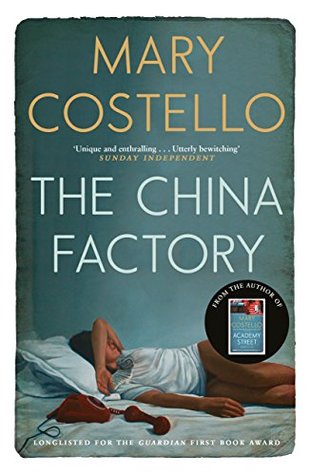 Academy Street is a near-perfect novella and I also enjoyed The River Capture, so I wanted to complete the set by reading Costello’s first book. Its dozen understated stories are about Irish men and women the course of whose lives are altered by chance meetings, surprise liaisons, or not-quite-affairs that needle them ever after with the could-have-been. The mood of gentle melancholy would suit a chilly moonlight drive along the coast road to Howth. In the opening title story, a teenage girl rides to her work sponging clay cups with an oddball named Gus. Others can’t get past things like his body odour, but when there’s a crisis at the factory she sees his calm authority save the day. Elsewhere, a gardener rushes his employer to the hospital, a woman attends her ex-husband’s funeral, and a school inspector becomes obsessed with one of the young teachers he observes.
Three favourites: In “And Who Will Pay Charon?” a man learns that, after he rejected Suzanne, she was hideously attacked in London. When she returns to the town as an old woman, he wonders what he might have done differently. “The Astral Plane” concerns a woman who strikes up a long-distance e-mail correspondence with a man from New York who picked up a book she left behind in a library. How will their intellectual affair translate into the corporeal world? The final story, “The Sewing Room,” reminded me most of Academy Street and could be a novel all of its own, as a schoolteacher and amateur fashion designer prepares for her retirement party and remembers the child she gave up for adoption. (Secondhand, gifted)
Blank Pages and Other Stories by Bernard MacLaverty (2021)
 I knew from The Great Profundo that I liked MacLaverty’s stories, and I also enjoyed his latest novel, Midwinter Break, so I was delighted to hear news of a new collection. A number of the longer stories are set at turning points in twentieth-century history. In 1940, a mother is desperate to hear word of her soldier son; in 1971 Belfast, officers search a woman’s house. Two of the historical stories appealed to me for their medical elements: “The End of Days,” set in Vienna in 1918, dramatizes Egon Schiele’s fight with Spanish flu, while “Blackthorns” gives a lovely picture of how early antibiotics promoted miraculous recovery. In the title story, a cat is all a writer has left to remind him of his late wife. “Wandering” has a woman out looking for her dementia-addled mother. “The Dust Gatherer” muses on the fate of an old piano. Elderly parents and music recur, establishing filaments of thematic connection.
Three favourites: In “Glasshouses,” a man temporarily misplaces his grandchildren in the botanical gardens; “The Fairly Good Samaritan” is the fable of a jolly drunk who calls an ambulance for his poorly neighbour – but not before polishing off her brandy; and in the gorgeous “Sounds and Sweet Airs” a young woman’s harp music enthrals the passengers on a ferry.
With thanks to Jonathan Cape for the free copy for review.
Lot: Stories by Bryan Washington (2019)
 The musical equivalent of Lot might be a mixtape played on a boombox or blasted from an open-top Corvette while touring the streets of Houston, Texas. Most of this Dylan Thomas Prize-winning linked collection follows Nic, a mixed-race Black/Latino boy who works in the family restaurant. As his family situation realigns – his father leaves, his older brother Javi enlists, his sister Jan has a baby – he’s trying to come to terms with his homosexuality and wondering if this gentrifying city suits him anymore. But he knows he’ll take himself wherever he goes, and as the book closes with “Elgin” (the most similar in mood and setup to Washington’s debut novel, Memorial) he’s thinking of taking a chance on love.
Drug dealers, careworn immigrants and prostitutes: Even the toughest guys have tender hearts in these stories. Eleven of 13 stories are in the first person. Where the narration isn’t Nic’s, it’s usually the collective voice of the neighbourhood boys. As far as I can tell, most of the story titles refer to Houston sites: particular addresses or neighbourhoods, or more vague locations. Like in Memorial, there are no speech marks. Washington’s prose is earthy and slang-filled. The matter-of-fact phrasing made me laugh: “He knocked her up in the usual way. For six minutes it looked like he’d stick around”; “He’d been staying there since the Great Thanksgiving Rupture, back when his brother’d found the dick pic in his pillowcase.” With the melting pot of cultures, the restaurant setting, and the sharp humour, this reminded me of Elaine Castillo’s America Is Not the Heart.
Three favourites: In “Shepherd,” the narrator emulates a glamorous cousin from Jamaica; “Bayou” is completely different from the rest, telling the urban legend of a “chupacubra” (a mythical creature like a coyote); “Waugh,” the longest story and one of just two told in the third person, is about a brothel’s worth of male sex workers and their pimp. Its final page is devastating. Despite their bravado, Washington’s characters are as vulnerable as Brandon Taylor’s. I think of these two young gay African American writers as being similar at root even though their style and approach are so very different. (New purchase)
A side note: I’m wondering how an author chooses primarily first person or third person POVs for short stories. MacLaverty and Taylor write exclusively in an omniscient third person; Washington and Eley Williams almost always plump for the first person. (Here, Butler was about half and half and Costello only used first person in three stories.) Is the third person seen as more impartial and commanding – a more elevated form of fiction? Is first person more immediate, informal and natural, but also perhaps too easy? I wouldn’t say I prefer one or the other (not in my novels, either); it all depends on the execution. Notably, none of this year’s stories were in the second person or employed experimental structures.
Two more collections I’m reading are spilling across into October for R.I.P., but will I keep up the short story habit after that? I still have a shelf full of unread story collections, and I have my eye on My Monticello, which I got from NetGalley…
Mary Jane by Jessica Anya Blau (Blog Tour)
Are you having a groovy June yet? If not, I have just the remedy: a juicy coming-of-age novel that drops you directly into the Baltimore summer of 1975. Mary Jane Dillard, 14, lives in the upper-class white neighborhood of Roland Park. Her parents are prim types who attend church every week, belong to a country club, and pray for the (Republican) president’s health before each sit-down family dinner. When Mary Jane starts working as a daytime nanny for five-year-old Izzy, the Cones’ way of life is a revelation to her. They are messy bohemians who think nothing of walking around the house half-naked, shouting up and down the stairs at each other, or leaving a fridge full of groceries to rot and going out for fast food instead.
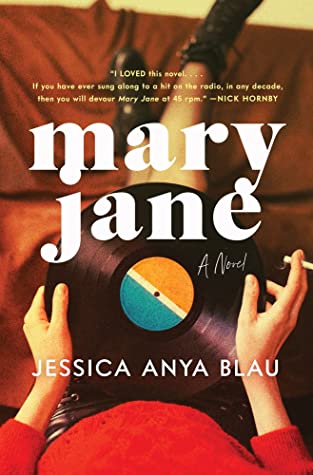 Dr. Cone is a psychiatrist whose top-secret assignment is helping a rock star to kick his drug addiction. Jimmy and his actress wife, Sheba, move into the Cones’ attic for the summer. If they go out in public, they wear wigs and pretend to be friends visiting from Rhode Island. While the Cones are busy monitoring or trying to imitate their celebrity guests, Mary Jane introduces discipline by cleaning the kitchen, alphabetizing the bookcase, and replicating her mother’s careful weekly menus with food she buys from Eddie’s market. In some ways she seems the most responsible member of the household, but in others she’s painfully naïve, entirely ignorant of sex and unaware that her name is a slang term for marijuana.
Open marriage, sex addiction and group therapy are new concepts that soon become routine for our confiding narrator, as she adopts a ‘What they don’t know can’t hurt them’ stance towards her trusting parents. Blau is the author of four previous YA novels, and while this is geared towards adults, it resonates for how it captures the uncertainty and swirling hormones of the teenage years. Who didn’t share Mary Jane’s desperate curiosity to learn about sex? Who can’t remember a moment of realization that parents aren’t right about everything?
Music runs all through the book, creating and cementing bonds between the characters. Mary Jane sings in the choir and shares her mother’s love of both church music and show tunes. Jimmy and Sheba are always making up little songs on which Mary Jane harmonizes, and a clandestine trip to a record store in an African American part of town forms one of the novel’s pivotal scenes. The relationship between Mary Jane and Izzy, who is precocious and always coming out with malapropisms, is touching, and Blau cleverly inserts references to the casual racism and antisemitism of the 1970s.
I love it when a novel has a limited setting and can evoke a sense of wistfulness for a golden time that will never come again. I highly recommend this for nostalgic summer reading, particularly if you’ve enjoyed work by Curtis Sittenfeld – especially Prep and Rodham.
My thanks to Harper360 UK and Anne Cater for arranging my proof copy for review.
I was delighted to be part of the blog tour for Mary Jane. See below for details of where other reviews and features have appeared or will be appearing soon.

Five Novellas in Translation
We’re coming to the close of Literature in Translation week of Novellas in November. Cathy and I have both noted that novellas seem more common in other languages, with the work more likely to take on experimental forms. We wondered why this is – do foreign languages and cultures somehow lend themselves to concise storytelling that takes more risks? However, a commenter on a post of Cathy’s suggested that economic realities may have something to do with it: translating short works is faster and cheaper. In a recent blog post, Louise Walters, whose indie publishing imprint is preparing to release its shortest book yet (In the Sweep of the Bay by Cath Barton, 22,000 words), confirms that production and shipping costs are lower for novellas, so she has the chance of recouping her investment.

I’ve gotten to five short translated works this month: three fiction and two nonfiction. (Or should that be four fiction and one nonfiction? With autofiction it’s hard to tell.)
Dependency by Tove Ditlevsen (1971; 2019)
[Translated from the Danish by Michael Favala Goldman]
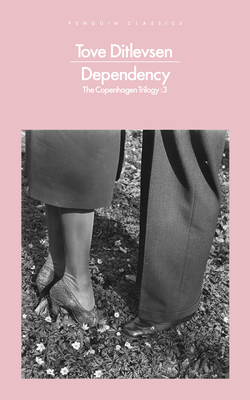 The final volume of the autobiographical Copenhagen Trilogy, after Childhood and Youth. Ditlevsen recalls her upbringing in poverty and her early success as a poet. By the end of the second book, she’s engaged to a much older literary editor. A series of marriages and affairs follows: Viggo, Ebbe, Carl and Victor are the major names, with some others in between. She produces stories and poems as well as a daughter and a son, but also has two abortions. Carl performs one of these and gives her a Demerol shot; ever afterwards, she takes advantage of his obsession with her chronic ear infection to beg for painkiller shots. “Then time ceases to be relevant. An hour could be a year, and a year could be an hour. It all depends on how much is in the syringe.” Addiction interferes with her work and threatens her relationships, but it’s an impulse that never leaves her even when she swaps the harder stuff for alcohol.
I only skimmed this one because from the other volumes I knew how flat and detached the prose is, even when describing desperate circumstances. I can admire this kind of writing – the present-tense scenes, the lack of speech marks, the abrupt jumps between time periods and emotional states, all coldly expressed – but I’m not sure I’ll ever love it. Of the three books, I liked Childhood the best for its universal observations.
La Symphonie Pastorale by André Gide (1919; 1931)
[Translated from the French by Dorothy Bussy]
“Love is blindness / I don’t want to see” (U2)
 I had a secondhand French copy when I was in high school, always assuming I’d get to a point of fluency where I could read it in its original language. It hung around for years unread and was a victim of the final cull before my parents sold their house. Oh well! There’s always another chance with books. In this case, a copy of this plus another Gide novella turned up at the free bookshop early this year. A country pastor takes Gertrude, the blind 15-year-old niece of a deceased parishioner, into his household and, over the next two years, oversees her education as she learns Braille and plays the organ at the church. He dissuades his son Jacques from falling in love with her, but realizes that he’s been lying to himself about his own motivations. This reminded me of Ethan Frome as well as of other French classics I’ve read (Madame Bovary and Thérèse Raquin). Melodramatic, maybe, but I loved the religious and medical themes (deaf-blind Laura Bridgman gets a mention; when the preacher and Gertrude attend the title symphony, he encourages her synesthetic thinking).
Stammered Songbook: A Mother’s Book of Hours by Erwin Mortier (2011; 2015)
[Translated from the Dutch by Paul Vincent]
 In fragmentary vignettes, some as short as a few lines, Belgian author Mortier chronicles his mother’s Alzheimer’s, which he describes as a “twilight zone between life and death.” His father tries to take care of her at home for as long as possible, but it’s painful for the family to see her walking back and forth between rooms, with no idea of what she’s looking for, and occasionally bursting into tears for no reason. Most distressing for Mortier is her loss of language. As if to compensate, he captures her past and present in elaborate metaphors: “Language has packed its bags and jumped over the railing of the capsizing ship, but there is also another silence … I can no longer hear the music of her soul”. He wishes he could know whether she feels hers is still a life worth living. There are many beautifully meditative passages, some of them laid out almost like poetry, but not much in the way of traditional narrative; it’s a book for reading piecemeal, when you have the fortitude.
Bonjour Tristesse by Françoise Sagan (1954; 1955)
[Translated from the French by Irene Ash]
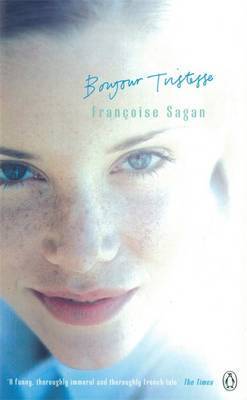 Like The Go-Between and Atonement, this is overlaid with regret about childhood caprice that has unforeseen consequences. That Sagan, like her protagonist, was only a teenager when she wrote it only makes this 98-page story the more impressive. Although her widower father has always enjoyed discreet love affairs, seventeen-year-old Cécile has basked in his undivided attention until, during a holiday on the Riviera, he announces his decision to remarry a friend of her late mother. Over the course of one summer spent discovering the pleasures of the flesh with her boyfriend, Cyril, Cécile also schemes to keep her father to herself. Dripping with sometimes uncomfortable sensuality, this was a sharp and delicious read.
The Order of the Day by Éric Vuillard (2017; 2018)
[Translated from the French by Mark Polizzotti]
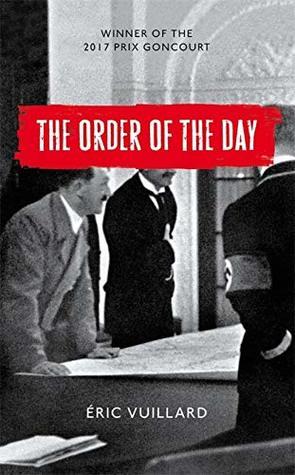 February 1933: 24 German captains of industry meet with Hitler to consider the advantages of a Nazi government. I loved the pomp of the opening chapter: “Through doors obsequiously held open, they stepped from their huge black sedans and paraded in single file … they doffed twenty-four felt hats and uncovered twenty-four bald pates or crowns of white hair.” As the invasion of Austria draws nearer, Vuillard recreates pivotal scenes featuring figures who will one day commit suicide or stand trial for war crimes. Reminiscent in tone and contents of HHhH, The Tobacconist, and the film Downfall, this starts off promisingly and ends with clear relevance to the present moment (“a mysterious respect for lies. Political manoeuvring tramples facts”) and a brilliant final paragraph, but in between was dull. You’d have to have more interest in history than I do to love this Prix Goncourt winner.
Publishers that specialize in novellas in translation:
Charco Press – I’ve reviewed:
 The Wind that Lays Waste by Selva Almada
Fish Soup by Margarita García Robayo
Die, My Love by Ariana Harwicz
Peirene Press – I’ve reviewed:
Mr. Darwin’s Gardener by Kristina Carlson
The Looking-Glass Sisters by Gøhril Gabrielsen
Ankomst by Gøhril Gabrielsen
 Dance by the Canal by Kerstin Hensel
The Last Summer by Ricarda Huch
Snow, Dog, Foot by Claudio Morandini
Her Father’s Daughter by Marie Sizun
The Orange Grove by Larry Tremblay
The Man I Became by Peter Verhelst
A few more favorite novellas in translation:
The Plimsoll Line by Juan Gracia Armendáriz
 Silk by Alessandro Baricco
Agatha by Anne Cathrine Bomann
Swallowing Mercury by Wioletta Greg
Next week, we’re closing out Novellas in November with a focus on short classics. I’ll introduce the week’s theme with some of my favorite examples on Monday.
Any theories as to why so many novellas are from other languages?
What are some of your favorites?
Doorstopper of the Month: The Cider House Rules by John Irving (A Reread)
Next month will be all about the short books (#NovNov!), but first it was time to get this excessively long one out of the way. My husband’s and my reading tastes don’t overlap in many areas, but John Irving is our mutual favorite author. I first started The Cider House Rules (1985) on our second honeymoon – being from two different countries, we had two nuptial ceremonies and two honeymoons, one per continent – which was a road trip through New England. We drove from Maryland to Maine and back; I have a specific memory of reading the chunky Irving hardback at our B&B in Stowe, Vermont. I was a much less prolific reader in those days, so I had to return my American library copy partially read and then pay to reserve one from the Hampshire Libraries system once we were back in the UK.
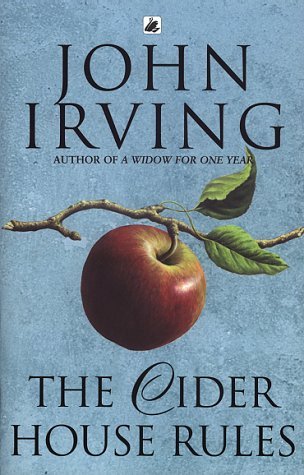
Thirteen years on, I remembered the orphanage and cider farm settings, the dynamic between Doctor Wilbur Larch and his protégé, Homer Wells, and Homer’s love for his best friend’s girl, Candy. I also remembered that this is a Trojan horse of a novel: it advocates, not very subtly, for abortion rights through pictures of women in desperate situations. Luckily, by the time I first read it I was no longer slavishly devoted to the American Religious Right. But this time I felt that even readers who consider themselves pro-choice might agree Irving over-eggs his argument. My memory of the 1999 film version is clearer. It severely condenses the book’s 40 years or so of action, cutting subplots and allowing Tobey Maguire and Charlize Theron to play the leads all the way through. A shorter timeframe also more neatly draws a line between Rose Rose’s experience and Homer’s change of heart about offering abortions.
I had a strong preference for the scenes set at St. Cloud’s orphanage in Maine. Dr. Larch is celibate and addicted to ether – all a result of his first sexual encounter with a prostitute. He has an ironclad conviction that he is doing the Lord’s work for the pregnant women who get off the train at St. Cloud’s, whether they come for an abortion or to leave a live baby behind. Homer Wells is the one orphan who never finds an adoptive home; he stays on and becomes Larch’s trainee in obstetrics, but vows that he won’t perform abortions. As a young adult, Homer is pulled away from the orphanage by his puppy love for Wally and Candy, a couple-in-trouble who come up from his family’s apple farm. Homer thinks he’ll go back with his new friends for a month or two, but instead he stays at Ocean View orchard for decades, his relationship with Candy changing when Wally goes off to war and comes back disabled.
I had forgotten the bizarre scenario Larch has to set up for the orphanage’s board of trustees to accept his chosen successor, and the far-fetched family situation Homer, Candy and Wally end up in. The orchard sections could feel endless, so I always thrilled to mentions of what was happening for Dr. Larch and the nurses back at St. Cloud’s.

Oktoberfest reading and snacking.
The Dickensian influence – lots of minor characters and threads tying up nicely by the end; quirks of speech and behavior – has generally been the aspect I like the most about Irving’s work, and while I loved the explicit references to David Copperfield here (a few kids get their names from it, it’s read aloud to the boy orphans every night, and its opening question about whether the protagonist will be the hero of his own life or not applies to Homer, too), I did find the novel awfully baggy this time. I even put in a slip of paper where I felt that things started to drift: page 450.
One further note to make about the film: it, rather unforgivably, eliminates Melony, a larger-than-life character and necessary counterpart to the book’s multiple passive females. She’s the de facto head of the girl orphans, as Homer is for the boys, and initiates Homer into sex. But her feelings for him are more of hero worship than of romantic love, and when he breaks his promise and leaves St. Cloud’s without her, she sets off to hunt him down. Her odyssey, delivered in parallel, is nearly as important as Homer’s (see what I/Irving did there?).
While I loved the medical history material and Dr. Larch’s moral fiber, this time I found Homer a little insipid and annoying (he answers nearly every question with “Right”), and the plot somewhat slack and obvious. In my memory this is probably #3 out of the Irving novels I’ve read, below A Prayer for Owen Meany and The World According to Garp – both of which I’d also like to reread to see if they’ve retained their power.
Page count: 731
My original rating (July–September 2007):
My rating now:
Done any rereading, or picked up any very long books, lately?
September Releases: Gyasi, McKay, Sheldrake, Tremain, Woolfson
September is always a big month in the publishing world, but even more so this year because of all the titles delayed from the spring and summer – apparently 600 books were published in the first week of September in the UK alone.
Still, I only ended up with my usual, manageable five new releases (with a few more on the way from the library). I read a beautiful novel about addiction and religion in contemporary America, speculative fiction about communication with wildlife in mid-pandemic (!) Australia, everything you ever wanted to know about fungi, historical fiction about outsiders in England and Borneo, and a study of our broken relationship with other animals.
Two of these are from my most anticipated list for the second half of 2020. Four of the five can be linked by the tenet that humans are only one species among many others necessary to life on this Earth, and not in some way above and beyond.
Transcendent Kingdom by Yaa Gyasi
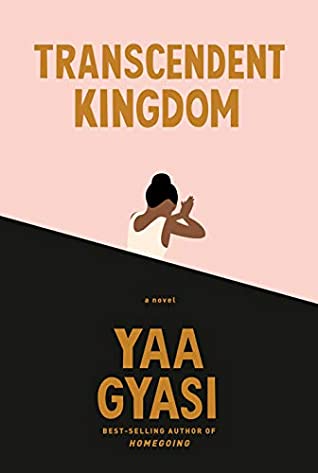 This follow-up to Gyasi’s dazzling, centuries-spanning linked story collection, Homegoing, won’t be out in the UK until March 2021, but I couldn’t resist reading an e-copy of the American edition (Knopf) from Edelweiss. It’s altogether a more subdued and subtle book, but its treatment of themes of addiction, grief, racism and religion is so spot on that it packs a punch. Gifty is a PhD student at Stanford, researching pleasure and reward circuits in the mouse brain. She gets mice hooked on a sugary drink and then performs experiments to see if she can turn off their compulsion to keep pressing a lever for more. Sometimes when they press the lever they get an electric shock. Certain mice give up; others never will. Why?
People who know Gifty well assume she chose her field because of a personal tragedy. When she was 10, her 16-year-old brother, Nana, a high school basketball star in this Ghanaian-American family’s Alabama town, died of an opiate overdose. He’d gotten addicted to prescription drugs after a sports injury. At one level, Gifty acknowledges she is trying to atone for her brother’s death, but she won’t see it in those terms. An intensely private person, she shoulders almost impossible burdens of grief and responsibility for her mother, who has plunged into depression and, when she comes to live with Gifty, spends all her time in bed.
The most compelling aspect of the novel for me was Gifty’s attitude towards the religion of her childhood. Though they were the only black family at their Pentecostal church, she was a model believer, writing prayers in her journal, memorizing scriptures, and never doubting that everything happens for a reason. Nana’s death shattered it all. Though she now looks to science for answers, she misses the certainty she once had: that she was saved, that humans are special, that someone was looking out for her and her family, that it all mattered. I highlighted dozens of passages, but it’s possible the book won’t mean quite as much to readers for whom there’s no personal resonance. The complex mother–daughter relationship is an asset, and musings on love and risk are tenderly expressed. I wanted a more climactic conclusion to take this into 5-star territory, but I’ve still added it to my Best of 2020 shelf.
Favorite lines:
the species Homo sapiens, the most complex animal, [is] the only animal who believed he had transcended his Kingdom, as one of my high school biology teachers used to say.
At times, my life now feels so at odds with the religious teachings of my childhood that I wonder what the little girl I once was would think of the woman I’ve become … I am looking for new names for old feelings. My soul is still my soul, even if I rarely call it that.
the more I do this work the more I believe in a kind of holiness in our connection to everything on Earth. Holy is the mouse.
My rating:
I read an advanced e-copy via Edelweiss.
The Animals in That Country by Laura Jean McKay
 McKay has a PhD in literary animal studies and serves as an animal expert and presenter on Australia’s ABC radio show Animal Sound Safari. Pair her academic background with the fact that this shares a title with a Margaret Atwood poetry collection and you’ll have some idea of what to expect here: mysterious but mostly believable speculative fiction that hinges on human communication with animals.
Jean Bennett isn’t your average grandma: a wise-cracking alcoholic, she drives the tourist train through the Australian wildlife park her daughter-in-law manages but wishes she could be a fully fledged ranger. Her ex-husband, Graham, left her and went down south, and eventually their only son Lee did the same. Now all Jean has left is Kim, her six-year-old granddaughter. Jean entertains Kim by imagining voices for the park’s animals. This no longer seems like a game, though, when news filters through of the “zooflu,” which has hit epidemic levels and has as a main symptom the ability to understand what animals say.
When Kim is kidnapped, Jean steals a camper van and takes Sue the dingo along to help her find her granddaughter. “There’s a new normal now,” a bus driver tells her. “And around here, not wearing a mask means you’ve gone animal. I’d put on my protective if I was you. Put that mutt in a cage.” It was uncanny reading this in the midst of a pandemic, but the specifics of McKay’s novel are hard to grasp. The animal language isn’t audible, necessarily, but a combination of smells, noises and body language. For a long time, they seem like pure nonsense, but gradually they resemble a sort of rough poetry. Here’s one example from Sue:
My front end
takes the food
quality.
Muzzle
for the Queen
(Yesterday).
(Sue usually calls Jean “Queen” or “Mother,” showing that she respects her authority, and “Yesterday” is frequently used to suggest a primitive sense of the past or of an older person.)
As entertaining a protagonist as Jean is, I lost interest in her road trip. If you focus on the journey into the wilderness and don’t mind a sudden ending, you may find this a worthwhile heir to Hollow Kingdom by Kira Jane Buxton and The Road by Cormac McCarthy.
My rating:
I read a proof copy for a Nudge review, but it’s never shown up on their website.
Entangled Life: How Fungi Make Our Worlds, Change Our Minds, and Shape Our Futures by Merlin Sheldrake
 I first heard about Sheldrake through Robert Macfarlane’s Underland. He struck me as a mad genius – an impression that was only strengthened by reading his detailed, enthusiastic book about fungi. Sheldrake researches fungal life in the tropical forests of Panama, accompanies truffle hunters in Italy, takes part in a clinical study on the effects of LSD (derived from a fungus), observes lichens off the coast of British Columbia, and attends a conference in Oregon on Radical Mycology. But more than a travel memoir, this is a work of science – there are over 100 pages devoted to notes, bibliography and index.
Basic information you’ll soon learn: mushrooms are only the fruiting bodies of fungi; under the ground is the material bulk, the mycelium, a sprawling network of hyphae. In what’s sometimes called the “Wood Wide Web,” fungal networks link the trees in a forest, and join up with plants, such as in lichens. “I feel a … sense of vertigo when I think about the complexity of mycorrhizal relationships – kilometers of entangled life – jostling beneath my feet,” Sheldrake confesses. He gives examples of fungi navigating and solving problems – what of our concept of intelligence if a creature without a brain can do such things?
Fungi are very adaptable to extreme conditions. Research is underway to grow edible mushrooms on some of our most troublesome waste, such as used diapers (nappies) and cigarette butts. And, of course, for millennia we’ve relied on certain fungi – yeasts – to create products like bread and beer. Sheldrake is a very hands-on writer: When he wants to know something, he does it, whether that’s scrumping Isaac Newton’s apples in Cambridge and fermenting the juice into cider at home or growing mushrooms on a copy of this very book.
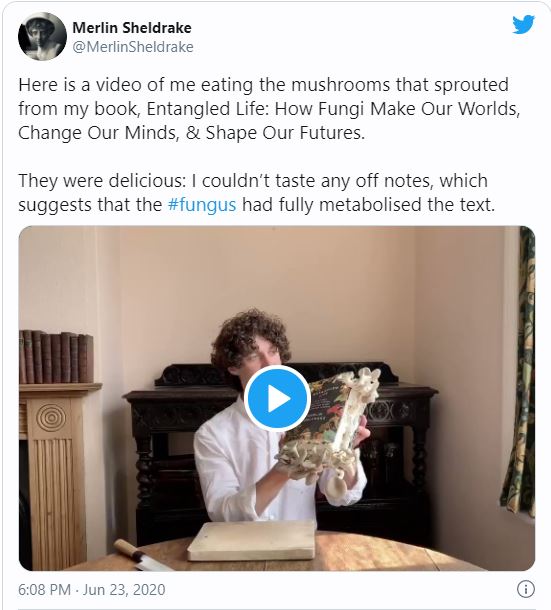
During the month I was reading this, I felt like I kept coming across references to fungi. (I even had a patch of ringworm!)

It’s a perspective-altering text, but one that requires solid concentration. I’ll confess that at times it went over my head and I wished for a glossary and diagrams. A greater than average interest in biology and/or botany would thus be a boon to a potential reader. But if you can keep up, the book will elicit many a cry of “wow!” and “what?!” I kept launching “did you know?” questions at my husband, especially about the zombie fungi that parasitize insects. What a strange and wonderful world.
Favorite lines: “Paying more attention to animals than plants contributes to humans’ plant-blindness. Paying more attention to plants than fungi makes us fungus-blind.”
My rating:
My thanks to Bodley Head for the free copy for review.
Islands of Mercy by Rose Tremain
 I read this back in June to prepare for writing a profile of Tremain for a forthcoming issue of Bookmarks magazine. Here’s the summary I wrote: “In Bath, England in 1865, 24-year-old nurse Jane Adeane is nicknamed ‘The Angel of the Baths’ for her healing touch. If she marries Dr. Valentine Ross, a colleague of her surgeon father, she can earn respectability – but will have to hide her love for Julietta, a married woman. Meanwhile, Dr. Ross’s brother, Edmund, a naturalist following in the footsteps of Alfred Russel Wallace, has journeyed to Borneo. Ill with malaria, he is taken in by British eccentric Sir Ralph Savage, a lover of native men and benevolent local rajah who funds infrastructure projects like a paved road and a hospital. Exiled or inwardly tortured for loving the wrong people, Tremain’s characters search for moments of wonder and comfort – whether those come in a primitive hut in the Malay Archipelago or in a cozy tearoom in Bath.”
It’s a slightly odd title, but tells you a lot about what Tremain is doing in this 14th novel. Often at the mercy of forces internal and external, her outcast characters look for places where they can find rest and refuge after a time of suffering. Will they, in turn, extend mercy? The split perspective and the focus on people who have to hide their sexuality are most similar to Sacred Country. The Victorian tip of the hat is mostly directed, I think, to George Eliot; of recent work, I was reminded of The Doll Factory and The Essex Serpent. I especially liked Jane’s painter aunt, Emmeline, and Clorinda, the Irish woman whose opening of a tearoom sets the plot going. The settings are surprising and vivid, and if Tremain doesn’t quite bring them and their story lines together seamlessly, she is still to be applauded for her ambition. This is probably my joint favorite of her novels that I’ve read so far, with The Road Home.
Favorite lines:
We must be unconventional in our joys and find them wherever we can.
life, so often so cruel in the way it thrust the human soul into prisons from which there seemed to be no escape, could sometimes place it athwart an open door.
My rating:
I read an advanced e-copy via NetGalley.
Between Light and Storm: How We Live with Other Species by Esther Woolfson
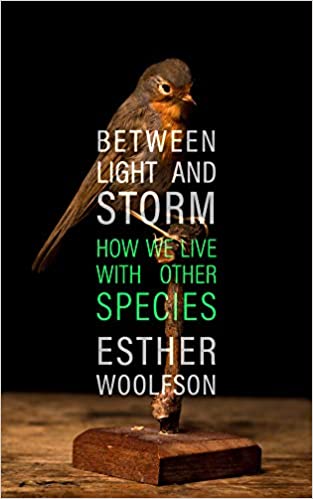 If you’ve read Woolfson’s Corvus, you’ve already met Chicken, an orphaned rook she raised. For over 31 years, Chicken was a constant presence in her home. The recently departed bird is the dedicatee of her new book, feted as “Colleague, companion, friend.” (No mere pet.) Relationships with these creatures with whom she shared her life led her to think differently about how we as humans conceive of the animal world in general. “If I had ever believed humans to be the only ones to live profound and interconnected lives, I couldn’t any more. … If we’re the gods now, shouldn’t we be better than we are?” From her introduction, it’s clear that her sympathy toward the more-than-human world extends even to spiders, and her language throughout – using words like “who” and “his” in reference to animals, rather than “that” or “its” – reinforces the view that all species are equally valuable.
Or, at least, should be. But our attitudes are fundamentally distorted, Woolfson believes, and have been since the days of Aristotle (whose Ladder of Nature is an origin of the ideas that nature is there for man to use) and the Old Testament writers (one of the two creation accounts in Genesis established the idea of “dominion”). From cave paintings to animal sacrifice, intensive farming to fur coats, taxidermy to whaling, she surveys what others have thought and said about how animals are, or should be, perceived. There was more of an academic tone to this book than I expected, and in early chapters I found too much overlap with other works I’ve read about deep time (Time Song, Surfacing, Underland again!).
I most appreciated the fragments of nature writing and memoir and would have liked more in the way of personal reflection. Woolfson’s perspective – as a Jewish woman in Scotland – is quite interesting. She is clearly troubled by how humans exploit animals, but mostly recounts others’ reasoning rather than coming to conclusions of her own. (Though there is a brilliant takedown of the gender politics of Watership Down.) It’s a book that demands more time and attention than I was able to give just now. As I only skimmed it, I’m going to refrain from assigning a rating and will pass this on to my husband and return to it one day. [I do wish the title, on its own (subtitle aside), was more indicative of the contents.]
My thanks to Granta for the free copy for review.
 Bookish Beck = Rebecca Foster. American transplant to England. Freelance proofreader and book reviewer.
 Bookish Beck